Digital competencies among the greying population: a scoping review
Abstract
Trends in emerging technologies, generative artificial intelligence and the use of ChatGPT and other AI tools necessitated certain skills for successful use. However, individuals, including greying, older adults find themselves at the periphery of the technological revolution. Their predicaments are caused by personal fears, unwillingness to use technologies, declining health conditions, disinterest, inability to transfer skills, competencies, and lack of knowledge and skills to use technologies. All these contribute to a gap referred to as the grey digital divide - a term referred to struggles older adults encounter in their digital technologies use. This inhibits access to vital information. Enhancing digital competence can support older adults to apply digital skills and knowledge in practical situations, which, in turn, can improve technology use and inclusiveness in the present technological era. This study used a scoping review where peer-reviewed articles were selected from databases. The literature revealed the need to build digital competencies among the greying population through sustainable digital literacy training, transferable skills, design of easy-to-use technologies suitable for older people with both cognitive and physical decline as well as policy for their digital inclusion.
digital competence; grey digital divide; digital exclusion, inclusion; grey population
1 Introduction
Trends in emerging technologies such as generative artificial intelligence (AI) and use of other AI technologies in present-day society have necessitated certain requirements, skills and competencies to actively participate and enjoy its benefits (Souza & Debs 2023). Without these, individuals may find themselves digitally excluded. Affected populaces of society, known as the greying population (older adults), are left out of the technological revolution due to certain traits like personal fears, declining health conditions, unwillingness to use technologies, disinterest, inability to transfer skills, lack of competencies, absence of knowledge and skills in the use of technologies (Golenko et al. 2020). This has led to a gap referred to the grey digital divide - a term referred to as the struggles the grey population encounter when using digital technologies (Alexopoulou, Astrom & Karlsson 2022).
As a result of the grey digital divide, the global health crisis is further worsened among the greying population due to the digital exclusion and isolation they experience (Ma, Fang & Guo 2023: 2). Particularly in terms of health information, the many older people lack basic digital literacies, competency and skills required to access necessary information. For example, during the COVID-19 pandemic, most of the greying population experienced mental anguish, suffering, hardship and depression first from the enforced isolation, which was subsequently made worse by their inability to use technologies worldwide for their everyday activities. Many could not connect or communicate with families and the outside world, leading to mental decline as well as deaths.
In this regard, conscious efforts must be made to support the greying population with technology competencies and adoption (Van Jaarsveld 2020:4; Sillat, Tammets & Laanpere 2021). Enhancing digital competence can support older adults to apply digital skills and knowledge in practical situations, which, in turn, can improve technology use and inclusiveness in the present technological era. There is no one-size-fits-all approach in teaching the greying population digital skills. It is important to know their social circle to use their influence to motivate them to learn new skills (Pihlainen et al. 2023:116).
2 Background
The grey digital divide can be termed as inequality in terms of access, the internet and other digital technologies usage, digital skills and opportunities that older adults face. This includes everyday challenges they face with life activities, which lead to exclusion and isolation from society (Wang, Zhang & Zhao 2023; Alexopoulou et al. 2022:277). These challenges could be attributed to declining health and ageing, socioeconomic factors, personal factors, lack of exposure to new technologies and benefits, and incompetence in use of technologies (Mubarak & Suomi 2022; Nguyen, Mosadeghi & Almario 2017:52; Morrison, Nicholson, Wood & Briggs 2023:10; Francis, Ball, Kadylak & Cotton 2019:36; Morris & Brading 2007). Ageing causes difficulties in performing daily tasks because of deterioration in motor and sensory systems causing decreased mobility and functional ability such as memory retention (Yap, Tan, Tan, & Choon 2022; Charness & Boot 2022:255), and difficulty in handling digital technologies. The declining physical and cognitive abilities of older adult people, coupled with a general absence of digital technology skills, discourage them from using technologies and make them view technologies differently from the way young adults do (Leburu, Grobler, & Bohman 2018:177; Steyn, Roos & Botha 2018:204; Freeman et al. 2022:287). Personal factors like fear, anxiety and apprehension about internet usage can create a barrier and prevent the greying population from using the digital technologies (Wang et al. 2023). This is attributed to a lack of necessary skills and competence in the use of technology. Individuals going through aging and cognitive decline and having no exposure to digital technologies tend to feel they are too old to learn or start using them (Vercruyssen et al. 2023:2). Their inability to access or use technologies in this age leads to social inequality (Scheerder, Van Deursen & Van Dijk 2017:1608), which Kerbo (2003:11) describes as a condition in which people have unequal access to valued resources or services in the society.
Inequality in terms of access and use of the internet and digital technologies still exists among older adults, as those who have never been exposed to technologies growing up, find it difficult to learn its use because of decline in intellectual capabilities that sometimes comes with ageing (Huxhold, Hees & Webster 2020:272). Their passiveness when it comes to the use of digital technologies leaves them marginalised in the digital dispensation, hence excluded. Digital exclusion, as noted by Rose, Holgersson and Soderstrom (2021:1) and Robinson et al. (2015), refers to the lack of access and skills to use digital technologies and having limited access to the internet and digital equipment. Ideally, exclusion encourages online connection, but for the greying population, the lack of skills, digital literacy and confidence makes it more challenging to use technology effectively. The implication of digital exclusion is unequal access to digital welfare services in the population (Alexopoulou et al. 2022:274). "Older adults are particularly at risk of internet-related social exclusion, since they tend to use the Internet less than younger adults" (Seberini, Nour & Tokovska 2022: 99).
On the other hand, "digital inclusion signifies the terms on which individuals and groups participate in digital aspects of society" (Bellini 2018:84). Digital inclusion for people of all ages is encouraged to promote equality (Lameijer, Mueller & Hage 2017:2). Schirmer, Geerts, Vercruyssen and Glorieux (2022:2-6) opine that for the greying population to be digitally included, there is a need to make them see how their lifeworld fit into the digital world; only then can they embrace and accept digital learning, access to skills, competence and use digital technologies. This position is supported by Bergstrom and Edstrom (2022:199), who note that older adults could benefit from digital content and services but are hampered from engaging with these due to a lack of access, skills and motivation to use them. Access and use of information and communication technologies are necessities for digital inclusion (Alexopoulou et al. 2022:281), but it is not enough to bridge the grey digital divide.
To bridge the grey digital gap, there is the need to equip older adults with necessary skills and competencies to use digital technologies (Ma et al. 2023,2). Competencies in the use of technologies can lead to improvement in technology usage by the greying population (Jimenez et al. 2020:2). Digital competence deals with a combination of knowledge and attitudes, which enable people to apply digital knowledge in practical situations (Helsper 2021), and in the use of technologies, with the intend to improve digital use (Jimenez 2020:2). However, motivation to learn or acquire digital skills in the greying population depends on their everyday activities and social environment (Pihlainen 2023:102). A case study carried out in Finland and Germany showed that most of the greying population take part in digital skills acquisition to be independent (Pihlainen et al. 2023: 108-109). Although, for the majority, one of the key obstacles for older adults to the utilisation of the internet has been identified as their lack of digital literacy (Broady, Chan & Caputi 2010).
3 Purpose and aim of the study
The purpose of this scoping review was to gauge the coverage of recent peer-reviewed articles that give a clear indication of the struggles of older adults using digital technologies as well as the level of their skills and competence with technologies. The central question is how competent are the greying population (older adults of 60+) in using digital technologies?
Over the past five years, there has been an abundance of published research on the grey digital divide, digital competence and skills in older adults. This study explored how many studies have been conducted between 2015 and 2023 on the grey digital divide or digital literacy, competence or skills in older adults? To what extent did these studies include or inform the older adult age range? Or, at what point does the struggle with the use of digital technologies become visible?
4 Research design
This section presents the methodology used for this study
4.1
Method: Scoping reviewA scoping review or study is a technique used to map out relevant literature in the field of interest, as noted by Arksey and O'Malley (2005:20). Thus, this present study employed a scoping review methodology to evaluate and present research evidence on the grey digital divide or digital divide in greying.
4.2
The search strategyPeer-reviewed articles reporting on the grey digital divide and the digital divide in older adults in English published between 2015 and 2023, were considered if they met the following criteria: (1) the context of the discussion is on the grey digital divide, (2) digital competence in older adults and (3) the discussion includes digital literacy and skills in older adults.
The databases include for this study were SAGE, PubMed, Google Scholar, Scopus and Web of Science and were studied during July 2024. The search strategy used keywords representing the two main concepts of digital divide and information ethics. Websites were searched using the local search function and a combination of the keywords "grey digital divide" AND "digital divide in older adults" OR "digital literacy in older adults"; "digital skills in older adults" OR "digital competences in older adults" as systematically as possible within the capabilities of each website. When the search returned many results (i.e., more than two pages of results), the first 20 items at a minimum were screened for relevance and recorded until a decline of relevance was observed. A log of the search strategies and results were kept in an Excel spreadsheet.
4.3
Eligibility criteriaThe inclusion and exclusion criteria used in the literature search for the scoping review was based on research focus, types of formats, published works, electronic and language of publication and peer-review. The main studies covered older adults (depending on studies 60+, 70+ or more).
Inclusion criteria considered studies in connection with the concept of digital divide in older adults, grey digital divide, digital inclusion/exclusion, digital skills, digital literacy or competencies in older adults, older people, elderly or seniors in the titles, abstracts or keywords. Only studies in English were considered.
Exclusion criteria included studies involving grey literature, abstracts only documents, preprints, book reviews, eBooks, textbooks, intergenerational studies, young children, older adults below 60 years involving digital competences and digital skills. Furthermore, studies not involving humans, but images and systems and in languages other than English were excluded.
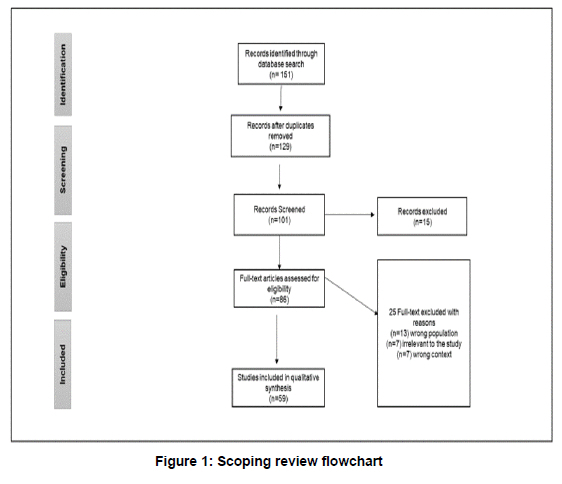
The flowchart in Figure 1 explains the scoping review and reporting process.
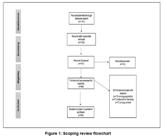
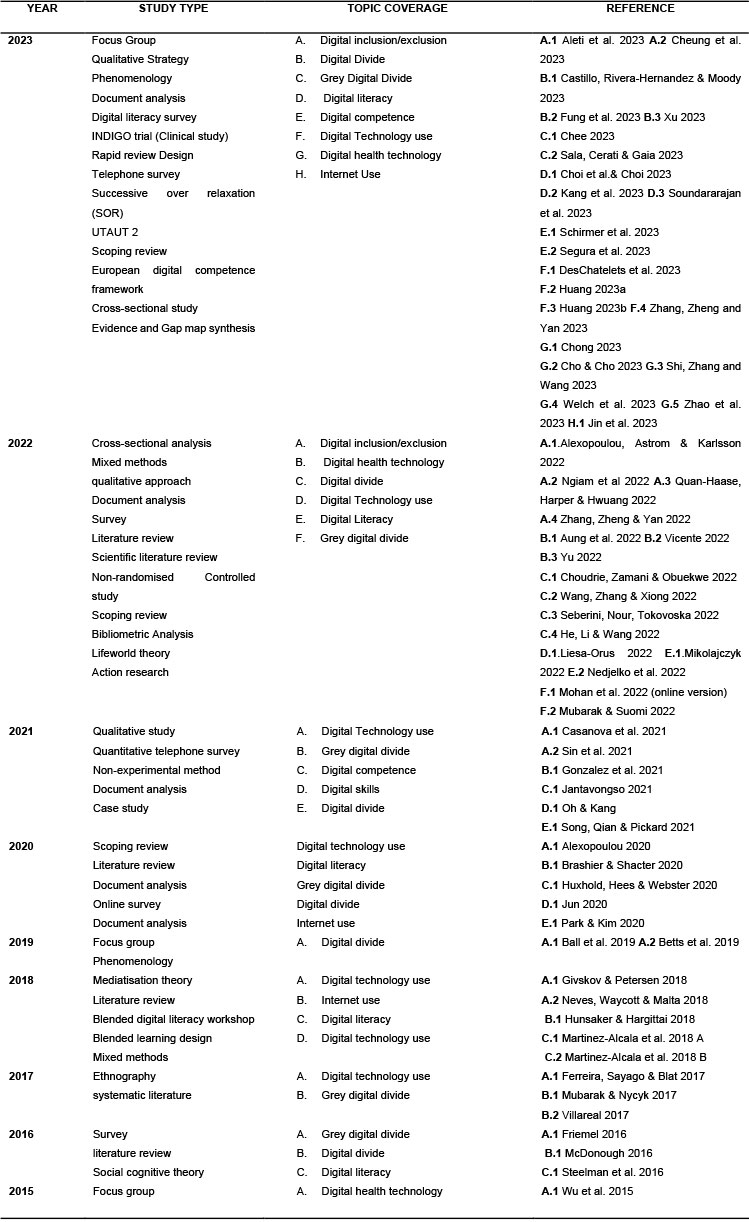
Using the searching decision of the first 20 items on the database at a minimum, the first search from Google Scholar, SAGE, Scopus and Web of Science yielded 151 documents. The screening was done manually without the use of a machine learning classifier. After duplicates were removed, 129 articles were identified and read, after which 15 had to be excluded, as they did not meet the criteria. Eighty-six full-text articles were then screened and carefully checked by the authors. Twenty-six articles were found not to be relevant to the study, 13 were targeted at the wrong population, some of the articles' populations were from 45+ and 55+, which did not correlate with the age target of the present study, which 60+. Seven articles were not within the context of the study, even though they focused on older adults, but were not within the context of the use of digital technologies and six were irrelevant to the study. Fifty-nine articles were identified as appropriate and included in the present study. Data collected included year, study type, coverage and reference.
5 Knowledge synthesis of results
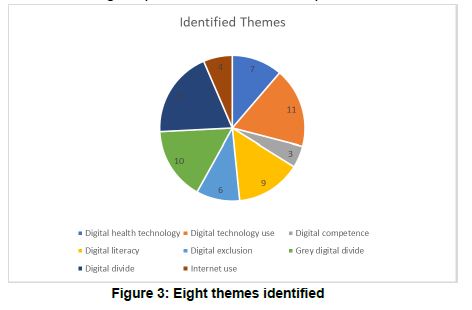
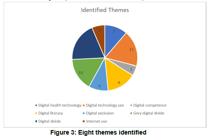
The data extracted from selected studies were tabulated and summarised into eight themes, as determined by the researchers.
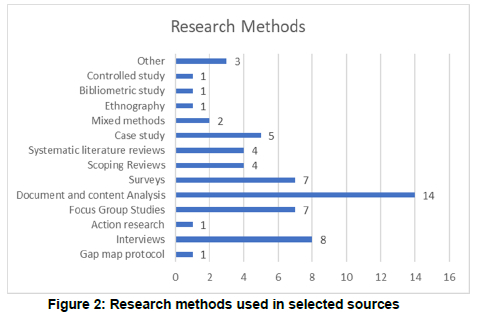
5.1 Research methods used selected sources
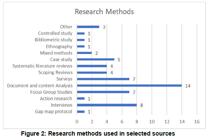
In Figure 2, the methods used in the selected and screened studies are listed.
6 Findings
The selected studies all allude to the phenomenon of the declined use of technology and the internet of older people's use of technology. There is overwhelming evidence that older generations are excluded from being able to afford technology innovations. This global trend is reported in studies ranging from healthcare to marketing. Essentially, this leads to a group of people, mostly those over 60, who are excluded from important aspects of society. Variant factors such as country of origin, socio-political and socioeconomic factors may impact trends.
6.1 Themes identified
The study presented eight themes, describing temporal research done and published. The themes are shown in Figure 3.
7 Discussion of findings
A deeper exploration into the themes covered by the eligible sources provided an understanding of the extent and nature of the problems experienced by the older population in using new technologies:
7.1
Digital health and health information technologyNine articles addressed aspects of digital health among the greying population. Studies (Zhao et al.; Aung et al. 2022; Cho & Cho 2023; Chong 2023; Welch et al. 2023) emphasise the importance of health information technology (HIT) such as wearable devices to manage health issues in the elderly, and literature stresses the importance of the improvement of digital capabilities among the ageing generations. Wu et al. (2015) mention attitude and lack of awareness as factors impacting the use of gerontechnology adoption and assistive technology are often stigmatised. As an interdisciplinary field of study, gerontechnology combines researching ageing populations and technology to enhance the quality of life for these populations. It focuses on developing and implementing technologies that can support the health, well-being and independence of elderly people. Gerontechnology aims to address the challenges associated with ageing, such as mobility, cognitive decline, social isolation and healthcare management.
7.2
Digital technology useStudies (Huang 2023a; Huang 2023b; Zhang et al. 2023; Liesa-Orus 2022; Casanova et al. 2021 ; Sin et al. 2021 ; Neves et al. 2018; Alexopoulou 2020; Givskov & Petersen 2018) indicate that the greying population shows a decline in technological use in areas ranging from business applications to marketing of mobile technologies. Huang (2023 attributes this behaviour to experiences of anxiety, trust, performance expectancy, expectation of the effort it will take, and even social influence as reasons for the decline in technological use.
7.3
Digital literacy, digital competence, and digital fluencyVercruyssen et al. (2023) posit that digital literacy is the only gateway to survive in the present era to avoid exclusion. It enables the understanding of the behavioural practices that take place in the digital space. Schirmer et al. (2023) define digital competence as the ability to engage with digital technology confidently and responsibly towards better security and general well-being.
7.4
Digital divide and the grey digital divideAs an overarching theme, the grey digital divide is defined by Chee (2023) as the various inequalities and divisions among individuals aged 60 years and older, which include differences in health outcomes, access to resources and social experiences. Brashier and Schacter (2020) remind that the expected cognitive decline in older generations' technology use is often overestimated as a reason for the digital divide. They suggest that even younger generations in the USA struggle with ethical issues such as identifying fake news (Brashier & Schacter 2020).
7.5 Digital technology usage trends and behaviour
Schirmer et al. (2023) share that technological innovation has many advantages for society, such as better connectivity and information access. These authors profess that it has advantages for users with limited mobility such as the ageing generations. Vercruyssen et al. (2023) posit that it may be that the most basic usage of digital technology is important to grasp for older adults with no or limited prior experience in using these applications. This may influence trust and confidence.
7.6 Internet use
In the developed world, the uptake of the older generations of using the internet is surprisingly low. Schirmer et al. (2023) report that only 37% of the population in Germany older than 65 make use of the internet on a regular basis. Hunsaker and Hargittai (2018) found that there is a correlation between the greying population's use of the internet and their health, pointing to a need to reconsider how health searches are accommodated. This was confirmed by the Korean study of Park and Kim (2020), who found that older adults with diabetes need better digital competencies to manage their health.
The lack of digital competency is underpinned as a major concern among ageing individuals in many countries and studies. More so, in countries where these skills are required for managing health issues and accessing vital information. Fear and a lack of trust impede the effective use of available technologies among this group.
8 Conclusion
The aim of the scoping review was to ascertain the coverage of peer-reviewed articles between 2015 and 2023 that addressed issues faced by older adults in the use of digital technologies. Fifty-nine articles reporting on the level of skills and competence in using technologies were selected. In answering the central question on the competency of the greying populations in using digital technologies, eight themes were identified in the selected sources.
Many studies advocate for a more interdisciplinary approach to researching the concerns around digital inclusion of greying populations. Though that is a viable way forward, Jantavongso (2021) reminds that while promoting digital literacy is the core of the multidisciplinary and interdisciplinary domains, little research has been conducted on practical and instructional approaches for endorsing digital literacy in older adults. Schirmer et al. (2023) opine that there is a lack of training and upskilling possibilities for retired populations, as they now fall outside of the structures of formal education. Casanova (2021) explains that underutilisation of technology is mainly related to privacy and security concerns.
The inclusion of the greying population holds benefits at many levels, most importantly, healthcare and the viability of the digital economy. Yet, research (see Jantavongso 2023) alludes to a gap in research in terms of the digital competencies of the greying population on a global scale. They state that much is being done to determine the barriers of using technology. More research needs to be done around obtaining digital competencies and literacies. There is a danger of stereotyping older generations, which may lead to undue prejudice, as this will further lead to divide and exclusion. There is an overall call for further scientific research to develop empirical, reliable findings for the sustainable, long-term implementation of support programmes for older and greying generations.
9 Recommendations
A deliberate attempt to design and develop training programmes pitched at the right level of the needs of the greying population, as well as ensuring affordable access to training opportunities must be brought about. A good example of this is the work of Martinez (2018) in Spain where the Instituto de Ciecias de la salud (ICSa) instituted digital literacy workshops for adults over 60 years of age. While this study indicated that much research is being done in developed countries, the need remains for further research in developing countries. This need is reaffirmed by Choudrie, Zamani and Obuekwe (2022). Over and above the need to continue research on the greying population, more research is needed to inform particularly the use of technology in managing health issues. Interdisciplinary and intergovernmental research must result in programmes and initiatives to address and minimise the grey digital divide.
References
- Refs Aleti, T., Figueiredo, B., Martin, D.M. and Reid, M. 2023. Digital inclusion in later life: Older adults' socialisation processes in learning and using technology. Australasian Marketing Journal, 0(0). https://doi.org/10.1177/14413582231187652
- Alexopoulou, S. 2020. The portrait of older people as (non)users of digital technologies: A scoping literature review and a typology of digital older (non) users. Gerontechnology, 19(3): 1-15 https://doi.org/10.4017/gt.2020.19.003.11
- Alexopoulou, S. Astrom, J. and Karlsson, M. 2022. The grey digital divide and welfare state regimes: A comparative study of European countries. Information Technology & People, 35(8): 273-291. https://doi.org/10.1108/itp-11-2020-0803
- Arksey, H. and O'Malley, L. 2005 Scoping studies: Towards a methodological framework. International Journal of Social Research Methodology, 8(1): 19-32 https://doi.org/10.1080/1364557032000119616
- Aung, M.N., Koyanagi, Y., Nagamine, Y., Nam, E.W., Mulati, N., Kyaw, M.Y., Moolphate, S., Shirayama, Y., Nonaka, K., Field, M. et al. 2022. Digitally inclusive, healthy aging communities (DIHAC): A cross-cultural study in Japan, Republic of Korea, Singapore, and Thailand. International Journal in Environmental Research and Public Health, 19: 6976. https://doi.org/10.3390/ijerph19126976Ball
- Bellini, C.G.P. 2018. The ABCs of effectiveness in the digital society. Communications of the ACM, 61(7): 84-91.
- Bergstrom, A. and Edstrom, M. 2022. Invisible or powerful? Ageing in a mediatised society. In: Falk, H., Erhag, U., Lagerlof Nilsson, T., Rydberg Sterner, I. and Skoog (Eds.), A multidisciplinary approach to capability in age and ageing, 3131. Springer: Cham, 191-205.
- Betts, L.R., Hill, R. and Gardner, S.E. 2019. There's not enough knowledge out there: examining older adults' perceptions of digital technology use and digital inclusion classes. Journal of Applied Gerontology, 38(8): 1147-1166. https://doi.org/10.1177/0733464817737621
- Brashier, N.M. and Schacter, D.L. 2020. Aging in an era of fake news. Current Directions in Psychological Science, 29(3): 316-323. https://doi.org/10.1177/0963721420915872
- Broady, T., Chan, A. and Caputi, P. 2010. Comparison of older and younger adults' attitudes towards and abilities with computers: Implications for training and learning. British Journal of Educational Technology, 41: 473-485.
- Casanova, G., Abbondanza, S., Rolandi, E., Vaccaro, R., Pettinato, L., Colombo, M. and Guaita, A. 2021. New older users' attitudes toward social networking sites and loneliness: The case of the oldest-old residents in a small Italian city. Social media + Society, 7(4). https://doi.org/10.1177/20563051211052905
- Castillo, A., Rivera-Hernandez, M. and Moody, K.A. 2023. A digital divide in the COVID-19 pandemic: Information exchange among older Medicare beneficiaries and stakeholders during the COVID-19 pandemic. BioMed Central Geriatric, 23(23). https://doi.org/10.1186/s12877-022-03674-4
- Charness, N. and Boot, W.R. 2022. A grand challenge for psychology: Reducing the age-related digital divide. Current Directions in Psychological Science, 31(2): 187-193.
- Chee, S.Y. 2024. Age-related digital disparities, functional limitations, and social isolation: Unravelling the grey digital divide between baby boomers and the silent generation in senior living facilities. Aging & Mental Health, 28(4): 621-632. https://doi.org/10.1080/13607863.2023.2233454
- Cheung, K., Chau, A.K.C., Woo, J. and Lai, E.T.C. 2023. The age-based digital divide in an increasingly digital world: A focus group investigation during the COVID-19 pandemic. Archives of Gerontology and Geriatrics, 115: 105225. https://doi.org/https://doi.org/10.1016/j.archger.2023.105225
- Cho, O.-H. and Cho, J. 2023. Changed digital technology perceptions and influencing factors among older adults during the COVID-19 Pandemic. Healthcare, 11(15): 2146. https://doi.org/10.3390/healthcare11152146
- Choi, J., Choi, S., Song, K., Baek, J., Kim, H., Choi, M., Kim, Y., Chu, S.H. and Shin, J. 2023. Everyday digital literacy questionnaire for older adults: Instrument development and validation study. Journal of Medical Internet Research, 25. https://www.jmir.org/2023/1/e51616/
- Chong, T.W.H., Curran, E., Southam, J., Bryant, C., Cox, K.L., Ellis, K.A., Anstey, K.J., Goh, A. and Lautenschlager, N.T. 2023. The potential of physical activity and technology interventions to reduce anxiety in older adults. Journal of Affective Disorders Reports, 14: 100633. https://doi.org/https://doi.org/10.1016/j.jadr.2023.100633
- Choudrie, J., Zamani, E. and Obuekwe, C. 2022. Bridging the digital divide in ethnic minority older adults: an organisational qualitative study. Information Systems Frontiers, 24: 1355-1375 https://doi.org/10.1007/s10796-021-10126-8
- DesChatelets, J.R., Khowaja, A.R., Mechelse, K., Koning, H. and Ventresca, D. 2023. Exploring the access and use of social technologies by older adults in support of their mental health during the covid-19 pandemic: A rapid review. Canadian Journal on Aging / La Revue Canadienne du Vieillissement, 42(4): 728-743. https://doi.org/10.1017/S0714980823000259
-
Ferreira, S.M., Sayago, S. and Blat, J. 2017. Older people's production and appropriation of digital videos: An ethnographic study. Behaviour & Information Technology, 36(6): 557-574, DOI: 10.1080/0144929X.2016.1265150
» https://doi.org/10.1080/0144929X.2016.1265150 - Francis, J., Ball, C., Kadylak, T. and Cotten, S.R. 2019. Aging in the digital age: Conceptualizing technology adoption and digital inequalities. In B.B. Neves and F. Vetere (Eds.), Ageing and digital technology: Designing and evaluating emerging technologies for older adults (pp. 35-49). Springer. http://dx.doi.org/10.1007/978-981-13-3693-5_3
- Freeman, S., Marston, H.R., Ross, C., Morgan, D.J., Wilson, G., Gates, J., Kolochuk, S. and McAloney, R. 2022. Progress towards enhanced access and use of technology during the COVID-19 pandemic: A need to be mindful of the continued digital divide for many rural and northern communities. Healthcare Management Forum, 35(5): 286290. https://doi.org/10.1177/08404704221108314
- Friemel, T.N. 2016. The digital divide has grown old: Determinants of a digital divide among seniors. New Media & Society, 18(2): 313-331. https://doi.org/10.1177/1461444814538648
- Fung, K.-k., Hung, S.S.-l., Lai, D.W.L., Shum, M.H.Y., Fung, H.-w. and He, L. 2023. Access to information and communication technology, digital skills, and perceived well-being among older adults in Hong Kong. International Journal of Environmental Research in Public Health, 20: 6208. https://doi.org/10.3390/ijerph20136208
- Givskov, C. and Petersen, L.N. 2018. Media and the ageing body: Introduction to the special issue. European Journal of Cultural Studies, 21(3): 281-289. https://doi.org/10.1177/1367549417708438
- Gonzalez, D.A., Maceiras, S.A., Catalan, C.D and Rodriguez, I.S. 2021. Types of older adults ICT users and the grey divide: attitudes matter. Revista De Cercetare Si Interventie Sociala, 74. https://oa.upm.es/68616/1/INVE_MEM_2021_339750.pdf.pdf
- He, Y., Li, K. and Wang, Y. 2022. Crossing the digital divide: The impact of the digital economy on elderly individuals' consumption upgrade in China. Technology in Society, 71: 102141. https://doi.org/https://doi.org/10.1016/j.techsoc.2022.102141
- Helsper, E. 2021. The digital disconnects: The social causes and consequences of digital inequalities. London: Sage.
- Huang, T. 2023a. Using SOR framework to explore the driving factors of older adults' smartphone use behaviour. Humanities and Social Sciences Communications, 10(1): 1-16 https://www.nature.com/articles/s41599-023-02221-9.pdf
- Huang, T. 2023b. Expanding the UTAUT2 framework to determine the drivers of mobile shopping behaviour among older adults. PLoS ONE, 18(12): e0295581. https://doi.org/10.1371/journal.pone.0295581
- Hunsaker, A. and Hargittai, E. 2018. A review of Internet use among older adults. New Media & Society, 20(10): 3937-3954. https://doi.org/10.1177/1461444818787348
- Huxhold, O, Hees, E. and Webster, N.J. 2020. Towards bridging the grey digital divide: Changes in internet access and its predictors from 2002 to 2014 in Germany. European Journal of Ageing, 17: 271-280
- Jantavongso, S. 2021. Toward global digital literate citizens: A case of Thailand's aging generation. The Electronic Journal of Information Systems in Developing Countries, 88(2): e12207. https://doi.org/10.1002/isd2.12207
- Jimenez, G., Spinazze, P., Matchar, D., Huat, G.K.C., Van der Kleij, R.M.J.J., Chavannes, N.H. and Car, J. 2020. Digital health competencies for primary healthcare professionals: A scoping review. International Journal of Medical Informatics, 143: 104260. https://doi.org/10.1016/j.ijmedinf.2020.104260
- Jin, L., Zhang, Z. and Jing, F. 2023. The impact of internet use in the digital age on the subjective well-being of older adults - an empirical study based on CGSS2021 data. Heliyon, 9(11): e21528. https://doi.org/https://doi.org/10.1016/j.heliyon.2023.e21528
- Jun, W. 2020. A study on the current status and improvement of the digital divide among older people in Korea. International Journal of Environmental Research and Public Health, 17(11): 3917. https://doi.org/10.3390/ijerph17113917
-
Kang, H., Baek, J., Chu S.H. and Choi J. 2023. Digital literacy among Korean older adults: a scoping review of quantitative studies. Digital Health, 29(9):20552076231197334. https//Doi: 10.1177/20552076231197334
» https://doi.org/10.1177/20552076231197334 - Kerbo, H. R. (2003). Social stratification and inequality: Class conflict in historical, comparative, and global perspective (p. 11). McGraw-Hill.
- Lameijer, C.S., Mueller, B. and Hage, E. 2017. Towards rethinking the digital divide - recognizing shades of grey in older adults' digital inclusion. ICIS 2017 Proceedings, 11. http://aisel.aisnet.org/icis2017/General/Presentations/11
- Leburu, K, Grobler, H. and Bohman, D. 2018. Older people's competence to use mobile phones: An exploratory study in a South African context. Gerontechnology, 17(3): 174-180. http://dx.doi.org/10.4017/gt.2018.17.3.005.00
- Liesa-Orús, M., Latorre-Cosculluela, C., Sierra-Sánchez, V. et al. 2023. Links between ease of use, perceived usefulness and attitudes towards technology in older people in university: A structural equation modelling approach. Education and Information Technologies, 28: 2419-2436 https://doi.org/10.1007/s10639-022-11292
- McDonough, C. 2016. The effect of ageism on the digital divide among older adults. Journal of Gerontology & Geriatric Medicine. https://heraldopenaccess.us/openaccess/the-effect-of-ageism-on-the-digital-divide-among-older-adults#a1
- Ma, J. Fang, G. and Guo, K. 2023. Bridging the digital divide: The influence of digital feedback on the digital capabilities of the rural elderly. Information Development, 1- 14 DOI: 10.1177/02666669231222208
- Martínez-Alcala, C.I., Rosales-Lagarde, A., Alonso-Lavernia, M.A., Ramírez-Salvador, J.A., Jiménez-Rodríguez, B., Cepeda-Rebollar, R.M., Lopez-Noguerola, J.S., Bautista-Díaz, M.L. and Agis-Juárez, R.A. 2018. Digital inclusion in older adults: a comparison between face-to-face and blended digital literacy workshops. Frontiers in ICT, 5: 21. Doi: 10.3389/fict.2018.00021
- Martinez-Alcala, C.I., Cepeda-Rebollar, R.M., Ramirez-Salavador, J.A., Rosales-Lagarde, A., Jimenez-Rodriguez, B. and Lopez-Noguerola, J.S. 2018. Blended learning supported on a learning management system an intervention for digital literacy for older adults. 13th Iberian Conference on Information Systems and Technologies (CISTI), Caceres, Spain, 1-6. Doi: 10.23919/CISTI.2018.8399253
- Mikołajczyk, B. 2023. Universal human rights instruments and digital literacy of older persons. The International Journal of Human Rights, 27: 3. https://doi.org/10.1080/13642987.2022.2131772
- Mohan, G. and Lyons, S. 2024. High-speed broadband availability, Internet activity among older people, quality of life and loneliness. New Media & Society, 26(5): 2889-2913. https://doi.org/10.1177/14614448221095218
-
Morris, A. and Brading, H. 200. E-literacy and the grey digital divide: a review with recommendations. Journal of Information Literacy, 1(3): 13-28.
» https://doi.org/10.1017/S0144686X21000416 - Morrison, B.A., Nicholson, J., Wood, B. and Briggs, P. 2023. Life after lockdown: The experiences of older adults in a contactless digital world. Frontiers in Psychology, 13: 1100521. Doi: 10.3389/fpsyg.2022.1100521
- Mubarak, F. and Nycyk, M. 2017. Teaching older people internet skills to minimize grey digital divides: developed and developing countries in focus. Journal of Information, Communication and Ethics in Society, 15(2): 165-178. https://doi.org/10.1108/JICES-06-2016-0022
- Nedeljko, A.M., Bogataj, P.D.D., Perović, A.P.D.B.T. and Kaučič, A.P.D.B.M. 2022. Digital literacy during the coronavirus pandemic in older adults: Literature Review and Research Agenda. IFAC-Papers Online, 55(39): 153-158. https://doi.org/https://doi.org/10.1016/j.ifacol.2022.12.027
- Neves, B.B., Waycott, J. and Malta, S. 2018. Old and afraid of new communication technologies? Reconceptualising and con testing the 'age-based digital divide. Journal of Sociology, 54(2): 236-248.
- Quan-Haase, A., Harper, G.M. and Hwuang, A. 2022. Digital media use and social inclusion: A case study of East York older adults. In P. Tsatsou (Ed.), Digital inclusion, vulnerability and associated complexities. Palgrave Macmillan
-
Robinson, L., Cotten, S.R., Ono, H., Quan-Haase, A., Mesch, G., Chen, W. et al. (2015). Digital inequalities and why they matter. Information, Communication & Society, 18: 569-582. Doi: 10.1080/1369118X.2015.1012532
» https://doi.org/10.1080/1369118X.2015.1012532 - Rogerson, S. 2022. Grey digital outcasts and COVID-19. First Monday, 27(4). https://doi.org/10.5210/fm.v27i4.12587
-
Rose, J. Holgersson, J. and Soderstrom. E. 2020. Digital inclusion competencies for senior citizens: The survival basics. 19th International Conference on Electronic Government (EGOV), Aug 2020, Linköping, Sweden, 151-163,ff10.1007/978-3-030-57599-1_12ff. ffhal-03282775f
» https://doi.org/10.1002/cl2.1369 - Scheerder, A., Van Deursen, A. and Van Dijk, J. 2017. Determinants of internet skills, uses and outcomes. A systematic review of the second- and third-level digital divide. Telematics and Informatics, 34(8): 1607-1624.
-
Schirmer, W., Geerts, N., Vercruyssen, A. and Glorieux, I. 2022. Digital ageing consortium. Digital skills training for older people: The importance of the 'lifeworld'. Archives of Gerontology and Geriatrics. https://www.sciencedirect.com/science/article/pii/S0167494322000760
» https://doi.org/10.1057/s41292-022-00290-8 - Schirmer, M., Dalko, K., Stoevesandt, D., Paulicke, D. and Jahn, P. 2023. Educational concepts of digital competence development for older adults-a scoping review. International Journal of Environmental Research and Public Health. 20: 6269. https://doi.org/10.3390/ijerph20136269
- Seberini, A., Nour, M.M. and Tokovska, M. 2022. From digital divide to technostress during the covid-19 pandemic: A scoping review. Sciendo, 55(2): 98-111. https://intapi.sciendo.com/pdf/10.2478/orga-2022-0007
- Segura, R.I., Garrido, Y.C., Morueta, R.T. and Rodríguez-Miranda, F.P. 2023. Adapting digital competence 2.1 from the DigCom Model in the context of active ageing. In 2023 XIII International Conference on Virtual Campus (JICV,) 1-4. IEEE.
- Shi, S., Zhang, L. and Wang, G. 2023. Bridging the digital divide: internet use of older people from the perspective of peer effects. Sustainability 2023, 15: 12024. https://doi.org/10.3390/su151512024
- Sillat, L.H., Tammets, K. and Laanpere, M. 2021. Digital competence assessment methods in higher education: A systematic literature review. Education Sciences, 11: 402. https://doi.org/10.3390/educsci11080402
- Sin, F., Berger, S., Kim, I.-J. and Yoon, D. 2021. Digital social interaction in older adults during the COVID-19 pandemic. Proceedings. ACM Human and Computer Interaction 5, CSCW2, Article 380 (October 2021), 20 pages. https://doi.org/10.1145/3479524
- Song, Y., Qian, C. and Pickard, S. 2021. Age-related digital divide during the COVID-19 pandemic in China. International Journal of Environmental Research and Public Health, 18: 11285. https://doi.org/10.3390/ijerph182111285
- Soundararajan, A., Lim, J.X., Ngiam, N.H.W., Tey, AJ-Y., Tang, A.K.W, Lim, H. A. et al. 2023. Smartphone ownership, digital literacy, and the mediating role of social connectedness and loneliness in improving the wellbeing of community-dwelling older adults of low socio-economic status in Singapore. PLoS ONE, 18(8): e0290557. https://doi.org/10.1371/journal.pone.0290557
- Souza, A.S.C.D. and Debs, L. 2023. Identifying emerging technologies and skills required for construction 4.0. Buildings, 13(10): 2535. https://doi.org/10.3390/buildings13102535
- Steelman, K.S., Tislar, K.L., Ureel, L.C. and Wallace, C. 2016. Breaking digital barriers: A social-cognitive approach to improving digital literacy in older adults. In: Stephanidis, C. (eds), HCI International 2016 - Posters' Extended Abstracts. HCI 2016. Communications in Computer and Information Science, 617. Springer, Cham. https://doi.org/10.1007/978-3-319-40548-3_74
- Steyn, S. Roos, V. and Botha, K.H.F. 2018. Cell phone usage relational regulation strategies of older South Africans. Journal of Psychology in Africa, 28(3): 201-205. https://doi.org/10.1080/14330237.2018.1475911
-
Van Jaarsveld, G.M. 2020 The effects of COVID-19 among the elderly population: A case for closing the digital divide. Front Psychiatry, 12(11): 577427. Doi: 10.3389/fpsyt.2020.577427. PMID: 33304283; PMCID: PMC7693633
» https://doi.org/10.3389/fpsyt.2020.577427 -
Vercruyssen A., Schirmer, W., Geerts, N. and Mortelmans, D. 2023. How "basic" is basic digital literacy for older adults? Insights from digital skills instructors. Frontier in Education, 8: 1231701. Doi: 10.3389/feduc.2023.1231701
» https://doi.org/10.3389/feduc.2023.1231701 - Villareal, M.G. 2017. The grey digital divide and the right to be forgotten: An inter-American approach. Asia Pacific Journal of Health Law & Ethics, 11(1): 83-104.
- Wang, W., Zhang, Y. and Zhao, J. 2023. Technological or social? Influencing factors and mechanisms of the psychological digital divide in rural Chinese elderly. Technology in Society, 74: 102307. https://doi.org/10.1016/j.techsoc.2023.102307
- Wang, T., Zhang, M. and Xiong, T. 2022. A bibliometric analysis of the digital divide among the elderly. 2022 8th International Conference on Information Management (ICIM), Cambridge, United Kingdom, 1-5. Doi: 10.1109/ICIM56520.2022.00007.
-
Wu, Y.H., Damnée, S., Kerhervé, H., Ware, C. and Rigaud, A.S. 2015. Bridging the digital divide in older adults: A study from an initiative to inform older adults about new technologies. Clinical Interventions in Aging, 10: 193-200. doi: 10.2147/CIA.S72399. PMID: 25624752; PMCID: PMC4296914
» https://doi.org/10.2147/CIA.S72399 - Xu, Y. 2023. Digital divide and social integration of rural elderly people: A grounded theory analysis. Transactions on Economics, Business and Management Research, 1: 256-267.
- Yap, Y.-Y., Tan, S.-H., Tan, S.-K. and Choon, S.-W. 2022. Integrating the capability approach and technology acceptance model to explain the elderly's use intention of online grocery shopping. Telematics and Informatics, 72(2022): 101842. https://doi.org/10.1016/j.tele.2022.101842
- Zhang, Y. Zheng, G. and Yan, H. 2022. Bridging information and communication technology and older adults by social network: action research in Sichuan, China. Journal of the Association for Information Science and Technology, 74(12): 1437-1448. https://doi.org/10.1002/asi.24700
- Zhao, Y., Zhang, T., Dasgupta, R.K. and Xia, R. 2023. Narrowing the age-based digital divide: developing digital capability through social activities. Information Systems Journal, 33(2): 268-298. https://doi.org/10.1111/isj.12400
Accepted: 3 February 2025