Evaluating Business Model Innovation Approaches: A Criteria-based Analysis and Foundation for Future Research
Abstract
Business model innovation (BMI) approaches are critical for maintaining a competitive advantage, yet assessment methods are limited. This foundational study identifies eight criteria to assess BMI approaches. The research uses a hybrid comparative analysis, assessing four prominent approaches using a multi-criteria decision analysis framework, anchored in quantitative content analysis, as an input to the analytical hierarchy process, combined with qualitative validation. The findings indicate that, while current approaches achieve theoretical saturation in value creation, they exhibit critical deficits in financial feasibility and temporal efficiency, revealing a significant gap between design capability and execution readiness. The analysis provides a pathway for academics and industry practitioners seeking to optimise business models.
Abstract
Besigheidsmodelinnovasie-benaderings (BMI-benaderings) is krities vir die handhawing van 'n mededingende voordeel, maar assesseringsmetodes is beperk. Hierdie grondliggende studie identifiseer agt kriteria om BMI-benaderings te evalueer. Die navorsing maak gebruik van 'n hibriede vergelykende analise wat vier prominente benaderings assesseer met behulp van 'n multikriteria-besluitnemingsanalise raamwerk (MCDA-raamwerk), geanker in kwantitatiewe inhoudsanalise as 'n inset vir die analitiese hiërargieproses (AHP), en gekombineer met kwalitatiewe validasie. Die bevindinge dui daarop dat, hoewel huidige benaderings teoretiese versadiging in waardeskepping bereik, hulle kritieke tekortkominge in finansiële uitvoerbaarheid en tydsdoeltreffendheid toon, wat 'n beduidende gaping tussen ontwerpvermoë en uitvoeringsgereedheid blootlê. Die analise bied 'n riglyn vir akademici en bedryfspraktisyns wat poog om besigheidsmodelle te optimaliseer
1. INTRODUCTION
Business model innovation (BMI) has emerged as a critical driver of competitive advantage in today's dynamic business environment. Unlike traditional product or process innovation, BMI involves rethinking how an organisation creates, delivers, and captures value [1]. As companies strive to adapt to rapidly changing market demands, technological advancements, and sustainability pressures, the ability to design, implement, and evaluate innovative business models has become essential [2]. However, despite its significance, there remains limited consensus on the criteria that are most effective in guiding and evaluating BMI efforts [3].
A comprehensive assessment of BMI approaches is crucial for understanding their strengths, weaknesses, and applicability in a range of industries. The five-phase BMI process, 4I-framework, Cambridge BMI process, and generic BMI process were selected for this study, based on their widespread adoption in industrial engineering practice and their high citation impact in the scholarly literature ([4], [5], [6], [7]); each offers a unique perspective on the innovation process.
The study developed a structured assessment framework that assessed these four BMI approaches using a set of eight criteria. These criteria were not only identified but also weighted for strategic importance through a systematic literature review that was based on recurrence and theoretical triangulation. Based on the findings of the assessment, the study identified strategic opportunities where current BMI approaches have shortcomings and where emerging technologies, such as artificial intelligence (AI), could be leveraged to resolve the revealed deficits.
This research makes a theoretical contribution through systematic comparative analysis, a critical precursor to empirical validation [8]. The theoretical framework that organises and evaluates existing knowledge provides an essential foundation for subsequent empirical research. This study establishes the evaluative infrastructure necessary for future empirical testing of BMI approaches. Consequently, this research is guided by two primary questions: (1) What are the critical criteria for evaluating the effectiveness of BMI approaches? and (2) How do prominent BMI approaches perform when evaluated against these criteria?
2. THEORETICAL BACKGROUND: BUSINESS MODEL INNOVATION
A business model describes the rationale of how an organisation creates, delivers, and captures value, serving as a blueprint that defines the logic of the firm [6]. BMI is a critical strategy for businesses that seek to maintain competitiveness in rapidly changing markets. It involves rethinking and redesigning an organisation's business model to create new value propositions, improve customer relationships, and enhance operational efficiency [3]. The key outcome of BMI is to create and redefine business models that can adapt to changing market conditions, leverage emerging technologies, and deliver superior value to customers. The BMI process is not only about strategic planning but also involves the practical implementation of these models into daily operations and enterprise architecture [9]. This integration is crucial for organisations to leverage the potential of BMI in respect of performance improvements and competitive advantage.
2.1. Triggers and phased adoption
The triggers for BMI can be either opportunity-driven or threat-driven. Opportunity-driven triggers include emerging technologies, changing customer preferences, and new market opportunities, while threat-driven triggers involve competitive pressures, regulatory changes, and market saturation [10]. The rise of advanced technologies such as artificial intelligence (AI), blockchain, and the Internet of Things (IoT) has compelled organisations to innovate their business models to remain competitive [11].
Both opportunity- and threat-driven triggers encourage organisations to innovate their business models by executing core BMI phases. BMI begins with strategic experimentation, where companies and organisations explore new business model components and architectures. This involves understanding the broader industry and economic context to align the business model with market demands and customer expectations [12], [13].
Second, successful innovation of business models requires translating strategic decisions into operational models. This involves aligning business models with enterprise architectures and integrating them into an organisation's daily operations, which is essential for achieving performance improvements [14]. Engaging customers and stakeholders is the crucial third and final phase in the BMI process. Their feedback and involvement can drive innovation and ensure that the business model aligns with market needs, sustainability goals, and customer expectations [15], [16].
2.2. Implementation strategies and expected outcomes
Several BMI implementation strategies exist; all centre on the goal of innovating business models. The first strategy is to adopt either incremental or disruptive changes. Companies can adopt either incremental changes to refine existing models or pursue disruptive innovations to create entirely new business models. The choice depends on organisational goals and market conditions and expectations [17]. Implementing BMI often involves adopting new technologies to support business processes and enhance information exchange. An additional strategy for BMI implementation focuses on leveraging technology. This technological integration is vital for modernising operations and improving efficiency [14]. A third strategy is to focus on sustainability. Many organisations are now focusing on sustainable business models. This involves innovating to address environmental and social challenges, which can also open new market opportunities and enhance brand reputation [16].
By innovating their business models, organisations can differentiate themselves from their competitors, offering unique value propositions that are difficult to replicate and superior customer experiences [12], [13]. To illustrate, platform-based business models and data-driven innovations have allowed companies such as Airbnb and Uber to disrupt traditional industries [18]. Innovative business models contribute to sustainable growth and increase their performance by accessing and opening new markets, improving operational efficiency, and enhancing customer loyalty [5]. The scholarly literature indicates that organisations that successfully implement BMI achieve higher performance and resilience in dynamic environments [19]. BMI equips organisations to navigate uncertainties and disruptions, especially technological shifts, by enabling them to adapt quickly and to explore new opportunities [20]. For instance, businesses that adopted digital transformation during the COVID-19 pandemic were better positioned not only to survive but also to thrive [21].
2.3. Business model innovation approaches
Four selected BMI approaches represent a diverse spectrum of methodologies for understanding and implementing business model innovation. These are the 4I-framework for BMI [4], the Cambridge BMI process [5], the five-phase BMI process [6], and the generic BMI process [7].
The 4I-framework for BMI, formulated by [4], offers a systematic, iterative approach to managing the complexity of BMI. This framework consists of four key phases: (1) initiation, (2) ideation, (3) integration, and (4) implementation. Each phase addresses specific problems and activities required for successful BMI. The 4I-framework's iterative and flexible nature allows firms to navigate the complexities of BMI effectively, aligning innovation efforts with market demands. The framework provides a comprehensive tool for developing, refining, and executing innovative business models [4].
The Cambridge BMI process (CBMIP) is a comprehensive approach designed to guide organisations through BMI, with an emphasis on sustainability. The approach, developed by [5], comprises eight phases that are both sequential and iterative: (1) ideation, (2) concept design, (3) virtual prototyping, (4) experimenting, (5) detail design, (6) piloting, (7) launch, and (8) adjustment and diversification. The iterative nature of the CBMIP ensures adaptability, allowing organisations to revisit earlier stages as necessary. This structure enhances resilience, making it a valuable tool for firms pursuing sustainable innovation [5].
The five-phase BMI process, by [6], is widely recognised as one of the foundational approaches for BMI. It offers a systematic and structured approach to guide organisations through the creation, implementation, and management of innovative business models. The approach comprises five distinct phases: (1) mobilise, (2) understand, (3) design, (4) implement, and (5) manage. These phases offer a thorough roadmap for managing the intricacies of BMI while fostering adaptability and creativity. The five-phase BMI process has become a cornerstone of BMI approaches, enabling organisations to adapt and thrive in dynamic environments [6].
The generic BMI process, as presented by [7], offers a systematic approach to managing business model innovation. This approach has seven key phases: (1) analysis, (2) ideation, (3) feasibility, (4) prototyping, (5) decision-making, (6) implementation, and (7) sustainability. These phases guide organisations through a systematic method for creating, evaluating, and enhancing innovative business models while ensuring adaptability to varying organisational contexts. The generic BMI process aims to overcome problems in the fragmented BMI literature, and provides a roadmap for systematically managing innovation [7]. Its comprehensive yet adaptable design makes it suitable for diverse organisational needs.
3. RESEARCH METHODOLOGY
As organisations increasingly turn to BMI to navigate complex and dynamic environments, the need for a systematic assessment of different BMI approaches becomes paramount. A structured methodology to assess the effectiveness and applicability of selected BMI approaches is proposed. The methodology is executed in two phases: first, a literature review to derive and weight the assessment criteria (Sections 3.4, 3.5, and 3.6), and second, a comparative analysis using a quantitative-qualitative scoring protocol to evaluate framework performance (Section 3.7). Given the variety of approaches, the study introduces eight carefully selected criteria drawn from the scholarly literature to ensure a comprehensive analysis. This assessment framework serves as a critical tool for understanding how different approaches perform in practice.
3.1. Literature review methodology
The literature review conducted used a hybrid approach that strategically combined elements of both scoping (exploratory and breadth-focused) and systematic (rigorous and quality-assessed) reviews. This choice aligns with contemporary guidance that suggests that scoping reviews can serve as "helpful precursors to systematic reviews and can be used to confirm the relevance of inclusion criteria and potential questions" [22]. The initial scoping phase involved an exploratory search to identify prominent BMI approaches and recurrent themes in business model assessment. The second systematic phase involved a structured selection process to condense broad themes into the final assessment criteria. Electronic databases, including Scopus, Web of Science, and Google Scholar were searched using Boolean search strings combining terms such as "Business Model Innovation" AND ("Evaluation" OR "Assessment" OR "Criteria" OR "Framework" OR "Success Factors"). Triangulation was applied, ensuring that a criterion was included only if cited as critical by multiple, independent, high-impact sources [23]. In addition, each criterion's relevance to assessment was evaluated to ensure that the literature explicitly linked the concept to business model performance or success. Furthermore, this phase served as the data collection step for the weighting model, establishing the theoretical frequency of each criterion (Section 3.6.1) to inform the analytical hierarchy process (AHP) in Section 3.6.2.
3.2. Comparative analysis methodology
Following the literature review, a comparative analysis was selected as the primary research methodology. Comparative analysis is a fundamental methodological tool in industrial engineering that is used to evaluate distinct artefacts or processes against a standardised set of requirements. This definition aligns with the literature, which describes comparative evaluation (analysis) in industrial engineering as a systematic process in which methods are assessed against selected criteria to determine their 'suitability' [24]. This methodology relies on a 'comparison matrix' and a 'weighted procedure' to establish a reference point for selection. Accordingly, this study operationalises comparative analysis through multi-criteria decision analysis (MCDA) [25] and gap analysis. The four selected BMI approaches were treated as distinct cases and systematically evaluated within a weighted scoring matrix, populated by the validated criteria.
3.3. Comparative analysis process
To evaluate systematically the four selected BMI approaches against eight distinct criteria, a structured and transparent procedure was developed. The following five-step approach ensured that the assessment was comprehensive, replicable, and grounded in both quantitative evidence and qualitative validation:
1. Define measurable indicators (Section 3.5): The assessment process begins by decomposing the broad criteria into tangible, observable indicators. These serve as a checklist to ensure consistent assessment in different frameworks.
2. Establish criteria weights (Section 3.6): To determine objectively the relative importance of each criterion, weights are derived using a quantitative content analysis of the literature, combined with the AHP.
3. Execute hybrid scoring (Section 3.7): A dual-method scoring protocol is applied. First, automated keyword density is calculated to measure theoretical coverage. Second, a qualitative validation is performed to assess operational capability. These are combined to form a final hybrid performance score.
4. Synthesise performance data (Section 4.1 and 4.2): The results of the scoring process are compiled into detailed data tables. These include the raw density metrics, qualitative justification matrices, and the final hybrid scores. This step highlights the absolute performance strengths and weaknesses of each approach, independent of their strategic weight.
5. Visualise and analyse strategic gaps (Section 4.3): A weighted gap analysis is performed by applying the AHP weights to the performance deficits. This strategic diagnosis is visualised in a heatmap to highlight critical discipline-related weaknesses immediately where high-importance criteria exhibit low performance.
Evaluating these approaches against the eight validated assessment criteria established in Section 3.4 provided a robust basis for analysis, ensuring that key theoretical and practical dimensions were not only addressed but also were grounded in triangulated scholarly evidence. With four approaches and eight criteria, this study involved 32 evaluating instances, allowing for an in-depth comparison using diverse methodologies. This number struck a balance between thoroughness and manageability, offering rich insights into the strengths and weaknesses of each approach while ensuring that the assessment remained systematic and focused.
3.4. Assessment criteria
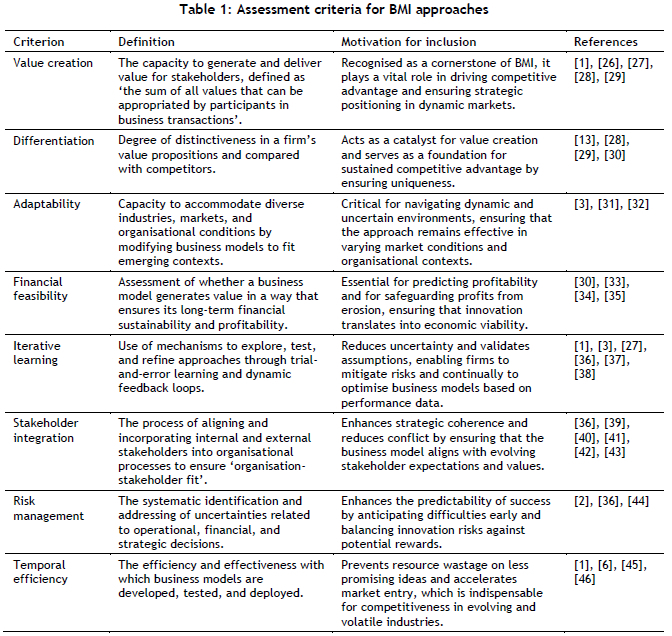
Based on the systematic review detailed in Section 3.1 above, eight recurring criteria were identified as essential for assessing the effectiveness of BMI approaches. Each criterion captured a unique dimension of business model success. Theoretical triangulation was applied, confirming that every selected criterion was supported by multiple, independent, high-impact scholarly sources. Table 1 below defines these criteria, outlines the motivation for each criterion's inclusion, and lists the triangulated academic references that grounded the assessment framework. By using this set of criteria, the study aimed systematically to reveal the strengths, weaknesses, and potential gaps in prominent BMI approaches.
3.5. Criteria indicators
To ensure a comprehensive assessment of the selected BMI approaches, each criterion was decomposed into tangible, observable indicators. The measurable indicators served as a checklist to justify the scoring allocation:
a. Value creation: Presence of specific steps for defining customer value co-creation; explicit mechanisms for validating value propositions; evidence of value capture strategies.
b. Differentiation: Inclusion of tools for analysing competitor models; specific focus on creating 'inimitable' assets; concrete steps to verify 'uniqueness'.
c. Adaptability: Specific mechanism for pivot decisions; modularity in design to allow component swapping; steps on responding to external shocks.
d. Financial feasibility: Integration of cost structure analysis; presence of revenue-modelling tools; requirements for return-on-investment (ROI) or break-even analysis.
e. Iterative Learning: Explicit phases for prototyping; requirements for customer testing loops; steps for data-driven validation.
f. Stakeholder integration: Mapping of internal/external stakeholders; mechanisms for gathering and incorporating stakeholder feedback.
g. Risk management: Presence of a risk management framework; steps for identifying risks; mitigation strategies embedded in the BMI process.
h. Temporal efficiency: Clear guidelines on process duration; tools for rapid prototyping; presence of strategies to reduce bottlenecks.
3.6. Criteria weighting
Determining the relative importance of assessment criteria introduces subjectivity. To mitigate this, a hybrid weighting methodology was used that combined quantitative content analysis with the AHP.
3.6.1. Quantitative content analysis
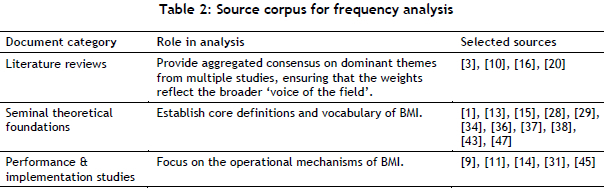
To derive objective inputs for the weighting model, this step was performed on a sample of 20 seminal documents. This sample size exceeded the threshold for theoretical saturation (12-20 sources) established by [54], ensuring the dataset represented a consensus of the BMI field. As detailed in Table 2, the sample was grouped into three categories to ensure a balanced representation of consensus (reviews), definition (theory), and operationalisation (performance).
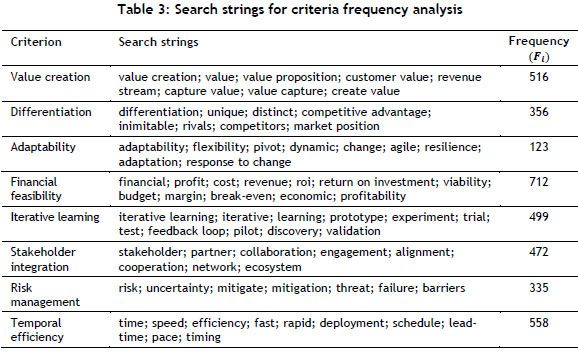
The total frequency of mentions (Fi) for each criterion served as a proxy for its theoretical prominence. To ensure that frequency counts captured the full theoretical scope of each criterion, a robust set of synonyms and related terms was defined. Table 3 details the specific search strings used in the Python (v3.10) content analysis algorithm, after the PyPDF2 library had been used to extract raw text from the source PDF corpus, as well as the recorded frequency (Fi) for each criterion. The Re library was used to account for lower- and upper-case variations and to remove special characters.
3.6.2. The analytical hierarchy process
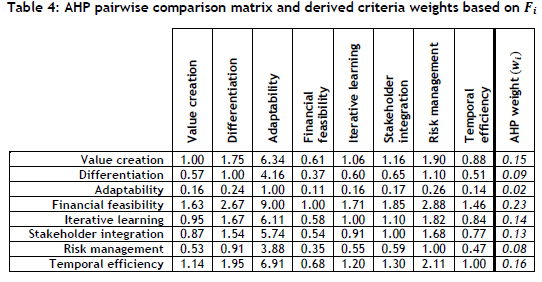
Traditional AHP - as a subset of multi-criteria decision analysis (MCDA), in which all criteria are important, but some hold greater significance [25] - relies on subjective expert judgement to populate the pairwise comparison matrix. In this study, these judgements were mathematically derived from the frequency data to ensure reproducibility. A frequency ratio (Rij) was calculated for every pair of criteria:

These ratios were mapped to Saaty's 1-9 fundamental scale using the min-max normalisation formula derived from [48] to determine the pairwise comparison matrix input (aij):

where Rmax represents the maximum observed ratio in the dataset. This transformation ensured that the criterion with the highest theoretical prominence received a rating of 9 (extreme importance) relative to the lowest, with all other relationships scaled proportionally. The final criteria weights were calculated by normalising the pairwise comparison matrix and computing the arithmetic mean of each row (the eigenvector method), as defined by [49]:

Table 4 presents the comprehensive AHP weighting model, displaying both the pairwise comparison matrix and the calculated AHP weight (wi) for each criterion. To validate the logical consistency of the derived weights, the consistency ratio  was calculated, where CI is the consistency index
 and RI is the random index for n = 8 criteria (RI = 1.41). The calculated CR was 0.0008, well below the threshold of 0.010, confirming the mathematical validity of the weighting model.
3.7. Scoring of business model innovation approaches
To evaluate the performance of the selected BMI approaches against the assessment criteria, another quantitative content analysis was used. This method derives performance metrics directly from the foundational texts of each approach [4], [5], [6], [7]. To ensure both objectivity and contextual accuracy, a hybrid scoring protocol was developed, combining automated text mining with qualitative validation.
3.7.1. Automated keyword density
In the first stage, the same Python-based algorithm as in Section 3.6.1 was used to calculate the raw frequency of criterion-specific keywords in the foundational texts of each approach. To control for document length bias (e.g., comparing book-length treatments with journal articles), raw frequencies were converted into keyword density (D):

where Fij is the frequency of criterion i in approach j, and Wj is the total word count of approach document j. This metric represents the depth of theoretical coverage per 1000 words. To facilitate comparative analysis, the density scores were normalised to a standard 0-1 scale using the min-max normalisation technique described by [48]. This transformation rescaled the data, based on the minimum and maximum density values observed in each BMI approach, rather than throughout the entire dataset. This method ensured that the scoring reflected the relative internal priorities of each framework, independent of the document's total length or verbosity compared with others:

where Dij is the keyword density for criterion i in approach j, and min (Dj) and max (Dj) are the minimum and maximum density values observed for all criteria in approach j. This process assigned a score of 1.00 to the most emphasised criterion within a specific framework, and 0.00 to the least emphasised, allowing for a standardised comparison of how each approach allocated its theoretical focus.
3.7.2. Qualitative validation
While keyword density provides an objective measure of theoretical coverage, it may overlook implicit process steps or tools that do not rely on specific terminology. To ensure accuracy, the automated scores (Sauto) were supplemented by a manual qualitative assessment (Sman). Each approach was evaluated against the observable indicators defined in Section 3.5, using a refined five-point rubric to capture nuance as follows: 1.0 (explicit) - presence of dedicated tools or process phases addressing the criterion; 0.75 (strongly implied) - concept is a core theme but specific tools may be generalised; 0.5 (partial) - mentioned or implied in the text but lacks specific instrumental support; 0.25 (weak/minor) - concept is mentioned only as a peripheral note without integration; 0.0 (absent) - no evidence of the criterion in the process workflow.
3.7.3. Hybrid scoring
The final performance score (Sfinal) for each criterion was calculated as the arithmetic mean of the automated and manual components. This hybrid method combines the objectivity of computational analysis with the contextual nuance of expert review, ensuring a comprehensive assessment of each approach's capabilities:

3.8. Gap analysis
To identify discipline-related weaknesses, the study used a weighted deficit model. This analysis quantified the magnitude between an approach's actual performance and the theoretical benchmark (Gij), weighted by the strategic importance of each criterion:

where wi is the AHP weight of criterion i (derived in Section 3.6), Sfinal,ij is the final hybrid performance score of approach j for criterion i (0-1 scale), and 1.0 represents the theoretical ideal performance benchmark. This produces a value where 0.00 indicates perfect strategic alignment (no gap), and higher values indicate critical disconnects. A high gap score signifies an area where the discipline demands high performance (wi), but fails to deliver (Sfinal,ij).
4. RESULTS
The application of the comparative analysis methodology yielded a comprehensive dataset evaluating the performance of the four selected BMI approaches. This section presents the results of the scoring protocol, followed by a comparative analysis of performance capabilities and a strategic gap analysis weighted by criteria importance.
4.1. Scoring results
To ensure that the assessment was both objective and contextually accurate, scores were derived through the three-stage hybrid protocol defined in Section 3.7.
4.1.1. Automated density scoring
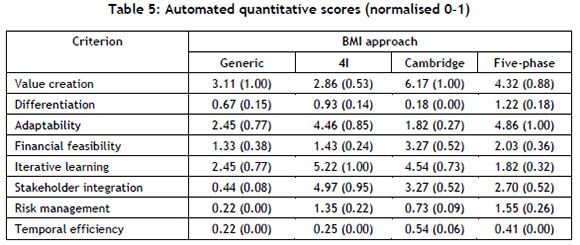
Table 5 presents the results of the automated quantitative content analysis outlined in Section 3.7.1. The values represent the 'theoretical depth' of each criterion in the foundational texts. The automated analysis revealed that criteria such as value creation, adaptability, and iterative learning exhibited high saturation in most frameworks, reflecting their centrality to BMI theory. However, the automated scoring also highlighted potential gaps: financial feasibility received low density scores in several texts, suggesting that, while these frameworks discuss value conceptually, they may lack specific terminology related to financial modelling (ROI, margins, break-even).
4.1.2. Qualitative validation
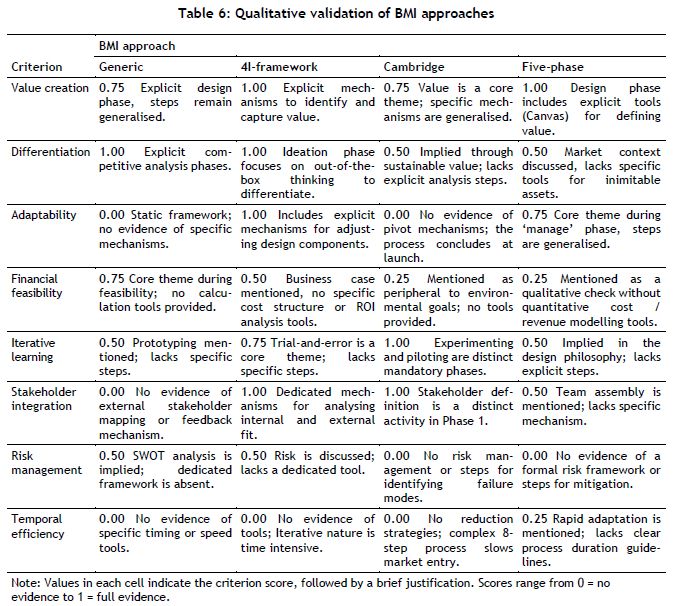
To address the limitations of text mining, a manual qualitative validation was performed as described in Section 3.7.2. Table 6 details the qualitative scores assigned to the BMI approaches, based on the observable indicators checklist in Section 3.5. The qualitative validation revealed distinct gaps between theoretical coverage and operational capability. The Cambridge BMI process had a high keyword density for 'financial feasibility' (Sauto = 0.52), and the manual review confirmed a lack of specific financial tools in the process workflow, necessitating a downward adjustment. The 4I-framework's focus on 'out-of-the box thinking' justified a perfect score for differentiation, even where specific keyword density varied. These adjustments ensure that the final scores reflected the utility of the approach, not just its vocabulary.
4.1.3. Final hybrid performance
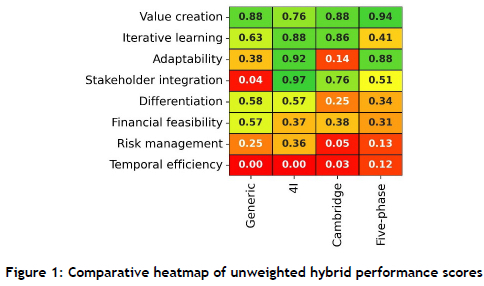
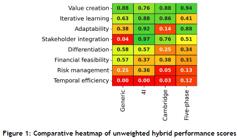
The final performance scores (Sfinal) for each criterion were calculated as the arithmetic mean of the automated (Sauto) and manual (Sman) assessments. These values served as the definitive inputs for the comparative analysis. The final unweighted hybrid scores are visualised directly in the performance heatmap presented in Figure 1 below.
4.2. Comparative performance analysis
Figure 1 illustrates the comparative performance of the four BMI approaches, based on the final hybrid scores (Sfinal). The heatmap is clustered to group visually regions of similar performance, highlighting distinct functional strengths and systemic weaknesses. The analysis reveals three distinct performance patterns:
4.2.1. Universal strengths
All four approaches demonstrated exceptional capability in value creation, with scores ranging from 0.76 (4I) to 0.94 (five-phase). This confirmed that the primary focus of current BMI methodology is the conceptualisation of the value proposition. Iterative learning proved a strong suit for most frameworks, particularly in the scores of 0.86 (Cambridge) and 0.88 (4I), indicating that trial-and-error learning is well ingrained in modern approaches.
4.2.2. Methodological divergence
Significant variation was observed in how frameworks handled external dynamics. Some approaches excelled in adaptability, with scores of 0.88 (five-phase) and 0.92 (4I), showing that these approaches provide clear mechanisms for pivoting; while others revealed more rigid designs, with scores of 0.14 (Cambridge) and 0.38 (generic), indicating the prioritisation of other areas ahead of dynamic adaption abilities. Stakeholder integration showed high scores of 0.76 (Cambridge) and 0.97 (4I), positioning these approaches as highly networked tools, and contrasting moderate and low scores of 0.51 (five-phase) and 0.04 (generic), revealing the internal-centric focus of these approaches.
4.2.3. Systemic weaknesses
Both differentiation and financial feasibility displayed low-moderate performances, with scores ranging from 0.25 to 0.58 and from 0.31 to 0.57 respectively for all approaches for these criteria. The analysis did, however, identify a universal lack of performance in execution constraints. Temporal efficiency revealed a discipline-related blind spot, with scores of 0.00 (generic, 4I), 0.03 (Cambridge) and 0.12 (five-phase), indicating that none of the evaluated approaches provide adequate tools for rapid prototyping or reducing time-to-market. Risk management was also consistently weak, with scores of 0.05 (Cambridge), 0.13 (five phase), 0.25 (generic) and 0.36 (4I). This suggests that, while these frameworks are effective at designing desirable models, they lack the rigour to mitigate operational risks before, during, and after launch.
4.3. Comparative gap analysis
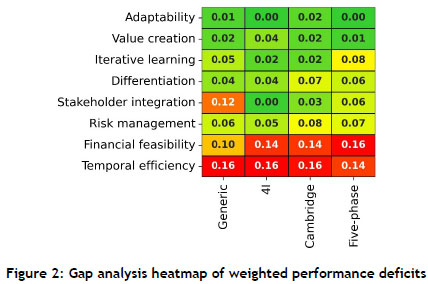
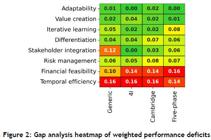
While the performance analysis (Figure 1) highlights functional capabilities, it does not account for the strategic importance of each criterion. To identify critical discipline-related weaknesses, a weighted gap analysis (as described in Section 3.8) was performed. Figure 2 visualises these deficits, calculated as the product of each criterion's AHP weight and the approach's performance shortfall (Gij). In this clustered heatmap, red (high values) indicates a critical failure in a high-priority area, while green (low values) indicates successful alignment with strategic requirements. The gap analysis reveals three tiers of discipline-related maturity.
4.3.1. Strategic alignment
Weighted deficits for adaptability and value creation are negligible, ranging from 0.00 to 0.02 and 0.01 to 0.04 respectively for all approaches. Irrespective of the weights of the two criteria (w1 = 0.15 and w3 = 0.02), the approaches deliver sufficient performance to close any gaps. This indicates discipline-related saturation: regardless of the specific framework chosen, practitioners could expect robust, alignment-focused support for designing adaptable value propositions.
4.3.2. Divergent or partial alignment
The middle tier reveals inconsistencies where specific frameworks fall short of strategic requirements. Iterative learning (w5 = 0.14) is generally well supported, with weighted deficits of 0.02 (4I, Cambridge) and 0.05 (generic). The five-phase process shows a moderate gap (0.08), suggesting a misalignment where the framework's mostly linear structure does not satisfy the high theoretical demand for cyclical validation. Both differentiation and risk management show consistent moderate deficits, with ranges of 0.04 to 0.07 and 0.05 to 0.08 respectively observed across all approaches. While the strategic weights for these two criteria are moderate (w2 = 0.09 and w7 = 0.08), the persistence of these gaps indicates that these concepts are frequently treated as descriptive themes rather than as operational steps that are supported by competitive analysis or risk mitigation tools. A sharp contrast in weighted deficits is evident for stakeholder integration. The weighted deficits of 0.00 (4I) and 0.03 (Cambridge) show that some frameworks successfully address this criterion, while others do so only moderately, with a deficit of 0.06 (five-phase). Despite the criterion's moderate weight (w6 = 0.13), a weighted deficit of 0.12 (generic) is still evident, identifying a specific risk for practitioners using this BMI process: while robust in design, it fails to meet the weighted importance of stakeholder co-creation.
4.3.3. Critical deficits
The most significant finding is the presence of universal, high-magnitude deficits in execution-oriented criteria. Temporal efficiency exhibits the highest weighted deficits for all approaches, with a range of 0.14 to 0.16. Despite having a moderately high theoretical weight (w8 = 0.16), the near-total absence of execution tools magnifies this into a critical strategic deficit. The discipline systematically lacks mechanisms for rapid deployment, creating a bottleneck for innovation in volatile markets. Similarly, all four approaches show significant gaps that range from 0.10 to 0.16 for financial feasibility. Given the high strategic priority of the criterion (w4 = 0.23), this represents a systemic execution blind spot. The analysis suggests that current BMI theory is effective at conceptualising value but critically deficient in providing the financial validation tools needed to ensure economic viability prior to launch.
5. DISCUSSION
The comparative analysis culminates in a distinct diagnosis of the field. The gap analysis demonstrates that the focus of BMI research must shift. The challenge is no longer design-oriented (value creation / adaptability), which is well-supported, but execution-related (temporal efficiency / financial feasibility), which remains critically underdeveloped relative to its importance. The disconnect between designing a model and operationalising it frames the discussions that follow on future enhancements, limitations, and theoretical implications.
5.1. Implications for future enhancements
To bridge the 'design-reality' gap, future research could explore the integration of AI as a transformative enhancer. Addressing the deficit in financial feasibility, AI-driven predictive analytics could replace qualitative 'sensing' with data-driven simulation of revenue streams under uncertainty, enabling continuous monitoring [50]. To resolve the failure in temporal efficiency, generative AI offers the potential to automate prototyping, accelerating development cycles without sacrificing thoroughness [51]. For approaches lacking stakeholder integration, such as the generic BMI process, natural language processing (NLP) could facilitate dynamic stakeholder sentiment analysis [52]. By automating the synthesis of market feedback, NLP would not only ensure continuous organisation-stakeholder fit, but would also directly address temporal inefficiencies by replacing manual analysis with rapid algorithmic processing [53].
5.2. Research limitations
In interpreting these findings, two methodological limitations are acknowledged. First, the quantitative content analysis relies on keyword density as a proxy for theoretical depth. While a robust synonym dictionary and manual qualitative analysis was used, this method may underrepresent approaches that use non-standard terminology to describe core concepts. Second, the AHP weights were derived from academic discourse. This assumes that the frequency of mentions equates to importance, reflecting the priorities of the scholarly community regarding the BMI field, which may not perfectly mirror the practical constraints of industry practitioners. Future research could validate these findings by conducting AHP surveys with industry experts.
5.3. Conclusion
This study advances BMI research by establishing the first systematic assessment framework grounded in a hybrid AHP-scoring protocol. By moving beyond subjective comparison to a mathematically grounded diagnosis, the research reveals critical performance gaps that challenge the current reliance on purely descriptive terminology, thus making a valuable theoretical contribution.
The results confirm that the discipline has achieved theoretical saturation in value creation but has shortcomings in execution-related criteria such as financial feasibility and temporal efficiency. The generic and Cambridge BMI processes are best suited to static environments that prioritise design thoroughness, whereas the 4I-framework and the five-phase process offer superior dynamic capabilities, with the 4I framework also extensively integrating stakeholders. Ultimately, the universal deficit in financial and temporal tools highlights an urgent need to transition BMI from a qualitative to a quantitative science, leveraging emerging technologies to operationalise the business model.
REFERENCES
-
[1] Chesbrough, H. 2010. Business model innovation: Opportunities and barriers. Long Range Planning, 43(2-3), pp. 354-363. [Online]. Available: https://doi.org/10.1016/j.lrp.2009.07.010
» https://doi.org/10.1016/j.lrp.2009.07.010 -
[2] Taran, Y., Boer, H. and Lindgren, P. 2013. Incorporating enterprise risk management in the business model innovation process. Journal of Business Models, 1(1). [Online]. Available: https://www.researchgate.net/publication/308792679
» https://www.researchgate.net/publication/308792679 -
[3] Ramdani, B., Binsaif, A. and Boukrami, E. 2019. Business model innovation: A review and research agenda. New England Journal of Entrepreneurship, 22(2), pp. 89-108. [Online]. Available: http://dx.doi.org/10.1108/NEJE-06-2019-0030
» http://dx.doi.org/10.1108/NEJE-06-2019-0030 -
[4] Frankenberger, K., Weiblen, T., Csik, M. and Gassmann, O. 2013. The 4I-framework of business model innovation: A structured view on process phases and challenges. International Journal of Product Development, 18(3-4), pp. 249-273. doi: https://doi.org/10.1504/IJPD.2013.055012
» https://doi.org/10.1504/IJPD.2013.055012 -
[5] Geissdoerfer, M., Savaget, P. and Evans, S. 2017. The Cambridge business model innovation process. Procedia Manufacturing, 8, pp. 262-269. [Online]. Available: https://doi.org/10.1016/j.promfg.2017.02.033
» https://doi.org/10.1016/j.promfg.2017.02.033 - [6] Osterwalder, A. and Pigneur, Y. 2010. Business model generation: A handbook for visionaries, game changers, and challengers. John Wiley & Sons.
-
[7] Wirtz, B. and Daiser, P. 2018. Business model innovation processes: A systematic literature review. Journal of Business Models, 6(1), pp. 40-58. [Online]. Available: https://doi.org/10.5278/ojs.jbm.v6i1.2397
» https://doi.org/10.5278/ojs.jbm.v6i1.2397 - [8] Whetten, D.A. 1989. What constitutes a theoretical contribution? Academy of Management Review, 14(4), pp. 490-495.
-
[9] Liu, A., Liu, H., Gu, J., Chen, M. and Jin, C. 2024. Business model implementation of new ventures: Linking TMT process antecedents, organizational culture, and firm performance. Entrepreneurship Theory and Practice, 48(3), pp. 826-855. [Online]. Available: http://dx.doi.org/10.1177/10422587231198428
» http://dx.doi.org/10.1177/10422587231198428 -
[10] Bashir, M., Naqshbandi, M. and Farooq, R. 2020. Business model innovation: A systematic review and future research directions. International Journal of Innovation Science, 12(4), pp. 457-476. doi: 10.1108/IJIS-06-2020-0081
» https://doi.org/10.1108/IJIS-06-2020-0081 -
[11] Adewumi, A., Ewim, S., Sam-Bulya, N. and Ajani, O. 2024. Strategic innovation in business models: Leveraging emerging technologies to gain a competitive advantage. International Journal of Management & Entrepreneurship Research, 6(10), pp. 3372-3398. [Online]. Available: http://dx.doi.org/10.51594/ijmer.v6i10.1639
» http://dx.doi.org/10.51594/ijmer.v6i10.1639 -
[12] Bereznoy, A. 2014. Business model innovation in competitive strategy of large corporations. Voprosy Ekonomiki, 9(9), pp. 65-81. [Online]. Available: doi: 10.32609/0042-8736-2014-9-65-81.
» https://doi.org/10.32609/0042-8736-2014-9-65-81 -
[13] Morris, L. 2009. Business model innovation the strategy of business breakthroughs. International Journal of Innovation Science, 1(4), pp. 191-204. [Online]. Available: http://dx.doi.org/10.1260/1757-2223.1.4.191
» http://dx.doi.org/10.1260/1757-2223.1.4.191 -
[14] Verhagen, M.P., De Reuver, G.A. and Bouwman, W.A.G.A. 2021. Implementing business models into operations: Impact of business model implementation on performance. IEEE Transactions on Engineering Management, 70(1), pp. 173-183. [Online]. Available: doi: 10.1109/TEM.2020.3046365
» https://doi.org/10.1109/TEM.2020.3046365 -
[15] Carayannis, E.G., Sindakis, S. and Walter, C. 2015. Business model innovation as lever of organizational sustainability. Journal of Technology Transfer, 40(1), pp. 85-104. [Online]. Available: doi: 10.1007/S10961-013-9330-Y
» https://doi.org/10.1007/S10961-013-9330-Y -
[16] Mignon, I. and Bankel, A. 2022. Sustainable business models and innovation strategies to realize them: A review of 87 empirical cases. Business Strategy and the Environment, 32(4), pp. 1357-1372. [Online]. Available: doi: 10.1002/bse.3192
» https://doi.org/10.1002/bse.3192 -
[17] Taran, Y., Boer, H. and Lindgren, P. 2015. A business model innovation typology. Decision Sciences, 46(2), pp. 301-331. [Online]. Available: doi: 10.1111/DECI.12128
» https://doi.org/10.1111/DECI.12128 -
[18] Šepel'ová, L., Calhoun, J.R. and Straffhauser-Linzatti, M. 2021. Sharing economy business models: Informational services innovation and disruption in Uber and Airbnb. Developments in Information & Knowledge Management for Business Applications, 2, pp. 521-540. [Online]. Available: http://dx.doi.org/10.1007/978-3-030-76632-0_18
» http://dx.doi.org/10.1007/978-3-030-76632-0_18 -
[19] Van Tonder, C., Bossink, B., Schachtebeck, C. and Nieuwenhuizen, C. 2024. The effect of digitally-driven business model innovation on business performance. Journal of Small Business & Entrepreneurship, 36(6), pp. 944-977. [Online]. Available: https://doi.org/10.1080/08276331.2023.2239039
» https://doi.org/10.1080/08276331.2023.2239039 -
[20] Foss, N.J. and Saebi, T. 2017. Fifteen years of research on business model innovation: How far have we come, and where should we go? Journal of Management, 43(1), pp. 200-227. [Online]. Available: http://dx.doi.org/10.1177/0149206316675927
» http://dx.doi.org/10.1177/0149206316675927 -
[21] Abidi, N., El Herradi, M. and Sakha, S. 2023. Digitalization and resilience during the COVID-19 pandemic. Telecommunications Policy, 47(4), 102522. [Online]. Available: https://ideas.repec.org/a/eee/telpol/v47y2023i4s0308596123000332.htm
» https://ideas.repec.org/a/eee/telpol/v47y2023i4s0308596123000332.htm -
[22] Munn, Z., Peters, M.D.J., Stern, C., Tufanaru, C., McArthur, A. and Aromataris, E. 2018. Systematic review or scoping review? Guidance for authors when choosing between a systematic or scoping review approach. BMC Medical Research Methodology, 18(1), 143. [Online]. Available: doi: 10.1186/s12874-018-0611-x
» https://doi.org/10.1186/s12874-018-0611-x -
[23] Noble, H. and Heale, R. 2019. Triangulation in research, with examples. Evidence-Based Nursing, 22(3), pp. 67-68. [Online]. Available: doi: 10.1136/ebnurs-2019-103145
» https://doi.org/10.1136/ebnurs-2019-103145 - [24] Ghimbaseanu, I. 2017. Methods and techniques used in industrial engineering to solve typical issues. International Journal of Circuits and Electronics, 2, pp. 37-42.
-
[25] Keeney, R.L. 1993. Decisions with multiple objectives: Preferences and value tradeoffs. Cambridge University Press. [Online]. Available: http://dx.doi.org/10.1109/TSMC.1979.4310245
» http://dx.doi.org/10.1109/TSMC.1979.4310245 -
[26] Amit, R. and Zott, C. 2012. Creating value through business model innovation. MIT Sloan Management Review, 53(3), pp. 41-49. [Online]. Available: https://www.researchgate.net/publication/279555624
» https://www.researchgate.net/publication/279555624 -
[27] Demil, B. and Lecocq, X. 2010. Business model evolution: In search of dynamic consistency. Long Range Planning, 43(2-3), pp. 227-246. [Online]. Available: https://doi.org/10.3917/mana.214.1213
» https://doi.org/10.3917/mana.214.1213 -
[28] Mahadevan, B. 2004. A framework for business model innovation. In IMRC Conference, Bangalore, pp. 16-18. [Online]. Available: https://www.researchgate.net/publication/228466168
» https://www.researchgate.net/publication/228466168 -
[29] Zott, C. and Amit, R. 2010. Business model design: An activity system perspective. Long Range Planning, 43(2-3), pp. 216-226. [Online]. Available: https://doi.org/10.1016/j.lrp.2009.07.004
» https://doi.org/10.1016/j.lrp.2009.07.004 - [30] Barney, J.B. and Hesterly, W.S. 2005. Strategic management and competitive advantage: Concepts. Pearson Education.
-
[31] Landau, C., Karna, A. and Sailer, M. 2016. Business model adaptation for emerging markets: A case study of a German automobile manufacturer in India. R&D Management, 46(3), pp. 480-503. [Online]. Available: http://dx.doi.org/10.1111/radm.12201
» http://dx.doi.org/10.1111/radm.12201 -
[32] Sharma, S., Dixit, M.R. and Karna, A. 2016. Design leaps: Business model adaptation in emerging economies. Journal of Asia Business Studies, 10(2), pp. 105-124. [Online]. Available: http://dx.doi.org/10.1108/JABS-01-2015-0009
» http://dx.doi.org/10.1108/JABS-01-2015-0009 -
[33] Afuah, A. 2004. Business models: A strategic management approach. McGraw-Hill/Irwin. [Online]. Available: https://www.researchgate.net/publication/215915160
» https://www.researchgate.net/publication/215915160 -
[34] Afuah, A. 2013. The theoretical rationale for a framework for appraising the profitability potential of a business model innovation. Ross School of Business Paper, 1025. [Online]. Available: http://dx.doi.org/10.2139/ssrn.2337057
» http://dx.doi.org/10.2139/ssrn.2337057 -
[35] Peteraf, M.A. and Barney, J.B. 2003. Unraveling the resource-based tangle. Managerial and Decision Economics, 24(4), pp. 309-323. [Online]. Available: https://doi.org/10.1002/mde.1126
» https://doi.org/10.1002/mde.1126 -
[36] Girotra, K. and Netessine, S 2014. Four paths to business model innovation. Harvard Business Review, 92(7), pp. 96-103. [Online]. Available: https://hbr.org/2014/07/four-paths-to-business-model-innovation
» https://hbr.org/2014/07/four-paths-to-business-model-innovation -
[37] McGrath, R.G. 2010. Business models: A discovery driven approach. Long Range Planning, 43(2-3), pp. 247-261. [Online]. Available: https://doi.org/10.1016/j.lrp.2009.07.005
» https://doi.org/10.1016/j.lrp.2009.07.005 -
[38] Sosna, M., Trevinyo-Rodríguez, R.N. and Velamuri, S.R. 2010. Business model innovation through trial-and-error learning: The Naturhouse case. Long Range Planning, 43(2-3), pp. 383-407. [Online]. Available: https://www.researchgate.net/publication/375958424
» https://www.researchgate.net/publication/375958424 -
[39] Brozovic, D. 2018. Strategic flexibility: A review of the literature. International Journal of Management Reviews, 20(1), pp. 3-31. [Online]. Available: https://doi.org/10.1111/ijmr.12111
» https://doi.org/10.1111/ijmr.12111 -
[40] Bundy, J., Vogel, R.M. and Zachary, M.A. 2018. Organization-stakeholder fit: A dynamic theory of cooperation, compromise, and conflict between an organization and its stakeholders. Strategic Management Journal, 39(2), pp. 476-501. [Online]. Available: https://doi.org/10.1002/smj.2736
» https://doi.org/10.1002/smj.2736 -
[41] Fritscher, B. and Pigneur, Y. 2014. Visualizing business model evolution with the business model canvas: Concept and tool. In 2014 IEEE 16th Conference on Business Informatics, IEEE, pp. 151-158. [Online]. Available: http://dx.doi.org/10.1109/CBI.2014.9
» http://dx.doi.org/10.1109/CBI.2014.9 -
[42] Keiningham, T. et al. 2020. Customer experience driven business model innovation. Journal of Business Research, 116, pp. 431-440. [Online]. Available: https://doi.org/10.1016/j.jbusres.2019.08.003
» https://doi.org/10.1016/j.jbusres.2019.08.003 -
[43] Khodaei, H. and Ortt, R. 2019. Capturing dynamics in business model frameworks. Journal of Open Innovation: Technology, Market, and Complexity, 5(1), 8. [Online]. Available: https://doi.org/10.3390/joitmc5010008
» https://doi.org/10.3390/joitmc5010008 -
[44] Brillinger, A.-S., Els, C., Schäfer, B. and Bender, B. 2020. Business model risk and uncertainty factors: Toward building and maintaining profitable and sustainable business models. Business Horizons, 63(1), pp. 121-130. [Online]. Available: http://dx.doi.org/10.1016/j.bushor.2019.09.009
» http://dx.doi.org/10.1016/j.bushor.2019.09.009 -
[45] Berends, H., Smits, A., Reymen, I. and Podoynitsyna, K. 2016. Learning while (re)configuring: Business model innovation processes in established firms. Strategic Organization, 14(3), pp. 181-219. [Online]. Available: http://dx.doi.org/10.1177/1476127016632758
» http://dx.doi.org/10.1177/1476127016632758 -
[46] Schrauder, S., Kock, A., Baccarella, C.V. and Voigt, K.-I. 2018. Takin' care of business models: The impact of business model evaluation on front-end success. Journal of Product Innovation Management, 35(3), pp. 410-426. [Online]. Available: http://dx.doi.org/10.1111/jpim.12411
» http://dx.doi.org/10.1111/jpim.12411 -
[47] Taran, Y., Nielsen, C., Montemari, M., Thomsen, P. and Paolone, F. 2016. Business model configurations: A five-V framework to map out potential innovation routes. European Journal of Innovation Management, 19(4), pp. 492-527. [Online]. Available: http://dx.doi.org/10.1108/EJIM-10-2015-0099
» http://dx.doi.org/10.1108/EJIM-10-2015-0099 - [48] García, S., Luengo, J., Herrera, F. 2015. Data preprocessing in data mining, ISLR series, vol. 72. Springer.
- [49] Saaty, T.L. 1990. How to make a decision: The analytic hierarchy process. European Journal of Operational Research, 48, pp. 9-26.
-
[50] Kripalani, N. 2024. AI in financial strategy: Continuous monitoring for enhanced profitability. International Journal for Multidisciplinary Research (IJFMR), 6(6). [Online]. Available: https://doi.org/g8tgqd
» https://doi.org/g8tgqd -
[51] Olutimehin, D.O., Ofodile, O.C., Ejibe, I., Odunaiya, O.G. and Soyombo, O.T. 2024. Implementing AI in business models: Strategies for efficiency and innovation. International Journal of Management & Entrepreneurship Research, 6(3), pp. 863-877. [Online]. Available: http://dx.doi.org/10.51594/ijmer.v6i3.940
» http://dx.doi.org/10.51594/ijmer.v6i3.940 -
[52] Mohit, M. 2024. Understanding natural language processing (NLP) techniques: From text analysis to language generation. International Journal of Research in Computer Applications and Information Technology (IJRCAIT), 7(2), pp. 2784-2792. [Online]. Available: http://dx.doi.org/10.34218/IJRCAIT_07_02_213
» http://dx.doi.org/10.34218/IJRCAIT_07_02_213 -
[53] Islam, M.S. et al. 2024. Challenges and future in deep learning for sentiment analysis: A comprehensive review and a proposed novel hybrid approach. Artificial Intelligence Review, 57(3), 62. [Online]. Available: https://link.springer.com/article/10.1007/s10462-023-10651-9
» https://link.springer.com/article/10.1007/s10462-023-10651-9
Accepted for publication: 15 Dec 2025
Available online: 22 May 2026
ORCID® identifiers
X.W. Praetorius: https://orcid.org/0009-0008-4241-5286
C.S.L. Schutte: https://orcid.org/0000-0002-0119-720X
P.J. Vlok: https://orcid.org/0000-0001-6352-589X