An Investigation Into the Quality of Life Accrued by Households Through 5S Implementation
Abstract
This research focuses on the impact of 5S adoption on households. Much research has been done on the outcome of quality concepts in many institutions and industries; but only a very few, or no, studies have been done on households. Thus, the objective of this research is to find out the outcome of 5S adoption with a special focus on South Indian households. A structured pilot questionnaire was circulated to 50 employees and their spouses in a leading company in Coimbatore. The respondents were well versed in 5S, Lean, Kaizen, and safety. The analysis indicates that 5S adoption in homes could lead to continuous improvement, reduced waste, and improved safety, all of which would be beneficial to families.
Abstract
Hierdie navorsing fokus op die impak van die toepassing van 5S in huishoudings. Daar is reeds heelwat navorsing gedoen oor die uitkomste van gehaltekonsepte in verskeie instellings en nywerhede, maar min, indien enige, studies is oor huishoudings gedoen. Die doel van hierdie navorsing is dus om die uitwerking van die toepassing van 5S te bepaal, met spesifieke fokus op huishoudings in Suid-Indië. 'n Gestruktureerde loodsvraelys is aan 50 werknemers en hul gades by 'n toonaangewende maatskappy in Coimbatore versprei. Die respondente was goed vertroud met 5S, Lean, Kaizen en veiligheid. Die ontleding dui daarop dat die toepassing van 5S in huishoudings tot voortdurende verbetering, minder vermorsing en verbeterde veiligheid kan lei, wat alles voordelig vir gesinne sou wees
1. INTRODUCTION
In recent years a strong impetus has been to enhance human capability and productivity[1]. Lean practices and waste elimination are two major metaphors in manufacturing and administrative processes[2]. 5S is a systematic methodology that encourages a simple and clean environment that is more organised and that saves operational space[3]. In many organisations, 5S is practised as workplace management[4]. The 5S concept was developed by Takashi Osada in 1991[5]. 5S is used 'to organise the workplace, keep it clean, maintain standardised conditions and also to enforce the discipline that is needed to do a good job'[6]. 5S is a philosophy for ensuring optimum workplace productivity, quality, output, and safety[7]; [8]. The roots of 5S can be traced back to after World War II, when Japan was rebuilding its industrial infrastructure. The groundwork for this methodology was laid in Toyota Industries as housekeeping principles; later it evolved into the 5S approach. Toyota, along with other Japanese manufacturing giants such as Honda and Mitsubishi, embraced this concept to streamline production and to create more efficient workplaces. The original purpose of 5S is to make the workplace orderly in order to improve safety and efficiency, reducing the number of product defects[9]. In Toyota production systems (TPS), 5S is a tool to help make problems visible; it can be part of the process of visual control of a well-planned lean system[10]. Some researchers claim that 5S implementation has brought many advantages to organisations[11];[12];[13]. Particularly as a result of the implementation of 5S, individual employees acquire knowledge and skills to keep their workplaces organised and clean[14]; [15].
Human factors play an important role in the implementation process and in bringing about the desirable outcomes. The attitude[16] and morale of employees[17] are fundamental to the spontaneous and effective implementation of 5S. The 5S methodology should be embedded in the work culture[18]. Organisations also encourage employees to practise 5S in their homes[19] so that the practices are embedded in their daily routine work.
This study is based on the assumption that employees who practise 5S at home would have a better lifestyle[20] and quality of life, and so it tested that assumption. The study was conducted in the households of employees who belonged to organisations that had implemented 5S. Relevant constructs were identified through a literature review, and hypotheses were framed. A survey method was used, and the data was collected via a structured questionnaire. Structural equation modelling (SEM) was used to test the hypotheses.
The structure of the paper is as follows. First, a thorough literature review is presented, followed by the hypotheses and the conceptual model. Second, the research methodology is described. A SEM model is developed next, and the results are presented in the last section.
The literature on 5S to date has been limited[21]. The elements of 5S technique drawn from reviewing the literature are presented in this section. The 5S technique is a systematic housekeeping technique that is implemented in industries in five phases, titled (in Japanese)seiri, seiton, seiso, seiketsu, and shitsuke[22]. The respective English equivalents of the five 5S phases are; 'reorganise', 'neatness', 'cleanliness', 'standardise' and 'discipline'. 5S is used to organise the workplace, keep it clean, and maintain effective and standard conditions[11]. It instils the discipline required to enable each individual to achieve and maintain a world-class environment[11]. Practitioners consider 5S useful to improve not just their physical environment, but also their thinking processes[23];[24]. 5S is also implemented in organisations while executing total quality management[11]. 5S has also been found to be a powerful technique for identifying problems and their root causes, and for developing an action plan for effecting continuous improvement[11]. The results of implementation have indicated that it is an effective technique for improving organisational performance[22]. Thus, both practitioners and researchers have shown a keen interest in exploring ways to implement 5S successfully in organisations and to enjoy its real benefits.
Overviews of the 5S implementation practices adopted by manufacturing organisations have been presented in a few research papers[21]. Some highlight the contributions of 5S initiatives to improving manufacturing performance[21]; [25]. A few studies have been reported to highlight the significant enablers and success factors for effecting the successful implementation of 5S technique[21]. The 5S technique also helps to reduce employees' time spent searching for tools, essentials items, information, etc.[11]. This decreases non-value-adding activities in workplaces and improves quality and productive performance in industries by establishing an organised environment[22]. The extent of 5S implementation in industries has been expanded to bring about good housekeeping in workplaces. This expansion has led to the implementation of 5S in the homes of employees. In other words, the implementation of 5S in industries is extended to the homes of employees, and that this improves the quality of their lives. A focused review of the literature indicates that the research on extending the implementation of 5S into the homes of employees is yet to be studied by researchers. This study is thus a first step in the direction of filling the research gap.
3. HYPOTHESES DEVELOPMENT AND CONCEPTUAL FRAMEWORK
Manufacturing waste, as defined by[26], is the use of resources such as raw materials, personnel, equipment, and machines over and above what is required to produce the goods or service that the customer has specified.[27] suggests that 'waste' means the inappropriate realisation of a business process - that is, a waste of time,a failure to analyse,and a lack of standard procedures. Researchers[28]; [29]; [30]; [31] have identified seven types of waste in the industrial process: transportation, inventory, motion, waiting, overproduction, over-procurement, and defects in a production plant.
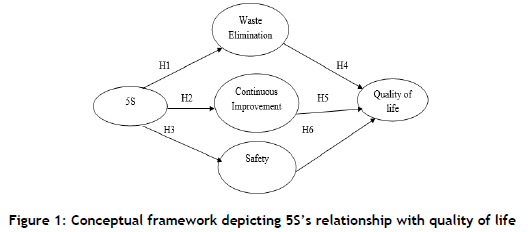
The results of a study reported by[32] suggest that 5S is an effective waste elimination technique that supports minimising waste in production processes and that aids in the development of an organisation.[33] states that waste elimination or minimisation is a secondary benefit of 5S implementation.[17] have found that 5S helps to improve the work environment by improving work routines, reducing search times, and reducing waste. This in turn leads to greater production efficiency.[34] state that 5S helps an organisation to identify and eliminate waste,to reduce equipment search times, and to increase productivity. 5S promotes cleanliness and neatness in inventory storage along with a considerable reduction of waste[16].[35] suggest that, after applying 5S, an organisation should be able to save 20% of its inventory cost as a result of eliminating waste.[36] indicate that the implementation of single-minute exchange of die (SMED), along with 5S, leads to decreased change over time and to waste elimination, which in turn increases overall productivity. These findings have been used to develop the first hypothesis:
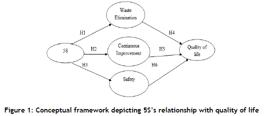
H1: There is a positive relationship between 5S and waste elimination
For the past three decades, researchers have studied the process of continuous improvement and the enablers of and barriers to continuous improvement[37]; [38]. The concept of continuous improvement is a systematic process to find and apply new methods in order to constantly improve an organisational process, using small steps[39]. Some authors define continuous improvement as the constant change brought about in an organisation through planned and organised activities that engage all the employees in enhancing their productive performance and well-being[40];[41]. The successful implementation of 5S facilitates increased productivity, employee satisfaction, and morale, and helps to create a safe and accident-free work environment[42]; [43]; [44]. According to[45], 5S is a system through which muda (waste) is reduced and productivity and quality are improved by establishing an orderly work area. Some studies pinpoint the important issues in 5S, such as maintenance techniques, the 5S framework, the relationship of 5S with lean manufacturing initiatives, and barriers and success factors in 5S implementation[21]. In essence, these findings indicate that the implementation of 5S supports the achievement of continuous improvement. Based on this, the second hypothesis is proposed:
H2: There is a positive relationship between 5S and continuous improvement
The main principle of any quality tool is to ensure health and safety in a workplace environment[46]. The implementation of 5S indicates the practical actions to be taken to establish a safer industrial working climate[47]. 5S could lead to safer work environments if used effectively in real-time[48]. It creates a systematic and comfortable work environment for the employees of an organisation[2].
The first 'S' in 5S is seiri, which is sorting things. It aims to reduce or eliminate accidents in the workplace, leading to increased safety[49]. The second S is seiton, which emphasises keeping safety equipment in the right place for emergency use[50]. The third 'S' is seiso, which means cleaning the workplace of pollution and dust to maintain cleanliness and safety[51]. These studies led to the development of the third hypothesis:
H3: There is a positive relationship between 5S and safety
5S can be implemented to improve significantly the organisation's environmental performance and to implement health and safety standards and housekeeping standards. According to[52], the primary objective of 5S is to maximise the level of workplace health and safety in conjunction with increased productivity.[53] note that the implementation of 5S improves health and safety standards in the workplace. According to[53], by effectively implementing 5S, an industry has reduced accidents through the involvement of both management and employees. Also, on implementing 5S, companies have achieved tangible results in safety. A clean and safe working environment is essential for a better quality of life, which promotes well-being in organisations[54]. On implementing 5S, the quality of life has improved in a number of industries[55]. The notion of 'quality of life'is subjective and multidimensional:it is a result of the individual's attitude towards their own psychological and physical well-being, their material existence, their interpersonal relationships, and the possibilities of personal development[56]; [57]; [58]; [59].
'Quality of life'is defined by the World Health Organization (1996) as 'an individual's perception of their position in life in the context of the culture and value systems in which they live and in relation to their goals, expectations, standards and concerns'. The triggers of quality of life are wealth, employment, the environment, physical and mental health, education, recreation, leisure time, social belonging, religious beliefs, safety, security, and freedom. According to the World Health Organization (1996), the individual's quality of life should be understood in the context of the perception of their life situation, related to the cultural context and the system of values accepted by the society in which the individual lives, and in relation to life goals, expectations, and interests. The concept of quality of life broadly encompasses how an individual measures the 'goodness' of multiple aspects of life. These evaluations include one's emotional reactions to life occurrences, and one's disposition, sense of life fulfilment, satisfaction with work, and personal relationships[60]. In the literature, the term 'quality of life' is often referred to as 'well-being'[61]; [62]; [63]. This information and knowledge derived from the literature was used to formulate the fourth, fifth, and sixth hypotheses:
H4: There is a positive relationship between waste elimination and quality of life
H5: There is a positive relationship between continuous improvement and quality of life
H6: There is a positive relationship between safety and quality of life
After formulating the hypotheses, a conceptual framework showing the relationship between the constructs is proposed, as shown in Figure 1.
4. METHODOLOGY
4.1. Questionnaire
The study used a survey method to test the conceptual framework. A structured questionnaire was developed from the extensive literature review and used for the survey. The questionnaire had two sections. Section 1 had questions to capture the demographic profile of the respondents, such as age, gender, income level, and educational qualification. Section 2 had questions related to the five constructs used in the study. The 5S construct had five sub-constructs, each one capturing the 5S practices of seiri, seiton, seiso, seiketsu, and shitsuke.
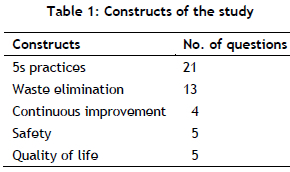
The construct 'waste elimination' was captured using the TIMWOOD lean approach[64]. The constructs and the number of questionnaire items in each construct are given in Table 1. To measure the response of each variable, a five-point Likert scale was used (strongly agree = 5, agree = 4, neutral = 3, disagree = 2, strongly disagree = 1). A pilot study was conducted with 30 respondents, and the questionnaire was tested for possible incorrect wording and the clarity of the questions. Suitable modifications were made to the questionnaire, and the final version was used to elicit responses.
4.2. Data collection
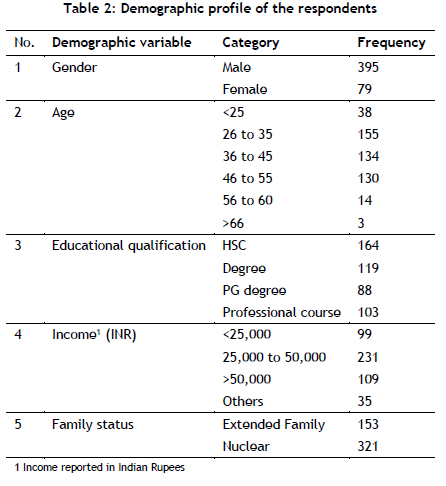
The questionnaire was developed in English and also in the local vernacular language for easy understanding by the respondents - employees belonging to the organisations that practised 5S and trained their employees to implement 5S at home. Six companies in Tamil Nadu State, India participated in the study. The respondents were chosen from different departments and at different levels: operators, supervisors, and managers. The majority of the respondents were male, apart from a few female members; and the respondents came from different age groups, thus forming a heterogeneous group. The purpose of the study was explained to the respondents before they completed the questionnaire. In total, 505 questionnaires were circulated, and 474 people responded. (Twenty employees did not respond, and eleven questionnaires were only partially completed and so were not considered for the study.) The data was collected during the period from April 2022 to September 2022. Table 2 presents the demographic profile of the respondents.
5. DATA ANALYSIS
5.1. Reliability and validity of the questionnaire
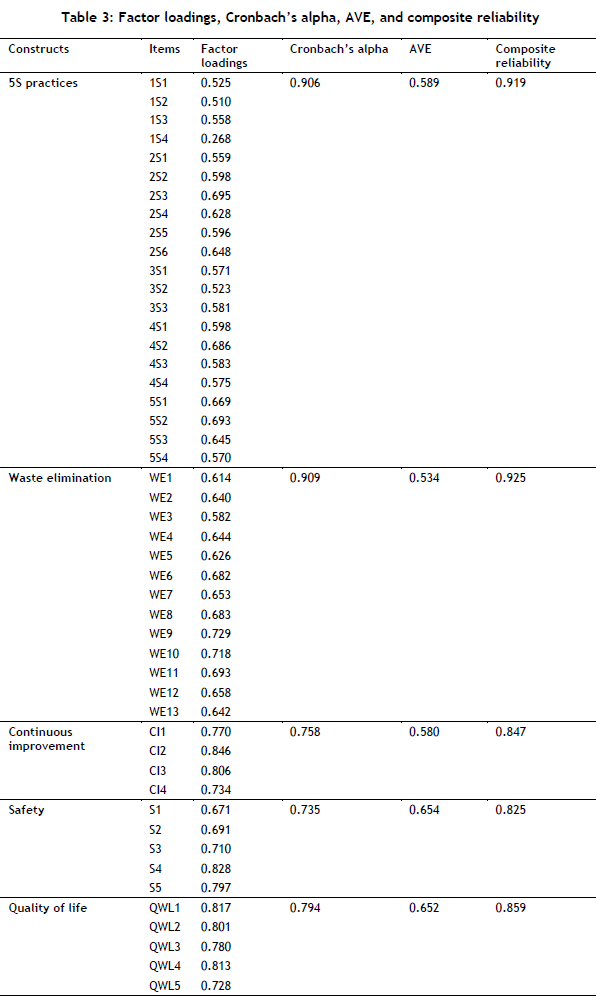
To establish the consistency and reliability of the data, Cronbach's alpha was computed using Warp PLS 7.0. Cronbach's alpha values of greater than 0.7 are considered to be acceptable[65];[66]. The Cronbach's alpha values of the constructs for 5S - waste elimination, continuous improvement, safety, and quality of life - were 0.906, 0.909, 0.758, 0.735, and 0.794 respectively. The reliability values were more than 0.7, indicating that the questionnaire had internal consistency and convergent validity. Table 3 shows the average variance extracted (AVE) and the conceptual framework's composite reliability. All the values for composite reliability and the AVE were greater than 0.5. AVE values greater than 0.5 are indicative of convergent validity or one-dimensionality in a construct[67]; [68]; [69]. These inferences indicated the consistency and reliability of the gathered data.
The responses to the items in the questionnaire were analysed to determine the confirmatory factor analysis. The results showed that the items relating to each construct loaded onto the anticipated factors. The factor loadings of the respective constructs are given in Table 3.
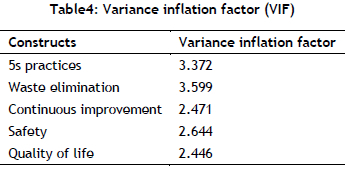
The variance inflation factor (VIF) values reflected the existence of multicollinearity among the constructs, indicating that there was more than one relationship among the constructs, which would lead to wrong outcomes[70]. The VIF values of the constructs considered for the study are shown in Table 4. The values are lower than the threshold value suggested by[71], showing that there was no multicollinearity among the constructs.
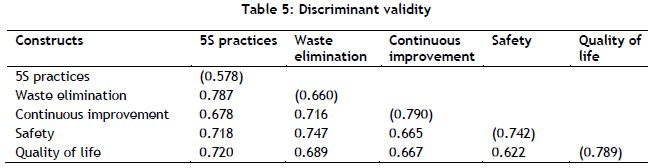
The discriminant validity of the questionnaire was ensured by comparing the squared correlation values of the constructs with the AVE values. The squares of the correlation values were lower than the square root of the AVE values of the constructs, indicating the discriminant values[72] of the questionnaire. The correlation values of the independent variables and the square root values of the AVE are shown in Table 5. The square root values of the AVE are shown along the diagonal in the brackets.
Goodness-of-fit (GoF) of the model:[73] define GoF as the geometric mean of the average communality and the average R squared for the model. The GoF measure is used to measure the global validity of partial least square models. The lower and upper range of GoF is between 0 and 1. This study had a GoF value of 0.529, which exceeded the threshold value of 0.36 for large effect sixes of R squared, as given by[74]. This indicated that the model had a good prediction power and fit.
5.2. Extent of 5S practices
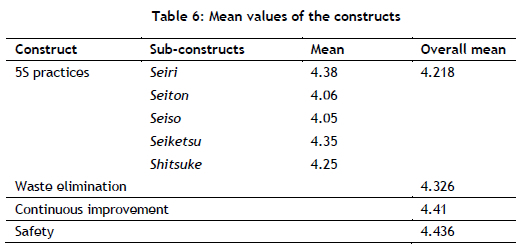
The mean values of the sub-scales used in each of the four constructs were calculated in order to understand the extent to which 5S was implemented by the employees and their spouses in their homes. The mean of constructs is shown in Table 6. A value of '4' in a scale of 1 to 5 is considered above average, and so it could be construed that the impact of the mean factor on the element was high. Since the means of all four constructs were greater than 4, it was construed that 5S was well implemented by the employees and their spouses in their homes. The mean value of 5S was 4.21. The sub-constructs of 5S (seiri, seiton, seiso, seiketsu, and shitsuke) had mean values of 4.38, 4.06, 4.05, 4.35, and 4.25 respectively. These values indicated that there was a high response to 5S when practised at home. The mean value of 'waste elimination' was 4.32 which showed that families strove to manage and eliminate all types of waste from their homes. Similarly, the mean value of 'continuous improvement' was 4.41, and 'safety' was 4.43. This showed that the households agreed that they practised 5S meticulously; thus, waste elimination, continuous improvement, and safety measures were also practised in their homes.
5.3. Structural equation modelling and hypothesis testing
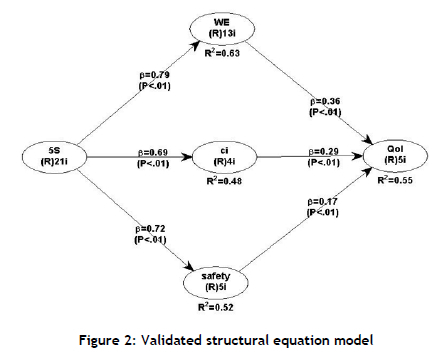
To understand the relationship among the constructs, and then to test them, a structural equation modelling using Warp PLS 7.0 software was carried out on the constructs at the aggregate level. The validated model, indicating the extent of relationship among the constructs, is shown in Figure 2. The relationship between 5S and waste elimination was found to be significant (β=0.79, p<0.01), and so hypothesis H1 was supported. This showed that there is a positive relationship, which reinforces the theory that 5S influences waste elimination. The relationship between 5S and continuous improvement was also found to be significant (β=0.69, p<0.01) and thus hypothesis H2 was supported, with a positive impact. Also, 5S showed a significant and positive impact on safety (β=0.72, p<0.01), and thus hypothesis H3 was supported.
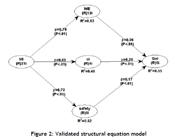
The relationship between waste elimination and quality of life was found to be significant (β=0.36, p<0.01) and thus hypothesis H4 was supported. This indicated that waste elimination has a significant relationship with quality of life. The relationship between continuous improvement and quality of life was also significant (β=0.29, p<0.01), and so hypothesis H5 was supported. The relationship between safety and quality of life was also significant (β=0.17, p<0.01), indicating that hypothesis H6 was supported. Therefore, it is reasonable to conclude that 5S practices drive employees and their spouses to lead a better quality of life in their homes.
6. DISCUSSIONS
The extensive literature review revealed that 5S technique had been widely implemented in many industries around the world. The results of the study provide a basis for 5S to be implemented in homes, and show that 5S practices also influence the quality of life. This provides an indirect benefit to organisations. This model provides insights into the impact of implementing 5S practices on waste elimination, continuous improvement, and the safety of employees' households, which in turn leads to the quality of life of their family members.
The results obtained from the structural equation model (Figure 2) provided enough evidence that, by implementing 5S in the homes of employees, waste is eliminated or considerably reduced. This supported hypothesis H1. By using the method of 'a place for everything and everything in its place' (PEEP)[17], which is a factor of seiton, a place is allotted to every household item, making it easier to track and find items and reducing the time needed to search for them. Also, the respondents do not buy the same items repeatedly because of the visual identification[16] that helps them to identify items for immediate use, especially for perishable items. By doing seiri, the respondents remove the unwanted items, and more space is made available to stock the necessary items. Also, by following the 'first in, first out' (FIFO) principle, it is easy to track the shelf life of items such as medicines and packed food items. When buying any item, because of 5S practices, the respondents check the expiry dates and buy only the most recent. They also check the stock of the items before buying them so that extra inventory is avoided. While preparing food, only the right quantity of food is prepared, and so it is not wasted. Because PEEP is followed, the respondents do not mix up items, and while working they are aware and careful not to waste any items. Thus, waste in homes is reduced, supporting hypothesis H1. The study also emphasises that, because of waste elimination, family members are able make considerable savings, leading to a better standard of life. They feel a sense of satisfaction, which leads to a better quality of life, thereby proving hypothesis H4.
This study provides enough evidence that, by implementing 5S, trivial problems are solved and repairs are attended to at home. Family members are able to devise systematic ways to handle problems related to household equipment, gadgets, and devices. 5S brings family members together, as it is everyone's responsibility to implement and practise it. It has effectively reduced the residents' frustration when doing mundane tasks. The 5S technique has adequately encouraged them to mitigate issues during their daily routines and to find solutions to problems, thus strengthening the culture of continuous improvement at home. This leads to improved daily household practices through continuous improvement, which supports hypothesis H2. Continuous improvements, such as attending to small problems or repairs themselves, and always refining the methods to solve issues and doing incremental improvements in household practices, should keep domestic equipment without faults and the home always in a ready condition. This provides more leisure time for households, and they can use the time saved to practise their passions or hobbies, thus leading to a better quality of life. This supports hypothesis H5.
Subsequently, hypothesis H3 is also supported. This indicates that 5S practices lead to safer homes. Safety is one of the major concerns needing to be improved in homes, both for family members and for domestic appliances. The implementation of 5S in homes makes it a routine procedure, such as having a first aid box at home, setting standard operating procedures for using or handling hazardous materials and cooking appliances, periodically checking the expiry dates of food items, medicines, and other products of essential use, and discarding unwanted items. All this helps to create a safer environment, and avoids any mishaps or minor accidents.
Hypothesis H6 is also supported by the study, postulating that safer homes provide better living conditions. The 5S technique is crucial in attaining a high level of safety in homes. The damage caused by negligence before 5S was a major cause of significant problems, thereby seriously affecting the happiness and lives of families. 5S implementation eliminated the various problems relating to safety factors, since it systematically organised the homes through the routine practice of each 'S' in a cumulative way. The assurance of a safe environment gives households a confidence that leads to a better quality of life, providing support for the hypothesis H6.
7. CONCLUSION, AND SCOPE FOR FUTURE STUDY
As an enabler of manufacturing and business excellence, the 5S technique has been extensively researched by many scholars. However, there are no studies of 5S implementation in homes. This study bridges that gap, and it is the first of its kind to research this topic. The study has shown that, like organisations, households can also benefit from 5S. The major outcome of this study is to prove not only that industries benefit, but also that employees' family members also reap the benefits of quality practices. This study has established the implementation of 5S practices in employees' homes. The study has also postulated that 5S implementation would improve the systematic management of homes, which in turn would improve the quality of life of employees and their families. The study also showed that 5S practices have a significant influence on waste elimination, continuous improvement, and safety in homes, thereby providing the second-order benefits of enhancing the life of households. The study emphasises that 5S could be implemented and practised at home as much as in organisations. It strongly establishes 5S as a facilitator of the quality of life for working people and their households.
Organisations measure their performance through productivity or profit; but the performance of households can be measured only according to the good quality of life of family members. Thus, this study has chosen 'quality of life' to measure the outcomes of 5S practices. The study has revealed significant associations between 5S practices and the quality of life of employees and their households. Dedicated 5S practices have considerably reduced the time needed to search for essentials items, and have allowed family members to enjoy quality leisure time. This study thus raises awareness about the significance of 5S for every home.
The study was conducted in the homes of employees who practised 5S in their organisations. This study could be extended to other households that are not part of any organisation but that would still like to practise 5S. The study could also be extended to understand the psychological and motivating factors underlying the implementation of 5S in homes and common barriers to the implementation process.
REFERENCES
2. LITERATURE REVIEW
-
[1] Patel, V. C., & Thakkar, H. (2014). A case study: 5S implementation in ceramics manufacturing company. Bonfring International Journal of Industrial Engineering and Management Science, 4(3), 132-139. https://doi.org/10.9756/bijiems.10346
» https://doi.org/10.9756/bijiems.10346 -
[2] Rizkya, I., Syahputri, K., Sari, R. M., & Siregar, I. (2019). 5S implementation in welding workshop: A lean tool in waste minimization. In IOP Conference Series: Materials Science and Engineering, 505(1), 012018. IOP Publishing. https://doi.org/10.1088/1757-899x/505/1/012018
» https://doi.org/10.1088/1757-899x/505/1/012018 -
[3] Shahriar, M. M., Parvez, M. S., Islam, M. A., & Talapatra, S. (2022). Implementation of 5S in a plastic bag manufacturing industry: A case study. Cleaner Engineering and Technology, 8, 100488. https://doi.org/10.1016/j.clet.2022.100488
» https://doi.org/10.1016/j.clet.2022.100488 - [4] Mehta, V. B., & Dave, P. Y. (2020). Impact of 5S and lean manufacturing techniques in various organisations to enhance the productivity. International Journal of Advances in Engineering and Management, 2(1), 421-436.
-
[5] Gapp, R., Fischer, R. & Kobayashi, K. (2008). Implementing 5S within a Japanese context: An integrated management system. Management Decision, 46(4), 565-579. https://doi.org/10.1108/00251740810865067
» https://doi.org/10.1108/00251740810865067 - [6] Osada, T. (1991). The 5S's: Five keys to a total quality environment. Tokyo: Asian Productivity Organisation.
- [7] Voelkel, G.J. & Chapman, C.D. (2003). Frontiers of quality: Value stream mapping. Quality Progress, 36(5), 65-69.
- [8] Kumar, K. & Kumar, S. (2012) Steps for implementation of 5S. International Journal of Management, IT and Engineering, 2(6), 402-416.
- [9] Dennis, P. & Shook, J. (2007) Lean production simplified: A plain language guide to the world's most powerful production system, 2nd ed. New York: Productivity Press.
- [10] Hirano, H. (1995). 5 pillars of the visual workplace. Portland, OR: Productivity Press.
-
[11] Ennin, Y. C., & Obi, D. (2012). 5S: Good housekeeping techniques for enhancing productivity, quality and safety at the workplace. Export Quality Bulletin, 89(2012). https://www.academia.edu/36108284/5S_GOOD_HOUSEKEEPING_TECHNIQUES_FOR_ENHANCING_PRODUCTIVITY_QUALITY_AND_SAFETY_AT_THE_WORKPLACE_ExPORT_QUALITY_BULLETIN_No_89_20
» https://www.academia.edu/36108284/5S_GOOD_HOUSEKEEPING_TECHNIQUES_FOR_ENHANCING_PRODUCTIVITY_QUALITY_AND_SAFETY_AT_THE_WORKPLACE_ExPORT_QUALITY_BULLETIN_No_89_20 -
[12] Randhawa, J. S.& Ahuja, I. S. (2018), An investigation into manufacturing performance achievements accrued by Indian manufacturing organization through strategic 5S practices. International Journal of Productivity and Performance Management, 67(4), 754-787. https://doi.org/10.1108/IJPPM-06-2017-0149
» https://doi.org/10.1108/IJPPM-06-2017-0149 - [13] Vasudevan, A., Hai, S. T., Raman, A., & Chan, A. H. A. (2022). The effective implementation of the 5S concept on the performance: A case study of a manufacturing company in Malaysia. International Journal on Global Business Management & Research, 11(1), 26-39.
-
[14] Sharma, R., Sharma, S., & Sharma, M. (2020). 5S housekeeping lean technique by using system dynamics method. In Proceedings of International Conference in Mechanical and Energy Technology: ICMET, 209-217. Springer. https://doi.org/10.1007/978-981-15-2647-3_19
» https://doi.org/10.1007/978-981-15-2647-3_19 - [15] Hanif, M. S., Batool, F., & Yaseen, H. (2023). Effectiveness of implementation of kaizen 5s and its impact on industry performance. Dinkum Journal of Economics and Managerial Innovations, 2(02), 100-109
-
[16] Chandrayan, B., Solanki, A. K., & Sharma, R. (2019). Study of 5S lean technique: A review paper. International Journal of Productivity and Quality Management, 26(4), 469-491. https://doi.org/10.1504/ijpqm.2019.099625
» https://doi.org/10.1504/ijpqm.2019.099625 -
[17] Makwana, A. D., & Patange, G. S. (2022). Strategic implementation of 5S and its effect on productivity of plastic machinery manufacturing company. Australian Journal of Mechanical Engineering, 20(1), 111-120. https://doi.org/10.1080/14484846.2019.1676112
» https://doi.org/10.1080/14484846.2019.1676112 - [18] Putri, F. A., Aurellia, K., Priska, H. A., Zaidan, A., & Basumerda, C. (2022). Implementation of 6S in convection MSME to increase worker productivity. In Proceedings of theInternational Conference on Religion,Science and Education, 1, 739-742.
-
[19] Kobayashi, K., Fisher, R., & Gapp, R. (2008). Business improvement strategy or useful tool? Analysis of the application of the 5S concept in Japan, the UK and the US. Total Quality Management, 19(3), 245-262. https://doi.org/10.1080/14783360701600704
» https://doi.org/10.1080/14783360701600704 -
[20] Gupta, S., & Jain, S. K. (2014). The 5S and kaizen concept for overall improvement of the organisation: A case study. International Journal of Lean Enterprise Research, 1(1), 22-40. https://doi.org/10.1504/ijler.2014.062280
» https://doi.org/10.1504/ijler.2014.062280 -
[21] Singh, A., & Ahuja, I. S. (2015). Review of 5S methodology and its contributions towards manufacturing performance. International Journal of Process Management and Benchmarking, 5(4), 408-424. https://doi.org/10.1504/ijpmb.2015.072320
» https://doi.org/10.1504/ijpmb.2015.072320 -
[22] Singh, J., Rastogi, V., & Sharma, R. (2014). Implementation of 5S practices: A review. Uncertain Supply Chain Management, 2(3), 155-162. https://doi.org/10.5267/j.uscm.2014.5.002
» https://doi.org/10.5267/j.uscm.2014.5.002 -
[23] Jaca, C., Viles, E., Paipa-Galeano, L., Santos, J., & Mateo, R. (2014). Learning 5S principles from Japanese best practitioners: Case studies of five manufacturing companies. International Journal of Production Research, 52(15), 4574-4586. https://doi.org/10.1080/00207543.2013.878481
» https://doi.org/10.1080/00207543.2013.878481 -
[24] Gupta, S., & Chandna, P. (2020). A case study concerning the 5S lean technique in a scientific equipment manufacturing company. Grey Systems: Theory and Application, 10(3), 339-357. https://doi.org/10.1108/gs-01-2020-0004
» https://doi.org/10.1108/gs-01-2020-0004 -
[25] Ribeiro, I. M., Godina, R., Pimentel, C., Silva, F. J. G., & Matias, J. C. O. (2019). Implementing TPM supported by 5S to improve the availability of an automotive production line. Procedia Manufacturing, 38, 1574-1581. https://doi.org/10.1016/j.promfg.2020.01.128
» https://doi.org/10.1016/j.promfg.2020.01.128 -
[26] Okpala, C. C. (2014). Tackling muda œ: The inherent wastes in manufacturing processes. International Journal of Advanced Engineering Technologies and Innovations, 5(4), 6, 11. https://www.academia.edu/18174003/Tackling_Muda_The_Inherent_Wastes_in_Manufacturing_Processes
» https://www.academia.edu/18174003/Tackling_Muda_The_Inherent_Wastes_in_Manufacturing_Processes -
[27] Vorkapić, M., Ćoćkalo, D., Đorđević, D., & Bešić, C. (2017). Implementation of 5S tools as a starting point in business process reengineering. Journal of Engineering Management and Competitiveness (JEMC), 7(1), 44-54. https://doi.org/10.5937/jemc1701044v
» https://doi.org/10.5937/jemc1701044v -
[28] Arunagiri, P., & Gnanavelbabu, A. (2014). Identification of major lean production waste in automobile industries using weighted average method. Procedia Engineering, 97, 2167-2175. https://doi.org/10.1016/j.proeng.2014.12.460
» https://doi.org/10.1016/j.proeng.2014.12.460 -
[29] Bergeson, A. (2021). The potential of affecting final potency of a poultry vaccine using lean methodology. Graduate Research Papers, 1941. University of Northern Iowa. https://scholarworks.uni.edu/grp/1941/
» https://scholarworks.uni.edu/grp/1941/ -
[30] Faridzi, F. R. (2023). Application of lean manufacturing to minimize waste in the Lajiem coffee business production process. Indonesian Vocational Research Journal, 2(2), 23-28. https://dx.doi.org/10.30587/ivrj.v2i2.5784
» https://dx.doi.org/10.30587/ivrj.v2i2.5784 -
[31] Alzahrani, Z., & Jazieh, A. R. (2018). Forms and function. Lean & Six Sigma Review, 18(1), 16-21. https://asq.org/quality-resources/articles/case-studies/forms-and-function?id=d6716907eb3a4e4988d499adddf6f848
» https://asq.org/quality-resources/articles/case-studies/forms-and-function?id=d6716907eb3a4e4988d499adddf6f848 - [32] Lingareddy, H., Reddy, G. S., & Jagadeshwar, K. (2013). 5S as a tool and strategy for improvising the work place. International Journal of Advanced Engineering Technology, 4(2), 28-30.
- [33] Gupta, K. (2022). A review on implementation of 5S for workplace management. Journal of Applied Research on Industrial Engineering, 9(3), 323-330.
-
[34] Patel, M., & Kiran, M. B. (2022). The review on various strategies adopted for implementing and sustaining 5S in a manufacturing industry. In Proceedings of the International Conference on Industrial Engineering and Operations Management, 5099-5108. https://ieomsociety.org/proceedings/2022istanbul/1030.pdf
» https://ieomsociety.org/proceedings/2022istanbul/1030.pdf - [35] Zagzoog, G. W., Samkari, M. M., & Almaktoom, A. T. (2019). A case of eliminating wastes using 5S for a household electrical appliance warehouse. In Proceedings of the International Conference on Industrial Engineering and Operations Management, pp. 26-28.
- [36] Bukhsh, M., Khan, M. A., Zaidi, I. H., Yaseen, R., Khalid, A., Razzaque, A., & Ali, M. (2021). Productivity improvement in textile industry using lean manufacturing practices of 5s & single minute die exchange (SMED). Proceedings of the 11th Annual International Conference on Industrial Engineering and Operations Management, 7374-7385.
-
[37] Alvarado-Ramírez, K. M., Pumisacho-Álvaro, V. H., Miguel-Davila, J. Á., & Suárez Barraza, M. F. (2018). Kaizen, a continuous improvement practice in organizations: A comparative study in companies from Mexico and Ecuador. The TQM Journal, 30(4), 255-268. https://doi.org/10.1108/tqm-07-2017-0085
» https://doi.org/10.1108/tqm-07-2017-0085 -
[38] Carnerud, D., Jaca, C. & Bäckström, I. (2018), Kaizen and continuous improvement - Trends and patterns over 30 years. The TQM Journal, 30(4), 371-390. https://doi.org/10.1108/TQM-03-2018-0037
» https://doi.org/10.1108/TQM-03-2018-0037 - [39] Tamim, S. A., Mahmood, F. A., & Anssari, M. A. A. (2023). The possibility of using kaizen method (continuous improvement) to improve quality and reduce costs: An application research on Kufa cement factory. The Journal of Modern Project Management, 11(1), 24-41.
-
[40] Suárez-Barraza, M. F., Miguel-Dávila, J. A., & Morales-Contreras, M. F. (2021). Application of Kaizen-Kata methodology to improve operational problem processes: A case study in a service organization. International Journal of Quality and Service Sciences, 13(1), 29-44. https://doi.org/10.1108/ijqss-07-2020-0113
» https://doi.org/10.1108/ijqss-07-2020-0113 - [41] Murga-Vasquez, A., Valenzuela-Garcia, J., & Castro-Rangel, P. (2021). Process improvement for the reduction of rework applying TPM and kaizen in a company in the metalworking sector. In Advances in Manufacturing, Production Management and Process Control: Proceedings of the AHFE 2021 Virtual Conferences on Human Aspects of Advanced Manufacturing, Advanced Production Management and Process Control, and Additive Manufacturing, Modeling Systems and 3D Prototyping, pp. 328-335. Springer.
-
[42] Prawira, A. Y., Rahayu, Y., Hamsal, M., & Purba, H. H. (2018). A case study: How 5S implementation improves productivity of heavy equipment in mining industry. Independent Journal of Management & Production, 9(4), 1184-1202. https://doi.org/10.14807/ijmp.v9i4.826
» https://doi.org/10.14807/ijmp.v9i4.826 -
[43] Chaurey, S., Kalpande, S. D., Gupta, R. C., & Toke, L. K. (2023). A review on the identification of total productive maintenance critical success factors for effective implementation in the manufacturing sector. Journal of Quality in Maintenance Engineering, 29(1), 114-135. https://doi.org/10.1108/jqme-11-2020-0118 .
» https://doi.org/10.1108/jqme-11-2020-0118 -
[44] Sharma, R., Singh, J., & Rastogi, V. (2018). The impact of total productive maintenance on key performance indicators (PQCDSM): A case study of automobile manufacturing sector. International Journal of Productivity and Quality Management, 24(2), 267-283. https://doi.org/10.1504/ijpqm.2018.10012947
» https://doi.org/10.1504/ijpqm.2018.10012947 -
[45] Bayo‐Moriones, A., Bello‐Pintado, A., & Merino‐Díaz de Cerio, J. (2010). 5S use in manufacturing plants: Contextual factors and impact on operating performance. International Journal of Quality & Reliability Management, 27(2), 217-230. https://doi.org/10.1108/02656711011014320
» https://doi.org/10.1108/02656711011014320 -
[46] Bataineh, O., Al-Hawari, T., Alshraideh, H.,& Dalalah, D. (2019), A sequential TPM-based scheme for improving production effectiveness presented with a case study. Journal of Quality in Maintenance Engineering, 25(1), 144-161. https://doi.org/10.1108/JQME-07-2017-0045
» https://doi.org/10.1108/JQME-07-2017-0045 -
[47] Srinivasan, S. (2012). The impact of 5S on the safety climate of manufacturing workers. Master's thesis 396, Louisiana State University and Agricultural & Mechanical College. https://doi.org/10.31390/gradschool_theses.396
» https://doi.org/10.31390/gradschool_theses.396 -
[48] Fardhosseini, M. S., Soltaninejad, M., Karji, A., Ghorbani, Z., & Ghanadiof, O. (2021). Qualitative evaluation of 5S application considering the experience of electrical construction experts. American Journal of Applied Sciences, 18(1), 51-60. https://doi.org/10.3844/ajassp.2021.51.60
» https://doi.org/10.3844/ajassp.2021.51.60 -
[49] Pačaiová, H., & Ižaríková, G. (2019). Base principles and practices for implementation of total productive maintenance in automotive industry. Quality Innovation Prosperity, 23(1), 45-59. https://doi.org/10.12776/qip.v23i1.1203
» https://doi.org/10.12776/qip.v23i1.1203 -
[50] Attri, R., Ashishpal, Khan, N. Z., Siddiquee, A. N., & Khan, Z. A. (2020). ISM-MICMAC approach for evaluating the critical success factors of 5S implementation in manufacturing organisations. International Journal of Business Excellence, 20(4), 521-548. https://doi.org/10.1504/ijbex.2020.106437
» https://doi.org/10.1504/ijbex.2020.106437 -
[51] Deshpande, S. P., Damle, V. V., Patel, M. L., & Kholamkar, A. B. (2015). Implementation of '5S' technique in a manufacturing organization: A case study. International Journal of Research in Engineering and Technology, 4(01), 136-148. https://doi.org/10.15623/ijret.2015.0401023
» https://doi.org/10.15623/ijret.2015.0401023 - [52] Kilpatrick, J. (2003). Lean principles. Utah Manufacturing Extension Partnership, 68(1), 1-5
-
[53] Ramesh, N., & Ravi, A. (2016). 5S route for safety management. International Journal of Business Excellence, 10(3), 283-300. https://doi.org/10.1504/ijbex.2016.10000125
» https://doi.org/10.1504/ijbex.2016.10000125 -
[54] Rocha, L. S., Dos Santos, M. E., De Alencar, D. B., Junior, M. F., Rodriguez, I. L. R., & Nascimento, M. H. R. (2019). The 5S program in school spaces a proposal for quality improvement. International Journal of Advanced Engineering Research and Science, 6(7).129-136. https://doi.org/10.22161/ijaers.6716
» https://doi.org/10.22161/ijaers.6716 -
[55] Rosak-Szyrocka, J. (2019). Quality of life improvement in Kaizen aspect. In Conference on Quality Production Improvement - CQPI, 1(1), 528-536. https://doi.org/10.2478/cqpi-2019-0071
» https://doi.org/10.2478/cqpi-2019-0071 -
[56] Walczak, M., & Tomczak, M. (2011).The structure of psychological determinants of selected aspects of physical activity in the light of the theory of self-determination. In Sport and recreation and the challenge of modern civilization. Scientific Notebooks of Szczecin University, No. 689, Economic Issues Services, No. 78. Szczecin, Poland: Uniwersytet Szczeciński. Available online: http://www.wzieu.pl/zn/689/ZN_689.pdf
» http://www.wzieu.pl/zn/689/ZN_689.pdf -
[57] Uysal, M., & Sirgy, M. J. (2019). Quality-of-life indicators as performance measures. Annals of Tourism Research, 76, 291-300. https://doi.org/10.1016/j.annals.2018.12.016
» https://doi.org/10.1016/j.annals.2018.12.016 -
[58] Robinson, M. (2015). Book review: 'Encyclopedia of quality of life and well-being research.' Reference Reviews, 29(7), 22. https://doi.org/10.1108/rr-06-2015-0143
» https://doi.org/10.1108/rr-06-2015-0143 - [59] Rosak-Szyrocka, J., Clark, C. C., Abbas, A. A., & Ullah, I. (2020). The meaning of physical activity in the quality of life management aspect. In Conference Quality Production Improvement - CQPI, 2(1), 69-76.
-
[60] Diener, E., Suh, E. M., Lucas, R. E., & Smith, H. L. (1999). Subjective well-being: Three decades of progress. Psychological Bulletin, 125(2), 276-302. https://doi.org/10.1037/0033-2909.125.2.276
» https://doi.org/10.1037/0033-2909.125.2.276 -
[61] Bartels, M. (2015). Genetics of wellbeing and its components satisfaction with life, happiness, and quality of life: A review and meta-analysis of heritability studies. Behavior Genetics, 45, 137-156. https://doi.org/10.1007/s10519-015-9713-y
» https://doi.org/10.1007/s10519-015-9713-y -
[62] Medvedev, O. N., & Landhuis, C. E. (2018). Exploring constructs of well-being, happiness and quality of life. PeerJ, 6, e4903. https://doi.org/10.7717/peerj.4903
» https://doi.org/10.7717/peerj.4903 -
[63] Espie, C. A., Emsley, R., Kyle, S. D., Gordon, C., Drake, C. L., Siriwardena, A. N., & Luik, A. I. (2019). Effect of digital cognitive behavioral therapy for insomnia on health, psychological well being, and sleep-related quality of life: A randomized clinical trial. JAMA Psychiatry, 76(1), 21-30. https://doi.org/10.1001/jamapsychiatry.2018.2745
» https://doi.org/10.1001/jamapsychiatry.2018.2745 -
[64] Mofolasayo, A., Young, S., Martinez, P., & Ahmad, R. (2022). How to adapt lean practices in SMEs to support Industry 4.0 in manufacturing. Procedia Computer Science, 200, 934-943. https://doi.org/10.1016/j.procs.2022.01.291
» https://doi.org/10.1016/j.procs.2022.01.291 -
[65] Hair, J. F., Ringle, C. M., & Sarstedt, M. (2012). Partial least squares: The better approach to structural equation modeling? Long Range Planning, 45(5-6), 312-319. https://doi.org/10.1016/j.lrp.2012.09.011
» https://doi.org/10.1016/j.lrp.2012.09.011 - [66] Nunally, J. C., & Bernstein, I. H. (1978). Psychometric theory. New York: McGraw-Hill.
-
[67] Anderson, J. C., & Gerbing, D. W. (1988). Structural equation modeling in practice: A review and recommended two-step approach. Psychological Bulletin, 103(3), 411-423. https://doi.org/10.1037/0033-2909.103.3.411
» https://doi.org/10.1037/0033-2909.103.3.411 -
[68] Barclay, M. J., & Smith, C. W. Jr. (1995). The maturity structure of corporate debt. The Journal of Finance, 50(2), 609-631. https://doi.org/10.1111/j.1540-6261.1995.tb04797.x
» https://doi.org/10.1111/j.1540-6261.1995.tb04797.x - [69] Chin, W. W. (1995). Partial least squares is to LISREL as principal components analysis is to common factor analysis. Technology Studies, 2(2), 315-319.
-
[70] Frisch, R. (1934). Circulation planning: Proposal for a national organization of a commodity and service exchange. Econometrica,Journal of the Econometric Society, 2(3), 258-336. https://doi.org/10.2307/1905624
» https://doi.org/10.2307/1905624 -
[71] Kim, J. H. (2019). Multicollinearity and misleading statistical results. Korean Journal of Anesthesiology, 72(6), 558-569. https://doi.org/10.4097/kja.19087
» https://doi.org/10.4097/kja.19087 -
[72] Fornell, C., & Larcker, D. F. (1981). Structural equation models with unobservable variables and measurement error: Algebra and statistics. Journal of Marketing Research, 18(3), 382-388. https://doi.org/10.2307/3150980
» https://doi.org/10.2307/3150980 -
[73] Tenenhaus, M., Vinzi, V. E., Chatelin, Y. M., & Lauro, C. (2005). PLS path modeling. Computational Statistics & Data Analysis, 48(1), 159-205. https://doi.org/10.1016/j.csda.2004.03.005
» https://doi.org/10.1016/j.csda.2004.03.005 -
[74] Cohen, J. (1988). Statistical power analysis for the behavioral sciences, 2nd ed. New York: Routledge. https://doi.org/10.2307/2290095
» https://doi.org/10.2307/2290095
Accepted for publication: 15 Apr 2026
Available online: 22 May 2026
ORCID® identifiers
S. Yogeshwari: https://orcid.org/0009-0003-9291-5776
R. Sujatha: https://orcid.org/0000-0002-5622-8392