Factors Contributing to The Failure of SMMEs in the Mining Construction Sector in the Northern Cape
Abstract
Small, medium, and micro enterprises (SMMEs) play an important role in economic development, employment, and poverty reduction in South Africa. However, SMMEs in the mining construction sector have very high failure rates, particularly in regions such as the Northern Cape, where the mining sector is a prime pillar of the economy. This study investigates the failure of SMMEs, using a case study methodology. It focuses on key factors that could influence the management of these SMMEs. Four propositions are presented, all of which were validated by the findings. Interviews were conducted with 12 SMME owners, and secondary data were obtained from the SMMEs and other external sources. This study aims to contribute to the limited literature on the factors that influence the success of SMMEs in the mining construction sector in developing countries.
Abstract
Klein, medium en mikro-ondernemings (KMMO's) speel 'n belangrike rol in ekonomiese ontwikkeling, indiensneming en armoedevermindering in Suid-Afrika. KMMO's in die mynbousektor het egter baie hoë mislukkingsyfers, veral in streke soos die Noord-Kaap, waar die mynbousektor 'n belangrike pilaar van die ekonomie is. Hierdie studie ondersoek die mislukking van KMMO's met behulp van 'n gevallestudie-metodologie. Dit fokus op sleutelfaktore wat die bestuur van hierdie KMMO's kan beïnvloed. Vier stellings word aangebied, wat almal deur die bevindinge bekragtig is. Onderhoude is met 12 KMMO-eienaars gevoer, en sekondêre data is verkry van die KMMO's en ander eksterne bronne. Hierdie studie het ten doel om by te dra tot die beperkte literatuur oor die faktore wat die sukses van KMMO's in die mynbousektor in ontwikkelende lande beïnvloed.
1. INTRODUCTION
Small, medium, and micro enterprises (SMMEs) play an important role in driving economic growth, creating jobs, and reducing poverty in South Africa. SMMEs represent more than 90% of all businesses, and contribute about 80% of total employment [1]. Even though they play such an important role, SMMEs in the mining construction sector have high failure rates, with 70-80% of enterprises failing within two years of becoming operational [2]. This poses a significant threat to the socio-economic growth of regions like the Northern Cape, where the mining sector makes a substantial contribution to the local economy. The failure of SMMEs weakens economic growth and aggravates unemployment and poverty, particularly in rural areas where alternative employment opportunities are limited.
Although previous studies have examined SMME failure in various industries, limited research focuses on the mining construction sector specifically in the Northern Cape. This region presents distinct conditions related to capital requirements, technical skills, and market fluctuations. This study investigates the factors that influence the success of SMMEs operating in this context.
2.1.
IntroductionThe definition of a small, medium, and micro enterprise (SMME) depends on regional economic structures and levels of development. In South Africa, the National Small Business Act of 1996 defines SMMEs by the number of employees, annual turnover, and assets. Micro-enterprises, for example, employ fewer than 10 employees, while small enterprises have a maximum of 50 [3]. In the European Union, SMMEs are classified based on the number of employees and annual turnover. Micro-enterprises include those with fewer than 10 employees, while small enterprises include those with fewer than 50 [4]. In Brazil, SMMEs are defined according to annual sales revenue. Micro-enterprises generate up to US$240,000, while small enterprises generate up to US$2.4 million [5]. These definitions highlight the heterogeneity of SMMEs and underscore the need for context-specific strategies to support their development.
2.2.
The importance and contribution of SMMEs to economic development"SMME" refers to a distinct entity, which may include cooperative enterprises and non-governmental organisations, managed by one or more owners. This includes any branches or subsidiaries, where applicable. To be classified as an SMME, the entity must operate mainly in a sector or sub-sector listed in the schedule of size standards, and meet the specified classification criteria [3].
In South Africa, SMMEs account for about 34% of gross domestic product (GDP) [5]. SMMEs contribute significantly to addressing socio-economic problems such as poverty, inequality, and unemployment. The National Development Plan (NDP) identifies SMMEs as a key driver in addressing its vision of generating 90% of new jobs by 2030 [6]. SMMEs play a similar role globally by contributing to innovation, supporting competitiveness, and enabling economic diversification [7]. The ability of SMMEs to respond to market demands and to create employment makes them a key component of sustainable development.
America and Germany have strong SMME support systems. These systems include access to accessible funding, mentorship programmes, and simplified regulatory frameworks [8]. They tend to act as models for South Africa, enabling it to create its own SMME ecosystem. The importance of the mining industry in South Africa
The mining industry is a cornerstone of the South African economy, contributing R495 billion to GDP in 2022 and directly employing over 475,000 people [9]. The Northern Cape relies heavily on mining, with major operations in iron ore, diamonds, and manganese. However, the industry faces difficulties such as declining mineral reserves, fluctuating commodity prices, and regulatory pressures. These have a ripple effect on SMMEs in the mining construction sector, which rely on mining activities for contracts and revenue. The interdependence between mining and SMMEs underscores the need for policies that support both sectors [9].
2.3.
"SMME success" defined2.3.1. Financial performance
Financial performance serves as a key indicator of SMME success. It involves assessing profitability, revenue growth, and return on investment. A successful SMME consistently generates earnings, shows income growth over time, and delivers sufficient returns to owners or shareholders [10]. The ability to generate revenue allows SMMEs to grow and sustain themselves by expanding their market reach, reinvesting in operations, and generating additional job opportunities.
2.3.2. Growth
Growth is another indicator of SMME success. It is measured by how the company is growing in respect of its clientele, market share, scope of offerings, and geographic reach. A prosperous SMME should be able to expand sustainably by continually enhancing its goods and services, exploring new markets, and adapting to the evolving needs of its clientele [11].
2.3.3. Sustainability
Sustainability reflects the ability of SMMEs to operate and grow despite problems. It combines social responsibility, environmental care, and profitability [11]. Key factors include strong management, a clear business plan, and the ability to adapt to market changes. Ethical practices, fair labour, and community engagement are also important. Successful SMMEs contribute to economic growth through job creation and tax contributions, while promoting inclusion, diversity, and social impact through corporate social responsibility [10], [11].
2.4.
SMME failure definedSMME failure is typically characterised by insolvency, closure, and/or the inability to meet financial obligations [12]. It can result from internal factors, such as poor management and a lack of skills, or from external factors, including economic downturns and regulatory changes. The failure rate of SMMEs in South Africa is among the highest in the world, with 60-80% of businesses collapsing within the first two years of operation [13].
2.5.
Obstacles to the success of SMMEsSMMEs face numerous obstacles that hinder their success. These are discussed below [11], [12], [14], [15].
2.5.1. Inadequate entrepreneurial education programmes
According to the entrepreneurship conceptual framework, entrepreneurs require managerial skills and the ability to create employment opportunities and improve productivity in the business setting. Entrepreneurs should have expertise in consumer behaviour, innovation induction, resource allocation, and adapting to a changing business environment [16]. "Entrepreneurship education" refers to the structured transfer of entrepreneurial competencies, which are knowledge, skills, and mindset. These skills are needed to start and grow growth-oriented businesses [17]. The entrepreneurship sector contributes to national economic development, with SMMEs playing a growing role in supporting entrepreneurial activity in many countries. Entrepreneurship brings energy and a spirit of competition to the economy that big corporations cannot match [18]. Worldwide, governments invest a considerable amount of money in entrepreneurship training and mentoring. In South Africa, a great number of SMME owners lack the necessary management skills [19]. Many SMMEs have failed because their owners are unable to anticipate the future and manage the firm effectively [15]. Entrepreneurship is central to business development processes in the 21st century. Entrepreneurship skills are necessary for implementing strategic decisions, which would lead to the sustained existence of the business. By anticipating risk, owners of SMMEs with entrepreneurial skills could ensure growth, prosperity, and well-being [20].
2.5.2. Unfavourable location
The SMME's location has a significant influence on its likelihood of success [21]. Business survival is unlikely if the location limits customer access, does not align with the target market, faces high competition in the area, or has a population density too low to support the size of the business [14]. The factors that an SMME owner should consider when choosing the site for their enterprise include rental costs, traffic, customer convenience, local crime rates, and proximity to target markets [2].
2.5.3. Access to funding
Inadequate funding is a significant issue that many SMMEs need support with [22]. Every organisation, whether it is just getting started, is developing, or has reached maturity, depends on funding. A lack of adequate financial support often leads businesses to struggle in establishing a solid and secure footing [3]. SMME owners require a clear understanding of the costs involved in securing finance [3]. One of the factors contributing to insufficient funding is the conditions that banks impose for granting loans to start a business. Funding is often sought only in urgent situations, without prior planning, which can place the business at long-term risk [3]. A SMME's capital may initially be limited to what its owner can afford. As the business grows, financial demands may exceed what the owner can cover alone, necessitating support from external sources, such as banks or shareholders [22].
2.5.4. Cash flow constraints
To meet its financial obligations, such as paying bills, making new purchases, and covering operational expenses, a business must maintain adequate cash flow. The business's cash inflows and outflows are critical components that should be effectively managed [23]. Many new SMME owners place a greater emphasis on earnings than on cash flow, which increases the likelihood of a business shutdown [24]. With a steady flow of funding, the business stands a good chance of succeeding and remaining solvent over time [15].
2.5.5. Inadequate governmental involvement in support and capacity-building
To foster and enable a favourable economic climate, governments should support entrepreneurs when they start new enterprises and protect them as they grow [25]. This would involve building and developing physical infrastructure such as roads, power, water, and transit systems. They also require a more lenient regulatory environment, such as reduced taxation levels, the implementation of laws that offer local SMMEs an advantage over international competitors, and support for a banking system that provides more accessible capital [23], [25]. Governments should assist SMMEs by providing tax breaks, a secure environment for their businesses and operations, and revised business legislation to support their expansion [23], [25].
2.5.6. Poor customer relationship management
Clients consistently seek high-value products or services, resulting in a competitive business environment marked by frequent changes in product design and variety [26]. SMMEs should consistently monitor the offers and pricing strategies of their competitors to stay ahead of the curve. Ignoring competition is risky and can lead to SMMEs failing [26]. SMMEs with better products, services, or prices tend to get more customers and to perform better than their counterparts [22].
2.6. Conclusion
SMME success depends on a combination of financial performance, growth, and sustainability [27]. These elements are influenced by internal capacity and external support. Problems such as limited entrepreneurial skills, poor location choices, restricted access to funding, cash flow issues, limited government support, lack of market awareness, and weak customer engagement continue to affect outcomes [27], [28]. Addressing these factors is necessary to improve survival rates and strengthen the contribution of SMMEs to economic development [28].
Although all the above factors are relevant, this study focuses on financial performance, entrepreneurial skills, and poor location choices, as these are frequently reported difficulties among SMMEs operating in the Northern Cape.
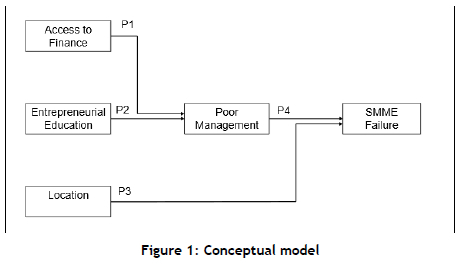
3. CONCEPTUAL MODEL
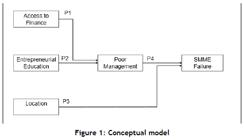
The propositions and the conceptual model for this study are the following:
P1: Restricted access to funding increases the likelihood of poor management in SMMEs.
P2: Poor entrepreneurial education increases the likelihood of poor management in SMMEs.
P3: The more unfavourable the location, the higher the likelihood of failure among SMMEs in the Northern Cape mining construction industry.
P4: Poor management could lead to the failure of SMMEs.
4. RESEARCH METHODOLOGY
This study targeted SMME owners in the Northern Cape's mining and construction industries. Kathu, a small mining town, was the focus area for this study. It was chosen because of the vast number of mines in the area and the many SMMEs that support mining activities. SMMEs were chosen because of the requirement that the mining and construction sector in the Kathu region and its surrounding areas within a 100 km radius serve as their primary business focus. These were sourced from the Stay in Business (SIB) business unit database (Sishen and Kolomela mines).
A case study design was selected to conduct the study. The primary data was collected through semi-structured interviews and triangulated with secondary textual data obtained from the case organisations (12 SMMEs). A set of pre-planned interview questions, aligned with the study's goals and conceptual model, was part of the primary data collection technique. Access to secondary data was restricted owing to its sensitive nature. To address this limitation, external secondary data from industry reports, government reports, and economic analyses (e.g., Stats SA and Moody's Economic Indicators [13], [29], [30]) were reviewed. This method made it easier to understand the contextual difficulties faced by SMMEs while adhering to confidentiality limitations.
Purposive sampling was used in this study. This sampling technique was chosen because of its capacity to extract data from the respondents' distinct qualities, experiences, attitudes, and perceptions. All the interviews were recorded and transcribed. The primary and secondary data were transferred into a computer-assisted qualitative data analysis software package. Thematic analysis was used to analyse the data. In addition to software, manual methods such as thematic maps and mind mapping were used to visualise relationships between themes and sub-themes. Data saturation was achieved after 10 interviews; no new themes were discovered in the last two, which justified the sample size. However, some additional information emerged from the individual interviews.
Ethical clearance for the study was obtained from the Ethics Committee of the Faculty of Engineering, Built Environment, and Information Technology at the University of Pretoria. All participants provided informed consent, and participation in the interviews was voluntary. The participants' identities were kept anonymous, and, in line with the approach taken by Carcillo [31], only aggregated data have been presented.
Construct validity was ensured by applying clearly defined constructs and drawing on multiple sources of evidence that aligned through data triangulation. Reliability was addressed by adhering to a case study protocol and preserving a transparent chain of evidence.
5. RESULTS
5.1. Descriptive statistics
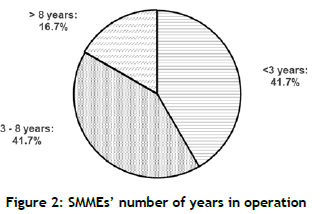
Figure 2 shows the number of years that the SMMEs have been in operation. Most of the SMMEs (a total of 58.4%) were either in the growth phase (3-8 years) or were well-established (more than 8 years), indicating a relatively mature sector. Newer businesses (less than 3 years) accounted for nearly 42% of the total.
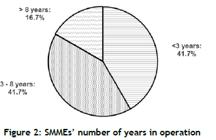
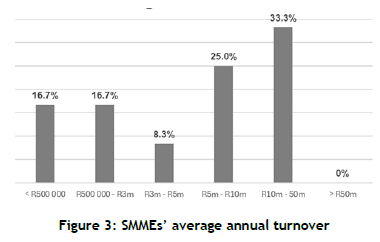
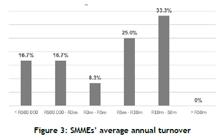
Figure 3 illustrates the annual turnover of the SMMEs. There is a clear connection between years in operation and turnover. For example, Company A, which had been operating for over eight years, stated an annual turnover of more than R50 million. In contrast, Company B, with three to eight years in operation, reported an annual turnover of between three and five million rand. Newer businesses tend to have lower turnovers, while established ones achieve significantly higher revenues. This underscores the need for targeted support to help newer SMMEs achieve sustainable growth.
5.2. Access to funding
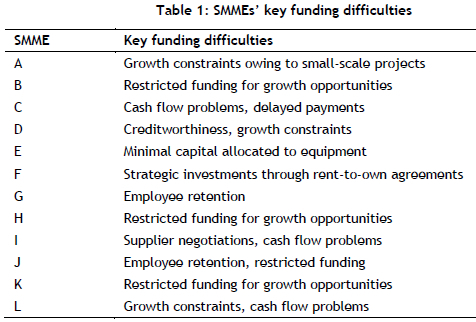
Table 1 shows the key funding difficulties identified by the SMME owners. Recurring themes that were identified were the following:
Restricted funding for growth opportunities and employee retention:
• Limited funding restricts investment in equipment and skilled staff.
• Limited funding hinders growth, forcing companies to focus on smaller projects and ultimately delaying expansion.
• Grants and development programmes (e.g., Zamele, Anglo American) provide valuable support, but the application process is often tedious and restrictive.
• Many SMMEs depend on personal savings, loans from family, or other informal arrangements because they have limited access to formal funding, and they often lack the necessary credit profile to qualify for a formal loan.
• Limited funding affects the ability to pay competitive salaries, leading to high employee turnover.
• Establishing creditworthiness is difficult, limiting certain SMMEs' access to loans and growth opportunities.
Cash flow difficulties:
• Financial constraints, project delays, and issues with delayed payment by suppliers lead to cash flow problems.
• Inadequate cash flow has an impact on the ability to pay employees on time, causing morale issues and high turnover rates.
• Inadequate cash flow prevents SMMEs from meeting daily operational costs, settling payments with suppliers, and servicing existing debt.
Restricted funding affected both growth opportunities and employee retention. Ten SMMEs (83%) depended on personal savings, informal loans, or grants as primary funding sources. Eight businesses (67%) reported growth limitations because of insufficient funding, while nine (75%) faced ongoing cash flow difficulties. In addition, half of the SMMEs experienced high rates of employee turnover.
Restricted access to finance increases the likelihood of poor management in SMMEs by limiting the resources needed for effective decision-making and operational control. Insufficient funding prevents investment in skilled staff, systems, and equipment, thereby weakening managerial capacity. Reliance on informal financial sources, often without adequate financial literacy, leads to poor cash flow management and reactive planning. Delayed payments, operational disruptions, and high employee turnover reflect management difficulties that are directly linked to financial constraints. The findings suggest that inadequate access to funding not only limits growth but also contributes to ineffective management practices.
5.3.
Entrepreneurial trainingA total of nine (75%) of the SMME owners who were interviewed received entrepreneurial training, while the remaining three (25%) received no training. Types of training included formal programmes via Zamele, Anglo American, South African Breweries (SAB), and Kumba Iron Ore. These programmes covered various topics, including financial management, marketing, human resource management, and project management. Specialised courses, such as leadership training or financial management, depending on specific needs, were also available. Some SMME owners had prior exposure to business studies or had received in-house training, which offered a foundational understanding of entrepreneurship.
The nine interviewees who received formal training reported that the training and work experience prepared them adequately to manage their SMMEs. The training contributed to the development of their business skills, improved their confidence, and offered networking opportunities, which helped them with sustainability. Respondents with training demonstrated stronger problem-solving abilities and business management capabilities. In contrast, the three SMME managers who had had no exposure to entrepreneurial training reported managerial inefficiencies, describing their experience as "a steep learning curve". These individuals acquired the necessary skills independently or through practical experience.
Restricted entrepreneurial education increases the likelihood of poor management in SMMEs by limiting the development of the core competencies required for effective business operations. The interviewees without formal training reported learning through trial and error, which resulted in gaps in their financial planning, strategic decision-making, and problem-solving skills. In contrast, those with access to an entrepreneurial education reported stronger management capabilities, greater confidence, and improved business performance. The findings indicate that limited access to structured training programmes contributes directly to weak managerial practices and reduces the capacity of SMMEs to operate efficiently and sustainably.
5.4.
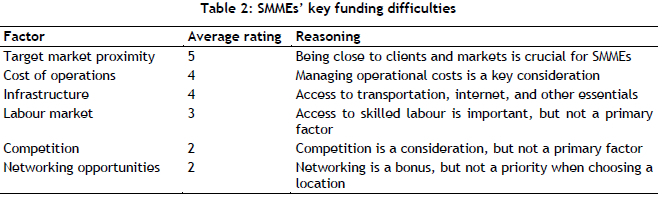
Business locationThe interviewees ranked factors influencing their location decisions using a five-point Likert scale, with 1 indicating the least importance and 5 indicating the highest importance. Table 2 shows the results.
A total of eight (75%) of the SMMEs were situated in or near the mining towns of Kathu and Kuruman, underscoring the significance of proximity to mining operations for their business activities. Three (25%) SMMEs selected towns located further away from Kathu and Kuruman because of the lower operational costs, such as rent and utilities.
SMMEs in the Northern Cape mining construction industry tend to locate in or near mining towns, highlighting the importance of their proximity to mining operations for business viability. Location proximity to clients reduces transportation costs, supports faster response times, and enables more consistent service delivery. Lower operational costs, such as rent and utilities, influenced the choice of towns like Kuruman and Deben for some businesses. Access to infrastructure remains a key consideration in ensuring operational continuity. Although access to skilled labour is valued, it is often addressed through in-house training. Factors such as competition and networking have limited influence on location decisions. The findings suggest that a poor location (i.e., one that is further away from mining activity, infrastructure, and affordable services) reduces the chances of business survival.
5.5. Empirical support for propositions
The study addressed four propositions:
• P1: Restricted access to funding increases the likelihood of poor management in SMMEs.
• P2: Poor entrepreneurial education increases the likelihood of poor management in SMMEs.
• P3: The more unfavourable the location, the higher the likelihood of failure among SMMEs in the Northern Cape mining construction industry.
• P4: Poor management could lead to the failure of SMMEs.
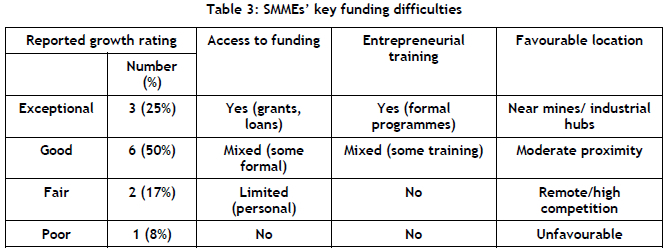
To correlate SMME growth ratings (as reported by the owners) with funding, training, and location, a cross-analysis was done - see Table 3 below.
The cross-analysis confirmed all four propositions, supported by the qualitative findings and the tabulated data.
• P1 was validated: SMMEs with limited or no access to funding, particularly those rated "Fair" (17%) or "Poor" (8%), experienced cash flow problems. These constraints were linked to poor management, identified in 17% of the sample.
• P2 holds: A total of 25% of SMME owners lacked entrepreneurial training, and this absence aligned with poor decision-making and weak operational control.
• P3 was supported: SMMEs rated "Exceptional" (25%) or "Good" (50%) were based near mines or industrial hubs, while those in remote or highly competitive areas ("Fair" or "Poor") showed slower growth.
• P4 was confirmed: Poor management, influenced by limited funding and training, contributed to operational inefficiency and weak performance. The data showed that poor growth was consistently associated with financial, educational, and locational limitations.
6. DISCUSSION
The objective of this research was to examine the reasons for the poor performance and failure of SMMEs in the Northern Cape mining construction industry. The four propositions the study addressed were these:
P1: Restricted access to funding increases the likelihood of poor management in SMMEs.
This proposition was supported. The study indicated that most SMME owners rely on personal savings, informal loans, or grants, which are often insufficient to support growth and operational needs. This finding aligns with a study by Fatoki and Asah [19], who found that limited access to funding is a major obstacle to small business growth, especially in developing economies. They noted that these businesses often rely on personal savings and informal loans, which are insufficient to support their operations. This financial constraint leads to poor cash flow management, delayed project completion, and the inability to invest in critical resources such as equipment and skilled labour. This aligns with Stats SA's [13] finding that only 12% of SMMEs in South Africa use formal bank loans, and that 65% use personal savings as the primary source of finance. Both the primary data and Stats SA [13] refer to a systemic reliance on informal and personal financing, which highlights the inaccessibility of available formal credit for SMMEs. This suggests that, despite government and private sector finance programmes, some SMMEs remain excluded from structured financial support. The World Bank Report [32] confirms these problems by noting that South Africa ranks low in "getting credit" (ranked 84th out of 190 economies), which indicates the persistent difficulty of accessing loans. This study has supported those findings by demonstrating how financial limitations lead to poor cash flow management, project delays, and difficulties in investing in essential resources, such as equipment and skilled labour.
P2: Poor entrepreneurial education increases the likelihood of poor management in SMMEs.
This study highlights the significance of entrepreneurial education in the sustainability and growth of SMMEs. While some SMME owners had been exposed to formal training programmes, others lacked this training, resulting in inefficient business management and decision-making. Trained SMME owners demonstrated better financial management, marketing, and project management competencies, which enabled them to respond more effectively to challenges. This aligns with the findings of several researchers [18] [23] [24], and has validated P2, that a lack of entrepreneurial education results in poor management.
P3: The more unfavourable the location, the higher the likelihood of failure among SMMEs in the Northern Cape mining construction industry.
This proposition was supported. The study pointed out the importance of strategic location choices for SMMEs in the mining construction industry. Sherman and Seidel [33] found that location is crucial for small business success, as being close to target markets and operating in cost-effective environments are key factors. This study found that SMMEs near mining operations perform better because they save on transportation costs and have easier access to clients. These findings align with those of Schaefer (2019) [34], who highlights how location can help to reduce operational inefficiencies. Those in poor locations had higher operating costs and lower market accessibility, supporting P3, which states that a poor location increases the likelihood of SMME failure.
P4: Poor management could lead to the failure of SMMEs
The findings of this study validated the proposition. The research found that poor management is one of the key reasons why SMMEs in the Northern Cape mining construction industry often fail. Interviews with SMME business owners showed that many of these businesses struggle because of poor management practices, particularly in areas such as handling finances, planning, decision-making, and managing staff. These shortcomings create significant hurdles to their success. These findings are supported by the literature [34] [35], which found that a lack of managerial skills, especially in financial management and strategic planning, is a major reason why small businesses fail.
7. CONCLUSION AND RECOMMENDATIONS FOR FUTURE RESEARCH
This study set out to understand why many SMMEs in the Northern Cape mining construction sector perform poorly, fail to grow, or shut down. All four propositions were supported by the findings. Limited access to finance often led to poor cash flow management and an inability to invest in staff or equipment. A lack of entrepreneurial training was linked to weak decision-making and poor planning. SMMEs based far from mining hubs struggled more with costs and access to clients. Poor management came up consistently as a problem, sometimes caused by limited training or funding, and it sometimes made those problems worse. These difficulties are interconnected and can exacerbate one another. Therefore, support strategies must address all these issues (funding, training, location, and management) simultaneously, not individually, to lead to sustainable improvement.
The following recommendations highlight areas for further research to build on the findings of this study and to inform more effective support for SMMEs:
• Compare the findings of this study with studies in each South African province.
• Include a larger and more diverse sample to improve its generalisability in the sector.
• Assess whether current support programmes address the key problems that have been identified.
• Track SMMEs' performance over time to assess the long-term impact of funding and training.
• Use the findings of this study as a baseline for studies in other developing countries.
8. LIMITATIONS OF THE STUDY
• Some SMME owners withheld detailed financial data owing to confidentiality concerns, thus limiting the depth of financial analysis.
• The study focused on 12 SMMEs in Northern Cape mining towns such as Kathu and Kuruman, which restricts its generalisation to other regions or sectors.
• The small purposive sample may not reflect the full range of SMMEs in the mining construction industry.
• Data were self-reported through interviews, which may have led participants to present themselves in a more positive light.
REFERENCES
2. LITERATURE REVIEW
- [1] A. Petersen, J. P. Bruwer, and R. B. Mason, "Source document usage and the financial sustainability of South African small, medium, and micro retailers," Expert Journal of Business and Management, vol. 8, no. 1, pp. 110-119, 2020.
- [2] A. Denton, "Why Do Small Businesses in Liberia Fail," Open Journal of Business and Management, vol. 8, no. 4, pp. 1771-1815, 2020.
-
[3] South Africa, National Small Business Amendment Act 21 of 2024. Pretoria. Available at: https://www.gov.za/documents/acts/national-small-enterprise-amendment-act-21-2024-english-afrikaans-23-jul-2024 (Accessed: 15 September 2024)
» https://www.gov.za/documents/acts/national-small-enterprise-amendment-act-21-2024-english-afrikaans-23-jul-2024 - [4] Government Gazette, 2003.
- [5] B. I. Gumel, "Strategizing for sustaining small business enterprises in Nigeria," IOSR Journal of Business and Management, vol. 19, pp. 8-25, 2017.
- [6] J. Cieslik, Entrepreneurship in Emerging Economies: Enhancing its Contribution to Socio-Economic Development. Palgrave Macmillan, 2017.
- [7] J. Barney, "Firm resources and sustained competitive advantage," Journal of Management, vol. 17, pp. 99-120, 1991.
- [8] T. Makwara, "Taking on the challenge: Small, micro, and medium enterprises (SMMEs) and socioeconomic development in South Africa," African Journal of Hospitality, Tourism and Leisure, vol. 8, no. 1, pp. 1-14, 2019.
-
[9] E. Olsen, "Ten common causes of business failure," On Strategy, May 16, 2021. Available at: https://onstrategyhq.com/resources/ten-common-causes-of-business-failure (Accessed: 15 September 2024). OECD, "Financing SMEs and entrepreneurs 2020: An OECD scoreboard," OECD Publishing, Paris, 2020. Available at: https://www.oecd.org/en/publications/financing-smes-and-entrepreneurs-2020_061fe03d-en.html_(Accessed: 30 September 2024).
» https://www.oecd.org/en/publications/financing-smes-and-entrepreneurs-2020_061fe03d-en.html_ - [10] S. Estrin, T. Mickiewicz, U. Stephan, and M. Wright, "Entrepreneurship in emerging markets," in The Oxford handbook of management in emerging markets, R. Grosse and K. Meyer, Eds, 2019, pp. 457-494.
- [11] B. Bushe, "The causes and impact of business failure among small to micro and medium enterprises in South Africa," Africa's Public Service Delivery and Performance Review, vol. 7, no. 2195-2310, 2019.
-
[12] J. Attard, "Sources of small business financing," Business Know-How, 2019. Available at: http://www.businessknowhow.com/money/financingsource.htm (Accessed: 15 September 2024).
» http://www.businessknowhow.com/money/financingsource.htm - [13] Statistics South Africa (Stats SA), SMME access to finance report. Pretoria: Stats SA, 2023.
-
[14] J. Murray, 2019. "What is cash flow?" the balance, 2021. Available at: https://www.thebalancemoney.com/cash-flow-how-it-works-to-keep-your-business-afloat-398180 (Accessed: 5 September 2024).
» https://www.thebalancemoney.com/cash-flow-how-it-works-to-keep-your-business-afloat-398180 - [15] G. Bongomin, J. Ntayi, J. C. Munene, and C. Malinga, "The relationship between access to finance and growth of SMEs in developing economies: Financial literacy as a moderator," Review of International Business and Strategy, vol. 27, no. 4, pp. 520-538, 2017.
-
[16] K. C. Wani, "Strategies to sustain small businesses beyond five years," Available at: https://scholarworks.waldenu.edu/cgi/viewcontent.cgi?referer=&httpsredir=1&article=6174&context=dissertations (Accessed 11 November 2024)
» https://scholarworks.waldenu.edu/cgi/viewcontent.cgi?referer=&httpsredir=1&article=6174&context=dissertations - [17] D. Agyapong, and A. B. Attram, "Effect of owner-managers' financial literacy on the performance of SMEs in the Cape Coast Metropolis in Ghana," Journal of Global Entrepreneurship Research, vol. 9, no. 67, pp. 1-13, 2019.
- [18] F. Alberti, S. Sciascia, and A. Poli, "Entrepreneurship education: Notes on an ongoing debate," in Proceedings of the 14th Annual IntEnt Conference, University of Napoli Federico II, Italy, vol.4, no.7, 2004.
- [19] O. Fatoki, and F. Asah, "The impact of firm and entrepreneurial characteristics on access to debt finance by SMEs in South Africa," International Journal of Business and Management, vol. 6, no. 8, pp. 170-179, 2011.
- [20] E. Abdul, "Entrepreneurial skills and growth of SMEs: A comparative analysis of Nigerian entrepreneurs and minority entrepreneurs in the UK," Journal of Small Business Management, vol. 56, no. 3, pp. 412-430, 2018.
- [21] L. McElherron, "An exploratory study into the strategic marketing planning practices of micro businesses in Ireland," Master's dissertation, John Moore University, Liverpool, 2013.
-
[22] P. Carter, "11 reasons why most entrepreneurs fail," Forbes, 2019. Available at: http://www.forbes.com/sites/forbescoachescouncil/2019/07/05/11-reasons-why-most-entrepreneurs-fail (Accessed: 1 September 2024).
» http://www.forbes.com/sites/forbescoachescouncil/2019/07/05/11-reasons-why-most-entrepreneurs-fail - [23] M. Herrington, and P. Kew, Global entrepreneurship monitor: South Africa report. Cape Town: University of Cape Town, 2023.
-
[24] P. Lotich, "10 primary functions of managing a small business," Thriving small business, 2019. Available at: https://thethrivingsmallbusiness.com/small-business-management (Accessed: 30 August 2024).
» https://thethrivingsmallbusiness.com/small-business-management - [25] H. Bhorat, Z. Asmal, K. Lilenstein, and K. van der Zee, "SMMEs in South Africa: Understanding the constraints on growth and performance," Development Policy Research Unit Working Paper 201802. DPRU, University of Cape Town, 2018.
-
[26] R. Sukhraj, "4 best ways to keep a customer happy & improve customer retention," Impact, 2017. Available at: http://www.impactbnd.com/blog/the-importance-of-keeping-your-customers-happy (Accessed: 10 March 2025).
» http://www.impactbnd.com/blog/the-importance-of-keeping-your-customers-happy - [27] K. Packirisamy, Supporting the SMME sector for sustainable growth and development in the Northern Cape province. Kimberley: Northern Cape Economic Development Agency, 2022.
- [28] G. O. C. Bongomin, J. M. Ntayi, J. C. Munene, and C. A. Malinga, "The relationship between access to finance and growth of SMEs in developing economies: Financial literacy as a moderator," Review of International Business and Strategy, vol. 27, no.4, pp. 520-538, 2017.
-
[29] Moody's Economic Indicators Analytics. http://www.economy.com/south-africa/indicators (Accessed: 10 January 2025).
» http://www.economy.com/south-africa/indicators - [30] Statistics South Africa (Stats SA), SMME access to finance report. Pretoria: Stats SA, 2023.
- [31] A. J. Carcillo, "The impact of project management maturity upon IT/IS project management outcomes," Doctor of Business Administration Dissertation, Wilmington University, New Castle, DE, 2012.
- [32] World Bank, World development report 2022: Finance for an equitable recovery. Washington, DC: World Bank, 2022.
-
[33] F. Sherman, "Why is the location of a business important?" Chron. 2019. Available at: https://smallbusiness.chron.com/location-business-important-43239.html (Accessed: 1 March 2025).
» https://smallbusiness.chron.com/location-business-important-43239.html - [34] J. Madzimure, and L. P. Tau, "Challenges facing small to medium enterprises in Metsimaholo Municipality, South Africa," Eurasian Journal of Social Sciences, vol. 9, no. 1, pp. 14-23, 2021.
- [35] S. Pretorius, T. J. Bond-Barnard, H. Steyn and J. Jordaan, "Project Success and Project Manager Competency", 2022 Proceedings of PICMET '22 Technology and Leadership in Digital Transformation - Looking Ahead to Post-COVID Era, Portland, USA, 2022.
ORCID® identifiers
S. Pretorius
https://orcid.org/0000-0003-4612-9558
L. Carls
https://orcid.org/0009-0001-5427-1717