Will the current National Strategic Plan enable South Africa to end AIDS, Tuberculosis and Sexually Transmitted Infections by 2022?
BACKGROUND: In May 2017, the South African National AIDS Council released the fourth National Strategic Plan (NSP) for HIV, tuberculosis and sexually transmitted infections. This five-year plan (2017-2022), which aims to track the progress towards transitioning these epidemics to no longer being public health threats by the year 2030, is built on the successes and barriers of the previous NSP (2012-2016). However, the NSP does not address some critical components, which may contribute to a future failure in achieving its hefty goals. OBJECTIVES: This article outlines the gaps within the new NSP, as well as highlighting aspects requiring careful focus, which are critical to address in order for South Africa to make progress towards the set targets. METHOD: This commentary included an in depth review of the NSP, other South African National Strategic Plans and documents, and scientific literature. RESULTS: The NSP does not address gaps in funding, oversights in prevention and treatment strategies, human resource shortages and lacking health system requirements. CONCLUSION: To realistically achieve the NSP targets and goals, a robust, client-centred strategy addressing the NSP gaps needs to be implemented. The strategy must be cost-effective; provide active linkage to care; and address health system weaknesses that inhibit its successful implementation, including human resources, service delivery and supply chain management, accountability and monitoring and evaluation (M).
Will the current National Strategic Plan enable South Africa to end AIDS, Tuberculosis and Sexually Transmitted Infections by 2022?
Kathryn L. HopkinsI, II; Tanya DohertyII, III, IV; Glenda E. GrayI, V
IPerinatal HIV Research Unit, Faculty of Health Sciences, University of the Witwatersrand, South Africa
IISchool of Public Health, Faculty of Health Sciences, University of the Witwatersrand, South Africa
IIIHealth Systems Research Unit, South African Medical Research Council, South Africa
IVSchool of Public Health, University of the Western Cape, South Africa
VOffice of the President, South African Medical Research Council, Cape Town, South Africa
BACKGROUND: In May 2017, the South African National AIDS Council released the fourth National Strategic Plan (NSP) for HIV, tuberculosis and sexually transmitted infections. This five-year plan (2017-2022), which aims to track the progress towards transitioning these epidemics to no longer being public health threats by the year 2030, is built on the successes and barriers of the previous NSP (2012-2016). However, the NSP does not address some critical components, which may contribute to a future failure in achieving its hefty goals.
OBJECTIVES: This article outlines the gaps within the new NSP, as well as highlighting aspects requiring careful focus, which are critical to address in order for South Africa to make progress towards the set targets.
METHOD: This commentary included an in depth review of the NSP, other South African National Strategic Plans and documents, and scientific literature.
RESULTS: The NSP does not address gaps in funding, oversights in prevention and treatment strategies, human resource shortages and lacking health system requirements.
CONCLUSION: To realistically achieve the NSP targets and goals, a robust, client-centred strategy addressing the NSP gaps needs to be implemented. The strategy must be cost-effective; provide active linkage to care; and address health system weaknesses that inhibit its successful implementation, including human resources, service delivery and supply chain management, accountability and monitoring and evaluation (M&E).
Fourth National Strategic Plan
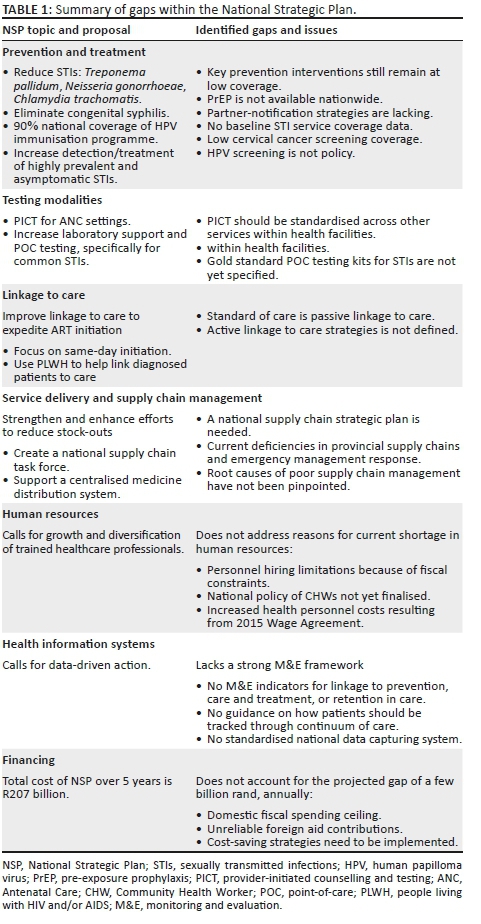
In May 2017, the South African National AIDS Council released the fourth National Strategic Plan (NSP) for HIV, tuberculosis (TB) and sexually transmitted infections (STIs). This five-year plan (2017-2022), which aims to track the progress towards transitioning these epidemics to no longer being public health threats by the year 2030, is built on the successes and barriers of the previous NSP (2012-2016).1,2However, the NSP does not address some critical components, which may contribute to a future failure in achieving its hefty goals. This article outlines the gaps within the new NSP (Table 1), as well as highlighting aspects requiring careful focus, in order for South Africa to make progress towards the set targets.
Today's epidemics: Where are we now?
South Africa's successes since the previous NSP include a 34% and 15% decrease in new HIV infections and TB incidence, respectively.11,3 Increased coverage of ART and combination prevention strategies, such as nationwide campaigns to scale up voluntary medical male circumcision (VMMC) (2.4 million procedures conducted) and the distribution of male and female condoms, has led to a decline in new HIV infections.1,4 Mathematical modelling on the new Universal Test and Treat (UTT) guidelines, which allow for initiation of treatment irrespective of CD4+ count, has shown that UTT could lead to substantial reductions in HIV incidence, potentially eliminating it as a public health problem over a period of 15-20 years.561,6,7 This rapid diagnosis and increased treatment success rate has contributed to the decline in numbers of new TB cases nationwide.6
Although TB incidence and number of new HIV infections have declined, they have fallen short of the 50% reduction target.1,2 The number of new HIV, TB and STI infections remains unacceptably high (270 000 new cases of HIV in 2016; 450 000 new cases of TB in 2015; and 1.4 million STIs treated annually in public health facilities).11,8,9 While HIV incidence is decreasing, the prevalence is increasing because of a recovering life expectancy (from 58.3 to 62.4 years between 2011 and 2015), as 50% of people living with HIV/AIDS (PLWH) are on life-saving therapy.11,10 Eclipsing the (modest) decline in TB incidence since 2012 is an increased prevalence of multidrug-resistant TB - the number of cases have doubled between 2007 and 2012.1
The earlier age of sexual debut and low condom use may have reduced the success of prevention efforts. The 2016 Demographic and Health Survey found that only 58% of women and 65% of men with multiple sexual partners within the past year reported using a condom during their last sexual intercourse. The number of sexually active men aged 15-49 years with multiple sexual partners has increased, with the mean number of lifetime partners reported as 14.7. South Africa has a high prevalence of gender-based violence, with one in five partnered women and 40% of divorced or separated women having experienced physical violence.11121314151617,18
Setting South Africa up to fail?
The NSP 2017-2022 has put forth eight goals, which include breaking the cycle of transmission; reaching the 90-90-90 targets in every district; having targeted interventions reaching all key and vulnerable populations; utilising a multidepartment and multisectoral approach; implementing equal treatment and social justice; promoting leadership and shared accountability; mobilising resources and maximising efficiencies for a sustainable response; and taking data-driven action.119
Gaps in prevention and treatment goals
The NSP focuses on five STIs and holds the following primary objectives: the reduction of Treponema pallidum, Neisseria gonorrhoeae and Chlamydia trachomatis; elimination of congenital syphilis; and 90% national coverage of the human papilloma virus (HPV) immunisation programme (of Grade 4 learners in South Africa).1202021,22 Details of proposed implementation for partner-notification strategies for HIV and TB infections and STIs are lacking.123,24 Studies in South Africa show that up to 50% of persons diagnosed with STIs have no intention of notifying their partner.25
An objective of the NSP is to increase the detection and treatment of highly prevalent and largely asymptomatic STIs such as chlamydia and HPV (prevalence of 17% - 42% and 71% in young women, respectively)26112728
A wider range of testing modalities must be used to reach NSP and global targets for increased disease detection for HIV, TB and STIs.2020
The NSP encourages PICT in the antenatal care setting to ensure 100% birth testing of newborns exposed to HIV, as well as PICT of mothers and testing of all children up to 18 months to identify those who have acquired HIV through breastfeeding.12930
In resource-poor settings, POC technology can offer inexpensive, large-scale screening programmes for HIV, TB, STIs and other emerging infections by expanding critical laboratory testing to rural areas and providing real-time results.31,32 For some POC testing, the unit cost per test may be larger through the loss of bulk testing in laboratories, but it offers potentially substantial savings through enabling rapid delivery of results and reduction of facility and personnel costs.33134
The NSP calls for improvement in linkage to care to ensure expedited initiation of ART for all people diagnosed with HIV, as soon as they are ready for treatment and preferably same day. However, it doesn't explicitly offer innovative ways to link people to services, outside of using 'PLWH to enhance linkage to care'.135
Lacking health system requirements
Achieving the NSP goals requires attention to critical health system requirements. We have used the WHO health system building blocks36
Service delivery and supply chain management
Delivering the services outlined in the NSP requires a well-functioning supply chain. In the Stop Stockouts Project (SSP) Stock Outs National Survey (June 2016), implemented in the last quarter of 2015, health facilities nationwide reported the following when queried about the last three months prior to contact: one in five facilities reported a stock-out of adult antiretrovirals (ARVs) (472/1875), and 70% of facilities reported the stock-out lasting longer than one month (529/760).37373738
In the aftermath of the SSP National Survey, the National Department of Health (NDoH) created a national supply chain task force to initiate supply chain reforms. In partnership, the SSP was granted R300 million to develop a national electronic medicine stock management system.39137,39
Health workforce
The NSP requires a substantial growth and diversification in human resources and commits to invest greater resources towards the training and mobilisation of these personnel. However, it avoids addressing any reasons for the current shortages of healthcare workers - both political and budgetary in nature - which may serve as barriers to its goals.19402019,20
The NSP implementation period coincides with a major health reform process in South Africa, namely the implementation of the National Health Insurance Policy. This policy, which includes contracting with private general practitioners and public clinics, has the potential to assist with skilled staffing shortages provided favourable contracting conditions.4120,42,43
A further cadre requiring greater legislative security are Community Health Workers (CHWs), who are being scaled up as part of ward-based outreach teams. These workers are responsible for contact tracing and counselling, but the national policy on CHWs is still not finalised and there are large provincial differences in contracting methods and salary. The current ratio of CHWs is far too small per population for impact, given their large and increasing scope of work.44
South Africa's health sector budget also needs to manage the increase in health personnel costs resulting from the 2015 wage agreement, which is expected to result in a 7.4% annual growth in wages across government.45
Health information systems
Data-driven action relies on monitoring and evaluation (M&E) of programmatic service delivery to identify service utilisation gaps and outcomes. However, there is little to no mention of NSP M&E indicators tracking linkage to prevention, care and treatment services or retention in care. Within the NSP's M&E framework indicators, there is no definition for 'lost to follow-up' or guidance on how patients should be tracked and data collected throughout the continuum of care.
Where resources are available, an electronic data capturing system can promote the timely submission and analysis of clinical data required for health service delivery improvements, as has been implemented in the Western Cape. The province introduced an award-winning offline electronic version of the typically used paper register system in many healthcare facilities: the Primary Health Care Information System (PHCIS). The PHCIS is now the most widely used patient-based system in South Africa and on the continent, with the patient master index having records for over 80% of patients in the Western Cape. Patient information can be shared across clinics irrespective of location.46,47 It incorporates a three-tiered monitoring approach, allowing the Ministries of Health to strategically implement one of the tiers in each facility offering ART services. Each tier has the ability to produce the same nationally required monthly enrolment and quarterly cohort reports to assist in aggregating all tier outputs into a single database at any level of the health system. Implementing such a system at country level for pre-antiretroviral wellness, ART, TB and so on can be an efficient approach to ensuring system-wide synchronisation and accurate M&E of services, including long term retention in care.47
Financing
In 2016, the health sector's share of the national budget sat at only 13.1% (R159.4 billion).20202020
The total cost of implementing the proposed NSP over the five-year period is a staggering R207 billion, which constitutes a major funding gap. Annual cost estimates rise from R35.1 billion to R45.7 billion, with two goals (prevention and treatment) accounting for 86.5% of the projected budget.1
NSP costing does not fully account for the lack of available government funding and foreign development assistance. While South Africa has increased national spending, the government has also declared adherence to a fiscal spending ceiling, as previously budgeted.201,20 Foreign development assistance is uncertain at best. Historically, South Africa received significant contributions from two main funders - the President's Emergency Plan for AIDS Relief (PEPFAR) and the Global Fund to Fight AIDS, Tuberculosis and Malaria, both of which are now simultaneously decreasing monetary support.1,20 The bilateral Partnership Framework Implementation Plan with PEPFAR projected a funding decline from $450 million to $250 million over five years.
The broad NSP has vague strategies (such as the language surrounding the need for provision of condoms within schools and the decriminalisation of sex work while lacking concrete plans on how to do so) with unknown associated costs.48,49 The South African HIV and TB Investment Case conducted by the NDoH depicts the gap of a few billion rand, annually, between required funding and projected available amounts.501,51
Summary
To realistically achieve the NSP targets and goals, a robust, client-centred strategy addressing the NSP gaps needs to be implemented. The strategy must be cost-effective; provide active linkage to care; and address health system weaknesses that inhibit its successful implementation, including human resources, service delivery and supply chain management, accountability and M&E.
Competing interests
The authors declare that they have no financial or personal relationships that may have inappropriately influenced them in writing this article.
Authors' contributions
K.L.H. conceptualised the manuscript and was the primary author. G.G. and T.D. provided conceptual contributions and review of the manuscript.
Acknowledgements
T.D. and G.G. are funded by the South African Research Council and the National Research Foundation.
References
- 1. SANAC. South Africa's National Strategic Plan for HIV, TB and STIs 2017-2022. Pretoria: South African National AIDS Council; 2017.
- 2. SANAC. National Strategic Plan on HIV, STIs and TB. Pretoria: South African National AIDS Council; 2011.
- 3. UNAIDS. UNAIDS Reference Data 2017. Geneva: Joint United Nation Programme on HIV/AIDS (UNAIDS); 2017.
-
4. Williams BG, Gupta S, Wollmers M, Granich R. Progress and prospects for the control of HIV and tuberculosis in South Africa: A dynamical modelling study. Lancet Public Health. 2017;2(5):223-230. https://doi.org/10.1016/S2468-2667(17)30066-X
» https://doi.org/10.1016/S2468-2667(17)30066-X - 5. Department of Health, Province of KwaZulu-Natal. Universal test and treat: A game changer in HIV prevention. Durban: Department of Health, Province of KwaZulu-Natal; 2016.
- 6. Vanleeuw L, Loveday M. Chapter 9: Tuberculosis. In: Massyn N, Peer N, English R, Padarath A, Barron P, Day C, editors. District Health Barometer 2015/16. Durban: Health Systems Trust, 2016; p. 180-208.
- 7. Cox H, Dickson-Hall L, Jassat W, et al. Chapter 15: Drug-resistant tuberculosis in South Africa: History, progress and opportunities for achieving universal access to diagnosis and effective treatment. In: Padarath A, Barron P, editors. South African Health Review 2017. Durban: Health Systems Trust, 2017; p. 157-168.
- 8. Johnson L. Thembisa version 1.0: A model for evaluating the impact of HIV/AIDS in South Africa. Cape Town: Centre for Infectious Disease Epidemiology and Research, University of Cape Town; 2014.
- 9. Africa, S.S. Mid-year population estimates, 2017. Pretoria: Statistics South Africa; 2017.
- 10. World Health Organization. Global Tuberculosis Report 2015. Geneva: World Health Organization; 2015.
- 11. South Africa Demographic and Health Survey 2016, Key Indicator Report. Pretoria: Statistics South Africa; 2016.
- 12. Akullian A, Bershteyn A, Klein D, Vandormael A, Bärnighausen T, Tanser F. Sexual partnership age pairings and risk of HIV acquisition in rural South Africa. AIDS (London, England) 2017;31(12):1755-1764.
-
13. Evans M, Risher K, Zungu N, et al. Age-disparate sex and HIV risk for young women from 2002 to 2012 in South Africa. J Int AIDS Soc. 2016;19(1):21310. https://doi.org/10.7448/IAS.19.1.21310
» https://doi.org/10.7448/IAS.19.1.21310 -
14. Maughan-Brown B, Kenyon C, Lurie MN. Partner age differences and concurrency in South Africa: Implications for HIV-infection risk among young women. AIDS Behav. 2014;18(12): 2469-2476. https://doi.org/10.1007/s10461-014-0828-6
» https://doi.org/10.1007/s10461-014-0828-6 - 15. Health 24, H.A. The clever dick campaign kicks off in the Cape. 2014.
-
16. Hoffman JR, Arendse K, Larbi C, Johnson N, Vivian LM, Perceptions and knowledge of voluntary medical male circumcision for HIV prevention in traditionally non-circumcising communities in South Africa. Glob Public Health. 2015;10(5-6):692-707. https://doi.org/10.1080/17441692.2015.1014825
» https://doi.org/10.1080/17441692.2015.1014825 - 17. EHealth News, S.A. South African men support medical circumcision campaign. Woodstock, Western Cape: EHealth News, South Africa; 2017.
-
18. Froneman S, Kapp P. An exploration of the knowledge, attitudes and beliefs of Xhosa men concerning traditional circumcision. Afr J Prime Health Care Fam Med. 2017;9(1):e1-e8. https://doi.org/10.4102/phcfm.v9i1.1454
» https://doi.org/10.4102/phcfm.v9i1.1454 - 19. Yawa A. 'We can't accept the new HIV, TB plan' - Treatment Action Campaign. BHEKISISA Centre for Health Journalism; 2017.
- 20. Blecher MS, Meyer-Rath G, Chiu C, et al. Chapter 17: HIV and AIDS financing in South Africa: Sustainability and fiscal space. South African Health Review 2016. Padarath A, King J, Mackie E, Casciola J, editors. Durban, Health Systems Trust, 2016; p. 203-220.
- 21. UNAIDS. PrEP in South Africa. Geneva: Joint United Nation Programme on HIV/AIDS (UNAIDS); 2016.
- 22. PrEPWatch, South Africa Close-Up. New York: AVAC, Global Advocacy for HIV Prevention; 2017.
- 23. Kalichman SC, Mathews C, Kalichman M, Lurie MN, Dewing S. Perceived barriers to partner notification among sexually transmitted infection clinic patients, Cape Town, South Africa. J Public Health. 2017;39(2):407-414.
-
24. Davey DLJ, Wall K. Need to include couples' HIV counselling and testing as a strategy to improve HIV partner notification services. AIDS. 2017;31(17):2435-2436. https://doi.org/10.1097/QAD.0000000000001632
» https://doi.org/10.1097/QAD.0000000000001632 - 25. Human Sciences Research Council of South Africa (HSRC),South African National HIV prevalence, incidence and behavioural survey, 2012. Pretoria: HSRC Press; 2015.
- 26. Bruni L, Barrionuevo-Rosas L, Albero G, et al. ICO Information Centre on HPV and Cancer (HPV Information Centre), Human Papillomavirus and Related Diseases in South Africa. 2016.
- 27. Botha MH, Dreyer G. Guidelines for cervical cancer screening in South Africa. South Afr J Gynaecol Oncol. 2017;9(1):2074-2835.
- 28. Massyn N, Peer N, English R, Padarath A, Barron P, Day C. District Health Barometer 2015/16. Durban: Health Systems Trust; 2016.
-
29. Moodley J, Brian M, Tunkyi K, Khedun SM. A clinical audit of provider-initiated HIV counselling and testing in a gynaecological ward of a district hospital in KwaZulu-Natal, South Africa. S Afr J Obstet Gynaecol. 2014;20(1):8-11. https://doi.org/10.7196/sajog.603
» https://doi.org/10.7196/sajog.603 - 30. Makhunga-Ramfolo N, Chidarikire T, Farirai T, Matji R. Provider-initiated counselling and testing (PICT): An overview. SAJHIV Med. 2011;12(2):6-11.
-
31. Abel G. Current status and future prospects of point-of-care testing around the globe. Expert Rev Mol Diagnostics. 2015;15:853-855. https://doi.org/10.1586/14737159.2015.1060126
» https://doi.org/10.1586/14737159.2015.1060126 -
32. Tucker JD, Bien CH, Peeling RW. Point-of-care testing for sexually transmitted infections: Recent advances and implications for disease control. Curr Opin Infec Dis. 2013;26(1):73-79. https://doi.org/10.1097/QCO.0b013e32835c21b0
» https://doi.org/10.1097/QCO.0b013e32835c21b0 - 33. John A, Price CP. Economic evidence and point-of-care testing. Clin Biochem Rev. 2013;34(2):61-74.
-
34. Shah M, Chihota V, Coetzee G, Churchyard G, Dorman SE. Comparison of laboratory costs of rapid molecular tests and conventional diagnostics for detection of tuberculosis and drug-resistant tuberculosis in South Africa. BMC Infect Dis. 2013;13:352. https://doi.org/10.1186/1471-2334-13-352
» https://doi.org/10.1186/1471-2334-13-352 -
35. Sharma M, Ying R, Tarr G, Barnabas R. Systematic review and meta-analysis of community and facility-based HIV testing to address linkage to care gaps in sub-Saharan Africa. Nature 2015;S77-S85. https://doi.org/10.1038/nature16044
» https://doi.org/10.1038/nature16044 - 36. World Health Organisation. Everybody's business: Strengthening health systems to improve health outcomes: WHO's framework for action. Geneva: World Health Organization; 2007.
- 37. Stop Stockouts Project. SSP Stockouts National Survey. Johannesburg: Stop Stockouts Project (SSP); 2016.
-
38. Bateman C. Drug stock-outs: Inept supply-chain management and corruption. S Afr Med J. 2013;103(9):600-602. https://doi.org/10.7196/SAMJ.7332
» https://doi.org/10.7196/SAMJ.7332 - 39. Christopher E. Essential medication stock outs persist in South Africa. Cape Town: AfricanHealthNews.com; 2016.
- 40. World Health Organization. World Health Statistics. Geneva: World Health Organization; 2015.
- 41. South African National Department of Health. White Paper on National Health Insurance for South Africa, Version 40. Pretoria: South African National Department of Health; 2015.
- 42. World Health Organization. The World Health Report - Working together for health. Geneva: World Health Organization; 2006.
- 43. South African National Department of Health. Policy guideline for HIV Counselling and Testing (HCT). Pretoria: South African National Department of Health; 2009.
-
44. Jaskiewicz W, Tulenko K. Increasing community health worker productivity and effectiveness: A review of the influence of the work environment. Hum Res Health. 2012;10:38. https://doi.org/10.1186/1478-4491-10-38
» https://doi.org/10.1186/1478-4491-10-38 - 45. Pretoria National Treasury of South Africa. Budget Review 2016. Pretoria: Pretoria National Treasury of South Africa; 2016.
- 46. Western Cape Government. Province's award-Winning patient database shares information across clinics. Cape Town: Western Cape Government; 2014.
-
47. Osler M, Hilderbrand K, Hennessey C, et al. A three-tier framework for monitoring antiretroviral therapy in high HIV burden settings. J Int AIDS Soc. 2014;17(1):18908. https://doi.org/10.7448/IAS.17.1.18908
» https://doi.org/10.7448/IAS.17.1.18908 - 48. Green A, Cullinan K. The new HIV and TB plan forgets about sex workers, gay men, drug-users and prisoners. Johannesburg: The Huffington Post, South Africa; 2017.
- 49. Furlong A. Former AIDS Council Head Criticises Government Plan. Durban: Ground Up; 2017.
- 50. South African National Department of Health. South African HIV and TB Investment Case Reference Report. Pretoria: South African National Department of Health; 2016.
- 51. World Health Organization. A decade of tracking progress for maternal, newborn and child health; The 2015 Report, Brazil. Geneva: World Health Organization; 2015.

Accepted: 07 June 2018
Published: 04 Oct. 2018