Outcomes of a model for re-testing HIV-negative index contacts in Sedibeng, South Africa
Abstract
BACKGROUND: Index contact testing is an HIV case-finding approach that elicits sexual or needle-sharing partners, as well as biological children, of people living with HIV (PLHIV) and offers them HIV testing services. OBJECTIVES: We aim to describe the results of an innovative project in Sedibeng District that expanded index testing by retesting previously negative contacts and incorporating status-neutral testing. METHOD: We used registers to identify people who previously tested HIV-negative through index testing from March 2019 to September 2021. The individuals were telephonically traced and offered HIV retesting. Data were collected on a weekly basis using REDCap®. We monitored the number of individuals called, those who came back for retest, and their HIV results. RESULTS: Fifteen counsellors contacted 968 people over 12 months. Forty-eight percent (462 out of 968) of those called returned for testing. Of those, 121 (26%) tested positive. Overall, 66 out of 276 (24%) men with HIV and 55 out of 186 (30%) women with HIV were identified and linked to antiretroviral treatment (ART). Fifty-seven percent (194 out of 341) of clients who tested HIV-negative were offered, and 124 out of 194 (64%) initiated, pre-exposure prophylaxis (PrEP). All individuals who retested HIV-positive had a new diagnosis; none reported having had another positive test result between the original negative and the positive retest. CONCLUSION: Revisiting index clients with a previous negative HIV test result is worthwhile, creating an opportunity to identify undiagnosed PLHIV and high-risk people for PrEP. The high positivity rate highlights the importance of providing a sero-neutral approach to HIV testing, including integrating prevention messaging and linkage to PrEP services.
index contacts testing; routine data; HIV case-finding; seroconversion; sero-different couples; pre-exposure prophylaxis; REDCAP; U=U
Introduction
The HIV epidemic remains an important challenge for health systems. Index contact testing is an HIV case-finding approach that focuses on eliciting sexual or needle-sharing partners, as well as biological children, of people living with HIV (PLHIV) and offering them HIV testing services (HTS). It aims to identify people at high-risk of HIV for testing and initiate them on antiretroviral treatment (ART) as soon as possible. Index testing has been adopted by the South African Department of Health (DoH)1223,4,5262
Sero-different couples, where one partner has HIV and the other does not, are common in sub-Saharan Africa,7,8910,11,12,13
In addition to its importance in case-finding, index testing provides an opportunity for targeted HIV prevention, by providing a point of entry into health services for the negative partner in sero-different couples, who is at substantial risk of HIV acquisition while their partner is becoming virally suppressed on ART.71415,16
Anova Health Institute (Anova) is the PEPFAR District Support Partner in Sedibeng District, South Africa. In partnership with Sedibeng Health District, alongside standard index testing strategies, we implemented an innovative project aiming to ensure that adults known to be in sero-different relationships are offered retesting for HIV and linked to HIV prevention services, including PrEP. We contacted people who had previously tested negative through index testing services and asked them to return for repeat testing. This article describes the uptake and test results of the index contact retesting approach.
Methodology
Setting
The study took place in Sedibeng Health District in Gauteng province, South Africa. The Naomi Model estimates that 110 000 PLHIV resided in Sedibeng in 2021, 40% of whom were men.171718
Programme description
Anova supports the standard DoH HIV index testing approach utilised across all facilities in Sedibeng District. As part of a quality improvement intervention, the project team developed an innovative element by revisiting individuals who had previously tested HIV-negative as part of routine index testing services. The team undertook a standardised quality improvement project (QIP) approach, utilising the Plan-Do-Study-Act (PDSA) cycle model to implement this new approach and analyse the outcomes and impact.19
Following development of the QIP, 15 HIV testing team counsellors identified individuals who previously tested HIV-negative through index contact testing from March 2019 to September 2021. The implementation of the project started in October 2021, and we report data through September 2022. These individuals were identified by reviewing the index testing registers completed during the time of their last HIV test. We targeted individuals who were in sero-different relationships (index client tested positive and elicited partner tested negative), grouped them according to the date of their last test, telephonically traced them and invited them to facilities for repeat HIV testing through Anova's HIV testing counsellors. The individuals who retested HIV-positive were linked to and initiated on ART on the day of their new positive test result while those who tested HIV-negative were offered and linked to prevention services (PrEP, voluntary medical male circumcision, condom provision). The counsellors offered and performed HIV testing according to the National HTS algorithm 2016 revised version, which includes a second confirmatory test should the first result be positive.20
As the project progressed, we developed scripts for common situations encountered by counsellors when telephonically recalling clients (e.g. no longer with the same partner). We also shifted the messaging towards a sero-neutral testing approach wherein individuals were encouraged to test to facilitate access to PrEP to prevent HIV acquisition, rather than solely testing to become aware of a positive HIV status. For example, the script for initiating the conversation (after introductions) ran: 'I am just calling to let you know that we now have PrEP in our facility' and then provided an explanation about what PrEP is, and issued the invitation for a HIV test: 'If you are interested then the first step is to come in to meet with me so you can have another HIV test to confirm that you are still HIV-negative'.
The scripts are included as Online Appendix 1. Confidentiality was maintained throughout the implementation of the project, no data were shared beyond the project team and identifying information was removed during analysis. All our testers were trained on how to provide index testing in a safe and ethical manner according to South African guidelines and DoH index testing standard operating procedures SOP000108/2020.
Data collection and analysis
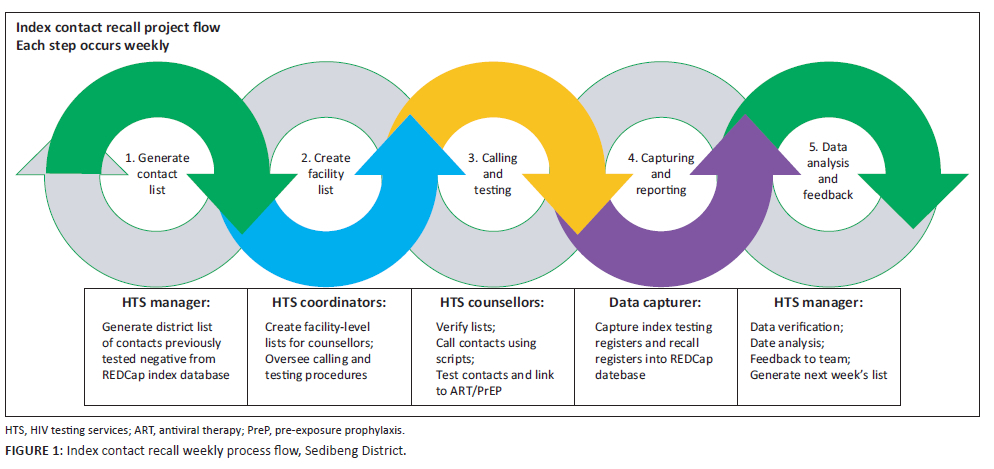
Data were collected on a weekly basis using a REDCap database (see Figure 1).21,22 Anova uses REDCap to capture routine programme data. We collected demographic information including age and gender, as well as the date of the repeat test and the repeat test results. Three telephonic attempts were made at different times to reach the index contacts before designating 'unreachable' as an outcome.
We present descriptive statistics for all contacts 15 years and older, including the number of contacts recalled, the rate of return, positivity rate, and PrEP offer and initiation rates. Results are presented as frequencies and proportions. The number of patients who declined repeat HIV testing is reported, including the reasons for declining repeat testing. To investigate associations between age or gender and testing, positivity, PrEP offer, and PrEP enrolment rates, we used the chi-squared test for difference between proportions.
Ethical considerations
Ethical clearance to conduct this study was obtained from the Human Sciences Research Council (No. REC 3/22/08/18). Because this QIP involved only the use of anonymised aggregated programme data, no informed consent was obtained.
Results
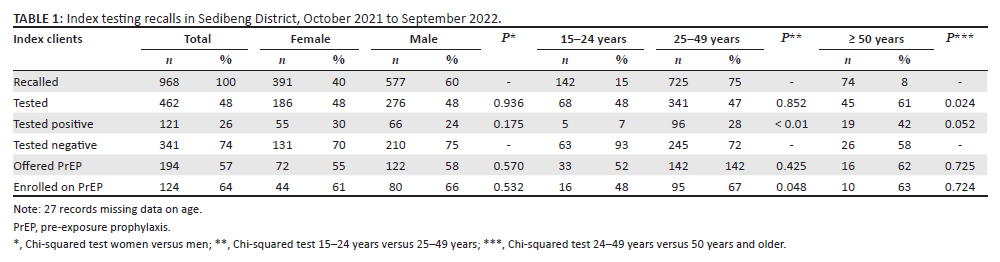
Over the 12-month period, 968 people were contacted by the HTS counsellors. Sixty percent (n = 577) were male, 15% (n = 142) were between 15 and 24 years old, 66% (n = 637) were between 25 and 44 years old and 8% (n = 74) were 50 years or older. Just over one-third of people contacted (n = 362) were unreachable on three attempts using the contact details on record. Forty-eight percent (n = 462 out of 968) of those called returned to the facility for testing (Table 1), and the remaining 144 were reached telephonically but declined the offer to retest. Testing rates were the same in women and men at 48% (P = 0.936). Since a higher number of the contacts were men, we reached more men for testing (n = 276), compared to women (n = 186). People 50 years and older were more likely to return for testing than those 25-49 years old (61% vs 47%, P = 0.024). Positivity was higher in women compared to men, 30% versus 24%, although this was not statistically significant (P = 0.175). Positivity was higher in those older than 25 years (15-24 years: 7%, 25-49 years: 48%, 50 years and older: 42%).
Overall, from the 968 individuals identified from the index registers for recall, 12.5% were newly diagnosed with HIV within a maximum interval of 2.5 years (March 2019 - September 2022) between initial negative and subsequent positive test results. All those identified as PLHIV were newly diagnosed with HIV at retest, none of them having reported any other positive test in the interim between their original index testing encounter and this retesting intervention. All 121 of these individuals were successfully linked to ART following their diagnosis.
Of the 341 clients who retested HIV-negative, 194 clients were offered PrEP (57%) and 124 enrolled on PrEP (64% of those offered). Pre-exposure prophylaxis offer rates were similar in age and gender groups, but PrEP uptake was lower for young people aged 15-24 years compared to people 25-49 years old (48% vs 67%, P = 0.048).
For the 144 clients that declined the offer of retesting, the following reasons were given: not ready to test again (17%, n = 24), no longer with the same partner (46%, n = 65), moved to another province (38%, n = 55).
Discussion
We have described an innovative QIP designed to strengthen outcomes of HTS services through recalling previously HIV-negative index contacts for retesting at least 1 year after their initial contact testing engagement. We found high positivity rates, with just over one-quarter of previously HIV-negative individuals retesting HIV-positive, implying high rates of seroconversion in this population. This project had three important programmatic outcomes: identifying high-risk people to offer PrEP, identifying HIV quickly in those who had seroconverted since their last HIV test, and reaching a high proportion of men.
The project has highlighted high infection rates in sero-different relationships, despite the positive partners having accessed ART by the time of initial index testing, and the negative partner accessing HIV testing. It is possible that some of the individuals who retested positive were in the window period during their first test, and either were unaware of the need to retest or did not attend as recommended after 3 months. In both cases, recalling index contacts for retesting provides a way to keep interacting with people at high-risk. It also points to missed opportunities for linkage to HIV prevention services during HTS interactions where the clients test HIV-negative. Although the project initially started with just offering HIV retesting, the need to integrate prevention services, particularly PrEP, quickly became clear, to support the client who tested negative to remain so. Oral PrEP has been available in public health facilities in Sedibeng since 2020. We only started offering PrEP midway during the project period but found that more than half of those offered PrEP took up the offer and initiated PrEP, including in men, although adolescents and young people had substantially poorer PrEP uptake. As well as providing PrEP services, education and awareness are needed for both service providers and users to ensure that prevention messages are structured in ways that are accessible and easily understood. Greater effort is needed to strengthen the offer of PrEP to as many as possible of those testing HIV-negative through index or repeat HIV testing and to understand the reasons clients decline PrEP despite being identified as belonging to a high-risk group. Couple-focussed approaches would enable follow-up of the positive partner to ensure adherence on ART and support couples to reach a situation where U=U can be in place. A greater focus on a sero-neutral approach to HIV testing may help to normalise access to, and uptake of, HIV prevention services as well as strengthening the integration of PrEP offer into index testing and other HTS modalities.
A similar approach was used in Uganda, identifying HIV-negative members of sero-different couples, and offering them PrEP,2323
In sub-Saharan Africa, there is generally lower awareness of HIV status in men,242526
HIV self-testing has been implemented in several settings, including in South Africa, and has been shown to increase acceptability of testing,272829,30
It is important for the authors to acknowledge that this project took place during the course of the coronavirus disease 2019 (COVID-19) pandemic, including from the time of South Africa's first extensive lockdown in March 2020 up until all restrictions were lifted in June 2022. Therefore, it is difficult to assess how much COVID-19 restrictions may have impacted both testing and seroconversion rates within the population reached during the project. COVID-19 drastically impacted healthcare access in South Africa, through myriad mechanisms including health facility closures, limited access to transport, altered health-seeking behaviour and disrupted access to ART for people enrolled in the ART programme.31,32,33
Limitations
This project was not designed as a research study, and this analysis uses routine programme data only. There are data quality challenges when using routine data (including missing data and capturing errors), but an added advantage in knowing the approach can be used in a real-world setting. We did not track testing in individuals longitudinally outside of this project, so we are unable to say whether people tested negative during the original window period, whether they had new partners, or whether their partners attended ART visits. We are also unable to summarise the time period between individual's HIV tests, and so were unable to calculate incidence rates. We have adapted our data collection to enable this going forward.
Conclusion
Our project indicates that revisiting previously negative index clients is a worthwhile endeavour, both to newly diagnose PLHIV and to identify high-risk clients to initiate PrEP. Index testing should continue to be used as an effective modality to identify PLHIV not yet aware of their status or not on ART, and interaction with contacts should be ongoing, particularly with men, who remain a priority group. The high positivity rate also highlights the critical importance of integrating prevention messaging and linkage to prevention services, including PrEP, into the offer of index testing. Index testing provider training must include a clear emphasis on linking not only those who test positive to ART, but also those who test negative to prevention services. In Sedibeng, during the period of the QIP, rapid ART initiation and index testing were offered simultaneously to all newly identified individuals with an HIV-positive test. Studies have shown that although same-day initiation may be more effective in supporting linkage to ART, achieving high rates of retention and viral suppression remains challenging.17
Competing interests
The authors declare that they have no financial or personal relationships that may have inappropriately influenced them in writing this article.
Authors' contributions
D.L.P. conceptualised and managed the project. N.D. and K.R. conceptualised the manuscript, and assisted with analysis and write-up.
Funding information
This material is based upon work supported by the United States President's Emergency Plan for AIDS Relief (PEPFAR) through the United States Agency for International Development (USAID) under Cooperative Agreement number 72067418CA00023 to the Anova Health Institute.
Data availability
The data that support the findings of this study are not openly available due to the sensitive nature of the data and are available from the corresponding author, D.L.P., upon reasonable request.
Disclaimer
The view and opinions expressed in this manuscript are those of the authors and do not necessarily reflect the official policy or position of any affiliated institution.
Acknowledgements
We would like to thank Sedibeng Health District, HIV testing teams and facility managers for their support in the implementation of this project, as well as Prof. James McIntyre and Dr Helen Struthers for providing oversight.
References
- 1.South Africa National Department of Health. National consolidated guidelines for the management of HIV in adults, children and infants and prevention of mother to child transmission. Pretoria: DoH; 2020.
-
2.PEPFAR. Country operational plan PEPFAR South Africa 2022 strategic direction summary [homepage on the Internet]. Washington, DC; 2022 [cited 2022 Dec 12]. Available from: https://www.state.gov/2022-country-operational-plan-guidance/
» https://www.state.gov/2022-country-operational-plan-guidance/ -
3.Mwango LK, Stafford KA, Blanco NC, et al. Index and targeted community-based testing to optimize HIV case finding and ART linkage among men in Zambia [homepage on the Internet]. 2020 [cited 2023 Mar 28]. Available 28 March 2023, from: http://onlinelibrary.wiley.com/doi/10.1002/jia2.25520/full
» http://onlinelibrary.wiley.com/doi/10.1002/jia2.25520/full -
4.Mahachi N, Muchedzi A, Tafuma TA, et al. Sustained high HIV case-finding through index testing and partner notification services: Experiences from three provinces in Zimbabwe [homepage on the Internet]. 2019 [cited 2023 Apr 04]. Available from: http://onlinelibrary.wiley.com/doi/10.1002/jia2.25321/full
» http://onlinelibrary.wiley.com/doi/10.1002/jia2.25321/full -
5.Joseph Davey D, Wall KM, Serrao C, et al. HIV Positivity and referral to treatment following testing of partners and children of PLHIV index patients in public sector facilities in South Africa. J Acquir Immune Defic Syndr (1988). 2019;81(4):365-370. https://doi.org/10.1097/QAI.0000000000002048
» https://doi.org/10.1097/QAI.0000000000002048 -
6.Marinda E, Simbayi L, Zuma K, et al. Towards achieving the 90-90-90 HIV targets: Results from the South African 2017 national HIV survey. BMC Public Health. 2020;20(1):1375. https://doi.org/10.1186/s12889-020-09457-z
» https://doi.org/10.1186/s12889-020-09457-z -
7.Lingappa JR, Lambdin B, Bukusi EA, et al. Regional differences in prevalence of HIV-1 discordance in Africa and enrollment of HIV-1 discordant couples into an HIV-1 prevention trial. PLoS One. 2008;3(1): e1411. https://doi.org/10.1371/journal.pone.0001411
» https://doi.org/10.1371/journal.pone.0001411 -
8.Chihana ML, Conan N, Ellman T, et al. The HIV cascade of care among serodiscordant couples in four high HIV prevalence settings in sub-Saharan Africa. S Afr Med J. 2021;111(8):768-776. https://doi.org/10.7196/SAMJ.2021.v111i8.15489
» https://doi.org/10.7196/SAMJ.2021.v111i8.15489 -
9.Chemaitelly H, Awad SF, Shelton JD, Abu-Raddad LJ. Sources of HIV incidence among stable couples in sub-Saharan Africa. J Int AIDS Soc. 2014;17(1):18765. https://doi.org/10.7448/IAS.17.1.18765
» https://doi.org/10.7448/IAS.17.1.18765 -
10.Cohen MS, Chen YQ, McCauley M, et al. Prevention of HIV-1 infection with early antiretroviral therapy. N Engl J Med. 2011; 365(6):493-505. https://doi.org/10.1056/NEJMoa1105243
» https://doi.org/10.1056/NEJMoa1105243 -
11.Rodger AJ, Cambiano V, Bruun T, et al. Sexual activity without condoms and risk of HIV transmission in serodifferent couples when the HIV-positive partner is using suppressive antiretroviral therapy. JAMA. 2016; 316(2):171-181. https://doi.org/10.1001/jama.2016.5148
» https://doi.org/10.1001/jama.2016.5148 -
12.Rodger AJ, Cambiano V, Phillips AN, et al. Risk of HIV transmission through condomless sex in serodifferent gay couples with the HIV-positive partner taking suppressive antiretroviral therapy (PARTNER): Final results of a multicentre, prospective, observational study. Lancet. 2019; 393(10189):2428-2438. https://doi.org/10.1016/S0140-6736(19)30418-0
» https://doi.org/10.1016/S0140-6736(19)30418-0 -
13.Bavinton BR, Pinto AN, Phanuphak N, et al. Viral suppression, and HIV transmission in serodiscordant male couples: An international, prospective, observational, cohort study. Lancet HIV. 2018;5(8):e438-e447. https://doi.org/10.1016/S2352-3018(18)30132-2
» https://doi.org/10.1016/S2352-3018(18)30132-2 - 14.South African National Department of Health. Guidelines for the provision of pre-exposure prophylaxis (PrEP) to persons at substantial risk of HIV infection. Pretoria: DoH; 2020.
-
15.Phanuphak N, Ramautarsing R, Chinbunchorn T, et al. Implementing a status-neutral approach to HIV in the Asia-Pacific. Curr HIV/AIDS Rep. 2020;17(5):422-430. https://doi.org/10.1007/s11904-020-00516-z
» https://doi.org/10.1007/s11904-020-00516-z -
16.Myers JE, Braunstein SL, Xia Q, et al. Redefining prevention, and care: A status-neutral approach to HIV. Open Forum Infect Dis. 2018;5(6). https://doi.org/10.1093/ofid/ofy097
» https://doi.org/10.1093/ofid/ofy097 -
17.Naomi Model. South Africa District HIV estimates [homepage on the Internet]. 2021 [cited 2022 Dec 13]. Available from: https://www.hivdata.org.za/
» https://www.hivdata.org.za/ -
18.Van Schalkwyk C, Dorrington RE, Seatlhodi T, Velasquez C, Feizzadeh A, Johnson LF. Modelling of HIV prevention and treatment progress in five South African metropolitan districts. Sci Rep. 2021;11(1):5652. https://doi.org/10.1038/s41598-021-85154-0
» https://doi.org/10.1038/s41598-021-85154-0 -
19.Morelli MS. Using the Plan, Do, Study, Act model to implement a quality improvement program in your practice. Am J Gastroenterol. 2016;111(9):1220-1222. https://doi.org/10.1038/ajg.2016.321
» https://doi.org/10.1038/ajg.2016.321 -
20.South African National Department of Health. National HIV testing services policy [homepage on the Internet]. 2016 [cited 2023 Feb 3]. Available from: https://www.knowledgehub.org.za/elibrary/national-hiv-testing-services-policy
» https://www.knowledgehub.org.za/elibrary/national-hiv-testing-services-policy -
21.Harris PA, Taylor R, Minor BL, et al. The REDCap consortium: Building an international community of software platform partners. J Biomed Inform. 2019;95:1-24. https://doi.org/10.1016/j.jbi.2019.103208
» https://doi.org/10.1016/j.jbi.2019.103208 -
22.Harris PA, Taylor R, Thielke R, Payne J, Gonzalez N, Conde JG. Research electronic data capture (REDCap)-A metadata-driven methodology and workflow process for providing translational research informatics support. J Biomed Inform. 2009;42(2):377-381. https://doi.org/10.1016/j.jbi.2008.08.010
» https://doi.org/10.1016/j.jbi.2008.08.010 -
23.Heffron R, Muwonge TR, Thomas KK, et al. PrEP uptake and HIV viral suppression when PrEP is integrated into Ugandan ART clinics for HIV-negative members of HIV-serodifferent couples: A stepped wedge cluster randomized trial. EClinicalMedicine. 2022;52:101611. https://doi.org/10.1016/j.eclinm.2022.101611
» https://doi.org/10.1016/j.eclinm.2022.101611 -
24.Cornell M, Majola M, Johnson LF, Dubula-Majola V. HIV services in sub-Saharan Africa: The greatest gap is men. Lancet. 2021;397(10290):2130-2132. https://doi.org/10.1016/S0140-6736(21)01163-6
» https://doi.org/10.1016/S0140-6736(21)01163-6 -
25.Haas AD, Radin E, Birhanu S, et al. Prevalence of and factors associated with late diagnosis of HIV in Malawi, Zambia, and Zimbabwe: Results from population-based nationally representative surveys. PLoS Global Public Health. 2022;2(2):e0000080. https://doi.org/10.1371/journal.pgph.0000080
» https://doi.org/10.1371/journal.pgph.0000080 -
26.West CA, Chang GC, Currie DW, et al. Unawareness of HIV infection among men aged 15-59 years in 13 sub-Saharan African countries: Findings from the population-based HIV impact assessments, 2015-2019. J Acquir Immune Defic Syndr (1988). 2021;87:S97-S106. https://doi.org/10.1097/QAI.0000000000002708
» https://doi.org/10.1097/QAI.0000000000002708 -
27.Harichund C, Moshabela M, Kunene P, Abdool Karim Q. Acceptability of HIV self-testing among men and women in KwaZulu-Natal, South Africa. AIDS Care. 2019;31(2):186-192. https://doi.org/10.1080/09540121.2018.1503638
» https://doi.org/10.1080/09540121.2018.1503638 -
28.Hamilton A, Thompson N, Choko AT, et al. HIV self-testing uptake and intervention strategies among men in sub-Saharan Africa: A systematic review. Front Public Health. 2021;8:594298. https://doi.org/10.3389/fpubh.2021.594298
» https://doi.org/10.3389/fpubh.2021.594298 -
29.Marwa T, Karanja S, Osero J, Orago A. The effects of HIV self-testing kits in increasing uptake of male partner testing among pregnant women attending antenatal clinics in Kenya: A randomized controlled trial. Pan Afr. Med. J. 2019; 13. https://doi.org/10.11604/pamj.2019.33.213.14160
» https://doi.org/10.11604/pamj.2019.33.213.14160 -
30.Johnson CC, Corbett EL. HIV self-testing to scale up couples and partner testing. Lancet HIV. 2016;3(6):e243-244. https://doi.org/10.1016/S2352-3018(16)00044-8
» https://doi.org/10.1016/S2352-3018(16)00044-8 -
31.Waterfield KC, Shah GH, Etheredge GD, Ikhile O. Consequences of COVID-19 crisis for persons with HIV: The impact of social determinants of health. BMC Public Health. 2021;21(1):299. https://doi.org/10.1186/s12889-021-10296-9
» https://doi.org/10.1186/s12889-021-10296-9 -
32.Global HIV Prevention Coalition. Maintaining and prioritizing HIV prevention services in the time of COVID-19 [homepage on the Internet]. 2020 [cited 2023 Mar 28]. Available from: https://www.unaids.org/sites/default/files/media_asset/maintaining-prioritizing-hiv-prevention-services-covid19_en.pdf
» https://www.unaids.org/sites/default/files/media_asset/maintaining-prioritizing-hiv-prevention-services-covid19_en.pdf -
33.Dorward J, Khubone T, Gate K, et al. The impact of the COVID-19 lockdown on HIV care in 65 South African primary care clinics: An interrupted time series analysis. Lancet HIV. 2021;8(3):e158-e165. https://doi.org/10.1016/S2352-3018(20)30359-3
» https://doi.org/10.1016/S2352-3018(20)30359-3

Accepted: 11 Apr. 2023
Published: 29 May 2023
Note: Additional supporting information may be found in the online version of this article as Online Appendix 1.