Causes of death in people living with HIV: Lessons from five health facilities in Eswatini
Abstract
BACKGROUND: Eswatini has a high HIV prevalence in adults and, despite being one of the first countries to achieve the UNAIDS 95-95-95 targets, AIDS-related deaths are still high. OBJECTIVES: This study describes the causes of death among people living with HIV (PLHIV) receiving care at five clinics in Eswatini METHOD: A cross-sectional review of sociodemographic, clinical and mortality data of deceased clients who received care from 01 January 2021 to 30 June 2022, was conducted. Data were extracted from the deceased clients' clinical records, and descriptive and comparative analysis was performed. RESULTS: Of 257 clients, 52.5% (n = 135) were male, and the median age was 47 years (interquartile range [IQR]: 38, 59). The leading causes of death were non-communicable diseases (NCDs) (n = 59, 23.0%), malignancies (n = 37, 14.4%), COVID-19 (n = 36, 14.0%), and advanced HIV disease (AHD) (n = 24, 9.3%). Clients who had been on antiretroviral therapy (ART) for 12-60 months (OR: 0.01; 95% confidence interval [CI]: 0.0006, 0.06) and > 60 months (OR: 0.006; 95% CI: 0.0003, 0.029) had lower odds of death from AHD compared to those on ART for < 12 months. Clients aged ≥ 40 years had higher odds of dying from COVID-19, while female clients (OR: 2.64; 95% CI: 1.29, 5.70) had higher odds of death from malignancy. CONCLUSION: Most clients who died were aged 40 years and above and died from NCD-related causes, indicating a need to integrate prevention, screening, and treatment of NCDs into HIV services. Specific interventions targeting younger PLHIV will limit their risk for AHD. What this study adds: People receiving treatment for HIV now live longer and mostly die from non-HIV-related causes, specifically non-communicable diseases. This indicates a need to integrate non-communicable disease screening and care into HIV services.
HIV; advanced HIV disease; people living with HIV; antiretroviral therapy; Eswatini; tuberculosis; non-communicable disease; COVID-19; malignancies; cervical cancer
Introduction
Global trends in AIDS-related mortality reveal the remarkable success of antiretroviral therapy (ART). HIV-related deaths have decreased from over 2 million in 2004 to 630 000 in 2022, representing 69% fewer deaths.1,2 The annual number of deaths among people living with HIV (PLHIV) has fallen substantially, and modelling suggests that the life expectancy of PLHIV is approaching that of the general population.345
In Africa, HIV/AIDS-related deaths have reduced from over 1 million in 2000 to 380 000 in 2022, primarily due to the introduction of ART.2,6 Although HIV/AIDS as a cause of death has dropped from 8th to 19th position globally between 2000 and 2019,77,8 Studies from sub-Saharan Africa indicate there is a shift in the predominant causes of death from AIDS-related to non-AIDS-defining conditions.9,10,11
Eswatini has the highest global prevalence of HIV, at 24.8% in people aged 15 years and above, with an estimated 230 000 PLHIV as of 2023.1,12 The country is an early adopter of evidence-based HIV control interventions, having introduced and scaled up a national ART Program in 2004, with the implementation of universal treatment for all in 2016. This has contributed to a 50% decline in HIV-related mortality between 2010 and 2016.13,14 As of 2021, AIDS-related deaths in Eswatini had dropped to 225 per 100 000 population from 513 per 100 000 in 2010,151617,18
With the achievement of the UNAIDS 95-95-95 targets,17,19 there is a need for the HIV care and treatment programme in Eswatini to focus on providing a better quality of life for PLHIV by addressing the prevalent causes of morbidity and mortality. To understand the causes of mortality in this population with high ART coverage and HIV viral load (VL) suppression rates, the study aims to describe the specific causes of death amongst PLHIV on treatment at five (AIDS Healthcare Foundation [AHF]-Eswatini) clinics from January 2021 to June 2022.
Research methods and design
Study setting and population
This study was conducted at five clinics in Eswatini (AHF Lamvelase Help Centre, AHF Matsapha, AHF Mbabane, AHF Nhlangano, and AHF Piggs Peak). The clinics commenced services in 2007 and, as of December 2023, served about 34 000 PLHIV receiving HIV care and treatment in Eswatini.
Individuals were included in this study if they had been actively receiving HIV care at any of the five clinics in Eswatini and became deceased, with their death being officially recorded from 01 January 2021 to 30 June 2022. Individuals were excluded if their deaths were reported before or after the study period. Formal sample size analysis and sampling were not done.
Study design and data management
A cross-sectional analysis of mortality data was conducted from the clinics' electronic database (Antiretroviral Therapy Patient Monitoring and Reporting - APMR), clients' files, and records of PLHIV who were receiving HIV care and whose death was reported between January 2021 and June 2022.
Data were extracted from the APMR and clients' chronic care files into an Excel spreadsheet (Online Appendix 1 Table 1) for mortality reporting and audit. The APMR system collects mandatory data related to routine client monitoring, clinical treatment, and outcomes, and mortality data are routinely reported and audited in an Excel spreadsheet. The causes of death are determined by death certificates, declarations, and a combination of information from verbal autopsies (family members or friends), the last morbid conditions, or health information in the medical records. A clinician (senior medical officer or the senior nurse) confirmed the cause of death during routine mortality audits. The medical manager validated all mortality data from different health facilities. Death is reported as unknown when all the above sources are not informative. Advanced HIV disease was attributed to PLHIV whose CD4+ cell count was less than 100 cells/µL at the time of their death and/or if they were reported to have died with World Health Organization (WHO) stage 3 or stage 4 conditions.
The Excel spreadsheets used for data collection are standardised across all AIDS Healthcare Foundation sites in Eswatini. They include the clinic ID (file number), gender, age at the time of death, date of HIV test, date of death (or of notification if the date of death is unknown), WHO stage, functional status at the time of death, ART status, duration in care, duration on ART, initial CD4, last CD4, date of last visit, cause or condition at death, HIV regimen, last VL, and last clinician who attended the client (nurse or doctor). The initial CD4 is the CD4 at ART initiation, and the last CD4 is the last available CD4 in the client's records.
As of 2018, clients stable on ART with undetectable VL and CD4 count ≥ 350 cells/µL were no longer required to undergo routine CD4 count monitoring,20
Using a programmatic approach, two clinicians assigned the reasons for death to nine different categories: Accident or Assault, Advanced HIV disease (AHD) conditions, COVID-19 Malignancy, Non-Communicable diseases (NCDs), Organ failure, Suicide, Tuberculosis, Others, and Unknown. In the absence of a CD4 of < 200 cells/µL and WHO stage 3 or stage 4 conditions or any other cause of death, clients were considered to have died of an AHD if they were enrolled in care within 6 months before their death, which coincided with a positive HIV test or ART initiation. Malignancies, which are also NCDs, were classified separately, to highlight the importance of malignancies as a cause of death among PLHIV. At a programmatic level, specific interventions targeting AIDS-related malignancies can be prompted by these statistics. Clients deceased with tuberculosis were grouped separately even if comorbidities or CD4 level would have classified them otherwise (e.g. AHD); we used the same approach for COVID-19. All other causes of death that were in numbers too small to constitute a category were grouped as 'Others'. Functional status was defined as walking, when the client can carry out regular work in or outside the home, harvest crops, attend school, or, for children, engage in everyday activities or play; ambulatory, when the client can carry out daily activities but is unable to work or play; or bedridden, when the client is unable to carry out daily activities.21,22
Data analysis
The data were initially checked for accuracy, consistency, and completeness. Where discrepancies were observed, the data were verified with the original client mortality record to ensure accuracy and completeness. A descriptive analysis of clinical and sociodemographic characteristics was performed; categorical descriptors were presented as numbers with proportions, while numeric descriptors were presented as a mean with standard deviation (s.d.) or median with interquartile range (IQR). The different causes of death were identified and grouped to identify the overall and cause-specific causes. The prevalence of each cause of death was determined as the number of each cause of death expressed as a proportion of the total number of deceased clients. This was presented using a table and a chart based on the deceased's clinical and sociodemographic features.
A comparative analysis using Pearson χ2T-test or Mann-Whitney U test for continuous variables was performed to identify associations between causes of death and clinical and sociodemographic characteristics of the deceased. Bivariate regression analysis used R code for variables that showed a statistical difference during the comparative analysis. The odds ratio (OR) was estimated to compare different categories. Statistical significance was set at P < 0.05, with a 95% confidence interval (95% CI). Stata version 15 (StataCorp LLC, College Station, Texas, United States) was used for statistical analysis.
Ethical considerations
The Eswatini Health and Human Research Review Board (EHHRRB) approved this study (reference no.: EHHRRB 120/2023) and provided a waiver for informed consent since we only accessed the clients' records. Deidentified data were used for analysis to ensure confidentiality.
Results
Sociodemographic and clinical characteristics of deceased clients
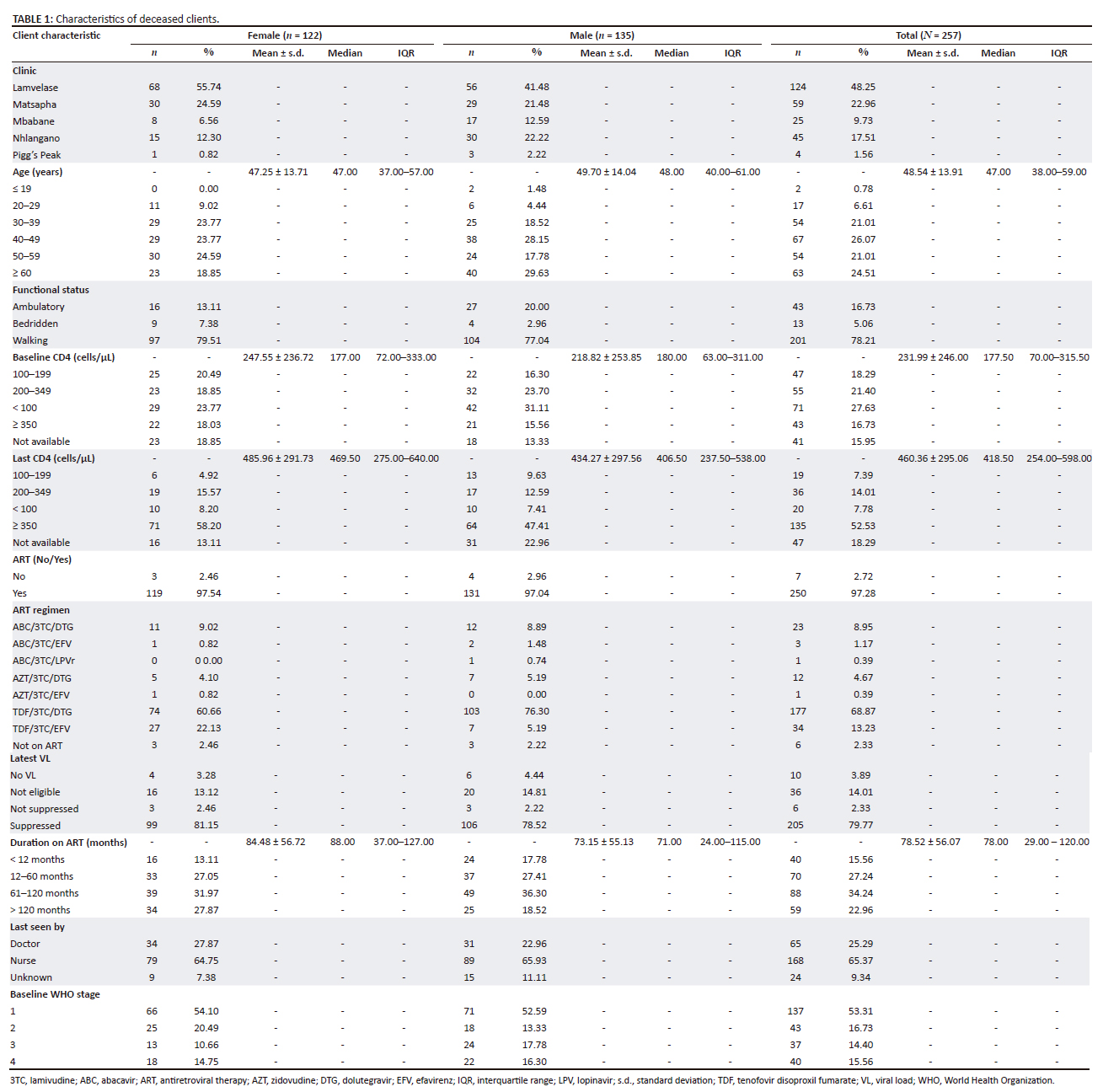
Table 1 summarises the deceased clients' characteristics (n = 257). The median age was 47 years (IQR: 38, 59). The majority who died (n = 240, 92.61%) were aged ≥ 30 years, with more deaths in the 40-49 (n = 67, 26%) and ≥ 60 (n = 63, 24.51%) years age groups. The median baseline CD4 count for all clients was 177 cells/µL (IQR: 71, 315), while the last CD4 count before death was 418 cells/µL (IQR: 255, 596). Based on the last documented VL result, 80% (n = 205) had a suppressed VL (< 1000 copies/mL). Most clients at the time of death (n = 250, 97.28%) had commenced ART, and 82.49% (n = 212) were on a dolutegravir-based ART regimen. The median duration of ART was 78 months (IQR: 29, 120), and 16% (n = 40) had received ART for less than 12 months at the time of death.
Specific causes of death
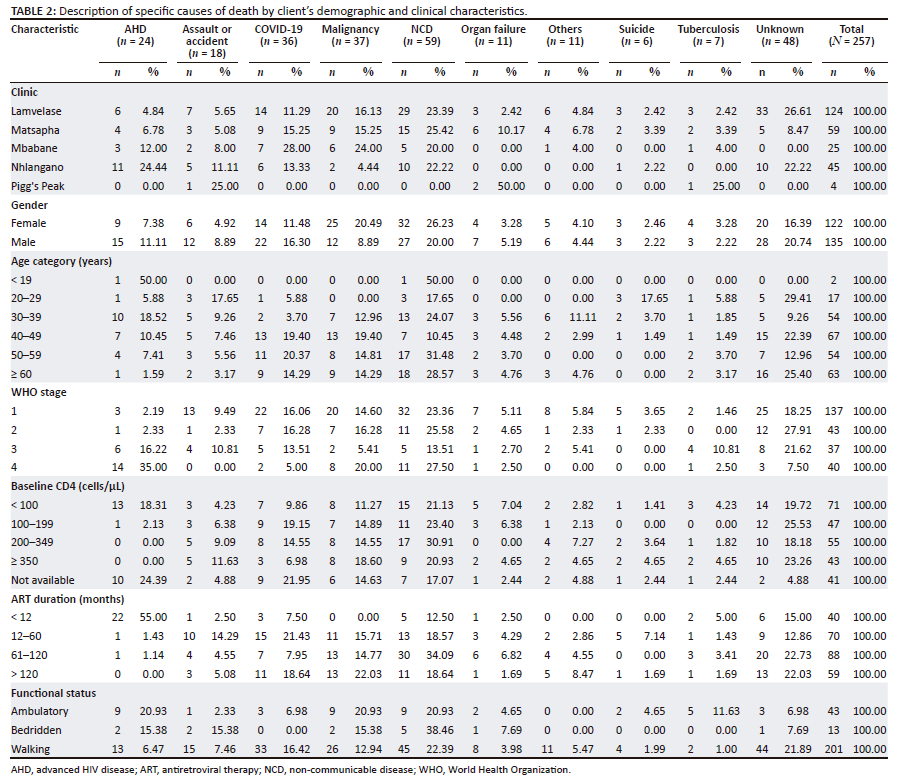
Table 2 and Online Appendix 1 Table 2 summarise the specific causes of death (n = 209) and those with an unknown cause of death (n = 48). The leading causes of death were NCDs (n = 59, 22.96%), malignancies (n = 37, 14.40%), COVID-19 (n = 36, 14.01%) and AHD (n = 24, 9.34%). Of the 257, only 7.00% (n = 18) died from accident or assault, 4.28% (n = 11) from organ failure, 2.72% (n = 7) from tuberculosis, and 2.33% (n = 6) from suicide. Forty-eight (18.68%) had an unknown cause of death. Most clients who died were from the Lamvelase clinic, mostly from NCD (n = 29), malignancy (n = 20) and COVID-19 (n = 14).
Non-communicable diseases
The most reported NCD causes of death were cardiovascular diseases (including hypertension and stroke) (n = 18), chronic kidney disease (n = 15), chronic anaemia of unknown cause (n = 6), and diabetes (n = 5). More NCD-related deaths (n = 32, 54%) occurred in female clients, and while all age groups contributed to NCD deaths, the majority were ≥ 30 years old (n = 55, 93%), mainly with baseline WHO stage 1 or stage 2 HIV disease (n = 43, 72.88%). Most (n = 54, 91.53%) had been on ART for ≥ 12 months.
Malignancy
The most reported malignancies were that of the cervix and urogenitalia (n = 8), prostate and penile tissue (n = 4), skin and soft tissues (n = 4), breast (n = 3) and eye (n = 2). More female clients died from malignancies (n = 25, 67.56%) than male clients (n = 12, 32.43%), and the majority who died were aged ≥ 40 years (n = 30, 81%).
COVID-19
More male (n = 22, 61.11%) than female clients (n = 14, 38.89%) died from COVID-19-related deaths, and the majority of those who died (n = 33, 91.67%) were aged ≥ 40 years old. Twenty-nine (80.56%) were classified as WHO stage 1 or stage 2, and 16 (44.40%) had a baseline CD4 < 200 cells/µL. The majority who died from COVID-19 had been on ART for ≥ 12 months (n = 33, 91.67%) and had a walking functional status (n = 33, 91.67%).
Advanced HIV disease
At baseline, 118 clients (45.91%) presented with AHD (CD4 < 200 cells/µL), while only 39 (15.18%) had a last CD4 < 200 cells/µL. The majority who died from AHD-related conditions were male clients (n = 15, 62.50%), mostly aged ≥ 30 years (n = 22, 91.67%). Most (n = 20, 83.33%) were classified as WHO stage 3 or stage 4, with more than half of these (n = 14, 58.33%) presenting with a baseline CD4 < 200 cells/µL, and 91.67% (n = 22) on ART for less than 12 months.
Assault- or accident-related deaths
More male clients (n = 12, 66.77%) died from assault or accident than female clients (n = 6, 33.33%), with a similar distribution across age groups, although most were from the age group 30-49 years (n = 10, 55.56%). In addition, 72.22% were classified as WHO stage 1, with a similar number of deaths across the different baseline CD4 groups, and more than half of these had been on ART for 12 to 60 months; 83.33% (n = 15) had a walking functional status.
Organ failure, suicide, tuberculosis, and other causes of death
Organ failure was similar between the sexes and across all age groups after age 29. The majority had been on ART for ≥ 12 months (n = 10, 90.91%), and 72.73% (n = 8) had a walking functional status. Most who died from suicide were in WHO stage 1 or stage 2, and most had been on ART for 12 to 60 months (n = 5, 83.33%). Deaths from tuberculosis were similar across both sexes, and most (n = 5, 71%) were classified as WHO stage 3 or stage 4, with varied baseline CD4 and mostly ambulatory functional status (n = 5, 71.43%). Causes of death classified as 'Other' include pneumonia (with similar chest symptoms) (n = 6), acute gastroenteritis (n = 2), sudden collapse (n = 2), and meningitis (n = 1).
Comparison of deceased characteristics and the four leading causes of death
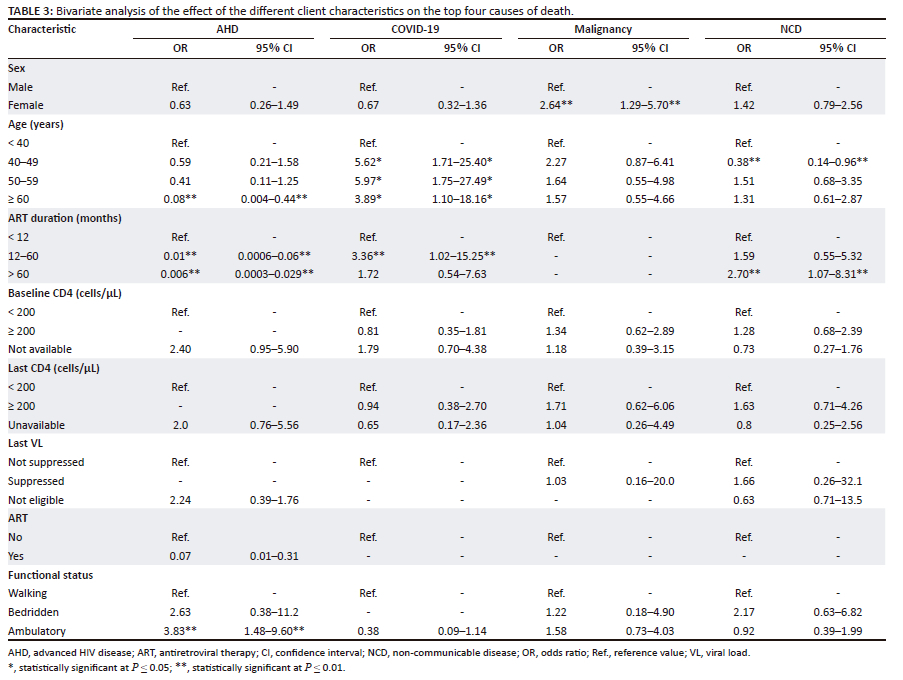
Table 3 describes the bivariate analysis of the different associations between the clients' sociodemographic and clinical characteristics and the four leading causes of death. Compared to clients younger than 40 years, older clients were less likely to die from AHD; the odds were lowest for those aged ≥ 60 years (OR: 0.08; 95% CI: 0.004, 0.44). Similarly, clients who had been on ART for 12 to 60 months (OR: 0.01; 95% CI: 0.0006, 0.06) and > 60 months (OR: 0.006; 95% CI: 0.0003, 0.029) had lower odds of death due to AHD compared to those on ART for less than 12 months. Clients with ambulatory functional status (OR: 3.83; 95% CI: 1.48-9.60) had higher odds of death from AHD than those with a walking functional status.
Clients aged 40-49 years (OR: 5.62; 95% CI: 1.7, 25.4), 50-59 years (OR: 5.97; 95% CI: 1.8, 27.5) and ≥ 60 years (OR: 3.89; 95% CI: 1.10, 18.16) had higher odds of dying from a COVID-19-related complication compared to those aged < 40 years. Female clients (OR: 2.64; 95% CI: 1.29, 5.70) had higher odds of death from a malignancy-related cause than male clients. For NCDs, the age group 40-49 years (OR: 0.38; 95% CI: 0.14, 0.96) had lower odds of death compared to those younger than 40 years, while those on ART for > 60 months (OR: 2.70; 95% CI: 1.07, 8.31) had higher odds of death due to an NCD compared to those on ART for < 12 months.
Discussion
We aimed to describe the specific causes of death amongst PLHIV who died or whose death was reported from January 2021 to June 2022. NCDs, malignancies, COVID-19 and AHD were the leading causes of death. More than half who died were male, and most were aged ≥ 40 years. NCD-related deaths increased with age and duration of ART. The odds of dying from COVID-19-related complications were higher for those aged ≥ 40 years, and more female clients died from malignancy-related causes than male clients. Older clients were less likely to die from AHD, and those on ART for < 12 months were more likely to die from AHD.
Our finding of NCDs as the leading cause of death amongst PLHIV is not surprising. Earlier studies from Tanzania, Zimbabwe and Uganda, while observing the traditional infectious disease causes of death, such as tuberculosis, AIDS-related opportunistic infections and malignancies, observed increasing trends in NCD as a cause of death from 2015.9,10,23,24,25 Cardiovascular diseases (hypertension, stroke), kidney diseases, diabetes mellitus and malignancies have been identified as the most common NCD causes of death from these earlier studies.9,10,23 Additionally, those who died from NCDs were observed to be much older, above 40 years.24,26 Our analysis identified NCDs as the leading cause of mortality, confirming that these trends have progressed.
Unlike studies conducted before 2018 in Burkina Faso, Uganda, Ghana, and South Africa,23,24,26,27 tuberculosis was not among our cohort's top three causes of death. This could be attributed to the fact that PLHIV now access more effective ART with improved immune response against opportunistic infections, and are living to older ages (common with NCDs).27,28 For instance, 80% of clients in our cohort had a suppressed last VL, and 71% were ≥ 40 years old, an age commonly associated with NCDs. In addition to the above, HIV-tuberculosis coinfection has dropped over the years in Eswatini, which could be partially attributed to the high coverage of tuberculosis prophylactic treatment amongst PLHIV in Eswatini.29
The observed deaths from malignancies in our cohort, mainly from genital cancers amongst female clients, indicate a limited availability of cancer prevention, screening, and treatment services within the HIV programme in Eswatini. For instance, human papillomavirus (HPV) vaccines have only been recently rolled out and are not widely accessible, and few eligible women living with HIV have access to cervical screening and treatment services, as this is offered in only 37% of health facilities.30,31 Previously, most PLHIV died from malignancies caused by non-Hodgkin lymphoma and Kaposi Sarcoma.32
Death from COVID-19-related complications ranked high in our list of causes of death - not surprising, as data from our cohort were obtained at the peak of the COVID-19 pandemic. Evidence suggests that most COVID-19-related deaths occurred in people aged ≥ 40 years,3333
Contrary to earlier studies in Tanzania and Zimbabwe, where ≥ 50% of HIV-related deaths occurred within the first year of commencing ART and from acute causes,9,10 most of our clients survived the first year of treatment, with only 15% dying within the first 12 months of treatment and 57% after 60 months of treatment, indicating that clients are more stable at diagnosis. The causes of death have shifted from acute to more chronic conditions. In three earlier studies from Sierra Leone,34352525,34,35 This is different from our study, as only 5% of clients who died were bedridden, with older adults (≥ 40 years) having lower odds of dying from AHD. This observed difference could be due to changes in treatment guidelines, for example test-and-treat,363,37 as well as the introduction of a more potent ART such as dolutegravir and the scale-up of HIV prevention, testing and treatment services in high-burden countries and amongst different sub-population groups.
Strengths and limitations
Given the widespread use of ART in Eswatini and the achievement of HIV epidemic control, this study contributes to the literature on the possible causes of death in a mature HIV programme. This will guide other programmes to institute adequate preventive measures when scaling up HIV services. Second, data for this study were obtained during the COVID-19 pandemic, which enabled us to explore the associations between different client characteristics and COVID-19 as a cause of death.
However, our study has limitations. First, we used data from health facility records to determine the cause of death without forensics, comprehensive autopsy reports or, at a minimum, verbal autopsy. Some causes of death may have been incorrectly assigned, especially for those who died at home. It was determined that the client's most recent documented condition was the cause of death when there was no identifiable cause of death. A unified vital records system for reporting and documenting deaths is yet to be rolled out in Eswatini, and our approach provided an approximate method for describing the cause of death. Second, service delivery during the pandemic was variable and could have limited services received by a client. Third, we could not identify the cause of death for about a fifth of the clients, and mortality might have been underestimated due to unreported deaths among unreachable clients reported as lost to follow-up. This could have biased our estimates for the causes of death. Despite these limitations, we believe some key learnings from this study will be helpful to different cadres of healthcare workers and HIV programme implementers.
Conclusion
As most of our clients were ≥ 40 years old and died from an NCD; the integration of NCD screening and treatment services into infectious disease programmes, as recommended by the WHO.38 More women died from malignancies than men, which could have been avoided if HPV vaccines and screening for cervical cancer were widely accessible. Context-specific interventions targeting men and middle-aged people (30-39 years age group) aimed at early diagnoses and treatment can further limit the presentation of AHD and death in middle-aged people. Finally, the rollout of an effective vital records registration system for deaths would help to track the number, trends and causes of death in the general population and amongst ART clients across multiple databases and through records linkage.
Competing interests
The authors declare that they have no financial or personal relationships that may have inappropriately influenced them in writing this article.
Authors' contributions
Y.M., S.K., V.W., Nduduzo D., and S.H. were responsible for conceptualisation of the study. Y.M., S.K., E.N., N.N., K.M., H.S., S.G., N.M., Nduduzo D., L.B., and Nduduzo D. were involved in client care and documentation. S.N., K.M., H.S., and S.G. took care of data extraction, and Y.M., V.W., S.N., A.K., and A.M. analysed the data. The first draft was written by Y.M., V.W., and S.K., and reviewed by E.N., N.N., A.K., N.M., A.M., P.B., Nduduzo D., L.B., Nkululeko D., and S.H. Ethical clearance was obtained by Y.M., and S.K. Y.M., S.K., V.W., S.N., E.N., N.N., A.K., K.M., H.S., S.G., N.M., A.M., P.B., N.D., L.B., N.D. and S.H. reviewed and approved the final draft.
Funding information
The write-up of this research did not receive any specific funding. The AIDS Healthcare Foundation (AHF) LaMvelase Clinic, Manzini, Eswatini, receives technical assistance from the Support Eswatini Achieve and Sustain HIV Epidemic Control (SEASEC) Program funded by the US President's Emergency Plan for AIDS Relief (PEPFAR) through the Centers for Disease Control and Prevention (CDC) (Co-operative Agreement No.: NU2GGH002294), implemented by Georgetown University in collaboration with the Government of the Kingdom of Eswatini. Alexander Kay's training award was granted by the National Institutes of Health (1K01TW011482-01A1; PI A Kay).
Data availability
The data used for this study are available from the corresponding author, V.W., upon reasonable request.
Disclaimer
The views and opinions expressed in this article are those of the authors and are the product of professional research. It does not necessarily reflect the official policy or position of any affiliated institution, funder, agency, or that of the publisher. The authors are responsible for this article's results, findings, and content.
Acknowledgements
We thank the healthcare workers who assisted with client care and data collection and the client's relatives for providing some details that helped clarify the cause of death.
REFERENCES
-
1. Joint United Nations AIDS Program. Eswatini: Country factsheets 2023 [homepage on the Internet]. [cited 2024 Jul 24]. Available from: https://www.unaids.org/en/regionscountries/countries/swaziland
» https://www.unaids.org/en/regionscountries/countries/swaziland -
2. World Health Organization. HIV - Number of people dying from HIV-related causes [homepage on the Internet]. Geneva: WHO; 2022 [cited 2024 Feb 20]. Available from: https://www.who.int/data/gho/data/indicators/indicator-details/GHO/number-of-deaths-due-to-hiv-aids
» https://www.who.int/data/gho/data/indicators/indicator-details/GHO/number-of-deaths-due-to-hiv-aids -
3. Croxford S, Kitching A, Desai S, et al. Mortality and causes of death in people diagnosed with HIV in the era of highly active antiretroviral therapy compared with the general population: An analysis of a national observational cohort. Lancet Public Health. 2017;2(1):e35-e46. https://doi.org/10.1016/S2468-2667(16)30020-2
» https://doi.org/10.1016/S2468-2667(16)30020-2 -
4. Marcus JL, Leyden WA, Alexeeff SE, et al. Comparison of overall and comorbidity-free life expectancy between insured adults with and without HIV infection, 2000-2016. JAMA Netw Open. 2020;3(6):e207954. https://doi.org/10.1001/jamanetworkopen.2020.7954
» https://doi.org/10.1001/jamanetworkopen.2020.7954 -
5. Bloch EM, Shoham S, Casadevall A, et al. Deployment of convalescent plasma for the prevention and treatment of COVID-19. J Clin Invest. 2020;130(6):2757-2765. https://doi.org/10.1172/JCI138745
» https://doi.org/10.1172/JCI138745 -
6. World Health Organization. HIV statistics, globally and by WHO region, 2023 [homepage on the Internet]. Geneva: WHO; 2023 [cited 2024 Jul 24]. Available from: https://cdn.who.int/media/docs/default-source/hq-hiv-hepatitis-and-stis-library/j0294-who-hiv-epi-factsheet-v7.pdf
» https://cdn.who.int/media/docs/default-source/hq-hiv-hepatitis-and-stis-library/j0294-who-hiv-epi-factsheet-v7.pdf -
7. World Health Organization. WHO reveals leading causes of death and disability worldwide: 2000-2019 [homepage on the Internet]. Geneva: WHO; 2020 [cited 2024 Feb 20]. Available from: https://www.who.int/news/item/09-12-2020-who-reveals-leading-causes-of-death-and-disability-worldwide-2000-2019
» https://www.who.int/news/item/09-12-2020-who-reveals-leading-causes-of-death-and-disability-worldwide-2000-2019 -
8. Joint United Nations AIDS Program. Global HIV & AIDS statistics - Fact sheet [homepage on the Internet]. 2024 [cited 2024 Jul 22]. Available from: https://www.unaids.org/en/resources/fact-sheet
» https://www.unaids.org/en/resources/fact-sheet -
9. Mollel GJ, Moshi L, Hazem H, et al. Causes of death and associated factors over a decade of follow-up in a cohort of people living with HIV in rural Tanzania. BMC Infect Dis. 2022;22(1):37. https://doi.org/10.1186/s12879-021-06962-3
» https://doi.org/10.1186/s12879-021-06962-3 -
10. Chimbetete C, Shamu T, Roelens M, Bote S, Mudzviti T, Keiser O. Mortality trends and causes of death among HIV positive patients at Newlands Clinic in Harare, Zimbabwe. PLoS One. 2020;15(8):e0237904. https://doi.org/10.1371/journal.pone.0237904
» https://doi.org/10.1371/journal.pone.0237904 -
11. Pettit AC, Giganti MJ, Ingle SM, et al. Increased non-AIDS mortality among persons with AIDS-defining events after antiretroviral therapy initiation. J Int AIDS Soc. 2018;21(1):e25031. https://doi.org/10.1002/jia2.25031
» https://doi.org/10.1002/jia2.25031 -
12. At a glance: HIV in Eswatini [homepage on the Internet]. Be in the KNOW. [cited 2024 Feb 20]. Available from: https://www.beintheknow.org/understanding-hiv-epidemic/data/glance-hiv-eswatini
» https://www.beintheknow.org/understanding-hiv-epidemic/data/glance-hiv-eswatini -
13. Akullian A, Vandormael A, Miller JC, et al. Large age shifts in HIV-1 incidence patterns in KwaZulu-Natal, South Africa. Proc Natl Acad Sci USA. 2021;118(28):e2013164118. https://doi.org/10.1073/pnas.2013164118
» https://doi.org/10.1073/pnas.2013164118 -
14. Akullian A, Morrison M, Garnett GP, et al. The effect of 90-90-90 on HIV-1 incidence and mortality in eSwatini: A mathematical modelling study. Lancet HIV. 2020;7(5):e348. https://doi.org/10.1016/S2352-3018(19)30436-9
» https://doi.org/10.1016/S2352-3018(19)30436-9 -
15. World Health Organization. Global health estimates: Leading causes of death [homepage on the Internet]. [cited 2024 Jul 25]. Available from: https://www.who.int/data/gho/data/themes/mortality-and-global-health-estimates/ghe-leading-causes-of-death
» https://www.who.int/data/gho/data/themes/mortality-and-global-health-estimates/ghe-leading-causes-of-death -
16. National Emergency Response Council on HIV and AIDS. Eswatini HIV estimates and projections report 2021 [homepage on the Internet]. Mbabane: NERCHA; 2022 [cited 2024 Feb 22]. Available from: https://infocenter.nercha.org.sz/hiv-estimates-and-projections-2021
» https://infocenter.nercha.org.sz/hiv-estimates-and-projections-2021 -
17. The Global Fund. Eswatini Meets Global 95-95-95 HIV Target [homepage on the Internet]. 2020 [cited 2024 Feb 13]. Available from: https://www.theglobalfund.org/en/stories/2020/2020-09-14-eswatini-meets-global-95-95-95-hiv-target/
» https://www.theglobalfund.org/en/stories/2020/2020-09-14-eswatini-meets-global-95-95-95-hiv-target/ -
18. United States Centers for Disease Control. Thembi's story: Hope in the epicenter of the epidemic [homepage on the Internet]. 2022 [cited 2024 Feb 20]. Available from: https://www.cdc.gov/globalhivtb/who-we-are/success-stories/success-story-pages/thembistory-eswatini.html
» https://www.cdc.gov/globalhivtb/who-we-are/success-stories/success-story-pages/thembistory-eswatini.html -
19. World Health Organization. Eswatini achieves the 95-95-95 HIV treatment target - A decade ahead of 2030 goal [homepage on the Internet]. WHO | Regional Office for Africa; 2023 [cited 2024 Feb 22]. Available from: https://www.afro.who.int/countries/eswatini/news/eswatini-achieves-95-95-95-hiv-treatment-target-decade-ahead-2030-goal
» https://www.afro.who.int/countries/eswatini/news/eswatini-achieves-95-95-95-hiv-treatment-target-decade-ahead-2030-goal -
20. Government of the Kingdom of Swaziland Ministry of Health. Swaziland integrated HIV management guideline 2018 [homepage on the Internet]. Mbabane: MOH; 2019 [cited 2024 Feb 22]. Available from: http://swaziaidsprogram.org/wp-content/uploads/2021/07/2018-Integrated-HIV-Management-Guidelines_final-1.pdf
» http://swaziaidsprogram.org/wp-content/uploads/2021/07/2018-Integrated-HIV-Management-Guidelines_final-1.pdf -
21. Thejus T, Jeeja M, Jayakrishnan T. The functional status of patients with AIDS attending antiretroviral treatment center. Indian J Palliat Care. 2009;15(1):57-60. https://doi.org/10.4103/0973-1075.53513
» https://doi.org/10.4103/0973-1075.53513 -
22. World Health Organization. Patient monitoring guidelines for HIV care and antiretroviral therapy (ART) [homepage on the Internet]. Geneva: WHO; 2006 [cited 2024 Mar 25]. Available from: https://iris.who.int/bitstream/handle/10665/43382/9241593881_eng.pdf
» https://iris.who.int/bitstream/handle/10665/43382/9241593881_eng.pdf -
23. Kiragga AN, Mubiru F, Kambugu AD, Kamya MR, Castelnuovo B. A decade of antiretroviral therapy in Uganda: What are the emerging causes of death? BMC Infect Dis. 2019;19(1):77. https://doi.org/10.1186/s12879-019-3724-x
» https://doi.org/10.1186/s12879-019-3724-x -
24. Kouanda S, Meda IB, Nikiema L, et al. Determinants and causes of mortality in HIV-infected patients receiving antiretroviral therapy in Burkina Faso: A five-year retrospective cohort study. AIDS Care. 2012;24(4):478-490. https://doi.org/10.1080/09540121.2011.630353
» https://doi.org/10.1080/09540121.2011.630353 -
25. Lewden C, Drabo YJ, Zannou DM, et al. Disease patterns and causes of death of hospitalized HIV-positive adults in West Africa: A multicountry survey in the antiretroviral treatment era. J Int AIDS Soc. 2014;17(1):18797. https://doi.org/10.7448/IAS.17.1.18797
» https://doi.org/10.7448/IAS.17.1.18797 -
26. Trickey A, May MT, Vehreschild J, et al. Cause-specific mortality in HIV-positive patients who survived ten years after starting antiretroviral therapy. PLoS One. 2016;11(8):e0160460. https://doi.org/10.1371/journal.pone.0160460
» https://doi.org/10.1371/journal.pone.0160460 -
27. Cresswell F, Fisher M. HIV and the ageing patient. Medicine. 2013;41(8):456-460. https://doi.org/10.1016/j.mpmed.2013.05.014
» https://doi.org/10.1016/j.mpmed.2013.05.014 -
28. Smit M, Olney J, Ford NP, et al. The growing burden of noncommunicable disease among persons living with HIV in Zimbabwe. AIDS. 2018;32(6):773-782. https://doi.org/10.1097/QAD.0000000000001754
» https://doi.org/10.1097/QAD.0000000000001754 -
29. StopTB Partnership. Tuberculosis situation in 2020: Eswatini TB dashboard [homepage on the Internet]. Geneva; 2020 [cited 2024 Mar 25]. Available from: https://www.stoptb.org/static_pages/SWZ_Dashboard.html
» https://www.stoptb.org/static_pages/SWZ_Dashboard.html -
30. World Health Organization. Eswatini: Launching HPV vaccination [homepage on the Internet]. Geneva: WHO; 2023 [cited 2024 Feb 14]. Available from: https://www.afro.who.int/countries/eswatini/news/launching-hpv-vaccination
» https://www.afro.who.int/countries/eswatini/news/launching-hpv-vaccination -
31. Eswatini Ministry of Health. Service Availability and Readiness Assessment (SARA) Eswatini 2017 [homepage on the Internet]. Mbabane: MOH; 2022 [cited 2024 Feb 16]. Available from: https://data-archive.hhfa.online/index.php/catalog/85/related-materials
» https://data-archive.hhfa.online/index.php/catalog/85/related-materials -
32. Chinula L, Moses A, Gopal S. HIV-associated malignancies in sub-Saharan Africa: Progress, challenges, opportunities. Curr Opin HIV AIDS. 2017;12(1):89-95. https://doi.org/10.1097/COH.0000000000000329
» https://doi.org/10.1097/COH.0000000000000329 -
33. Zhang J-J, Dong X, Liu G-H, Gao Y-D. Risk and protective factors for COVID-19 morbidity, severity, and mortality. Clin Rev Allerg Immunol. 2023;64(1):90-107. https://doi.org/10.1007/s12016-022-08921-5
» https://doi.org/10.1007/s12016-022-08921-5 -
34. Lakoh S, Jiba DF, Kanu JE, et al. Causes of hospitalization and predictors of HIV-associated mortality at the main referral hospital in Sierra Leone: A prospective study. BMC Public Health. 2019;19(1):1320. https://doi.org/10.1186/s12889-019-7614-3
» https://doi.org/10.1186/s12889-019-7614-3 -
35. Saavedra A, Campinha-Bacote N, Hajjar M, et al. Causes of death and factors associated with early mortality of HIV-infected adults admitted to Korle-Bu Teaching Hospital. Pan Afr Med J. 2017;27:48. https://doi.org/10.11604/pamj.2017.27.48.8917
» https://doi.org/10.11604/pamj.2017.27.48.8917 -
36. World Health Organization. Progress report 2016: Prevent HIV, test and treat all: WHO support for country impact [homepage on the Internet]. Geneva: WHO; 2016 [cited 2024 Feb 22]. Available from: https://iris.who.int/bitstream/handle/10665/251713/whohiv?sequence=1
» https://iris.who.int/bitstream/handle/10665/251713/whohiv?sequence=1 -
37. Wajanga BM, Webster LE, Peck RN, et al. Inpatient mortality of HIV-infected adults in sub-Saharan Africa and possible interventions: A mixed methods review. BMC Health Serv Res. 2014;14:627. https://doi.org/10.1186/s12913-014-0627-9
» https://doi.org/10.1186/s12913-014-0627-9 -
38. World Health Organization. Integrating the prevention and control of noncommunicable diseases in HIV/AIDS, tuberculosis, and sexual and reproductive health programmes: Implementation guidance [homepage on the Internet]. Geneva: WHO; 2023 [cited 2024 Jul 24]. Available from: https://www.who.int/publications/i/item/9789240061682
» https://www.who.int/publications/i/item/9789240061682

Accepted: 29 July 2024
Published: 28 Oct. 2024