Intracranial pressure management in patients with human immunodeficiency virus-associated cryptococcal meningitis in a resource-constrained setting
Abstract
BACKGROUND: Cryptococcal meningitis (CCM) is the leading cause of meningitis in people living with HIV (PLWH) in sub-Saharan Africa (SSA). The mortality and morbidity associated with CCM remain high. Combination of antifungal therapy, diligent management of intracranial pressure (IP) and the correct timing of the introduction of antiretroviral therapy (ART) minimise the risk of mortality and morbidity. The absence of spinal manometers in many healthcare centres in SSA challenges the accurate measurement of cerebrospinal fluid (CSF) pressure and its controlOBJECTIVES: We hypothesised that four lumbar punctures (LPs) in the first week of the diagnosis and treatment of CCM would reduce IP such that in-hospital mortality and morbidity of HIV-associated CCM (HIV/CCM) would be significantly reducedMETHODS: We conducted a retrospective study to assess whether receipt of four or more LPs in the first week of the diagnosis and treatment with combination antifungal therapy of HIV/CCM would be associated with the reduction of in-hospital mortality in adult PLWHRESULTS: From 01 January 2016 to 31 December 2016, 116 adult patients were admitted to the Dora Nginza District Hospital in Zwide, Port Elizabeth, South Africa. After exclusion of 11 (two were younger than 18 years, two had missing hospital records and seven demised or left the hospital before 7 days of hospitalisation), 105 patients were included in the analysis. The mean age was 39.4 (standard deviation [s.d.] ± 9.7) years, 64.8% were male. All were PLWH. A total of 52.4% had defaulted ART and 25.7% were ART naïve. Forty-three patients received four or more LPs (mean = 4.58 [± 0.96]) in the first week of hospitalisation with an associated in-hospital mortality of 11.6% (n = 5/43) compared with 62 patients who received less than four LPs (mean = 2.18 [± 0.80]) with an in-hospital mortality of 29% (n = 18/62) and a relative risk of 0.80 (95% CI, 0.66-0.97), p = 0.034CONCLUSION: In the current study of adult PLWH presenting to hospital with HIV/CCM, four or more LPs in the first 7 days following admission and the initiation of treatment were associated with a 17.4% reduction in absolute risk of in-hospital mortality and a 20% reduction in relative risk of in-hospital mortality. This mortality difference was noted in patients who survived and were in hospital at the time of the 7-day study census and persisted until the time of hospital discharge
cryptococcal meningitis; HIV; antifungal therapy; antiretroviral therapy; in-hospital mortality; adult PLWH
Background
Cryptococcal meningitis (CCM) accounts for up to 60% of meningitis in adult persons living with HIV (PLWH) in many African countries including South Africa (SA).1,2 Those with CD4 cell counts < 100 cells/µL are particularly at risk.334567
The initial (induction phase) management of HIV/CCM requires the following: (1) combination antifungal therapy including IV amphotericin B and oral flucytosine (first week only) and high-dose oral fluconazole 1200 mg daily (second week), after that an 8-week consolidation phase of oral fluconazole 800 mg daily, (2) control of raised intracranial pressure (rIP) with therapeutic lumbar punctures (LPs) to maintain the 'opening-pressure' (CSF-OP) at < 25 cm of water and (3) minimising the risk of immune reconstitution inflammatory syndrome (IRIS) by delaying the initiation of ART until 4 to 6 weeks after the start of antifungal therapy.8,9,10,11,12
In the absence of a spinal manometer, the SA guidelines for the prevention, diagnosis and management of CCM recommend performing an LP to remove 20 mL - 30 mL of CSF if the symptoms and signs of rIP are present.1213,14 A symptom guided approach has the potential to miss asymptomatic patients who might benefit from therapeutic LPs.
We hypothesised that four or more LPs in the first 7 days of treatment could facilitate CSF drainage and reduce in-hospital mortality in PLWH and HIV/CCM in a resource constrained setting where there are no spinal manometers. We, therefore, conducted a single centre retrospective cohort study to determine the impact on in-hospital mortality of four or more LPs in the first 7 days of antifungal therapy compared with PLWH/CCM who received fewer than four LPs.
Methods
Study design
The study was designed as a retrospective cohort review of PLWH/CCM admitted to the department of medicine at the Dora Nginza Hospital from 01 January 2016 to 31 December 2016. The Dora Nginza Hospital is a district hospital located in the Zwide township of the Nelson Mandela Bay Municipality (Port Elizabeth), SA. The Nelson Mandela Bay region has a population of 1 152 115 and an unemployment rate of 36.6%.15without access to intensive or high care services and with limited access to radiological imaging apart from plain chest radiography.
Study population
Clinical notes, discharge summaries and death notification registries were reviewed to identify patients who received a primary or secondary diagnosis of CCM.
Data collection
A standardised data collection form was prepared. This included patient demographic details, comorbidities, history of previous CCM, data of concurrent tuberculosis (TB) and details of the index admission. Patients' folders were checked for the results of therapeutic LPs and to document the indications for the procedure. The National Health Laboratory Services (NHLS) computer records were accessed for admission bloods, CD4 count, HIV viral load (VL) and CSF results. Identifying patient material was anonymised at the time of the collection and storage of data.
Statistical analysis
Continuous variables are reported as mean (± standard deviation, [s.d.]) when normally distributed and as median (interquartile range, IQR) when not normally distributed. Discrete data are presented as number and percentages. Pearson's chi-square test and corresponding 95% Confidence Intervals (CI) were used to calculate the mortality difference between the study and comparator groups. A p-value of < 0.05 defined significance. Patients who died or left hospital within the first 7 days were excluded from the mortality analysis. Statistical analyses were performed by using IBM SPSS Statistics for Macintosh version 24.0.
Ethical consideration
Approval to conduct the study was obtained from Walter Sisulu University Human Research Committee. Ethical clearance number: 027/2018.
Results
Clinical characteristics of the study population
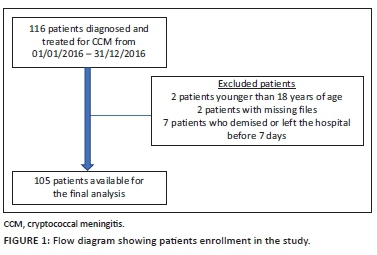
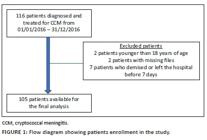
From 01 January 2016 to 31 December 2016, a total of 116 patients received a diagnosis of CCM. After exclusion of 11 (two were younger than 18 years, two had missing hospital files/records and seven demised or left the hospital before 7 days of hospitalisation), 105 patients were available for study analysis (Figure 1).
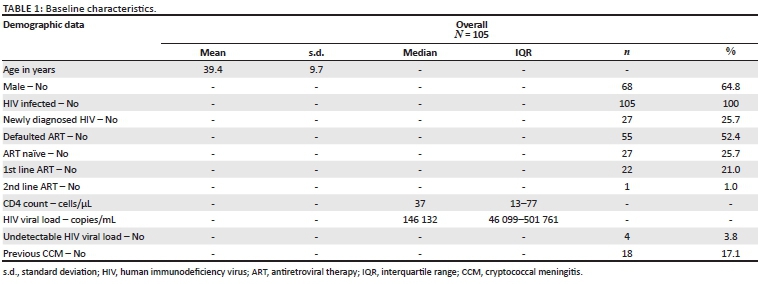
The mean age of patients was 39.4 (s.d. ± 9.7) years. A total of 65.2% were male. All the patients were PLWH and had a median CD4 count = 37 (IQR, 13-77) cells/µL. Human immunodeficiency virus infection was newly diagnosed on the index admission in 25.7%. Default from previous ART was recorded in 52.4% of patients (Table 1).
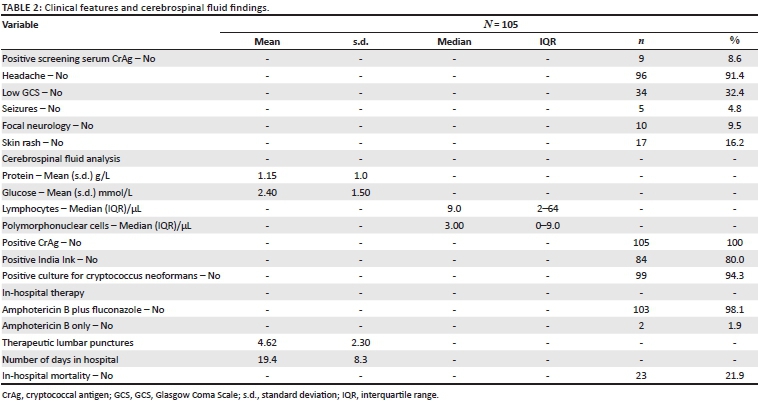
A total of 17.1% of patients gave a history of previous CCM. Headache was the most prevalent presenting symptom (91.4%) followed by a low Glasgow Coma Scale (32.4%) (Table 2). A total of 9.5% of patients had a focal neurological deficit, namely an abducent (cranial nerve 6) palsy, suggesting possible rIP at presentation. The diagnosis of CCM was based on a positive CSF-Cryptococcal Antigen (CrAg) in all patients, a positive CSF India Ink in 80% and a positive CSF culture for Cryptococcus neoformans in 94.3%. One hundred and three (n = 103) patients received local guideline-based therapy consisting of a combination of amphotericin B and fluconazole. Two patients did not receive fluconazole: one had acute hepatitis B and the other, a drug-induced liver injury (DILI) resulting from TB therapy.
Therapeutic lumbar punctures and hospital mortality
A total of 496 LPs were performed. Each patient received a mean of 4.62 (s.d. ± 2.30) therapeutic LPs (all patients). The mean duration of hospitalisation of the entire group was 19.4 (s.d. ± 8.3) days. A total of n = 23/105 (21.9%) patients died during the index hospitalisation.
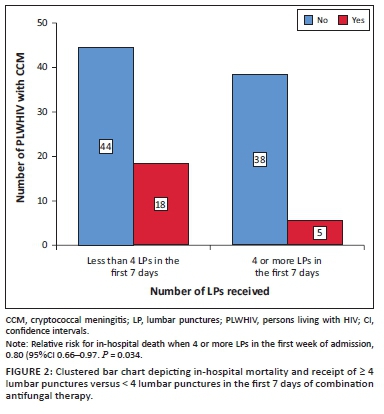
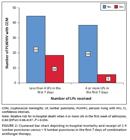
Patients who received ≥ 4 LPs in the first 7 days had an in-hospital mortality rate of 11.6% (n = 5/43), whereas those with < 4 LPs in the first 7 days had in-hospital mortality of 29% (n = 18/62). This represents a 17.4% absolute risk reduction of in-hospital mortality and a relative risk of 0.80 (95% CI, 0.66-0.97, p = 0.034), namely a 20% relative risk reduction of in-hospital mortality (Figures 2 and 3). Patients who received four or more LPs in the first 7 days received a mean of 4.58 (s.d. ± 0.96) LPs in the first week of treatment.

Discussion
In this retrospective study of patients with HIV/CCM, receipt of four more LPs in the first week of diagnosis and treatment was associated with reduced in-hospital mortality. These findings inform the recorded 98.2% compliance of hospital staff with local guideline-based treatment of CCM with combination antifungal therapy.
Raised intracranial pressure develops in most PLWH with HIV/CCM and portends a poor prognosis if not adequately treated.161718,19 Despite the increased prevalence of rIP, therapeutic LPs are seldom instituted even when symptoms and signs of rIP are present.13,16 In a clinical audit by Adeyemi and Ross, only 23% of patients with CCM related headaches received therapeutic LPs despite 82% of patients receiving analgesia for their pain.131414
Spinal manometers are recommended for the measurement of rIP. In resource limited settings spinal manometers are seldom available. Instead, guidelines recommend using tubing from intravenous giving-sets.20212O versus 22.7 (s.d ± 10) cm H2O, p < 0.001.2212
The optimal management of CCM consists of a triad of (1) combination antifungal therapy, (2) intracranial pressure (IP) management with CSF drainage and (3) immune reconstitution with ART after completion of 4 to 6 weeks of combination antifungal therapy to avoid CCM-IRIS.12
The limitations of this study include it's retrospective and single centres design. Also, we do not have data on the volume of CSF removed and survival beyond the index hospitalisation.
In conclusion, this study shows that PLWH/CCM can be effectively managed in centres with limited access to spinal manometers. We have shown that ≥ four LPs with CSF drainage in the first 7 days of hospitalisation improves early survival.
Competing interests
The authors have declared that no competing interest exists.
Authors' contributions
P.M. designed the study and collected the data. J.D. and S.N. collected the data.
Funding information
This research received no specific grant from any funding agency in the public, commercial or not-for-profit sectors.
Data availability statement
Data are available on request.
Disclaimer
Data sharing is not applicable to this article as no new data were created or analysed in this study.
Acknowledgements
We would like to thank Professor Graeme Meintjes for his insight and advice.
References
-
1.Durski KN, Kuntz KM, Yasukawa K, Virnig BA, Meya DB, Boulware DR. Cost-effective diagnostic checklists for meningitis in resource-limited settings. J Acquir Immune Defic Syndr. 2013;63(3):e101-e108. https://doi.org/10.1097/QAI.0b013e31828e1e56
» https://doi.org/10.1097/QAI.0b013e31828e1e56 -
2.Jarvis JN, Meintjes G, Williams A, Brown Y, Crede T, Harrison TS. Adult meningitis in a setting of high HIV and TB prevalence: Findings from 4961 suspected cases. BMC Infect Dis. 2010;10:67. https://doi.org/10.1186/1471-2334-10-67
» https://doi.org/10.1186/1471-2334-10-67 -
3.Sloan DJ, Parris V. Cryptococcal meningitis: Epidemiology and therapeutic options. Clin Epidemiol. 2014;6:169-182. https://doi.org/10.2147/CLEP.S38850
» https://doi.org/10.2147/CLEP.S38850 -
4.Jarvis JN, Bicanic T, Loyse A, et al. Determinants of mortality in a combined cohort of 501 patients with HIV-associated cryptococcal meningitis: Implications for improving outcomes. Clin Infect Dis. 2014;58(5):736-745. https://doi.org/10.1093/cid/cit794
» https://doi.org/10.1093/cid/cit794 -
5.Arez AP, Pyrgos V, Seitz AE, Steiner CA, Prevots DR, Williamson PR. Epidemiology of cryptococcal meningitis in the US: 1997-2009. PLoS One. 2013;8(2):e56269. https://doi.org/10.1371/journal.pone.0056269
» https://doi.org/10.1371/journal.pone.0056269 -
6.Park BJ, Wannemuehler KA, Marston BJ, Govender N, Pappas PG, Chiller TM. Estimation of the current global burden of cryptococcal meningitis among persons living with HIV/AIDS. AIDS. 2009;23(4):525-530. https://doi.org/10.1097/QAD.0b013e328322ffac
» https://doi.org/10.1097/QAD.0b013e328322ffac -
7.Jarvis JN, Boulle A, Loyse A, et al. High ongoing burden of cryptococcal disease in Africa despite antiretroviral roll out. AIDS. 2009;23(9):1182-1183. https://doi.org/10.1097/QAD.0b013e32832be0fc
» https://doi.org/10.1097/QAD.0b013e32832be0fc -
8.Perfect JR, Dismukes WE, Dromer F, et al. Clinical practice guidelines for the management of cryptococcal disease: 2010 update by the infectious diseases society of America. Clin Infect Dis. 2010;50(3):291-322. https://doi.org/10.1086/649858
» https://doi.org/10.1086/649858 -
9.Govender NP, Dlamini S. Management of HIV-associated cryptococcal disease in South Africa. S Afr Med J. 2014;104(12):896. https://doi.org/10.7196/SAMJ.9070
» https://doi.org/10.7196/SAMJ.9070 -
10.Govender NP, Meintjes G, Bicanic T, et al. Guideline for the prevention, diagnosis and management of cryptococcal meningitis among HIV-infected persons: 2013 update. S Afr J HIV Med. 2013;14(2):76-86. https://doi.org/10.4102/sajhivmed.v14i2.82
» https://doi.org/10.4102/sajhivmed.v14i2.82 -
11.Boulware DR, Meya DB, Muzoora C, et al. Timing of antiretroviral therapy after diagnosis of cryptococcal meningitis. N Engl J Med. 2014;370(26):2487-2498. https://doi.org/10.1056/NEJMoa1312884
» https://doi.org/10.1056/NEJMoa1312884 -
12.Govender NP, Meintjes G, Mangena P, et al. Southern African HIV clinicians society guideline for the prevention, diagnosis and management of cryptococcal disease among HIV-infected persons: 2019 update. S Afr J HIV Med. 2019;20(1):a1030. https://doi.org/10.4102/sajhivmed.v20i1.1030
» https://doi.org/10.4102/sajhivmed.v20i1.1030 -
13.Adeyemi BO, Ross A. Management of cryptococcal meningitis in a district hospital in KwaZulu-Natal: A clinical audit. Afr J Prim Health Care Fam Med. 2014;6(1):672. https://doi.org/10.4102/phcfm.v6i1.672
» https://doi.org/10.4102/phcfm.v6i1.672 -
14.Rolfes MA, Hullsiek KH, Rhein J, et al. The effect of therapeutic lumbar punctures on acute mortality from cryptococcal meningitis. Clin Infect Dis. 2014;59(11):1607-1614. https://doi.org/10.1093/cid/ciu596
» https://doi.org/10.1093/cid/ciu596 -
15.Stats SA. Nelson Mandela Bay [homepage on the Internet] [cited 2019 Jun 18]. Available from: https://www.statssa.gov.za/?page_id=1021&id=nelson-mandela-bay-municipality
» https://www.statssa.gov.za/?page_id=1021&id=nelson-mandela-bay-municipality -
16.Graybill JR, Sobel J, Saag M, et al. Diagnosis and management of increased intracranial pressure in patients with AIDS and cryptococcal meningitis. Clin Infect Dis. 2000;30(1):47-54. https://doi.org/10.1086/313603
» https://doi.org/10.1086/313603 -
17.Sun H-Y, Hung C-C, Chang S-C. Management of cryptococcal meningitis with extremely high intracranial pressure in HIV-infected patients. Clin Infect Dis. 2004;38(12):1790-1792. https://doi.org/10.1086/421272
» https://doi.org/10.1086/421272 -
18.Day J, Imran D, Ganiem AR, et al. CryptoDex: A randomised, double-blind, placebo-controlled phase III trial of adjunctive dexamethasone in HIV-infected adults with cryptococcal meningitis: Study protocol for a randomised control trial. Trials. 2014;15:441. https://doi.org/10.1186/1745-6215-15-441
» https://doi.org/10.1186/1745-6215-15-441 -
19.Beardsley J, Wolbers M, Kibengo FM, et al. Adjunctive dexamethasone in HIV-associated cryptococcal meningitis. N Engl J Med. 2016;374(6):542-554. https://doi.org/10.1056/NEJMoa1509024
» https://doi.org/10.1056/NEJMoa1509024 -
20.Abassi M, Boulware DR, Rhein J. Cryptococcal meningitis: Diagnosis and management update. Curr Trop Med Rep. 2015;2(2):90-99. https://doi.org/10.1007/s40475-015-0046-y
» https://doi.org/10.1007/s40475-015-0046-y -
21.Meda J, Kalluvya S, Downs JA, et al. Cryptococcal meningitis management in Tanzania with strict schedule of serial lumber punctures using intravenous tubing sets: An operational research study. J Acquir Immune Defic Syndr. 2014;66(2):e31-e36. https://doi.org/10.1097/QAI.0000000000000147
» https://doi.org/10.1097/QAI.0000000000000147 -
22.Mogambery TA, Moodley A, Connolly C. Is the intravenous giving set a reliable alternative to the spinal manometer in measuring cerebrospinal fluid opening pressure? S Afr Med J. 2018;108(10):865-869. https://doi.org/10.7196/SAMJ.2018.v108i10.13176
» https://doi.org/10.7196/SAMJ.2018.v108i10.13176
Accepted: 20 Oct. 2020
Published: 18 Dec. 2020