Tonsil histopathology in HIV-infected versus HIV-uninfected adults
Abstract
BACKGROUND: The relationship between HIV and tonsil malignancy has not been fully investigated and established. Both of these diseases prominently feature in the Otorhinolaryngology clinics. OBJECTIVE: There is minimal data available on the histopathology of tonsillectomy specimens in the HIV-infected population. This retrospective review compared tonsil histopathology between HIV-infected and HIV-uninfected patients. METHODS: Of the 319 adult patients undergoing tonsillectomy (01 July 2005 to 30 June 2015), HIV results were available for 160. The histological findings were compared in the HIV-infected and HIV-uninfected subgroups. The effects of age, HIV status and CD4 count on the risk of malignancy were determined. RESULTS: There were 86 patients who were HIV-infected and 74 were uninfected. Reactive lymphoid hyperplasia was the most common diagnosis in both groups (77%). Malignancies were diagnosed in eight HIV-infected and six HIV-uninfected patients, an insignificant difference. CONCLUSION: The majority of patients undergoing tonsillectomy had benign conditions. HIV status does not appear to be a specific risk factor for tonsil malignancies, but advanced age may be
HIV; Malignancy; Tonsil; Tonsillectomy; HIV-infected patients; HIV-uninfected patients
Introduction
In resource-rich centres, histopathology assessments are performed routinely on adult tonsillectomy specimens.123
Beaty et al. in 1998 identified certain features that were associated with an increased risk of tonsillar malignancy:
•History of cancer.
•Tonsillar asymmetry.
•Tonsil firmness.
•Visible lesions.
•Concomitant neck adenopathy.
•Unexpected weight loss.
•Constitutional symptoms (fatigue, night sweats, fever, anorexia).4
Recent evidence suggests that HIV infection should be considered an additional risk factor for malignancy.15
Few studies have documented the effect of HIV infection on tonsillar histology. One Nigerian study by Adoga et al. reviewed 61 patients. The cohort comprised 35 children and 26 adults. They did not comment on the number of patients with HIV infection, although they did detect lymphoma in an adult patient with HIV. They concluded that a request for histopathology on tonsillectomy specimens should be based on the presence of established risk factors with consideration of the cost to patients and to spare histopathological resources.6
A South African study by Von Lierop et al. evaluated the impact of HIV on the incidence of adenotonsillar lesions in the paediatric population. Of the 172 patients evaluated in their study, 50% were HIV-positive. They detected only one case of lymphoma, and the patient was HIV-negative. They concluded that, given the high cost of pathological examinations, routine pathology would not be cost effective.1
The palatine tonsils play an important role in immunologic surveillance and resistance to infection in the upper aero digestive tract. Palatine tonsils taken from individuals infected with HIV-1 have shown infected lymphocytes localised to the surface of the tonsillar crypt epithelium. Thus, HIV may replicate rapidly at this site because of the numerous T-cells and dendritic cells present. HIV is rarely transferred through the oral cavity and oropharynx as long as the mucosa is intact as demonstrated by a laboratory experiment, whereby minimal transfer of HIV was found after human tonsillar tissue was bathed in HIV semen with an intact mucosa.7
HIV infection is associated with an increased risk of a range of malignancies given as follows:
•Acquired immunodeficiency syndrome (AIDS) defining (virus-related):
■Kaposi sarcoma (KS).
■ Non-Hodgkin's lymphoma (NHL).
■Cervical cancer.
•Non-AIDS defining carcinomas (NADC):
■Lung.
■Liver.
■Anal.
■Tonsillar.8
In the case of tonsillar malignancies, co-infection with human papilloma virus (HPV) is thought to be responsible for the increase, but HIV itself may play a role.8
KS is a frequently reported mesenchymal neoplasm characterised by neoangiogenesis and endothelial-derived, spindle-shaped tumour cells in HIV-infected people, and it is caused by human herpes virus 8 (HHV8). KS is usually isolated to the skin and oral mucosa although it may also occur in the lungs, liver, stomach, bowel and lymph nodes. It has also been described in multiple mucosal sites, including the pharynx, larynx, nasal cavity, oral cavity and the palatine tonsil.9
Lymphomas are the most common malignancy in HIV-infected individuals. They represent more than 50% of AIDS-related malignancies. HIV-associated lymphomas are usually:
•high grade
•clinically advanced at presentation
•associated with extra nodal disease.
Common NHLs occurring with HIV are diffuse large B-cell lymphoma and Burkitt's lymphoma. Hodgkin's lymphoma does occur, but not as commonly as NHL.10
It has been shown that for NADC, the CD4 count does not appear to play a singular role in carcinoma development.8,11111010,11
Materials and methods
We reviewed our departmental theatre registries and identified 319 patients with tonsillar histopathology. The surgical procedures were performed between 01 July 2005 and 30 June 2015 at the Chris Hani Baragwanath Hospital, Charlotte Maxeke Johannesburg Academic Hospital and Helen Joseph hospitals, Johannesburg, South Africa. These are teaching hospitals affiliated to the University of the Witwatersrand. The patients' histology and laboratory records were collected from the National Health Care Laboratory database.
In our cohort, we included adult patients with known HIV serostatus, and 160 patients were identified.
In addition, we recorded other factors, including age, CD4 count and histology result. We did not record clinical data because of incomplete medical records.
Ethical consideration
Ethics approval was obtained in March 2016 from the University of the Witwatersrand (Ethical Clearance number: M151140).
Results
There were 160 patients in our cohort. All the statistical tests were carried out with a 5% significance level. All the analyses were carried out using the Statistical Packages for Social Sciences version 1.
Ages of patients
The ages of the patients in the study range from 18 to 77 years old, with a mean age of 35 years. In the HIV-positive group, the mean age was 32.5 years and the range was 19-66 years. In the HIV-negative group, the mean age was 34 years and the range was 18-77 years.
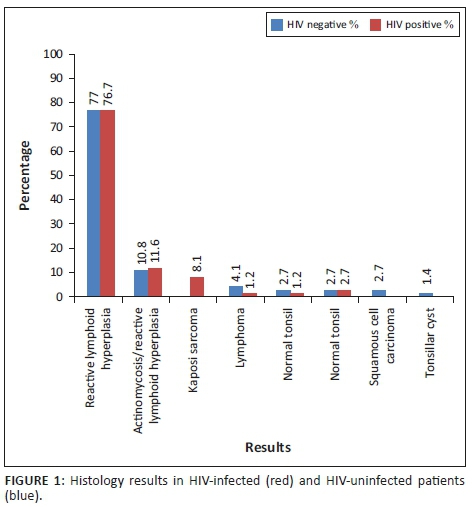
Figure 1 indicates the distribution of tonsillar histopathology results in HIV-infected and HIV-uninfected patients in red and blue colour, respectively. In both groups, reactive lymphoid hyperplasia was found in 77% of patients. Actinomycosis was found in 12% of patients in the HIV-infected group, while in the HIV-uninfected patients, it was observed in 11% of patients.
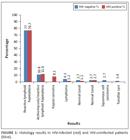
Chi-square test of independence
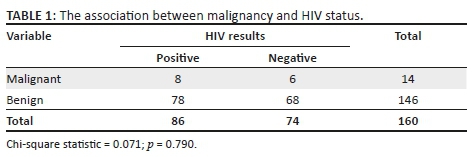
The majority of patients (both HIV-positive and negative) had benign pathology of their tonsils. In the HIV-infected patients, eight patients (9.3%) had a malignant pathology. In the HIV-uninfected group, six patients (8.1%) had a malignant pathology. We concluded that there was no statistical evidence that HIV infection conferred an increased risk for the development of malignant tonsillar disease (see Table 1 and Table 2).
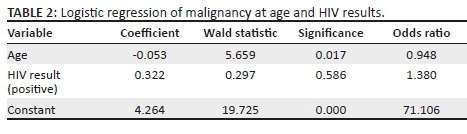
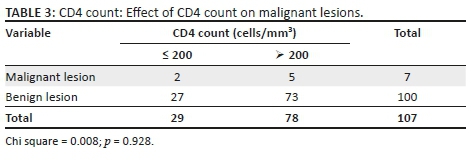
Logistic regression was performed to test the effects of age and HIV infection on the presence of malignant lesions. The results indicated that when controlling for the effect of age in the model, HIV-infected patients are 1.380 times more likely to have malignant tonsillar pathology than HIV-uninfected patients. The Wald tests showed that only age significantly predicted the presence of malignant pathology (p = 0.017). HIV infection did not influence the risk of developing malignant pathology (p = 0.586). This result is in accordance with the chi-square test in Table 3.
Patients with a lower CD4 count (< 200 cells/mm3p = 0.928).
Discussion
We reviewed 160 tonsillectomy specimens. The most common finding on histopathology was reactive lymphoid hyperplasia, which is a pattern of hyperplasia seen in tonsils secondary to an inflammatory or immune response.1213,14
There are minimal data available on the histopathology of routine tonsillar specimens in the adult HIV-infected population. A South African study by Lierop et al. reviewed the tonsil histology in 344 paediatric patients.1
Dell'Aringa et al. studied 250 patients between the ages of 2 and 34 years; the mean age was 7.3 years. Of these, 245 (95%) had lymphoid hyperplasia or inflammation; 2 (0.8%) had tonsillar cysts and 2 (0.8%) had actinomycosis infection.15
Actinomyces are commonly found in the oral cavity where they are commensals. Their role in the development of tonsillar disease has not been firmly established.16,171817
South Africa has one of the highest burdens of TB in the world, with an estimated 450 000 active cases in 2013.1920
SCC is the most common malignancy in patients with non-benign tonsillar lesions. It accounts for up to 7% of malignancies. Courville et al. tested 1093 adult patients, and of these, 75 (7%) had SCC.2122
Lymphomatous lesions are well described in patients with tonsillar malignancy. Their occurrence ranges from 0% to 1.74%.1,13,14,15,21,221314
The relationship between tonsillar malignancies and underlying HIV is not well established. We found 14 patients with malignancies, and of those patients, eight were HIV-infected and six were HIV-uninfected. The results showed no significant correlation between tonsil malignancy and HIV infection.
HIV infection is associated with an increased risk of a range of cancers, including KS, NHL and cervical cancer, which are considered virus-related and AIDS-defining diseases. The spectrum and incidence of NADC (smoking- and virus-related) has also been shown to be augmented. Franzetti et al. found a higher than expected incidence of tonsil carcinoma in their review of 5924 HIV-infected patients.81123
In our study, KS was detected in seven patients, all of whom were HIV-infected. There is an established strong correlation between HIV and KS, which has been borne out of the literature.8,11,24,252425
Franzetti et al. found a significant association between NADC and low CD4 counts (< 200 cells/mm38
Study limitations
The size of our study cohorts may be adequate, but is not ideal for a statistically powerful analysis. Unfortunately, many patients were excluded because of the absence of HIV results.
The lack of clinical data on the patients is not ideal as we were unable to establish the absence or presence of established high-risk features.
The significance of our study lies in the findings that advancing age may be an additional risk factor to consider, and HIV status does not confer an added risk in the development of tonsillar malignancies.
Conclusion
Our study findings are consistent with current recommendations that there is inadequate proof for routine histological examinations from patients who do not exhibit high-risk features.34
Tonsil histology should probably be reserved for patients with clinically suspicious lesions independent of HIV status.
Summary
•There is minimal data on the histopathology of tonsillectomy specimens in the HIV-infected population.
•This retrospective review compared tonsil histopathology between HIV-infected and HIV-uninfected patients.
•There were 86 patients HIV-infected patients and 74 HIV-uninfected patients in this study.
•Reactive lymphoid hyperplasia was the most common diagnosis in both groups (77%).
•Malignancies were diagnosed in eight HIV-infected and six HIV-uninfected patients, an insignificant difference.
•The majority of patients undergoing tonsillectomy had benign conditions.
•HIV status does not appear to be a specific risk factor for tonsil malignancies, but advanced age may be.
Competing interests
The authors declare that they have no financial or personal relationship(s) which may have inappropriately influenced them in writing this article.
Authors' contributions
R.E. was responsible for the data collection and analysis. S.M. was responsible for the conceptualisation and data analysis. K.H. was responsible for the write-up and editing. S.M. was responsible for the literature review and editing.
Acknowledgements
The research was part of the MMEd research report for Dr Ridwaan Essa, Faculty of Health Sciences, University of the Witwatersrand.
References
-
1.Lierop A, Prescott J. Is routine pathological examination required in South African children undergoing adenotonsillectomy? S Afr Med J [serial online]. 2009 [cited 2015 Dec 01];99:805-809. Available from: https://www.ncbi.nlm.nih.gov/pubmed/20218481
» https://www.ncbi.nlm.nih.gov/pubmed/20218481 -
2.Hajiioannou J, Tsiouvaka S, Exarchos S, et al. Histopathologic examination of routine tonsillectomies in times of Greek austerity. Necessity or luxury? Clin Otolaryngol [serial online]. 2014 [cited 2016 Jan 01];39:235-257. Available from: www.ncbi.nlm.nih.gov/pubmed/24814402
» www.ncbi.nlm.nih.gov/pubmed/24814402 -
3.Rokkjaer M, Klug E. Malignancy in routine tonsillectomy specimens: A systematic review. Eur Arch Oto Rhino Laryngol [serial online]. 2014 [cited 2016 Feb 01];271:2851-2861. Available from: https://www.ncbi.nlm.nih.gov/pubmed/24481924
» https://www.ncbi.nlm.nih.gov/pubmed/24481924 -
4.Beaty M, Funk G, Karnell L, et al. Risk factors for malignancy in adult tonsils. Head Neck [serial online]. 1998 [cited 2016 Feb 01];20:399-403. Available from: https://www.ncbi.nlm.nih.gov/pubmed/966366
» https://www.ncbi.nlm.nih.gov/pubmed/966366 -
5.Avert HIV, AIDS in South Africa. [homepage on the Internet]. c2016 [updated 2016 Jun 06; cited 2016 Aug]. Available from: https://www.avert.org/professionals/hiv-around-world/sub-saharan-africa/south-africa
» https://www.avert.org/professionals/hiv-around-world/sub-saharan-africa/south-africa -
6.Adoga S, Ma`an D, Nuhu S. Is routine histopathology of tonsil specimen necessary? Afr J Paediatr Surg [serial online]. 2011 [cited 2016 Mar 01];8:283-285. Available from: https://www.ncbi.nlm.nih.gov/pubmed/22248890
» https://www.ncbi.nlm.nih.gov/pubmed/22248890 -
7.Lü F, Jacobson R. Oral mucosal immunity and HIV/SIV infection. J Dent Res [serial online]. 2007 [cited 2016 Jun 01];86:216-226. Available from: https://www.ncbi.nlm.nih.gov/pubmed/17314252
» https://www.ncbi.nlm.nih.gov/pubmed/17314252 -
8.Franzetti M, Adorni F, Parravicini C, et al. Trends and predictors of non-AIDS-defining cancers in men and women with H.I.V infection: A single-institution retrospective study before and after the introduction of H.A.A.R.T. J Acquir Immune Defic Synd [serial online]. 2013 [cited 2016 Jan 01];62:414-420. Available from: www.ncbi.nlm.nih.gov/pubmed/23274934
» www.ncbi.nlm.nih.gov/pubmed/23274934 -
9.Pittore B, Pelagatti C, Deiana F, et al. Isolated Kaposi Sarcoma of the tonsil: A case report and review of the scientific literature. Case Report Otolaryngology [homepage on the Internet]. 2015 [cited 2016 Jul 20]. Available from: http://0-www.ncbi.nlm.nih.gov.innopac.wits.ac.za/pmc/articles/PMC4338387
» http://0-www.ncbi.nlm.nih.gov.innopac.wits.ac.za/pmc/articles/PMC4338387 -
10.Dolcetti R, Gloghini A, Caruso A, Carbone A. A lymphomagenic role for HIV beyond immune suppression? Topics Antiv Med. Blood. 2016 [cited 2016 Feb 01];127:1403-1409. Available from: https://www.ncbi.nlm.nih.gov/pubmed/26773045
» https://www.ncbi.nlm.nih.gov/pubmed/26773045 -
11.Mitsuyasu. Non-AIDs-defining cancers. Topics Antiv Med. 2013 [cited 2017 Jan 01];22(3). Available from: https://www.iasusa.org/sites/default/files/tam/22-3-660.pdf
» https://www.iasusa.org/sites/default/files/tam/22-3-660.pdf -
12.Sharon D, Mukerji S, Pine H. Tonsillectomy and adenoidectomy. Pediatr Clin N Am. 2013 [cited 2016 Jan 01];60:793-807. Available from: www.sciencedirect.com/science/article/pii/S0031395516340743
» www.sciencedirect.com/science/article/pii/S0031395516340743 -
13.Ikram M, Khan M, Ahmed M, Siddiqui T. The histopathology of routine tonsillectomy specimens: Results of a study and review of literature. Ear Nose Throat J. 2000 [cited 2017 Jan 01]; 79(11): 880-882. Available from: https://www.ncbi.nlm.nih.gov/pubmed/11107690
» https://www.ncbi.nlm.nih.gov/pubmed/11107690 -
14.Younis R, Hesse S, Anand V. Evaluation of the utility and cost-effectiveness of obtaining histopathologic diagnosis on all routine tonsillectomy specimens. Laryngoscope. 2001 [cited 2017 Feb 01];111(12):2166-2169. Available from: https://www.ncbi.nlm.nih.gov/pubmed/11802018
» https://www.ncbi.nlm.nih.gov/pubmed/11802018 -
15.Dell'Aringa AR, Juares AJ, Melo CD, et al. Histological analysis of tonsillectomy and adenoidectomy specimens from January 2001 to May 2003. Braz J Otorhinolaryngol. 2005 [cited 2017 Mar 01];71(1):18-22. Available from: https://www.ncbi.nlm.nih.gov/labs/articles/16446886/
» https://www.ncbi.nlm.nih.gov/labs/articles/16446886/ -
16.Valour F, Sénéchal A, Dupieux C, et al. Actinomycosis: Etiology, clinical features, diagnosis, treatment, and management. Infect Drug Resist. 2014 [cited 2016 Dec 01];7:183-197. Available from: https://www.ncbi.nlm.nih.gov/pubmed/25045274
» https://www.ncbi.nlm.nih.gov/pubmed/25045274 -
17.Hasan M, Kumar A. Actinomycosis and tonsillar disease. Br Med J Case Rep. 2011;2011:bcr0120113750. https://org/10.1136/bcr.01.2011.3750
» https://org/10.1136/bcr.01.2011.3750 -
18.Rebechi G, Ponte T, Braga E, Matos W, Rebech F, Matsuyama C. Are histologic studies of adenotonsillectomy really necessary? Int Arch Otorhinolaryngol. 2013;17(4):387-389. https://doi.org/10.1055/s-0033-1353441
» https://doi.org/10.1055/s-0033-1353441 -
19.Soul City Institute. Literature review of TB in South Africa [homepage on the Internet]. 2015 [cited 2017 Jul 01]. Available from: http://www.soulcity.org.za/projects/tuberculosis/research/literature-review-on-tuberculosis-in-south-africa.pdf/view
» http://www.soulcity.org.za/projects/tuberculosis/research/literature-review-on-tuberculosis-in-south-africa.pdf/view - 20.Ricciardiello F, Martufi S, Cardone M, Cavaliere M, Errico P, Lango P. Otorhinolaryngology-related tuberculosis. Acta Otorhinolaryngol Italy. 2006;26(1):38-42.
-
21.Courville E, Lew M, Sadow P. Routine evaluation of adult tonsillectomy specimens: Toward establishing a new standard of care. Int J Surg Pathol. 2011 [cited 2016 Jun 01];19:469-475. Available from: https://www.ncbi.nlm.nih.gov/pubmed/21427094
» https://www.ncbi.nlm.nih.gov/pubmed/21427094 -
22.Randall D, Martin P, Lester D, Thomson L. Routine histologic examination is unnecessary for tonsillectomy or adenoidectomy. Laryngoscope. 2007 [cited 2016 Jun 01];117:1600-1604. Available from: https://www.ncbi.nlm.nih.gov/pubmed/17762791
» https://www.ncbi.nlm.nih.gov/pubmed/17762791 -
23.Grulich A, Leeuwen M, Falster M, Vajdic C. Incidence of cancers in people with HIV/AIDS compared with immunosuppressed transplant recipients: A meta-analysis. Lancet. 2007 [cited 2017 Mar 01];370(9581):59-70. Available from: https://www.ncbi.nlm.nih.gov/pubmed/17617273
» https://www.ncbi.nlm.nih.gov/pubmed/17617273 -
24.Robeya C, Bower M. Facing up to the ongoing challenge of Kaposi's sarcoma. Curr Opin Infect Dis. 2015 [cited 2017 Jul 01];28(1):31-40. Available from: https://www.ncbi.nlm.nih.gov/pubmed/25490104
» https://www.ncbi.nlm.nih.gov/pubmed/25490104 - 25.Amador V, Saavedra G, Martínez G. Kaposi's sarcoma of the head and neck: A review. 2010;46(3):135-145.

Accepted: 26 Feb. 2019
Published: 28 May 2019