Unexpected low frequency of respiratory symptoms in an HIV-positive urban sub-Saharan population compared to an HIV-negative control group
Abstract
BACKGROUND: Chronic respiratory illnesses and respiratory infections are common in HIV-positive populations. It seems reasonable that HIV-positive people experience more respiratory symptoms, such as coughing and breathlessness, than those who are HIV-negative OBJECTIVES: This study aims to determine the frequency of respiratory symptoms in an urban African HIV-positive population METHOD: A cross-sectional study was conducted in Johannesburg, South Africa, in 2016-2017. Four groups of participants were included: HIV-positive participants (1) not yet on antiretroviral therapy (ART), (2) on first-line ART, (3) on second-line ART and (4) age- and sex-matched HIV-negative controls. Data were collected on socio-demographics, respiratory risk factors and respiratory symptoms. A logistic regression analysis was performed to determine if respiratory symptoms differed between groups and to identify determinants associated with symptoms RESULTS: Overall, 547 participants were included, of whom 62% were women, with a median age of 37 years. Of these patients, 63% (347) were HIV-positive, 26% were ART-naïve, 24% were on first-line ART and 50% were on second-line ART. Cough and/or productive cough was reported by 27 (5%), wheezing by 9 (2%) and breathlessness by 118 (22%) of the participants. The frequency of these symptoms did not differ by HIV status after adjustment for age and sex. Breathlessness was associated with age, female sex, obesity, a history of respiratory infection and a history of airway hyper-reactivity CONCLUSION: The frequency of respiratory symptoms was low in our study population except for breathlessness. HIV-positive participants, whether or not on ART, did not experience more symptoms than HIV-negative participants
respiratory complaints; cough; HIV; ART; sub-saharan Africa
Introduction
In the last two decades, the introduction of antiretroviral therapy (ART) has substantially improved life expectancy of HIV-positive patients. Patients who are adequately treated with ART have a near-normal lifespan compared to the general population and, as a consequence, HIV has become a chronic disease.12
However, non-communicable chronic respiratory illnesses, such as chronic obstructive pulmonary disease (COPD), are more frequently seen in people living with HIV (PLHIV) compared to people without HIV.345
We studied the frequency of respiratory symptoms in PLHIV whether or not on ART in an urban area in South Africa in comparison to an HIV-negative control group, as well as the determinants of respiratory symptoms.
Methods
We conducted a cross-sectional study in Johannesburg, South Africa, from July 2016 to November 2017. We recruited four groups of participants from the Johannesburg area: HIV-positive participants not yet on ART, HIV-positive participants on first-line ART, HIV-positive participants on second-line treatment and HIV-negative control participants. The HIV-positive participants were recruited from past or ongoing randomised controlled trials (RCTs) comparing different ART regimens in a governmental HIV care facility in central Johannesburg.6,78
Data collection
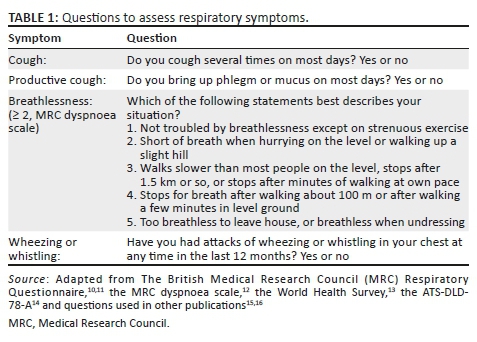
Data were collected during a single visit. Information on demographics and smoking was assessed with a modified version of the WHO STEPs instrument910,1112131415,16Table 1).
A physical examination was performed, which included measurements of height and weight. Blood sample was collected for measurement of HIV viral load and CD4-cell count (HIV-positive participants only). For participants who were recruited from one of the RCTs, laboratory data were retrieved from the RCT visit closest to our study visit.
Data analysis
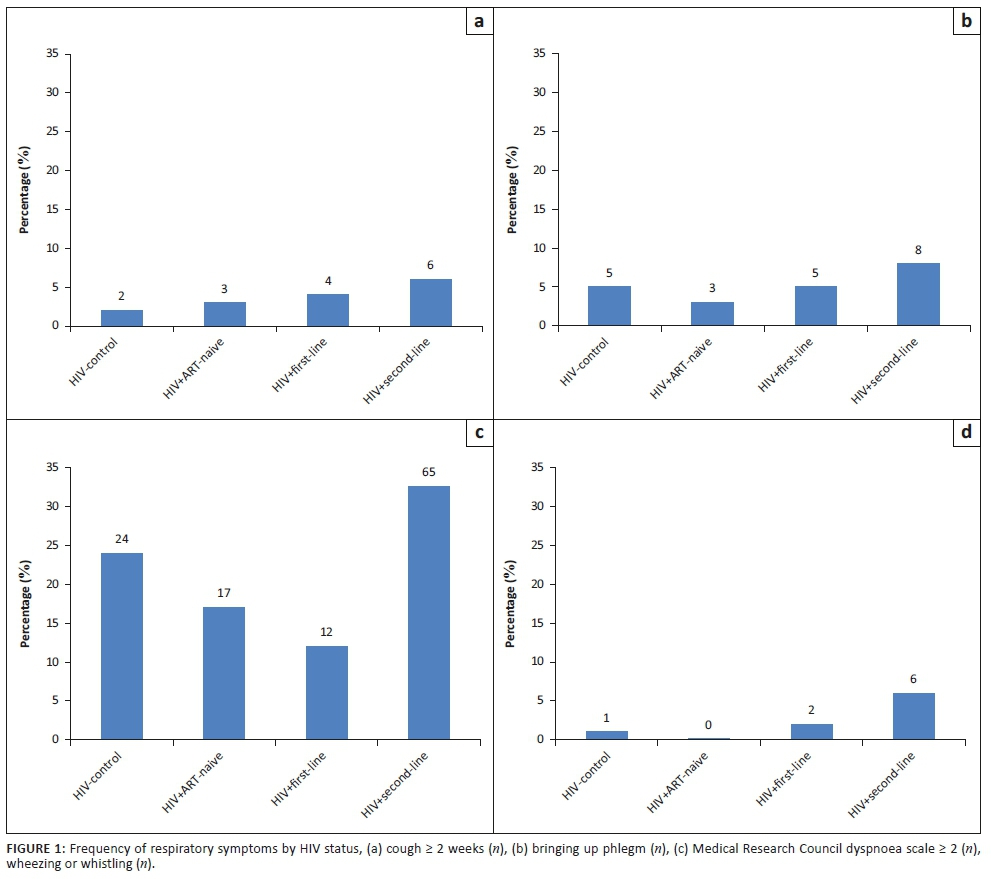
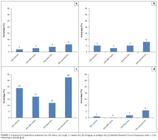
Outcomes were described as median with interquartile range for continuous variables (all non-normally distributed) and count with percentage for categorical variables. Differences in continuous variables across the four groups were tested using a Mann-Whitney U test and categorical variables using a Fisher's exact test. The frequency of respiratory symptoms across the four groups was displayed in bar charts.
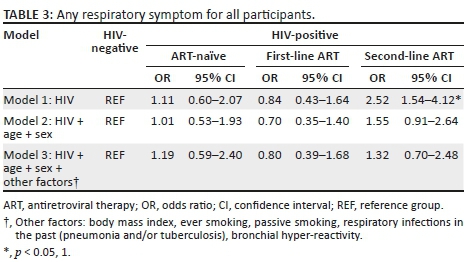
We combined the four respiratory symptoms in a composite outcome 'any respiratory symptom' that was defined as the occurrence of at least one of the respiratory complaints, namely coughing, bringing up phlegm, shortness of breath and/or wheezing or whistling. We first analysed if the frequency of respiratory symptoms differed according to HIV or ART status in three logistic regression models using 'any respiratory symptom' as outcome. In the first model, we assessed the unadjusted association between HIV and ART status and the occurrence of any respiratory symptom using the HIV-negative group as the reference group. The second model was adjusted for sex and age, and the third model additionally adjusted for body mass index (BMI), ever smoking, passive smoking, respiratory infections in the past (pneumonia and/or tuberculosis) and bronchial hyper-reactivity. To investigate the influence of HIV- and ART-related characteristics, we repeated the models described above including the HIV-positive participants only and using the ART-naïve group as the reference group. In the third model, HIV viral load and CD4+ cell counts were added.
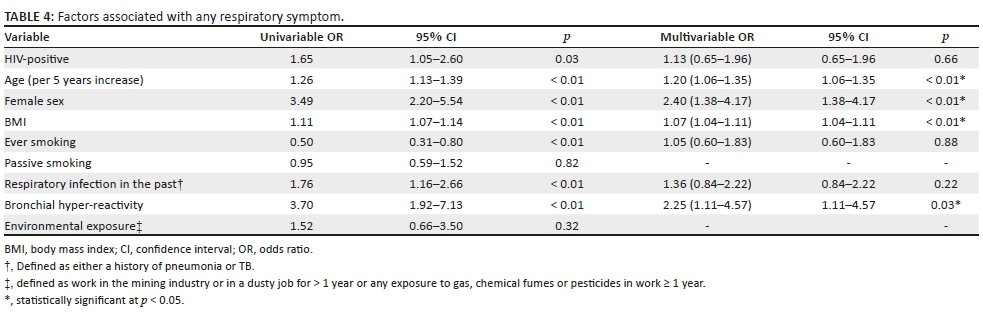
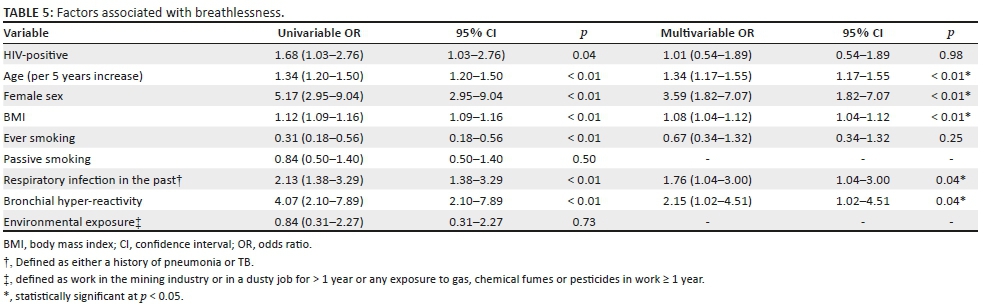
Finally, we analysed which determinants were associated with any respiratory symptom. The following factors were considered in univariable analysis: HIV status, age, sex, BMI, ever smoking and passive smoking, respiratory illnesses in the past such as tuberculosis and pneumonia, history of bronchial hyper-reactivity and environmental factors (worked in the mining industry or worked in a dusty job or exposure to gas, chemical fumes or pesticides in work). All factors with a p-value of < 0.2 in univariate analysis as well as age and sex were then included in multivariable analysis using forced entry. A p-value < 0.05 was considered to be statistically significant.
For the statistical analyses, we used the statistic programme 'IBM SPSS statistics' version 24.0 (IBM SPSS Statistics for Windows, Version 24.0. IBM Corp., Armonk, NY).
Ethical considerations
Ethical permission was obtained from the Human Research Ethics Committee of the University of the Witwatersrand (HREC number M160131). All participants provided written informed consent prior to participation.
Results
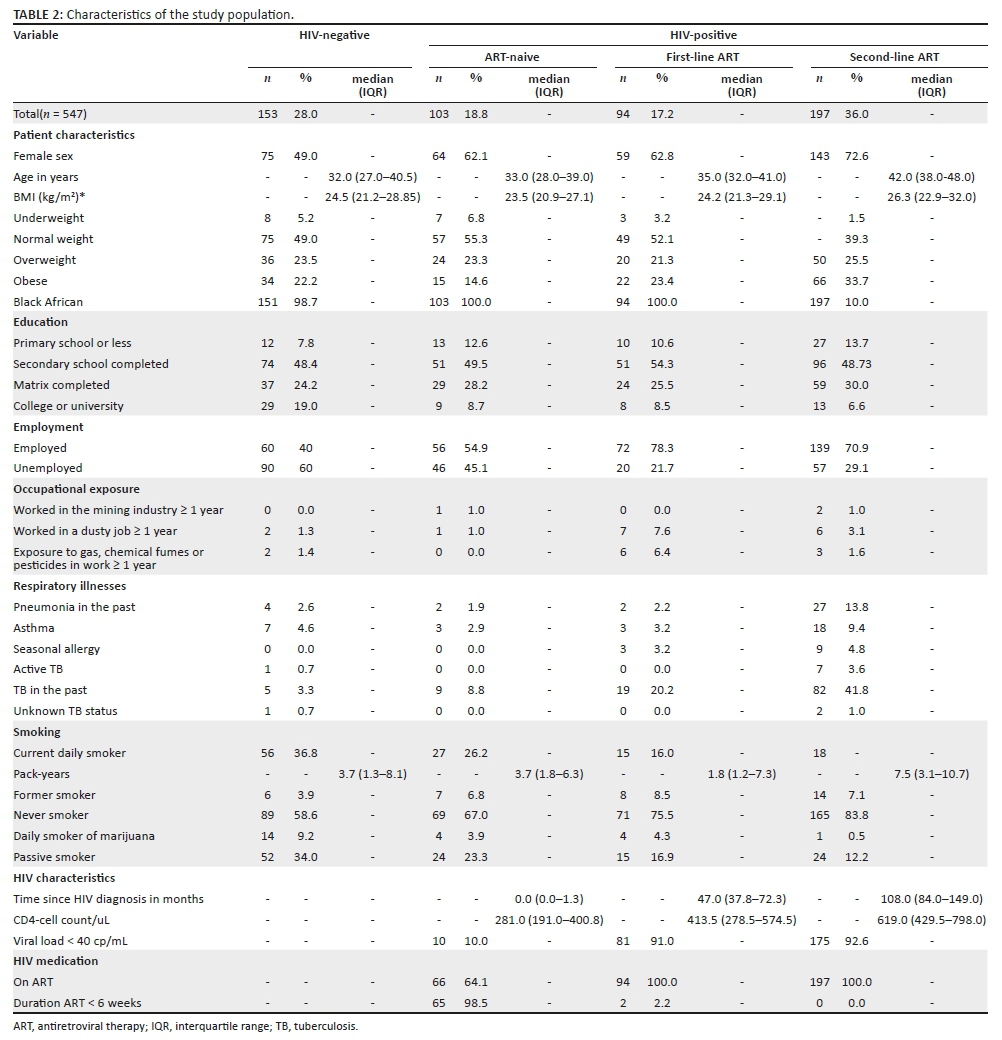
Of the 548 participants, 547 were included in the study. One participant was excluded as there was no information on HIV status. Almost all participants were black Africans (99.6%), 341 (62%) were women, 394 (72%) were HIV-positive, and the median age was 37 years (Table 2). Of the HIV-positive group, 103 (26%) were ART-naïve, 94 (24%) were on first-line treatment and 197 (50%) were on second-line treatment (Table 2).
The HIV-positive group on second-line treatment had a higher percentage of women (73%, p < 0.001) and was older compared to the other groups (42 years, p < 0.001). The control group and the ART-naïve group had a high percentage of current daily smokers (37% and 26%, respectively). Thirty-four per cent HIV-positive participants reported a history of a respiratory infection such as tuberculosis or pneumonia. The numbers were especially high in the group on second-line treatment (51%).
Occupational exposure was uncommon, with only 26 participants (5%) reporting any exposure. Almost all participants used gas or electricity for cooking (99.5%) and heating (99%).
Cough was reported by only six (1%) participants. Bringing up phlegm was reported by 12 (2%) participants and 9 (2%) participants reported both. Wheezing occurred in 9 (2%) participants and breathlessness in 118 (22%) participants (Figure 1).
In total, 143 participants (26%) reported at least one respiratory symptom of which 128 participants (90%) reported one symptom, 11 (8%) reported two symptoms, 3 (2%) reported three symptoms and only one participant reported all symptoms.
In the unadjusted comparison across the four groups, the HIV-positive group on second-line ART had significantly more respiratory symptoms compared to the HIV-negative group (odds ratio [OR] 2.5, 95% confidence interval [CI] 1.5-4.1) (Table 3). However, after adjustment for sex and age, there was no difference in the frequency of respiratory symptoms related to HIV or ART status. Further adjustment for respiratory risk factors did not change this finding.
When we restricted the analysis to the HIV-positive participants, the same crude trend was observed with participants on second-line ART having more respiratory symptoms than the other participants in the unadjusted analysis. This result disappeared after adjustment for sex and age. Additional adjustment for CD4-cell count and viral load did not change the findings.
The occurrence of any respiratory complaint was associated with age, female sex, BMI and a history of bronchial hyper-reactivity (Table 4). When limiting the analysis to breathlessness, age, female sex, BMI, bronchial hyper-reactivity and a history of pulmonary infection were the associating factors (Table 5).
Discussion
The frequency of respiratory complaints in our study was surprisingly low when compared to what has been reported in the literature in studies from both HIC and LMIC. For coughing, a frequency of 17%171819,20,21,22,2318,21,2418,21,2424,25
In contrast, breathlessness was a frequently expressed complaint with 22% of the participants in our study, indicating that they experienced breathlessness. This is in line with the literature, mostly from HIC, reporting that between 1.4% and 42% of the population experience breathlessness. People living with HIV were found to experience breathlessness more often than HIV-negative individuals,18,25,26
The following reasons should be considered to understand the low number of respiratory complaints, except for breathlessness, noted among the participants in our study compared to previous studies. Firstly, our study population differed from study populations in HIC. People living with HIV from HIC represent a particular group with specific health risk behaviour, such as men having sex with men (MSM) or intravenous drug users with a higher percentage of smokers than the HIV-negative population.27p < 0.01). Secondly, with regard to LMIC, most of the studies from the African countries reported that the use of wood fire was still common and responsible for a high burden of respiratory disease and symptoms,28,29
Finally, most of the studies conducted previously in Africa had a low percentage of participants on treatment with ART,21,30
Despite these possible explanations for our findings, it is still particularly surprising that HIV-positive, ART-naïve participants in our study hardly reported respiratory symptoms. A possible explanation could be the fact that the ART-naïve group was still young and had not had the chance to develop symptoms yet. Additionally, they had a median CD4 count of 281 cells/mm331
Another unexpected finding of our study was that despite the high burden of respiratory infections in the past in PLHIV, this did not result in a higher frequency of respiratory symptoms except for breathlessness. It may be the case that, given the relatively young age of the population, there was still enough pulmonary reserve capacity to limit complaints in daily life. Clearly, the next step to clarify the relationship between respiratory infections in the past, particularly tuberculosis, and current pulmonary function would be to include lung function testing in the analysis.
Limitations of this study include the recruitment process of the study population which may influence the generalisability of our results. Participants were not randomly sampled from the general HIV-positive population but were recruited from RCTs. However, we think that the participants were representative of people with the same HIV and ART status as they were all recruited from routine local HIV diagnostic services. Furthermore, it is possible that the control group experienced more breathlessness as a result of the high percentage of smokers in this group. This could have reduced the contrast between the HIV-positive and HIV-negative participants.
Lastly, although we tried to define respiratory complaints clearly, there may still be uncertainty around the definition. Future studies should seek to standardise the definition of respiratory symptoms more strictly and it would be helpful if all studies used the same definitions.
In conclusion, the results of this study among a large group of HIV-positive and -negative patients do not support the view that respiratory symptoms are more common among patients with HIV.
Competing interests
The authors declare that they have no financial or personal relationships that may have inappropriately influenced them in writing this article.
Authors' contributions
A.V. was responsible for the study design and coordination of data collection. E.J.S. was involved in data collection. M.K. performed the data analyses and was responsible for interpretation of results under the supervision of A.V. M.K. and A.V. wrote the article. E.J.S., K.K.-G., R.B.B., D.E.G., F.D.F.V. and C.F. critically revised the article. All authors gave final approval for the version to be published.
Funding
No funding was received for this project.
Data availability statement
The authors confirm that the data supporting the findings of this study are available within the article or its supplementary materials.
Disclaimer
The views and opinions expressed in this article are the authors' own and do not reflect an official position of the authors' institutions.
Acknowledgements
References
-
1.Bor J, Herbst AJ, Newell ML, Barnighausen T. Increases in adult life expectancy in rural South Africa: Valuing the scale-up of HIV treatment. Science. 2013 Feb 22;339(6122):961-965. https://doi.org/10.1126/science.1230413
» https://doi.org/10.1126/science.1230413 -
2.Palella FJ, Jr, Delaney KM, Moorman AC, et al. Declining morbidity and mortality among patients with advanced human immunodeficiency virus infection. HIV outpatient study investigators. N Engl J Med. 1998 Mar 26;338(13):853-860. https://doi.org/10.1056/NEJM199803263381301
» https://doi.org/10.1056/NEJM199803263381301 - 3.Fitzpatrick ME, Kunisaki KM, Morris A. Pulmonary disease in HIV-infected adults in the era of antiretroviral therapy. AIDS. 2018 Jan 28;32(3):277-292.
-
4.Brown J, Roy A, Harris R, et al. Respiratory symptoms in people living with HIV and the effect of antiretroviral therapy: A systematic review and meta-analysis. Thorax. 2017 Apr;72(4):355-366. https://doi.org/10.1136/thoraxjnl-2016-208657
» https://doi.org/10.1136/thoraxjnl-2016-208657 -
5.Smit M, Brinkman K, Geerlings S, et al. Future challenges for clinical care of an ageing population infected with HIV: A modelling study. Lancet Infect Dis. 2015 Jul;15(7):810-818. https://doi.org/10.1016/S1473-3099(15)00056-0
» https://doi.org/10.1016/S1473-3099(15)00056-0 - 6.Venter WD, Kambugu A, Chersich M, et al. Efficacy and safety of tenofovir disoproxil fumarate versus low-dose stavudine over 96 weeks: A multi-country randomised, non-inferiority trial. J Acquir Immune Defic Syndr. 2019;80(2):224-233.
- 7.Venter F, Moorhouse M, Sokhela S, et al. Low-dose ritonavir-boosted darunavir once daily versus ritonavir-boosted lopinavir for participants with less than 50 HIV RNA copies per mL (WRHI 052): A randomised, open-label, phase 3, non-inferiority trial. Lancet HIV. 2019;6(7):428-437.
-
8.Departement of Health South Africa. National HIV counseling and testing policy guidelines [homepage on the Internet]. c2015 [cited 2018 Aug 14]. Available from: https://www.health-e.org.za/wp-content/uploads/2015/07/HCT-Guidelines-2015.pdf.
» https://www.health-e.org.za/wp-content/uploads/2015/07/HCT-Guidelines-2015.pdf -
9.WHO. The STEPS instrument and support materials [homepage on the Internet]. c2017 [cited 2019 Feb 01]. Available from: https://www.who.int/ncds/surveillance/steps/instrument/en/.
» https://www.who.int/ncds/surveillance/steps/instrument/en/ -
10.Fletcher CM, Clifton M, Fairbairn AS. Standardized questionaries on respiratory symptoms. Br Med J. 1960;2(5213):1665. https://doi.org/10.1136/bmj.2.5213.1665
» https://doi.org/10.1136/bmj.2.5213.1665 -
11.Cotes JE. Medical research council questionnaire on respiratory symptoms (1986). Lancet. 1987 Oct 31;2(8566):1028. https://doi.org/10.1016/S0140-6736(87)92593-1
» https://doi.org/10.1016/S0140-6736(87)92593-1 -
12.Fletcher CM, Elmes PC, Fairbairn AS, Wood CH. The significance of respiratory symptoms and the diagnosis of chronic bronchitis in a working population. Br Med J. 1959 Aug 29;2(5147):257-266. https://doi.org/10.1136/bmj.2.5147.257
» https://doi.org/10.1136/bmj.2.5147.257 -
13.World Health Organization. Evidence and information for policy. WORLD HEALTH SURVEY 2002. B - Individual questionnaire, rotation - A [homepage on the Internet]. [cited 2015 October 07]. Available from: www.who.int.
» www.who.int - 14.Ferris BG. Epidemiology standardization project (American Thoracic Society). Am Rev Respir Dis. 1978 Dec;118(6 Pt 2):1-120.
-
15.Mengersen K, Morawska L, Wang H, et al. The effect of housing characteristics and occupant activities on the respiratory health of women and children in Lao PDR. Sci Total Environ. 2011 Mar 15;409(8):1378-1384. https://doi.org/10.1016/j.scitotenv.2011.01.016
» https://doi.org/10.1016/j.scitotenv.2011.01.016 -
16.Isara AR, Aigbokhaode AQ. Household cooking fuel use among residents of a sub-urban community in Nigeria: Implications for indoor air pollution. Eurasian J Med. 2014 Oct;46(3):203-208. https://doi.org/10.5152/eajm.2014.0051
» https://doi.org/10.5152/eajm.2014.0051 -
17.el-Sadr W, Goetz RR, Sorrell S, Joseph M, Ehrhardt A, Gorman JM. Clinical and laboratory correlates of human immunodeficiency virus infection in a cohort of intravenous drug users from New York, NY. Arch Intern Med. 1992 Aug;152(8):1653-1659. https://doi.org/10.1001/archinte.152.8.1653
» https://doi.org/10.1001/archinte.152.8.1653 -
18.Diaz PT, Wewers MD, Pacht E, Drake J, Nagaraja HN, Clanton TL. Respiratory symptoms among HIV-seropositive individuals. Chest. 2003 Jun;123(6):1977-1982. https://doi.org/10.1378/chest.123.6.1977
» https://doi.org/10.1378/chest.123.6.1977 -
19.Lepage P, Dabis F, Hitimana DG, et al. Perinatal transmission of HIV-1: Lack of impact of maternal HIV infection on characteristics of livebirths and on neonatal mortality in Kigali, Rwanda. AIDS. 1991 Mar;5(3):295-300. https://doi.org/10.1097/00002030-199103000-00008
» https://doi.org/10.1097/00002030-199103000-00008 -
20.Corbett EL, Zezai A, Cheung YB, et al. Provider-initiated symptom screening for tuberculosis in Zimbabwe: Diagnostic value and the effect of HIV status. Bull World Health Organ. 2010 Jan;88(1):13-21. https://doi.org/10.2471/BLT.08.055467
» https://doi.org/10.2471/BLT.08.055467 - 21.Onyedum CC, Chukwuka JC, Onwubere BJ, Ulasi II, Onwuekwe IO. Respiratory symptoms and ventilatory function tests in Nigerians with HIV infection. Afr Health Sci. 2010 Jun;10(2):130-137.
-
22.Gounder CR, Wada NI, Kensler C, et al. Active tuberculosis case-finding among pregnant women presenting to antenatal clinics in Soweto, South Africa. J Acquir Immune Defic Syndr. 2011 Aug 1;57(4):e77-e84. https://doi.org/10.1097/QAI.0b013e31821ac9c1
» https://doi.org/10.1097/QAI.0b013e31821ac9c1 -
23.Telisinghe L, Fielding KL, Malden JL, et al. High tuberculosis prevalence in a South African prison: The need for routine tuberculosis screening. PLoS One. 2014 Jan 30;9(1):e87262. https://doi.org/10.1371/journal.pone.0087262
» https://doi.org/10.1371/journal.pone.0087262 -
24.Campo M, Oursler KK, Huang L, et al. Association of chronic cough and pulmonary function with 6-minute walk test performance in HIV infection. J Acquir Immune Defic Syndr. 2014 Apr 15;65(5):557-563. https://doi.org/10.1097/QAI.0000000000000086
» https://doi.org/10.1097/QAI.0000000000000086 -
25.Drummond MB, Kirk GD, Ricketts EP, et al. Cross sectional analysis of respiratory symptoms in an injection drug user cohort: The impact of obstructive lung disease and HIV. BMC Pulm Med. 2010 May 11;10(27). https://doi.org/10.1186/1471-2466-10-27
» https://doi.org/10.1186/1471-2466-10-27 -
26.Crothers K, McGinnis K, Kleerup E, et al. HIV infection is associated with reduced pulmonary diffusing capacity. J Acquir Immune Defic Syndr. 2013 Nov 1;64(3):271-278. https://doi.org/10.1097/QAI.0b013e3182a9215a
» https://doi.org/10.1097/QAI.0b013e3182a9215a -
27.Frazier EL, Sutton MY, Brooks JT, Shouse RL, Weiser J. Trends in cigarette smoking among adults with HIV compared with the general adult population, United States - 2009-2014. Prev Med. 2018 Jun;111:231-234. https://doi.org/10.1016/j.ypmed.2018.03.007
» https://doi.org/10.1016/j.ypmed.2018.03.007 -
28.Buist A, McBurnie M, Vollmer W. International variation in the prevalence of COPD (the BOLD study): A population-based prevalence study. Lancet. 2007(370):741-750. https://doi.org/10.1016/S0140-6736(07)61377-4
» https://doi.org/10.1016/S0140-6736(07)61377-4 -
29.Van Gemert F, Kirenga B, Chavannes N, et al. Prevalence of chronic obstructive pulmonary disease and associated risk factors in Uganda (FRESH AIR Uganda): A prospective cross-sectional observational study. Lancet Glob Health. 2015 Jan;3(1):e44-e51. https://doi.org/10.1016/S2214-109X(14)70337-7
» https://doi.org/10.1016/S2214-109X(14)70337-7 -
30.Norrgren H, Da Silva ZJ, Andersson S, et al. Clinical features, immunological changes and mortality in a cohort of HIV-2-infected individuals in Bissau, Guinea-Bissau. Scand J Infect Dis. 1998;30(4):323-329. https://doi.org/10.1080/00365549850160585
» https://doi.org/10.1080/00365549850160585 -
31.Phair J, Munoz A, Detels R. The risk of Pneumocystis carinii pneumonia among men infected with human immunodeficiency virus type 1. N Engl J Med. 1990(322):161-165. https://doi.org/10.1056/NEJM199001183220304
» https://doi.org/10.1056/NEJM199001183220304

Accepted: 22 July 2019
Published: 26 Sept. 2019