The evolution and adoption of World Health Organization policy guidelines on antiretroviral therapy initiation in sub-Saharan Africa: A scoping review
Abstract
BACKGROUND: Despite past and present global interventions, the human immunodeficiency virus (HIV) pandemic remains a public health problem in low- and middle-income countries (LMICs). The World Health Organization (WHO) has assisted these countries by providing antiretroviral therapy (ART) policies for adoption and adaptation to local needs. OBJECTIVES: This article describes the response of countries in sub-Saharan Africa (SSA), to the WHO's changing CD4-threshold ART-initiation recommendations of the past two decades. METHODS: Relevant articles published in international peer-reviewed journals were accessed via the following search engines: PubMed, Google Scholar, Cochrane, Embase and EBSCOhost. The study's inclusion criteria were articles published in the English language between 2000 and 2019 that highlighted changes to the CD4 ART-initiation threshold and that focused on the WHO's 'commencement of ART' policy guidelines. Sixteen studies (n = 16) from SSA were identified and included in this review: four are cross-sectional, four deal with cost-effectiveness, four are retrospective, one is a randomised trial and three are observational studies. Only studies conducted in SSA were assessed. RESULTS: Four themes emerged: (1) adoption of the WHO CD4-ART-initiation policy by SSA countries, (2) timely implementation of the changing guideline initiation policy in the region, (3) barriers and facilitators encountered in the implementation of the changing guidelines and (4) description of similarities in policy implementation at country level from 2002 to 2019. Regional studies - cross-sectional, observational, retrospective, cost-effectiveness and randomised have described greater access to ART in SSA. However, barriers remain. The most common barriers to the timely implementation of 'new' ART-initiation guidelines were economic constraints, drug stock-outs, delays in obtaining baseline blood-test results and staff shortages. CONCLUSION: Although countries in SSA have adopted the WHO-ART-CD4 initiation-threshold policy guidelines, implementation has seldom occurred in a timely manner. Barriers have been identified. Whilst a small number of countries have implemented recommendations promptly, for many, the barriers still require to be overcome.
ART initiation; WHO-ART guidelines adoption; implementation of ART guidelines in sub-Saharan Africa; CD4; human immunodeficiency virus
Background
The first cases of the acquired immunodeficiency syndrome (AIDS) were reported in 1981. Since then, infection with human immunodeficiency virus (HIV) has spread globally and caused an estimated 74.9 million infections and 32 million AIDS-related illnesses.1 In its first 15 years no treatment could control the infection or halt its spread.2 By 2018, the African region was home to approximately 25.7 million people living with HIV (PLWH)1 and in that year alone, Africa experienced approximately 1.1 million new infections.1 Almost two-thirds of all new global infections occur in sub-Saharan Africa (SSA).1
The World Health Organization's (WHO's) antiretroviral therapy (ART) initiation-guidelines have changed substantially over the last two decades.2 The guidelines were first published in 2002.3 These (2002/2003) recommended starting ART in those with AIDS-related conditions and/or at a CD4 of ≤ 200 cells/mm. The available treatment at that time was expensive and toxic. Delaying ART until the CD4 reached levels < 200 c/mm34 Continued deaths from AIDS and success with ART prompted a CD4 increase in 2006 200 to 350 cells/mm3334,5 By June 2013, the threshold was further increased to CD4 < 500/cells/mm36 In 2015, the WHO and numerous international organisations removed the CD4 threshold and recommended ART to all regardless of CD4 cell count and clinical stage.7 Data from two highly influential randomised controlled clinical trials, the START and TEMPRANO studies, underpinned this decision. Both demonstrated survival advantage to those on ART irrespective of clinical stage or CD4 count.8,9 This led to the introduction by all international agencies, including the WHO, of the policy of 'universal test and treat (UTT)'. The WHO estimates that if these recommendations are adopted globally, 21 million deaths and 28 million new infections could be prevented by 2030.10
The rate at which countries have aligned their national ART programmes and implemented WHO guidelines since 2002 has varied. Most SSA countries took ± 2 years to implement the WHO's 2010 ART guidelines.511112 In this review, we sought to determine how different SSA countries adapted to the WHO's ART-initiating CD4-threshold changes over time and how WHO guidelines have impacted ART in the region.
Methods
Search strategy and selection criteria
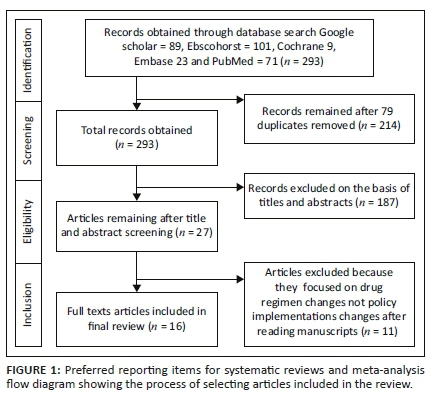
We carried out a systematic electronic literature search on PubMed, Google Scholar, Cochrane, Embase and EBSCO host for the period, 2000-2019 (Figure 1). The databases were selected based on our inclusion criteria and the availability of free full-text articles and papers. In this review, we used the preferred reporting items for systematic reviews and meta-analysis (PRISMA) as described by Moher et al., to identify an evidence-based dataset and to provide transparency in the selection process of the articles.12
The search was based on the combination of the following terms and Boolean operators: WHO-ART guidelines or ART-initiation guidelines and changes in CD4-initiation guidelines and implementation of WHO guidelines or adoption of WHO-ART guidelines. We also applied a manual country filter to limit our search to SSA. Articles published in a language other than English and articles focusing on ART regimen-change were excluded. The study included articles that focused on CD4-threshold changes and were published between 2000 and 2019. The following articles were not included: duplicates, articles not centered on the WHO and ART initiation guidelines or their adoption and implementation. Exclusion was based on the screening of the title and abstract.
The search process is illustrated in Figure 1. Seventy-nine (79) duplicate articles were removed, which were identical in Google Scholar and PubMed. Fewer articles dealt with the topic in Cochrane and Embase. The articles in PubMed were more detailed, easier to search and free to access. We also excluded 187 articles because they did not specifically address implementation based on CD4-threshold changes. Another 11 were excluded because they focused on only regimen change. Only 16 articles remained. These covered quantitative and qualitative synthesis of how SSA countries adopted the WHO and ART initiation guidelines between 2000 and 2019 and its impact on the management of HIV.
Data extraction and synthesis
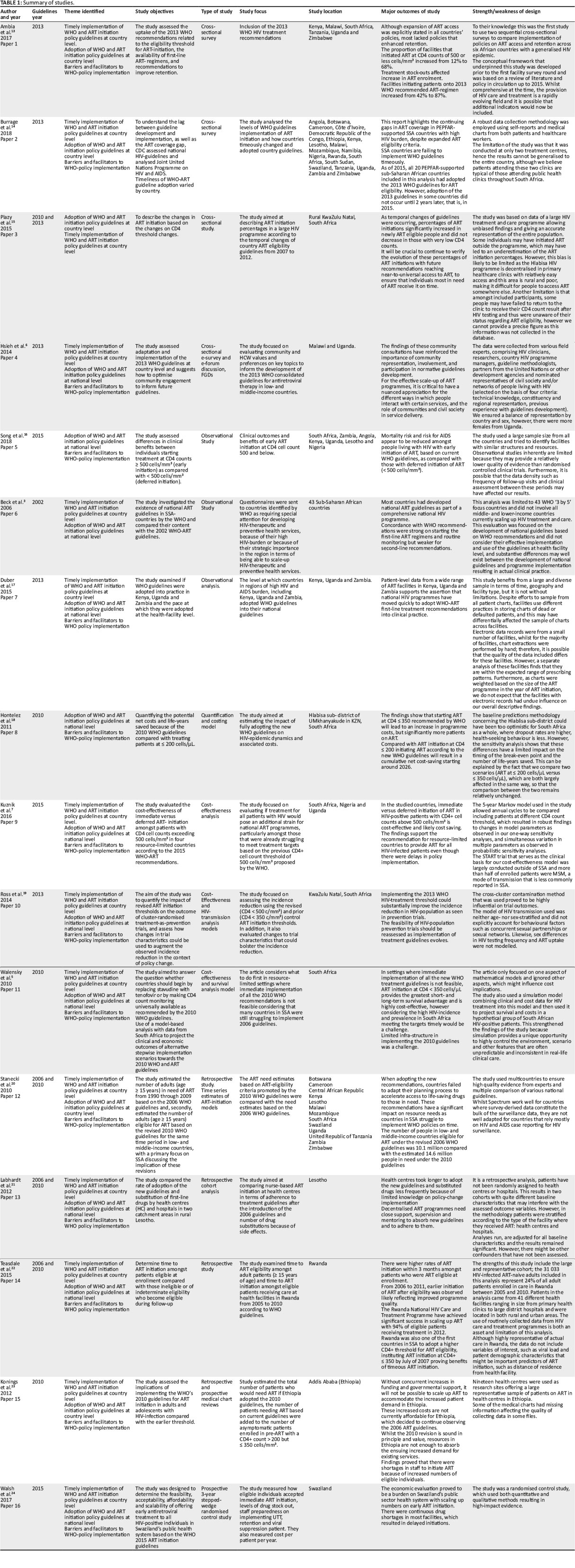
The following information was extracted from selected studies using a template: publication details, country of study, objective(s) of the study, study design, summary of findings and theme (Table 1). Two review authors independently assessed the eligibility of the studies identified in the search. Articles with different study designs and objectives were selected to reduce the risk of bias. We used different high-impact databases to search for articles and global authors. The study designs were divided into five groups: cross sectional, cost-effectiveness, retrospective, randomised trial and observational studies. We did not subject the reviewed articles to this quality process because this is a scoping review. For synthesis, extracted information was grouped into themes derived from the articles in line with the review objectives and different study designs. The themes identified were: how different SSA countries adopted WHO and ART initiation policy guidelines at country level, timely implementation levels of the policies by different SSA countries, the barriers and facilitators to WHO and ART initiation policy adoption in SSA and the similarities in country characteristics in policy implementation in different SSA countries.
Ethical consideration
Ethical approval was obtained from the University of KwaZulu-Natal Biomedical Research Ethics Committee (UKZN BREC, reference number: BREC/00000819/2019).
Results
Overview of selected studies
We reviewed 16 studies from an initial collection of 293 articles in Google Scholar, PubMed, Cochrane, Embase and EBSCOhost (Figure 1). We only reviewed studies that examined how different SSA countries adopted changes in WHO and ART initiation guidelines based on CD4 threshold and how the guidelines have impacted ART programmes in SSA. The following four themes were identified from the 16 papers: (1) Adoption of WHO and ART initiation policy guidelines at country level in SSA, (2) timely implementation of WHO and ART initiation policy guidelines at country level, (3) barriers and facilitators to WHO policy implementation in SSA and (4) characteristics at country level.
Of the 16 reviewed articles 4 (articles 4, 13, 14 and 16) addressed all 4 themes, 8 articles addressed 3 themes (articles 1, 2, 7, 9, 10, 11, 12 and 15) and 4 articles (articles 2, 5, 6 and 8) addressed only 2 themes. The theme of the adoption of the WHO-ART initiation guidelines at country level was dominant in all articles.
Theme 1: Adoption of World Health Organization antiretroviral therapy initiation policy guidelines at country level in sub-Saharan Africa
The results confirm that all the countries in SSA that are part of this review have adopted the WHO and ART initiation guidelines since 2002. Hsieh et al. reported that between July 2013 and July 2015, seven national policy documents incorporating the 2013 WHO guidelines were developed in Kenya, Malawi, Tanzania, Uganda, Zimbabwe and two in South Africa.619621
Rwanda implemented the 2006, 2010, 2013 and 2015 WHO and ART initiation guidelines in a timely manner, that is, on an average within 6 months of international release.25
Theme 2: The timely implementation of World Health Organization antiretroviral therapy initiation policy guidelines at country level
Teasdale et al. describe high rates of early - within 3 months - ART initiation amongst ART-eligible Rwandan patients. Indeed, by 2012, the Rwanda National HIV Care and Treatment Programme had managed to initiate 94% of eligible PLWH on ART in line with the 2006 and 2010 WHO guidelines. Rwanda was also one of the first countries in SSA to implement the higher CD4+ initiation threshold for ART eligibility.2217
However, in a study conducted in 15 SSA countries, facilities were slow to align with the WHO's 2006 and 2010 guidelines. They experienced delays in the actual implementation and expanding access to ART.20142014
Theme 3: Barriers to and facilitators of antiretroviral therapy initiation policy implementation
Fourteen studies examined the barriers to and facilitators of ART-initiation policy implementation in SSA. Ambia et al. reported a significant increase in ART initiations, from 42% to 87%, in some facilities in the urban centres of Kenya, Malawi, South Africa (SA), Tanzania, Uganda and Zimbabwe.1322621
The cost-effectiveness articles namely 8, 9, 10 and 11, in Table 1, indicate that economic constraints hindered various countries from implementing guidelines timeously. An Ethiopian study by Konings et al., revealed major financial constraints for the state even before ART services could be expanded as per the 2013 WHO guidelines. The government continued implementing the 2006 ART guidelines for more than a year after the 2010 guidelines were released because their financial capacity could not absorb the increased demand.2318
Most facilities in SSA failed to fully implement the policy guidelines on time because of limited ARV-stock.1324523
Theme 4: Characteristics at country level
World Health Organization guidelines are based on the best available scientific evidence and are directed to the ART-needs of LMICs. International guidelines unfortunately cannot speak to the individual economic and social realities of individual SSA countries. Of the 20 countries addressed in this review, there are nonetheless considerable similarities such as strained healthcare systems, structural and operational barriers and the need of cost-cutting measures to support healthcare systems. With the largest ART-programme on the continent, SA also carries the largest ART-related financial burden.871214132414
Discussion
This review provides detailed information regarding WHO and ART initiation guidelines on CD4 count threshold changes and adoption of the guidelines in SSA. There were some variations in study designs, however, all the articles focused on CD4 ART-initiation changes in the WHO guidelines. The findings indicate that delays in adoption and implementation were frequent and widespread throughout SSA. We employed a thematic analysis and identified four crucial themes that were in all the articles. Several barriers to implementing the guidelines were identified. These include costs related to providing ART to eligible individuals, the shortage of staff and drugs in healthcare facilities and limited training of staff when guidelines were changed.
Our findings are consistent with those of Pell et al., who reported that the implementation of the 2015 guidelines took > 12 months to be adopted in all SSA countries after their official release.1
Mikkelsen et al. noted that in an effort to contain the demand for ART, most African countries were forced to defer treatment-initiation to those eligible PLWH who were well.26
The WHO-ART guidelines are crafted by an international committee of experts drawn from rich and poor nations whose mandate is to provide the world's low- and middle-income countries (LMICs) with affordable high-quality ART guidelines. Historically, ART-guideline development in high-income countries is independent of the WHO and takes a more local character, for example, the International AIDS Society (IAS)-USA division, the Southern African HIV Clinicians Society, the European AIDS Clinical Society (EACS), the British HIV Association and the ASIA-Pacific HIV Society, etc. Liaison between the WHO and these regional societies and associations is constant. WHO guidelines committee members are also members of their national HIV-agencies. International ART guidelines are almost never produced in isolation.
Local guidelines frequently predate the release of the WHO's guidelines as local bodies require less administration/bureaucracy and can respond to new data in real time, for example, UTT and the Insight-Start and the Temprano Studies, dolutegravir in first-line ART and the ADVANCE Trial, etc.27282930
There is a worrisome trend in SSA countries concerning the national adoption of the WHO-ART initiation guidelines. This may explain why countries in SSA are still struggling to achieve the 90-90-90 target. Despite the increase in HIV testing, rapid ART initiation based on the 2015 WHO guidelines are yet to be achieved in SSA. Furthermore, there is need for African governments to seriously consider local situations and experiences when embracing global guidelines.
Limitations
One of the limitations of our study is that we reviewed data from SSA and possibly excluded some important articles published in languages other than English. The study included only articles focusing on CD4 threshold changes on ART initiation. More articles might have been captured if language and the CD4 threshold had not been a filter.
Conclusion
We conclude that although countries in SSA have generally adopted the WHO-ART guidelines, implementation has frequently been delayed. We noted that the changes in guidelines were fraught with many challenges like switching from treating at a CD4 count of 200 cells/mm3
Competing interests
The authors declare no conflict of interest. The funders had no role in the design of the study; in the collection, analyses or interpretation of data; in the writing of the manuscript or in the decision to publish the results.
Authors' contributions
S.M.G. and M.J.C. conceptualised the study. S.M.G. did literature searches, analysis, writing and compilation of manuscript. M.J.C. supervised the processes, reading all versions. Both authors have read and approved the final article.
Funding information
This research was funded by the University of KwaZulu-Natal through a PhD studentship bursary awarded to SMG by the College of Health Sciences.
Data availability statement
Data sharing is not applicable to this article as no new data were created or analysed in this study.
Disclaimer
The views and opinions expressed in this article are those of the authors and do not necessarily reflect the official policy or position of any affiliated agency of the authors.
Acknowledgements
References
-
1.Pell C, Reis R, Dlamini N, Moyer E, Vernooij E. 'Then her neighbour will not know her status': How health providers advocate antiretroviral therapy under universal test and treat. Int Health. 2019;11(1):36-41. https://doi.org/10.1093/inthealth/ihy058
» https://doi.org/10.1093/inthealth/ihy058 - 2.World Health Organization. Consolidated guidelines on the use of antiretroviral drugs for treating and preventing HIV infection: Recommendations for a public health approach. Geneva: World Health Organization; 2016.
-
3.Beck EJ, Vitoria M, Mandalia S, Crowley S, Gilks CF, Souteyrand Y. National adult antiretroviral therapy guidelines in resource-limited countries: Concordance with 2003 WHO guidelines? AIDS (London, England). 2006;20(11):1497-1502. https://doi.org/10.1097/01.aids.0000237365.18747.13
» https://doi.org/10.1097/01.aids.0000237365.18747.13 - 4.WHO Guidelines Approved by the Guidelines Review Committee. WHO recommendations on the diagnosis of HIV infection in infants and children. Geneva: World Health Organization; 2010.
-
5.Walensky RP, Wood R, Ciaranello AL, et al. Scaling up the 2010 World Health Organization HIV treatment guidelines in resource-limited settings: A model-based analysis. PLoS Med. 2010;7(12):e1000382. https://doi.org/10.1371/journal.pmed.1000382
» https://doi.org/10.1371/journal.pmed.1000382 -
6.Hsieh AC, Mburu G, Garner AB, et al. Community and service provider views to inform the 2013 WHO consolidated antiretroviral guidelines: Key findings and lessons learnt. AIDS (London, England). 2014;28(Suppl 2):S205-S216. https://doi.org/10.1097/QAD.0000000000000251
» https://doi.org/10.1097/QAD.0000000000000251 -
7.Kuznik A, Iliyasu G, Habib AG, Musa BM, Kambugu A, Lamorde M. Initiation of antiretroviral therapy based on the 2015 WHO guidelines. AIDS (London, England). 2016;30(18):2865-2873. https://doi.org/10.1097/QAD.0000000000001251
» https://doi.org/10.1097/QAD.0000000000001251 -
8.Danel C, Moh R, Gabillard D, et al. A trial of early antiretrovirals and isoniazid preventive therapy in Africa. N Engl J Med. 2015;373(9):808-822. https://doi.org/10.1056/NEJMoa1507198
» https://doi.org/10.1056/NEJMoa1507198 -
9.Lundgren JD, Babiker AG, Gordin F, et al. Initiation of antiretroviral therapy in early asymptomatic HIV infection. N Engl J Med. 2015;373(9):795-807. https://doi.org/10.1056/NEJMoa1506816
» https://doi.org/10.1056/NEJMoa1506816 -
10.Perriat D, Balzer L, Hayes R, et al. Comparative assessment of five trials of universal HIV testing and treatment in sub-Saharan Africa. J Int AIDS Soc. 2018;21(1):e25048. https://doi.org/10.1002/jia2.25048
» https://doi.org/10.1002/jia2.25048 -
11.Nash D, Yotebieng M, Sohn AH. Treating all people living with HIV in sub-Saharan Africa: A new era calling for new approaches. J Virus Eradic. 2018;4(Suppl 2):1-4. https://doi.org/10.1016/S2055-6640(20)30340-X
» https://doi.org/10.1016/S2055-6640(20)30340-X -
12.Moher D, Liberati A, Tetzlaff J, Altman DG, PRISMA Group. Preferred reporting items for systematic reviews and meta-analyses: The PRISMA statement. Ann Intern Med. 2009;151(4):264-269. https://doi.org/10.7326/0003-4819-151-4-200908180-00135
» https://doi.org/10.7326/0003-4819-151-4-200908180-00135 -
13.Ambia J, Renju J, Wringe A, et al. From policy to practice: Exploring the implementation of antiretroviral therapy access and retention policies between 2013 and 2016 in six sub-Saharan African countries. BMC Health Serv Res. 2017;17(1):758. https://doi.org/10.1186/s12913-017-2678-1
» https://doi.org/10.1186/s12913-017-2678-1 -
14.Burrage A, Patel M, Mirkovic K, et al. Trends in antiretroviral therapy eligibility and coverage amongst children aged < 15 years with HIV infection - 20 PEPFAR-supported sub-Saharan African countries, 2012-2016. MMWR Morb Mortal Wkly Rep. 2018;67(19):552-555. https://doi.org/10.15585/mmwr.mm6719a4
» https://doi.org/10.15585/mmwr.mm6719a4 -
15.Plazy M, Dabis F, Naidu K, Orne-Gliemann J, Barnighausen T, Dray-Spira R. Change of treatment guidelines and evolution of ART initiation in rural South Africa: Data of a large HIV care and treatment programme. BMC Infect Dis. 2015;15:452. https://doi.org/10.1186/s12879-015-1207-2
» https://doi.org/10.1186/s12879-015-1207-2 -
16.Song A, Liu X, Huang X, et al. From CD4-based initiation to treating all HIV-infected adults immediately. Front Immunol. 2018;9:212. https://doi.org/10.3389/fimmu.2018.00212
» https://doi.org/10.3389/fimmu.2018.00212 -
17.Duber HC, Dansereau E, Masters SH, et al. Uptake of WHO recommendations for first-line antiretroviral therapy in Kenya, Uganda, and Zambia. PLoS One. 2015;10(3):e0120350. https://doi.org/10.1371/journal.pone.0120350
» https://doi.org/10.1371/journal.pone.0120350 -
18.Hontelez JA, De Vlas SJ, Tanser F, et al. The impact of the new WHO antiretroviral treatment guidelines on HIV epidemic dynamics and cost in South Africa. PLoS One. 2011;6(7):e21919. https://doi.org/10.1371/journal.pone.0021919
» https://doi.org/10.1371/journal.pone.0021919 -
19.Ross E, Tanser F, Pei P, et al. The impact of the 2013 WHO antiretroviral therapy guidelines on the feasibility of HIV population prevention trials. HIV Clin Trials. 2014;15(5):185-198. https://doi.org/10.1310/hct1505-185
» https://doi.org/10.1310/hct1505-185 -
20.Stanecki K, Daher J, Stover J, Beusenberg M, Souteyrand Y, Garcia Calleja JM. Antiretroviral therapy needs: The effect of changing global guidelines. Sex Transm Infect. 2010;86(Suppl 2):ii62-ii66. https://doi.org/10.1136/sti.2010.046177
» https://doi.org/10.1136/sti.2010.046177 -
21.Labhardt ND, Sello M, Lejone T, et al. Adoption of new HIV treatment guidelines and drug substitutions within first-line as a measure of quality of care in rural Lesotho: Health centers and hospitals compared. Trop Med Int Health. 2012;17(10):1245-1254. https://doi.org/10.1111/j.1365-3156.2012.03051.x
» https://doi.org/10.1111/j.1365-3156.2012.03051.x -
22.Teasdale CA, Wang C, Francois U, et al. Time to initiation of antiretroviral therapy amongst patients who Are ART eligible in Rwanda: Improvement over time. J Acquir Immun Defic Syndr. 2015;68(3):314-321. https://doi.org/10.1097/QAI.0000000000000432
» https://doi.org/10.1097/QAI.0000000000000432 -
23.Konings E, Ambaw Y, Dilley K, Gichangi P, Arega T, Crandall B. Implications of adopting new WHO guidelines for antiretroviral therapy initiation in Ethiopia. Bull World Health Organ. 2012;90(9):659-663. https://doi.org/10.2471/BLT.11.089599
» https://doi.org/10.2471/BLT.11.089599 -
24.Walsh F, Bärnighausen T, Delva W, et al. Impact of early initiation versus national standard of care of antiretroviral therapy in Swaziland's public sector health system: Study protocol for a stepped-wedge randomized trial. Trials. 2017;18(1):383. https://doi.org/10.1186/s13063-017-2128-8
» https://doi.org/10.1186/s13063-017-2128-8 -
25.Mutimura E, Addison D, Anastos K, et al. Trends in and correlates of CD4+ cell count at antiretroviral therapy initiation after changes in national ART guidelines in Rwanda. AIDS (London, England). 2015;29(1):67-76. https://doi.org/10.1097/QAD.0000000000000520
» https://doi.org/10.1097/QAD.0000000000000520 -
26.Mikkelsen E, Hontelez JAC, Nonvignon J, et al. The costs of HIV treatment and care in Ghana. AIDS (London, England). 2017;31(16):2279-2286. https://doi.org/10.1097/QAD.0000000000001612
» https://doi.org/10.1097/QAD.0000000000001612 -
27.Venter WDF, Moorhouse M, Sokhela S, et al. Dolutegravir plus two different prodrugs of tenofovir to treat HIV. N Engl J Med. 2019;381(9):803-815. https://doi.org/10.1056/NEJMoa1902824
» https://doi.org/10.1056/NEJMoa1902824 -
28.Mehraj V, Cox J, Lebouché B, et al. Socio-economic status and time trends associated with early ART initiation following primary HIV infection in Montreal, Canada: 1996 to 2015. J Int AIDS Soc. 2018;21(2):1-N.PAG. https://doi.org/10.1002/jia2.25034
» https://doi.org/10.1002/jia2.25034 -
29.Suarez-Garcia I, Gonzalez J, Berenguer J, et al. Reasons for noncompliance with the national guidelines for initial antiretroviral therapy of HIV-infected patients in Spain, 2010-2015. Enfermed Infecc Microbiol Clin. 2019;37(9):580-587. https://doi.org/10.1016/j.eimc.2019.02.007
» https://doi.org/10.1016/j.eimc.2019.02.007 -
30.Larsen A, Cheyip M, Tesfay A, et al. Timing and predictors of initiation on antiretroviral therapy amongst newly-diagnosed HIV-infected persons in South Africa. AIDS Behav. 2019;23(2):375-385. https://doi.org/10.1007/s10461-018-2222-2
» https://doi.org/10.1007/s10461-018-2222-2

Accepted: 26 July 2020
Published: 30 Sept. 2020