Structured leadership development programmes: an enabler towards talent sustainability in higher education
Abstract
Managing talent has become increasingly critical in today's dynamic and competitive work environment. Higher education institutions are not excluded from this challenge and have an important responsibility to attract, develop and retain the best talent in support of providing quality education. Effective talent management efforts are, therefore, essential to creating long-term institutional talent sustainability. Various strategies and practices are employed by institutions to acquire, develop and retain their talent. In support of these efforts, higher education institutions often spend considerable resources on developing their talent without adequately assessing and knowing the benefit of these efforts. This study explores the impact of structured leadership development programmes as a talent development initiative on employees' career advancement, retention, and performance within a higher education institution. A longitudinal study and a comparative analysis of numeric data was conducted. Two hundred and thirty-six (236) employees' career and performance progress were tracked over a period of ten years after they successfully completed a structured leadership development programme. Employee data from the institution's human resource database was analysed against important talent management criteria and indicators such as leadership capacity, employee performance, employee retention, succession planning and employee promotability. The study revealed that targeted talent development initiatives, such as structured leadership development programmes, forming part of a comprehensive talent management strategy, can contribute towards long-term talent sustainability in higher education institutions.
Leadership development programme; higher educational institutions; talent management; employee performance; talent sustainability
INTRODUCTION
In today's dynamic and competitive environment, managing talent has become increasingly critical, especially within higher education institutions responsible for attracting, developing, and retaining the best talent to ensure quality education. Kafetzopoulos and Gotzamani (2022, 837) and Al Aina and Atan (2020, 2) state that purposeful talent management efforts play a critical role in creating long-term organisational sustainability and performance. However, in many instances, the success of these investments is not always determined or known. Organisations and institutions spend a considerable number of resources in the form of time and money to grow and develop their talent without really establishing the benefits to the individual and the organisation (Kafetzopoulos and Gotzaman, 2022, 838-839). Over the last decade, many organisations and institutions have developed and implemented different talent management strategies, approaches, and practices, all in an attempt to acquire and retain the best possible talent for themselves. Despite various strategies employed by institutions, there is often a lack of adequate assessment of the benefits derived from these efforts. Gan and Voon (2021, 11) have identified that criteria such as building one's leadership capability, reducing employee turnover, and establishing employee promotability and successors fall within the top talent indicators for business success. Previous studies, however, have often overlooked the direct link between talent development initiatives and these tangible talent indicators. It is thus of interest to establish if higher education institutions that also invest extensively in the development of their talent, do benefit in any way toward long-term talent sustainability. To answer this all-important question, a selected talent pool that successfully completed a structured leadership talent development programme, within a higher education environment, was examined over a period of 10 years, against key talent sustainability indicators.
This study specifically explores the impact of structured leadership development programs as a talent development initiative on employees' career advancement, retention, and performance within a higher education institution.
A TALENT MANAGEMENT PERSPECTIVETalent Management forms an integral part of any institution's People Management Plan and is seen as a systematic process (not an event) to secure general and targeted individual competencies (what people know, do, and value) and organisational capabilities (not just a person, but rather the process) that creates sustainable value for multiple stakeholders (employees, clients and partners) (Boštjančič and Slana, 2017, 2).
Developing talent through targeted interventions allows the creation and growth of a pool of talented individuals that the organisation can best benefit from. This is especially relevant for managers and leaders in any organisation (Dopson et al. 2019, 219). These efforts also further create a sense of belonging and purpose for individuals which in turn, strengthens the psychological contract between employee and organisation (Narayanan, Rajithakumar and Menon 2019). In many instances, employees are seen as valuable human assets to the institution rather than just employees. There are several definitions of talent management. Notwithstanding these different interpretations, the main efforts of a successful talent management process should be to ensure the right person is employed in the right position (Almohtaseb et al., 2020, 11; Jackson and Schuler, 1990, 235); to encourage individual advancement (Rothwell, 1994, 6); and, to manage the supply, demand, and flow of talent through the human capital engine (Pascal, 2004, ix).
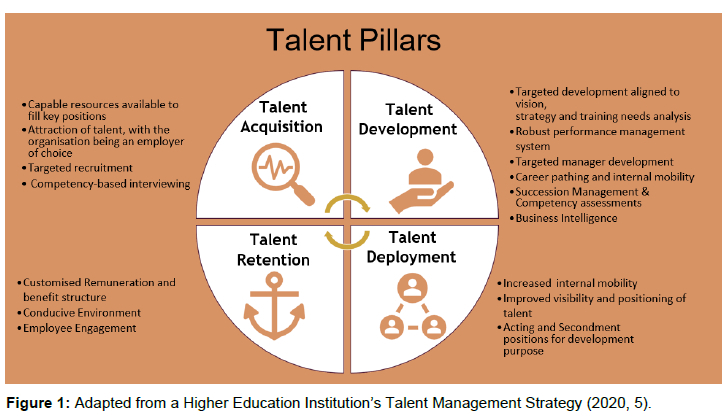
A deeper understanding of the concept of talent management can, in many instances, be related to Aristotle's quote that "The whole is greater than the sum of its parts." If talent management is seen as the whole, it is important to understand that the four talent management pillars (parts), depicted in the model below, need to be considered.
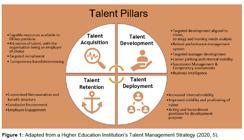
The abovementioned model serves as a useful framework to realise the importance of managing talent as an integrative human resource (HR) system. Talent management practices are unique to every organisation and institution. For instance (Sullivan, 2004, 2005) points out that recruiters' focus is on sourcing the best candidates possible, training and development specialist and practitioners encourage 'growing talent' through the use of training and leadership development programmes (LDP) (Cohn, Khurana and Reeves, 2005, 64), compensation emphasises the use of monetary compensation and performance management processes to attract and retain employees and line managers adopts succession planning and leader development through deployment and stretch assignments (Conger and Fulmer, 2003, 84). Talent management therefore forms an integrated process aimed at attracting, developing, deploying, and retaining talented employees who can contribute to achieving strategic objectives thereby creating a vibrant and sustainable organisation (Riham and Atkan, 2020, 8; Yildiz and Soner, 2023, 95). The attraction, development, retention, and deployment of talent has been a challenge that many organisations and institutions face worldwide. The exceptional complexity of the current world of work that has seen shifts in its landscape as a result of globalisation, technology, socio-economic, geopolitical, and demographic changes accelerated by COVID-19 and the fourth industrial revolution (4IR), has necessitated organisations and institutions to focus on identifying, attracting, recruiting, developing, and retaining talent to mitigate and navigate the challenges resulting from these shifts. (Gallardo-Gallardo, Thunnissen and Scullion. 2020, 485).
Talent attraction is known as the practice of enticing the most suitable passive candidates to a particular organisation and incentivising them to apply for jobs with suggested and envisioned advantages (Yildiz and Soner, 2023, 96). The methods and tactics used to attract talent vary, but may also include employer branding, recruitment marketing, organisational culture, compensation, and benefits. Staffing strategies, in particular talent attraction, is widely regarded as the key means by which higher education institutions can obtain and maintain institutional quality (Neri and Wilkens, 2019, 54).
Talent development involves capitalising on an employee's qualities and skills in order to grow, develop and strengthen talent within the organisation (Whysall, Owtram and Brittain, 2019, 126; Yildiz and Soner, 2023, 96). Today's employees spend more time at work and seek greater balance in their lives. This balance is especially important for younger workers, as is the knowledge that their concerted effort makes a difference (Mukuna, 2019, 3). Initiatives for talent development provide employees with opportunities to learn and grow in their areas of interest. Scholastic articles have highlighted the value-add for organisations employing effective talent development strategies to be correlated to higher employee performance, commitment, motivation, and satisfaction (Barkhuizen and Gumede, 2021, 3). What is critical is that organisations realise that talent development goes beyond simple regulatory compliance in training activities. Targeted development initiatives aligned to the strategy and vision of the organisation ensure the right people are in the right roles, such competency enhancement contributes to the economy of the country and also adds value to employee's job satisfaction, thus increasing job retention and providing the organisation with a competitive edge (Barkhuizen and Gumede, 2021, 2) Talent development will further allow employees to explore and develop their interests and skills within the framework of their employment. Therefore, robust performance and higher employee satisfaction will be enhanced by successful talent development through training initiatives, which in turn will lead to improved organisational effectiveness and performance (Barkhuizen and Gumede, 2021, 5)
Talent retention is a set of policies and procedures implemented by organisations to guarantee that their above-average workers remain with them for a much longer period of time and will, therefore, possibly create a substantial, sustainable competitive advantage (Akunda , Chen and Gikiri, 2020, 9; Yildiz and Soner, 2023, 96). Talent attraction, development and retention are strongly correlated with the extent to which an organisation is perceived to have a change-quality, technology-driven culture characterised by support for creativity, open communications, effective knowledge management, and the core values of respect and integrity (Akunda et al., 2020, 9).
Talent deployment in the context of talent management involves the internal mobility of employees to guarantee that there is a person-job and person-organisation fit and may be determined through assessment results of the employees' capabilities and interests (Yildiz and Soner, 2023, 96). By developing and moving employees into suitable positions, organisations will invest in their current talent for future leadership and strategically aligned roles (Dopson et al., 2018, 227; Kafetzopoulos and Gotzaman, 2022, 851).
To achieve a holistic talent management strategy, it is crucial to highlight the interconnections of these talent management pillars. Recruitment serves as the entry point, identifying and attracting individuals whose skills and values align with the organisation's needs. Once onboard, development programmes enhance these employees' capabilities, ensuring they can grow into more complex roles. Effective compensation strategies then reward performance and development progress, encouraging motivation and retention. Finally, succession planning ensures that the organisation has a pipeline of capable leaders ready to fill critical positions, thus maintaining organisational stability and continuity. These interconnected practices create a seamless talent management process, where each element supports and enhances the others, leading to a sustainable and dynamic workforce that can adapt to changing organisational needs and external challenges. Organisations and institutions can better manage talent to achieve long-term success and resilience by viewing these practices as interdependent components of a unified strategy. Furthermore, discussing potential conflicts or trade-offs within these practices could provide a more nuanced view, challenging readers to think critically about the application and management of these practices.
TALENT MANAGEMENT INDICATORSConsidering all the efforts organisations and institutions make to manage talent it is important to determine if those talent management efforts and initiatives do add value to the organisation and institution. Lewis and Heckman (2006, 145) state that considering the effectiveness of talent management without regard for impact can lead to poor talent decisions. They mention for instance, that if organisations conduct training programmes, this improved performance of delegates that attended the training should improve the execution of the strategy to develop, grow and position your internal human resource capability. In other words, the degree to which talent management interventions affect and impact the practices, behaviours, and actions in the organisations. Boudreau and Ramstad (2005, 14-15) affirm this viewpoint by mentioning that any talent management interventions should address the capacity of the talent or the processes/practices (aligned actions) of the talent within the organisation.
Developing and implementing an integrated talent management strategy is seen as the roadmap to organisational success in the twenty-first-century workplace (Narayanan et al., 2019, 229). Successful development and implementation will see the organisation as reaping benefits such as an increased revenue per employee, less need for layoffs and restructuring, less turnover among high performers, less overall voluntary turnover, and the ability to hire the best talent and develop effective leadership (Narayanan et al., 2019, 240).
Important measures to determine if talent management contributes to organisational sustainability and improved performance include retention, succession, internal promotions, deployment, and individual and organisational performance (Yildiz and Soner, 2023, 96). Performance management is a crucial element of talent management in organisations. It involves the process of setting goals, evaluating and appraising employee performance, and providing feedback to improve performance (Dopson et al., 2019, 227). In today's competitive business environment, it is essential for organisations and institutions to identify and retain talented employees to maintain a competitive edge. Performance management is a continuous process that involves setting objectives, evaluating performance, and providing employees with feedback to improve performance (Almohtaseb et al., 2020, 12). This process helps managers to identify employee strengths and weaknesses and provide guidance on areas for improvement. The main aim of performance management is, therefore, to improve employee productivity, ensure employee satisfaction, and achieve organisational goals. Through performance management, managers can also identify talented employees who can be developed for future leadership roles (Almohtaseb et al., 2020, 12-13). This is where talent development initiatives and succession planning come into play.
Talent development initiatives are programs designed to enhance employee skills, knowledge, and abilities. Talent development initiatives are essential in retaining talented employees and ensuring a continuous flow of competent leaders in the organisation and institution. Talent development serves to grow an organisation's talent pool (Whysall et al., 2019, 126). A well-structured and effective talent management development programme stems to benefit both the individual and organisation (Narayanan et al., 2019, 241; Meyers, 2020, 1). There is a wide scope of talent development initiatives which include and are not limited to practices such as career pathing, succession management, job shadowing, rotation, stretch assignments, coaching, mentoring, focussed training and development of talent pools (Meyers, 2020, 7). The aim of these programs is to develop employees' potential and prepare them for future leadership roles.
Succession planning is the process of identifying and developing potential leaders to fill key leadership positions in the organisation and involves assessing employee skills, identifying potential successors, and preparing them for future leadership roles (Bano, Omar and Ismail, 2022, 40). Succession planning is essential in ensuring continuity in leadership and maintaining organisational and institutional stability (Ugoani, 2020, 31). Performance management is essential in identifying and retaining talented employees in the organisation. Through performance management, managers can identify employees with potential for future leadership roles (Pagan-Castaño et al., 2022, 533). Talent development initiatives are then used to enhance the skills and abilities of these employees, preparing them for future leadership roles. Succession planning ensures that these employees are ready to assume leadership positions when the need arises.
The link between performance management, talent development initiatives, and succession planning is that they are all part of the talent management process and serve as important talent measures. Performance management is the first step in identifying potential leaders, while talent development initiatives prepare them for future leadership roles, while succession planning ensures that the organisation has a continuous supply of competent leaders to fill key positions (Bano et al., 2022, 41) Thus, having an effective talent management strategy, policy and measures will guide the organisation in retaining and developing the best talent.
CASE CONTEXT
A leadership and management talent development programme was designed and developed by the human resources department of a higher education university, with the main purpose to grow and develop its leadership and management potential whilst building the leadership capacity of professional and administrative staff in the institution. The programme was targeted for all potential talent serving as Deputy Directors, Managers, Supervisors and Team leaders in the professional and support environment. This training intervention was specifically intended to develop and expose this selected group of managers, supervisors and team leaders to innovative leadership and management theories, methodologies, technologies, and practices in acquiring new knowledge and skills. Participants of the programme had the opportunity to expand their leadership potential by confronting and challenging their inherent and unique leadership attributes and characteristics. Furthermore, the programme focussed on growing one's leadership integrity and credibility, establishing purposeful leadership, managing organisational resources, leading organisational teams and managing with accountability.
A significant investment in terms of time and money was made to these selected individuals. It was envisaged that once delegates successfully completed this training programme, they would be competent to function in their current or future leadership and management positions in the institution.
Over a ten-year period, 256 delegates were exposed to this training and development programme. Structured learning and development approach was followed, and delegates were exposed to written and oral evaluations.
METHODOLOGY
The research was carried out at a large comprehensive South African university. The delegates who participated in a leadership and management development programme were the focus for this study. Data of two hundred and thirty-six (236) delegates that attended the programme over a ten-year period from 2012 until 2022 was used. A purposive sampling methodology was used by collating a list of all two hundred and thirty-six (236) support and professional staff that attended the leadership and management programme between the years of 2012 to 2022. A robust longitudinal study and a detailed comparative analysis of numeric data were conducted to assess the impact of the leadership development programme. This methodology and approach allowed to track the career progression, retention, and performance of 236 employees over a ten-year period. This methodological approach allowed for a comprehensive understanding of the programme's long-term effects on employee development and mentioned indicators, providing valuable insights into the efficacy of targeted talent development initiatives. Secondary data from the institution's Human Resource Information System (HRIS) was also obtained. This data included performance management scores, promotions, deployments, retention status (talent indicators), and biographical details. To ensure the accuracy and reliability of the findings, the data underwent rigorous cleaning to address any missing values, system errors, and outliers.
DATA ANALYSISThe sample group was mainly representative in terms of demographics, functionality, discipline, race, and gender, which represent the demographics of South Africa. Secondary data from the Human Resource Information System (HRIS) was analysed to track delegates' future promotions and deployment status after attending the leadership programme. The specific focus was on data indicating whether delegates had been promoted or received acting positions or secondments since participating in a leadership and management development programme. This analysis also provided more insight into further vertical career advancement, an important indicator for talent sustainability. The number of staff that had left the institution was also calculated to determine the retention rate of employees that attend a LDP.
In addition, an analysis was done on delegates performance management scores before and after participation in the programme. This analysis provided further clarity into whether or not the average performance management scores of the Leadership Development Programme (LDP) group increased or decreased after attending the programme. These performance rating scores were also compared over the period 2012 to 2022 against the rest of the institution's ratings (six hundred employees).
RESULTS
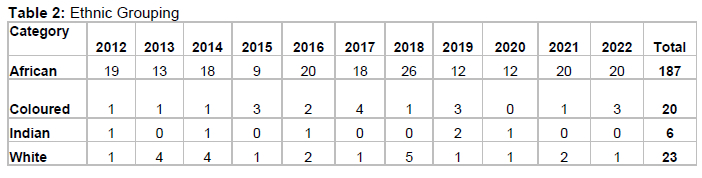
The delegates involved in the study were spread across three different post levels, namely Line Managers, Team leaders and Supervisors. Table 1 provides a breakdown of gender representation. The participants gender consisted of one hundred and thirty females (130) and one hundred and six (106) males. Representation in terms of race included two hundred and eighty-seven (187) Africans, twenty (20) Coloureds, six (6) Indians and twenty-three (23) Whites (See table 2). Representation was made from all 30 departments across the institution, including regional centres and satellite offices. The age of delegates that attended the programme averaged between thirty-five (35) and forty-five (45). Training delegates in a leadership development program between the ages of 35-45 is proven to be vital because it targets individuals at a critical mid-career stage, where employees are ready to take on higher responsibilities (Baba, Makhdoomi and Siddiqi, 2021). This age group also has significant work experience to pursue future leadership roles. Training and development at this career stage also plays an important part in future mentoring (Dewanto et al, 2024).
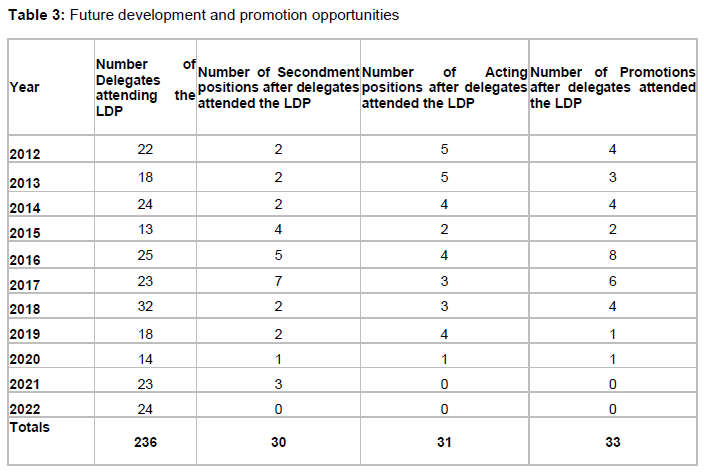
Of particular interest was determining how many delegates that participated in the programme were advanced by being promoted, seconded or placed in acting positions. The data indicated that thirty-three (14%) of employees that attend the LDP were given promotion opportunities (see Table 3). Over this time period, thirty employees (13%) were deployed by way of secondments, and a further thirty-one employees (13%) were placed in acting positions. It is worth noting that all these promotions occurred subsequent to employees being on the programme. In total nighty four (40%) delegates that attended the programme were provided with further career advancement by means of promotion, acting positions or secondments into a higher position over the period 2012 - 2020.
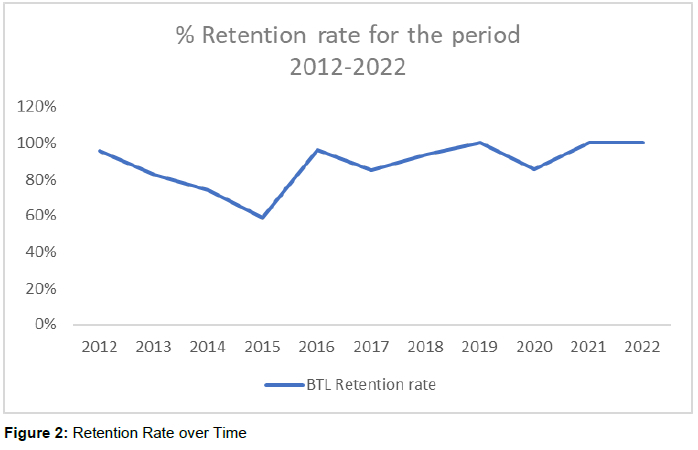
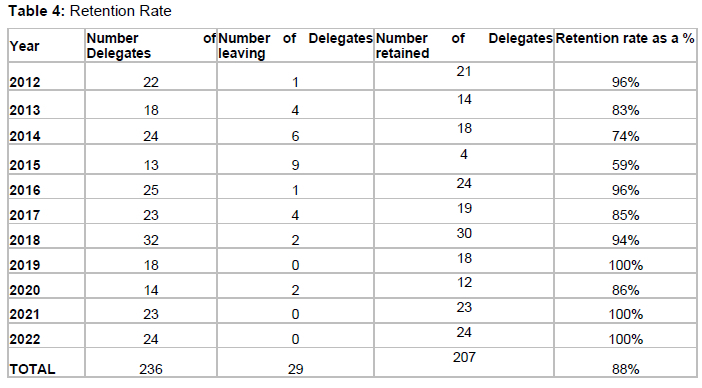
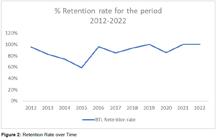
Considering the retention rate of delegates that attended the leadership and development programme compared to the rest of the institution, it was found that the retention rate of these delegates was 88 per cent compared to a retention rate of 94 per cent (from the HR database) for the rest of the institution. Twenty-nine delegates (14%) have left the institution's employment after attending the programme. The turnover is higher when compared to the rest of the institution's turnover rate of 6 per cent. Figure 2 indicates a timeline of the percentage retention rate over the period 2012 to 2022. In 2015 there is a clear indication of more employees leaving the institution when compared to the stable retention rate over the period.
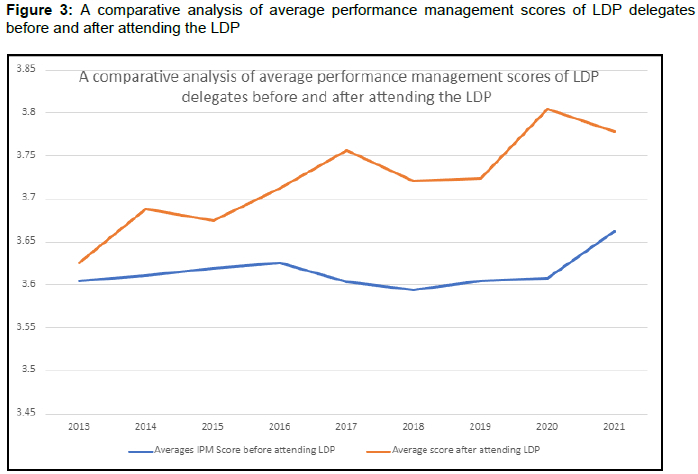
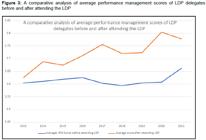
After analysing the average performance management scores of delegates who attended the LDP it was found that the average performance score for the delegates before attending the LDP was lower than the average performance management score after attending LDP (Figure 3). This implies that the average performance management score for the delegates increased after attending the LDP.
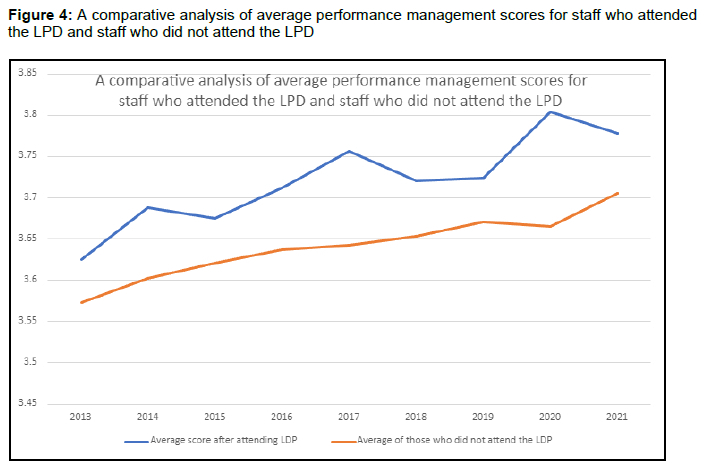
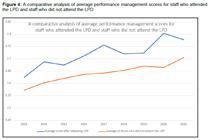
A comparative analysis of average performance management scores over the span of nine years, from 2013 to 2021, was conducted (Figure 4). The blue line represents the average performance management score for the LDP cohort for the year after attending the LDP. The average score is just above 3.6 in 2013 and shows a gradual inclination towards an average performance score of just below 3.85 in 2021. The orange line in the figure, represents the average performance management score per year of those who did not attend the LDP. This line also indicates an average performance score of just above 3.6 in 2013 and has a more moderate inclination towards an average performance score of 3.7 in 2021. The higher inclination in scores represented by the blue line suggests that this programme might have an influencing factor in contributing towards higher individual performance scores attending the LDP.
DISCUSSION AND FINDINGS
The results suggest that at least a third of delegates attending the leadership development programme were afforded further development opportunities through formal higher-level promotions, secondments and acting in more senior positions. Rothwell and Kazanas (2003, 263) state that promotions, secondments and acting positions are all important components of succession management, providing avenues for skill development, talent identification, knowledge transfer, and addressing immediate talent needs while nurturing a pipeline of future leaders. These opportunities afforded to employees are core factors to enhance succession planning and talent management. The positive results of this study are contrary to Richards (2009, 120), who found there is limited formal succession management and planning occurring in institutions of higher education. Charan, Drotter and Noel (2011, 5) also found that the leadership pipeline or the internal strategy to grow leaders in many companies is dry or non-existent. Thus, institutions must create these internal leadership development opportunities (Conger and Fulmer, 2003, 77) and implement proper deployment initiatives to build and grow a leadership pipeline as part of a succession management strategy.
The need for organisations to measure employee turnover is seen as an important predictor of organisational effectiveness (Erasmus, Grobler and Van Niekerk, 2015, 35). Erasmus et al (2015, 41) further cite that turnover rates vary across industries and organisations and high turnover rates can be dysfunctional, unhealthy and costly to the organisation. According to them the turnover of high-performing groups should be minimised to retain the investment made in these employees. Price (2000, 604-605) found that quality training and development opportunities could also lead to higher retention rates. The study also recognises that certain tendencies and trend, such as the noticeable dip in retention rates in 2015, might be attributed to external economic factors or internal organisational changes such as restructuring or shifts in leadership that could have impacted employee morale and retention. The result of this study affirms that the proper development of talent is one of many aspects and initiatives that can contribute to higher retention rates, but it is also important that institutions make all efforts to retain talented employees, especially in cases where a significant amount of investment has been made in developing employees.
The results further indicated that the performance management scores of delegates who attended the LDP improved after attending the LDP, thereby strengthening the findings of Alnaga and Amen (2013, 141) that training and development programmes are one of the vital human resources functions that positively affect employee's knowledge, skills and abilities towards improved performance. Additionally, the higher performance management scores post-LDP participation suggest that the programme effectively enhances individual capabilities, aligning with the findings of previous studies, which indicate that targeted development initiatives can significantly improve employee performance (Kumar et al., 2023). The plausibility that employees do gain valuable skills and knowledge by attending these programmes cannot be excluded as a contributing factor towards individual and institutional performance.
However, it is also important to consider the possibility of selection bias, where individuals chosen for the LDP might already possess higher potential, thereby skewing the performance outcomes. Comparing these findings with existing literature reveals a consistent pattern where well-structured leadership development programmes contribute to improved organisational outcomes, yet also highlights areas where the institution's unique context may diverge from broader trends. For example, the retention rate discrepancies between LDP participants and non-participants underscore the need for a tailored retention strategy that addresses the specific needs and expectations of high-potential employees. Future research should explore these nuances in greater detail, possibly through qualitative methods such as interviews or focus groups, to gain deeper insights into the factors influencing these outcomes. This comprehensive approach would not only validate the quantitative findings but also provide a richer understanding of the program's impact on both individual and organisational levels.
CONCLUSION AND RECOMMENDATIONS
The study highlights the importance of investing in talent development initiatives, as they contribute to improved career progression, higher retention rates, and potential enhanced performance. The positive impact on career progression, performance and sustainable retention rates underscores that investing in talent development initiatives may yield tangible and intangible returns and benefits for the institution. This study emphasises the importance of Human Resource practitioners having a proper retention strategy in place to counter the possible loss of expertise and talent in the institution, as replacing employees is also immensely costly. This retention strategy should include a strong focus on career development, career discussions, alignment of organisational and personal goals, mentoring and coaching initiatives. These practices will aid in transferring knowledge and skills back in the workplace, ultimately benefiting the return on investment made by organisations. To further mitigate the retention challenge and harness talent developed within the institution, it is essential to implement a robust career pathing and succession planning strategy. This strategy should focus on creating clear and attractive career progression opportunities within the institution. Elements of this strategy should include, identifying and communicating potential career paths and growth opportunities within the institution, establishing mentorship programs to guide LDP attendees in their career development, ensuring promotions and advancement opportunities are merit-based and readily available to those who demonstrate leadership potential and enhanced performance. These practices will provide further encouragement for selected talent to stay and grow within the institution whilst also strengthening the psychological contract between employer and employee. Strengthening the psychological contract between employer and employee involves building trust and mutual commitments. When talent management policies such as promotion, supportive performance management and learning and development opportunities are linked to the outcomes of leadership development programmes it is essential for institutions to fulfil the promises made to participants that complete these programmes to ensure that there is clarity regarding roles, responsibilities, and expectations. Open dialogue helps in creating a sense of psychological safety as employees feel more informed and involved. It is therefore recommended that Higher Education institutions should implement a comprehensive talent management strategy that allows for targeted development initiatives coupled to proper succession planning and performance management. This internal drive, to offer and invest in quality and targeted leadership development interventions, will contribute to higher education institutions' efforts to nurture and grow a strong, motivated and capable workforce for the future.
While effective talent management practices clearly influence various organisational outcomes like increased revenue per employee, improved retention rates, and enhanced performance, it's crucial to consider the measurability of these impacts. Reliable measurement of talent management initiatives is essential for organisations to make well-informed decisions. Traditional metrics, such as revenue per employee and turnover rates, provide valuable insights but might not fully capture all benefits or potential unintended consequences. For example, high retention rates generally seem positive but could also indicate a lack of new ideas and innovation if new talent isn't regularly introduced. Additionally, some benefits of talent management, like enhanced employee engagement and improved organisational culture, are more intangible and harder to measure yet vital for long-term success. For these reasons, future research should consider exploring alternative or complementary metrics encompassing a wider range of outcomes, including employee well-being, innovation capacity, and the overall cultural health of the organisation. Developing more comprehensive evaluation frameworks could assist organisations in better understanding the true value of their talent management efforts and refine their strategies to maximise both tangible and intangible benefits.
REFERENCES
-
Al Aina, Riham, and Atan Tarik. 2020. "The impact of implementing talent management practices on sustainable organizational performance." Sustainability 12, no. 20 (October): 8372. https://doi.org/10.3390/su12208372
» https://doi.org/10.3390/su12208372 -
Akunda, Doreen, Zhixia Chen, and Simon Ndwiga Gikiri. 2018. "Role of HRM in talent retention with evidence." Journal of management and strategy 9, no. 2 (April): 8-19. https://doi.org/10.5430/jms.v9n2p8
» https://doi.org/10.5430/jms.v9n2p8 -
Almohtaseb, Ahmad Ali, Hisham A. Kareem Shaheen, Khalid Mohummed Alomari, and Mohmmad Adnan Yousef. 2020. "Impact of talent management on organizational performance: The moderating role of an effective performance management system." International Journal of Business and management 15, no. 4 (March): 11-24. https://doi.org/10.5539/ijbm.v15n4p11
» https://doi.org/10.5539/ijbm.v15n4p11 -
Baba, Mubashir Majid, Ursil Majid Makhdoomi, and Mushtaq Ahmad Siddiqi. 2021. "Emotional intelligence and transformational leadership among academic leaders in institutions of higher learning." Global Business Review 22, no. 4 (August): 1070-1096. https://doi.org/10.1177/0972150918822421
» https://doi.org/10.1177/0972150918822421 -
Bano, Yasmeen, Siti Sarah Omar, and Fadillah Ismail. 2022. "Succession planning best practices for organizations: A systematic literature review approach." International Journal of Global Optimization and Its Application 1, no. 1 (March): 39-48. https://doi.org/10.56225/ijgoia.v1i1.12
» https://doi.org/10.56225/ijgoia.v1i1.12 -
Barkhuizen, Nicolene, and Bongekile Gumede. 2021. "The relationship between talent management, job satisfaction and voluntary turnover intentions of employees in a selected government institution." SA Journal of Human Resource Management 19 (February): 12. https://doi.org/10.4102/sajhrm.v19i0.1396
» https://doi.org/10.4102/sajhrm.v19i0.1396 -
Boštjančič, Eva, and Zala Slana. 2017. "The role of talent management comparing medium-sized and large companies-major challenges in attracting and retaining talented employees." Frontiers in psychology 9 (September): 1750. https://doi.org/10.3389/fpsyg.2018.01750
» https://doi.org/10.3389/fpsyg.2018.01750 - Boudreau, John W., and Peter M. Ramstad. 2005. "Talentship and the evolution of human resource management: From professional practices to strategic talent decision science." Human Resource Planning Journal 28, no. 2 (September): 17-26.
- Charan, Ram, Stephen Drotter, and James L. Noel. 2011. The leadership pipeline: How to build the leadership powered company. Vol. 391. John Wiley & Sons.
-
Cohn, Jeffrey M., Rakesh Khurana, and Laura Reeves. 2005. "Growing Talent as If Your Business Depended on It. (Cover Story)." Harvard Business Review 83 (10): 62-70. https://0-search_ebscohost-com.oasis.unisa.ac.za/login.aspx?direct=true&db=bsu&AN=18500888&site=ehost_live&scope=site.
» https://0-search_ebscohost-com.oasis.unisa.ac.za/login.aspx?direct=true&db=bsu&AN=18500888&site=ehost_live&scope=site -
Conger, Jay A., and Robert M. Fulmer. 2003. "Developing your leadership pipeline." Harvard Business Review 81, no. 12 (December): 76-84. https://europepmc.org/article/med/14712546
» https://europepmc.org/article/med/14712546 -
Dewanto, Irwan, Donald Crestofel Lantu, Achmad Fajar Hendarman, and Agung Wicaksono. 2024. "Accelerating Millennials' Leadership Development Program-A Proposal for New Guidelines." Grey Journal (TGJ) 20, no. 1 (Spring). https://search.ebscohost.com/login.aspx?direct=true&db=asn&AN=175995964&site=ehost_live&scope=site
» https://search.ebscohost.com/login.aspx?direct=true&db=asn&AN=175995964&site=ehost_live&scope=site -
Dopson, Sue, Ewan Ferlie, Gerry McGivern, Michael D. Fischer, Mahima Mitra, Jean Ledger, and Sonja Behrens. 2019. "Leadership development in Higher Education: A literature review and implications for programme redesign." Higher Education Quarterly 73, no. 2 (December): 218-234. https://doi.org/10.1111/hequ.12194
» https://doi.org/10.1111/hequ.12194 -
Erasmus, Barney. J., Grobler, Anton, and Van Niekerk, Melissa. 2015. "Employee retention in a higher education institution: An organisational development perspective." Progressio 37, no. 2: 33-63. https://doi.org/10.13140/RG.2.1.4474.5049
» https://doi.org/10.13140/RG.2.1.4474.5049 -
Gallardo-Gallardo, Eva, Marian Thunnissen, and Hugh Scullion. 2020. "Talent management: context matters." The International Journal of Human Resource Management 31, no. 4 (July): 457-473. https://doi.org/10.1080/09585192.2019.1642645
» https://doi.org/10.1080/09585192.2019.1642645 -
Gan, Evelyn, and Mung Ling Voon. 2021 "The impact of transformational leadership on job satisfaction and employee turnover intentions: A conceptual review." In SHS Web of Conferences, vol. 124, p. 08005. EDP Sciences, November. https://doi.org/10.1051/shsconf/202112408005
» https://doi.org/10.1051/shsconf/202112408005 -
Jackson, Susan E., and Randall S. Schuler. 1990 "Human resource planning: Challenges for industrial/organizational psychologists." American psychologist 45, no. 2 (1990): 223. http://0-dx-doi-org.oasis.unisa.ac.za/10.1037/0003-066X.45.2.223
» http://0-dx-doi-org.oasis.unisa.ac.za/10.1037/0003-066X.45.2.223 -
Kafetzopoulos, Dimitrios, and Katerina Gotzamani. 2022. "The effect of talent management and leadership styles on firms' sustainable performance." European Business Review 34, no. 6 (October): 837-857. https://0-doi-org.oasis.unisa.ac.za/10.1108/EBR-07-2021-0148
» https://0-doi-org.oasis.unisa.ac.za/10.1108/EBR-07-2021-0148 -
Kumar, A. Naresh, Sujit Kumar Acharya, R. Muralidharan, E. P. John, S. Naganandini, and Vikas Pathak. 2023 "Impact on HRM to Develop Relationship between Leadership Effectiveness and Organizational Performance." Journal of Informatics Education and Research 3, no. 2. 1630 - 1637. https://doi.org/10.52783/jier.v3i2.289
» https://doi.org/10.52783/jier.v3i2.289 -
Lewis, Robert E., and Robert J. Heckman. 2006. "Talent management: A critical review." Human resource management review 16, no. 2 (June): 139-154. https://doi.org/10.1016/j.hrmr.2006.03.001
» https://doi.org/10.1016/j.hrmr.2006.03.001 -
Meyers, Maria Christina. 2022. "The neglected role of talent proactivity: Integrating proactive behavior into talent-management theorizing." Human Resource Management Review 30, no. 2 (June): 100703. https://doi.org/10.1016/j.hrmr.2019.100703
» https://doi.org/10.1016/j.hrmr.2019.100703 - Mukuna, Salome Watiri. 2019. "Talent Management Strategies in the Retention of Millenials and Generation Z." PhD diss., United States International University-Africa. SALOME WATIRI MUKUNA MBA 2019.pdf (usiu.ac.ke)
-
Neri, Selina, and Stephen Wilkins. 2019. "Talent management in transnational higher education: strategies for managing academic staff at international branch campuses." Journal of Higher Education Policy and Management 41, no. 1 (September): 52-69. https://doi.org/10.1080/1360080X.2018.1522713
» https://doi.org/10.1080/1360080X.2018.1522713 -
Narayanan, Anoopa, S. Rajithakumar, and Manoj Menon. 2019. "Talent management and employee retention: An integrative research framework." Human Resource Development Review 18, no. 2 (November): 228-247. https://doi.org/10.1177/1534484318812159
» https://doi.org/10.1177/1534484318812159 -
Pagan-Castaño, Esther, José Carlos Ballester-Miquel, Javier Sánchez-García, and María Guijarro García. "What's next in talent management?" Journal of Business Research 141 (2022): 528-535. https://doi.org/10.1016/j.jbusres.2021.11.052
» https://doi.org/10.1016/j.jbusres.2021.11.052 - Pascal, Connie. 2004. "Foreword". In Talent management systems: Best practices in technology solutions for recruitment, retention and workforce planning by Schweyer, Allan, x-xv. John & Sons.
- Rothwell, William. 2010. Effective succession planning: Ensuring leadership continuity and building talent from within. Amacom.
- Rothwell, William J., and H. C. Kazanas. The strategic development of talent. Human Resource Development, 2003.
-
Sullivan, John. 2004. Talent management defined: Is it a buzzword or a major breakthrough. Accessed October 20, 2023. https://www.ere.net/articles/talent-management-defined-is-it-a-buzzword-or-a-major-breakthrough
» https://www.ere.net/articles/talent-management-defined-is-it-a-buzzword-or-a-major-breakthrough -
Sullivan, John. 2005. To build, buy or trade talent: That is the question behind talent management. Accessed October 20, 2023. https://drjohnsullivan.com/articles/to-build-buy-or-trade-talent-that-is-the-question-behind-talent-management/ .
» https://drjohnsullivan.com/articles/to-build-buy-or-trade-talent-that-is-the-question-behind-talent-management/ -
Ugoani, John. 2020. "Management Succession Planning and Its Effect on Organizational Sustainability". International Journal of Economics and Business Administration Vol. 6, No. 2, 2020, pp. 30-41. https://ssrn.com/abstract=3598097
» https://ssrn.com/abstract=3598097 -
University of South Africa. 2020. Talent Management Strategy https://acrobat.adobe.com/link/review?uri=urn:aaid:scds:US:94d4d2a6-3a30-3f60-88b9-6074adc692d1
» https://acrobat.adobe.com/link/review?uri=urn:aaid:scds:US:94d4d2a6-3a30-3f60-88b9-6074adc692d1 -
Whysall, Zara, Mike Owtram, and Simon Brittain. 2019. "The new talent management challenges of Industry 4.0." Journal of management development 38, no. 2: 118-129. https://doi.org/10.1108/JMD-06-2018-0181
» https://doi.org/10.1108/JMD-06-2018-0181 - Yildiz, Ramazan Ozkan, and Soner Esmer. 2023. "Talent management strategies and functions: a systematic review." Industrial and Commercial Training 55, no. 1 (August): 93-111.