Artificial Intelligence in health science education in the Global South: A critical autoethnographic inquiry
Abstract
This study, situated within Health science education (HSE), drew on critical autoethnography to explore the ethical and pedagogical dilemmas emerging from the increasing unease that I, author 1 (RP) have experienced as a lecturer and researcher while observing my students' overreliance on AI. This unease, when observing polished, yet shallow academic texts and potentially unethical academic practices, prompted a deeper, critical self-reflection on the implications for their learning, the development of complex graduate attributes and my own role within a multicultural, multilingual and historically unequal context. Guided by decolonial theory, critical pedagogy and transformative learning, this study positions AI as embedded within broader historical, epistemic and pedagogical structures. These theoretical lenses also enabled the deep reflexive critique required to confront my vulnerability and complicity within a rapidly evolving digital landscape. Data was generated through the reflexive personal narratives of author 1 (RP), critical conversations with author 2 (NC) and an interview with a student. Together, we explored the cognitive, ethical, and pedagogical implications of AI for HSE in the Global South. Specifically, we examined the challenges of AI integration and the shifting roles and identities of educators within this context and ultimately envisioned a transformative praxis for the field through integrating a decolonial lens. Through the portrayal of three vignettes, "The Unravelling", "The Recalibration" and "The Revelation", the analysis traced a reflexive learning trajectory. We show that while AI can democratise access to disciplinary knowledge, it simultaneously risks deepening the epistemic injustices for students in the Global South. In tracing these tensions, through critical autoethnography, we have shown that AI operates within pedagogical border zones, where language, power, identity and epistemic authority are negotiated. In these spaces, AI may function as a pharmakon simultaneously enabling access or threatening epistemic justice. By making visible the ethical and epistemic tensions, this enquiry contributes to higher education scholarship by foregrounding lived experience as a locus for theorising AI integration for HSE in the Global South. The study offers recommendations for AI literacy, assessments redesign, educator professional learning and the development of communities of practice. A key emphasis in this research, through our findings, is the co-responsibility through policy, pedagogy and professional learning, which is essential to prevent AI from amplifying existing inequities under the guise of efficiency or innovation.
Artificial intelligence; health science education; Global South; critical autoethnography
INTRODUCTION
"For me, it didn't meet the academic standard... I put my own work in and... [asked AI to] make it sound academic."
The nervousness in my student's voice as she admitted this, exposed a fault line in my classroom: here was a talented clinical technology student in South Africa, using Generative AI ... to polish her writing and mask her own perceived inadequacies. Her words, poignant and unsettling, confronted me with an uncomfortable possibility: this was not a failing of the student, but a reflection of the colonial academic norms that I, as an educator, had inadvertently amplified.
This moment presented what Mezirow (2000) describes as a disorienting dilemma and disrupted my taken-for-granted assumptions about learning, assessment and academic legitimacy as a health science educator. It compelled me to pause, look inward and question how my pedagogical practices might be shaping my students' relationships with knowledge, language and authority in an AI-saturated environment.
Across higher education (HE), generative Artificial Intelligence (AI)1 tools such as ChatGPT have rapidly transformed how students access information, complete academic tasks, and engage with learning. These concerns are particularly pressing in HSE, where accurate clinical reasoning, ethical judgement, and contextualised decision-making are foundational (Yang et al 2024).
Much of the global conversation around AI in education, however, stems from North American and European contexts, where stronger digital infrastructure, clearer policy frameworks, and more institutional support for AI integration are well developed (Edeni, Adeleye and Adeniyi 2024; Okolo 2021; Samuel-Okon and Abejide 2024). In contrast, institutions in developing countries face enduring structural inequalities, resource constraints, and multilingual student populations (Singh and Maistry 2024).
In the South African context, and particularly within universities of Technology, the realities of large classes, over-extended curricula, and a linguistically diverse student body intensify these challenges. Although scholarly attention to AI in Health Professions Education (HPE) is growing, discussions largely focus on the technical and practical aspects of AI. Ethical considerations in the classroom around how students use AI in medical practice or clinical activities, its impact on learning and what it means for assessment integrity in African health science, is still comparatively muted (Masters 2023).
In my own teaching practice, I have witnessed increasing student dependence on AI for assignments and assessments, with many fellow academic colleagues feeling overwhelmed and uncertain of how to respond pedagogically, particularly in the absence of institutional guidelines. My concern is that this uncritical reliance allows students to bypass the slow, effortful learning process through which contextual, experiential and culturally shaped judgement, essential in health science (Hersh 2025) is developed. Similar concerns were raised by Singh and Maistry (2024, 197), who cautioned that students will "become information generators and miss the critical aspects of conceptual and critical thinking". Purser (2025) also critiques AI use in HE as encouraging a formulaic "paint by numbers" approach to thinking.
It was against this unsettled backdrop, that this study emerged, drawing on reflexive personal narratives of author 1 (RP) and critical conversations with author 2 (NC), as we explored the cognitive, ethical, and pedagogical implications of AI for HSE in the Global South.
This article contributes to HE scholarship by conceptualising AI as a pedagogical border zone, using critical autoethnography (CAE) to examine how language, epistemic authority, academic identity and ethical responsibility are renegotiated in a South African context. Guided by this orientation, our enquiry was directed by three core questions:
• What challenges does AI present for learning, teaching and assessment (LTA) in health science?
• How might we envision a transformative AI praxis for HSE in the Global South embedded within ethical and decolonial parameters?
• How might academics and researchers reimagine their professional identities in the age of AI?
This article responds directly to the Special Issue focus on Artificial Intelligence in Higher Education in the Global South by offering a situated, critical autoethnographic account of how AI is experienced within a South African health sciences context.
LITERATURE REVIEW AND THEORETICAL FRAMEWORK
To situate our inquiry, we draw on three interrelated bodies of scholarship, namely, decolonial theory, particularly the coloniality of power (Quijano 2007), Critical pedagogy (Freire, 1970), and Transformative learning theory (Mezirow 2000). Together, this framing allows us to position AI within broader historical, epistemic and pedagogical structures, rather than treating it as a neutral technological innovation.
Coloniality of power and decolonial praxis
Decolonial scholars such as Quijano (2007) and Ndlovu-Gatsheni (2013) conceptualise the coloniality of power as the persistence of colonial structures in knowledge production, identity formation and institutional practice, long after the formal end of colonial rule. In HE, this coloniality manifests through the privileging of western epistemologies, and normative assumptions about what counts as legitimate knowledge.
A decolonial praxis is understood as a continuous, critical and action-orientated process of dismantling colonial systems, structures and practices. A crucial aspect of this praxis is epistemic disobedience and delinking (Mignolo 2007). For educators, this requires deep critical reflexivity and self-critique regarding our values, positionality and complicity in perpetuating colonial academic norms.
Al's rapid integration into the educational space amplifies this urgency. While framed as a tool for efficiency or support, AI risks subtly reinscribing existing inequities by normalising dominant epistemologies and linguistic norms under the guise of technological neutrality. A decolonial lens may therefore enable us to examine how AI could simultaneously offer possibilities for access, while reinforcing long-standing asymmetries of power.
Critical pedagogy
Paulo Freire's "Pedagogy of the Oppressed" (1970) provides a foundational framework for critically examining educational practices shaped by power and coloniality. Freire rejected the "banking model" of education. Two concepts are particularly relevant for this study: critical consciousness (conscientização) and critical reflection (reflexão critica). Freire (1970) emphasises that critical reflection must be coupled with action (praxis) if meaningful transformation is to occur.
In South Africa, where colonialism and apartheid legacies continue to shape HE, Freire's framework remains especially salient. Such practices reproduce the very hierarchies that critical pedagogy seeks to disrupt. This framing allows us to examine how AI may both reinforce or challenge existing power structures in the Global South HE contexts.
Transformative learning theory
To frame the personal, pedagogical and ethical shifts emerging from our encounters with AI, we draw on Mezirow's (2000) Transformative Learning Theory. Brookfield (2000) argues that critical reflection is a necessary condition for transformative learning.
We found transformative learning profoundly resonant for our research focus as it enabled us to "turn the critical eye inwards...to examine.. .[our] own belief systems through critical reflection and critical reflexivity" (Taylor 2014, 138). In this sense, transformative learning involves a deep structural shift in thinking, feeling, and acting, aligning closely with the reflexive orientation of our inquiry (O'Sullivan, Morrell and O'Connor 2002, cited in Taylor 2013).
Mezirow (2000) further highlights the role of disorientating dilemmas in catalysing transformation. The moral tension, discomfort, and self-interrogation provoked by AI in my teaching practice can be understood as such a dilemma, prompting a reassessment of my pedagogical assumptions, identity and complicity within existing hierarchies.
Extending this work, Torres (2013) draws on Freire's concept of marginality to argue that "transformative social justice learning" involves developing more nuanced understandings of oneself and one's world. This perspective is apt for South African HE where colonial hierarchies continue to influence whose knowledge is centred, legitimised or marginalised. Situating AI within this framework allows us to critically interrogate its potential to either reinforce or unsettle these inequalities.
Academic identity and educator positionality
Clegg (2008) and Archer (2008) theorise academic identity as fluid, and relational, influenced by institutional cultures and the broader socio-political forces. In postcolonial contexts, as in South Africa, identity formation is further complicated by historical inequalities, linguistic diversity and the contested notions of academic legitimacy (Heugh 2015; Ndlovu-Gatsheni 2013). The emergence of AI adds another layer of identity negotiation, requiring educators to rethink their roles as assessors, knowledge brokers and ethical stewards (Selwyn 2019).
In this study, academic identity provides an important lens for understanding how AI reshapes pedagogical habits and expectations, both for educators and students. As AI simultaneously disrupted and reshaped my sense of authority and expertise, questions of positionality, vulnerability and professional responsibility became central to this enquiry.
Linguistic and epistemic justice in African HE
South African scholars (Heugh 2015; Madiba 2019) have long highlighted the struggle for linguistic justice in HE, where academic English continues to function as a primary marker of legitimacy. Recent African scholarship (Woldergiogis 2026, 56) further argues that AI integration in HE must be understood as an "ideological and epistemic undertaking" rather than a purely technical one. Therefore, this study builds on this emerging body of African scholarship by extending these concerns into the everyday pedagogical spaces of health sciences education, where ethical questions are enacted through decisions about language, authorship and assessment. In this sense, the analysis, aligns with arguments that AI in African HE must be understood as an epistemic and ethical project shaped by local histories of inequality rather than as a neutral technological development (Woldegiorgis, 2026; Mhlambi and Tiribelli, 2024).
Drawing on theorists like Fricker (2007), Spivak (1998) and Bhabha (1994) Woldergiogis (2026) argues that AI can be conceptualised as a contested locus where power, knowledge and identity intersect, particularly in contexts characterised by structural inequality (Jansen and Walters 2022). While AI may support multilingual expression and access, it also risks deepening inequalities by reproducing linguistic hierarchies and data biases. In my experience, these contradictions compel us as educators to critically re-examine our roles, and assumptions, in this rapidly shifting landscape.
Ethics, Ubuntu and relational responsibility
The emergence of AI in global HE has been met with both optimism and concern. In response, there is a growing interest in developing ethical frameworks grounded in decolonial context-responsive approaches (Eaton 2023). Ubuntu-informed relational ethics, grounded in African philosophies, emphasise interdependence, communal responsibility and ethical obligations enacted through relationships (Yilma 2025). Ethical AI therefore requires a shift towards reconfiguring sociotechnical systems in ways that honour collective well-being, historical context and the lived realities of those most vulnerable to technological harms.
Gap in the knowledge
While the global discourse debates the technical possibilities or ethical risks of AI in education (Selwyn 2019; Williamson, Komljenovic and Gulson 2023), there remains limited attention to how AI intersects with the coloniality of knowledge, linguistic injustice and academic identity in African HSE. Existing studies seldom foreground how AI mediates epistemic authority, language norms and disciplinary ways of knowing in Global South contexts, with emerging scholarship emphasising broader ethical and epistemic concerns rather than their enactment within specific pedagogical settings (Woldegiorgis 2026; Mhlambi and Tiribelli 2024). Moreover, there is a notable paucity of reflexive or critical autoethnographic approaches to theorise AI integration through lived experience (Ellis, Adam and Bochner 2011; Taylor, 2013).
Our study addresses these gaps by offering a decolonial and transformative account of AI, grounded in reflexive educator-researcher narratives, within a South African health science HE context. In so doing, it extends current AI in HE scholarship beyond the dominant Global North framings and foregrounds lived experience as a legitimate site for theorising transformative pedagogical praxis.
METHODOLOGY
Framing: Critical autoethnography
This study adopted a critical autoethnographic (CAE) approach to reflexively unpack how AI intersected with the coloniality of knowledge and the shifting identity of educators in HSE. CAE positions personal narratives, not as anecdote, but as a site for theorising how broader structures, such as race, language, coloniality, class, and professional hierarchies, shape lived experiences (Reed-Danahay 2017; Boylorn and Orb 2014).
Within this framing, the researcher's positionality is not treated as bias to be bracketed out, but as analytical data. Lived experience is foregrounded as a legitimate site of knowledge production (Ellis, Adam and Bochner 2011). The emotional responses documented in the vignettes (fear, uncertainty, ethical discomfort and moments of pedagogical dissonance) are treated as symptoms of deeper structural tensions in contemporary learning, teaching and assessment practices, intensified by the emergence of AI.
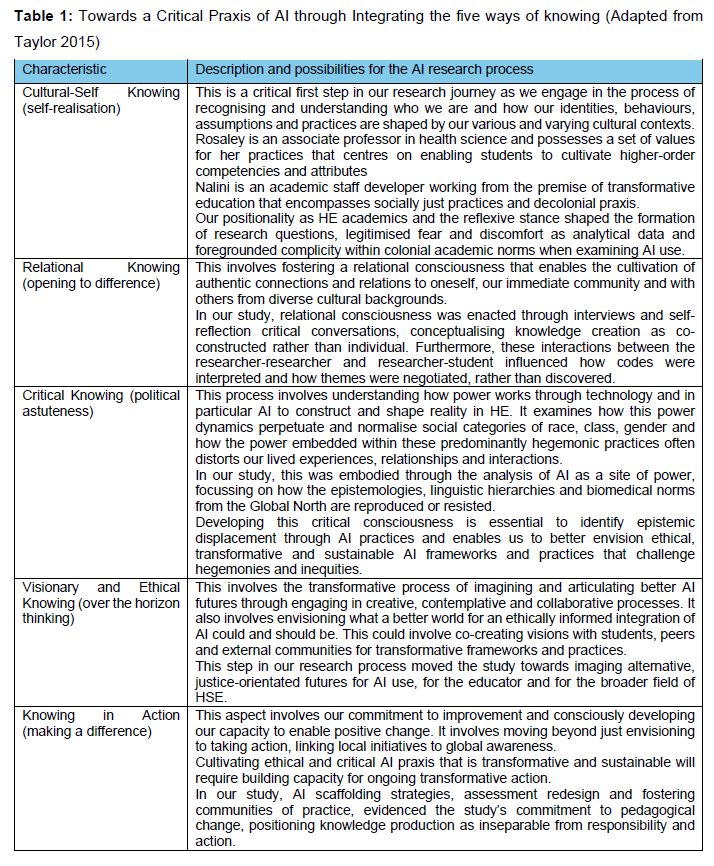
Analytic framing: Five ways of knowing
To support reflexive depth and analytic coherence, we drew on Taylor's (2015) five ways of knowing, which extend Mezirow's (2000) transformative learning theory. As Taylor (2015, 1079) notes, "Critical reflection emancipates us from our ideological prisons, thereby enhancing our conscious awareness of ourselves, others and the worlds that we co-construct."
The five ways of knowing provided an analytic scaffold rather than a prescriptive framework that guided how we generated the data, interpreted meaning and connected individual experience to broader structural critique, particularly in relation to AI's impact on HSE, allowing us to envision new possibilities for improving health science praxis and our commitments to action.
Integrating Taylor's five ways of knowing with Critical autoethnography moves the research inquiry from a personal narrative to a critical inquiry of the broader socio-historical HSE. Tayor's five ways of knowing aligns well with the CAE commencing with the author's reflections on her positionality and identity as a health science educator in the face of rapid AI influx. The integration of multiple voices for a holistic critical understanding reveals inequities and hegemonies inherent in the contexts through western epistemic traditions that shape/influences Global South experiences. This led us to envisioning new possibilities for educating HS students for ethical, Ubuntu inspired decolonised futures and finally moving towards action and making a difference through critical and transformative praxis.
DATA PRODUCTIONData were produced through multiple, overlapping sources, consistent with CAE practice. We started the process by drawing on Jack Whitehead's (2000) living theory approach, particularly his emphasis on reflexive questioning as a means of making values, assumptions and contradictions visible in professional practice. Initial interview and reflection prompts were adapted from this approach (Appendix 1).
However, as the enquiry unfolded, these prompts did not sufficiently foreground issues around coloniality and power, and epistemic authority in relation to AI use in a Global South context. This led to an iterative redesign of the data-generation instruments.
To deepen the critical focus of the inquiry, we used AI tools reflexively (specifically Perplexity and Gemini) to support the development of alternative prompts. These new sets of questions were then critically interrogated and refined collaboratively as follows:
• Overlapping or redundant prompts were removed
• Questions that reproduced depoliticised framings were rejected, and
• Prompts that opened spaces for reflexivity about power, fear, and authority were kept and further refined.
This process resulted in a co-constructed set of critically oriented prompts that informed the subsequent self-reflections and critical conversations between us (Appendix 2).
Participants and data sources
The final data set comprised:
• Four dialogic, reflexive, critical conversations between the authors, allowing evolving nterpretations, uncertainties and positional shifts to emerge over time.
• Four recorded self-reflections by Author 1, structured around the finalised prompt set.
• One semi-structured interview with a student, conducted by Author 1.
This student was purposefully selected as she had openly disclosed her reliance on generative AI in an earlier conversation with her after concerns around AI-generated text emerged. In addition, she showed a level of maturity and willingness to discuss her learning process, including her anxieties, motivations and perceptions around use of AI for academic tasks, which made her well-suited to offer rich insights into the phenomenon under inquiry.
Data analysis process
While the five ways of knowing framework informed data production, data analysis was conducted using Braun and Clarke's six-phase reflexive approach (Braun and Clarke 2019), selected for its epistemic compatibility with CAE. Both approaches emphasise meaning making and researcher reflexivity, rather than coding reliability or frequency counts.
Analysis was iterative and interpretive, consistent with CAE (Boylorn and Orbe 2014). Rather than seeking data saturation, the study focussed on patterns of meaning that illuminated how power, identity, language and pedagogical practices were negotiated within AI-mediated pedagogical encounters. The analytic process was as follows:
• We familiarised ourselves with the data sources (critical conversations, self-reflections and student conversation).
• Initial codes were generated inductively, with explicit reflexive attention to my position as an educator and examiner.
• Codes were treated as sensitising concepts rather than fixed categories, enabling movement between personal experience and structural critique.
• Reviewing and grouping of codes into provisional themes through an iterative and recursive process.
• Refining, naming and defining themes to foreground tensions, contradictions and moments of pedagogical dissonance.
• Embedding reflexivity throughout the process through analytic memos and critical reflection, ensuring that the theme development was aligned with the study's CAE aims.
In presenting the analysis, we first allowed for uninterrupted description of lived experience through three vignettes. The vignettes were developed by selecting and synthesising key moments from the data, providing context and incorporating emotions, internal dialogue and reflexive insight. This process sought to create verisimilitude (Barone and Eisner 1997) while creating a foundation for subsequent analytical interpretation.
So, Taylor's five ways of knowing and reflexive thematic analysis enabled the movement between lived experience and structural critique. CAE provided the methodological orientation, while the five ways of knowing informed reflexive attention to values, power and action. Reflexive thematic analysis offered a flexible analytic process for identifying patterns of meaning across the dataset. This alignment ensured coherence between data generation, interpretation and the study's aims.
ETHICS AND TRUSTWORTHINESSEthical considerations were approached relationally through ongoing consent, care and reflexive accountability, particularly in relation to the student interview and the use of emotionally charged self-narratives. Trustworthiness was supported through iterative dialogue between the authors, analytical memoing and triangulation across self-reflections, critical conversations and the student narrative.
VIGNETTE ANALYSIS: CONTESTATIONS, COMPLEXITIES, REVELATIONS AND POTENTIALITIES
In this section, we present three vignettes to depict the contestations, complexities and revelations of a health science educator and the transformative possibilities for envisioning socially just and equitable praxis for the integration of AI, as I grappled with the implications of AI for learning, teaching and assessment, and professional identity.
Following the vignettes, we move into the analytic interpretation. Reading across the vignettes and the wider dataset, we identified a set of interrelated themes that capture how AI functioned simultaneously as a site of disruption, possibility, and risk within an AI-mediated pedagogical landscape. The first vignette captures a moment of unravelling, marked by destabilisation of pedagogical authority and identity. The second reflects a process of recalibration, as initial fear gave way to grappling with how AI might be pedagogically repositioned from a crutch to a scaffold. The third reveals a moment of ethical and epistemic reckoning, in which attention shifted inward to examine complicity in sustaining linguistic and epistemic hierarchies that shape students' relationships with knowledge.
Vignette 1: The unravelling
A Microsoft Teams call is in progress, on two screens ten kilometres apart. Rosaley and Nalini are in deep conversation. Rosaley has just completed an assessment with her students; she's agitated and shares her experience. Nalini is thinking about her staff development engagements with Rosaley. She believes in developing health science students with the relevant critical competencies and attributes to contribute meaningfully to health science in the Global South. However, like many academics around the world, Rosaley has experienced the uncertainties, disruptions and potentialities of AI.
Rosaley: "AI threatens to dismantle my power as a lecturer and educator. I'm not the person with all the answers anymore. My students are fact-checking me. I am no longer the expert. You know, what I'm really thinking is that we need deep, deep transformation" [emphasising deep].
Nalini: "This is powerful. By this deep transformation of these relationships, what are you thinking about?"
Rosaley: "Well, not just of our relationship with this...but how we even perceive ourselves as educators, and what our roles are."
Nalini: "What are you thinking about your role? What are you scared of? What are you hopeful about?"
Rosaley: "My whole psyche as an educator is now beginning to unravel."
There is a long pause that makes the atmosphere feel somewhat heavy. Rosaley exhales deeply and continues:
"I have placed my entire identity as an educator on being the one who has the power in the classroom to wield all of this knowledge...honestly I am feeling very threatened by this. So now if I'm not the provider and the facilitator of this knowledge, what is my role here? Do I even need to be in a classroom? This scares me!"
The question hangs in the air between them, eviscerating.
Rosaley thinks to herself: "I've spent my entire professional career building this identity, and now. I feel the walls cocooning this identity are falling apart."
Vignette 2: The recalibration - From crutch to scaffold
By this stage of our inquiry, the initial shock had given way to something more unsettling and complex. Rosaley was now struggling to understand what AI meant for the learning process itself - the slow, effortful development of thinking, writing and professional judgement in HSE.
This conversation occurred in the wake of a research project assessment cycle. Today Nalini and Rosaley are meeting at a Café. They both felt that the fresh air outside campus would be a good change.
Rosaley: "So one of my colleagues said, 'but you know writing is overrated.'" Nalini: "That's interesting. Did you feel the same?"
Rosaley: "Well, my response was 'if writing is overrated, then how do we know that you've actually given this [concept] some thought?' What happens to that whole process of learning?"
Rosaley pauses, and confesses something more difficult:
Rosaley: "I have used it too. I used AI to help me understand this very dilemma. I'm not saying don't use it. But I feel that the students have short-circuited this" [the learning process].
Rosaley looks at Nalini, unsettled...
Rosaley: "AI is not just a technical tool. It's a scaffold for students to .. I don't know... reach their full potential irrespective of the context that they are in. We need to find ways to transform it from being a crutch into a scaffold."
Nalini:" What do we mean by crutch? By scaffold? What kind of scaffolding do we want to create?"
They both chatted and a cold realisation crystalised for Rosaley.
Rosaley: "My assessments will become obsolete! I have to change them".
She then whispers.
Rosaley: "I'm so scared and I'm so insecure. I am trying to understand this new generation of students. Is there a way that they can use AI and also show that they have learned that they have the ability to think?"
Nalini does not offer a quick fix. Instead, she sits with Rosaley, feeling her discomfort and insecurities. After some time, she adds.
Nalini: "AI is here. Are our students AI literate, to navigate this space and develop the kinds of criticality we want?"
The questions stayed with me. They were not just abstract questions about the process anymore: they were about the scaffold that we are still learning how to build.
Suddenly, it seemed like the Café got louder... it was lunch time and they decided to pause their discussions. As Rosaley made her way back to her office, she thought about her students in the Global South where systemic inequities exist. Students already experiencing language barriers and poor educational background may lack the foundational knowledge to critically evaluate AI. They risk citing ghost references or fictitious data because they are unaware and thus become vulnerable.
Vignette 3: The revelation
In this vignette, in a critical conversation with a student, Rosaley was prompted to question her complicity in contributing to the pressure experienced by her students.
Weighed down by the mental turmoil that this state of uncertainty was causing her, Rosaley felt compelled to understand the student's perspective. This student was one of those who had over-relied on AI, had been required to rework and resubmit her chapter, yet performed exceptionally well in the oral assessment. A frank, yet calm conversation unfolded, without accusation or defensiveness, yet it revealed one of the most persistent tensions in the classroom: the unspoken weight of language. Here the expectations of "high-quality work" careened with the realities of learning in a multilingual, postcolonial academic space, where linguistic fluency is often mistaken for intellectual competence.
Rosaley felt heavy in her chest, thinking of the possibility of what she may have inadvertently created.
Rosaley: "Thank you for sending me your revised assignment. I would really like to understand the process. Please share with me how you engaged with AI."
Student: "So basically, for me, when I first wrote it, it didn't mean the academic standard when I was reading it. I literally just wrote and then I was like, can you make it sound academic? It just sounded academic, you know, like academic standard writing. So yeah, that is what I was doing."
Rosaley: "Do you think that there is too much focus to get a document that is perfectly written in English? Is there too much pressure? Was that your main concern?"
Student: 'Teah, there is. And yeah, there is pressure."
Student pauses, takes a long breath and adds further...sounding almost careful of the words she was saying:
Student: 'Teah, it it's.. .the pressure was there, but you didn't say like the English parts separately, it was more of like... in this level I expect...high quality work from you guys because you'll be going out [graduating as independent practitioners]."
What emerged was a misalignment between what was meant to signal readiness for professional practice and what was experienced as pressure to conform to a particular linguistic ideal. Rosaley realised that academic expectations have the potential to be internalised as silent judgement, even when they are framed as neutral or developmental. This really hit hard.
RESULTS AND DISCUSSION
The vignettes presented above capture the moments through which AI intersected with everyday pedagogical practice in HSE. The discussion is organised around three interrelated themes: AI as a site of disruption and pedagogical possibility; AI and the coloniality of knowledge; and the shifting ethical and professional identity of the educator.
The three vignettes, "The Unravelling", "The Recalibration" and "The Revelation" trace a reflexive learning trajectory. This trajectory can be understood as a spiral process, beginning with disruption and uncertainty as my identity as the expert knowledge holder was unsettled. As the enquiry deepens, the next step of the spiral turns our attention inward, prompting critical reflection on how inequities continue to prevail.
The role of AI as a site of possibility: Disruption and transformation
In our study, AI emerged as both a disruptor and impetus for transformation within HSE. In earlier critical self-reflections, I had worried that AI over-reliance might short-circuit students' learning process, preventing them from developing critical-thinking skills, typically developed through struggle and practice, and a key graduate attribute in health science. Yet, the student's account revealed a more complex possibility: AI could serve as a cognitive scaffold, enabling her to participate more fully in scholarly discourse, rather than replace learning. This was evident when the student described rewriting the AI-generated text in her own words (after I had given feedback):
"I started... changing the way it sounds... writing in a way that, if I was saying it, this is how it would have sounded... I changed everything."
Far from diminishing her professional growth, this strategy of using AI, in this instance, provided a linguistic template which she then studied, reworked and made her own. This was reflected in her strong understanding of her research during the oral presentation, which was not conveyed in the original written submission. AI supported her when she struggled with a complicated Cardiology article; she used ChatGPT to get a plain-language summary.
"I asked ChatGPT to explain it in the simplest form... then I understood it better".
In this context, AI functioned as a knowledge translation tool that allowed movement between vernacular, academic English and disciplinary discourse. This illustrates AI as a pedagogical border space. In this space, AI enabled access as the student re-entered the text critically rather than just accepting it as it was generated. This is in keeping with emerging evidence that AI-supported feedback and simulations can enhance learning when used reflectively and deliberately (Meinlschmidt et al 2025, Pham et al 2025; Hersh 2025).
Hersh (2025) further argues that AI forces educators into "epistemic humility" (McMillan 2023), exposing how much of fixed biomedical knowledge is contingent, patterned and reproducible (Hersh 2025). Ultimately, I realised that AI destabilised entrenched hierarchies, creating a locus where alternative forms of knowledge and participation become possible - the caveat being the need for educators to harness this disruption with intentionality and deliberation. Without this scaffolding, AI enacts the very coloniality it claims to mitigate, and these strategies will be unpacked later in the article.
However, this disruption was not inherently emancipatory. The same linguistic support offered by AI was double-edged: while it could scaffold participation, it could also become an epistemic crutch, particularly for students with lower confidence in academic writing (Smit Bond-Barnard and Wagner 2025). In this context, the risk is not simply that students will "use AI", but they may begin to substitute polished output for conceptual understanding. This is the very banking model approach to education that Freire (1970) vehemently challenges.
This poses risks for HSE, as the deep contextual wrestling required to understand pathology, physiology, clinical medicine is bypassed. When AI substitutes, rather than supports this struggle, it risks producing graduates who can produce information but lack the critical consciousness to critique, adapt and/or localise biomedical knowledge (Hersch 2025) for African contexts.
AI and the coloniality of knowledge in health science education
When students uncritically accept outputs generated from predominantly Global North data sources, there is a risk that AI functions as another form of epistemic colonialism (Petrakaki, Chamakiotis and Curto-Millet 2023). This prompted renewed questions related to epistemic justice, what and whose knowledge is valued, legitimised or marginalised within AI-mediated learning environments.
Decolonial AI scholars caution that AI systems are never neutral (De Matas, 2025). In HSE, Masters (2023) highlights how algorithmic bias can reinforce existing power inequalities and racialised assumptions in HPE. The danger lies firstly, in the misrepresentation, but also in the authority given to these AI outputs, even if they are blind to African health practices, socio-economic realities and contextual forms of meaning-making (Woldegiorgis 2026), an enactment of what Fricker (2007) describes as hermeneutical injustice. This concern emerged reflexively in my own thinking:
"...this over reliance on AI is actually another subtle form of coloniality ... because the danger is that students are now believing everything that comes out of this AI and most of the ideas are generated in the Global North... perspectives from the Global South [are] not reflected."
This analysis revealed a critical tension. AI can democratise explanatory power for Global South students by offering a counter-space where students can experiment with identity, voice and disciplinary language (Woldegiorgis 2026; Pham et al 2025). On the other hand, students must be guided and cautioned not to mistake language fluency for conceptual mastery. While we aver that AI does not inevitably reproduce coloniality, without strong foundational knowledge and epistemic guidance, students may lack the critical capacity to interrogate, contextualise and challenge AI-generated outputs.
Confronting this tension necessitated acknowledging my vulnerability and shifting my own educator identity, positionality and pedagogical stance. Moving from my perceived role as a gatekeeper of a singular biomedical canon, I began to ponder my role as a curator of epistemic diversity, responsible for scaffolding students' engagement with multiple knowledge systems, while making the limitations and biases embedded within AI tools, visible. Reclamation in this current context of AI demands the intentional decolonising of the digital scaffolds ensuring that AI is embedded within our specific contexts, rather than imposed as a universal authority. Such an approach has the potential to ameliorate the inequities of our systems.
Becoming otherwise: Shifting identities, ethical integration and pedagogical adaptation
A dominant theme which developed from the critical conversations and self-reflection was the ethical integration of AI into HPE. Masters (2023) foregrounds the largely unregulated nature of AI use in HPE, and this absence of guidance was evident in my early encounters with AI-generated student work. These moments heightened my feelings of uncertainty and scepticism, reaffirming that AI is neither neutral nor inevitable.
My experience suggests that ethical engagement with AI cannot be reduced to a broad refrain of "use the tool but think critically". Scholarship on academic integrity similarly argues that the ethical concerns lie not in AI technology itself, but in how it is taken up in learning environments (Eaton 2025). In practice, this requires an intentional pedagogical shift to position human intellectual development, judgement and reasoning at the centre of AI integration, rather than technological efficiency. This tension is captured in my reflections:
"We need to be using it ethically ... treat it as a scaffold and not as a crutch, because we use it to build ourselves."
"...in our context, students need to be adaptable and quick on their feet. If you've skipped the struggle of learning, you will not cope in the [clinical] environment."
At the same time, this experience complicated my initial assumptions about student intent. The prevailing academic system continues to equate excellence with fluency in a colonial language and with dominant forms of Western academic expression. When students turned to AI out of linguistic insecurity, these acts revealed that they were not necessarily trying to bypass learning but employing strategies for navigating academic spaces that felt exclusionary. This was one of the study's most important shifts: the realisation that what I had initially perceived as unethical behaviour could also be read as a genuine struggle for voice, legitimacy and survival. The disorienting dilemmas experienced through the rapid influx of AI prompted a reflexive turn in my practice as a health science educator in the Global South and forced me to re-evaluate my assumption and preconceptions. Engaging ethically with AI therefore entailed a reconfiguration of my personal identity, where I was confronted with my potential complicity in contributing to the pressure experienced by my students, as illustrated in the vignette 3. As noted by other researchers, AI adoption represents a major identity shift for health professional educators (Pham et al 2025), demanding new competencies from educators, and moving away from authoritative knowledge-holder into that of co-learner and critical epistemic guide (Meinlschmidt et al 2025). This positioning involves cultivating students' capabilities on how to detect bias, verify accuracy, and contextualise machine-generated content, particularly in environments marked by uncertainty and uneven access to epistemic resources (Smit et al 2025).
For me, this repositioning has provoked considerable emotional labour of adapting, translating and critically mediating AI use, while remaining mindful of its epistemic and ethical implications. As Woldegiorgis (2026) cautions, a decolonial praxis compels educators to resist the algorithmic authority by actively affirming the value of local epistemologies. Such work demands epistemic humility (McMillan 2023) and a willingness to interrogate one's own assumptions and investments with AI-mediated learning environments.
SYNTHESIS: EQUITY, JUSTICE, AND THE FUTURE OF HEALTH SCIENCE PEDAGOGY
AI as Pharmakon
"The real issue isn't that students might use AI inappropriately, but that over-reliance on these tools will prevent them from developing what educators call a 'transformative relationship to knowledge'. True education involves intellectual struggle, grappling with complexity, and developing analytical capabilities that fundamentally change how students understand themselves and their world." McKenna (2025).
This assertion by McKenna (2025) underscores Rosaley's vision that her students develop a "transformative relationship with knowledge". However, across this inquiry, we see that AI presents both opportunities and challenges; it functioned as what Derrida (1981) describes as a "pharmakon", embodying the idea that something can be both beneficial and harmful. Originating from Greek, the pharmakon is illustrative of a drug that serves simultaneously as a remedy and poison, as introduced by Derrida (1981) in discussing Plato's reading of Phadreus as supporting memory while inducing forgetfulness (Marom and Ruitenberg 2018). Applied to AI, this duality reflects its capacity to support education whilst simultaneously weakening the very processes through which epistemic agency and professional judgement are formed (Teal 2019; Güder 2026; Singh and Maistry 2024). As reflected in the preceding discussion, the negative pharmakonic effect may be more prevalent in the Global South, where colonial legacies continue to influence HE. This, together with the slow transformation (Badat 2022) in South African HE and the current lack of institutional policies and procedures guiding AI, risks entrenching further digital dependency and hegemonies.
The transformation paradox evident through the pharmakon highlights the contradiction in the role of AI in HE and its potentialities. While AI offers the potential to democratise knowledge, it simultaneously risks deepening the epistemic injustices for students in the Global South.
AI as a pedagogical border
The pharmakonic tension is further clarified by conceptualising AI as a pedagogical border zone. Drawing on Giroux's (2007) border pedagogy and Anzaldua's (1999) concept of borderlands, AI-mediated classrooms can be understood as lived, liminal spaces of tension, negotiating and becoming. For our study, this space was one where students and staff oscillated between empowerment and vulnerability. While some students use AI as a scaffold to expand their participation, others risk it becoming an epistemic crutch that displaces critical reasoning and contextual judgment.
Rosaley's words revealed the deep entanglement of AI over-reliance with language anxiety and the weight of western expectations. Perhaps, in focusing solely on policing AI, we were missing the real issue: a lack of inclusive support for students struggling with academic English. This revelation reflects deeper systemic issues in HE, as purported by Stein (2026) and requires a shift in educators' mindsets to embrace a perspective of AI as a learning collaborator. The emergence of AI unsettled the premise of the academic being the primary holder of knowledge as students can now easily access and interrogate information with authority that they previously lacked. The educator's role now needs to be foregrounded as a mediator of epistemic plurality (Heleta 2024) and demands epistemic humility.
The disruption of traditional notions of academic expertise through the emergence of AI has highlighted this shift in the educator's role. Drawing on the scholarship of Bovill (2019) on students as partners, this repositioning opens space for students to participate as co-creators of knowledge, rather than passive consumers thereof.
Ultimately, we realise that AI in health science education cannot be understood solely through a technical or pedagogical lens, as its impact is always ethical, political and epistemic.
LIMITATIONSThis study is small-scale, and intentionally so, as it is deeply situated. The inclusion of one student narrative and a limited set of reflexive accounts do not permit broad empirical generalisation. The value of this study lies in its analytic contribution of how AI intersects with language, power, academic identity and pedagogical co-responsibility in one South African health science context. The intention was transferability through theoretical and contextual resonance that could prompt further reflexive inquiries among educators in the Global South
IMPLICATIONS AND RECOMMENDATIONSDrawing on the experiences and the insights of this CAE, several implications emerge for HEIs, educators and academic staff developers navigating the integration of AI in learning and teaching.
First, HEIs should embrace student-centred AI literacy initiatives by developing policies and discipline-specific academic literacy programmes, that teach students how to use AI ethically and effectively, rather than banning AI (Hammerman et al, 2025). Ambiguous or absent institutional AI policies creates moral hazards, leaving students vulnerable to overreliance (Smit et al 2025). These initiatives include clarifying when AI use is appropriate, how to credit AI assistance, and providing practice in detecting AI inaccuracies (Bittle and El- Gayar 2025).
Secondly, assessment design requires rethinking. Educators should develop tasks that make AI use visible and pedagogically productive. A practical example would be for students to use AI-assisted drafting accompanied by a reflective commentary or oral defence. Such designs both deter misuse and, as our experience has shown, can enhance learning equity and critical thinking (through reflection) (Hamerman, Aggarwal and Martins 2025). Another project is a follow up from this article, which will incorporate the Indaba, Ubuntu principles, reflective harvest, story circles and moving toward a co-created curriculum with AI as a collaborator.
While designing such tasks is time-consuming, Johnston et al (2024) argue that this level of structured engagement is essential to ensure equitable access and to support students, particularly those with lower academic confidence, in developing critical, ethical, and reflective academic practices.
Thirdly, staff development must foreground critical AI reflexivity. Educators need spaces to unpack their own biases and learn new pedagogical strategies for the AI age (Bittle and El-Gayar 2025). Communities of practice can support experimentation for AI in teaching and share learning experiences and pedagogical strategies that uphold academic standards without resorting to prohibition, surveillance or exclusion.
Across these recommendations the central implication of responsibility for ethical AI use keeps emerging: the responsibility cannot be individualised or delegated solely to students. Institutional co-responsibility through policy, pedagogy and professional learning is essential to prevent AI from amplifying existing inequities under the guise of efficiency or innovation.
CONCLUSION
The dilemma presented by students' responses to an assessment and my reflections thereof prompted this inquiry and catalysed a transformative learning experience for both Rosaley and her student. While she initially assumed AI would undermine her student's learning, the enquiry revealed a more complex reality: AI could both constrain and support understanding, depending on how it was engaged.
Through this CAE, we have shown that AI operates within pedagogical border zones, where language, power, identity and epistemic authority are negotiated. In these spaces, AI may function as a pharmakon simultaneously enabling access or threatening epistemic agency. While this study is not a generalisable account of AI use in HSE, these findings compel us as educators to re-examine our ethical obligations and responsibilities and confront the architecture of equality that have shaped learning and teaching in South Africa. By making visible the ethical and epistemic tensions, this enquiry contributes to HE scholarship by foregrounding lived experience as a locus for theorising AI integration in the Global South HSE. Rather than positioning AI as a solution or threat, we argue for pedagogical intentionality, epistemic humility and context-sensitive scaffolding. Ironically, the very technology that initially provoked Rosaley's anxiety may also serve as an unexpected equaliser, precisely through the pedagogical border zones it opens. As Giroux reminds us:
"Uncertainties can be a time of great anxiety but a time of great possibility ... a discourse of anxiety should give way to a discourse of critique, and a discourse of critique should give way to a discourse of possibility. And a discourse of possibility means that you can imagine a future very different from the present" (Giroux, 2019).
It is within these unsettled pedagogical spaces that educators are called on to reimagine their roles as facilitators of critical engagement, ethical judgement and epistemic justice, in an AI-saturated world.
AI DECLARATIONAI was used to generate reflective prompts building on Whitehead's reflective questions (Appendix 2).
REFERENCES
- Anzaldúa, Gloria. 1999. Borderlands/La Frontera: The New Mestiza. San Francisco: Aunt Lute Books.
- Archer, Louise. 2008. "Younger Academics' Constructions of 'Authenticity,' 'Success,' and Professional Identity." Studies in Higher Education 33 (4): 385-403.
- Badat, Saleem. 2022. "Reflection on the Review." In Review of Higher Education in South Africa Twenty-Five Years into Democracy, 232-262. Council on Higher Education.
- Barone, Tom, and Elliot Eisner. 1997. "Arts-Based Educational Research." In Complementary Methods for Research in Education, 2nd ed., edited by Richard M. Jaeger and Tom Barone, 73-94. Washington, DC: American Educational Research Association
- Bhabha, H. K. (1994). The location of culture. Routledge.
- Bittle, Kyle, and Omar El-Gayar. 2025. "Generative AI and Academic Integrity in Higher Education: A Systematic Review and Research Agenda." Information 16 (4): 296.
- Bovill, Catherine. 2019. "A Co-Creation of Learning and Teaching Typology: What Kind of Co-Creation Are You Planning or Doing?" International Journal for Students as Partners 3 (2): 91-98.
- Boylorn, Robin M., and Mark P. Orbe, eds. 2014. Critical Autoethnography: Intersecting Cultural Identities in Everyday Life. Left Coast Press.
- Braun, Virginia, and Victoria Clarke. 2019. "Reflecting on Reflexive Thematic Analysis." Qualitative Research in Sport, Exercise and Health 11 (4): 589-597.
- Brookfield, Stephen D. 2000. "The Concept of Critically Reflective Practice." In Handbook of Adult and Continuing Education, edited by Arthur L. Wilson and Elisabeth R. Hayes, 33-49. San Francisco: Jossey-Bass.
- Clegg, Sue. 2008. "Academic Identities under Threat?" British Educational Research Journal 34 (3): 329-345.
- De Matas, Jarrel. 2025. "Reprograming the Narrative Machine: Toward a Decolonial Ethics of Artificial Intelligence in Global Health." Emerging Media 3 (3): 451-461.
- Derrida, Jacques. 1981. Dissemination. Translated by Barbara Johnson. Chicago: University of Chicago Press.
- Eaton, Sarah Elaine. 2025. "Global Trends in Education: Artificial Intelligence, Postplagiarism, and Future-Focused Learning for 2025 and Beyond-2024-2025 Werklund Distinguished Research Lecture." International Journal for Educational Integrity 21 (1): 12.
- Edeni, Chima Abimbola, Olabisi Oluwakemi Adeleye, and Idowu Sulaimon Adeniyi. 2024. "The Role of AI-Enhanced Tools in Overcoming Socioeconomic Barriers in Education: A Conceptual Analysis." World Journal of Advanced Research and Reviews 21 (3): 944-951.
- Ellis, Carolyn, Tony E. Adams, and Arthur P. Bochner. 2011. "Autoethnography: An Overview." Historical Social Research/Historische Sozialforschung 36 (4): 273-290.
- Freire, Paulo. 1970. Pedagogy of the Oppressed. The Continuum Publishing Company
- Fricker, Miranda. 2007. Epistemic Injustice: Power and the Ethics of Knowing. Oxford: Oxford University Press.
-
Giroux, Henry A. 2019. "All Education Is a Struggle over What Kind of Future You Want for Young People." YouTube video, 9:58. Posted by CCCB, July 2, 2019. https://www.youtube.com/watch?v=LCMXKt5vRQk.
» https://www.youtube.com/watch?v=LCMXKt5vRQk - Giroux, H. A. (2007). Border crossings: Cultural workers and the politics of education. Routledge.
- Güder, Feride Zeynep. 2026. "AI as Digital Pharmakon: The Critical AI Literacy with the Perspectives of Epistemology and Meta-Knowledge." In Critical Perspectives on Digital Culture and Gaming, 1-28. IGI Global Scientific Publishing.
- Hamerman, Eric J., Anubhav Aggarwal, and Chrissy Martins. 2025. "An Investigation of Generative AI in the Classroom and Its Implications for University Policy." Quality Assurance in Education 33 (2): 253-266.
- Heleta, Savo. 2024. "The 'Quest for Relevance': Reconceptualising and Redefining Internationalisation of Higher Education in South Africa." In Critical Reflections on the Internationalisation of Higher Education in the Global South, 183-199. Emerald Publishing Limited.
- Hersh, William. 2025. "Generative Artificial Intelligence: Implications for Biomedical and Health Professions Education." Annual Review of Biomedical Data Science 8.
- Heugh, Kathleen. 2015. "Epistemologies in Multilingual Education: Translanguaging and Genre-Companions in Conversation with Policy and Practice." Language and Education 29 (3): 280-285.
- Jansen, J. D., & Walters, C. A. (2022). The decolonization of knowledge: Radical ideas and the shaping of institutions in South Africa and beyond. Cambridge University Press.
-
Johnston, Heather, Rebecca F. Wells, Elizabeth M. Shanks, Timothy Boey, and Bryony N. Parsons. 2024. "Student Perspectives on the Use of Generative Artificial Intelligence Technologies in Higher Education." International Journal for Educational Integrity 20: article 2. https://doi.org/10.1007/s40979-024-00149-4.
» https://doi.org/10.1007/s40979-024-00149-4 - Madiba, Mbulungeni. 2014. "Promoting Concept Literacy through Multilingual Glossaries: A Translanguaging Approach." In Multilingual Universities in South Africa: Reflecting Society in Higher Education, 68-87.
- Masters, Ken. 2023. "Ethical Use of Artificial Intelligence in Health Professions Education: AMEE Guide No. 158."Medical Teacher 45 (6): 574-584.
- Marom, Lilach, and Claudia W. Ruitenberg. 2018. "Professionalism Discourses and Neoliberalism in Teacher Education." Alberta Journal of Educational Research 64 (4): 364-377.
-
McKenna, Sioux. 2025. "Universities' Focus on Policing Is Fighting the Wrong AI Battle." University World News, August 7, 2025. https://www.universityworldnews.com/post.php?story=20250806191842970.
» https://www.universityworldnews.com/post.php?story=20250806191842970 - McMillan, John. 2023. "Humility." Journal of Medical Ethics 49 (4): 227-228.
- McNiff, Jean and Jack Whitehead. 2006. All You Need To Know about Action Research. London: Sage.
- Meinlschmidt, Gunther, Sara Koc, Emma Boerner, Marion Tegethoff, Thomas Simacek, Liam Schirmer, and Michael Schneider. 2025. "Enhancing Professional Communication Training in Higher Education through Artificial Intelligence (AI)-Integrated Exercises: Study Protocol for a Randomised Controlled Trial." BMC Medical Education 25 (1): 804.
- Mezirow, Jack. 2000. "Learning to Think Like an Adult: Core Concepts of Transformation Theory." In Learning as Transformation: Critical Perspectives on a Theory in Progress, edited by Jack Mezirow, 3-34. San Francisco: Jossey-Bass.
- Mhlambi, Sábelo, and Simona Tiribelli. 2024. "Correction: Decolonizing AI Ethics: Relational Autonomy as a Means to Counter AI Harms." Topoi: 1-1.
- Mignolo, Walter D. 2007. "Delinking: The Rhetoric of Modernity, the Logic of Coloniality and the Grammar of De-Coloniality." Cultural Studies 21 (2-3): 449-514.
- Ndlovu-Gatsheni, Sabelo J. 2013. Coloniality of Power in Postcolonial Africa. African Books Collective.
- Okolo, Joy Nnenna. 2021. "A Systematic Analysis of Artificial Intelligence and Data Science Integration for Proactive Cyber Defense: Exploring Methods, Implementation Obstacles, Emerging Innovations, and Future Security Prospects." Communication in Physical Sciences 7 (4): 581-596.
- O'Sullivan, Edmund. V., Amish Morrell, and Mary O'Connor. ed. 2002. Expanding the Boundaries of Transformative Learning: Essays on Theory and Praxis. New York: Palgrave.
- Pham, Thai Duong, Nilushi Karunaratne, Betty Exintaris, Danny Liu, Travis Lay, Elizabeth Yuriev, and Angelina Lim. 2025. "The Impact of Generative AI on Health Professional Education: A Systematic Review in the Context of Student Learning." Medical Education.
- Petrakaki, Dimitra, Petros Chamakiotis, and Daniel Curto-Millet. 2023. "From 'Making Up' Professionals to Epistemic Colonialism: Digital Health Platforms in the Global South." Social Science & Medicine 321: 115787.
-
Purser, R. (2025, December 1). AI is destroying the university and learning itself. Current Affairs. https://www.currentaffairs.org/news/ai-is-destroying-the-university-and-learning-itself
» https://www.currentaffairs.org/news/ai-is-destroying-the-university-and-learning-itself - Quijano, Aníbal. 2007. "Coloniality and Modernity/Rationality." Cultural Studies 21 (2-3): 168-178.
- Reed-Danahay, Deborah. 2017. "Bourdieu and Critical Autoethnography: Implications for Research, Writing, and Teaching." International Journal of Multicultural Education 19 (1): 144-154.
- Selwyn, Neil. 2019. Should Robots Replace Teachers? AI and the Future of Education. Hoboken, NJ: John Wiley & Sons.
- Singh, Upasana Gitanjali, and Suriamurthee Moonsamy Maistry. 2024. "AI and Higher Education in Developing Country Contexts: About Envisioning Potentiality!" In Imagining the Futures of Higher Education in Southern Africa: An Exploration from Multiple Perspectives, edited by Vicky Avinash Oojorah and Waaiza Udhin, 85-103. Singapore: Springer
- Smit, Michelle, Taryn Bond-Barnard, and Reinhard F. Wagner. 2025. "Artificial Intelligence in South African Higher Education: Survey Data of Master's Level Students." Data in Brief: 111813.
- Spivak, G. C., 1988. Can the subaltern speak? In: Nelson, C. and Grossberg, L. (eds.) Marxism and the Interpretation of Culture. London: Macmillan Education, pp. 271-313.
- Stein, Sharon. 2026. "Beyond Cheating: AI Exposes Deeper Crises in Universities." University World News.
- Teal, Randall. 2019. "The Digital Pharmakon: The Poisonous/Potential of Partial Determinism." In 107th ACSA Annual Meeting Proceedings, Black Box: Articulating Architecture's Core in the Post-Digital Era, edited by Jeremy Ficca, Amy Kulper, and Grace La, 106-111. Washington, DC: ACSA Press.
- Taylor, Peter Charles. 2013. "Research as Transformative Learning for Meaning-Centered Professional Development." In Meaning-Centered Education, 168-185. Routledge.
- Taylor, Peter Charles. 2015. "Transformative Science Education." In Encyclopedia of Science Education, edited by Richard Gunstone, 1079-1082. Dordrecht: Springer.
- Torres, Carlos Alberto. 2013. "The Secret Adventures of Order: Globalization, Education and Transformative Social Justice Learning." Revista Brasileira de Estudos Pedagógicos 94 (238): 661-676.
- Whitehead, Jack. 2000. "How Do I Improve My Practice? Creating and Legitimating an Epistemology of Practice." Reflective Practice 1 (1): 91-104.
- Williamson, Ben, Janja Komljenovic, and Kalervo N. Gulson. 2023. "Introduction: Digitalisation of Education in the Era of Algorithms, Automation and Artificial Intelligence." In World Yearbook of Education 2024, 1-19. Routledge.
- Woldegiorgis, Emnet Tadesse. 2026. "Artificial Intelligence and the Future of African Higher Education: Promise, Peril, and the Pursuit of Epistemic Justice." African Journal of Teacher Education 15 (1): 54-76.
- Yang, Rui, Yilin Ning, Emilia Keppo, Mingxuan Liu, Chuan Hong, Danielle S. Bitterman, Jasmine Chiat Ling Ong, Daniel Shu Wei Ting, and Nan Liu. 2024. "Retrieval-Augmented Generation for Generative Artificial Intelligence in Medicine." arXiv preprint arXiv:2406.12449.
- Yilma, Kinfe. 2025. "Ethics of AI in Africa: Interrogating the Role of Ubuntu and AI Governance Initiatives." Ethics and Information Technology 27 (2): 24.