Bridging the digital divide: Innovative approaches to 21st-century skill development in work-integrated learning programmes
Abstract
Studies have confirmed technology as an enabler of work-integrated learning for 21st-century skills. Higher education institutions that offer teacher education in South Africa, however, still struggle with ways to address students' needs and to prepare them for the workplace. Several areas have been identified as posing particular challenges, such as using technology to strengthen co-operative learning, communication, and problem-solving skills required by students for the workplace. In this article, we argue that technology should be incorporated into work-integrated learning to facilitate learning and improve student engagement and self-directed learning. Employing a qualitative research approach, the study on which this article is based used data extrapolated from an open-ended questionnaire completed by participating students (n = 100). The findings revealed that technology provides a platform for students to collaborate, communicate, and solve problems in their diverse groups. The study also found that technology provides opportunities for students to develop creative and critical thinking skills, as well as the possibility to engage actively in group activities. It is recommended that technology be incorporated into work-integrated learning programmes to facilitate learning of the 21st-century skills, improve student engagement, and enhance self-directed learning. By using technology, students can engage in meaningful learning activities that simulate real-world scenarios, promoting active participation and diverse group interactions, which are essential for their future workplace environments.
work-integrated learning; technology support; co-operative learning; teamwork; communication; problem solving; practical knowledge; workplace skills
INTRODUCTION
Among the challenges faced by higher education institutions (HEIs) that offer work-integrated learning (WIL) in South Africa, the use of technology to prepare students for the workplace looms large, particularly in regions where the digital divide is ubiquitous. This challenge has grown more acute because of the lack of digital infrastructure and human capital in digital literacy, competency, and fluency (Ramorola 2024, 167) that will develop students' 21st-century skills. Our participation in previous WIL excursions identified a high number of first-year student teachers who lacked collaboration, communication, and problem-solving skills within diverse cultural groups. Some students, for example, find it difficult to work effectively in teams, while many others are shy and scared to interact with new people. Another common issue was communication. Students found it difficult to talk or express opinions in teams. Some students did not engage in the thought process during problem-solving activities, which led to disagreements and a waste of time. Such problems draw special attention to improved critical thinking, creativity, collaboration, and communication skills required by students for the workplace. It is therefore crucial for researchers to investigate the effects of technology in developing such skills within the context of WIL excursions.
Despite several studies (Doolan et al. 2019; Du Toit and Petersen 2023; Geldenhuys et al. 2022; Martin and Rees 2018; Sebotsa, Petersen and Speight Vaughn 2020) that have confirmed successful WIL programmes in HEIs, there is a serious paucity of technology research-supported WIL programmes to enhance 21st-century skills. Katsamba (2024) confirm that an important goal of teacher education programmes is to enhance student teachers' skills to conduct excellent teaching interactions in practice. After the programme has been completed, many HEIs still follow the traditional approach of face-to-face contact, which is cost-effective and time-consuming, and does not address the learning skills of the twenty-first century. This requires teacher education institutions around the world to redesign their curricula to ensure that student-teachers are prepared to incorporate learning and innovation skills effectively into their future instructional activities (Bedir 2019, 232).
Already in the past three decades, scholars (Reich 1992; Voogt and Odenthal 1997) reflected on the implications of technology for society and argue that society not only faces a change in the types of jobs that are needed but also requires a transformation in the skills and competencies necessary to navigate an increasingly digital and technology-driven world. The implication is that today's generation needs to be educated for a job that does not yet exist. This generation, therefore, will need skills for the knowledge society, which include knowledge construction, adaptability, information literacy, information management, critical thinking, and teamwork (Anderson 2008). These learning and innovation skills are popularly called the '4Cs skills' and include critical thinking, creativity, collaboration, and communication (Bedir 2019, 2019; Kumaro and Barliana 2022, 88; Pardede 2020, 71). We believe that all these skills can be attained by using technology.
Whilst the use of technology to develop student teachers' 21st-century skills seems to be an under-researched area in the field of education, the current study investigated whether the use of technology in WIL activities is sufficiently effective in developing skills that students require in their workplace. The study was therefore undertaken to explore the capacity of virtual WIL programmes in South Africa to develop 21st-century skills, since face-to-face WIL provides only limited opportunities for students to think critically, collaborate, communicate, and engage in problem solving as a diverse group, anytime, and anywhere. The aim was to rethink an improved WIL programme in support of more effective teacher education in the country. We believe that, if designers consider the integration of technology tools when planning the WIL activities, students will be encouraged to improve their learning skills and be motivated towards the success of their studies.
AIM AND OBJECTIVESThe main aim of the study was to improve the use of technology in support of WIL programmes intended to develop student teachers' 21st-century skills. The objective was to identify the skills students develop in the technological platform within the WIL context.
In this section, we present a narrative and review of the literature in relation to approaches to 21st-century skill development in work-integrated learning.
Work-integrated learning
Work-integrated learning has been widely researched. Various scholars (such as Doolan et al. 2019; Martin and Rees 2019) describe WIL as a popular approach to higher education in recent years, which offers students the opportunity to apply theoretical knowledge in real-world settings, gain practical experience, and develop essential skills for their future careers. In addition, Zegwaard et al. (2023, 38) regard WIL as "a practice that allows students to learn through active engagement in purposeful work tasks, which enable the integration of theory with meaningful practice that is relevant to the student's discipline of study and/or professional development". This practice includes off-campus, workplace immersion activities, such as work placements, internships, practicum, service learning, and co-operative education (Zegwaard et al. 2023). According to Oliver (2015), WIL should include tasks that either resemble those of graduates in their early careers or which are proximal to workplaces or spaces where professional work occurs.
Whilst De Beer et al (2023) argue that participation in WIL excursions or other similar programmes allows students to gain first-hand experience, the Faculty of Education at North-West University (NWU) (South Africa) saw the importance of a WIL programme to prepare first-year student teachers for the workplace environment, before student placement in diverse schools. This preparation followed an interventional innovative journey of educational excursions, initially conducted in face-to-face contact. The excursions allowed students to step outside the confines of the classroom and immerse themselves in real-world contexts, providing invaluable opportunities for practical learning.
Student engagement in WIL excursions
Student engagement specifically promotes student activities that involve cognitive processes, such as creating, problem solving, reasoning, decision-making, and evaluation, in which students are motivated to learn due to the meaningful nature of the learning environment (Kearsley and Schneiderman 1998, 20). Given that the excursions were initially conducted face to face, the emergence of COVID-19 and adherence to its protocols forced the Faculty of Education to adapt its approaches and shift to virtual excursions. The technologies facilitated engagement in ways that were difficult to achieve otherwise (Kearsley and Schneiderman 1998). A synchronous virtual excursion, including simulations and other methods based on technology, was therefore conducted between 2 and 24 May 2023, and continues to provide enriching educational experiences (Du Toit and Petersen 2023, 5).
Kearsley and Schneiderman (1998) argue that the fundamental idea underlying technology-based learning and teaching is that students must be meaningfully engaged in learning activities through interaction with others and worthwhile tasks. In the current study, students were engaged in several activities that required critical thinking, communication and co-operation. These were guided by supervisors who facilitated the students' learning. This agrees with the research conducted by Fiore, Graesser, and Greiff (2018), which emphasised the critical role of collaborative problem solving in contemporary educational settings. Lee, Song, and Hong (2019) applauded online learning for its high levels of students' engagement with the learning content as it allowed students to engage in the learning environment anywhere and at any time. This suggests a substantial amount of time spent on tasks. Korte and Li (2015) support Ademuyiwa et al. (2023) suggestion of the importance of supervisors spending time with students on their learning during WIL. Rowe, Mackaway and Winchester-Seeto (2012) argue that time involving supervisors may provide rich learning opportunities, as supervisors have space to observe students' performance, provide feedback, and model behaviour on a given task. While Gettinger (1985) relates the meaning of more time spent on tasks to more opportunities to practice and learn. Kearsley and Schneiderman (1998) identified three principles of engagement, namely relating, creating, and donating. These principles are described below.
Relating emphasises team efforts that involve communication, planning, management, and social skills. This principle relates to collaborative learning, where students are required to clarify and verbalise their problems, thereby facilitating solutions. In their view, Kearsley and Schneiderman (1998) argue that collaboration increases the motivation of students to learn, and when students work in teams, they often have the opportunity to work with others from quite different backgrounds, which facilitates an understanding of diversity and multiple perspectives.
Creating involves students' participation in the development of their assessment tasks, making learning a creative, purposeful activity, as explained by Kearsley and Schneiderman (1998). In this principle, students have to define the project (problem domain) and focus their efforts on the application of ideas to a specific context. Given the nature of the project, students have a sense of control over their learning, which is absent in traditional classroom instruction.
Donating emphasises the value of making a useful contribution while learning (Kearsley and Schneiderman 1998). This refers to a feature that motivates learners because they are engaged in an activity they value. All these principles are instrumental in a study of WIL that seeks to integrate technology in its programmes.
21st-century skills
21st-century skills have been noted in the literature (see Bedir 2019; Erdoğan 2019; Kumaro and Barliana 2022; Pardede 2020). For example, Kim, Raza, and Seidman (2019, 100) confirm that twenty-first-century skills generally incorporate a variety of competencies and skills, indicating learning and innovation skills as a subset of the larger set of skills (Pardede 2020, 71). According to Erdoğan (2019, 115) and Pardede (2020, 71), learning and innovation skills are crucial for equipping students for the twenty-first century, since these skills are widely recognised as differentiators between prepared and unprepared students in the light of the increasingly complicated living and working environments. While the Partnership for 21st-century (Kivunja, 2015, 21) identified four primary skills which were termed the "Four Cs" (critical thinking, communication, collaboration, and creativity), Kennedy and Sundberg (2020) identified 21st-century to include several soft skills and dispositions, such as cross-cultural skills, collaboration skills, critical skills, and problem-solving skills. They also identified collaboration as an essential skill needed for problem solving because the complexity of real-life problems requires a variety of skills (Kennedy and Sundberg 2020, 487). Kumaro and Barliana (2022, 88), however, identified the Four Cs as the crucial skills that students must acquire as critical competencies.
Given Kennedy and Sundberg's description, the National Research Council (NRC) highlights several competencies that relate to 21st-century skills. These include the ability to -
"[S]olve complex problems, to think critically about tasks, to effectively communicate with people from a variety of different cultures and using a variety of different techniques to work in collaboration with others, to adapt to rapidly changing environments and conditions for performing tasks, to effectively manage one's work, and to acquire new skills and information on one's own" (Koenig 2011, 1).
Kearsley and Shneiderman (1998) indicate that the modern workplace demands proficiency in the above skills. Making education relevant in the 21st-century is thus a complex and important pursuit (Grewe and Gie 2023, 124).
RESEARCH METHODOLOGYThe research approach
The current study was undertaken in the context of the distance learning educational system and focused on students studying towards a degree in teaching. The study adopted the qualitative research methodology. The qualitative approach stems from the interpretivist paradigm, which aims to understand social science (De Vos et al. 2024, 165). The ontology (how the researcher perceives reality) and epistemology (how the researcher believes the social phenomena should be studied) assisted the researchers with selecting the exploratory case study research design. According to a case study design, researchers investigate a specific case in depth within its real-world context (Nieuwenhuis 2007; Yin 2018).
Participant selection
The target population for the current study comprised students enrolled for a Bachelor of Education (BEd) programme at the Unit for Distance Learning at NWU. This included all students in their first year of study in 2023. A total of 100 students were selected by means of random sampling after their informed consent. Students from three campuses of the institution under study were selected, and they met for the first time in the WIL virtual excursion, where they collaborated and engaged virtually in breakaway sessions.
Data collection
Following the virtual excursion, data collection was carried out using a post-excursion reflective open-ended questionnaire. All students following the virtual excursion completed a questionnaire, which consisted of seven open-ended questions. These questions aimed to capture students' perceptions of their experiences participating in the virtual excursion; their perceived benefits in terms of knowledge, skills, and attributes gained, and the enhancement of their self-directed learning abilities. The investigation thus aimed to explore how the WIL virtual excursion created a space for the development of students' twenty-first-century skills. Although the questionnaire originally comprised seven reflective questions, only three were selected and considered for analysis in this article:
What were your overall experiences of participating in the WIL virtual excursion?
You were faced with a problem that you had to try and solve in your small group. How did you experience this process?
What were the major lessons that you have personally learnt during the WIL virtual excursion?
Data analysis
In all, 100 completed questionnaires were received and analysed. The data was entered into ATLAS.ti™ Version 23, after which thematic analysis was performed. The analysis involved identifying, analysing, and reporting themes within the data (Braun and Clarke 2006). The participant's actual responses were coded (see Lapan and Quartaroli 2009, 165). The interpretation-focused coding approach effectively structured and simplified the intricate data, transforming it into meaningful and manageable codes, categories, and overarching themes (Adu 2022). In line with Adu (2022), interpretation-focused coding in this study involved selecting relevant excerpts from the transcripts, understanding the passages, determining their meaning, assigning codes, and putting each code under its respective research questions. As part of the level of the analysis, we developed a thematic map, which themes, codes, and their relationships virtually (Figure 1).
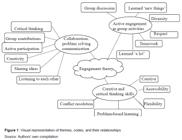
Figure 1 represents a thematic map summarising the qualitative findings, with central ovals signifying overarching themes derived from the data analysis, such as group interactions, engagement, and learning. Surrounding rectangles and cloud shapes denote sub-themes, elaborating on specific aspects like collaboration, problem-solving, and communication. Connecting lines illustrate relationships between themes and their respective sub-themes, highlighting conceptual linkages.
Ethical approval for this investigation was obtained from NWU (approval number: NWU-01013-21-A2), together with permission from the NWU gatekeeper to conduct research involving students at the institution (permission number: NWUGK-21-065). To uphold ethics, principles of voluntary participation, non-harm, anonymity, and confidentiality, as well as ensuring the absence of any risks to participants, as required by the institution under study, were confirmed before the study commenced. All the participants consented to participate voluntarily. To safeguard the anonymity and confidentiality of the participants, pseudonyms (see, for example, ATLAS.ti generated codes 1:2 p.4; 1:13 p.17, where 1:2 and 1.3 signify the anonymised student numbers, and p.4 = a page in which a code is taken from) were used to represent the participants. This practice aligns with ethical standards in research, where the primary focus is understanding the individuals' experiences and behaviours rather than divulging their identities (see Bos 2020). The participants were assigned codenames for ease of referencing during the analysis process. Page and line numbers were used to identify extracts from participants' responses (e.g. 1:13 p.17), meaning that the extract is from the first task, participant 13, on page 17. All responses are reproduced verbatim and unedited.
FINDINGS AND DISCUSSIONS
Theme 1: Students collaborate, communicate, and solve problems in diverse groups
The enhancement of collaboration, communication, and problem-solving skills in diverse group activities, as observed in the virtual WIL excursion findings, is echoed in the broader literature on educational practices (see Fiore et al., 2018; Kennedy and Sundberg 2020; Koenig 2011). Kennedy and Sundberg (2020) point out that, for students to thrive in the 21st-century workforce, education systems must prioritise the development of collaboration, communication, and problem-solving skills. The findings indicate that student teachers widely reported improved abilities to collaborate, communicate, and work across linguistic, cultural and experiential differences. The virtual WIL excursion provided a low-stakes environment where they could test ideas, express opinions and develop interpersonal trust. However, several participants noted that digital platforms sometimes magnified language barriers and a few students dominated group discussions, limiting their inclusivity of engagement. This finding resonates with Fiore et al (2018), Kennedy and Sundberg (2020), and Koenig (2011), who highlight the importance of scaffolded structures to support equitable collaboration. To give a brief overview of the findings, the participants explained how they worked together as a group and believed that "teamwork makes the dream work" (1:3 p.5). Teamwork made it easier for the group to solve problems because of their "informed decision making" (1:9 p.12), and they respected the team's value of diversity (1:2 p.4; 1:13 p.17; 1:21 p.32; 1:49 p.67; 1:53 p.76), teamwork (1:2 p.4; 1:13 p.17; 1:21 p.32; 1:49 p.67; 1:53 p.76), respect (1:7 p.10; 1: 17 p.24; 1:30 p.41), together with individuality and dedication (1:14 p.19; 1:59 p.85).
Previous studies (see Bedir 2019; Kumaro and Barliana 2022; Pardede 2020) confirmed that diverse groups often bring a wide range of perspectives and solutions to problem-solving tasks, enriching the collaborative experience and fostering an innovative and comprehensive approach to challenges. The current findings revealed that students developed problem-solving skills when working collaboratively in small groups (1:2 p.15; 1:5 p.18; 1:7 p10; 1:9 p12; 1:17 p.24; 1:18 p.26; 1:21 p.32; 1:23 p.34; 1:24 p.35; 1:27 p.38; 1:28 p.39; 1:29 p.40; 1:35 p.49; 1:37 p.51; 1:38 p.52; 1:39 p.54; 1:45 p.60; 1:46 p.61; 1:48 p.66; 1:52 p.72; 1:55 p.81; 1:56 p.82; 1:58 p.84; 1:60 p.86). In this regard, participants mentioned, "there are many ways of solving a problem and if we help each other, it becomes easy to solve it" (1:12 p.15; 1:14 p.19; 1:18 p.26; 1:21 p.32; 1:23 p.34; 1:26 p.37; 1:28 p.39; 1:34 p.48; 1:35 p.49; 1:37 p.51; 1:45 p.60; 1:52 p.72: 1:54 p.78; 1:55 p.81; 1:56 p.82; 1:58 p.84; 1:60 p.86). This is evidenced by the extracts where participants explained how they "helped each other through finding certain solutions and creative ways to solve problems", as well as "communicating and discussing the problem" they faced (1:5 p.8; 1:14 p.19; 1:27 p.38; 1:39 p.54; 1:45 p.60; 1:52 p.19; p.72). Participants were able to share opinions and ideas among themselves and to solve all the problems assigned to them (1:34 p.48). They also mentioned that they "came with combined ideas" (1:5 p.8; 1:12 p.15) to solve the problem. The possibility was that each member in the group came with an opinion of solving the problem and, in the end, they had many options (1:21 p.32; 1:39 p.54). Solving the problems was possible due to equal participation by all group members. To this, they said, "We were all participating, and we used different minds, and ways to solve complex problems until we reached the solution" (1:27 p.38; 1:37 p.51;).
Kearsley and Schneiderman (1998) posit that, for students to engage deeply with content, there should be a learning environment where students are encouraged to question, analyse, and synthesise information. As the groups solved problems, they simultaneously acquired learning (1:3 p.5; 1:6 p.9; 1:13 p.17; 1:30 p.41; 1:32 p.45; 1:34 p.48; 1:45 p.60; 1:47 p.65; 1:51 p.71; 1:53 p.76). In this regard, some students have learned "a lot" (1:30 p.41), whereas others have learned "new things and saw how people think differently" (1:51 p.71). One of the participants summarised the idea of learning and stated that meeting in an online excursion was "very educative and enlightening... whatever [sic] one encounters a problem and find a solution to it, creates a sense of pleasure within themselves and one could also learn throughout the experiences" (1:32 p.45). Another participant shared a sentiment and confirmed, "Yes, it's one of the exciting experiences that I had" (1:45 p.60). This finding resonates with literature on the incorporation of learning and innovation skills into future instructional activities (Bedir 2019; Kumaro and Barliana 2022; Pardede 2020).
Theme 2: Creativity and critical thinking skills through problem-solving tasks
Many participants described their virtual learning as a shift from passive consumption of knowledge to active problem solving. The tasks required students to brainstorm solutions, evaluating competing ideas, and presenting their ideas creatively. This pedagogical move aligns with Vivekanandan (2019) emphasis on authentic assessment. Learning from the groups also developed students' creative and critical thinking skills (1:3 p.5; 1:43 p.58; 1:47 p.65; 1:54 p.78). One of the participants (1:43 p.58) explained, "creative thinking made everything easy". The same participant also mentioned that they were "all creative and thinking outside the box". Another participant stated, "I learnt that critical thinking is not rocket science, that you have to keep trying, keep an open mind, and also learn from other perspectives" (1:47 p.65). This means that participants did not get learning right away; they kept on trying as well as learning from others. Vivekanandan (2019) confirms that 21st-century skills bring a shift in paradigm learning where students develop the capacity to apply their knowledge creatively and critically in diverse contexts. In this regard, participants connected and worked well with their group members, as one participant (2:201 p. 32) stated, "We all just worked so well together to come up with creative ways to address all the challenges we faced." They also shared "innovative ideas" (2:344 p.52) while working together to achieve common goals. Participants further reported that they had to "think creatively" (2:209 p.33) to find solutions to their problems.
It is interesting to learn that participants experienced conflicts in their groups, which they used their creative skills to solve problems. The notion of conflict resolution was confirmed by one of the participants who stated, "It was somehow challenging, but through communication and dedication, we managed to resolve conflicts" (1:14 p.19). Listening to each other was one of the strategies used to resolve conflict in the group. It is imperative for student-teachers to learn this, as they will have to listen to learners (1:7 p.10) at their workplace before they can come to conclusions to resolve conflicts. The data meant that participants had the ability to follow the protocols on how to resolve conflicts, despite the challenges they encountered. At the same time, some participants expressed feelings of overwhelm by the cognitive load associated with digital multitasking and indicating a need for better task design and digital literacy support.
Theme 3: Uneven participation, digital inequality and group conflict
While the majority of participants found the experience empowering, a notable minority felt excluded or marginalised. Some students cited a lack of access to stable internet or personal devices, while others mentioned being ignored or unvalued in group settings. Power dynamics are often influenced by language proficiency, age or prior digital exposure, which surfaced in several responses. Instead of viewing this tension as failures, the study suggests that they be used as entry points for pedagogical reflection on conclusion, silence, and group facilitation. The principles of collaborative learning emphasise the importance of interaction and active participation in the learning process (Vivekanandan 2019). It was evident from the data that working in groups "encouraged active participation and engagement as well as brainstorming" ideas (2:211 p.33). Participants contributed to the collective ideas in their groups. In this regard, different members of the group came up with different opinions or suggestions, which were evaluated for reaching a "consensus" (2:191 p.30). This was easy as group members had to come up with "different approaches" (2:203 p.32), listen to each other (2:267 p.42), share ideas and "welcome everyone's contribution" (2:253 p.40). This means that the groups were co-operating (2:267 p.42). Participants thus related, created, and donated ideas in their diverse groups (Kearsley and Schneiderman 1998).
While Zegwaard et al. (2023) regard WIL as a platform that allows students to learn through active engagement in purposeful work tasks, the data revealed that not all members contributed to the group activities. While expecting participants to engage actively in group activities, there was a challenge of equal participation. As one of the participants explained, some of the group members did not contribute to the group's achievement. The participant had this to say, "Most of the time I was the only one coming up with ideas while they said they don't know anything" (2:613 p.91). Another participant (2:274 p.42) added, "some did not want to participate or have ideas about activities." The same participants explained that they had to force those who were not willing to participate to co-operate or ask each member of the group to come up with ideas as an individual.
CONCLUSION
The objective of the study reported on here was to explore whether work-integrated learning (WIL) online excursions create space for the development of students' 21st-century skills. Evidence from this study indicated skills that were developed, such as co-operative learning, communication, critical thinking, and problem solving, as the importance of interaction and active participation in the learning process has been confirmed. Collaboration, communication, and problem-solving in teams align with the observed outcomes of the WIL excursion, where student engagement in team-based problem-solving activities facilitated the application and enhancement of critical and creative thinking. These underscore the relevance of collaborative learning in preparing students for complex, real-world challenges. The collective problem-solving process observed in the WIL virtual excursion also highlighted the importance of diversity and inclusivity in team dynamics. The acknowledgement of each team member's unique background and contributions reinforced the value of diversity in enhancing team performance and learning outcomes.
As highlighted in the article, the cultivation of creative and critical thinking skills reflected the critical educational shift towards fostering skills that empower students to navigate and contribute effectively to the complex, ever-evolving global landscape. This shift aligns with the broader educational discourse, emphasising the necessity of these skills for success in both personal and professional spheres. It has been noted that creative thinking is stimulated as students explore multiple solutions, brainstorm innovative approaches, and engage in reflective practices that encourage divergent thinking.
The significance of active engagement in group activities, as evidenced by the current study, extends beyond the development of interpersonal skills, deeply influencing students' learning outcomes and their readiness to face real-world challenges. Active engagement not only facilitates the acquisition of knowledge but also encourages the application of this knowledge in novel and complex situations. Such an approach aligns with contemporary educational goals that aim to prepare students for the demands of the 21st-century workforce, where the ability to work effectively in teams, communicate clearly, and solve problems creatively is highly valued.
Given the above, the role of technology in facilitating the development of 21st-century skills cannot be overemphasised. As digital tools become increasingly integrated into educational settings, they offer unique opportunities to enhance collaborative learning experiences, creative and critical thinking skills, as well as active engagement. Technological tools, such as virtual reality and online collaborative platforms, could simulate real-world scenarios that allow students to immerse themselves in problem-solving activities, thereby bridging the gap between theoretical knowledge and practical application. Such technologies not only enhance the learning experience but also cater to diverse learning styles, enabling personalised learning paths that could significantly improve student engagement and motivation. Overall, the constant evolution of technology makes it possible for HEIs to seek alternative ways of presenting the WIL programmes.
The study explored the efficacy of WIL virtual excursions in enhancing students' collaboration, communication, problem solving, and critical thinking skills, addressing a significant gap in educational research. This inquiry aligned with the overarching purpose of identifying innovative educational practices that can prepare students for the demands of the 21st-century workplace. By focusing on WIL virtual excursions, the study contributes to the body of knowledge that examines the integration of technology in educational settings and its effect on developing essential skills. The study demonstrated the potential of WIL virtual excursions as a valuable educational tool for developing 21st-century skills. It bridged existing research on collaborative learning and the use of technology in education, offering new insights into how virtual environments can mimic and even enhance the benefits of traditional experiential learning methods. The research achieved a deeper understanding of the ways WIL virtual excursions could foster critical and creative thinking, collaboration, and active engagement, even in a remote learning context. The value of this research lies in highlighting the adaptability of WIL programmes to virtual formats, ensuring that essential skills development is not hindered by physical constraints. The way forward calls for educators, policymakers, and researchers to consider the integration of virtual excursions and similar technology-enhanced WIL experiences into the broader curriculum. Technology-enhanced WIL has the potential to democratise experiential learning, especially for students in remote and under-resourced contexts. However, the success of such models depends on careful attention to issues of inclusion, digital fluency, and pedagogical integrity. This approach not only prepares students for a rapidly changing world but also ensures education remains inclusive and accessible to all, regardless of geographical or physical limitations. The study affirms the value of students' voice, collaborative engagement, and creative problem solving, while also acknowledging the structural and interpersonal barriers that can undermine these goals, which resonate with Balfour's (2023, 229) recommendations about the importance of student voice and student feedback in the WIL environment.
Given the above, this research contributes to the growing field of African digital pedagogy by situating technological enhancement WIL within broader debates on decolonisation and epistemic justice. Following the work of Nyamnjoh (2012, 129), it calls for incompleteness as openness and acknowledges that students bring partial but valuable knowledge systems to the learning environment. Ngubane, Mncube and Ajani (2024, 803) opine that the need for educational institutions and policymakers should explicitly focus on the alignment and enhancement of mechanisms to support students in higher education institutions in all walks of life. Comparative insights from Kenya's competency-based teacher training (Muchira et al 2023, 563) and Ghana's practicum reforms (Amponsah, Ayim and Forkuor, 2024) revealed parallel efforts to indigenise WIL models, providing fertile ground for future collaboration and across national policy learning.
Despite its contributions, the study faced limitations, such as its reliance on a specific educational context and the potential variability in students' access to and proficiency with technology. These factors may affect the replicability and scalability of the findings. Future research could expand upon this work by exploring diverse educational settings, incorporating longitudinal outcomes of virtual WIL, exploring culturally specific facilitation strategies, and assessing the influence of multilingual digital platforms. Only by weaving together technological innovation, curriculum reform, and decolonial imaginations, WIL can truly prepare African teachers for the complex realities of the 21st-century classroom.
IMPLICATIONS FOR THE STUDYCurriculum design: WIL model should incorporate structured virtual components that explicitly develop the 4Cs.
Faculty development: teachers, educators and supervisors must be re-skilled on online facilitation, conflict resolution and inclusive pedagogy.
Infrastructure and access: institutions of higher learning and government departments must invest in digital infrastructure, subsidised connectivity, and multilingual platforms.
Policy guidance: the national frameworks should outline standards for virtual WIL, including assessment, supervision, and equity considerations.
REFERENCES
LITERATURE REVIEW
- Ademuyiwa, Idris, David Drewery, Michelle J. Eady, and Anne-Marie Fannon. 2023. "Work Experience Reduces a Gender-Based Gap in Time on Tasks with Supervisors in Co-Operative Education." International Journal of Work-Integrated Learning 24 (3): 293-303.
- Adu, Philip. 2022. Understanding the Use, Strengths, and Limitations of Automated Text Analysis.
- Amponsah, Enoch Boafo, Mary Ayim, and John Boulard Forkuor. 2024. "From Block Placement to Blended Model: The Way Forward for Social Work Practicum in Ghana." Social Work Education 43 (3): 588-603.
- Anderson, Ronald E. 2008. "Implications of the Information and Knowledge Society for Education." In International Handbook of Information Technology in Primary and Secondary Education, 5-22.
- Balfour, Robert J. 2023. Teaching-Learning Synergy-Alignment Workshop: NWU Work Integrated and Service Learning Colloquium: An Integrated Approach to Work Integrated and Service Learning. North-West University.
- Bedir, Hasan. 2019. "Pre-Service ELT Teachers' Beliefs and Perceptions on 21st Century Learning and Innovation Skills (4Cs)." Journal of Language and Linguistic Studies 15 (1): 231-246.
- Bos, Jaap. 2020. Research Ethics for Students in the Social Sciences. Springer Nature.
- Braun, Virginia, and Victoria Clarke. 2006. "Using Thematic Analysis in Psychology." Qualitative Research in Psychology 3 (2): 77-101.
- De Beer, Josef, Neal Petersen, Elsa Mentz, and Robert J. Balfour, eds. 2023. Self-Directed Learning in the Era of the COVID-19 Pandemic. Vol. 9. AOSIS.
- De Vos, Marlies E., Liesbeth K. J. Baartman, Cees P. M. van der Vleuten, and Elly de Bruijn. 2024. "How Do Workplace Educators Assess Student Performance at the Workplace? A Qualitative Systematic Review." Vocations and Learning 17 (1): 165-188.
- Doolan, Maria, Ben Piggott, Sian Chapman, and Paul Rycroft. 2019. "The Benefits and Challenges of Embedding Work-Integrated Learning: A Case Study in a University Education Degree Program." Australian Journal of Teacher Education 44 (6): 91-108.
- Du Toit, Adri, and Neal Petersen. 2023. "Re-Imagining Work-Integrated Learning Excursions to Decrease the Theory-Practice Divide." In Innovative Curriculum Design: Bridging the Theory-Practice Divide in Work-Integrated Learning to Foster Self-Directed Learning, 1-30.
- Erdoğan, Vacide. 2019. "Integrating 4C Skills of 21st Century into 4 Language Skills in EFL Classes." International Journal of Education and Research 7 (11): 113-124.
- Fiore, Stephen M., Arthur Graesser, and Samuel Greiff. 2018. "Collaborative Problem-Solving Education for the Twenty-First-Century Workforce." Nature Human Behaviour 2 (6): 367-369.
- Geldenhuys, Yolani, Elize Küng, Lloyd Conley, Lounell White, Jako Olivier, Nothile Abrijard Tivelele Kunene, Marietjie Havenga, et al. 2022. Self-Directed Learning in the Era of the COVID-19 Pandemic: Research on the Affordances of Online Virtual Excursions. AOSIS.
- Gettinger, Maribeth. 1985. "Time Allocated and Time Spent Relative to Time Needed for Learning as Determinants of Achievement." Journal of Educational Psychology 77 (1): 3-11.
- Grewe, M. H., and L. Gie. 2023. "Can Virtual Reality Have a Positive Influence on Student Engagement?" South African Journal of Higher Education 37 (5): 124-141.
- Kearsley, Greg, and Ben Shneiderman. 1998. "Engagement Theory: A Framework for Technology-Based Teaching and Learning." Educational Technology 38 (5): 20-23.
- Katsamba, Dzingai. 2024. "Enhancing Graduate Employability through Work-Integrated Learning: A Multi-Faceted Analysis of Student Competencies, Teaching Approaches, and the Impact of Digital Literacy." Journal of Administrative and Business Studies 10 (3-4): 109-120.
- Kennedy, Teresa J., and Cheryl W. Sundberg. 2020. "21st Century Skills." In Science Education in Theory and Practice: An Introductory Guide to Learning Theory, 479-496.
- Kim, Sharon, Mahjabeen Raza, and Edward Seidman. 2019. "Improving 21st-Century Teaching Skills: The Key to Effective 21st-Century Learners." Research in Comparative and International Education 14 (1): 99-117.
- Kivunja, Charles. 2015. "Exploring the Pedagogical Meaning and Implications of the 4Cs 'Super Skills' for the 21st Century through Bruner's 5E Lenses of Knowledge Construction to Improve Pedagogies of the New Learning Paradigm." Creative Education 6 (2): 224-239.
- Koenig, Judith Anderson, ed. 2011. Assessing 21st Century Skills: Summary of a Workshop. National Academies Press.
- Korte, Russell, and Jessica Li. 2015. "Exploring the Organizational Socialization of Engineers in Taiwan." Journal of Chinese Human Resource Management 6 (1): 33-51.
- Kumaro, Mumu, and M. Syaom Barliana. 2022. "Integration of 4Cs Skills into Learning by Using the Project-Based Learning (PjBL) Model to Face the Challenges of the 21st Century." In Proceedings of the 4th International Conference on Innovation in Engineering and Vocational Education (ICIEVE 2021), 88-93. Atlantis Press.
- Lapan, Stephen D., and MaryLynn T. Quartaroli, eds. 2009. Research Essentials: An Introduction to Designs and Practices. John Wiley & Sons.
- Lee, Jeongju, Hae-Deok Song, and Ah Jeong Hong. 2019. "Exploring Factors and Indicators for Measuring Students' Sustainable Engagement in E-Learning." Sustainability 11 (4): 985.
- Martin, Andy, and Malcolm Rees. 2018. Work-Integrated Learning: More Than Enhancing Employability and Graduate Attributes. Ako Aotearoa.
- Muchira, John M., Francis Kiroro, Maurice Mutisya, Vollan O. Ochieng, and Moses W. Ngware. 2023. "Assessing Technical Vocational Education and Training Institutions' Curriculum in Kenya: What Strategies Can Position the Youth for Employment?" Journal of Adult and Continuing Education 29 (2): 563-582.
- Ngubane, Phiwokuhle B., Dumisani W. Mncube, and Oluwatoyin Ayodele Ajani. 2024. "Exploring Experiences of TVET Graduates' Work-Integrated Learning in a Rural Ecology: The Case of TVET Colleges in KwaZulu-Natal." International Journal of Research in Business & Social Science 13 (5).
- Nieuwenhuis, Jan. 2007. "Qualitative Research Designs and Data Gathering Techniques." In First Steps in Research, 70-97.
- Nyamnjoh, Francis B. 2019. "Decolonizing the University in Africa." In Oxford Research Encyclopedia of Politics.
- Oliver, Beverley. 2015. "Redefining Graduate Employability and Work-Integrated Learning: Proposals for Effective Higher Education in Disrupted Economies." Journal of Teaching and Learning for Graduate Employability 6 (1): 56-65.
- Pardede, Parlindungan. 2020. "Integrating the 4Cs into EFL Integrated Skills Learning." Journal of English Teaching 6 (1): 71-85.
- Ramorola, Mmankoko Z. 2024. "Digital Knowledge and Skills in Higher Education Institutions: A Means for Educational Transformation." In Rethinking Higher Education in Africa: Examining the Ongoing Struggle for Cognitive Justice and Politics of Transformation, edited by V. Msila, 155-187. Sun Press.
- Reich, Robert B. 1992. "The Work of Nations: Preparing Ourselves for 21st-Century Capitalism." Challenge 34 (2): 60-64.
- Rowe, Anna, Jacqueline Mackaway, and Theresa Winchester-Seeto. 2012. "'But I Thought You Were Doing That': Clarifying the Role of the Host Supervisor in Experience-Based Learning." Asia-Pacific Journal of Cooperative Education 13 (2): 115-134.
- Sebotsa, T., N. Petersen, and M. Speight Vaughn. 2020. "The Role of Work-Integrated Learning Excursions in Preparing Student Teachers for Diverse Classrooms and Teaching Social Justice in South African Classrooms." In Becoming a Teacher: Research on the Work-Integrated Learning of Student Teachers, NWU Self-Directed Learning Series 4: 279-322.
- Vivekanandan, Ramya. 2019. Integrating 21st Century Skills into Education Systems: From Rhetoric to Reality.
- Voogt, Joke, and Linda Elise Odenthal. 1997. Emergent Practices Geportretteerd: Conceptueel Raamwerk. University of Twente.
- Yin, Robert K. 2017. Case Study Research and Applications: Design and Methods. Sage.
- Zegwaard, Karsten E., T. Judene Pretti, Anna D. Rowe, and Sonia J. Ferns. 2023. "Defining Work-Integrated Learning." In The Routledge International Handbook of Work-Integrated Learning, 29-48. Routledge.