The dual role of student-athletes: academic advising factors that predict contentment with academic services among university soccer players in South Africa
Abstract
The purpose of this study was to investigate the factors influencing soccer players' satisfaction with academic services in six universities in Gauteng Province, South Africa. The study adopted a quantitative research design. A sample of 177 soccer players from six universities in the Gauteng Province of South Africa participated in the study. The results showed that female soccer players reported significantly higher values for satisfaction with academic support programmes (M = 3.78, SD = 0.91; t(175) = -2.55, p = 0.01) and advising staff (M = 3.82, SD = 0.94; t(175) = -1.66, p = 0.05) than their male counterparts. The study further revealed that overall satisfaction with academic services was strongly correlated with tutoring (r = 0.55, p < 0.01), academic support programmes (r = 0.55, p < 0.01), advising staff (r = 0.60, p < 0.01) and advising facilities (r = 0.71, p < 0.01). These findings have practical implications for universities in their efforts to help student-athletes strike a balance between their academic goals and athletic careers.
advising staff; tutoring; facilities; student-athletes
INTRODUCTION
University student-athletes represent a special population with unique challenges and needs compared to their non-athlete counterparts (Gayles 2009). In addition to completing assignments and taking exams, student-athletes are required to engage in frequent travel, maintain positive relationships with coaches and teammates, navigate media interactions and participate in vigorous training schedules, all while experiencing pressure to succeed in their sport (Chyi et al. 2018; Etzel 2009; Johnson and Ivarsson 2011; Steffen, Pensgaard, and Bahr 2009; Yusko et al. 2008). Student-athletes spend, on average, more than 20 hours per week practising and frequently miss classes, particularly during the competition season (Gayles 2009; Watt and Moore 2001; Wolverton 2008). As Rothschild-Checroune et al. (2012) confirmed, the physical and psychological demands of training and competition are high for student-athletes, and meeting these demands requires substantial time and effort.
To fulfil their athletic obligations, student-athletes may reduce their academic engagement and, consequently, compromise their academic success (Rothschild-Checroune et al. 2012). Attempting to simultaneously succeed in two serious endeavours - academics and varsity sports - is both challenging and stressful (Gomez, Bradley, and Conway 2018) and may require modifications to be made to student-athletes' academic programmes (Henrion 2009). These adjustments can be challenging for lecturers to accommodate and difficult for student-athletes to manage (O'Neill, Calder, and Hinz 2017), necessitating the availability of additional forms of academic support. A strong university support system is crucial if student-athletes are to achieve success both on the playing field and in the classroom (Rothschild-Checroune et al. 2012). Only by identifying and understanding the challenges student-athletes encounter can universities provide the individualised support student-athletes need (Lu et al. 2012).
Despite the availability of a plethora of research on student-athletes in South Africa (Kubayi et al. 2013; Nthangeni et al. 2021; Nxumalo and Edwards 2017), no study has investigated the academic support that universities offer to this student population. Research on this topic may thus be useful to the development of academic support services for university student-athletes, as identifying the factors that influence student-athletes' satisfaction with available academic services is an essential starting point for university initiatives aimed at enhancing support for student-athletes on and off the field (Lu et al. 2012). By focusing on the needs of this population, a university can implement novel or modify existing programmes to facilitate the ability of student-athletes to develop long-term career aspirations in athletics and achieve academic success (Henrion 2009). Therefore, the purpose of this study was to investigate satisfaction with academic support services among university soccer players in Gauteng Province, South Africa.
METHODS
Participants
A sample of 177 soccer players from six universities in the Gauteng Province of South Africa participated in this study. Participants' ages ranged from 18 to 34 years (M = 21.72 years, SD = 2.39 years). Among the participants, 110 were male (62%) and 67 were female (38%). Most participants were Black (86%), and the rest identified as Coloured (9%), White (3%) or Indian (2%). The largest proportion of participants were in their first year (27%) or third year (26%) of study, and the smallest proportion were postgraduates (11%). Student-athletes were purposively selected to take part in the study, with eligibility to participate based on involvement in Varsity Football, University Sport South Africa and South African Football Association leagues.
Research instrument
The Academic Support and Satisfaction Questionnaire was utilised to collect data on university student-athletes' satisfaction with the academic services and support provided to them (Hazzaa, Sonkeng, and Yoh 2018). This questionnaire consists of 20 items organised into the following four subscales: tutoring (4 items), academic support programmes (5 items), advising staff (4 items), advising facilities (4 items) and overall satisfaction (2 items). Each item is scored on a 5-point Likert scale ranging from 1 (strongly disagree) to 5 (strongly agree). The Cronbach's alpha coefficient value for the questionnaire was 0.95.
Data collection
Permission to conduct the study was granted by the six universities, which issued signed permission letters. Data collection at the universities was scheduled in consultation with the soccer team managers. At all universities, data collection took place in the afternoon either before or after a soccer practice session, which was determined to be a suitable time due to all soccer players being finished with their classes and present at the practice session. Data collection was undertaken by the principal investigator. The questionnaires were distributed to the student-athletes in consultation with the universities' athletic departments. A brief was provided to the student-athletes before they completed the questionnaire to explain the purpose of the questionnaire and provide instructions on where and how to complete it. The participants were required to complete their questionnaires independently, which took between 10 and 25 minutes.
Data analysis
Data were analysed using statistical methods, including means, standard deviations, percentages and frequencies. An independent-samples i-test was conducted to compare participants' scores for academic advising factors and overall satisfaction based on gender. Pearson correlations were employed to examine relationships between participants' academic support and overall satisfaction, and multiple regression analysis was applied to predict participants' overall satisfaction with their academic services. The statistical analyses were conducted using SPSS version 25, and the alpha value was set at 0.05 or less.
Ethical considerations
Ethical approval was granted by the Faculty of Science Ethics Committee at Tshwane University of Technology. Before data collection commenced, the participants were informed of the nature of the study, the processes required and how the data would be used and disseminated. All participants were then required to sign an informed consent form to participate in the study. Participants were informed that their participation was voluntary and that the study data would remain confidential, with the data coded with no links to personal identifiers. Participants were assured that their identities would not be revealed, and that all data would be stored in a secure place and not shared with anyone beyond the researchers.
RESULTS
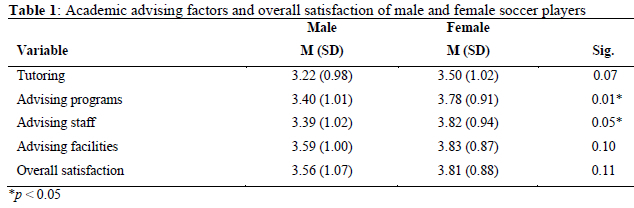
Table 1 presents the results for the comparison of academic advising factors and overall satisfaction with academic services between male and female university soccer players. Female soccer players reported significantly higher satisfaction values for academic support programmes (M = 3.78, SD = 0.91; t(175) = -2.55, p = 0.01) and advising staff (M = 3.82, SD = 0.94; t(175) = -1.66, p = 0.05) than their male counterparts.
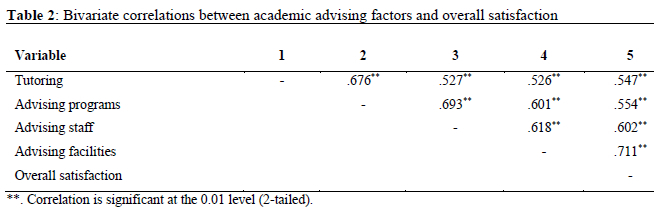
Table 2 displays the correlations between advising factors and overall satisfaction with academic services. Overall satisfaction with academic services was strongly correlated with tutoring (r = 0.55,p < 0.01), academic support programmes (r = 0.55, p < 0.01), advising staff (r = 0.60, p < 0.01) and advising facilities (r = 0.71, p < 0.01).
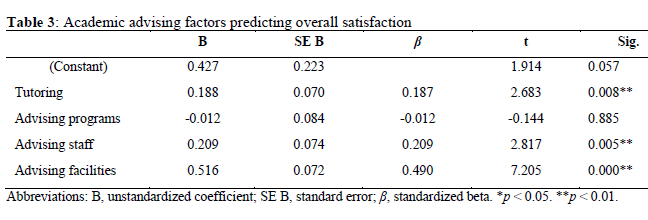
Table 3 illustrates the multiple regression analysis results predicting overall satisfaction with academic services based on tutoring, academic support programmes, advising staff and advising facilities. The four academic advising factors significantly predicted overall satisfaction with academic services (F(4, 171) = 56.67, p < 0.001, R2 = 0.57). However, only three factors independently predicted overall satisfaction with academic services, with advising facilities making the largest contribution (β = 0.49, p < 0.01), followed by advising staff (β = 0.21, p < 0.01) and tutoring (β = 0.19, p < 0.01).
DISCUSSION
This study investigated the relationship between student-athletes' assessment of four academic advising factors and their overall satisfaction with academic services. While a previous study conducted in the United States (Hazzaa et al. 2018) found no significant differences between male and female university students in satisfaction with academic advising factors, this study's results indicated gender-based discrepancies. Specifically, there were significant differences in students' opinions of academic support programmes and advising staff, with female students reporting higher levels of satisfaction than their male counterparts. These findings support those of Kamusoko and Pemberton (2011), who reported that female students demonstrated higher levels of academic persistence than male students. These findings could indicate a tendency among female students to be more determined to succeed academically than male students (Woods 2013).
Notably, women's sports are still moving towards professionalisation in South Africa (Kubayi et al. 2020). Indeed, a previous study (Kubayi, Coopoo, and Morris-Eyton 2017) found that professional female soccer players are paid substantially less than their male counterparts. This lack of equality may lead female soccer players to dedicate themselves more intently to the pursuit of academic goals. By contrast, male soccer players' lower satisfaction with academic services may reflect their hectic schedules, which leave them little time to participate in academic programmes or consult with advising staff. Nthangeni et al. (2021) reported that male South African university athletes have busier schedules than female athletes; they attend daily practices, have longer training sessions and travel across the country to participate in varsity competitions, which may cause them to miss classes and other academic activities.
Male soccer players are additionally more likely to be scouted by professional clubs during varsity matches, which could further explain their lower satisfaction with academic programmes. However, as only a few student-athletes will go on to compete at a professional level, athletic directors, administrators and coaches must encourage student-athletes to develop strong relationships with academic advisors and, if necessary, seek further academic support (Hazzaa et al. 2018; Nthangeni et al. 2021). Student-athletes benefit from having an academic degree to fall back on if they fail to attain professional athlete status.
This study showed no significant differences in satisfaction between first- and third-year students, with only postgraduate students reporting low overall levels of satisfaction. This finding is in contrast to Hazzaa et al. (2018), who reported significant differences in satisfaction among student-athletes, with senior students reporting higher levels of satisfaction than junior students. In this study, the low level of satisfaction among postgraduate students likely reflects the tendency of universities to provide more assistance to undergraduate students, who are less independent and may have years of study remaining before graduation and suggests that athletic departments should invest in postgraduate student-athletes. Doing so would enable postgraduate student-athletes to act as mentors to undergraduate students during their transition from high school to university.
The results of this study revealed that satisfaction with academic services was strongly related to tutoring, academic support programmes, advising staff and advising facilities. The importance of these findings is underlined when considered alongside the correlation that previous research has found between academic support services and a positive academic experience. The current study offers insights into how student-athletes perceive academic services and their satisfaction with these services, which has been similarly highlighted in previous research conducted in the United States (Hazzaa et al. 2018). According to Russell (2015), "[s]atisfaction with academic support services is unequivocally the highest area of positive correlation with a student-athlete's adjustment to college" (p. vi). Given this statement and the results of the current study, it is apparent that tutoring, academic support programmes, advising staff and advising facilities should be promoted for student-athletes. Administrators in university athletic departments should seek to address students' challenges, identify components of academic advising programmes that need improvement and equip student-athletes with the skills they need for academic success. These efforts would additionally enhance the effectiveness of university administrators due to their improved understanding of the academic advising factors that are most important to their student-athletes (Hazzaa et al. 2018).
CONCLUSION
The current investigation highlighted several important factors that contribute to student-athletes' contentment with academic services. These findings provide practical implications for university athletic departments, which devote significant financial and human resources to student-athletes' eligibility and academic performance. Universities recognising the potential benefits and taking action to ensure the availability of academic facilities for students and highly qualified academic support staff can aid student-athletes in maintaining their athletic eligibility by helping them meet and exceed academic performance requirements. To assist athletic departments in decision-making that will have the most impact on student success, we offer the following suggestions based on the findings of this study. The academic service facilities that athletic departments provide for their student-athletes should be clean, comfortable and conducive to learning. In addition, student-athletes should receive support from academic advisors and have access to extra classes (tutoring) to facilitate their academic success and reduce academic barriers to university sports participation.
REFERENCES
- Chyi, T., F. Lu, E. Wang, Y. Hsu, and K. Chang. 2018. "Prediction of life stress on athletes' burnout: The dual role of perceived stress". Peer J 6: e4213.
- Etzel E. F. 2009. Counseling student athletes: Issues and interventions. Morgantown: Fitness Information Inc.
- Gayles, J. 2009. "The student athlete experience". New Directions for Institutional Research 144: 3341.
- Gomez J., J. Bradley, and P. Conway. 2018. "The challenges of a high-performance student athlete". Irish Educational Studies 37(3): 329-349.
- Hazzaa, R. N., K. Sonkeng, and T. Yoh. 2018. "Antecedents and consequences of student-athletes' contentment with academic services". Journal of Intercollegiate Sport 11: 65-81.
- Henrion, K. J. 2009. Key challenges facing student athletes and connections to their choice of major. [Unpublished Dissertation]. Western Michigan University.
- Johnson U., and A. Ivarsson. 2011. "Psychological predictors of sport injuries among junior soccer players". Scandinavian Journal of Medicine and Science in Sports 21: 129-136.
-
Kamusoko, S. D., and C. L. A. Pemberton. 2011. "Student-athlete wellbeing and higher education persistence". Journal of Issues in Intercollegiate Athletics 4: 1, Article 12. Available at: https://scholarcommons.sc.edu/jiia/vol4/iss1/12
» https://scholarcommons.sc.edu/jiia/vol4/iss1/12 - Kubayi, A., Y. Coopoo, and H. Morris-Eyton. 2017. "Work-related constraints in sports coaching: Perceptions of South African female coaches". International Journal of Sports Science and Coaching 12(1): 103-108.
- Kubayi, A., F. F. Didymus, H. Morris-Eyton, and J. Jooste. 2020. "Design and preliminary validation of the barriers to sports coaching questionnaire for women in South Africa: An application of the ecological model". Journal of Sports Sciences 35(21): 2500-2507.
- Kubayi, N.A., A. S. Nthangeni, A. L. Toriola, and E. Haycock. 2013." Perceived barriers to female sports participation: A case study of Tshwane University of Technology, Pretoria, South Africa". African Journal for Physical, Health Education, Recreation and Dance, December (Supplement 1:2), 442-451.
- Lu, F. J. H., Y. W. Hsu, Y.S. Chan, J. R. Cheen, K. T. and Kao. 2012. "Assessing college student-athletes' life stress: Initial measurement development and validation". Measurement in Physical Education and Exercise Science 16: 254-267.
-
Nthangeni, S., A. Toriola, Y. Paul, and V. Naidoo. 2021. "Student-athlete or athlete student: Analysis of benefits and barriers of university sport participation in South Africa". Annals of Applied Sport Science 9(2): 1-7. https://aassjoumal.com/article1-924-en.html
» https://aassjoumal.com/article1-924-en.html - Nxumalo, S. A., and S. D. Edwards. 2017. "Attitudes of female university students towards participation in sports". African Journal for Physical Activity and Health Sciences (AJPHES) 23(1.2): 226-240.
- O'Neill, M. M., A. A. Calder, and B. Hinz. 2017. "Student-athletes in my classroom: Australian teachers' perspectives of the problems faced by student-athletes balancing school and sport". Australian Journal of Teacher Education 42(9).
- Rothschild-Checroune E., F. Gravelle, D. Dawson and G. Karlis. 2012. "Balancing academic and athletic time management: A qualitative exploration of first year student athletes' university football experiences". Society and Leisure 35(2): 243-261.
- Steffen, K., A. M. Pensgaard, and R. Bahr. 2009. "Self-reported psychological characteristics as risk factors for injuries in female youth football". Scandinavian Journal of Medicine and Science in Sports 19: 442-451.
- Watt, S. K., and J. L. Moore. 2001. "Who are student athletes?" In S. Watt and J. Moore (eds.), Student Services for Athletes: New Directions for Student Services, no. 93. San Francisco: Jossey-Bass.
-
Wolverton, B. 2008. "Athletes' hours renew debate over college sports". Chronicle of Higher Education. Accessed 5 October 2019 from http://chronicle.com.
» http://chronicle.com - Woods, A. D. 2013. A study of the student-athlete's academic achievements: The relationship between student-athlete academic support programs and academic progress rate (Master's thesis). Tennessee, Middles Tennessee University.
- Yusko, D. A., J. F. Buckman, H. R. White, and R. J. Pandina. 2008. "Risk for excessive alcohol use and drinking-related problems in college student athletes". Addictive Behaviors 33: 1546-1556.