Constructing the Doctoral Graduate Attribute Scale (DGAS-10): A South African higher education initiative
Abstract
The Council on Higher Education (CHE) has identified nine doctoral graduate attributes as degree outcomes, yet a recent doctoral review highlighted that these attributes are not well understood in the sector, hindering their development. While doctoral assessment primarily occurs through thesis examination, there is a gap in contextually relevant tools to support ongoing attribute development in South Africa. The Doctoral Graduate Attribute Scale (DGAS-10) was developed to address this need, allowing doctoral scholars to reflect on their attribute development. This article reports on the DGAS-10's construction and preliminary validation through a three-round Delphi study with thirteen experts with experience in doctoral education and scale development. The iterative process resulted in refined domain and subdomain definitions and items. The scale provides a useful tool for supporting doctoral education in the South African context, and the rigorous development may guide the creation of similar tools for other degree levels or contexts.
doctoral graduate attributes; doctoral education and training; scale construction; Delphi; higher education capacitation; postgraduate education and training
INTRODUCTION
Doctoral education holds a strategic focus in policy and higher education (HE) transformation (Molla and Cuthbert 2016). Doctoral outputs are traditionally concerned with the thesis, but increasing focus has been given to the development of the doctoral graduate as equally important (Creaton and Anderson 2021, Yazdani and Shokooh 2018). As such, the issue of doctoral graduate attributes comes to the fore. Doctoral graduate attributes are the outcomes of the doctorate, in terms of the qualities, skills and competencies developed in the scholar during the degree (Yazdani and Shokooh 2018). The South African Qualification Standards for Doctoral Degrees (CHE 2018) (hereafter, the Doctoral Standards) identify five knowledge and four skills attributes developed during the doctoral degree. The knowledge attributes include:
knowledge of the field or discipline
depth of knowledge of specific research topics
interconnected knowledge with other related fields
ethical and professional conduct
original contribution to the field of study.
The skills attributes include:
research methodologies
reflection and autonomy
communication skills
critical thinking.
While these attributes are clearly delineated in the Doctorate Standards, an area needing attention is the formative and summative assessment of doctoral graduate attributes, to support their development (Faller et al. 2023). Against this backdrop, the Doctoral Graduate Attribute Scale (DGAS-10) was developed to address the need for a contextually relevant tool that allows doctoral scholars to reflect on their attribute development.
This article unfolds in four interconnected sections, each serving a distinct purpose in documenting the rigorous development of the DGAS-10. First, a comprehensive literature review establishes the theoretical foundation and practical necessity for such an instrument, drawing on both international scholarship and local policy frameworks. This background not only justifies the need for the DGAS-10 but also positions it within the broader discourse on doctoral education quality and graduate attribute development. The methodology section provides a detailed account of the four-phase scale development process, grounded in established psychometric principles. While the essential context from the first three phases is provided (construct identification, item generation, and technical decisions), the primary empirical focus centres on the fourth phase: preliminary validation through a comprehensive three-round Delphi study involving thirteen international and local experts. The findings section presents the iterative refinement process that emerged from expert consultation, demonstrating how the scale evolved from 150 initial items to a focused 90-item instrument across ten domains and thirty subdomains. Rather than traditional empirical outcomes, these findings illuminate the collaborative process of scale refinement and the expert consensus-building that underpinned the tool's development.
The doctorate is purported to be for developing the workforce for HE (CHE 2018). In a recent national doctoral tracer study, findings showed that graduates were employed in various sectors, and while most were employed in cognate fields, there was a subset who were not (Mouton et al. 2022). These findings align with international literature highlighting the importance of transferable skills development, beyond standard academic attributes such as depth of knowledge and research skills (Durette, Fournier, and Lafon 2016, Senekal, Munnik, and Frantz, 2022). Transferable skills are particularly vital, as many doctoral graduates are employed or seeking employment outside of academia, engaging in inter-/transdisciplinary contexts, and in applied research (Cardoso et al. 2022, McAlpine, Castello, and Pyhaltö 2020). As such, more weight is being given to the developmental process in doctoral education, in terms of the holistic development of the graduate beyond depth of expertise (Creaton and Anderson 2021, Senekal, Munnik, and Frantz 2025).
In the South African context, increased efforts towards doctoral enrolment are noted (Cardoso et al. 2022, Faller et al. 2023), and subsequently, the quality and impact of doctoral education has come into question (Faller et al. 2023). This was addressed by the National Review of South African Doctoral Qualifications (CHE 2022) (hereafter, the Doctoral Review). Among varied findings across institutional contexts, one area of concern addressed doctoral graduate attributes. The Doctoral Review highlighted concern about a lack of awareness around doctoral graduate attributes, including their purpose, scope and relevance to doctoral student development (CHE 2022, Faller et al. 2023). Lack of awareness of expected learning outcomes has been identified as a crucial barrier to intentional doctoral graduate attribute development (Senekal et. al. 2025). It has been noted that the Doctoral Standards (CHE 2018) are relatively new in practice, having only been in circulation since 2018 (Faller et al. 2023), which may partially explain the lack of awareness of their relevance. Similar findings noted in local stakeholder interviews on doctoral graduate attributes revealed that most participants (doctoral supervisors, doctoral students and doctoral graduates) understood doctoral graduate attributes in reference to undergraduate contexts, as opposed to the doctoral context specifically (Senekal, Munnik, and Frantz 2024). While supportive evidence of the attributes from the Doctoral Standards (CHE 2018) was found, the study extended these attributes to include various other personal qualities (such as adaptability, network orientation and resilience) and transferable skills (such as teamwork, collaboration and project management) (Senekal et al. 2024). As such, there are other attributes, beyond the traditional academic attributes outlined in the Doctoral Standards, that may warrant consideration.
The role of the hidden curriculum is pertinent in considering doctoral graduate attributes, as it reflects the unintentional learnings that take place, often outside of formal learning spaces (Elliot et al. 2020). In South Africa, doctoral studies take place primarily through independent research under supervision, typically without a structured curriculum component into which the doctoral graduate attributes may be embedded (Molla and Cuthbert 2016). The onus thus often falls on the doctoral student to seek out and make use of optional institutional support as needed (Senekal et al. 2025). Awareness again plays a crucial role, and supervisors are vital in facilitating access to such support (Senekal et al. 2025). In order to support the quality of doctoral education development in South African HE, greater focus on awareness of doctoral graduate attributes is required among relevant stakeholders, including academics and students (Faller et al. 2023).
Another area of concern raised in the Doctoral Review was that of assessment at the doctoral level (CHE 2022, Faller et al. 2023). The CHE (2018) Doctoral Standards provide general rules for assessment and examination, yet each institution has their own protocols or policies in this regard (CHE 2022). At present, there are limited options for assessment in the doctoral education context. Summative assessment of the written thesis is the primary focus; however, only certain attributes can be readily assessed in the thesis (for example, original contribution and depth of knowledge) (Faller et al. 2023). The oral examination, or viva voce, may afford opportunities to evaluate other doctoral graduate attributes, such as communication skills (CHE 2024). However, this is not yet common practice in the South African context, and there is ongoing discussion about how oral examinations may be introduced, to ensure that the guidelines, purpose and processes involved are appropriate (CHE 2024).
There is comparatively "less attention given to a formative process of inculcation throughout the doctoral journey" (Faller et al. 2023, 105). Formative development during the doctorate takes place primarily in the supervisory relationship, in particular, through the feedback provided from the supervisor on written drafts or through discussion (Friedrich-Nel and Mac-Kinnon 2015). Supervision is a crucial space where developmental conversations take place and may support the development of doctoral graduate attributes, such as independence, critical thinking and problem-solving (Wisker 2023). However, this is strongly dependent on the supervisors' own knowledge and their approach to supervision. The supervisors' awareness of doctoral graduate attributes is vital here, to meaningfully support students' attribute development in supervision spaces (Senekal et al. 2025). Reflection on doctoral graduate attribute development is recommended, for example, through a research journal (Friedrich-Nel and Mac-Kinnon 2015); however, this is not common practice and may not be taught in more quantitative fields. As such, while formative practices may be taking place in the supervision space, this is varied, and often without benchmarking or practical tools for reflecting on or measuring doctoral graduate attribute development.
There are various, albeit sporadic, evidence-based approaches to measuring graduate attributes. Studies typically focus on a specific domain or cluster of domains, for example, lifelong learning (Kirby et al. 2010, Wetzel et al. 2010), academic resilience (Cassidy 2016), communication skills (Cuic Tankovic, Kapeš, and Benazić 2022), and global citizenship (Reysen and Katzarska-Miller 2013). There is considerably more focus on measuring employability attributes (Bezuidenhout 2011; Llinares-Insa et al. 2018). There is also evidence of a generic group of attributes measured through graduate tracer study research, using various iterations of the Standard Instrument for Graduates by Schomburg (1995) (Egesah et al. 2014, Senekal 2018). However, this scale is lacking in evidence of the conceptual foundation or validation of the graduate attributes represented. Other studies in the South African context that focus specifically on graduate attributes are typically located in a specific field or discipline (Coetzee 2014, Kew 2015). Few studies focus on doctoral (Nikol and Lietzmann 2019) or early career researchers' attributes (Weber et al. 2018). Both of these studies are from the European context and, in the case of Nikol and Lietzmann (2019), focus specifically on science, technology, engineering and mathematics (STEM) fields. Therefore, there is a gap in terms of scales that focus specifically on doctoral graduate attributes in the South African context, which may support the reflection on and formative development of doctoral graduate attributes.
There are some international tools that may be used to facilitate reflexive evaluation of researcher skills development. These include the Research Skills Development Framework (Vitae 2010), which was developed in the United Kingdom and focuses across various levels of researcher development (but not specifically the doctorate). The Researcher Skill Development Framework (Willison and O'Regan 2008/2015) similarly provides a framework for researcher development across developmental stages (from undergraduate to established academics). The Research Student [Virtual] Portfolio, developed in Australia, is a tailored approach to collating a portfolio of evidence of a students' growth and development (Manathunga, Lant, and Mellick 2007). While not a scale per se, it allows for collaborative reflection between student and supervisor. However, these tools were developed in and for the Global North. There is a need for more theoretically grounded tools in general, and specifically in the South African context (Senekal et al. 2022, Spronken-Smith, Brown, and Cameron 2023). Furthermore, a scale needs to be developed through rigorous processes, to improve the reliability and validity of the measure and thus the confidence with which the measure may be used for its intended purpose and target audience (Foxcroft 2018). As such, a multiphase project was initiated to develop a scale to measure doctoral graduate attributes in the South African context. The present article is focused on the development of the DGAS-10, more specifically, the construction and preliminary validation of the scale.
METHODOLOGY
The Doctoral Graduate Attribute Scale
This study employed a rigorous, multi-phase approach to scale development, grounded in established psychometric principles and tailored to the South African doctoral education context. The development of the DGAS-10 represents a methodical journey from conceptual foundation through to preliminary validation, designed to create a contextually relevant and theoretically sound instrument for doctoral graduate attribute reflection. The methodology unfolds across four interconnected phases, each building upon the previous to ensure both scientific rigor and practical applicability. While the previous work from this project established the conceptual groundwork, this article focuses primarily on the critical fourth phase - preliminary validation through expert consultation. The foundational phases that informed the present study are outlined, in order to foreground and contextualise the current validation study against the scale's development trajectory. This methodological framework was deliberately chosen to address the identified gap in contextually appropriate tools for doctoral education in South Africa, while ensuring the resulting instrument meets international standards for scale development. The process acknowledges both the complexity of doctoral graduate attributes and the diverse contexts within which South African doctoral education occurs.
The aim of the scale is to assist doctoral scholars in reflecting on the extent to which they have developed their graduate attributes, during or after completing their doctoral degree. The scale may be used by current doctoral students and doctoral graduates, to identify their strengths and areas of growth. It may also be used as part of supervision, to facilitate discussions around doctoral graduate attribute development. Lastly, it may be used to evaluate doctoral graduate attribute development, for example, by quality assurance practitioners, academics and/or researchers.
The DGAS-10 was developed using scale development as a functional frame. Scale development is a rigorous scientific process, involving careful preparation and strong theoretical grounding to ensure that the resultant scale is reliable and valid (Foxcroft 2018). The development of the DGAS-10 was informed by a clearly delineated multi-phase process aligned to the first four steps proposed by the DeVellis (2016) model of test construction. The steps followed were: (1) construct identification, (2) item pool generation, (3) scalar decisions, and (4) preliminary validation by expert panellists. In order to ground the preliminary validation of the scale, an overview of the prior scale development steps is provided, including the construct identification, item generation, and technical decisions. The prior work related to the first step, construct identification, has already been published (see Senekal et al. 2022, 2024 and 2025). Steps 2 and 3 are rarely reported on as separate methodological phases in other published work. As such, the detail provided serves to foreground the preliminary validation of the scale, describe the steps taken and to underscore the rigour of the processes followed. The remainder of the article focuses primarily on the preliminary validation of the DGAS-10, through a Delphi study with a panel of local South African and international experts.
Step 1: Construct identification
Conceptual ambiguity is a noted challenge in graduate attribute research, as various terms are used interchangeably (Kensington-Miller et al. 2018); thus, construct identification was particularly important for the development of the DGAS-10. The broader study involved a two-phased approach of construct identification, and attention to contextual relevance, in alignment with best practice recommendations for scale development (Munnik and Smith 2019). First, a systematic review of international literature on doctoral graduate attributes was conducted; this identified that there is a broader range of doctoral graduate attributes than is included in many models, with both academic and personal qualities (Senekal et al. 2022). Thereafter, local stakeholder interviews were conducted, which confirmed the contextual relevance of this more inclusive view of doctoral graduate attributes, highlighting that the personal attributes are particularly important for retention and throughput (Senekal et al. 2024). In addition, the stakeholder interviews led to a model of doctoral graduate attribute development, which demonstrated the interconnected roles of doctoral students, supervisors, HEIs and peer groups in facilitating and/or hindering doctoral graduate attribute development (Senekal et al. 2025).
In the South African context, the majority of doctoral programmes lack a formal coursework component, leading to the understanding that doctoral graduate attributes are primarily nurtured through the hidden curriculum - implicit learnings that occur during supervision and other formal and informal learning settings (Elliot et al. 2020, Senekal et al. 2025). Consequently, the development of doctoral graduate attributes will vary across graduates, given their different doctoral experiences (Faller et al. 2023, Senekal et al. 2024). The definition of doctoral graduate attributes underscores the potential for growth available at the doctoral level, rather than prescribing specific achievements required for graduation (Creaton and Anderson 2021, Senekal et al. 2024, Yazdani and Shokooh 2018). Doctoral graduate attributes are inherently developmental, building upon prior educational and learning experiences (both formal and informal), and they continue to evolve post-doctorate (Mahon 2022, Senekal et al., 2024). These attributes encompass a broader range of skills than those outlined in the South African Doctoral Standards (CHE, 2018). Similarly, international literature emphasises the transferable skills that many doctorates possess, often without realising it (Durette et al 2016).
Ten domains and 30 subdomains are covered by the DGAS-10, informed by international literature and models (Senekal et al. 2022, Spronken-Smith et al 2023, Vitae 2010), local policy (CHE 2018) and local stakeholder consultation (Senekal et al. 2024). Please consult previous works on the topic by the authors for fuller descriptions of these domains and subdomains (Senekal et al. 2022, 2024). The ten domains on the DGAS-10 and their respective subdomains include:
Knowledge: depth of knowledge and interdisciplinarity
Research: research knowledge, research skills and ethics
Academic literacy: digital literacy, information literacy and lifelong learning
Higher-order thinking: critical thinking, problem-solving and creativity
Communication: written communication, oral communication, scholarly dissemination and research translation
Interpersonal skills: teamwork, networking, leadership, and learning and teaching
Global citizenship: global awareness and cultural competence
Organisational skills: project management, time management and grants management
Self-management: agency, motivation and interdependence
Personal: adaptability, resilience and network orientation
Step 2: Item generation
Item generation is a foundational step in scale construction. It is recommended to generate a large pool of items (DeVellis 2016), both through sourcing existing items and through writing original items where necessary (Foxcroft 2018). The domains and subdomains that emerged from the previous phases of study (Senekal et al. 2022, 2024) confirmed that the scale would be multidimensional. Existing frameworks were consulted in order to confirm the grouping of the various subdomains under relevant domains (CHE 2018, Vitae 2010, Spronken-Smith et al. 2023). The result was the model of doctoral graduate attributes with ten domains with 30 subdomains, mentioned above. The initial definition of each domain and subdomain was drafted based on the findings from the systematic review and stakeholder interviews.
During the previous study phases, published articles and scales with potentially relevant items were earmarked. These were consulted to create the initial pool of items. The items and response options were documented in a table and mapped against the identified domains and/or subdomains. For example, items from the Lifelong Learning Scale (Kirby et al. 2010) were mapped directly onto the lifelong learning subdomain under the academic literacy domain, while other items from this scale were mapped against critical thinking, adaptability and information literacy. Additional targeted searches of the literature were conducted to identify relevant items where there were gaps. Items were extracted from 25 different sources resulting in a pool of 434 potential items, 393 of which were identified as relevant to the domains and subdomains of the DGAS-10. Half of these were edited for relevance. For example, an item on career resilience from Bezuidenhout (2011): "I am able to persevere even in the face of difficult career circumstances" was revised to: "I am able to persevere even in the face of difficult research circumstances," to align with the focus of the doctorate. All items sourced were in the public domain, or the authors had legal access to the published articles through the University of the Western Cape (UWC) library.
A minimum of ten items per subdomain were targeted for the initial item pool. Where necessary, additional items were drafted. The Researcher Development Framework (RDF) (Vitae 2010) was used as a reference to draft relevant items as needed, as the RDF does not include items per se, but does include attribute descriptions. For example, under the RDF subdomain: "Research methods - theoretical knowledge," one of the descriptors is "understands relevant research methodologies and techniques and their appropriate application within own research area." This was revised into a draft item: "I understand relevant research methodologies and techniques and their appropriate application within my own research area." All items in the pool were grouped by subdomain, and five items per subdomain were selected for the draft DGAS-10; the authors ensured that the five items were clearly worded, were as discrete as possible, and provided sufficient coverage of the subdomain, as per theoretical definition. The draft DGAS-10 contained 150 items: 90 items that had been sourced (from 17 separate sources) and 60 new items that were written by the author.
Step 3: Technical and administrative decisions
Below is a summary of the key technical and administrative decisions made in relation to the DGAS-10. The purpose of the DGAS-10 is to assist doctoral students and/or graduates in reflecting on their doctoral graduate attributes. The scale is recommended for use by doctoral students to reflect on doctoral graduate attribute development and to assist them in identifying areas of growth and development. Secondly, the scale is recommended for use by doctoral graduates, to reflect on the doctoral graduate attributes they possess having completed their degree, aiding in marketing their skills. Thirdly, the scale may be integrated as part of supervision practices by supervisors to facilitate discussions around doctoral graduate attribute development. Lastly, the scale is recommended for use by quality assurance practitioners, academics and researchers, to investigate trends in doctoral graduate attribute development. The target population is doctoral scholars during and/or after completion of their doctoral degree.
The DGAS-10 is a self-administered, reflective, self-report scale. It makes use of a five-point Likert scale, indicating the level of agreement related to statements regarding doctoral graduate attributes. The response options are: (1) "strongly disagree", (2) "somewhat disagree", (3) "neutral", (4) "somewhat agree" and (5) "strongly agree". The scale is in English, the primary language of instruction at South African HEIs. The scale comprises of demographic questions related to the individual and their doctoral degree, the doctoral graduate attribute component with 90 items (after the revisions from the Delphi reported below), and ten optional self-reflective questions that may be used for additional reflection or developmental activities (for example, as part of supervision). The above information was also shared with the panel of experts in the Delphi study, and revised based on their input.
Step 4: Preliminary validation - Delphi study
The next step, after constructing the initial version of the DGAS-10, was obtaining information on its face validity. Delphi studies are recommended for use as part of scale refinement to ensure the content validity of the scale under development (Munnik and Smith 2019). Delphi studies are usually recommended, as it provides an opportunity to obtain expert feedback in iterative rounds, allowing for multiple rounds of cumulative refinement (Skulmoski, Hartman, and Krahn 2007). The aim of this Delphi study reported below was to establish the content validity of the DGAS-10 through consultation with local and international experts. The methodology of this approach is detailed below.
PARTICIPANTS, SAMPLING AND RECRUITMENT
Local and international experts in the field of doctoral education and scale development were purposefully selected as participants in this study. The DGAS-10 was developed in and for the South Africa context, yet international experts contributed useful insights and enhanced the transferability of the findings to other contexts. Experts included in this study were current or former academics at HEIs, specialising in doctoral education, with at least ten years of doctoral supervision experience and related publications, and/or at least ten years of experience in scale development.
Delphi studies usually involve eight to 20 experts (Cadorin et al. 2017). A pool of 88 potential experts were identified, 43 of whom were invited, based on those for whom active email accounts could be identified and who were most closely aligned with the inclusion criteria. An initial email invitation was sent with the study information and ethics documentation, with a link to a Google Form in which participants were asked to provide consent, together with relevant demographic information which was aggregated to establish the expertise of the panel. A layer of snowball sampling was added, resulting in an additional three potential participants. Of the 46 potential participants, 33 were local and 13 were international. Responses were received from 29 of the sampling frame (63.04%), with 13 local experts and four international experts agreeing to participate. Those who declined the invitation (n=12) indicated that their current workload demands influenced their choice not to participate, while one participant expressed their disagreement with the neoliberal underpinnings of graduate attributes in general. Each expert who agreed to participate was allocated a unique identifier to ensure anonymity and assist in ensuring that no expert had undue influence over the process (Cadorin et al. 2017).
DATA COLLECTION AND ANALYSISA stimulus document was created, which included the draft definitions of each domain and subdomain, the draft items and technical decisions that guided the construction of the DGAS-10. Experts provided closed-ended and open-ended feedback on each definition and item (Lima-Rodríguez et al. 2013). For example, the definition of the first domain, "knowledge," was provided, after which participants were asked to indicate whether the definition provided was appropriate (yes/no response options), and if "no," to provide comment on recommended revisions.
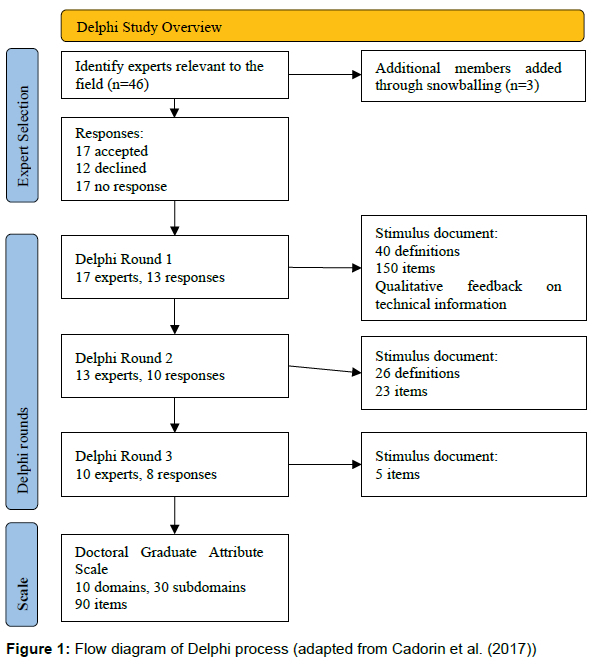
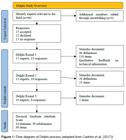
The items for each subdomain were presented together, and participants were requested to indicate if each item appropriately measured or reflected the subdomain. The definition of the relevant subdomain was provided, and each item had two response options: "include" or "revise/omit." If the latter was selected, participants were asked to elaborate on the recommended action, i.e. how it should be revised or why it should be omitted. The stimulus document was distributed via Google Forms to the panel of experts, to ensure ease of access and convenience, as participants could complete it in their own time. Each response was anonymised with a unique identifier (Cadorin et al. 2017, Skulmoski et al 2007). Descriptive statistics were analysed to measure level of agreement or consensus, as a percentage. In each round, definitions and/or items not reaching 70 per cent consensus were revised and retained for subsequent rounds (Cadorin et al. 2017). Items and definitions that did not meet the 70 per cent threshold were revised or omitted, based on the qualitative feedback from the panel. Reminders and notification of round closure were sent to all participants in that round. The Delphi took place over a two-month period and involved three rounds. The overall process of the Delphi is reflected in Figure 1 below.
ETHICS CONSIDERATIONS DURING THE DELPHI STUDY
Ethics clearance was obtained from UWC's Humanities and Social Science Research Ethics Committee (HS21/7/19). Consent was obtained electronically through Google Forms and the expert panellists' rights were maintained, including the right to withdraw and not participate in subsequent rounds. Further, anonymity was supported through the use of a unique identifier on each round of the Delphi. In addition, the anonymisation of expert responses facilitated objectivity in the analysis process, so that all feedback was given equal consideration.
FINDINGS
The findings of the Delphi study are presented below, first summarising the panel of experts. Thereafter, the findings of each of the three rounds of the Delphi is described, including the percentage agreement reached on each item and definition, and the subsequent action taken. Selected examples of revisions are provided, to demonstrate how the input from the expert panel was integrated. However, due to the length of the original stimulus document, it was not feasible to include detail on all items.
Expert panel
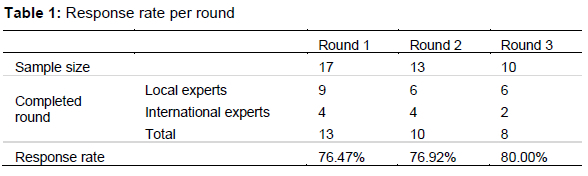
A total of 17 invited participants agreed to participate; however, only 13 completed the first round of the Delphi. Further, there was attenuation over the rounds, with ten participants in Round 2 and eight in Round 3 (Table 1).
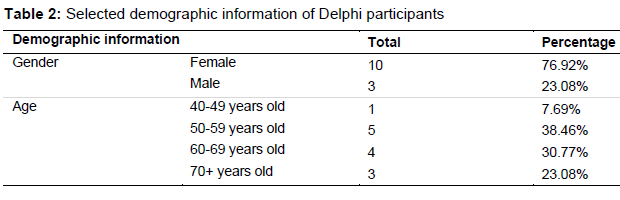
The sample information provided reflects the demographics of those 13 participants who participated in Round 1 (Table 2). The participants were affiliated with nine different higher education institutions, five in South Africa, two in the United Kingdom and two in New Zealand. Three were emeritus professors and/or retired. The experts had completed their own doctorates from 1985 onwards, with the most recent having graduated in 2022.
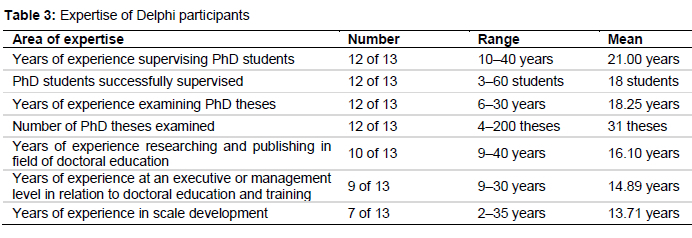
The panel's expertise in related fields is documented in Table 3. All but one of the experts had experience in doctoral education, including supervising and examining doctoral theses. Ten of the experts had experience researching and publishing in the field of doctoral education and training, while nine had experience at an executive or management level in HEI contexts. Seven of the experts had experience in scale development.
Round 1
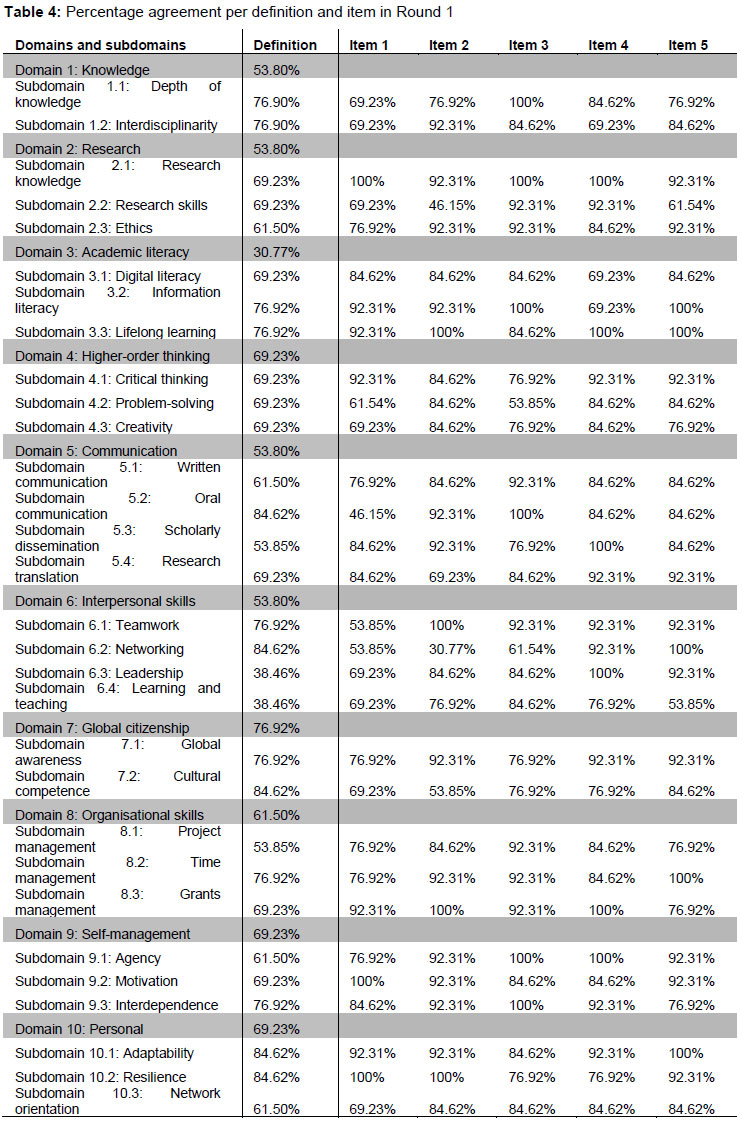
The definitions of the ten domains and 30 subdomains, as well as the 150 items, were reviewed by the expert panellists in Round 1. Experts indicated whether each definition was appropriate, and whether each item appropriately measured or reflected the definition of the corresponding subdomain. The expert panellists were provided with space to give qualitative feedback as to suggested revisions for each definition and item. The level of agreement obtained in Round 1 of the Delphi is indicated in percentages in Table 4 below. A threshold of 70 per cent was set as threshold for agreement (Cadorin et al. 2017).
Only one of the domain definitions met consensus in Round 1, while just under half of the subdomain definitions (13 of 30) met consensus. All definitions were revised according to the qualitative feedback, and three domains and two subdomains were renamed. Only the definitions that did not meet the threshold of 70 per cent were sent for comment in Round 2. For example, the definition of the "research skills" subdomain was revised from: "research skills refers to the ability to practically implement methodologies and research activities, as required in the specific research project" to: "research skills refers to the ability to practically implement methodologies and research activities, in order to answer the research question(s). This includes all activities involved in conceptualisation, execution of the study, analysis and write up of the findings." The feedback about the domain definitions reflected that they were too limited and thus they were substantially revised for the next round. Three domains were recategorized to domain names with definitions that better captured the relevant subdomains. Specifically, "scholarship" was recategorized to "academic literacy;" "cognitive skills" was recategorized to "higher-order thinking;" and "project management" was recategorized as "organisational skills."
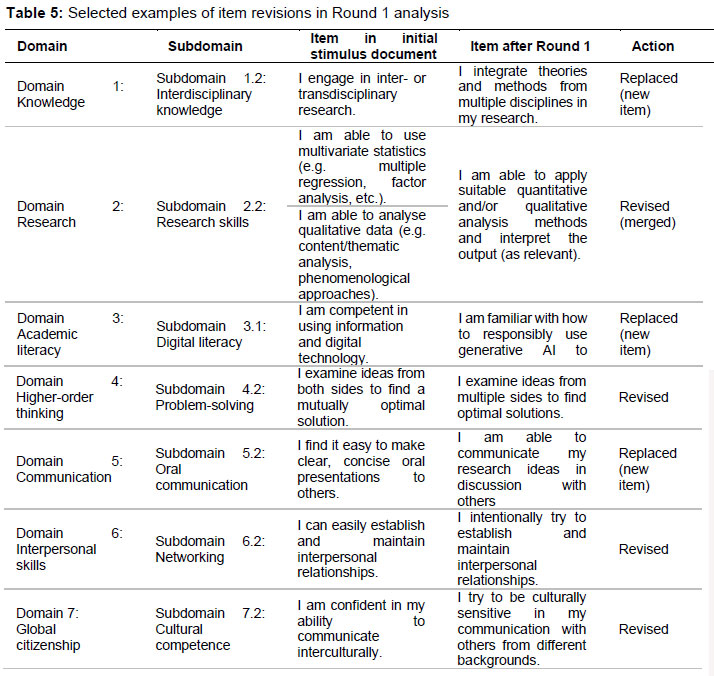
Most of the items met consensus (127 of 150). All items that did not meet the 70 per cent threshold were revised using the qualitative feedback provided and were sent to the panel for feedback in Round 2. Of the items revised, 11 were replaced with new items, ten were edited, two items were merged, and two additional items were added (see example of item revisions in Table 5). For example, in the research skills subdomain, there were two separate items that spoke to qualitative and quantitative analysis. The feedback from the panellists identified that, while it may be ideal for doctoral students to develop skills in both qualitative and quantitative methodologies, this is rarely the case. As the goal of the scale is to be inclusive across doctoral experiences, these two items were merged into a single item: "I am able to apply suitable quantitative and/or qualitative analysis methods and interpret the output (as relevant)."
Additional feedback from reviewers included questions about the feasibility of the scale given its current length, with concern that few participants would persevere through the full scale. It was recommended that the length be reduced to three items per subdomain and to include qualitative, open-ended questions to allow for triangulation and to capture more of the nuance than may be possible in a Likert-scale questionnaire.
Round 2
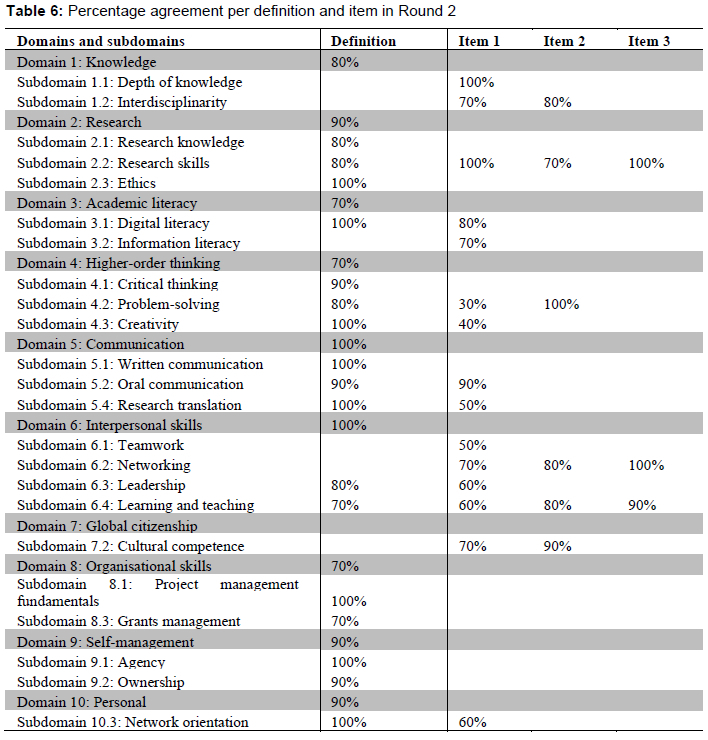
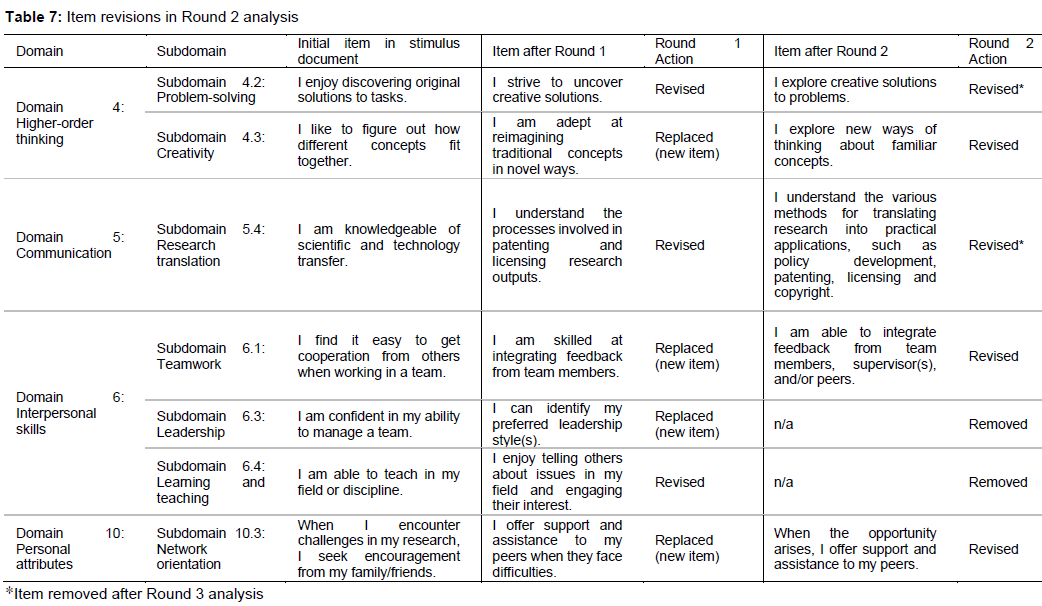
The threshold for agreement in Round 2 remained at 70 per cent. All of the definitions that were sent for feedback in Round 2 met the threshold of 70 per cent; thus, no definitions were carried through to Round 3 (Table 6). Of the items reviewed in Round 2, seven failed to reach consensus. Five of these items were edited according to the feedback provided, and two were removed (see examples of item revision in Table 7). Therefore, only five items were sent for comment in Round 3. It appeared that there was some confusion about the items, as some panellists expressed uncertainty as to whether the items presented per subdomain constituted all of the items, and thus felt that they were insufficient. However, it was indicated that only those items that did not reach consensus were presented and thus did not necessarily reflect all the items for the subdomain.
Round 3
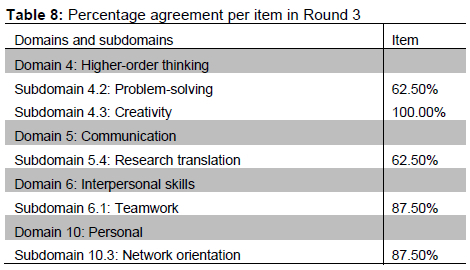
The level of consensus remained at 70 per cent for Round 3. Three of the five items reached consensus, and the remaining two items that did not meet the threshold were removed from the draft scale (Table 8). The removal of items was justified, as the length of the scale needed to be reduced, and the lack of consensus after three rounds indicated that the items were seen as problematic. One of the items was under the "problem-solving" subdomain, and the other under the "research translation" subdomain (indicated with * on Table 7 above).
Draft scale compilation
The remaining items were reviewed by the authors for cohesion. For each subdomain, the three items that provided the best coverage of the domain were selected, ensuring that there was sufficient discreteness across subdomains. This selection was compared against the levels of consensus from the experts on the corresponding items per subdomain, to ensure alignment. The final scale includes three items for each subdomain, in accordance with the recommendations of the expert panel, resulting in 90 items in total across the 30 subdomains.
RECOMMENDATIONSIt is recommended that the newly developed DGAS-10 scale is piloted, as recommended by DeVellis (2016), with the focus on establishing the psychometric properties (reliability and construct validity) of the scale. It is likely that there may be some overlap in the domains and/or subdomains that would be revealed through exploratory factor analysis, and appropriate revisions to the scale could take place thereafter. Once the scale has been validated, it will be made available for use. It would also be beneficial to explore if the scale needs to be adapted for use in the South African context, as this context holds various languages and cultural backgrounds.
LIMITATIONSDelphi studies are iterative, and due to the necessity of moving forward, there was inevitable attrition of expert panellists over the rounds. As such, certain experts provided more input than others, and thus may have had more influence over the revision of the DGAS-10. However, attrition is common, as one cannot force panellists to participate and must uphold their right to withdraw. The length of the DGAS-10 scale made the Delphi somewhat cumbersome and time-consuming for the panellists to complete, which may have led to fatigue in completing the various rounds; this may have added to the attrition from round to round. As the goal of the scale is to be inclusive across doctoral education in the South African HE context, the domains included were intentionally comprehensive.
CONCLUSION
The DGAS-10 was developed for use in the South African context through a clearly delineated and rigorous process. It is suggested that it be used as a self-reflective tool, for doctoral students to become aware of the attributes they have developed and to identify potential areas for growth. Similarly, supervisors may use the tool to identify what areas to focus on in tailoring their supervision practice to each students' needs and professional aspirations (Elliot et al. 2020). Doctoral graduates may use the tool to reflect on and realise the scope of their doctoral graduate attributes, which may assist them in the enhancement and intentional marketing of their skillsets. The scale may also be used to analyse trends, which may inform policy and institutional decision-making about the further development and improvement of doctoral education in the South African context. The steps for scale construction outlined in this article may be used as a point of reference for others in developing and/or adapting similar scales of graduate attributes or related educational concepts.
REFERENCES
BACKGROUND LITERATURE
- Bezuidenhout, Mareli. 2011. The Development and Evaluation of a Measure of Graduate Employability in the Context of the New World of Work. Master's thesis, University of Pretoria.
-
Cadorin, Lucia, Annamaria Bagnasco, Angelo Tolotti, Nicola Pagnucci, and Loredano Sasso. 2017. "Developing an Instrument to Measure Emotional Behaviour Abilities of Meaningful Learning through the Delphi Technique." Journal of Advanced Nursing 73 (9): 2208-2218. https://doi.org/10.1111/jan.13273.
» https://doi.org/10.1111/jan.13273 -
Cardoso, Sónia, Sandra Santos, Sara Diogo, Diana Soares, and Teresa Carvalho. 2022. "The Transformation of Doctoral Education: A Systematic Literature Review." Higher Education 84 (4): 885-908. https://doi.org/10.1007/s10734-021-00805-5.
» https://doi.org/10.1007/s10734-021-00805-5 -
Cassidy, S. 2016. "The Academic Resilience Scale (ARS-30): A New Multidimensional Construct Measure." Frontiers in Psychology 7: 1787. https://doi.org/10.3389/fpsyg.2016.01787.
» https://doi.org/10.3389/fpsyg.2016.01787 - Council on Higher Education (CHE). 2018. Qualification Standard for Doctoral Degrees: Higher Education Qualifications Sub-Framework. Pretoria: Council on Higher Education.
- Council on Higher Education (CHE). 2022. National Review of South African Doctoral Qualifications 2020-2021: Doctoral Degrees National Report. Pretoria: Council on Higher Education.
- Council on Higher Education (CHE) 2024. Viva Voce: The Oral Examination of a Thesis for a Doctoral Degree. Pretoria: Council on Higher Education.
-
Coetzee, Melinde. 2014. "Measuring Student Graduateness: Reliability and Construct Validity of the Graduate Skills and Attributes Scale." Higher Education Research & Development 35 (3): 887-902. https://doi.org/10.1080/07294360.2014.890572.
» https://doi.org/10.1080/07294360.2014.890572 -
Creaton, Jane, and Valerie Anderson. 2021. "The Impact of the Professional Doctorate on Managers' Professional Practice." The International Journal of Management Education 19 (1): 100461. https://doi.org/10.1016/j.ijme.2021.100461.
» https://doi.org/10.1016/j.ijme.2021.100461 -
Cuic Tankovic, Ana, Jelena Kapeš, and Dragan Benazić. 2022. "Measuring the Importance of Communication Skills in Tourism." Economic Research-Ekonomska Istraživanja 36 (1): 460-479. https://doi.org/10.1080/1331677x.2022.2077790.
» https://doi.org/10.1080/1331677x.2022.2077790 - DeVellis, Robert F. 2016. Scale Development: Theory and Applications. 4th ed. Applied Social Research Methods Series 26. California: Sage.
-
Durette, Barthélémy, Marina Fournier, and Matthieu Lafon. 2016. "The Core Competencies of PhDs." Studies in Higher Education 41 (8): 1355-1370. https://doi.org/10.1080/03075079.2014.968540.
» https://doi.org/10.1080/03075079.2014.968540 - Egesah, Omar, Mary Wahome, E. K. Langat, and Bel Wishtemi. 2014. "University Graduate Tracer Studies (UNITRACE): Methodological Lessons and Utilization of Selected Results in Kenya." Journal of International Academic Research for Multidisciplinary 2 (8): 305-325.
- Elliot, Dely, Søren Bengsten, Kay Guccione, and Sofie Kobayashi. 2020. The Hidden Curriculum in Doctoral Education. London: Palgrave Macmillan.
-
Faller, F., S. Burton, A. Kaniki, A. Leitch, and I. Ntshoe. 2023. "Achieving Doctorateness: Is South African Higher Education Succeeding with Graduate Attributes?" South African Journal of Higher Education 37 (2). https://doi.org/10.20853/37-2-5370.
» https://doi.org/10.20853/37-2-5370 - Foxcroft, Cheryl. 2018. "Developing a Psychological Measure." In Introduction to Psychological Assessment in the South African Context, edited by Cheryl Foxcroft and G. Roodt. Cape Town: Oxford.
-
Friedrich-Nel, H. S., and J. L. Mac-Kinnon. 2015. "Formative Assessment in Doctoral Education." Journal for New Generation Sciences 13 (2): 1-14. https://hdl.handle.net/10520/EJC182371.
» https://hdl.handle.net/10520/EJC182371 -
Kensington-Miller, Barbara, Bernadette Knewstubb, Alys Longley, and Amanda Gilbert. 2018. "From Invisible to Seen: A Conceptual Framework for Identifying, Developing and Evidencing Unassessed Graduate Attributes." Higher Education Research & Development 37 (7): 1439-1453. https://doi.org/10.1080/07294360.2018.1483903.
» https://doi.org/10.1080/07294360.2018.1483903 - Kew, B. 2015. A Study of the Relationship between Students' Participation in the Commerce Education Development Unit and Their Graduate Attributes. Master's thesis, University of Cape Town.
-
Kirby, John, Christopher Knapper, Patrick Lamon, and William Egnatoff. 2010. "Development of a Scale to Measure Lifelong Learning." International Journal of Lifelong Education 29 (3): 291-302. https://doi.org/10.1080/02601371003700584.
» https://doi.org/10.1080/02601371003700584 -
Lima-Rodríguez, Joaquín, Marta Lima-Serrano, Nerea Jiménez-Picón, and Isabel Domínguez-Sánchez. 2013. "Content Validation of the Self-Perception of Family Health Status Scale Using the Delphi Technique." Revista Latino-Americana de Enfermagem 21 (2): 595-603. https://doi.org/10.1590/S0104-11692013000200017.
» https://doi.org/10.1590/S0104-11692013000200017 -
Llinares-Insa, Lucía, Pilar González-Navarro, Juan Zacarés-González, and Ana Córdoba-Inesta. 2018. "Employability Appraisal Scale (EAS): Development and Validation in a Spanish Sample." Frontiers in Psychology 9: 1437. https://doi.org/10.3389/fpsyg.2018.01437.
» https://doi.org/10.3389/fpsyg.2018.01437 -
Manathunga, Catherine, Paul Lant, and George Mellick. 2007. "Developing Professional Researchers: Research Students' Graduate Attributes." Studies in Continuing Education 29 (1): 19-36. https://doi.org/10.1080/01580370601146270.
» https://doi.org/10.1080/01580370601146270 -
McAlpine, Lynn, Montserrat Castelló, and Kirsi Pyhältö. 2020. "What Influences PhD Graduate Trajectories During the Degree: A Research-Based Policy Agenda." Higher Education 80 (6): 1011-1043. https://doi.org/10.1007/s10734-019-00448-7.
» https://doi.org/10.1007/s10734-019-00448-7 -
Molla, Tebeje, and Denise Cuthbert. 2016. "In Pursuit of the African PhD: A Critical Survey of Emergent Policy Issues in Select Sub-Saharan African Nations, Ethiopia, Ghana and South Africa." Policy Futures in Education 14 (6): 635-654. https://doi.org/10.1177/1478210316641567.
» https://doi.org/10.1177/1478210316641567 - Mouton, Johan, Milandré van Lill, Heidi Prozesky, Tracy Bailey, Michelle Duncan, Nelius Boshoff, Charl Albertyn, and Rein Treptow. 2022. A National Tracer Study of Doctoral Graduates in South Africa. DSI-NRF Centre of Excellence in Scientometrics and Science, Technology and Innovation Policy.
-
Munnik, Erica, and Mario Smith. 2019. "Methodological Rigour and Coherence in the Construction of Instruments: The Emotional Social Screening Tool for School Readiness." African Journal of Psychological Assessment 1: 2a. https://doi.org/10.4102/ajop.
» https://doi.org/10.4102/ajop -
Nikol, Petra, and Anja Lietzmann. 2019. European Transferable Skills Training Demands Survey: Analysis Report. European Commission. https://www.mindset-project.eu/.
» https://www.mindset-project.eu/ -
Reysen, Stephen, and Iva Katzarska-Miller. 2013. "A Model of Global Citizenship: Antecedents and Outcomes." International Journal of Psychology 48 (5): 858-870. https://doi.org/10.1080/00207594.2012.701749.
» https://doi.org/10.1080/00207594.2012.701749 - Schomburg, Harald. 1995. Standard Instrument for Graduate and Employer Surveys. Education Report 68. Eschborn, Germany: Deutsche Gesellschaft für Technische Zusammenarbeit.
- Senekal, Janine. 2018. "Employment and Employability Profiles of Postgraduate Psychology Alumni from a Historically Disadvantaged University." Master's thesis, University of the Western Cape.
-
Senekal, Janine, Erica Munnik, and Jose Frantz. 2022. "A Systematic Review of Doctoral Graduate Attributes: Domains and Definitions." Frontiers in Education 7:1-22. https://doi.org/10.3389/feduc.2022.1009106.
» https://doi.org/10.3389/feduc.2022.1009106 -
Senekal, Janine, Erica Munnik, and Jose Frantz. 2024. "Multi-stakeholder Perceptions of Doctoral Graduate Attributes: A South African Perspective." South African Journal of Higher Education 38 (4): 240-264. https://dx.doi.org/10.20853/38-4-5857.
» https://dx.doi.org/10.20853/38-4-5857 -
Senekal, Janine, Erica Munnik, and Jose Frantz. 2025. "Doctoral Graduate Attribute Development: Lessons from the South African Context." International Journal of African Higher Education 11 (2): 19-41. https://doi.org/10.6017/ijahe.v11i2.17923
» https://doi.org/10.6017/ijahe.v11i2.17923 -
Skulmoski, Gregory, Francis Hartman, and Jennifer Krahn. 2007. "The Delphi Method for Graduate Research." Journal of Information Technology Education 6: 1-21. https://doi.org/10.28945/199.
» https://doi.org/10.28945/199 -
Spronken-Smith, Rachel, Kim Brown, and Claire Cameron. 2023. "Perceptions of Graduate Attribute Development and Application in PhD Graduates from US and NZ Universities." Assessment & Evaluation in Higher Education 49 (1): 86-101. https://doi.org/10.1080/02602938.2023.2182873.
» https://doi.org/10.1080/02602938.2023.2182873 -
Vitae. 2010. Researcher Development Framework. The Careers Research and Advisory Centre Limited. https://vitae.ac.uk/vitae-researcher-development-framework/.
» https://vitae.ac.uk/vitae-researcher-development-framework/ -
Weber, Charlotte, Melania Borit, Fabien Canolle, Eva Hnatkova, Gareth O'Neill, Davide Pacitti, and Filomena Parada. 2018. Identifying Transferable Skills and Competences to Enhance Early-Career Researchers Employability and Competitiveness. Brussels: European Council of Doctoral Candidates and Junior Researchers. https://ideas.repec.org/p/hal/wpaper/hal-01894753.html.
» https://ideas.repec.org/p/hal/wpaper/hal-01894753.html -
Wetzel, Angela, Paul Mazmanian, Mohammedreza Hojat, Kathleen Kreutzer, Robert Carrico, Caroline Carr, J. Jon Veloski, and Azhar Rafiq. 2010. "Measuring Medical Students' Orientation toward Lifelong Learning: A Psychometric Evaluation." Academic Medicine 85 (10 Suppl): S41-S44. https://doi.org/10.1097/ACM.0b013e3181ed1ae9.
» https://doi.org/10.1097/ACM.0b013e3181ed1ae9 -
Willison, John, and Kerry O'Regan. 2008/2015. "Research Skill Development Framework." https://www.adelaide.edu.au/rsd/framework/rsd7.
» https://www.adelaide.edu.au/rsd/framework/rsd7 - Wisker, Gina. 2023. "Facilitating Researcher Independence through Supervision as Dialogue." In Developing Researcher Independence through the Hidden Curriculum, edited by Dely Elliot, Søren Bengsten, Kay Guccione, and Sofie Kobayashi, 79-92. London: Palgrave Macmillan.
-
Yazdani, Shahram, and Forozaan Shokooh. 2018. "Defining Doctorateness: A Concept Analysis." International Journal of Doctoral Studies 13: 31-148. https://doi.org/10.28945/3939.
» https://doi.org/10.28945/3939