Lecturers overcoming challenges using teaching strategies and digital tools to implement blended learning at a private higher education institution in South Africa
Abstract
The Fourth Industrial Revolution has ushered in an era where technology significantly impacts various aspects of life, including higher education. Blended learning, which combines synchronous and asynchronous learning, has gained popularity as a pedagogical approach. However, its effective implementation is a challenge, particularly in the context of the COVID-19 pandemic and technological obstacles faced in South Africa. This study focused on lecturers' pedagogical practices to implement blended learning. With a specific aim to understand teaching and learning strategies preferred by lecturers to integrate digital tools that facilitate the blended learning approach. Using heutagogy and constructivism as theoretical frameworks, the study aimed to uncover insights into the lecturer's teaching and learning practices to overcome challenges in designing and facilitating blended learning modules. Through a qualitative analysis, the following themes emerged student engagement, pedagogical practices, digital tools, and feedback emerged, highlighting the complexities and opportunities in a blended learning classroom. The findings emphasize the importance of tailoring methods to students' needs and subject matter, aligning with constructivist principles. Recommendations include promoting professional development opportunities, addressing infrastructure issues, and fostering a supportive learning environment.
Blended Learning; Digital Tools; Higher Education; Teaching Strategies
INTRODUCTION
The world entered an era, driven by the Fourth Industrial Revolution (4IR), where technology compliments manual labour, transforms our cognitive processes, and redefines how we learn using technology (Schwab 2017). This digital age has left no facet of life untouched, including the realm of higher education. Public and private institutions have recognized the pivotal role of technology and embraced a blended learning approach (Graham 2006). Blended learning is a pedagogical approach that combines synchronous and asynchronous learning. It is not a novel concept but has gained prominence in recent years (Garrison and Vaughan 2008). According to Sanders and Mukhari (2023), the blended learning approach has existed in higher education, but there has not been much change to the approach. The approach is not easy to administer due to challenges faced with poor technology infrastructure, cost of data and access to technology, which can hinder the teaching and learning process (Sanders and Mukhari 2023). The outbreak of the COVID-19 pandemic has accelerated the adoption of blended learning, thrusting lecturer's and students into a novel digital landscape (Mhlanga and Moloi 2020).
Therefore, the research centres on a private higher educational institution (PHEI) that has embraced blended learning. The study seeks to explore the teaching and learning practices of lecturers operating within this dynamic environment, focusing on their choices of student centred teaching methods and digital online tools (Baker et al. 2022). Utilizing thematic analysis, this study endeavours to uncover lecturer's understanding of teaching and learning practices and integration of digital tools. The emerging themes aims to contribute to the growing knowledge of best practices when using the blended learning approach. Its findings will empower lecturers with the tools and knowledge necessary to navigate this ever-evolving educational landscape effectively as they overcome the technology challenges faced in South Africa.
BACKGROUND
Covid - 19 galvanized the usage of technology to deliver courses online (Mhlanga and Moloi 2020; Dawood and Van Wyk 2021). This transition exposed underlying challenges, particularly in economically developing countries particularly in Africa. The literature from African countries focused on challenges when implementing the blended learning approach. These challenges included, poor infrastructure, limited access to hardware and software, exorbitant data costs, and unsustainable digital infrastructure emerged, financial constraints, gaps with training lecturers to make use of technology in the classroom and barriers to policy, were significant hurdles to widespread online adoption (Bakibinga-Gaswaga et al. 2020; Adams, Tan, and Sumintono 2021; Mpofu and Mpofu 2023; Klatt and Milana 2020; Faturoti 2022). African countries need to overcome these challenges when implementing the blend ensuring to strengthen their infrastructure, train their lecturers to make use of digital tools and make changes to their blended learning policies to strengthen the blended learning environment. Transitioning to a blended learning model, combining face-to-face and online instruction, introduces complex challenges for both educators and students (Adams Tan, Sumintono 2021; Mpofu and Mpofu 2023). Blended learning requires effective integration of synchronous and asynchronous activities, a pedagogical shift from traditional in-person classes that emphasized human interaction and physical presence (Mulenga and Shilongo 2025; Al-Abdulaziz and Al Darwesh 2023).
In Kenya, for instance, the high costs of mobile data and limited internet infrastructure have hindered many students' accesses to online learning, creating a divide between urban and rural students (Kibuku, Ochieng, and Wausi 2020; Malenya and Ohba 2023). In response, institutions adopted innovative strategies, such as distributing offline resources and encouraging the use of low-data communication tools like WhatsApp group discussions (Malenya and Ohba 2023). Additionally, Ghana's government collaborated with universities to provide students with free data access and instituted digital literacy programs to ease the transition to online learning (Kumi-Yeboah, Kim, and Armah 2023). Despite these efforts, the need for affordable and reliable digital infrastructure remains critical to the long-term viability of blended learning models in these regions (Bailey et al. 2013).
South Africa faced similar challenges by recognizing these challenges, the South African higher education used similar procedures such lower data costs to access the learning management system, training for lecturers and using alternative ways to reach their students (Mhlanga and Moloi 2020). However, transitioning to a blended learning environment presents unique challenges. While traditional face-to-face classrooms foster familiarity and human interaction, the virtual landscape poses unfamiliar terrain for both educators and students (Adams, et al 2021). Despite the availability of developmental workshops, educators often grapple with articulating student-centred approaches and fostering engagement in virtual settings due to limited experience with blended learning design and the technology challenges faced in the country. Amidst these challenges, private higher education institutions (PHEIs) have increasingly turned to blended learning as a viable pedagogical approach. Blended learning, characterized by a mix of synchronous and asynchronous learning activities, necessitates educators to design engaging and cognitively stimulating lessons that seamlessly integrate both offline (face-to-face) and online components (Zydney, Warner, and Angelone 2020; Graham 2006; Alammary, Sheard, and Carbone 2014; Poon 2013; Divaharan and Chia 2022). Transitioning to a blended learning approach requires effective integration of synchronous and asynchronous activities, a pedagogical shift from traditional in-person classes that emphasized human interaction and physical presence (Mulenga and Shilongo 2025). Despite the provision of professional development workshops aimed at equipping educators with digital and blended learning competencies, many lecturers in South Africa report difficulties in creating student-centered virtual environments that foster active learning and engagement due to limited experience with seamless integration of digital tools with teaching and learning practices (Al-Abdulaziz and Al Darwesh 2023). The study focuses on lecturer's understanding when using teaching and learning strategies to integrate digital tools and overcoming challenges faced with technology.
THEORETICAL AND CONCEPTUAL FRAMEWORKIn this study, the theoretical and conceptual framework draws upon two foundational pillars: heutagogy and constructivism, to elucidate the dynamics of blended learning within the educational landscape. Heutagogy, rooted in the philosophy of self-directed learning, serves as a cornerstone theory (Terblanché 2018). Within the context of blended learning, heutagogy empowers educators and learners alike to assume active roles in their educational journey, fostering autonomy, agency, and self-regulation (Brieger, Arghode, and McLean 2020; Muhajirah 2020). By using this theoretical lens, the researchers could understand the teaching and learning practices that was used and to overcome the challenges faced when implementing blended learning.
Complementing heutagogy is the constructivist perspective, which underscores the importance of active engagement, collaboration, and the construction of knowledge through meaningful interactions (Graham 2006). Within a blended learning framework, constructivism advocates for the integration of prior knowledge, diverse perspectives, and authentic learning experiences. By encouraging learners to actively construct their understanding of concepts and apply them in real-world contexts, constructivism aligns seamlessly with the goals of blended learning, facilitating deeper comprehension and skill acquisition. Moreover, key concepts such as the blended learning approach, community of inquiry, and student engagement theory enrich the framework, providing additional layers of understanding and practical guidance for educators (Garrison and Vaughan 2008). The blended learning approach emphasizes the strategic integration of synchronous and asynchronous learning modalities to optimize learning outcomes.
By integrating these theories concepts, the study seeks to illuminate the complexities of blended learning implementation, elucidating both challenges and opportunities. Through a deeper understanding of heutagogy and constructivism within the blended learning context, educators can navigate the digital landscape with confidence, designing enriching and transformative learning experiences for their students.
METHODOLOGY
A qualitative approach was employed within an interpretivist paradigm (Du Plooy-Cilliers and Cronje 2014). Purposive sampling was utilized to select participants based on the phenomenon under investigation, while convenience sampling gathered data from readily available populations (Ponelis 2015). Ethical procedures were strictly adhered to, with approval obtained from the PHEI where the study was conducted, allowing researchers to closely examine the blended learning approach. To provide a comprehensive understanding, one lecturer from each school within the institution was selected as a case study, representing the School of Education, Humanities and Social Science, Information Technology (IT), Law, and Management. The criteria for choosing lecturer were based on going through blended learning training during COVID-19 and still employed with the higher education institute.
Data was gathered via semi-structured interviews; the sampling strategy was purposeful and convenient. The lecturers were available on-site and could be reached. If they accepted, each participant was given an informed consent form to sign. Before each interview started, the participant agreed for the interview to be recorded. The researchers explained the value of the study and the need for the interview. Eighteen questions were posed to the participants, and the questions were based on the literature which guided the study. Each school was represented; unfortunately, one lecturer was unreachable, but there was data saturation due to the number of questions used in the interview process. The participants answered the questions openly and honestly based on their experiences, and the researchers guided the interview process.
The data collected from the interviews were analysed using thematic analysis, which involved a systematic and detailed coding process, following Braun and Clarke (2006) six-step approach to ensure a structured and rigorous process. This began with an in-depth familiarization stage, where each transcript was read and re-read to deeply understand the lecturers' experiences with blended learning. Initial coding was then conducted by labelling segments relevant to key aspects of the lecturer's experience. This process, driven by an inductive approach, allowed major themes such as "student engagement," "digital tools," "teaching and learning strategies," and "feedback" to emerge naturally.
These themes were then reviewed and refined for coherence and alignment with the research questions (Braun and Clarke 2006). Any overlapping themes were merged, and broader themes were subdivided where necessary. This process ensured that each theme was distinct, cohesive, and well-supported by the data. Finally, the themes were defined and named, capturing their essence with concise yet descriptive labels. For example, "feedback" covered aspects of timely, constructive responses to students in the blended learning format. The final report presented these themes, supported by participant quotes to offer a vivid portrayal of their experiences.
To ensure trustworthiness of the data an iterative process of refining and cross-checking was conducted among researchers, alongside peer debriefing, enhancing the rigor of the findings. While the sample yielded rich insights, the small sample size may limit the generalizability of the findings across broader higher education contexts.
FINDINGS AND DISCUSSION
The findings of this study, derived from semi-structured interviews and subjected to thematic analysis, reveal in depth insights into the lecturer's teaching and learning practices regarding blended learning within a PHEI. Through collaborative efforts, researchers identified and refined themes related to student engagement, teaching and learning strategies, digital tools, and feedback. These themes provide a comprehensive understanding of the complex dynamics at play in the implementation of blended learning.
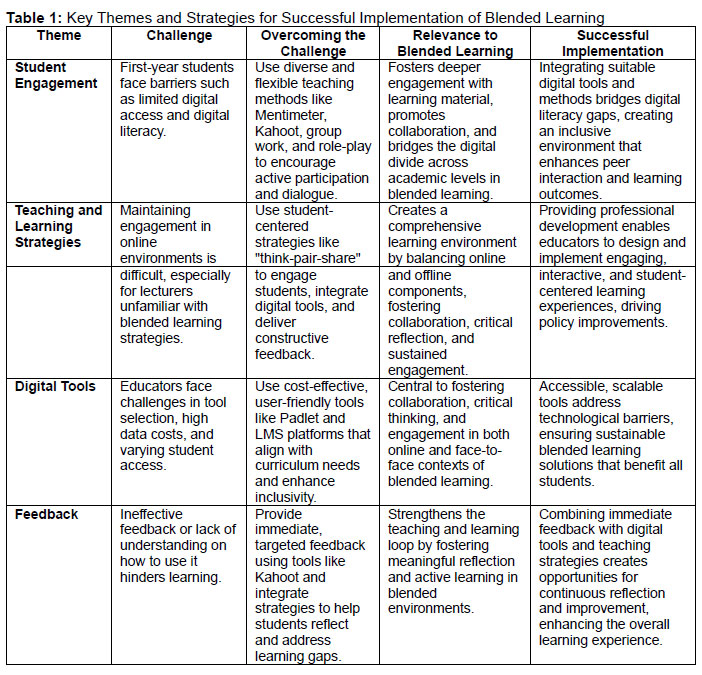
Table 1 summarises the challenges and strategies for implementing effective blended learning. It emphasizes the importance of addressing student engagement, equipping educators with appropriate teaching strategies, leveraging digital tools, and providing meaningful feedback. Each theme is linked to practical solutions, such as using diverse digital tools, fostering collaboration, and focusing on professional development for educators.
Student Engagement
Lecturers emphasized the importance of fostering active student involvement and participation as a central theme. Across disciplines, strategies such as role play, group work, and interactive tools like Mentimeter and Kahoot were utilized to stimulate social interactions and communication among students. For example, a Humanities lecturer mentioned, "... role play approach to learning and all of that. Interestingly, a variation in engagement levels was noted across different academic levels and disciplines, with third and fourth-year students exhibiting higher engagement compared to first-year students. This emphasizes the importance of educators tailoring their approaches to accommodate varying levels of familiarity and comfort with online platforms and collaborative learning environments. As one lecturer noted, "So yeah, I would say that requires a bit of dialogue and interaction amongst the students within a group-based setting...".
While these strategies promote active engagement, their success depends on the learning environment in which they are applied. Blended learning, which combines online and face-to-face learning, aims to deepen student engagement by offering more flexible and dynamic learning opportunities. Effective engagement strategies-whether online or in-person-are crucial to achieving meaningful learning outcomes. Lecturers employed diverse teaching strategies and digital tools to facilitate participation and ensure that students remained engaged with both the content and the lecturer. This interaction, whether with the lecturer or the material, fosters dialogue, active participation, and opportunities for feedback. Such strategies align with constructivist principles, which emphasize the importance of active student participation and collaborative learning (Adams et al 2021).
However, the shift to blended learning models introduces new challenges, particularly for first-year students who may be less familiar with technology. The digital divide-a term referring to the gap in access to digital resources-can hinder students' ability to engage effectively. Issues such as slower internet speeds, limited bandwidth, and unreliable connectivity create barriers for some students. This divide is particularly concerning for institutions trying to implement blended learning at scale, as not all students have equal access to the necessary online tools. The variation in the engagement levels across the different academic years and disciplines, highlights the importance for tailored approaches that accommodate students' varying familiarity and comfort with digital tools. Further, establishing the importance of adapting teaching strategies to meet students' learning needs (Braun and Clarke 2006). This further reinforces the need for adaptive teaching strategies to meet students' learning needs. Moreover, addressing the digital divide goes beyond just providing access to technology-it also involves ensuring that students are equipped with the necessary digital literacy skills. Introductory training in digital tools before the course begins could help bridge the gap, particularly for first-year students, and reduce their discomfort with unfamiliar platforms.
Teaching and Learning Strategies
Lecturers emphasized the importance of choosing teaching and learning strategies to create a comprehensive learning environment. Strategies such as think pair share, group work, and questioning techniques were identified as effective methods for promoting active learning and critical thinking. A lecturer mentioned, "...different approaches that really have worked well, one of them being the think pair share approach I found that's really worked. They enjoy the group collaborative type of teaching strategies and approach to learning so...". The effective delivery of teaching in a blended learning environment requires a thoughtful mix of strategies that promote active learning and critical thinking, such as the identified think, pair, share, group work and questioning techniques (Graham 2006).
The think, pair share technique is particularly valuable as it encourages individual reflection, peer interaction, and broader classroom discussion. This makes think pair share technique an effective tool for engaging students at multiple levels of the learning process. According to (Faturoti 2022), think-pair-share and similar collaborative strategies foster a more interactive and engaging classroom environment, which is essential in blended learning settings where maintaining student engagement can be challenging.
In addition to think-pair-share, group work is another strategy that promotes collaboration, communication, and teamwork among students. Group work can take various forms, including small group discussions, project-based learning, and peer reviews. The use of group work aligns with constructivist principles, which emphasize the importance of social interactions and collaborative knowledge construction (Sweet and Michaelsen 2023). Studies have shown that group work helps students develop critical thinking skills, enhances their understanding of the material, and increases their engagement with the content (Miri, Ben Chaim, and Zoller 2007).
In a blended learning environment, questioning can be employed in both synchronous (live) and asynchronous (discussion forums, online quizzes) settings. According to (Nicol and Macfarlane-Dick 2006), higher-order questioning techniques, which challenge students to analyse, synthesize, and evaluate information, are particularly effective in promoting critical thinking.
Despite recognizing the challenges in maintaining a balanced blend of online and offline components, educators stressed the importance of ongoing professional development and adaptability to meet the evolving demands of the digital age to ensure teaching and strategies used promote students' participation in class and foster student engagement. To effectively implement these teaching strategies, ongoing professional development is essential. Educators need to be equipped with the skills and knowledge to navigate the digital tools and pedagogical approaches required for blended learning. As (Poon 2013) suggests, professional development opportunities should focus on enhancing educators' ability to design and deliver engaging, interactive, and student-centred learning experiences.
Digital Tools
Despite challenges with technology infrastructure, diversity and adaptability emerged as key themes in the discussion of digital tool preferences among educators. While some educators embraced a variety of tools to enhance student engagement and collaboration, others strategically integrated specific tools aligned with their subject matter. For example, a Humanities lecturer mentioned, "I've used a variety of different tools... But in terms of actual digital tools that I've used, I've used many different tools like Padlet, Visio design tools, and blogging tools..." to enrich learning experiences and accommodate diverse student needs (Serrano et al. 2019). As (Alammary et al 2014) point out, selecting familiar, accessible tools enhances engagement in blended learning, facilitating active knowledge construction (Means 2010; Means, Padilla, and Gallagher 2010). According to Graham (2006), the use of diverse digital tools allows educators to create rich and varied learning experiences that cater to different learning preferences and needs.
Regardless of discipline, educators recognized the importance of selecting tools that are both accessible and familiar tools to students and lecturers. This accessibility is crucial in blended learning environments, where digital tools support the teaching and learning process by facilitating active student engagement and knowledge construction. The integration of digital tools was viewed as essential for supporting the teaching and learning process within a blended learning environment, facilitating active student engagement and knowledge construction. Braun and Clarke (2006) suggest that digital tools enhance interaction and collaboration among students, fostering a more engaging and interactive learning experience. These tools also provide flexibility through synchronous and asynchronous learning, allowing students to participate and collaborate at their own pace.
By integrating digital tools effectively, educators can create interactive learning environments that promote exploration, discussion, and reflection (Braun and Clarke 2006). However, limited access to hardware, software, and reliable internet connectivity poses significant challenges in regions with inadequate technological infrastructure. Educators emphasized the importance of selecting tools that require minimal technical expertise and are compatible with a range of devices. Therefore, selecting tools that require minimal technical expertise and are compatible with various devices is crucial (Bakibinga-Gaswaga et al. 2020). The scalability and sustainability of blended learning initiatives depend heavily on students' access to affordable technology.
In regions like South Africa, where socio-economic disparities persist, many students from disadvantaged backgrounds lack access to essential devices such as laptops, tablets, or smartphones, as well as reliable internet connectivity. This limits their ability to fully engage in blended learning environments, where online participation is essential. Data costs in South Africa remain high compared to other regions, making it financially burdensome for students to access online content, attend virtual lectures, or participate in discussions. This financial barrier reinforces educational inequality, preventing low-income students from engaging in blended learning to the same extent as their peers. Even when students have access to devices, the cost of maintaining a stable internet connection discourages regular online engagement, reducing the effectiveness of blended learning.
Therefore, the integration of digital tools is crucial for fostering interaction and collaboration in blended learning environments. The study's findings highlight that while digital tools can enhance the learning experience, the effectiveness of these tools is contingent on adequate infrastructure and access to technology. Addressing these barriers will be key to ensuring the scalability and sustainability of blended learning in contexts like South Africa, where technological disparities persist.
Feedback
Feedback is a fundamental component of the teaching and learning process, emphasizing continuous assessment and improvement. Educators highlighted the value of providing timely and constructive feedback to students, encouraging reflection and self-assessment. An education lecturer emphasized, "...my third years and the fourth years, they're actually going more in depth... I think that's important because in that classroom... it's very important to show that you open with them..." Timely feedback allows students to understand and track their progress and areas needing improvement. According to Miri et al (2007) effective feedback should focus on three key levels: the task, the process, and self-regulation. This comprehensive approach helps students reflect on their learning, understand their mistakes, and apply corrections effectively. This approach encourages students to reflect on their learning, understand their mistakes, and apply corrective measures. In a blended learning environment, feedback can be provided through various digital platforms, ensuring that it is timely and accessible.
In a blended learning environment, the delivery of feedback can be streamlined through digital platforms, making it both timely and accessible. Tools such as learning management systems (LMS), online quizzes, and discussion boards enable educators to provide immediate feedback that students can access at their convenience, promoting continuous engagement. However, challenges remain, particularly with first-year students, who often struggle with self regulation and feedback utilization. As a management lecturer noted, "...getting feedback don't always get that from all students in first year..." This finding aligns with Alammary et al (2014) who suggest that first-year students often lack the self-regulation skills necessary for effective learning and feedback utilization.
To address this, educators should implement strategies that facilitate feedback literacy, equipping students with the skills to interpret, and act on feedback effectively. This is particularly important for first-year students, as it helps them develop the skills needed for reflective practice and active learning. Encouraging a culture of feedback within the classroom, through both formal and informal channels, can significantly enhance student learning outcomes.
Feedback in blended learning should be continuous and formative, contributing to ongoing assessment and improvement. In this context, formative assessments, such as online quizzes, peer reviews, and interactive discussions, provide opportunities for interactive and engaging feedback. In a blended learning environment, continuous assessment can be integrated through online quizzes, peer reviews, and interactive discussions, allowing interactive and engaging feedback (Divaharan and Chia 2022). Real-time feedback during synchronous sessions, as well as automated feedback integrated into LMS systems, can further enhance the student learning experience. However, the integration of feedback within the blended learning environment is essential from promoting student engagement and identifying areas for improvement. Effective feedback mechanisms include online discussion boards, real time feedback during synchronous sessions, and automated feedback in learning management systems.
Feedback is essential for continuous student assessment and engagement in blended learning. The study emphasizes that effective feedback mechanisms not only support student learning but also help educators identify areas for improvement. By integrating feedback through digital platforms, educators can enhance the learning experience and encourage deeper engagement with course content. The findings suggest that addressing the challenges of feedback, particularly with first-year students, is key to promoting a culture of reflection and active learning in blended settings.
Hence the implementation of blended learning could have implications on policy. Policy should include academics and students as stakeholder as there is implications on the use of pedagogy and the integration of digital tools as it contributes to the students learning experience to implement blended learning successfully in the classroom.
CONCLUSION
The success of blended learning depends on its ability to scale effectively across different educational contexts, from large urban universities to small rural campuses. However, the limitations in infrastructure and access to technology directly impact the scalability of these models. Scaling blended learning requires not only the expansion of digital infrastructure but also the standardization of technological tools and practices across institutions. In regions with insufficient infrastructure, institutions may be forced to implement hybrid models that rely more heavily on traditional, in-person teaching methods, with only minimal use of digital tools.
This uneven implementation results in a fragmented approach to education, where some students receive a fully immersive blended learning experience while others are left with a substandard version that fails to deliver the same benefits. Consequently, the scalability of blended learning is limited by the region-specific challenges institutions face in providing equitable access to the necessary tools and resources.
To overcome these limitations, institutions must focus on developing scalable solutions that work across different contexts. This could include low-bandwidth or offline solutions for accessing digital content, as well as flexible blended learning models that can be adapted to different technological environments. By developing adaptive approaches that consider the varying levels of access to digital tools, institutions can create more inclusive and sustainable blended learning models. To sustain a blended learning model the institution will need to look towards cost of ensuring that the correct software is available, and infrastructure is supported. Hence, budgets should be allocated for upgrading equipment or software as well as maintaining infrastructure of training rooms for staff and lecturer venues for students. The learning management platform (LMS) is an important digital tool used by both lecturer and students and requires effective training and support to use the tool correctly.
The cost of maintaining digital platforms, updating software, and providing ongoing support to both students and educators can strain institutional budgets. Additionally, frequent technological upgrades and the need for continuous professional development for educators contribute to the ongoing financial burden. Without sustainable funding models, institutions may struggle to maintain the quality and accessibility of blended learning over time.
Sustainability also hinges on the ability of institutions to address the evolving technological landscape and keep pace with advancements in digital learning tools. Institutions that fail to invest in future-proof infrastructure and adaptive learning technologies may find themselves unable to sustain their blended learning efforts in the long term. Therefore, blended learning policies should prioritize investment in scalable, sustainable technologies that can evolve alongside educational demands, ensuring the longevity of blended learning models.
The integration of teaching strategies, digital tools, and feedback mechanisms within a blended learning framework is essential for creating engaging, interactive, and student-centred learning environments. The study's findings reinforce the significance of self-directed learning, active engagement, effective implementation, and the creation of meaningful learning experiences in blended learning approaches. The alignment of these practices with established educational theories and concepts provides a cohesive understanding of lecturers' teaching and learning practices, contributing to the successful implementation of blended learning within PHEIs. Ongoing professional development for educators remains crucial in adapting to the evolving demands of the digital age and enhancing the overall quality of education. The interconnectedness of themes such as Engagement, Teaching and Learning, Digital Tools, and Feedback underscores the complexity of blended learning. The integration of teaching strategies and digital tools aligns with the constructivist theory, emphasizing the need for active, experimental, and collaborative learning experiences. The findings highlight the importance of creating engaging, interactive, and collaborative learning environments through the effective implementation of teaching strategies and digital tools within the blended learning approach. This aligns with the theoretical framework of constructivism and contributes to a deeper understanding of student learning in diverse academic disciplines.
Furthermore, the results demonstrate that the lecturer's teaching and learning practices when using the blended learning approach is consistent with theoretical and conceptual frameworks in education, emphasizing the importance of fostering student engagement, motivation, critical thinking, and active learning. This alignment suggests that lecturers are employing pedagogical approaches with a strong theoretical foundation, which can contribute to effective blended learning experiences. Additionally, limitations in digital infrastructure and access to technology pose significant challenges to the scalability and sustainability of blended learning in South Africa. Without addressing these barriers, the full potential of blended learning will remain out of reach for many students, particularly those in rural and low-income communities. To ensure the long-term success of blended learning, institutions and policymakers must prioritize infrastructure investment, equitable access to technology, and the development of sustainable strategies that account for the socio-economic realities of South Africa. By overcoming these limitations, blended learning can become a powerful strategy for enhancing educational access, improving student engagement, and fostering deeper learning experiences across the country. The future of blended learning in South Africa hinges on the ability of institutions to create adaptable, inclusive, and sustainable models that meet the diverse needs of their student populations.
The study's results demonstrate that the lecturer's self-directness teaching and learning practices when using the blended learning approach is consistent with theoretical and conceptual frameworks in education, emphasizing the importance of fostering student engagement, motivation, critical thinking, and active learning. This alignment suggests that lecturers are employing pedagogical approaches with a strong theoretical foundation, which can contribute to effective blended learning experiences.
RECOMMENDATIONSThe blended learning approach gave rise to the following guidelines: (1) understanding the construction of student knowledge in your discipline that contributes to understanding and application of knowledge, (2) perceptions of student engagement by administering teaching and learning strategies with the integration of digital online tools, (3) lecturer's experiences guiding the usage of teaching strategies and integration of digital tools, (4) perceptions of students learning, (5) experiences of the blended learning differ across Schools hence the variations within the strategies and digital tool implementation and institutions should consider the variations for support and training, (6) the institution should provide professional development opportunities for integration digital online tools as lecturer implement their teaching strategies, (7) Accessibility and infrastructure are elements to ensuring the blended learning approach takes place there should be support mechanisms in place when challenges are arise from the institution and (8) potential policy implications for blended learning in SA institutional policies play a crucial role in mitigating the effects of digital infrastructure and technology access limitations.
The policy should include a definition that will be suitable for blended learning in their institution. It should reflect the voices of the lecturer, students, administrators and support as they stakeholders in the blended learning approach. The data strongly suggested that lecturers are prepared to be trained to implement blended learning to strengthen their curriculum. They want students to be active participants in the learning process. Teaching and learning should then be part of the definition of blended learning. There needs to be goals set by the institution to sustain, support and ensure scalability of blended learning in their institution. There needs to be provision and work around budget constraints.
Collaborating with government agencies and private sector technology companies to secure funding for digital infrastructure and affordable technology access is essential to achieving this goal. In doing so, blended learning becomes not only an educational initiative but also a national priority, underpinned by a comprehensive policy framework that addresses infrastructure, affordability, and inclusivity. Collaborate with other African countries, like Kenya and Ghana, have addressed similar issues in this way Africa can strengthen the policy developed for blended learning and speaks to their context of the challenges faced and providing sustainable solutions for the future (Tauté 2020; Nwokolo et al. 2023). By incorporating flexibility into blended learning approach, institutions can create a resilient educational system capable of overcoming infrastructure and technological challenges to ensure an effective and equitable learning experience for all their students.
The Independent Institute of Education (IIE) for allowing this study to take place. Your commitment to fostering academic research provided us with the necessary platform to explore and develop our ideas. The EM Research Office for their steadfast support, resources and encouragement were critical in ensuring the smooth progression and completion of this research.
To all who contributed to this project, your support and assistance have been deeply appreciated. Thank you for making this research possible.
ACKNOWLEDGMENT
We would like to extend our deepest gratitude to the following individuals and institutions whose contributions were instrumental in the successful completion of this research: Dr. Njabulo, Dr. Aradhana Mansingh, and Dr. Quraisha, for taking the time to assist us throughout the research process. Your guidance, expertise, and unwavering support were invaluable, and we are immensely grateful for your contributions.
REFERENCES
-
Adams, Donnie, Mabel Hwee Joo Tan, and Bambang Sumintono. 2021. "Students' Readiness for Blended Learning." Interactive Technology and Smart Education 18 (4): 515-534. https://www.emerald.com/insight/content/doi/10.1108/ITSE-03-2020-0032/full/html
» https://www.emerald.com/insight/content/doi/10.1108/ITSE-03-2020-0032/full/html - Al-Abdulaziz, F., and A. Q. Al Darwesh. 2023. "Cultivating Active Learning and Learner-Centered Pedagogical Practices on MOOCs." In Massive Open Online Courses.
- Alammary, Ali, Judy Sheard, and Angela Carbone. 2014. "Blended Learning in Higher Education." Australasian Journal of Educational Technology 30 (4).
- Bailey, J., N. Martin, C. Schneider, T. Vander Ark, L. Duty, S. Ellis, and A. Terman. 2013. Blended Learning Implementation Guide 2.0.
-
Baker, Sally, Joel Anderson, Rachel Burke, Teresa De Fazio, Clemence Due, Lisa Hartley, and Tebeje Molla. 2022. "Equitable Teaching for Cultural and Linguistic Diversity." Educational Review 74 (3): 444-459. https://www.tandfonline.com/doi/abs/10.1080/00131911.2021.2015293
» https://www.tandfonline.com/doi/abs/10.1080/00131911.2021.2015293 -
Bakibinga-Gaswaga, Elizabeth, Stella Bakibinga, David Baxter Mutekanga Bakibinga, and Pauline Bakibinga. 2020. "Digital Technologies in the COVID-19 Responses in Sub-Saharan Africa." Pan African Medical Journal 35 (Suppl 2). https://www.ncbi.nlm.nih.gov/pmc/articles/PMC7875745/
» https://www.ncbi.nlm.nih.gov/pmc/articles/PMC7875745/ - Braun, Virginia, and Victoria Clarke. 2006. "Using Thematic Analysis in Psychology." Qualitative Research in Psychology 3 (2): 77-101.
- Brieger, Earl, Vishal Arghode, and Gary McLean. 2020. "Connecting Theory and Practice." European Journal of Training and Development 44 (4/5): 321-339.
- Chikuni, Patricia Rudo, Blessing Makwambeni, and Wallace Chigona. 2021. "Dominant Discourses Informing E-Learning Policies." International Journal of Education and Development using ICT 17 (4): 5-21.
-
Dawood, Quraisha, and Brenda Van Wyk. 2021. "Postgraduate Research during COVID-19 in a South African Higher Education Institution." African Journal of Inter/Multidisciplinary Studies, 1-12. https://journals.dut.ac.za/index.php/ajims/article/view/966
» https://journals.dut.ac.za/index.php/ajims/article/view/966 - Divaharan, Shanti, and Alexius Chia. 2022. "Blended Learning Reimagined." Education Sciences 12 (10): 648.
- Du Plooy-Cilliers, Franzél, and J. Cronje. 2014. "Research Paradigms and Traditions." In Research Matters, 18-35.
- Faturoti, B. 2022. "Online Learning during COVID-19 and Beyond." International Review of Law, Computers & Technology 36 (1): 68-90.
-
Garrison, D. Randy, and Norman D. Vaughan. 2008. Blended Learning in Higher Education: Framework, Principles, and Guidelines. Hoboken, NJ: John Wiley & Sons. https://books.google.co.za/books?id=2iaR5FOsoMcC
» https://books.google.co.za/books?id=2iaR5FOsoMcC -
Graham, Charles R. 2006. "Blended Learning Systems." In The Handbook of Blended Learning: Global Perspectives, Local Designs, 3-21. https://books.google.co.za/books?id=tKdyCwAAQBAJ
» https://books.google.co.za/books?id=tKdyCwAAQBAJ - Hattie, John, and Helen Timperley. 2007. "The Power of Feedback." Review of Educational Research 77 (1): 81-112.
- Kibuku, R. N., D. O. Ochieng, and A. N. Wausi. 2020. "e-Learning Challenges Faced by Universities in Kenya." Electronic Journal of e-Learning 18 (2): 150-161.
-
Klatt, G., and M. Milana. 2020. "Education and Training 2020." In Europe's Lifelong Learning Markets, Governance and Policy, 23-48. https://link.springer.com/chapter/10.1007/978-3-030-38069-4_2
» https://link.springer.com/chapter/10.1007/978-3-030-38069-4_2 - Kumi-Yeboah, A., Y. Kim, and Y. E. Armah. 2023. "Strategies for Overcoming the Digital Divide." British Journal of Educational Technology 54 (6): 1441-1462.
- Malenya, F. L., and A. Ohba. 2023. "Equity Issues in Online Learning in Kenya." Journal of International Cooperation in Education 25 (1): 96-107.
- Mcinziba, Dorothea Zandile. 2020. "The Role of Social Media in Teaching and Learning." PhD diss., Cape Peninsula University of Technology.
- Means, B. 2010. "Technology and Education Change." Journal of Research on Technology in Education 42 (3): 285-307.
- Means, Barbara, Christine Padilla, and Larry Gallagher. 2010. Use of Education Data at the Local Level. U.S. Department of Education.
-
Mhlanga, David, and Tankiso Moloi. 2020. "COVID-19 and the Digital Transformation of Education: What Are We Learning on 4IR in South Africa?" Education Sciences 10 (7): 180. https://www.mdpi.com/2227-7102/10/7/180
» https://www.mdpi.com/2227-7102/10/7/180 - Miri, Barak, David Ben-Chaim, and Uri Zoller. 2007. "Promoting Higher-Order Thinking Skills." Research in Science Education 37: 353-369.
-
Mpofu, F. Y., and A. Mpofu. 2023. "The COVID-19 Pandemic and Digital Transformation in Zimbabwean State Universities." International Journal of Social Science Research and Review 6 (3): 64-88. https://www.ijssrr.com/journal/article/download/957/826
» https://www.ijssrr.com/journal/article/download/957/826 - Muhajirah. 2020. "Basic of Learning Theory." International Journal of Asian Education 1 (1): 37-42.
- Mulenga, R., and H. Shilongo. 2025. "Hybrid and Blended Learning Models." Acta Pedagogia Asiana 4 (1): 1-13.
- Nicol, David J., and Debra Macfarlane-Dick. 2006. "Formative Assessment and Self-Regulated Learning." Studies in Higher Education 31 (2): 199-218.
- Nwokolo, Samuel Chukwujindu, Eyime Echeng Eyime, Anthony Umunnakwe Obiwulu, and Julie C. Ogbulezie. 2023. "Africa's Path to Sustainability." Trends in Renewable Energy 10 (1): 98-131.
- Ponelis, Shana R. 2015. "Using Interpretive Qualitative Case Studies." International Journal of Doctoral Studies 10: 535-550.
- Poon, Joanna. 2013. "Blended Learning: An Institutional Approach." Journal of Online Learning and Teaching 9 (2): 271.
-
Sanders, Debbie A., and Shirley S. Mukhari. 2023. "The Perceptions of Lecturers about Blended Learning at a Particular Higher Institution in South Africa." Education and Information Technologies, 1-16. https://link.springer.com/article/10.1007/s10639-019-10019-z
» https://link.springer.com/article/10.1007/s10639-019-10019-z -
Schwab, Klaus. 2017. The Fourth Industrial Revolution. New York: Crown Currency. https://books.google.co.za/books?id=ST_FDAAAQBAJ
» https://books.google.co.za/books?id=ST_FDAAAQBAJ - Serrano, D. R., M. A. Dea-Ayuela, E. Gonzalez-Burgos, A. Serrano-Gil, and A. Lalatsa. 2019. "Technology-Enhanced Learning." European Journal of Education 54 (2): 273-286.
- Sweet, Michael, and Larry K. Michaelsen, eds. 2023. Team-Based Learning in the Social Sciences and Humanities. Taylor & Francis.
- Tauté, Nicole. 2020. "Collaborative Partnerships in South African Local Government." Journal of Contemporary Management 17 (se2): 62-85.
- Terblanché, Elize. 2018. "Collaborative Endeavours and Challenges of 21st-Century Skills." Commonwealth Youth & Development 16 (1).
- Vygotsky, Lev S., and Michael Cole. 1978. Mind in Society. Cambridge, MA: Harvard University Press.
- Zydney, Janet Mannheimer, Zachary Warner, and Lauren Angelone. 2020. "Learning through Experience." Computers & Education 143: 103678.