Peer support interventions in the time of crisis: peer-based adaptation strategies of undergraduate students during Covid-19 pandemic at a rural University in South Africa
Abstract
One of the most significant elements that help students address difficult academic situations is Peer Support Interventions (PSIs). During the COVID-19 pandemic, various PSIs emerged from university students in universities around the world, to deal with the difficulties associated with blended learning. While such interventions represent valuable collaborative approaches for enhancing effectiveness and students' learning capacities in traditional settings, an analysis of their values in blended learning contexts, particularly in rural-based higher education contexts, remains limited within education and COVID-19 literature. This qualitative study examines peer support interventions to alleviate challenges encountered during blended learning among undergraduate students at a rural-based University of Venda in South Africa. Drawing on the firsthand experiences of thirty undergraduate students, the results show how various forms of peer connections act as forms of mitigating the challenges of e-learning during the pandemic. In alignment with the Transactional Distance Theory (TDT), the study illustrates the role of PSIs in supporting students and reducing transactional distance in online learning environments. The findings shed light on five central peer support interventions: formation of study groups with friends and peers, interactions with experienced students, participation in peer discussions, and emotional support services for students. Based on these findings, it is recommended that both the State and institutions of higher learning pay more attention to how peer-learning and student-led interventions can foster positive pedagogical outcomes when traditional teaching-and-learning models are impossible. Interventions should consider how students help themselves rather than always focusing on top-down intervention plans that do not seriously consider or take students' agency, abilities, creativity, and resilience.
blended learning; COVID-19 pandemic; peer support; interventions; rural-based university; undergraduate student
INTRODUCTION
In 2020, the global community confronted an unprecedented pandemic in the form of COVID-19, with far-reaching and enduring consequences (Aucejo, et al., 2010; Sadiki et al., 2023). The pandemic, inter alia, laid bare profound disparities existing between South African higher education institutions (historically black-only and historically white-only institutions-otherwise known as rural-based institutions and urban-based institutions) and the societal frameworks at large. Notably, it highlighted marked differences in technical proficiency for students actively participating in higher education in rural-based institutions and their counterparts in other institutions (Abdullah, 2019; Sadiki et al., 2023).
Analogous to the plight of people in other spheres of life in South Africa is also a general sense of regret and recognition of the institutions' unpreparedness to quickly develop strategies and interventions that have helped students navigate the challenges associated with learning during this period, especially in the rural settings (Zwane and Mudau, 2023). In the best-case scenario, students were able to develop context-specific PSIs that helped them cope with the challenges associated with new forms of learning adopted by their institutions (Boud and Cohen, 2014; Huang et al., 2020.).
PSIs offer access to group learning in seminars and tutorials, help selecting courses, diagnostic testing, study techniques, emotional support, and provide study skills to the students (Zwane and Mudau, 2023). Peer support interventions have been shown to have several benefits, as evidenced by recent studies (Araujo, 2018), Tenório et al., 2016).. These benefits include facilitating students' transition to higher education and offering benefits for financial, social, cognitive, and altruistic growth.
PSI is primarily focused on peer learning and personal growth (Gosser Jr et al., 2010). For instance, one of the pillars of PSI is creating opportunities for senior-to-junior learning. "Pairing junior and senior undergraduate students provides psychological support and aids professional and personal development," says Roberts (2006). Online sessions allow students to gain more information and skills. As stated by Bournemouth University (U.K.), researchers Gunn, Lee, and Steed (2017), the goal of PSI sessions "is to create a safe, welcoming environment to help students adjust to university life more quickly, strengthen their study habits, and gain a clear understanding of the goals and direction of the course, in addition to improving their comprehension of the subject matter through group projects and debates." According to Thomson and Esses (2016), PSI is a peer support and improvement program that allows first-year students to collaborate with seasoned students.
While the literature on PSI highlights its benefits in helping young students transition seamlessly from high school to higher education institutions, they do not emphasize the benefits of PSI in situations where traditional pedagogical forms are complex to uphold. The state of teaching and learning was drastically affected by the emergence of COVID-19 to the extent that new strategies were required as a state of emergency to ensure that learning continues, leading to a need for blended learning.
The study investigates students' experience with peer support interventions during the pandemic in a rural-based university in South Africa, the University of Venda (Sadiki et al., 2023). This means (a) identifying the specific forms of PSIs used by students to deal with the challenges of blended learning, and (b) analysing their implications to the student 's learning experience during the period.
Understanding these mechanisms provides valuable insights into peer-based learning in times of adversity. This can contribute to the scholarly understanding of how peer support mechanisms operate within remote and rural educational settings. The study also potentially provides a nuanced understanding of how socioeconomic factors, infrastructure limitations, and cultural dynamics impact the implementation and effectiveness of peer intervention strategies and how students respond to these.
PEER STUDENT SUPPORT INTERVENTIONS VALUE IN RURAL-BASED INSTITUTIONS OF HIGHER LEARNING DURING COVID-19 IN BLENDED LEARNING
Let's begin by defining PSI. Even if earlier investigations have demonstrated the idea of peer support interventions, they have primarily focused on a traditional theoretical framework of a community of inquiry (Lau et al., 2021) and a decreased pass rate due to a lack of peer support intervention during online sessions (Makala, 2017; Tenório et al., 2016). Teachers (Tiroyabone and Strydom, 2021) also thoroughly studied emergency remote schooling during the COVID-19 epidemic. The study examined online peer learning studies that mainly examined the viewpoints of rural-based students and their parents. In addition to qualitative and quantitative non-experimental methodologies, the case studies technique was used. Participants in the study came from the Philippines, Spain, Germany, China, Indonesia, and the United States. The primary focus areas included teacher digital competency, general issues, student well-being, digital infrastructure, and the connection between the home and school (Walters et al., 2021).
Formal and informal approaches are the two available types of peer support interventions. According to Cocquyt et al., 2019), informal peer support emerges spontaneously in communities when individuals provide a helping hand to people in similar circumstances based on their personal experiences. Without structure, evaluating this kind of peer help is challenging. Conversely, formal peer support intentionally brings people with similar experiences together to exchange knowledge for mutual gain, promoting social ties and reducing feelings of isolation (Cocquyt, et al., 2019). A preliminary study suggests that online peer support interventions protect frontline healthcare workers from the stress, anxiety, and psychological discomfort associated with the COVID-19 pandemic (Du Preez et al., 2013). An Iranian initiative produced an online peer support system platform for university students.
An online peer support platform in Iran found that seventy-one percent of first-year students reported some relief from pandemic-related stress (Cocquyt et al., 2019). A comprehensive study with meta-analysis found that among college students, peer support therapies had the most significant impact size for depression and generalised anxiety disorder when compared to other community interventions (Du Preez, et al., 2013). Peer-based therapy appears to be a viable strategy considering the COVID-19 pandemic.
Peer support was particularly crucial for the Walter Sisulu University first-year students when adjusting to university life because it created a sense of belonging, making it easier for them to seek help when needed, Ntakana (2011). Furthermore, to give prospective student mentors the education, professional, and graduate skills they need to advise their peers, the University of South Africa (UNISA) developed a student mentor training program for 2021 (Zwane and Mudau, 2023), which lists the fundamental competences in peer mentoring. Egege and Kutieleh (2015) looked at the viewpoints of mentors and mentees in a peer module mentoring program in Economic and Management Sciences (EMS), with an emphasis on the perceived effect on student progress (Wilson, Diao and Huang, 2015).
The peer support program's main goal was academic achievement. Still, it also increased students' motivation and sociability in education (Limone, 2012). Tenório et al. ( 2016) state that Peer support programs, as cited by (Cocquyt et al.,2019), primarily target the academic mentoring help area, according to Tenório et al. (2016).
Examining students' motivation for the virtual classroom (Tenório et al., 2016); students' preparedness for the virtual classroom (García-Martínez, et al., 2019); the effect of COVID-19 on parental involvement and acceptance of virtual learning technology (Roberts, 2006); the psychology, well-being, morale, and behaviour of teachers and students (Tiroyabone and Strydom, 2021); and the challenges associated with assessment and pedagogy for instruction in the wake of Colorado (Walters et al., 2021).
Moreover, the notion of peer learning was centred around the relationships between assessment and peer learning in online peer learning environments (Maisela and Ross, 2018), the psychological health of students (Naidoo and Cartwright, 2022), mapping a subject-specific pedagogy (Makgahlela et al., 2021), and the experience of international students with peer learning (Asghar, 2010).
The university studied has systematic challenges referred to as institutional readiness and policy responses that have contributed to the reliance on peer support among students. As COVID-19 caught institution off-guard, many where not prepared of the challenges they faced. Institutional readiness is a multifaceted concept that encompasses the preparedness of educational institutions to implement, support, and sustain peer support interventions. This preparedness is characterized by the availability of resources, including training for peer supporters, access to mental health professionals for supervision, and the integration of peer support programs within the academic and social structures of the institution. Other scholars highlighted that the lack of institutional readiness, manifesting as insufficient training or resources, significantly impaired the potential of peer support interventions to provide the requisite emotional and academic support (Gaston, 2013).
Additionally, Policy responses, as referred to the formal strategies and guidelines developed by educational institutions and governmental bodies to promote resilience among students during crises such as the COVID-19 pandemic. Effective policy responses are those that explicitly promote peer support through funding, research, and the integration of these programs into the broader educational framework. Policies should also address potential barriers to participation in peer support programs, such as the lack of formal recognition of these support structures within the institution's academic policies (Heaney and Israel, 2008).
The intersection of institutional readiness and policy responses plays a critical role in shaping the landscape within which peer support interventions operate. A robust institutional framework supported by clear, supportive policies can enhance the effectiveness of peer support interventions by ensuring that they are well-integrated, appropriately resourced, and accessible to all students. Conversely, the absence of such a framework can lead to fragmented or ineffective support systems, undermining the potential benefits of peer support and exacerbating the challenges faced by students during crises (Zhou et al., 2020). To summarize, the systemic challenges of institutional readiness and policy responses are pivotal in determining the reliance on and effectiveness of peer support interventions in rural university settings during the COVID-19 pandemic.
Gender disparities, an overview of PSI challenges on blended learning
Recent studies (Marinoni and van't Land,2020; Mtshweni, 2022; Owusu-Fordjour, Koomson and Hanson, 2020; Anifowoshe et al., 2020; Roberts, 2006; Zongozzi, 2021.) show that undergraduate students (mainly men) in rural settings in Africa found it easier to rely on their peers for assistance when confronted with difficult academic situations. In Ghana, for example, male students could quickly turn to their peers for help during the COVID-19 pandemic. Their peers also developed learning solutions despite several technical issues, such as insufficient network connection and load shedding during the COVID-19 pandemic (Owusu-Fordjour et al., 2020,).
Notably, female students had, in contrast to their male counterparts, not made maximum use of the PSIs during the pandemic. Previous (Amaechi and Thobejane, 2021; Sadiki et al., 2023) shows that amidst the COVID-19 pandemic, they had struggled to draw resources from their peers. This is primarily because of cultural imperatives and corresponding domestic responsibilities that constrained and limited their time for academic activities (Mtshweni., 2022; Owusu-Fordjour et al., 2020). Being expected to take care of their siblings and parents and engage in several domestic chores limited their time to engage in academic activities during the pandemic. They could also not readily engage with other counterparts as such interactions could be easily misinterpreted within their cultural settings.
Peer Student Support Interventions in the Context of South African Rural-based Institutions of Higher Learning during Covid-19
Similar situations were found in the South African cases. Studies (Amaechi and Thobejane, 2021; Sadiki et al., 2023) document how women's engagement in academic activities and options were limited due to domestic responsibilities.
Studies also describe how BL in rural-based universities suffered slightly due to institutions' lack of support for online learning, including funds to provide adequate ICT infrastructure for online lectures (Sadiki et al., 2023). Students relied primarily on Peer support services and collaboration to deal with the challenges that evolved from abrupt migration and implementation to blended learning in rural-based universities (Dampson et al., 2020; Mtshweni, 2022; Paulette and Cartwright, 2022). This is mainly because e-learning was unprecedented due to the COVID-19 pandemic, so the approach was not compulsorily used in these institutions before the pandemic. Thus, students were not familiar with and skilled at using these platforms. Additionally, these institutions provided their students with academic assistance and emotional assistance.
These lack of resources and unfamiliarity with the technological systems made the migration and utilisation of E-learning quite tricky for the students (Paulette and Cartwright, 2022; Sadiki et al., 2023; Ndebele et al., 2023).. Also, COVID-19 pandemic restrictions and BL meant that students were forced to participate in online classes. The State's social distancing policies meant they were forced to vacate their academic institutional dorms and temporarily move back to their parent's homes, where interactions with other student peers and extracurricular activities were limited. This temporary loss of freedom and independence became a source of frustration and, as such, made it more difficult for students, especially female students, to engage with peers during the pandemic (Paulette and Cartwright, 2022, p 360; Zongozzi, 2021).
Reading from previous studies (Sadiki et al., 2023; Van Schalkwy, 2021), it is unclear whether specific context PSIs had evolved among the students amidst the physical restrictions. If they did, what form did they take (digitally or physically), given the students' significant lack of technical skills for internet-based academic platforms (Sadiki et al., 2023) in rural contexts? How had such interventions contributed to alleviating undergraduate students' challenges in a rural-based South African university during the COVID-19 pandemic?
The study's analytic lenses for understanding the relationship between PSI and students' academic experience are drawn from the Transactional Distance Theory (TDT). Using its theoretical understanding of the importance of resources for cognition, the study analyses how different peer support components can contribute to learning in higher education settings (Giossos et al., 2009). The study's initial assumption following TDT is that learning is most successful when it has these three primary axes: learner autonomy, clear learning structure, and opportunity for dialogue. This means peer support interventions can become effective/ineffective if they are mediated along suitable venues for "dialogues'' and learner's autonomy, clearly identified structures for academic engagement, and substantial space for students to process the learning materials.
THEORETICAL FRAMEWORKTransactional Distance Theory
Transactional Distance Theory (TDT), as formulated by Moore (1973), offers a nuanced lens through which to examine the dynamics of peer support within educational contexts, particularly under the constraints imposed by the COVID-19 pandemic. This theoretical framework posits that the educational experience is defined by the pedagogical distance between learners and instructors, which is modulated by three core variables: structure, dialogue, and learner autonomy. When adapted to the analysis of peer support initiatives, especially in the digital or distance learning environments prevalent in rural university settings during the pandemic, TDT can provide valuable insights into optimizing these interventions for enhanced student resilience and academic performance.
Applying TDT to the analysis of peer support interventions highlights the importance of meticulously designing these programs to reduce transactional distance, thereby maximizing their impact on student resilience and academic outcomes. By carefully considering the interplay of structure, dialogue, and autonomy, educators and policymakers can develop more effective, responsive, and supportive peer support environments. This approach is especially critical in the context of the unprecedented challenges presented by the COVID-19 pandemic, underscoring the need for innovative strategies to support students in rural university settings.
MATERIAL AND DATA
An exploratory qualitative approach was utilised for the study. Using this approach, it is possible to develop new data and scientific knowledge on subjects with little or no available data (Babbie, 2020). The approach also provides an opportunity to create significant expertise through the experience or points of view of research participants in the study (Creswell, 2009). Based on this, we will be able to borrow from Creswell (2009), to demonstrate how a qualitative approach can, among other things, provide context for people's impressions of their feelings and experiences in natural settings.
Methods of Data Collection
The data set consists mainly of in-depth semi-structured interviews with study participants. In line with Gibbs (2020) and Creswell (2009), the data collection here centered around using a set of questions given to study participants to explore or expand the given research topic. The data-gathering approach can facilitate the acquisition of essential data for qualitative research. The study has relied chiefly on video-assisted WhatsApp and regular calls for the interviews. This improvisation evolved due to the researcher's inability to use the initially planned face-to-face interview strategy. The failure to use face-to-face interviews was because the research was conducted between March and September 2020, when South Africa was enforcing a countrywide COVID-19 lockdown that restricted people's movements.
Sampling and Population of the Study:
A non-probability purposeful sampling technique was used to select the participants for the study. The study sampled thirty students enrolled in different programs at a given tertiary Institution because they are undergraduates. These students are from a pool of those who happened to be a cohort of blended learning infusion due to COVID-19 restrictions. Using purposive sampling assisted in developing rapport as the chosen individuals knew each other and readily communicated about the research. This rapport was essential for creating trust and was helpful for the researcher's engagement in the research process.
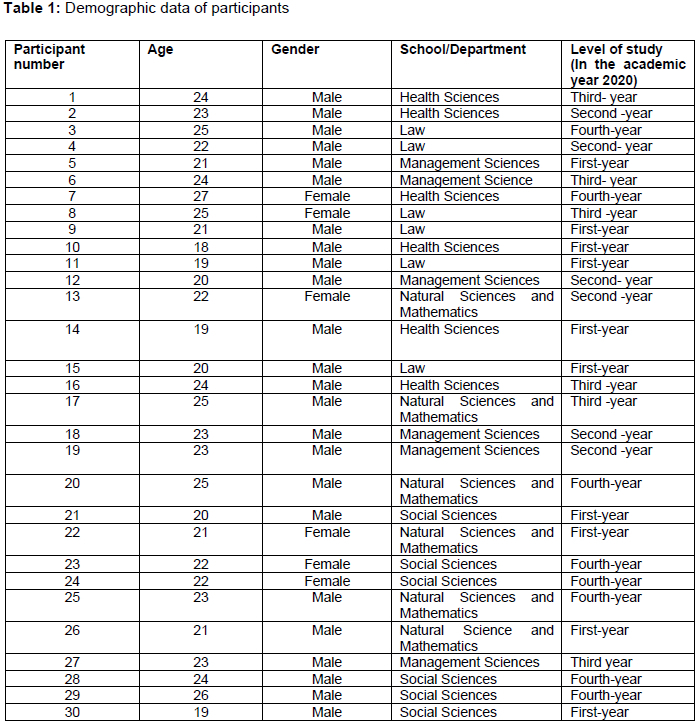
Thirty (30) participants were selected and interviewed for the study. Interestingly, twenty-two (22) out of the thirty (30) lived in the communities around Thohoyandou in the Limpopo Province of South Africa, where the university is located. While Four (4) identified themselves as being from Polokwane, the remaining four (4) come from Johannesburg. Below is a detailed biographical information of the participants:
Notably, all participants in the study were undergraduate students at the time of the study. The students were all registered from the faculties of management science, Health Science, Law, Social sciences, natural science, and mathematics. The selection was selected based on the following criteria:
• Enrolled as an undergraduate student at UNIVEN during the COVID-19 pandemic (academic year(s)2020-2021),
• The ability to communicate in English or Tshivenda (the local vernacular),
• And experienced BL during the COVID-19 pandemic (2020-2021).
The decision to employ purposive sampling in this study, focusing on the experiences of 30 students at a rural university during the COVID-19 pandemic, was driven by a desire to deeply understand the nuanced impacts of peer support interventions on undergraduate students' academic performance. Purposive sampling allowed us to target students who were not only navigating the challenges of their academic pursuits during this unprecedented time but were also engaged in or beneficiaries of peer support interventions. This approach was instrumental in ensuring that the data collected were highly relevant to our research questions, particularly in examining the applicability and effectiveness of Transactional Distance Theory in a real-world crisis situation.
However, this sampling strategy does come with considerations regarding the study's representativeness and generalizability. By focusing on a relatively small group of 30 students, selected for their specific experiences and context, the findings may not be directly translatable to all undergraduate students in rural institutions or those facing a pandemic. The chosen sample reflects a deep dive into a particular aspect of the student experience during COVID-19, rather than a broad overview of the student body's experiences. The impact of this purposive sampling technique on the study's representativeness is twofold. On one hand, it provides in-depth insights into the lived experiences of a selected group of students, uncovering the nuanced ways in which peer support can influence academic outcomes during crises. On the other hand, the specificity of the sample means that caution must be exercised in extrapolating the findings to a wider population. This limitation underscores the importance of considering the context and specific characteristics of the sample when interpreting the study's conclusions and their applicability to different groups or settings.
Data analyses
The six-step thematic data processing approach created by Braun and Clarke (2022) was primarily utilised in this study. The researchers started by familiarising themselves with the data collected about peer support intervention experienced during COVID-19 in step 1. The second step was the generation of draft codes; different themes were searched in step 3, and researchers developed five themes. Step 4 was the review of the five themes that emerged. In step 5, researchers defined the themes leading to the report's writing in step 6. The first researchers meticulously converted the audio recordings of the observations and interviews into writing form to become acquainted with the data. Once the data was transcribed, the other researchers found the data more accessible to read and reread.
After the first codes were developed, themes were looked up. Here, the research's most notable claims were discovered using colour to construct categories in a simple Microsoft document. The main issues were also determined by three of the researchers, who coded them. The codes developed by the three researchers were regularly compared to guarantee the reliability and objectivity of the data. Sorting these codes based on their relevance to the research subjects gets easier as they synchronise. We also proceeded with the fourth step, which included reviewing the subjects.
This involved categorising all significant responses and recurring themes in the participant statements to address the study's objectives. The replies were further arranged and examined in the fifth phase as the main subjects of the research questions. At last, the data were documented (sixth step) in line with the identified themes.
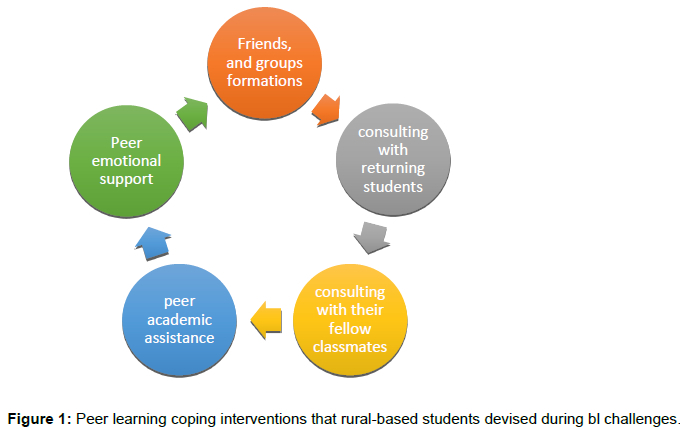
RESEARCH RESULTSFive significant peer forms of support emerged from the analysis of the data. These included Making new friends, consultations with returning students, interactions with classmates, peer academic assistance (including face-to-face tutorials, e-tutorials, and writing consultancy services), and peer emotional support. Below is a diagram demonstrating the major themes:
PEER LEARNING INTERVENTIONS DEVELOPED IN THREE MAIN FORMS: Peer-support in the form of friends and groups formations
Participants reported that they relied on their friends and groups of friends when access to a stable connection was impossible, or they did not have the technological devices required to participate in e-learning. As some students put it,
"Because I lacked a compatible smartphone, I used to attend lessons with my friend using her phone. I would consult with other reliable students if I missed a lesson; like my friends, I knew I could rely on them. Since we had to go in groups, I was using someone else's phone, so I didn't have enough time to learn more about the recently used applications. My friend used to set up the phone before our group chat. The group talks aimed to clarify any academic matters and to solve any concerns we were facing instantly". Participant 22
''I had to attend with my friends who were my classmates then. Group formations helped us become more involved and increased our skills and abilities for teamwork. Group projects boost students' capacity for collaboration and promote their engagement. Most students said that they were able to attend all courses and turn in assignments on time because they took part in group Whatsapp talks". Participant 23
Having friends and friends who took the same classes enabled students to keep participating in the learning experience even when it had migrated online. Furthermore, the findings indicate that gender roles and assignments are distinct and appear unequal in South Africa (Maisela and Ross 2018), which has consequences for student teaching and learning (Zabaniotou, 2020). Young girls, particularly female students, are expected to be co-mothers, carers, and domestic assistants in most South African rural houses (Ngum, 2011). Therefore, it is not coincidental that all the female students (participants 6, 7, and 22) who complained about household chores at home. These roles are imposed in traditional houses; in this instance, it was only natural for female students to get entirely irritated by them (Zabaniotou, 2020). Few prior research studies have investigated this element in students' e-learning experiences.
Consultation with returning students
Examining the participant narratives reveals that returning students were crucial in helping new students with trouble using e-learning platforms like Moodle by providing guidance and support tutorials. Because BL required a level of computer literacy that new students did not yet possess, returning students valuable. Notably, most female participants in the sample said that even though they were aware that senior students could assist them in figuring out how to use Moodle and MS Suite, it was sometimes difficult to consult with returning students because of their limited social circle and clashes in availability.
Female participants mentioned juggling family duties and academic obligations was a significant challenge. Some of the replies that were offered are included below:
"As I ran into trouble with the learning tools that were available at the time, such as Moodle and Microsoft Teams, I devised a plan to approach the returning students who were familiar with those platforms. Things started to unfold when I went to a returning student who showed me how to connect to Moodle. Some students were using such apps without any problems. As time passed, I found that the applications required little effort and attention.
Using Microsoft Teams wasn't too hard; my assistant even installed it on my phone to make things easier. It was now more straightforward since we used my phone when he was getting me oriented. Over time, I was the one who began assisting other students who were having technical or software-related problems. What I liked about our What's App class groups was that I had access to all my classmates' phone numbers and those of my lecturers and tutors". Participant 30
"I was having trouble managing my time since I had a lot of household duties to conduct. The technical elements necessary for academic writing were my biggest issue. Since high school essay writing differs from college writing, I was unsure how to write an essay with references. I was alone, and I'm a loner. I couldn't ask any of my small friends for assistance because most were still in high school. I once completed an assignment using my knowledge but failed since I could not properly cite. Afterward, I learned that there are reference guides and apps for a returning student. I had been able to locate my classmates' phone numbers, but I selected a person who was repeating the module". Participant 5
Consultation with classmates
An examination of the participant narratives revealed that some students chose not to engage in group discussions in favour of speaking with a classmate one-on-one or over the phone. Several students said that by utilising What's App groups, they could obtain the contact details of other students. Most students admitted that they had previously missed classes due to network problems, but they would follow up with their enrolled peers to see what they had missed. A few of the following responses contain some of the remarks that came up during the interviews.
"I had to ask my classmates to remark on the lectures I missed because I periodically missed classes due to slow internet connectivity. We used WhatsApp's App audio and messages, which proved more trustworthy and efficient than emails '. Participant 19
"After experiencing network connectivity issues, I devised a strategy to inform my classmates and ask them to utilise What's App to report anything they noticed I was overlooking. Thankfully, we had What's App groups where we could discuss various issues. These group discussions enabled us to comprehend several topics on which we were discovering difficulties." Participant 13
These findings support those of Gabster et al. (2020), who argued that BL seemed the best option given the COVID-19 pandemic since it decreased contacts and the transmission rate, although at the price of specific students (female). Or (those residing in a remote location), which raises concerns. Coetzee (2014) describes how students found it difficult to consult with other students in a comparative study of elite and rural institutions. Most students in remote locations said that load shedding, inconsistent internet connections, and unsuitable gadgets made it impossible to achieve the digital environment. As a result, some students created or received peer support interventions in the 2020-2021 academic year (s).
PEER SUPPORT INTERVENTIONS THAT RURAL-BASED INSTITUTIONS DEVISED FOR RURAL-BASED UNDERGRADUATE STUDENTS DURING BL CHALLENGES.
In the addition to the above-described interventions, rural-based undergraduate students also specifically developed the following interventions:
Peer academic assistance
Students reported receiving peer-to-peer learning academic assistance designed to support rural-based undergraduate students through challenging circumstances.
When they encountered challenges during BL, several students noted that their local institution offered online academic student assistance to effectively support their participation in learning. Many students commented that they were aware of the rise in online tutors who offered significant academic support. E-tutors gave exam modifications, advice, sessions, and suggestions to students. Most students said that the tutors provided them with contact lectures on Saturdays.
Many students reported that when they had problems during BL, their distant institution established academic online student support services to enable them to engage in learning effectively. Some students commented that they had seen a rise in online teachers providing a wealth of academic support.
Students received lessons, revisions, exam instructions, and recommendations from these online teachers. A few students said that the tutors provided them with virtual lectures in addition to helping them with administrative duties like preparing papers and citing sources. Below are a few of the responses that were given:
"BL has, in my opinion, made tutoring services more accessible to students. various modules were allocated to various teachers, who made learning easier. We learned how to read and comprehend the assignment, how to come up with ideas for answers to the questions on the assignment, how to choose credible sources and read them, how to pick the best ideas, how to use the reading tracker to summarise readings, and how to create a thesis statement, developing paragraphs, giving evidence for argument, in-text referencing, linking paragraphs, how to read and understand assignment inquiry, main ideas of each paragraph and how it relates to the thesis statement, how to write a compelling introduction, body, and conclusions, editing, proofreading, and modifying your document. I successfully passed Introductions to Sociology and Industrial Sociology 1541 in both semesters 1 and 2 of the 2021 academic year thanks to the assistance of these sessions". (Participant 30)
"I worked as a tutor that academic year and our compensation increased. We were awarded R1300 a month instead of R1000. I could save enough money to buy a good tablet even though I was not qualified for an NSFAS-free tablet. I had little money, yet I could still attend and turn in all my schoolwork before the due date because I could afford to buy more data after my airtime ran out. I finished all my final year assignments and applied for my honour's sociology degree in 2021. I'm enrolled in the first year of the sociology master's course at the University of Johannesburg in 2022. As an online tutor, I developed more expertise and still help students now". (Participant 23)
Emotional support
Many students reported feeling stressed out because of the challenges that BL presented. A few undergraduate students claimed that the section for intellectual development gave them career guidance and psychological support. Other students expressed their gratitude to the professors for their emotional support and said that some of the skills they had learned would help them in their lifetime and impact their personal development. Some of the responses that were given are included below.
"The only person I could confide in is my mother, who passed away from COVID-19. Therefore, I used to be miserable and couldn't take the lockdown scenario. My dad and I haven't gotten along since I was a little child. He seemed to prioritise his job over his family, in my opinion. Academically, 2020 was the worst year of my life. As a fourth-year student, I found adjusting to the new adjustments challenging.
I had only lost one person who could relate to and encourage me emotionally. I wouldn't have been able to get over those difficult times in my life and go on if my instructor hadn't helped. Her text on WhatsApp inviting me to see her so she could set up an appointment to come to her office and talk about my academic achievements caught me off guard. Ever since I started the programme, she has been lecturing me.
I was unaware that a few of our instructors knew us by name. I was very taken aback by her What's App text invitation to meet with her so we could schedule a time for me to visit her office and discuss my academic success.
Regretfully, during the session, I broke down and started crying. She also said how weary she was. She said she had seen a drop in my performance and suggested that I get mental help after I told her about my late mother. She told me that there were programmes available to assist me in moving on, but what I valued most was that the assistance would come from a private, one-on-one environment.
During my first week visit to the career development and student counselling centre, I was assigned a licenced psychologist to help me. She offered me a variety of therapy sessions covering issues, including trauma, family issues, grief and loss, and individual counselling. The psychologist who received my professor's recommendation sent me to the professional development department. The following week, I went there and got advice on academics and professions.
I decided to pursue graduate studies at the professional development unit and submitted applications for master's courses in 2021. They assisted me in determining my interests and talents even though I wasn't sure which path to choose. During the third week, I received assistance from peer educators who provided me with a psycho-education programme including substance abuse, emotional intelligence, and stress management.
After four weeks of rigorous classes held four days a week, I got up and continued to study despite my situation. That year, I completed all the modules, and I'm grateful that I also gained lifelong skills like problem-solving, stress management, and critical thinking. My abilities have been beneficial since I now get along with my dad, something I didn't have before the therapy sessions". (Participant 7)
Most female students reported that after returning to their parent's house, they became irritated and discouraged from participating in online academic activities because it meant handling a variety of household chores, putting up with unruly siblings and parents, dealing with unfavorable study environments, and frequently losing all independence. Not just students from historically all-white universities complained about the off-campus environment; students from rural campuses also had similar complaints.
The students experienced a significant lot of pain and sorrow when returning to their parent's homes, as relocating back to their parents' houses naturally caused a great deal of anguish and sadness for the students since moving into the apartments of the institutions represented a significant rite of passage and independence from their families.
The results showed that the COVID-19 pandemic significantly increased the University of Venda's undergraduate students' capacity for online learning. Peer support services like the following were the leading cause of this: Peer academic interventions encompassing many alternatives such as in-person tutorials, online tutorials, writing consultancy, a) friendship and group creation, b) consultation with returning students, c) consultation with fellow classmates, and e) peer emotional support-conversely, a dearth of required materials led to students' discontent, frustration, and demotivation. As a result, several students were able to devise and seek peer support interventions to participate in lectures and access online learning resources throughout the COVID-19 outbreak.
DISCUSSION
According to the data gathered for this study, University of Venda undergraduate students used peer support as one of their intervention techniques to get beyond the difficulties presented by ill-prepared online learning tactics brought on by the development of COVID-19. Sadiki et al., (2023) note that as blended learning became more popular, the students faced a variety of difficulties during the COVID-19 epidemic, including practical unpreparedness and a lack of skills necessary for the switch from traditional face-to-face to online learning. Intervention techniques were therefore needed to allow higher education institutions to continue offering instruction.
Second- and third-year returning students served as cornerstones for incoming freshmen (Bharuthram and Kies, 2013). According to the participants, they depended on recurrent students who had completed the courses they were taking the year before. According to students, most returning students make good mentors since they have experience with online learning. Every student who entered for the first time reported that returning students greatly supported them when they had problems during BL. Students said learning from them was simple for them- their peers as opposed to when they received instruction from their instructors. Students also mentioned that they found BL to be engaging because of the assistance of returning students, and after the school year, they passed with high grades.
This is in line with the arguments made by Maisela and Ross (2018), who claimed that students benefit from online learning because it allows for flexibility and interaction in their own self-pacing. He also mentioned that students typically seek advice from previous course participants when they are having problems. Similarly, Greg Flanik, the Chief Information Officer of Baldwin Wallace University in Ohio, is recorded to have demonstrated how returning students at Wallace University in Ohio have higher knowledge of online learning platforms than students who were enrolling for the first time, and they also helped their peers who were having problems with online learning (Adedoyin, Babatunde and Soykan, 2023). In a a research conducted by Adedoyin, Babatund and Soykan (2023), autonomy is a crucial component that students must possess as it is expected of them to be able to operate independently. Additional help is necessary for students who only rely on their instructor for academic aid. In this instance, students from remote areas chose to seek help from returning students. Most incoming first-year students said that since rural students had access to Blackboard, they could better understand what online learning entailed.
Autonomous learning prevails when students must develop coping mechanisms, such as consulting with returning students to help them overcome their computer ineptitude issues and lack of experience with popular online learning apps like Microsoft Teams and Moodle (Hill, Woodward and Arthur, 2020). Participants stated that they typically went in groups to ensure they didn't miss any crucial material about their learning. Most students said that participating in group projects made it simple for them to do so. A few participants argued that group projects improve students' collaboration abilities and stimulate student engagement.
Many students said that by participating in group WhatsApp discussions, they could attend all classes and turn in assignments on time. Every participant said that allocating group work also lessened their own and their families workload and lectures, giving lecturers more time to answer questions from the students and promoting student-teacher interaction. Montacute (2020) asserts that there is a strong likelihood of future crises necessitating the use of remote learning. It is now necessary to prepare for virtual instruction, where learners can engage in individual and group projects.
The first comment from Participant 30 is consistent with the findings of Broadbent (2017), who found that students benefit from blended learning since it allows for flexible interaction throughout their own self-paced learning. According to Mtebe (2015), when students have trouble with BL, they typically seek advice from individuals who completed the course in the prior year(s).
Moakofhi et al. (2017) evidenced that rural-based undergraduate returning students had more understanding about online learning platforms than first-time entering students, and they also assisted their fellow classmates when they encountered problems during online learning challenges. However, participant 30's responses show that female students were less engaged than males. This confirms the results of Minello (2020), who found that gender roles in African families are not evenly distributed.
Regardless of age or academic standing, female students do not receive the same amount of time as their male counterparts for studying, resting, or engaging in other activities. Furthermore, Coetzee (2014) states that pupils still fall behind in the digital revolution due to a lack of ICT infrastructure and skills for students in rural African regions. This is a societal issue that cannot be overstated. Zwane and Mudau (2023) concluded that because of the distance between the student and the institution, BL had drawbacks and stress-related consequences that require not only peer support interventions but also faculty and governmental intervention is a dire need in this regard.
CONCLUSION
Peer support was identified as an intervention technique for teaching and learning models during the COVID-19 epidemic at the University of Venda in South Africa based on the experiences of thirty undergraduate students. This research looks to understand better how to increase relational engagement in technologically enhanced learning and teaching contexts, considering the peer support interventions that university students believe are most important to their learning and development. According to the findings, students discovered that switching from in-person instruction to online learning presented several difficulties that must be resolved immediately. These interventions included creating study groups, friendships, and consultations with classmates and returning students. Peer academic support, emotional support, and consultation with returning students were also beneficial.
LIMITATIONSA notable limitation of this research is its inability to conduct an exhaustive, comparative examination of the peer support interventions that students utilise on e-learning platforms to overcome challenges in various rural educational institutions and between both genders. Although such a thorough and detailed comparison would offer further insights into students' knowledge in multiple contexts, it is outside the purview and objectives of the current study. Second, the results cannot be extrapolated to a broader group because only 30 people were included in the research, and only a qualitative technique was employed. However, the researcher's results are only theoretically generalizable.
RECOMMENDATIONSConsidering the findings of this study, comparisons should be made in later research endeavours. Future research might examine how students have used peer support interventions for electronic learning platforms at different institutions by examining gender perspectives. Such studies might provide more background information and a gender-based viewpoint on students' local, national, and worldwide experiences. Numerous socioeconomic classes, several socioeconomic class distinctions, and how they manifest themselves in more significant variances in the needs for safety and subsistence.
When developing policies and procedures to address socioeconomic realities that affect students' academic lives, universities should keep these observations in mind. Second, a quantitative research technique should be used in future studies on undergraduate students' experiences with E-LP peer support interventions in general and at institutions in rural areas.
More statistically based research is needed as this issue is examined more to validate the narratives arising from qualitative investigation. The two will be a formidable tool for encouraging political participation and advocating for policies to build a more equitable educational framework. Sex and gender have a significant role in how social interactions take shape. Severe disparities in duties and expectations within the family and household are a few instances of this.
Pedagogical interventions should consider how students help themselves rather than constantly focus on top-down intervention plans that do not consider or take students' abilities, creativity, and resilience seriously.
Universities can integrate peer-led strategies into existing support services in several effective ways to ensure sustainable and institutionalized support for students. These strategies can enhance students' overall well-being, especially during challenging times such as pandemics or other crises.
By adopting the following strategies, universities can create a more supportive, resilient, and inclusive environment that recognizes the value of peer experiences and leverages them to enhance student support services:
•
Training and DevelopmentDevelop comprehensive training programs for peer supporters that cover essential skills such as active listening, empathy, confidentiality, and crisis management. This training should also include understanding when to refer peers to professional help. Incorporating modules to understand diverse student experiences can enhance the effectiveness of peer support.
•
Integration with Academic ProgramsPeer support can be embedded within academic programs through mentorship initiatives, study groups, and peer tutoring. This integration can help normalize seeking and offering help, making it a fundamental part of the learning environment. Academic credit for peer supporters can further incentivize participation.
• Digital Platforms for Peer Support
Utilize digital platforms to facilitate peer support, which is especially important in remote learning or for students who may feel isolated. These platforms can offer forums, chat rooms, or even apps dedicated to connecting students with peer supporters.
REFERENCES
LITERATURE REVIEW
- Abdullah, J., W. N. Mohd-Isa, and M. A. Samsudin. 2019. "Virtual reality to improve group work skill and self-directed learning in problem-based learning narratives". Virtual Reality, 23, pp.461-471.
- Adedoyin, Olasile Babatunde, and Emrah Soykan. "Covid-19 pandemic and online learning: the challenges and opportunities." Interactive learning environments 31, no. 2 (2023): 863-875.
- Amaechi, K.E., T. D. Thobejane, and R. Rasalokwane. 2021. "Feminist reflections on the impact of the South African national COVID-19 lockdown on the upsurge of gender-based violence in Mahwelereng Township of Limpopo Province, South Africa." Gender and behaviour, 19(1), pp.17186-17203.
- Araujo, Nelly. 2018."Reviewing the evidence of effective peer education among young people." Perspectives in Public Health 138, no. 6 (2018): 299-300.
- Asghar, A., 2010. "Reciprocal peer coaching and its use as a formative assessment strategy for first-year students". Assessment & Evaluation in Higher Education, 35(4), pp.403-417.
- Aucejo, E.M., J. French, M. P. U.Araya, and B. Zafar, B., 2020. "The impact of COVID-19 on student experiences and expectations: Evidence from a survey." Journal of public economics, 191, p.104271.
- Babbie, E.R., 2020. The practice of social research. Cengage AU.
- Bharuthram, S. C. and Kies. 2013. "Introducing e-learning in a South African Higher Education Institution: Challenges arising from an intervention and possible responses." British Journal of Educational Technology, 44(3), pp.410-420.
- Boud, D. and R. Cohen. 2014. Peer learning in higher education: Learning from and with each other. Routledge.
- Bowden, J.L.H., 2022. "Analogues of engagement: Assessing tertiary student engagement in contemporary face-to-face and blended learning contexts." Higher Education Research & Development, 41(4), pp.997-1012.
- Braun, V., & Clarke, V. (2022). Conceptual and design thinking for thematic analysis. Qualitative Psychology, 9(1), 3-26.
- Broadbent, Jaclyn. "Comparing online and blended learner's self-regulated learning strategies and academic performance." The Internet and Higher Education 33 (2017): 24-32.
- Cocquyt, C., C. Zhu, A. N. Diep, M. De Greef, and T. Vanwing, 2019. "Examining the role of learning support in blended learning for adults' social inclusion and social capital". Computers & Education, 142, p.103610.
- Coetzee, M., 2014. "School quality and the performance of disadvantaged learners in South Africa." Stellenbosch University Economics Department Working Paper, 22, p.14.
- Creswell, J.W. 2009. "Mapping the field of mixed methods research." Journal of mixed methods research, 3(2), pp.95-108.
- Dampson, D.G., R. Addai-Mununkum, S. K. Apau, and J. Bentil. 2020. "COVID-19 and online learning: A SWOT analysis of users' perspectives on the learning management system of University of Education, Winneba, Ghana." International Journal of Learning, Teaching and Educational Research, 19(9), pp.382-401.
- Du Preez, R., L. P. Steenkamp, and R. S. Baard. 2013. "An investigation into a peer module mentoring programme in economic and management sciences." International Business & Economics Research Journal (IBER), 12(10), pp.1225-1238.
- Egege, S. and S. Kutieleh. 2015. "Peer mentors as a transition strategy at University: Why mentoring needs to have boundaries." Australian Journal of Education, 59(3), pp.265-277.
- Gunn, F., S. H. Lee, and M. Steed. 2017. "Student perceptions of benefits and challenges of peer mentoring programs: Divergent perspectives from mentors and mentees." Marketing Education Review, 27(1), pp.15-26.
- Gabster, B.P., K. van Daalen, R. Dhatt, and M. Barry. 2020. "Challenges for the female academic during the COVID-19 pandemic." The Lancet, 395(10242), pp.1968-1970.
- Gaston, P. 2013. The challenge of institutional readiness in higher education. Brookings Institution Press.
- Gibbs, T., 2020. "The Covid-19 pandemic: provoking thought and encouraging change." Medical Teacher, 42(7), pp.738-740.
- Giossos, Y., M. Koutsouba, A. Lionarakis, and K. Skavantzos. 2009. "Reconsidering Moore's Transactional Distance Theory". European Journal of Open, Distance and E-Learning.
- Gosser Jr, D.K., J.A. Kampmeier, and P. Varma-Nelson. 2010. "Peer-led team learning: 2008 James Flack Norris award address". Journal of Chemical Education, 87(4), pp.374-380.
- Heaney, C. A., and B. A. Israel. 2008. "Social networks and social support". In K. Glanz, B. K. Rimer, and K. Viswanath (Eds.), Health behavior and health education: Theory, research, and practice (4th ed., pp. 189-210). Jossey-Bass.
- Hill, R., M. Woodward, and A. Arthur. 2020. "Collaborative Learning in Practice (CLIP): Evaluation of a new approach to clinical learning." Nurse Education Today, 85, p.104295.
- Huang, R., D. Liu, A. Tlili, S. Knyazeva, T. W. Chang, X. Zhang, D. Burgos, M. Jemni, M. Zhang, R. Zhuang, and C. Holotescu. 2020. Guidance on open educational practices during school closures: Utilising OER under COVID-19 pandemic in line with UNESCO OER recommendation. Beijing: Smart Learning Institute of Beijing Normal University.
- Keegan, D. ed., 2005. Theoretical principles of distance education. Routledge.
- Limone, P., 2012. "Peer Learning and Peer assessment to enhance Participation in online courses: a case study in Teacher's training in Foggia, Italy." International Journal of Digital Literacy and Digital Competence (IJDLDC), 3(3), pp.27-47.
- Makala, Q., 2017. "Peer-assisted learning programme: Supporting students in high-risk subjects at the Mechanical Engineering Department at Walter Sisulu University." Journal of Student Affairs in Africa, 5(2), pp.17-31.
- Makgahlela, M., T. M. Mothiba, J. P. Mokwena, and P. Mphekgwana. 2021. "Measures to enhance student learning and well-being during the COVID-19 pandemic: Perspectives of students from a historically disadvantaged university." Education Sciences, 11(5), p.212.
- Maisela, T. and E. Ross. 2018. "The experiences of motherhood among black undergraduate students at a South African University: Reconciling competing roles." South African Review of Sociology, 49(2), pp.41-60.
- Marinoni, G. and van't Land, H., 2020. The impact of COVID-19 on global higher education. International higher education, (102), pp.7-9.
- Minello, A., 2020. "The pandemic and the female academic". Nature, 17(1).
- Moakofhi, Moakofhi, Oratile Leteane, Tawona Phiri, Thato Pholele, and Perncy Sebalatlheng. "Challenges of introducing e-learning at Botswana University of Agriculture and Natural Resources: Lecturers' perspective." International Journal of Education and Development using ICT 13, no. 2 (2017).
- Montacute, R., 2020. "Social mobility and COVID-19". The Sutton Trust.: 20 July 2021.
- Moore, M. G. 1973. "Toward a theory of independent learning and teaching." Journal of Higher Education, 44(9), 661-679.
- Moore, M. G., and G. Kearsley. 1996. Distance education: A systems view. Wadsworth Publishing Company.
- Mtebe, J., 2015. "Learning management system success: Increasing learning management system usage in higher education in sub-Saharan Africa." International Journal of Education and Development using ICT, 11(2).
- Mtshweni, B.V., 2022. "Covid-19: exposing unmatched historical disparities in the South African institutions of higher learning." South African Journal of Higher Education, 36(1), pp.234-250.
- Naidoo, P. and D. Cartwright. 2022. "Where to from here? Contemplating the impact of COVID-19 on South African students and student counselling services in higher education". Journal of College Student Psychotherapy, 36(4), pp.355-369.
- Ndebele, Nduduzo C., Mfundo Mandla Masuku, and Victor H. Mlambo. 2023 "Funding Open Educational Resources in Higher Education: A South African Public Policy Perspective." Social Sciences 12, no. 1: 49.
- Ngum, F., 2011. "An exploratory study of parenting experiences among female students at the University of the Western Cape, South Africa". Masters Thesis, University of the Western Cape
- Ntakana, K. N. 2011. The effectiveness of student support programmes at a tertiary institution: A case study of Walter Sisulu University (Doctoral dissertation).
- Owusu-Fordjour, C., C. K. Koomson, and D. Hanson. 2020. "The impact of Covid-19 on learning-the perspective of the Ghanaian student." European journal of education studies, 7 (3) pp. 88-101
- Paulette N., & Cartwright, D. (2022). "Where to from here? Contemplating the impact of Covid-19 on South African students and student counselling services in higher education". Journal of College Student Psychotherapy, 36(4), 355-369.
- Roberts, T.S., 2006. "Self, Peer, and Group Assessment in E-Learning: An Introduction...". Self, peer and group assessment in E-learning (pp. 1-16). IGI Global.
- Sadiki, A., R. Tshifhumulo, V. Mpatlanyane, and K. E. Amaechi. 2023. "Undergraduate Students' Experiences with Electronic Learning Platforms During the Covid-19 Pandemic at a Rural-Based Tertiary Institution in South Africa". International Journal of Learning, Teaching and Educational Research, 22(8), pp.83-103.
- Tenório, T., I. I. Bittencourt, S. Isotani, and A. P. Silva. 2016. "Does peer assessment in on-line learning environments work? A systematic review of the literature." Computers in Human Behavior, 64, pp.94-107.
- Tiroyabone, G.W. and F. Strydom. 2021. "The development of academic advising to enable student success in South Africa." Journal of Student Affairs in Africa, 9(2), pp.1-16.
- Thomson, C. and V. M. Esses. 2016. "Helping the transition: Mentorship to support international students in Canada." Journal of International Students, 6(4), pp.873-886.
- Van Schalkwyk, F., 2021. "Reflections on the public university sector and the covid-19 pandemic in South Africa." Studies in Higher Education, 46(1), pp.44-58.
- Walters, C., L. Ronnie, J. Jansen, and S. Kriger. 2021. "September. 'Academic guilt': The impact of the pandemic-enforced lockdown on women's academic work." In Women's Studies International Forum (Vol. 88, p. 102522). Pergamon.
- Wilson, M.J., M. M. Diao, and L. Huang. 2015. "I'm not here to learn how to mark someone else's stuff : an investigation of an online peer-to-peer review workshop tool." Assessment and Evaluation in Higher Education, 40(1), pp.15-32.
- Zabaniotou, A., 2020. "Towards Gender Equality in Higher Education Institutions: Equal Female Academics in the Mediterranean during and after the COVID-19 pandemic." Global University Network for Innovation (GUNI).
- Zongozzi, J.N., 2021. "A concept analysis of theory in South African open distance and e-learning research." Open Learning: The Journal of Open, Distance and e-Learning, 36(2), pp.149-163.
- Zwane, S.A. and P. K. Mudau. 2023. "Student Teachers' Experiences of Open Distance e-Learning Support in a Posthuman Era: A Learner Engagement Perspective." Journal of Curriculum Studies Research, 5(1), pp.13-33.
- Zhou, X., C. L. Snoswell, L.E. Harding, M. Bambling, S. Edirippulige, X. Bai and A. C. Smith. (2020). "The role of telehealth in reducing the mental health burden from COVID-19." Telemedicine and e-Health 26, 4 (2020): 377-379.