Research projects as a learning tool in accounting education: a supervisor perspective
Abstract
The work environment that Stellenbosch University (SU) accounting graduates enter is changing with the advent of technology. The Fourth Industrial Revolution requires new skills from accounting professionals. Professional bodies have responded by updating their competency frameworks, while higher education institutions (HEIs) are expected to respond by changing their teaching and learning approaches. The core focus of competency development is business, digital, relational, and decision-making acumen (South African Institute of Chartered Accountants SAICA 2021b), and focuses on both professional and technical skills. Even though several of these professional skills align with the graduate attributes aspired to be developed by HEIs (such as SU), this is still a significant departure from traditional thoughts about accounting pedagogy, where much of the focus is on passing external assessments set by professional bodies. This is not the only change that accounting academics must make. The accounting profession is not known for research, nor postgraduate studies. As a result, until recently, many accounting academics have not had the opportunity to conduct or supervise research. The entire SU BAcc(Hons) programme class of 2020 completed a large integrated research project by researching a self-defined research problem and documenting the results. These students have never been required to complete any large group research project before, and consequently were able to develop new skills. The students were for the first time required to, inter alia, decide on a research problem, develop and justify a methodology, execute the research, and communicate the findings. It was also the first time that many of the lecturers acted as supervisors. This presented a unique opportunity to obtain an understanding of the lecturers' perceptions of whether the inclusion of the large-scale group research component (as a learning tool) assisted students in attaining the competencies required by the research development framework (Vitae®© 2010) together with the updated SAICA competency framework (SAICA 2021b). The results were used to understand the effectiveness of the group research project in developing competencies not currently addressed by traditional learning tools used to educate aspiring professional accountants. The results indicate that a research project develops skills (such as communication, problem-solving, critical thinking, and collaboration skills) not normally developed at such a large scale, nor over a sustained period of time. The results highlight the importance of correct positioning of the project to develop professional competencies as opposed to technical competencies. This positioning is important for students and staff, since it appears that there are some lecturers who still believe that the focus should remain on passing the professional standard setting assessments (i.e., short-term view), rather than developing competencies (such as argumentative communication skills) that could aid the students' career in the long term.
accounting education; professional skills; research project
INTRODUCTION
A rapidly changing world of work is impacting the educational models used to train aspirant chartered accountants both globally and locally in South Africa. In the South African context, this process has been led by the South African Institute of Chartered Accountants (SAICA 2021b) and the Certified Institute of Management Accountants (CIMA 2014), among others. Changes to competency frameworks and training models have forced members of academia at higher education institutions (HEIs) to reconsider the pedagogical stance on how accounting-related subjects are taught. The revised competency frameworks continue to emphasise the required technical skills; however, they were significantly amended in relation to the professional skills (also referred to as "pervasive" or "soft" skills) (Barac 2009; Crawford, Helliar, and Monk 2011; Low et al. 2016; García and De los Ríos 2021; SAICA 2021b). This shift has brought professional skills, such as an understanding of ethics, lifelong learning, analytical and critical thinking skills, as well as communication and networking abilities to work effectively in a collaborative manner, to the forefront of pedagogical approaches in South Africa (Barac 2009; Crawford et al. 2011; García and De los Ríos 2021; SAICA 2021b). Academics are on a continuous search for new tools to assist in this evolution.
The South African education and training model for aspirant chartered accountants is traditionally structured to ensure that newly qualified chartered accountants attain the required competencies as contained in SAICA's (2021b) Competency Framework. Given the nature of the profession, the qualification process involves three core elements: under- and postgraduate study specialising in accounting sciences, a three-year practical traineeship, and the successful completion of two professional examinations. Universities have been commended by training offices (responsible for the practical traineeship, known as "articles") for delivering graduates with good technical skills through this process, but also challenged them to increase opportunities for students, as well as to develop professional skills while at university (Barac 2009; García and De los Ríos 2021). This is because they believe that universities leave the training related to the professional skills to the practical element of the training. With the implementation of the new SAICA (2021b) Competency Framework and changing demands in the market, this is too late, since trainees are required to possess these professional skills when entering the job market.
Accounting education has also been criticised for not having a foundation in educational theory. Arguments are often presented that the pedagogical approaches used to teach aspirant chartered accountants are outdated, are focused on passing professional examinations, and are confined to the use of limited teaching tools (i.e., passive learning) and limited assessment types and formats (e.g., limited scenario paper-based assessment) (Barac and Du Plessis 2019; Terblanche and Waghid 2021; Sexton and Rudman 2022). Universities have been slow and unwilling to change because of a lack of skills and experience. Accounting departments at universities that deliver professional programmes have historically focused on teaching aspirant professional accountants for the job market. As a result, many accounting academics hold a professional designation (such as Chartered Accountant (South Africa) [CA(SA)]) and a postgraduate degree without a research component (Venter and De Villiers 2013). These departments were also not known for producing research (Venter and De Villiers 2013). Staff with postgraduate qualifications of a master's degree or higher and established research records were the exception and not the norm, as in other disciplines such as economics, and finance (Venter and De Villiers 2013). This lack of a need for a postgraduate degree or research record can still be seen today in advertisements for the recruitment of accounting academics when compared to other disciplines that have higher postgraduate qualification appointment requirements. It is only until recently that academics in accounting departments have started to obtain additional postgraduate qualifications and engaging in research-related activities. This, in contrast, to accounting academics in developed countries such as the United Kingdom, New Zealand and Australia, where there is a culture of research and accounting academics have influence research voice that influences the accounting industry. Accounting academics from Central and West-Africa have historically received a broader exposure to research through post-graduate degrees and have a more developed research culture. Much of this exposure, however as comes from African accounting academics furthering their studies in developed countries and not conducting research in their home country. The quality of the research culture in developing countries is however debatable (Lassou, Hopper and Ntim 2021).
It is within this context that South African universities are considering changes to curricula and pedagogical approaches to scaffold technical learning with room to develop professional skill competencies. The literature has highlighted several teaching tools that can be used to teach professional skill competencies, such as case studies (Fortin and Legault 2010), group work (Ballantine and McCourt Larres 2009; Rudman and Kruger 2014), real-life application (Sexton 2019), inquiry-based learning activities (Zafra, Román and Gómez 2015), and blended learning (Sexton and Rudman 2022). One tool that is under-utilised in the training of aspirant chartered accountants in South Africa is research projects (Barac and Du Plessis 2019). Postgraduate study to become a chartered accountant at most universities in South Africa is in the form of a diploma, which does not include a compulsory research component. The academically strongest students (in a cohort of 10 to 20) are generally invited to complete an honours degree, which includes a compulsory research component. Academically stronger students tend to have better problem-solving skills, put more hours into their studies, are able to articulate themselves better, etc., and do not reflect the general student population.
A unique opportunity presented itself in 2020 when all the postgraduate students at a South African university were registered for the honours degree and were required to complete a large research project. This was the first time that most (90 per cent) of the students completed a large-scale research project. This meant that students (with diverse levels of academic strength and performance) were for the first time required to, inter alia, decide on a research problem, develop and justify a methodology, execute the research, and communicate the findings. Because of this lack of an established research culture (as outlined above), the lecturers did not supervise often. Since the minimum requirements to supervise was that the lecturer had to hold a master's degree, it was their first time supervising a research project for just over half of the lecturers surveyed. Therefore, almost half of the respondents (who are also lecturers in technical modules) to the survey had never taught in an unstructured manner.
As far as the researchers could establish, this was the first time at any of the SAICA-accredited universities where all students were required to take part in large-scale research. The researchers used this opportunity to investigate the supervisors' perceptions and attitudes in relation to whether the inclusion of the large-scale group research component assisted students in attaining the competencies as required by SAICA's (2021b) Competency Framework and as detailed in the researcher development framework (CRAC 2011). The researchers also investigated the students' perceptions of whether such a large-scale research project developed professional skills, which forms the basis for a forthcoming article titled "Aspirant South African accountants' perceptions of the usefulness of a research project as a learning tool to develop professional competency".
RESEARCH OBJECTIVE AND CONTRIBUTIONSThe objective of this research was to investigate the supervisors' (i.e., lecturers') perceptions and attitudes regarding the value of the competencies believed to be developed by the postgraduate accounting students during the implementation of the first large-scale academic research project. The research specifically investigated the impact that the research project as a learning tool had on the students' professional competency development as chartered accountants of the future. Literature and prior studies gave rise to the research questions for each of the competencies that intersected in the mapping of the Researcher Development Framework (RDF) (Vitae®© 2010) and SAICA's (2021b) Competency Framework. While taking part in the research project, the following research questions were asked:
• In the lecturers' opinion, did the research project create an opportunity for the students to develop professional competency?
• Within the broad competency category, how did the students engage with that competency development opportunity while taking part in the research project?
The literature emphasises the role that the teacher's (i.e., lecturer's) attitude towards a learning intervention plays in the success of the intervention. Given that this was the first large-scale research project undertaken by the School of Accountancy that involved academic staff who had predominantly never supervised before, an additional broad research question was raised: What where the lecturers' attitudes towards and experience of the research project, and would they recommend the use of a research project for future cohorts of students?
The context of this study is unique because the students and supervisors were faced with a new learning intervention that had never been required before. This exposed both the supervisors and students to new competencies. As this learning tool is not traditionally used in the training of aspirant chartered accountants, if found to be effective, it could inform future learning opportunities on a large scale, which can enable competency development against the background of the new SAICA (2021b) Competency Framework. The findings of the research would also be of value to accounting academics that would like to focus on competency development and improve the research culture and output in Africa (Negash, Lemma and Samkin 2019).
The following section, the literature review, investigates the use of a large-scale research project in professional competency development and frames what those competencies are. These competencies, as set out in the Vitea RDF (Vitae®© 2010) and SAICA's (2021b) Competency Framework, are discussed thereafter. Finally, the supervisors' perceptions of the use of the research project in developing the identified competencies are analysed and discussed before the study is concluded.
Research project
Research and creative enquiry during tertiary education are widely accepted as a pedagogical approach to teaching and learning (Beckman and Hensel 2009; Parker 2018). However, because there are so many elements (such as objective, scope, academic level, originality, contribution, and discipline) that impact research project learning opportunities, there is no consensus on a universal definition thereof (Beckman and Hensel 2009; Parker 2018). To commence the search for competencies that are developed using a research project, a starting point was needed and the Council on Undergraduate Research's (CUR 2017) definition of "a mentored investigation or creative inquiry conducted by undergraduates that seeks to make a scholarly or artistic contribution to knowledge" was employed. As this research project fits the elements of the CUR's (2017) definition, it grounds the pedagogical basis for its consideration as a learning tool to teach professional skills. Since the research project undertaken in the context of this study by the 2020 postgraduate students was in the accounting specialisation (Financial Accounting, Management Accounting, Taxation, and Auditing) fields, research areas were provided by the supervisors. The students needed to use these parameters to engage in the research process under supervision.
Research projects in developing the competencies of aspirant chartered accountants
The literature survey indicated that the literature has focused on what skills or competencies can be developed through research assignments (also referred to as projects). Parker (2012) found that research projects are used globally in both under- and postgraduate study to develop competencies in many of the social sciences such as economics, business, sciences, and psychology. Considering its broad use as a teaching and learning tool, research has been conducted on the skills that can be learned by creating research opportunities at university. Some of these skills include independent thinking, problem-solving skills, inquiry and analysis, critical thinking, reading, communication, and teamwork (Petrella and Jung 2008; Lopatto 2008, 2010; Parker 2012; Barac and Du Plessis 2019; Seifan, Lal, and Berenjian 2022). In training aspirant chartered accountants in South Africa, Barac and Du Plessis (2019) recommend that research projects be incorporated as learning opportunities to teach students professional skills, which include critical thinking, problem solving, and building arguments. However, they found that only a few of the accredited universities in South Africa have built research proj ects into their pedagogical approaches, but these tended to be small projects (Barac and Du Plessis 2019). Possible reasons for this exclusion include the traditional emphasis on technical skills (Sexton and Rudman 2022), learning with a focus on assessment, which has traditionally been based on technical skills (Sahd and Rudman 2020), or the limited research exposure, output, experience, and skills of South African chartered accountants (Steenkamp 2009). This historic background may have also impacted lecturer attitudes towards the inclusion of a research project into the pedagogy as they themselves, as South African chartered accountants, may have had limited exposure to research.
Lecturer attitudes
Lecturer attitudes play an important role in the teaching and learning process (Eggen and Kauchak 2001; Muzenda 2013; Mardiana 2020; Pacheco et al. 2021). Eggen and Kauchak (2001) specifically highlight that positive lecturer attitudes are fundamental to effective teaching. Egg and Kauchak (2001) consider lecturer attitudes to be the consistent tendency by a lecturer to react in a particular way, positively or negatively, to an academic matter (Adediwura and Tayo 2007). A negative attitude would hinder curriculum reform and the introduction of new approaches by a lecturer. Mardiana (2020) found that teacher knowledge about information technology (IT) also has an impact on their attitude when implementing IT into pedagogy. In a similar manner, lecturers' prior exposure to research may impact their attitude to using a research project as a teaching and learning tool, despite the benefits that may accrue or the competencies that students may develop.
Competency development through research at university
The benefits for and impact on undergraduate student achievement, as well as students' learning and engagement when using research projects, have been discussed by, inter alia, Lopatto (2008; 2010), Petrella and Jung (2008), Parker (2018), and Seifan et al. (2022). The technical and professional competencies highlighted in these studies are often based on the educator's judgement. It also often focuses on the natural sciences and, to a limited extent, the social sciences (Parker 2018). In the context of this research, to consider a complete list of competencies that students could develop through a research project, the researchers employed researcher development competency frameworks.
Researcher development competency frameworks
Fazal and Chakravarty (2021) consider "researcher development" to be the formal or informal process that researchers undergo as they develop over time from novice to proficient researchers. Examples of frameworks that have been developed to add structure to this process include Evans' Conceptual Framework of Researcher Development (Fazal and Chakravarty 2021), the RDF (Vitae®© 2010), the Research Skill Development Framework (Fazal and Chakravarty 2021), and the Researcher Development Skills Framework (University of Canberra n.d.). The RDF (Vitae®© 2010), the industry standard for researcher development in the United Kingdom, is internationally recognised as a tool to support researchers' competency development (University of Edinburgh n.d.; Nath, Jones, and Viney 2021). The RDF was selected as the basis for the competencies considered in this study. The competencies listed in the RDF (Vitae®© 2010) reflect a complete set of skills required of a proficient researcher and although not all the skills will be developed at once, it serves as a frame of reference when investigating professional skills that could be learned during the execution of a research project. The RDF (Vitae®© 2010) is divided into four broad domains: (i) knowledge and intellectual abilities, (ii) personal effectiveness, (iii) research governance and organisation, and (iv) engagement influence and impact. These domains are disaggregated into more detailed skills developed (Vitae®© 2010). The RDF has a broad focus and, to be relevant, attention must shift specifically to professional skills required by aspirant chartered accountants.
Professional skills relevant to aspirant chartered accountants
The professional skills included in SAICA's (2021b) Competency Framework are divided into the following areas: ethical values and attributes, engagement in lifelong learning, consideration of corporate citizenship, digital acumen, relational acumen, decision-making acumen, business acumen, and integrated thinking.
Because the research specifically related to the training of aspirant chartered accountants, and the two frameworks were sufficient detailed, the researchers were able to integrate the two frameworks to synthesise a complete list of competencies required by SAICA's (2021b) Competency Framework that could be developed through a research project. Because the RDF (Vitae®© 2010) can be used at all levels of proficiency, it includes skills required by proficient researchers that would not be required by aspirant chartered accountants; not all the competencies in the RDF (Vitae®© 2010) were therefore relevant to this study. There were, however, many areas that overlapped, which can be aggregated to skills that relate to communication skills, project management, independence, collaboration and teamwork, self-development and motivation, ethics and legal considerations, limited IT acumen, and critical thinking skills. The aggregation performed by the researchers largely confirmed the competencies that can be developed through a research project by Petrella and Jung (2008), Lopatto (2008; 2010), Parker (2012), Barac and Du Plessis (2019), and Seifan et al. (2022). The aggregation performed by the researchers provided further detail into the broad areas identified in prior literature.
RESEARCH METHODOLOGYResearch design and data collection and analysis
To achieve the research objectives, the researchers conducted empirical research that investigated lecturers' perceptions of two broad areas, namely their engagement in research activities, and the competencies they believed students had developed. The data collection and analysis is discussed in the following sub-sections.
Data collection
A questionnaire was used as the primary data-collection tool. This method of data collection of academic practice about perceptions and experience in tertiary education is similar to those employed by Papanastasiou (2005), Lopatto (2010), Rudman and Terblanche (2011), Hiralaal (2012), Hardway and Stroud (2014), and Sexton (2019) using this technique. A questionnaire was designed using the literature review as the background and the professional competencies required from students who completed the research project as contained in the RDF (Vitae®© 2010) and SAICA's (2021b) Competency Framework. The RDF and SAICA Competency Framework were selected as the theoretical base to design the questionnaire because of arguments presented earlier in the literature review. The questionnaires were structured as follows: data on the lecturers' research activities, prior supervision exposure, and attitudes towards the research project and supervision. Thereafter, data were collected about the lecturers' perceptions of the ability of a research project as a learning tool to develop competencies in students as contained in the RDF (Vitae®© 2010) and SAICA's (2021b) Competency Framework. These two frameworks were synthesised into a single questionnaire, which eliminated areas of duplication and comprised questions focusing on each of the following competencies:
• Self-development and motivation;
• Ethics and legal considerations;
• Independence and project management;
• Teamwork and collaboration;
• Communication skills;
• Critical thinking;
• Problem solving;
• Professional judgement;
• IT acumen; and
• Use of resources.
The questionnaire included numerous closed-ended Likert-scale questions, with 1 representing "not at all" and 5 "definitely", as well as "yes" or "no" response mechanisms. Further qualitative data were collected from open-ended comment questions, which were included throughout the questionnaire where individualised feedback was considered more appropriate. The researchers viewed qualitative feedback as an important mechanism to obtain a deeper understanding of the lecturers' perceptions.
The questionnaire was reviewed by experienced and knowledgeable lecturing staff with supervision experience (two of whom had attended a supervision training course) and was subject to institutional ethical clearance and institutional permission both at a departmental and institutional levels. The questionnaire was distributed to all lecturers who supervised as part of the BAcc(Hons) research module in 2020 to request their voluntary participation in the study.
Data analysis
The data from the questionnaire were transferred to Microsoft (MS) Excel, where the responses were reviewed and unusual responses were removed. Thereafter, the responses were analysed in Statistica statistics software. Statements with a "yes" or "no" option were tallied and analysed in relation to the group as a whole. Statements where data were captured in the form of a Likert scale were collated, the mean calculated, and the statistical impact assessed using standard deviation (SD). As the data were in the form of Likert-scale responses and thus ordinal, it may not necessarily be normally distributed.
Content analysis was performed on the responses to the open-ended questions. Where recurring themes emerged, they were included in the appropriate research findings. The lecturers' perceptions of the research project, as well as the findings on the various professional competencies, were considered against the reviewed literature. Based on the findings, recommendations were made regarding the use of research projects in future learning opportunities.
FINDINGS
The questionnaire was distributed to 40 eligible supervisors and 30 useful responses were received, resulting in a 75 per cent response rate. Considering the exploratory nature of the research and the wide array of responses across years and level of teaching and supervision experience and the correlation to the staff in the department (sampling frame), the responses are considered a fair representation of the sampling frame and the potential non-response bias is accepted with the 75 per cent response rate. The average number of years spent teaching in higher education was 10.2 (SD = 5.16, median = 9), with a range of three to 23 years' teaching experience. The respondents had experience at first-, second-, and final-year undergraduate as well as postgraduate levels of instruction. Fifty-seven percent of the lecturers taught in the postgraduate accounting course for which the research project was a requirement. A minimum requirement for supervision was a master's degree, with 90 per cent of the respondents meeting this requirement, while the remainder had a PhD. Less than half (47 per cent) of the respondents had prior supervision experience. Very few opportunities exist for lecturers to supervise since the School of Accountancy offers only two master's coursework programmes, as well as the CIMA research project. There is no postgraduate Financial Accounting coursework degree. Although each of the professional subjects has a full dissertation option, very few students register for it, which explains the low supervision rate.
An analysis of the feedback obtained from the lecturers is set out in the sub-sections that follow. The broad themes are around, firstly, their prior exposure to research supervision is discussed; secondly their attitude towards the research project as a learning tool is highlighted; thirdly, their responses relating to the potential development of each professional competency are presented; and finally, obstacles are presented and recommendations for future projects are made.
Specialisation, research activity, and supervision experience
The lecturers were asked to share general information about their history through responses to "yes/no" questions. The supervisors were from the following professional subject areas: Auditing (13 per cent), Taxation (23 per cent), Management Accounting (30 per cent), and Financial Accounting (33 per cent). Having a fair distribution of respondents from each subject area ensured balanced feedback from all the areas of specialisation. In relation to research activity, the respondents had an average of 5.3 (SD = 6.03; median = 4) research publications ranging between one and 27 accredited publications. A mean number of four (SD = 6.48; median = 1) conference proceedings ranging between 0 and 30 were reported. This, together with the fact that 16 of the 30 lecturers had no supervision experience, shows the wide array of research and supervision experience (i.e., high SD). One researcher, an outlier, distorted the means upwards. A benefit of this research project was the upskilling of many lecturers who had little or no research supervision experience, which also allowed them to develop the necessary skills for CA2025. Given the wide range of research and supervision experience, the researchers specifically wanted to determine whether the wide range of experience would impact the lecturers' attitudes toward supervising the research project.
Attitude towards supervision
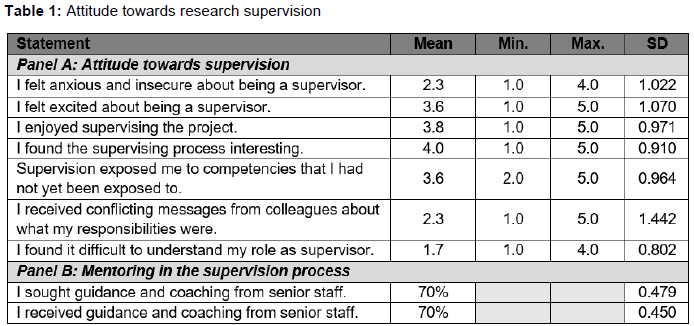
Using the principles that Papanastasiou (2005) developed in the Attitudes Towards Research scale, the supervisors were asked about their attitude towards supervision using a Likert scale, with 1 representing "not at all" and 5 "definitely", to rate the applicability of the statements. The responses are presented in Panel A of Table 1. Thereafter, in Panel B, the supervisors were asked (in the form of "yes/no" questions) whether they sought mentoring while supervising the student groups.
The researchers found that the wide range of experiences of the lecturers resulted in a wide range of responses, as reflected in the SDs. It is interesting to note that just under half of the supervisors felt anxious and insecure about being a supervisor (mean = 2.3, SD = 1.02) and some even responded with 4, which is closer to the "definitely" side of the Likert scale. Overall, the supervisors showed positive attitudes to being supervisors and were excited (mean = 3.6, SD = 1.07), enjoyed supervising the project (mean = 3.8, SD = 0.97), and found the process interesting (mean = 4.0, SD = 0.91). However, all these questions had a minimum response of 1, which indicates that some supervisors did not enjoy the process or found it interesting. One lecturer stated that they would not like to be forced to supervise. This wide distribution of responses may also be due to the fact that some supervisors received conflicting messages about supervision (mean = 2.3, SD = 1.4) and found it difficult to understand their role as supervisors (mean = 1.7, SD = 0.82), particularly given that for more than half (53 per cent) of the supervisors this was a new role, as they had previously taught only technical subjects. Feedback to the open-ended questions highlighted two aspects: firstly, lecturers' frustration with the administration and communication during the project; and secondly, two respondents stated that the project might not be beneficial to students' careers unless it related to topics they would work with in the future. This calls into question whether the lecturers themselves were not more focused on technical content than the professional competency that could be developed through the project. This could be remedied by proper supervisor training. Against this background, it was, however, positive to note that approximately 70 per cent of the lecturers sought assistance and received guidance from senior staff members. This is positive since Waddell et al.'s (2017) findings showed that mentorship can be a key strategy to help new faculty transition into their new roles. Mentorship could assist in clarifying the role of supervisors, while at the same time reducing stress and enhancing the experience for the supervisors. Despite the mixed feelings/attitudes to supervising the research project, 90 per cent of the lecturers recommended that the project be repeated for future students and that it was a positive learning experience for the students. Anecdotally, when the project was run in subsequent years, few lecturers volunteered to be supervisors again, which highlights the contradiction.
Self-development and motivation
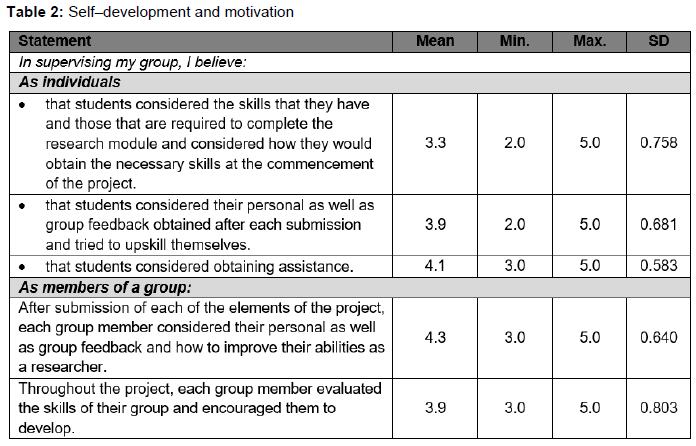
As future professionals who will be placed in high-pressure environments with tight deadlines, the competency of self-development and motivation is key to personal growth and fulfilling responsibilities. The lecturers were required to consider the students' engagement in self-development and motivation during the project. Table 2 presents this feedback. Overall, it appears that students took the project seriously (mean = 4.0, SD = 0.89) and that they engaged in the research process. However, one lecturer noted that the students were informed that they could not fail the research project and their group therefore did not take it seriously. This confirms Sahd and Rudman's (2020) findings that assessment drives learning and should new learning tools be used to teach competencies, careful consideration will need to be given to how this is communicated to students.
When considering individual students' self-development and motivation, the supervisors mostly thought that the students did consider the skills that were lacking in the group and what to do to obtain those skills (mean = 3.3, SD = 0.76). However, this was not close to the "definitely" side of the Likert scale, which raises questions regarding to what extent it was done without having received feedback about the work that they had done. Much higher means of between 3.9 and 4.3 (low SDs) were evident for self-development steps taken once the students had received feedback on their research products. This indicates that there is room for lecturers to create more self-reflection and assessment opportunities in the research project, which can be integrated with teacher feedback, as suggested by Taras (2003). Historically, accounting academics have not used reflection as a learning tool and accounting students tend to dislike doing it. In the open-ended questions, two lecturers pointed out that giving students feedback exposed them to lifelong learning and taking initiative for their own learning competency. Whether this always holds true is, however, in question, as respondents to the open-ended questions specifically noted that they found that the students lost interest in the research module when formal assessments in their coursework (of the four professional subjects) drew near, with the benefit of being given feedback declined. This again emphasises what Sahd and Rudman (2020) argued, namely that assessment drives behaviour and that scoping of any learning activities is important.
Ethics and legal considerations
Chartered accountants are considered ethical gatekeepers (Nathan 2015) wherever they are employed. During their undergraduate study, students had been exposed to broad business ethics principles and the details of the Code of Professional Conduct (CPC) (SAICA 2021a). This foundation should have grounded their ethical behaviour in the execution of the project. A research project, without defined parameters that accounting students are accustomed to, presents students with a broader and different context in which to consider ethics. The project also exposes the students to real-world considerations and decisions they need to make about ethics, legislation, etc., as well as the impact thereof on potential stakeholders.
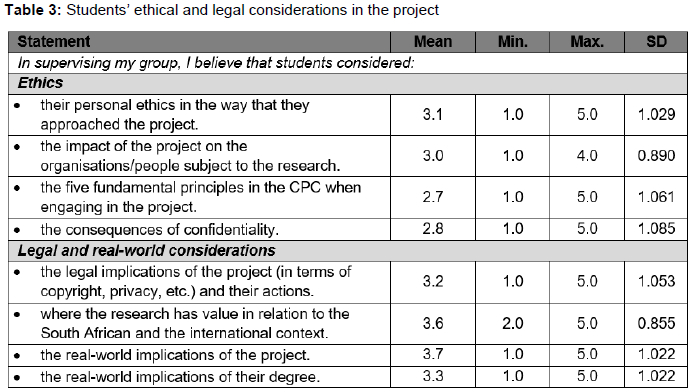
Table 3 presents the lecturers' views on whether the project allowed the students to consider ethics, compliance with rules and regulations, and real-world application of their degree while conducting the research. Although low, it is positive to note that the overall responses relating to ethics range between a mean of 2.7 and 3.1 (higher SDs). Personal ethics and ethical considerations in relation to the research subject were rated higher than professional ethics (applying the CPC). This is important because an accountant in practice needs to maintain a high moral standing and, in all probability, will not encounter situations that can directly be related to the CPC. However, aspirant chartered accountants' ethics as a competency should be embedded in the students' way of thinking by the time they enter postgraduate studies, but this is not represented by the means. Sadler and Barac (2005) found that one of the challenges of teaching accounting students ethics is that they apply ethics when given the parameters but find it challenging when presented with unstructured situations. This requires lecturers to create more unstructured learning interventions throughout tertiary study so that the students can develop this competency. The narrative feedback highlighted that the project presented unexpected and unstructured problems that needed to be responded to, which was a prime opportunity for the students to consider the ethical implications of what they were doing and for the lecturers to discuss the issues and implications. An example of such a learning opportunity was where a student with a high Turnitin similarity index was referred to the Central Disciplinary Committee.
Depending on the students' methodologies, they were required to complete ethical declarations, obtain institutional permission, validate data sources, and attend sessions by the library on, inter alia, copyright and plagiarism. The lecturers believed that these learning opportunities afforded the students the opportunity to consider the broad legal implications of the project (mean = 3.2, SD = 1.05), while the research topics allowed them to see the real-world implications of the project, as well as content they are studying (with a mean response of above 3.3). The respondents provided examples, which included the theme "Affording students the opportunity to see that accounting standards and legislation are there for a reason and that it needs to be considered in the real world". One lecturer mentioned that students could see the practical impact of the theory learned in class and that it created a space for students to think outside of the "general box" that is limited to the scoping of the professional examinations. Recommendations to improve the research project included the need to directly link research to theory taught during lectures. For the questionnaire question that focused on the real-world application, this again highlights the fact that the lecturers' focus appeared to be on technical content rather than professional competency development.
Independence and project management
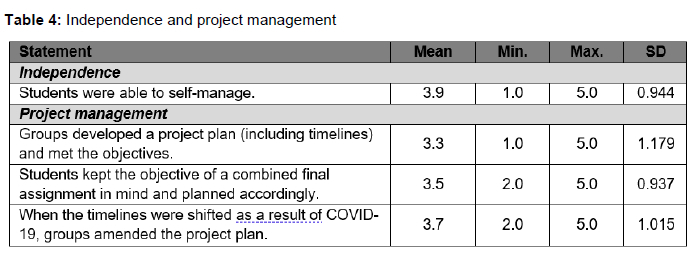
As the research project included both individual and group submissions, the students had to navigate working and overcoming their own challenges, as well as those of the group. Because this was a large-scale project with several submissions over eight months, project management was key. This resembled the students' future workplace where they will work in teams with both individual and group deliverables. The responses in Table 4 show that the lecturers believed that the students were able to self-manage (mean = 3.9, SD = 0.94), which is expected of a postgraduate accounting student. Even with this high overall rating, the narrative feedback questioned the students' ability to independently execute the research project since despite attending lectures on research methodology, they were still very reliant on their supervisors.
The means in Table 4 in relation to project management show that the exposure to group work in undergraduate study developed certain skills, but that there was still room for growth as they were not at the "definitely" side of the Likert scale, which would have been expected from postgraduate students. This confirms the findings by Bhattacharjee and Shaw (2001) and Barac and Du Plessis (2019). The project was run in 2020, and the lecturers believed that the students were able to adjust their plans when the COVID-19 restrictions were implemented (mean = 3.7, SD = 1.02), which shows that the students were able to adapt when they were required to by necessity. Zhang et al. (2021) found that adaptability during the COVID-19 pandemic directly increased student engagement. In the narrative responses, the lecturers agreed that time and project management skills as a competency were further developed by the project; however, they commented that the available time was limited and that the students required more time, particularly given the significant workload in the coursework component of the postgraduate programme. Some respondents recommended that the research project be included earlier in the curriculum, maybe at the undergraduate level, because even though they believed there was value in competency development through the project, more time was required for the completion of the project, which would address the tension between coursework and research. This tension had already been identified by Lopatto (2010). The majority of the lecturers, however, recommended that the project remain in the postgraduate course. This raises the question as to whether research projects should be included in both the under- and postgraduate courses and consideration be given to course credits.
Teamwork and collaboration
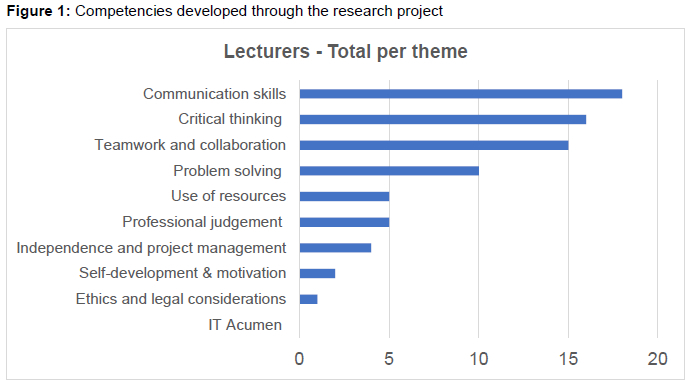
Chartered accountants work in collaborative work environments. Although students have worked in teams on projects during their undergraduate study, these tended to be small in scale and short in duration. This large-scale research project over an extended eight-month period created the opportunity for groups to work in new ways. The COVID-19 pandemic also created other opportunities. Although Kruger and Rudman (2014) found that accounting students may resist group work, of all the competencies that could be developed by the research project, this was the competency ranked third highest by lecturers.
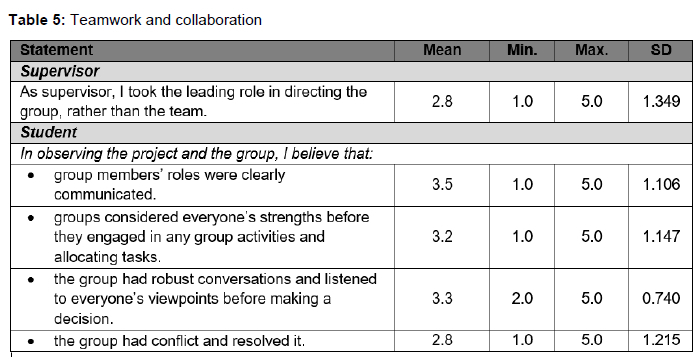
In the researchers' experience, most group projects for accounting students tend to be more cooperative than collaborative. As this research project required students to work together on an integrated final project submission, it forced the students to work collaboratively. The results in Table 5 support the expectation that students were afforded the opportunity to engage with the teamwork and collaboration competency offered by the project.
Overall, it appears that the belief exists that the students allocated roles within the team (mean = 3.5, SD = 1.11) and consideration was given to what each member's strengths were and how it could benefit the team (mean = 3.2, SD = 1.15). The students, to a certain degree, collaborated by discussing different views before reaching conclusions (mean = 3.3, SD = 0.74). When considering conflict, there was no indicator of how many groups had conflict and the mean of 2.8 (SD = 1.22) relating to whether they resolved conflict therefore does not provide meaningful information. The narrative feedback emphasised the teamwork and collaboration in the project and the lecturers explained that the students benefitted from the long-term integrated group work exercise. One lecturer commented that they enjoyed observing how the students engaged in collaborative learning, which they had not seen before. Although it appeared that the groups worked in teams, the lecturers noted that the students did not necessarily work in the most effective manner and that there was still room to scaffold learning earlier in the students' university career. Based on past experience, as noted above, the researchers also believed this to be true.
Communication skills
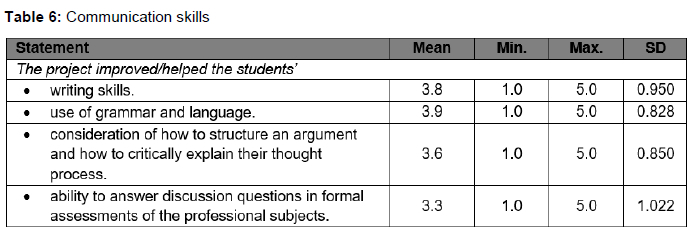
Dolce et al. (2020) found that employers and graduates consider teamwork and communication skills to be two of the most important professional skills for chartered accountants to possess. Despite this, accounting students tend to prefer numerical problem solving and can find formulating and articulating arguments a challenge. A key element of the research project was formulating arguments and articulating written thoughts clearly. Overall, this was the competency that the lecturers felt was the most developed (ranked the highest) through the research project, although the students required a great deal of guidance in the process. Table 6, which presents the lecturers' feedback on the students' ability to communicate, shows that the students' writing skills, including language and grammar, improved significantly (means above 3.8). The lecturers argued that the project presented an opportunity for the students to structure an argument and to show their thought process (mean = 3.6, SD = 0.85). The narrative feedback went as far as to suggest that the project forced students to communicate without using jargon, which they have found is a strategy often employed by students during written questions especially in Auditing. Although the lecturers saw some benefit for the students developing the ability to formulate answers to assessments (mean = 3.3, SD = 1.02), it was not as much as expected. It is, however, worth noting that, with the exception of Auditing, the other professional subjects tend to use discussion questions to a limited extent. In the open-ended questions, the lecturers did, however, state that there are real-life benefits of management or tax report writing should communication skills be properly developed. They also highlighted some of the groups that experienced challenges in communication where groups included both English first language and English second or third language participants.
Considering the benefits identified by this study, as well as those documented by Parker (2018) and Seifan et al. (2022), earlier introduction of research projects is recommended specifically in relation to the communication skills that can be developed.
Problem solving
With many chartered accountants being business leaders, solving unstructured problems is considered a core competency (Dolce et al. 2020). Besides allowing students to, inter alia, determine the research question and design an appropriate methodology, the research project created a space where students stumbled across unexpected problems and had to solve them (Parker 2018; Seifan et al. 2022). Table 7 supports Parker's (2018) and Seifan et al.'s (2022) findings that the research project afforded the students the opportunity to be creative outside of the normal theoretical "boxes" of accounting specialisation (free from the restrictions that exist in the content required for professional assessments) (mean = 3.9, SD = 0.83) and taught them to think of solutions (mean = 3.8, SD = 0.81).
The lecturers highlighted the learning benefit of students of being forced to solve problems that do not necessarily have a correct answer to work towards, even if it makes them feel uncomfortable. This discomfort is where learning happens. Being able to solve problems requires critical thinking.
Critical thinking
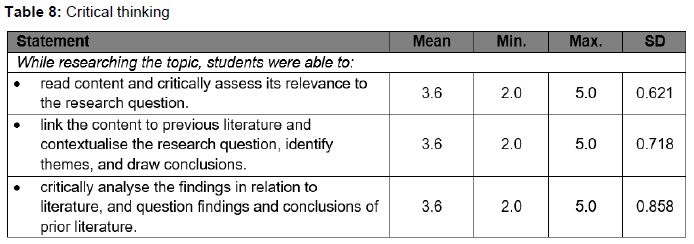
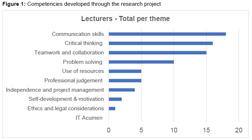
Critical thinking is a current buzzword in South African accounting education, with Barac (2017) suggesting that it is a prized commodity. Although there is a large body of research on critical thinking, there is still no clear definition of what exactly critical thinking is. Lai (2011) synthesised the philosophical, cognitive psychological, and educational approaches to critical thinking and presented the agreement (across the three approaches from the literature) that critical thinking includes analysing arguments, claims, and evidence; making inferences using deductive reasoning, judging, or evaluating; and making decisions or solving problems. Lai (2011) and Terblanche and De Clercq (2021) suggest that open-ended unstructured problem types can be used to teach critical thinking. Since the objective of the research conducted by the students was open-ended and had scope for several outcomes, it had a pedagogical basis for teaching critical thinking and afforded the students the opportunity to think critically about, inter alia, principles learned during coursework, ethical considerations, and unstructured problems (Terblanche and De Clercq 2021). This thought was echoed by the lecturers who, according to the thematic analysis, ranked critical thinking as the second most developed competency through the project (see Figure 1). The lecturer responses in Table 8 indicate that they believed that the students were given the opportunity to think about the research question, its context, and potential research themes, and to analyse where their findings fit in the context of the existing literature. All of these are part of critical thinking. The narrative feedback included statements such as "The project allowed them to ask 'why?' and not just accept the standards as a set of books'", and "The research project created a space for curiosity, scepticism and humility, which will improve the students thinking process and require an enquiring mind". However, the responses included several comments that the students lacked critical thinking skills and recommendations that additional opportunities needed to be created earlier on in a student's career to develop these skills. It also implies that the current BAcc curriculum does not necessarily develop the critical thinking skills as expected. This confirmed work by Terblanche and Waghid (2021). Unfortunately, given that the questionnaires were anonymous, it was not possible to link these responses to the academic performance of the groups. This could have provided insight into the divergent narrative feedback.
Professional judgement
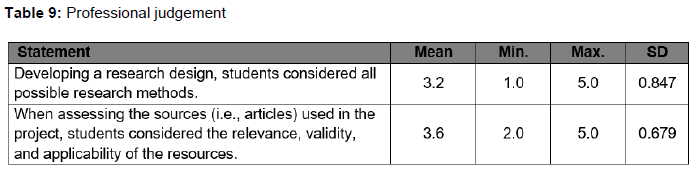
The ability to apply relevant training, professional knowledge, skills, and experience to a particular accounting or auditing context and selecting the most appropriate course of action is so important to professional accountants that it is explicitly contained in both the International Auditing Standards (International Auditing and Assurance Standards Board 2014) and the ethical requirements (SAICA 2021a). West and Buckby (2022) emphasise the importance of professional judgement within professional accounting and went as far as to make a link between the Carillion Plc ethical failure and the decisions made by the professional accountants involved. This again emphasises the need for lecturers to start providing opportunities for students to gather information and make judgement calls (decisions) based on context and the appropriate theoretical (or accounting) guidance. These recommendations were made by the Institute of Chartered Accountants of Scotland in 2016. The unstructured environment of a research project where the students had to decide on the most appropriate research design and assess the quality of sources of various forms of data (whether it be literature or quantitative or qualitative data) created a space where the students could use professional judgement. Table 9 shows that the lecturers thought that the students did think about the relevant factors when making two key decisions that impacted the research process. However, they rated the decision making around considering the source higher than the decision making surrounding determining the appropriate research design, with a narrower SD. The researchers surmise that this is due to the fact that some research topics employed more simplistic methodologies and that the students did not understand all the methodologies available and thus did not consider or present an argument for all possible methodologies.
Digital acumen
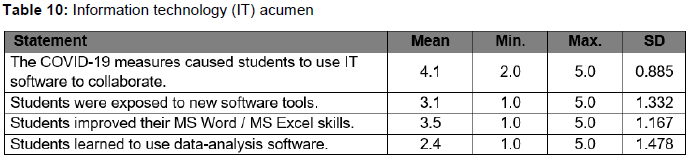
This cohort of students was impacted by the March 2020 COVID-19 pandemic restrictions, which necessitated remote group work with IT providing a real-time solution to collaborate on the group element of the project (mean = 4.1, SD = 0.89) (Ahmed and Opoku 2022). Besides using collaboration platforms, research projects have been found to provide a platform for students to develop IT skills (Bhattacharjee and Shaw 2001) and learning new packages other than traditional word-processing and accounting software. Table 10 presents the lecturers' feedback on the use of IT by the students.
The high SDs, showing varied responses in relation to digital acumen, are understandable since different research questions and methodologies impacted which technologies the students would be required to use. This may also be the reason for the low mean of 2.4 (and high SD of 1.48) regarding the use of software required for data analysis. The lecturers indicated that throughout the process, the students were exposed to new software packages (mean = 3.1, SD = 1.33) and improved their word-processing skills in writing up the research (mean = 3.5, SD = 1.16). The feedback on the impact of online meetings provided mixed results. Some argued that technology made it more convenient to meet; however, it removed the personal element and the transfer of social skills normally associated with the supervision process. The researchers surmise that the challenge was heightened because the students' socio-economic status may have affected their access to IT infrastructure off campus.
Use of resources
In understanding access to resources, consideration must be given to both the feedback obtained when investigating the students' perceptions of the project (a different questionnaire), as well as the lecturers' perceptions. In completing the research project, several students noted that they were not aware of the resources available at the university to support them in the research process. As this was the first large-scale research project that the students had been exposed to and for most of the supervisors their first supervision opportunity, it is understandable that they might not have been aware of the resources and support provided by the university. Despite this, it is positive to note the low means in the lecturers' response to whether they believed that the students used the Internet for the project, rather than using academic resources (mean = 2.5, SD = 1.25). Moreover, it is worth noting that the student feedback to the project showed that they were frustrated with having to research remotely and acknowledged their lack of experience with the online library services, which hindered their progress. The supervisors also learned something new in the process (mean = 2.8, SD = 1.42).
Competencies developed and obstacles encountered
As universities progress in developing professional skill competencies outside of the traditional focus on technical competencies, new teaching tools become necessary. This research project afforded the postgraduate students and lecturers an opportunity to engage in professional skill competency development. Based on the content analysis of the narrative feedback, Figure 1 shows the competencies considered by the lecturers as being the best developed competencies through the research project. All these skills are required by accountants in the Fourth Industrial Revolution (4IR).
When implementing any learning intervention that is new to both the students and more than half of the lecturers, there are bound to be challenges, no matter how pedagogically sound or beneficial the intervention may be. Resistance to change and the uncomfortable position of growth may impact both the lecturers' and the students' attitudes towards the project. The narrative feedback highlighted several obstacles, with the most notable being the tension between class and research, which was also highlighted by Loatto (2010). Within the context of chartered accountancy training, some of the narrative feedback suggested that the project did not aid in the preparation of the professional assessments, would not be applicable to a chartered accountant in practice, and added unnecessary pressure to the students. This view, if applied to students and implicitly through a lecturer's attitude, affects the lecturer engagement, as well as the student response, who viewed the project as a "tick box" exercise rather than a learning opportunity.
The students' lack of prior research experience was listed as potentially slowing down the research process, which affected the time they had available for other work. The timing of the research project was also questioned by some of the lecturers, who were of the view that a project of this magnitude should be undertaken in undergraduate study. Two arguments are presented: firstly, the postgraduate years should focus on preparation for the professional assessments; and, secondly, competency development should form part of the undergraduate programme. Either way, in the researchers' view, the underlying cause of these arguments could be due to the lecturers' unwillingness to change the postgraduate programme. In the researchers' experience, the postgraduate accountancy programmes at South African universities have taken the least action in preparation for CA2025. The significant changes are implemented at the undergraduate level.
Another historic tension was also noted. One of the lecturers felt that because the results of the project were not publishable, the project should not be undertaken. This comment made the researchers question whether the supervisor understood the benefits of the research project and the skills that the students could develop. The researchers also argue that research pressure on staff should not impact students' learning. This was confirmed by the supervisors, who felt that the teaching lecturers (i.e., lecturers who did not supervise groups) did not send a consistent message to students regarding the research project and its benefits or importance to their studies. They also recommended that the department should manage the project and the expectations around it better. These obstacles would also impact the role-out of a similar project in developing countries such as those in Central- and West-Africa (particularly where the lecturer or facilitator has not had a broad international exposure), as well as developed countries at institutions that are teaching focused. Much of the success of using a research project as a tool to develop competencies lies in the experience of the lecturer or facilitator of the programme and the objective of the faculty, either being technically focused or focused on competency development (Lassou, Hopper, and Ntim 2021).
As expected, many lecturers emphasised the consequences of the COVID-19 pandemic and the related restrictions that mitigated the benefits that could have been derived if the supervision had taken place face to face. It is worth noting that once the 2021 research module was presented face to face, which allowed the lecturers to engage in person with the students, while affording them the use of the technologies that gained prominence during the COVID-19 restrictions, it allowed them to leverage the benefits that technology provides while mitigating the disadvantages.
Some of the obstacles can be overcome by the strategies proposed by Mhlahlo (2020) following the authors reflection about the supervision experience of a research project in Development studies.
CONCLUSION
Accounting graduates in South Africa are entering a world that is driven by the 4IR, is littered with ambiguity and uncertainty, and is asking them to be ethical beacons. As the accountancy profession upskills for the future and training models and frameworks evolve, so too do education providers need to incorporate new learning initiatives into their teaching methods that are not only focused on technical competencies, but professional competencies as well. One example of a well-researched but under-utilised learning initiative in competency development is the use of a research project. The academic requirements for the 2020 cohort of postgraduate accounting students at Stellenbosch University presented an opportunity to better understand the lecturers' perceptions of the use of a research project to develop competencies since most of the students had not had prior experience with conducting research and more than half of the supervisors had never supervised before. This opportunity is (at present) unlikely to arise again, as research projects in postgraduate accounting study are generally limited to a small group of the top-performing students. Using the RDF (CRAC 2011) and SAICA's (2021b) Competency Framework, the researchers used the generic competency areas as the basis for the competencies that could be developed in a research project. This questionnaire was distributed to the supervising lecturers to obtain a better understanding of the issues relevant to new supervisors.
In the research process, lecturers' as well as students' attitudes to learning activities were identified as important impactors on learning. The findings showed that despite the challenges, the lecturers perceived the research project as a tool to develop professional skills; however, varied responses from the lecturers (overall) indicated that they did not have a common belief, understanding, or conviction about using research projects to develop professional skills. Some lecturers appeared to still want to focus on teaching technical content to pass professional assessments and did not necessarily see the value of a research project for students' future professional lives.
This study showed that a research project is an effective tool for competency development in aspirant chartered accountants and echoes the call of Barac and Du Plessis (2019) for more research projects to be introduced in universities' professional programmes. It also presents a case for research projects to be introduced in undergraduate study to build competence before students' highly technical postgraduate year. The accounting profession has always argued that the accounting curriculum is decolonised because of the nature of its content; however, studies show that much work must still be done to decolonise the delivery mechanisms. This has implications for the transformation of higher education. The accountancy profession claims to develop competencies; however, it appears that the tools used to develop competencies are not embedded in pedagogy in a sustained and impactful manner. Moreover, there are contradictions regarding what accounting education should focus on (i.e., professional assessment vs competency development) and the tools used. The findings also highlighted the teaching and researching tension that has become more prevalent as more accounting academics conduct research. As a result, an area for further research is to understand the differences in perception between supervisors and students to determine if these tensions are communicated to students. Furthermore, we also need to acknowledge that the impact of the background of the students and supervisors also need further investigation.
REFERENCES
LITERATURE REVIEW
-
Adediwura, A.A., and B. Tayo. 2007. "Perception of Teachers' Knowledge, Attitude and Teaching Skills as Predictor of Academic Performance in Nigerian Secondary Schools." Educational Research and Review 2 (7):165-71. http://www.academicjoumals.org/ERR.
» http://www.academicjoumals.org/ERR -
Ahmed, V., and A. Opoku. 2022. "Technology Supported Learning and Pedagogy in Times of Crisis: The Case of COVID-19 Pandemic." Education and Information Technologies 27: 365-405. https://doi.org/10.1007/s10639-021-10706-w.
» https://doi.org/10.1007/s10639-021-10706-w - Ballantine, J., and P. McCourt Larres. 2009. "Accounting Undergraduates' Perceptions of Cooperative Learning as a Model for Enhancing Interpersonal and Communication Skills to Interface Successfully with Professional Accountancy Education and Training." Accounting Education: An International Journal 16(4): 387-402.
- Barac, K. 2009. "South African Training Officers' Perceptions of the Knowledge and Skills Requirements of Entry-Level Training Accountants." Meditari Accountancy Research 17(2): 1946.
-
Barac, K. 2017. "Critical Thinking: A Prized Commodity." https://www.bbrief.co.za/2017/09/19/critical-thinking-a-prized-commodity/.
» https://www.bbrief.co.za/2017/09/19/critical-thinking-a-prized-commodity/ -
Barac, K., and L. du Plessis. 2019. "Teaching Pervasive Skills to South African Accounting Students." Southern African Business Review 18(1): 53-79. https://doi.org/10.25159/1998-8125/5645.
» https://doi.org/10.25159/1998-8125/5645 -
Beckman, M., and N. Hensel. 2009. "Making Explicit the Implicit: Defining Undergraduate Research." CUR Quarterly 29(4): 40-4. https://www.mcgill.ca/senate/files/senate/beckman__hensel_making_explicit.pdf.
» https://www.mcgill.ca/senate/files/senate/beckman__hensel_making_explicit.pdf -
Bhattacharjee, S., and L. Shaw. 2001. "Evidence That Independent Research Projects Improve Accounting Students' Technology-Related Perceptions and Skills." Accounting Education 10(1): 83-103. https://doi.org/10.1080/09639280110058909.
» https://doi.org/10.1080/09639280110058909 -
Chartered Institute of Management Accountants (CIMA). 2014. CGMA Competency Framework. London: Association of International Certified Professional Accountants. https://www.cimaglobal.com/Employers/CGMA-The-new-global-standard/CGMA-Competency-Framework/.
» https://www.cimaglobal.com/Employers/CGMA-The-new-global-standard/CGMA-Competency-Framework/ -
Council on Undergraduate Research (CUR). 2017. Definition of Undergraduate Research. http://www.cur.org/about_cur.
» http://www.cur.org/about_cur - Crawford, L., C. Helliar, and E.A. Monk. 2011. "Generic Skills in Audit Education." Accounting Education: An International Journal 20(2): 115-31.
-
Dolce, v., F. Emanuel, M. Cisi, and C. Ghislieri. 2020. "The Soft Skills of Accounting Graduates: Perceptions Versus Expectations." Accounting Education 29(1): 57-76. https://doi.org/10.1080/09639284.2019.1697937.
» https://doi.org/10.1080/09639284.2019.1697937 - Eggen, P., and D. Kauchak. 2001. Educational Psychology: Windows on Classrooms. New Jersey: Prentice Hall.
-
Fazal, F.A., and R. Chakravarty. 2021. "Researcher Development Models and Library Research Support." Library Hi Tech News 38(4): 18-22. https://doi.org/10.1108/LHTN-04-2021-0015.
» https://doi.org/10.1108/LHTN-04-2021-0015 -
Fortin, A. and Legault, M. 2010. "Development of Generic Competencies: Impact of a Mixed Teaching Approach on Students' Perceptions." Accounting Education: An International Journal 19(1/2): 93-122. https://doi.org/10.1080/09639280902888195.
» https://doi.org/10.1080/09639280902888195 -
García, J.L., and I. de los Ríos. 2021. "Model to Develop Skills in Accounting Students for a 4.0 Industry and 2030 Agenda: From an International Perspective." Sustainability (Switzerland) 13(17): 1-31. https://doi.org/10.3390/su13179699.
» https://doi.org/10.3390/su13179699 - Hardway, C.L., and M. Stroud. 2014. "Using Student Choice to Increase Students' Knowledge of Research Methodology, Improve Their Attitudes Toward Research, and Promote Acquisition of Professional Skills." International Journal of Teaching and Learning in Higher Education 26(3): 381-92.
- Hiralaal, A. 2012. "Students' Experiences of Blended Learning in Accounting Education at the Durban University of Technology." South African Journal of Higher Education 26(2): 316-28.
-
Lassou, P.J.C., T. Hopper, and C. Ntim, 2021. "Accounting and development in Africa." Critical Perspectives on Accounting 78: 1-9. https://doi.org/10.1016/j.cpa.2020.102280
» https://doi.org/10.1016/j.cpa.2020.102280 - Institute of Chartered Accountants of Scotland (ICAS). 2016. A Professional Judgement Framework for Financial Reporting Decision Making. Edinburgh: ICAS.
- International Auditing and Assurance Standards Board (IAASB). 2014. Overall Objective of the Independent Auditor and the Conduct of an Audit in Accordance with International standards on Auditing. ISA200, Effective December 15, 2009.
-
Lai, E.R. 2011. "Critical Thinking: A Literature Review." Pearson's Research Reports 6(1): 1-50. http://images.pearsonassessments.com/images/tmrs/CriticalThinkingReviewFINAL.pdf.
» http://images.pearsonassessments.com/images/tmrs/CriticalThinkingReviewFINAL.pdf - Lopatto, D. 2008. "Exploring the Benefits of Undergraduate Research Experiences: The SURE Survey." In Creating Effective Undergraduate Research Programs in Science, edited by R. Taraban and R.L. Blanton, 112-32. New York: Teachers College Press.
- Lopatto, D. 2010. "Undergraduate Research as a High-Impact Student Experience." Peer Review : Emerging Trends and Key Debates in Undergraduate Education 12(2): 27-31.
- Low, M., V. Botes, D. de la Rue, and J. Allen. 2016. "Accounting Employers' Expectations - The Ideal Accounting Graduates." The e-Journal of Business Education & Scholarship of Teaching 10(1): 36-57.
-
Mardiana, H. 2020. "Lecturers' Attitudes Towards Online Teaching in the Learning Process." Register Journal 13(1): 77-98. https://doi.org/10.18326/rgt.v13i1.77-98.
» https://doi.org/10.18326/rgt.v13i1.77-98 -
Mhlahlo, A. 2020. "Reflecting on Supervision experiences: Honours students' Research project in Development studies at the Nelson Mandela University." South African Journal of Higher Education 34(2): 164-176. https://dx.doi.org/10.20853/34-2-3565
» https://dx.doi.org/10.20853/34-2-3565 - Muzenda, A. 2013. "Lecturers' Competences and Students' Academic Performance." International Journal of Humanities and Social Science Invention 3(1): 6-13.
-
Nath, S.R., K. Jones, and C. Viney. 2021. Understanding the Experiences of Postgraduate Researchers Using the Vitae Researcher Development Framework at UK Universities. https://www.vitae.ac.uk/researchers-professional-development/about-the-vitae-researcher-development-framework/understanding-experience-of-pgrs-using-the-vitae-rdf-at-uk-universities-final-june-2021.pdf.
» https://www.vitae.ac.uk/researchers-professional-development/about-the-vitae-researcher-development-framework/understanding-experience-of-pgrs-using-the-vitae-rdf-at-uk-universities-final-june-2021.pdf -
Nathan, D. 2015. "How South African Societal and Circumstantial Influences Affect the Ethical Standards of Prospective South African Chartered Accountants." African Journal of Business Ethics 9(1): 42-62. doi:10.15249/9-1-79.
» https://doi.org/10.15249/9-1-79 -
Negash, M., T.T. Lemma, and G Samkin. 2019. "Factors impacting accounting research output in developing countries: An exploratory study." The British Accounting Review 51: 170-192. https://doi.org/10.1016/j.bar.2018.09.003
» https://doi.org/10.1016/j.bar.2018.09.003 -
Pacheco, G., M.-I. Espinoza, S. Cabrera-Arias, and P. Cabrera-Tenecela. 2021. "Lecturers' Aptitudes, Attitudes and Professional Development in Higher Education at University of Cuenca". European Journal of Educational Research 10(2): 553-65. https://doi.org/10.12973/eu-jer.10.2.553.
» https://doi.org/10.12973/eu-jer.10.2.553 - Papanastasiou, E. 2005. "Factor Structure of the 'Attitudes Toward Research' Scale." Statistics Education Research Journal 4: 16-26.
- Parker, J. 2012. "International Comparisons of the Integration of Research Into Undergraduate Degrees in the Social Sciences." Council on Undergraduate Research Quarterly 32(3): 28-33.
-
Parker, J. 2018. "Undergraduate Research, Learning Gain and Equity: The Impact of Final Year Research Projects." Higher Education Pedagogies 3(1): 145-57. https://doi.org/10.1080/23752696.2018.1425097.
» https://doi.org/10.1080/23752696.2018.1425097 - Petrella, J.K., and A.P. Jung. 2008. "Undergraduate Research: Importance, Benefits, and Challenges." International Journal of Exercise Science 1(3): 91-5.
- Rudman, R.J., and J. Terblanche. 2011. "Practical Role-Play as an Extension to Theoretical Audit Education: A Conceptualising Aid." Southern African Journal of Accountability and Auditing Research 11: 63-74.
-
Rudman, R.J., and W. Kruger. 2014. "Using a Group Work Project as an Educational Tool in Management Accounting Education." International Business & Economics Research Journal (IBER) 13(3): 611-28. https://doi.org/10.19030/iber.v13i3.8598.
» https://doi.org/10.19030/iber.v13i3.8598 -
Sadler, E., and K. Barac. 2005. "A Study of the Ethical Views of Final Year South African Accounting Students, Using Vignettes as Examples." Meditari Accountancy Research 13(2): 107-28. https://doi.org/10.1108/10222529200500015.
» https://doi.org/10.1108/10222529200500015 - Sahd, L., and R.J. Rudman. 2020. "Audit Trainees' Perceived Value of Case Studies as an Assessment Tool in Developing and Assessing Professional Skills: A National Perspective." South African Journal of Accountability and Auditing Research 22(1): 1-14.
-
Seifan, M., N. Lal, and A. Berenjian. 2022. "Effect of Undergraduate Research on Students' Learning and Engagement." International Journal of Mechanical Engineering Education 50(2): 326-48. https://doi.org/10.1177/0306419021988962.
» https://doi.org/10.1177/0306419021988962 - Sexton, N.D. 2019. "Accounting Students' Perceptions: Internal Control Theory Moves Outside the Classroom and Online." South African Journal of Higher Education 33(4): 271-90.
- Sexton, N.D., and R.J. Rudman. 2022. "Program Renewal: Students Perception on Changes to Teaching Pedagogy in Auditing." South African Journal of Higher Education 36(3): 249-68.
-
South African Institute of Chartered Accountants (SAICA). 2021a. Code of Professional Conduct of the South African Institute of Chartered Accountants (Revised 2018) 2021 Edition. Johannesburg: SAICA. https://saicawebprstorage.blob.core.windows.net/uploads/resources/SAICA-Code-of-Professional-Conduct-Revised-2021.pdf.
» https://saicawebprstorage.blob.core.windows.net/uploads/resources/SAICA-Code-of-Professional-Conduct-Revised-2021.pdf -
South African Institute of Chartered Accountants (SAICA). 2021b. CA(SA) Competency Framework. Johannesburg: SAICA. https://ca2025.co.za/wp-content/uploads/2021/03/DOCUMENT-2-CASA-Competency-Framework-2021.pdf.
» https://ca2025.co.za/wp-content/uploads/2021/03/DOCUMENT-2-CASA-Competency-Framework-2021.pdf -
Steenkamp, L.P. 2009. "South African Chartered Accountants' Views on and Expectations of a Career in Academia." Meditari Accountancy Research 17(1): 81-98. https://doi.org/10.1108/10222529200900006.
» https://doi.org/10.1108/10222529200900006 -
Taras, M. 2003. "To Feedback or Not to Feedback in Student Self-Assessment." Assessment and Evaluation in Higher Education 28(5): 549-65. https://doi.org/10.1080/02602930301678.
» https://doi.org/10.1080/02602930301678 -
Terblanche, E.A.J., and B. de Clercq. 2021. "A Critical Thinking Competency Framework for Accounting Students." Accounting Education 30: 325-54. doi:10.1080/09639284.2021.1913614.
» https://doi.org/10.1080/09639284.2021.1913614 -
Terblanche, J., and Y. Waghid. 2021. "Chartered Accountancy and Resistance in South Africa." South African Journal of Higher Education 35(3): 239-53. https://doi.org/10.20853/35-3-3894.
» https://doi.org/10.20853/35-3-3894 -
University of Canberra. n.d. Researcher Development Skills Framework. https://www.canberra.edu.au/research/graduate-research/researcher-development/researcher-development-skills-framework/RDSFSkillAreas.pdf.
» https://www.canberra.edu.au/research/graduate-research/researcher-development/researcher-development-skills-framework/RDSFSkillAreas.pdf -
University of Edinburgh. n.d. Researcher Development Framework (RDF). https://www.ed.ac.uk/institute-academic-development/research-roles/research-only-staff/career-management/researcher-framework#:~:text=The%20framework%20has%20been%20developed,the%20characteristics%20of%20excellent%20researchers.
» https://www.ed.ac.uk/institute-academic-development/research-roles/research-only-staff/career-management/researcher-framework#:~:text=The%20framework%20has%20been%20developed,the%20characteristics%20of%20excellent%20researchers -
Venter, E.R., and C. de Villiers. 2013. "The Accounting Profession's Influence on Academe: South African Evidence." Accounting, Auditing & Accountability Journal 26(8): 1246-78. https://doi.org/10.1108/AAAJ-06-2012-01027.
» https://doi.org/10.1108/AAAJ-06-2012-01027 -
Vitae®©. 2010. Researcher Development Framework (Version 2 April 2011). https://www.vitae.ac.uk/vitae-publications/rdf-related/researcher-development-framework-rdf-vitae.pdf/@@download/file/Researcher-Development-Framework-RDF-Vitae.pdf.
» https://www.vitae.ac.uk/vitae-publications/rdf-related/researcher-development-framework-rdf-vitae.pdf/@@download/file/Researcher-Development-Framework-RDF-Vitae.pdf -
Waddell, J., J. Martin, J. Schwind, and J. Lapum. 2017. "A Faculty-Based Mentorship Circle: Positioning New Faculty for Success." Canadian Journal of Higher Education 46(4): 60-75. https://doi.org/10.47678/cjhe.v46i4.186173.
» https://doi.org/10.47678/cjhe.v46i4.186173 -
West, A., and Buckby, S. 2023. "Professional Judgement in Accounting and Aristotelian Practical Wisdom." Accounting, Auditing & Accountability Journal 36(1): 120-45. https://doi.org/10.1108/AAAJ-09-2020-4949.
» https://doi.org/10.1108/AAAJ-09-2020-4949 -
Zafra-Gómez. J.L., I. Román-Martínez, and M.E. Gómez-Miranda. 2015. "Measuring the Impact of Inquiry-Based Learning on Outcomes and Student Satisfaction." Assessment & Evaluation in Higher Education 40(8): 1050-69. https://doi.org/10.1080/02602938.2014.
» https://doi.org/10.1080/02602938.2014 -
Zhang, K., S. Wu, Y. Xu, W. Cao, T. Goetz, and E.J. Parks-Stamm. 2021. "Adaptability Promotes Student Engagement Under COVID-19: The Multiple Mediating Effects of Academic Emotion." Frontiers in Psychology 11: 1-8. https://doi.org/10.3389/fpsyg.2020.633265.
» https://doi.org/10.3389/fpsyg.2020.633265