Reflectivity towards improving postgraduate student research supervision: a digital lens on the University of Namibia
Abstract
The purpose of this paper is to explore student supervision in research at the University of Namibia and propose interventions that enhance effective postgraduate student research supervision using digital technology. The paper employed Barry Stierer's methods of critical reflection dictated by the three domains namely, criticality, reflexivity, and praxis. These methods are further used to support critical reflection of the context and make interpretations related to the use of technology to enhance student supervision in higher education institutions in general and at the University of Namibia in particular. This paper revealed that student supervision in research is not taken as a mean to enable pedagogic access. There is no institutional common procedures or model of postgraduate student research supervision leading to academics adopting the supervisory methods they have experienced when they were supervised. The paper contributed to theory, practice and policy that research supervision is taken as a common sense than a scientific approach. However, it recommended that postgraduate student research supervision can benefit from digital technology just like teaching and learning as well as assessment
Digital Technology; Research Supervision; Model; Pedagogy; Common Sense
INTRODUCTION
The significance of research in contribution to socio-economic development of any given country cannot be overemphasised. At the university level, research study is usually undertaken at the postgraduate level. According to Taysum (2015), postgraduate studies are very important in terms of developing future researchers and building capacity for research by advancing knowledge through international networks, from which alternative futures might be constructed. This is important particularly for developing countries that need to develop researchers who can fully participate in the creation of knowledge that leads to innovation to solve socio-economic challenges that face communities.
Research is defined at the University of Namibia (UNAM) as "any form of disciplinary inquiry that aims to contribute to a body of knowledge or involves a disciplined inquiry at any level which is designed to demonstrate mastery of research skills and techniques" (University of Namibia 2019). Alongside teaching, innovation, and community service, research makes up the core business of the University of Namibia that it renders to society (University of Namibia 2021).
The importance of research in higher education is evidenced by the fact that it is one of the conditions of service of academic staff, in addition to teaching and community engagement. The value placed on research performance of institutions of higher learning has increased in the 21st Century where research and development increasingly play a role in contributing to national economic and social development. With the emphasis on innovation in the drive towards developing into knowledge economies and part-taking in the 4th Industrial Revolution, research has become a priority to many universities, and the University of Namibia is no exception.
Understanding what technology integration into the research supervision process at the postgraduate level offers the individual student and supervisor is crucial as technology continues to become an integral part of education (Cuff 2014). Using technology in postgraduate research supervision has various benefits and objectives in general. These include the opportunity to broaden universities' reach by enabling postgraduate students to enrol with institutions further from their geographical locations, where Information and Communication Technologies (ICTs) facilitate student-lecturer communication and research support (Zvavahera and Masimba 2019). The relative anonymity of technology when used in research supervision also fosters better student learning as they are less likely to be negatively affected by unfavourable comments from supervisors as compared to hand-written feedback (Suparman 2021).
Using a reflective practice exploratory research approach, the article proceeds by presenting the research problem and research objectives, describing the methodology used, providing a review of relevant literature, and presenting the findings.
STATEMENT OF THE PROBLEMPostgraduate research output for universities is one of the areas of performance whereby graduation rates are used as a metric to measure institutional effectiveness (Suhaimi et al 2019). However, research has found that many postgraduate students do not graduate on time, and factors that play a role in postgraduate student success such as quality of supervision and relationship between supervisors and students, and student characteristics including motivation (van Rooij, Fokkens-Bruinsma and Jansen 2021). Similarly, a mismatch between supervisor's expectations and student capabilities, supervisor high workload, and predominant use of traditional methods with limited use of technology are other factors (Muraraneza, Mtshali and Bvumbwe 2020). This article interrogates the concept of research supervision and its importance to postgraduate research at the University of Namibia. It further explores the theoretical conceptualisation and approaches of research supervision in higher education in general, the practice of research supervision at the University of Namibia, and the opportunities for the use of digital technologies to improve postgraduate research supervision and address the current challenges encountered in research supervision at University of Namibia and those identified in the literature. Therefore, the purpose of this article is to explore strategies to improve postgraduate student research supervision (PSRS), concerning the role of technology in enhancing research supervision at the University of Namibia.
OBJECTIVES OF THE ARTICLEThis article adopted the following objectives:
• To interrogate the concept of postgraduate student research supervision's linkage to epistemological access.
• To explore the theoretical conceptualization and approaches of postgraduate student research supervision at the University of Namibia.
• To propose the use of digital technology to provide wider and cheaper access to postgraduate student research supervision at the University of Namibia.
METHODOLOGY
Poston and Boyer (1992) suggest continual reflective inquiries aimed at improving teaching and learning should be conducted. Further, Schön (1987) postulates that critical reflective practice contributes to transformational learning. This article used Barry Stierer's (2008) analytical elements of criticality, reflexivity, and praxis. A contextualized critical reflective practice is adopted as a research approach to interrogate and address the issues experienced with postgraduate research supervision and how digital technologies can be used to improve student research supervision at the University of Namibia. The reflective practice approach employed in this article is guided by the concepts of criticality, reflexivity, and praxis, that are further explained next.
Criticality
Criticality involves being critical by going beyond simple description and deeply engaging the context. Criticality does not equate to criticising but rather focuses on providing constructive reflection aimed at transforming the context (Stierer 2008). This study critically assesses the practice of postgraduate research supervision at UNAM and identifies opportunities for improving it through digitalisation.
Reflexivity
In the context of this article, reflexivity refers to "reflection [as] a process of self-examination and self-evaluation" for improving the student supervision practice in research (Shandomo 2010, 103). Through critical reflection, agents in student research supervision engage in transformative lifelong learning that provides new meaning to their practice. It also provides new insights into research supervision through introspection to avoid complacency and stagnation.
Praxis
According to Freire (1972), praxis is about putting theory into practice to effect transformation. Praxis is about putting theories, concepts and ideas into practice (Stierer 2008). It demonstrates moving away from the commonsense approach. Praxis displays that there is a change or transformation, which leads to a shift from common sense or periphery towards the centre. In the context of this article, the ideas generated are expected to impact the practice of postgraduate research supervision positively by improving it through the adoption of digital technologies.
The concept of digital technology in research supervision
Digital technologies provide added value to research supervision, especially in dual-mode universities. Given that most students doing postgraduate programmes, especially in developing countries like Namibia are in full-time employment and cannot do their studies full-time, technology becomes an attractive proposition. Digital technologies enable supervisors to interact with and provide supervision services to their students regardless of their respective locations (Suparman 2021). Blending face-to-face supervisory contact with online supervision using platforms such as, including online chats and forums, conferencing tools, and collaborative writing spaces, has been found to reduce the workload of research supervisors while enhancing the independence of students (Oehne and Bardua 2019). Ubiquitous digital communication technologies such as WhatsApp, according to Ngakane and Madlela (2022), have been found to facilitate the provision of frequent feedback from supervisors and enhance higher levels of interaction between supervisors and students.
Defining postgraduate student research supervision
The conceptualisation of postgraduate student research supervision is sought from the relevant policy documents and guidelines University of Namibia but no definite answer was found to the question of how postgraduate student research supervision is defined. In fact, the term "research supervision" and let alone "student research supervision" does not feature in the Research Ethics Policy, Regulations and Guidelines (University of Namibia 2019). Neither does the concept appear in the University of Namibia Guidelines for Supervisors for Postgraduate Studies. This alone is a concern as it indicates a lack of recognition of the value of postgraduate student research supervision as an important activity within the business of research at the University of Namibia.
Research supervision is conceptualised differently depending on the predominant view of research, the research agenda and culture of a given institution, or the leadership style of supervisors. Taylor (2018) refers to research supervision as the teaching of research candidates on how to do research and supporting them to become independent researchers. Maxwell and Smyth (2011) argue that conceptualising supervision within the "teaching/learning dichotomy is insufficient to express the complex nature of supervision which results in knowledge production" (223). Qureshi and Vazir (2016) critique the notion of traditional research that emphasise the content knowledge and research expertise of the supervisor, whereby "if supervisors can do research they can supervise as well", thereby ignoring the "pedagogical content knowledge of research" which is "complicated and intensive form of one-on-one teaching of research which takes on a unique form of sustained interaction over" a long period (Qureshi and Vazir 2016, 95).
It is important to consider the changes that have taken place in the field of research supervision and how these changes should redefine how the term is conceptualised.
Traditionally, postgraduate student research supervision tends to focus on the supervisor and the research student. This traditional view can be justified by the assertion that "the relationship between the supervisor and the postgraduate student is considered to be the key factor in the success or failure of students' research work" (Alam, Alam and Rasul 2013, 876). However, "supervision have expanded to include complex interactions between researchers, departments, administration, the university and the external research environment" (Reid and Marshall 2009, 145-146). In light of this view, more work needs to be done on defining and conceptualising research supervision, taking into consideration of all key stakeholders in the supervision process. It is proposed that postgraduate student research supervision is the process of facilitating the development of appropriate research skills and subject expertise of the research student involving a research supervisor, institutional research support services, structures, and the relevant stakeholders in the external research environment. This working definition should continue to be tweaked and revised in the practice of research supervision .
Roles and responsibilities of postgraduate research supervisors
Supervisors need to understand their roles and responsibilities so that they guide the students properly. Novice supervisors often grapple with how to develop a professional relationship with their postgraduate students. Therefore, they need to understand how to build a professional encounter with their students in terms of relationships, roles, and responsibilities. Botha (2017) identifies five main roles and responsibilities of a supervisor:
• Advise the student in the management of the postgraduate project (advisor/expert). It is important for supervisors to discuss with their students at the onset the relevant issues of research conduct and ethics.
• Guide the student through the research process (guidance). Obtaining a postgraduate degree involves the candidate performing independent and autonomous research under the supervision of an experienced researcher. The scope and support a candidate receives from the supervisor determines the candidate's success. This may include but is not limited to guidance in the selection of the thesis topic, literature, theoretical framework, research methods, etc.
• Ensure that the required scientific and academic standards and quality are achieved so that the student has the necessary opportunities to pass (quality assurance/control).
• Provide the required emotional and psychological support when needed (pastoral/counsellor role). The nature of postgraduate studies, particularly doctoral studies, may make the student feel alienated, lonely, and isolated; and hence vulnerable to psychological challenges that may lead to lack of motivation and dropout. Botha (2017) argues that doctoral candidates may end up not completing their studies due to reasons such as personal factors, motivational factors, feelings of isolation, family demands, financial circumstances, and work circumstances. Therefore, it is the responsibility of supervisors to be aware of their student's strengths and limitations, motivate them to be committed to their studies, and show interest in what the student is doing.
• Provide administrative and logistical support to students (administrative role) including ensuring the candidate understands rules and requirements, and abidance to deadlines.
From the authors' experience, novice supervisors are often not very clear about these roles, and they usually approach supervision from their own experience with their supervisors when they were students. Lee (2008) argues that supervisor's own experience when they were postgraduate students has a significant impact on how they supervise. Therefore, supervisors need to understand that supervision is a teaching practice that must be approached from a scholarly perspective in line with Boyer's (1990) fourth level of scholarship, the Scholarship of Teaching and Learning (SoTL). To ensure smooth supervision, universities must have in place a code of conduct for supervisors and postgraduate students. This code is a best practice that guides the supervisors and doctoral students in terms of the roles and responsibilities of each party.
The other good practice that universities and supervisors may consider is to enter into a memorandum of understanding (MoU) with postgraduate students. It is important to sign an MoU between a supervisor and the postgraduate student to provide an opportunity to develop a sound and productive working relationship. Furthermore, research supervision needs to consider the specific circumstances and needs of individual students. According to Carmesin et al (2015), it is important that supervision agreements cover aspects such as the degree and types of support to be provided to students and should include both rights and responsibilities of both parties involved in the supervision relationship. Carmesin et al (2015) further recommend that such supervisor-supervisee agreements should be concluded at the beginning of supervision and be regularly revised. To be comprehensive, things such as the nature of the research discipline and the circumstances of the student should be reflected in the agreement. Concurring with the assertions of Carmesin et al is Chamberlain (2016), who indicates the helpfulness of binding long-term agreements that specify expectations towards supervisees in consultation sessions which both parties sign off. Such agreements must also contain transparent procedures for termination of the agreement.
Furthermore, Botha (2017) argues that it is very important to manage relationships between the supervisor and the supervisee by keeping a professional distance. Some supervisors use their position to exert power over their students so that they demonstrate that they are in charge. However, even with agreements in place, the unequal power relations between a student and the supervisor may leave the former vulnerable (Chamberlain 2016).
Chamberlain (2016) therefore advises that the chum relationship should be avoided in postgraduate supervision at all costs. This is a type of relationship which comes when there is courtesy and the two parties remain cordial, and at times friendly. Therefore, any arrangement that may put postgraduate students in situations where they get too personally involved with supervisors comes with risks of unequal benefits, and the student may not necessarily benefit from the professional networks (Chamberlain 2016).
Practices, models, and theories of postgraduate student research supervision
Traditionally, postgraduate student research supervision has been seen through the same lens as teaching in that subject content of knowledge was considered sufficient for the latter, and previous research experience was deemed enough for the former. This is mainly because traditionally, research supervision has only focused on methodological issues (McCallin and Nayar 2012). Pearson and Brew (2002) advance that if we accept the responsibilities of research supervisors to be that of facilitating "the student becoming an independent professional researcher and scholar in their field, capable of adapting to various research arenas, whether university or industry based" (139), then their supervision practices need to reflect this expectation.
It is then important that research supervisors move beyond relying on their knowledge of research that they developed in their research journeys and actively develop supervision skills. This means that "supervisors have to extend their understanding of the nature of research and supervisory practice in order to deal with variations in these learning and career goals of different students, and in differing institutional, disciplinary and professional contexts" (Pearson and Brew 2002, 143), particularly given the fact that many academics offer research supervision services beyond their institutions.
In exploring models of supervision, it is worth looking at the contribution of McCallin and Nayar (2012) who put forth three types, namely traditional, group supervision, and mixed/ blended model. The traditional model is the one referred to earlier, being "a dyadic relationship between a supervisor and a student", the group supervision supplements the supervisor-student relationship with that of student and student relationship, while the mixed model blends the two while adding the component of technology to enhance networking with participants beyond the immediate environment (McCallin and Nayar 2012, 68). The traditional model seems to suit students with a great degree of research independence who can work with minimal support from supervisors.
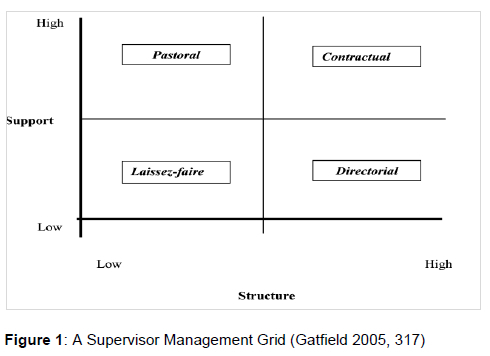
Gatfield (2005) put forward a supervisory management model with four quadrants that categorise the different styles of research supervisors into four groups, namely the Laissez-faire, Pastoral, Directorial and Contractual (see Figure 1).
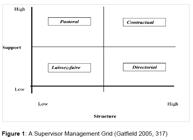
According to Gatfield (2005), the Laissez-faire style offers limited support, and it is low on structure, usually suiting research students who are low on motivation and management skills, and supervisors are non-interfering to a great extent. The Pastoral style is typically low on structure and high on support where the supervisor offers "considerable personal care and support but not necessarily in a task-driven directive capacity" (Gatfield 2005, 318). In the African context where cultures value human relationships and the relationship between the supervisor and students is valued, as maintained by Gumbo (2019), the Pastoral style appears to be particularly meaningful. This is because, in this cultural context, students value the socio-emotional support that is best achieved through regular face-to-face contact (Gumbo 2019).
The Directorial style fits self-directed research students who need less support but follow structure such as meeting deadlines on their own, with supervisor interaction being limited to ensuring compliance with structural aspects of the research project. The fourth style, the Contractual Style is high on both support and structure suits contexts such as where funding structures demand high research outputs and supervisors are required to graduate students promptly (McCallin and Nayar 2012).
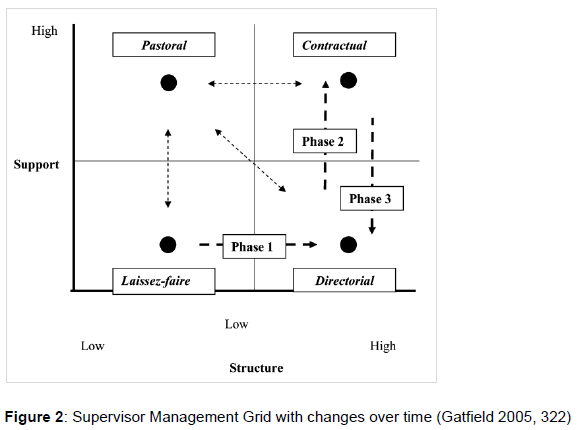
Gatfield (2005) maintains that no specific style is better than the other, but that the needs of the student, institutional objectives and preference of the supervisor determine which style one can use. A supervisor may move between the different styles with one student within the course of the research project, or use different styles when working with different students, at the same or different institutions.
Figure 2 shows, according to Gatfield (2005), how the initial stages of a research project may well be suited to the Laissez-faire style where students are still finding their feet and exploring literature to identify research gaps. Once the stage moves to the research methodology and design stages, the supervisor may need to play a more active role, hence the change to Directorial. However, once the student moves to data collection, the student may need support but also need to comply with institutional structural issues like timeline and use of correct procedures. Finally, in the write-up stage, though structure is needed, a degree of support reduces, hence the move back to the Directional style.
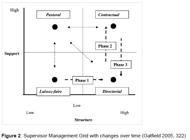
In reflection on the practice of postgraduate student research supervision and the types of students at the University of Namibia, one would argue that lecturers prefer to use the Directorial style for the most of their research supervision where they provide students with documents and guiding them on what is expected of them, but offer minimal support, mainly due to the heavy teaching workload and the large number of research students assigned to each lecturer. However, student research needs indicate that they require the use of the Pastoral style with more support needed. Only when deadlines approach when research projects ought to be submitted and graded, do the lecturers usually move to the Contractual quadrant. Therefore, there is a need for critical reflection on how to determine the supervision style used and how student needs and institutional contexts play a role.
FINDINGS
Practice of postgraduate student research supervision at the University of Namibia
It was indicated earlier that reference to postgraduate student research supervision could not be found in the key documents that govern research supervision at the University of Namibia, namely the Research Ethics Policy, Regulations and Guidelines or the University of Namibia Guidelines for Supervisors. This leaves supervisors to rely on their knowledge of supervision as students. This means that supervisors who received their postgraduate education at different institutions would have competing views and understanding of research supervision and sometimes opposing ideas on the expectations of students, regardless of the existence of guidelines. This has led to inefficiencies in student supervision processes. It has been experienced where a supervisor may submit a student's research proposal for departmental review, only for others to critique the submission, based on different traditions of research design followed by each.
As much as there are guidelines for supervisors, there is a need for supervision development programmes through which a common understanding and praxis can be developed among academics. The existing guidelines are predominantly regulatory, guiding on the administrative aspects and documentation tracking, while silent on the pedagogy of research supervision. The University of Namibia should however be lauded for offering academic development interventions in the area of research supervision such as the offering of a module through the Postgraduate Diploma in Higher Education (PDHE) and short course on Student Supervision in Research. These two programmes have potential to provide supervisors with the necessary skills and knowledge about student supervision, responsibilities, and roles of supervisors and supervisees in the research supervision process.
The course exposes participants to debates on research supervision and the procedural aspects of student supervision at the University of Namibia. However, it does not address the pedagogy of research supervision, meaning it does not conceptualise research supervision as a facilitation of learning through research and as discovery learning which requires the application of specific pedagogical approaches. Another way to enhance the quality of this course is by ensuring that it addresses the issue of context, where research supervisors learn about the contextual needs and uniqueness of universities in the region (international) where University of Namibia academics are likely to offer supervisory and external examination services.
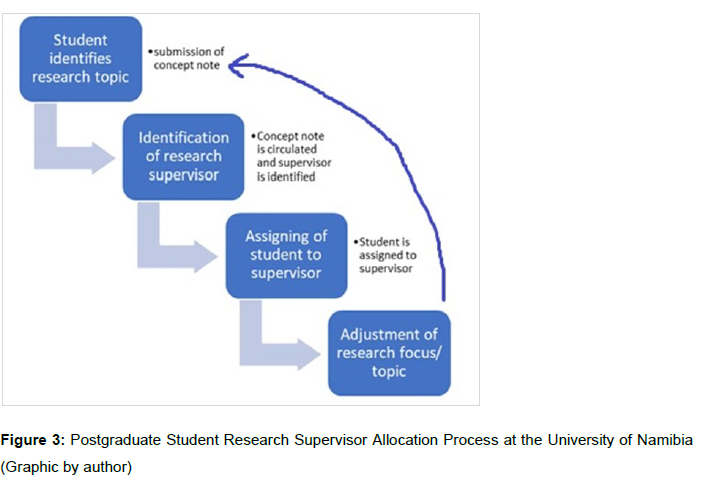
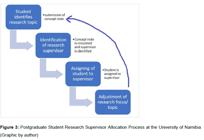
Additionally, to what has been discussed above, another aspect that would need to be strengthened in the course is the use of different supervisory styles, the choice of which ought to be informed by the needs of students, the institution or research environment, or by the structure of the supervision team. For example, when there is a main supervisor and a co-supervisor, one may assume a Pastoral style while another may adopt a Directorial style while dealing with the same student. But this should happen deliberately by design, rather than by accident based on supervisor personality or leadership temperament. Finally, the process of assigning students to supervisors also needs critical review. The current practice as illustrated in Figure 3 has a built-in weakness by overly assigning too much freedom to students in terms of their choice of research topics, which in turn leads to delays in the assigning of research supervisors, while inherently delaying the research process because the process of negotiating and adjusting the student's research focus consumes time.
Opportunities for improving postgraduate student research supervision
Examining the Research Policy at the University and the Guidelines for Supervisors, both of which are solid documents informing the structural and procedural aspects of research supervision. Opportunities for improving research supervision therefore lie elsewhere, such as defining postgraduate skills and competencies to be developed through research, introducing research supervision pedagogy - research as teaching, developing research groups and agendas at department levels, introducing technology to the research supervision process, and implementing student evaluation of quality of supervision.
Defining postgraduate research skills
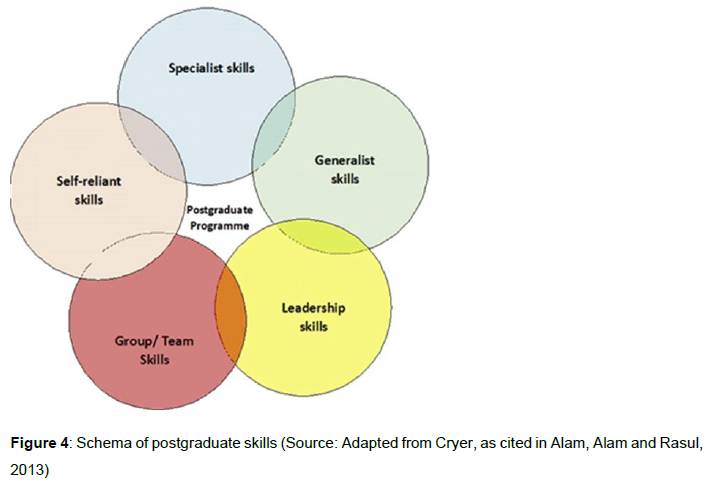
Research should not only be product focused where the only goal is to produce theses and dissertations to contribute to knowledge and elevate the institution's research profile. The current research agenda is dominated by demands on supervisors to achieve "higher research completion, research output and graduate student satisfaction" (Alam, Alam and Rasul 2013, 876). But research should also be a learning process, in itself, through which students develop key skills needed in the workplace, and their professional, social and personal lives. Examples of such skills are outlined in Figure 4.
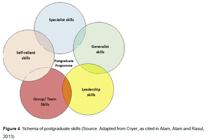
The idea is that research supervision should foster the development of skills outlined by Cryer in his schematic of postgraduate skills. Specialist skills are enhanced through the deepening of the student's expert knowledge about research; generalist or generic research skills enable the graduate to carry out future research independently complemented by self-reliant skills which reflect the development of self-directedness; group or teamwork skills are collaborative skills that require deliberate choice of pedagogical approaches, discussed next. The original Schema by Cryer only has 4 types of skills that postgraduate students need to develop. Given the fact that a growing number of postgraduate students are either already in leadership or aspiring to occupy leadership positions, the 'leadership skills" component is added to the schema to ensure that postgraduate studies emphasise the development of this skill. The focus could be on how to enhance the development of research-informed policies and agendas in the workplace or to improve practice and lead institutional transformation, informed by research.
Research supervision pedagogy
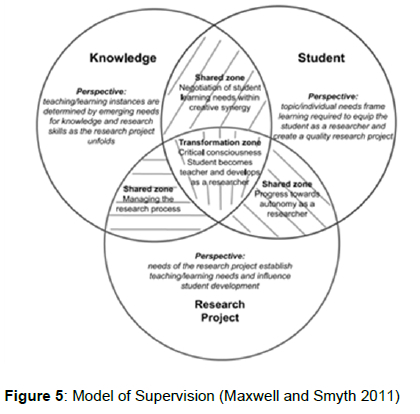
Research supervision pedagogy simply refers to the models or approaches used to facilitate the student researcher's pedagogic access through learning. This learning may involve deepening knowledge about a research area, enhancing research capabilities by understanding research techniques needed to accomplish the research project or strengthening self-reliance towards self-directedness. Figure 5 shows the research supervision model by Maxwell and Smyth (2011) that captures the key three areas that may inform pedagogical consideration for research education. The three areas of knowledge, student, and research project interact with each other, and their zones of interaction can inform the curriculum needs for the design of research supervision development.
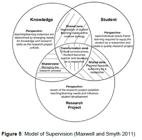
The knowledge zone refers to the skills needed by the student to carry out research, and the student zone captures the individual student competencies required to carry out research, while the overlap between the two involves the negotiation of the student learning needs in relation to knowledge required. The research project zone focuses on the student research development whereby its interaction with the student zone represents the student's progress toward research autonomy, while its overlap with the knowledge zone involves the management of the research process.
Essentially, this model can be used to inform the framework that research supervisors can use when carrying out pedagogical planning of research supervision education for their research students, and when reflecting on their practices. It can help in asking questions on where the focus should be, what the learning needs are, and how students can best be supported to achieve which goals.
The Power of feedback in supporting and enhancing Postgraduate Student Learning
A supervisor need to understand the importance of effective feedback provision in student supervision. The core of postgraduate supervision is feedback by the supervisor; but the big question is: How to achieve effective feedback in the supervisory process? Feedback provides an opportunity for the supervisor to guide the student into discipline-specific ways of thinking and writing while providing the student with concrete and situated assistance in the development of their writing and ideas (Morton, Storch and Thompson 2014).
Wellington (2013) provides more insight on the provision of timely, appropriate, and high-quality feedback to students. High quality feedback enhances student entry into the academic discourse community. Wellington (2013) classifies feedback into different categories as follows:
• Phatic comments: Aimed at maintaining good and academic social relationships between the supervisor and supervisee.
• Developmental comments: Aimed at helping the student to improve subsequent work about the current work. These could come in the form of either alternative, future, reflective, or informational.
• Structural comments: These comments refer to the structural organization of the work in terms of whole or sections, discourse level, paragraphs, and sentence levels.
• Stylistic comments: These comments consider the use and presentation of academic language within the thesis.
• Content-related comments: This includes comments on the content of the thesis in terms of appropriateness/accuracy or inappropriateness/inaccuracy.
• Methodological comments: These refer to comments on approaches used in the study, procedures, or process.
• Administrative comments: These refer to comments on logistical issues such as rules and requirements, and abidance to deadlines.
Supervisors need to classify their comments into different categories as suggested by Wellington (2013). This approach helps supervisors to provide feedback which is focused. Therefore, they will be able to provide effective and high-quality feedback, which is classified into phatic, developmental, structural, stylistic, content, methodological, and administrative comments.
Role of digital technology in postgraduate student research supervision at UNAM
Technology has been adopted for teaching and learning in many institutions of higher learning during COVID-19 (Magesa and Josua 2022). Technologies such as video conferencing tools can add value to research supervision by making supervisor-student meetings easier to schedule and increase their frequency by making such meetings economical. The other advantage of the use of technology is the possibility to implement group supervision and student-to-student interaction through virtual seminars. This is reflected in literature where Dai et al (2023) maintain that technology use in research supervision tends to be limited in the functional aspects such as facilitating the administrative and communicative activities, while strengthening logistical dimensions including scheduling meetings, sharing documents and tracking progress. At the University of Namibia, there is a combination of challenges, encouraging practices, and promising opportunities for using digital technologies in postgraduate research supervision. UNAM has a Research Policy that articulates the research skills to be developed among researchers and research supervisors (UNAM 2024), but there is no reference to the use of technology. The same Policy addresses the value of research infrastructure, but these are limited to tools for carrying out research such as laboratories, equipment, and other tools, with no reference to supervisory digital tools. As far as postgraduate research is concerned the policy only addresses the regulations regarding research agenda and publishing, with aspects of supervision missing. There is therefore a challenge from a policy perspective regarding guidance on research supervision in general and on the use of technology to enhance it. Encouraging practices entail the use of quality monitoring technologies such as originality checkers that supervisors use to guide students on the quality of their work. Anecdotal evidence on the use of technology in supervision is limited to email and chat platforms such as WhatsApp for communication and sharing of feedback and documents, the learning management system (Moodle), video conferencing tools for presentations and meetings, and cloud platforms such as Office365 and Google docs for collaboration and provision of feedback. Promising opportunities are provided by new developments in the form of the introduction of the new curriculum where most programmes have adopted a blended approach. This promises to enhance to adoption of digital technologies in postgraduate research supervision as all courses will have an online presence in the learning management system.
Adopting digital technologies in research supervision enables supervisors to make use of the services of research field or methodological experts to provide guidance and mentorship to students from wherever they may be in the world, thereby cutting costs to the institutions, and on the student, who may have otherwise been expected to contribute to travel costs. Halse and Malfroy (as cited in Dai et al 2023) highlight the challenge of supervisor availability resulting in a lack of timely communication and support for students as one of the motivating factors for the adoption of technology-enabled research support mechanisms and blended supervisory models. Therefore, according to Oehne and Bardua (2019), sharing information and knowledge, interacting with students and peers, producing, discussing, and reflecting on feedback, and managing the supervision process are some of the motivating factors for the use of technology in research supervision. Digital technologies such as eportfolios enable research students to document their writing process by housing the various historical versions of the thesis chapters and keeping records of engagements between students and their supervisors (Le 2012). The ePortfolios further cultivate opportunities for networking among researching students by sharing artifact to share with peers in the field, thereby benefiting from their engagement and feedback.
CONCLUSION AND RECOMMENDATIONS
Student supervision in research is an area of emerging interest and significance in higher education because of its strong relation to the success rate of institutional research output. Research as one of the main mandates of universities has taken on greater significance in the 21st century due to its association with innovation that the knowledge economy and 4IR needs. An analysis of the current research supervision environment at the University of Namibia has established that there are sufficient policy and guideline frameworks for guiding the procedural and regulatory aspects of research supervision. There is however room for improvement as far as the pedagogy of research supervision education and expansion of the "curriculum" reflecting the skills that ought to be developed in postgraduate students because currently the focus seems to be on simply producing research outputs in the form of theses and the graduation numbers. This article has proposed ways in which research supervision can be improved at the University of Namibia and beyond. Based on the reflection and the conclusion drawn, this article recommended that a research supervision framework should be designed for pedagogical planning of research supervision education for supervisees and supervisors. It is recommended that institutions of higher learning, through structures (policies, committees and technological as well as physical) culture (believes, norms, and values), and agency (individually and groups) should explore the use of technology to enhance student supervision through digital facilities, which has a potential to reduce cost and eliminate geographical distance. Student supervision in research is an area of emerging interest and significance in higher education because of its strong relation to the success rate of institutional research out-put.
Conflicts of Interest
The authors declare no conflicts of interest regarding the publication of this article.
REFERENCES
LITERATURE REVIEW
-
Alam, Firoz, Quamrul Alam, and M.G. Rasul. 2013. "A Pilot Study on Postgraduate Supervision." Procedia Engineering 56: 875-81. https://doi/org/10.1016/j.proeng.2013.03.210.
» https://doi/org/10.1016/j.proeng.2013.03.210 - Botha, Jan. 2017. "Doctoral supervision". African Doctoral Academy. SUN MeDIA: Stellenbosch.
- Boyer, Ernest L. 1990. "Scholarship reconsidered: Priorities of the professoriate". Princeton University Press, 3175 Princeton Pike, Lawrenceville, NJ 08648.
- Carmesin, Berit, Uta Hoffmann, Gunda Huskobla, and Sebastian Huster,(Eds.) 2015. "Doctoral supervision: Recommendations and good practice for universities and doctoral supervisors." UniWiND, 2015.
-
Chamberlain, Sussana. 2016. "Ten types of PhD supervisor relationships-which is yours." The conversation 12. Accessed November, 30, 2023 http://theconversation.com/ten-types-of-phd-supervisor-relationshipswhich-is-yours-52967
» http://theconversation.com/ten-types-of-phd-supervisor-relationshipswhich-is-yours-52967 -
Cuff, Ed. 2014. "The effect and importance of technology in the research process." Journal of Educational Technology Systems 43(1): 75-97. https://doi/org/10.2190/ET.43.1.f
» https://doi/org/10.2190/ET.43.1.f -
Dai, Yun, Sichen Lai, Cher Ping Lim, and Ang Liu. 2023. "ChatGPT and its impact on research supervision: Insights from Australian postgraduate research students." Australasian Journal of Educational Technology 39 (4):,74-88. https://ajet.org.au/index.php/AJET/article/download/8843/2026
» https://ajet.org.au/index.php/AJET/article/download/8843/2026 - Freire, Paulo. 1972. Pedagogy of the oppressed. Continuum: New York.
-
Gatfield, Terry. 2005."An investigation into PhD supervisory management styles: Development of a dynamic conceptual model and its managerial implications." Journal of Higher Education Policy and Management 27(3): 311-325. https://doi/org/10.1080/13600800500283585
» https://doi/org/10.1080/13600800500283585 -
Gumbo, Mishack Thiza. 2019. "Online or offline supervision? Postgraduate supervisors state their position at university of South Africa." South African Journal of Higher Education 33(1) 92110. https://doi/org/10.20853/33-1-2673
» https://doi/org/10.20853/33-1-2673 - Lee, Anne. 2008 "How are doctoral students supervised? Concepts of doctoral research supervision." Studies in Higher education 33(3: 267-281.
-
Le, Quynh. 2012 . "E-Portfolio for enhancing graduate research supervision." Quality Assurance in Education 20, no. 1, 54-65. https://doi/org/10.1108/09684881211198248
» https://doi/org/10.1108/09684881211198248 -
Magesa, Emmanuel, and Lukas Matati Josua. 2022. Use of technology to morph teaching and learning in higher education: Post COVID-19 era. Creative Education 13(3) : 846-853. https://doi/org/10.4236/ce.2022.133055.
» https://doi/org/10.4236/ce.2022.133055 -
Maxwell, Thomas W., and Robyn Smyth. 2011. "Higher degree research supervision: From practice toward theory." Higher Education Research & Development 30(2): 219-231. https://doi/org/10.1080/07294360.2010.509762
» https://doi/org/10.1080/07294360.2010.509762 -
McCallin, Antoinette, and Shoba Nayar. 2012. "Postgraduate research supervision: A critical review of current practice." Teaching in Higher Education 17(1): 63-74. https://doi/org/10.1080/13562517.2011.590979
» https://doi/org/10.1080/13562517.2011.590979 -
Morton, Janne, Neomy Storch, and Celia Thompson. 2014. "Feedback on writing in the supervision of postgraduate students: Insights from the work of Vygotsky and Bakhtin." Journal of Academic Language and Learning 8(1) A24-A36. Accessed at https://journal.aall.org.au/index.php/jall/article/download/308/183
» https://journal.aall.org.au/index.php/jall/article/download/308/183 - Muraraneza, Claudine, Ntombifikile Mtshali, and Thokozani Bvumbwe. 2020. "Challenges in postgraduate research supervision in nursing education: Integrative review." Nurse education today 89: 104376.
- Ngakane, B., and B. Madlela. 2022. "Effectiveness and policy implications of using WhatsApp to supervise research projects in open distance learning teacher training institutions in Swaziland." Indiana Journal of Humanities and Social Sciences 3(3): 1-10.
-
Oehne, Christian, and Sascha Bardua. 2019. "University Teachers' Perspectives on the Use of Educational Technology in the Research Supervision Process: A case-study on the supervision process of students during their final thesis at the Jönköping University in Sweden." Accessed https://hj.diva-portal.org/smash/get/diva2:1325845/FULLTEXT01.pdf
» https://hj.diva-portal.org/smash/get/diva2:1325845/FULLTEXT01.pdf -
Pearson, Margot, and Angela Brew. 2002. "Research training and supervision development." Studies in Higher education 27(2): 135-150. https://doi/org/10.1080/03075070220119986c
» https://doi/org/10.1080/03075070220119986c -
Poston, Lawrence, and Ernest L. Boyer. 1992. "Scholarship Reconsidered: Priorities of the Professoriate." AAUP Bulletin 78(4): 43. https://doi/org/10.2307/40250362.
» https://doi/org/10.2307/40250362 -
Qureshi, Rashida, and Neelofar Vazir. 2016. "Pedagogy of research supervision pedagogy: A constructivist model." Research in Pedagogy 6(2): 95-110. https://doi/org/10.17810/2015.38
» https://doi/org/10.17810/2015.38 -
Reid, Anna, and Stephen Marshall. 2009. "Institutional development for the enhancement of research and research training." International Journal for Academic Development 14(2): 145-157. https://doi/org/10.1080/13601440902970031
» https://doi/org/10.1080/13601440902970031 -
Schön, Donald A.1987. "Educating the Reflective Practitioner: Toward a New Design for Teaching and Learning in the Professions." http://psycnet.apa.org/record/1987-97655-000.
» http://psycnet.apa.org/record/1987-97655-000 -
Shandomo, Hibajene M. 2010. "The Role of Critical Reflection in Teacher Education" School-University Partnerships 4(1): 101-13. http://files.eric.ed.gov/fulltext/EJ915885.pdf.
» http://files.eric.ed.gov/fulltext/EJ915885.pdf - Stierer, Barry. 2008. "Learning to write about teaching: understanding the writing demands of lecturer development programmes in higher education." The scholarship of teaching and learning in higher education, 34-45.
-
Suhaimi, Nurafifah Mohammad, Shuzlina Abdul-Rahman, Sofianita Mutalib, Nurzeatul Hamimah Abdul Hamid, and Abdul Hamid. 2019. "Review on Predicting Students' Graduation Time Using Machine Learning Algorithms." International Journal of Modern Education and Computer Science 11(7): 1-13. https://doi.org/10.5815/ijmecs.2019.07.01.
» https://doi.org/10.5815/ijmecs.2019.07.01 -
Suparman, Ujang. 2021." The Implementation of the Online Thesis Supervision During Pandemic Covid-19 at One of Graduate and Postgraduate Programs in Indonesia." Aksara 22(1): 43-53. https://doi.org/10.23960/aksara/v22i1.pp43-53.
» https://doi.org/10.23960/aksara/v22i1.pp43-53 - Taylor, Stan.2018. "Enhancing practice in research supervision." Research Supervisors' Network.
- Taysum, Alison. 2015. Doctoral supervision. In Waghid, Yusef. "Dancing with doctoral encounters: Democratic education in motion". AFRICAN SUN MeDIA.
- University of Namibia. 2019. "Research ethics policy, regulations and guidelines." Windhoek: University of Namibia.
-
University of Namibia. 2023. "Strategic Plan: 2019 - 2024. Vision & Mission." 2021. Accessed December 12, 2023, https://www.unam.edu.na/about-unam/vision-mission
» https://www.unam.edu.na/about-unam/vision-mission - van Rooij, Els, Marjon Fokkens-Bruinsma, and E. Jansen. 2021. "Factors that influence PhD candidates' success: the importance of PhD project characteristics." Studies in Continuing Education 43(1): 48-67.
-
Wellington, Jerry. 2013. "Searching for 'doctorateness'." Studies in Higher Education 38(10): 14901503. https://doi/org/10.1080/03075079.2011.634901
» https://doi/org/10.1080/03075079.2011.634901 -
Zvavahera, Promise, and Fine Masimba. 2019. "The use of information and communication technology in supervising open and distance learning PhD students." Ukrainian Journal of Educational Studies and Information Technology 7(3): 32-41. https://doi.org/10.32919/uesit.2019.03.04
» https://doi.org/10.32919/uesit.2019.03.04