Staff perspective of factors influencing masters and PhD student enrolment: a case of public universities in Kwazulu-Natal, South Africa
Abstract
The dynamic higher education landscape and government recognition of universities' role in contributing towards a skilled workforce and socioeconomic development increased the demand for masters and doctorate enrolment at universities. There are however various factors that have resulted in a shortfall in enrolments at the postgraduate level. This study therefore aims to explore the environmental factors influencing the enrolment numbers of masters and doctorate students at public universities in KwaZulu-Natal Province, South Africa. The study used a purposive non-probability sampling procedure to select and interview four research managers and two marketing personnel using an in-depth semi-structured interview schedule. Thematic analysis was employed to analyse views and discover patterns for theme development. The findings indicate that student background, institutional environment, and political, social and economic factors have an impact on masters and doctorate enrolments at universities. Interestingly, student needs, expectations, and service preferences were highlighted as some of the factors that influence enrolment at the postgraduate level. In light of the findings, it appears that universities will not be able to contribute significantly towards the developmental agenda of the country through high-quality research and skills development. It is recommended that a formal environmental scanning framework is established to help universities formulate effective responses to any external environmental threats and institutional weaknesses.
environmental scanning; macro-environmental factors; micro-environmental factors; masters and doctorate enrolments; postgraduate education
INTRODUCTION
Universities are considered producers of knowledge (Sing, 2020) globally. Mnisi, quoted in Mail and Guardian (2021), argues that there would never be knowledge creation without postgraduate programmes at universities. Mnisi's argument is corroborated by the National Development Plan (NDP) document which indicates that knowledge production at universities is measured by a mixture of input and output variables such as master's and doctoral enrolments, graduation rates, the percentage of doctoral graduates to permanent staff and accredited publication output of graduates (National Planning Commission, 2012). Literature highlights that "postgraduate programmes are considered conduits through which universities develop research capacity and also generate high skills needed for a functional economy and in addressing complex issues such as global financial recessions, climate change, poverty alleviation and more" (Mutula, 2011). As a result, the National Planning Commission (NPC), whose NDP Vision 2030 document became government policy proposes strategies and set targets aimed at increasing enrolments and postgraduate levels (Department of Higher Education and Training, 2020). These targets included (i) a 25 per cent increase in postgraduate enrolments at South African institutions of higher learning by 2030; (ii) an increase in the number of PhD graduates per year to 100 per million people by 2030; and (iii) to increase the academic staff who hold a PhD by 75 per cent in 2030. To support these targets, the South African government through the Department of Science and Innovation, has implemented a funding framework for students and staff members pursuing further studies. The funding framework is administered by the government agency (NRF) through initiatives such as Scarce Skills, nGAP, and Future professors' programmes. There are other funding sources such as the Water Research Commission (WRC), Technology Innovation Agency (TIA) and National Institute for Humanities and Social Sciences (NHISS) who support students in different areas of specialization (Luruli, Wangenge-Ouma, and Mgwebi 2022).
Despite the policy initiatives aimed at growing and developing postgraduate education, enrolments at South African universities have actually declined, falling from 16 per cent in 2016 to 14.5 per cent in 2021 (Kuluvhe and Netshifhefhe, 2023). Havenga and Sengane (2018) claim that "the situation in South Africa has discouraged prospective postgraduate students from enrolling for postgraduate studies, particularly medical sciences students". Kieu et al. (2020) blame the challenges posed by social and economic forces in the regions where these universities are located. Camilleri (2020) concurs that macro-environmental factors, particularly political and socio-economic factors, influence the higher education environment. The external environmental factors inform students' changing demands (Hooley et al., 2017) and their interest in postgraduate education. Studies addressing postgraduate education focus on enrolment trends, student challenges and postgraduate throughput, with a lack of focus on the influence of environmental factors on postgraduate student enrolment. It is, therefore, significant to explore the influence of macro environmental factors on masters and doctorate enrolment numbers.
Furthermore, this article argues that the factors influencing the enrolment numbers at masters and doctorate levels are complex and diverse, and this multidimensionality is not adequately explored in postgraduate education literature. Some studies focused on factors that influence postgraduate students' intention to stay in higher education and do not cover university staff perspectives regarding internal and external environmental factors that influence postgraduates' enrolments.
Due to the rapid growth in the postgraduate sector (Adefulu eta., 2020), empirical studies are essential to understand this higher education segment, which has been identified as a national priority in South Africa. The goal of this study is to explore the environmental factors influencing the enrolment numbers of masters and doctorate students at public universities in KwaZulu-Natal Province, South Africa. A decline in enrolment for master's and doctorate programmes at universities creates substantial issues and has a negative impact on knowledge building, high-level research, and the development of specialised skills required for economic growth. Therefore, to develop strategies that might improve masters and doctorate enrolments at universities, it is crucial to comprehend the effect of internal and external environmental factors on postgraduate education.
To address the study aim, this article begins with a brief overview of environmental scanning and its components and a summary of available empirical evidence regarding factors affecting postgraduate enrolments at universities. After that, the article explains the research methods used to collect data, discussion of findings, recommendations, and the study's contribution.
Scanning the higher education environment
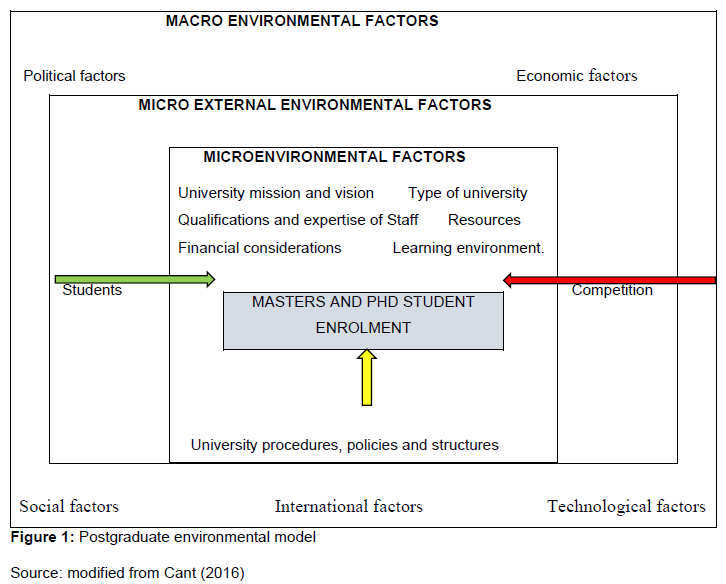
The environment in which universities operate is dynamic, and institutions of higher learning need to monitor the environmental factors that could potentially affect the higher education sector's ability to contribute to knowledge production. The most effective way to monitor the dynamic higher education environment is to scan the environment. Abu-Rahma and Jaleel (2019) and Gray (2022) describe environmental scanning as the process of gathering, analysing and dispensing information for strategic decision-making. Environmental scanning components are internal and external to the organisation and require constant monitoring (Cant, 2016). Environmental scanning provides information that helps organisations identify potential threats, opportunities, strengths and weaknesses. Literature indicates that scanning the environment is essential to enable decision-makers to predict postgraduate education's future position based on current trends (Abbate and Cesaroni, 2014). Figure 2.1 depicts the proposed model that this study adopts.
Macro environmental factors
Macro-environmental components include political, economic, social, technological and international factors (Cant, 2016). The influence of macro-environmental factors presents both opportunities and threats for universities (Filip, 2012a).
Political factors
The political environment influences the development of laws and policies that govern the higher education sector. As a result, when South Africa entered a new political era in April 1994, the government undertook several actions to redress the imbalances created under the apartheid political environment. The measures influenced by political agendas resulted in a move from a primarily white elite higher education system to a mass education system (Van der Merwe, 2004 and Roberts, 2012). Firstly, the National Plan for Higher Education identified the need to increase postgraduate output as a priority for the sector (Department of Education, 2001). Consequently, the government-initiated setting of enrolment, performance, and programme targets for postgraduate education based on national goals. Reports reveal that the NDP targets to increase African women enrolment numbers at the doctorate level, have 25 per cent of university enrolments at the postgraduate level, and produce more than 100 doctorate graduates per million people (National Planning Commission, 2012). To grow postgraduate qualifications, the government has tried to intervene through research output block grants (Council on Higher Education, 2018) and various funding mechanisms. Perhaps the government should also consider supporting the promotion of their universities by providing relevant information about their universities locally and internationally (Mushketova, Bydanova and Rouet, 2018). All the policy documents cited above affirm Mogaji, Maringe, and Hinson's (2020) assertion that South Africa's higher education is regulated and monitored by the government and other stakeholders.
Economic factors
As an emerging economy, South Africa strives to build an international standard higher education system (Sehoole and De Wit, 2014 and Chasi, 2020). Mahlangu (2019) indicates that universities now understand their role in economic growth. As a result, there are various initiatives that South Africa has embarked on to intensify the contribution of doctoral graduates to national economic growth and innovation (Cloete, Mouton, and Sheppard, 2015b). However, financial constraints are hindrances that cause doctorate students to drop out and seek employment before finishing their studies (Herman 2011). Various studies revealed that financial matters were frequently cited as an influential variable when deciding where and what to study at the postgraduate level by students across the world (Dye, 2013; Mlambo, 2017; and Adefulu et al., 2020). Ndebele and Ndlovu (2019) believe that the unemployment situation in South Africa could be an opportunity to encourage unemployed graduates to attain higher postgraduate qualifications to upgrade their knowledge and skills for better job prospects.
Social factors
According to the Department of Higher Education and Training (2018), the major challenge facing South Africa is the drop in participation and progression of students, particularly black South African students. Wakeling and Kyriacou (2010) explain that most students do not progress immediately from a first degree to a higher degree due to different patterns of entry by socioeconomic class. In South Africa, it is challenging to recruit undergraduates for postgraduate studies because most of the students enrolled in the university system are black students who are breaking new grounds for their families (Herman, 2009). Conversely, a pertinent finding by Adefulu et al., (2020) depicts that Nigerian society exerts pressure on graduates to pursue postgraduate studies if they are not in employment after obtaining undergraduate qualifications. Role models who have walked the same path influence how students view postgraduate studies (Mavundla, 2021).
A study by Carroll, Ng, and Birch (2013) revealed that poor health has contributed to students' withdrawal from postgraduate studies. This finding is supported by the Department of Higher Education (2017), which states that health issues contribute to education. Another significant finding discovered that postgraduate students drop out due to academic demands, limited time, financial challenges, poor supervision, and challenges in personal life (Mouton et al, 2015).
Technological factors
Online learning at universities appears to be one of many Information Computer Technologies (ICT) enhanced practices for undergraduate and postgraduate programmes. E-learning includes using e-mails, online journals, networked libraries, and other institutional administrative systems for online registration, student performance databases, etc (Bagarukayo and Kalema, 2015).
Universities benefit from technology as follows:
• Access to information and systems,
• Integration of information communication technology in teaching and research,
• Creation of flexible programme delivery systems through the use of e-mail, blackboard, Moodle, webinars, blogs and Turnitin computer programmes,
• Creation of digital literacy support networks for students,
• Initiating institutional revitalisation and repositioning through new media (Mashile and Pretorius, 2003; Mutula, 2011; Ngcamu, 2019; Camilleri, 2020).
Therefore, technological advancements are making university education more accessible to traditional distance education and postgraduate students.
International factors
Internationalization and partnerships in the higher education sector have become important globally. As a result, South African universities have exchange programs with European and North American universities (Chasi, 2020). However, these exchange programs are not beneficial due to imbalances in the exchange process because most South African students cannot take up space due to financial constraints (Chasi, 2019). Furthermore, The National Plan for Higher Education proposed increased recruitment of students from the Southern African Development Community (SADC), especially at the postgraduate level. In 2016 South Africa attracted 69 381 international students (Department of Higher Education and Training, 2018).
Micro-external environmental factors
The micro-external environmental factors include students, competitors and university suppliers.
Students
Students are considered primary customers of higher education (Ostrom, Bitner and Burkhard, 2011). Different types of students enter higher education. These types are career learners, socio-improvement learners, leisure learners, and ambivalent learners (Summer, 2007). Mavundla (2021) indicates that personal motivation influences postgraduate enrolment. Similarly, career planning, career decision-making, career confidence and motivation influence postgraduate enrolment (de Villiers, 2019). Khauoe and Fore (2020) indicate that students' inability to balance work and studies, poor time management and student motivation are some of the factors that have an impact on the throughput rate of postgraduate students.
Competitors
Competitors are organisations that offer similar services and compete for business patronage of the same consumer (Cant, 2016). The higher education landscape consists of both public and private institutions. The public higher education sector in South Africa has 26 public universities (Council on Higher Education, 2018) that compete for the same calibre of students at the postgraduate level. As a result, for universities to remain competitive, various faculties and departments should ensure that the curriculum of postgraduate education meets prospective students' expectations and addresses the problems of the global environment (Herman, 2012).
Microenvironmental factors
The microenvironment consists of factors within the organisation (Cant, 2016). Hadi and Huhammad (2019) point out that institutional factors directly influence postgraduate education. The application process for postgraduate programmes is viewed as tiring and requires determination, confidence and motivation by prospective students (Dominguez-Whitehead 2015). The provision of relevant information to prospective postgraduates (Adefulu et al., 2020) improves courage and student motivation (Dominguez-Whitehead, 2015).
Findings in a study by Khauoe and Fore (2020) indicate that supervisor/student relationships and poorly defined research areas are the main factors that affect postgraduate throughput. In addition, a study by Adefulu et al., (2020) shows that university accommodation, lecture halls, and libraries were cited as essential by postgraduate students as these determined their service delivery experience. The number of staff with doctorates impacts the supervisory power (Breier and Herman, 2017). It is for this reason that the NPC proposes that the number of university staff members with doctorates should be increased to 75 per cent (Department of Higher Education and Training, 2020).
Furthermore, findings reveal that the university's physical location is one of the factors that influenced prospective postgraduate students' decision to enrol for postgraduate studies (Adefulu et al., 2020).
METHODOLOGY
In an endeavour to comprehend the influence of environmental factors on masters and doctorate enrolment, the study adopted exploratory research to enable the researcher to provide explanations of ambiguous responses (Zikmund et al.,2011). Qualitative methods permit the researcher to probe more deeply to uncover unexpected findings and reactions (Hair et al.,2016) about the influence of internal and external factors on postgraduate enrolments.
An exploratory research design was deemed a suitable approach as the aim was to source meanings from participants. The researcher used cluster sampling to choose the province of study and public universities that offer postgraduate degrees to serve as representative samples. Of the four public universities in KwaZulu-Natal, the Mangosuthu University of Technology failed to meet the inclusion criteria because it does not offer Master's and Doctorate degrees. The advantage of cluster sampling is that it is cost-effective, quick and easy (Hair et al., 2016). The researcher's experiences with two of the selected public universities as a postgraduate student informed the university's choice. Equally important, the three universities in KwaZulu-Natal represent the three types of South African public university sector known as traditional, comprehensive, and university of technology as per the higher education policies (Council on Higher Education, 2018).
Purposive sampling was deemed suitable as the focus was on certain special features and characteristics that are of interest to the researcher (Bhattacharyya, 2012; Leedy and Ormrod, 2010; Etikan, Musa andAlkassim, 2016). Maximum variation sampling was used as this type of purposive sampling technique enables the researchers to compare similarities and common trends amongst different types of universities. Four research managers and two marketing personnel were in the best position to answer the research questions. According to Farrugia (2019), qualitative sampling involves a small sample for participation, while the data collected can be extended with many hours of participant interviews. Castro et al., (2010) explain that in qualitative research, the focus is on the depth of the analysis of research constructs and not the small number of participants. Therefore, for this study, the researcher interviewed six participants from the three selected public universities.
The study employed a survey method. A pre-determined interview schedule was used to provide interview guidance and obtain the type of information sought. A voice recorder was used to gather information during the semi-structured interviews with the selected universities' personnel. Informed consents were sought from the participants and granted. Confidentiality and anonymity were emphasized to the participants.
Thematic analysis is considered suitable for this article and research that seeks to discover themes using interpretations (Alhojailan, 2012) during the qualitative data analysis. The thematic analysis focuses on identifiable patterns (themes) within the texts while minimally organising and describing data sets in detail (Braun and Clarke, 2006). The study ensures that the themes and phrases used in the text answer the research questions (Alhojailan, 2012; Hair et al., 2016; Kolb, 2018). For the coding process, the researchers listened to the recordings and summarised the transcripts to ensure the overall content and context were understood.
Thereafter, interrelated units of meaning were grouped into segments and codes were assigned to each segment. The coded segments were used to search for themes by identifying word repetition, similar phrases, patterns, relationships and differences between sub-groups. Similar themes that answered the research questions were then collapsed together, and those that did not have enough data were discarded. Lastly, a detailed analysis was done to establish what the theme says and its focus to help decide on an informative name for the theme and identify the sub-themes. Specific procedures were employed to check for the finding's accuracy to ensure the study's credibility. The following section presents the results of the study.
FINDINGS AND DISCUSSION
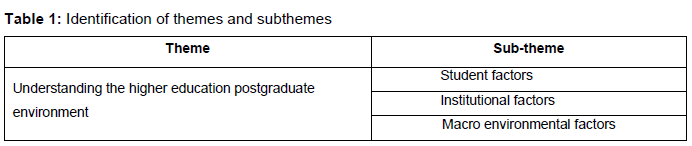
The results were analysed and grouped into a main theme and three sub-themes, as shown in Table 1. In some instances, the participants are quoted verbatim.
UNDERSTANDING THE HIGHER EDUCATION POSTGRADUATE ENVIRONMENT
Higher education environment is continuously changing due to unpredictable forces. Consequently, an in-depth analysis of all the internal and external factors that define the environmental context in which educational institutions activate is required (Filip, 2012b). In other words, universities' sound knowledge of the internal and external environment is highly essential for understanding the enrolment trends for masters and doctorate programmes. This theme assesses the higher education postgraduate environment from the perspective of research managers and marketing staff at three selected universities within KwaZulu-Natal. Public universities' survival and growth depend on the universities' ability to monitor and adjust to the demands of the postgraduate education environment. The findings extracted from the interview resulted in identification of one theme with three subthemes: student factors, institutional factors, and macro environmental factors.
Subtheme 1: student factors
Mlambo (2017) states that universities should focus on analysing the student's needs and wants to ensure student satisfaction. Gilmour and Soudien (1994) and Soudien (2007) (cited in Nkambule, 2014) explain that students from previously disadvantaged schools remain educationally disadvantaged and this results in various challenges for those who want to pursue higher education studies. Additionally, the Social and personal problems of students influence postgraduate enrolment (Backhouse, 2009).
From the interviews, the researcher uncovered that the student's background, motivation, academic challenges, student needs, expectations, and service preferences are an essential requirement to understand student enrolment trends at the postgraduate level.
Student background
Poverty is a significant constraint on many students' ability to obtain masters and doctorates due to socio-economic backgrounds. They are under massive pressure to leave university and get a job as soon as possible (Herman, 2009). In terms of the student's background, for the UNIZULU, the researcher uncovered that most people were born during the apartheid era when there were limited opportunities for black South Africans.
"Most black South Africans want to see their children getting employment after undergraduate qualifications. Remember, in some families, no one is employed. Another issue, there is a lack of understanding of what a postgraduate qualification is. Some of the parents were not exposed to opportunities before 1994. Therefore, the students themselves come to university without any knowledge of postgraduate qualifications and their importance." (UNIZULU # P6)
Equally, another participant from DUT reveals that most of the students enrolled in their university are from marginalised communities.
"Most students at our institution are from marginalized communities and the working class. That is a barrier to enrolment for students from disadvantaged schools "(DUT #P4)
Student motivation
In terms of the student's motivation to study, for the UNIZULU, the researcher uncovered that most undergraduate students lack the motivation to study.
"Undergraduate students lack the motivation to further their studies. Even when you ask the final year undergraduate students if they have applied for honours or masters, they say no. The only thing that motivates students to come for postgraduate qualification is unemployment. It is only then that they want to improve their qualifications. But once they get employment, they do not continue with their studies." (UNIZULU #P6)
Student beliefs, attitudes, perceptions and needs
For the UKZN, the reasons cited regarding student factors appear to be different from those that face the DUT and UNIZULU. The researcher found that many undergraduates struggle to return because of the perception of postgraduate qualifications as academic careers. Of interest, the researcher uncovered that students who do return do so due to the challenge they face getting employment.
"In the commerce field, most of our students see honours', masters and doctorates as academic careers. So, they want to finish studying and make money as they get employed by businesses. That is the reason they do not return. We often get students coming to those levels because they cannot get hired. But most are not interested in research" (UKZN #P1).
While it can be deduced from the above narrative that students prefer the world of work than to return for a postgraduate study, participant 2 from the UKZN, however, hinted that students opt to enrol for their postgraduate study through other universities. The participants hypothesised that this might be due to the postgraduate study's difficulties at UKZN.
"Postgraduate students feel it is better to do it through UNISA. I am not sure why. The few people (5 to 8) I have spoken with feel it is too challenging to do postgraduate studies with UKZN." (UKZN #P2).
During the analysis of the UNIZULU participants' responses, the researcher uncovered that students have service preferences other than what is offered by the university. The participants provided input in the narrative below.
"Students prefer to be taught than to be required to go through the extensive process of writing dissertations and theses. Even in coursework masters, students do not like the part where they must do a mini dissertation. Others even drop out of university because they could not complete the research aspect of the course work masters" (UNIZULU #P6)
Student experience
While the above narrative suggests that students prefer traditional teaching and learning, another participant reveals that student experience at the undergraduate level discourages students from progressing with their studies. In the participants, own words:
"University culture and disciplinary practices at the undergraduate level are alienating to students. You find that the focus is on teaching, learning and assessments. This traumatises the students because students' lives become about academic work with little room for socialisation. By the time students graduate, they want nothing to do with university" (UKZN #P1)
Work commitments.
Students' inability to balance their jobs and studies has consequences for postgraduate education enrolment (Backhouse, 2009). For the DUT, participant 3 illuminated the following:
"Some students are working especially those who want to pursue doctoral studies. Therefore, it becomes challenging for them to find time for research degrees. Conducting a research study requires time. That is why they end up taking longer to finish" (DUT #P3).
These findings are in line with those of Hajar and Mhamed (2021), where most participants indicated that they had no challenges balancing their time between their research studies, family and work commitments. The findings indicate that students do not always experience similar challenges. Therefore, understanding each student's psychographics is crucial for understanding individual student needs, motivation and goals.
Subtheme 2: Institutional and academic factors
The institutional environment consists of functional areas within the university that affect its ability to serve its stakeholders effectively. Studies conducted at historically black universities show that research supervision is poor, and this results in postgraduate students dropping out or taking longer to complete their studies (Wadesango and Machingambi, 2011; Cekiso et al., 2019; Costa 2019; Khauoe and Fore, 2020). In analysing the institutional environment's content, the core areas extracted are the status of the university, supervision, and funding.
Supervisory capacity
The status of research at universities of technology was low due to an absence of research expertise, inadequately trained supervisors, and supervisors working outside their fields of specialisation (Biermann and Jordaan, 2007 cited in Mutula, 2011). As gathered from the DUT participants, it emerged that the postgraduate programmes are oversubscribed due to the supervisory challenge which is responsible for the limited spaces in some of the faculties.
"Enrolment is skewed; some of the faculties are oversubscribed because they went all out on a recruitment drive and marketing campaign. They offered free masters, but some faculties did not have the supervisory capacity." (DUT #P3 and5).
The participant from the University of Zululand also echoed the challenge of limited supervision. This is reflected in the narrative of the participant.
"Yes, they are full. We say that they are full because we do not have enough supervisors, and sometimes the supervisor would have reached the maximum number of students to supervise. Some students want to focus on topics that fall outside the supervisors' scope or area of specialisation; students will go to other universities" (UNIZULU #P6).
These findings support Jowi (2021), who claims that African universities (Ghana, Nigeria and South Africa) have a shortage of qualified staff, which impacts supervision. The study's findings and literature suggest that African universities do not view postgraduate studies as essential; hence, there are no aggressive initiatives to increase supervisory capacity.
University procedures, policies, and support systems
The participants from the UKZN did not share the above sentiments of limited supervision. In the participant's opinion, the student's application timing was the challenge of finding a space, as not all programmes are full. According to the participants' statement, some of the students apply for programmes very late.
"Not all programmes are full if more people can apply. Suppose those who have the right requirements can apply. The challenge for postgraduate studies is that most people apply very late, after the closing dates. Most people think they can come in January with their degrees and apply whilst the closing date for most postgraduate applications is September" (UKZN #P2).
The perceived conditions of students from disadvantaged socio-economic backgrounds could explain the DUT's desire to allow students with weaker academic abilities more opportunities. However, the participant posits that the absence of cut-off criteria for student enrolment was responsible for student attrition at the postgraduate level.
"DUT has tried to broaden its horizon by focusing on students from historically disadvantaged backgrounds. It was done as follows: invitations have been extended to applicants from previously disadvantaged backgrounds. Secondly, there were no academic cut-off criteria; most universities have a minimum requirement that you must achieve at undergraduate like 60/65 per cent. At the faculty of Management, we allow average students to enrol, most students from previously disadvantaged backgrounds are not A/ B students. As a result, some of them end up not completing their qualifications or giving up" (DUT #P5)
Similarly, another participant at DUT blamed the low throughout on the university policy of accommodating weaker students.
"Throughput is extremely low due to several factors; like that pre-registration process we used to have to accommodate weaker students to put up a research proposal has been done away with, which is to our disadvantage. Students leave when they cannot get their proposal approved" (DUT #P3)
Another participant claimed that the DUT postgraduate studies are poorly managed due to the operational research management system shortage. Also, restrictions on library access and campus closing affected the student's throughput.
"Some students have spent four years without coming up with a topic. Changes in rules, that masters must be three years full-time and five years part-time. Postgraduate studies are poorly managed because the university does not have an operational research management system. Needing a student card to access the library, and closing down the campus have a negative impact on postgraduates who need to use the resources. There was a talk about putting an ombudsman and advisory committee for supporting students, but that was moved. Faculty people are not trained to provide support for research and handle what students are asking. To gain access to the library is difficult if you are not registered. Having people who have not been trained weakens the system" (DUT #P4).
Unlike the DUT, the participant from UNIZULU faulted the low throughput rate entirely on the laziness of the supervisor(s). In the participants, exact words:
"Laziness from the supervisors leads to students taking longer to complete; thus, they get discouraged. For instance, some postgraduate students take four to five years to complete their masters and by the time they finish, they are no longer interested in studying" (UNIZULU #P6).
The finding that postgraduate students take longer to complete their studies is consistent with the finding by IseOlorunkanmi et al., (2021) where Nigerian postgraduate students revealed that they end abandoning their studies due to prolonged academic programmes. The implication of student attrition at the postgraduate level is that fewer advanced skills are being produced, which may lead to a lack of innovation, which results in further underdevelopment in African countries.
Academic challenges
Postgraduate students face problems in writing, searching and presenting original work (Biermann and Jordan 2008 cited in Mutula, 2011). The claim corresponds with the responses that universities in KwaZulu-Natal attract students who possess challenges with academic writing at the postgraduate level.
"Some of the students struggle with academic work. Academic writing is a major challenge. Remember, these students come from a school system that has trained them to reproduce textbook content for them to pass. Now, it becomes a challenge for the students to present original work and make academic sound arguments. The matter is further exacerbated by the fact that DUT mostly offer research masters and students struggle to work independently. This discourages student from applying for research degrees" (DUT #P4 and #P5)
During the analysis of the UKZN and UNIZULU participant responses, the researcher uncovered similar opinions to the DUT. It was extracted that many of their students are from underprivileged schools, and thus participants infer that this may cause challenges at the postgraduate level.
"Poor academic writing has an impact on students; hence they do not proceed to postgraduate studies. Even lecturers at our MBA year one classes have to start teaching about referencing and how students should write at the masters' level" (UKZN #P2).
"For undergraduates, we mostly attract students from rural schools. So, most undergraduate students who progress to postgraduate studies are not quality graduates. They struggle with critical thinking and understanding research terminology." (UNIZULU #P6)
Respondents in a study conducted in Nigeria indicated that their competencies in academic writing were average (Desmennu and Owoaje, 2017). The findings of both studies indicate challenges with the education systems of African countries.
University type
For the DUT, it emerged that the university type also influences postgraduate enrolments.
"We are not a traditional university. We are a UOT, and UOTs are not widely known for research." (DUT #P5).
"I would say DUT is not well known for postgraduate qualifications, because it is a university of technology. Research is known in traditional universities. So students prefer to apply for postgraduate studies at traditional universities. Hence, we created relationships with other universities; we wanted to bridge that gap"(DUT #P4).
Lack of Funding
Challenges with self-funding and the risk of financial exclusion posed a serious challenge at the postgraduate level (Mavundla, 2021). At UKZN, the matter of postgraduate funding was raised. This is captured in the statement below.
"Most of our postgraduate degrees are self-funded, perhaps if they could be funded. This would really encourage undergraduates to come back for postgraduate degrees." (UKZN #P2).
This study's findings are consistent with those of a study conducted in Nigeria by Desmennu and Owoaje (2017), in which a lack of funding was mentioned as a barrier to the successful completion of postgraduate research studies. Financial support not only helps students pay fees but also helps students pay for essential services like statisticians, language editors, study material and other services required to complete postgraduate qualifications. Issues raised regarding funding suggest that governments of African countries need to invest more in their country's higher education system, particularly postgraduate research degrees.
Student recruitment and retention challenges
Universities must ensure a transparent, easily accessible and sought-after transition from undergraduate to postgraduate studies (Council on Higher Education, 2009). Student recruitment efforts begin at the undergraduate or Honours level to ensure high retention of quality students for postgraduate studies (Herman, 2012). However, the retention of talented students is not essential at African universities (Nwedu, 2019). Student completion and retention in higher education studies depend on how universities respond to student's needs and expectations (Guilbault, 2018). It, therefore, becomes increasingly important to know the challenges the university faces in retaining students. The participants from the three universities provided input in the narrative below.
The UKZN participant pointed out the university's low postgraduate enrolment as evidence of poor awareness challenge to buttress his position.
"Our numbers were not more than 981 last year, I am not sure if it was a masters or PhD. Enrolments were very poor. It was scary, especially knowing that we are a very large university. More awareness of postgraduate degrees is needed." (UKZN #P2)
Participant 5 and Participant 6 indicated that student recruitment and retention for postgraduate studies were not the focal point.
"There is no recruitment of postgraduate students in my faculty". (DUT#P5)
"No, there is no retention or progression strategy for undergraduates. It is normally the students decision to comeback" (UNIZULU #P6).
Subtheme 3: Macro environmental factors
Filip (2012a) reveals that educational institutions develop their activities under the general influence of some significant external forces that could present both opportunities and threats. These external forces form the macro-environment, which is structured into demographic, economic, social, political and technological environments (Cant, 2016). Camilleri (2020) claims that there is a poor response by universities regarding political, socio-economic, and technological environmental changes. Therefore, it was critical to know how the macroenvironment variables influence the postgraduate education environment at the selected universities.
The researcher extracted four macro-environment forces, such as economic, social, political and technological variables from the participants.
Economic
Filip (2012a) and Strydom (2014) noted that economic variable comprises factors that influence people's living standards. This includes their purchasing power and structure of consumption expenditures. Therefore, the authors advise that universities analyse a market's attractiveness by using a series of macroeconomic indicators, such as the levels of economic growth, average income and income distribution on various customer groups, inflation rate, and or unemployment. In line with this, the researcher uncovered from the interview transcript that the student's economic outlook was not all favourable. One of the DUT participants, for example, voiced that students are sitting with debt due to economic challenges.
"Students sitting with debt for some years, and students take longer than normal to graduate, timelines, we ask for people who should be economically active to come back to study full time, it's not easy" (DUT #P3).
The participants from the UKZN shared similar thoughts as DUT participants by noting the following:
"Some postgraduates are not working in Durban; you know we are based in Durban and Pietermaritzburg only. Therefore, would find it difficult for students to quit their jobs and come to Durban for postgraduate studies" (UKZN #P2).
In a different direction of comment to the above participant, another of the DUT colleagues noted that factors such as self-development and desire for work promotion were the motivating factors for why some of the students sought postgraduate studies.
"From the comments I get from students, I would not say it's macro-environmental variables. Students come for self-development. Some come because they want to get a promotion at work" (DUT #P4).
Social
Another macro-environmental variable extracted from the transcript analysis is the social state of the students. The researcher uncovered that some of the students reside in rural areas. Therefore, they struggle with connectivity and access to emails. Equally, the travel distance from the student's location to where the institution is situated also presents a challenge.
"Some students are based in rural areas; therefore, it might be difficult for them to have access to emails if they are based in certain parts of the country. Others cannot travel to Durban to attend evening classes or block classes" (UKZN #P2).
A study in Nigerian by Desmennu and Owoaje (2017) revealed that irregular electricity posed a challenge to completing postgraduate research studies. The findings of the two studies imply that the regions where African universities are located threaten the increase of research degrees. The factors mentioned above symbolise the complex socio-economic terrain universities operate under in Africa.
Political
Friesenhahn (2014) believes that the quality of education was compromised to pursue a political goal, thus creating a mass education system. In participant's 4 own testimony, the Department of Higher Education's benchmark may be responsible for the limited space for postgraduate studies.
"The challenge here is that the Department of Higher Education benchmark is that the total number of postgraduate students has to comprise 5 per cent of your total student enrolment, but we are way short of that "(DUT #P4).
Centre for Research on Science and Technology (CREST) (2009) indicate that a South African doctorate bursary of R40,000 a year is not enough to sustain the average doctoral student, who is likely to need subsistence support for the applicants' family. Another of the participants raised a concern regarding government funding for masters and doctorate students. This is captured in the statement below.
"Government funding through NRF is not enough to cater for the needs of mature students. If the government could pump more money into postgraduate qualifications, we would see more South African students enrolling for these courses. Currently, it is mostly Black international students who enrol for postgraduates on a full-time bases" (DUT #P3).
Technological
The technological variable is the most dynamic macro-environmental component. For instance, "technological variable highlights the novelty and technological developments within the education system, visible through investments made in information infrastructure, modern teaching equipment, or access to various learning sources" (Filip, 2012a). From the interview data extracted, one of the UKZN participants noted the importance of a technological variable for postgraduate enrolments. In the participants, own words:
"Technology allows us to reach a wider African and international market. Technology has enabled students to enrol for research-based masters and PhD even if they are based in other countries, they do not have to be physically here to enrol. It is one of the reasons we have many students from other African countries "(UKZN #P1).
CONCLUSION AND RECOMMENDATIONS
The study findings reiterate the importance of reshaping and aligning universities with the key components of the macro-environmental demands. The article revealed the influence of macro-environmental factors on institutional factors and student factors. Thus, the study makes the relationship between the three higher education environments explicit. The findings of this study further highlight the significant impact of each of the higher education environmental factors on enrolments at masters and doctorate levels.
Understanding the postgraduate education environment is critical in expanding postgraduate education. Therefore, the study proposes that there must be an integration between the macro environment, micro external environment, and microenvironment, as there is interdependence and interaction between these three environments. An increase in masters and doctorate enrolments can only occur once there has been a proper analysis of the higher education postgraduate environment. This study serves as a base for analysis of the current strengths and weaknesses of the system.
The establishment of a formal environmental scanning framework at universities can contribute significantly towards strategic planning. Environmental scanning is important for gathering and interpreting information to predict future trends. Therefore, environmental scanning can be done to understand and interpret the postgraduate education environment, especially when it is uncertain. Information gathered during environmental scanning could help universities formulate effective responses to any institutional weaknesses and external environmental threats and protect their position in the future.
This research is significant in that it assists university management in understanding the complex issues faced by mature students at the postgraduate level.
LIMITATIONSThe study was limited to public universities in KwaZulu Natal that offer both master's and doctoral degrees to serve as representative sample. The findings of this study may not compulsory be the representative of other universities in the country. Additionally, the relatively small number of participants may not fully represent the broader population.
DECLARATIONThe authors declare that this study is their own work and has not been published elsewhere.
This article is based on a PhD thesis completed at the University of KwaZulu Natal (UKZN).
Moreso, the authors declare no conflict of interest.
DATA AVAILABILITY STATEMENT
Data used in this study is available upon request
REFERENCES
ACKNOWLEDGEMENTS
The authors would like to express their gratitude to all participants in this study.
LITERATURE REVIEW
-
Abbate, T. and F. Cesaroni. 2014. "Marketing Orientation and Academic Spin-off Firms". [Online] Available at: http://hdl.handle.net/10016/18322 [Accessed 30 July 2016].
» http://hdl.handle.net/10016/18322 -
Abu-Rahma, A., and B. Jaleel. 2019. "Perceived uncertainty and use of environmental information in decision making: the case of the United Arab Emirates". Journal of Organizational Analysis, 27(3): 690711. https://doi.org/10.1108/IJOA-07-2017-1205.
» https://doi.org/10.1108/IJOA-07-2017-1205 - Adefulu, A., T. Farinloye, and E. Mogaji. 2020. "Factors Influencing Postgraduate Students' University Choice in Nigeria". In: E. Mogaji, F. Maringe and R. E. Hinson, eds. Higher Education Marketing in Africa.Switzerland: Springer Nature, 187-225.
- Alhojailan, M. I. 2012. Thematic Analysis: "A Critical Review of its Process and Evaluation." West East Journal of Social Sciences, 1(1): 39-47.
- Backhouse, J. P. 2009. "Doctoral Education in South Africa: Models, Pedagogies and Student Experiences." Doctoral Thesis. Johannesburg: University of Witwatersrand.
- Bagarukayo, E. and B. Kalema. 2015. "Evaluation of elearning usage in South African universities: A critical review." International Journal of Education and Development using ICT, 11 (2): 168-183.
- Bhattacharyya, K. 2012. Communities of Practice Facilitating Learning and Innovation in the Indian Administrative Services-a Qualitative Investigative Study. London: City University.
- Biermann, E. & Jordaan, M.C.E., 2007. Developing applied research skills in 4th year students using e-learning: A case study. Paper presented at the WWW Applications Conference, University of Johannesburg, South Africa.
- Breier, M. and C. Herman. 2017. The PhD Conundrum in South African Academia. Higher Education Quarterly, 71(4): 1-28.
- Camilleri, M., 2020. Higher Education Marketing Communications in the Digital Era. In E. O. Mogaji,, F. Maringe, and R. E. Hinson. Marketing Higher Education in Africa: Challenges and Opportunities. 1st Edition, CRC Press (Routledge), Oxford, UK.
- Cant, M.C. 2016. Essentials of Marketing. 5th ed. Cape Town: Juta.
- Castro, F. G., J. G. Kellison, S. J. Boyd, and A. Kopak. 2010. "A Methodology for Conducting Integrative Mixed Methods Research and Data Analysis". Journal of Mixed Method Research, 4(4): 342-360.
- Carroll, D., E. Ng,. and D. Birch. 2013. "Strategies to Improve Retention of Postgraduate Business Students in Distance Education Courses: an Australian Case." Turkish Online Journal of Distance Education, 14(1): 140-153.
- Cekiso, M., B. Tshotsho, R. Masha, and T. Saziwa. 2019. "Supervision experiences of postgraduate research students at one South African Higher Education Institution." South African Journal of Higher Education, 33(3): 8-25.
- Chasi, S. 2019. North-South Partnerships in Public Higher Education: A selected South African Case Study. Unpublished Doctoral Thesis, Johannesburg: University of the Witwatersrand.
- Chasi, S. 2020. Partnership with Universities in South Africa: Challenges and Opportunities for Student and Staff Mobility. In: E. Mogaji, F. Maringe and R. E. Hinson, eds. Understanding the Market Higher Education in Africa. New York: Routledge. 89-107.
- Cloete, N., J. Mouton, and C. Sheppard. 2015. Doctoral Education in South Africa, Cape Town: African Minds.
-
Costa, K.A. 2019. "Systematic Review of Challenges in Research Supervision at Southern African Universities" Preprints2018120305.http://dx:doi:10.20944/preprints201812.0305.v1.
» http://dx:doi:10.20944/preprints201812.0305.v1 - Centre for Research on Science and Technology (CREST), 2009. Doctoral Students in South Africa: A Statistical Profile Based on HEMIS Data, Cape Town: Centre for Research on Science and Technology, Stellenbosch University.
- Council on Higher Education, 2009. Postgraduate Studies in South Africa, Pretoria: Council on Higher Education.
- Council on Higher Education. 2018. VitalStats Public Higher Education, Pretoria: Council on Higher Education.
- Department of Education. 2001. National Plan on Higher Education in South Africa, Pretoria: Department of Education.
- Department of Higher Education and Training. 2017. Annual Report 2016/17, Pretoria: Department of Higher Education and Training.
- Department of Higher Education and Training. 2018. Statistics on Post-School Education and Training in South Africa 2016, Pretoria: Department of Higher Education and Training.
- Department of Higher Education and Training. 2020. Are we Producing Enough Doctoral Graduates in Our Universities?, Pretoria: Department of Higher Education and Training.
- Desmennu, A. T. and E. T. Owoaje. 2017. "Challenges of Research Conduct Among Postgraduate Research Students in an African University." Educational Research and Reviews. 13(9): 336-342.
- de Villiers, N. 2019. An examination of the factors that influence postgraduate students intention to stay in higher education. Masters thesis. KwaZulu-Natal: Stellenbosch University.
- Dominguez-Whitehead, Y. 2015. Evaluating postgraduate preparation in the South African context. Assessment and evaluation in Higher education. 40(7): 914-927.
- Dye, J. 2013. Understanding the Information Needs of Postgraduate Taught Students and How These Can Be Met. London: International Insight group LTD.
- Etikan, I., S. A. Musa, and R. S. Alkassim. 2016. Comparison of Convenience Sampling and Purposive Sampling. American journal of theoretical and applied statistics, 5(1): 1-4.
- Farrugia, B. 2019. WASP (write a scientific paper): Sampling in Qualitative Research. Early Human Development, 133 (1):69-71.
- Filip, A. 2012(a). A Global Analysis of the Educational Market Environment. Procedia-Social and Behavioral Sciences, 46: 1552-1556.
- Filip, A. 2012(b). Marketing Theory Applicable in Higher Education. Procedia-Social and Behavioral Sciences, 46: 912-916.
-
Friesenhahn, I. 2014. Making Higher Education Workfor Africa: Facts and Figures. [Online] Available at: http://sciedev.net/global/education/feauture/higher-education-africa-facts-figures.html. [Accessed 10 June 2017].
» http://sciedev.net/global/education/feauture/higher-education-africa-facts-figures.html - Gilmour, D. & Soudien, C., 1994. Disadvantage in South African education: The issue of equality and equity in transformative policy and research. In: A. Dawes & D. Donald, eds. Childhood and adversity: Psychological perspectives from South African research. Cape Town: David Phillips, pp.220-239.
- Gray. S. 2022. The importance of environmental scanning for successful marketing: An Analysis of Internal and external Fctors. International Journal of Interdisciplinary Research in Marketing and Management: Theory and Practice, 9(3): 49-55.
- Guilbault, M. 2018. Students as Customers in Higher Education: The (controversial) Debate Needs to End. Journal of Retailing and Consumer Services, 40 (C):295-298.
- Hadi, N. and B. Huhammad. 2019. Factors Influencing Postgraduate Students' Performance: A High Order Top Down Structural Equation Modelling Approach. Educational Sciences: Theory and Practice, 19(2): 58-73.
- Hair, J. F., M. Celsi, D. J. Ortinau, and R. P. Bush. 2016. Essentials of Marketing Research. 4th ed. New York: McGraw Hill.
- Hajar, A. and B. Mhamed. 2021. "Exploring Postgraduate Students' Challenges and Strategy Use while Writing a Master's Thesis in an English-Medium University in Kazakhstan." Tertiary Education and Management, 27: 187-207.
- Havenga, Y. and M. L. Sengane. 2018. "Challenges experienced by Postgraduate Nursing Students at a South African University". Health SA Gesondheid, 23(1): 1025-9848.
- Herman, C. 2009. Exemplary PhD Programmes in South Africa: A Qualitative Report of Constraints and Possibilities, Pretoria: Unpublished Report Commissioned by the ASSAF Panel On the PhD.
- Herman, C. 2011. "Expanding Doctoral Education in South Africa-Pipeline or Pipedream?." Higher Education Research and Development, 30(4): 1 -13.
- Herman, C. 2012. "The Purpose of the PhD : a South African Perspective." Higher Education Policy, 25 (1):. 1-18.
- Hooley, G., N. F. Piercy, B. Nicoulaud, and J. M. Rudd. 2017. Marketing Strategy and Competitive Positioning. 6th ed. United Kingdom: Pearson Education Limited.
- IseOlorunkanmi, J.O., M. E. Rotimi, O. G. Adebola, A. L. Lawal, N. C. Henry and T. Adebisi. 2021. "Challenges in Nigeria's Education Sector and the Migration of postgraduate students to South African Universities." Cogent Social Sciences, 7(1): 1-19.
- Jowi, J. O. 2021. "Doctoral Traing in African Universities: Recent Trends, Developments and Issues." Journal of British Academy, 9(s1): 159-181.
- Kieu, T., E. Mogaji, C. Mwebesa, S. Sarofin, T. Soetan, and S. Vululle. 2020. Moving from research to practice: Marketing higher education in Africa. In: E. Mogaji, F. Maringe and R. E. Hinson, eds. Strategic Marketing of Higher Education in Africa. Abingdon Oxfordshire: Routledge.
- Khauoe, T. and Fore, S. 2020. "Factors impacting postgraduate throughput rates at South African university of technology." 18th Johannesburg conference on education, economics, Humanitiies and social sciences (EEHSS-20) Nov 16-17, 2020. Johannesburg South Africa.
- Kolb, B. 2018. Marketing Research. 2nd ed. New Delhi: Sage Publications Ltd.
- Kuluvhe. M. and E. Netshifhefhe. 2023. Are we Producing Enough Doctoral Graduates in Our Universities?, Pretoria: Department of Higher Education and Training.
- Leedy, P.D. and J. E. Ormrod. 2010. Practical Research. 9th ed. New Jersey: Pearson.
- Luruli, N., G. Wangenge-Ouma, and T. Mgwebi. 2022. "Government funding of public higher education." In Review of Higher Education in South Africa Twenty-five Years into Democracy. Pretoria: Council on Higher Education.
- Mahlangu, V.P. 2019. Rethinking Student Admission and Access in Higher Education Through the Lens of Capabilities Approach. International Journal of EducationalManagement, 34(2):450-460.
-
Mail and Guardian. 2021. The future of postgraduate education. 15 March 2021. https://mg.co.za/special-reports/2021-10-15-the-future-of-postgraduate-education/
» https://mg.co.za/special-reports/2021-10-15-the-future-of-postgraduate-education/ - Mashile, E. O. and F. J. Pretorius. 2003. Challenges of Online Education in a Developing Country. South African Journal of Higher Education, 17(1):132-139.
- Mavundla, N. 2021. The motives behind students pursuing postgraduate studies in Humanities: A case study of postgraduate students at the university of KwaZulu-Natal. Masters thesis. KwaZulu-Natal : University of KwaZulu-Natal.
- Mlambo, C. C. 2017. Positioning Planning: Creating a Positioning Strategy for The Post-graduate International Students Market for the University of KwaZulu-Natal. Master of Commerce Dissertation. Durban: University of KwaZulu-Natal.
- Mouton, J., M. van Lill, J. Botha, N. Boshoff, A. Valentine, N. Cloete, and C. Sheppard. 2015. A study on the retention, completion and progress rates of South African postgraduate students. Research Report. Stellenbosch: Centre for Research on Evaluation, Science and Technology.
- Mogaji, E., F. Maringe, and R. E. Hinson. 2020c. Understanding Higher Education Market in Africa. New York: Routledge.
- Mushketova, N., E. Bydanova, and G. Rouet. 2018. "National Strategy for Promotion of Russian Universities in the World Market of Education Services." International Journal of Educational Management, 32(1):46-56.
- Mutula, S. M. 2011. Challenges of Postgraduate Research: Case of Developing Countries. South African Journal of Library and Information Science, 77(1):184-190.
- National Planning Commission. 2012. National Development Plan: Vision 2030: Our Future-Make it Work. Pretoria: National Planning Commission.
- Ndebele, N. C. and J. Ndlovu. 2019. "Employment Experiences of Postgraduate Students in KwaZulu-Natal: An intersection of Qualifications and Employability in the Labour Market." South African Journal of Higher Education, 33(2):92-106.
-
Ngcamu, B. S. 2019. Digitalising South African Universities: Exploring Benefits, Barriers and Risks. [Online] Available at: https://www.intechopen.com/books/digital-leadership-a-new-leadership-style-for-the-21st-century/digitalizing-south-african-universities-exploring-benefits-barriers-and-risks [Accessed 20 July 2020].
» https://www.intechopen.com/books/digital-leadership-a-new-leadership-style-for-the-21st-century/digitalizing-south-african-universities-exploring-benefits-barriers-and-risks - Nkambule, T. 2014. Against all odds: The role of 'community cultural wealth" in overcoming challenges as a black African woman. South African Journal of Higher Education. 1-14
- Nwedu, C. N. 2019. "Strategies and Opportunities for Student Recruitment and Retention in African Universities: Lessons from Western Universities." Journal of Educational and Psychological Research, 1(2):1-9.
-
Ostrom, A., M. Bitner, and K. V. Burkhard. 2011. Leveraging Service Blueprinting to Rethink Higher Educatiom: When Students Become Valued Customers, Everybody Wins, Washington: Centre for American Progress. [Online] Available at:https://www.americanprogress.org/issues/labor/report/2011/10/31/10512/leveraging-service-blueprinting-to-rethink-higher-education/
» https://www.americanprogress.org/issues/labor/report/2011/10/31/10512/leveraging-service-blueprinting-to-rethink-higher-education/ - Roberts, J. W. 2012. Beyond Learning by Doing: Theoretical Currents in Experiential Education. New Yorke: Routledge.
- Sehoole, C. and H. De Wit. 2014. "The regionalisation, internationalisation, and globalisation of African higher education." International Journal of African Higher Education, 1(1): 216-240.
- Sing, N. 2020. "Experiences of Doctoral Students' Vulnerability in South Africa". In: E. Mogaji, F. Maringe and R. E. Hinson, eds. Higher Education Marketing in Africa.Switzerland: Springer Nature, pp. 343-367.
- Strydom, J. 2014. Introduction to Marketing. 5th ed. Cape Town: Juta and Co.
- Summer, E. 2007. "Student Targeting Marketing Strategies for Universities." Journal of College Admission, 196: 14-19.
- Van der Merwe, I.J. 2004. "The humanities in a changing SA: Challenges and opportunities." South African journal of higher education. 18(1):127-139.
- Wadesango, N. and S. Machingambi. 2011. "Post graduate students' experiences with research supervisors." Journal of Sociology and Social Anthropology, 2(1):31-37.
- Wakeling, P. & Kyriacou, C., 2010. Widening participation from undergraduate to postgraduate research degrees: A research synthesis. Swindon, UK: NCCPE & ESRC.
- Zikmund, W. G., B. J. Babin, J. C. Carr, and M. Griffin. 2011. Business Research Methods. 8th ed. Mason, Ohio: South Western.