From transactional to transcendent inclusion: a document analysis of how universities in South Africa conceptualize the inclusion that responds to the transformation quest
Abstract
BACKGROUND: Transformation is a key priority for universities in South Africa. While an important way universities in South Africa have tried to be transformative is through greater emphasis on inclusion, no document analysis or synthesis exists that articulates the account of inclusion that responds to the quest for transformation by South African universities. We address this gap METHODS: Precisely, this document analysis articulates the account of inclusion that responds to the quest for transformation emanating from publicly available 48 transformation instruments of key South African universities RESULTS: This analysis found that transactional, transformational, and transcendent inclusion are three forms of inclusion that respond to the quest for transformation. There are two prominent areas targeted for inclusion work: place and institutional culture. Additionally, underlying these inclusion forms are principles of pragmaticism, deep inclusion work and relevance CONCLUSION: Understanding how universities conceptualize inclusion is the critical first step towards exploring what more needs to be done to ensure inclusion work in South Africa adequately responds to the transformation quest
Transformation; inclusion; South African universities; transactional inclusion; transformational inclusion; transcendent inclusion; Document analysis
BACKGROUND
Transforming universities in South Africa into non-racialized and non-fragmented institutions has been a key objective and quest of education policy efforts and changes to universities' operations since the advent of democracy in 1994. Other efforts include critically interrogating the assumptions, values and epistemologies that structure the curriculum, governance, policies, and pedagogy, as well as academic and university life; shifting learning and research paradigms and approaches to suit society's developmental needs; reconfiguring power relations; and identifying and removing barriers that prevent access to education institutions or prevent universities from reinventing themselves in light of the call to transform. Evidently, these efforts are required to undermine the impact that unfair discrimination suffered by oppressed individuals in the apartheid regime in the country continues to have on these population groups (Mhlauli et al., 2015; Sonn and Fisher, 2003).
The contexts that foreground the universities in South Africa's quest for transformation are worth describing. First, this quest is influenced by external pressures, that is, the transition to a democratic society taking place in South African society since independence. For our purpose, this transition entails the conversion of systems and structures from the oppressive apartheid State that promotes the supremacy of the white person of non-African descent to a just and participatory society. This new political (and legislative) climate required different institutions and establishments to transform their environments to reflect the ongoing changes in South African society (Osman and Maringe, 2019; Seepe, 2017). This imperative is mandated by the White Paper on Higher Education, Section 9 of the South African Constitution, Section 51 of the Employment Equity Act, Employment Equity Regulations 2014, Higher Education Act and Section 9 of Promotion of Equality and the Prevention of Unfair Discrimination Act 2000 (UCT, 2021a; UP, 2023). As an example, the 1997 Higher Education Act specifically mandates education institutions to redress unfair discrimination of the past.
Second, South African universities' quest for transformation is also informed by pressures from within, that is, turmoil, activism, protests and unrest in response to class polarization and racial fragmentation within the South African education environment. Between 2015 and 2022, many universities in South Africa experienced much unrest from students and staff, who believed that the universities were not doing enough to root out legacies of unfair discrimination from the apartheid regime (Luescher et al., 2023). For example, staff unions like the National Education, Health and Allied Workers Union (NEHAWU) consistently demanded better working conditions and remuneration for university staff (Farham, 2018; Mpofu and Tavuyanago, 2023). Similarly, concerns around how increasing fees limited access to higher education or how racial and gender divides structure institutional leadership, success and promotion gave rise to movements like #FeesMustFall and #RhodesMustFall (Nyamnjoh, 2021), forcing universities to rethink their identity and culture.
One way universities have responded to these external and internal pressures is by prioritizing inclusion. Many published articles explore how universities in South Africa make sense of transformation. For example, one study discusses the dimensions of transformation which a higher education institution ought to consider when considering transformation progress, as well as potential interventions like outreach interventions that target individuals in designated groups that should be implemented to dismantle legacies of unfair discrimination. The study conceptually identifies digital, social, governance, funding and knowledge production to name a few, as core dimensions of transformation in South African Higher Education (CHE, 2022). Some studies have also defended how transformation remains elusive in higher education even though it is an important quest in the country. For transformation work to be more impactful, the studies conclude that it must address the socio-economic and cultural challenges that keep unfavourable power relations in knowledge production in place (Hlongwane and Chigo Esther, 2020; Seepe, 2017). Equally, Muthoni Masinde and Peter Roux (2020) have undertaken a bibliometric analysis of the state of scientific research in South African universities', as well as global transformation quest and found decolonization, community engagement and structural transformation are core emerging themes in scientific research into this topic. However, no study, synthesis or analysis exists that describes how universities conceptualize the inclusion that responds to universities' quest for transformation and the way it does. Understanding how universities conceptualize inclusion is the critical first step towards exploring what more needs to be done for inclusion work to adequately respond to the transformation quest. Equally, the discussions on how universities understand transformation also need to be synthesized to inform practice and policy. This is a document analysis that contributes toward filling these gaps. In the subsequent section, we describe our method for the analysis and the result before discussing the result.
METHOD AND MATERIALS
This is a qualitative document analysis of transformation instruments including plans, policies, reports, strategies, documents and briefs on transformation published by key South African Universities to outline and analyze the account of inclusion that these instruments generate. Document analyses are a preferred approach when the goal is to "elucidate background and context to a phenomenon, highlight areas for further inquiry, provide supplemental data, or to assess change over time" (Puddester et al., 2023; p. 498). This analysis goes deep into these instruments to outline the conception of inclusion that emerges; it taps into these instruments to know how the conception of inclusion that emerges responds to the transformation quest, and importantly, the analysis interrogates this conception in the discussion section to understand critically evaluate if this conception is working in concrete context to respond to the transformation quest. Does this conception undermine this quest?
It is not uncommon to undertake qualitative research on published textual data, and is, in fact, recommended for this purpose (Cardno, 2019; Dalglish et al., 2021; Krippendorff, 2019). Different authors have undertaken such endeavours in the past (Adebiyi et al., 2019; Gupta and Awasthy, 2015; Katchmarchi et al., 2018). Several steps have been suggested by different scholars for undertaking document analysis (Altheide and Schneider, 1996; Gupta and Awasthy, 2015). We have adapted 5 steps from existing recommendations: i) accessing documents, ii) validating documents, iii) comprehending documents, iv) analyzing documents and v) summarizing information through extracted themes.
To identify universities whose transformation instruments would be analysed, we used a purposive sampling method. South African universities have published several plans and strategies for transforming their institutions. Thus, it is not always possible to analyze all published instruments in one study. Hence, there is a need to focus on specific institutions. Notably, we selected and analyzed only publicly available transformation instruments of the QS 2024 World University Rankings of the top Seven South African public universities (QS-WUR, 2024). These universities include the University of Cape Town, University of the Witwatersrand, University of Stellenbosch, University of Johannesburg, University of Pretoria, University of KwaZulu-Natal and North-West University. Other search procedures are described in the subsequent sections.
Search procedure and validation (Steps I-II)
To retrieve these documents on transformation, we searched the websites of these universities for their publicly available instruments on transformation. We used search terms such as "policy on transformation", "transformation report", "employment equity", "language policy", "equity plan", "equity policy", "anti-discrimination strategy", "anti-discrimination policy", "diversity strategy", "transformation document", "transformation strategy", "transformation agenda", "university transformation briefs". These terms yielded 51 different instruments on transformation by these universities, with pages ranging from 2 to 180 pages.
The retrieved instruments on transformation were subsequently validated by drawing on Scott's four step validation method. First, we authenticated these documents and ensured their representativeness by emailing the university's transformation unit/office on May 24, 2024 to confirm that these documents are actually the views of the university as a whole. This process of authenticating allowed us to ensure that only instruments on transformation approved by a South African university are included. To ensure the reliability of these instruments on transformation, the first author emailed - in the absence of a Transformation Office - the Registrar's Office to request their most recent instrument on transformation on May 24, 2024. We had also planned to email the transformation office or unit suppose we failed to recover a university's document on transformation from their website. The first author followed up after about 3 weeks by emailing the institutions again when we did not receive any response. The transformation office of UKZN and UCT responded and confirmed that we, in fact, have their most recent transformation instruments. This confirmation is the second step. Representatives from the Offices of Inclusivity and Transformation at UCT also volunteered to meet with the first author to clarify their approach to transformation, as well as suggested 2 transformation instruments published by the SA government that are important to include in the analysis at the meeting. These suggested instruments include the South African government's recent analyses of the annual reports on transformation by public universities in South Africa and a government's report on employment equity. We included these instruments, bringing the total number of instruments retrieved to 53. We also received a response from the Registrar of the University of Pretoria. The Registra equally gave approval for the transformation unit of the university to provide any assistance.
Third, we checked each document's credibility by ensuring that the document on transformation is not merely a view or opinion of a unit or department in the university. In the final stage of the validation process, we retrieved instruments on transformation that were written in comprehensible language, particularly the English language. In the next section, we provide further information on inclusion and exclusion criteria.
Inclusion and exclusion criteria
This document analysis only retrieved the most recent instruments that are deemed to be representative of the university's position and their quest for transformation. Hence, briefs, plans, strategies and documents on transformation published by a department or unit in the university, as well as previous or outdated versions of these instruments, were excluded from the analysis. Additionally, this document analysis also focused only on publicly available documents. It excluded documents if they were not publicly available. This is to ensure that the study can easily be replicated. Equally, instruments were limited to only strategies, plans, policies, and reports on transformation by these South African universities. We also included directives, guidelines, information bulletins and publicly available manuals on transformation issued by these universities. We focussed on these since a university's formal position on transformation and what sort of strategies they deemed important for transforming their institutions or the inclusion that responds to the transformation quest (our primary objective) are more likely to be found in such documents. Hence, they are reliable sources of information for our research question.
Furthermore, we also wanted to understand the practical steps that have been taken to effect, as well as barriers to inclusion in these university's transformation programs. Thus, we included the most recent report on how universities in South Africa have been transformative. These reports - in addition to explaining how institutions have been transformative, also - explained the practical barriers to transformation. If a university had two or more instruments on transformation, we included all instruments to understand the changes. Regarding this, it is worth pointing out that strategies and plans for transformation are often found in more than one instrument. For example, the University of Cape Town plans to be transformative in different areas: i) Student access, support and success, 2) Staff access, support and success, iii) place and space, iv) Discrimination, harassment and violence, v) Community engagement, vi) curriculum support and vii) employment equity. To transform these areas, the university developed different plans for realizing transformation in each area. We included all recent publicly available instruments for realizing transformation in these areas. We excluded documents on transformation issued by colleges or high schools in South Africa. Journal article publications and Books on transformation in South African universities were also excluded since we plan a future study that will describe the account of inclusion in published articles on transformation. We equally excluded transformation instruments by private degree-granting institutes or seminaries like the Auckland Park Theological Seminary, Baptist Theological College of South Africa and George Whitefield College, given the emphasis on QS 2024 World University Rankings of the top seven South African public universities. Future studies can interrogate these documents to outline the account of inclusion that responds to the transformation quest in them. References for all documents which met the inclusion criteria were saved in EndNotes and subsequently appraised for inclusion/exclusion using Rayyan.ai by the first author. Notably, 48 instruments met the inclusion criteria. The documents were not scored, and we did not perform any quality assessment checks on each document.
Data organization, extraction and analyses (Steps III-IV)
We carried out the analysis between May 19 and August 05, 2024, on instruments which we retrieved between May 22 and July 15, 2024. We initially organized data and subsequently analyzed the same. The data organization adopted a combination of iterative (undertaken at the semantic level) and aggregative analysis. The combination of iterative and aggregative analysis gives rise to the thematic analysis. Consequently, the document analysis adopted a thematic analysis to outline the conception of inclusion that responds to the transformation quest by key universities in South Africa. There are many versions of the thematic analysis, including versions published by Attride-Stirling (2001), Fereday and Muir-Cochrane (2006), Izadi and colleagues (2023), to name a few. We adapted five steps from the existing versions for thematic analysis. They include i) creating a prior charting framework based on the research question, ii) extracting data and coding documents which met the inclusion criteria, iii) verifying codes to ensure consistency with the charting framework, iv) categorizing codes into initial themes, and v) confirming themes. The research question informed the charting framework. The primary research question is, "What is the account of inclusion that emerges from key South African universities' transformation instruments?". Subsequently, the charting framework was piloted on three randomly selected documents on transformation and subsequently revised following the piloting. The first author was also mostly responsible for (ii)-(v). It is worth emphasizing here that (ii)-(iv) mainly involves inductive reasoning whereby codes were first generated from a document's content after thoroughly reviewing the documents in Atlas.ti (7.5.7) to gain an understanding of the key concepts, recurring ideas, themes and patterns.
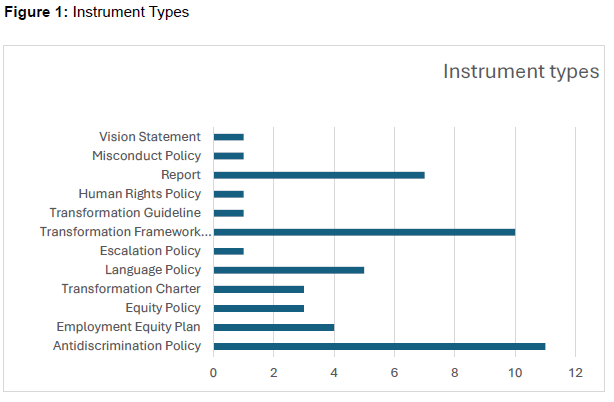
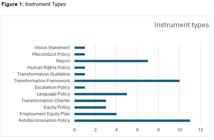
"Following familiarization, the text was segmented, and initial codes were assigned to specific passages that appeared relevant to the primary research question. These codes are reflected in various aspects of the instruments analyzed (Figure 1). Once all documents were coded, these codes were grouped into broader themes. Initial themes were refined by reviewing the coded data within each theme to ensure consistency and coherence. Themes that were too broad were subdivided, while those with significant overlap were merged. The refined themes were then analysed in relation to the study objectives. The codes were grouped into broader themes by the first author. The codes and themes were subsequently verified for consistency by the second author. For grouping the codes into broader themes, the first author uses an inductive reasoning process. Inductive reasoning is a useful approach for allowing documents to tell the "story of the findings" (Popay et al., 2005), while exploring relationships among generated codes and highlighting opportunities for future research (Lisy and Porritt, 2016). For the inductive reasoning process, the first author uses a social constructionist epistemological framework. Within a social constructionist epistemological framing, the thematic analysis considers the themes it identifies as a group's or institution's own way of making meaning or understanding - within this context - transformation taking place in society and what they ought to do to reflect those changes in their own space or context (Phillips, 2023). Hence, how institutions repond to transformation takes place within the context of interactions: with the larger society (external pressures) and within the institution (internal pressures). The codes and themes that emanate are deeply rooted in these contexts of social interactions. They have a complex connection with society's own past of racial prejudice and unfair discrimination, universities' own acknowledgement of their own complicity in that past, as well as how this past continues to shape life and relationships in the present (UCT, 2022b), and a firm wish to do something in the present to redress and restitute for this past so that the future is more equitable. The entire process, including the codes and themes, was verified by the second author for consistency and relevance to the primary research question. In the subsequent section, we describe the result.
RESULT (Step V)
To describe the inclusion that emanates from the transformation instruments by key South African universities, we analysed 11 Anti-discrimination Policies, 3 Equity Policies, 1 Escalation Policy, 1 Misconduct Policy, 1 Human Rights policy, 5 Language policies, 7 Reports, 3 Transformation Charter, 10 Transformation Plans and Frameworks, 4 Employment Equity Plans, 1 Transformation Guideline and 1 Vision Statement (Confer Figure 1). The anti-discrimination policies consist of harassment, sexual abuse and anti-bullying policies.
Some observations are worth making at the outset. First, since inclusion is a response to the quest to transform, it is worth interrogating how these instruments conceptualize transformation as the useful first step towards outlining the exact ways inclusion responds to this quest, the benchmarks that are set, what mechanisms, practices and measures are operationalized to realize inclusion practically, or the metrics for measuring progress that are developed. This is the focus of the first part of this section. In the second part, we outline the inclusion that responds to this quest, emanating from these documents, as well as universities' view of what areas to target and who is accountable so that inclusion work is more impactful.
Second, it is equally worth noting that the conceptions that we highlight below are the conceptions of transformation (and inclusion) in recent transformation instruments of these institutions. Transformation itself as a concept has evolved over time. Between 1994-2003, efforts were put into making sense of the term (transformation) intellectually, which then resulted in concerns for demographic equity. Between 2004 and 2013, the focus shifted to rearranging institutional spaces to realize equitable configurations. In the third period, from 2014, there is a strong emphasis on deep change (Luescher et al., 2023). The point of the preceding is that how the term was conceived immediately following apartheid differs from how it is understood today. While enabling black students' access into education spaces may have been a key concern for transformation in 1994, this concern has evolved more into non-numerical targets (Lange, 2014).
Keeping to our plan for the description of our findings, in the next section, we describe the conception of transformation that emerges from the instruments we analyzed.
Transformation in universities' transformation instruments
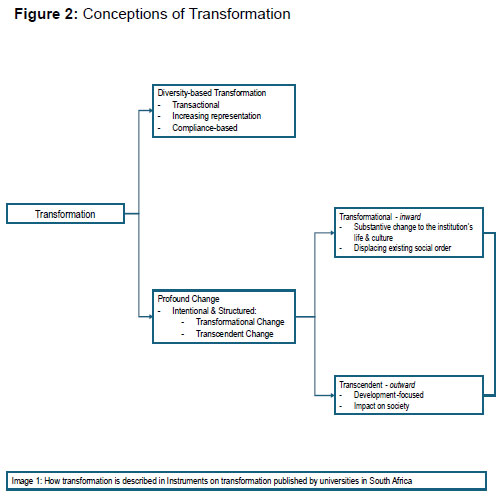
This analysis reveals that, first, transformation is described transactionally to focus on enhancing academic, students and staff diversity (North-West, 2022b; UP, 2019a, 2023). The goal of this way of thinking about transformation is not necessarily to displace prevailing social order or relations but to create room within this order or relations to allow for the addition of new faces. Within this context, emphasis is placed on accommodating new epistemologies/knowledge systems, on reform and equity in "relation to race and gender, as well as class and disability" (Luescher et al., 2023). Furthermore, this analysis also found that the motivation for transactional transformation is externally located - in national directives (UP, 2023). Hence, it is likely a compliance-informed conception of transformation. As one transformation instrument confirms (UP, 2023), compliance-driven approaches to transformation are key drivers of transactional relationships that fail to be substantive. Although the goal of this section is not to critique these conceptions but to report, it is worth pointing out that these conceptions risk becoming window-dressing and a tick-box exercise to ensure obedience to these national policies and imperatives for universities to rectify their demographic imbalances owing to legacies of discrimination, histories of inequity and apartheid.
Second, transformation is also conceptualized as an intentional and structured profound change. This change entails a two-fold commitment. On the one hand, it entails a commitment - beyond the diversity-based conception - to a deep (transformational) change in a university's programmes, identity, values, places, people, life, operations and culture, requiring an institution to recreate how it does things and the type of epistemologies or assumptions that underlie their actions, pedagogy or research (SU, 2019, 2020c; UCT, 2018, 2022b; UKZN, 2018; UP, 2017; Wits, 2022a). This may necessitate a change of an institution's language and employment policies/plans/interventions, reinventing its customs and curriculum, renaming its buildings, changing past symbols that perpetuate unfair discriminatory practices, reimagining sources of knowledge, rethinking disciplines, reorganizing power relations, or redressing legacies of inequalities. Transformational change recognizes the insufficiency of demographic changes to effect the creation of a culture that respects human rights as described in the South African Constitution. Instead, it partly calls for the dissolution of existing social institutions or practices and their replacement with a substantially new democratic social order that embraces as many perspectives as possible. The process of this profound change does not need to be sudden or violent but systemic and may take many years to realize (North-West, 2020).
On the other hand, profound change entails a commitment to substantive democratization of an institution's systems to enable better engagement with society and the production of a mass of individuals to contribute to society's quest for development. This commitment reflects South African universities' keen interest in ensuring that its internal operations and life translate into real societal impact and development. To this extent, it is transcendent change, necessitating a change of an institution's systems to benefit the changing economy. This differs from transformational change, which requires institutions to embed transformation in their internal fabric and life. Instead, the transcendent change concerns an institution's impact on, as well as its contributions towards development in, society (North-West, 2022b; UP, 2023). This outward or development-focused conception of transformation is also a massified conception like transactional change, emphasizing high throughput, mass production of qualified graduates and evolving university systems to benefit a changing economy (North-West, 2022b; UP, 2017). However, transactional change is oriented inward (Confer Figure 2).
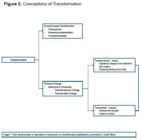
Finally, although transactional, transformational and transcendent change are different conceptions of transformation emanating from analysed instruments, it is worth stating here that these analysed instruments emphasize these conceptions to varying degrees. Thus, this analysis does not yield the conclusion that certain universities prefer one conception of transformation to other conceptions. Transactional conception of transformation often requires quantitative metrics to measure progress, while both transformational and transcendent conceptions of transformation require quantitative and qualitative metrics to assess progress. Some universities like UCT have developed benchmarks to measure their transactional, transformational and transcendent performance metrics and to improve the same. In the next section, we describe the different ways inclusion reponds to transactional, transformational and transcendent change.
Inclusion and quest for transformation
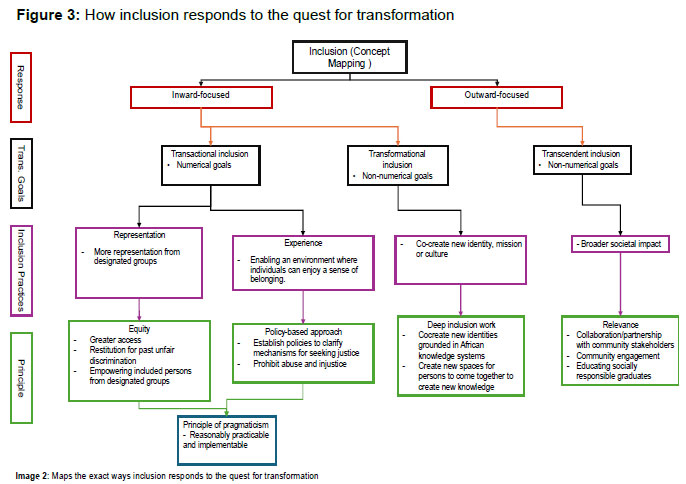
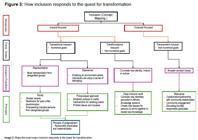
As a response to transformation (e.g., transactional, transformational or transcendent change), inclusion generates different practices (or practices of inclusion or inclusion work) that can also be broadly categorized into transactional, transformational and transcendent inclusion. We describe this in the subsequent section. In addition, our analysis also found that the principles of pragmaticism, deep inclusion work and relevance are the core principles underlying transactional, transformational and transcendent inclusion respectively. The subsequent section also explains the way these principles underlie these forms of inclusion. Equally, our analysis identifies place and institutional culture as core targets of inclusion. Finally, we reveal two broad practices of inclusion: inward-focused and outward-focused (Confer Figure 3). These are described in the subsequent sections.
Inclusion practices that respond to diversity-based transformation
Diversity-based conception of transformation (or transactional change) generates inclusion practices around internal matters of a combination of representation and experience within a university. The inclusion that prioritizes the combination of representation and experience is described as transactional inclusion.
Representation
Our analysis reveals that universities emphasize representation primarily to allow individuals from designated groups access to previously inaccessible (or difficult-to-access) education spaces. Designated groups include black persons (or black Africans), coloured persons, Indians, women of all races and persons with disabilities. These transformation instruments differentiate this term designated group from a related term targets of the inclusion. While designated groups described the groups mentioned previously and are the primary focus of representation, inclusion practices broadly target more people than groups described as designated.
Representation is realized through numerical targets, which aim for, i) the university's demographic profile to reflect the economically active population and demographic diversity of the country and ii) the representation of designated groups at all occupational levels of the university's workforce and life (SU, 2016a, 2020a, 2020c; UCT, 2022b; UJ, 2021b, 2024; UP, 2023; Wits, 2022a, 2022b). For example, the University of Johannesburg's (2024: p. 5) employment equity document observes that "the primary goal of [its] employment equity is to achieve representativity of and for the country's population groups, genders and people with disabilities." The University of the Witwatersrand aims for a 44 per cent female representation and 2 per cent representation by individuals with disabilities for its demographic profile in its 2022 Employment Equity Plan document (Wits, 2022b).
To track progress, the University of Cape Town developed six benchmarks to foreground actions that enable its units to contribute to the work of transforming pedagogy, research and institutional culture (UCT, 2022b). These benchmarks include diversifying the students and staff population, building an inclusive campus, developing zero-tolerance to discrimination and abuse, partnering with communities, co-creating a new identity for the university, and prioritizing staff development to implement curriculum change (UCT, 2024).
Underlying the quest for numerical increase is the principle of equity. Concretely, this principle is operationalized through i) targeted recruitment strategies like preferential treatment and headhunting of skilled or suitably qualified persons in the designated groups (the focus of nearly all the disability and employment equity plans/policies), ii) enabling greater (physical, epistemological and social) access to information, communication and opportunities at all levels1 by persons in designated groups, ii) restituting for (or redressing including visual redress to remove upsetting symbols) past unfair discrimination against designated groups through affirmative action measures,2 iii) empowering persons from designated groups through training, reasonable accommodation3 and scholarship provisions (Luescher et al., 2023; North-West, 2022a; SU, 2016a, 2016b, 2020a, 2020c, 2021; UCT, 2020a, 2022a; UJ, 2016, 2022a, 2024; UP, 2017, 2019b; Wits, 2018, 2019, 2021).
Experience
Representation enables persons in designated groups to access previously inaccessible spaces. In addition to access, these documents equally prioiritize the experience of this access (by persons in designated groups and other targets of inclusion practices) as an equally important core component of transactional inclusion or the inclusion practices that respond to the quest for transactional change. For this reason, UCT (2018: p. 3) remarks, "We want a university with an inclusive culture at which everyone feels at home. We want a community in which there is respect for different values, views and heritages; in which none of us feels othered."
To this extent, although transactional inclusion mostly aims for numerical targets, it does not exclude non-numerical goals. Notably, increased representation within universities ought to coincide with a qualitative (depth and nature) and quantifiable (number) experience within universities' structures. Enabling an environment where staff, students, visitors and others can equally pursue excellence, feel safe and enjoy a sense of belonging, as well as where differences are welcomed, valued, celebrated or heard, fosters a favourable experience within institutional structures. To create an enabling environment, these instruments mostly adopt a principled policy-based approach. This approach, i) prohibits unfair discrimination and abuse within the university, ii) clarifies the channels and mechanisms for victims and alleged perpetrators of (or parties to) unfair discrimination, bullying or abuse to seek justice safely, confidentially and timeously (the focus of many anti-discrimination, sexual harassment and escalation policies and plans), iii) mandates race and diversity awareness training for employees and university stakeholders, iv) prioritizes strategic and operational needs of the university, and pedagogical needs of staff and learners as the underling norms of language plans and procedures, and v) recommends the provision of support (financial, academic, psychological and emotional) for targets of the inclusion work and the removal of symbols that perpetuate unfair discrimination on campus, vi) obligates periodic auditing to monitor - for example through surveys - and evaluate transactional inclusion practices, as well as staff and students' experience of inclusion (North-West, 2022c; SU, 2016a, 2021; UCT, 2020a, 2020b, 2021a, 2022c; UJ, 2021a, 2022b; UKZN, 2014; UP, 2019a, 2021a, 2021b; Wits, 2020).
Finally, although the combination of the quest for increased representation of persons from designated groups within universities and favourable experience are core components of transactional inclusion, these instruments acknowledge that transactional inclusion is not an absolute or exceptionless rule. Instead, transactional inclusion is foregrounded by the principle of pragmaticism. In other words, transactional inclusion is meaningful to the extent that it is practically useful and implementable (SU, 2021; UJ, 2022b). For example, Stellenbosch University confirms in its English Language Policy document that sign language will be available during lectures if it is practicable. Also, confer the following remark by the University of Cape Town:
"UCT need not accommodate a qualified applicant or an employee with a disability if this would impose an unjustifiable hardship on the operations of the institution. This involves considering the effectiveness of the accommodation and the extent to which it would seriously disrupt the operation of the Unit/Department. An accommodation that imposes an unjustifiable hardship for one employer at a specific time may not be so for another or for the same employer at a different time hence every case will be assessed on its merits" (UCT, 2021a: p. 10).
Profound change-based transformation and corresponding inclusion
In this section, we describe the forms of inclusion that respond to the view of transformation as entailing profound change. The profound change-based conception of transformation - as "transformational and transcendent" - typically inspires two-fold inclusion practices corresponding to its two-fold commitment. Transformational change generates inclusion practices around "internal matters" of identity and culture. This is transformational inclusion. Transcendent change generates inclusion practices that are "outward-focused" and are called transcendent inclusion. Like transactional inclusion, transformational inclusion is inward-focused. However, unlike transactional inclusion, both transformational and transcendent inclusion respond to forms of transformation that mostly aim for non-numerical targets. Notably, they entail the creation of measures that eliminate systemic issues that perpetuate inequalities or barriers - for example - to the employment of individuals from diverse backgrounds or inhibit the pursuit of excellence within institutional structures (Luescher et al., 2023; UCT, 2021a; Wits, 2018). These barriers may be attitudinal or language barriers that prevent the translation of knowledge into public good. The subsequent sections provide a greater description of transformational and transcendent inclusion, as well as the principles that underlie them.
Transformational inclusion
Transformational inclusion responds to the quest for transformational change. In this regard, this form of inclusion generates inclusion practices that are directed inward, requiring institutions to change, overhaul their identity and mission and co-create new ones (UKZN, 2018). Transformational inclusion acknowledges that unfair discrimination and racism can be hidden in a university's structures, spaces, and mindsets that may un/intentionally embody colonial modes of being. Thus, merely shifting or creating rooms within these (oppressive) identities, structures or cultures for individuals from various backgrounds and identities (or renaming buildings) may be insufficient to counter or end unfair discrimination or injustice (UCT, 2024; UP, 2023). It may be far more important to dismantle and establish through open democratic processes that engage everyone, a new identity, structure, a new mindset or mission for the university.
Transformational inclusion is foregrounded by the principle of deep inclusion work. This principle is operationalized in different ways. For example, this is not limited to, i) rethinking how the university is governed, the bureaucratic processes that are in place, ii) co-creating a new university culture or identity that recognizes and is grounded in African knowledge systems, iii) unveiling what knowledge constructs in teaching learning or research curriculum extend the legacies of the colonial past and dismantle them, iv) establishing new and decolonized curriculum, as well as spaces for diverse staff and students to come together and contribute to the development of new knowledge, identity or culture that is sufficiently grounded in African contexts and worldviews (North-West, 2022b; SU, 2020c; UCT, 2021b; UJ, 2016; UKZN, 2014, 2018; UP, 2023; Wits, 2019, 2022a).
Transcendent inclusion
Transcendent inclusion describes an outward-based inclusion narrative (or set of duties) that addresses key concerns around relevance to society, industries and government. It also includes discussions about the impact a university can have or the contributions it can make to the socio-economy and a society's developmental outcomes. Thus, influencing this form of inclusion is the principle of relevance. These instruments enact this principle in different ways. For example, through i) collaboration or partnership with community stakeholders and alumni to implement programs and develop curricula that reflect the institution's geophysical location and can positively impact society, ii) engaging communities in the conceptualization, design and implementation of unversities' research agenda so that research outputs address transformation needs of both local and global communities, iii) "educating socially responsible graduates" to apply their knowledge to the "scientific, technological and socio-economic development of [the nation] and the wider world", iv) developing programs with broader societal impacts and producing skilled labour to contribute towards addressing complex societal problems or human capital and knowledge to support industry, innovation and knowledge economy, v) empowering staff to engage communities, as well as stakeholders in communities (Luescher et al., 2023; North-West, 2022b; SU, 2020b; UCT, 2018; UKZN, 2018; UP, 2017),
Areas to target
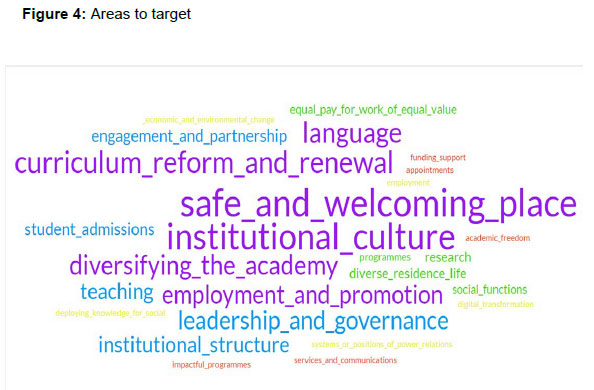
So far, we have described the idea of transformation that emanates from recent transformation instruments published by key South African universities, as well as the views of inclusion that respond to the quest for transformation. In this section and the next, we describe the areas that are targeted so that transactional, transformational and transcendent inclusion are impactful, as well as who ought to be accountable or monitor progress. Notably, our analysis also reveals several target areas for inclusion practices (Confer Figure 4). There are two prominent areas: place and institutional culture. Places are both physical spaces like the campus and metaphorical spaces like academic discussion spaces: whose voices are acknowledged, who is invisibilized? Institutional culture refers to those systems, procedures, governance, institutional expectations, policies or frameworks that shape the way "a university does things, views itself or encounters the world" (SU, 2019). Other areas include curriculum reform and renewal, language, the academy, leadership and governance, as well as employment and promotion.
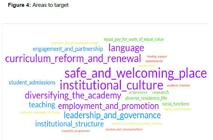
Two observations are worth outlining about these targets. First, how some of these areas are described as a target of inclusion depends greatly on the form of the inclusion. For example, as a target for transactional inclusion, discussions on place often focus on creating a welcoming space where individuals can enjoy a sense of belonging. As a target of transformational inclusion, the focus is on configuring and reconfiguring mindsets and co-creating and co-owning (academic or university) spaces. In contrast, as a target of transcendent inclusion, analysed instruments emphasized the importance of making academic spaces to be places for nurturing socially responsible minds that can engage complex societal issues. Equally, as a target of transactional inclusion, discussions on language prioritize multilingualism on campus. These instruments also encourage the use of non-gender-specific language as a means of creating an environment where gender-neutral persons and non-heterosexuals can enjoy a sense of belonging (UCT, 2017). Whereas the deep inclusion work necessitated by transformational inclusion demands intellectualizing local (African) languages like Sesotho and Setswana. Intellectualizing local African languages is not limited to learning and teaching using these languages. One way analyzed instruments have sought to fulfil this demand is by providing translation services for students during lectures. Nonetheless, for a truly deep inclusion work, these instruments acknowledge the importance of capacitating staff and students to be competent in these languages. Finally, a learning that is steeped in local languages has a greater probability to benefit the transformation needs of society (transcendent inclusion). Additionally, this can better prepare students and staff to engage communities
Second, although some areas are important targets for all inclusion forms, a few targets are the primary preoccupations of specific inclusion forms. For example, discussions about diversifying the academy or realizing gender equity tend to be a primary focus of transactional inclusion. This is less of an area of concern (if at all) for transcendent inclusion. Similarly, while renaming structures, removing symbols and signs that perpetuate colonial legacies or increasing access for persons with disabilities are important considerations for transformational and transactional inclusion, these are seldom target areas for transcendent inclusion. One primary target concern for transcendent inclusion - that is not a key target for transformational and transactional inclusion - is partnership with communities.
Who is accountable?
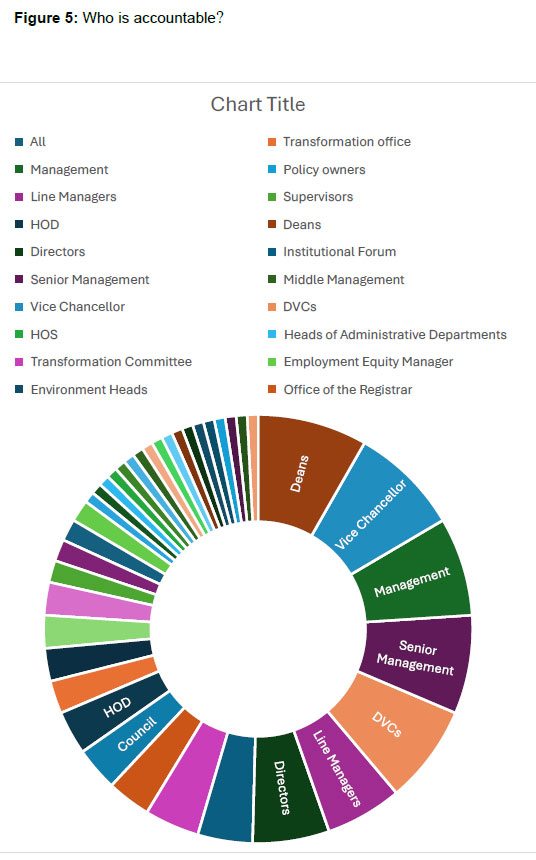
Analysed instruments primarily emphasize a top-down approach to describing who ought to be accountable for the inclusion practices. Notably, the Vice-Chancellor, Deans and Management (including Senior and Middle Management) are frequently identified as accountable for monitoring, implementing and evaluating inclusion practices (Confer Figure 5). In other words, the leadership of a university is the primary agent of inclusion. It is insufficient for a university leadership (the top) to speak about inclusion. To be effective agents of inclusion, the leadership itself needs to be inclusive (UP, 2023). For example, its operations need to be democratic and transparent. Participation of the junior faculty in leadership needs to be actively encouraged. A non or less-inclusive leadership can inhibit inclusion. Furthermore, as inclusion agents, leaders also need to inspire inclusion among those they lead (top-down). They can do this by setting a tone and culture that allows others to flourish, creating awareness of inclusion practices, promoting the freedom to speak, supporting staff and students' activism and developing the bravery to act in ways that advance the best interest of inclusion practices (Luescher et al., 2023; North-West, 2022b; UP, 2023).
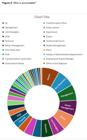
Secondarily, inclusion practices also require the participation of the entire university community (bottom). The university community can participate by sharing and owning the values and vision of inclusion. As one instrument remarks (UCT, 2018: p. 4), "The university we want to see and live [in] needs to be something we all own." As the secondary agents of inclusion, all members of the university community are also accountable for monitoring and implementing transformation plans as highlighted by different instruments (UCT, 2020b). For example, they can advise leadership on interventions that respond to the quest for institutional culture change (bottom-up) (UCT, 2018, 2020b). In addition to advising the leadership, the university community can collaborate with one another (left-right and right-left) to eliminate unfair discrimination based on race, sex or gender (SU, 2022).
DISCUSSION
This is the first attempt to articulate the account of inclusion - through a document analysis - that responds to the quest for transformation by key South African universities. This analysis found that transactional, transformational and transcendent inclusion are three forms of inclusion that respond to the quest for transformation. Two prominent areas are targeted for the inclusion work: place and institutional culture. Additionally, underlying or influencing these inclusion forms are principles of pragmaticism, deep inclusion work and relevance. Although analysed documents identify the leadership as the primary agent of inclusion, nonetheless, everyone is accountable for monitoring, implementing and evaluating inclusion and its practices.
Transformation work in South Africa is a work in progress. A Report prepared by a research team at the Human Sciences Research Council and published in 2023 analysed two years (2018 and 2019) of annual reports by universities in South Africa confirmed that while some universities have made notable strides - within this context - towards inclusion, others continue to grapple with this imperative. Additionally, the Report also showed that no institutions had fully realized this imperative nor overcome the legacy of their origins (Luescher et al., 2023). This may be a reason why one occasionally still sees headlines about acts of racism in South African universities in more recent studies (Hlatshwayo, 2020). It may also be a reason why empirical studies continue to report unequal representation of women in leadership positions in institutions of higher learning in South Africa (Manyaki and Cheteni, 2021).
Regarding the universities that have made some strides, the depth of their efforts also varies, with some institutions showing substantive progress. In contrast, others risk falling into "performative" or compliance-driven approaches (Ahmed, 2012; Valian and Stewart, 2018). Transformation (or the inclusion that responds to the quest to transform) often involves more than embedding diversity into institutional missions, with measurable outcomes and ongoing reflection, whereas surface-level efforts may focus on meeting quotas or improving optics without addressing systemic barriers (Ahmed, 2012). The distinction lies in whether inclusion initiatives lead to long-term, systemic change or remain focused on meeting minimal expectations. Nonetheless, we acknowledge here that a new Report or other empirical studies are long overdue to assess whether and what substantive progress towards transformation (or the inclusion that responds to it) has been made since 2019. Where are we, and what more ought to be done so that universities in South Africa become truly transformed?
Like universities in South Africa, many institutions in Africa also still grapple with the imperative of transforming education by striving towards inclusion. A Report (UNICEF and AU, 2021) on the State of Transforming Education in Africa jointly published by the African Union and UNICEF shows that while some progress has been recorded recently in the education of children, many disparities, like the disparity in the education of males and females in rural and urban schools, remain. There are cultural and religious factors that still undermine the education of girls. Further, the number of children out of school continues to increase, and school completion by children still proves to be an insurmountable hurdle. Other challenges undermine education institutions' quest to transform, such as the lack of the required number of quality teachers who can drive the vision for this quest as well as universal education by 2030. To address these challenges, there is a need for investments in the training of teachers. Alternatives to delivering education to remote areas must also be explored. For this purpose, digital technologies can be explored. During the COVID-19 pandemic, when many students could not be physically present in schools, digital technologies proved to be valuable tools for mitigating the harm that could have emerged as a result of this since they facilitated students' capacity to keep learning remotely even whilst being prevented from physical presence in the classroom. However, we recognize that in order for digital technologies to be valuable tools for delivering remote learning solutions, the current digital divide in Africa must be addressed. For example, funds must be created to enable fast internet connections in remote areas.
Nonetheless, we acknowledged that the Report only focussed on the state of transformation in primary and secondary schools in Africa, implying that studies are required to assess the state of transformation in African tertiary institutions. It would be equally helpful to explore how the inclusion that responds to transformation efforts by other African tertiary institutions differs from the conception of the same in South Africa. We imagine that their own contexts and legacies would differ from the realities in South Africa. Thus, the exact ways their own legacies and contexts (and what contexts) shape their view of transformation or the inclusion that responds to it deserves to be explored. Regardless of this point, one potential insight for doing inclusion work (that responds to the calls to transform education institutions) in other African contexts is that inclusion must be pursued at different levels to be impactful. In addition to seeking diversity and representation, the culture and systemic structures that prevent included persons from enjoying a sense of belonging ought to be identified and dismantled.
Our analysis also yields other notable insights. Contrary to the belief that transformation excludes reform (Fourie, 1999), this analysis found that transformation can, in fact, include reform and renewal. However, reform and renewal do not exhaust this term.
There are important observations about this finding that are worth outlining. First, what does success look like? It is often difficult to determine when designated groups and targets of the inclusion work have been successfully transactionally, transformationally or transcendently included. What does this look like in a concrete context? What metrics should be employed to measure progress towards the different forms of inclusion? In this regard, this analysis confirms the Report we referred to earlier, which also observes that many universities in South Africa struggle with identifying benchmarks for assessing performance towards a truly transformed university (Luescher et al., 2023).
Second, what does the inclusion work come at the cost of? Wits University's faculty of humanities requires all first-year students to complete eiter "isiZulu, Sesotho or other African Sign Language" (Wits, 2022a). Would this disconnect Afrikaans-speaking students in the faculty from their social roots? Evidently, universities have become more de-genderized and de-racialized, with black persons, Indians, and coloured persons now having greater access to these spaces (CHE, 2022). Nonetheless, it is worth interrogating whether the realization of (for instance) transactional inclusion will not come at the cost of a violation of individuals' rights. For example, is it possible that the preferential treatment of persons from the designated groups in employment potentially denies white males an equal opportunity to seek employment? Universities justify their employment equity policies by claiming that such preferential treatment is an affirmative action that repairs the damage of previous unfair discrimination and lingering colonial legacies that continue to disadvantage persons in the designated groups and advantage white persons, particularly white male persons (North-West, 2023; SU, 2020a; UCT, 2020a; UJ, 2024; Wits, 2018). This is fair discrimination, even if this produces unequal outcomes for persons in designated groups and outside of the same. As some scholars argue, black male persons (for example) were previously unfairly discriminated against in employment because they were black (Wilkinson, 2002). So, previous unfair discrimination was race-based. Yet, this preferential treatment of persons in designated groups, which now disadvantages particularly white male persons, is also race-based. At the very least, it encourages a preference for particular race and gender groups. Suppose injustice entails treating people unfairly on the grounds of their race, gender or age. In that case, future updates to the transformation instruments published by universities in South Africa must wrestle with the question regarding whether "race-based discrimination is always unfair and immoral" or "some race-based discriminations are fair and moral". Some scholars appear to accept the former to be true (Basu, 2019; Do-No-Harm, 2023; Friedman, 2023). Similarly, the beliefs of other scholars like Kasper Lippert-Rasmussen (Garcia, 2018) is that race-based differentiation (that is, the latter) that accords one race preferential treatment and disadvantages others is not necessarily immoral. Suppose this is true. In that case, is race-based discrimination in employment that disadvantages white male persons fair and moral if not all white male persons benefited from the disadvantages that - say - black persons suffered in the past? Is this cost fair? What would transformational and transcendent inclusion come at the cost of? There is an urgent need for a moral assessment of the cost of inclusion.
Third, the conceptions of inclusion that emerge from the analyzed documents are also at risk of essentialization, which is disabling and can further invisibilize black people of African origin. For example, some transformation instruments describe Chinese-South Africans who acquired their citizenship by naturalization or birth as coloured persons (UCT, 2020a; Wits, 2018). Coloured persons and Indians are then described as black persons (North-West, 2023; UCT, 2020a; Wits, 2018). This way of thinking about Chinese-South Africans as black persons was formalized in the 2008 South African High Court ruling in Pretoria that aimed to end the unfair discrimination against Chinese-South Africans in employment (Harris, 2017). We do not deny that Chinese-South Africans suffered unfair discrimination in employment in South Africa. Some studies have documented specific discrimination that Chinese people suffered following the COVID-19 outbreak (Gray and Hansen, 2021; Huang et al., 2023). Although coloured people, Indians, Chinese-South Africans and black people of African origin suffered varying forms of discrimination during the apartheid regime, black people of African origin suffered the worst form of this discrimination (Hlongwane and Chigo Esther, 2020). Equally, the nature and the reasons for the unfair discrimination are not always the same for both Chinese-South Africans and black persons of African origin, in the same way, that the nature and form of unfair discrimination that black women and black men suffer are not always similar (Wilkinson, 2002). Black persons of African origin suffer unfair discrimination because they are black persons (Zheng and Bhargava, 2020). Their experience of unfair discrimination is not limited to Africa but extends to Europe and Asia. For example, black persons are considered inferior to the majority of Han Chinese (Ouassini et al., 2022). Consequently, this way of grouping individuals risks obscuring the unique conversation that needs to be had about how colonialization specifically impacted black persons of African origin or continues to undermine their capacity to favourably seek employment or other opportunities.
Fourth, it is equally worth highlighting that although many persons from the designated groups can now access education institutions, the attrition and dropout rates for included persons from these groups continue to grow at an alarming rate (Luescher et al., 2023). Both attrition and dropout rates potentially inhibit the capacity of included persons to contribute to the socioeconomic development of their society (transcendent inclusion). Specifically, the proportion of black graduates employed in high-paying positions, as well as in key decision-making positions where included persons can exert change, is significantly lower than the proportion of white graduates with similar education levels (Makgetla, 2020; Parks-Yancy, 2010; Seepe, 2017). According to a 2020 Report (Makgetla, 2020), it seems graduating from a top university appears to have little impact on getting a high-paying job for a black person in South Africa. The implication of the preceding is that transactional inclusion may not likely increase the opportunities that individuals from designated groups have to contribute towards the realization of the transformation goals of their society (transcendent inclusion). Furthermore, this disconnect between the vision of transcendent inclusion (that is, the university's quest to educate a mass of those who can contribute to society's development) and those "who do, in fact, contribute to this development" also reveals who ultimately benefits from inclusion work, who is visibilized, who determines the socioeconomic trajectory of a society. The implication here is that transcendent inclusion may fail to be impactful if it does not equally prioritize numerical targets.
Finally, it is also worth drawing our readers to a potential conflict that can arise between transactional, transformational and transcendent forms of inclusion and the way they also complement each other. The potential conflict arises when institutions focus heavily on transactional inclusion as an easy way to demonstrate "progress" while neglecting deeper forms of inclusion. For example, a university might meet diversity quotas but fail to transform its institutional culture, leaving marginalized students feeling alienated despite increased representation. Conversely, a strong focus on transformational or transcendent inclusion might clash with institutional pressures to meet transactional metrics or short-term goals, creating friction between immediate compliance and long-term cultural change or societal impact.
In order to bridge this gap, transactional inclusion should lay the groundwork for transformational and transcendent inclusion. Meeting quotas and achieving representation can be a starting point, ensuring that diverse voices are present within the institution. However, this should be seen as a means to achieve the deeper, more substantive change required for transformational inclusion (Anderson, 2017; Meidelina et al., 2023; Shields, 2020). Transactional steps create an environment where transformational efforts (like changing institutional norms) can take place. Transcendent goals can inspire and motivate both transactional and transformational efforts by providing a broader vision of societal impact.
LIMITATIONSThis study has some limitations. The conception of inclusion that is outlined in this analysis is not static. As universities in South Africa expand their thinking around transformation following changing circumstances and new insights from research, the inclusion that responds to this quest may also evolve over time. As a result, the goal of this document analysis is not to present a definitive or exhaustive description of inclusion. Future references to this work should equally consider new insights on inclusion from future publications on the subject.
This study is limited in other ways. We only reviewed the top seven universities in South Africa, and the reasons are as follows: the top seven universities in South Africa are usually well-financed and have the resources which make them an attractive destination for scholars compared to the historically disadvantaged, or less-resourced universities may require assistance with infrastructure, funding, and institutional capacity challenges, which can hinder their ability to embrace similar policies. The experiences of the top universities may not entirely represent the transformation efforts of the other institutions.
Within the South African context, these top seven universities possess distinctive institutional histories, cultures, and demographics that shape their approach to transformation. These factors can vary significantly from those of other universities, particularly historically disadvantaged or technical institutions. Policies that prove effective at these top institutions may be less applicable or successful elsewhere, where the legacy of apartheid-era disparities or different governance structures may present unique challenges for transformation. Equally, although these top universities set trends and can influence national policies, their specific strategies for transformation might not be feasible or relevant for all universities in the country. Without considering a wider range of institutions, it becomes difficult to draw conclusions about the state of transformation across South Africa's diverse higher education universities. While analyzing the top seven universities provides valuable insights into the transformation policies of leading institutions, this focus limits the generalizability of the findings to the broader South African university context.
There is another way our focus on the top seven South Universities also limits our study. Notably, although we justified this decision, nonetheless, we recognize that this decision may impact the transferability of this study's findings on inclusion to other non-educational contexts like the Federal Ministries or Cooperate organizations. Nonetheless, we do not think that the preceding points necessarily doom this endeavour given that other non-educational contexts, like universities in South Africa, are situated within the same country that is impacted by a history of apartheid and discrimination; the recognition by nearly all persons within the country to take practical steps to end these ills wherever they persist. While we acknowledge that empirical studies ought to be undertaken to describe the conception of inclusion emanating from these non-education contexts, our findings, nonetheless, can provide insights into how these non-education contexts may be more inclusive.
Finally, since the account of inclusion that emanates from these transformation instruments is also influenced by the history of problematic social relations in South Africa, the findings of this study are context-specific, implying that it is also likely not transferrable to contexts outside of South Africa. Future studies can focus on exploring the conception of inclusion that emerges from transformation instruments published by other universities.
RECOMMENDATIONSOur study also yields some recommendations on how - for example - the university leadership can implement inclusion more effectively within the education setting. These are only a few examples.
Form partnerships with historically disadvantaged institutions. The leadership can develop collaborative programs, such as staff and student exchanges or resource-sharing initiatives, with HDIs to promote inclusivity across the country.
Conduct institutional assessments. Transformation (or the inclusion that responds to it) is a work in progress that must be monitored and, constantly evaluated and re-evaluated. We recommend that university leadership should perform in-depth audits to identify specific challenges and opportunities for transformation, ensuring policies are context-specific and address the unique needs of each university. This audit should also include surveys that assess students' and staff's experience of transformation within the institution, as well as a needs analysis for leadership governance competencies of members of the designated groups for senior leadership governance positions in universities in South Africa. Progress towards transformation should also be monitored.
To assess progress, it would also be important to set measurable transformation goals. Faculties, departments, Centers and units within the institution can be incentivized to meet these goals through trophies or other forms of incentives that are created for goalkeepers. Metrics that are established to assess the progress of transformation initiatives by different units or departments ought to be clarified. Annual reporting should also be mandated, and leadership in every department or unit should be held accountable for meeting these goals.
Establish inclusive advisory bodies. Create decision-making councils or committees that represent diverse voices, including students, staff, and marginalized groups, to shape policies and practices related to transformation. Membership of such advisory bodies may also be extended to community leaders, who can contribute key insights on what actions a university may take to contribute towards the realization of the transformation needs of a community.
CONCLUSION
This analysis found that transactional, transformational and transcendent inclusion are three forms of inclusion that emanate from key South African universities' transformation instruments. Inclusion work is challenging, and as this analysis has shown, merely gaining access to educational institutions does not imply that the included individual is, therefore, capacitated to exert change in these spaces. Studies are still required to interrogate questions about the inclusion that truly empowers included persons. The preceding point is important since inclusion can, in fact, intersect with exclusion. This phenomenon is described as internal exclusion (Nyamnjoh and Ewuoso, 2023). Internal exclusion is the experience of exclusion even while included. Although present, included persons can fail to participate in decision-making or in discussions that occur in spaces where they are included. To prevent internal exclusion, future studies and updates on transformation published by South African universities should focus on interrogating what more is required to enable the participation of included persons.
DECLARATIONEthics approval and consent to participate
This study is a document analysis of publicly available transformation instruments of ke South African universities and does not involve human participants. No ethical approval was sought for this study.
Consent for publication
This study does not contain any person's data.
Availability of Data and Materials
This study is part of a larger project. This ongoing project aims to increase our understanding of what more is required to foster the inclusion that matters in health research collaborations. Thus, the datasets used and/or analyzed during the current study are available from the corresponding author following reasonable request.
Competing Interests
The author declares that they have no competing interests
Funding
No specific grant was received for this particular work.
REFERENCES
- Adebiyi, B. O., F. C. Mukumbang, and A. M. Beytell. 2019. "To what extent is Fetal Alcohol Spectrum Disorder considered in policy-related documents in South Africa? A document review". Health Research Policy and Systems, 17, 1-12.
-
Ahmed, S. 2012. On Being IncludedRacism and Diversity in Institutional Life. Duke University Press. https://doi.org/10.20853/j.ctv1131d2g
» https://doi.org/10.20853/j.ctv1131d2g - Altheide, D. L., and C. J. Schneider. 1996. "Process of qualitative document analysis". Qualitative media analysis, 2, 39-74.
-
Anderson, M. 2017. "Transformational Leadership in EducationA Review of Existing Literature". International Social Science Review, 93(1), 1-13. https://www.jstor.org/stable/90012919
» https://www.jstor.org/stable/90012919 -
Attride-Stirling, J. 2001. "Thematic networks: an analytic tool for qualitative research". Qualitative Research, 1(3), 385-405. https://doi.org/10.1177/146879410100100307
» https://doi.org/10.1177/146879410100100307 -
Basu, R. 2019. "The wrongs of racist beliefs". Philosophical Studies, 176(9), 2497-2515. https://doi.org/10.1007/s11098-018-1137-0
» https://doi.org/10.1007/s11098-018-1137-0 - Cardno, C. 2019. "Policy Document Analysis: A Practical Educational Leadership Tool and a Qualitative Research Method". Educational Administration: Theory and Practice.
-
CHE, C. o. H. E. 2022. "Dimensions of transformation of higher education in South Africa". BrieflySpeaking(21), 17. Retrieved August 09, 2024, from https://www.che.ac.za/publications/research/brieflyspeaking-n0-20-dimensions-transformation-higher-education-south-africa
» https://www.che.ac.za/publications/research/brieflyspeaking-n0-20-dimensions-transformation-higher-education-south-africa -
Dalglish, S. L., H. Khalid, and S. A. McMahon. 2021." Document analysis in health policy research: the READ approach". Health Policy Plan, 35(10), 1424-1431. https://doi.org/10.1093/heapol/czaa064
» https://doi.org/10.1093/heapol/czaa064 -
Do-No-Harm, S. 2023. A racist award at the American Society of Hematology. https://donoharmmedicine.org/2023/10/18/a-racist-award-at-the-american-society-of-hematology/
» https://donoharmmedicine.org/2023/10/18/a-racist-award-at-the-american-society-of-hematology/ -
Farham, B. 2018. "The right to strike". South African Medical Journal, 108(8), 605-605. https://doi.org/10.7196/SAMJ.2018.v108i8.13542
» https://doi.org/10.7196/SAMJ.2018.v108i8.13542 -
Fereday, J., and E. Muir-Cochrane. 2006. "Demonstrating Rigor Using Thematic Analysis: A Hybrid Approach of Inductive and Deductive Coding and Theme Development". International Journal of Qualitative Methods, 5(1), 80-92. https://doi.org/10.1177/160940690600500107
» https://doi.org/10.1177/160940690600500107 -
Fourie, M. 1999. "Institutional transformation at South African universities: Implications for academic staff". Higher Education, 38(3), 275-290. https://doi.org/10.1023/A:1003768229291
» https://doi.org/10.1023/A:1003768229291 -
Friedman, M. 2023. Morality in Social Work [Electronic article]. 0(0), 7. https://www.michaelbfriedman.com/mbf/images/MORALITY_IN_SOCIAL_WORK--1-9-2023.pdf
» https://www.michaelbfriedman.com/mbf/images/MORALITY_IN_SOCIAL_WORK--1-9-2023.pdf -
Garcia, J. L. A. 2018. "Wrongful racial discrimination in moral analysis: Some recent accounts, an alternative conception, and attempts to extend theoretical models" [JOur]. The Georgetown Journal of Law and Public Policy, 16(S), 33. https://law.georgetown.edu/public-policy-journal/in-print-2/volume-16-special-issue-2018/wrongful-racial-discrimination-in-moral-analysis-some-recent-accounts-an-alternative-conception-and-attempts-to-extend-theoretical-models/
» https://law.georgetown.edu/public-policy-journal/in-print-2/volume-16-special-issue-2018/wrongful-racial-discrimination-in-moral-analysis-some-recent-accounts-an-alternative-conception-and-attempts-to-extend-theoretical-models/ -
Gray, C., and K. Hansen. 2021. "Did Covid-19 Lead to an Increase in Hate Crimes Toward Chinese People in London?" Journal of Contemporary Criminal Justice, 37(4), 569-588. https://doi.org/10.1177/10439862211027994
» https://doi.org/10.1177/10439862211027994 - Gupta, R. K., and R. Awasthy. 2015. Qualitative research in management : methods and experiences.
-
Harris, K. 2017. BEE-ing Chinese in South Africa: a legal historic perspective". Fundamina, 23, 1-20. https://doi.org/10.17159/2411-7870/2017/v23n2a1
» https://doi.org/10.17159/2411-7870/2017/v23n2a1 -
Hlongwane, P., and M. Chigo Esther. 2020. "Barriers to transformation in the South African Universities : are solutions elusive?" Commonwealth Youth and Development, 17(1), 1-15. https://doi.org/10.25159/1727-7140/4794
» https://doi.org/10.25159/1727-7140/4794 -
Huang, J. T., M. Krupenkin, D. Rothschild, and J. Lee Cunningham. 2023. "The cost of anti-Asian racism during the COVID-19 pandemic". Nature Human Behaviour, 7(5), 682-695. https://doi.org/10.1038/s41562-022-01493-6
» https://doi.org/10.1038/s41562-022-01493-6 -
Izadi, R., M. A. Bahrami, Y. Sarikhani, and P. Bastani. 2023. "Qualitative document analysis on Iranian contents and trends of population policies: Lessons learned and avenues for future". Heliyon, 9(6), e17377. https://doi.org/10.1016/j.heliyon.2023.e17377
» https://doi.org/10.1016/j.heliyon.2023.e17377 - Katchmarchi, A. B., A. R. Taliaferro, and H. J. Kipfer. 2018. "A document analysis of drowning prevention education resources in the United States". International journal of injury control and safety promotion, 25(1), 78-84.
-
Krippendorff, K. 2019. Content Analysis: An Introduction to Its Methodology (Fourth Edition ed.) https://doi.org/10.4135/9781071878781
» https://doi.org/10.4135/9781071878781 -
Lange, L. 2014. "Rethinking Transformation and Its Knowledge(s): The Case of South African Higher Education". Critical Studies in Teaching and Learning, 2. https://doi.org/10.14426/cristal.v2i1.24
» https://doi.org/10.14426/cristal.v2i1.24 -
Lippert-Rasmussen, K. 2006. "The badness of discrimination". Ethical Theory and Moral Practice, 9, 167-185. https://doi.org/10.1007/s10677-006-9014-x
» https://doi.org/10.1007/s10677-006-9014-x -
Lisy, K., and K. Porritt. 2016. "Narrative Synthesis: Considerations and challenges". International Journal of Evidence-Based Healthcare, 14, 201. https://doi.org/10.1097/01.XEB.0000511348.97198.8c
» https://doi.org/10.1097/01.XEB.0000511348.97198.8c -
Luescher, T. M., B. Mncwango, S. Fongwa, T. Oppelt, Z. Mthombeni, and M. Paterson. 2023. The state of transformation in South Africa's public universities: Research report of the ministerial oversight committee on transformation in the South African public universities. TOC/Department of Higher Education and Training. https://helm.ac.za/wp-content/uploads/2023_State_of_Transformation_in_Universities_TOC-DHET_FULL_REPORT.pdf
» https://helm.ac.za/wp-content/uploads/2023_State_of_Transformation_in_Universities_TOC-DHET_FULL_REPORT.pdf -
Makgetla, N. 2020. Inequality in South Africa: An overview [Report]. T. I. P. Strategies. https://www.tips.org.za/images/TIPS_Working_Paper_Inequality_in_South_Africa_An_Overview_September_2020.pdf
» https://www.tips.org.za/images/TIPS_Working_Paper_Inequality_in_South_Africa_An_Overview_September_2020.pdf -
Masinde, M., and P. Soux. 2020. "Transforming south africa's universities of technology: a roadmap through 4ir lenses". Journal of Construction Project Management and Innovation, 10. https://doi.org/10.36615/jcpmi.v10i2.405
» https://doi.org/10.36615/jcpmi.v10i2.405 -
Meidelina, O., A. Saleh, C. Cathlin, and S. Winesa. 2023. "Transformational leadership and teacher well-being: A systematic review". Journal of Education and Learning (EduLearn), 17(3), 417-424. https://doi.org/https://doi.org/10.11591/edulearn.v17i3.20858
» https://doi.org/https://doi.org/10.11591/edulearn.v17i3.20858 -
Mhlauli, M., E. Salani, and R. Mokotedi. 2015. "Understanding Apartheid in South Africa through the Racial Contract". International Journal of Asian Social Science, 5, 203-209. https://doi.org/10.18488/journal.1/2015.5.4/1.4.203.209
» https://doi.org/10.18488/journal.1/2015.5.4/1.4.203.209 -
Mpofu, K., and S. Tavuyanago. 2023. "Nehawu healthcare strike". New Agenda: South African Journal of Social and Economic Policy, 2023(89), 43-46. https://doi.org/10.10520/ejc-negenda_v2023_n89_a10
» https://doi.org/10.10520/ejc-negenda_v2023_n89_a10 -
North-West, U. 2020. The Transformation Journey [Report]. 45. Retrieved June 11, 2024, from https://www.nwu.ac.za/sites/www.nwu.ac.za/files/files/i-news/electronic_newsletters/Council%20Newsletter/2022/Vol4-2022/Transformation-journey.pdf
» https://www.nwu.ac.za/sites/www.nwu.ac.za/files/files/i-news/electronic_newsletters/Council%20Newsletter/2022/Vol4-2022/Transformation-journey.pdf -
North-West, U. 2022a. Language Policy of the NWU [Policy]. 8. Retrieved June 11, 2024, from https://www.nwu.ac.za/sites/www.nwu.ac.za/files/files/i-governance-management/policy/2022/LanguagePolicy/2P_2.5_2022_e1.pdf
» https://www.nwu.ac.za/sites/www.nwu.ac.za/files/files/i-governance-management/policy/2022/LanguagePolicy/2P_2.5_2022_e1.pdf -
North-West, U. 2022b. NWU Transformative Charter [Charter]. 4. https://www.nwu.ac.za/sites/www.nwu.ac.za/files/files/i-governance-management/policy/2022.02.24_NWUTransformationCharter_approved.pdf
» https://www.nwu.ac.za/sites/www.nwu.ac.za/files/files/i-governance-management/policy/2022.02.24_NWUTransformationCharter_approved.pdf -
North-West, U. 2022c) Sexual Harassment Policy [Policy]. 4. Retrieved June 11, 2024, from https://www.nwu.ac.za/sites/www.nwu.ac.za/files/files/i-governance-management/policy/3P_3.13B_sexual%20harassment_e.pdf
» https://www.nwu.ac.za/sites/www.nwu.ac.za/files/files/i-governance-management/policy/3P_3.13B_sexual%20harassment_e.pdf -
North-West, U. 2023. Policy on Employment Equity. 3. Retrieved June 11, 2024, from https://www.nwu.ac.za/sites/www.nwu.ac.za/files/files/i-governance-management/policy/3P-3.14_Employment%20Equity%20Policy_e.pdf
» https://www.nwu.ac.za/sites/www.nwu.ac.za/files/files/i-governance-management/policy/3P-3.14_Employment%20Equity%20Policy_e.pdf -
Nyamnjoh, A.-N., and C. Ewuoso. 2023. "What type of inclusion does epistemic injustice require?" J Med Ethics, jme-2023-109091. https://doi.org/10.1136/jme-2023-109091
» https://doi.org/10.1136/jme-2023-109091 -
Nyamnjoh, A. 2021. "The phenomenology of rhodes must fall: student activism and the experience of alienation at the University of Cape Town". The Strategic Review for Southern Africa, 39(1), 22. https://doi.org/https://doi.org/10.35293/srsa.v39i1.330
» https://doi.org/https://doi.org/10.35293/srsa.v39i1.330 - Osman, R., and F. Maringe. 2019. "Transformation in Higher Education in South Africa Toward the Decolonization of South African Universities". In Oxford Research Encyclopedias. Online: Oxford Research.
-
Ouassini, A., M. Amini, and N. Ouassini. 2022. "#ChinaMustexplain: Global Tweets, COVID-19, and Anti-Black Racism in China." Rev Black Polit Econ, 49(1), 61-76. https://doi.org/10.1177/0034644621992687
» https://doi.org/10.1177/0034644621992687 - Parks-Yancy, R. 2010. Equal Work, Unequal Careers: African-Americans in the Workforce.
-
Phillips, M. J. 2023. "Towards a social constructionist, criticalist, Foucauldian-informed qualitative research approach: Opportunities and challenges". SN Social Sciences, 3(10), 175. https://doi.org/10.1007/s43545-023-00774-9
» https://doi.org/10.1007/s43545-023-00774-9 - Popay, J., H. Roberts, S. Aj, M. Petticrew, N. Britten, L. Arai, K. Roen, and M. Rodgers. 2005. "Guidance on the Conduct of Narrative Synthesis in Systematic Reviews Final Report". J Epidemiol Community Health., 59(Suppl 1):, A7.
-
Puddester, R., J. Limoges, S. Dewell, J. Maddigan, L. Carlsson, and A. Pike. 2023. "The Canadian Landscape of Genetics and Genomics in Nursing: A Policy Document Analysis". Can J Nurs Res, 55(4), 494-509. https://doi.org/10.1177/08445621231159164
» https://doi.org/10.1177/08445621231159164 -
QS-WUR, Q.-W. 2024, May 24, 2024. "QS World University Rankings 2024". QS World University Rankings 2024. https://www.universityrankings.ch/results?ranking=QS®ion=World&year=2024&q=South+Africa
» https://www.universityrankings.ch/results?ranking=QS®ion=World&year=2024&q=South+Africa -
Seepe, S. 2017. "Higher Education Transformation in South Africa". In M. Cross and A. Ndofirepi (Eds.), Knowledge and Change in African Universities: Volume 1 - Current Debates (pp. 121-143). SensePublishers. https://doi.org/10.1007/978-94-6300-842-6_8
» https://doi.org/10.1007/978-94-6300-842-6_8 -
Shields, C. M. 2020. "Transformative Leadership Theory: Critical, Comprehensive, and Activist". In The Palgrave Handbook of Educational Leadership and Management Discourse (pp. 1-18). Springer International Publishing. https://doi.org/10.1007/978-3-030-39666-4_75-1
» https://doi.org/10.1007/978-3-030-39666-4_75-1 -
Sonn, C. C., and A. T. Fisher. 2003. "Identity and oppression: differential responses to an in-between status". Am J Community Psychol, 31(1-2), 117-128. https://doi.org/10.1023/a:1023030805485
» https://doi.org/10.1023/a:1023030805485 -
SU, S. 2016a. Policy on Unfair Discrimination and Harassment [Policy]. 32. Retrieved June 11, 2024, from https://www.sun.ac.za/english/Documents/2017_Everlytic/Unfair_Discrimination_and_Harassment_ENG_2016.pdf
» https://www.sun.ac.za/english/Documents/2017_Everlytic/Unfair_Discrimination_and_Harassment_ENG_2016.pdf -
SU, S. 2016b. Transformation Barometer [Report]. 7. Retrieved June 11, 2024, from https://www.sun.ac.za/english/transformation/Documents/Transformation-Barometer-%202016.pdf
» https://www.sun.ac.za/english/transformation/Documents/Transformation-Barometer-%202016.pdf -
SU, S. 2019. Stellenbosch University Transformation Plan [Framework]. 22. Retrieved June 11, 2024, from https://www.sun.ac.za/english/transformation/Documents/Transformation%20Plan%20(Update%20May%202019).pdf
» https://www.sun.ac.za/english/transformation/Documents/Transformation%20Plan%20(Update%20May%202019).pdf -
SU, S. 2020a. Employment Equity Plan 2020 to 2025 [Framework]. 31. Retrieved June 11, 2024, from https://www.sun.ac.za/english/human-resources/Documents/Employment-Equity-Diversity/EEA13%20Employment%20Equity%20Plan%202020%20to%202025.pdf
» https://www.sun.ac.za/english/human-resources/Documents/Employment-Equity-Diversity/EEA13%20Employment%20Equity%20Plan%202020%20to%202025.pdf -
SU, S. 2020b. SU Transformation Strategic Priorities and Indicators: A Framework for Guiding Transformation KPA Development 2020 [Framework]. 5. Retrieved June 11, 2024, from https://www.sun.ac.za/english/learning-teaching/student-affairs/Documents/DSAf%20Transformation%20Forum/InstitutionalTransformationPlan.pdf
» https://www.sun.ac.za/english/learning-teaching/student-affairs/Documents/DSAf%20Transformation%20Forum/InstitutionalTransformationPlan.pdf -
SU, S. 2020c. Transformation at Stellenbosch University [Report]. 64. Retrieved June 11, 2024, from https://www.sun.ac.za/english/transformation/Documents/Transformation%20at%20SU%202020%20Report.pdf
» https://www.sun.ac.za/english/transformation/Documents/Transformation%20at%20SU%202020%20Report.pdf -
SU, S. 2021. Language Policy of Stellenbosch University [Policy]. 18. Retrieved June 11, 2024, from https://www.sun.ac.za/english/Documents/Language/English%20Language%20Policy_final_2Dec2021.pdf
» https://www.sun.ac.za/english/Documents/Language/English%20Language%20Policy_final_2Dec2021.pdf -
SU, S. 2022. EMS Transformation Charter [Charter]. 2. Retrieved June 11, 2024, from https://www.sun.ac.za/english/faculty/economy/Documents/transformation_charter/SU_EMS_TRANSFORMATION_CHARTER_ENGLISH_AW.pdf
» https://www.sun.ac.za/english/faculty/economy/Documents/transformation_charter/SU_EMS_TRANSFORMATION_CHARTER_ENGLISH_AW.pdf -
UCT, U. 2017. UCT Inclusivity Policy for Sexual Orientation [Policy]. 12. Retrieved June 11, 2024, from https://faculty.uct.ac.za/sites/default/files/content_migration/uct_ac_za/39/files/Policy_Inclusivity_Sexual_Orientation_December2017.pdf#:~:text=The%20policy%20encourages%20the%20best,regardless%20of%20their%20sexual%20orientation.
» https://faculty.uct.ac.za/sites/default/files/content_migration/uct_ac_za/39/files/Policy_Inclusivity_Sexual_Orientation_December2017.pdf#:~:text=The%20policy%20encourages%20the%20best,regardless%20of%20their%20sexual%20orientation. -
UCT, U. 2018. Towards an Inclusive UCT [Framework]. 16. Retrieved June 11, 2024, from https://connect.uct.ac.za/sites/default/files/content_migration/uct_ac_za/39/files/TransformationFramework.pdf
» https://connect.uct.ac.za/sites/default/files/content_migration/uct_ac_za/39/files/TransformationFramework.pdf -
UCT, U. 2020a. Policy on Employment Equity [Policy]. 14. Retrieved June 11, 2024, from https://uct.ac.za/sites/default/files/content_migration/includes/files/Policy_Employment_Equity_2020.pdf
» https://uct.ac.za/sites/default/files/content_migration/includes/files/Policy_Employment_Equity_2020.pdf -
UCT, U. 2020b. Policy on Sexual Misconduct: Sexual Offences and Sexual Harassment [Policy]. 23. Retrieved June 11, 2024, from https://uct.ac.za/sites/default/files/content_migration/uct_ac_za/39/files/Policy_on_Sexual_Misconduct_2021.pdf
» https://uct.ac.za/sites/default/files/content_migration/uct_ac_za/39/files/Policy_on_Sexual_Misconduct_2021.pdf -
UCT, U. 2021a. University of Cape Town Disability Policy [Policy]. 36. Retrieved June 11, 2024, from https://uct.ac.za/sites/default/files/content_migration/uct_ac_za/39/files/DIS_Policy_Disability_December-2021.pdf
» https://uct.ac.za/sites/default/files/content_migration/uct_ac_za/39/files/DIS_Policy_Disability_December-2021.pdf -
UCT, U. 2021b. Vision 2030 [Framework]. 18. Retrieved June 11, 2024, from https://www.news.uct.ac.za/images/userfiles/files/publications/UCT_Vision_2030.pdf
» https://www.news.uct.ac.za/images/userfiles/files/publications/UCT_Vision_2030.pdf -
UCT, U. 2022a. Guidance for Implementation of Employment Equity, 2022-2026 [Framework]. 13. Retrieved June 11, 2024, from https://mig-lib.uct.ac.za/sites/default/files/media/documents/uct_ac_za/39/Guide_Employment_Equity_2022.pdf
» https://mig-lib.uct.ac.za/sites/default/files/media/documents/uct_ac_za/39/Guide_Employment_Equity_2022.pdf -
UCT, U. 2022b. UCT Transformation Report 2022 [Report]. 115. https://www.news.uct.ac.za/publications/transformation/uct-transformation-report/-edition/2021
» https://www.news.uct.ac.za/publications/transformation/uct-transformation-report/-edition/2021 -
UCT, U. 2022c. University of Cape Town Disciplinary Policy on Anti-racism, Racial Discrimination and Racial Harassment [Policy]. 41. Retrieved June 11, 2024, from https://uct.ac.za/sites/default/files/media/documents/uct_ac_za/39/OIC_Policy_Anti-Racism_June2022.pdf
» https://uct.ac.za/sites/default/files/media/documents/uct_ac_za/39/OIC_Policy_Anti-Racism_June2022.pdf -
UCT, U. 2024. Factsheet on Transformation [Factsheet]. 2. Retrieved June 11, 2024, from https://www.news.uct.ac.za/images/userfiles/files/publications/factsheets/UCT_FactSheet_24_Transformation.pdf
» https://www.news.uct.ac.za/images/userfiles/files/publications/factsheets/UCT_FactSheet_24_Transformation.pdf -
UJ, U. 2016. Guidelines for Curriculum Transformation [Guidelines]. 4. Retrieved June 11, 2024, from https://www.uj.ac.za/wp-content/uploads/2021/12/guidelines-for-curriculum-transformation-approved.pdf
» https://www.uj.ac.za/wp-content/uploads/2021/12/guidelines-for-curriculum-transformation-approved.pdf -
UJ, U. 2021a. Policy on Anti-Xenophobia [Policy]. 13. Retrieved June 11, 2024, from https://www.uj.ac.za/wp-content/uploads/2022/11/uj-anti-xenophobia-policy-sep-2021.pdf
» https://www.uj.ac.za/wp-content/uploads/2022/11/uj-anti-xenophobia-policy-sep-2021.pdf -
UJ, U. 2021b. University of Johannesburg Institutional Transformation Plan [Framework]. 19. Retrieved June 11, 2024, from https://www.uj.ac.za/wp-content/uploads/2022/11/uj-institutional-transformation-plan-2016-2021.pdf
» https://www.uj.ac.za/wp-content/uploads/2022/11/uj-institutional-transformation-plan-2016-2021.pdf -
UJ, U. 2022a. Transformation Unit Annual Report 2022 [Report]. 27. Retrieved June 11, 2024, from https://www.uj.ac.za/wp-content/uploads/2023/11/uj-transformation-unit-annual-report-2022_compressed.pdf
» https://www.uj.ac.za/wp-content/uploads/2023/11/uj-transformation-unit-annual-report-2022_compressed.pdf -
UJ, U. 2022b. UJ Language Policy [Policy]. 5. Retrieved June 11, 2024, from https://www.uj.ac.za/wp-content/uploads/2023/02/language-policy.pdf
» https://www.uj.ac.za/wp-content/uploads/2023/02/language-policy.pdf -
UJ, U. 2024. Employment Equity Plan [Framework]. 41. Retrieved June 11, 2024, from https://www.uj.ac.za/wp-content/uploads/2022/11/uj-employment-equity-plan-2022-2024.pdf
» https://www.uj.ac.za/wp-content/uploads/2022/11/uj-employment-equity-plan-2022-2024.pdf -
UKZN, U. 2014. Language Policy of the University of KwaZulu-Natal [Policy]. 7. Retrieved June 11, 2024, from https://ulpdo.ukzn.ac.za/wp-content/uploads/2022/09/UKZN-Language-Policy.pdf
» https://ulpdo.ukzn.ac.za/wp-content/uploads/2022/09/UKZN-Language-Policy.pdf -
UKZN, U. 2018. The UKZN Transformation Charter [Charter]. 5. Retrieved June 11, 2024, from https://ww3.ukzn.ac.za/wp-content/miscFiles/docs/general-docs/the-ukzn-transformation-charter.pdf
» https://ww3.ukzn.ac.za/wp-content/miscFiles/docs/general-docs/the-ukzn-transformation-charter.pdf -
UNICEF, U., and AU, A.(2021. Transforming Education in Africa: An evidence-based overview and recommendations for long-term improvements [Report](106686). U. a. A. Union. https://www.unicef.org/media/106686/file/Transforming%20Education%20in%20Africa.pdf
» https://www.unicef.org/media/106686/file/Transforming%20Education%20in%20Africa.pdf -
UP, U. 2017. Reimagining Curricula for a just University in a vibrant Democracy [Framework]. 7. Retrieved June 11, 2024, from https://www.up.ac.za/media/shared/780/uppr427640-1.zp180643.pdf
» https://www.up.ac.za/media/shared/780/uppr427640-1.zp180643.pdf -
UP, U. 2019a. Anti-discrimination Policy [Policy]. 34. Retrieved June 11, 2024, from https://www.up.ac.za/media/shared/1/ZP_Files/r34_19-anti-discrimination-policy-with-annexures-approved-by-council-amended.zp180351.pdf
» https://www.up.ac.za/media/shared/1/ZP_Files/r34_19-anti-discrimination-policy-with-annexures-approved-by-council-amended.zp180351.pdf -
UP, U. 2019b. Escalation Policy [Policy]. 10. Retrieved June 11, 2024, from https://www.up.ac.za/media/shared/1/Webcenter%20Content/rt292_19-escalation-policy-with-annexures.zp178981.pdf
» https://www.up.ac.za/media/shared/1/Webcenter%20Content/rt292_19-escalation-policy-with-annexures.zp178981.pdf -
UP, U. 2021a. Language Policy [Policy]. 7. Retrieved June 11, 2024, from https://www.up.ac.za/media/shared/1/Webcenter%20Content/r36_21-language-policy.zp209077.pdf
» https://www.up.ac.za/media/shared/1/Webcenter%20Content/r36_21-language-policy.zp209077.pdf -
UP, U. 2021b. Transformation Office 2021 Annual Report [Report]. 10. Retrieved June 11, 2024, from https://www.up.ac.za/media/shared/858/2022/Policies/new-progress-report-on-the-implementation-of-the-anti-discrimination-policy-2022.zp225163.pdf
» https://www.up.ac.za/media/shared/858/2022/Policies/new-progress-report-on-the-implementation-of-the-anti-discrimination-policy-2022.zp225163.pdf -
UP, U. 2023. Transformation Plan [Framework]. 32. Retrieved June 11, 2024, from https://www.up.ac.za/media/shared/858/2023/up-transformation-plan-2023-2027-2.zp245420.pdf
» https://www.up.ac.za/media/shared/858/2023/up-transformation-plan-2023-2027-2.zp245420.pdf - Valian, V., and A. Stewart. 2018. An inclusive academy: Achieving diversity and excellence. Cambridge, MA: MIT Press. MIT Press.
- Wilkinson, J. R. 2002. "Race and gender". In P. H. Coetzee and A. P. J. Roux (Eds.), Philosophy from Africa: A text with readings 2nd Edition (pp. 343). Oxford University Press.
-
Wits, U. 2018. Employment Equity Policy [Policy]. 2, 21. Retrieved June 11, 2024, from https://www.wits.ac.za/media/wits-university/footer/about-wits/transformation-office/documents/employment-equity-policy.pdf
» https://www.wits.ac.za/media/wits-university/footer/about-wits/transformation-office/documents/employment-equity-policy.pdf -
Wits, U. 2019. Transformation Update [Report]. 9. Retrieved June 11, 2024, from https://www.wits.ac.za/media/wits-university/news-and-events/images/documents/report.pdf
» https://www.wits.ac.za/media/wits-university/news-and-events/images/documents/report.pdf -
Wits, U. 2020. Anti-discrimination Policy [Policy]. 13. Retrieved June 11, 2024, from https://www.wits.ac.za/media/wits-university/about-wits/documents/Anti-Discrimination%20Policy%20and%20Procedures.pdf
» https://www.wits.ac.za/media/wits-university/about-wits/documents/Anti-Discrimination%20Policy%20and%20Procedures.pdf -
Wits, U. 2021. Policy and disciplinary procedure on sexual and gender related misconduct [Policy document]. 25. https://www.wits.ac.za/media/wits-university/students/gender-equity-and-tolerance/documents/2021%20Policy%20and%20Disciplinary%20Procedure%20on%20Sexual%20and%20Gender%20Related%20Misconduct%20-%20Final.pdf
» https://www.wits.ac.za/media/wits-university/students/gender-equity-and-tolerance/documents/2021%20Policy%20and%20Disciplinary%20Procedure%20on%20Sexual%20and%20Gender%20Related%20Misconduct%20-%20Final.pdf -
Wits, U. 2022a. Integrated Report [Report]. 164. Retrieved June 11, 2024, from https://www.wits.ac.za/media/wits-university/about-wits/documents/Integrated%20Report%202022_23%20June_web.pdf
» https://www.wits.ac.za/media/wits-university/about-wits/documents/Integrated%20Report%202022_23%20June_web.pdf -
Wits, U. 2022b. University of the Witwatersrand Employment Equity Plan [Framework]. 38. Retrieved June 11, 2024, from https://www.wits.ac.za/media/wits-university/about-wits/documents/UNIVERSITY%20OF%20THE%20WITWATERSRAND%20EMPLOYMENT%20EQUIT%20PLAN.pdf
» https://www.wits.ac.za/media/wits-university/about-wits/documents/UNIVERSITY%20OF%20THE%20WITWATERSRAND%20EMPLOYMENT%20EQUIT%20PLAN.pdf -
Zheng, S., and A. Bhargava.(2020, December 02, 2020. How racism and discrimination affect black people in China and Hong Kong. https://www.scmp.com/lifestyle/article/3112105/how-racism-and-discrimination-affects-black-people-china-and-hong-kong
» https://www.scmp.com/lifestyle/article/3112105/how-racism-and-discrimination-affects-black-people-china-and-hong-kong
2 Affirmation action is a deliberate employment, selection and appointment measure designed to remedy the effects of past unfair discrimination or eliminate any existing ones so as to increase the representation of persons from designated groups at all levels in an institution. This may include revising the language policy of an institution, especially if such policies prevent participation, critically exploring underlying colonial biases and exclusionary norms inherent in dominant disciplines, and the way such colonial biases or norms intersect with race, gender, sexuality or invisibilizes certain individuals. Finally, affirmation action may also include interventions like financial support, succession plans, procurement diversification, capacity-building and mentorship programs - into academic and leadership positions - such as the Next Generation of Academics (nGAP) Programme
3 Reasonable accommodation may include the provision of assistive devices to persons with disability to easily navigate campus.
APPENDIXES
Appendix 1
Population, concept and context (PCC)
Population - Universities
Context - South Africa
Concept - The inclusion that responds to the quest to transform
Appendix 2
Analysis framework
What is the account of inclusion emanating from publicly available transformation instruments published by South African institutions?
What are key South African universities reporting on in relation to the inclusion that responds to the quest for transformation?
Are there principles of inclusion?
What practical steps are universities in South Africa taking to be more inclusive?
What do key South African universities say about the lines that must be recontoured in order to realize inclusion in their institutions?
What are key South African universities saying about the potential barriers to implementing the inclusion that responds to the quest for transformation?
What sort of instruments: policy briefs, policy directives, etc.?
What attempts at inclusion by key South African universities enable exclusion or new forms of (what) harm?
Where should discussions about inclusion be had?
What do key South African universities say about who or what should be targeted for the inclusion work?
Who is at risk of being left behind by key South African universities' inclusion strategies?