Equitable education: virtual modes of instructional delivery
Abstract
Higher education institutions have been confronted with an epidemic-driven shift to virtual teaching and online learning, and this poses a challenge to sustaining equality in education. Consequently, higher education institutions must be innovative and develop a contingent delivery mode of instruction to ensure pedagogical efficacy to transform teaching and learning and make education more accessible to all students. Given the realities of the exponential growth of students wanting to further their education, the pedagogical efficacy of digital modalities is not enough if the complex, wicked problem of digital equity is not addressed. Thus, there is a need for new ecologies of learning to enable higher education institutions to move beyond the brick-and-mortar. Through educational equity and the community of inquiry lens, we explored the different modes of instructional delivery, such as blended, hybrid, and online learning, with the aim of generating insightful and meaningful data on the various modes of instructional delivery. This article aims to present an understanding of the epidemic-driven shift to virtual teaching and online learning and demonstrate the value of implementing virtual teaching and online learning in an unequal and resource-constrained society to contribute towards digital inclusion and equitable access. An intra-method mixing approach was adopted. Thematic analysis was used to examine the descriptive responses to the open-ended questions, and simple descriptive statistics was used to analyse the numerical data of the close-ended question. Our findings identified elements of teaching presence, learner presence, social presence, cognitive presence, material equity, digital equity, and digital capital as contributing factors to the choice of the different modes (blended, hybrid, and online learning) of instructional delivery in an unequal society.
Instructional delivery; equitable education; learner presence; digital equity; material equity; digital capital; community of inquiry
INTRODUCTION
In 2020, higher education institutions (HEIs) adopted multiple modes of instructional delivery such as blended, hybrid, and online learning to rescue the academic year (Ferri, Grifoni, and Guzzo, 2020). However, infrastructural bottlenecks, such as information and communication technologies (ICTs) penetration, internet access, and stable electricity, impeded the transition to digitalisation (Dlamini, 2023). Therefore, the transition to virtual teaching and online learning needed a little bit of "TLC" (tender loving care) instead of a one-size-fits-all approach. Shin and Hickey (2021), refers to "TLC" as "extra attention to make someone or something look or feel better, and compassion, to college students and the instructors during uncertain times and as we move forward" (p. 973). HEIs in South Africa were not immune to the transition to provide academic continuity, and this transition affected the extent and nature of students' learning as well as instructors' professional practices. Overwhelming anecdotal reports indicated that many instructors, especially those inexperienced with incorporating technology into their teaching, struggled with the transition and tried to emulate traditional face-to-face teaching using various web-conferencing tools.
According to Czerniewicz, Agherdien, and Badenhorst (2020), this was "a wakeup call" (p. 943) because of the realities of educational and digital inequalities in South Africa. Material inequality was evident, while the infrastructural bottleneck erected a barrier to resource-constrained families and communities. Therborn (2012) referred to material inequality as "inequality of opportunity" (p. 580) that leads to distanciation, a situation where "some people are running ahead while others are falling behind" (p. 580). In South African HEIs, resource inequalities are a reality and manifested "most overtly through material divides" during the pandemic period (Czerniewicz et al., 2020). The abrupt adoption of virtual teaching and online learning exacerbated the learning technologies disparity in South Africa in such a way that low-income and most students were disadvantaged in accessing computing resources and ongoing lessons.
This article presents an understanding of epidemic-driven shift to virtual teaching and online learning and demonstrate the value of implementing virtual teaching and online learning in an unequal and resource-constrained society to contribute towards digital inclusion and equitable access. Firstly, our work analysed virtual teaching and online learning in the South African context and technology-enhanced learning in general. Secondly, it explored the different modes of instructional delivery with the aim of generating insightful and meaningful data on their pedagogical efficacy to transform teaching and learning. Thirdly, it adds value to the current literature on virtual teaching and online learning by offering a thorough analysis of instructional delivery methods, encompassing both challenges and opportunities. To achieve this aim, we focused on the following research questions:
• To what extent is the implementation of virtual teaching and online learning in a resource-constrained society diminishing the complex, wicked problem of digital equity?
• What is the pedagogical value of blended, hybrid, and online learning in an unequal society?
VIRTUAL TEACHING AND ONLINE LEARNINGGiven the impact of the pandemic and the internet, HEIs have adopted various modes of instructional delivery, and central to the epidemic-driven shift to virtual teaching and online learning are digital learning platforms (Dlamini and Ndzinisa, 2020). Remote teaching and online learning were referred to by (Hodges et al., 2020) as "emergency remote teaching", which is "a temporary shift of instructional delivery to an alternate delivery mode due to crisis circumstances" (p. 13). However, universities must be ready and capable of preparing academics to pedagogically integrate digital tools in their instructional activities.
The epidemic-driven shift presented a novel pedagogical challenge, but through the lens of educational equity, remote teaching and online learning became the alternative to pursuing new ways of serving students (Dlamini, 2023). Alongside digital learning platforms, virtual conferencing tools such as Zoom, Microsoft Teams, and Big Blue Button became the most viable web-conferencing tools. The roll-out and pedagogical integration of ICT and web-conferencing tools accelerated the adoption of new modes of instructional delivery and enabled continuous interactions between students and their lecturers. The pandemic inculcated the spirit of perseverance, hard work, endurance, and creativity. Academics were forced to emerge with strategies to continue with teaching and learning. They developed practical strategies to support innovative and technology-rich curriculum delivery (Khoza and Mpungose, 2020). However, academics and students faced multiple challenges that impacted their well-being and mental health (Barbayannis et al., 2022).
Digital resource inequalities are a reality in South Africa and were stumbling blocks to technology-based education and technology-enhanced learning (Czerniewicz et al., 2020). Digital resource inequalities rendered the transition to virtual teaching and online learning impractical. In addition, the costs of internet bundles, the development of soft skills, and conducting practical's deprived students of comprehensive education opportunities. Due to the unique and unprecedented situation, it became crucial to develop innovative approaches to teaching and seek ways to include all students regardless of their socio-economic status. Consequently, it became necessary for the 26 universities and technical and vocational education and training colleges in South Africa to engage with government and telecommunication companies. This was an effort to negotiate affordable internet bundles and to ensure there is considerable investment in digital infrastructure.
As a consequence of the change to remote teaching and online learning, negotiations with telecommunication giants such as Telkom, Vodacom and MTN led each company to establish a zero-rated portal with free access to network-curated content on education, and this was further extended to e-school portal with content for Grades R-12 (Chinembiri, 2020). One of the most essential requirements for using ICTs in education is to ensure both lecturers and students have sufficient access to it (Soomro et al., 2020). Despite these efforts, South Africa "has a long way to go to provide access for the majority of the population and to ensure digital inclusion" (Du Preez and le Grange, 2020). It is therefore evident that the notion of a "digital divide" in South Africa is a wicked problem, and in this case, the problem continues to be magnified by various inequalities. The digital divide highlights the unfairness in society between those who have access to essential digital learning tools like computers and the internet and those who do not. Furthermore, it is not just about having the right tools but also about knowing how to use them effectively, including skills like digital literacy, which help learners succeed in digital environments (Laufer, Leiser, Deacon, Perrin de Brichambaut, Fecher, Kobsda, and Hesse, 2021).
TECHNOLOGY-ENHANCED LEARNING
During the strategy development of Higher Education Funding Council for England (HEFCE, 2009), it was important to understand the feasibility for innovation by taking into consideration the relationship between education transformation, curriculum, digital equity, and digital capital. Strategies were devised concerning computer usage, resource assessment, detailed lesson planning, leveraging web-based materials, and implementing alternative assessments. Academics grew in their digital competencies and improved their knowledge on how to integrate technology into teaching. They used technology to enhance their teaching and student learning.
In short, technology-enhanced learning is any technology that enhances teaching and learning experiences. In their revised e-Learning strategy, the Higher Education Funding Council for England (HEFCE, 2009) defined technology-enhanced learning as "enhancing learning and teaching through the use of technology", and highlighted the following benefits:
• Efficiency because existing processes are conducted in a more cost-effective, time-effective, sustainable, or scalable manner;
• Enhancement because existing processes and the outcomes are improving; and
• Transformation because there are radical, positive changes in the existing processes or the introduction of new processes.
We acknowledged the wicked problem of digital inequalities in South Africa, but the attention is given to the digital innovations during pandemics. It is evident that digitalisation in developing economies is "unaffordable, impractical and elitist" (Du Preez and Le Grange, 2020, p. 97). It is against this background that we want to add value to the current literature on virtual teaching and online learning by providing a thorough analysis from an unequal developing country. Most debates on the epidemic-shift came from developed countries, yet in Africa, especially South Africa, we found ourselves "between a rock and a hard place". Virtual teaching and online learning are pervasive, and leaders of HEIs hold a distinct advantage in steering away from hastily adopting online learning due to emergencies and pandemics but should rather focus on fostering comprehensive, enduring perspectives for digital education that prioritise collaboration over personal advancement (Laufer et al., 2021). Hence, the importance of closing the knowledge gap on various digital innovations and modes of instructional delivery in South Africa.
TOWARD DIGITALLY ENABLED INSTRUCTIONAL DELIVERY APPROACHESAfrican universities have historically relied on face-to-face instructional methods (Cuban, 1986; Mgqwashu, 2016). According to Jansen (2004), face-to-face teaching is commonly regarded as a conventional approach that disregards students' personal or independent learning experiences. This type of teaching takes place within a defined classroom setting where a lecturer imparts knowledge to students using traditional methods. This involves a teacher-centred approach and resources like textbooks, chats, and chalkboards (Jansen, 2004). Nevertheless, the accessibility of these designated physical classrooms may be hindered in by a wide range of challenges, including, but not limited to, student protests and pandemic outbreaks (Mpungose, 2020). In-person education offers immediate access to resources and individuals, occurs during designated contact hours, and delivers timely feedback to students (Black, 2010).
Online Learning
Online learning, also known as e-learning, denotes educational activities conducted through the internet. It encompasses all forms of learning that occur remotely, transcending physical constraints of time and location typically associated with face-to-face education (Anderson, 2016; Mpungose, 2020; Pascu and Petcovici, 2021). Choudhury and Pattnaik (2019) stated that definition of e-learning has evolved alongside the development of the web, advancing from Web 0 to Web 4.0. Consequently, the advent of internet-based education commenced with the emergence of Web 0, characterised by its limited functionality as a read-only platform. Subsequently, the advent of Web 2.0 and Web 3.0 facilitated real-time interactivity and enhanced connectivity through intelligent networking. The current era is characterised by the emergence of Web 4.0, which enables direct interaction between machines and the human brain. This is a clear depiction of how technology has transformed (Choudhury and Pattnaik, 2019).
Arkorful and Abaidoo (2015) defined e-learning as the use of educational technologies to enable online access to learning materials and instructional resources. The significance of e-learning, conducted via the internet, in higher education during the 21st century is unquestionable, especially for contemporary students who are considered digital natives (Bennett, Maton, and Kervin, 2008). Amory (2010) posited that e-learning can provide online access to course content because of the prevalent use of contemporary technologies and software resources. This implies that students possess the sovereignty to retrieve course information and content at their convenience, regardless of obstacles such as a pandemic or strikes if they possess the necessary hardware and software resources.
Blended Learning
Numerous authors consider blended learning to combine the benefits of in-person instruction (live teaching and classroom interaction) with online teaching (including technology-based interactions among students, academics, and learning resources) (Bliuc et al., 2007; Shetu et al., 2021; Siegelman, 2021; Yuen, 2011).
Boelens et al. (2015) defined blended learning as "learning that happens in an instructional context which is characterised by a deliberate combination of online and classroom-based interventions to instigate and support learning". Blended learning integrates traditional face-to-face classroom instruction with activities conducted in an online learning environment. In simple terms, it is a combination of synchronous and asynchronous learning because students have the pleasure of learning in real time, at their own space, and in their own time by accessing the content through the LMS (Mpungose, 2020; Pascu and Petcovici, 2021).
Class materials can be easily accessed by to students by LMS because academics can post articles, videos, podcasts, quizzes, and interactive online activities for students to engage with outside of face-to-face class time. Students can independently review course content at their own pace, in their own time, and as many times as necessary because these materials are easily accessible via multiple devices (Mpungose, 2020). According to (Yuen, 2011), the blended learning technique has a significant impact on the learning and teaching processes of students. In addition to this, students in blended courses not only perform better but also have higher motivation and lower anxiety. The successful integration of both components relies on contextual factors such as learning objectives, course design, target group, content, digital equity, and material equity (Pascu and Petcovici, 2021). Blended learning revolves around three key elements; access, achievement, and how students view their learning environment (Dziuban et al., 2018).
Hybrid Learning
Hybrid learning involves different students simultaneously attending classes in-person and virtually. The terms "hybrid courses" and "blended courses" are frequently used interchangeably (Olapiriyakul and Scher, 2006); hybrid courses distinguish themselves by using online components to substitute a portion of face-to-face class time (Linder, 2017). Linder (2017) described hybrid teaching as a pedagogical approach that uses technology to offer students diverse learning environments. Students who are unable to attend in person can participate synchronously in the online classroom via a digital platform. In other words, face-to-face and online teaching occurs at the same time. The hybrid approach is well-suited for students from different locations or those balancing part-time enrolment with busy schedules or full-time employment. Additionally, offering many advantages of a blended course mode of delivery, students no longer need to travel to in-person classes as often and can complete their coursework at times and locations that are most convenient for them.
Flipped Approach
A flipped approach can also incorporate both in-person and online elements, but the student interaction with course content is distinct from that of a traditional course. In a traditional setting, students grasp fundamental concepts in the classroom through lectures or activities and then apply this knowledge outside the classroom (Saichaie, 2020; Siegelman, 2021). According to (Ullah et al., 2019), the flipped learning approach has gained widespread acceptance and adoption as a driving force for enabling active learning. It is a pedagogical approach in which teacher-centred instruction is shifted to a student-centred approach (Siegelman, 2021). Lai (2015) found that "student-centred approach improves student thinking approach and ability".
The flipped classroom or student-centred method involves exposing students to course content outside of class so they can engage at a deeper level in class (Alexander et al., 2019). In essence, the flipped learning method is underpinned by a blended learning approach and a teaching strategy that reverses traditional instruction and involves providing learning materials online for students to access outside of the physical classroom environment (Aydin and Demirer, 2022). It incorporates all activities considered homework in a traditional learning environment into the classroom (Ullah et al., 2019). Students learn fundamental knowledge prior to class through readings, podcasts, or videos, and then expand on that knowledge through activities conducted in class with the instructor's assistance. The flipped classroom model creates opportunities for active and social learning for students through collaborative and interactive educational activities (Aydin and Demirer, 2022).
Summary of Modes of Instructional Delivery and Approaches
In summary, face-to-face teaching is a traditional or conventional mode of instructional delivery and learning, while blended learning is a combination of online and face-to-face instructional delivery, and hybrid learning is an approach that combines a proportion of students learning face-to-face with others synchronously learn online. All these learning methods can contain an element of a flipped approach as they promote a student-centred approach instead of a teacher-centred approach.
DIGITAL CAPITAL AND DIGITAL EQUITYThe WorldBank (2019) named South Africa the nation with the worst economic and social inequality in 2019. Inequality in South Africa is getting worse because of the lack of increased digital access, literacy, and skills. The realities of South Africans and the disparate levels of digital proficiency among educators and students were starkly revealed during the COVID-19 lockdown (Jantjies, 2020). The shift by HEIs to include components of online learning brought both advantages and disadvantages, and both the advantages and disadvantages proved that owning technology is now a necessity for education and no longer a luxury.
Digital capital looks at the accretion of digital competencies and technologies (Bourdieu,; Richardson, 1983; Ragnedda, 2018). It is important to look at digital capital across the following three levels of inequalities: (1) In accessing ICTs, (2) in accessing the internet, and (3) outcomes that result from the access and use of the internet (Ragnedda, 2018). It is also important to look beyond access to the ICT resources and the internet to the different dimensions of access of individuals (Selwyn, 2004).
Digital equity can be seen across five dimensions: (1) Access to the device, which involves access to hardware, software, and an internet connection; (2) access to the language, which involves access to meaningful, high quality, and relevant content; (3) access to digital content, which involves the ability to create, share, and exchange content; (4) access to human resources, which involves having educators who know how to use the various digital resources; and (5) access to quality research, which involves access to information on how to use the digital resources to enhance learning (Resta, Laferrière, and Mclaughlin, 2018). In other words, the interaction with the digital tool and the internet experience is influenced by individuals' level of access to digital equity and the development of their digital capital. In the context of South Africa, a developing country with a population of approximately 60 million and limited resources, the contextual realities must also be considered.
Upon review of the literature, the analysis of the data, and the contextual realities of South Africa, the authors deemed it necessary to introduce a concept known as material equity. Material equity can be seen as a main contributor to digital equity and digital capital, which puts more emphasis on the other resources that enable access to the resources of digital equity and digital capital itself. To put it simply, digital equity is the digital tool and the skill or competency to access the internet, and material equity is the resource to access the digital tool itself.
MATERIAL EQUITY
Material equity involves looking at access to the actual resources of digital capital and digital equity that provide or allow access to the digital technological devices and the internet. These include access to electricity, network coverage, network connectivity, data costs, and costs of accessibility.
For a few years, the economic growth of South Africa has been hindered by limitations in the supply of electricity. The implementation of scheduled power outages, known as load shedding, began in 2007 and has experienced significant escalation, with a near-daily duration of approximately 9 hours per day observed in 2022. The significant deficit in electricity supply has resulted in the disruption of economic operations, educational interruptions, and a rise in operational expenses for households and businesses. The shortage of electricity that results in power outages has a negative effect on and aggravates the network signals resulting in poor network connectivity. The connectivity issues that students are already struggling with as a result of the current digital divide are amplified by load shedding (Majola and Mudau, 2022). At times even when there is access to electricity, there are still instances of poor infrastructure in remote areas, resulting in poor network speed and stability (Majola and Mudau, 2022; Mpungose, 2020). Data costs can also prove to be a barrier for students to access the internet and online tools (Mataka, Mukurunge, Bhila, 2020). Senanayake et al. (2023) found that data costs and costs to accessibility are a major challenge.
It is evident that the issues of digital equity, digital capital, and material equity have not manumitted the disruption caused to the integrating of virtual teaching and learning as a mode of instructional delivery. To combat these issues and enable equitable access, the government and organisations have invested time and money in backup power supplies, community learning centres, and "digital hubs", among a variety of other initiatives. This is to assist with access to both digital devices and the internet to allow individuals to access the internet and continue with their education. Some existing initiatives in South Africa are the Vodacom Connected Education, Vodacom School in a Box, and ALX Tech Hub (Tech-drive, 2023). A more recent initiative is the Digital Learning Hub (DLH) in the Mayfield Square Shopping Centre in Daveyton, Gauteng, developed by Edunova, a non-profit organisation focused on improving education in South Africa (Bizcommunity, 2023).
UNVEILING THE DISTINCTION BETWEEN EQUALITY AND EQUITY IN EDUCATIONEquity refers to achieving both equal quantity and quality, which can be associated with fairness and justice, especially considering individual circumstances and needs in education. Equality, on the other hand, focuses on treating everyone the same based on the belief in equal rights. While equality might appear to promote justice and equal opportunities in education, equity offers additional criteria for enhancing justice (Espinoza, 2007; Fr0nes et al., 2021). In relation to this, it is crucial to note that the notion of equality entails, in a general sense, the principle of uniform treatment, but this uniformity does not inherently imply fairness. When examining a collective of diverse individuals with varying needs and abilities, it is important to recognise that treating all group members equally may not necessarily be considered just (Fr0nes et al., 2021) because certain individuals possess unique needs that are not shared by the entire group, thus requiring a differentiated approach to their treatment compared to the remainder of the group.
South Africa is characterised by limited material equity, and a lack of digital equity and digital capital that contribute hugely to equitable education. Despite the efforts that were implemented during the pandemic, South Africa still faces significant challenges in achieving equitable access for all students nationwide, ensuring digital inclusion.
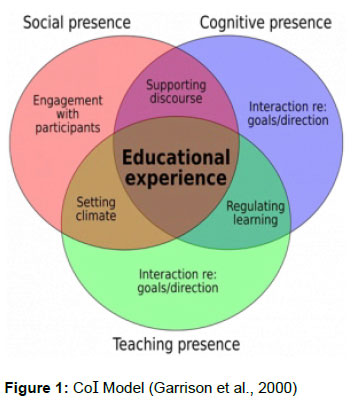
THEORETICAL FRAMEWORKIt is important to conjointly consider and discuss virtual environments and learning theories. According to Swan (2010), the theory of social constructivism suggests that knowledge is developed through social interactions among learners within a community of knowledge. (Anderson and Dron, 2011) categorised social constructivism into three levels that are integral to the learning process, namely cognitive, social, and teaching presence. This categorisation is aligned with the community of inquiry (CoI) framework that was developed by (Garrison, Anderson, and Archer, 2000).
The CoI is a popular framework for teaching and learning and is useful for selecting and implementing strategies specifically designed to encourage interactivity and community in learning environments. The CoI assumes that learning occurs through the interaction of three key elements within the online community, namely social presence, teaching presence, and cognitive presence. Befus (2016) stated that these elements are essential to facilitate successful educational experiences within learning environments. This is illustrated in Figure 1.
The sudden implementation of virtual teaching and online learning has intensified the preexisting gap in learning technologies in South Africa. This has resulted in a disadvantage for low-income students and most learners in accessing computing resources and continuous educational opportunities, indicating the lack of digital equity. Vartanova and Gladkova (2020, as cited by Dlamini, 2023) defined digital equity "as an integral set of users' access to information technologies, digital communication environment (primarily the internet) and the ability to use them for professional and personal purposes". Digital equity, in essence, is providing equal access and opportunities to digital tools, resources, and services to enhance digital capital, awareness, and skills.
This study therefore used the lens of digital equity and the Col by Garrison et al. (1999). The CoI framework was a good fit as it provides a dynamic model for an institutional approach beyond brick-and-mortar passive teaching to new ecologies of learning, thus reshaping the educational experience through different modes of instructional delivery and learning approaches. A conceptual framework was developed in this study to aid South African HEIs in the implementation of virtual teaching and online learning in a resource-constrained society. Thus, exacerbating the complex, wicked problem of digital equity as well as promoting the value of pedagogical affordances of blended learning, hybrid learning and online learning in an unequal society.
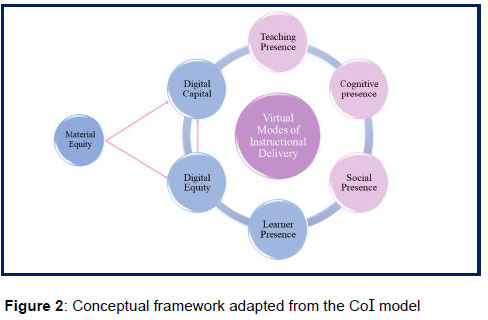
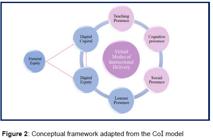
CONCEPTUAL FRAMEWORKBuilding from the CoI framework and the themes from the data and literature review, a conceptual framework was developed. The conceptual framework expands from the CoI framework and includes components of teaching presence, social presence, cognitive presence, learner presence, digital capital, digital equity, and material equity. Material equity feeds into digital capital and digital equity. It is important to note the relationship between digital capital, digital equity, and material equity, and the impact it has on the successful modes of instructional delivery using virtual teaching and online learning. This is illustrated in Figure 2.
METHODOLOGY
An intra-method mixing and theoretical triangulation approach was adopted to complement the research design. Theoretical triangulation was used as it "helps researchers to see the problem at hand using multiple lenses" Hussein (2009) and increased the validity of the study. Given that the research is premised on educational equity and the CoI framework, it is essential to understand the various elements of technology-orientated interventions. The intra-method mixing approach involves both closed-ended and open-ended questions contained in the same instrument (Johnson and Turner, 2003).
An anonymous online questionnaire containing both open- and close-ended questions was used for data collection. The close-ended questions were used to gauge the participants' preferred mode of instructional delivery, and the open-ended questions sought to understand the affordances and limitations of the preferred choice. The open-ended questions allowed participants to respond freely, justify their choices, and give their perspectives, and thereby, provide insight into issues not covered by the close-ended questions. Prior to mass distribution and data collection, the questionnaire was piloted to improve language, eliminate ambiguity, and ensure the questions drew the required data for the research.
A cluster sampling probability technique was used where 180 participants (30 academics and 30 students from each university) from three universities across three South African provinces (Limpopo, Gauteng, and KwaZulu-Natal) were sampled.
Thematic analysis was used to examine the text responses to the open-ended questions, and simple descriptive statistics were used to analyse the close-ended question. Pseudonyms were used when analysing and presenting the data to maintain the anonymity of the participants.
FINDINGS
Preferred Mode of Instructional Delivery
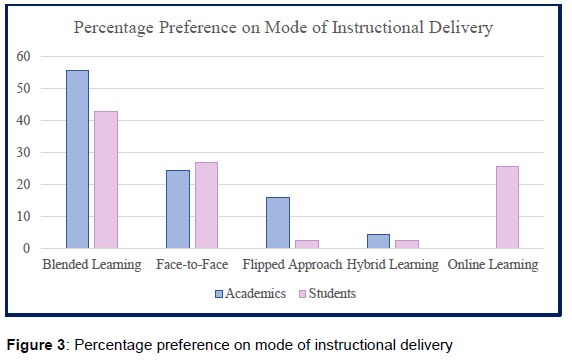
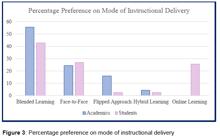
Both academics and students predominantly prefer blended learning, followed by the face-to-face mode of instructional delivery. Academics opted for flipped approaches too. Students also prefer online learning, but academics showed no preference for online learning. This summary is illustrated in Figure 3.
Theme 1: Teaching Presence
The teaching presence theme encompasses the planning, facilitation, and guidance of cognitive and social processes to achieve meaningful and valuable educational learning outcome. This theme enabled us to unpack the pedagogical value of the modes of teaching and learning that can accommodate all students. It was interesting to learn from both students and academics how they navigated learning during the pandemic period. Some students mentioned that as much as they prefer face-to-face learning, they appreciated recorded sessions because they can revisit the materials. Thulani, a student whose preference is blended learning, said, "I think we really need to have more online classes, because many of those classes are recorded and there's no crowd to disturb you during your online class". Lwazi, a student who opted for face-to-face as his preferred method of instruction, also recognised the importance of having an online component, saying the following:
"I also concentrate better when I see the lecturer in front of me. However, it is nice to work at my own pace and to then have access to the lectures again, since most of them are recorded, so I can catch up if I need to."
Academics acknowledged that blended learning offered a way to get more learning materials for students online. Dr Mbali said the following:
"A blended learning system offers a way for students to get the learning material online via recorded videos; in this way, students have an unlimited amount of time to revisit the material whenever they wish. Face-to-face instruction could then be used to reteach some of the difficult concepts that students are failing to grasp easily from the videos. They will also have time to ask the lecturer questions as they go over these challenging concepts. Again, graded material could be assessed face-to-face to avoid issues of copying or plagiarism."
A key concern from this comment, which was also shared by other academics, is assessing students as there is the issue of gauging students' understanding of concepts because of the possibility of plagiarism and cheating.
Theme 2: Learner Presence
The learner presence theme takes into consideration learners' perceptions, thoughts, and actions in learning environments. This theme reveals how learners experience learning in the different learning environments. Tshepo, a student who opted for online learning, said that the opportunities from online learning were vast. He stated that online learning "provided me with opportunities to collaborate with other students and instructors from different parts of the world. This interaction allows for knowledge sharing and peer-to-peer learning which can enhance student understanding". The students mentioned that online learning affords them the opportunity to meet with others across different times and locations as well as gives them the opportunity to pace their work, resulting in less pressure, which positively affects their mental health. Sarah claimed, "I have enough time to plan my work and do my work at my own pace and time. I can sleep all day and it helped my mental health".
The academics also supported the students' view by mentioning that blended learning offers students the flexibility to learn anywhere and anytime. Dr Maake said that "blended learning allows students to learn further during their own time". The flexibility of learning anywhere and anytime allows students to engage with material beforehand, which means they are better prepared for class and engage with more active learning. Prof Radebe said, "I think the flipped learning would help our students to have the opportunity to engage with active learning during the class time and then read material to supplement active learning at their own time".
Theme 3: Cognitive Presence
This theme highlights the elements essential to facilitate successful educational experiences in learning environments. Both students and academics mentioned that online learning environments ensure learning continuity in cases of learning disruptions. Dr Vilakazi stated the following:
"Blended learning keeps track of content in an organised online space. Contact classes can be recorded and uploaded on the learning system. So, you would not have to repeat yourself. During student strikes, you can refer students to work missed on the online space."
Lwando confirmed this by saying, "During the recent protest, for one course the lecturer shared slides and videos online and when we got to campus, she prioritised what required active learning, and that worked really well".
Another factor that arose from both academics and students with regards to face-face teaching and learning was the turnaround time of information when students ask questions and academics provide feedback. Dr Mbatha stated that "face-to-face learning provides face-to-face interaction and asking questions and discussions can be more active than other method of teaching". Siphokazi confirmed this by saying, "In-person feedback and assessments enabled me to receive immediate and constructive feedback on my performance. This helped me identify areas of my weaknesses and strengths, set clear learning goals, and track my progress over time".
Theme 4: Social Presence
This theme focused on participants of courses being able to freely express opinions and hold discussions and conversations with lecturers and each other. Both academics and students emphasised the significance of peer-to-peer learning. Some students indicated that peer-to-peer learning can only be achieved through the face-to-face mode of delivery. Paul, a student who opted for face-to-face instruction, stated that "face-to-face learning has facilitated collaboration and teamwork to me. Working together on group assignments or projects, helped me learn from one another's diverse perspectives, exchange ideas, and build social skills that will prove beneficial in my professional careers". Moreover, Dr Zahidi stated that "social and peer support networks are critical, and difficult to replicate online".
While some stated that they preferred face-to-face learning because it makes teamwork easier, other participants indicated that they preferred online as it gives them the opportunity to collaborate with people they had not previously considered working with. Students also highlighted the affordances of peer-to-peer learning in blended learning environments. Adam said, "Working together on group assignments or projects, helped me learn from one another's diverse perspectives, exchange ideas, and build social skills that will prove beneficial in my professional career".
Another predominant finding is the importance of interaction during teaching and learning. Academics and students said that their interaction was better in a face-to-face setting. Prof Entle stated that "face-to-face is better to facilitate interaction with students and to motivate them". Fred, a student who opted for a blended mode of instructional delivery, stated that "going face-to-face you are able to interact with classmates and the lecturers". On the other hand, some students find that a mode of delivery with an online learning component enhances their interactivity. Kayla said that "online learning has enhanced me with more interactive and collaborative learning experiences, such as through group discussions, online forums, and virtual classrooms".
A point highlighted by academics is reading students' emotions. Dr Nevada said that "it's much easier to have a discussion and to gauge what has been understood and to keep attention on the topic in person in class, while still exploiting our familiarity with online platforms". Dr Zulu concurred by saying that "you are able to observe the behaviour of the students if they don't understand". Most academics said that face-to-face classes affords a real-time view of student's reactions and emotions in response to the content. Prof du Toit further agreed to the notion of reading emotions and stated that "face-to-face learning is sometimes important as the lecturer have the opportunity to observe verbal and non-verbal cues, therefore identifying the challenges which would not be identified in a different setting".
Theme 5: Material Equity
This theme primarily focused on the availability of digital resources across the different modes of instructional delivery. Both academics and students highlighted the current situation of loadshedding that subsequently affects networks as one of the predominant issues of having an online component in the mode of delivery. Prof Martin stated that "online learning and hybrid learning can also have challenges with loadshedding and network issues". Ali, a student who opted for a blended approach, said that "online learning is great, but the only thing that makes it problematic are issues such as load shedding and unstable Wi-Fi".
Following the issue of loadshedding and connectivity, both academics and students stressed the role cost plays in the preference of instructional delivery. Dr Naidoo said, "One is not elaborate enough when teaching online because one considers data costs, connectivity issues and any other unforeseen interruptions". Nobuhle, a student who prefers blended learning, said that "you can barely miss class due to no transport as you learn at the comfort of your home or res [residence]". The costs mentioned include data and transport costs.
Another cost that is more intangible is the cost of time. The participants stated that time can be saved when instructional and content delivery has an online component as travel time can then be used to engage more with the content. Cayla, a blended mode of instructional delivery student, claimed, "I could have taken that time plus the travel to campus time to go through slides, research more for clarity as well as ask questions online or through email to gain more understanding".
Another major issue emphasised by students is the availability of resources used during teaching and learning. Based on the responses, resources are viewed as content materials used during instructional delivery, such as actual study material, or as the materials used in the process of teaching and learning, such as facilities of laboratories or support equipment needed for experiments and practicals. Juliet said, "With online tools and resources, I was able to access course materials anytime, anywhere, and can work at their own pace and level". While Chris stated that "face-to-face learning has provided me with access to a wealth of resources such as libraries, laboratories, and other academic facilities that support research, experimentation, and practical learning experiences".
Theme 6: Digital Equity
This theme primarily focused on the availability of digital capital and digital equity across the different modes of instructional delivery. Academics highlighted the lack of social, communication, and collaborative skill development in an online mode of delivery. Prof. Proton said the following:
"Many of the soft skills of social awareness, communication skills and leadership and teamwork skills are much more difficult to instil if students aren't comfortable with each other. Social and peer support networks are critical, and difficult to replicate online."
Contrary to this, students found that collaborative skills can be developed well in an online environment. Chanai, a student who prefers virtual teaching, said, "Online learning has enhanced me with more interactive and collaborative learning experiences, such as through group discussions, online forums, and virtual classrooms".
Both academics and students opted for online components by emphasising the importance of digital skill development, especially to become digital citizens and prepare for the digital world. Dr Garda expressed it as follows:
"With the pace at which technology is moving in this world, especially in the presence of the fourth industrial revolution, it is important for students to get firsthand experience with technology-based learning to improve their skills and prepare them for a future workforce".
Khanya and Mbali acknowledged the growth of knowledge, and Khanya said that "you gain more knowledge on how to use online facilities", and Mbali said that digital skills are important "bc [because] we are transitioning to digital world".
The gap in digital preparation from the current school system and the lack of digital capital was also highlighted. Prof Inzwe stated the following:
"They do not possess the skillset needed to be successful in a tertiary education system without the face-to-face accountability and support provided by a lecturer in class. The primary education system has not equipped the student body with necessary computer skills, critical thinking skills, nor writing/communication skills to make online learning a viable option."
DISCUSSION
The research was conducted at three South African Universities, one based in a rural area with previous disadvantaged status, one semi-rural university, and one urban university. The article sought to uncover the extent of the implementation of virtual teaching and online learning in a resource-constrained society and the pedagogical value of blended learning, hybrid learning, and online learning in an unequal society. Thematic analysis was used to examine the descriptive responses to the open-ended questions, and simple descriptive statistics was used to analyse the close-ended question to determine the preferred learning approach. The following themes were analysed based on the responses from both the academics and the students.
The first theme explored in this study is teaching presence. It was found that most students (42%) and academics (55%) expressed a preference for a blended learning approach. Furthermore, they also acknowledged the value of recorded sessions as they give them the opportunity to revisit recordings and course materials. In addition, academics recognised that adopting a blended learning approach could offer students access to a greater range of online resources and content materials and prepare students for the digital age.
Teaching presence incorporates course design, facilitation, and collaboration between students in learning environments. Therefore, virtual teaching and online learning without teaching presence is worthless. HEIs need a mode of instructional delivery that will enable all students to engage, explain concepts, explore, and discuss concepts during learning. According to Mpungose (2020), LMSs like Blackboard and Moodle should be more than just repositories; they should be customised to connect with social networking sites like WhatsApp, Facebook, and Connectyard; lecture-recording tools; video and audio-conferencing platforms such as Zoom, Blackboard Collaborate, Skype, and Microsoft Teams; and other educational resources to offer interactive lectures, both synchronous and asynchronous.
Although there are many teaching and learning benefits from virtual teaching and online learning, the academics raised concerns about the evaluation of students which poses a challenge as it hinders lecturers' ability to accurately gauge students' comprehension of concepts, primarily due to concerns of plagiarism and cheating. As teaching and learning is progressing through the integration of digital technologies along with virtual teaching and online learning, it is pertinent that e-Assessment strategies be looked at to avoid such concerns and that the focus is more on teaching and learning rather than "catching the criminal".
The second theme in this study is learner presence. Most students and academics are happy with the affordance of blended learning with the flipped learning approach where content materials are posted online, and students can access the content material anywhere and anytime. This promotes self-directed learning for most of the students as they are responsible for their own learning and can prepare for online classes independently and use the face-to-face lecture times to clarify concepts.
Teaching and learning go hand in hand, and therefore, it was imperative for us to include learner presence in the CoI framework to holistically foster both social and cognitive development during the learning process. It is imperative to design learning environments that are conducive to student success and motivation (Shea and Bidjerano, 2010). To achieve this, instructors must construct and manage online environments that facilitate active and self-directed learning. Additionally, it is necessary to integrate interactive and collaborative learning within teaching and learning environments to allow for students to learn from others, nationally and globally.
The third theme explored in this study is cognitive presence. This theme highlighted the elements essential to facilitate successful educational experiences in learning environments. Both students and academics mentioned that online learning environments ensure learning continuity in cases of learning disruptions. In line with Yuen (2011), the implementation of blended learning methodology has a notable influence on the educational experiences of students, as well as the instructional practices employed by educators. Furthermore, it has been observed that students enrolled in blended courses exhibit not only enhanced academic performance but also heightened levels of motivation and reduced anxiety. The successful integration of both components is contingent on contextual factors, including learning objectives, course design, target audience, content, digital equity, and material equity (Pascu and Petcovici, 2021). Most of the participants concurred with Befus' (2016) notion about student satisfaction with e-learning or techniques or measuring communicative action and the application of the Col model in today's technology driven classrooms, and further mentioned that online learning environments should ensure learning continuity in cases of learning disruptions.
The fourth theme explored in this study is social presence. This theme highlighted the participants' capacity to integrate into the community, engage purposefully in a supportive environment, and cultivate interpersonal relationships that reflect their unique personalities (Anderson, 2016). Social presence is linked to the level of engagement and social interaction among members of the collaborative group, making it a crucial factor in the learning process (Kreijns et al., 2014). It is interesting that some students felt that online learning offers them a space where they can communicate freely without judgement. On the other hand, academics pointed out the difficulties in gauging students' understanding of concepts in online teaching and learning as monitoring students' emotions and facial cues or indications are difficult. Another interesting factor that emanated from some students was that the face-to-face learning environment facilitates collaboration and teamwork to them, and they can be grouped together to work on group assignments or projects, which encourages sharing of knowledge. However, some students mentioned that the online environment provides them with opportunities to collaborate with other students and instructors from different parts of the world. This difference of opinion could be indicative of the lack of knowledge on collaborative methods that can be used in a virtual environment.
The fifth theme explored in this study is material equity. This theme highlighted the availability of digital resources across the different modes of instructional delivery. It is apparent that there is still an imbalance in material equity in South Africa. According to Akoojee and Nkomo, (2007) in South Africa, the primary challenge is to address historical inequalities and reshape the higher education system to support a new social order that meets urgent national needs and adapts to contemporary realities and opportunities. This remains relevant today. Transformation necessitates replacing the past ethos of higher education institutions with a new democratic culture aimed at actively dismantling race-based segregation. With the current economic and socio-economic state, it becomes impossible to equalize access to education for all students. Some students are left behind because of the current state in which they find themselves. Both the students and academics echoed the current situation of loadshedding that affects networks as one of the predominant issues of having an online component in the mode of delivery. Rural areas are constantly on stage 6 loadshedding, which means that every day they only have access to electricity and network for about six hours. There are initiatives put in place to assist students with access to free Wi-Fi or other internet connections across almost all areas in South Africa, such as public libraries, Project Isizwe, and Wi-Fi cities.
The sixth theme explored in this study is digital equity. This theme focuses on access to resources enabling students to learn in online learning environments and develop their digital skills or fluency. The reality is that the connectivity issues, cost of data, lack of infrastructure, and shortage of electricity can limit students' online learning activities, making the shift by schools and universities to online learning more of a disadvantage. Once again, it is clear that owning technology is now a necessity and no longer a luxury. The same applies to digital skills, and both students and academics ought to be equipped with the necessary skills needed for online and teaching learning. The challenge is to address past inequalities and to transform the higher education system to align with a new societal structure, addressing national requirements and adapting to emerging opportunities and realities, thereby promoting equitable access to education. A possible direction is making more investments in education centres, digital hubs, and digital learning centres, and ensuring these investments are guided by student and community needs.
CONCLUSION AND RECOMMENDATIONS
We believe that the catalyst for change emanating from the pandemic in the modes of instructional delivery can be used by HEIs in South Africa to introduce virtual teaching and online learning through blended and hybrid modes of instructional delivery. This will allow education systems to be more resilient and accessible, allowing for digital inclusion and equitable access, enabling both students and lecturers to cope with current disruptions, and provide equitable education. However, we must acknowledge the various challenges students face in transitioning to online learning and work towards finding solutions. It is crucial to consider students' difficulties and preferences, as these insights will aid in developing strategies to manage any learning disruptions effectively.
Among the main advantages offered to the educational process by blended and hybrid learning is increased flexibility for lecturers in presenting their subjects, increased flexibility for students in their learning approaches, effectiveness in the learning outcome for students due to the multiple teaching methods, and more interactions with students because teachers can interact with individuals and small groups of students to determine gaps and check their progress. Moreover, there are some cost savings, such as classroom space savings and commuting expenses, including traffic and parking places for university students or parents. On the other hand, one of the biggest disadvantages of blended learning is related to its dependence on technology. Schools and universities are supposed to have the tools and finances to support the necessary technology for a blended learning classroom. Moreover, lecturers as well as students must have some training in the use of technology, which requires time. Finally, students' access to technology, such as personal computers, tablets, phones, and internet, must also be considered.
Given the chronic challenges and e-learning infrastructural issues, it becomes necessary for public-to-private partnerships. In other words, HEIs must further engage with government and telecommunication companies to provide the necessary infrastructural development and internet access to students. Despite the efforts that were implemented during the pandemic, South Africa still faces significant challenges in achieving equitable access for all students nationwide, ensuring digital inclusion. It is evident that the notion of the digital divide in South Africa is a wicked problem, and this problem continues to be magnified due to the various inequalities.
We must consider that to redress existing inequalities and promote more equitable access to education, a needs analysis must be done given the different socio-economic backgrounds, digital capital, digital equity, and material equity that students face, in conjunction with more investment in providing students with access to the internet.
DECLARATIONSAvailability of Data and Materials
The datasets used and/or analysed during the current study are available from the corresponding author on reasonable request.
Funding
This research received no external funding.
Acknowledgements
Not applicable
REFERENCES
- Akoojee, S., and M. Nkomo. 2007. "Access and quality in South African higher education: the twin challenges of transformation". Human Sciences Research Council, 21(3), 385-399.
- Alexander, J., M. Barcellona, S. Mclachlan, and C. Sackley. 2019. "Technology-enhanced learning in physiotherapy education: Student satisfaction and knowledge acquisition of entry-level students in the United Kingdom". British Journal of Educational Technology, 27(1063519), 1-14.
- Amory, A. 2010. "Education technology and hidden ideological". Educ Technol Soc, 13(1), 69-79.
-
Anderson, T. 2016. "Theories for learning with emerging technologies". Emerging Technologies in Distance Education, 7(1), 7-23. http://www.aupress.ca/index.php/books/120177
» http://www.aupress.ca/index.php/books/120177 -
Anderson, T., and J. Dron. 2011. "Three generations of distance education pedagogy". International Review of Research in Open and Distance Learning, 12(3), 80-97. https://doi.org/10.19173/irrodl.v12i3.890
» https://doi.org/10.19173/irrodl.v12i3.890 - Arkorful V, and N. Abaidoo. 2015. "The role of e-learning advantages and disadvantages in HE". International Journal of Instructional Technology & Distance Learning, 12 (1), 29-42.
-
Aydin, B., and V. Demirer. 2022. "Are flipped classrooms less stressful and more successful? An experimental study on college students". International Journal of Educational Technology in Higher Education, 19(1). https://doi.org/10.1186/s41239-022-00360-8
» https://doi.org/10.1186/s41239-022-00360-8 -
Barbayannis, G., M. Bandari, X. Zheng, H. Baquerizo, K. W. Pecor, and X. Ming. 2022. "Academic Stress and Mental Well-Being in College Students: Correlations, Affected Groups, and COVID-19". Frontiers in Psychology, 13(May), 1-10. https://doi.org/10.3389/fpsyg.2022.886344
» https://doi.org/10.3389/fpsyg.2022.886344 -
Befus, M. K. 2016. Digital Thesis Room: A thematic synthesis of Community of Inquiry research 2000 to 2014. https://dt.athabascau.ca/jspui/handle/10791/190
» https://dt.athabascau.ca/jspui/handle/10791/190 - Bennett, S., K. Maton, and L. Kervin. 2008. "The Digital Natives Debate". British Journal of Educational Technology, 39(5), 775-786.
-
Bizcommunity. (2023). Digital Learning Hub opens in shopping mall. https://www.bizcommunity.com/Article/196/500/237290.html#. Accessed on 09 August 2023
» https://www.bizcommunity.com/Article/196/500/237290.html# -
Black, P. 2010. "Inside the Black Box: Raising Standards Through Classroom Assessment". Granada Learning. https://doi.org/10.1177/003172171009200119.
» https://doi.org/10.1177/003172171009200119 -
Bliuc, A., P. Goodyear, and R. A. Ellis. 2007. "Research Focus and Methodological Choices in Studies Into Students ' Experiences of Blended Learning in Higher Education". The Internet and Higher Education, December. https://doi.org/10.1016/j.iheduc.2007.08.001.
» https://doi.org/10.1016/j.iheduc.2007.08.001 - Boelens, R., S. Laer, S.Van, and B. De Wever. 2015. "Blended learning in adult education : towards a definition of blended learning". The Internet and Higher Education, June, 5-7.
- Bourdieu, Pierre; J. Richardson. 1983. The Forms of Capital - , Handbook of Theory and Research for the Sociology of Education (1983). 241-258.
-
Chinembiri, T. 2020. "Despite Reduction in Mobile Data Tariffs, Data Still Expensive in South Africa". Research ICT Africa, April, 1-6. https://africaportal.org/publication/despite-reduction-mobile-data-tariffs-data-still-expensive-south-africa/
» https://africaportal.org/publication/despite-reduction-mobile-data-tariffs-data-still-expensive-south-africa/ -
Choudhury, S., and S. Pattnaik. 2019. "Emerging themes in e-leaming : A review from the stakeholder's perspective." Computers & Education, 144. https://doi.org/10.1016/j.compedu.2019.103657.
» https://doi.org/10.1016/j.compedu.2019.103657 - Cuban, L. 1986. Teachers and machines: The classroom use of technology since 1920. Teachers college press.
- Czerniewicz, L., N. Agherdien, and J. Badenhorst. 2020. "A Wake-Up Call : Equity, Inequality and Covid-19 Emergency Remote Teaching and Learning". Postdigital Science and Education, 946967.
-
Dlamini, R. 202). "Interactivity, the heart and soul of effective learning: The interlink between internet self-efficacy and the creation of an inclusive learning experience". South African Journal of Higher Education, 37(2). https://doi.org/10.20853/37-2-5105
» https://doi.org/10.20853/37-2-5105 -
Dlamini, R., and N. Ndzinisa. 2020. "Universities trailing behind: Unquestioned epistemological foundations constraining the transition to online instructional delivery and learning". South African Journal of Higher Education, 34(6), 52-64. https://doi.org/10.20853/34-6-4073
» https://doi.org/10.20853/34-6-4073 -
Du Preez, P., and L. le Grange. 2020. "The COVID-19 Pandemic, Online Teaching/ Learning, the Digital Divide, and Epistemological Access". Alternation African Scholarship Book Series (AASBS): Rethinking the Humanities Curriculum in the Time of COVID, 1(December), 90-106. http://altemation.ukzn.ac.za/Files/books/series-01/01/06-Du-Preez.pdf%0Ahttps://doi.org/10.29086/978-0-9869936-1-9/2020/AASBS01
» http://altemation.ukzn.ac.za/Files/books/series-01/01/06-Du-Preez.pdf%0Ahttps://doi.org/10.29086/978-0-9869936-1-9/2020/AASBS01 -
Dziuban, C., C. R. Graham, P. D. Moskal, A. Norberg, and N. Sicilia. 2018. "Blended learning: the new normal and emerging technologies". International Journal of Educational Technology in Higher Education, 15(1), 1-16. https://doi.org/10.1186/s41239-017-0087-5
» https://doi.org/10.1186/s41239-017-0087-5 -
Espinoza, O. 2007. "Solving the equity-equality conceptual dilemma: A new model for analysis of the educational process." Educational Research, 49(4), 343-363. https://doi.org/10.1080/00131880701717198
» https://doi.org/10.1080/00131880701717198 -
Ferri, F., P. Grifoni, and T. Guzzo. 2020. "Online learning and emergency remote teaching: Opportunities and challenges in emergency situations". Societies, 10(4), 1-18. https://doi.org/10.3390/soc10040086
» https://doi.org/10.3390/soc10040086 -
Frønes, T. S., A. Pettersen, J. Radisic, and N. Buchholtz. 2021. "Equity, equality and diversity in the Nordic model of education-contributions from large-scale studies". In Equity, Equality and Diversity in the Nordic Model of Education. https://doi.org/10.1007/978-3-030-61648-9_1
» https://doi.org/10.1007/978-3-030-61648-9_1 - Garrison, D. R., T. Anderson, and W. Archer. 2000. "Critical inquiry in a text-based environment: Computer conferencing in higher education model. The Internet and Higher Education". The Internet and Higher Education, 2((2-3)), 87-105.
- HEFCE. 2009. Enhancing learning and teaching through the use of technology: A Revised Approach to HEFCE's Strategy for e-Learning, Bristol: Higher Education Funding Council for England. March.
-
Hodges, C., S. Moore, B. Lockee, T. Trust, and A. Bond. 2020." The Difference Between Emergency Remote Teaching and Online Learning." Educause, 1-12. https://er.educause.edu/articles/2020/3/the-difference-between-emergency-remote-teaching-and-
» https://er.educause.edu/articles/2020/3/the-difference-between-emergency-remote-teaching-and- - Jansen, J. 2004. Changes and continuities in South Africa's higher education system, 1994 to 2004. Changing class: education and social change in postapartheid South Africa. Oxford University Press Southern Africa.
-
Jantjies, M. 2020. How South Africa can address digital inequalities in e-learning. https://theconversation.com/how-south-africa-can-address-digital-inequalities-in-e-learning-137086
» https://theconversation.com/how-south-africa-can-address-digital-inequalities-in-e-learning-137086 - Johnson, B., and F. Turner. 2003. Data collection strategies. Handbook of mixed methods in social and behavioural research. Thousand Oaks: Sage.
-
Khoza, S. B., and C. B. Mpungose. 2020. "Digitalised curriculum to the rescue of a higher education institution". African Identities, 00(00), 1-21. https://doi.org/10.1080/14725843.2020.1815517
» https://doi.org/10.1080/14725843.2020.1815517 -
Kreijns, K., F. Van Acker, M. Vermeulen, and H. Van Buuren. 2014. "Community of Inquiry: Social presence revisited". E-Learning and Digital Media, 11(1), 5-18. https://doi.org/10.2304/ELEA.2014.11.1.5
» https://doi.org/10.2304/ELEA.2014.11.1.5 - Laufer, M., Leiser, A., Deacon, B., Perrin de Brichambaut, P., Fecher, B., Kobsda, C., & Hesse, F. (2021). Digital higher education: a divider or bridge builder? Leadership perspectives on edtech in a COVID-19 reality. International Journal of Educational Technology in Higher Education, 18(1), 51.
-
Lai, G. H. C. 2015. "Seamless flipped learning : a mobile technology- enhanced flipped classroom with effective learning strategies." Journal of Computers in Education, 2(4), 449-473. https://doi.org/10.1007/s40692-015-0043-0
» https://doi.org/10.1007/s40692-015-0043-0 -
Linder, K. 2017. "Fundamentals of Hybrid Teaching and Learning". New Directions for Teaching and Learning, 2017, 11-18. https://doi.org/10.1002/tl.20222
» https://doi.org/10.1002/tl.20222 -
Mail&Guardian. 2020, November 10. Digital Learning Hub opens in shopping mall. Mail&Guardian. https://www.bizcommunity.com/Article/196/500/237290.html
» https://www.bizcommunity.com/Article/196/500/237290.html - Majola, M. X; P. K. Mudau. 2022. "Lecturers' Experiences of Administering Online Examinations at a South African Open Distance E-Learning University during the COVID-19 Pandemic". International Journal of Educational Methodology, 8(2), 275-283.
- Mataka, T. W., T. Mukurunge, T. Bhila. 2020. "Virtual teaching and learning: a sad reality of the "haves" and "have nots", the teacher's voice in Zimbabwe during COVID 19 pandemic." International Journal of All Research Writings, 1(12), 8-14.
-
Mgqwashu, E. 2017. Universities can't decolonise the curriculum. www.conversation.com/universities-cant-decolonise-the-curriculumwithout-%0Adefining-it-first-63948
» www.conversation.com/universities-cant-decolonise-the-curriculumwithout-%0Adefining-it-first-63948 -
Mpungose, C. B. 2020. "Emergent transition from face-to-face to online learning in a South African University in the context of the Coronavirus pandemic". Humanities and Social Sciences Communications, 1-10. https://doi.org/10.1057/s41599-020-00603-x
» https://doi.org/10.1057/s41599-020-00603-x - Olapiriyakul, K., J. M. Scher. 2006. "A guide to establishing hybrid learning courses: Employing information technology to create a new learning experience, and a case study". The Internet and Higher Education, 287-"301.
- Pascu, and Petcovici. 2021. Face-to-face, blended/hybrid and online teaching". Anale. Seria Stiinte Economice. Timisoara, 26, 113-117.
- Ragnedda, M. 2018. "Conceptualizing digital capital". Telematics and Informatics, 35(8), 2366-2375. https://doi.org/10.1016/j.tele.2018.10.006.
- Resta, P., T. Laferrière, and R. Mclaughlin. 2018. Issues and Challenges Related to Digital Equity: An Overview. 987-1004.
-
Saichaie, K. 2020. Blended, Flipped, and Hybrid Learning: Definitions, Developments, and Directions. 164, 95-104. https://doi.org/10.1002/tl.20428.
» https://doi.org/10.1002/tl.20428 -
Selwyn, N. 2004. "Reconsidering Political and Popular Understandings of the Digital Divide". New Media & Society - NEW MEDIA SOC, 6, 341-362. https://doi.org/10.1177/1461444804042519.
» https://doi.org/10.1177/1461444804042519 - Senanayake, A. C., A. Samarakkody, C. Malalgoda, D. Amaratunga, R. Haigh, C. Liyanage, R. Shaw. 2023. "Towards an Inclusive Disaster Education: The State of Online Disaster Education from the Learner's Perspective." Sustainability, 15(14), 11042.
-
Shea, P., and T. Bidjerano. 2010. "Learning presence: Towards a theory of self-efficacy, self-regulation, and the development of a communities of inquiry in online and blended learning environments". Computers and Education, 55(4), 1721-1731. https://doi.org/10.1016/j.compedu.2010.07.017
» https://doi.org/10.1016/j.compedu.2010.07.017 -
Shetu, S. F., M. Rahman, A. Ahmed, M. F. Mahin, A. U. Akib, and M. Saifuzzaman. 2021. "Current Research in Behavioral Sciences Impactful e-learning framework: A new hybrid form of education". Current Research in Behavioral Sciences, 2(April), 100038. https://doi.org/10.1016/j.crbeha.2021.100038.
» https://doi.org/10.1016/j.crbeha.2021.100038 -
Shin, M., and Hickey, K. 2021. "Needs a little TLC: examining college students' emergency remote teaching and learning experiences during COVID-19". Journal of Further and Higher Education, 45(7). https://doi.org/10.1080/0309877X.2020.1847261
» https://doi.org/10.1080/0309877X.2020.1847261 -
Siegelman, A. 2021. "Blended Learning, Hybrid Learning, The Flipped Classroom... What's the Difference?" In Panopto. https://www.panopto.com/blog/blended-leaming-hybrid-leaming-flipped-classroom-whats-difference/
» https://www.panopto.com/blog/blended-leaming-hybrid-leaming-flipped-classroom-whats-difference/ -
Soomro, K. A., U. Kale, R. Curtis, M. Akcaoglu, and M. Bernstein. 2020. "Digital divide among higher education faculty". International Journal of Educational Technology in Higher Education, 17(1). https://doi.org/10.1186/s41239-020-00191-5
» https://doi.org/10.1186/s41239-020-00191-5 -
Swan, A. 2010. The Open Access citation advantage: Studies and results to date. https://eprints.soton.ac.uk/268516/2/Citation_advantage_paper.pdf?msID=a2f4c223-3af2-44c3-afe5-8c823efea7fb&msID=29ed99ba-1ea3-47d0-9e21-a46a42fd6f05
» https://eprints.soton.ac.uk/268516/2/Citation_advantage_paper.pdf?msID=a2f4c223-3af2-44c3-afe5-8c823efea7fb&msID=29ed99ba-1ea3-47d0-9e21-a46a42fd6f05 -
Tech-drive. 2023. Tech-driven Innovation Sparks Investor Interest in South Africa's Start-ups". https://www.techinafrica.com/tech-driven-innovation-sparks-investor-interest-in-south-africas-start-ups/
» https://www.techinafrica.com/tech-driven-innovation-sparks-investor-interest-in-south-africas-start-ups/ -
Therborn, G. 2012. "The killing fields of inequality". International Journal of Health Services, 42(4), 579-589. https://www.jstor.org/stable/45140301
» https://www.jstor.org/stable/45140301 -
Ullah, K., S. T. Hussain Shah, S. M. Ali, and A. Khan. 2019. "Development and Validation of Technology Enhanced Learning Framework Driven by Flipped Methodology Learning Environment". Mehran University Research Journal of Engineering and Technology, 38(3), 667686. https://doi.org/10.22581/muet1982.1903.12.
» https://doi.org/10.22581/muet1982.1903.12 -
Vodafone. 2020. Using technology to help students learn from anywhere with connected education. Vodafone Business News. https://www.vodafone.com/business/news-and-insights/blog/gigabit-thinking/using-technology-to-help-students-learn-from-anywhere-with-connected-education. Accessed on 09 August 2023
» https://www.vodafone.com/business/news-and-insights/blog/gigabit-thinking/using-technology-to-help-students-learn-from-anywhere-with-connected-education - WorldBank. 2011. Inequality in South Africa: An Assessment of the African Southern Union Customs.
- Yuen, A. H. K. 2011. Exploring teaching approaches in blended learning. 6(1), 3-23.