Bridging the quality education gap: The interplay between students' well-being and academic success in South African higher education
Abstract
In the contemporary world quality education is influenced by numerous factors, including the well-being of students in higher education environments. This article therefore explores the significance of the well-being of students as an essential factor in achieving necessary quality education. Many HEIs tend to overlook this component of student's well-being and focus primarily on students' academic achievements as a formal educational goal. Through a systematic literature review this article uses a qualitative research method to analyse secondary sources of data. For this purpose, data was collected through interactions with peer-reviewed publications produced between 2019 and 2025, to substantiate its discussions. The findings revealed a gap within the academic experiences of enrolled students, which may be mitigated through strengthened wellness support services. The article highlights the importance of ongoing efforts to enhance student well-being and advocates for institution-based wellness programmes that are available to all students, irrespective of gender, beliefs, and religious background. The study is well positioned to assists in assessing the extent to which HEIs are committed to promoting student wellness alongside the delivery of quality education. Prioritising student Through such an approach the well-being of students is nominated as a vital component of improving quality education and promoting a healthier academic environment for students. The article further calls for collaborative action among HEIs stakeholders to finance supportive environments that emphasise both academic achievement and the resilience and well-being of enrolled students.
Academic achievement; sense of belonging; student support; student well-being; student retention; resilience
INTRODUCTION AND BACKGROUND
Quality education has consistently remained a central concern for communities, educational institutions, and policymakers worldwide (Reimers and Chung 2019). Nevertheless, an increasing volume of scholarship indicates that quality education should not be measured exclusively through academic achievement. Students' well-being should be recognised as a fundamental component of an effective education system that is closely connected to real-life experiences and not as a separate concern (Douwes et al 2023; Hill et al 2024). Bharuthram and van Heerden (2025) argue that students' well-being has become a significant issue within higher education. Building on this viewpoint, the article combines academic excellence with critical cross-field outcomes (CCFO) while placing emphasis on students' well-being. Particular attention is given to well-being matters, which have recently emerged as important that influence and, in some cases, hinder the delivery of quality education in the aftermath of the COVID-19 pandemic (Tang 2023; Pandey et al 2021). From global perspective, the effective promotion and management of students' well-being is significant for sustaining quality education throughout the academic cycle. This perspective is equally relevant in South African context and should be considered alongside the realities of the country's higher education system.
South Africa's higher education sector continues to encounter numerous challenges that undermine both its efficiency and inclusivity. One of the significant issues is the persistently low student retention rate, as a considerable number of students do not complete their qualifications within the prescribed period (Mlachila and Moeletsi 2019). According to Chemagosi and Ajayi (2023), the challenge is further intensified by inadequate readiness and adjustment difficulties among first-year students, which are often associated with insufficient wellness support, limited resources, and poor-quality teaching. In the South African context, issues related to student preparedness and well-being are closely linked to enduring historical inequalities that continue to shape access to quality education and affect students' overall wellness, particularly among disadvantaged and marginalised communities. Moreover, socioeconomic inequalities and limited access to educational opportunities within many South African communities contribute to widening disparities in quality education and the attainment of CCFOs (Mlachila and Moeletsi 2019). The effects of apartheid have also profoundly influenced the education system, leading to uneven allocation of resources across HEIs and geographic regions.
Despite the rise in student enrolments since 1994, which was intended to expand higher education access for historically disadvantaged communities, this growth has not been accompanied by corresponding improvements in graduation outcomes or the quality education offered (Mlachila and Moeletsi 2019). In relation to the latter issue, Theoharis (2024) argues that overcoming systemic barriers affecting students' academic progression requires inclusive reforms. Such reforms should focus on strengthening student readiness through improved secondary education systems while simultaneously enhancing institutional support mechanisms, including students' wellness initiatives.
This study is aligned with Sustainable Development Goal (SDG) 3, which promotes Good Health and Well-being, and SDG 4, which advocates Quality Education. The link between student' well-being and academic achievement demonstrates the relationship between these goals in HEIs that seek to advance equitable access to education and constructive health outcomes. Accordingly, this article is motivated by the aim to investigate the crucial relationship between quality education and students' well-being and to propose a framework for addressing the existing gap. The objectives of the study are to:
Assess the importance of students' well-being, and its influence on the provision of quality education within HEI.
Determine the role of a sense of belonging within the higher education community in supporting students' well-being.
Establish the challenges associated with translating theoretical approaches to a sense of community and belonging into practical implementation within higher education systems.
Propose an integrated cross-sector strategy that incorporates students' well-being support and social-emotional learning into the higher education experience.
The central focus in this article is the increasing disconnection between the provision of quality education and the inadequate attention given to students' well-being. This disconnect has produced adverse consequences, including escalating rates of youth suicide and the growing prevalence of mental health challenges (Duffy et al, 2020), particularly among students in tertiary institutions who are confronted with the demand and pressures of faced with contemporary academic environments.
CONCEPTUAL FRAMEWORKThe conceptual framework underpinning this article is informed by Astin's Student Involvement Theory and Input-Environment-Outcome (I-E-O) model developed in 1984. Astin's Student Involvement Theory and I-E-O framework provides the principal theoretical foundation for this study. In addition, the concepts of student well-being, sense of belonging, social-emotional learning, and Critical Cross-Field Outcomes are utilised as complementary constructs that reinforce and extend the application of Astin's model.
Alexander Astin's Student Involvement Theory and I-E-O model of 1984
The Astin model illustrates how student engagement within institutional environment shapes educational outcomes. The I-E-O model proposes that students enter HEI with characteristics and attributes (inputs), engage with various experience and conditions within the institution (environment), and subsequently achieve specific outcomes, including academic performance, well-being, persistence, and resilience. Within the context of this study, student well-being is viewed as both an input and an outcome variable. Students begin their higher education journey with differing levels of economic, emotional, psychological, and social well-being, which affect their ability to succeed academically. Environmental factors such as wellness support services, social-emotional learning initiatives, academic staff support, and a sense of belonging create institutional conditions that influence students' participation in educational activities. These interactions ultimately shape outcomes such as academic achievement, the attainment of CCFOs, and the delivery of quality education.
Students' well-being
The concept of students' well-being has been defined in various ways by different scholars. Stanton et al (2016,92) describe well-being as encompassing "social, physical and mental dimensions" that must be balanced to promote a sense of satisfaction and personal fulfilment. According to Sun and Shek (2023), student well-being refers to the extent to which students are able to function effectively within the educational environment and whether their needs are adequately supported to maintain a healthy balance between personal capabilities and available developmental resources. Although some researchers use the terms students' well-being and mental health interchangeably, this article adopts a broader understanding of well-being that includes psychological, physical, and other related aspects of students' academic lives.
Sense of belonging
A sense of belonging within HEIs plays a significant role in promoting students' well-being and academic success. Despite its recognised importance, uncertainties remain regarding how the concept is defined and assessed in higher education, particularly across student groups that differ in ethnicity and generational statuses (Dias-Broens, Meeuwisse and Severiens 2024). Sense of belonging is a multidimensional concept with numerous interconnected elements (Pincus 2024). An enhanced understanding of this concept can be achieved through incorporating African perspectives within higher education discourse. From this perspective, sense of belonging be viewed as the creation of an inclusive environment of belonging where both academics and students experience acceptance and connectedness, thus support quality education and well-being. Additionally, sense of belonging includes meaningful engagement during learning, social integration, and inclusive practices, all of which contribute to effective learning and the provision of quality education.
Social-emotional learning
Student well-being has become an increasingly important issue in higher education, as many students experience high levels of anxiety, depression, and stress arising from academic demand. Furthermore, social interactions, competitive educational environments and societal expectations can have significant effect on students' well-being (Julius, Putteeraj and Somanah 2024). Khatri et al (2024) define student well-being as the collective students' physical, psychological, and social health experienced within higher education contexts. These scholars further note that higher education environments are often characterised by demanding workloads, unmet aspirations, and concerns regarding graduation and future employment opportunities, which negatively affect student well-being.
Critical cross-field outcomes and quality education
Quality higher education serves as the key component of economic development in every country. It is therefore essential for HEIs to equip students with the knowledge and skills required by the economy while also promoting critical thinking abilities that enable them to participate effectively in society. To support this, Critical Cross-Field Outcomes (CCFOs) should be integrated into teaching and learning practices to strengthen the quality of higher education. This aligns with the South African Qualifications Authority (SAQA) definition of CCFOs as "generic outcomes that inform all teaching and learning and are critical for the development of the capacity for lifelong learning" (2026). The CCFOs adopted by SAQA include the following (SAQA, 2012; 2023):
Identify and solve problems in which responses demonstrate that responsible decisions using critical and creative thinking have been made.
Work effectively with others as a member of a team, group, organisation, or community.
Organise and manage oneself and one's activities responsibly and effectively.
Collect, analyse, organise and critically evaluate information.
Communicate effectively using visual, mathematical and/or language skills in the modes of oral and/or written presentation.
Use science and technology effectively and critically, showing responsibility towards the environment and the health of others.
Demonstrate an understanding of the world as a set of related systems by recognising that problem-solving contexts do not exist in isolation.
Student wellness can be incorporated into, or aligned with, the Council of Higher education 's (CHE) mandate on quality education. The CHE occupies a pivotal position in promoting quality within higher education sector. Section 25 of the National Qualifications Framework Act (Act No. 67 of 2008) designates the CHE as the Quality Council for Higher Education. Similarly, the Higher Education Act (Act No. 101 of 1997) entrusts the CHE with the responsibility to promote quality assurance in higher education and evaluating the effectiveness of quality assurance systems. Consequently, the HEIs should embed these CCFOs within their programmes and qualifications to ensure that quality education is delivered to students.
Institutional commitment to addressing the multifaceted nature of quality education is fundamental in bridging the divide between academic achievement and student well-being through strengthened wellness support services (Malema, Gawulayo and Naidoo 2025). Such initiatives should be prioritised to establish supportive learning environment that enable students to navigate their academic journeys successfully and attain the CCFOs, summarised as, adaptability, creativity, critical thinking, effective communication, ethical awareness and problem-solving, and teamwork. This article relates students' well-being with the achievement of the CCFOs, which contribute significantly to quality education through meaningful learning experiences, relevant curriculum content, effective teaching practices, assessment strategies aligned with learning outcomes, and the cultivation of critical thinking, problem-solving, and lifelong learning competencies (Liverpool et al 2024).
Drawing on the preceding discussion of well-being, it may be argued that the realisation of student well-being facilitates the attainment of the CCFOs. This notion therefore requires a collaborative and holistic approach to address the relationship between students' well-being and provision of quality education in HEIs (Van Beek, 2024).
METHODOLOGY
To address existing gaps in understanding the influence of student's well-being on students and the provision of quality education, the reviewed literature in this article served as a basis for consolidating existing knowledge on wellness services, their effectiveness, and their implementation within educational institutions.
A systematic search for relevant studies was performed using four major databases: ERIC, Scopus, Web of Science, and Google Scholar. ERIC (accessed through EBSCOhost/ProQuest) was selected because of its focus on educational and psychological research. Scopus, Web of Science, and Google Scholar were included to ensure broader coverage across multiple academic fields.
The search process employed Boolean operators to combine five central concepts: (1) academic success, (2) higher education settings, (3) quality education, (4) student well-being, and (5) sense of belonging, together with related outcomes such as competence, motivation, and resilience. An example of the search strategy applied in Scopus was:
("student wellbeing") AND (motivation OR resilience OR "sense of belonging") mp. [mp = title, abstract, heading word, table of contents, key concepts] AND (ALL ("student wellbeing" OR "academic wellbeing") AND ALL ("academic success") AND ALL ("critical cross-field outcomes") AND ALL ("universities" OR "higher education") AND ("teaching strategies" or "educator behaviours").
Inclusion and exclusion criteria
A structured inclusion and exclusion processes was implemented to ensure the selection of relevant and quality studies. The review:
Included peer-reviewed journal articles that examined wellness services within universities and focused on interventions aimed at enhancing students' well-being, such as counselling or mindfulness programmes.
Excluded non-peer-reviewed studies and publications that were also unrelated to educational contexts or lacked a direct connection to students' well-being outcomes.
Limited the search to articles published in English and subjected to peer-review.
Identified additional relevant studies through manual examining and screening of reference lists from selected articles to ensure a comprehensive coverage theoretical and empirical literature aligned with the review objectives.
Studies were considered eligible if they explored student well-being and the quality of education within university settings. To qualify for inclusion, studies had to report outcomes associated to academic quality and students' sense of belonging. Quantitative, qualitative, and mixed-methods research published in peer-reviewed journals between 2019 and 2025 were included.
Studies were excluded if they focused solely on general academic performance without addressing student well-being, or if they examined academic achievement and educational outcomes without considering dimensions of quality education. Furthermore, book chapters, commentaries, conference proceedings, editorials, non-peer-reviewed sources, publications unavailable in full text, and articles not written in English were omitted from the review.
This approach ensured that the inclusion of relevant and research rigour while reducing the potential bias through the systematic removal of studies that did not align with the stated objectives.
Study selection and data extraction
The relevance of identified studies was initially assessed through title and abstract screening conducted independently by two reviewers. Articles that met preliminary criteria subsequently underwent full text evaluation. Any discrepancies regarding the inclusion of extracted studies were discussed among the reviewers and resolved through consensus. The final selection of articles was based on their contribution to one or more of the review's central themes.
Data relevant to the study objectives were systematically extracted from the selected publications. Extracted information included: author(s), publication year, and country of study; research design and methodological approach; study population and educational context; measures and indicators of student well-being; aspects related to quality education; and outcomes associated with academic achievement and success.
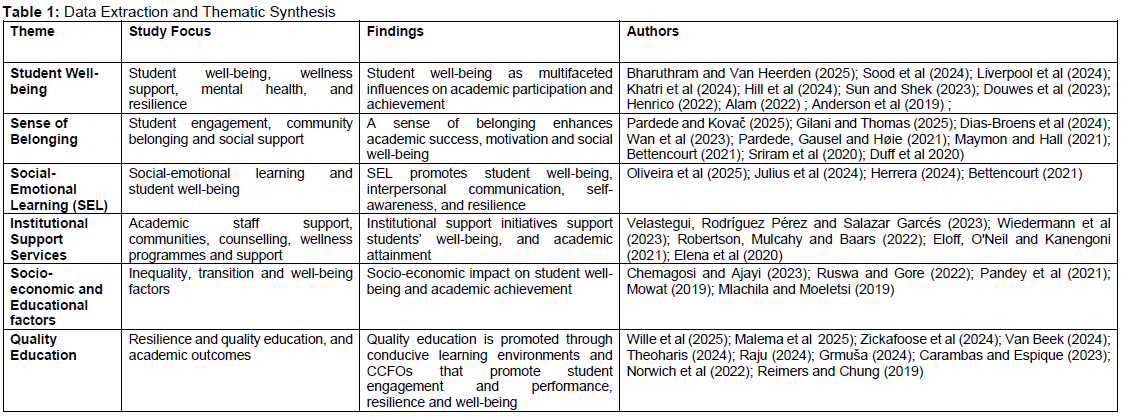
The findings were analysed and synthesised thematically using the conceptual framework informed by the sense of belonging theory and SAQA critical outcomes. The synthesis focused on six broad themes as shown in Table 1. Table 1 illustrates the data extraction matrix used to organise and synthesise literature reviewed in this study.
Six major themes were identified from the reviewed literature, namely, student well-being, social-emotional learning, sense of belonging and community, institutional support and wellness services, socio-economic and educational challenges, and quality education. The findings suggest that student well-being serves as the fundamental pillar of academic achievement, while sense of belonging, social-emotional learning, and institutional support act as key mechanisms through which HEIs can enhance students' experiences and educational performance. When examined through the lens of Astin's (1984) I-E-O model, student well-being and socio-economic conditions are regarded as input factors, whereas sense of belonging, social-emotional learning and institutional support constitute environmental factors. The outcomes factors include academic achievement, resilience, retention, the attainment of CCFOs, and the provision of quality education. This integrated analysis highlights the interrelationship between student well-being and the achievement of quality education in HEIs.
FINDINGS AND DISCUSSION
Research has emphasised the vital importance of a sense of belonging within the higher education space as the key contributor to students' well-being and academic achievement. Astin's (1984) Student Involvement Theory offers a valuable lens through which this relationship can be understood, as it proposes the student learning and development are influenced by the extent and quality of their engagement in academic experience. Within the I-E-O model, sense of belonging, social-emotional learning, and wellness support services are considered environmental factors that shape students' involvement and participation in educational activities. Despite this theoretical understanding, a considerable disparity remains between the conceptualisation and practical implementation of strategies intended to support a sense of belonging in higher education. To bridge this gap, HEIs should adopt a comprehensive that places student well-being support and social-emotional learning at the centre of the educational experience. Through such integrated strategy, institutions can improve access to wellness resources, deliver holistic student support, create learning environments that are safe, supportive, and conducive to the overall student well-being.
Findings from the systematic literature review point out to the existence of an "academic gap" arising from inadequate well-being support structures within HEIs. Strengthening wellness services may help overcome barriers to quality education and ensuring that all students, irrespective of their social, cultural, or religious backgrounds, have access to the resources required for academic success. The results and discussion therefore align closely with the objectives underpinning this study.
Students' well-being and quality education
This study examined how HEIs recognise the important connection between student well-being and CCFOs in achieving quality education. Robertson et al (2022) contend that inequitable learning environments can restrict access to quality education by increasing levels of stress, anxiety, and discomfort among students when their well-being is compromised. However, some institutions fail to promote the relationship between and CCFO because their primary attention remains focused on formal academic performance. This situation reflects a broader challenge within the higher education in South Africa. Although policy frameworks such as the Education White Paper 3 of 1997, advocate for the transformation of higher education through equity promotion and responsiveness to societal needs (South Africa Department of Education 1997), a gap continues to exist between policy objectives and their implementation in practice. For example, while these policies point out that human resource development and advanced skills training, obstacles remain, including lecturer's limited capacity to identify, support, and appropriately refer students experiencing well-being related challenges that may negatively affect teaching and learning processes towards quality education (Dreyer 2017; Zickafoose et al 2024; Carambas and Espique 2023). Moreover, several factors with South Africa further complicate the relationship between student well-being and quality education. Poverty, inequality, and unemployment, among other challenges, intensify existing barriers restricting access to opportunities and resources necessary to academic success (Mowat, 2019; Norwich et al 2022). Consequently, these socio-economic realities reinforce the disparities in educational attainment and student experiences.
These findings are consistent with Astin's (1984) assertion that students facing psychological difficulties, health-related issues, financial stress, or insufficient social support often possess a reduced capacity to participate effectively and meaningfully in academic activities. Within the I-E-O model, such circumstances are regarded as input variables that influence later levels of engagement and achievement. It can therefore be argued that students whose well-being is adequately are more likely to engage actively in learning processes, leading to stronger academic performance and improved quality education. The findings thus indicate that student well-being is an important outcome in itself and a fundamental prerequisite for meaningful student involvement, academic achievement and the realisation of quality education.
A Sense of belonging for student well-being
Creating a sense of belonging has become important priority for universities seeking to improve student success and overall educational outcomes (Gilani and Thomas 2025). The findings revealed that students who developed a strong sense of belonging early in the academic year were more likely to engage frequently with peers, academic staff and family members. A high level of sense of belonging has been associated with greater student resilience, while parental support has been linked to stronger intentions to remain enrolled throughout the academic year (Pardede et al 2021; Maymon and Hall 2021). Moreover, students' sense of belonging is influenced by institutional conditions as universities play a significant role in creating supportive conditions that promote inclusion and connection, factors that students themselves they may be unable to establish independently (Bettencourt 2021; Gilan and Thomas 2025).
Drawing on the concept of sense of belonging, this study argues that a sense of connection within an institutional environment serves as a mechanism that promote both student well-being and academic achievement. Sriram et al (2020) posit that students who feel recognised, supported and connected to their university community will thrive emotionally while achieving positive academic outcomes.
Relatedness, which is the experience of meaningful and secure connections with others, is widely recognised as a fundamental psychological need relatedness, or the feeling of being securely connected to others in the environment (Pardede and Kovač 2025; Kluwer et al, 2020), is considered a fundamental psychological need, alongside autonomy and competence. According to Wan et al (2023), students' needs for belonging are met, they are more likely to engage in learning, demonstrate positive social behaviours, and develop resilience when faced with challenges. Conversely, students who feel disconnected from their academic communities may be at greater risks of emotional distress, substance misuse, violent behaviour, and other risky behaviours.
The significance of promoting supportive institutional community is reinforced by evidence that community-focused contribute positively to students' well-being. These findings suggest that enhancing students' sense of belonging may assist institutions addressing a wide range of well-being challenges, including substance abuse and suicidal tendencies.
Sense of belonging also aligns with Astin I-E-O model as it represents the core aspect of the institutional environment that shapes student engagement. Astin (1984) maintain that quality education is most effectively when students experience meaningful connections to their institutions. The positive relationships between belonging, persistence, and academic success support these assertions, demonstrating that supportive educational environments contribute significantly to student development, academic success, and quality education.
Social-emotional learning and students' well-being
Social-emotional learning (SEL) has emerged as an important component of higher education. It involves the development of competencies such as self-awareness, self-regulation, decision-making, empathy, communication, and problem-solving skills (Herrera 2024:5). Existing research suggests that the integration of SEL within higher education supports the creation of learning environments that promotes both student well-being and quality education (Bettencourt 2021; Herrera, 2024). Consequently, HEIs should incorporate SEL learning into the academic programmes to enhance students' emotional and psychological well-being.
Within Astin's model, social-emotional learning may similarly be viewed as an environmental factor that influence student outcomes. SEL increases and self-awareness (Sun and Shek 2023; Khatri et al 2024). Such participation contributes to positive outcomes strengthens student involvement and contributes to positive outcomes, including resilience, well-being, and academic success. The findings indicate that SEL function as a valuable HEIs strategy for enhancing strengthen student engagement and academic achievement.
Integrates students' well-being support in higher education
Despite widespread recognition of the benefits associated with student well-being and a strong sense of belonging, many HEIs continue to face challenges in translating these principles into practice. Although sense of belonging remains closely linked to student achievement and persistence (Gilani and Thomas, 2025), difficulties relating to student well-being and connectedness remain prevalent. One major obstacle is the limited level of well-being literacy among higher education university personnel and students. Many lecturers, administrators, and support staff report insufficient confidence and knowledge in identifying or responding to student well-being concerns (Riva et al 2020; Eloff et al 2023). This often results in a gap between theoretical understanding and practical implementation of well-being initiatives within university settings.
Research further highlights those institutional efforts to cultivate sense of belonging should involve multiple forms of support, including assistance from lecturers, parents, and peers (Maymon and Hall, 2021; Douwes et al, 2023). Another challenge arises from the fragmented nature of educational and wellness systems, which frequently operate independently. Such separation can limit opportunities for coordinated strategies that utilise the strengths and resources of both sectors to support students' well-being effectively.
Astin's I-E-O model identifies institutional support services as critical environmental factors influences on student outcomes. Services such as counselling centres, referral mechanisms, wellness programmes, lecturer support structures, and peer networks create opportunities for meaningful engagement in academic experience (Astin 1984). The findings indicate that where these structures are absent or poorly integrated, students may encounter barriers to participation that negatively affect their educational experiences. In contrast, comprehensive wellness services strengthen student engagement, promote belonging, encourage persistence, and contribute to both student well-being and quality education.
The role of well-being in quality education
Student well-being plays a significant role in determining quality education in higher education worldwide, including within South African context. Research indicates that well-being issues among university students are widespread and can negatively affect academic performance when insufficiently addressed (Sood et al 2024). Nevertheless, many institutions continue to focus predominantly on academic achievements while providing comparatively minimal attention to student well-being. Cefai, Simões, and Caravita (2021) challenge this narrow emphasis on academic outcome and advocate for a balanced approach that places student well-being alongside academic success.
Within South Africa, however, issues of well-being are further complicated by historical inequalities and socioeconomic disparities that influence access to quality education and well-being support services (Ruswa and Gore, 2022). University students also encounter a range of additional pressures, including adaptation to unfamiliar environments, financial difficulties, social challenges, and limited access to professional support services (Liverpool et al, 2024). In response to these realities, this article supports the view that South African HEIs should adopt a holistic strategy that incorporates student well-being into core academic functions. Such an approach should involve strengthening inclusive support systems, expanding access to counselling services, and leveraging innovative technologies, including artificial intelligence (AI), to improve student support mechanisms (Velastegui et al, 2023).
Ultimately, prioritising students' well-being would enhance academic performance and contributes to the development of resilient graduates who are equipped to navigate personal and professional challenges beyond higher education. In accord, Alam (2022) opines that in recognising the interplay between academic achievements and psychological well-being, HEIs play a pivotal role in shaping healthier futures for their students.
Collectively, the findings highlight a strong relationship between student well-being and educational quality. Students' personal circumstances and well-being conditions influence their ability to engage effectively in higher education, while institutional factors such as wellness services, social-emotional learning initiatives, and opportunities for belonging shape the environment in which learning occurs. These factors ultimately affect academic success, student retention, and the achievement of CCFOs. The findings therefore suggest that improving educational quality requires investment not only in academic programmes but also in supportive environments that promote student well-being.
RECOMMENDATIONSWiedermann et al (2023) propose that addressing student well-being and improving the delivery of quality education requires a comprehensive and multidimensional approach. Based on the findings of this article, proffers the following recommendations:
Provide ongoing staff training and professional development to equip the higher education personnel with the knowledge and skills required to identify, support and refer students with wellness needs.
Integrate social-emotional learning (SEL) programmes into curricula and promoting a culture inclusion, connectedness, and community belonging within the higher education environment.
Establish referral pathways and coordinated service delivery strategies to ensure students receive appropriate support when needed.
Implementing evidence-based interventions designed to address specific well-being needs of marginalised, vulnerable and underserved student groups.
Regularly monitor and evaluate student well-being initiatives and refine strategies based on students' outcomes stakeholder feedback.
This article highlights the importance of collaborative efforts among higher education stakeholders in developing academic environments that promotes both academic achievement and student resilience. Through incorporating student well-being support within institutional policies, structures and practices, universities can strengthen quality education while creating learning environment that enhances students' outcomes. Furthermore, Khatri et al (2024) note that integrating student well-being into curricula and institutional cultures contributes to the achievement of SDG 3, which focuses on ensuring health and well-being for all.
CONCLUSION
Bridging the quality education gap requires recognition of interrelationship between student well-being and academic achievement towards attaining quality education. The implementation of institution-based wellness services that are accessible to all students can enhance the quality of education and should be incorporated into higher education service charters. Such initiatives contribute to the creation of healthier and more supportive learning environments across HEIs in South Africa. Consequently, HEIs should integrate and actively promote student well-being within their teaching and learning practices to strengthen the delivery of quality education. In addition, academic staff should receive appropriate training to increase their awareness of student wellness matters and to encourage the promotion of well-being among the student population.
REFERENCES
Literature Search
-
Alam, Ashraf. 2022. "Investigating Sustainable Education and Positive Psychology Interventions in Schools towards Achievement of Sustainable Happiness and Wellbeing for 21st Century Pedagogy and Curriculum." ECS Transactions 107 (1): 19481-19494. https://doi.org/10.1149/10701.19481ecst.
» https://doi.org/10.1149/10701.19481ecst -
Anderson, Joanna K., Tamsin Ford, Emma Soneson, Jo Thompson Coon, Ayla Humphrey, Morwenna Rogers, Darren Moore, Peter B. Jones, Emmet Clarke, and Emma Howarth. 2019. "A Systematic Review of the Effectiveness and Cost-Effectiveness of School-Based Identification of Children and Young People at Risk of, or Currently Experiencing, Mental Health Difficulties." Psychological Medicine 49 (1): 9-19. https://doi.org/10.1017/S0033291718002490.
» https://doi.org/10.1017/S0033291718002490 - Astin, Alexander W. 1984. "Student Involvement: A Developmental Theory for Higher Education." Journal of College Student Personnel 25 (4): 297-308.
-
Bettencourt, Genia M. 2021. "'I Belong Because It Wasn't Made for Me': Understanding Working-Class Students' Sense of Belonging on Campus." The Journal of Higher Education 92 (5): 760-783. https://doi.org/10.1080/00221546.2021.1872288.
» https://doi.org/10.1080/00221546.2021.1872288 - Bharuthram, S., and M. van Heerden. 2025. "Is Being Careful Enough? Reflections on Possible Impediments to Care and Student Wellbeing in an Academic Literacy Module." South African Journal of Higher Education 39 (2): 32-44.
-
Carambas, Janice R., and Felina P. Espique. 2023. "Lived Experiences of Teachers and Students in Distance Education: Shift from Traditional to Online Learning." Educational Technology Quarterly 2023 (4): 422-435. https://doi.org/10.55056/etq.606.
» https://doi.org/10.55056/etq.606 -
Cefai, Carmel, Celeste Simões, and Sara Caravita. 2021. A Systemic, Whole-School Approach to Mental Health and Well-Being in Schools in the EU. NESET Report, Executive Summary. Luxembourg: Publications Office of the European Union. https://doi.org/10.2766/50546.
» https://doi.org/10.2766/50546 -
Chemagosi, Mary Jebii, and Oluwakemi Bolanle Ajayi. 2023. "Coping Mechanism for First-Year Students Transitioning to Higher Education: Academic Challenges and Adjustments to First-Year Students." In Handbook of Research on Coping Mechanisms for First-Year Students Transitioning to Higher Education, 230-244. IGI Global Scientific Publishing. https://doi.org/10.4018/978-1-6684-6961-3.ch014.
» https://doi.org/10.4018/978-1-6684-6961-3.ch014 -
Dias-Broens, Aike S., Marieke Meeuwisse, and Sabine E. Severiens. 2024. "The Definition and Measurement of Sense of Belonging in Higher Education: A Systematic Literature Review with a Special Focus on Students' Ethnicity and Generation Status in Higher Education." Educational Research Review 45: 100622. https://doi.org/10.1016/j.edurev.2024.100622.
» https://doi.org/10.1016/j.edurev.2024.100622 -
Douwes, Rynke, Janneke Metselaar, Gerdina Hendrika Maria Pijnenborg, and Nynke Boonstra. 2023. "Wellbeing of Students in Higher Education: The Importance of a Student Perspective." Cogent Education 10 (1): 2190697. https://doi.org/10.1080/2331186X.2023.2190697.
» https://doi.org/10.1080/2331186X.2023.2190697 -
Dreyer, Lorna M. 2017. "Constraints to Quality Education and Support for All: A Western Cape Case." South African Journal of Education 37 (1): 1-11. https://doi.org/10.15700/saje.v37n1a1226.
» https://doi.org/10.15700/saje.v37n1a1226 - Duffy, Anne, Charles Keown-Stoneman, Sarah Goodday, Julie Horrocks, Matthew Lowe, Nathan King, William Pickett, et al 2020. "Predictors of Mental Health and Academic Outcomes in First-Year University Students: Identifying Prevention and Early-Intervention Targets." BJPsych Open 6 (3): e46.
-
Eloff, Irma, Sumari O'Neil, and Herbert Kanengoni. 2023. "Students' Wellbeing in Tertiary Environments: Insights into the (Unrecognised) Role of Lecturers." Teaching in Higher Education 28 (7): 1777-1797. https://doi.org/10.1080/13562517.2021.1931836.
» https://doi.org/10.1080/13562517.2021.1931836 -
Gilani, David, and Liz Thomas. 2025. "Understanding the Factors and Consequences of Student Belonging in Higher Education: A Critical Literature Review." Journal of Learning Development in Higher Education 34. https://doi.org/10.47408/jldhe.vi34.1385.
» https://doi.org/10.47408/jldhe.vi34.1385 -
Grmuša, Tanja. 2024. "Student Well-Being Is an Important Indicator of Quality Assurance." Studies-Business-Society: Present and Future Insights 1 (IX): 66-78. https://doi.org/10.52320/svv.v1iIX.345.
» https://doi.org/10.52320/svv.v1iIX.345 -
Henrico, Karien. 2022. "Sustaining Student Wellness in Higher Educational Institutions: Possible Design Principles and Implementation Strategies." The Journal for Transdisciplinary Research in Southern Africa 18 (1): 1114. https://doi.org/10.4102/td.v18i1.1114.
» https://doi.org/10.4102/td.v18i1.1114 -
Herrera, Luis Javier Pentón. 2024. "Introduction to Social-Emotional Learning in English Language Education: Mapping the Landscape and Reflecting on the Way Forward." ANGLICA-An International Journal of English Studies 33 (1): 5-18. https://doi.org/10.7311/0860-5734.33.1.01.
» https://doi.org/10.7311/0860-5734.33.1.01 -
Hill, M., N. Farrelly, C. Clarke, and M. Cannon. 2024. "Student Mental Health and Wellbeing: Overview and Future Directions." Irish Journal of Psychological Medicine 41 (2): 259-266. https://doi.org/10.1017/ipm.2020.110.
» https://doi.org/10.1017/ipm.2020.110 -
Julius, B., M. Putteeraj, and J. Somanah. 2024. "A Systematic Review of University Students' Mental Health in Sub-Saharan Africa." Transformation in Higher Education 9: a316. https://doi.org/10.4102/the.v9i0.316.
» https://doi.org/10.4102/the.v9i0.316 -
Khatri, Puja, Harshleen Kaur Duggal, Weng Marc Lim, Asha Thomas, and Atul Shiva. 2024. "Student Wellbeing in Higher Education: Scale Development and Validation with Implications for Management Education." The International Journal of Management Education 22 (1): 100933. https://doi.org/10.1016/j.ijme.2024.100933.
» https://doi.org/10.1016/j.ijme.2024.100933 -
Kluwer, Esther S., Johan C. Karremans, Larisa Riedijk, and C. Raymond Knee. 2020. "Autonomy in Relatedness: How Need Fulfilment Interacts in Close Relationships." Personality and Social Psychology Bulletin 46 (4): 603-616. https://doi.org/10.1177/0146167219867964.
» https://doi.org/10.1177/0146167219867964 -
Liverpool, Shaun, Mohammed Moinuddin, Katie Bracegirdle, Jade Eddison, Seyi Joseph, Supritha Aithal, and Eve Allen. 2024. "Mental Health Coping Strategies and Support Needs among Marginalised Further and Higher Education Students in the UK: A Cross-Sectional Study." PLOS Mental Health 1 (1): e0000046. https://doi.org/10.1371/journal.pmen.0000046.
» https://doi.org/10.1371/journal.pmen.0000046 -
Malema, Makhaya, Sibulelo Gawulayo, and Sade Naidoo. 2025. "Participation in Wellness Programmes and Academic Success among Students in Higher Education Institutions: A Scoping Review." African Journal for Physical Activity and Health Sciences 31 (4). https://doi.org/10.37597/ajphes.2025.31.4.3.
» https://doi.org/10.37597/ajphes.2025.31.4.3 -
Maymon, Rebecca, and Nathan C. Hall. 2021. "A Review of First-Year Student Stress and Social Support." Social Sciences 10 (12): 472. https://doi.org/10.3390/socsci10120472.
» https://doi.org/10.3390/socsci10120472 -
Mlachila, Mr Montfort, and Tlhalefang Moeletsi. 2019. "Struggling to Make the Grade: A Review of the Causes and Consequences of the Weak Outcomes of South Africa's Education System." https://doi.org/10.5089/9781498301374.001.
» https://doi.org/10.5089/9781498301374.001 -
Mowat, Joan Gaynor. 2019. "Exploring the Impact of Social Inequality and Poverty on the Mental Health and Well-Being and Attainment of Children and Young People in Scotland." Improving Schools 22 (3): 204-223. https://doi.org/10.1177/1365480219835323.
» https://doi.org/10.1177/1365480219835323 - Norwich, Brahm, Darren Moore, Lauren Stentiford, and Dave Hall. 2022. "A Critical Consideration of 'Mental Health and Wellbeing' in Education: Thinking about School Aims in Terms of Wellbeing." British Educational Research Journal 48 (4): 803-820.
- Oliveira, Sofia, Tiago Maçarico, Ricardo Pacheco, Isabel Janeiro, and Alexandra Marques-Pinto. 2025. "Mind the (Social and Emotional Competence) Gap to Support Higher Education Students' Wellbeing: Psychometric Properties of the SECAB-A(S)." European Journal of Investigation in Health, Psychology and Education 15 (8): 162.
-
Pandey, Kabita, Michellie Thurman, Samuel D. Johnson, Arpan Acharya, Morgan Johnston, Elizabeth A. Klug, Omalla A. Olwenyi, Rajesh Rajaiah, and Siddappa N. Byrareddy. 2021. "Mental Health Issues during and after the COVID-19 Vaccine Era." Brain Research Bulletin 176: 161-173. https://doi.org/10.1016/j.brainresbull.2021.08.012.
» https://doi.org/10.1016/j.brainresbull.2021.08.012 -
Pardede, Saga, Nicolay Gausel, and Magnhild Mjåvatn Høie. 2021. "Revisiting 'The Breakfast Club': Testing Different Theoretical Models of Belongingness and Acceptance (and Social Self-Representation)." Frontiers in Psychology 11: 604090. https://doi.org/10.3389/fpsyg.2020.604090.
» https://doi.org/10.3389/fpsyg.2020.604090 -
Pardede, Saga, and Velibor Bobo Kovač. 2025. "A Conceptual Relation between the Need to Belong and Sense-of-Belongingness." Psychological Reports: 00332941251320281. https://doi.org/10.1177/00332941251320281.
» https://doi.org/10.1177/00332941251320281 -
Pincus, Jonathan D. 2024. "Well-Being as Need Fulfillment: Implications for Theory, Methods, and Practice." Integrative Psychological and Behavioral Science 58 (4): 1541-1579. https://doi.org/10.1007/s12124-023-09758-z.
» https://doi.org/10.1007/s12124-023-09758-z -
Raju, Trishanya. 2024. "Effects of School Culture on Learner Wellbeing and Academic Achievement." PhD diss., Johns Hopkins University. https://jscholarship.library.jhu.edu/handle/1774.2/69712.
» https://jscholarship.library.jhu.edu/handle/1774.2/69712 - Reimers, Fernando M., and Connie K. Chung, eds. 2019. Teaching and Learning for the Twenty-First Century: Educational Goals, Policies, and Curricula from Six Nations. Harvard Education Press.
-
Riva, Elena, Rebecca Freeman, Lauren Schrock, Victoria Jelicic, Cameron-Tosh Özer, and Ruth Caleb. 2020. "Student Wellbeing in the Teaching and Learning Environment: A Study Exploring Student and Staff Perspectives." Higher Education Studies 10 (4): 103. https://doi.org/10.5539/hes.v10n4p103.
» https://doi.org/10.5539/hes.v10n4p103 -
Robertson, Alix, Ellie Mulcahy, and Sam Baars. 2022. What Works to Tackle Mental Health Inequalities in Higher Education? London: Transforming Access and Student Outcomes in Higher Education. Accessed July 16, 2026. https://cdn.taso.org.uk/wp-content/uploads/2022-05-17_What-works-tackle-mental-health-inequalities-he_TASO.pdf.
» https://cdn.taso.org.uk/wp-content/uploads/2022-05-17_What-works-tackle-mental-health-inequalities-he_TASO.pdf -
Ruswa, Anesu Sam, and Oliver Tafadzwa Gore. 2022. "Rethinking Student Poverty: Perspectives from a Higher Education Institution in South Africa." Higher Education Research & Development 41 (7): 2353-2366. https://doi.org/10.1080/07294360.2021.2014409.
» https://doi.org/10.1080/07294360.2021.2014409 -
South Africa Department of Education. 1997. Education White Paper 3: A Programme for the Transformation of Higher Education. Pretoria: Department of Education. https://www.gov.za/documents/education-white-paper-3-programme-transformation-higher-education.
» https://www.gov.za/documents/education-white-paper-3-programme-transformation-higher-education - South African Qualifications Authority (SAQA). 2012. Level Descriptors for the South African National Qualifications Framework. Accessed July 16, 2026.
-
South African Qualifications Authority (SAQA). 2026. "Glossary of Terms." Accessed July 16, 2026. https://hr.saqa.co.za/glossary/document.php?file=v49SRKBUh2hk9ybw.
» https://hr.saqa.co.za/glossary/document.php?file=v49SRKBUh2hk9ybw -
Sood, Ajay, Deepti Sharma, Manish Sharma, and Rajiv Dey. 2024. "Prevalence and Repercussions of Stress and Mental Health Issues on Primary and Middle School Students: A Bibliometric Analysis." Frontiers in Psychiatry 15: 1369605. https://doi.org/10.3389/fpsyt.2024.1369605.
» https://doi.org/10.3389/fpsyt.2024.1369605 - Sriram, Rishi, Susan D. Weintraub, Joseph Cheatle, Cliff Haynes, Joseph L. Murray, and Christopher P. Marquart. 2020. "The Influence of Academic, Social, and Deeper Life Interactions on Students' Psychological Sense of Community." Journal of College Student Development 61 (5): 593-608.
- Stanton, Alisa, David Zandvliet, Rosie Dhaliwal, and Tara Black. 2016. "Understanding Students' Experiences of Wellbeing in Learning Environments." Higher Education Studies 6 (3): 90-99.
-
Sun, Rachel C. F., and Daniel T. L. Shek. 2023. "Wellbeing, Student." In Encyclopaedia of Quality of Life and Well-Being Research, edited by Filomena Maggino. Cham: Springer. https://doi.org/10.1007/978-3-031-17299-1_2891.
» https://doi.org/10.1007/978-3-031-17299-1_2891 - Tang, Kuok Ho Daniel. 2023. "Impacts of COVID-19 on Primary, Secondary and Tertiary Education: A Comprehensive Review and Recommendations for Educational Practices: KHD Tang." Educational Research for Policy and Practice 22 (1): 23-61.
- Theoharis, George. 2024. The School Leaders Our Children Deserve: Seven Keys to Equity, Social Justice, and School Reform. Teachers College Press.
-
Van Beek, Alexandra. 2024. "Same Mountain, Different View: A Systemic Exploration of Mental Health, Participatory Research, and Intentional Social Change." PhD diss., CQ University. https://doi.org/10.1177/16094069251348546.
» https://doi.org/10.1177/16094069251348546 - Velastegui, Diana, Mayra Lucía Rodríguez Pérez, and Luis Fabián Salazar Garcés. 2023. "Impact of Artificial Intelligence on Learning Behaviours and Psychological Wellbeing of College Students." Salud, Ciencia, Tecnología-Serie de Conferencias 2: 343.
-
Wan, Xiao, Haitao Huang, Yiming Zhang, Qianwen Peng, Xiajun Guo, Sijia Wu, Yuanyuan Li, Yueming Ding, and Chaoran Chen. 2023. "The Effect of Prosocial Behaviours on Chinese Undergraduate Nursing Students' Subjective Well-Being: The Mediating Role of Psychological Resilience and Coping Styles." International Journal of Mental Health Nursing 32 (1): 277-289. https://doi.org/10.1111/inm.13081.
» https://doi.org/10.1111/inm.13081 -
Wiedermann, Christian J., Verena Barbieri, Barbara Plagg, Pasqualina Marino, Giuliano Piccoliori, and Adolf Engl. 2023. "Fortifying the Foundations: A Comprehensive Approach to Enhancing Mental Health Support in Educational Policies amidst Crises." Healthcare 11 (10): 1423. https://doi.org/10.3390/healthcare11101423.
» https://doi.org/10.3390/healthcare11101423 -
Wille, Elisabeth, Helene Margrethe Storebø Opheim, Daisy Michelle Princeton, Sezer Kisa, and Kari Jonsbu Hjerpaasen. 2025. "Building Resilience and Competence in Bachelor Nursing Students: A Narrative Review Based on Social Cognitive Theory." Nursing Reports 15 (7): 253. https://doi.org/10.3390/nursrep15070253.
» https://doi.org/10.3390/nursrep15070253 -
Zickafoose, Alexis, Olawunmi Ilesanmi, Miguel Diaz-Manrique, Anjorin E. Adeyemi, Benard Walumbe, Robert Strong, Gary Wingenbach, Mary T. Rodriguez, and Kim Dooley. 2024. "Barriers and Challenges Affecting Quality Education (Sustainable Development Goal #4) in Sub-Saharan Africa by 2030." Sustainability 16 (7): 2657. https://doi.org/10.3390/su16072657.
» https://doi.org/10.3390/su16072657