Centring well-being as an indicator of quality in the internationalisation of higher education
Abstract
Over the past decade, student mobility within Africa has increased significantly, with South Africa emerging as a key destination for students from across the continent. This shift challenges traditional understandings of internationalisation, which have predominantly focused on South-North mobility, and calls for greater attention to the quality of internationalisation in African higher education. While universities increasingly pursue internationalisation strategies, less attention has been paid to what constitutes quality internationalisation from the perspective of those who experience it. Drawing on a qualitative study of staff and African international students at two South African universities between 2021 and 2022, this paper examines students' experiences. The findings show that institutional approaches to quality remain centred on academic provision and mobility, while limited attention is given to international students' well-being, sense of belonging, administrative experiences, and access to institutional support. We argue that quality internationalisation should be understood as more than the successful implementation of mobility initiatives or the achievement of institutional performance indicators. Rather, it should be evaluated in terms of the extent to which universities foster the well-being, belonging, and flourishing of both international students and staff. Positioning well-being as a central indicator of quality offers a more holistic and human-centred understanding of internationalisation in African higher education.
African international students; internationalisation of higher education; quality; well-being
INTRODUCTION
Concerns regarding the quality provision of education and the internationalisation of higher education (IoHE) have been topical in higher education (HE) discourse (Seehole 2006; Banda and Zungu 2024). While quality is viewed as an internal matter, stemming from the self-evaluation of teaching, research, and administrative functions that define institutions (Gouws and Waghid 2006; Matsudaira 2016; Rueben 2018), internationalisation is a strategy that integrates international and global dimensions into the university's purpose, functions, and delivery (of research, teaching, and administration) through mobility, teaching, and research collaborations (de Wit et al 2015). These university processes are often portrayed as mutually exclusive. We view quality and IoHE as interrelated and mutually constitutive processes that shape the aims, processes, and outcomes of HE in a globalised context. Rather than positioning quality as an internal institutional matter and internationalisation as an external strategic endeavour, we argue that the two should be understood together as part of a broader project to reimagine higher education's role in society. This approach foregrounds questions of purpose, values, and impact that extend beyond mere institutional competitiveness.
Although quality assurance (QA) frameworks have expanded alongside IoHE, governments, accreditation bodies, and institutions define and measure quality through a range of indicators, including teaching excellence, research productivity, graduate employability, and institutional reputation. This has elevated both quality and internationalisation as central pillars of HE policy and practice globally. Nevertheless, the dominant discourses around quality and internationalisation often operate in parallel rather than in conversation with each other. QA is often seen as a technical exercise focused on compliance with standards and performance indicators while internationalisation is regarded as a strategy to enhance institutional prestige, diversify income streams, or achieve geopolitical influence. This separation can obscure how internationalisation strategies influence, and are influenced by, conceptions of quality, particularly in relation to curriculum relevance, pedagogical practices, student experiences, and knowledge production.
Scholarship has recently begun to challenge this compartmentalisation, calling for a more integrated and critical engagement. For example, de Wit et al (2015) argue that internationalisation should not be reduced to mobility numbers or rankings but rather be embedded in the core functions of HE to improve quality for all students. Similarly, QA frameworks are increasingly being scrutinised for their reliance on metrics that may privilege dominant epistemologies and marginalise diverse knowledge systems. In contexts such as the Global South, these tensions are particularly pronounced, as institutions navigate the dual imperatives of aligning with global standards and responding to local developmental needs. In this article, we contribute to these debates by exploring a more context-sensitive and well-being-centred understanding of quality and internationalisation. We conceptualise quality not merely as a set of measurable outputs but as a dynamic process that involves relevance, inclusivity, and responsiveness to societal needs. Likewise, we understand internationalisation as a multidimensional process that encompasses academic, cultural, social, and ethical dimensions, and not just economic or reputational goals. By bringing these perspectives together, we aim to offer a capability-informed framework that focuses on holistic human well-being.
INTERNATIONALISING THE CURRENT UNIVERSITYGlobalisation, knowledge mobility, and technological transformation shape the 21st-century university. Within this context, Boni and Walker (2013; 2016) advocate for a modern university that centres on human development values and responds to public, social, and common good values and ideals. Such a university would be centred on advancing human development principles (Ul Haq 1995), such as sustainability, efficiency, equity, participation, and empowerment (Boni and Walker 2016). Furthermore, the university is detached from the view of 'higher education as a business whose product is to increase revenue and profit' (Boni and Walker 2013, 1). Internationalisation emerges as a defining feature of contemporary higher education, impacting its teaching, research, and institutional missions. Therefore, as Marginson (2010) argues, in the global knowledge economy, universities operate within a highly interconnected system characterised by the flow of students, academics, ideas, and technologies across borders. Institutions seek to position themselves competitively through international student recruitment, staff mobility, and participation in global research networks. Internationalisation is thus a response to and a driver of these processes, enabling universities to contribute to global knowledge production while enhancing their visibility and relevance (Knight 2012).
Therefore, rather than being an external practice, internationalisation should be integrated into the core functions of universities, reflecting their roles as global knowledge producers and actors in a connected world (Altbach and Knight 2007; de Wit et al 2015). In this regard, various transformative processes occur. For example, as Leask (2015) notes, embedding international perspectives into course content, fostering intercultural competencies, and promoting multilingualism would be part of the process of curriculum and pedagogical transformation. For example, innovative approaches such as Collaborative Online International Learning (COIL) and transnational education programmes expand access to international learning opportunities without requiring physical mobility (O'Dowd 2018). digital technologies further transform the internationalisation landscape by expanding opportunities for virtual mobility, online conferences, collaborative learning, research collaborations and transnational knowledge creation beyond the constraints of physical mobility (de Wit & Jones, 2022; Beelen, 2022; Holubinka et al 2021). These pedagogical shifts reflect the university's role in producing graduates who are globally competent and able to engage with complex regional and international issues. With this understanding of the university's role, we focus on HE's influence on students' holistic wellness, including cognitive, physical, and mental aspects that are often overlooked, with well-being being limited to the mere integration of international students into host institutions.
Complexity of internationalisation
The inherent complexity of IoHE reflects the multiple overlapping dimensions and contextually sensitive processes that shape how institutions engage with globalisation. de Wit et al (2015) suggest that internationalisation is multidimensional and contextual, with varied applications across institutions and regions. They define internationalisation as the "intentional process of integrating an international, intercultural, or global dimension into the purpose, functions, and delivery of post-secondary education to enhance the quality of education and research for all students and staff and to make a meaningful contribution to society" (de Wit et al 2015, 29). The multidimensional and contextual nature of internationalisation means that this phenomenon cannot be understood as a one-size-fits-all model. Institutions in different national, regional, cultural, and historical contexts adopt distinct approaches to internationalisation. South Africa has adopted a comprehensive internationalisation approach. This entails the incorporation of international content and perspectives in teaching, research, and community engagement in HE (Association of International Educators [NAFSA], n.d). In our work, we also draw on the definition by Heleta and Chasi (2023, 269-270) because of its context specificity:
"a critical and comparative process of the study of the world and its complexities, past and present inequalities and injustices, and possibilities for a more equitable and just future for all. Through teaching, learning, research, and engagement, internationalisation fosters epistemic plurality and integrates critical, antiracist, and anti-hegemonic learning about the world from diverse global perspectives to enhance the quality and relevance of education."
Heleta and Chasi's definition captures the uniqueness of the context in which our study is situated. In doing so, it illuminates the priorities and focus areas for internalisation attempts and agendas by institutions. For example, some institutions may emphasise mobility among students and staff, while others may concentrate on curriculum internationalisation or digital collaboration. These strategies and focus areas (including outcomes) differ markedly between the Global North and the Global South, shaped by local policy priorities, resources, and institutional histories. Grasping the complexities of internationalisation requires recognising that it is not simply a technical set of activities (such as mobility and partnerships) but a dynamic, negotiated process embedded in institutional and national contexts. It entails navigating various rationales, reconciling local and global imperatives, and considering how strategy, culture, and resources influence implementation. To grasp the full significance of internationalisation, researchers and practitioners must consider "how" and "why", not just "what".
HIGHER EDUCATION INTERNATIONALISATION AND QUALITY ASSURANCE IN SOUTH AFRICAHE is increasingly recognising the strategic and complex relationship between internationalisation and QA. As universities expand their international activities through student mobility, research collaborations, and transnational partnerships, there is a growing imperative to ensure that these activities maintain and enhance academic quality, institutional credibility, and public trust (Knight, 2012; de Wit et al, 2015). Therefore, internationalisation drives innovation and serves as a platform for negotiating issues of quality, accountability, and equity. De Wit et al (2015, 29) definition of internationalisation, which includes "enhancing the quality of education", positions quality enhancement as a central rationale rather than a peripheral outcome of internationalisation. Since independence in 1994, South African HE has been tasked with transformation and redress while also actively positioning itself within the global knowledge economy. This is seen through policies such as the White Paper for Post-School Education and Training (DHET 2013) and the Policy Framework for the Internationalisation of Higher Education (DHET 2019) which emphasise:
Regional cooperation, especially within Africa, through SADC and the AU's Agenda 2063.
Promoting South Africa as a 'desired' destination for international students.
South Africa is one of the leading destinations for international students on the continent, with most students (84.2%) coming from SADC countries like Zimbabwe, Namibia, Lesotho, and Eswatini (DHET 2025, 73). However, challenges exist. For example, the Pan-African solidarity aspirations clash with the realities of xenophobia (Mittelmeier and Lomer 2021), students experiencing bureaucratic challenges related to visas (Quinlan and Singh 2022), and the potential risk (as with many other contexts) of economic rationales eventually overshadowing academic and social goals. These limitations potentially reduce international students to sources of income or mere outputs rather than full participants in academic life.
Related to quality, South Africa's 2019 Policy Framework for the Internationalisation of Higher Education reinforces internationalisation's role in enhancing the quality of teaching, research, and engagement (DHET 2019) with the following quality assessment guidelines:
The content and value of initiatives, rather than just numbers.
The depth and outcomes of collaborations, whether student and staff exchanges, should genuinely enrich Learning.
But there is a gap: the framework does not spell out how to evaluate whether internationalisation enhances these activities, leading us to identify three limitations:
Internationalisation is not fully integrated into universities' quality assurance mechanisms.
There is little attention to local and international students' international capability expansion, whether they are gaining real freedoms to learn and flourish. (Although both groups of students are affected, our focus is on the latter)
Minimal focus on international students' overall well-being.
We therefore note that the current focus on quality provides broad directions but lacks specific guidelines, especially in measuring the experiences of international students. Because internationalisation is considered as enhancing the quality of education and research, and sometimes, as an indicator of quality, in practice, there is limited attention to the quality of international students' experiences and well-being. We argue for the need to also ensure the quality of the internationalisation process itself. This means considering the lived realities of people involved in the process, and in the context of our study, these are international students. Although there is now a growing body of work, the quality of international students' experiences and well-being has previously received limited attention (Soong and Maheepala 2023; Rudakova and Lal 2025). Consequently, the following questions guide this article:
How do we determine the quality of the internationalisation process itself?
What key quality indicators enable HEIs to evaluate the achieved outcomes of an international experience for international students?
We argue that QA mechanisms can, and should, address, among other things, the holistic experience of international students. To address these gaps, the capability approach advanced by Amartya Sen (1992;1999) provides a way to recenter well-being in quality assurance discussions. This means that QA must move beyond technical compliance to engage with contextual, cultural, and ethical dimensions, which we discuss in the following session.
CENTRING WELL-BEING AS A QUALITY INDICATOR
We draw on the work of Sen (1992, 39), who notes that well-being represents the end of development and constitutes more than individuals' economic positions or contributions to productivity. Instead, it is "the quality (the 'wellness' as it were) of the person's being". In this sense, well-being is multidimensional and relates to what international students can become and achieve, as well as the opportunities to live lives they find valuable and meaningful. In the context of IoHE, centering well-being as a quality indicator demands a fundamental rethinking of what constitutes a valuable, successful, and meaningful international experience. We define quality not merely as compliance or efficiency but as the realisation of human potential in its fullest sense, encompassing the physical, mental, emotional, social, and even spiritual dimensions of life. Thus, our conception of well-being is normative and critical, as it challenges the economic arrangements, institutional practices, and policy discourses that perpetuate any form of harm (Deuchar and Gorur 2023).
Well-being should be cross-cutting across all rationales of internationalisation: academic, economic, political, and sociocultural. Studies by Kivela et al (2024) and Misirlis, Zwaan, and Weber (2020) have demonstrated that international students' experiences are profoundly shaped by their mental health, emotional resilience, and social connectedness. Beyond the academic and economic dimensions of internationalisation, students' well-being (encompassing their sense of belonging, safety, and care) is an essential measure of institutional quality and global engagement. Deuchar and Gorur (2023) argue that centring care within HE is crucial for promoting the well-being of international students and for creating an environment that attracts, retains, and supports them. In this process, HEIs should be careful that the marketisation of HE, often tied to globalisation, competition, branding, and income generation, does not undermine the moral and relational foundations necessary for nurturing well-being.
A well-being-centred approach to quality invites universities to move beyond rhetoric and embed care, equity, and relational ethics at the heart of their internationalisation strategies. Despite universities having various well-being initiatives ranging from counselling services to wellness campaigns, Deuchar and Gorur (2023) caution that these are often co-opted by neoliberal logic. Institutions may operationalise well-being strategies as part of marketing or reputation management, rather than as "a genuine and robust attempt to foster care and well-being" (Deuchar and Gorur 2023, 1202). The QA of IoHE must therefore interrogate whether institutional efforts truly enhance human flourishing or serve institutional prestige. We identify multiple, interconnected dimensions of well-being that should inform QA and evaluation in international HE. These include:
Mental and emotional well-being: psychological safety, reducing stress, and nurturing self-worth and resilience.
Physical well-being: access to health, safety, and supportive environments conducive to study and living.
Social well-being: fostering inclusion, community belonging, and intercultural relationships within and across institutions.
Academic well-being: meaningful learning, academic support, and intellectual engagement.
Financial well-being: affordability, equitable access to funding, and economic security for international students.
Each of these dimensions represents a capability space, the freedom to live well within and through the university. Thus, well-being becomes a relational and institutional responsibility, not merely an individual concern.
METHODOLOGY
Although our project involved collaboration among three South African universities, two urban and one rural, the data presented in this article was from two universities (one urban and one rural). The universities host international students in various programmes. The three universities were purposively selected based on two considerations. First, the institutions represented diverse contexts, enabling the exploration of international student experiences across contrasting HE environments. Second, existing collaborations between the members of the research team facilitated institutional access, ethical approval processes, and participant recruitment. The research project focused on African international students and was conducted between 2022 and 2023. The study used a phenomenological research design. In qualitative research, phenomenology is the intentional study of participants' lived experiences. Neubauer, Witkop, and Varpio (2019, 91) define phenomenology as "an approach to research that seeks to describe the essence of a phenomenon by exploring it from the perspective of those who have experienced it." Conditions, occurrences, ideas, and in this case, international education experience are examples of phenomena. As explained in some of our other work (Mukwambo, Mkwananzi, and Seshoka 2024), this design was suitable for the study because we were interested in exploring the lived experiences of international students in South African universities during the COVID-19 pandemic.
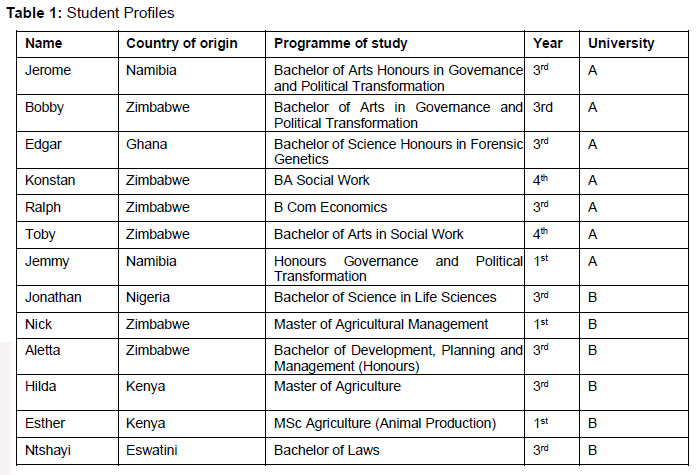
The sampling process involved identifying and selecting individuals or groups with experience, knowledge, or familiarity with the topic of interest. In this case, 15 African international students were selected. Twelve of the 15 students were in their final year in 2023, allowing them to reflect more deeply on their learning experience. Two students were registered for the Master's and one for their Honours degrees, but they all reflected on their Undergraduate experiences (See Table 1 below). Individual semi-structured interviews were conducted in a conversational format, consisting of both closed and open-ended questions, often accompanied by follow-up probes. The data for this study were collected over a period of two months, after obtaining permission from the universities and the students. All students were above the consent age of 18 years, and informed consent was obtained only after the study details were explained to them. Despite the students' diverse linguistic backgrounds, there was no language barrier, as the participating institutions use English as the medium of instruction. The study's data were anonymised and analysed thematically, with open coding used to classify meaningful data from the transcripts. Codes that reflected comparable concepts or patterns were combined into a single category, and the developing themes were labelled after observing trends and patterns within the categories.
FINDINGS AND DISCUSSION
The findings are presented based on the dimensions of well-being we identified: physical, academic, social, financial, and emotional. Despite the inclusion of the spiritual dimension in our theorisation of well-being, students did not mention it, so it is excluded from the discussion. The five well-being dimensions are interrelated and collectively impact students' overall wellness. Research shows that international students have varied experiences of adapting to their new environments. As students and foreigners, international students often face challenges related to language, acculturation, social interaction, and maintaining contact with family and friends in their home country while adjusting to new educational and social environments (Koo et al 2021). Although we separate the different types of well-being, student narratives revealed their interconnectedness. For example, academic well-being could positively or negatively influence emotional well-being and vice versa. Thus, support for international students must include all aspects of wellness. While some aspects of well-being received greater emphasis than others, it was clear that challenges in one area negatively affected students' overall well-being. While students provided examples of well-being during and after COVID, this article primarily focuses on aspects affecting international students beyond the pandemic. However, these issues may have been exacerbated by it. As Deuchar and Gorur (2023) highlight, in addition to spotlighting the inadequacy of existing care arrangements, the COVID pandemic has also created new ones.
EMOTIONAL WELL-BEING
Emotional well-being encompasses an awareness and ability to manage one's feelings in a healthy way. Highlighting the centrality of emotional wellness, most of the literature highlighting international students' challenges primarily focuses on emotional well-being and its impact on other aspects of well-being (Sawir et al 2008; Chen et al 2020; Koo et al 2021; Soong and Maheepalaa 2023; Mkwananzi et al 2025). In our study, students expressed experiencing emotional challenges, which they overcame in different ways.
Emotional well-being challenges were multifaceted. Some challenges stemmed from students' feelings of isolation, academic and financial difficulties, unfamiliarity with the HE system, and the experience of being in a different country, all of which worsened during the pandemic. For instance, for some students in our study, such as Hilda (University B), the major challenge of being an international student was navigating the processes on their own. While Hilda struggled in her first year, she went to a psychologist for counselling in her second year, which "boosted my confidence to just face some of the fears that I had initially." Hilda was also paired with a local student to help her navigate unfamiliar university systems and languages and noted:
"The student was there to help; if you had any questions or needed assistance, they were available. So, that really helped me because then I was able to ask, if I face this problem, where do I go? What should I do? "
However, not all students got that kind of support. Ntshayi from the same university expressed his confusion and emotional uncertainty:
"I am not really sure of some of these things, because there is this disconnect. So, with some things, you didn't know that, are we really supposed to do this? Or aren't we allowed to do this? Can we try to fight this? Or what? So, it was just, it was just being on your own."
International students exhibit different mental well-being and help-seeking attitudes and behaviours (Koo et al 2021) due to a combination of personal and migration structural barriers. These can be associated with separation from established social support networks, language barriers, concerns about stigma and cultural norms around mental health. While some students are comfortable seeking help, others may be reluctant to access well-being initiatives and may conceal their hardships from peers for cultural reasons (Deuchar and Gorur 2023). Hence, student counselling services are generally underutilised due to their inadequacy for students, students' unawareness of their existence (Kasese-Hara and Mugambi 2021), and concerns about trustworthiness, shame, and other cultural issues (Sawir et al 2008). Consequently, Koo et al (2021) emphasise the need for culturally sensitive approaches to encourage international students to seek mental health services, suggesting that practitioners should learn more about students' cultures to better inform their support.
Students also mentioned issues they could not get help with, like accommodation challenges, visas and registration. For instance, Bobby (University A) explained the challenges international students face with registration. Despite the additional paperwork required of international students, they still had to complete registration at the same time as local students. For him, registration was:
"The one thing that rocked me for these whole three years, even after COVID. You need a study permit, and to apply for one, you need additional documents, such as a police clearance and a doctor's form. We must also take tests. All those things take time; they're not things you can apply for and then get tomorrow."
In dealing with challenges relating to visas and registration, the international office was, in most cases, unhelpful, and some students had to follow up on their own. Consequently, Aletta (University B) noted how, instead of the international office contacting Home Affairs on students' behalf, they had to do it by themselves. Aletta had to send emails to Home Affairs following up on her study visa. For most students, this was exacerbated by the pandemic, as offices were closed and everything had to be done online, which further slowed the process.
International student literature highlights various bureaucratic challenges related to visas, accommodation, registration (Quinlan and Singh 2022; Mukwambo et al 2024; Mkwananzi et al 2025), and housing (Mulvey, Morris, and Ashton 2024). Despite institutional differences, the case study universities had international offices dedicated to addressing internationalisation-related issues. The students largely agreed with the sentiments expressed by Kasese-Hara and Mugambi (2021, 130‒131) that the international office "did not have the competency or awareness of their unique needs as foreign students." The students perceived the international office as an ineffective and unnecessary burden. Consequently, some students would register late, resulting in delayed class attendance, further escalating their emotional distress and dissatisfaction. These findings suggest that quality is not simply about curriculum content or students' pedagogic experiences in the classroom, but also about whether students are able to access learning in a timely and equitable manner. Delayed registration means that students begin their studies from an unequal starting point, and this compromises their learning experience.
PHYSICAL WELL-BEING
Physical well-being addresses self-care practices that help students maintain good physical health. Although other studies on international students' physical well-being highlight challenges such as racism, stigmatisation, xenophobia (Dominguez-Whitehead and Sing 2015; Mittelmeier and Lomer 2021), and, at times, violence (Mittelmeier and Lomer 2021), our discussion on this aspect mainly centres on the effects of the pandemic. Students explained how COVID highlighted well-being issues, underscoring the need to maintain and improve physical health through social distancing, handwashing, and exercising. A related challenge arising from the need to maintain students' physical health was the closure of residences, forcing students to vacate campus accommodation. Students experienced distress due to the closure, in which they were only given two to three days to leave campus. They had to make travel arrangements, secure money for flights, and make arrangements for their property on campus. To avoid emotional turmoil, Nick (University B) indicated that consulting international students would have been better because "they come from different countries and know their backgrounds". He noted:
"It was out of control. I would have let the international students stay on campus. Just giving them accommodation and adhering to the restrictions, so that not everyone had to leave. Because we were forced to go back home without planning, it's much more expensive than when you plan it."
Several researchers have highlighted the impact this decision likely had on students' well-being. We discuss this impact further in the section on emotional well-being.
ACADEMIC WELL-BEING
Academic wellness centers around students' learning activities and academic achievement and success. Although students reported mixed experiences with institutional support for their learning, they generally described negative experiences that affected their well-being during the pandemic. For instance, despite Jerome (University A) noting that his university responded to international students' complaints to the Student Representative Council (SRC) regarding data allowance to access online learning, not all students benefited:
"The Office of International Affairs sent out emails stating that if you're an international student and struggling with data, for example, the university provides a data allowance when you are outside of South Africa. However, I discovered that not everyone received it, so it was not distributed equally. I did receive it, and it was helpful when our home Wi-Fi wasn't working properly." (Jerome, University A)
While some of the students' examples, including Jerome's, focused on the pandemic, others also gave examples of mixed institutional support after the pandemic. For instance, Ralph (University A) expressed that:
"The lecturers were giving us whatever everybody else was getting. There was nothing that was extended beyond what was already there, or I never got anything that I could say the institution specifically reached out about, saying it was for international students who are struggling. Although we have an international office, I didn't really know about them."
Despite these challenges, students had to pass and move on to the next academic level. Sawir et al (2008), Rawlings and Sue (2013), and Koo et al (2021) have similarly identified the pressure on local and international students to succeed academically. This pressure comes from families, friends, and sponsoring organisations or universities and tends to be harder on international students who require more financial resources. It may result in students spending more time studying, which reduces social interactions. Koo et al (2021) also note that self-imposed academic pressure negatively affects mental well-being. Additionally, international students sometimes face challenges with language, pedagogy, and the curriculum, necessitating that teaching staff explore ways to support students to avoid self-imposed academic pressure. In some cases, as illustrated by Ralph (University A), academic pressure stems from the financial commitments and sacrifices families make, as discussed under financial well-being. For Ralph, it was sometimes difficult to focus on his academic performance while constantly worrying about money.
SOCIAL WELL-BEING
Social wellness encompasses relationships with others and one's connection to society. Most of the students did not know anyone at their institutions when they registered and generally felt lonely and isolated. As Sawir et al (2008, 156) note, loneliness can become "emotionally entrenched as social alienation". Students' social well-being was supported and inhibited in different ways. Esther (University B) found support from within her residence. She said:
"Within the residence space, they have this thing that they call sisterhood. So, I was able to forge those interactions with people that were living within my residence space."
The sisterhood was not culture-specific and enabled Esther to meet both local and international students. This was unlike Fumane (University B), who, despite valuing meeting and connecting with different people and their cultures, found that "there isn't always the space". While acknowledging that not everyone might value cross-cultural relationships, Mukwambo et al (2024, 54) observe that the limited institutional support "in fostering affiliative and social relationships exemplifies how universities seem to focus on attracting international students but lack the strategies to ensure their well-being, integration, and cultural exchange once they are enrolled".
Hilda's experience, highlighted earlier, can be contrasted with Konstan's (University B), who felt lonely. He explained:
"I didn't know anyone, and no one to ask, okay, what do I do now when this happens? I was just alone at the time. And at home, they're doing their part, like sending you to school and stuff, and they don't even understand these things."
In most cases, students expressed the need to be around people from their home countries, who "understood" exactly what they were experiencing. For example, Edgar (University A), noted:
"You do get lonely in terms of having to speak your home language, and you cannot even find someone else who comes from the same country as you."
Some students also felt left out whenever they were around local students who spoke their language, which they could not understand. While our findings support Sawir et al's (2008, 169) argument that those "with strong support networks tend to exhibit better well-being and capacity to handle stress", it is also important to create environments where international students can care for each other without having to (Deuchar and Gorur 2023). Furthermore, while same-culture networks are crucial, they do not absolve the university of its responsibility to provide pastoral care and support for students' well-being.
FINANCIAL WELL-BEING
Financial well-being relates to students' financial security and their ability to manage expenses in ways that positively affect their well-being, both in the short and long term. The study participants were from middle-class to less affluent families. For example, Jemmy's (University A) parents resided in England, owned a family farm, and could afford to pay for him to study in South Africa, while Ralph's parents struggled to keep him at university. This supports the literature that challenges the commonly held assumption that international students are wealthy and come from developed areas in their countries, as noted by Caldwell and Hyams-Ssekasi (2016), Mulvey et al (2024), and Filippou and Jokila (2024).
Several students spoke about the financial hardships of being an international student, which include additional expenses. These expenses included visa fees, international student fees, levies, and medical aid payments. It is such financial considerations that led Jonathan (University B) to take a gap year to work and save before applying to university. Even then, he did not "even have a lot of the required learning material that someone should have had in the beginning." While literature generally homogenises international students, classifying them as privileged members of the global middle class, Mulvey et al (2024) illustrate the flawed assumptions that inform the relationship between mobility and privilege. Their examination of precarity among predominantly middle-class international students in Australia reveals how economic insecurity, well-being, free time, and relationships intersect and shape migrants' experiences differentially along lines of financial vulnerability.
The pandemic worsened the circumstances of some students. For instance, Jonathan (University B) noted that he even tried to get food aid but failed. He explained that:
"Although they did say you could apply, there was a reservation that if you are an international student, you really cannot apply for food. As an international student, you must be financially sound to study at an institution or at this university."
Similarly, Ralph (University A) explained how he "was always under stress and pressure" about money to buy data for each day's class. Without money, he worried:
"What if the lecturer doesn't record the lesson? How will I study? How will I get clarity? "
Like Ralph's narrative, Filippou and Jokila (2024) illustrate how the pandemic exacerbated the financial circumstances of international students in Nordic countries. Ralph's narrative, as does Mulvey et al (2024), further shows how economic precarity among less affluent international students creates precariousness in other domains, affecting their well-being. For instance, in Ralph's case, financial stress resulted in anxiety, which negatively affected his mental and academic well-being. As Mkwananzi et al (2025) illustrate, during the pandemic, limited financial resources resulted in students' inability to attend lectures, leading to anxiety and emotional distress, as well as negatively impacting their grades.
Ralph (University A) further noted:
"You feel bad when you keep asking for money. So, you are just forcing things; like, as much as you're putting stress on the parents, you are also stressed. It was worse during COVID, and you think, I'm stressing my parents due to this thing, maybe if I drop out, it'll be a better decision, so that the stress could just go away."
While we acknowledge that financial challenges are not unique to international students, the experiences of students like Ralph are further shaped by additional factors such as limited access to local funding schemes such NSFAS or state support that may be available to local students. It also illustrates the value families place on education, as Tagliabue (2022) shows SADC students' families making financial sacrifices to send their children to South Africa by pooling resources, selling livestock, or taking loans. This adds to the pressure on students to achieve academic success. Unlike their local counterparts, international students reported having fewer opportunities for graduate trainee programmes and internships in South Africa than in their home countries. Even with this limitation, many students continue to perceive a South African qualification as a valuable investment that aligns with their aspirations and prospects for employment within, and beyond the continent. Thus, amid the challenges that the students faced during and after the pandemic, they all supported the idea of internationalisation. Toby (University A) explained that:
"From the stories that we heard about university, we were so eager to experience that. It's an opportunity or a space to develop yourself, especially in a different country."
Hilda added:
"Because these interactions are important, they involve real people, real conversations, and real things. It helps us forge relationships because we need these connections. We need these relationships when we get into the workplace, and we need to know each other. You need to know the person you might one day hire at your company, work with, or recommend when a certain skill is needed. You can make real connections that you can always fall back on."
REFRAMING WELL-BEING QUALITY IN HIGHER EDUCATION INTERNATIONALISATION
Understanding the quality of IoHE hinges on how internationalisation is conceptualised. Although academic, social, cultural, and economic factors generally motivate internationalisation, in practice, economic factors dominate. The emphasis on the economic rationale in the current framing of internationalisation and the associated ideas of quality result in inadequate support that fails to address the everyday challenges faced by students (Mittelmeier and Lomer 2021). Therefore, reframing internationalisation as "a reciprocal process with instrumental and intrinsic benefits to universities and students" (Mukwambo et al 2024, 55) would enable the centring of well-being as a measure of quality. As Soong and Maheepalaa (2023, 1213) highlight, well-being is "holistic, contingent, and relational". Rather than homogenising international students, foregrounding the various forms of well-being situates them "as highly diverse, multifaceted individuals with intersectional experiences" (Mittelmeier and Lomer 2021, para 6).
Despite varying levels of institutional support, shaped by institutional contexts, development, resources, and the importance attributed to internationalisation (Chasi and Quinlan 2021), universities can implement several QA strategies to support student well-being. Based on our findings, we propose the following four:
Contextualise an institution-wide internationalisation approach that ensures diverse and multiple stakeholder engagement. The IoHE should not be left to the international office alone. It should involve the input of stakeholders at the national government level (such as the Department of Home Affairs) and the institutional level (the international office, academics, international and local students, etc.). Such an institutional approach would guide the next step.
Clearly outline, implement, and fund internationalisation activities: Universities should have a clearly outlined institutional strategy that they can implement, given their existing resources. HEIs should be able to fund and support their internationalisation practices and identify quality outcomes that guide them. The strategy should also identify key roles and responsibilities and provide guidelines on their practice.
Shift from red tape to red carpet: This refers to governments and universities streamlining bureaucratic processes to enhance support for international students. Most students discussed the bureaucratic challenges they face as international students, including the visa application process and the registration requirements. For example, collaboration between the university and key government departments, such as Home Affairs might help to facilitate the timely issuance of study visas. At the institutional level, beyond the international office overseeing issues relating to registration, there should also be "regular 'network audits'" that assess the availability and relevance of student support services (Sawir et al 2008). This can help identify what works well and the gaps in service provision.
Draft internationalisation quality indicators: Rather than internationalisation being a quality indicator, it should have its own internal measures and benchmarks, which are evaluated and assessed. For example, based on our findings, we suggest centring well-being as an indicator. It would encompass emotional, physical, social, financial, and academic values. Key to this would be student evaluations based on their experiences of the institution's internationalisation rationales and practices.
CONCLUSION
By integrating a CA-informed conception of well-being into QA, HEI can reframe what constitutes quality in the IoHE. Quality, in this sense, is not just about producing competitive graduates or achieving global rankings but about expanding the capabilities of all participants in the academic community to lead flourishing, meaningful, and dignified lives. This approach foregrounds justice, care, and human development as evaluative principles for assessing the success of institutions. Ultimately, centring well-being as a quality indicator moves beyond compliance-based QA systems towards a transformative quality culture, one that values humanity over hierarchy, inclusion over competition, and flourishing over mere survival. Internationalisation becomes not only a means of global engagement and competition but also a moral project that nurtures human well-being in an increasingly interconnected world.
DISCLOSURE STATEMENTNo potential conflict of interest was reported by the author(s).
FUNDINGFunding for this project was provided by the Faculty of Economics and Management Sciences at the University of the Free State.
ACKNOWLEDGEMENTS
The authors acknowledge all the participants in the project and the academic support from the Higher Education and Human Development Research Programme and the Centre for Development Support at the University of the Free State, as well as the School of Education at the University of Glasgow, which enables this and related work. The authors are also grateful to the Council on Higher Education for the collegial support during the writing of this article.
REFERENCES
- Altbach, Philip G., and Jane Knight. 2007. "The Internationalization of Higher Education: Motivations and Realities." Journal of Studies in International Education 11 (3-4): 290-305.
-
Association of International Educators (NAFSA). n.d. "Comprehensive and Strategic Internationalisation: Lessons Learned and Prospects." https://www.nafsa.org/sites/default/files/media/document/comprehensive-strategic-izn-introduction.pdf.
» https://www.nafsa.org/sites/default/files/media/document/comprehensive-strategic-izn-introduction.pdf - Banda, Tiffany, and Bhekuyise Zungu. 2024. "Internationalisation and the Lived Experiences of Non-South African Postgraduate Students in Accessing Higher Education in South Africa." South African Journal of Higher Education 38 (1): 130-148.
- Beelen, Jos. 2022. "Why We Should Continue to Ask Critical Questions about Internationalisation at Home." Perspectives in Education 40 (4): 325-327.
- Boni, Alejandra, and Melanie Walker. 2013. Human Development and Capabilities. Taylor & Francis.
- Boni, Alejandra, and Melanie Walker. 2016. Universities and Global Human Development: Theoretical and Empirical Insights for Social Change. Routledge.
- Caldwell, Elizabeth Frances, and Denis Hyams-Ssekasi. 2016. "Leaving Home: The Challenges of Black-African International Students Before Studying Overseas." Journal of International Students 6 (2): 588-613.
-
Chasi, Samia, and Orla Quinlan. 2021. "Inclusion in Times of COVID-19: The Case of International Students in South Africa." Journal of Student Affairs in Africa 9 (1): 205-221. https://doi.org/10.24085/jsaa.v9i1.1439.
» https://doi.org/10.24085/jsaa.v9i1.1439 -
Chen, Juliet H., Yun Li, Anise M. S. Wu, and Kwok K. Tong. 2020. "The Overlooked Minority: Mental Health of International Students Worldwide under the COVID-19 Pandemic and Beyond." Asian Journal of Psychiatry 54: 102333. https://doi.org/10.1016/j.ajp.2020.102333.
» https://doi.org/10.1016/j.ajp.2020.102333 -
Department of Higher Education and Training (DHET). 2013. White Paper for Post-School Education and Training. https://www.dhet.gov.za/SiteAssets/Latest%20News/White%20paper%20for%20post-school%20education%20and%20training.pdf.
» https://www.dhet.gov.za/SiteAssets/Latest%20News/White%20paper%20for%20post-school%20education%20and%20training.pdf -
Department of Higher Education and Training (DHET). 2019. Policy Framework for the Internationalisation of Higher Education in South Africa. https://www.dhet.gov.za/Policy%20and%20Development%20Support/Policy%20Framework%20for%20Internationalisation%20of%20Higher%20Education%20in%20South%20Africa.pdf.
» https://www.dhet.gov.za/Policy%20and%20Development%20Support/Policy%20Framework%20for%20Internationalisation%20of%20Higher%20Education%20in%20South%20Africa.pdf -
Department of Higher Education and Training (DHET). 2025. Statistics on Post-School Education and Training in South Africa: 2023. https://www.dhet.gov.za/Information%20Systems%20Management/Statistics%20on%20Post-School%20Education%20and%20Training%20in%20South%20Africa%2C%202023.pdf.
» https://www.dhet.gov.za/Information%20Systems%20Management/Statistics%20on%20Post-School%20Education%20and%20Training%20in%20South%20Africa%2C%202023.pdf - De Wit, Hans, Fiona Hunter, Laura Howard, and Eva Egron-Polak. 2015. "Internationalisation of Higher Education." Study commissioned by the European Parliament's Committee on Culture and Education. European Parliament.
- De Wit, Hans, and Elspeth Jones. 2022. "A New View of Internationalization: From a Western, Competitive Paradigm to a Global Cooperative Strategy." Journal of Higher Education Policy and Leadership Studies 3 (1): 142-152.
-
Deuchar, Andrew, and Radhika Gorur. 2023. "A Caring Transformation of International Education: Possibilities, Challenges and Change." Higher Education Research & Development 42 (5): 1197-1211. https://doi.org/10.1080/07294360.2023.2193726.
» https://doi.org/10.1080/07294360.2023.2193726 - Dominguez-Whitehead, Yasmine, and Nevensha Sing. 2015. "International Students in the South African Higher Education System: A Review of Pressing Challenges." South African Journal of Higher Education 29 (4): 77-95.
-
Filippou, Kalypso, and Suvi Jokila. 2024. "Academic, Social, and Financial Changes in International Students' Lives Due to the COVID-19 Pandemic." Nordic Journal of Migration Research 14 (2): 1-18. https://doi.org/10.33134/njmr.560.
» https://doi.org/10.33134/njmr.560 - Gouws, Amanda, and Yusef Waghid. 2006. "Higher Education Quality Assurance in South Africa: Accreditation in Perspective." South African Journal of Higher Education 20 (6): 751-761.
- Ul Haq, Mahbub. 1995. Reflections on Human Development. Oxford University Press.
- Heleta, Savo, and Samia Chasi. 2023. "Rethinking and Redefining Internationalisation of Higher Education in South Africa Using a Decolonial Lens." Journal of Higher Education Policy and Management 45 (3): 261-275.
- Holubinka, Kateryna, Christian M. Stracke, Panu Forsman, and Sanna Juutinen. 2021. "Virtual Internationalization in Higher Education: Design Reflections and Lessons Learned." Zeitschrift für Hochschulentwicklung 16 (2): 43-56.
-
Kasese-Hara, M., and J. I. Mugambi. 2021. "Experiences of African International Students in a South African University: A Qualitative Study." South African Journal of Higher Education 35 (4): 116-137. https://doi.org/10.20853/35-4-4065.
» https://doi.org/10.20853/35-4-4065 - Kivela, Liia, Joanne Mouthaan, Willem Van der Does, and Niki Antypa. 2024. "Student Mental Health during the COVID-19 Pandemic: Are International Students More Affected?" Journal of American College Health 72 (2): 414-422.
- Knight, Jane. 2012. "Concepts, Rationales, and Interpretive Frameworks in the Internationalization of Higher Education." In The SAGE Handbook of International Higher Education, edited by Darla K. Deardorff, Hans de Wit, John D. Heyl, and Tony Adams, 27-42. SAGE Publications.
-
Koo, Katie, Young Won K., Joonyoung Lee, and Gudrun Nyunt. 2021. "It's My Fault: Exploring Experiences and Mental Wellness among Korean International Graduate Students." Journal of International Students 11 (4): 790-811. https://doi.org/10.32674/jis.v11i4.2801.
» https://doi.org/10.32674/jis.v11i4.2801 - Leask, Betty. 2015. Internationalizing the Curriculum. Routledge.
- Marginson, Simon. 2010. "Higher Education in the Global Knowledge Economy." Procedia-Social and Behavioral Sciences 2 (5): 6962-6980.
- Matsudaira, Jordan. 2016. "Defining and Measuring Institutional Quality in Higher Education." In Quality in the Undergraduate Experience: What Is It? How Is It Measured? Who Decides?, edited by G. W. McLaughlin, Richard D. Howard, and Leslie A. Wilkinson, 57-80. Jossey-Bass.
- Misirlis, Nikolaos, Miriam H. Zwaan, and David Weber. 2020. "International Students' Loneliness, Depression and Stress Levels in COVID-19 Crisis: The Role of Social Media and the Host University." arXiv preprint arXiv:2005.12806.
-
Mittelmeier, Jenna, and Sylvie Lomer. 2021. "The Problem of Positioning International Students as Cash Cows." Higher Education Policy Institute (blog), November 4. https://www.hepi.ac.uk/2021/11/04/the-problem-of-positioning-international-students-as-cash-cows/.
» https://www.hepi.ac.uk/2021/11/04/the-problem-of-positioning-international-students-as-cash-cows/ -
District, Faith, Patience Mukwambo, Winter Seshoka, and Nomzingisi Notenga. 2025. "Emotional Scarcity and Well-Being among International Students at Times of Crisis in South Africa during the COVID-19 Pandemic." In Minorities, Scarcity and Conflict, edited by A. Montañés Jiménez, C. Ferreira Marinelli, and S. Pipyrou. Routledge. https://doi.org/10.4324/9781032661780.
» https://doi.org/10.4324/9781032661780 - Mukwambo, Patience, Faith Mkwananzi, and Winter Seshoka. 2024. "The Policy and Practice of Internationalization in the Global-South: African International Students' Experiences in South Africa during COVID-19." Journal of Comparative & International Higher Education 16 (5): 45-59.
-
Mulvey, Benjamin, Alan Morris, and Luke Ashton. 2024. "Differentiated Experiences of Financial Precarity and Lived Precariousness among International Students in Australia." Higher Education 87: 741-760. https://doi.org/10.1007/s10734-023-01033-9.
» https://doi.org/10.1007/s10734-023-01033-9 - Neubauer, Brian E., Catherine T. Witkop, and Lara Varpio. 2019. "How Phenomenology Can Help Us Learn from the Experiences of Others." Perspectives on Medical Education 8 (2): 90-97.
- O'Dowd, Robert. 2018. "From Telecollaboration to Virtual Exchange: State-of-the-Art and the Role of UNICollaboration in Moving Forward." Research-publishing.net 1: 1-23.
-
Quinlan, Orla, and Tasmeera Singh. 2022. "How Can Internationalisation Regain Momentum in South Africa?" University World News, May 11. https://www.universityworldnews.com/post.php?story=20220509145739708.
» https://www.universityworldnews.com/post.php?story=20220509145739708 -
Rawlings, Melody, and Edna Sue. 2013. "Preparedness of Chinese Students for American Culture and Communicating in English." Journal of International Students 3 (1): 29-40. https://files.eric.ed.gov/fulltext/EJ1056442.pdf.
» https://files.eric.ed.gov/fulltext/EJ1056442.pdf - Rueben, Brent D. 2018. Quality in Higher Education. Routledge.
-
Rudakova, Kira, and Shalini Lal. 2025. "Mental Health Concerns and Needs of International Students in Higher Education Settings: A Scoping Review Protocol." PLOS ONE 20 (8): e0327812. https://doi.org/10.1371/journal.pone.0327812.
» https://doi.org/10.1371/journal.pone.0327812 -
Sawir, Erlenawati, Simon Marginson, Ana Deumert, Chris Nyland, and Gaby Ramia. 2008. "Loneliness and International Students: An Australian Study." Journal of Studies in International Education 12 (2): 148-180. https://doi.org/10.1177/1028315307299699.
» https://doi.org/10.1177/1028315307299699 - Sehoole, Chika. 2006. "Internationalisation of higher education in South Africa: A historical review". Perspectives in Education 24 (1): 1-13.
- Sen, Amartya. 1992. Inequality Reexamined. Oxford University Press.
- Sen, Amartya. 1999. Development as Freedom. Oxford University Press.
-
Soong, Hannah, and Vihara Maheepala. 2023. "Humanising the Internationalisation of Higher Education: Enhancing International Students' Well-Being through the Capability Approach." Higher Education Research & Development 42 (5): 1212-1229. https://doi.org/10.1080/07294360.2023.2193730.
» https://doi.org/10.1080/07294360.2023.2193730 -
Tagliabue, Veera V. 2022. "Too Rich to Care? Southern African (SADC) International Students Navigating Transnationalism and Class at South African Universities." Journal of Southern African Studies 48 (1): 5-21. https://doi.org/10.1080/03057070.2022.2018837.
» https://doi.org/10.1080/03057070.2022.2018837