Students' perceptions of Covid-19-related changes to the assessment model in the postgraduate diploma (Accounting Science)
Abstract
With the advent of the coronavirus disease in 2019 (Covid-19), several higher education institutions worldwide amended their modes of teaching and learning and the administering of assessments. This research was aimed at determining students' perception of the changes in the assessment model from a sit-down assessment to an online assignment due to Covid-19, with specific reference to the Postgraduate Diploma (Accounting Science). It also aimed to gain insight into the self-reflection procedures that students employed with the different assessments. The study employed a quantitative approach using a survey and quantitative content analysis of the answers to the open-ended questions. Data was collected by sending out a questionnaire to three different population groups, covering both the 2020 and the 2021 class groups. The findings from the questionnaires revealed that both assessment types held advantages, as traditional assessments prepare students for future assessments, whereas assignments prove most advantageous in fostering critical thinking skills and relieving time pressure. The assignment developed certain competencies and skills not otherwise developed, and a combination of both assessments is preferable going forward.
Assessment; assignment skills; critical thinking; learning process; formative assessment; academic performance
INTRODUCTION
During the 2020 academic year, the world and social interaction came to a halt due to the Covid-19 pandemic. Measures put in place to curb the spread of the virus included the wearing of masks, frequent hand washing and the observance of social distancing. The Minister of Higher Education announced that all institutions of higher education would be closed for an early recess (Nzimande 2020), which became a prolonged closure. Consequently, students no longer had the option of attending campus-based courses or being in classrooms.
Academics across the world had to adapt as a result of multiple national lockdown periods and restrictions in the education sector. Covid-19 caused a great deal of disruption in higher education, because it placed barriers on a number of traditional assessment components. In relation to this study, the traditional Postgraduate Diploma (Accounting Science) (PGDAS) accounting programmes employed formal sit-ins in formative assessments, which were prohibited by a variety of measures, including social distancing and travel restrictions. This had an impact on the way that assessments could be administered. Academics lecturing on the PGDAS qualification introduced an assignment format to assess students during their April assessment period, hereafter referred to as the "April assignment".
The research was centred around the advantages and disadvantages of the changes in assessment and the competencies contained in the South African Institute of Chartered Accountants (SAICA) competency framework that were developed with the different assessments. It also explored the concept of self-reflection and whether the different assessments resulted in varying degrees of self-reflection and possible reasons for these differences.
RESEARCH QUESTIONSThis study sought to answer the following research questions:
• What were the advantages and disadvantages of the different assessment approaches as perceived by the students?
• Which competencies were developed as a result of the assessment model change?
• Did the change in assessment model bring about a change in self-reflection?
Assessment is a fundamental aspect of effective learning (Bransford, Brown, and Cocking 2000). During the academic year of PGDAS, students are typically exposed to assessments as formative assessment incorporated into the classroom instruction cycle (Bloom 1960) as well as the final assessment, which is a summative assessment. Black and Wiliam (1996) recognise the need for summative assessments as an essential part of any learning cycle (Black & Wiliam, 1996).
The Covid-19 pandemic compelled lecturers to adjust to novel pedagogical concepts and methods of instruction (Masina and Mawonedzo 2022). The pandemic also challenged university instructors to devise innovative methods to provide equal access to high-quality education for all students (Meda and Waghid 2022). Covid-19 therefore necessitated the change to the introduction of the PDGAS's April assignment. While the change was necessary, it also allowed for an opportunity to explore the effectiveness of a university plan including alternative ways of assessing students (Sewall and Smith 1998). This was done to ensure that students were equipped with the skills and ability to connect theoretical learning with practice, which would allow them to adapt and be able to solve problems (Thomas 2011). While Covid-19 had negative impacts, such as the increased cost of learning and lower educational achievements, it also brought a positive impact in terms of revamping and upgrading the tertiary education system (Mashonganyika and Muyambo 2022).
Gardner (2012) argues that students' ability to adapt to changing circumstances and problems existing beyond formal schooling is an essential outcome of education. To ensure that these outcomes are achieved, a broader range of assessment methods is needed. These methods should consist of open-ended performance tasks that allow for critical reasoning, complex problem solving and application of theoretical knowledge in real-world contexts. Students struggle to develop decision-making attributes because educators are focused on transmitting course content ("what to think") and neglect teaching students how to correctly understand and evaluate the subject matter, i.e. critical thinking ("how to think") (Schafersman 1991). Other authors concur that students do not receive tasks suitable for developing critical and analytical thinking (Brown, Afflerbach and Croninger 2014). Students are seldom encouraged to employ critical thinking, a skill which can address challenges faced by marginalised communities or to engage in educational experiences (Terblanche 2019)
It has further been highlighted that, other than solely focusing on transferring course content, educators also tend to teach students to do assessments well (Shepard 2000). The excessive emphasis on delivering knowledge undermines the independence of both teachers and learners (Waghid and Davis 2020). Chartered Accountant (CA) education frequently employs a teacher-centred model, in which academics instruct and students passively participate in the learning process. This instructional approach provides limited opportunities for fostering critical thinking and problem-solving abilities (Terblanche and Waghid 2020).
Educators in accredited accounting departments often do not fulfil the educational mandate of providing a comprehensive education that promotes the whole development of the student (Terblanche and Waghid 2021). Educators can develop acumen in students by focusing less on structured scenarios and more on unstructured situations and scenarios comparative to a real-world context. In doing so, students are not only focused on understanding and applying a concept, but also on developing more challenging skills such as analysing, synthesising and evaluating (Lee and Thathong 2017).
The need has been recognised for formative assessment to adapt and take on different forms in order to be more effective (Boston 2019). Black and Wiliam (1998) identified a definite fault in traditional formative assessment systems, highlighted by candidates who struggle, or are graded as incompetent, under formal assessment conditions who may perform entirely differently in more realistic conditions. A substantial number of students perceive traditional assessments, such as formal written sit-down assessments, as arbitrary and irrelevant (Struyven, Dochy, and Janssens 2005). Further studies concur that students perceive traditional closed-book assessments as insufficient in assessing their capabilities (Iannone and Simpson 2016). In contrast, when considering alternative assessment methods, students perceived that it increased the quality of their learning. Students stated that they were engaging with the material and tried to understand the content, rather than employing rote memorisation tactics (Iannone and Simpson 2016). In addition, there is evidence that the implementation of online open-book examinations presents a potential alternative for the existing educational system (Meeran and Davis 2022).
These studies affirm the merits of implementing an alternative, such as an online assignment, instead of a traditional formative assessment. It is acknowledged that there may be numerous other formative assessment formats, but these were beyond the scope of this study. Instead, the study focused on an assignment as an alternative.
Assignments are the primary means by which students can learn to solve problems and engage in practice to develop a facility for various skills (Gibbs and Simpson 2005). Using assignments as an assessment tool can assist with assessing the student's capacity to implement solutions, design, develop, and implement solutions, and analyse and resolve problems (El-Wageeh 2014).
Sullivan and McConnell (2017) provide strong support for the significance of assignments, as assignments equip students for success in foundational skills and competencies irrespective of their field of study.
Assignments are assessment techniques that are widely applicable but not used as often as they should be (Sullivan and McConnell 2018). The authors asserted that assignments could be the game changer for student learning and inclusive excellence in undergraduate education today. This is because frequent assignments and detailed feedback received by students are core parts of student learning (Gibbs and Simpson 2005). During an investigation in a student assessment unit, it was determined that assignments encouraged students to reflect on their learning. The authors also provided strategies to support or challenge that learning and provided mechanisms to modify and advance learning (Davies, Pantzopoulos and Gray 2011). There is evidence that a change in assessment format to include an assignment is pedagogically sound.
In addition to the change from formative assessment to assignments, the study also explored the students' own perceptions of self-reflection in both assessment methods. Before students can become successful self-regulated learners, they must first perceive the purposes and procedures of the assessment and be able to evaluate their own performance once the assessment has been completed (Schellekens et al. 2021). Durkin (2021) concludes that an assessment that concentrates solely on academic performance or results without reflection on the task does not promote a deeper sense of learning in the student.
Traditionally, the assessments on the PGDAS qualification (also referred to as the Certificate in the Theory of Accounting [CTA]), a one-year qualification, were in-venue assessments. However, the Covid-19 regulations prohibited students from coming to the venue to write their assessments.
The April assignment was therefore introduced and consisted of assessments that were written on the University of Johannesburg's (UJ) online education platform provider, BlackBoard Learn. The students were given two days to complete the assessment for each of their postgraduate modules, namely Financial Accounting and Reporting, Auditing and Corporate Governance, Financial Management and Strategy, and Taxation. In previous years, the April assessment consisted of a physical, sit-down assessment opportunity in a written format, hereafter referred to as the "April assessment". Therefore, the April assignment immediately distinguished itself as a PGDAS first by introducing a new assessment format and an online assessment opportunity. Due to the easing of Covid-19 restrictions during the 2021 academic year, the April assessment format returned to an in-person sit-down assessment, allowing students to be assessed in the traditional manner.
METHODOLOGY
The purpose of this study was to gauge students' perceptions of the advantages, disadvantages, competencies developed and changes in self-reflection brought about by the changes in the assessment model necessitated by Covid-19. This was done with the use of a self-developed questionnaire using a Likert scale, supplemented by open-ended questions to obtain richer data from the respondents.
DESIGNThe research employed interpretivism as a philosophical approach as one of the main objectives was to interpret and gain a deeper comprehension (Creswell 2007) of the students' perception of the change in assessment. A quantitative method was followed utilising percentages and tables on the Likert scale questions, while the open-ended questions were analysed through quantitative content analysis.
POPULATION, INSTRUMENT AND DATA COLLECTION
The research was conducted by sending out questionnaires and analysing the perception of the following three population groups:
• 2020 population: Candidates who were successful in obtaining their qualification when the April assignment evaluation method was used in 2020.
• Repeaters: Candidates who were initially unsuccessful in 2020 and who were aiming to obtain the PGDAS qualification in 2021. This population was expected to highlight additional findings from a student's perspective, as they were exposed to both methods for the April evaluations.
• 2021 population: Candidates who were enrolled in the 2021 PGDAS qualification and who did not attempt to obtain this qualification in the past. This population had only been exposed to the April assessment evaluation method.
The questionnaires were conducted via an online application (KwikSurveys) containing both closed and open-ended questions as well as questions specific to the four PGDAS modules/subjects. Questions focused on obtaining an understanding of candidates' perspectives and experiences in writing both the 2020 assignment and the 2021 April assessment. Definitive responses were analysed quantitatively. Quantitative content analysis was performed on responses from open-ended/unrestricted questions and results were used by the researchers to conclude on candidates' perspectives of the different evaluation methods.
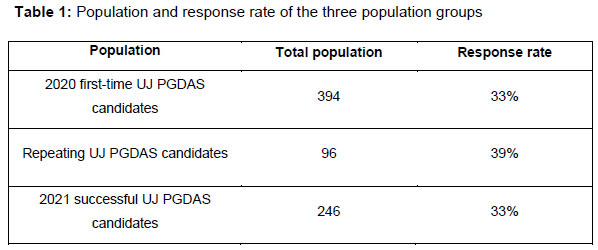
Table 1 indicates the responses received from the three separate questionnaires disseminated.
The response rate for each population met the acceptable range of 25 per cent to 38 per cent for survey-based research performed in South Africa (Marx 2008; Strauss-Keevy 2014). In addition, when compared to other web-based questionnaires administered in South Africa, the response rate was higher (Nkoutchou and Eiselen 2012).
RESEARCH FINDINGSThe research findings are presented under various headings showing how different attributes of the two assessment methods were perceived by the students. The findings of both closed and open-ended questions are presented under the relevant headings.
Perceived difficulty
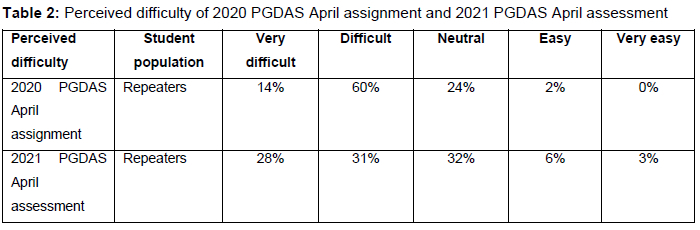
In all three questionnaires, a question was posed to the students on the perceived difficulty of the two assessment methods to determine whether one method may have the disadvantage of proving to be too difficult. The answers captured evidenced the information presented in Table 2.
The repeaters perceived the total difficulty of the 2020 assignment (74%) as much higher than that of the 2021 assessment (59%). This could be because the repeaters had been exposed to more PGDAS formal assessments than first-time candidates and therefore perceived the 2021 assessment to be easier.
Perceived advantages and disadvantages
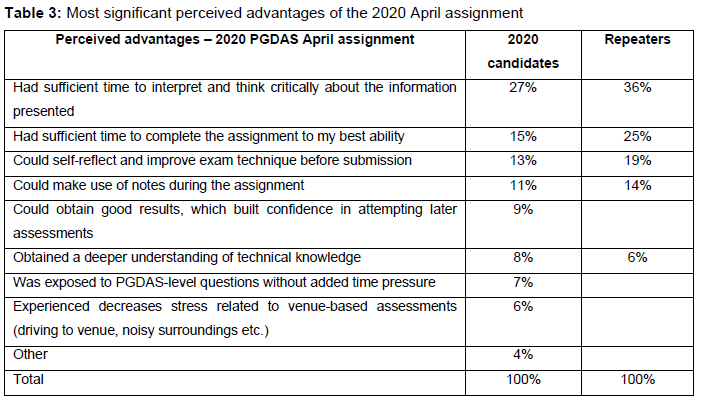
Students' perceptions of the advantages obtained through the assignment are presented in Table 3.
It is clear from the above that the most significant advantage of the 2020 April assignment for both the 2020 population and the repeaters was the development of critical thinking regarding the assessment information provided. The second and third most significant perceived advantages ("Had sufficient time to complete the assignment" and "Could self-reflect before submission") relate to the elimination of a traditional time constraint. This is in line with other research that argues that students should be given sufficient time to think and formulate solutions (Lee and Thathong 2017). By doing so, educators create an environment that encourages students to revise their logical thinking processes and constructs, ultimately promoting the development of critical thinking (Duplass and Ziedler 2002).
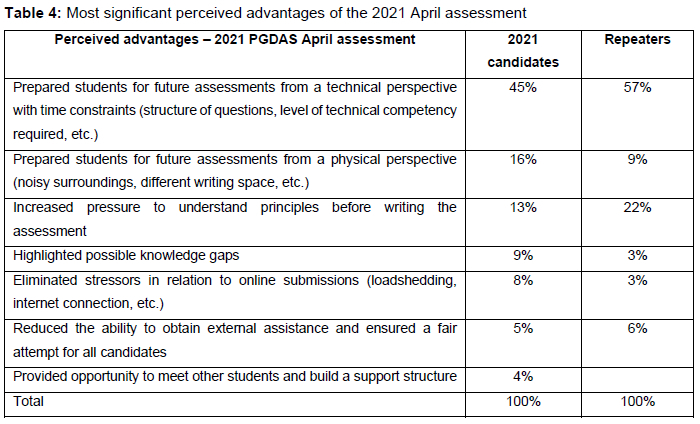
Students' perception of the advantages obtained through the assessment methods is presented in Table 4.
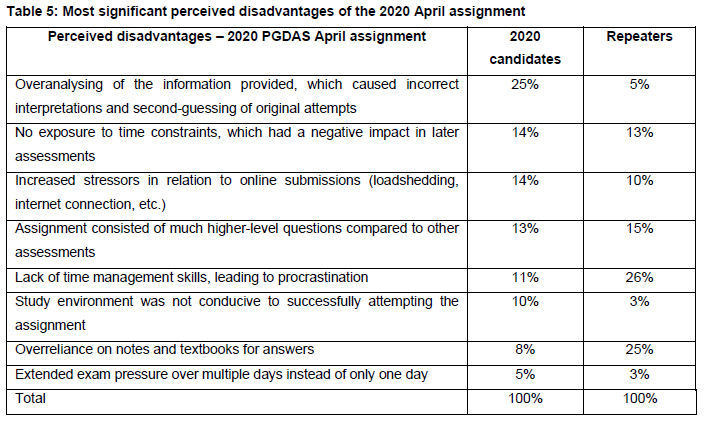
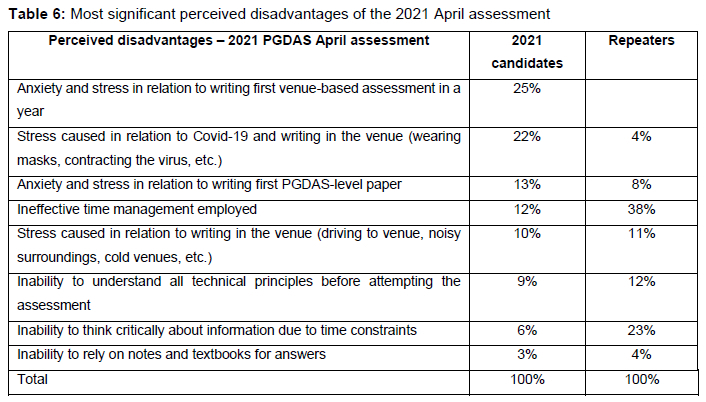
As shown in Table 4, the 2021 candidates and repeaters overwhelmingly perceived the most significant advantage of the 2021 April assessment to be that it prepared them for future assessments that follow the traditional written sit-down evaluation method. This is also the assessment method used in the Initial Test of Competence, SAICA's first board exam. Even though the 2021 April assessment provided exposure to evaluation methods used in later assessments, it is still important to consider whether the "do assessments well" methodology is not employed, leading to a possible decline in student understanding and development of critical thinking (Sheppard 2000). Students' perceptions of the greatest disadvantages of the assignment and assessment are presented in Tables 5 and 6.
Table 5 shows that the repeaters perceived the "Lack of time management skills, leading to procrastination" and "Overreliance on notes and textbooks for answers" as the most significant disadvantages of the 2020 April assignment.
The 2020 candidates perceived "Overanalysing of the information provided" to be the most significant disadvantage. It is also important to note that "Increased stressors in relation to online submissions" (2020: 14%; repeaters: 10%) and "Study environment was not conducive to successfully attempting the assignment" (2020: 10%; repeaters: 3%) would be eliminated if a traditional venue-based assessment method was followed.
The 2021 candidates perceived the most significant disadvantage of the 2021 April assessment to be the anxiety and stress suffered in relation to adjusting to writing venue-based assessments for the first time in over a year. This may be due to the fact that these candidates wrote exclusively online-based assessments in the previous academic year. The second most significant disadvantage was that of stress caused due to Covid-19 and writing an in-venue assessment. The repeaters perceived ineffective time management to be their most significant disadvantage. As ineffective time management was also their most significant disadvantage in attempting the 2020 April assignment (Table 5: 26%), it can be concluded that the repeaters struggled with time management skills from a holistic perspective.
Technical competencies, enabling competencies and other skills
All populations were asked to rate to what extent the 2020 assignment and 2021 assessment developed certain skills that form part of the SAICA competencies and acumen (SAICA 2021).
2020 assignment
When looking at the responses, the repeaters had an average agreement rating of 45 per cent across all the competencies and acumen developed. This was, however, due to the apparent small agreement found in the development of "enabled me to practise working under extreme time pressure" and "quick recall memory" questions. This was expected, as it was never the objective of an assignment to develop time management skills or quick memory, rather the assignment should put appropriate time in place for students to think about questions and recall knowledge over time. When these factors were removed, the average agreement rate of the repeaters changed to 51 per cent and that of the 2020 candidates to 76 per cent. This clearly indicates that if the skills an assignment tries to promote are taken into account, the agreement rate is much higher.
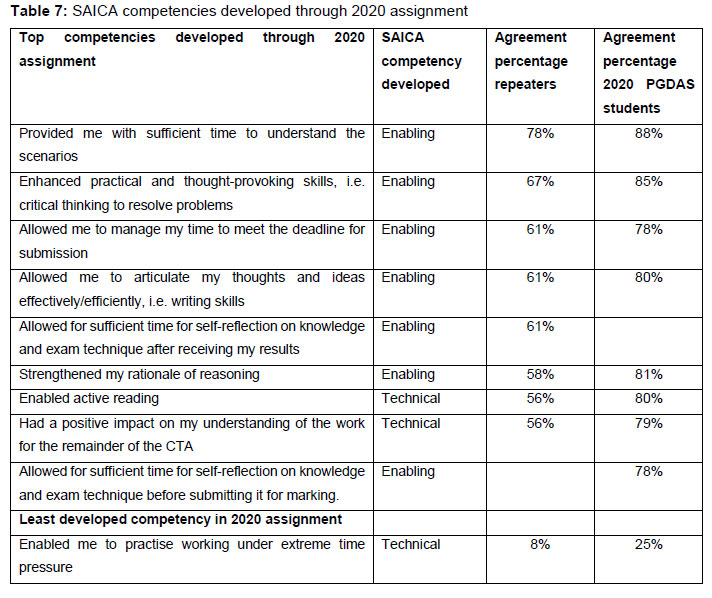
Table 7 shows the top seven competencies developed through the assignment as well as the least developed competency developed through the assignment.
The business acumen of enabling competencies was inarguably being developed, as both populations strongly agreed that they had sufficient time to understand the scenarios, which in turn meant understanding the internal and external environment of businesses presented in the assignment. Both populations felt that the assignment developed critical thinking and effective writing skills (communication), and it also developed decision-making and relational acumen. As both the 2020 class and the repeaters agreed that critical thinking and reasoning were improved, the 2020 assignment fulfilled its assessment duty. This proves that an assignment engages in the "how to think" bubble (Schafersman 1991). Extracting the benefit of assignments requires that information be given in unstructured situations and scenarios that will lead to developing skills such as analysing, synthesising and evaluating thereof (Lee and Thathong 2017).
When looking at the positive impact of the assignment on the future preparation and understanding of the students, it can be seen that the repeaters had lower agreement percentages. This is, however, contradictory to the opinions of the same students, who agreed to a large extent (78%) that they had two opportunities to self-reflect (both before and after the submission of the assignment, as the majority agreed, as shown in Table 7). If the self-reflection done by the repeaters was optimal, the low agreement percentages may have been avoided. The lack, or inadequacy, of the repeaters' self-reflection may be supported by the 2020 class that did in fact agree (61%) that the assignment had a positive impact on their future preparation and understanding of work.
2021 assessment
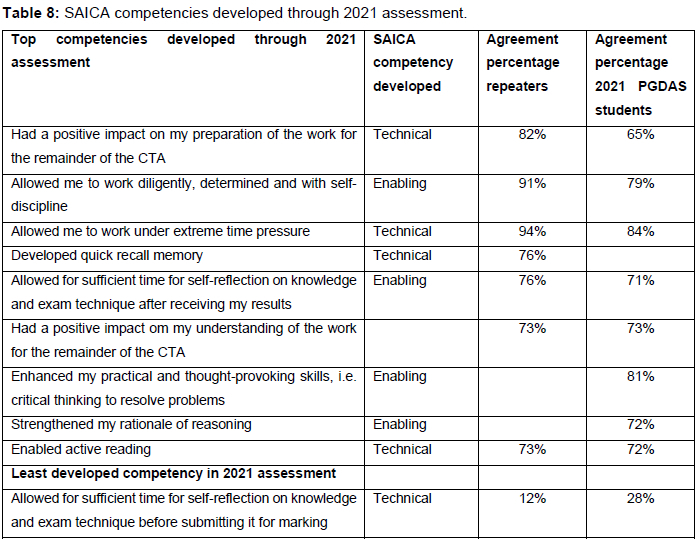
Table 8 shows the top seven competencies developed through the assessment as well as the least-developed competency developed through the assessment.
The data shows that students thought the assessment improved technical skills like active reading, quick recall, and functioning under pressure. However, there was limited room for self-reflection before submitting or during the assessment. This is due to the fact that these types of assessments have a set completion time that students must adhere to. There is a high level of agreement regarding the skill developed by the 2021 assessment and its impact on the remainder of the learning process.
Technical and enabling competencies
The above tables demonstrate the effectiveness of the different assessments in developing technical and enabling competencies. However, students reported that both assessment methods promoted active reading, which is advantageous.
Students agreed that the assignment helped to improve the enabling competencies. The data shows that the opportunity for self-reflection helped before and after the project was submitted. This supports that feedback should begin the learning process rather than conclude it (Jansen et al. 2019).
Most students believed that preparing a formal assessment prevents self-reflection before submission. The enabling competencies indicate that time management is often viewed as a challenging aspect when writing an assessment.
The assessment is also better than the assignment for developing technical competencies since students thought it would help them prepare for future assessments. This brings into question the suitability of both assessment methods, as the usefulness of the assessment depends on the students' perception (Kniveton 1996).
Comparing assessment methods and modules
The repeat population was posed with a question on which assessment method should be used. This question was posed specifically to this population, as they were the only population that had exposure to both methods of assessment. They were given the option to select the assignment, the assessment or a mixed methodology of assessment.
Table 9 demonstrates that most repeaters thought a mixed assessment method would be preferable for PGDAS learning. A mixed method was chosen despite the apparent difficulty of the traditional written 2021 April assessment. This supports the literature that students decide if an evaluation is suitable based on its strengths and shortcomings, not what they enjoy (Kniveton 1996).
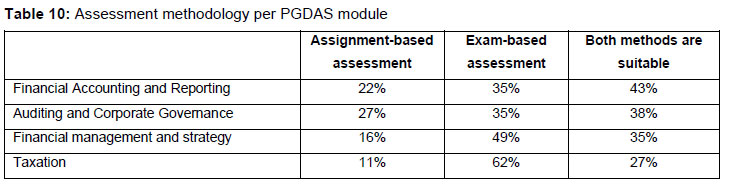
In addition, the same population was asked a follow-up question to describe the assessment method they would prefer in each of the four PGDAS modules. The results in Table 10 show the preferences for each of the subjects.
The Financial Accounting and Reporting module's overwhelming desire for a mixed methodology may be due to pupils self-studying an accounting standard before writing the April assignment/assessment. Many 2020 students cited this as an assignment benefit. The different assessment methodologies were the most evenly spread within Auditing and Corporate Governance. This shows a clear need for students to have more than one assessment method in the Auditing and Corporate Governance module.
Taxation students preferred exam-based assessment emphasises the need to memorise legislative passages. The idea is that increasing the evaluation time will not help a lack of knowledge of tax legislation and its sections ("either you know a section or you do not"). Thus, time constraints will not affect assessment interpretation or student achievement.
Different assessment methods for different modules are expected based on the perceived benefits and disadvantages of an assessment method (Kniveton 1996), as students tend to prefer the method they find most beneficial for a given module. Critical and analytical thinking is not always transferable between curriculum areas and disciplines, and a student may have critical thinking skills in one domain but not another (Brown et al. 2014). This means the modules' skill development and assessment methods should vary. As this study examined multiple formative assessments, PGDAS students preferred a mixed assessment methodology, supporting the idea that different assessment forms might improve learning (Black and Wiliam 1998).
Process of self-reflection
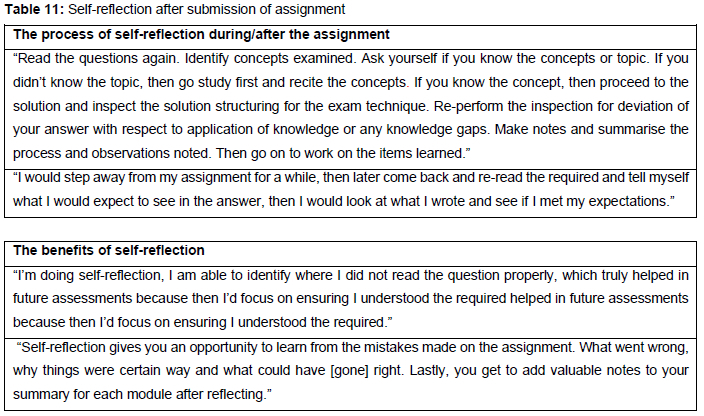
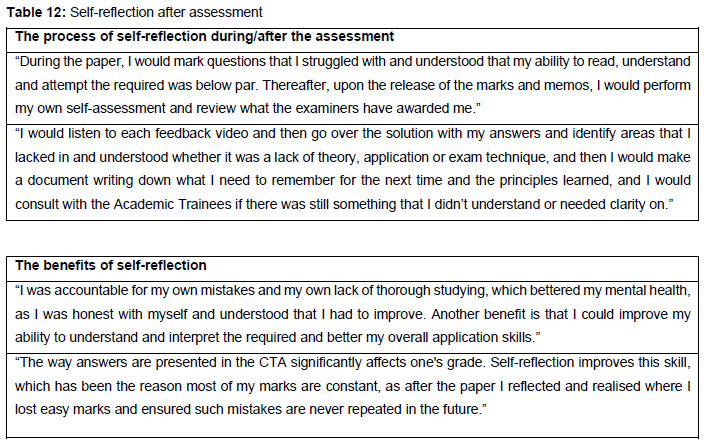
In all three questionnaires, a question was posed to the students on the process of self-reflection they applied when attempting the different assessments. Thereafter, open-ended questions were asked to establish why students either did not self-reflect or why they felt self-reflection was necessary. In total, 83 per cent of the 2020 candidates and 62 per cent of the repeaters in the 2020 class opted to self-reflect either during the assignment time or before submitting the assignment. After identifying the ratio of students that did indeed self-reflect, a question was posed on the process they followed as well as the benefits of self-reflection. The data indicates that most 2020 students felt that the assignment allowed them to take some time to reflect and look at what they had written. This allowed them to identify misconceptions, basic errors and exam technique flaws before submitting the assignment. Some of the key responses are shown in Table 11 and 12.
The 2021 class and the repeaters were asked to respond on self-reflection after submitting the 2021 assessment. These groups were specifically required to answer this question, as they would not have had time to self-reflect during the formal assessment due to time constraints. The 2021 class showed a significant increase in self-reflection (95%) compared to that of the 2020 class (83%). The repeaters also showed an increase in self-reflection from 62 per cent in 2020 to 76 per cent in 2021. This increase clearly shows that students preferred to self-reflect after they had written the assessment. It may also indicate that the repeaters realised the importance of self-reflection and therefore incorporated it as part of their learning process during their second attempt.
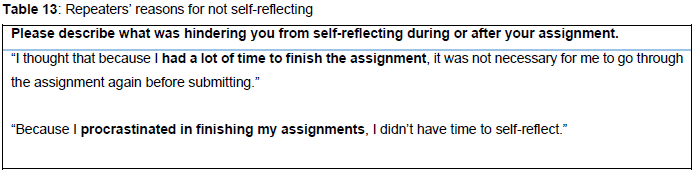
When analysing the above, it is evident that in 2021 more of the repeaters considered self-reflection than in 2020. Furthermore, 24 per cent of the repeaters continued to opt not to self-reflect after the 2021 assessment compared to 5 per cent of the 2021 candidates. Some of the key reasons are listed in Table 13.
The information in the tables shows that PGDAS students had a clear sense of the importance of self-reflection to obtain the maximum benefit from their formative assessments. This supports the opinion reached that feedback plays a critical role in student performance (Morris, Perry, and Wardle 2021).
CONCLUSION
The objective of the research was to examine students' perceived advantages, disadvantages, and competencies when the evaluation model changed from formal assessment to an assignment. It also examined whether assessment model changes affected self-reflection.
Strengths of assessment methods
The assignment's biggest benefit was giving pupils more time than the formal assessment. The time allowed students to comprehend and think critically about the information and finish the task to the best of their capacity, including self-reflection before submission. SAICA PGDAS students need technical and enabling competencies, which are both developed by the two assessment methods. The assignment was better than the assessment in developing enabling qualities, such as giving students enough time, improving critical thinking to solve challenges, and allowing self-reflection.
The assessment had an advantage over the assignment in developing technical competencies because students thought it would help them prepare for future assessments in the same format. It helped students develop self-discipline and time management skills.
Challenges with assessment methods
The assignment's biggest drawback was students doubting their knowledge and not managing their time. Students also acknowledged over-relying on notes and textbooks, which would not be available in future sit-down tests.
The biggest disadvantages of the assessment were the anxiety and stress related to the in-venue assessment and students' ineffective time management, especially since this was the first traditional written in-venue assessment opportunity the students faced in over a year.
Self-reflection
The content analysis of the open-ended questions demonstrated that students understood the importance of self-reflection to maximise assessment benefits. Students stated that both assessment methods facilitated self-reflection. However, during the assignment, students have two opportunities to self-reflect (before and after submission), while the assessment allows for reflection only once (after submission).
This study adds to the existing literature on students' perspectives regarding various assessment models and the different skill sets that are being developed, focusing on PGDAS students in particular. Additional research could be conducted to establish the students' perspectives on e-learning tools and technologies that can be incorporated after Covid.
Diverse assessment methods contribute to the development of distinct competencies and hold merit. Universities may consider increasing the frequency with which they integrate these methods in the future.
REFERENCES
LITERATURE REVIEW
-
Black, Paul, and Dylan Wiliam. 1996. "Meanings and Consequences: a basis for distinguishing formative and summative functions of assessment?" British Educational Research Journal 22 (5): 537-548. https://doi.org/10.1080/0141192960220502
» https://doi.org/10.1080/0141192960220502 - Black, Paul, and Dylan Wiliam. 1998. "Inside the black box: Raising standards through Classroom Assessment." Phi Delta Kappan 80 (2): 139-148.
- Bloom, Benjamin S. 1960. Learning for Mastery. Durham: Regional Education Laboratory for the Carolinas and Virginia.
-
Boston, Carol. 2019. "The Concept of Formative Assessment." Practical Assessment, Research & Evaluation 8 (9). https://doi.org/10.7275/kmcq-dj31
» https://doi.org/10.7275/kmcq-dj31 - Bransford, John D., Ann L. Brown, and Rodney R. Cocking. 2000. How People Learn. Washington: National Academy Press.
-
Brown, Nathaniel J.S., Peter P. Afflerbach, and Robert G. Croninger. 2014. "Assessment of Critical-analytic Thinking." Education Psychology Review 26: 543-560.https://doi.org/10.1007/s10648-014-9280-4
» https://doi.org/10.1007/s10648-014-9280-4 - Creswell, John W. 2007. Research Design: Qualitative, Quantitative and Mixed Method Approaches. 3rd ed. Los Angeles: Sage.
-
Davies, Anne, Kerry Pantzopoulos, and Kathleen Gray. 2011. "Emphasising assessment 'as' learning by assessing wiki writing assignments collaboratively and publicly online." Australasian Journal of Educational Technology 27 (5): 798-812. https://doi.org/10.14742/ajet.932
» https://doi.org/10.14742/ajet.932 - Duplass, James A., and Dana L. Ziedler. 2002. "Critical Thinking and Logical Argument." Social Education 66 (5).
-
Durkin, Lauren. 2021. "The Imperfect Practice of Assessment in Higher Education." Assessment Update 33 (5): 6 - 13. https://doi.org/10.1002/au.30270
» https://doi.org/10.1002/au.30270 - El-Wageeh, Sherif. 2014. "Integrating Weighted Learning Outcomes in Assignment Design: Does It Help Students." The Online Journal of Quality in Higher Education 1 (3): 16 - 23.
- Gardner, John. 2021. Assessment and Learning. 2nd ed. London: Sage.
- Gibbs, Graham, and Claire Simpson. 2005. "Conditions under which Assessment Supports Students' Learning. " Learning and Teaching in Higher Education 1
-
Iannone, Paola, and Adrian Simpson. 2016. "University Students' Perceptions of Summative Assessment: The Role of Context." Journal of Further and Higher Education 41 (6): 785-801. https://doi.o https://doi.org/10.1080/0309877X.2016.1177172
» https://doi.o https://doi.org/10.1080/0309877X.2016.1177172 -
Jansen, Renée S., Anouschka van Leeuwen, Jeroen Janssen, Suzanne Jak, and Liesbeth Kester. 2019. "Self-regulated Learning Partially Mediates the Effect of Self-regulated Learning Interventions on Achievement in Higher Education: A Meta-analysis." Educational Research Review 28. https://doi.org/10.1016/j.edurev.2019.100292
» https://doi.org/10.1016/j.edurev.2019.100292 -
Kniveton, Bromley H. 1996. "Student Perceptions of Assessment Methods." Assessment & Evaluation in Higher Education 21 (3): 229-237. https://doi.org/10.1080/0260293960210303
» https://doi.org/10.1080/0260293960210303 - Lee, Pak, and Sunisa Thathong. 2017. "Teaching Critical Thinking in Accounting Classes: Asian Higher Education Context." Catalyst 16: 53-64.
- Marx, Benjamin. 2008. "An Analysis of the Development, Status and Functioning of Audit Committees at Large Listed Companies in South Africa." PhD thesis, University of Johannesburg.
-
Mashonganyika, D, and Tenson Muyambo. 2022. "The Effects of Covid-19 on Higher Education: Experiences of Family and Religious Studies Final Year Students at Great Zimbabwe University."South African Journal of Higher Education 36 (4): 173-187https://doi.org/10.20853/36-4-5240
» https://doi.org/10.20853/36-4-5240 -
Masina, Rumbidzayi, and A Mawonedzo. 2022. "The Impact of COVID-19 Pandemic on TVET Students' Learning Process: A Case of One Polytechnic College in Harare." South African Journal of Higher Education 36 (4): 101-116. https://doi.org/10.20853/36-4-5185
» https://doi.org/10.20853/36-4-5185 -
Meda, Lawrence, and Zayd Waghid. 2022. "Exploring special need students' perceptions of remote learning using the multimodal model of online education". Education and Information Technologies 27, 8111-8128. https://doi.org/10.1007/s10639-022-10962-4
» https://doi.org/10.1007/s10639-022-10962-4 - Meeran, Safura, and Mogamat Davids. 2022. "Covid-19 Catalysing Assessment Transformation: A Case of the Online Open Book Examination." South African Journal of Higher Education 36 (3): 109122.
-
Morris, Rebecca, Thomas Perry, and Lindsey Wardle. 2021. "Formative assessment and feedback for learning in higher education: A systematic review." Review of Education 9(3) e3292. https://doi.org/10.1002/rev3.3292
» https://doi.org/10.1002/rev3.3292 - Nkoutchou, Huhue, and Riette Eiselen. 2012. "Retirement Saving Behaviour of Young Adults in the Financial Sector." Journal of Economic and Financial Sciences 5 (1): 31-48.
-
Nzimande, Blade. 2020. "Government Gazette Vol 660" Accessed June 8, 2023. : https://archive.opengazettes.org.za/archive/ZA/2020/govemment-gazette-ZA-vol-660-no-43414-dated-2020-06-08.pdf
» https://archive.opengazettes.org.za/archive/ZA/2020/govemment-gazette-ZA-vol-660-no-43414-dated-2020-06-08.pdf -
SAICA. 2021. "Guidance on the Content, Development and Assessment of Competencies in the Academic Programme." Accessed 7 September 2021. https://ca2025.co.za/ca2025/
» https://ca2025.co.za/ca2025/ -
Schafersman, Steven D. 1991. An Introduction to Critical Thinking. Accessed 20 October 2021. https://facultycenter.ischool.syr.edu/wp-content/uploads/2012/02/Critical-Thinking.pdf
» https://facultycenter.ischool.syr.edu/wp-content/uploads/2012/02/Critical-Thinking.pdf -
Schellekens, Lonneke H., Harold G.J. Bok, Lubberta H. de Jong, Marieke F. van der Schaaf, Wim D.J. Kremer, Cees P.M. van der Vleuten. 2021. "A Scoping Review on the Notions of Assessment as Learning (AaL), Assessment for Learning (AfL), and Assessment of Learning (AoL)." Studies in Educational Evaluation 71. https://doi.org/10.1016/j.stueduc.2021.101094
» https://doi.org/10.1016/j.stueduc.2021.101094 - Sewall, Angela M., and Tom E.C. Smith. 1998. Effective and Ineffective Assessment Programs in Higher Education.
-
Shepard, Lorrie A. 2000. "The Role of Assessment in a Learning Culture." Educational Research 29 (7): 4-14. https://doi.org/10.3102/0013189X029007004
» https://doi.org/10.3102/0013189X029007004 - Strauss-Keevy, Monique. 2014. "Education Programmes Responsibilities Regarding Pervasive Skills." Journal of Economic and Financial Sciences 7 (2): 415-432.
-
Struyven, Katrien, Filip Dochy, and Steven Janssens. 2005. "Students' Perceptions about Evaluation and Assessment in Higher Education: A Review." Assessment & Evaluation in Higher Education 30 (4): 331-347. https://doi.org/10.1080/02602930500099102
» https://doi.org/10.1080/02602930500099102 - Sullivan, Daniel F., and Kate D. McConnell. 2017. "Big Progress in Authentic Assessment, But by Itself Not Enough." Change: The Magazine of Higher Learning 49 (1): 14-25.
-
Sullivan, Daniel F., and Kate D. McConnell. 2018. "It's the Assignment: A Ubiquitous and Inexpensive Strategy to Significantly Improve Higher-order Learning." Change: The Magazine of Higher Learning 50 (5): 16-23. https://doi.org/10.1080/00091383.2018.1510257
» https://doi.org/10.1080/00091383.2018.1510257 - Judith. 2019. "Cultivating socially just responsible citizens in relation to university accounting education in South Africa". Ph.D. thesis, Stellenbosch: Stellenbosch University
-
Terblanche, Judith, and Yusef Waghid. (2020). "A Foucauldian analysis of the CA profession in South Africa: Implications for society". South African Journal of Higher Education 34(1): https://doi.org/10.20853/34-1-3893
» https://doi.org/10.20853/34-1-3893 -
Terblanche, Judith, and Yusef Waghid. (2021). "Chartered accountancy and resistance in South Africa". South African Journal of Higher Education 35(3): https://doi.org/10.20853/35-3-3894
» https://doi.org/10.20853/35-3-3894 -
Thomas, Theda. 2011. "Developing First Year Students' Critical Thinking Skills." Asian Social Science VII 7(4): 26-35. https://doi.org/10.5539/ass.v7n4p26
» https://doi.org/10.5539/ass.v7n4p26 -
Waghid, Yusef, and Nuraan Davids. 2020. "The Thinking University Expanded: On Profanation, Play and Education". London: Routledge. https://doi.org/10.4324/9781003001850
» https://doi.org/10.4324/9781003001850