Carboxymethyl Cellulose Formulation of a South African Isolate of Steinernema yirgalemense
Abstract
South African organic wine production is a small, but rapidly growing, sector supported by increasing global demand for organic wines. In growing organic vines, the process relies on the use of approved products available for organic production. At the same time, entomopathogenic nematodes (EPNs) offer an excellent solution for managing key insect pests in table grapes, particularly by addressing challenges related to maximum residue limits and withholding periods before and during the harvesting of grapes intended for export. Research on the use of EPNs in South Africa has demonstrated their potential as effective biological control agents against major grapevine pests, including vine mealybug, false codling moth and the banded fruit weevil. Key to their commercial success is the development of a formulation protocol for the active ingredient, which is the infective juveniles (IJ) of the nematode. The formulation provides a prolonged shelf life, without negatively affecting their pathogenicity and application methods. This study assessed the shelf life and pathogenicity of a carboxymethyl cellulose (CMC)-based formulation, using a South African nematode isolate, Steinernema yirgalemense 157-C. The infective IJs used in this study were cultured by means of in vitro liquid culture in Erlenmeyer flasks. The results show that 5% CMC at 14°C offered the highest viability of S. yirgalemense (79%) over a period of 21 days, with no negative effect on the infection potential of the IJs.
CMC; shelflife; temperature; pathogenicity; survival; partial anhydrobiosis
INTRODUCTION
The principal wine and table grape-producing regions of South Africa lie along the country's coastal belt, where they are influenced by both the Atlantic and Indian Oceans. Key viticultural areas include the Coastal region (Stellenbosch, Paarl and the West Coast), the Breede River Valley, Olifants River, Cape South Coast and Klein Karoo. These zones are characterised by a Mediterranean-type climate, yet each exhibits distinct macroclimatic and soil variations. Vineyards are commonly established on well-drained, clay-rich soils that retain moisture. Summers are typically hot and dry, with high solar radiation, whereas winters bring cooler, wetter conditions, with snow occurring on the mountains. Given South Africa's limited water availability, irrigation remains a critical component of vineyard management in much of the industry (Stevenson, 2005) and should be taken into consideration with the applications of nematodes as biocontrol agents.
Entomopathogenic nematodes (EPNs) are widely used to control soilborne insect pests (Malan & Hatting, 2015). Species in the Steinernematidae form mutualistic associations with the bacteria Xenorhabdus, together acting as lethal insect parasites (Grewal et al., 2005; Rolston et al., 2005). The infective juvenile (IJ), a stress-tolerant third larval stage, actively seeks insect hosts and is the stage used for biopesticide formulations (Kaya & Gaugler, 1993; Ehlers & Peters, 1995). Although EPNs can be mass-produced in vitro or in vivo and are highly effective, their commercial use is limited by a short shelf life linked to their physiology and sensitivity to stress (Kagimu et al., 2017; Nxitywa & Malan, 2021). Nevertheless, they remain valuable components of integrated pest management (IPM) due to their safety, efficacy and ease of culture (Grewal & Jagdale, 2002, Malan & Knoetze, 2024).
EPNs as a biocontrol method to control insect pests experienced exponential expansion in recent years (Askary et al., 2017). However, the high expense of manufacturing, formulating and storing EPNs contributes significantly to the high market value of biocontrol agents. Although there has been further development in mass production, and multiple formulation techniques already exist, the yet unfulfilled need to attain prolonged shelf life is still a constraint (Georgis et al., 2006; Jaffuel et al., 2019), particularly in developing countries. Thus, key to their commercial success is the development of a formulation protocol that possesses an acceptably long shelf life, without negatively affecting their pathogenicity, while also considering the needs of the end consumer in terms of creating a product that is simple to use and that can be applied to the soil with existing spray application equipment.
Steinernema yirgalemense 157-C, which was first discovered and described by Nguyen et al. in Yirgalem, Ethiopia (Nguyen et al., 2004), was later detected in Kenya (Mwaniki et al., 2008) and South Africa (Malan et al., 2011). This nematode species is one of eight that have been reported as belonging to the Bicornutum-clade, in which two horn-like features are seen in the cephalic region of the unsheathed IJ (Nguyen et al., 2004). As of present, no reports of this nematode outside Africa have yet been made. Local EPNs have been successfully evaluated against grapevine pests, including codling moth, Cydia pomonella (L.) (De Waal et al., 2011; Odendaal et al., 2016), false codling moth, Thaumatotibia leucotreta (Meyrick) (Malan et al., 2011; Steyn et al. 2021), and vine mealybug Planococcus ficus (Signoret) (Le Vieux & Malan, 2013). Of particular concern in South Africa is that S. yirgalemense has demonstrated effective control of false codling moth, a major citrus quarantine pest (Malan et al., 2011; Steyn et al., 2019, 2021) and recently also of grapevine (Malan et al. 2018). However, no high-quality, registered, locally produced and locally formulated EPN product is currently available in South Africa, and research in this area is still ongoing (Dlamini et al., 2020; Dunn et al., 2022).
Different formulation techniques already exist and have consequently been tested. One such formulation is diatomaceous earth (DE), which has a partial desiccation effect on the IJs, causing the nematodes involved to enter a state of quiescence (Kagimu & Malan, 2019). Furthermore, gels are also frequently used, despite them tending to have an immobilising, rather than a desiccating effect on IJs. In a recent paper, Kary et al. (2021) used a novel formulation in the form of carboxymethyl cellulose (CMC), which showed promising results. They demonstrated that CMC is an efficient inert substrate for the formulation of Steinernema carpocapsae (Weiser) and Heterorhabditis bacteriophora Poinar, with a survival rate of 93% and 77%, respectively, over a period of six months kept at 25°C, when the nematodes had undergone pretreatment with glycerol and an antimicrobial agent was added (Kary et al., 2021). Moreover, the researchers observed differences in storage temperature tolerance (15°C vs 25°C) between the two species. They found that S. carpocapsae, which maintained a viability of over 90%, is more suitable for CMC formulations at room temperature than H. bacteriophora.
CMC is an organic, non-toxic, biodegradable, water-soluble, natural polysaccharide compound, with negligible environmental and human health-related impacts (Mazuki et al., 2020). CMC is approved by the European Food Safety Authority and the American Food and Drug Administration as being safe for use in food consumption, demonstrating its safety as an agricultural soil input product (Martins et al., 2020). However, using CMC as a formulation could lead to obstacles, as it has been demonstrated that CMC can facilitate the development of various bacteria and fungi (Anita et al., 2013; Van Ginkel & Gayton, 1996). According to Anita et al. (2013), the fungi that can degrade CMC create a variety of xylanase-related enzymes, and such contaminants can adversely affect CMC-based formulations while being stored. Since microbial contaminants can potentially shorten the shelf life of the IJs in formulation - if the formulation promotes their growth - it is a factor that requires consideration.
In the current study, IJs of a local Steinernema isolate, produced through in vitro liquid mass culture, were formulated using CMC. The impact of different storage temperatures on the IJs in the formulation was evaluated, and the survival of the in vitro-cultured IJs at different temperatures and CMC concentrations was determined over a three-week period.
MATERIALS AND METHODS
Nematode culture
Monoxenic IJs of S. yirgalemense and Xenorhabdus indica Somvanshi et al. were obtained from the nematode storage cultures kept at the Department of Conservation Ecology and Entomology, Stellenbosch University, South Africa. The IJs were mass-produced, following the technique of Dunn et al. (2020; 2022), in 250 ml Erlenmeyer flasks in liquid medium, containing mainly egg yolk, yeast extract and canola oil. A 200 μ! sample of frozenX. indica (-80°C) was inoculated into 30 ml of tryptic soy broth (TSB) and transferred to a junior orbital shaker (Benchmark Orbi-Shaker™ JR) in a growth chamber, where it was kept for 48 h at 28°C and 140 rpm. A 600 μl (2% v/v) sample of the bacteria solution was then added to 30 ml of nutrient complex media consisting of yeast extract, dried egg yolk powder, NaCl, KCl, CaCl2, MgSO4 and canola oil (Dunn et al., 2022), with the formulation subsequently being placed on platform shakers (Labotec) at 25°C for 48 h. The contents of the Erlenmeyer flask, consisting of bacteria and complex media, were inoculated from a stock culture of IJs (700 μΓ) (6 000 IJs/ml), which were then incubated on shakers run at 140 rpm for 14 days at 25°C. Thereafter, the flasks were moved to cold storage at 14°C and placed on a shaker at 140 rpm for three days.
Concentration of IJs
The in vitro mass-produced IJs were separated from the complex media and bacterial mixture by means of sedimentation and the siphoning of the supernatant. The sediment, which was then poured through a 25 μπι sieve to remove bacteria and accumulated secondary metabolites, was washed through the sieve with tap water. The resultant nematode paste was then collected and added to a glass beaker together with 100 ml of distilled water. The five-drop method was used to calculate the yield of the IJs in the Erlenmeyer flask after 14 days (Glazer & Lewis, 2000). A1 ml sample of the yield suspension was then diluted with 100 ml of distilled water to enable the counting of the number of IJs in the suspension. In short, five drops of 10 μl each were pipetted onto a 9.5 mm-diameter Petri dish, where the number of IJs present was enumerated. The average number of IJs per five drops (repeated three times) was used to calculate the number of IJs per ml present in the flask. Each 30 ml Erlenmeyer flask was found to contain approximately 7.2 × 10⁶ IJs. For the formulation with CMC, a 30 ml Erlenmeyer flask with IJs was cleaned and used directly for each treatment administered.
Formulation in CMC
Three different concentrations (1%, 3% and 5%) of CMC were weighed and added to 500 ml glass beakers, together with 100 ml distilled water. The nematode suspension was then added to the CMC and mixed thoroughly with an electronic hand-mixer (Sunbeam) to form a homogeneous gel, with an IJ concentration of 7.2 × 10⁶ per CMC treatment. The formulated product containing different concentrations of CMC was divided into three 100 ml smaller glass containers (40 ml per container, containing 60 000 IJs/ ml) and stored at 25°C, 14°C and 8°C, respectively, with nematodes in distilled water in all temperature ranges serving as controls. All experiments were conducted with a fresh batch of nematodes on a different test date.
Survival of CMC-stored nematodes
The survival of the nematodes formulated in CMC at different temperatures (8°C, 14°C and 25°C), concentrations of CMC (1%, 3% and 5%) and storage time (seven, 14 and 21 days) was assessed weekly by means of counting the first 100 IJs with the aid of a stereomicroscope to determine the percentage mortality. The percentage of IJs that survived at each assessment time was calculated by dissolving 2 ml of the formulated product in 30 ml of distilled water. The suspension was left for 30 min and swirled throughout the waiting period to allow the nematodes to acclimatise at room temperature and escape the formulation. One ml of each suspension was then transferred to 10 cm Petri dishes, the contents of which were examined with the aid of a stereomicroscope.
Pathogenicity test
A bioassay was conducted after 21 days by making use of a 24-well bioassay tray (CELLSTAR®, Cat. No. 662160). To ensure the even distribution of the applied cellulose formulation containing nematodes, a circular filter paper (12.7 mm in diameter) (Ahlstrom-Munksjö) was used to line each alternate well, using five trays in total and 12 wells per tray for the treatment with the cellulose formulation. A control treatment was then prepared, containing unformulated nematodes. Each of the 12 wells containing the treatment was inoculated with a concentration of 100 IJs per ml and 200 μl tap water. Mealworm (Tenebrio molitor L.) larvae in the final instar (n = 60) were added to each well containing filter paper and the formulated IJs. To keep the larvae from escaping, the inside of the lid was covered with a glass pane. The trays were placed in a plastic container lined with moist tissue paper (moisture chamber) to ensure the maintenance of humidity, and placed in a growth chamber kept at 25°C for 48 h. Afterwards, the mortality obtained was determined by investigating the larvae for movement, with the extent of infectivity being determined by means of dissecting the larvae under a stereomicroscope. The whole process was repeated, at a different time and date, with a fresh batch of nematodes that had undergone formulation and treatment.
Statistical analysis
Data was analysed by means of STATISTICA, version 14.0 (StatSoft Inc., 2016). A multifactorial analysis ANOVA was performed using the following factors: storage time (seven, 14 and 21 days), temperature (8°C, 14°C and 25°C) and CMC concentration (1%, 3% and 5%). After analysis using a one-way ANOVA, whereby no significant difference was found between the two trials, the results were pooled before analysis.
RESULTS
Temperature
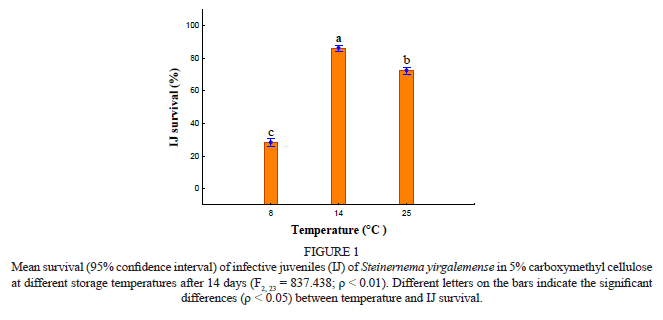
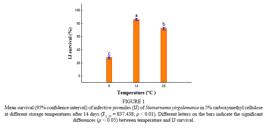
Analysis using a one-way ANOVA showed no significant difference between the two trials, therefore the results were pooled for analysis. The rate of survival of the IJs was found to be significantly affected by the temperature (Fig. 1) (F2 23 = 837.43, ρ < 0.01) after 14 days. When analysing the effect of the temperature treatments on the survival of the formulated S. yirgalemense in 5% CMC concentration, a significant difference (ρ < 0.01) was detected between treatments. Moreover, a significant difference (ρ < 0.001) was detected between IJ survival in the 8°C and the 14°C treatment and the 8°C and 25°C treatment (ρ < 0.001), as well as between the 14°C and the 25°C (ρ < 0.001) treatments. The mean percentage survival for the 14°C treatment was 86.26% ± 2.01%, whereas the mean percentage survival for those kept at 25°C was 72.42% ± 9.7%, and for 8°C it was 28.25% ± 1.09%.
Concentration of CMC
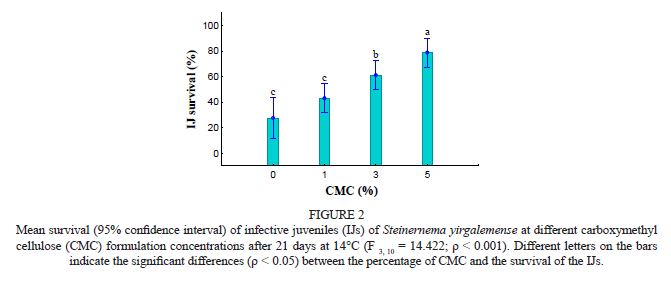
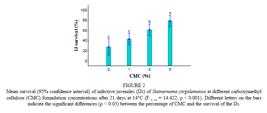
Analysis using a one-way ANOVA showed no significant differences between the two trials, therefore the results were pooled for analysis. The survival of the IJs was found to be significantly affected by the concentration of CMC formulation (F3,10 = 14.4, ρ < 0.001). When analysing the effect of different CMC concentrations at 14°C, after a storage period of 21 days, no significant difference (ρ = 0.109) was traced between the control (27.5% ± 7.19%) and the 1% CMC (43.0% ± 5.08%) concentration. However, a significant difference (ρ = 0.003) was detected between the control treatment and 3% CMC concentration (61.0% ± 5.08%) and the 5% CMC concentration (78.75% ± 5.08%). A significant difference (ρ = 0.03) was also detected between the 1% CMC concentration and the 3% CMC, as well as between the 1% CMC and the 5% CMC concentration (ρ < 0.001) (Fig. 2).
Storage time and temperature
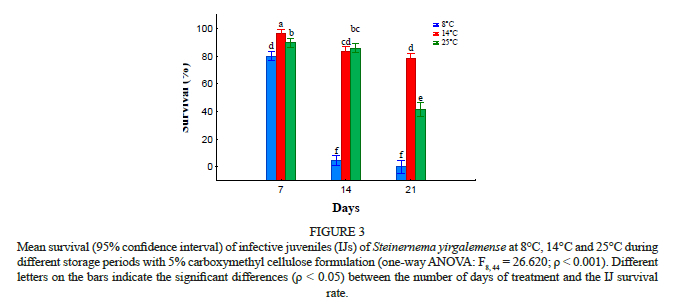
Analysis using a one-way ANOVA showed no significant differences between the two trials, therefore results were pooled for analysis. The survival of the IJs was significantly (F 8,44 = 26.620; ρ < 0.001) affected by the temperature and storage duration (in days) (Fig. 3). When comparing the mean survival of S. yirgalemense with a 5% CMC concentration over a period of 21 days at 8°C, the IJ survival was found to decrease significantly from day 7 to day 14 (ρ = 0.001). By day 21, all the IJs were dead. At 14°C, a significant difference (ρ = 0. 005) was detected between the survival at seven days and at 14 days, but no significant difference (ρ = 0.529) was detected between survival at 14 days and 21 days.
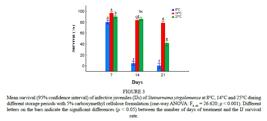
When analysing the data at 25°C, no significant difference (ρ = 0.787) was found between survival at seven days and at 14 days; however, a significant difference (ρ = 0.001) was seen between survival at 14 days and at 21 days.
When analysing the results found in relation to survival at three different temperatures (8°C, 14°C and 25°C) on different days, other results were seen. At seven days, a significant difference (ρ < 0.00) occurred between 8°C and 14°C, as well as between 8°C and 25°C (ρ = 0.01). A significant difference (ρ = 0.168) was also found to occur between the 14°C and the 25°C treatments and, after 14 days, no significant difference (ρ = 0.971) was detected between 14°C and 25°C, although a significant difference (ρ = 0.0016) was detected between these two temperatures (14°C, 25°C) and the 8°C treatment. After 21 days, significant differences were detected between the treatments at all three temperatures. As mentioned, after 21 days at 8°C, all the nematodes were dead, with a significant difference (ρ < 0.001) being seen between the 8°C treatment and both the 14°C and the 25°C treatments. A significant difference (ρ < 0.001) was also detected between the 14°C and the 25°C treatments (Fig. 3).
The mean survival of IJs at 8°C was 80.25% ± 1.6% after seven days, decreasing to zero survival after 21 days. The survival of the IJs at 25°C decreased from 89.75% ± 1.64% after seven days to 41.5% ± 2.3% at 21 days. The viability of the IJs at 14°C indicated positive results, with a survival rate of 96.25% ± 1.64% after seven days and 78.75% ± 1.63% after 21 days, with the mean survival rate being double the survival rate achieved at 25°C and triple the survival rate recorded at 8°C (Fig. 3).
Pathogenicity of formulated nematodes
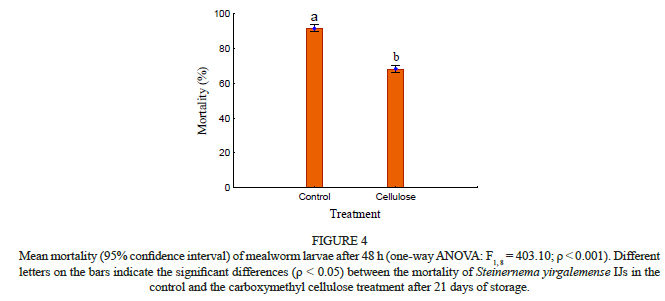
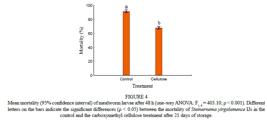
Last-instar mealworm larvae were found to be susceptible to the applied formulation, with an average mortality of 68.1% for the treatment and 91.6% for the control, which consisted of a fresh batch of IJs. The last-instar mealworm was significantly (F1,8 = 403.10; ρ < 0.002) affected by the cellulose formulation after 21 days (Fig. 4). When comparing the mean survival of the S. yirgalemense control to the cellulose treatment, a significant difference (ρ < 0.002) was detected.
DISCUSSION
The focus of the current study was to determine the longevity of IJs of S. yirgalemense in a CMC-based formulation. Temperature was found to be the most important factor that needed to be taken into consideration for formulation and storage. CMC had previously been used for the formulation of other EPN species, but not for the formulation of S. yirgalemense.
The findings suggest that CMC plays an important protective role in maintaining the survival of S. yirgalemense IJs, particularly under conditions that are otherwise unfavourable for nematode persistence. The absence of IJ survival in the control at 8°C indicates that refrigeration alone is detrimental, whereas the presence of surviving IJs in all CMC formulations highlights the capacity of the polymer matrix to buffer temperature-related stress. This protective effect of CMC, however, appears to be temperature dependent, as no clear advantage over the control was observed at 14°C, suggesting that moderate temperatures may already be within the tolerance range of the species.
At higher temperatures, the concentration of CMC became increasingly important, with higher concentrations providing substantially greater protection to IJs. This indicates that denser CMC matrices may enhance moisture retention or reduce metabolic stress, thereby improving IJ longevity. The loss of survival at 8°C after 14 days further emphasises that prolonged cold storage remains unsuitable for S. yirgalemense, even when formulated. In contrast, the comparable survival rates observed at 14°C and 25°C at higher CMC concentrations suggest that these formulations can stabilise IJ viability across a relatively wide temperature range over time.
The absence of a clear time effect between seven and 14 days implies that the composition of the formulation may be a more critical determinant of IJ survival than storage duration within this period. However, the divergence among CMC concentrations after 21 days, with the highest survival recorded at 5% CMC, indicates that long-term storage benefits from optimised formulation strength. These findings align with previous work demonstrating the efficacy of CMC-based formulations in enhancing nematode performance. For example, Fallet et al. (2022) reported high efficacy of a 3% CMC formulation of S. carpocapsae against Spodoptera frugiperda, achieving complete larval mortality under both laboratory and field conditions. Collectively, these results support the potential of CMC formulations to improve the storage stability and practical application of entomopathogenic nematodes in biological control programmes.
A contributing factor in such a situation could be that S. yirgalemense isolates are not adapted to endure such adverse conditions, with the survival of IJs over time substantially reduced at low temperatures such as 8°C (Kagimu & Malan, 2019). Survival rates at 14°C were higher than at both the highest and lowest temperatures, indicating that 14 °C is the most suitable storage temperature for the formulated S. yirgalemense, consistent with the findings of Nxitywa and Malan (2021). Moreover, a study conducted by Ramakuwela et al. (2015) on the survival of Steinernema innovation Çimen et al., a local South African isolate, showed that IJs can also have reduced survival rates at low temperatures. The results obtained indicate that the lowest percentage survival for IJs formulated on sponge were observed at 5°C, with 13% survival after 84 days, whereas a mean survival rate of ± 91% was achieved at 15°C storage. Therefore, the storage, survival and infectivity of IJs were confirmed as being significantly affected by temperature, with the survival rate declining as the storage time and temperature (>15°C) (Ramakuwela et al., 2015) increased.
Thus, for EPN species originating in a relatively warm climate such as occur in South Africa, the storage temperatures should be kept mild. In a field trial, Odendaal et al. (2016) confirmed S. feltiae as being a cold-active nematode, in contrast to locally isolated S. yirgalemense, H. bacteriophora and Steinernema jeffreyense Malan, Knoetze & Tiedt, which tend to prefer comparatively warm temperatures, indicating that temperature can be species-/ isolate-specific. Kary et al. (2021) investigated the survival of S. carpocapsae and H. bacteriophora in 5% CMC, together with 22% glycerol and 0.02% formaldehyde as an antimicrobial, over a six-month period at 15°C and 25°C. After six months of storage at 25°C, the survival rate of H. bacteriophora and S. carpocapsae was 77% and 93%, respectively. The authors also found that storage temperature was species-specific, with H. bacteriophora being less suited for CMC formulations at room temperature.
The survival of the IJs increased with increasing CMC concentration, indicating that a CMC concentration of 5% is optimum for the final product, with such a concentration serving to decrease nematode movement, and with it showing the highest survival of the IJs. At the end of the storage period (21 days), 5% CMC at 14°C provided > 75% viability, which is a value that is almost double the value recorded in the case of each of the other temperatures. The CMC concentrations at 8°C proved to be unsuitable for EPN storage, with those kept at 25°C facing contamination without the addition of antimicrobial products. Therefore, the 14°C treatment was only considered together with the 5% CMC concentration, with a mean survival rate of 86%. Nxitywa and Malan (2022) found that the survival of S. yirgalemense and S. jeffreyense was higher at 14°C than it was at 25°C when formulated in diatomaceous earth (DE), which correlates with the findings of the present study.
A visual change in the viscosity of the formulated products was observed in the 8°C temperature treatment, which changed the composition of the formulation to a liquid rather than a gel and losing the air bubbles, whereas only a slight change in the viscosity occurred at 14°C and 25°C. In addition, the viscosity of the CMC formulation prevented active movement of the nematodes. IJs depend on energy reserves, like lipids, for their survival (Qiu et al., 2000) and, if they are immobilised by a formulation, it can increase their longevity by not allowing them to use these energy reserves. The findings of this study are supported by the results of Kary et al. (2021), illustrating that CMC is a suitable IJ-trapping system that can be used for formulation. Movement was observed to be slightly less with the 5% CMC concentration than the 3% CMC concentration, but rapid movement was detected at the 1% CMC concentration. This led to the conclusion that the higher the concentration (w/v) of CMC used in a formulation, the less the nematode movement will be. This may be a factor contributing to nematode long-term survival in the form of a viscous gel-like substance.
A pathogenicity bioassay was then conducted to investigate whether temperature and CMC concentration, in combination, influenced IJ virulence after 21 days. The findings of the present study verified the suitability of CMC for the formulation of S. yirgalemense, with a 68% mealworm mortality being achieved. Predictably, the addition of glycerol and an antimicrobial product can enhance the effectiveness of the product; however, prior screening for antimicrobial compatibility is essential. In a paper by Kagimu et al. (2022), the authors evaluated the effect of antifungal agents on S. yirgalemense pathogenicity after 24 h exposure when applied to G. mellonella larvae.
Microbial contamination was a significant factor affecting nematode formulations, with further research being required to suppress the growth of these contaminants, as they degrade the adequacy and disposability of the formulated product. Microbial contamination was found to be a major setback in the present study, especially at a temperature of 25°C, as nearly all the CMC concentrations involved showed visible contamination after seven days. However, contamination was found to be less of a problem at 14°C, where the product could be stored for a period of 21 days with only minor signs of contamination. No contamination occurred at 8°C, but the nematodes were unable to survive longer than seven days. Based on recorded data, the EPN formulation shelf life seems to be severely affected by both the direct as well as indirect effects of microbial contamination (Chen & Glazer, 2005; Kary et al., 2017), and it has been demonstrated that CMC can facilitate the growth of common air-contaminated bacteria and fungi (Freeman et al., 1948; Van Ginkel & Gayton, 1996; Anita et al., 2013). Trichoderma spp., Fusarium sp., Aspergillus and Penicillium sp. are the most prevalent and effective cellulase producers (Yalpani, 1987), with members of the fungus genera Trichoderma and Aspergillus having already been the subject of substantial research. Ghanbary et al. (2010) demonstrated that every isolate of Aspergillus is capable of degrading cellulose. In addition, Van Ginkel and Gayton (1996) demonstrated that the acetal bonds of CMC are hydrolysed by the CMC-degrading bacteria Agrobacterium CM-1, leading to the shelf life of the IJs in formulation being adversely affected by such microorganisms.
The results achieved indicate that a 5% CMC concentration was the most ideal for S. yirgalemense formulation. Considering the importance of antimicrobial agents in EPN formulations, additional research is required in terms of the production of antibacterial and antifungal agents that can be added as adjuvants to a formulation, with the aim of avoiding negative effects regarding the pathogenicity and survival of the IJs. Different types of formulations, like alginate gels, diatomaceous earth, granules and powders, could also be investigated as potential formulation protocols. It is anticipated that, by optimising the CMC concentration and adding a powerful, nontoxic antibacterial agent to the formulation, a prolonged shelf life can be obtained.
LITERATURE CITED
-
Anita, B., Thatheyus, A.J. & Ramya, D., 2013. Biodegradation of carboxymethyl CMC using Aspergillus flavus. Sci. Int. (Lahore) 1, 85-91. https://doi.org/10.5567/sciintl.2013.85.91
» https://doi.org/10.5567/sciintl.2013.85.91 -
Askary, T.H., Nermut, J., Ahmad, M.J. & Ganai, M.A., 2017. Future thrusts in expanding the use of entomopathogenic and slug parasitic nematodes in agriculture. In: Abd-Elgawad, M.M.M., Askary, H. & Coupland, J. (eds). Biocontrol agents: Entomopathogenic and slug parasitic nematodes. CABI, Wallingford. pp. 620-627. https://doi.org/10.1079/9781786390004.0620
» https://doi.org/10.1079/9781786390004.0620 -
Chen, S. & Glazer, I., 2005. A novel method for long-term storage of the entomopathogenic nematode Steinernema feltiae at room temperature. Biol. Control 32(1), 104-110. https://doi.org/10.1016/j.biocontrol.2004.08.006
» https://doi.org/10.1016/j.biocontrol.2004.08.006 -
De Waal, J.Y., Malan, A.P. & Addison, M.F., 2011. Efficacy of entomopathogenic nematodes (Rhabditida: Heterorhabditidae and Steinernematidae) against codling moth, Cydia pomonella (Lepidoptera: Tortricidae) in temperate regions. Biocontrol Sci. Technol. 21, 1161-1176. https://doi.org/10.1080/09583157.2011.607922
» https://doi.org/10.1080/09583157.2011.607922 -
Dlamini, B.E., Malan, A.P. & Addison, P., 2020. Entomopathogens from agricultural soil and their potential to control the banded fruit weevil, Phlyctinus callosus (Schönherr) (Coleoptera: Curculionidae). Afr. Entomol. 28(2), 374-384. https://doi.org/10.4001/003.028.0374
» https://doi.org/10.4001/003.028.0374 -
Dunn, M.D., Belur, P.D. & Malan, A.P., 2020. In vitro liquid culture and optimization of Steinernema jeffreyense using shake flasks. BioControl 65(2), 223-233. https://doi.org/10.1007/s10526-019-09977-7
» https://doi.org/10.1007/s10526-019-09977-7 -
Dunn, M.D., Belur, P.D. & Malan, A.P., 2022. Development of cost-effective media for the in vitro liquid culture of entomopathogenic nematodes. Nematology 24(7), 763-775. https://doi.org/10.1163/15685411-bja10166
» https://doi.org/10.1163/15685411-bja10166 - Ehlers, R.-U. & Peters, A., 1995. Entomopathogenic nematodes in biological control: Feasibility, perspectives and possible risks. In: Hokkanen, H.T.M. & Lynch, J. (eds). Biological control: Benefits and risks. Cambridge University Press, Cambridge. pp. 119-136.
-
Fallet, P., Bazagwira, D., Guenat, J.M., Bustos-Segura, C., Karangwa, P., Mukundwa, I.P. Kajugac, J., Degena, T., Toepfer, S. & Turlingsa, T.C.J, 2022. Laboratory and field trials reveal the potential of a gel formulation of entomopathogenic nematodes for the biological control of fall armyworm caterpillars (Spodopterafrugiperda). Biol. Control 176, 105086. https://doi.org/10.1016/j.biocontrol.2022.105086
» https://doi.org/10.1016/j.biocontrol.2022.105086 - Freeman, G.G., Baillie, A.J. & Maclnnes, C.A., 1984. Bacterial degradation of CMC and methyl ethyl cellulose. Chem. Industry 59, 279-289.
-
Georgis, R., Koppenhöfer, A.M., Lacey, L.A., Bélair, G., Duncan, L.W., Grewal, P.S., Samish, M., Tan, L., Torr, P. & Van Tol, R.W.H.M., 2006. Successes and failures in the use of parasitic nematodes for pest control. Biol. Control 38(1), 103-123. https://doi.org/10.1016/j.biocontrol.2005.11.005
» https://doi.org/10.1016/j.biocontrol.2005.11.005 - Ghanbary, M.A.T., Lotfi, A., Asgharzadeh, A., Telmadarrehei, T. & Javadi, M.A., 2010. Laboratory simulation of cellulose degradation by soil Aspergilli. Am.-Eurasian J. Agric. Environ. Sci. 7(2), 146-148.
- Glazer, I. & Lewis, E.E., 2000. Bioassays of entomopathogenic nematodes. In: Navon, A. & Ascher, K.R.S. (eds). Bioassays of entomopathogenic microbes and nematodes. CABI Publishing, Wallingford. pp. 229-247.
-
Grewal, P.S. & Jagdale, G.B., 2002. Enhanced trehalose accumulation and desiccation survival of entomopathogenic nematodes through cold preacclimation. Biocontrol Sci. Technol. 12(5), 533-545. https://doi.org/10.1080/0958315021000016207
» https://doi.org/10.1080/0958315021000016207 - Grewal, P.S., Ehlers, R.-U. & Shapiro-Ilan, D.I., 2005. Nematodes as biocontrol agents. CABI, New York.
-
Jaffuel, G., Sbaiti, I. & Turlings, T.C., 2019. Encapsulated entomopathogenic nematodes can protect maize plants from Diabrotica balteata larvae [Abst.]. Insects 11(1), 27. https://doi.org/10.3390/insects11010027
» https://doi.org/10.3390/insects11010027 -
Kagimu, N. & Malan, A.P., 2019. Formulation of South African entomopathogenic nematodes using alginate beads and diatomaceous earth. BioControl 64(4), 413-422. https://doi.org/10.1007/s10526-019-09945-1
» https://doi.org/10.1007/s10526-019-09945-1 -
Kagimu, N., Ferreira, T. & Malan, A.P., 2017. The attributes of survival in the formulation of entomopathogenic nematodes utilised as insect biocontrol agents. Afr. Entomol. 25(2), 275-291. https://doi.org/10.4001/003.025.0275
» https://doi.org/10.4001/003.025.0275 -
Kagimu, N., Nxitywa, A. & Malan, A.P., 2022. Storability at room temperature of Steinernema yirgalemense (Rhabditida: Steinernematidae) in diatomaceous earth and the effect of antifungal agents. J. Plant Dis. Prot. 129(1), 137-144. https://doi.org/10.1007/s41348-021-00521-3
» https://doi.org/10.1007/s41348-021-00521-3 -
Kary, N., Chahardoli, S., Mohammadi, D. & Dillon, A.B., 2017. Effect of temperature, time and glycerol concentration on the dehydration and rehydration process of Steinernema carpocapsae and S. feltiae in alginate granule formulation. Nematology 19(2), 225-235. https://doi.org/10.1163/15685411-00003042
» https://doi.org/10.1163/15685411-00003042 -
Kary, N., Chahardoli, S., Mohammadi, D. & Dillon, A.B., 2021. Efficacy of carboxymethyl CMC as an inert water-soluble carrier for formulation of entomopathogenic nematodes, Heterorhabditis bacteriophora and Steinernema carpocapsae. Biol. Control 160, 104690. https://doi.org/10.1016/j.biocontrol.2021.104690
» https://doi.org/10.1016/j.biocontrol.2021.104690 -
Kaya, H.K. & Gaugler, R., 1993. Entomopathogenic nematodes. Ann. Rev. Entomol. 38, 181-206. https://doi.org/10.1146/annurev.en.38.010193.001145
» https://doi.org/10.1146/annurev.en.38.010193.001145 -
Le Vieux, P.D. & Malan, A.P., 2013. The potential use of entomopathogenic nematodes to control Planococcus ficus (Signoret) (Hemiptera: Pseudococcidae). S. Afr. J. Enol. Vitic. 34, 296-306. https://doi.org/10.21548/34-2-1108
» https://doi.org/10.21548/34-2-1108 - Malan, A.P. & Hatting, J.L., 2015. Entomopathogenic nematode exploitation: Case studies in laboratory and field applications from South Africa. In: Campos-Herrera, R. (ed), Nematode pathogenesis of insects and other pests: Ecology and applied technologies for sustainable plant and crop protection. Springer International Publishing, Cham. pp. 477-508.
-
Malan, A.P. & Knoetze, R., 2024. Role of entomopathogenic nematodes in an integrated pest management strategy for grapevine: South Africa as a model system. In: Shapiro-Ilan, D.I. & Lewis, E.E. (eds). Entomopathogenic nematodes as biological control agents. CAB International. pp. 333-356. https://doi.org/10.1079/9781800620322.0019
» https://doi.org/10.1079/9781800620322.0019 -
Malan, A.P., Knoetze, R. & Moore, S.D., 2011. Isolation and identification of entomopathogenic nematodes from citrus orchards in South Africa and their biocontrol potential against false codling moth. J. Invert. Pathol. 108, 115-125. https://doi.org/10.1016/jjip.20n.07.006
» https://doi.org/10.1016/jjip.20n.07.006 -
Malan, A.P., Von Diest, J.I., Moore, S.M. & Addison, P., 2018. Control options for false codling moth, Thaumatotibia leucotreta (Lepidoptera: Tortricidae), in South Africa, with emphasis on the potential use of entomopathogenic nematodes and fungi. Afr. Entomol. 26(1), 14-29. https://doi.org/10.4001/003.026.0014
» https://doi.org/10.4001/003.026.0014 -
Martins, D., De Carvalho, F.D., Gama, M. & Dourado, F., 2020. Dry bacterial CMC and carboxymethyl CMC formulations with interfacial-active performance: Processing conditions and redispersion. Cellulose 27, 6505-6520. https://doi.org/10.1007/s10570-020-03211-9
» https://doi.org/10.1007/s10570-020-03211-9 -
Mazuki, N.F., Majeed, A.A., Nagao, Y. & Samsudin, A.S., 2020. Studies on ionics conduction properties of modification CMC-PVA based polymer blend electrolytes via impedance approach. Polym. Test. 81, 106234. https://doi.org/10.1016/j.polymertesting.2019.106234
» https://doi.org/10.1016/j.polymertesting.2019.106234 -
Mwaniki, S.W., Nderitu, J.H., Olubayo, F., Kimenju, J.W. & Nguyen, K., 2008. Factors influencing the occurrence of entomopathogenic nematodes in the Central Rift Valley Region of Kenya. Afr. J. Ecol. 46, 79-84. https://doi.org/10.1111/j.1365-2028.2008.00933.x
» https://doi.org/10.1111/j.1365-2028.2008.00933.x -
Nguyen, K.B., Tesfamariam, M., Gozel, U., Gaugler, R. & Adams, B.J., 2004. Steinernema yirgalemense n. sp. (Rhabditida: Steinernematidae) from Ethiopia. Nematology 6, 839-856. https://doi.org/10.1163/1568541044038605
» https://doi.org/10.1163/1568541044038605 -
Nxitywa, A. & Malan, A.P., 2021. Formulation of entomopathogenic nematodes for the control of key pests of grapevine: A review. S. Afr. J. Enol. Vitic. 42(2), 123-135. https://doi.org/10.21548/42-2-4479
» https://doi.org/10.21548/42-2-4479 -
Nxitywa, A. & Malan, A.P., 2022. Formulation of high concentrations of entomopathogenic nematode in diatomaceous earth. Biocontrol Sci. Technol. 32(9), 1107-1121. https://doi.org/10.1080/09583157.2022.2090511
» https://doi.org/10.1080/09583157.2022.2090511 -
Odendaal, D., Addison, M.F. & Malan, A.P., 2016. Entomopathogenic nematodes for the control of the codling moth (Cydia pomonella L.) in field and laboratory trials. J. Helminth. 90(5), 615-623. https://doi.org/10.1017/S0022149X15000887
» https://doi.org/10.1017/S0022149X15000887 -
Qiu, L., Lacey, M.J. & Bedding, R.A., 2000. Using deuterium as an isotopic tracer to study the energy metabolism of infective juveniles of Steinernema carpocapsae under aerobic conditions. Comp. Biochem. Physiol. Part B, 127(3), 279-288. https://doi.org/10.1016/S0305-0491(00)00253-4
» https://doi.org/10.1016/S0305-0491(00)00253-4 -
Ramakuwela, T., Hatting, J., Laing, M.D., Hazir, S. & Thiebaut, N., 2015. Effect of storage temperature and duration on survival and infectivity of Steinernema innovationi (Rhabditida: Steinernematidae). J. Nematol. 47, 332-336. https://doi.org/10.1016/j.jip.2008.02.013
» https://doi.org/10.1016/j.jip.2008.02.013 -
Rolston, A.N., Griffin, C.T. & Downes, M.J., 2005. Distribution of entomopathogenic nematodes in an Irish sand dune system. Nematology 7(2), 259-266. https://doi.org/10.1163/1568541054879485
» https://doi.org/10.1163/1568541054879485 -
StatSoft Inc., 2016. Dell Statistica (data analysis software system), version 13. http://www.statsoft.com
» http://www.statsoft.com - Stevenson, T. 2005 (4th ed.). The Sotheby's wine encyclopedia. Dorling Kindersley, London.
-
Steyn, V.M., Malan, A.P. & Addison, P., 2019. Control of false codling moth, Thaumatotibia leucotreta (Lepidoptera: Tortricidae), using in vitro-cultured Steinernema jeffreyense and S. yirgalemense. Biol. Control 138, 104052. https://doi.org/10.1016/j.biocontrol.2019.104052
» https://doi.org/10.1016/j.biocontrol.2019.104052 -
Steyn, V.M., Malan, A.P. & Addison, P., 2021. Efficacy of entomopathogens against Thaumatotibia leucotreta under laboratory conditions. Entomol. Exp. Appl. 169(5), 449-461. https://doi.org/10.1111/eea.13044
» https://doi.org/10.1111/eea.13044 -
Van Ginkel, C.G. & Gayton, S., 1996. The biodegradability and nontoxicity of carboxymethyl CMC (DS 0.7) and intermediates. Environ. Toxicol. Chem. 15(3), 270-274. https://doi.org/10.1002/etc.5620150307
» https://doi.org/10.1002/etc.5620150307 - Yalpani, M., 1987. Developments and prospects in enzymatic biopolymer modifications. In: Yalpani, M. (ed). Industrial polysaccharides: Genetic engineering, structure/property relations, and applications. Symp. Appl. Modif. Ind. Polysacch., April 1987, Vol. 3, Elsevier, Amsterdam. pp. 7-34.
Acknowledgements: This study was funded by Citrus Research International (CRI). D.G. Nel, from the Centre for Statistical Consultation, Stellenbosch, South Africa, is thanked for assistance with the statistical analysis