South African football's dilemma: Balancing profit, utility and social entrepreneurship for sustainability
Abstract
BACKGROUND: This empirical study explores how football club sale decisions, made under financial duress, reflect tensions between profitability, utility maximisation and principles of social entrepreneurship, among fans. AIM: This study investigates whether football managers, acting as social entrepreneurs, prioritise social utility and community impact over narrow profit and how such decisions affect fan behaviour and psychological health. SETTING: The setting is in Durban and focuses on a professional football club with a fan base of 100,000 individuals. METHODS: This study uses a mixed-methods approach that combines surveys from 384 quantitative fans with qualitative interviews from 12 managers and four sponsors to analyse emotional, behavioural and managerial dimensions was used. RESULTS: The study reveals a significant disconnect between managers and fans, leading to psychological ramifications for supporters. The emotional distress experienced can be attributed to the lack of understanding and empathy exhibited by managers who prioritise financial gain. The findings suggest that fans subjected to such treatment become vagabonds, (i.e.) without a true football home, which limits their ability to experience and express joy. Unfortunately, these critical aspects are overlooked, adversely affecting fans' overall well-being, domestic life and psychological health. CONCLUSION: The research underscores the importance of collective and inclusive management, providing a framework that enhances sustainability. It highlights the impact of poorly managed social entrepreneurship initiatives, which can uproot communities if not carefully considered. CONTRIBUTION: The study contributes to literature of the under-researched professional football league. This context has received limited attention, presenting an opportunity that addresses knowledge gap between football and entrepreneurship.
social entrepreneurship; profitability; utility maximisation; fan identity; South African Premier League
Introduction
Football is the most popular sport in Africa, boasting millions of passionate fans, hundreds of thousands of players and numerous clubs competing at various levels (Freer, Wafer & Flowers 2023; Pannenborg 2008). Beyond being a unifying force, it also fuels intense club-level rivalries (Sibanda 2024). To enhance the sport's professionalism, many African nations have established structured leagues governed by football associations, with oversight provided by league boards or management committees (Bayle 2025). These governing bodies regulate both top-tier premiership leagues and lower-division competitions. The clubs within these leagues are owned by individuals, businesses or community organisations (Starkings & Brett 2021). This study investigates whether football managers, particularly within the South African context, function as social entrepreneurs by prioritising social value and community engagement over pure financial gain, and how these managerial decisions influence fan behaviour and psychological well-being. The research is situated within the socio-historical landscape of South African football, especially in the post-apartheid era, where the sport has played a vital role in nation-building, social identity and economic transformation. In this context, football clubs often extend beyond their athletic function to serve as platforms for community cohesion, empowerment and social change.
Background
Football in South Africa, particularly within the Premier Soccer League (PSL), operates at the intersection of intense commercialisation and socio-cultural responsibility. While club owners invest significantly to compete in this lucrative league, they concurrently face the ambiguity of financial returns, a central tension in the context of social entrepreneurship. Mphahlele (2024) indicated that the operational monthly costs associated with operating a PSL club range from R2.5 million to R4.5 million. This situation prompts an ongoing debate regarding whether football clubs should primarily function as social enterprises or as profit-driven entities.
This study is underpinned by Freeman's (1984) stakeholder theory, which serves as a normative framework for evaluating how football clubs manage the competing interests of multiple stakeholders, including fans, local communities, corporate sponsors and league authorities. Within this context, the study explores how social entrepreneurship intention (SEI) influences football business strategies (Nguyen, Nguyen & Huynh 2024). It investigates whether South African club owners balance financial imperatives with a broader commitment to social impact or whether financial pressures compromise their social mission.
This enquiry is further sharpened by a paradox central to the literature: under economic strain, club owners, initially motivated by social goals, often revert to self-interest, thereby contradicting the principles of social entrepreneurship (Civera & Freeman 2020; Hammerschmidt et al. 2021). The role of corporate sponsorship and corporate social investment adds another layer of complexity, raising questions about the sustainability of socially driven football enterprises within an increasingly commercialised environment (Sauer et al. 2023).
This study critically examines the extent to which club owners prioritise profit maximisation over broader social goals, shedding light on the tension between these competing objectives.
It also incorporates Sloane's (1971) theory, integrating the concept of social entrepreneurship to illustrate how club owners secure financial sponsorship while maintaining a commitment to community development (Jacobsen 2023). The research underscores the far-reaching impact of football, extending beyond financial gain to emphasise the significance of team success and fan enthusiasm (Kaplanidou 2020). This enthusiasm often culminates in fan euphoria, typically experienced when a club plays in local stadiums, wins games, signs top-quality talent and secures championships, ultimately yielding substantial financial rewards. However, according to Jacobsen (2023), the biggest challenge arises when clubs face financial burdens, leading owners to prioritise financial gain over sporting performance. This conflict often affects fan ecstasy, as their interests are sacrificed for economic stability, leaving their passion and loyalty overshadowed by financial considerations.
Based on this background, the study investigates the strategic decision-making of South African Premier League clubs in the face of financial challenges, examining whether they prioritise utility maximisation to benefit fans and supporters or focus on profitability (Traynor 2024). As social entrepreneurs, club owners are expected to uphold their guiding principles and values, prioritising social impact alongside financial considerations, regardless of whether their organisations face profitability or insolvency (Kobayashi 1975).
South Africa's socio-historical context, particularly post-apartheid, imbues football with profound symbolic and community functions. However, the financial instability faced by PSL clubs challenges the capacity of club owners to remain true to their social mandates. This study critically evaluates whether these owners adopt utility-maximising strategies that favour stakeholder well-being or default to profit-maximising behaviours during financial crises (Traynor 2024). Fans often experience significant psychological effects, as their emotional investment in the club often outweighs any financial considerations. Clarke, Geurin and Burch (2022) emphasised that fans' mental well-being is frequently undermined by ownership decisions driven by profitability over community loyalty.
Here, the study contributes to the literature by exploring the psychosocial dimensions of organisational change. Drawing on Davis et al. (2021), firstly, it examines how club sales and shifts in ownership affect stakeholder attitudes, loyalty and mental health. Secondly, the study examines the unrestrained landscape of football club sales in the South African Premier League, where financial pressures often compel social entrepreneurs to prioritise business interests over their primary social objectives (Dzomonda 2021). The high financial demands associated with operating and managing a football club can lead social entrepreneurs to adopt a more business-oriented approach, potentially resulting in negative consequences, including stakeholder disillusionment, hurt and frustration (Traynor 2024).
The study provides an overview of academic literature on social entrepreneurs in football clubs, highlighting the motivations and investments of social entrepreneurs who prioritise player development and professional team management over economic gains (Alonso et al. 2024). The discussion delves into the aspects of social responsibility assumed by these entrepreneurs, including player development and professional team management, underscoring the tension between economic reality and social objectives (Jacobsen 2023). The performance outcomes of football clubs often result from a complex interplay between the objectives of owners and management, necessitating a delicate balance to optimise utility. Football clubs face intense pressure to optimise asset utilisation, balancing desired efficiency and effectiveness while navigating the dual imperatives of financial sustainability and sporting success (Sanchez et al. 2024). This encompasses managing the logistical complexities of competing in a national league, which requires travelling to diverse locations weekly for matches while concurrently maintaining financial sustainability and resource optimisation. The methodology employed in this study is outlined, detailing the data collection process and analytical techniques utilised.
The South African Premier League (PSL) distinguished itself from European leagues primarily through its unique government structures, which are marked by localised ownership and management (Wafer & Flowers 2022). The governance architecture of the PSL is characterised by a peculiar contradiction: club owners often hold concurrent positions on the league's executive committees (Mokoena 2024). The concurrent dual role of club owners as executive committee members contributes to the PSL's laxity in evaluating the financial stability and liquidity of prospective club owners, as well as their managerial competence in operating a financially sustainable club (Du Preez 2024; Mbonambi 2023). It assumes that the investor possesses the required skills and competence to be a social entrepreneur (Jacobsen 2023). In contrast to European leagues, which enforce stringent ownership regulations, such as the English Football League's Rule 34 (Evans, Walters & Hamil 2024), the PSL's structure presumes that investors possess the necessary capabilities to function as both entrepreneurs and social custodians (Jacobsen 2023; Kritikos 2022). This creates a perverse incentive to prioritise personal financial gain over the well-being of fans and stakeholders (Mbonambi 2023). This dynamic underscores the need for governance reforms in the PSL to align directional incentives with the long-term sustainability and social responsibility of football clubs (Boya 2024).
South African perspective
The Statute of SAFA (2012) explicitly mandates that the sport's objective be utility maximisation. Aligning football's objective with game victory, stadium attendance, player popularity and competitive suspense, as well as talent investment, is high under utility maximisation (Arrondel, Duhautois & Laslier 2023). To attain club success or wins, clubs adopt a two-pronged approach to financial sustainability (Di Simone & Zanardi 2021).
To ensure financial sustainability, football clubs adopt a two-pronged strategy. Firstly, they secure corporate sponsorships to guarantee long-term financial stability, complemented by leveraging monthly PSL grants to address short-term financial needs. Secondly, they implement robust financial management policies and guidelines (Dube 2023). This holistic approach enables club owners to strike a balance between self-interest and financial stability, ultimately upholding the club's financial integrity (Frazer & Andrew 2023). By establishing a stable financial foundation, clubs focus on key performance indicators crucial for overall success, including maximising wins, increasing match attendance and recruiting top talent (Eriksson 2023).
In South Africa's PSL, this practice is under the guidance of experienced technocrats, who bring essential skills and expertise to the club, assisting in addressing the complexities of modern football (SAFA Statute 2012). This collaborative approach enables clubs to adapt to the sport's evolving demands and achieve financial sustainability (Jacobsen 2023). However, ineffective club management frequently disrupts club liquidity because of conflicting institutional demands, such as sporting success and financial sustainability, which often hinders striking a balance between utility maximisation and profit maximisation (Sandy, Sloane & Rosentraub 2024).
Social entrepreneurship in this context is complicated as it assumes club owners are profit-averse. It prioritises social-tainment by offering an array of options available, which primarily do not prioritise the club owner (Mthembu & Barnard 2019). Bull and Whittam (2020) suggested that social entrepreneurship's utility maximisation often does not fully align with football fan's expectations. To reconcile this disparity, stakeholders have had to navigate budget constraints, prioritising strategic trade-offs between expenditures (Hammè & Galiena 2021). The crucial optimal level of consumer satisfaction for club owners often diverges from that of fans, highlighting the complexity of balancing competing interests (Khadka & Khadka 2022).
This study aims to construct a robust African perspective on the intersection of social entrepreneurship and sports management, with a specific focus on South African football clubs. It begins by critically evaluating the financial decisions made within these clubs, highlighting a prevalent emphasis on maximising profits through club sales, often at the expense of social outcomes (Jaeger 2021). The investigation further explores the psychological and economic impacts of these decisions on fans and stakeholders, recognising the unique operational structure of football clubs, based on a tripartite model involving management, players and fandom (Jacobsen 2023).
The study underscores the importance of understanding these dynamics for effective club governance (Starkings & Brett 2021), ultimately addressing a significant gap in the literature by examining how South African club owners manage the tension between financial viability and social accountability. It does so in the context of institutional fragility, inconsistent regulatory frameworks and persistent stakeholder expectations.
Value for money
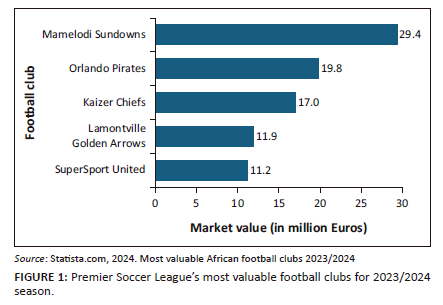
South Africa has some of the most valuable football clubs in Africa. According to Galal (2023), Mamelodi Sundowns, Orlando Pirates, Kaizer Chiefs, Lamontville Golden Arrows and SuperSport United are among the top-most valuable clubs in the country. The continent's market valuation for 2021/2022 placed them in the top 20 list of the continent's most valuable clubs in Africa, which was led by the Egyptian giants Al Ahly (Vardien 2022).
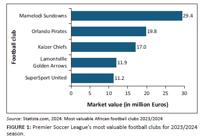
Except for SuperSport United, which is owned by the conglomerate SuperSport International Holdings Pty Ltd, clubs in the PSL are predominantly family-owned and socially entrepreneurial in nature, highlighting the importance of acquiring skilled business acumen to assist clubs with professional business expertise (Mogajane, Du Plessis & Slabbert 2019).
Given the vast sums of money in the football industry, these family-owned businesses face unique challenges in balancing resource management discipline with ownership dynamics, prioritising utility maximisation over profit maximisation (Sloane 1971). Many football clubs experience agency problems because of the pressure on technocrats from family members, who often clash on maximising family income as opposed to maximising utility as per the PSL mandate (Hayes 2022).
Football is a societal activity, and football club owners are regarded as inherently social entrepreneurs and maximise social utility, which often creates challenges for the organisation's mission and objectives of separating the accountability of technocrats from that of club ownership (Mthembu & Barnard 2019). Therefore, special attention should be given to social entrepreneurship in its inherent form, as family governance impacts performance and firm value, and without corrective measures in place, club owners tend to prioritise profit at the expense of the social nature of the business (Duncan & Hasso 2018).
The impact on fans
Sports management researchers have rigorously explored the concept of fandom, defining it as the intense emotional affection between an individual and their preferred team (Clarke et al. 2022). Numerous theoretical perspectives have investigated this relationship, proposing team management strategies that can foster a deeper attachment between fans and the team (Hirshon 2020).
Empirical evidence suggests that by prioritising fan interests over profit maximisation and involving fans in decision-making processes related to team operations, teams can enhance fan engagement, foster loyalty and increase attendance and revenue (Kima, Love & Park 2024; Saima et al. 2019). Adopting this fan-oriented paradigm enables teams to cultivate a dedicated fan base, ensuring long-term viability and success.
Football success is inextricably linked to fan support. Fans contribute significantly to the team's viability through various channels, including ticket sales, merchandise purchases and intangible enthusiasm. Given their significant investment in the team's success, fans deserve to be consulted in the event of a potential sale (Zhang 2023). Moreover, it is essential to prioritise continuity and stability for both fans and the community. Ideally, any sale should ensure that the team remains in its current location, avoiding relocation to a different city, town or region (Evans et al. 2024). This safeguard would respect the fan's emotional connection and loyalty, maintaining the team's legacy and community ties (Jacobsen 2023).
The widespread relocation of football clubs in South African football has precipitated a profound psychological impact on devoted fans (Madyauta 2023). The abrupt displacement of their cherished teams has induced emotions of humiliation, betrayal and despair (Aren & Hamamcı 2021). The emotional attachment and sense of ownership fans have cultivated with their teams render the sale and relocation a catastrophic event, triggering significant mental stress (McElwaine 2025). Furthermore, the financial commitments made to support their teams serve as a poignant reminder of the loss, intensifying the emotional suffering (ChilliPepper 2022).
The sale of Bloemfontein Celtics, a Premier League team from Bloemfontein in the Free State with a massive following, serves as a poignant example (Feikie, Das & Mostafa 2018). Despite financial struggles since the early 2000s, the passionate owner initially prioritised fans' emotional well-being by selling the team to local interests (ChilliPepper 2022). However, the subsequent sale in 2014, to the KDS group, proved devastating (Dube 2024). Disregarding fan interest, the new ownership relocated the team to KwaZulu-Natal, inflicting immense emotional strain and distress on loyal supporters (Dube 2023). Fans felt a profound sense of loss and disconnection, severed from the team they had passionately supported for years (Madyauta 2023).
The sale of Witbank Aces in 2016 serves as another poignant example. Financial difficulties led to the team's sale, but the new owner's decision to relocate from Mpumalanga to Cape Town had devastating consequences (Hirshon 2020). The move severely impacted the province, region and local economy. The loss of a premier team meant visiting teams no longer travelled to the area, resulting in significant revenue loss and reduced economic activity (Cox & Philippou 2022). This was particularly detrimental given Mpumalanga's investment in hosting the 2010 FIFA World Cup, including the construction of a state-of-the-art stadium (Swanepoel 2024). The absence of local premier teams has left this infrastructure underutilised, undermining the region's economic potential (Makamu 2024). These cases highlight the imperative need of stakeholder engagement at a broader regional level to avoid negative implications of football club ownership decisions.
Theoretical framework
This study employs the theory of football utility maximisation owned by social entrepreneurs to analyse the decision-making process of football social entrepreneurs (Davis et al. 2021), specifically utility maximisation, as a more accurate objective for professional football clubs (Eriksson 2023). This concept, developed by Sloane (1971), prioritises achieving euphoria through utility maximisation over profit maximisation. Sloane's theory suggests that football clubs should focus on maximising overall satisfaction, rather than solely pursuing financial gains (Sloane 1971). Franck's (2010) assertion supported this morality, stating that football club owners' primary concerns are not profits, but the club's success and supporter satisfaction. This is exemplified by multi-millionaire owners who invest substantial resources into their clubs, often with motivations extending beyond mere profit. To better understand the decision-making processes of such football social entrepreneurs, this study adopts the lens of social entrepreneurship theory, specifically the concept of utility maximisation, as a more accurate framework for assessing the objectives of professional football clubs. Developed by Sloane (1971), this concept prioritises achieving euphoria through utility maximisation over sole financial analysis. The moral justification for prioritising sportive success over profit maximisation in sports management is supported by the notion that football club owner's primary concerns are not monetary gains, but rather the club's success and supporter satisfaction (Cicut et al. 2024). Contrary to conventional wisdom, evidence suggests that these multi-millionaire owners are not solely profit-driven, as they demonstrate a willingness to invest in their clubs, prioritising sportive excellence (Jacobsen 2023).
In the context of the South African PSL, a paradigm shift in sports management emphasises overall value creation over sole financial returns, aligning with ethical and sustainable practices (Mosola 2017). This perspective challenges conventional wisdom, which prioritises profit maximisation, instead advocating for optimised overall value as the primary objective (Gücüm & Özesmi 2019).
The prevailing notion that club owners and managers prioritise profit maximisation is challenged, suggesting instead that their primary objective should be to optimise overall value, encompassing more than just financial gain (Arrondel et al. 2023). This perspective diverges from the traditional corporate approaches, where managers prioritise shareholder wealth and personal profits by manipulating production resources, inputs and prices to achieve maximum profits (Park 2022). By redefining sports management's primary objective, this narrative advocates for a more holistic and ethical approach, administering sports organisations with a broader focus.
Football financial struggles and encountering financial shortfalls
Beneath the glamorous façade of top-tier football, the reality of running a football club in South Africa is far from lucrative (Dube 2024). Over the past 20 years, the South African Premier League has witnessed a concerning trend, with numerous clubs changing at an alarming rate of approximately one sale per season (Cowling 2023), primarily driven by persistent financial struggles (Freer et al. 2023). Majority of football clubs competing in the PSL are family-owned entities. Unlike their rugby counterparts, who benefit from dedicated sponsorships, they face a scarcity of sponsorships (Morton 2024), posing a significant challenge that impacts operational costs. To bridge this financial gap, club owners and managers often rely on their personal funds, effectively using cash injections from club owners to keep the club afloat (Kisaka, Andanje & Rintaugu 2022; Traynor 2024).
Contrary to top European leagues where 100% of teams have secured sponsorships because of structured ownership models and objectives, the South African Premier League presents a stark contrast (Barnes & Gannon 2022). Fifty-six per cent of clubs in the 2023/2024 season have successfully managed to attract sponsorship deals, leaving 44% without vital financial support and struggling to accumulate adequate revenue for survival (Lenssen & Craig Smith 2019).
This disparity underscores the challenges in applying profit maximisation theory in the South African context, highlighting the need for more effective sponsorship acquisition strategies and sustainable financial models for clubs like Golden Arrows, Sekhukhune United, Swallows FC, Richards Bay FC, TS Galaxy, Marumo Gallants and Royal AM (Madyauta 2023) and (Evans et al. 2024). An application of profit maximisation theory reveals that South African Premier League football clubs incur sustainable operational costs of approximately 4.2 million rand monthly (Mphahlele 2024). The prevalent financial constraints stem from difficulties in attracting and securing sponsorship deals, compelling club owners to rely on personal finances (Tim Sukazi 2022).
Contrary to the common perception that football club owners are wealthy individuals with vast financial resources, this often places immense pressure on them to achieve success while navigating various expenses (Buwembo 2023). These costs include player salaries, stadium bookings, logistical operations, flights and accommodation bookings (Traynor 2024). Because of the complexity and multifaceted nature of running a football club, many owners struggle to keep their teams financially afloat, leading to insolvency (Evans et al. 2024). This precarious financial situation frequently results in the sale of the club, highlighting the inherent challenges owners face in maintaining the economic viability and financial stability of their teams (Evans et al. 2024).
In the 2023/2024 season, the PSL witnessed significant financial challenges faced by two major clubs, Moroka Swallows and TS Galaxy (Dube 2024). These clubs encountered difficulties in remunerating their players, thereby exposing the harsh realities of managing a professional football team in South Africa (Buwembo 2023). Notably, Bidvest Wits, an institution with a century-long legacy, was dissolved in 2020 (Malepa 2020). Similarly, Bloemfontein Celtic, a club deeply rooted in its community, was sold shortly thereafter in the 2021/2022 season. Highlands Park experienced financial challenges as far back as 1983 before the inception of the PSL. Thereafter, teams like Free State Stars in 2002, Mpumalanga Black Aces in 2016, Thanda Royal Zulu in 2017 and Platinum Stars in 2018 experienced similar challenges (Dube 2024).
When sports clubs often face financial distress such as these, they often resort to sale, leading to a change of ownership, frequently to non-local buyers (Owusu-Ansah 2021). Football clubs often experience financial struggles, forcing owners to sell to recoup their investments (Evans et al. 2024). Financial constraints can be the primary driver for the sale of a football club, but it is, however, not the exclusive instigator (Kisaka et al. 2022).
The past two decades of the league have demonstrated other factors that can trigger ownership changes (Malepa 2020). For instance, the sale of the Wits University football club was prompted by the impact of coronavirus disease 2019 (COVID-19) (Wafer & Flowers 2022), while the sale of AmaZulu Football resulted from the owner's deteriorating health (Breakfast 2020). Notably, the later sale is one of the few sales that yielded a positive outcome, as the club was retained in its original jurisdiction, retaining its original name, logo and brand, ensuring continuity and stability for the team and its fans (Ngcatshe 2020). This makes it increasingly difficult for clubs to avoid relegation as they struggle to be competitive both on the field and stay afloat amid financial constraints (Andrews & Harrington 2016), highlighting the complexity of factors influencing football club ownership changes.
During the transfer process, disputes over agency fees frequently arise as club owners are eager to minimise financial losses, thus entertaining buyers offering the highest bids (ChilliPepper 2022). This transition often results in negative repercussions and alterations to the club's assets and legacy, leading to name change, logo and identity loss, and emotional turmoil among loyal local supporters who have an intense emotional connection to the club (Williams et al. 2021). In South Africa, supporters often experience disruption and hardships because of club relocations to different districts or provinces, resulting in regional economic losses. Unfortunately, club owners tend to prioritise financial recovery over the well-being of supporters, demonstrating a lack of consideration of the socio-economic impact of their decisions (Williams et al. 2021).
The study investigates whether football clubs in the PSL prioritise utility maximisation over profit maximisation, particularly during financial distress (Sandy, Sloane & Rosentraub 2024). Focusing on decision-making by football social entrepreneurs, this research explores the conflict between pursuing profits and utility maximisation in club sales (Dube 2024). The study seeks to find an answer to the implications of club sales on the fan base and, secondly, assess whether football social entrepreneurs prioritise profit maximisation over utility maximisation when selling clubs to recoup financial losses (Giuseppe 2021). In seeking answers, the study presents a literature review, followed by a description of the research method and a brief description of club sales and their effect on the club fan base. The empirical data are presented and analysed before focusing on the discussion and conclusions.
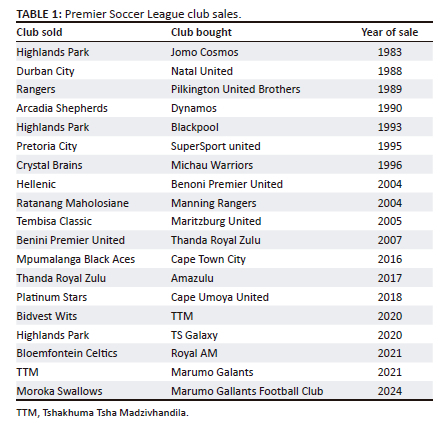
Finally, Table 1 presents the limitations and recommendations for future research, illustrating a timeline of club sales in South Africa's PSL from 1983 to 2024. This timeline highlights significant patterns of instability, governance deficiencies and financial vulnerabilities within the club structures of the league. Although the data encompass four decades, the trend of franchise sales has notably intensified in recent years, particularly with a substantial concentration of transactions occurring from 2016 onward. This upward trend indicates increasing financial pressures and speculative dynamics within the league. The commodification of club identities through sales and rebranding erodes the historical and emotional ties between clubs and their communities. This disconnect is further exacerbated by the limited involvement of supporters and local stakeholders in decision-making processes surrounding ownership changes.
From a stakeholder theory perspective, these developments raise significant concerns. Football clubs are not merely commercial entities; they are social institutions embedded within communities. The recurring sales and transformations of club identities suggest a misalignment between financial imperatives and the broader social responsibilities that clubs hold. The marginalisation of fans, players and local communities in ownership transitions reflects an imbalance of power and a failure to uphold inclusive and participatory governance principles.
In addressing these challenges, there is a pressing need to reconsider the regulatory and financial architecture of the PSL. Without comprehensive reforms to ensure transparency, enforce accountability and foster community engagement, the league risks undermining both its sporting integrity and its socio-cultural legitimacy. The unchecked circulation of club franchises may ultimately weaken the stability and identity of South African football, diminishing its value not only as a sport but also as a shared national institution.
Research methods and design
Approach
This study adopts an empirical perspective and takes an inductive approach in seeking to contribute to the existing literature on the nexus between social entrepreneurship, professional football management, and organisational well-being. Specifically, it seeks to inform strategies that strike a balance between economic sustainability and social responsibility in the football industry (Clarke et al. 2022). It is grounded in the transformative paradigm, which emphasises the interconnectedness of research and social change (Creswell & Creswell 2023). The approach prioritises the needs and perspectives of marginalised groups, seeking to confront and dismantle social oppression at all levels (Pearce 2020). The transformative paradigm centralises the voices and experiences of oppressed communities to stimulate meaningful social change. In this context, the researcher investigates the pressing social issue of consumer marginalisation in the decision-making process surrounding the sale of football clubs (Khudiyev & Szabo 2020).
Sample
This study employs a transformative mixed-methods research design underpinned by an inductive approach. The choice of design is rooted in the study's aim to explore the complex intersection between social entrepreneurship, professional football management and community well-being within the South African PSL. The transformative paradigm is particularly appropriate as it foregrounds social justice and emphasises the inclusion of marginalised voices, especially football fans and community stakeholders, who are often excluded from critical decision-making processes in club ownership and management. By integrating qualitative and quantitative methods, the study ensures a comprehensive and balanced exploration of both managerial strategies and supporter perspectives. This combination allows for triangulation of data, enhancing the study's validity, reliability and depth of understanding.
Ethical clearance for the research was obtained from the relevant institutional board (details redacted for review integrity), as confirmed by the approval letter, information redacted to maintain the integrity of the review process. The sample consisted of 16 participants for the qualitative strand, including members of the AmaZulu Football Club executive team and sponsorship executives. For the quantitative component, a sample of 384 fans was drawn from a population of over 100 000, based on the club's attendance records and financial reports. This dual-layered sampling approach provided a robust foundation for examining the divergence and overlap between internal managerial intentions and external stakeholder expectations (Sekaran & Bougie 2019).
To enhance the validity and trustworthiness of the findings, data triangulation was employed, involving the cross-validating of information across qualitative and quantitative datasets. This approach enabled the establishment of validity and reliability, thereby strengthening the overall rigour of the study (Makanyeza 2014). This approach, aligned with established social science research protocols, facilitated a comprehensive understanding of the research objectives. By integrating qualitative and quantitative methods, the study enhanced validity, reliability and generalisable findings that contribute meaningfully to the existing body of knowledge (Creswell & Creswell 2023).
Data were collected sequentially, beginning with qualitative interviews followed by quantitative surveys. The qualitative data were subjected to thematic analysis using NVivo software. This software facilitated systematic coding by allowing the data to be broken down into key ideas and patterns, which were then grouped into themes and sub-themes. The coding process followed an interpretive framework guided by Sloane's theory of utility maximisation, which emphasises satisfaction and communal well-being over financial profit. Through open, axial and selective coding, the researcher was able to draw connections between management practices and the emotional, economic and social concerns of stakeholders.
The quantitative data, analysed using SPSS, provided descriptive and inferential statistics that supported the qualitative findings. Statistical tests such as Cronbach's alpha were used to assess the internal consistency of the measures, while exploratory factor analysis (EFA) examined correlations among key variables. The results of the Kaiser-Meyer-Olkin (KMO) test and Bartlett's test of sphericity confirmed the suitability of the dataset for factor analysis. The findings from the quantitative data validated the patterns emerging from the qualitative analysis and helped reveal significant relationships, such as the impact of demographic factors on financial decision-making within football clubs.
Overall, the methodology was carefully chosen and applied to support the study's central objective: to critically assess how social entrepreneurship manifests in the governance of South African football clubs, especially under financial distress. The integrated design and systematic analysis enabled the researcher to uncover how club owners balance - or fail to balance - profit-driven motives with the broader social responsibilities they hold towards fans and communities.
Data analysis
Data analysis followed QUAL → QUAN analysis of which data collection followed the same sequence. The qualitative data were analysed using a specialised software package called NVivo. This software package enabled the categorisation of information into themes and sub-themes, facilitating the origination of data into meaningful patterns (Makanyeza 2014). Thematic analysis was used in the coding of the data into themes that represent ideas, incidents, concepts, interactions, behaviours and phrases (Creswell & Creswell 2023). Recurring themes were then contextualised and structured into sub-themes, yielding applicable findings from the data (Naeem et al. 2023).
To ensure the quality of quantitative data analysis, Statistical Package for the Social Sciences (SPSS) was employed for descriptive, inferential analysis, and EFA was used to analyse the data (Blackmon & Maylor 2005; Dawadi, Shrestha & Giri 2021). In assessing the reliability of the measures used in the study, the internal consistency approach measure was used. Cronbach's alpha was used to assess the internal consistency of the constructs, while EFA helped identify relationships between unique factors and determine the number of factors generated from variables (Maduku 2015).
Descriptive statistics
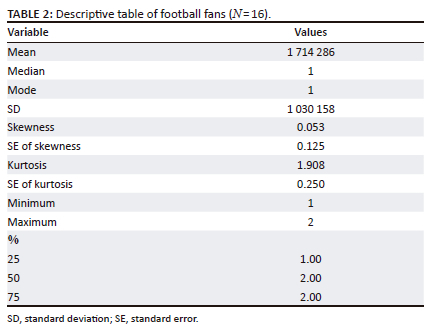
Quantitative data show the following descriptive statistical results of the mean value being 1.714 coupled with a standard deviation of 1.03. The results indicate a positively skewed distribution of participants' ages. The skewness suggests the presence of a minority of 50-60-year-olds, which exerts an upward pull on the mean. Conversely, the bulk of the data points are concentrated at the lower end of the scale, which is 25-35-year-olds. This distributional asymmetry implies that although the mean age appears elevated, the majority of data points, as represented by the median and mode, are situated at lower values. This discrepancy may be indicative of the subset of significantly older individuals exerting an influence on the mean, while the majority of participants are relatively younger. Table 2 displays descriptive results.
Ethical considerations
Ethical clearance to conduct this study was obtained from the University of KwaZulu-Natal's Humanities & Social Sciences Research Ethics Committee (No. HSS/0778/017M).
Results
To gain insight into the profit-oriented financial decision-making processes surrounding club liquidation, this study examined the profitisation and utilitisation of the club management resources. A comprehensive analysis of some club management decisions was conducted to identify the underlying factors that influence financial decision-making, particularly in relation to the allocation of resources and pursuit of profitability. By examining the club's management decisions, this study aimed to shed light on the ways in which financial considerations shape the strategic direction of the club, especially in situations where liquidation is a possibility.
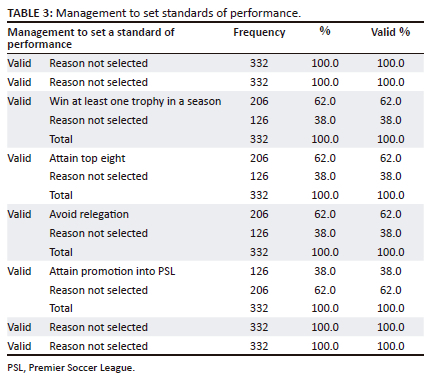
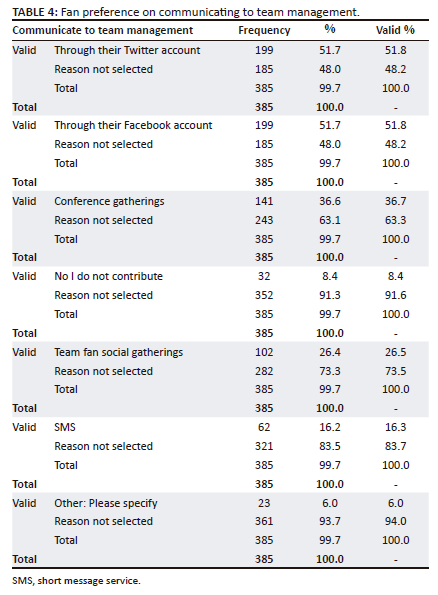
The lack of financial sponsorship has heightened the sense of instability to enticing clubs to maximise fan utility. Notably, the analysis revealed a significant correlation between management age, gender and financial accumulation, suggesting that demographic factors play a crucial role in shaping financial decisions. Furthermore, the data indicate that personal factors, as reflected in Table 2, exert a considerable influence on clubs' financial investments, implying that individual characteristics and biases can impact the allocation of resources and the overall financial strategy of the club. The findings in Table 3, Management to set standards of performance indicates fan expectations from management, highlight the importance of considering the human fan element in financial decision-making, particularly in the context of utility management. The established performance management standard service benchmark evaluates expectations and outcomes. Specifically, the ability to avoid relegation, attain a trophy, avoid relegation and achieve a top-eight position in the league standings are among the key performance indicators (KPIs) used to assess management performance. Table 4 on fan preference on communicating to team management suggests that fans have a strong desire for management engagement and communication regarding the clubs' plans and visions. The data reveal that supporters prefer various communication channels, with 51.8% opting for X (formerly Twitter) engagement, 51.8% preferring Facebook communication, 36.7% preferring communication conferences or sessions with the club and 26% preferring to communicate via fan social gatherings. Additionally, 16.3% preferred communication via SMS or cell phone marketing. However, a significant proportion of supporters (8%) expressed dissatisfaction with the current state of communication, indicating a substantial gap between expectations and clubs' communication efforts. This parity presents a critical opportunity for management to reflect on the reasons behind this dissatisfaction and explore strategies to improve communication and engagement with supporters.
The descriptive statistical analysis was conducted to elucidate patterns in the executive management's responses to interval-scale items. The resultant mean value of 1.714, coupled with a standard deviation of 1.03, indicates a positively skewed distribution of the effect of management's ages affecting decision-making towards profit maximisation. The skewness suggests that the presence of a few younger executives is of extremely high value, as it exerts an upward pull on the mean. Conversely, the bulk of the data points are concentrated at the lower end of the scale. This distributional asymmetry implies that although the mean age appears elevated, the majority of the management executives, as represented by the median and mode, are situated in the lower age group of 25 - 50-year-olds. This discrepancy may be indicative of the subset of significantly older individuals exerting an influence on the mean, while the majority of participants are relatively younger. This finding warrants further investigation to elucidate the underlying factors contributing to this distributional pattern.
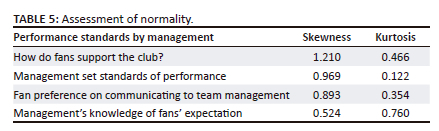
A statistical analysis of the skewness and kurtosis values yielded a range of 0.524 to 1.210 for skewness and 0.122 and 0.760 for kurtosis, respectively (Table 5). Under established criteria, normality is inferred when both skewness and kurtosis values are less than 2.0 (Maduku 2015), indicating a relatively normal distribution. The findings of the study suggest that the data conform to a normal distribution, as evidenced by the skewness and kurtosis values falling within the prescribed limits, thereby lending support to the assumption of normality. This result has important implications for the validity and reliability of subsequent statistical analysis, which frequently presupposes normality as a necessary condition.
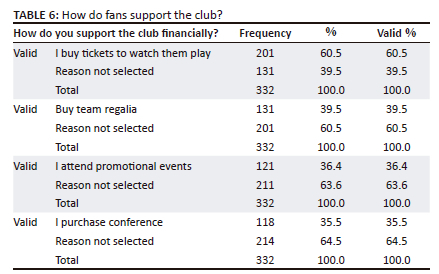
Sloane's model (1971) simplifies the theory of utility maximisation by prioritising revenue winnings percentages to be the primary club objective of football clubs, providing a nuanced understanding of professional football club's decision-making processes through comparing profit maximisation and utility maximisation outcomes (Giuseppe 2021). A survey examining fan's financial support revealed that most fans (60%) support their club through ticket purchases. In comparison, 40% demonstrate their allegiance through merchandise sales, 6% through event attendance and 36% through participation in team-organised conferences.
Notably, the findings underscore the diverse ways fans financially support their clubs, emphasising the importance of clubs engaging with customers or fans to understand their preferences and tailor communication strategies accordingly. This reciprocal understanding fosters enhanced fan engagement and loyalty. The study highlights the multifaceted nature of fan support, underscoring the need for football clubs to adopt customer-centric approaches that acknowledge and respond to the varied ways fans demonstrate their allegiance (Table 6).
Football clubs possess a unique capacity to unite and inspire large crowds, thereby fostering a collective energy that motivates teams to strive for success (Blackmon & Maylor 2005). Similar to customers, fans hold explicit expectations regarding club performance, with a significant majority 62% desiring league victory and 60% anticipating a top-four league finish. Additionally, avoiding relegation and maintaining premiership status emerge as paramount concerns for 62% of fans. The expectations align with management objectives for utility maximisation.
In turn, fans demonstrate their support and attachment to the club through various financial and emotional investments, including 60.5% on ticket purchases, 39.5% on merchandise sales, 36.4% on attendance, 36.4% on promotional events and 35.5% on participation in conference activities. This enthusiastic engagement underscores the significance of fan management relationships in shaping club success. By acknowledging and responding to fan expectations, management can cultivate a loyal supporter base, ultimately contributing to the club's long-term viability.
The study further assesses the standard performance expectations of customers for utility maximisation to be fulfilled. The findings revealed that 62% of respondents expect their club to win at least one trophy per season. Additionally, 62% anticipate a top-eight finish, while 16% prioritise avoiding relegation. Furthermore, 38% of respondents aspire to club participation in the PSL, an indication that top premiership participation is a dominant expectation given to management.
The sale of a football club provides valuable insight into management's performance. While predicting the actions of financially destressed clubs is challenging, research indicates that management's response to a potential sale can have significant consequences. Financial struggles often negatively impact organisational morale and staff performance, which can be reflected in the selling price of underperforming clubs. Furthermore, management's decision to sell the club abroad to investors outside the community is frequently driven by self-interest, prioritising maximum returns on investment over fans sentimental and psychological attachment to the club.
Further, Table 4 indicates that supporters demand from management engagement on what the club plans or envisions. The communication can come via different communication channels, with 51.8% preferring X (formerly Twitter) engagement, 51.8% preferring Facebook communication, 36.7% preferring to communicate in conference sessions that the football club engages in, 26.5% preferring to communicate in team fan social gatherings and 16.3% preferring to communicate via SMS (cell phone marketing). Meanwhile, 8% are despondent on communication, giving management a moment to ponder why customers or fans would feel this way.
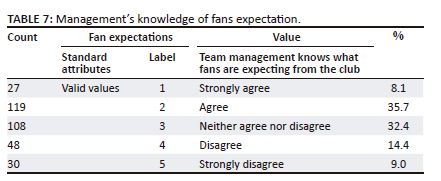
In a question on whether 'does management know what fans expect from the club', 8.1% are strongly of the view that management understands their demands as fans, while 35.7% agree (Table 7). A staggering 32% are of a neutral stance, maybe because of how they view the performance and progress of the club. Those who disagree are 21.4%, indicating most of the club supporters have confidence in team management.
Exploratory factor analysis
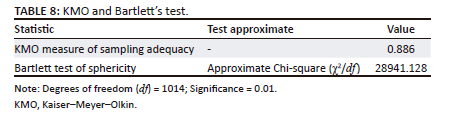
Computed KMO and the Bartlett test of sphericity initiated the EFA. This was done to examine the correlation between 'decision-making to profitise' and 'conceding to fan demands' as variables in the underlying structure of data to be fit for factor analysis. The results show that the computed KMO is 0.886 (Table 8). The Bartlett test of sphericity produced p-value (< 0.01). The data can be considered fit for factor analysis.
Discussion
This study evaluates the extent to which football clubs balance utility maximisation, as expected by supporters, with club owners' pursuit of profit maximisation (Arrondel et al. 2023). While leadership seeks to maximise return on investment, it must also prioritise fan satisfaction and overall utility. Globally, football has evolved into a significant arena for strategic investment, particularly as Persian Gulf states and Arab investors increasingly channel substantial resources into European and Saudi Arabian football. Their approach reflects an emerging model that seeks to balance commercial profitability with social utility, positioning football not only as an economic enterprise but also as a tool for soft power and societal engagement. However, failure to balance this critical aspect has led to catastrophic consequences, as demonstrated by the collapse of clubs such as Bloemfontein Celtic FC and Witbank Aces FC in the South African Premier League. The disbandment of these clubs left players and supporters emotionally and psychologically distressed. Notable examples include passionate fans such as 'Botha' from Bloemfontein Celtic and 'Mzion' from Witbank Aces, whose deep connections to their clubs highlight the profound social impact of football beyond financial considerations (Di Simone & Zanardi 2021).
Findings from the PSL indicate that clubs primarily focus on entrepreneurial objectives, often prioritising financial returns over broader social responsibilities. In financially distressed situations, clubs may resort to selling assets to recover value, reinforcing the traditional capitalist approach to business, which emphasises profit maximisation above all else (Arrondel et al. 2023; Sauer et al. 2023). According to economic theory, businesses typically prioritise profit maximisation, sometimes at the expense of consumer or community benefits (Giuseppe 2021).
However, this profit-driven approach presents significant challenges in football. Many clubs are sold to new owners, leading to relocations that disenfranchise long-standing fans, local economy and depressed environment. Such changes can have devastating emotional consequences for supporters, who often feel disconnected from their clubs. Additionally, an exclusive focus on profit maximisation may prove unsustainable when marginal financial returns diminish (Gücüm & Özesmi 2019). Football success requires significant financial investment, and excessive emphasis on revenue generation can divert attention from crucial elements such as team performance and community engagement. Therefore, a balanced approach from investors, governments and community is required when integrating financial sustainability and social responsibility that is long-term and sustainable (Žukauskas, Vveinhardt & Andriukaitienė 2018).
Football extends beyond being just a sport - it serves as a unifying force, bringing together players, management and supporters in a dynamic ecosystem (IvyPanda 2020). Fans, in particular, play a critical role in fostering team spirit, energising players and contributing to the club's financial stability through ticket sales and merchandise purchases (Breakfast 2020). Given their significant emotional and financial investment, any major transformation within a club must involve inclusive communication with all stakeholders. For many supporters, loyalty to a club is deeply personal and often spans generations. Thus, decisions that impact a club's identity, such as relocation or ownership changes, must be carefully managed to avoid alienating devoted fans. Engaging with supporters as key stakeholders ensures that their interests are acknowledged and strengthens the long-term sustainability of the club (Cowling 2023).
Although fans generally trust the management of PSL clubs, unmet expectations and underperformance can lead to dissatisfaction. If a team consistently fails to meet key objectives - such as winning the league, finishing in the top four or eight or qualifying for prestigious competitions, supporters may express their discontent through various actions, including boycotting games, reducing merchandise purchases or protesting against club leadership. Prolonged dissatisfaction can escalate into demands for major structural changes, such as the replacement of coaches, adjustments to technical staff or administrative reforms. Ultimately, fans seek accountability and improved performance from club leadership, and persistent underperformance can have significant consequences for management and governance.
Recommendations
The study recommends that the South African Premier League adopts policies encouraging football entrepreneurs to adopt a social entrepreneurship approach that recognises players, fans or customers as stakeholders and engages them meaningfully. Furthermore, every effort should be made to prioritise local buyers before contemplating the sale of a team to out-of-province investors. In addressing these challenges, there is a pressing need to reconsider the regulatory and financial architecture of the PSL. Without comprehensive reforms to ensure transparency, enforce accountability and foster community engagement, the league risks undermining both its sporting integrity and its socio-cultural legitimacy. The unchecked circulation of club franchises may ultimately weaken the stability and identity of South African football, diminishing its value not only as a sport but also as a shared national institution. Lastly, collaboration with the provincial government is essential to develop legislation that prevents the relocation of teams, which could result in economic losses for the province.
Conclusion
Football supporters continue to show remarkable loyalty to their clubs, despite persistent psychological and financial pressures, highlighting the sport's deep cultural and social significance. This study emphasises the importance of football clubs maintaining a balance between financial sustainability and their social responsibilities to communities and fans. While revenue generation is essential, it should not come at the expense of the club's role as a community institution.
A key concern identified is the PSL's reliance on sponsorship and investor funding. Although necessary, this dependence has encouraged short-term, profit-driven decision-making that threatens the league's long-term sustainability. Without reinvestment in youth development, infrastructure and community engagement, the PSL risks undermining its future.
The growing commercial value of PSL franchises has created a speculative environment where financial interests often outweigh sustainable club development. The frequent sale and rebranding of clubs weaken historical and emotional ties with local communities, further alienated by limited stakeholder involvement in ownership decisions.
From a stakeholder theory perspective, these trends reveal a troubling misalignment between financial objectives and the broader social role of football clubs. The marginalisation of fans, players and communities in governance processes reflects a lack of inclusive decision-making and participatory leadership.
This study calls for a dual commitment to financial discipline and social responsibility. Strategic investments in governance, infrastructure and youth development are essential to preserving the integrity of South African football. Only through an integrated, stakeholder-focused approach can the PSL enhance its resilience, competitiveness and contribution to national football development.
Competing interests
The author declares that there are no financial or personal relationships that may have inappropriately influenced the writing of this article.
Author's contributions
T.M. is the sole author of this research article.
Funding information
This research received no specific grant from any funding agency in the public, commercial or not-for-profit sectors.
Data availability
The data that support the findings of this study are available from the corresponding author, T.M. upon reasonable request.
Disclaimer
The views and opinions expressed in this article are those of the author and are the product of professional research. They do not necessarily reflect the official policy or position of any affiliated institution, funder, agency or that of the publisher. The author is responsible for this study's results, findings and content.
References
Acknowledgements
This article is partially based on the author T.M.'s master's dissertation entitled 'Challenges of Management Performance in Managing a Professional Team: A Case of AmaZulu Football Club' towards the degree of Master of Commerce in the School of Management, Information Technology and Governance, University of KwaZulu-Natal, South Africa, supervised by Dr. L.N. Kunene and co-supervised by Dr. T.P. Mbhele, received in April 2019. It is available here, https://researchspace.ukzn.ac.za/items/d876a900-f242-415f-aca5-ba7ba653a6c2.
Literature review
-
Alonso, A.D., Kok, S. & O'Brien, S., 2024, '"Profit is not a dirty word": Social entrepreneurship and community development', Journal of Social Entrepreneurship 11(2), 111-133. https://doi.org/10.1080/19420676.2019.1579753
» https://doi.org/10.1080/19420676.2019.1579753 - Andrews, M. & Harrington, P., 2016, Off pitch: Football's financial integrity weaknesses, and how to strengthen them, CID working paper no. 311.
-
Aren, S. & Hamamcı, H.N., 2021, 'Emotional finance: Determinants of phantasy', Kybernetes 50(5), 1250-1276. https://doi.org/10.1108/K-02-2020-0084
» https://doi.org/10.1108/K-02-2020-0084 - Arrondel, L., Duhautois, R. & Laslier, J.-F., 2023, Profit vs. win maximization in a league: A paradox, Working paper no. 2023-45.
-
Barnes, J.C. & Gannon, W.L., 2022, 'Sport management education in an era of global neoliberalism and corporate influence on higher education', Policy Futures in Education 21(1), 1-14. https://doi.org/10.1177/14782103211067653
» https://doi.org/10.1177/14782103211067653 -
Bayle, E., 2025, 'Governance, regulation and management of global sport organisations', in Routledge research in sport business and management, Online edn., Routledge, New York, NY, viewed 16 May 2024, from https://library.olympics.com/Default/doc/SYRACUSE/3416627/governance-regulation-and-management-of-global-sport-organisations-emmanuel-bayle.
» https://library.olympics.com/Default/doc/SYRACUSE/3416627/governance-regulation-and-management-of-global-sport-organisations-emmanuel-bayle - Blackmon, K. & Maylor, H., 2005, Researching business and management: A roadmap for success, 2005th edn., Palgrave, London.
-
Boya, K.S., 2024, 'Governance and social responsibility perceptions of the SAFA affiliated football clubs executives', Corporate Board: Role, Duties & Composition 12(1), 75-83. https://doi.org/10.22495/cbv12i1c1art1
» https://doi.org/10.22495/cbv12i1c1art1 -
Breakfast, S., 2020, Amazulu: One of SA's oldest club sold to top businessman, viewed 27 April 2023, from https://www.thesouthafrican.com/sport/soccer/psl-south-africa/amazulu-one-of-sas-oldest-club-sold-to-top-businessman/.
» https://www.thesouthafrican.com/sport/soccer/psl-south-africa/amazulu-one-of-sas-oldest-club-sold-to-top-businessman/ -
Bull, M. & Whittam, G., 2020, 'Sustainable value creation? Entrepreneurial orientations in the football industry', International Journal of Entrepreneurial Behaviour & Research 27(1), 27-44. https://doi.org/10.1108/IJEBR-07-2020-0498
» https://doi.org/10.1108/IJEBR-07-2020-0498 -
Buwembo, J., 2023, Be positive, Afcon might restore confidence in EAC project, viewed 16 May 2025, from https://www.theeastafrican.co.ke: https://www.theeastafrican.co.ke/tea/opinion/columnists/be-positive-afcon-might-restore-confidence-in-eac-project-4392272
» https://www.theeastafrican.co.ke: -
ChilliPepper, 2022, How sports clubs harness the power of fan loyalty, viewed 16 January 2025, from https://chillipepper.ie/how-sports-clubs-harness-the-power-of-fan-loyalty/.
» https://chillipepper.ie/how-sports-clubs-harness-the-power-of-fan-loyalty/ -
Cicut, N., Montchaud, S., Millereux, V. & Dantin, P., 2024, 'Identification, priorization and management of professional football clubs' stakeholders', International Business Research 10(7), 99-117. https://doi.org/10.5539/ibr.v10n7p99
» https://doi.org/10.5539/ibr.v10n7p99 -
Civera, C. & Freeman, E.R., 2020, 'Stakeholder relationships and responsibilities: A new perspective', Symphonya Emerging Issues in Management 1(1), 40-58. https://doi.org/10.4468/2019.1.04civera.freeman
» https://doi.org/10.4468/2019.1.04civera.freeman -
Clarke, E., Geurin, A.N. & Burch, L.M., 2022, 'Team identification, motives, and behaviour: A comparative analysis of fans of men's and women's sport', Managing Sport and Leisure 29(3), 445-468. https://doi.org/10.1080/23750472.2022.2049455
» https://doi.org/10.1080/23750472.2022.2049455 -
Cowling, N., 2023, Market value of football teams in the DSTV premiership 2023/2024, viewed 16 May 2024, form https://www.statista.com/statistics/1231728/market-value-of-football-teams-in-south-africa/#statisticContainer.
» https://www.statista.com/statistics/1231728/market-value-of-football-teams-in-south-africa/#statisticContainer -
Cox, A. & Philippou, C., 2022, 'Measuring the resilience of English Premier league clubs to economic recessions', Soccer & Society 23(4-5), 482-499. https://doi.org/10.1080/14660970.2022.2059858
» https://doi.org/10.1080/14660970.2022.2059858 - Creswell, D. & Creswell, J.W., 2023, Research design: Qualitative, quantitative, and mixed methods approaches, 4th edn., Sage, Thousand Oaks, CA.
-
Davis, P.E., Bendickson, J.S., Muldoon, J. & Mcdowell, W.C., 2021, 'Agency theory utility and social entrepreneurship: Issue of identity and role conflict', Review of Managerial Science 15(1), 2299-2318. https://doi.org/10.1007/s11846-020-00423-y
» https://doi.org/10.1007/s11846-020-00423-y -
Dawadi, S., Shrestha, S. & Giri, R.A., 2021, 'Mixed-methods research: A discussion on its types, challenges, and criticisms', Journal of Practical Studies in Education 2(2), 25-36. https://doi.org/10.46809/jpse.v2i2.20
» https://doi.org/10.46809/jpse.v2i2.20 -
Di Simone, L. & Zanardi, D., 2021, 'On the relationship between sport and financial performances: An empirical investigation', Managerial Finance 47(6), 812-824. https://doi.org/10.1108/MF-09-2020-0478
» https://doi.org/10.1108/MF-09-2020-0478 -
Du Preez, D., 2024, Unpacking the empty stands: The premier soccer league's attendance dilemma, viewed 16 November 2024, from https://mscsports.co.za/2024/07/24/unpacking-the-empty-stands-the-premier-soccer-leagues-attendance-dilemma/.
» https://mscsports.co.za/2024/07/24/unpacking-the-empty-stands-the-premier-soccer-leagues-attendance-dilemma/ -
Dube, M., 2023, The monthly cost of running a PSL club, viewed 26 December 2024, from https://farpost.co.za/2023/03/07/the-monthly-cost-of-running-a-psl-club/.
» https://farpost.co.za/2023/03/07/the-monthly-cost-of-running-a-psl-club/ -
Dube, P., 2024, Football business: How South Africa got game right, and wrong, viewed 16 January 2025, from https://nation.africa/kenya/sports/football-business-how-south-africa-got-game-right-and-wrong-4725184.
» https://nation.africa/kenya/sports/football-business-how-south-africa-got-game-right-and-wrong-4725184 -
Duncan, K. & Hasso, T., 2018, 'Family governance signals and heterogeneous preferences of investors', Journal of Behavioural Finance 19(4), 381-395. https://doi.org/10.1080/15427560.2018.1405267
» https://doi.org/10.1080/15427560.2018.1405267 - Dzomonda, O., 2021, 'Demystifying the challenges faced by social entrepreneurs in pursuit of their social mission in South Africa', Academy of Entrepreneurship Journal 27(4), 1-17.
-
Eriksson, J., 2023, 'Financial prosperity and sport achievement in the European football', Master's thesis, Dalarna University, viewed 16 December 2024, from https://du.diva-portal.org/smash/record.jsf?pid=diva2%3A1783290&dswid=2181.
» https://du.diva-portal.org/smash/record.jsf?pid=diva2%3A1783290&dswid=2181 -
Evans, R., Walters, G. & Hamil, S., 2024, 'Football club ownership and sporting ambition', Managing Sport and Leisure, 1-13. https://doi.org/10.1080/23750472.2024.2380712
» https://doi.org/10.1080/23750472.2024.2380712 -
Feikie, X.E., Das, D.K. & Mostafa, M.M., 2018, 'Perceptions of the factors causing traffic congestion and plausible measures to alleviate the challenge in Bloemfontein, South Africa', in 37th Annual Southern African Transport Conference (SATC 2018), Pretoria, South Africa, July 9-12 2018, Society for Research into Higher Education, Pretoria, pp. 741-754, viewed 17 March 2025, from https://www.satc.org.za/archive18/assets/3b_feikie.pdf.
» https://www.satc.org.za/archive18/assets/3b_feikie.pdf - Franck, E., 2010, 'Private firm, public corporation or member's association governance structures in European football', International Journal of Sport Finance 5(2), 108-127.
-
Frazer, L. & Andrew, S., 2023, A sustainable future - Reforming club football governance, England: Parliament by the Secretary of State for Culture, Media and Sport - Department for Culture, Media & Sport, viewed 16 March 2024, from https://www.gov.uk/government/publications/a-sustainable-future-reforming-club-football-governance/a-sustainable-future-reforming-club-football-governance.
» https://www.gov.uk/government/publications/a-sustainable-future-reforming-club-football-governance/a-sustainable-future-reforming-club-football-governance - Freeman, E.R., 1984, Strategic management: A stakeholder approach, Cambridge University Press, New York, NY.
-
Freer, M., Wafer, S. & Flowers, N., 2023, The pitch for prosperity: The African football league, viewed 16 June 2024, form https://javelin-sports.co.za/blog/post/the-pitch-for-prosperity-the-african-football-leag/.
» https://javelin-sports.co.za/blog/post/the-pitch-for-prosperity-the-african-football-leag/ -
Galal, S., 2023, Most valuable African football clubs 2023/2024, by market value, viewed 19 June 2024, from https://www.statista.com/statistics/1231531/most-valuable-football-clubs-in-africa/.
» https://www.statista.com/statistics/1231531/most-valuable-football-clubs-in-africa/ -
Giuseppe, G., 2021, Between profit maximization and wins maximization: A case of study of Palermo FC, ISCTE, viewed 19 June 2024, from https://repositorio.iscte-iul.pt/handle/10071/23690.
» https://repositorio.iscte-iul.pt/handle/10071/23690 -
Gücüm, S. & Özesmi, U., 2019, Maximising impact, optimising profit, OSF Preprints, Center for Open Science, viewed 16 April 2025, from https://osf.io/preprints/osf/q4pfy_v1.
» https://osf.io/preprints/osf/q4pfy_v1 -
Hammè, B. & Galiena, G., 2021, How do football clubs make money?, viewed 29 November 2024, from https://iterpro.com/how-do-football-clubs-make-money/.
» https://iterpro.com/how-do-football-clubs-make-money/ -
Hammerschmidt, J., Durst, S., Kraus, S. & Puumalainen, K., 2021, 'Professional football clubs and empirical evidence from the COVID-19 crisis: Time for sport entrepreneurship?', Technological Forecasting and Social Change 165, 1-10. https://doi.org/10.1016/j.techfore.2021.120572
» https://doi.org/10.1016/j.techfore.2021.120572 -
Hayes, A., 2022, The agency problem: Two infamous examples, viewed 16 December 2024, from https://www.investopedia.com/ask/answers/041315/what-are-some-famous-scandals-demonstrate-agency-problem.asp.
» https://www.investopedia.com/ask/answers/041315/what-are-some-famous-scandals-demonstrate-agency-problem.asp -
Hirshon, N., (2020), 'Social Identity Theory in Sports Fandom Research', in R.A. Dunn (ed), Multidisciplinary Perspectives on Media Fandom, pp. 172-191, IGI Global Information, Hershey, PA, viewed 16 February 2025, from https://doi.org/10.4018/978-1-7998-3323-9.ch010
» https://doi.org/10.4018/978-1-7998-3323-9.ch010 -
Ivypanda, 2020, Pragmatism and transformative paradigm in research essay (critical writing), viewed 20 July 2024, from https://ivypanda.com/essays/pragmatism-and-transformative-paradigm-in-research/.
» https://ivypanda.com/essays/pragmatism-and-transformative-paradigm-in-research/ -
Jacobsen, Å., 2023, 'Managing institutional complexity in a football organization', Managing Sport and Leisure, 1-20. https://doi.org/10.1080/23750472.2023.2248133
» https://doi.org/10.1080/23750472.2023.2248133 -
Jaeger, J., 2021, 'Football fans and stakeholder theory - A qualitative approach to classifying fans in Germany', Sport Business and Management an International Journal 11(5), 598-619. https://doi.org/10.1108/SBM-11-2020-0127
» https://doi.org/10.1108/SBM-11-2020-0127 -
Kaplanidou, K.K., 2020, 'Sport events and community development: Resident considerations and community goals', Sport events and Community Development 22(1), 53-66. https://doi.org/10.1108/IJSMS-05-2020-0082
» https://doi.org/10.1108/IJSMS-05-2020-0082 -
Khadka, K. & Khadka, S., 2022, 'Factors affecting customer satisfaction in fitness clubs: Study from Kathmandu Valley', NCC Journal 7(1), 27-32. https://doi.org/10.3126/nccj.v7i1.58616
» https://doi.org/10.3126/nccj.v7i1.58616 -
Khudiyev, M. & Szabo, Z., 2020, 'Consumer behavior in sports marketing in the context of football', Studia Mundi - Economica 7(2), 51-64. https://doi.org/10.18531/Studia.Mundi.2020.07.02.51-64
» https://doi.org/10.18531/Studia.Mundi.2020.07.02.51-64 -
Kima, S., Love, A. & Park, S., 2024, 'Impact of met-expectation on work-related outcomes for sport and recreation managers in Hong Kong', Journal of Global Sport Management, 1-23. https://doi.org/10.1080/24704067.2024.2379281
» https://doi.org/10.1080/24704067.2024.2379281 -
Kisaka, M.T., Andanje, J.M. & Rintaugu, E.G., 2022, 'The determinants of corporate sponsorship award opportunities for soccer premier league clubs in Kenya', Physical Education and Sport Management 13(1), 1-14. https://doi.org/10.5897/JPESM2020.0349
» https://doi.org/10.5897/JPESM2020.0349 -
Kobayashi, Y., 1975, The implication of profit or utility maximization in firm's, Hokkaido University Collection of Scholarly and Academic Papers, viewed 26 January 2025, from https://eprints.lib.hokudai.ac.jp/dspace/bitstream/2115/30664/1/5_P39-56.pdf.
» https://eprints.lib.hokudai.ac.jp/dspace/bitstream/2115/30664/1/5_P39-56.pdf - Kritikos, A., 2022, Personality and entrepreneurship, GLO discussion paper, no. 1137, Global Labor Organization (GLO), Essen.
- Lenssen, G.G. & Craig Smith, N., 2019, Managing sustainable business, Springer, Brussels.
-
Maduku, K.D., 2015, 'Determinants of mobile marketing adoption among SMEs in South Africa', PhD thesis in Marketing Management, University of Johannesburg, viewed 26 February 2025, from https://ujcontent.uj.ac.za/esploro/outputs/doctoral/Determinants-of-mobile-marketing-adoption-among/9912686507691.
» https://ujcontent.uj.ac.za/esploro/outputs/doctoral/Determinants-of-mobile-marketing-adoption-among/9912686507691 -
Madyauta, T., 2023, Jessica Motaung's advice to PSL teams on getting sponsorship, viewed 16 March 2024, from https://farpost.co.za/2023/04/24/jessica-motaungs-advice-to-psl-teams-on-getting-sponsorship/.
» https://farpost.co.za/2023/04/24/jessica-motaungs-advice-to-psl-teams-on-getting-sponsorship/ -
Makamu, T., 2024, The failure to spend the municipal infrastructure grant and the lack of consequence management, viewed 06 April 2025, from https://dullahomarinstitute.org.za/multilevel-govt/local-government-bulletin/archives/volume-19-issue-2-june-2024/the-failure-to-spend-the-municipal-infrastructure-grant-and-the-lack-of-consequence-management.
» https://dullahomarinstitute.org.za/multilevel-govt/local-government-bulletin/archives/volume-19-issue-2-june-2024/the-failure-to-spend-the-municipal-infrastructure-grant-and-the-lack-of-consequence-management - Makanyeza, C., 2014, 'Consumer awareness, ethnocentrism, attitude and purchase behaviour toward imported poultry products: A Zimbabwean perspective', Unpublished doctoral thesis, University of KwaZulu-Natal, Durban.
-
Malepa, T., 2020, Bidvest turned down request from university that could have saved Wits FC - Sources, viewed 19 June 2024, from https://www.sowetanlive.co.za/sport/soccer/2020-06-19-bidvest-turned-down-request-from-university-that-could-have-saved-wits-fc-sources/.
» https://www.sowetanlive.co.za/sport/soccer/2020-06-19-bidvest-turned-down-request-from-university-that-could-have-saved-wits-fc-sources/ -
Mbonambi, P., 2023, Mark Williams: 'Invest money carefully', viewed 09 March 2024, from https://personal.nedbank.co.za/learn/blog/mark-williams-on-investing-your-money.html.
» https://personal.nedbank.co.za/learn/blog/mark-williams-on-investing-your-money.html -
McElwaine, P., 2025, The psychology of sports fandom: Balancing wins and losses, viewed 06 May 2025, from https://www.psychologytoday.com/za/blog/stigma-addiction-and-mental-health/202502/the-psychology-of-sports-fandom-balancing-wins-and.
» https://www.psychologytoday.com/za/blog/stigma-addiction-and-mental-health/202502/the-psychology-of-sports-fandom-balancing-wins-and -
Mogajane, V.S., Du Plessis, E. & Slabbert, E., 2019, 'Assessing the importance of spectators to soccer clubs in South Africa: A management perspective', Acta Commercii 19(1), a633. https://doi.org/10.4102/ac.v19i1.633
» https://doi.org/10.4102/ac.v19i1.633 -
Mokoena, K., 2024, Sukazi will avail himself if football calls upon him, viewed 26 March 2025, form https://sundayworld.co.za/sports/soccer/sukazi-will-avail-himself-if-football-calls-upon-him/.
» https://sundayworld.co.za/sports/soccer/sukazi-will-avail-himself-if-football-calls-upon-him/ -
Morton, M., 2024, Why aren't South African footballers as attractive to brands as rugby players in our country, viewed 16 August 2024, from https://www.linkedin.com/posts/michael-morton-2239bb66_why-arent-south-african-footballers-as-attractive-activity-7227564862497820672-V1Km/?utm_source=share&utm_medium=member_desktop&rcm=ACoAABUzfFYBfgEr32t4qDbGh4WU1QCczKWwi5I.
» https://www.linkedin.com/posts/michael-morton-2239bb66_why-arent-south-african-footballers-as-attractive-activity-7227564862497820672-V1Km/?utm_source=share&utm_medium=member_desktop&rcm=ACoAABUzfFYBfgEr32t4qDbGh4WU1QCczKWwi5I - Mosola, M.E., 2017, 'The business of sports towards a viable business model for the management of professional football in Africa', Unpublished doctoral thesis, University of Pretoria, Pretoria.
- Mphahlele, M., 2024, 'You need between R4.2 million to R5 million a month to run a PSL club', - Tim Sukazi.
- Mthembu, A. & Barnard, B., 2019, 'Social entrepreneurship: Objectives, innovation, implementation and impact on entrepreneurship', Expert Journal of Business and Management 7(1), 147-177.
-
Naeem, M., Ozuem, W., Howell, K. & Ranfagni, S., 2023, 'A step-by-step process of thematic analysis to develop a conceptual model in qualitative research', International Journal of Qualitative Methods 22(1),1-18. https://doi.org/10.1177/16094069231205789
» https://doi.org/10.1177/16094069231205789 -
Ngcatshe, P., 2020, Ex-Bidvest wits CEO Ferreira on why the club was sold to Tshakhuma Tsha Madzivhandila, viewed 16 March 2024, from https://www.goal.com/en-au/news/ex-bidvest-wits-ceo-ferreira-on-why-he-club-was-sold-to-tshakhuma-tsha-madzivhandila/18h62h5vb6ylw1ex7xa2u539kr.
» https://www.goal.com/en-au/news/ex-bidvest-wits-ceo-ferreira-on-why-he-club-was-sold-to-tshakhuma-tsha-madzivhandila/18h62h5vb6ylw1ex7xa2u539kr -
Nguyen, T.T.D., Nguyen, D.T. & Huynh, V.A., 2024, 'The mediating effect of individual capital in the relationship between entrepreneurship education and social entrepreneurship intentions', International Journal of Educational Management 38(7), 2075-2093. https://doi.org/10.1108/IJEM-09-2023-0454
» https://doi.org/10.1108/IJEM-09-2023-0454 - Owusu-Ansah, K., 2021, 'The impact of club branding on fans' patronage: A perspective of two leading football clubs in Ghana', Masters thesis, University of Ghana.
- Pannenborg, A., 2008, How to win a football match, African Studies Centre in Leiden, Cameroon.
-
Park, J.J., 2022, 'From Managers to Markets: Valuation and Shareholder Wealth Maximization', Journal of Corporation Law, 42(2), 436-485, viewed 16 February 2025, from https://jcl.law.uiowa.edu/articles/2022/04/managers-markets-valuation-and-shareholder-wealth-maximization.
» https://jcl.law.uiowa.edu/articles/2022/04/managers-markets-valuation-and-shareholder-wealth-maximization -
Pearce, R., 2020, 'A methodology for the marginalised: Surviving oppression and traumatic fieldwork in the neoliberal academy', Sociology 54(4), 806-824. https://doi.org/10.1177/0038038520904918
» https://doi.org/10.1177/0038038520904918 -
SAFA Statute, 2012, SAFA regulations club licensing, 16 March 2024, from https://www.safa.net/wp-content/uploads/2025/05/Club-Licensing-Approved18-Aug12.pdf.
» https://www.safa.net/wp-content/uploads/2025/05/Club-Licensing-Approved18-Aug12.pdf -
Saima, N., Fauzia, S., Nauman, S., Tasneem, F., Ifrah, J. & Namra, R., 2019, 'Understanding how leaders' humility promotes followers' emotions and ethical behaviours: Workplace spirituality as a mediator', Journal of Positive Psychology 15(3), 407-419. https://doi.org/10.1080/17439760.2019.1615103
» https://doi.org/10.1080/17439760.2019.1615103 -
Sanchez, L.C., Barajas, A. & Sanchez-Fernandez, P., 2024, 'Are football clubs as pieces of art or as regular corporations? An empirical evidence of market valuation of football clubs in the big 5 leagues', Managing Sport and Leisure 29(4), 591-610. https://doi.org/10.1080/23750472.2022.2081251
» https://doi.org/10.1080/23750472.2022.2081251 -
Sandy, R., Sloane, P.J. & Rosentraub, M.S., 2024, 'Club and league objectives: profit versus utility maximization', in R. Sandy, P.J. Sloane & M. S. Rosentrau (eds.), The Economics of Sport: An International Perspective, 1st ed., pp. 10-27, Red Globe Press, London, viewed 26 May 2025, from https://link.springer.com/chapter/10.1007/978-0-230-37403-4_2.
» https://link.springer.com/chapter/10.1007/978-0-230-37403-4_2 -
Sauer, T., Anagnostopoulos, C., Zülch, H. & Werthmann, L., 2023, 'Creating value in football: Unveiling business activities and strategies of financial investors', Managing Sport and Leisure, 1-21. https://doi.org/10.1080/23750472.2024.2314568
» https://doi.org/10.1080/23750472.2024.2314568 - Sekaran, U. & Bougie, R., 2019, Research methods for business - A skill building approach, John Wiley & Sons, West Sussex.
-
Sibanda, O.S., 2024, Divided football club loyalties must not overshadow national pride in Bafana Bafana, viewed 16 February 2024, from https://www.dailymaverick.co.za/opinionista/2024-02-07-divided-football-club-loyalties-must-notovershadow-national-pride-in-bafana-bafana/.
» https://www.dailymaverick.co.za/opinionista/2024-02-07-divided-football-club-loyalties-must-notovershadow-national-pride-in-bafana-bafana/ -
Sloane, P.J., 1971, 'Scottish journal of political economy: The economics of professional football: The football club as a utility maximiser', Scottish Journal of Political Economy 18(2), 121-146. https://doi.org/10.1111/j.1467-9485.1971.tb00979.x
» https://doi.org/10.1111/j.1467-9485.1971.tb00979.x - Starkings, P. & Brett, W., 2021, These clubs are ours putting football into community hands, Power To Change, Wimbledon.
-
Swanepoel, G., 2024, Construction for the 2010 FIFA World Cup, viewed 16 April 2025, from https://cairnmead.com/; https://cairnmead.com/construction-for-the-2010-fifa-world-cup/.
» https://cairnmead.com/ -
Traynor, R., 2024, Financial distress in football: What's the state of the beautiful game?, viewed 16 July 2024, from https://www.redflagalert.com/articles/financial-distress-in-football-whats-the-state-of-the-beautiful-game.
» https://www.redflagalert.com/articles/financial-distress-in-football-whats-the-state-of-the-beautiful-game -
Traynor, R., 2024, Financial distress in football: What's the state of the beautiful game?, viewed 16 July 2024, from https://www.redflagalert.com/articles/uk-business-news/financial-distress-in-football-whats-the-state-of-the-beautiful-game.
» https://www.redflagalert.com/articles/uk-business-news/financial-distress-in-football-whats-the-state-of-the-beautiful-game -
Vardien, T., 2022, Sundowns, pirates, chiefs among Africa's top 20 most valuable clubs, viewed 05 January 2024, from https://www.news24.com/sport/soccer/psl/sundowns-pirates-chiefs-among-africas-top-20-most-valuable-clubs-20220105.
» https://www.news24.com/sport/soccer/psl/sundowns-pirates-chiefs-among-africas-top-20-most-valuable-clubs-20220105 -
Wafer, S. & Flowers, N., 2022, How are football clubs governed, incorporated & acquired in South Africa?, viewed 16 December 2024, from https://javelin-sports.co.za/blog/post/how-are-football-clubs-governed-incorporated-acqui/.
» https://javelin-sports.co.za/blog/post/how-are-football-clubs-governed-incorporated-acqui/ -
Williams, A.S., Son, S., Walsh, P. & Park J., 2021, 'The influence of logo change on brand loyalty and the role of attitude toward rebranding and logo evaluation', Sport Marketing Quarterly 30(1), 69-81. https://doi.org/10.32731/SMQ.301.032021.06
» https://doi.org/10.32731/SMQ.301.032021.06 -
Zhang, J.J., 2023, 'World Association for Sport Management Series', in H.K. Leng & J.J. Zhang (eds.), Sports Sponsorship and Branding, 1st edn., pp. 1-19, Routledge, London. https://doi.org/10.4324/9781003458890
» https://doi.org/10.4324/9781003458890 - Žukauskas, P., Vveinhardt, J. & Andriukaitienė, R., 2018, Management culture and corporate social responsibility, IntechOpen, London.

Accepted: 28 May 2025
Published: 19 Aug. 2025