The strategic implications of black empowerment policy in South Africa: a case study of boundary choice and client preferences in a small services firm
Abstract
This paper studies the relationship between a firm’s boundary choices within its value chain and the BEE pressures it faces from its clients. The paper shows that BEE policy alters the value chain preferences of a firm’s clients. These changes in client preferences motivate the firm to altering its boundaries. More important, boundary changes due to BEE are implemented in a way that ensures that the firm retains crucial architectural knowledge, which preserves its competitive advantage. Firms therefore do not respond passively to BEE-induced changes in client preferences, but aim to meet BEE aims within their broader strategic environment.
boundaries; vertical integration; black empowerment; demand-side
4.1 Overview of MRS boundaries
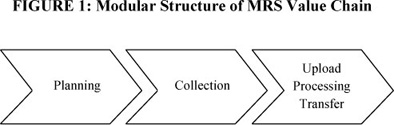
The meter-reading process can be divided into three consecutive steps: (1) planning of monthly meter-reading projects according to dates set by clients; (2) collection of meter-readings; and (3) processing of meter-readings by uploading the data onto a central database, identifying discrepancies (and re-reading if required), and transmitting processed data to clients. Each of these steps involves a set of highly interdependent activities with a distinct knowledge base: planning requires the ability to manage human resources and adjust work schedules, collection requires geographic knowledge of the areas in which meter-readings are collected as well as numerical skills, and processing requires computer skills and a familiarity with meter-reading processing procedures. The meter-reading value chain can therefore be described as modular (Grant, 2006), as shown in Figure 1:
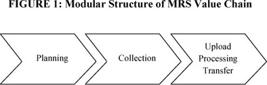
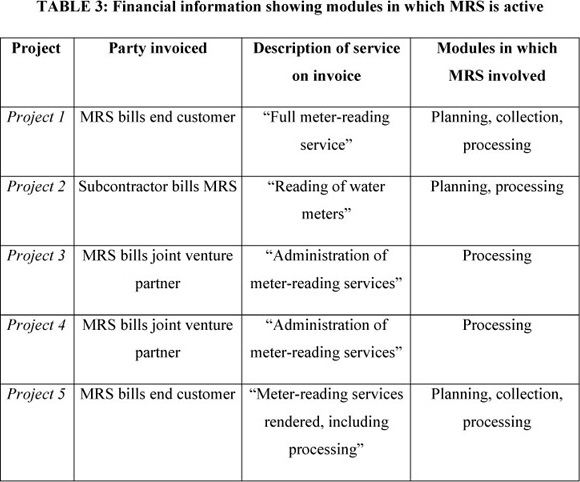
This modular structure has enabled MRS to occupy a variety of positions along the value chain, that is, to choose a variety of boundaries along the value chain. To investigate this variety, the paper studies five clients with whom MRS has been involved from 1997 to 2007. These five clients represent 90% of MRS revenue over this period. Table 3 presents a summary of information for the five clients.
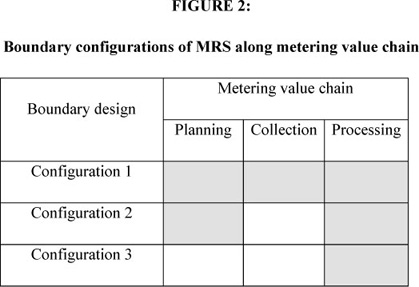
Information from invoices, supplemented by discussions with the owner, shed light on the vertical structure of MRS over this period. The data shows that MRS offered a vertically- integrated service to client 1. According to discussions with the owner, MRS offered such an integrated service since its foundation in 1989. However, for clients 2 to 5, all acquired after 1999, MRS has also rendered services limited to specific modules. Figure 2 summarizes the boundary configurations along the metering value chain suggested by the invoice data. Highlighted cells indicate activity by MRS, whereas blank cells indicate outsourced activity.
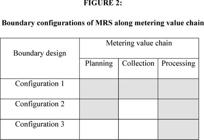
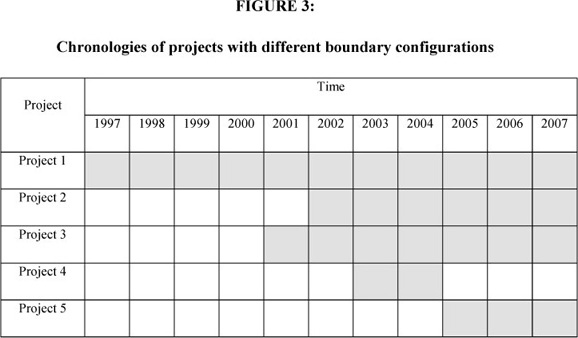
Even though three types of boundary configurations are identified in Figure 2, these are not pre-defined. As will be shown in the empirical analysis, MRS created new configurations depending on the requirements of particular clients. Furthermore, it is important to note that the above-mentioned configurations do not follow one another in chronological order, but that several boundary configurations were operative simultaneously, as shown in Figure 3.
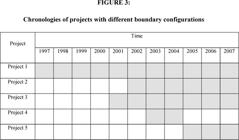
Figure 3 shows that meter-reading projects have life times varying from one to ten years and illustrates the overlap in project life times. This confirms that MRS employs flexible boundaries to meet heterogeneous requirements, rather than a periodic adjustment of its overall boundaries. The empirical analyses following later in the thesis provides additional support that the boundaries are set in accordance with the requirements of particular projects.
MRS has evolved from a vertically integrated service provider in the mid-nineties to a solution provider offering client-specific services constructed using flexible boundaries along the value chain. The aim of this paper is to study the link between these boundary changes and BEE policy. To this end, the following subsections consider the three research questions highlighted earlier.
4.2 Research question 1 and 2: linking firm boundaries and demand-side preferences
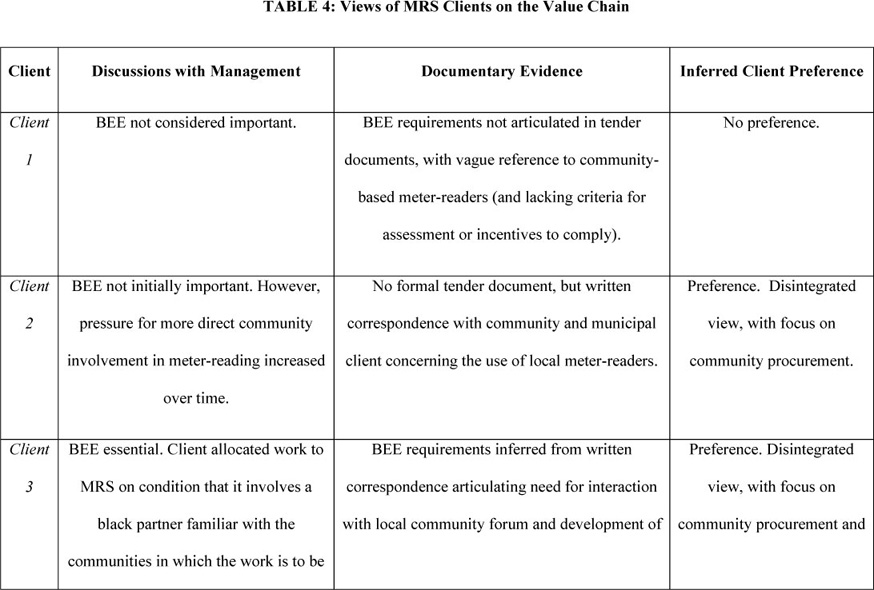
A study of the link between demand-side preferences and boundary changes requires explicit evidence on demand-side preferences, which may be difficult to measure for most firms. However, the municipal clients of MRS all specify their value chain requirements and preferences in tender bid documents. Table 4 summarises these preferences for the five major clients of MRS, who together account for approximately 90% of revenue over the study period. Value chain preferences are measured in two ways: first, via the bid evidence mentioned above, and, second, via semi-structured interviews. The evidence from the two sources is summarised in the third column, which is titled "value chain preference". The column distinguishes between clients with no strong value chain preferences and those with particular preferences. For clients in the latter group, a short description of the specific value chain requirements is provided.
Table 4 shows that the five clients have heterogeneous value chain preferences. One client prefers meter-reading firms to use locally procured labour from the areas in which the firms are collecting meter-readings. Two other clients expect more intensive collaboration efforts between meter-reading firms and favoured local suppliers, with the aim of improving the business skills of local suppliers. The remaining two clients have no strong preferences and are willing to accept the structure proposed by the bidding firm.
This paper is concerned with understanding whether this heterogeneous demand environment influences the boundary decisions of MRS. In particular, Research Question 1 focuses on whether BEE-based value chain views influence MRS boundary choice and, if so, Research Question 2 focuses on whether heterogeneity in value chain preferences (as shown in Table 4) is correlated with heterogeneity in MRS boundary decisions described earlier.
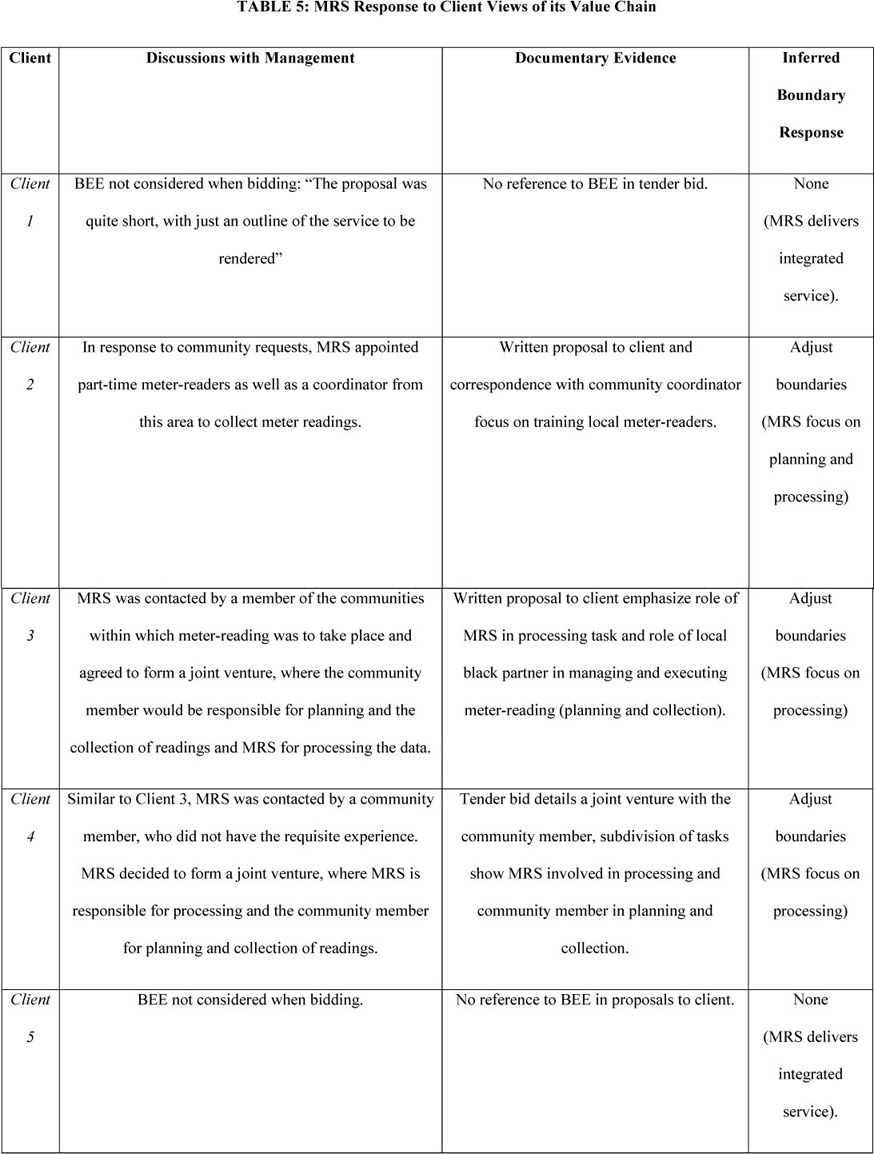
Table 5 studies the role of client preferences in the boundary decisions of MRS. The table relies on two sources of evidence to assess how boundary decisions respond to clients: documentary evidence and discussions with management. The findings are summarized in the final column by, firstly, classifying boundary responses at MRS into "none" and "adjust boundaries" and, secondly, mentioning to which modules MRS chooses to restrict its boundaries.
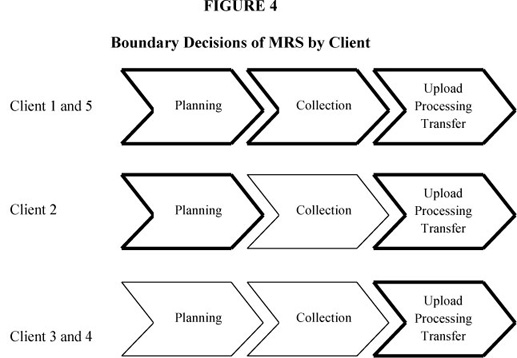
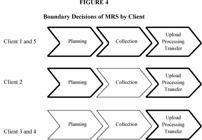
Table 5 shows that boundary decisions at MRS are highly correlated with the value chain preferences of its clients: Client 2 values community procurement and MRS responds to this preference by outsourcing the collection module. The value chain preferences of Clients 3 and 4 extend beyond community procurement and include both procurement and promotion of local business and MRS responds by restricting its boundaries to the processing module and outsourcing the collection and planning module. Clients 1 and 5 do not exhibit strong value chain preferences and MRS chooses to perform all activities inhouse. Heterogeneity in value chain preferences is therefore reflected in heterogeneity in firm boundaries. Figure 4 highlights the modules in which MRS is active for each client:
To guarantee the internal validity of the claim that it was demand-side pressures that led MRS to adopt flexible boundaries, it is necessary to eliminate potential supply-side explanations. One competing explanation could be that technological change has caused MRS boundary change. Hand-held devices, used to electronically capture readings in the field, are slowly replacing traditional paper-based meter-reading in South Africa. However, while the hand-held technology does generate minor reallocation of tasks among modules, the technology does not alter the modular structure of the value chain or favour vertical disintegration3. Apart from technology, the literature suggests a range of conventional supply-side explanations for flexible boundaries, including transaction cost economics and neoclassical economic theories (Parmigiani, 2007). However, dimensions of asset specificity or production uncertainty did not change fundamentally since the late nineties, precluding these as serious alternative explanations for the MRS boundary decision (Williamson, 1975; Whinston, 2003).
4.3 Research question 3: strategic benefits of flexible boundaries
Flexible boundaries may not appear to be a long-run strategic solution for MRS, given that clients increasingly prefer the involvement of more firms along the meter-reading value chain. If the majority of clients prefer vertically specialized players, why not permanently change the boundaries of the firm to adopt a fully specialized position in the value chain? This question is the rationale underlying Research Question 3, which focuses on how the firm may implement flexible boundaries in a way that balances the BEE demands of its clients and its competitive advantage.
At first glance, it appears that MRS implements flexible boundaries to serve those few remaining clients still preferring a single vertically-integrated firm. However, the strategic benefits of flexible boundaries extend well beyond an ability to meet heterogeneous client preferences. In particular, the case suggests that flexible boundaries confer so-called architectural knowledge, i.e. knowledge of how the modules along the value chain interrelate and co-function to produce the final product (see Jacobides (2006)).
To understand the salience of architectural knowledge in meter-reading, consider clients 2, 3 and 4, for which MRS restricts its boundaries to the processing module only. This specialized focus enables MRS to meet the value chain preferences of these clients, as it outsources the collection and planning modules to community-based firms. The problem with outsourcing to community-based firms is that they do not hold operational knowledge beyond their own activities and hold little knowledge of how modules co-function to produce the final product - an accurate meter reading delivered to the client on time. In contrast, MRS holds architectural knowledge of all modules and their interrelationships because of the vertically-integrated service it provides to Clients 1 and 5. A vertically integrated solution requires MRS to have knowledge of all modules and their interrelationships. If MRS chooses to restrict its boundaries and not provide a vertically integrated solution to clients 1 and 5, it would not be able to manage the value chain for clients 2, 3 and 4: MRS would gradually lose the capability to understand and manage the interrelationships across the value chain.
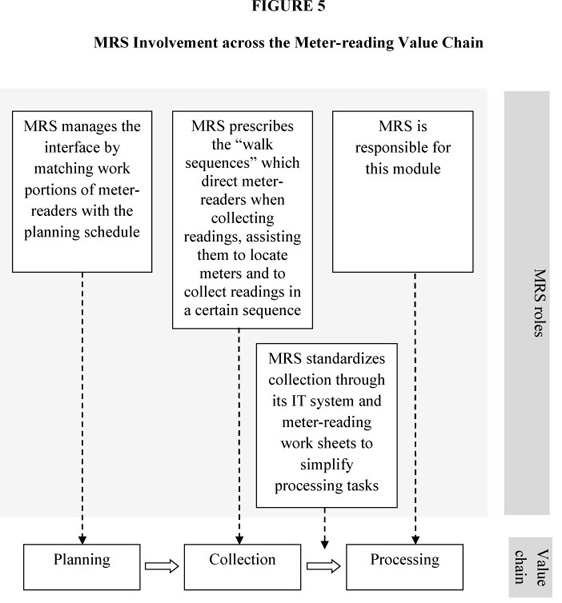
MRS uses its architectural knowledge to undertake a managerial role to ensure the accuracy and timeliness of meter-readings. Electronic and printed marketing documents, with ubiquitous references to "management", "administration" and "experience" as well as similar references (to "operations management", among others) in tender bid documents provide evidence on this management role. MRS "management" involves more than the coordination of daily activity in a given meter-reading value chain, important as that may be. It also entails the establishment of the underlying language and organizing concepts used across the meter-reading value chain. At MRS, this language is articulated in the firm's unique proprietary computer software system. The software system assists MRS in establishing a standard language by specifying a vocabulary of organizing concepts ("meter books", "walk sequences") as well as a system of standard codes to be used, for example, by meter-readers when recording problems encountered during meter-reading (e.g. code "11" refers to inaccessible meters, code "12" to defective meters, etc.). Figure 5 illustrates the managerial role of MRS in these different modules and their interfaces:
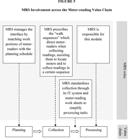
Figure 5 shows that, even where it is only responsible for the processing module in the value chain, it still manages the planning and collection modules as well as the interfacing between collection and planning.
During interviews concerning their management role in the value chain, MRS management noted that "the client wants you to involve these guys but they also want readings delivered on time without a lot of problems". Adopting such a management role provides MRS with a competitive advantage relative to the specialized community-based firms, as acknowledged by MRS: "Our IT [the MRS meter-reading software system]and our experience of getting the job done is what sets us apart. You know, meter-reading is not just about reading, it's about planning and sticking to dates. A lot of guys [other meter-reading firms]just don't know how to do this and that's why they fail". MRS therefore adopts flexible boundaries rather than a fully specialized vertical position in order to both deal with heterogeneity in the preferences of its clients and because flexible boundaries enable MRS to continue to manage the entire value chain. In sum, the adoption of flexible boundaries at MRS was not merely a response to survive, but also a strategy to ensure growth going forward.
5. Results
As argued in the section on methodology, the case study method is aimed at developing theory in an inductive fashion. This requires distilling three general theoretical propositions from the specific empirical case. The analysis of the MRS case in the preceding section assists in developing three theoretical propositions, corresponding to the three research questions developed earlier. The following paragraphs outline each of these theoretical propositions and, in each case, situates the emerging theoretical proposition within the larger literature, consistent with the case study approach by Eisenhardt (1989).
5.1 Research question 1: BEE policy and boundary choice
The first research question centres on whether BEE policy leads to changes in the boundary decisions of firms. The case confirms that BEE policy is a demand-based intervention, i.e. that BEE policy aims to alter demand along value chains in a cascading fashion. In particular, the case study provides systematic evidence for the following theoretical proposition:
Proposition 1: Changes in demand-side preferences shaped by BEE considerations lead to concomitant changes in boundary structure to match these preferences.
The demand-side interpretation of BEE policy is consistent with a view of BEE as a form of corporate social responsibility (CSR), albeit involuntary (Arya and Bassi, 2009; Arya and Zhang, 2009). CSR is recognized as demand-side driven: for example, in the international food and textile value chains, firms have developed outsourcing practices and governance mechanisms to accommodate smaller players, mostly because of demand-side pressure from activists and socially-conscious buyers (Gereffi, Humphrey and Sturgeon, 2005).
5.2 Research question 2: Heterogeneity in BEE policy and heterogeneity in boundary choice
The second research question centres on whether a firm faced by heterogeneous client preferences regarding BEE will adopt heterogeneous boundary structures. The case shows that BEE is a market-based policy that may be implemented in a variety of corporate forms depending on market context. BEE policy documents emphasize that the BEE balanced scorecard discussed earlier enables agents to tailor their BEE strategy to their individual environments. Andrews (2008: 87-88) explores the possibility of multiple corporate responses to BEE policy and suggests that "BEE will catalyze structural change more effectively when there is decision space for organizations and sectors to ... self discover the appropriate change for their setting". The paper supports the view that different industries may exhibit different BEE patterns: the MRS case is set in the meter-reading industry, where clients strongly emphasize BEE's value chain aspects than the affirmative action employment or ownership aspects. In fact, the paper goes further by showing that within a given sector, heterogeneity in BEE approaches of individual clients manifest in substantial heterogeneity in demand-side preferences. This suggests the following theoretical proposition:
Proposition 2: Heterogeneity in BEE-based value chain preferences of its clients leads the firm to choose heterogeneous boundaries.
It is particularly significant that the paper studies the impact of this heterogeneity on small firms with only a few large clients, given that much of research focuses on the corporate structure of large firms (Chabane et al., 2006). The case suggests that where South African firms face heterogeneous client preferences because of heterogeneous BEE requirements they may adopt flexible structures. The use of flexible structures to deal with BEE is consistent with the recent literature on the strategic use of flexibility under conditions of uncertainty (van Wyk, Dahmer and Custy, 2004; Kogut and Kulatilaka, 2006) and, specifically, with the strategic value chain literature (Nadkarni and Narayanan, 2007).
5.3 Research question 3: Using BEE-induced boundary changes to retain competitive advantage
The third research question asks how a firm implements boundary structures to both meet BEE requirements and maintain competitive advantage. The case shows that firms do not passively respond to BEE policy but explore strategic responses that balance BEE requirements with other organizational goals. MRS did not merely respond to the demand-side pressures, but implemented a particular boundary choice that carried architectural benefits. In particular, MRS employed flexibility in its boundaries that enabled the firm to accommodate joint ventures and the involvement of other firms while maintaining architectural knowledge allowing MRS to manage the overall value chain processes (Santos and Eisenhardt, 2005; Jacobides and Billinger, 2006). The case therefore provides support for the following theoretical proposition:
Proposition 3: Flexible boundaries allow the firm to accommodate BEE preferences of clients while retaining architectural knowledge, which can be used to manage the overall value chain. Flexible boundaries therefore offer a competitive advantage to the firm.
A strategy of this type is consistent with the literature's view of flexible boundaries as both a cooperative and a competitive device: architectural management ensures cooperation across the value chain to improve efficiency, while it is also a distinctive capability distinguishing the firm from competitors.6.
Conclusions
The paper seeks to initiate a research programme on the strategic implications and, more specifically, the value chain and boundary implications of BEE policy in South Africa. The MRS case study is therefore a first attempt at analyzing the mechanisms through which BEE policy is linked to strategic outcomes. The case study develops three theoretical propositions regarding BEE policy as a strategic variable. Firstly, BEE policy can act as a demand-side driver of boundary change. Secondly, heterogeneity in the BEE preference of clients leads to heterogeneity in a firm's boundary structures. Thirdly, a firm implements BEE-driven boundary change in such a way that its competitive advantage is preserved.
The paper relies on a single-case study, given the 'revelatory' nature of the case. The aim is therefore analytical rather than statistical generalization. However, the next step is to investigate the extent to which this emergent theory generalises to a larger population of firms. Future research should therefore be extended to a variety of industries.
Also, the case study and emergent theories suggests a number of areas that require further investigations. Firstly, it is necessary to study under which conditions ownership and employment issues, rather than value chain issues, dominate the BEE requirements of clients. Secondly, it is crucially important to study the conditions under which firms will respond to BEE requirements: do firms (both local and international) avoid industries with particular BEE emphases and what is the role of competitive pressure? Thirdly, it is necessary to understand how smaller firms differ from larger firms in their responses to BEE policy. Finally, and perhaps most important to practitioners, it is important to study how firms develop value chain structures that both enhance their own competitive advantage and ensure sustainable long-run BEE partners in their value chains. It is not helpful to argue that firms should "co-operate" on the basis of "the greater good". Organizations, especially profit-seeking firms, have specific long-run goals and act strategically in their response to government policy. Understanding the strategic nature of corporate responses to BEE is crucial and this paper is an important step towards better understanding in this regard.
References
- Andrews, M. 2008. Is Black Economic Empowerment a South African Growth Catalyst? (or Could It Be...). Center for International Development at Harvard University Working Paper No. 170. [Online]. Available.
- Arya, B. and Bassi, B. 2009. Corporate Social Responsibility and Broad-Based Black Economic Empowerment Legislation in South Africa. Business & Society, doi:10.1177/0007650309332261.
- Arya, B., Bassi, B. and Phiyega, R. 2008. Transformation Charters in Contemporary South Africa: The Case of the Absa Group Limited. Business & Society Review, 113(2): 227-251.
- Arya, B. and Zhang, G. 2009. Institutional Reforms and Investor Reactions to Csr Announcements: Evidence from an Emerging Economy. Journal of Management Studies, 46(7): 1089-1112.
- Black, P.A. 2002. On the Case for 'Black Economic Empowerment' in South Africa. South African Journal of Economics, 70(8): 1148-1162.
- Bolton, P. 2008. The Public Procurement System in South Africa: Main Characteristics. Public Contract Law Journal, 37(4): 719-740.
- Bolton, P. 2010. Municipal Tender Awards and Internal Appeals by Unsuccessful Bidders. Potchefstroom Electronic Law Journal, 13(3): 56-82.
- Buchanan, D.A. 1999. The Logic of Political Action: An Experiment with the Epistemology of the Particular. British Journal of Management, 10: S73-S88.
- Chabane, N., Goldstein, A. and Roberts, S. 2006. The Changing Face and Strategies of Big Business in South Africa: More Than a Decade of Democracy. Industrial and Corporate Change, 15(3): 549-577.
- Clark, A. 2000. Demand-Side Management Investment in South Africa: Barriers and Possible Solutions for New Power Sector Contexts. Energy for Sustainable Development, 4(4): 2735.
- Department of Trade and Industry 2007. Bee Codes of Good Conduct. Pretoria.
- Edmondson, A.C. and McManus, S.E. 2007. Methodological Fit in Management Field Research. Academy of Management Review, 32(4): 1155-1179.
- Eisenhardt, K.M. 1989. Building Theories from Case Study Research. The Academy of Management Review, 14: 532-550.
- Eisenhardt, K.M. and Graebner, M.E. 2007. Theory Building from Cases: Opportunities and Challenges. Academy of Management Journal, 50: 25-32.
- Fauconnier, A. and Mathur-Helm, B. 2008. Black Economic Empowerment in the South African Mining Industry: A Case Study of Exxaro Ltd. South African Journal of Business Management, 39(4): 1-14.
- Flyvbjerg, B. 2006. Five Misunderstandings About Case-Study Research. Qualitative Inquiry, 12(2): 219-245.
- Gereffi, G., Humphrey, J. and Sturgeon, T. 2005. The Governance of Global Value Chains. Review of International Political Economy, 12(1): 78-104.
- Grant, R.M. 2006. The Knowledge-Based View of the Firm, in D. O. Faulkner and A. Campbell (eds.). The Oxford Handbook of Strategy. Oxford: Oxford University Press.
- Hall, P.A. and Soskice, D.W. 2001. Varieties of Capitalism: The Institutional Foundations of Comparative Advantage. New York: Oxford University Press.
- Hayes, K.T.A. 2006. Grounding African Corporate Responsibility: Moving the Environment up the Agenda, in W. Visser, M. McIntosh and C. Middleton (eds.). Corporate Citizenship in Africa. Sheffield, UK: Greenleaf: 93-104.
- Helfat, C.E. and Eisenhardt, K.M. 2004. Inter-Temporal Economies of Scope, Organizational Modularity, and the Dynamics of Diversification. Strategic Management Journal, 25:1217-1232.
- Horn, G.S. 2007. Black Economic Empowerment (Bee) in the Eastern Cape Automotive Industry: Challenges and Policies. South African Journal of Economic and Management Sciences,10(4): 490-503.
- Jackson, W.E., Alessandri, T.M. and Black, S.S. 2005. The Price of Corporate Social Responsibility: The Case of Black Economic Empowerment Transactions in South Africa: Federal Reserve Bank of Atlanta.
- Jacobides, M.G. 2005. Industry Change through Vertical Disintegration: How and Why Markets Emerged in Mortgage Banking. Academy of Management Journal, 48: 465-498.
- Jacobides, M.G. 2006. The Architecture and Design of Organizational Capabilities. Industrial and Corporate Change, 15: 151-171.
- Jacobides, M.G. and Billinger, S. 2006. Designing the Boundaries of the Firm: From "Make, Buy, or Ally" To the Dynamic Benefits of Vertical Architecture. Organization Science, 17: 249-261.
- Kogut, B. and Kulatilaka, N. 2006. Strategy, Heuristics, and Real Options, in D. O. Faulkner and A. Campbell (eds.). The Oxford Handbook of Strategy. Oxford: Oxford University Press.
- Kuhn, T.S. 1970. Logic of Discovery of Psychology of Research:, in M. Curd and J. A. Cover (eds.). Philosophy of Science: The Central Issues. London: W.W. Norton & Company.
- Martin, L. and Root, D. 2010. Emerging Contractors in South Africa: Interactions and Learning. Journal of Engineering, Design and Technology, 8(1): 64-79.
- Mitchell, J.C. 1983. Case and Situational Analysis. Sociological Review, 31(2): 187-211.
- Nadkarni, S. and Narayanan, V.K. 2007. Strategic Schemas, Strategic Flexibility, and Firm Performance: The Moderating Role of Industry Clockspeed. Strategic Management Journal, 28: 243-270.
- Parmigiani, A. 2007. Why Do Firms Both Make and Buy? An Investigation of Concurrent Sourcing. Strategic Management Journal, 28: 285-311.
- Popper, K.R. 1963. Conjectures and Refutations. London: Routledge & Keegan Paul Limited.
- Republic of South Africa 2006. South Africa's Economic Transformation: A Strategy for Broad-Based Black Economic Empowerment. Pretoria.
- Runde, J. and De Rond, M. 2010. Evaluating Causal Explanations of Specific Events. Organization Studies, 31(4): 431-450.
- Santos, F.M. and Eisenhardt, K.M. 2005. Organizational Boundaries and Theories of Organization. Organization Science, 16: 491-508.
- Siggelkow, N. 2007. Persuasion with Case Studies. Academy of Management Journal, 50: 20-24.
- Strydom, B., Christison, A. and Matias, J. 2009. An Empirical Investigation of the Effect of Black Economic Empowerment Transactions on Share Prices: 1996 to 2006. African Journal of Accounting, Economics, Finance and Banking Research, 5(5): 67-76.
- van Wyk, J., Dahmer, W. and Custy, M.C. 2004. Risk Management and the Business Environment in South Africa. Long Range Planning, 37: 259-276.
- Visser, W. 2005. Corporate Citizenship in South Africa: A Review of Progress since Democracy. Journal of Corporate Citizenship, 18: 29-38.
- Whinston, M.D. 2003. On the Transaction Cost Determinants of Vertical Integration. Journal of Law, Economics and Organization, 19(1): 1-23.
- Williamson, O.E. 1975. Markets and Hierarchies: Analysis and Antitrust Implications. New York: Free Press.
- Wolmarans, H. and Sartorius, K. 2009. Corporate Social Responsibility: The Financial Impact of Black Economic Empowerment Transactions in South Africa. South African Journal of Economic and Management Sciences, 12(2): 180-193.
- Yin, R.K. 2003. Case Study Research: Design and Methods. London: Sage Publications.
2 Name changed for confidentiality reasons.
3 Hand-held technology results in a re-allocation of tasks between the collection and processing modules, by allowing the upload of data and an important part of the processing activity to take place during the collection, rather than the processing, phase.