A Place-Based and Systems Approach to Curriculum Design for Water Education: A case study from Pune, India
Abstract
Addressing complex socio-environmental challenges such as climate change and ecological degradation is one of the major challenges facing us today. Such challenges cannot be adequately addressed by scientific and technical fixes alone but require a critical assessment of values and priorities implicit in decision-making regarding socio-environmental problems. To develop in school students the knowledge, concepts and skills required to address such challenges, a learning progression called Water Classrooms was developed. Qualitative and semi-quantitative analysis of the activities conducted during Water Classrooms shows that such a pedagogy can indeed enable students to think about water-related issues from physical, cultural and social lenses. Water Classrooms provides a practical example of how multiple stakeholders can co-create an engaging and multidisciplinary curriculum on water that can be adapted to other parts of the world.
water education; multidisciplinary; systems thinking; climate
Introduction
Climate change and degradation of the global biosphere are among the most important challenges facing humanity today. These challenges, though global in nature, present themselves to us as local challenges such as increasing extreme weather events, reduction in availability and quality of potable water, air pollution, new zoonotic diseases and reduction in green cover. Trying to address such local challenges without acknowledging the interconnectedness of social, cultural and ecological spheres frequently leads to solutions that are inequitable and insufficient (Gadgil & Guha, 1993).
Climate and the biosphere are systems - the amalgamation of many dynamics that interact with each other, just like societies and economies. Finding sustainable solutions to systems problems requires an integrated approach and methodology commonly known as 'systems thinking'. Lack of systems thinking leads to difficulties in conceptualising systems problems at all levels - in school students (Assaraf & Orion, 2010), college undergraduates (Jacobson & Wilensky, 2006) and professionals (Nguyen et al., 2012). In the context of education about climate and climate change, it has been suggested that learning about climate as a system provides a strong foundation for understanding climate change, especially since it is challenging to both observe climate change or analyse data related to climate change in a classroom context (Shepardson et al., 2012). While there is consensus that it is important for students to develop the ability to meaningfully address large, complex problems such as climate change, there is a lack of any agreed-upon framework within which to design a pedagogy for the same. In the context of climate change and sustainability, curricula have been based on other conceptual approaches such as place-based education and critical pedagogy and not only systems thinking (see Evans et al., 2017 and references therein). Therefore, it is important that attempts are made to develop and evaluate curricula which provide insights into what approaches work and what outcomes can be expected.
A concern regarding education for sustainability in some contexts, is the methodological individualism of pedagogical approaches (Boström et al., 2018). This bias precludes learning about and from diverse viewpoints. It may also fail to provide students with the necessary skills to constructively handle the inevitable value conflicts about shared ecological resources that arise in a plural and unequal society with skills (such as discussion and negotiation) that can only be taught and learned in group settings.
In this Think Piece, which we develop with a case study, we have used water as a focal point to create a learning progression that allows students to develop a systems viewpoint of water and analyse contemporary challenges and conflicts related to water from this viewpoint. The water cycle has been used previously to develop systems thinking skills in school students (Assaraf & Orion, 2010; Gunckel et al., 2012). However, the human dimensions of water systems have commonly not been incorporated in such curricula (Pani, pahar, 2020; TROPICSU, 2023). The progression that we have designed begins with students' individual experience with water in their day-to-day life and progressively builds up to a planetary scale view, without losing focus on the human dimensions of water (social and cultural).
Goals and rationale of the study
The goal of this study was to provide middle school students with an integrated and ethical view of their waters and enable them to build capacities essential in moving towards sustainable water futures.
Water is recognised by the United Nations' Sustainable Development Goal 6 (SDG 6) -"ensure availability and sustainable management of water and sanitation for all" (Department of Economic and Social Affairs, 2024). It is essential to life and has shaped various aspects of our civilization, heritage, communities and survival. In South Asia, the provision and management of water has always been challenging due to the region receiving little rainfall outside the monsoon season (June-September) (Gadgil, 2003). Both surface water (rivers and lakes) as well as groundwater have been utilised extensively, but there has been a dramatic increase in the exploitation of groundwater over the past half a century (Kulkarni et al., 2023). Currently, the northern parts of the subcontinent experience some of the highest rates of groundwater extraction in the world (Tiwari et al., 2009). There have been increasing water-related conflicts, which include conflict over water quality, privatisation of water, displacement due to large dams and sharing of river waters (Gujja et al., 2006). These issues of unsustainable water use and conflicts arising due to inequitable access have been prevalent in Maharashtra as well, the state in which Pune city is located (Joy et al., 2014; Kulkarni et al., 2019, 2023), where our case is based. Even though the Pune urban agglomeration (which includes the twin cities of Pune and Pimpri Chinchwad) is served by multiple dams, it still remains dependent on groundwater and has faced rapidly depleting levels of groundwater in recent years (Kulkarni et al., 2023). Furthermore, like many other cities in India, Pune has experienced urban flooding over the past few decades (Deshpande et al., 2021; Singh et al., 2021), and the urbanisation trends are likely to exacerbate the impacts of floods in the future (Karutz et al., 2023).
Thus, there is an urgent need to reform water governance in a manner which acknowledges both the climatic and social context of water availability and utilisation. Such reform will require civic action by citizens who are able to conceive of water-related issues from a multidimensional perspective. However, studies with middle school students from different parts of the world have shown that the current education system does not lead to an understanding of how water is connected to place and human activity (Gunckel et al., 2012). Combined with crisis-based messaging around climate, this lack of systems understanding often causes students to feel disempowered and to be disengaged (Boström et al., 2018). Amahmid et al. (2019) suggest that water education in schools needs to become more value-driven and activity-based to lead to behavioural transformation. While South Asian countries have enacted various policies to bolster the ability for the population to understand and adapt to climate change, operationalising such policies, especially in the context of education, has not been as encouraging (Mbah et al., 2022).
To address such issues, we designed a water curriculum to integrate the diverse and sometimes conflicting lenses from which water can be viewed. Since water is taught across all disciplines, a curriculum that is centred on water will likely bridge the traditional disciplines of education (Brody, 1995) and facilitate learning from a holistic perspective. Conventionally, the hydrological cycle taught in schools comprises only biophysical components. However, human values can be incorporated into systems models of water by including stocks and flows created by societies into such a hydrological cycle. Since the magnitude of these stocks and flows are determined by value judgments, the importance of understanding the values that underlie such decisions can be made clear to the students. Given the success of previous water curricula in using visually-engaging and interactive content to educate learners of different age groups about water, health and sanitation (Ahmed & Sen, 2022; Covitt et al., 2009; Nordhauser & Rosenfeld, 2020), our content was also designed to be visually rich and interactive.
Design and implementation of the curriculum
Review of middle school textbooks
We examined the textbooks of every subject for 6th to 8th grade of two boards of education in India - NCERT (National Council of Educational Research and Training, published in 2020-21) and Bal Bharti (Maharashtra state board, published in 2019). We examined where text on water is included in these books and in what ways. We also interacted with middle school teachers in Pune, India to find out which concepts related to water are taught in classrooms. Our textbook analysis showed that middle school curricula largely present water knowledge from a physical and geographical perspective such as properties of water, water distribution, quality, treatment and conservation. These topics were taught largely in a classroom setting with very little experimentation and almost no field visits. The social and ethical aspects of water such as water history, heritage, equity and water justice are rarely addressed in classrooms. In a study conducted on some of the Australian and Canadian curricula, it was noted by Sammel (2016) that the above-mentioned manner of teaching about water leads to the decontextualising of water education from one's lived experience. This tends to prevent students from understanding the social dimensions of management and movement of water. Such lack of understanding would in turn impede the ability of students to systematically and holistically problematise local issues about water.
Design of the water curriculum
The framework of a place-based water curriculum, which we called 'Water Classrooms', drew on the design used in an undergraduate course module called 'Water Studio' at Ahmedabad University in 2019. The Water Classrooms curriculum was divided into four modules. Module 1 on 'Water and Self' included topics such as water and myself, where does my water come from, water I use daily, virtual water and water and health. Module 2 entitled 'Shared Waters' included the following topics: water values and cultural practices, water as a human right and rights to water which focussed on access, caste, gender, poverty. It also included a water privilege game and content on the relationship between water and the arts. Module 3 was composed of topics about larger water systems such as water management, agriculture, energy, wastewater and disasters. Module 4 drew on systems thinking to learn about water and the planet including climate, oceans and biodiversity.
We adapted the template for teaching plans from the Pani, Pahar curriculum (Pani, pahar, 2020). All teaching plans were co-created with multiple stakeholders, including water researchers, educators, biologists, data scientists, climate scientists, disaster management experts, artists, filmmakers, experts and grassroot organisations working on social, political and ecological issues of water in Pune city. A total of 19 topics were planned, 18 of these were written and 17 teaching plans were tested with middle school students. Teaching plans and outputs are available from the following website: https://waterclassrooms.in/.
Implementation of the water curriculum
The teaching plans were used by facilitators for conducting testing workshops in July and August 2022 over half a day on seven Sundays. These workshops were attended by 31 students (14 to 16 years of age) from four different schools in and around Pune. These students were recruited by teachers from their respective schools. The teachers also participated in different capacities in this project. Two of these schools follow the national level board which uses NCERT books and other two schools follow the state level board of education that uses Bal Bharti books. The group was diverse and consisted of 13 males and 17 females, students identifying with four different religions and five different castes/sub-castes/tribes. Students came from joint, nuclear or single parent families.
The workshops were conducted at the Indian Institute of Science Education and Research (IISER) in Pune. For most workshops, students were seated around several round tables to facilitate group conversations. Other venues for the workshops included rooms with regular classroom seating and laboratories. Each teaching plan supported an inquiry-based and student-centred interaction for about an hour. The workshops were attended by the participating students, educators, one or two other observers and project coordination and research team. After each workshop, the project and research team along with the observers shared verbal and written feedback. All workshops were systematically documented using photographs, audio, video and notes. Worksheets and drawings made by students were collected and anonymised. In the case of drawings, each element across all drawings was individually considered and counted separately in drawings made before and after the sessions. This list of elements and counts was used as an input in the python package "wordcloud" (version 1.9.3) to generate a word cloud. In the case of activity sheets, the text entered by the students was used to determine categories (pre-determined categories were not used) such as economic, caste, biodiversity and local communities, amongst others. These categories and the number of students who mentioned these categories in 'quick write' activities were plotted as a bar graph. All workshop data collection, analyses and reporting activities were conducted as per the ethical guidelines approved by the institutional review boards at IISER Pune and Indian Institute of Human Settlements, Bangalore. Signed consent forms providing relevant information to the participants and guardians about the goals and nature of the project and its outputs, tasks and time commitment expected from the participants, voluntary nature of their engagement, privacy and data handling were duly obtained.
Findings
Thirty-one students from four schools in and around Pune participated in nearly twenty hours of the 'Water Classrooms' programme spread out over two months in an informal learning environment. In order to evaluate ways in which students understand the water cycle and the flow of water from rainwater to their homes, some drawing-based exercises were conducted in which students were asked to draw the water cycle. Everybody drew the stages of the water cycle - evaporation, condensation and precipitation - within abstract natural scenes (Figure 1). The students were then asked where the water droplets outside a glass of cold water comes from. Nearly half of the students were unable to state that these water droplets were a result of the condensation of water vapour present around the glass. This observation revealed that while students demonstrated familiarity with the concepts of condensation, they are unable to apply this to the water cycle in real life scenarios as has been observed previously (Gunckel et al., 2012).
In another exercise, students were asked to draw the pathway of how precipitating water reaches their homes. The majority of drawings depicted rainwater being collected in an abstract collection body on land and then piped to an overhead tank from where water reached the taps at home. A representative figure is shown in Figure 2. A few students drew rainwater harvesting systems while others depicted centralised or local water purification systems. It was apparent that students did not have a clear understanding of the path of rainwater in nature and its diversion for human use.
The ensuing workshop used movies and open discussions to discuss the local hydrological cycle - how rainwater is captured in the Sahyadri hills to the west of Pune city from where it either flows as streams and rivers or seeps into the ground and flows within aquifers, and how these flows are intercepted for human use in reservoirs or wells and eventually supplied to Pune city as piped water or water tankers. After this discussion, students were again asked to draw how rainwater reaches their homes.
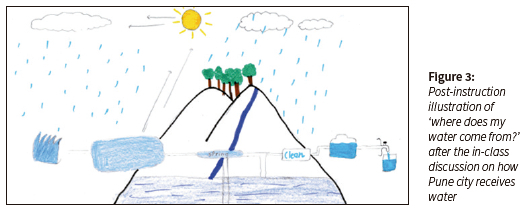
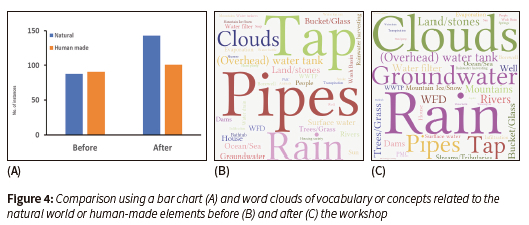
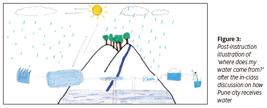
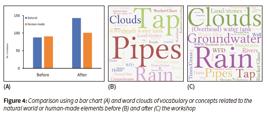
In the drawings made at the end of the workshop, the natural and topographical components were found to appear more frequently (Figure 3). A comparative analysis of the natural and human-made components mentioned in the drawings made before and after the workshop by all the students was carried out. As shown in Figure 4, it was observed that the occurrence of natural elements increased after the session, especially the depiction of streams/tributaries, aquifers, mountains, springs and groundwater.
To further bring forth the interconnectedness of the water cycle and climate in an analytical framework, we introduced students to a systems thinking approach. Within the systems thinking framework, the water cycle is conceived of as several stocks of water connected by flows. The workshop highlighted the fact that any permanent stock of water such as a lake or the ocean must be replenished by continuous flows. The water cycle was shown to be part of the climate of a region since the climate is the result of continuous cycling of energy and water. Human interference in the natural water cycle could therefore potentially change the climate of a region. An activity was conducted where students were asked to complete different sections of the water cycle using pictorial representations of stocks and flows to form a realistic path from the beginning to the end. Students were able to identify correct stocks and flows 91.9 and 84.1 percent of the time, respectively and were able to build connections between the stocks and flows nearly 84.2 percent of the time.
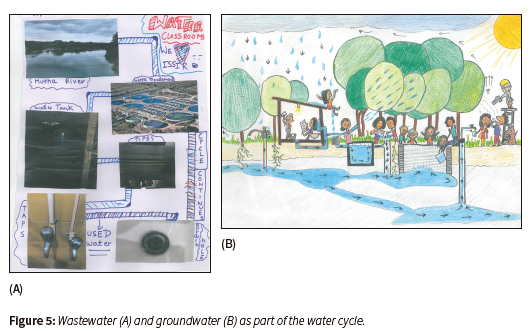
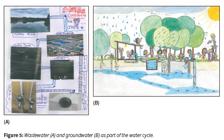
The workshops culminated in an end-of-term exhibition of student learning. One of the students made a collage showing that wastewater through pipes, wastewater treatment plants and drainage into the rivers becomes a part of the water cycle (Figure 5A). Another student's artwork demonstrated that human interventions such as dug wells, borewells and handpumps expose groundwater to the surface. These human-made structures as well as evapotranspiration were shown to make groundwater a part of the water cycle (Figure 5B). In another collage, oceans, lakes as well as dams and reservoirs all were shown as a part of the water cycle (figure not included in this article). These artworks demonstrated that students were able to reimagine the water cycle and introduce hydro-social complexities that the classic representation and teaching of water cycle does not address. These elements have been reported to be crucial in teaching about water and climate (Thompson et al., 2018).
While systems knowledge helps to put things in a larger perspective (local or global), students also need to build capacities to apply this knowledge in ways that can lead them to think through different possibilities, make informed decisions and take action towards a sustainable future. This requires students to have the ability to critically analyse the information they have. This is where the importance of values-based judgements, collaborative working and stakeholder negotiations become crucial (Anderson, 2012).
Students were also engaged in a group activity to learn about water values through visual stories (I Remember Water, 2023) and asked to list how they prioritise these values. The priority scheme for water values in this group of students was found to emerge as environmental/social > economic > governance > spiritual (based on median values obtained from student responses). A discussion about individual choices led to spontaneous debates amongst students. They debated the consequences of prioritising certain values of water over others in different situations. These students, however, collectively agreed that the economic value of water - the commodification of water - conflicted with other values such as the environmental and social ones. It was interesting to note that the students drew on their lived experiences to explore the values of water during these discussions.
We designed an activity called the Water Privilege game based on a similar activity designed earlier by the Ashoka Trust for Research in Ecology and the Environment, Bengaluru. For this activity, six characters with different socio-economic backgrounds and access to water were developed. Students were divided into six groups and each group of students was assigned one character. They were then asked ten questions about their water access and availability; for example, do you have enough water to bathe every day?
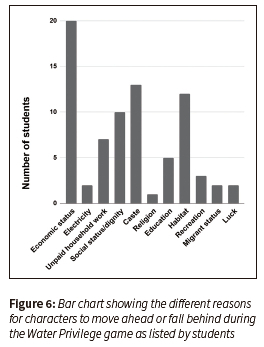
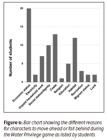
All the groups started together at the same start line. The characters who were more privileged moved a longer distance away from the start line compared to those who were less privileged. This activity allowed students to visualise the inequity in access to water in physical space. Following the activity, students were engaged in discussions and writing exercises to reflect on the reasons why some characters could move forward, and others could not. It was observed that while economic capacity was considered important by most of the students, they also were able to identify issues like caste, habitat - urban/ rural or organised/unorganised housing, household responsibilities - and other factors as influencers on access to water and consequently progress in life (see Figure 6).
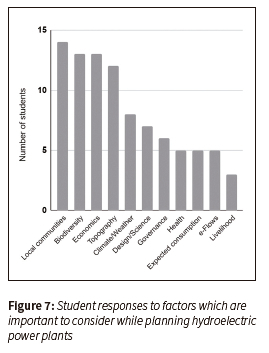
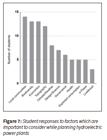
In a workshop on water and energy, students were asked to imagine that they were engineers and had to decide on building a large dam and a hydroelectric power plant. They had to list which factors they consider are important before making this decision. In addition to science and design, the responses from students included issues of biodiversity, local communities, topography, and livelihoods, amongst others (see Figure 7).
Learnings from this case study
Water Classrooms represents a learning progression that enables students to conceptualise and problematise complex, multi-scale issues surrounding socio-environmental problems (see Mathur, 2023; Mathur et al., 2023 for the content and a detailed description). Not only did the learning progression provide the necessary conceptual skills, but it also challenged students to incorporate values and privilege into their reasoning about such issues - an extremely important aspect of decision-making in a deeply unequal society such as India. Thus, water and water-related problems were posed not simply as questions of biophysical remediation and management, but also as questions of social justice. These initial sessions laid the ground for discussing complex issues such as the construction and operation of large dams. Not only were the students more receptive to the multiple factors that need to be considered, but were also able to incorporate concerns beyond purely the economic or biophysical into their decision making (see Figure 7). This suggests that it is indeed possible for middle school students to conceptualise the complexities of real-world water challenges when provided with the right conceptual and normative tools. However, we observed that there sometimes was a gap between conceptual understanding and action by the students. At times, they exhibited conflict-averse behaviour during role-play activities and tended to reach agreements that could be quite disadvantageous to their designated role. For example, a group of students were given a situation where the water pipeline serving an apartment building malfunctioned, leaving people without water on a weekday morning. Instead of raising queries and concerns for the students playing the roles of the representative of the municipal corporation and the plumber, students unanimously chose to purchase water at a higher cost from a commercial water supplier. Bridging this gap between understanding and action is an area which needs more focus in future work.
Another unique feature of Water Classrooms was the close collaboration with a museum to develop visually engaging content. Some of the content for the sessions was obtained from a recently curated exhibition on Pune's water heritage called Punyache Paani (Punyache Paani - stories of Pune's waters, 2022), developed by the Living Waters Museum. This exhibition featured visual stories developed in collaboration with a wide variety of experts who have been closely associated with the history, heritage and contemporary challenges associated with Pune's water systems. The exhibition aimed to provide an accessible introduction to Pune's waters that was grounded in research and fieldwork conducted by the experts. Thus, the material developed for the exhibition was a valuable resource from which the Water Classrooms curriculum could draw. This content allowed the curriculum to have a strong place-based focus which would not have otherwise been possible since it is challenging for schools and school teachers to collate and curate such multidisciplinary material. Water Classrooms is therefore a good example of how museums around the world can play an active role in contributing to sustainability education while fulfilling their primary role of preserving and presenting our natural and cultural heritage.
Our experience with Water Classrooms suggests that a telescopic approach - zooming out from "Water and myself" to "Water and the planet" - allows students to pose the questions of environmental problems in a progressively more nuanced manner. This approach enabled students to engage with the problem of Pune's water systems without becoming overwhelmed by the complexity of the issues involved. The approach allowed students to apply their learning to biophysical systems such as climate while giving importance to normative issues such as equity and privilege. Indeed, it is important that many more such curricula are developed to impart critical skills and attitudes that are essential to the development of well-rounded stewards of our environment and society.
Notes on Contributors and their ContributionsLead author
Mathur, Chhavi
Chhavi Mathur has a PhD in biosciences from the Indian Institute of Science, Bangalore, India. She consults on the development and implementation of education-based projects in museums, grassroots organisations and academic institutions internationally.
Co-author
Monteiro, Joy Merwin
Joy Merwin Monteiro has a PhD in Atmospheric Sciences and is currently an Assistant Professor at the Department of Earth and Climate Science. His research interests are in climate science and its application to health.
Acknowledgements
We thank Dr Sara Ahmed (Living Waters Museum, India) for her contributions during conceptualisation and implementation of this project. We are grateful to Dr Poonam Batra (Transforming Education for Sustainable Futures (TESF), India), Amir Bazaz (Indian Institute of Human Settlements (IIHS), Bangalore) and the team at IIHS for their timely inputs in the project. We thank Dr Sanskriti Menon and Kunal Jaiswal (Centre for Environment Education, Pune), Dr Bejoy Thomas, Dr Durba Biswas and Darab Nagrawalla for their contributions to the development of the curriculum. We thank the Centre for Water Research, the Department of Humanities and Social Sciences, the Department of Earth and Climate Science and the Science Activity Centre at the Indian Institute of Science Education and Research (IISER), Pune for their support. We are also deeply grateful to all the student participants, educators and experts who engaged with us during this project (listed at https://waterclassrooms.in/contributors/). The data collection and analysis in this project would not have been possible without the sincere efforts of (late) Aakriti Parashar. The financial support of the Economic and Social Research Council (UK) is gratefully acknowledged (award title: 'UKRI GCRF Transforming Education Systems for Sustainable Development (TES4SD) Network Plus').
References
-
Ahmed, S., & Sen, S. (2022). Living waters museum: A digital platform for sustainable and inclusive futures. Blue Papers, 1(2), 70-77. https://doi.org/10.58981/bluepapers.2022.2.07
» https://doi.org/10.58981/bluepapers.2022.2.07 -
Amahmid, O., El Guamri, Y., Yazidi, M., Razoki, B., Kaid Rassou, K., Rakibi, Y., Knini, G., & El Ouardi, T. (2019). Water education in school curricula: Impact on children knowledge, attitudes and behaviours towards water use. International Research in Geographical and Environmental Education, 28(3), 178-193. https://doi.org/10.1080/10382046.2018.1513446
» https://doi.org/10.1080/10382046.2018.1513446 -
Anderson, A. (2012). Climate change education for mitigation and adaptation. Journal of Education for Sustainable Development, 6(2), 191-206. https://doi.org/10.1177/0973408212475199
» https://doi.org/10.1177/0973408212475199 -
Assaraf, O. B.-Z., & Orion, N. (2010). System thinking skills at the elementary school level. Journal of Research in Science Teaching, 47(5), 540-563. https://doi.org/10.1002/tea.20351
» https://doi.org/10.1002/tea.20351 -
Boström, M., Andersson, E., Berg, M., Gustafsson, K., Gustavsson, E., Hysing, E., Lidskog, R., Löfmarck, E., Ojala, M., Olsson, J., Singleton, B. E., Svenberg, S., Uggla, Y., & Öhman, J. (2018). Conditions for transformative learning for sustainable development: A theoretical review and approach. Sustainability, 10(12), 4479. https://doi.org/10.3390/su10124479
» https://doi.org/10.3390/su10124479 -
Brody, M. (1995). Development of a curriculum framework for water education for educators, scientists, and resource managers. Journal of Environmental Education, 26(4), 18-29. https://doi.org/10.1080/00958964.1995.9941448
» https://doi.org/10.1080/00958964.1995.9941448 -
Covitt, B. A., Gunckel, K. L., & Anderson, C. W. (2009). Students' developing understanding of water in environmental systems. Journal of Environmental Education, 40(3), 37-51. https://doi.org/10.3200/JOEE.40.3.37-51
» https://doi.org/10.3200/JOEE.40.3.37-51 -
Department of Economic and Social Affairs. (2024, May 10). https://sdgs.un.org/goals/goal6
» https://sdgs.un.org/goals/goal6 - Deshpande, S., Wani, K., Deodhar, A., Gole, S., Nulkar, G., Gabale, S., Shitole, T., Kulkarni, H., & Bhagwat, M. (2021). Flood fury of Pune: Understanding the tributaries. Journal of Ecological Society, 32-33, 100-135.
-
Evans, N., Stevenson, R. B., Lasen, M., Ferreira, J.-A., & Davis, J. (2017). Approaches to embedding sustainability in teacher education: A synthesis of the literature. Teaching and Teacher Education, 63, 405-417. https://doi.org/10.1016/j.tate.2017.01.013
» https://doi.org/10.1016/j.tate.2017.01.013 - Gadgil, M., & Guha, R. (1993). This fissured land: An ecological history of India. University of California Press.
-
Gadgil, S. (2003). The Indian monsoon and its variability. Annual Review of Earth and Planetary Sciences, 31(1), 429-467. https://doi.org/10.1146/annurev.earth.31.100901.141251
» https://doi.org/10.1146/annurev.earth.31.100901.141251 - Gujja, B., Joy, K.J., Paranjape, S., Goud, V., & Vispute, S. (2006). "Million revolts" in the making. Economic and Political Weekly, 41(7), 570-574.
- Gunckel, K. L., Covitt, B. A., Salinas, I., & Anderson, C. W. (2012). A learning progression for water in socio-ecological systems. Journal of Research in Science Teaching, 49(7), 843-868.
-
I remember water. (2023). https://irememberwater.watermuseums.net/exhibition
» https://irememberwater.watermuseums.net/exhibition -
Jacobson, M. J., & Wilensky, U. (2006). Complex systems in education: Scientific and educational importance and implications for the learning sciences. Journal of the Learning Sciences, 15(1), 11-34. https://doi.org/10.1207/s15327809jls1501_4
» https://doi.org/10.1207/s15327809jls1501_4 -
Joy, K.J., Kulkarni, S., Roth, D., & Zwarteveen, M. (2014). Re-politicising water governance: Exploring water re-allocations in terms of justice. Local Environment, 19(9), 954-973. https://doi.org/10.1080/13549839.2013.870542
» https://doi.org/10.1080/13549839.2013.870542 -
Karutz, R., Klassert, C. J. A., & Kabisch, S. (2023). On farmland and floodplains: Modeling urban growth impacts based on global population scenarios in Pune, India. Land, 12(5), Article 5. https://doi.org/10.3390/land12051051
» https://doi.org/10.3390/land12051051 -
Kulkarni, H., Bhagwat, M., Kale, V., & Aslekar, U. (2019). Pune's aquifers: Some early insights from a Strategic Hydrogeological Appraisal (ACWA/HYDRO/2019/H-86). ACWADAM. https://www.researchgate.net/publication/335976478_PUNE'S_AQUIFERS_Some_Early_Insights_From_A_Strategic_Hydrogeological_Appraisal
» https://www.researchgate.net/publication/335976478_PUNE'S_AQUIFERS_Some_Early_Insights_From_A_Strategic_Hydrogeological_Appraisal -
Kulkarni, H., Rajguru, J., & Korde, P. (2023). Unravelling Pune's Aquifers-Framework for Groundwater Management and Governance (ACWA/Hydro/2023/H142). ACWADAM. https://www.researchgate.net/profile/Himanshu-Kulkarni/publication/368666891_Unravelling_Pune's_Aquifers_-_Framework_for_Groundwater_Management_and_Governance/links/63f47e2e0d98a97717a70b35/Unravelling-Punes-Aquifers-Framework-for-Groundwater-Management-and-Governance.pdf
» https://www.researchgate.net/profile/Himanshu-Kulkarni/publication/368666891_Unravelling_Pune's_Aquifers_-_Framework_for_Groundwater_Management_and_Governance/links/63f47e2e0d98a97717a70b35/Unravelling-Punes-Aquifers-Framework-for-Groundwater-Management-and-Governance.pdf -
Mathur, C. (2023). Water Classrooms. https://waterclassrooms.in/
» https://waterclassrooms.in/ -
Mathur, C., Ahmed, S., Parasha, A., Nagarwalla, D., Menon, S., Swaraj, B., Meddapil, R., Karampuri, Y., Sivaram, M., Talele, R., Radhika Mulay, S. D., Lepcha, M., Sen, S., Thatte, K., Tandon, A., Monteiro, J. M., Joshi, A., & Kaabaadee, R. (2023). Development of Water Classrooms for middle school students. Indian Institute for Human Settlements. https://doi.org/10.24943/TESF1206.2023
» https://doi.org/10.24943/TESF1206.2023 -
Mbah, M. F., Shingruf, A., & Molthan-Hill, P. (2022). Policies and practices of climate change education in South Asia: Towards a support framework for an impactful climate change adaptation. Climate Action, 1(1), 1-18. https://doi.org/10.1007/s44168-022-00028-z
» https://doi.org/10.1007/s44168-022-00028-z -
Nguyen, N. C., Graham, D., Ross, H., Maani, K., & Bosch, O. (2012). Educating systems thinking for sustainability: Experience with a developing country. Systems Research and Behavioral Science, 29(1), 14-29. https://doi.org/10.1002/sres.1097
» https://doi.org/10.1002/sres.1097 -
Nordhauser, J., & Rosenfeld, J. (2020). Adapting a water, sanitation, and hygiene picture-based curriculum in the Dominican Republic. Global Health Promotion, 27(3), 6-14. https://doi.org/10.1177/1757975919848111
» https://doi.org/10.1177/1757975919848111 -
Pani, pahar: The water curriculum. (2020, January 13). https://thehearthadvisors.com/our-work/pani-pahar-the-water-curriculum/
» https://thehearthadvisors.com/our-work/pani-pahar-the-water-curriculum/ -
Punyache Paani - stories of Pune's waters. (2022, March 27). https://punyachepaani.livingwatersmuseum.org/
» https://punyachepaani.livingwatersmuseum.org/ -
Sammel, A. (2016). Her beauty and her terror: A case study exploring the framing of water and extreme water events within formal education in Queensland, Australia and Saskatchewan, Canada. Geoforum; Journal of Physical, Human, and Regional Geosciences, 76, 164-175. https://doi.org/10.1016/j.geoforum.2016.09.015
» https://doi.org/10.1016/j.geoforum.2016.09.015 -
Shepardson, D. P., Niyogi, D., Roychoudhury, A., & Hirsch, A. (2012). Conceptualizing climate change in the context of a climate system: Implications for climate and environmental education. Environmental Education Research, 18(3), 323-352. https://doi.org/10.1080/13504622.2011.622839
» https://doi.org/10.1080/13504622.2011.622839 -
Singh, A., Monteiro, J. M., & Thomas, B. (2021, July 9). [Commentary] Long term rainfall patterns and flooding in Pune city. Mongabay-India. https://india.mongabay.com/2021/07/commentary-long-term-rainfall-patterns-and-ñooding-in-pune-city/
» https://india.mongabay.com/2021/07/commentary-long-term-rainfall-patterns-and-ñooding-in-pune-city/ - Thompson, C., Farnum, R., & Macdougall, R. (2018). Re-envisioning the hydro cycle: The hydrosocial spiral as a participatory toolbox for water education and management. In Water, creativity and meaning. Routledge.
-
Tiwari, V. M., Wahr, J., & Swenson, S. (2009). Dwindling groundwater resources in northern India, from satellite gravity observations. Geophysical Research Letters, 36(18). https://doi.org/10.1029/2009GL039401
» https://doi.org/10.1029/2009GL039401 -
TROPICSU. (2023). Climate change education across the curricula, across the globe. https://tropicsu.org/
» https://tropicsu.org/