Integration of Climate Change Concepts in the Namibian School Curriculum: Challenges, opportunities and recommendations for enhanced implementation
Abstract
Like many countries in the Global South, Namibia is vulnerable to disproportionate impacts of climate change. The country is facing intensified challenges in adapting to rising temperatures, changing rainfall patterns, and a higher prevalence of extreme weather events, which contribute to existing socio-economic and environmental problems. The complex nature of climate change science requires that climate change concepts are integrated into all education systems. This article is a content analysis of how the Namibian basic education curriculum integrates concepts related to climate change. The analysis reveals that climate change concepts are partially integrated into Namibia's basic education curriculum as part of the environmental learning cross-curricular theme. This integration of climate change concepts is only evident in the Natural and Social Science subjects across grade levels and mostly covers basic concepts related to climate science, sustainable lifestyles and ecosystems and biodiversity. In commercial and technical subjects, climate change concepts are minimal. In summary, the integration of climate change related concepts in the Namibian basic curriculum is not sufficient for learners to fully understand the complex concepts of climate change. For climate action, curriculum developers need to integrate climate change content in all subjects of the Namibian basic education curriculum especially those related to climate justice, climate ethics and post-carbon economies.
climate change; basic education; environmental learning; cross-curricular theme; curriculum developers; climate-change integration
Introduction and background
According to the Intergovernmental Panel on Climate Change (IPCC) (2023) report, approximately 3.3 to 3.6 billion people live in contexts that are highly vulnerable to climate change. Addressing climate change is thus one of the major issues on the international political agenda, and it must be one of the issues that require emphasis in education (UNESCO [United Nations Educational, Scientific and Cultural Organisation], 2021, 2024).
To mitigate the wicked impacts of climate change, countries all over the world have therefore acknowledged that climate change education is key (Hindley, 2022; Hung, 2023). Hung (2023) has argued, however, that there are many discourses of climate change ranging from scientific, economic, political and ethical discourses. Climate change education is therefore differently understood in different contexts, with the main definition focusing on climate change literacy (Molthan-Hill et al., 2019).
In response to the 'wicked problem' of climate change (Weaver et al., 2023), the United Nations Framework Convention on Climate Change (UNFCCC), the Kyoto Protocol, the Paris Agreement, and the United Nations Sustainable Development Goals (UN [United Nations] 1992, 1998; UNESCO, 2017, 2024) are supporting national initiatives and encouraging development and implementation of climate change policies at multiple levels of governance. In this regard, UNESCO (2017, 2024) advocates for the integration of climate change content across all sectors of education. Education can illustrate that, as conscious consumers and responsible citizens, individuals play a critical role in altering their lifestyles to tackle sustainability issues such as climate change (Hung, 2023).
Namibia is the driest country south of the Sub-Sahara and is highly vulnerable to climate change. As a signatory to climate change conventions and agreements, Namibia aims to "provide a legal framework and overarching national strategy for the development, implementation, monitoring and evaluation of climate change mitigation and adaptation activities" (Namibia. Ministry of Environment and Tourism, 2011, p. 6), in order to improve the quality of life of its citizens. The climate change policy for Namibia has identified mainstreaming of climate change into education as a key principle. This recognises that education is important in mitigating the impacts of climate change in the country.
Despite the urgent need to address climate change challenges (IPCC, 2023), the topic is relatively new within some countries globally (Field et al., 2023) and in the southern African school system (Dlamini, 2016; Lotz-Sisitka et al., 2021; Tshiningayamwe, 2019). Leading to a limited understanding of climate change concepts among learners (Dlamini, 2016; Nhamo & Shava, 2014). Nhamo and Shava (2014) emphasised that learning processes and curricula must be central to establishing climate-resilient pathways in southern Africa. This need is urgent, as Africa has been identified as a region particularly vulnerable to the impacts of climate change (IPCC, 2023) especially dry countries like Namibia. This calls for research on climate change education in education systems (Field et al., 2023). In Namibia, there is evidence of research on climate change integration in some subjects such as Geography and Physical Science (lipinge, 2019; Tshiningayamwe, 2019) but no evidence of research on climate change concepts in all subjects of the Namibian basic education curriculum, which is the focus of this article. This has the potential to enhance climate change education in Namibia.
Climate change education in the global context
As noted in the above discussion, the world is grappling with the escalating climate crisis and as a result, education has been positioned as a critical component of governments' response to the crisis. However, climate change education is differently understood in different contexts, and there is no substantial definition on climate change literacy (Molthan-Hill et al., 2019). Anderson (2012), however, posited that:
Climate change education for sustainable development must be comprehensive and multidisciplinary; it must not only include relevant content knowledge on climate change, environmental and social issues, disaster risk reduction and sustainable consumption and lifestyles, but it should also focus on the institutional environment in which that content is learned. (pp. 193-194)
In line with the above quote which acknowledges the connections between education and Education for Sustainable Development (ESD), Mochizuki and Bryan (2015) noted that climate change education belongs within the field of ESD:
Climate change has far reaching repercussions for where people can settle, grow food, maintain built infrastructure and rely on functioning ecosystems. It therefore touches upon multiple aspects of sustainable development, ranging from human displacement to food security, economic growth and biodiversity loss. Given that CC encompasses environmental, political, social and economic factors, the holistic framework of ESD is an optimal framework to advance CCE. (p. 9)
In accordance with the above, UNESCO (2017, 2024) asserts that education is a powerful tool for developing people's knowledge and skills on how to address climate change. This is because education provides an avenue through which individuals can engage in debates to understand the extent of climate change impacts (Hung, 2023). All this reinforces the importance of climate change education. Climate change education empowers learners to adopt appropriate climate actions (Hung, 2023; Poortinga et al., 2019; UNESCO, 2024). Countries have, therefore, put in place policies and interventions to combat climate change and its impacts through mainstreaming it in education systems (UNESCO, 2021). However, this has not been sufficient (Amanchukwu, 2015; Hindley, 2022; Field et al., 2023; Tshiningayamwe, 2019).
Field et al. (2023) did a systematic review of climate change education within Canada's regional curricula. Their study found fractured and uneven inclusion of climate change concepts in Canada's provincial curricula. Amanchukwu (2015) conducted a climate change education curriculum review in Nigeria. He found that the Nigerian formal school curriculum does not sufficiently expose learners to the dangers of climate change. One recommendation made in his study was that climate change should be taught as a separate subj ect and should be made one of the compulsory courses offered in the school curriculum. Hung (2023) observed that in the Singapore formal school curriculum, climate change education is only integrated within the Natural and Social Science; and Moral Education and Values subjects. He further observed that together with the general environmental issues, climate change concepts are packaged as part of ESD in the school curriculum. Lotz-Sisitka et al. (2021) noted a need for a multi-stakeholder approach to conceptualising climate change education in the South African curriculum in a way that addresses the problems of inconsistency and 'patchiness'. In the Namibian context in a study on the integration of climate change in the Physical Science curriculum, lipinge (2019) noted that the Physical Science syllabus does not directly address the concept of climate change. In the same context, Tshiningayamwe (2019) researched the integration of climate change into the Geography curriculum. The analysis showed that climate change content is not yet fully integrated into the Namibian school Geography curriculum.
Methodology
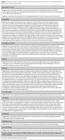
A content analysis of the Ministry of Education, Arts and Culture (MoEAC) curriculum documents for pre-primary to Grade 12 was conducted. The aim was to carry out a comprehensive analysis of how the Namibian basic education integrates climate change related concepts into the school curriculum across grade levels and subjects. Content analysis refers to analysing documents (Jawabreh & Gündüz, 2021), in this case curriculum documents that contain themes, basic competencies and topics of content to be taught in the Namibian school curriculum. The curriculum documents were initially collected and analysed between September and October 2023. There have been few changes to these curriculum documents as there has not been a major curriculum review or transformation since 2023. However, in May 2025, documents were re-analysed to establish whether there were any updates. Minor differences in the analyses were reconciled. To analyse the climate change content integration in the curriculum documents, a search for keywords and phrases related to climate change (see see box entitled 'Key climate change concepts' that follows in a few pages) was conducted. This search aimed to find where climate change related concepts were integrated across curriculum documents. Further analysis was done by searching for a combination of climate change related concepts such as climate science, ecosystem and biodiversity, climate justice, resilience building, post-carbon economies, sustainable lifestyles (UNESCO, 2024) to offer a comprehensive understanding of the current state of climate change concepts integration in Namibia's school curriculum. The findings of the analysis were documented in the journal (see Tables 2, 3, 4 and 5). The curriculum documents analysed were purposively selected according to the grades, subjects and learning areas (see Table 1). The analysis focused primarily on the basic competencies of the different subjects and phases of the curriculum.
Analysis of the climate change concepts in the Namibian curriculum
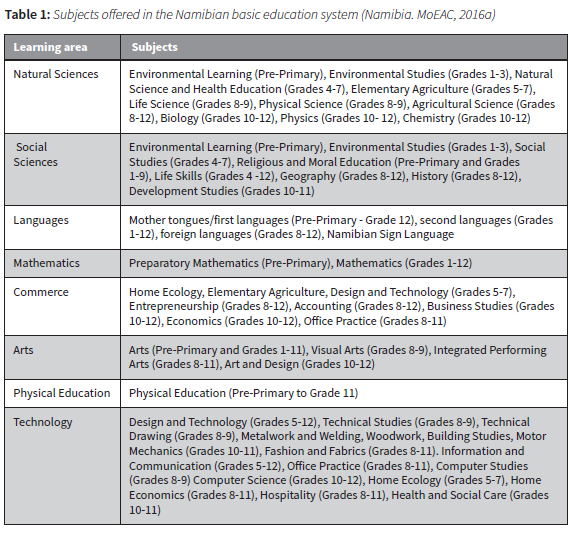
Namibian basic education is structured in four phases: Junior Primary (Pre-Primary and Grades 1-3), Senior Primary (Grades 4-7), Junior Secondary (Grades 8-9), and Senior Secondary (Grades 10-12) (Namibia. MoEAC, 2016a). Subjects are divided into the learning areas of Natural Sciences, Social Sciences, Languages, Mathematics, Commerce, Arts, Physical Education and Technology (Namibia. MoEAC, 2016a), as summarised in Table 1.
The focus of this research was to analyse the integration of climate change related concepts across all the different learning areas of the Namibian curriculum as shown in Table 1. Climate change is part of environmental learning which is a cross-curricular theme (Namibia. MoEAC, 2016a). Cross-curricular themes deal with particular risks and challenges in Namibia, such as the risks and challenges faced when natural resources are not managed, and risks faced by globalisation (Namibia. MoEAC, 2016a). Learners need to understand how these risks and challenges can be addressed on a personal, local, national and global level and how they can play a part in addressing these risks and challenges in their local communities (Namibia. MoEAC, 2016a). The concepts in the box below were used as a basis for the analysis of climate change content in the Namibian basic education curriculum.
Key climate change concepts
(Adapted from Amanchukwu, 2015; UNESCO, 2017,2021,2024)
• The basic science and definitions of the concept of climate change and related concepts such as greenhouse effects, greenhouse gas and their emissions, disaster risk management
• Environmental impacts and issues of energy production, supply and usage; big ecosystems like forests, oceans, glaciers and biodiversity
• Impact of climate change on transportation, industry and commerce, education, health, forestry, fresh water resources, coastal water resources and fisheries; local crops and the global economy
• Sustainability and individual respect for the environment
• Sources of climate change and the ecological, ethical, social, cultural and economic consequences of climate change at individual, local, national and global level
• Prevention, mitigation and adaptation strategies at different levels (global to individual) and for different contexts and their connections with disaster response and disaster risk reduction
• Ecosystem dynamics and the environmental, social, economic and ethical impact of climate change
• Strategies to deal with climate change/ reduce emissions (e.g. local, national and global institutions) and managing impacts of climate change
• Individual impact on the world's climate, from a local to a global perspective and protection of the global climate
• Energy, agriculture and industry-related greenhouse gas emissions
• Climate change-related hazards leading to disasters and their unequal social and economic impact within households, communities, countries and between countries.
• Future scenarios (including alternative explanations for the global temperature rise)
• Climate science, ecosystem and biodiversity, climate justice, resilience building, post-carbon economies, sustainable lifestyles
Climate change concepts in the Namibian Junior Primary Curriculum
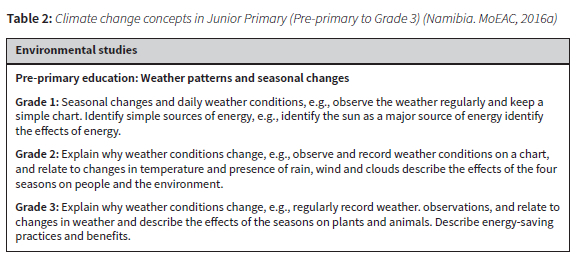
As mentioned above, the first phase of the Namibian curriculum is Junior Primary. Table 2 below shows how this phase of the Namibian curriculum covers concepts related to climate change.
The Namibian Junior primary curriculum integrates the theme of natural environment in the Environmental Studies subject. Learning experiences in this theme aim to increase learners' knowledge and understanding of the physical and biological world of which they are part (Namibia. MoEAC, 2023a). This includes understanding how people use the natural environment to satisfy their needs, how to care for the environment, and how the environment may be changed in ecologically sustainable ways. Environmental Studies topics are used for integration in other subjects such as Arts, Physical Development, Religious and Moral Education and Mathematics. As shown in Table 2, climate change concepts in Environmental Studies include weather, seasons and the environment. The basic competencies for these topics include learners being able to observe and describe seasonal changes, daily weather conditions change, as well describe the effects of seasons and weather change (Namibia. MoEAC, 2023a). The Language curriculum aims at developing listening, speaking, reading, writing, grammar and language use skills. Teachers are expected to integrate environmental learning which includes climate change in Languages to develop these skills. For example, to develop listening skills, teachers can ask learners to listen to the weather report.
Climate change concepts in the Namibian Senior Primary Curriculum
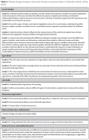
The second phase of the Namibian curriculum is Senior Primary. Table 3 below shows how this phase of the Namibian curriculum covers concepts related to climate change.
As shown in Table 3, in Grade 4-7 Natural Science and Health Education curriculum there are topics related to climate change such as ecosystems, energy and water (Namibia. MoEAC, 2023b). This helps learners to identify the different ecosystems and examples of human activities that have beneficial or harmful effects on the environment. The topic of 'Water around us' enables learners to understand the water cycle, realise the importance of water in the environment and the importance of the sustainable use of water. Learners are expected to describe the impact of deforestation and overgrazing on vegetation and to discuss how these negative impacts can be reduced (Namibia. MoEAC, 2023b).
As shown in Table 3, the Social Studies curriculum also covers concepts related to climate change. In Social Studies Grade 4 to 7, the topic of weather and climate is covered (Namibia. MoEAC, 2023c). Learners learn to distinguish between weather and climate, describe weather patterns in different seasons; observe and record the weather and discuss how the elements of weather influence human activities in their local environment. Learners further learn the major climatic regions; the relationship between climate and natural vegetation of Africa and of the world (Namibia. MoEAC, 2023c). In Social Studies learners are also expected to draw climate graphs; list the different types and causes of natural disasters and how they affect human lives and the environment, as well as understand human activities and their effects on the natural environment.
Similar to Junior Primary, the Senior Primary Language curriculum aims at developing listening, speaking, reading, writing, grammar and language use skills. For example, to develop writing skills, learners can write a letter of appreciation to a community leader who took part in tree planting at a school on Arbor Day.
Climate change concepts in the Namibian Junior Secondary Curriculum
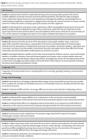
Table 4 shows how the third phase (Junior Secondary) of the Namibian curriculum covers concepts related to climate change.
As shown in Table 4, in Grade 8 and 9 Geography, learners continue to learn about weather and climate of Namibia and are introduced to the structure of the atmosphere and synoptic weather maps (Namibia. MoEAC, 2015a). In this subject, learners are expected to demonstrate their ability to measure and apply skills of weather observations to draw and interpret climatic graphs. Learners are further expected to describe how the atmosphere is heated by the processes of insulation, terrestrial radiation, absorption, and convection; describe Namibian weather patterns and explain factors that influence climate in Namibia. Furthermore, in Grade 9 Geography, learners investigate the reasons for the deterioration of the environment and suggest possible solutions. Learners are introduced to the theme of geomorphology and economic activities in Namibia and the factors that influence economic growth. The Language curriculum aims to develop listening, speaking, reading, writing, grammar, and language use skills.
In Grade 8 Life Sciences learners learn about ecosystems (Namibia. MoEAC, 2015b). The basic competency within this topic is for learners to understand the need for sustainable farming and realise how population growth will result in possible depletion of natural resources and environmental problems; the major ecological cycles; human activities and how they reduce the Earth's carrying capacity for people and other organisms. In Grade 9 Life Sciences and Physical Science the topic of global warming is covered (Namibia. MoEAC, 2015c). Learners learn how some gases create a greenhouse effect causing global warming; the local and global ecological effects of global warming on the environment; effect and mitigation of human activities on the ozone layer and the impact of global warming on the ecosystem. In Grade 8 Entrepreneurship learners only need to understand the concepts of environmental sustainability; components of the natural environment; and how businesses depend on the natural environment (Namibia. MoEAC, 2015d).
Climate change concepts in the Namibian Senior Secondary Curriculum
The last phase of the Namibian school curriculum is Senior Secondary. Table 5 shows how this phase covers concepts related to climate change.
As shown in Table 5, in Grade 12 Geography, learners learn about regional and global issues related to the natural environment; the human impact to catchment flows and water storage and the causes and effects of river floods (Namibia. MoEAC, 2016b). The curriculum also focuses on flood management techniques with reference to forecasts and warnings and how climate influences the shape of hydrographs. Learners also learn about atmospheric processes, how the atmosphere is heated; climate change and its effects in global and local context; and the impact and effects of human activities on climate. As shown in Table 5, in Grade 12 Geography learners learn the social and economic environmental consequences of industrial developments and different agricultural systems; and energy production, mining and transportation to understand various sources of energy and their impact on both people and the environment. The topic of water allows learners to understand the problems associated with water scarcity; and the social, economic, political and environmental issues associated with water control (Namibia. MoEAC, 2016b).
In Development Studies Grade 10-11, concepts, and practice of development within the context of their social, economic, political, environment, and sustainable development is covered (Namibia. MoEAC, 2017). In this subject, learners learn about the National Development Plans towards Namibia's economic and social development. They also learn about industrialisation to suggest possible sustainable ways of increasing production in Namibian industries. The topic of rural development allows learners to describe and demonstrate the importance of the need to conserve the environment in rural areas including importance of maintaining wildlife diversity and sustainable development.
In Commerce, History, Arts and Physical Education as well as Technical Studies subjects such as Woodwork, Fashion and Fabrics, Metalwork and Welding, concepts of climate change are not clearly visible. In the Building Studies Grade 10-11 curriculum, learners only learn about the need to preserve the environment by, for example, explaining procedures for disposing/sourcing materials without environmental damage (Namibia. MoEAC, 2019). In Arts and Design Grade 10-11 learners only need to understand the use of materials from the environment (Namibia. MoEAC, 2018a).
Grade 10, 11 and 12 Agricultural Science (Namibia. MoEAC, 2018b) introduces the topic of sustainable agriculture and content on environmental influences on agricultural practices. Learners are expected to understand the effects of environmental factors on agricultural activities in Namibia. This subject also covers a theme of community-based natural resource management which helps learners to understand the importance of empowering local communities to manage forest resources in a sustainable way for their improved livelihood.
Discussion of climate change concepts in the Namibian basic curriculum
It is evident from the curriculum analysis (see Tables 2, 3, 4 and 5), that different subjects and phases of the Namibian curriculum incorporate concepts related to climate change. This resonates with Hung (2023) who notes that the complex nature of climate change science requires that climate change concepts are placed as an orientation to any basic curriculum within different subjects. Integration of climate change concepts across the curriculum aims at creating citizens that are literate, confident, independent, multi-skilled and compassionate with respect for the environment (UNESCO, 2021, 2024). The analysis in this research shows that the Namibia basic education curriculum includes basic concepts of climate change (especially those related to climate science, sustainable lifestyles, ecosystem and biodiversity) in subjects such as Geography and Life Sciences. In these subjects, impacts of climate change on the environment are covered. Causes of climate change are covered in subjects such as Life Science and Biology where learners are expected to describe human activities and their effects on the natural environment. Strategies on how to mitigate climate change are also part of the curriculum as learners in Geography Grade 9 are expected to investigate the reasons for the deterioration of the environment and suggest possible solutions. This resonates with Amanchukwu (2015) and UNESCO (2017) who noted that most climate change related concepts are normally integrated in Natural and Social Sciences subjects.
The analysis of the Namibian curriculum (see Tables 2, 3, 4 and 5) further reveals that progression of climate change concepts within and across some of the subjects is clear. For example, the topic of weather and climate is consistently integrated in the Environmental Studies and Social Studies subjects from Pre-primary to Grade 7. While the topics of ecosystems, energy sources, human impacts on the environment and how they can be reduced are covered in Natural Science subjects from Grade 4 to 12. In Grade 4 to 11 Agriculture and Agricultural Science, the concepts of agriculture, sustainable agriculture and impacts of agriculture on the environment are covered. Even though in most cases the climate change knowledge covered is basic, in the higher grades lesson objectives are slightly more complex than in lower grades. For example, on the topic of weather and climate, in Grade 1 to 3 learners only learn about related terms but in Grades 4 to 7 they describe the climate in each region using climatic graphs and describe human activities and their effects on the natural environment. However, in other subjects the climate change content is fragmented and patchy, reflecting a similar issue to that found in the South African curriculum (Lotz-Sisitka et al., 2021). For example, the concepts of industrialisation, development, and impacts of industries on the environment are only covered in Grade 10 to 11 Development Studies. Development Studies is an elective subject in Grade 10 and 11. Thus not all learners benefit from this content and given the complexity of these concepts, they should be introduced in the earlier grades, for example in Social Studies subjects in Grade 4 to 9 that are compulsory for all learners.
Despite UNESCO (2021, 2024) recommendations, concepts of climate ethics, climate systems and post-carbon economies are not adequately covered in the Namibian curriculum. Similar to Lotz-Sisitka et al.'s (2021) findings on the South African curriculum, the Namibian basic curriculum does also not fully reflect the contemporary issues of climate change such as an understanding of earth systems. Climate change issues are emerging and changing, thus learners need to be able to anticipate and predict climate change issues both in local and global contexts (IPCC, 2023). It is, however, also worth noting that the review revealed that despite environmental learning (including of climate change) being a cross-curricular theme in the Namibian basic education curriculum (Namibia. MoEAC, 2016a), climate change concepts are only integrated in some subjects. Those are mostly topics related to Natural Sciences and Social Sciences. This is supported by lipinge (2019) who observed that even though one of the objectives of the Namibia basic curriculum guidelines stated within the Physical Science syllabus is to provide insight and understanding of crucial global issues such as global warming, environmental degradation and others that affect quality of life in the rapidly changing world, the Physical Science syllabus does not directly address the concept of climate change or global warming. For climate action, all subjects should include knowledge of climate change (Hindley, 2022; Hung, 2023; UNESCO, 2021). There is therefore an opportunity for integrating climate change related concepts in all subjects across levels of the Namibian school curriculum in a progressive way.
Conclusion and recommendations
This analysis of the Namibian curriculum reveals that climate change concepts are integrated in the Namibian basic curriculum, but only in some subjects, some of which are electives. Given the urgency to address climate change causes and impacts, every learner needs to know about climate change mitigation tools - in Physical Science, Business Studies, Chemistry, Economics or any other subject. The analysis, for example, reveals that the Namibia curriculum does not integrate basic knowledge of earth systems, climate ethics and climate systems. This could be integrated in all subjects across phases or in Arts, Commerce and Technical subjects such as Building Studies where there is minimal or no coverage of climate change related content. This is in line with Molthan-Hill et al. (2019) who observed a need for each basic curriculum to 'mainstream' climate change concepts in all subjects. In addition, for Namibian learners to fully understand the causes and impacts of climate change, climate change concepts such as weather and climate that are mainly covered in the Primary phase, should be strengthened. There is also a need to include more complex concepts related to climate change such as climate systems and earth systems in higher grades to empower learners to respond to the scientific, social, ethical and political complexities of climate change.
In conclusion, climate change education is an under-researched topic, even within specific subject areas or disciplines. This article therefore recommends further research on climate change education, particularly on how climate change concepts such climate justice, resilience building and post-carbon economies can be integrated in school curricula.
Notes on ContributorTshiningayamwe, Sirkka
Sirkka Tshiningayamwe is a Senior Lecturer at the University of Namibia. She has a PhD in Environmental Education. Sirkka facilitates ESD programmes for teachers and teacher education, which is also the area of her research.
References
-
Anderson, A. (2012). Climate change education for mitigation and adaptation. Journal of Education for Sustainable Development, 6(2), 191-206. https://doi.org/10.1177/0973408212475199
» https://doi.org/10.1177/0973408212475199 -
Amanchukwu, R. N. (2015). Climate change education in Nigeria: The role of curriculum review. Education, 5(3), 71-79. https://doi.org/10.5923/j.edu.20150503.01
» https://doi.org/10.5923/j.edu.20150503.01 - Dlamini, M. N. (2016). Understanding and teaching climate change in the secondary education curriculum in Swaziland. [Unpublished doctoral thesis]. University of Pretoria.
-
Field, E., Spiropoulos, G., Nguyen, A. T., & Grewal K. R. (2023). Climate change education within Canada's regional curricula: A systematic review of gaps and opportunities. Canadian Journal of Educational Administration and Policy, 202, 155-184. http://dx.doi.org/10.7202/1099989ar
» http://dx.doi.org/10.7202/1099989ar -
Hindley, A. (2022). Understanding the gap between university ambitions to teach and deliver climate change education. Sustainability, 14-17. http://dx.doi.org/10.3390/su142113823
» http://dx.doi.org/10.3390/su142113823 -
Hung, C. C. (2023). Climate change education: Knowing, doing and being. Routledge. https://doi.org/10.1080/10382046.2019.1703318
» https://doi.org/10.1080/10382046.2019.1703318 - IPCC [Intergovernmental Panel on Climate Change]. (2023). Climate Change2023. Synthesis Report. Contribution of Working Groups 1, 11 and 111 to the Sixth Assessment Report of the Intergovernmental Panel on Climate Change. IPCC.
-
Jawabreh, R. & Gündüz, N., (2021). Content analysis of curriculum development related studies during 2000 - 2019. Near East University Journal of Education Faculty, 4(2), 12-21. http://dx.doi.org/10.32955/neuje.v4i2.429
» http://dx.doi.org/10.32955/neuje.v4i2.429 - Iipinge, W. N. (2019). The integration of climate change in the Namibian senior secondary Physical Science syllabus through environmental education. [Unpublished master's thesis]. North West University.
- Lotz-Sisitka, H., Mandikonza, C., Misser, S., & Thomas, K. (2021). Making sense of climate change in a national curriculum. In I. Schudel, Z. Songqwaru, S. Tshiningayamwe, & H. Lotz-Sisitka (Eds). Teaching and learning for change education and sustainability in South Africa. African Minds.
-
Molthan-Hill, P., Worsfold, N., Nagy, G.J., Filho, L.W., & Mifsud, M. (2019). Climate change education for universities: A conceptual framework from an international study. Journal of Cleaner Production, 226, 1092-1101. https://doi.org/10.1016/j.jclepro.2019.04.053
» https://doi.org/10.1016/j.jclepro.2019.04.053 -
Mochizuki, Y. & Bryan, A., (2015). Climate change education in the context of education for sustainable development: rationale and principles. Journal of Education Sustainable Development, 9, 4 -26. https://doi.org/10.1177/0973408215569109
» https://doi.org/10.1177/0973408215569109 -
Namibia. MoEAC [Ministry of Education, Arts and Culture]. (2015a). Geography Syllabus Grade 8-9. NIED, Okahandja. https://www.nied.edu.na/assets/documents/02Syllabuses/04JuniorSecondary/Geography/JSGeographySyllabus2024.pdf
» https://www.nied.edu.na/assets/documents/02Syllabuses/04JuniorSecondary/Geography/JSGeographySyllabus2024.pdf -
Namibia. MoEAC [Ministry of Education, Arts and Culture]. (2015b). Life Science Syllabus Grade 8-9. NIED, Okahandja. http://www.nied.edu.na/assets/documents/02Syllabuses/04JuniorSecondary/LifeScience/JSC_Syllabuses_Life-sci_Sep2016.pdf
» http://www.nied.edu.na/assets/documents/02Syllabuses/04JuniorSecondary/LifeScience/JSC_Syllabuses_Life-sci_Sep2016.pdf -
Namibia. MoEAC [Ministry of Education, Arts and Culture]. (2015c). Physical Science Syllabus Grade 8-9. NIED, Okahandja. http://www.nied.edu.na/assets/documents/02Syllabuses/04JuniorSecondary/PhysicalScience/JSC_Syllabuses_PS_Sep2016.pdf
» http://www.nied.edu.na/assets/documents/02Syllabuses/04JuniorSecondary/PhysicalScience/JSC_Syllabuses_PS_Sep2016.pdf -
Namibia. MoEAC [Ministry of Education, Arts and Culture]. (2015d). Entrepreneurship Syllabus Grade 8-9. NIED, Okahandja. http://www.nied.edu.na/assets/documents/02Syllabuses/04JuniorSecondary/Entrepreneurship/JSEntrepreneurshipSyllabusupdated2February2016.pdf
» http://www.nied.edu.na/assets/documents/02Syllabuses/04JuniorSecondary/Entrepreneurship/JSEntrepreneurshipSyllabusupdated2February2016.pdf -
Namibia. MoEAC [Ministry of Education, Arts and Culture]. (2016a). The national curriculum for basic education. NIED, Okahandja. https://www.nied.edu.na/assets/documents/05Policies/NationalCurriculumGuide/National_Curriculum_Basic_Education_2016.pdf
» https://www.nied.edu.na/assets/documents/05Policies/NationalCurriculumGuide/National_Curriculum_Basic_Education_2016.pdf -
Namibia. MoEAC [Ministry of Education, Arts and Culture]. (2016b). Geography Syllabus, Grade 10-11. NIED, Okahandja. https://www.nied.edu.na/assets/documents/02Syllabuses/05SeniorSecondary/Geography/NSSCO_Geography_syllabus.pdf
» https://www.nied.edu.na/assets/documents/02Syllabuses/05SeniorSecondary/Geography/NSSCO_Geography_syllabus.pdf -
Namibia. MoEAC [Ministry of Education, Arts and Culture]. (2017). Development Studies Syllabus, Grade 10-11. NIED, Okahandja. http://www.nied.edu.na/assets/documents/02Syllabuses/05SeniorSecondary/DevelopmentStudies/NSSCO_DevelopmentStudies_Syllabus.pdf
» http://www.nied.edu.na/assets/documents/02Syllabuses/05SeniorSecondary/DevelopmentStudies/NSSCO_DevelopmentStudies_Syllabus.pdf -
Namibia. MoEAC [Ministry of Education, Arts and Culture]. (2018a). Arts and Design Syllabus, Grade 10-11. NIED, Okahandja. http://www.nied.edu.na/assets/documents/02Syllabuses/05SeniorSecondary/ArtandDesign/SS_Arts_syllabus.pdf
» http://www.nied.edu.na/assets/documents/02Syllabuses/05SeniorSecondary/ArtandDesign/SS_Arts_syllabus.pdf -
Namibia. MoEAC [Ministry of Education, Arts and Culture]. (2018b). Agricultural Science Syllabus, Grade 10-11. NIED, Okahandja. https://www.scribd.com/document/639833595/NSSCO-Agricultural-Science-syllabus
» https://www.scribd.com/document/639833595/NSSCO-Agricultural-Science-syllabus -
Namibia. MoEAC [Ministry of Education, Arts and Culture]. (2019). Building Studies Syllabus, Grade 10-11. NIED, Okahandja. http://www.nied.edu.na/assets/documents/02Syllabuses/05SeniorSecondary/BuildingStudies/NSSCO_Building_Studies_syllabus_Cambridge_June_2020_Final.pdf
» http://www.nied.edu.na/assets/documents/02Syllabuses/05SeniorSecondary/BuildingStudies/NSSCO_Building_Studies_syllabus_Cambridge_June_2020_Final.pdf -
Namibia. MoEAC [Ministry of Education, Arts and Culture].(2023a). Environmental Studies Syllabus. NIED, Okahandja. http://www.nied.edu.na/assets/documents/02Syllabuses/02JuniorPrimary/01Syllabuses/02English/JP_EnvironmentalStudiessyllabus(English)2024.pdf
» http://www.nied.edu.na/assets/documents/02Syllabuses/02JuniorPrimary/01Syllabuses/02English/JP_EnvironmentalStudiessyllabus(English)2024.pdf -
Namibia. MoEAC [Ministry of Education, Arts and Culture]. (2023b). Natural Science and Health Education Syllabus Grade 4-7. NIED, Okahandja. http://www.nied.edu.na/assets/documents/02Syllabuses/03SeniorPrimary/NaturalScienceandHealthEducation/SP_NSHE_syllabus2024Final.pdf
» http://www.nied.edu.na/assets/documents/02Syllabuses/03SeniorPrimary/NaturalScienceandHealthEducation/SP_NSHE_syllabus2024Final.pdf -
Namibia. MoEAC [Ministry of Education, Arts and Culture]. (2023c). Social Studies Syllabus Grade 4-7. NIED, Okahandja. http://www.nied.edu.na/assets/documents/02Syllabuses/03SeniorPrimary/SocialStudies/SP_SocialStudiessyllabus2024.pdf
» http://www.nied.edu.na/assets/documents/02Syllabuses/03SeniorPrimary/SocialStudies/SP_SocialStudiessyllabus2024.pdf -
Namibia. Ministry of Environment and Tourism. (2011). National Policy on Climate Change for Namibia. Windhoek. https://www.meft.gov.na/files/files/National_Policy_on_Climate_Change_for_Namibia_2011(1).pdf
» https://www.meft.gov.na/files/files/National_Policy_on_Climate_Change_for_Namibia_2011(1).pdf - Nhamo, G. & Shava, S. (Eds.) (2014). Climate change education in the SADC School curriculum. Africa Institute of South Africa.
-
Poortinga, W., Whitmarsh, L., Steg, L., Böhm, G., & Fisher, S. (2019). Climate change perceptions and their individual- level determinants: A cross-European analysis. Global Environmental Change, 55, 25-35. https://www.sciencedirect.com/science/artide/abs/pii/S0959378018305107
» https://www.sciencedirect.com/science/artide/abs/pii/S0959378018305107 -
Tshiningayamwe, S. A. N. (2019). Integration of climate change into the Namibian school geography curriculum. Alternation Special Edition, 21, 234-257. https://doi.org/10.29086/2519-5476/2018/sp21a11
» https://doi.org/10.29086/2519-5476/2018/sp21a11 -
UNESCO [United Nations Educational, Scientific and Cultural Organisation]. (2017). Education for Sustainable Development Goals Learning Objectives. UNESCO. https://unesdoc.unesco.org/ark:/48223/pf0000247444
» https://unesdoc.unesco.org/ark:/48223/pf0000247444 -
UNESCO [United Nations Educational, Scientific and Cultural Organisation]. (2021). Learn for our planet. A global overview of how environmental issues integrated into education. UNESCO. https://unesdoc.unesco.org/ark:/48223/pf0000377421
» https://unesdoc.unesco.org/ark:/48223/pf0000377421 -
UNESCO [United Nations Educational, Scientific and Cultural Organisation]. (2024). Greening curriculum guidance. Teaching and learning for climate action. UNESCO, Paris. https://www.uncclearn.org/wp-content/uploads/library/390022eng.pdf
» https://www.uncclearn.org/wp-content/uploads/library/390022eng.pdf -
UN [United Nations]. (1998). Kyoto Protocol to the United Nations Framework convention on climate change. United Nations. https://unfccc.int/resource/docs/convkp/kpeng.pdf
» https://unfccc.int/resource/docs/convkp/kpeng.pdf -
UN [United Nations]. (1992). United Nations Framework Convention on Climate Change. United Nations. https://unfccc.int/files/essential_background/background_publications_htmlpdf/application/pdf/conveng.pdf
» https://unfccc.int/files/essential_background/background_publications_htmlpdf/application/pdf/conveng.pdf -
Weaver, D., Moyle, B. D., McLennan, C. L., & Casali, L. (2023). Taming the wicked problem of climate change with "virtuous challenges": An integrated management heuristic. Journal of Environmental Management, 347(10), 119-136. https://doi.org/10.1016/j.jenvman.2023.119136
» https://doi.org/10.1016/j.jenvman.2023.119136