Effect of an integrated active-lessons programme on vocabulary and narrative comprehension in pre-school children
Abstract
The acquisition of vocabulary and narrative comprehension are key abilities for children's literacy development and to potentiate cognitive and academic skills from early ages. The aim with this study was to analyse the effects of a 6-week integrated active-lessons programme based on playful games, vocabulary, and narrative comprehension. Ninety-two preschool children (45.7% girls) aged 35.83 ± 2.57 months were split into experimental and control groups. Results from the pre-and post-intervention assessments show improvements of 56.1% in vocabulary (p < 0.001, Cohen's d = 0.759) and 24.7% in narrative comprehension (p < 0.001, Cohen's d = 0.710) in the treatment group. The results do not vary based on gender or age (31-36 and 37-42 months). Active lessons based on playful games within the classroom are suggested as support for the acquisition of vocabulary and narrative comprehension in childhood education.
active learning; cognitive load theory; embodied learning; physical activity across the curriculum; physically active lesson
Introduction
The acquisition of vocabulary and narrative comprehension are key abilities for children's literacy development and to potentiate cognitive and academic skills from an early age (Curenton, 2011; Snell, Wasik & Hindman, 2022; Strasser, Larrain, López de Lérida & Lisi, 2010). The identification of problems in early vocabulary levels may help detect children at risk of having difficulties in the teaching-learning process (Rowe, Raudenbush & Goldin-Meadow, 2012). Children begin learning short words related to their near context, and later they expand their vocabulary and oral-written language (Biemiller, 2001). It has also been proven that vocabulary size at age 2 to 3 years can significantly predict subsequent language ability and literacy achievement at 5 years (Lee, 2011), and pre-school children who have a greater vocabulary are linked with better later learning (Rowe et al., 2012). Moreover, a large vocabulary predicts performance in other abilities such as narrative comprehension (Strasser & Del Río, 2014). This last variable refers to children's reasoning regarding narrative elements and episodes shown in pictures when linguistic cues to meaning are minimised (Paris & Paris, 2003). The ability to understand and connect ideas such as those found in narratives or informational text, to construct coherent global representations, is essential for overall school success, as well as many daily activities or communicating with other humans (Lynch, Van den Broek, Kremer, Kendeou, White & Lorch, 2008; Strasser & Del Río, 2014).
The development of both variables is part of the main axis in early learning (Biemiller, 2001; Paris & Paris, 2003). Nevertheless, daily implementation of instruction focused on these abilities is not always successful due to the lack of motivating methodologies for children (Mavilidi, Okely, Chandler, Cliff & Paas, 2015; Schulze & Van Heerden, 2015). Furthermore, many pre-schools children spend long periods in sedentary positions, which can make attention and concentration difficult (Lahuerta-Contell, Molina-García, Queralt & Martínez-Bello, 2021; Minges, Chao, Irwin, Owen, Park, Whittemore & Salmon, 2016). A novel and emergent way to promote learning or language development is through physical activity (PA) (Hillman, Kamijo & Scudder, 2011; Mavilidi et al., 2015; Ruiz-Ariza, Suárez-Manzano, López-Serrano & Martínez-López, 2021). Donnelly, Greene, Gibson, Smith, Washburn, Sullivan, DuBose, Mayo, Schmelzle, Ryan, Jacobsen and Williams, (2009) propose interventions based on integrated active lessons through playful games based on movement - e.g. jumping between the words on the ground to form a specific word family - as a method to enhance academic instruction within the classroom. In this context, Mullender-Wijnsma, Hartman, De Greeff, Doolaard, Bosker and Visscher (2016) have shown that the participants preferred this teaching method to the traditional one. Trost, Fees and Dzewaltowski (2008) carried out the move and learn programme, integrating movements in the pre-school curriculum. They found that children were more physically active and also showed more attention and enthusiasm towards learning tasks.
Another recent project by Mavilidi, Lubans, Miller, Eather, Morgan, Lonsdale, Noetel, Karayanidis, Shaw and Riley (2020), Mavilidi, Okely, Chandler, Domazet and Paas (2018) and Mavilidi and Zhong (2019) shows that a 4-week programme of Thinking While Moving in English - 40 minutes each 3 days per week - has the potential to improve primary school children's on-task behaviour, literacy and academic achievement (aged 10-11 years). These authors provide example lessons and guidelines that illustrate how to teach a foreign language to children while they are moving. Some other researches have shown that at least 10 to 15 minutes of integrated active lessons per day could improve reading, spelling (through hopping on a floor mat with alphabet letters) (Donnelly, Hillman, Greene, Hansen, Gibson, Sullivan, Poggio, Mayo, Lambourne, Szabo-reed, Herrmann, Honas, Scudder, Betts, Henley, Hunt & Washburn, 2017; Donnelly & Lambourne, 2011; Mavilidi et al., 2018; Mullender-Wijnsma et al., 2016), literacy skills (McCrady-Spitzer, Manohar, Koepp & Levine, 2015), and other positive improvements in primary school children. In the same vein, Pesce, Crova, Cereatti, Casella and Bellucci (2009) investigated the effects of PA on children's memorisation of vocabulary words from a foreign language in 11 to 12-year-old children after circuit training and team games. Tellier (2008) also assessed learning vocabulary words from a foreign language. Pre-school children had to either listen and repeat each word, watch a gesture related to the word, and reproduce the gesture (gesture group), or listen and repeat a word, and watch a picture related to the word (picture group). She found that children in the gesture group performed better than those in the picture group. Among the benefits of including physically active lessons may be the acquisition of better attention and conceptual maps, symbolic representations or the consolidation of memory (Vitale, Swart & Black, 2014).
Proposal Justification and Research Aim
Despite the above, the majority of studies have focused on primary school learners and just a few studies have been conducted on learners in the preschool stage (Mavilidi & Zhong, 2019; McMullen, MacPhail & Dillon, 2019). These researches have analysed the effect on the learning of a foreign language (Mavilidi et al., 2015), geography (Mavilidi, Okely, Chandler & Paas, 2016), science (Donnelly & Lambourne, 2011; Mavilidi, Okely, Chandler & Paas, 2017), and mathematics (Mavilidi et al., 2018; Mavilidi & Zhong, 2019). Nevertheless, studies to understand important linguistic aspects such as vocabulary or narrative comprehension do not exist and the specific stimuli and duration thereof are not clear.
Based on the above, the aim of this study was to analyse the effect of an integrated active-lessons programme (based on playful games) on the vocabulary and narrative comprehension of preschool children. The programme was implemented for 30 minutes per day, three times per week for 6 weeks for the experimental group. It was hypothesised that integrated active lessons with playful games would increase the acquisition of vocabulary and the capacity for narrative comprehension of children in the experimental group (EG). Furthermore, it was hypothesised that the same would not apply to children in the control group (CG) who would not undergo this intervention programme. The CG would be taught using traditional and static learning methodology with the same number of stimuli during the intervention period.
Methodology
Design
The study was designed to use a quantitative, randomised, controlled and blind trial with an EG (n = 46) who underwent 30 minutes of integrated active lessons (3 days/week for 6 weeks), and a CG (n = 46), who underwent 30 minutes of traditional and static learning with the same number of word exposures during the intervention period. Four classes of two pre-school centres in the south of Spain were included in this research.
Participants
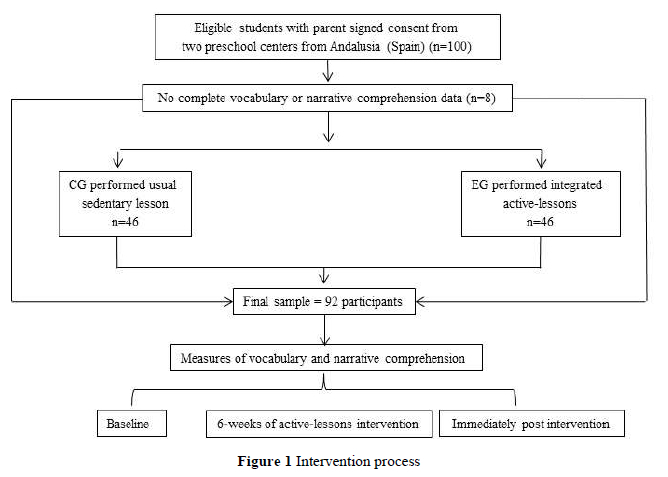
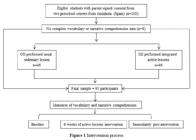
An initial total sample of 100 pre-school children participated in this study. After eliminating incomplete data, 92 children (45.7% girls) of 35.83 ± 2.57 months of age (range: 32-40) were included in the analysis (92% of the initial sample). The structure used for group formation and intervention characteristics is shown in Figure 1.
Measures
Vocabulary
For the variable, vocabulary, we used the Spanish version of the Peabody Picture Vocabulary Test -Third Edition (PPVT-III) based on pictures (Arribas, 2006; Dunn, Dunn & Arribas, 1997). This is a test of individual application and with a broad scope of application for use with people aged between 2 and 90 years old and consists of a book with pictures, notes and a user guide. It is a test that evaluates the level of receptive vocabulary and the detection of difficulties or screening of verbal aptitude. Direct scores can be transformed into percentiles, enneatypes and equivalent ages. This test has a single application form and consists of 192 elements ordered by difficulty. Each element is composed of four black-and-white images. The children's role is to point out from the four images the one that the examiner has communicated verbally. The average application time of the test is approximately 12 minutes. The reliability of the test-retest (48 hours, n = 15) was 0.878.
Narrative comprehension
The Preschool Narrative Comprehension Test was used (Strasser et al., 2010). This is an instrument that measures the narrative comprehension in pre-school children. It is composed of a book with pictures and without words called Chigüiro finds help (Da Coll, 1987). The book consists of 18 pages with colour illustrations, which tells the story of a capybara (rodent) that tries to reach some bananas. It is a simple and brief book in which the illustrations reflect the intentions, problems and emotions of the capybara (problems and resolutions). The questionnaire consists of 19 questions. Most are questions of causal inference about intentions, thoughts, feelings, problems, dialogue and resolutions. It also contains a question on literal information (characters) and another about the comprehension of the general topic of the story (title).
The task consists of three parts: introduction, preliminary vision and questions. In the introduction it is explained that the book has neither letters nor words, but the drawings tell the story. During the preliminary vision, the child is instructed to look at all the pages and to say everything he/she sees after viewing the illustrations. In the third part, 19 questions are formulated, showing the corresponding page for each question. The answers are written down literally. Each response receives 0, 1 or 2 points according to its relevance. The theoretical range of test scores is from 0 to 38 points. The reliability test-retest (48 hours, n = 15) was 0.902.
Integrated active-lessons programme based on playful games
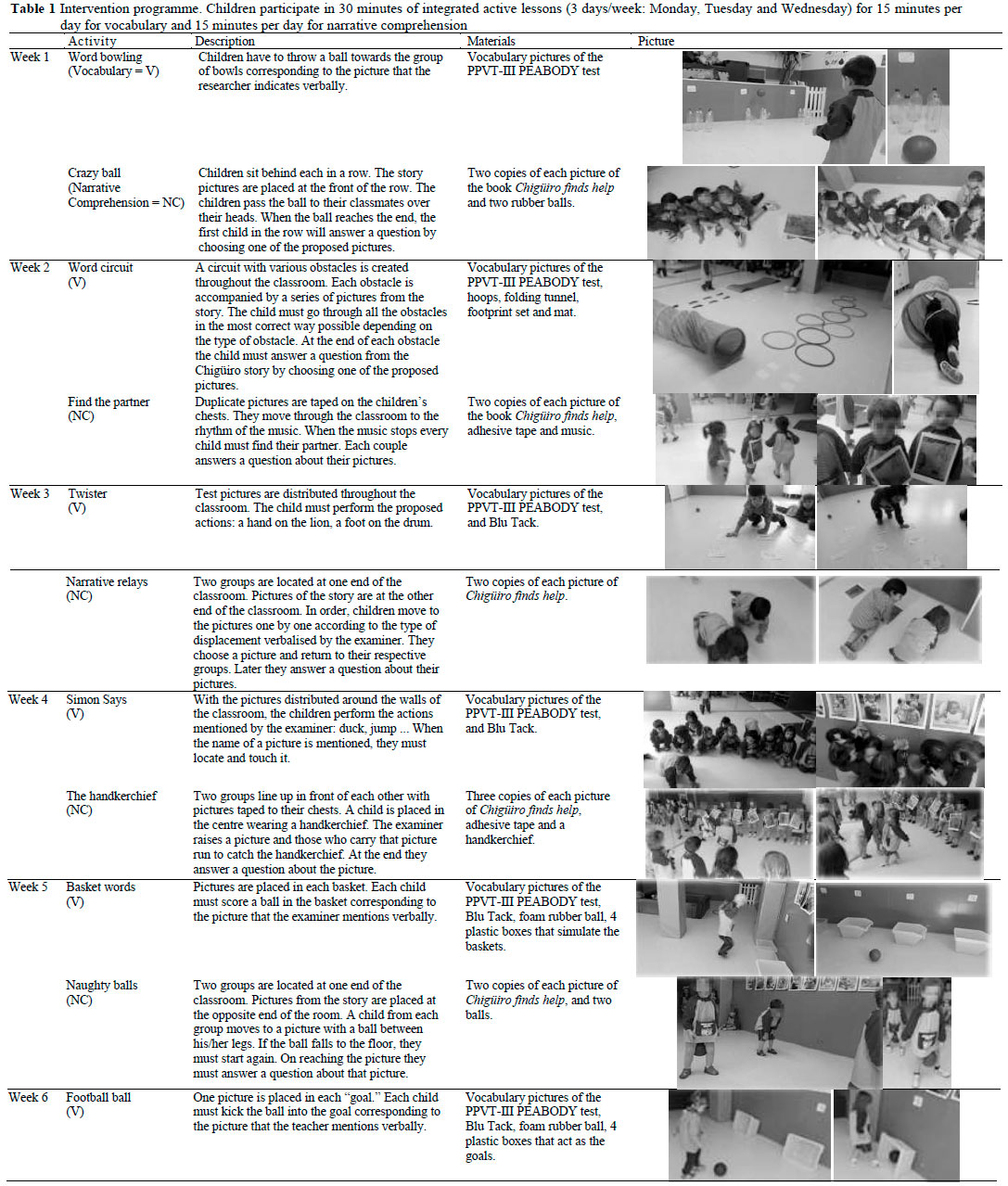
The EG underwent an integrated active-lessons programme based on playful games referred to vocabulary and narrative aspects, while CG continued with the usual and sedentary lessons about these variables (for example, children verbally repeated the same word stimuli while remaining seated). Twelve different kinds of games were used (six of them were based on vocabulary and the other six based on narrative comprehension). Each day, one game of each variable was played for 15 minutes. The rest period between games incorporated the change to and explanation of the next game. The intensity was low according to the evolutive stage of the participants (see a description of all the active playful games in Table 1).
Confounders
In this study we acknowledge Body Mass Index (BMI), PA and maternal educational level as possible confounders. Previous studies have shown that high levels of BMI (Datar, Sturm & Magnabosco, 2004) and low PA (Oberer, Gashaj & Roebers, 2017) in young children can minimise the acquisition of learning. It has also been proven that high levels of maternal educational studies are associated with greater monitoring of children's learning during the school period, affecting their school performance (Christian, Morrison & Bryant, 1998).
BMI was calculated with weight and height [weight/height (m2)]. A scale ASIMED® B-type-class III (Spain) and a portable height metre SECA® 214 (Germany) were used. Both measurements were performed on barefoot individuals dressed in light clothes. Parents reported daily PA - unstructured free play in and out of school and organised activities (Sarker, Anderson, Borkhoff, Abreo, Tremblay, Lebovic, Maguire, Parkin, Birken & TARGet Kids Collaboration, 2015; Tremblay & Connor Gorber, 2007). Parents informed about how much time their children spent outside or in a gymnasium for recess or unstructured free play, on a usual weekday: (a) during childcare/school; (b) during pre-school programme/day care; and (c) apart from childcare and pre-school programme/school and day care. This variable was called "free play." Parents also informed on how much time their children spent in organised PA on a usual weekday (i.e. swimming, football, et cetera). This question was also repeated for a usual day on the weekend. This variable was called "sports." Finally, to get the total PA, free play + sports were summed using the following formulae: free play = sum of minutes/day for three unstructured free play questions (based on age group), and sports = (5 [weekday] + 2 [weekend] / 7 = minutes/day) (Sarker et al., 2015). Maternal educational level was assessed according to these possible answers: no studies, primary school, secondary school and university (Ruiz-Ariza, Grao-Cruces, De Loureiro & Martínez-López, 2017).
Procedure
Parents signed consent forms at the beginning of the data collection. The participants' vocabulary and narrative comprehension were measured at two points: at baseline and after 6 weeks of intervention. Pre- and post-tests were performed in the classrooms between 09:00 and 11:00. The same instrument was used (PPVT-III and Chigüiro) for the pre- and post-tests, but exactly the same words were not used in the post- as in the pre-tests to avoid the learning. Both groups (control and experimental groups), were administered the same tests and the same words in both measures. During the pre-test, a sociodemographic sheet was also completed by the parents. During testing, one specialised researcher gave instructions and kept track of the time, while two research assistants helped to administer the tests and observe any possible disturbances (e.g. noise outside the classroom, children's behaviour, mistakes on some tasks, or children experiencing problems).
To perform integrated active lessons in class, each pre-school teacher received 30 minutes' instruction on the programme (three/week for 6 weeks). The schedule was always the same (between 12:00 and 12:30). For this objective, a 1-day training programme in a real context was provided before the start of the intervention by the researchers who had developed the programme. The CG did not undergo the special programme. They continued with their usual sedentary lessons sitting at their desks with the same number and type of stimuli than the EG during the 30-minute intervention period. In addition, families received a report about their children with a full assessment of the results.
This study was approved by the Bioethics Committee of the University of Jaen (Spain), reference: CEIH211015. The design complied with the Spanish regulations for clinical research in humans (Law 14/2007, July 3rd, Biomedical Research), with the regulations for private data protection (Organic Law 15/1999) and with the principles of the Declaration of Helsinki (2013 version, Brazil).
Data Analysis
The comparison of the continuous and categorical variables according to participation in the study (CG vs EG), was carried out through students' /-tests and χ2, respectively. Tests of normal distribution and homogeneity (Kolmogorov-Smirnov and Levene's) were conducted before the analysis. To study the relationship between variables, Pearson's correlation was used. The repeated measures analysis of covariance (ANCOVA) two times (pre-, post-test) times two groups (CG, EG) was used to analyse the effects of 6 weeks of integrated active lessons. Vocabulary and narrative comprehension were used as dependent variables, the groups were used as fixed factors, and BMI, PA and the educational level of mothers as confounders. Post hoc analysis was adjusted by Bonferroni. The effect size was computed and reported as a partial η2 value for the analysis of variance (ANOVA) evaluations. To quantify the magnitude of changes between and within groups in the dependent variables, we calculated Cohen's d effect sizes. A Cohen's d value > 0.8 indicates a large effect size, a Cohen's d value > 0.5 < 0.8 indicates a medium effect size, and a Cohen's d value > 0.2 < 0.5 indicates a small effect size (Cohen, 1998). Analyses were carried out separately for each dependent variable. For all the analyses, a 95% confidence level was used (p < 0.05). The percentage of change between groups after the integrated active-lessons programme was calculated as: (EG post-measurement - CG post-measurement)/CG post-measurement x 100.) The analyses were completed using the Statistical Package for the Social Sciences ([SPSS] v.22 for Windows).
Results
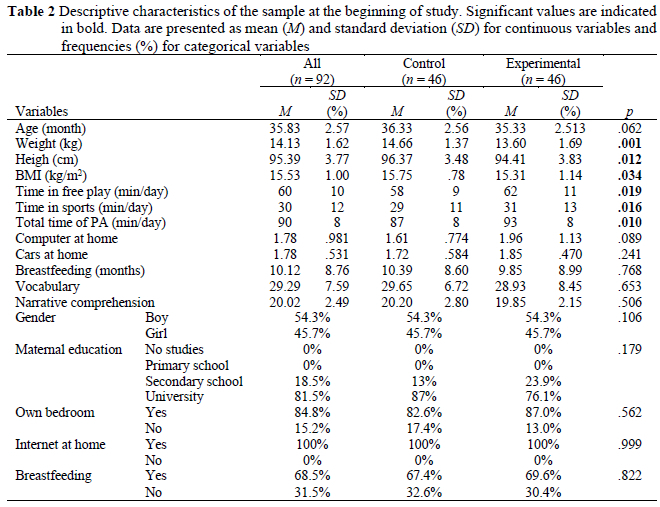
Descriptive Analysis and Correlations Table 2 shows the descriptive characteristics of the study sample. Significant differences between the CG and the EG were not found in vocabulary or narrative comprehension in pre-measurements, however there were differences in weight (M = 14.66 ± 1.37 vs. M = 13.60 ± 1.6 kg; p = 0.001), height (M = 96.37 ± 3.48 vs. M = 94.41 ± 3.83 cm; p = 0.012) and BMI (M = 15.75 ± 0.78 vs. M = 15.31 ± 1.14 kg/m2; p = 0.034), with higher scores in the CG. The EG had higher scores on time in free play (min/day) (M = 62.41 ± 11.32 vs. M = 58.39 ± 9.51; p = 0.019), time in sports (min/day) (M = 31.56 ± 13.01 vs. M = 29.77 ± 11.33; p = 0.016), and total time of PA (min/day) (M = 93.63 ± 8.56 vs. M = 87.11 ± 8.74; p = 0.010).
Participants reported similar results in other sociodemographic variables analysed. Thus, preschool children's families had 1.78 ± 0.9 computers and 1.78 ± 0.53 cars at home; 68.5% of the study sample had been breastfed (10.12 ± 8.76 months), 85.1% of mothers had studied at university, 84.8% of the children had their own bedroom and 100% had internet at home. No significant correlation was found between the variables "vocabulary" and "narrative comprehension" in pre-school children (r = 0.017, p > 0.05). Finally, a previous analysis showed no differences according to gender (girls vs boys) and age (31-36 vs. 37-42 months) in the dependent variables (both p > 0.05) (data not shown).
ANCOVA analysis of 6 weeks of integrated active lessons on vocabulary and narrative comprehension
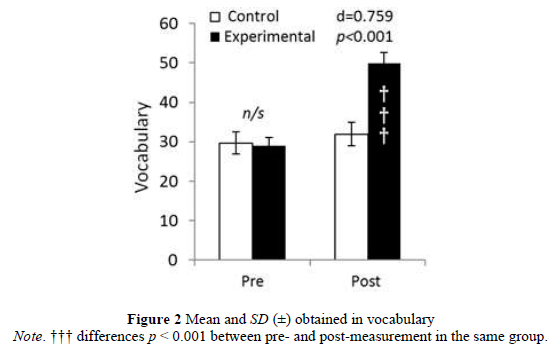
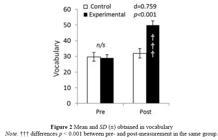
Figure 2 shows the results of the ANCOVA analysis, where vocabulary was used as dependent variable, the group (CG vs EG) as fixed factor, and BMI, PA and the educational level of mothers as confounders. Results on vocabulary show a time main effect F(1,86) = 5.934, p = 0.017, η2 = 0.065, 1-β = 0.676; a group main effect F(1,86) = 34.135, p < 0.001, η2 = 0.284, 1-β > 0.999, and an interaction time X group F(1,86) = 174.387, p < 0.001, η2 = 0.670, 1 -β > 0.999. Intergroup analysis shows that the EG had a 56.12% greater improvement in vocabulary compared to the CG after the programme (EG = 49.89 ± 8.54 vs CG = 31.96 ± 6.70 arbitrary units (a.u.), p < 0.001, Cohen's d = 0.759). The EG increased vocabulary significantly after 6 weeks of integrated active lessons, compared to the pre-measurement (Pre- = 28.93 ± 8.447 vs post- = 49.89 ± 8.541 a.u., p < 0.001, Cohen's d = 0.776). No significant differences were found between groups in the pre-measurement (EG = 28.93 ± 8.44 vs CG = 29.65 ± 6.72 a.u.), or in the pre-/post- measurements within the CG (29.65 ± 6.72 vs 31.96 ± 6.70 a.u.), both p > 0.05.
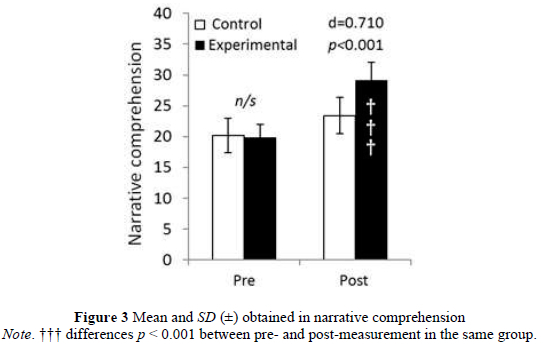
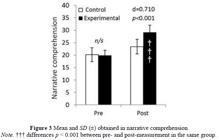
Results on narrative comprehension show a time main effect F(1,86) = 8.572, p = 0.004, η2 = 0.091, 1-β = 0.825, a group main effect F(1,86) = 29.692, p < 0.001, η2 = 0.257, 1-β > 0.999, and a time X group interaction F(1,86) = 122.373, p < 0.001, η2 = 0.587, 1-β > 0.999. Intergroup analysis shows that the EG had a 24.73% greater improvement in narrative comprehension compared to the CG after the programme (EG = 29.20 ± 2.80 vs. CG = 23.41 ± 2.93 a.u., p < 0.001, Cohen's d = 0.710). The EG had increased significantly in narrative comprehension after 6 weeks of the integrated active-lessons programme, compared to pre-measurement (Pre- = 19.85 ± 2.10 vs Post- = 29.20 ± 2.80 a.u., p < 0.001, Cohen' s d = 0.883). No significant differences were found between groups in the pre-measurement (CG = 1 9.85 ± 2.10 vs EG = 20.20 ± 2.80 a.u.), nor in the pre/post-measurements within the CG (20.20 ± 2.80 vs.19.85 ± 2.10 a.u.), both p > 0.05 (cf. Figure 3).
Discussion
With this research we studied the effect of an active-lessons programme through playful games on vocabulary and narrative comprehension in pre-school children. Results show that 30 minute per day (3 days/week for 6 weeks) improved preschool learners' vocabulary by 56.1% and narrative comprehension by 24.7%, independently of BMI, weekly PA practice and maternal educational level. In addition, the results do not vary according to gender and age (31-36 and 37-42 months). The results of this research show the improvement effects of playful games on vocabulary and narrative comprehension, which until now, were unknown regarding pre-school children.
Mavilidi et al. (2015) proposed similar research to ours, but their aim was to integrate physical exercise into learning vocabulary of a foreign language. For example, for the word "fly", children ran and moved their hands as if they were flying. In this context, Pesce et al. (2009) concluded that acute sessions of PA might facilitate memory and minimise vocabulary consolidation time. Other studies have provided evidence for the positive effects of gestures on language learning. Macedonia and Klimesch (2014) showed that the encoding of novel words from an artificial language were better achieved when information was presented through gestures rather than audio-visually. Thus, gesturing can be of powerful help to learning foreign languages in pre-school children. In general, in line with our findings, the integrated active lessons had higher linguistic learning scores, participants were more physically active, and enjoyed the learning process more.
Our positive results are also in line with other pioneer studies integrating active lessons in early childhood. For example, in the last 5 years, Mavilidi et al. have proposed different interventions of 10 to 15 minutes per day, 1 day per week for 4 weeks. They aimed to include learning of vocabulary related to geography through a typical animal from each of the six continents using a world map placed on the floor. In the integrated PA condition, children "travelled" from one continent to the other imitating the movements of the animal representing the continent (e.g. hop like a kangaroo starting from Oceania). In the non-integrated PA condition, children just ran around the map. Children in both conditions learned better and enjoyed their learning the most (Mavilidi et al., 2016). One year later, the same authors analysed the effects of moving from the sun to mercury and repeat the same process for all planets while learning about the planets' names and their distance from the sun. In this sense, they learnt specific vocabulary and needed to use comprehension. This EG had the highest learning results in the science lesson (Mavilidi et al., 2017).
The lack of specific information regarding the analysed variables makes a comparison with our findings difficult. However, when similar active methods were employed, learning results in other variables were mostly satisfactory. For example, Vetter, O' Connor, O' Dwyer and Orr (2018) aimed to focus on active lessons in maths and they proposed the Maths on the Move programme, based on the effectiveness of learning the important numeracy skill of time tables while concurrently engaging in aerobic activity, compared with a seated classroom approach (20 min/day, 3 days/week for 6 weeks). The results show that numeracy was significantly greater for the EG. Another research showed that 15 minutes of active lessons in pre-school children could be positive with regard to learning geometry by forming different shapes with their bodies (i.e. squares or triangles) while walking or hopping on an outdoor playfield, or in learning cardinal directions by running to the appropriate area allocated (Donnelly & Lambourne, 2011). In another study, Bartholomew and Jowers (2011) observed positive effects on time after 4 weeks' instruction in the TEXAS-I CAN!® programme (50 min x 4/5 days/week with four to six metabolic equivalents of tasks [METS]). Donnelly et al. (2009, 2017) found improvement in cognitive performance after 3 years of using active lessons (10 min x two times/day x 5 days/week) or TAKE 10!® (10 min x nine times/week). With a similar programme, Mullender-Wijnsma et al. (2016) also observed improvements in mathematic scores. In the medium term, active lessons over 3 months (30 min/day x 3 days/week) also improved scores in social studies (Reed, Einstein, Hanh, Hooker, Gross & Kravitz, 2010). Therefore, this method based on active lessons through playful learning seems to be an adequate option to improve general learning in early ages beyond linguistic abilities.
Some reasons for our findings could be explained through several mechanisms. All human movements have been shown to affect learning and cognition (Mavilidi et al., 2018). Based on this theoretical assumption of shared information processes in both motor and cognitive control, this hypothesis explains intervention effects in terms of the specific activation of these processes during PA, which promotes cognitive benefits (Schmidt, Jäger, Egger, Roebers & Conzelmann, 2015). For example, playing while running towards different letters according to a linguistic task requires the ability to discriminate between different responses, visual stimuli, and to make appropriate motor decisions. In this way, physical and cognitive tasks involve exactly the same cognitive processes in a single exercise (Schmidt et al., 2015). Furthermore, Schmidt, Benzing, Wallman-Jones, Mavilidi, Lubans and Paas (2019) have recently indicated that whereas the simple PA condition promotes a medium effect size (d = 0.51), the physical-cognitive scenario leads to a large effect size on cognitive variables (d = 1.12).
The explanation used as the analytical lens for this study can be focused on gross motor or whole-body movements, promoting physiological mechanisms, as well as the effects of fine motor or part-body movements, such as gestures explained by cognitive mechanisms such as embodied learning or cognitive load theory (Ruiz-Ariza et al., 2021). Authors such as Mavilidi et al. (2015) and Mavilidi and Zhong (2019) define the embodied learning theory as teaching-learning strategies in which the body interacts with content and knowledge, which consequently favours learning, memory, and the construction of conceptual maps. Furthermore, physical experiences involving observation and manipulation by pre-school children are considered fundamental to the understanding of the acquisition of vocabulary and abstract concepts (Zacharia, Loizou & Papaevripidou, 2012). Uttal, Miller and Newcombe (2013) also showed that proposing symbolic representations, analogies or gestures to understand the concepts of subjects such as mathematics or sciences was better for learners' academic performance. Thus, it is argued that embodying knowledge through motor actions contributes to the construction of mental representations and conceptual assimilation of higher quality, facilitating memory and learning (Madan & Singhal, 2012).
Complementary to the embodied cognition theoretical framework is the evolutionary explanation of cognitive load theory, which categorises information into biologically primary and secondary knowledge (Madan & Singhal, 2012; Paas & Sweller, 2012). Biologically primary knowledge evolves naturally without explicit instruction, for example, the development of a native language that it is a kind of knowledge that does not need a load on memory and can be acquired directly without formal instruction or the use of unconscious movements. And later people acquire biologically secondary knowledge through learning, such as reading and narrative comprehension (Mavilidi & Zhong, 2019). Primary knowledge can be employed to support the learning of complex tasks of secondary knowledge (Mavilidi et al., 2018). From the perspective of cognitive load theory, research shows that visual and motor processes in the brain are involved during cognitive tasks, such as text comprehension, mental arithmetic, reasoning, and problem-solving, while semantic codes are activated during specific motor actions illustrating the inter-relationship of cognitive and sensorimotor mechanisms (Mavilidi et al., 2018). For example, hand gesturing can reduce a speaker's cognitive load during instruction and task resolution (Goldin-Meadow, Nusbaum, Kelly & Wagner, 2001). The evidence has shown that connecting action and perception during instruction can be a way to promote and consolidate better comprehension and learning (Mavilidi & Zhong, 2019; Paas & Sweller, 2012). Some authors have shown that activation of the motor system during the language process enhances memory retrieval and encoding, such as learning. Linguistic performance can be better when verbal instructions are carried out while learning. Thus, corporal movements can connect different modalities such as verbal, visual and motor skills potentiating an integral development (Mavilidi et al., 2015). Another explanation can be based on mirror neurons. When children look at others' or peers' movements, they activate neurons that are related to the same action in the motor cortex. Children in the integrated active-lessons group may have activated the relevant neurons linked with the PA actions in their motor cortex, which, enhanced by the movements, transform that information into the acquisition of knowledge (Mavilidi et al., 2015, 2019).
Other justifications for the effect of integrated active lessons on learning could be found in the known improvements of PA based on whole-body movements (Mavilidi et al., 2015). Erickson, Hillman and Kramer (2015) reviewed the effect of PA on brain structure, brain function, and academic performance. They concluded that more active children showed a range of physiological benefits (for example, greater grey matter volume in the hippocampus, more effective brain activity patterns), performed better in tasks that required executive control and associative memory, and showed higher academic achievement. Another recent meta-analysis by Vazou, Pesce, Lakes and Smiley-Oyen (2016) showed that PA interventions positively affected children's cognitive functioning (Hedge's g = 0.46). These improvements have effects on neuronal efficiency, speed in decision-making (Chaddock-Heyman, Hillman, Cohen & Kramer, 2014), and an increase in angiogenesis, neurogenesis, synaptogenesis and brain-derived neurotrophic factor (Adkins, Boychuk, Remple & Kleim, 2006; Sleiman, Henry, Al-Haddad, El Hayek, Abou Haidar, Stringer, Ulja, Karuppagounder, Holson, Ratan, Ninan & Chao, 2016). In addition, PA programmes can raise the level of serotonin or norepinephrine (Li, O'Connor, O'Dwyer & Orr, 2017). These physiological adaptations increased arousal and available attentional resources, facilitating cognition (Schmidt et al., 2019). Additional reasons may be that PA balances cortisol levels, reducing the anxiety and stress levels during academic tasks (Hillier, Murphy & Ferrara, 2011). Likewise, this stimulus could increase self-esteem or motivation, and might optimise social behaviour in competing in each playful game. All these improvements could be caused, among other reasons, by an increase in the changes in the brain's prefrontal regions during integrated active lessons (Mavilidi et al., 2018).
Limitations and Strength
The main limitation of the study could be that the sample was too small to be representative of the population studied. Convenience sampling is another limiting factor. The lack of previous studies on the active-lessons programme through playful games and its relationship with the variables studied in this population group make it difficult to compare our results. It would be interesting to analyse the effect of these active lessons on other physical or cognitive variables. In addition, accelerometers should be used in future studies to quantify the amount of PA during active lessons. Another limitation is that we do not know whether the participants enjoyed this programme or not. Maybe a pictorial satisfaction questionnaire would have been useful. As strength, our study provides new data and knowledge that help improve teaching and educational practice, as well as promoting active lessons from an early age to improve the learning process.
Educational Implications and Practical Recommendations
Our findings suggest including active playful games within the classroom in the pre-school stage. We observed improved motivation and participation, social relationships, and greater effort in class, and children showed more attention and enthusiasm towards learning tasks. Regarding the teacher's role, in addition to the previous effort of planning, this kind of programme also requires a high level of supervision during its implementation. The teacher has to make the playful aspects compatible with meaningful learning, maintain motivation and be attentive to encourage participation and individualisation of learning.
Therefore, as practical recommendations, we suggest that educational centres encourage the inclusion of these active methodologies for their teachers. Physical Education (PE) should play a transversal role in the school curriculum and should serve as a means in the teaching-learning process of a great variety of content from an early age (i.e. vocabulary or narrative comprehension). In addition, non-specialist teachers at the pre-school level should be instructed in the application of active lessons. It is suggested that at least 30 minutes of active lessons per day for at least 3 days per week should be included. Active lessons could be based on traditional games or playful activities rather than sedentary behaviour during academic classes (Mavilidi et al., 2020). Finally, it would be interesting to combine these active lessons with other different school-based PA programmes during the school day, either through active recess or active breaks, increasing the intensity of PA in PE classes, or with hybrid programmes integrating extracurricular PA and active lessons (Martínez-López, Ruiz-Ariza, De la Torre-Cruz & Suárez-Manzano, 2021).
Conclusion
We conclude that the application of an active-lessons programme through playful games for 6 weeks (30 min/day x 3 days/week) significantly increased the vocabulary and narrative comprehension of pre-school children. These findings seem not to vary according to gender and age (31-36 and 37-42 months). The introduction of active lessons based on playful games within the classroom as support for the acquisition of vocabulary and narrative comprehension in early childhood education is suggested.
Authors' Contributions
ARA and ACM conducted the intervention and provided data for the results; EJML conducted all statistical analyses; ACM and SSM wrote and reviewed the manuscript. All authors reviewed the final version of the manuscript.
Notesi. This article is based on the doctoral thesis of Alba Cámara-Martínez.
ii. Published under a Creative Commons Attribution Licence.
Acknowledgments
We would like to thank the participants who helped develop this research as well as the T+I project of the University of Jaen (pIMED54_201921), and the University Teacher Training Programme (grant number AP-2016-07226), implemented by the Government of Spain, for supporting and financing this project.
References
-
Adkins DL, Boychuk J, Remple MS & Kleim JA 2006. Motor training induces experience-specific patterns of plasticity across motor cortex and spinal cord. Journal of Applied Physiology, 101(6):1776-1782. https://doi.org/10.1152/japplphysiol.00515.2006
» https://doi.org/10.1152/japplphysiol.00515.2006 - Arribas D 2006. Spanish adaptation of PPVT-III Peabody test of vocabulary in pictures. Madrid, Spain: TEA Ediciones.
-
Bartholomew JB & Jowers EM 2011. Physically active academic lessons in elementary children. Preventive Medicine, 52:S51-S54. https://doi.org/10.1016/j.ypmed.2011.01.017
» https://doi.org/10.1016/j.ypmed.2011.01.017 - Biemiller A 2001. Teaching vocabulary: Early, direct, and sequential. American Educator, 25(1):24-28.
-
Chaddock-Heyman L, Hillman CH, Cohen NJ & Kramer AF 2014. III. The importance of physical activity and aerobic fitness for cognitive control and memory in children. Monographs of the Society for Research in Child Development, 79(4):25-50. https://doi.org/10.1111/mono.12129
» https://doi.org/10.1111/mono.12129 -
Christian K, Morrison FJ & Bryant FB 1998. Predicting kindergarten academic skills: Interactions among child care, maternal education, and family literacy environments. Early Childhood Research Quarterly, 13(3):501-521. https://doi.org/10.1016/S0885-2006(99)80054-4
» https://doi.org/10.1016/S0885-2006(99)80054-4 -
Cohen J 1988. Statistical power analysis for the behavioral sciences (2nd ed). New York, NY: Routledge. https://doi.org/10.4324/9780203771587
» https://doi.org/10.4324/9780203771587 -
Curenton SM 2011. Understanding the landscapes of stories: The association between preschoolers' narrative comprehension and production skills and cognitive abilities. Early Child Development and Care, 181(6):791 -808. https://doi.org/10.1080/03004430.2010.490946
» https://doi.org/10.1080/03004430.2010.490946 - Da Coll I 1987. Chigüiro finds help. Bogotá, Colombia: Babel Libros.
-
Datar A, Sturm R & Magnabosco JL 2004. Childhood overweight and academic performance: National study of kindergartners and first-graders. Obesity Research, 12(1):58-68. https://doi.org/10.1038/oby.2004.9
» https://doi.org/10.1038/oby.2004.9 -
Donnelly JE, Greene JL, Gibson CA, Smith BK, Washburn RA, Sullivan DK, DuBose K, Mayo MS, Schmelzle KH, Ryan JJ, Jacobsen DJ & Williams SL 2009. Physical Activity Across the Curriculum (PAAC): A randomized controlled trial to promote physical activity and diminish overweight and obesity in elementary school children. Preventive Medicine, 49(4):336-341. https://doi.org/10.1016/j.ypmed.2009.07.022
» https://doi.org/10.1016/j.ypmed.2009.07.022 -
Donnelly JE, Hillman CH, Greene JL, Hansen DM, Gibson CA, Sullivan DK, Poggio J, Mayo MS, Lambourne K, Szabo-reed AN, Herrmann SD, Honas JJ, Scudder MR, Betts JL, Henley K, Hunt SL & Washburn RA 2017. Physical activity and academic achievement across the curriculum: Results from a 3-year cluster-randomized trial. Preventive Medicine, 99:140145. https://doi.org/10.1016/j.ypmed.2017.02.006
» https://doi.org/10.1016/j.ypmed.2017.02.006 -
Donnelly JE & Lambourne K 2011. Classroom-based physical activity, cognition, and academic achievement. Preventive Medicine, 52:S36-S42. https://doi.org/10.1016/j.ypmed.2011.01.021
» https://doi.org/10.1016/j.ypmed.2011.01.021 - Dunn L, Dunn L & Arribas D 1997. PPVT-III Peabody, test of vocabulary in pictures. Madrid, Spain: TEA Ediciones.
-
Erickson KI, Hillman CH & Kramer AF 2015. Physical activity, brain, and cognition. Current Opinion in Behavioral Sciences, 4:27-32. https://doi.org/10.1016/j.cobeha.2015.01.005
» https://doi.org/10.1016/j.cobeha.2015.01.005 -
Goldin-Meadow S, Nusbaum H, Kelly SD & Wagner S 2001. Explaining math: Gesturing lightens the load. Psychological Science, 12(6):516-522. https://doi.org/10.1111/1467-9280.00395
» https://doi.org/10.1111/1467-9280.00395 -
Hillier A, Murphy D & Ferrara C 2011. A pilot study: Short-term reduction in salivary cortisol following low level physical exercise and relaxation among adolescents and young adults on the autism spectrum. Stress & Health, 27(5):395-402. https://doi.org/10.1002/smi.1391
» https://doi.org/10.1002/smi.1391 -
Hillman CH, Kamijo K & Scudder M 2011. A review of chronic and acute physical activity participation on neuroelectric measures of brain health and cognition during childhood. Preventive Medicine, 52:S21-S28. https://doi.org/10.1016/j.ypmed.2011.01.024
» https://doi.org/10.1016/j.ypmed.2011.01.024 -
Lahuerta-Contell S, Molina-García J, Queralt A & Martínez-Bello VE 2021. The role of preschool hours in achieving physical activity recommendations for preschoolers. Children, 8(2):82. https://doi.org/10.3390/children8020082
» https://doi.org/10.3390/children8020082 -
Lee J 2011. Size matters: Early vocabulary as a predictor of language and literacy competence. Applied Psycholinguistics, 32(1):69-92. https://doi.org/10.1017/S0142716410000299
» https://doi.org/10.1017/S0142716410000299 -
Li JW, O'Connor H, O'Dwyer N & Orr R 2017. The effect of acute and chronic exercise on cognitive function and academic performance in adolescents: A systematic review. Journal of Science and Medicine in Sport, 20(9):841-848. https://doi.org/10.1016/j.jsams.2016.11.025
» https://doi.org/10.1016/j.jsams.2016.11.025 -
Lynch JS, Van den Broek P, Kremer KE, Kendeou P, White MJ & Lorch EP 2008. The development of narrative comprehension and its relation to other early reading skills. Reading Psychology, 29(4):327-365. https://doi.org/10.1080/02702710802165416
» https://doi.org/10.1080/02702710802165416 -
Macedonia M & Klimesch W 2014. Long-term effects of gestures on memory for foreign language words trained in the classroom. Mind, Brain, and Education, 8(2):74-88. https://doi.org/10.1111/mbe.12047
» https://doi.org/10.1111/mbe.12047 -
Madan CR & Singhal A 2012. Encoding the world around us: Motor-related processing influences verbal memory. Consciousness and Cognition, 21(3):1563-1570. https://doi.org/10.1016/jxoncog.2012.07.006
» https://doi.org/10.1016/jxoncog.2012.07.006 -
Martínez-López EJ, Ruiz-Ariza A, De la Torre-Cruz M & Suárez-Manzano S 2021. Las alternativas de actividad física en horario escolar y sus efectos en la cognición. Una revisión sistemática y guía práctica educative [Alternatives of physical activity within school times and effects on cognition. A systematic review and educational practical guide]. Psicología Educativa, 27(1):37-50. https://doi.org/10.5093/psed2020a16
» https://doi.org/10.5093/psed2020a16 -
Mavilidi MF, Lubans DR, Miller A, Eather N, Morgan PJ, Lonsdale C, Noetel M, Karayanidis F, Shaw K & Riley N 2020. Impact of the "Thinking while Moving in English" intervention on primary school children's academic outcomes and physical activity: A cluster randomised controlled trial. International Journal of Educational Research, 102:101592. https://doi.org/10.1016/j.ijer.2020.101592
» https://doi.org/10.1016/j.ijer.2020.101592 -
Mavilidi MF, Okely AD, Chandler P, Cliff DP & Paas F 2015. Effects of integrated physical exercises and gestures on preschool children's foreign language vocabulary learning. Educational Psychology Review, 27(3):413-426. https://doi.org/10.1007/s10648-015-9337-z
» https://doi.org/10.1007/s10648-015-9337-z -
Mavilidi MF, Okely A, Chandler P, Domazet SL & Paas F 2018. Immediate and delayed effects of integrating physical activity into preschool children's learning of numeracy skills. Journal of Experimental Child Psychology, 166:502519. https://doi.org/10.1016/jjecp.2017.09.009
» https://doi.org/10.1016/jjecp.2017.09.009 -
Mavilidi MF, Okely AD, Chandler P & Paas F 2016. Infusing physical activities into the classroom: Effects on preschool children' s geography learning. Mind, Brain, and Education, 10(4):256-263. https://doi.org/10.1111/mbe.12131
» https://doi.org/10.1111/mbe.12131 -
Mavilidi MF, Okely AD, Chandler P & Paas F 2017. Effects of integrating physical activities into a science lesson on preschool children' s learning and enjoyment. Applied Cognitive Psychology, 3(31):281-290. https://doi.org/10.1002/acp.3325
» https://doi.org/10.1002/acp.3325 -
Mavilidi MF & Zhong L 2019. Exploring the development and research focus of cognitive load theory, as described by its founders: Interviewing John Sweller, Fred Paas, and Jeroen van Merriënboer. Educational Psychology Review, 31(2):499-508. https://doi.org/10.1007/s10648-019-09463-7
» https://doi.org/10.1007/s10648-019-09463-7 -
McCrady-Spitzer SK, Manohar CU, Koepp GA & Levine JA 2015. Low-cost and scalable classroom equipment to promote physical activity and improve education. Journal of Physical Activity and Health, 12(9): 1259-1263. https://doi.org/10.1123/jpah.2014-0159
» https://doi.org/10.1123/jpah.2014-0159 -
McMullen JM, MacPhail A & Dillon M 2019. "I want to do it all day!"-Students' experiences of classroom movement integration. International Journal of Educational Research, 94:52-65. https://doi.org/10.1016/jijer.2018.11.014
» https://doi.org/10.1016/jijer.2018.11.014 -
Minges KE, Chao AM, Irwin ML, Owen N, Park C, Whittemore R & Salmon J 2016. Classroom standing desks and sedentary behavior: A systematic review. Pediatrics, 137(2):e20153087. https://doi.org/10.1542/peds.2015-3087
» https://doi.org/10.1542/peds.2015-3087 -
Mullender-Wijnsma MJ, Hartman E, De Greeff JW, Doolaard S, Bosker RJ & Visscher C 2016. Physically active math and language lessons improve academic achievement: A cluster randomized controlled trial. Pediatrics, 137(3):e20152743. https://doi.org/10.1542/peds.2015-2743
» https://doi.org/10.1542/peds.2015-2743 -
Oberer N, Gashaj V & Roebers CM 2017. Motor skills in kindergarten: Internal structure, cognitive correlates and relationships to background variables. Human Movement Science, 52:170-180. https://doi.org/10.1016/J.HUMOV.2017.02.002
» https://doi.org/10.1016/J.HUMOV.2017.02.002 -
Paas F & Sweller J 2012. An evolutionary upgrade of cognitive load theory: Using the human motor system and collaboration to support the learning of complex cognitive tasks. Educational Phychology Review, 24(1):27-45. https://doi.org/10.1007/s10648-011-9179-2
» https://doi.org/10.1007/s10648-011-9179-2 -
Paris AH & Paris SG 2003. Assessing narrative comprehension in young children. Reading Research Quarterly, 38(1):36-76. https://doi.org/10.1598/RRQ.38.L3
» https://doi.org/10.1598/RRQ.38.L3 -
Pesce C, Crova C, Cereatti L, Casella R & Bellucci M 2009. Physical activity and mental performance in preadolescents: Effects of acute exercise on free-recall memory. Mental Health and Physical Activity, 2(1):16-22. https://doi.org/10.1016/j.mhpa.2009.02.001
» https://doi.org/10.1016/j.mhpa.2009.02.001 -
Reed JA, Einstein G, Hanh E, Hooker SP, Gross VP & Kravitz J 2010. Examining the impact of integrating physical activity on fluid intelligence and academic performance in an elementary school setting: A preliminary investigation. Journal of Physical Activity and Health, 7(3):343-351. https://doi.org/10.1123/jpah.7.3.343
» https://doi.org/10.1123/jpah.7.3.343 -
Rowe ML, Raudenbush SW & Goldin-Meadow S 2012. The pace of vocabulary growth helps predict later vocabulary skill. Child Development, 83(2):508-525. https://doi.org/10.1111/j.1467-8624.2011.01710.x
» https://doi.org/10.1111/j.1467-8624.2011.01710.x -
Ruiz-Ariza A, Grao-Cruces A, De Loureiro NEM & Martínez-López EJ 2017. Influence of physical fitness on cognitive and academic performance in adolescents: A systematic review from 20052015. International Review of Sport and Exercise Psychology, 10(1): 108-133. https://doi.org/10.1080/1750984X.2016.1184699
» https://doi.org/10.1080/1750984X.2016.1184699 -
Ruiz-Ariza A, Suárez-Manzano S, López-Serrano S & Martínez-López EJ 2021. Physical activity as means of cultivating intelligence in a school context [La actividad física como medio para cultivar la inteligencia en el contexto escolar]. Revista Espanola de Pedagogía, 79(278):161177. https://doi.org/10.22550/REP79-1-2021-04
» https://doi.org/10.22550/REP79-1-2021-04 -
Sarker H, Anderson LN, Borkhoff CM, Abreo K, Tremblay MS, Lebovic G, Maguire JL, Parkin PC, Birken CS & The TARGet Kids Collaboration 2015. Validation of parent-reported physical activity and sedentary time by accelerometry in young children. BMC Research Notes, 8:735. https://doi.org/10.1186/s13104-015-1648-0
» https://doi.org/10.1186/s13104-015-1648-0 -
Schmidt M, Benzing V, Wallman-Jones A, Mavilidi MF, Lubans DR & Paas F 2019. Embodied learning in the classroom: Effects on primary school children's attention and foreign language vocabulary learning. Psychology of Sport and Exercise, 43:45-54. https://doi.org/10.1016/IPSYCHSPORT.2018.12.017
» https://doi.org/10.1016/IPSYCHSPORT.2018.12.017 -
Schmidt M, Jäger K, Egger F, Roebers CM & Conzelmann A 2015. Cognitively engaging chronic physical activity, but not aerobic exercise, affects executive functions in primary school children: A group-randomized controlled trial. Journal of Sport and Exercise Psychology, 37(6):575-591. https://doi.org/10.1123/jsep.2015-0069
» https://doi.org/10.1123/jsep.2015-0069 -
Schulze S & Van Heerden M 2015. Learning environments matter: Identifying influences on the motivation to learn science. South African Journal of Education, 35(2):Art. # 1058, 9 pages. https://doi.org/10.15700/saje.v35n2a1058
» https://doi.org/10.15700/saje.v35n2a1058 -
Sleiman SF, Henry J, Al-Haddad R, El Hayek L, Abou Haidar E, Stringer T, Ulja D, Karuppagounder SS, Holson EB, Ratan RR, Ninan I & Chao MV 2016. Exercise promotes the expression of brain derived neurotrophic factor (BDNF) through the action of the ketone body β-hydroxybutyrate. eLife, 5:e15092. https://doi.org/10.7554/eLife.15092
» https://doi.org/10.7554/eLife.15092 -
Snell EK, Wasik BA & Hindman AH 2022. Text to talk: Effects of a home-school vocabulary texting intervention on prekindergarten vocabulary. Early Childhood Research Quarterly, 60:67-79. https://doi.org/10.1016/j.ecresq.2021.12.011
» https://doi.org/10.1016/j.ecresq.2021.12.011 -
Strasser K & Del Rio F 2014. The role of comprehension monitoring, theory of mind, and vocabulary depth in predicting story comprehension and recall of kindergarten children. Reading Research Quarterly, 49(2):169-187. https://doi.org/10.1002/rrq.68
» https://doi.org/10.1002/rrq.68 -
Strasser K, Larrain A, López de Lérida S & Lisi MR 2010. La comprensión narrativa en edad preescolar: Un instrumento para su medición [Narrative comprehension in preschool age: An instrument for its measurement]. Psykhe, 19(1):75-87. https://doi.org/10.4067/S0718-22282010000100006
» https://doi.org/10.4067/S0718-22282010000100006 -
Tellier M 2008. The effect of gestures on second language memorisation by young children. Gesture, 8(2):219-235. https://doi.org/10.1075/gest8.2O6tel
» https://doi.org/10.1075/gest8.2O6tel -
Tremblay MS & Connor Gorber S 2007. Canadian Health Measures Survey: Brief overview. Canadian Journal of Public Health, 98(6):453-456. https://doi.org/10.1007/bf03405437
» https://doi.org/10.1007/bf03405437 -
Trost SG, Fees B & Dzewaltowski D 2008. Feasibility and efficacy of a "move and learn" physical activity curriculum in preschool children. Journal of Physical Activity and Health, 5(1):88-103. https://doi.org/10.1123/jpah.5.1.88
» https://doi.org/10.1123/jpah.5.1.88 -
Uttal DH, Miller DI & Newcombe NS 2013. Exploring and enhancing spatial thinking: Links to achievement in science, technology, engineering, and mathematics? Current Directions in Psychological Science, 22(5):367-373. https://doi.org/10.1177/0963721413484756
» https://doi.org/10.1177/0963721413484756 -
Vazou S, Pesce C, Lakes K & Smiley-Oyen A 2016. More than one road leads to Rome: A narrative review and meta-analysis of physical activity intervention effects on cognition in youth. International Journal of Sport and Exercise Psychology, 17(2):153-178. https://doi.org/10.1080/1612197X.2016.1223423
» https://doi.org/10.1080/1612197X.2016.1223423 -
Vetter M, O'Connor H, O'Dwyer N & Orr R 2018. Learning "math on the move": Effectiveness of a combined numeracy and physical activity program for primary school children. Journal of Physical Activity and Health, 15(7):492-498. https://doi.org/10.1123/jpah.2017-0234
» https://doi.org/10.1123/jpah.2017-0234 -
Vitale JM, Swart MI & Black JB 2014. Integrating intuitive and novel grounded concepts in a dynamic geometry learning environment. Computers & Education, 72:231-248. https://doi.org/10.1016/j.compedu.2013.11.004
» https://doi.org/10.1016/j.compedu.2013.11.004 -
Zacharia ZC, Loizou E & Papaevripidou M 2012. Is physicality an important aspect of learning through science experimentation among kindergarden students? Early Childhood Research Quarterly, 27(3):447-457. https://doi.org/10.1016/j.ecresq.2012.02.004
» https://doi.org/10.1016/j.ecresq.2012.02.004
Revised: 21 November 2022
Accepted: 31 December 2022
Published: 31 December 2022