Mitigating ICT-related challenges in geography classrooms in the Further Education and Training (FET) Phase: Teacher-driven solutions
Abstract
The current trend is integrating information and communication technology (ICT) in geography teaching. This approach creates fun in the learning space and allows active learner participation in the learning experience. In this article we examine teachers' strategies to mitigate the challenges with ICT in the teaching of geography in the Further Education and Training (FET) Phase. Employing the interpretivism paradigm and a multiple case study design, we relied on the qualitative approach to interact with twenty-seven (n = 27) teachers from eight (n = 8) rural public schools in KwaZulu-Natal as participants to access strategies that teachers use to mitigate challenges regarding the integration of ICT in FET geography teaching. Individual semi-structured interviews, observations, and document reviews were data-collection tools. We applied the technological, pedagogical, and content knowledge substitution, augmentation, modification, and redefinition (TPACK-SAMR) data integration model as lens in the article. We used purposive sampling to select the participants. The purpose with this article was based on the notion that equipping learners with ICT skills is vital in preparing individual learners for a world dominated by digital technology. The results reveal that, under the guidance of teachers, geography learners can direct their learning and produce knowledge to enhance the content taught in class. Researchers advocate that it is easier for a child to retain and apply the knowledge that s/he has helped to source rather than merely assimilating what the teacher presents. Recommendations based on the findings of this study can inform curriculum planners to craft and monitor curriculum policies that focus on learner-centred rather than teacher-centred approaches. This may potentially deliver a cohort of technologically skilled learners who can use digital devices ethically, develop as researchers, and be self-reliant in generating knowledge using various digital devices. In the same vein, we aimed to support educational planners in enhancing their models for both pre-service and in-service teacher development, while also providing strategies to address ICT-related challenges in the teaching process.
Google Maps; ICT in education; ICT skills; learner-centred approach; South African schools; video-flipped learning
Introduction
Diverse viewpoints exist about the incorporation of technology into geography education. Some individuals regard it as a factor contributing to the digital divide, while others view it as essential for enhancing the development of geographical skills and knowledge. For instance, Mahlo and Waghid (2022) note that although the digital divide in South Africa applies to all subjects, Interactive-GIS-Tutor (I-GIS-T) may help to bridge that gap in geography, offering a step-by-step interactive tutorial guide which can be uploaded onto a universal serial bus (USB), smartphones and learners' laptops. They further affirm that this may assist learners in mastering geographic information system (GIS) skills at their own pace. Similarly, Kurniawan, Eva, Dafip and Sriyanto (2020) explain that information and communication technology (ICTs) can be used ubiquitously, thus the integration thereof in the teaching of geography is no longer an option. Kadhim (2020) asserts that teachers must know that technological pedagogical content knowledge (TPACK) and geography are inseparable in the effective teaching of geography. Charles, Awila, Kargbo and Luyeye (2023) affirm that ICT integration allows learners to gain vital skills required for research while equipping teachers with skills related to personal growth and professional development. As Guo, Meadows, Duan and Gao (2020) point out, the outbreak of the coronavirus disease (COVID-19) pandemic enabled geography teachers to rely on media technologies in environmental education (EE), which is integrated into the geography curriculum. As part of China's efforts to promote environmental sustainability, geography teachers were required to upgrade their media technology skills, enabling them to contextualise EE by linking it with the human-environment interactions at the heart of geography teaching (Guo et al., 2020). Thus, using ICT in geography can empower teachers to capacitate learners to continue their geography education beyond the classroom, enhancing their performance in the subject. This does not, however, mean that learners no longer need their teachers' guidance when technology is integrated into the teaching process. Also, monitoring learner attendance and ensuring that teachers honour their teaching periods are fundamental prerequisites for integrating ICT in classroom management.
As Hogan (2021) observes, ICT integration in education for sustainable development (ESD) teaching allows differentiation, as geography learners may, among others, be exposed to virtual fieldwork. Furthermore, ICT will facilitate learners in gathering data regarding remote locations on Earth, even when physical visitation is not feasible. For example, students may be assigned research topics that address global challenges, such as the impact of climate change and global warming on the environment because of human activities. Subsequently, they may engage in virtual fieldwork through online platforms to enhance their understanding of the issues that affect local and global communities. This process will culminate in collaborative efforts among learners to collect data and complete their projects effectively. In this scenario, Clark, Welsh, Mauchline, France, Whalley and Park (2021) and Kadhim (2020) suggest customising learners' access to geography-related digital content via YouTube videos and electronic mails (emails). While certain teachers may implement a broad instructional strategy, it is advisable for each learner to progress at their own pace, as learners exhibit diverse learning styles and preferences. This means that teachers can compile and disseminate emails with links from which learners may access content, irrespective of their geographical location.
The integration of ICT in teaching thus transcends physical boundaries. Despite these advances, Chirwa and Mubita (2021) and Hart (2023) assert that some serving teachers are still technophobic and, therefore, reluctant to accept new technology as a tool that may improve learners' motivation and their academic performance scores (APSs). However, Guo et al. (2020) caution against the wholesale integration of GIS as an interactive ICT tool in the teaching of geography map skills, fearing learners may end up paying more attention to GIS as a tool and forget that it is a means to an end, not an end. Their emphasis is on geography learners being equipped with ICT skills to acquire subject content, as was the intentions of the curriculum designers.
Kadhim (2020) posits that Google Earth (GE) serves as a geo-visualisation ICT tool, allowing geographers to zoom in and out of the virtual globe and granting them access to digital images that cannot be captured in textbooks (the latter being a rather inflexible resource). GE helps teach learners new content, promoting cooperative learning and allowing teachers to individualise their teaching (Kadhim, 2020). This happens when digital content is displayed, and highflyers work independently, leaving the stragglers to alert the teacher that they require assistance. Through active learning, the learners produce their learning material rather than receive ready-made content or learn passively as mere recipients of the information.
Notably, Bengel and Peter (2021) argue that spatial analysis in geography can be done accurately using a geographical positioning system (GPS), allowing learners to take control of their learning without waiting for their teacher to explore the world. From there, compulsory extra classes may be replaced by electronic learning (e-learning), as learners can work independently from the comfort of their homes. Supporting this notion, Wu, Chai and Wang (2022) argue that teachers can stay in touch with their learners, irrespective of either party' s geographical location, using video-flipped learning (VFL) - that involves accessing YouTube, blogs, podcasts or Facebook on mobile phones or other devices. When learners do not have smartphones, a database may be created of geography learners' parents/guardians which may be used to send and share subject-related tasks or activities with their learners (Wu et al., 2022). This will aid parents in overseeing their children' s activities on digital devices and enable them to stay informed about their academic progress. Teachers can empower learners to use computers autonomously, allowing them to take charge of their own learning while simultaneously preventing time wastage through the supervision of the educational process.
Bengel and Peter (2021) and Mwaluko, Musamas and Tarmo (2023) assert that every profession has been affected positively by ICT. Conversely, they argue that many teachers in South Africa are still battling to make technology a vital component of their lesson preparation, including geography. To do so would require not only thorough preparation but also upskilling through training. Therefore, we investigate how South African teachers mitigate challenges of ICT integration in FET geography classes. We aim to answer the following research questions:
1) What teacher-initiated strategies are used by teachers to mitigate ICT integration strategies in geography teaching?
2) In what manner do geography teachers integrate ICT-mitigating strategies in geography teaching?
Independent learning
Scholars like Chirwa and Mubita (2021) and Mwaluko et al. (2023) have implemented a range of ICT in the learning process, which teaches learners how to learn independently, irrespective of where they find themselves. Although proficient learners are capable of independent study, this situation may also prove advantageous for those who are not in school or are facing obstacles that prevent their attendance. In that way, no learner will be left behind. Rigdel, Dorji and Rai (2023) propose that learners consolidate the material taught in class by using YouTube videos to facilitate understanding challenging concepts in geography. Once trained to use these age-appropriate technologies, learners may create and upload their learning material. For instance, learners may watch the weather channel and mimic climatologists as they present weather forecasts, thereby honing their communication skills - one example of integrating technology in the teaching of geography (Mwaluko et al., 2023).
Using a wide range of ICT, geography teachers may shift their focus from rote learning to inquiry-based learning (IBL). For instance, Mzuza and Van der Westhuizen (2023) point out that a paradigm shift towards properly training pre-service teachers will hopefully promote and implement self-directed learning among geography learners. Geography teachers might, for instance, assign learners projects that will enable them to apply their collaborative and interpersonal skills to conduct enquiries and undertake group work to solve geospatial problems. Teachers could also expose the learners to ICT tools, such as GE and Google Maps (GMs), by asking learners to do research on spatial issues to upskill them in project-based learning (PBL) (Arisanty, Hastuti, Setiawan & Imawwati, 2020). Similarly, Mwaluko et al. (2023) point out that anytime-anywhere and self-directed learning (SDL) are competencies required in the era of the Fourth Industrial Revolution (4IR), where learners and teachers are in a position - and are expected - to work smart, with minimal supervision. Such a learning environment will allow learners to learn from one another and outside educational sources, and teachers, in turn, will learn from those same sources and their learners. According to Kadhim (2020), ICT integration in map skills practice can be achieved through GE and GM. This could be labelled social design, in the sense that learners must work as a team to brainstorm ideas and design a project/map of items/data collected from various sites using ICT tools.
This will expose learners to various strategies to address or resolve burning social issues such as resource scarcity or deforestation. Geography learners should be allowed to present their findings using digital maps or propose solutions in short videos, slides or PowerPoint presentations (France, Lee, Maclachlan & McPhee, 2021). Teamwork can take place when those learners communicate the scope of their projects, distribute tasks among group members, and agree on the technology that will be used to present their findings (Arisanty et al., 2020). Worryingly, Mwaluko et al. (2023) highlight the poor uptake and inadequate ICT skills of some in-service geography teachers.
Conversely, Chirwa and Mubita (2021) assert that modern-day geography learners learn in an era of significant technological advances. Hence, they can be labelled digital natives. This means that excluding ICT from geography will guarantee that these tech-savvy learners remain passive during lessons, letting information wash over them, leaving them at significant risk of returning poor academic scores, as their interest is not being stimulated. The introduction of ICT in geography learning will likely prompt keen learners to source new knowledge on topics related to the subject, which they should be encouraged to share with their classmates. This implies that, as new knowledge becomes available online, collaborative learning will occur, with teachers learning something from their learners, even as they learn from their peers (Arisanty et al., 2020; Mwaluko et al., 2023).
The buddy system
Scholars highlight the inculcation of collaboration to learners as a vital 21st-century skill. For instance, Koh, Suresh, Tee, Seow, Ng, Hong, Liu, Chang, Tamsir, Toh and Ho (2021) posit that technology facilitates the sharing of tools such as my Groupwork Buddy for Geography (MGBGeo), a tool that helps teachers to promote teamwork, collaboration and the buddy system in which high-achieving learners collaborate with struggling learners to benefit from the process. Similarly, Chirwa and Mubita (2021) and Siljeg, Milanovic and Maric (2022) affirm that learners were generally willing to learn new ICT skills if the result was that they could participate in technology-integrated geography lessons. Such integration ensures that geography learners are kept abreast of current issues and developments in the field. Additionally, creating a study network might accommodate both learners and teachers, as learners who do not master their class lessons can turn to their classmates or buddies. Such a platform will serve as a one-stop nexus where learners and teachers may share ideas, best practices, failures, and strategies for overcoming learning-related challenges (Koh et al., 2021).
Similarly, Çoklar and Bozyiğit (2021) are of the opinion that geography teacher capacity development is vital in allowing learners to integrate ICT, which will lower their technostress (stress emanating from the fear of using technology). As Avdić, Dresković and Marić (2020) and Passadelli and Klonari (2021) explain concerning lesson planning, ICT enables geography teachers to create maps in the Quantum Geographic Information System (Q-GIS), demonstrating to learners how some entities reduce environmental risks and contribute to saving people' s lives. If, for example, learners craft a map showing areas that are at risk of flooding, they might track rainfall figures or deforestation over a set period. Guo et al. (2020) found that integrating ICT and other multimedia technology in lessons presented during the COVID-19 pandemic helped teachers to promote creativity in their learners across a range of subjects, as it capacitated learners to work in teams to complete research projects where they honed their skills by collecting, interpreting, manipulating, and analysing data. All these activities took place with minimal guidance from the teacher. The aim is that, eventually, such learners will become ICT-enabled and, of their own free will, learn to establish networks with their fellow learners, locally and globally, thereby expanding their horizons. In so doing, they can experience the realities of others through word of mouth (e.g., voice notes [VNs]) or images (e.g., screen grabs, videos) obtained from their friends without needing to displace themselves physically.
Hogan (2021) explains that digital visual technology (e.g., animation, simulation, and moving images) helps facilitate the learning of complex concepts in geography. This means that, by teaching geography with the aid of animated videos, for instance, teachers change from being controllers of learning to facilitators who expand opportunities for their learners, such that the latter begin to learn at their own pace and source knowledge that is relevant to their unique context (Çoklar & Bozyiğit, 2021). From there, the belief is that teamwork among learners will be promoted as they take a leading role in their knowledge acquisition. However, Siljeg et al. (2022) assert that there is a need for GIS content and knowledge to be increased in the geography curriculum.
Collaborative learning
White Paper 7 on e-Education (Department of Education [DoE], Republic of South Africa [RSA], 2004), which envisages transforming learning and teaching through ICT, indicates that the integration of ICT in teaching and learning should accommodate all learners, irrespective of their capabilities. This grants learners a space to participate fully in the knowledge economy. Mzuza and Van der Westhuizen (2023) remind us that learners can access digital resources outside the school premises, with teachers giving learners feedback on their performance after school on occasion. That kind of engagement and commitment are invaluable to learners, who will be encouraged to improve their performance in geography. By using 21st-century skills and tools that appeal to learners, the latter will soon feel more comfortable with technology and even become generators of solutions via independent learning at their own pace.
Similarly, Avdic et al. (2020) assert that adopting ICT in geography classrooms enables teachers to differentiate their teaching by customising lessons/assignments to match the learners' differing ability levels. This means that educational platforms will allow teachers to change from being content experts to being mentors and co-learners. Technology, such as YouTube videos and recorded lessons, can render the digital learning environment conducive to collaborative and interactive learning. This happens at a time when learners are battling to stay focused (if they are passive consumers of knowledge), erroneously placing the onus on the teacher to know it all and direct their learning. This notion aligns with what Mwaluko et al. (2023) state about ICT integration via GE, GIS-T (which focuses on transportation systems) and GM contributing to how learners perceive collaboration and technology-aided teaching and learning. Interactive ICT tools such as GE and GM not only help to improve learners' content knowledge but also boost their interest in geography as a subject (Arisanty et al., 2020; Koh et al., 2021; Šiljeg et al., 2022), bringing an element of fun to the learning experience.
Given how technologically adept even young children are nowadays, learners need no longer only rely on textbooks as a source of information (Arisanty et al., 2020; Siljeg et al., 2022). YouTube videos of volcanic eruptions will introduce learners to concepts such as magma, which forms lava sheets and plateaus, leaving learners fascinated by phenomena they have probably never encountered. Their geography lessons will thus break down the four walls of the classroom and expose them to the world at large (Avdić et al., 2020).
Theoretical Framework
The technological, pedagogical, and content knowledge substitution, augmentation, modification, and redefinition (TPACK-SAMR) theory was applied as lens in the study reported on here. Drugova, Zhuravleva, Aiusheeva and Grits (2021), Muslimin, Mukminatien and Ivone (2023) and Tunjera and Chigona (2020) combined the TPACK (Mishra & Koehler, 2006) and the SAMR models, to evaluate ICT integration in a university teaching context as, in their view, combining these models is critical for achieving sustained capacity development. This is what Drugova et al. (2021), Muslimin et al. (2023) and Tunjera and Chigona (2020) envisage: with regard to technological knowledge (TK), traditional assignments are substituted with online work that teachers monitor digitally; augmentation refers to learners analysing work and receiving prompt feedback from their teachers through an online platform; modification allows learners to request recommendations from their teachers who use input from the platform to design lessons to meet the learners' needs; and redefinition, where geography learners design activities, that are aligned with their own needs, on an online platform.
In expounding pedagogical knowledge (PK), Drugova et al. (2021), Muslimin et al. (2023) and Tunjera and Chigona (2020) combine TPACK with SAMR as follows: substitution involves teaching methods being uploaded onto the platform for scrutiny, with teachers assessing the strengths and weaknesses of each; augmentation implies that in-class assignments are discontinued and learner-centred methods prioritised; modification involves exposing learners to a variety of teaching strategies such as PBL, to guarantee individualised teaching; redefinition entails teachers assuming a mentorship role, allowing learners to choose their material, plan for such, and determine the frequency of their activities, guided by feedback downloaded from the online platform.
Drugova et al. (2021), Muslimin et al. (2023) and Tunjera and Chigona (2020) also combine content knowledge (CK) with substitution, in the sense that analogue content is substituted by digital content (either partially or entirely); augmentation implies that existing content is supplemented by a broader range of content, with assignments given by the geography teacher who monitors the online platforms to determine each student' s progress; modification entails interactive ICT being put to use to improve the learning experience; and redefinition involves educators and learners collaborating to produce digital content.
Drugova et al. (2021), Muslimin et al. (2023), and Tunjera and Chigona (2020) recommend the Skyes platform to be used where traditional homework is replaced by online activities that can be monitored digitally by geography teachers, and the TPACK-SAMR framework, a policy that covers the following:
An educator training corner, where:
• TK means that individual learning is analysed to produce personalised learner trackers (collecting data on individual learner performance as the year progresses)
• PK involves methods to integrate digital platforms into learning activities
• CK involves ideal interactive ICT being identified for the digital learning environment
• Learners are assessed to verify the influence of ICT exposure
• The continuous monitoring of teachers and learners covers learner progress records, teacher performance indicators, and
• The Skyes team provides technological and methodological support.
Wu et al. (2022) point out that, by using VFL, teachers can promote a learner-centred approach by uploading simple videos to view at home before the lesson is presented in class. After that, learners can complete more challenging problem-solving activities in class under the guidance of their teacher. Such an approach combines online and face-to-face tuition. However, Wu et al. (2022) warn that teachers must have a very strong TPACK in place for VFL to be effectively implemented. The argument is that a geography teacher competent in PK (which entails lesson planning, classroom management and teaching methodologies) will find it easy to integrate diverse technologies in teaching geography as a subject.
Research Paradigm
We situated our study within the interpretivism paradigm, believing that reality is better understood at the level and within the context of the study participants. Aliyu, Bello, Kasim and Martin (2014) argue that reality can also be understood at researchers' level of thinking, which means that what they perceive to be accurate can be interpreted and understood at the level of their perceptions. Chilisa and Kawulich (2012) concur with Yin (2018), asserting that the interpretive paradigm is closely linked to researchers' comprehension of reality, which is shaped by their perceptions and subjective evaluations of that reality. For researchers, it is thus vital to understand that the actions of participants are subjective since the meanings influence them; participants, as individuals, attach to the situations and the conditions in which they find themselves (Greener, 2008; Saunders, Lewis & Thornhill, 2003).
Research Approach
As McMillan and Schumacher (2010) and Starman (2013) state, the qualitative approach allows researchers to arrive at an in-depth understanding of the phenomenon under study - in this case, how teachers perceive and integrate ICT in the geography lessons they present in the FET Phase at South African schools. Since qualitative research accommodates and reflects the participants' voices concerning how they perceive reality, we employed the qualitative approach to garner the study participants' views on the strategies they used and their experiences in context in seeking to integrate ICT in geography lessons.
Research Design
We employed a multiple case study design to gather data in this study. A total of twenty-seven (n = 27) different participants were sampled to obtain a deeper and more thorough understanding of the lived experiences of the participants in their context as they sought to mitigate the challenges presented by attempts to integrate ICT in the teaching of FET-phase geography (Starman, 2013). The participating geography teachers were from research sites where ICT was integrated into the teaching of geography. To that end, multiple voices of teachers from different research sites are reflected here. This was intended to access data from different perceptions and different contexts.
Data-collection Tools
We applied observations, individual semi-structured interviews and the examination of documents to gather insight and a more profound comprehension of the participants' points of view regarding the approaches employed to surmount challenges associated with ICT integration in geography classrooms during the FET phase. Individual semi-structured interviews were used, as they allowed us and the interviewees to interact closely in assessing the issue at hand. In contrast, observations were used as a tool to close any information-related gaps revealed during the interview process. Furthermore, documents, such as minutes of departmental meetings, policies on ICT, lesson preparation books and learner workbooks were reviewed to authenticate statements made by the interview participants.
Any information that may have disclosed the identity of the participants or institutions of learning involved was kept private. We sought the participants' written consent before starting with the study and we obtained approval from all parties involved. To conduct research in eight (n = 8) schools, permission was sought from the provincial DoE in the KwaZulu-Natal province.
Discussion of the Findings
The use of "walking companions" is a process in which teachers upload geography notes on learner's digital devices to be replayed on their way to and from school. This is intended to educate learners on using their digital devices for educational purposes.
Walking Companions as a Motivational Tool for Geography Learners
The research findings reveal that teachers frequently use the internet to access up-to-date and relevant information and respond rapidly to the educational demands of their learners. This was achieved by using digital devices to record summaries of the content taught in class to allow learners to repeatedly play such information on their way to school and back home to enhance their understanding of their subject. Participant 1 emphasised the importance of using digital gadgets as learning tools:
[...] Social media platforms [are] used to post rules and regulations that bind all the learners and parents whose children are doing geography in our school. On this platform, I sensitise them to the importance of sticking to the rules by ensuring that the WhatsApp groups are meant strictly for academic matters. Those that are not toeing the line are either blocked or the restriction of only allowing the administrator to send messages onto the platform is used. Complex concepts are clarified and uploaded onto the platform to cross the language barrier issue so learners can easily access them. (Participant 1)
This teacher participant highlighted the need for geography teachers to use the opportunity presented by digital devices to unpack challenging concepts for learners. This finding aligns well with the TPACK-SAMR model by Drugova et al. (2021), Muslimin et al. (2023), and Tunjera and Chigona (2020) where teachers use online platforms to support their learners.
Using Social Media Platforms to Disseminate Key Information to Geography Learners
The findings also reveal that some participants relied on social media to disseminate the schools' policies on cyberbullying and to raise awareness among parents and learners about what is expected of them in terms of their behaviour on social media - especially since Silva, Rodrigues and Miguéis (2024) confirm that ICT has the potential to expose learners to dangerous sites and too much dependence on parents for academic assistance, leaving learners with little room to develop their ICT skills.
We set rules for my learners on how to behave on online platforms. For instance, administrators in our WhatsApp group are allowed to block learners who share material that has nothing to do with geography on our platform. We also agreed not to allow intruders to join our group. If one of my learners is using a smartphone from the parent to join, a written letter from the parent must be submitted to me before I allow the administrators to add that parent to our group. (Participant 24)
The findings reveal that participants in online activities who were not prepared to toe the line were either blocked or removed from the group by the group administrator. The participating teachers reported varying their digital resources regarding lesson presentation to ensure that the lessons appealed to diverse learners and learning styles. The aim was to keep learners focused since they were familiar with using the internet.
I have improved my ICT skills by creating PowerPoint slides and attaching voiceovers where slides are complimented by my voice to facilitate understanding challenging geographical concepts. In addition to that, I use games and YouTube videos to improve learner engagement in the learning process. I achieved this objective by requesting the school governing body (SGB) to review ICT policies in our school to allow learners to bring their digital devices and use them ethically in the presence of the teacher. (Participant 18)
The findings also reveal the importance of having ICT integration policies reviewed for the benefit of the learners. Many participants argued that integration could be more widely affected if the state reviewed the social grants and used those monies to upgrade technology-related infrastructure at schools and in impoverished rural communities. In their view, such efforts could close the gap between the rich and the poor and bridge the urban-rural divide regarding ICT adoption and implementation. Participant 20 indicated the following:
Learners who qualify for social grants must have some monies deducted to improve access to data needed for their studies. This strategy can potentially enhance our learners ' access to online platforms. I witnessed it while fundraising for data costs for our research assignments with my geography learners. (Participant 20)
The above extracts highlight the value of shifting the paradigm from allowing learners to believe in entitlement and using the little they have to look for lasting solutions that will positively impact their studies.
The issue of involving parents in managing the data costs incurred when learners access the Internet of Things (IoT) was also mentioned. As the participants explained, reviewing the ICT integration policy from the outset was essential to mitigate cyberbullying and disruptions during lessons. Participant 2 remarked as follows:
Using different resources, such as videos, VNs, images and digital notes, allows me to access [...] several of my learners. This, in turn, limits the challenges I face in class, as most of my learners strongly believe in the Internet of Things. This happens whenever you give them challenges; they quickly go on Google and search for answers. This enables my learners to be centre stage [in] their learning. With ICT integration, my learners [are] exposed to the Internet of Things. (Participant 2)
Participant 2 also indicated that successful ICT integration is a tool which geography teachers use to expose learners to diverse ways of retrieving data. This is possible because the learners are not daunted by ICT and different devices. This fearlessness facilitates learning, as learners take charge of their education. This finding is supported by Bengel and Peter (2021) who are of the opinion that when geography teachers employ technology to teach their subject, they might use GPS to do spatial analyses. This breaks down geographical borders, bringing learners into contact with the world and giving them a sense of the challenges that communities in other countries face. This corroborates the TPACK-SAMR model by Drugova et al. (2021), Muslimin et al. (2023), and Tunjera and Chigona (2020), where feedback from learners is used to customise the lessons to the learners' needs.
Using Hybrid or Blended Learning to Provide Access to Impoverished Learners
The findings further reveal that teachers could not teach learners online if technology were not integrated into teaching geography. They could not involve parents in monitoring their children' s progress at home but instead had to wait for parents' evenings to broach any concerns about a child' s progress. Participant 11 stated:
When preparing my lessons, I consider the issues of load-shedding and poor network coverage. I also accommodate learners who do not have access to digital material by providing them with hard copies. Blending the digital material and hard copies serves my learners better. To make ICT-aided learning a solution to the teaching of geography, I draft a timetable that will assist our parents in budgeting for [...] data bundles for projects that require our learners to retrieve, manipulate, and analyse data from the internet, with [the] intention [of having] learners producing their work. [...] Although it is time-consuming to prepare digital content, I also ensure that learners without digital gadgets are not left behind. I use [...] social media platforms to reach out to learners and parents.
Participant 22 had this to say:
ICT integration [...] has afforded me [...] the opportunity to work closely with parents/guardians. [...] Parental involvement has served as a solution to [the] many challenges [...] fac[ing] the integration of ICT [...]. For learners who claim to be without data bundles and smartphones, I upload the digital material onto their parents ' gadgets. This reduces the number of activities that are not submitted.
During [...] parental visits, I address parents and highlight the importance of ICT integration in the teaching and learning of geography. We have sat down with my learners to craft the ICT integration policy [...]. I emphasise this because we are now in the 4IR era. The ICT integration policy also addresses the issue of mobile phones that ring during the learning process. This is addressed by ensuring mobile phones are always on [aero]plane mode during [class].
These teacher participants eloquently highlighted the importance of blending ICT integration with traditional learning in the teaching of geography to close the digital divide created by differences regarding access to suitable or appropriate infrastructure. This aligns with modification in the TPACK-SAMR model by Drugova et al. (2021), Muslimin et al. (2023) and Tunjera and Chigona (2020), where learners are exposed to different learning pedagogies.
Handling Cheating Using ICT Devices
The findings reveal that teachers were challenged by learners' unethical use of ICT during assessment. Teachers were, admittedly, not constantly aware of the risks of technology, on which Participant 5 commented as follows:
Regarding learners who frequent restrooms during [...] assessment, our invigilators and school safety committee must ensure no mobile gadgets are hidden in the toilets. Teachers must accompany learners who go to the restrooms, so they do not get enough time to browse their gadgets and go to the examination room better prepared than learners who do not go to the restroom. To avoid disruptions during the learning process, the ICT integration policy must cover the issue of ensuring that mobile phones are always on [...] [aero]plane mode during the learning process.
Interestingly, other teachers agreed that the necessity of ensuring that ICT did not distract but offered solutions to facilitate the learning process. This was done by teachers who insisted that devices be switched to aeroplane mode during instructional time. In addition, the invigilators constantly reminded learners about the dangers of bringing mobile phones into the examination venues. This finding is in line with that of Chirwa and Mubita (2021), who confirm that there is a dire need to capacitate teachers with a range of ICT skills to enhance their teaching of geography. It further affirms the need to promote learner-centred teaching approaches as indicated by the modification aspect in the TPACK-SAMR model by Drugova et al. (2021), Muslimin et al. (2023) and Tunjera and Chigona (2020).
Learners' perspectives occasionally proved invaluable regarding the obstacles confronting educators nationwide. Participant 8 suggested the following:
To access internet connectivity, I suggest that we heed a call from our learners to request municipalities to budget for internet connectivity in every community where our schools are located so that learners can easily access the internet. I also think [...] free Wi-Fi must be installed in each school. This will relieve learners and parents of the added responsibility of purchasing [...] data bundles. I say this because many of them lost their jobs during the lockdown. When schools have Wi-Fi, learners will stay behind after school hours and do their homework. This will save us from the anger of unemployed parents who cannot support their children financially. It also saves us from the hardship we face from parents who come home from work tired and [become agitated] when teachers ask for parental involvement and [...] support in terms of assisting their children with [the] school activities [...]. The internet installed in our schools must be the one that does not allow us to access [...] online platforms that will prove to be disruptive to us.
The value of ICT integration in the teaching of geography was appreciated by this participant, judging from the input regarding the best strategies for the state to adopt to ensure equity in terms of the provision of technical infrastructure. Participant 8 invited intervention from other stakeholders outside the teaching fraternity. This finding aligns with that of Mkhongi and Musakwa (2020), who posit that technology offers the ideal means for compelling learners to acquire and experiment with various problem-solving skills. This notion corroborates our observations that teachers managed to expose learners to the productive use of digital devices. Participant 8 also admitted that it would be in their best interest to limit the content that learners may access. Participant 15 had the following to say:
The COVID-19 pandemic has closed the gap between teachers and schools. This happened when we created [...] WhatsApp groups for our children and [...] us. Such online platforms work wonders for us, as we know the personal challenges that our children go through. We also see the kind of support we must give our children. We can share our assessment plan with parents on time. This assists parents in budgeting for the time and costs related to school activities. ICT integration enabled us to share the assessment programme with parents on time. This allows parents to prepare children for the tasks they will be facing without adding more chores [to] their daily activities.
Participant 15 highlighted that integrating ICT also benefited parents and capacitated them to meet the demands of the 4IR. The participant, in turn, valued these advantages and appreciated that they helped them realise their children's educational goals.
Aiding Technophobic Teachers
We noted that very little was mentioned about the innovative ideas to assist serving technophobic educators to integrate technology into their teaching practice. This is supported by the fact that the participants did not mention any ICT skill development programme as part of their personal growth plan to supplement educational teaching practices. The lesson plans reviewed by us also did not reveal how teachers planned to deal with those learners who abused digital gadgets, nor how to reward those who used them fruitfully. There was a strong correlation between the review of documents and observations in that the integration of ICT promoted SDL by reinforcing knowledge acquired in class. Furthermore, there was an urgent need to get buy-in from teachers and learners who may have been challenged by the lack of ICT skills and poor network coverage. This would mean that introducing digital remote learning activity booklets (DRELABs) would be handy in addressing the issue of the shortage of learning and teaching and support material (LTSM).
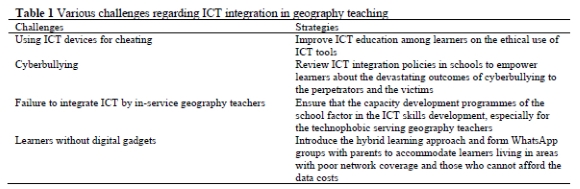
The literature reviewed did not align with the TPACK-SAMR model by Drugova et al. (2021), Muslimin et al. (2023) and Tunjera and Chigona (2020) and ICT integration practices suggested by the KwaZulu-Natal DoE as it did not implement the teacher laptop initiative (DoE, RSA, 2009:4), which has been adopted by provinces such as Gauteng and the Eastern Cape. This would have assisted children from rural areas who have no internet connectivity or data bundles, to have digital material uploaded to their gadgets, thereby ensuring that they are on par when it comes to integrating technology across all lessons, as is indicted in Table 1.
Conclusion
In this study we explored the strategies used by teachers to mitigate the challenges regarding the implementation of technology in the learning and teaching of geography in the FET Phase. The findings reveal that, under the guidance of teachers, geography learners can be exposed to SDL, and digital devices enhance the content taught in classroom. It is advised that curriculum developers formulate policies that prioritise learner-centred methodologies over predominantly teacher-centred ones. Such an approach can cultivate learners who assume complete accountability for their educational journey, utilising diverse technological tools and platforms to equip themselves for a global market increasingly influenced by ICT. The results indicate that educators possess the ability to recognise potential challenges. It is essential to involve them in developing strategies to improve the integration and application of ICT in geography instruction.
Authors' Contributions
BG: conceptualisation, methodology, investigation, resources, preparation of the original draft, writing, review and editing, and project administration. VM: visualisation, validation, and supervision. Both authors have read and agreed on the published version of the manuscript.
Notesi. Published under a Creative Commons Attribution Licence.
References
Acknowledgements
I am sincerely grateful to my co-author for all the effort, time, and advice offered in this study. We thank all the learners, parents and participating geography teachers at the different schools.
Literature Review
-
Aliyu AA, Bello MU, Kasim R & Martin D 2014. Positivist and non-positivist paradigm in social science research: Conflicting paradigms or perfect partners? Journal of Management and Sustainability, 4(3):79-95. https://doi.org/10.5539/jms.v4n3p79
» https://doi.org/10.5539/jms.v4n3p79 -
Arisanty D, Hastuti KP, Setiawan FA & Imawwati R 2020. Improving geography learning through project-based learning model. International Journal of Psychosocial Rehabilitation, 24(5):585-594. https://doi.org/10.37200/IJPR/V24I5/PR201723
» https://doi.org/10.37200/IJPR/V24I5/PR201723 -
Avdić B, Drešković N & Marić R 2020. Attitudes among geography teachers in Bosnia and Herzegovina toward geospatial technology use: Gender, age and regional differences. Geographica Pannonica, 24(2):136-146. https://doi.org/10.5937/gp24-24223
» https://doi.org/10.5937/gp24-24223 -
Bengel PT & Peter C 2021. Modern technology in geography education-Attitudes of pre-service teachers of geography on modern technology. Education, Science, 11(11):708. https://doi.org/10.3390/educsci11110708
» https://doi.org/10.3390/educsci11110708 -
Charles K, Awila G, Kargbo M & Luyeye MB 2023. Impact of ICT on teaching and learning process in secondary schools in Uganda: Literature review. International Journal of Management and Commerce Innovations, 11(2):220-226. https://doi.org/10.5281/zenodo.10453829
» https://doi.org/10.5281/zenodo.10453829 - Chilisa B & Kawulich BB 2012. Selecting a research approach: Paradigm, methodology and methods. In C Wagner, B Kawulich & M Garner (eds). Doing social research: A global context. London, England: McGraw-Hill.
-
Chirwa C & Mubita K 2021. Preparedness of teachers and learners in the integration of Information Communication Technologies in the teaching and learning of Geography in selected schools of Petauke district of Eastern province in Zambia. International Journal of Research and Innovation in Social Science (IJRISS), 5(3):456-464. Available at https://www.researchgate.net/profile/Cosmas-Chirwa/publication/351283344_Preparedness_of_Teachers_and_Learners_in_the_integration_of_Information_Communication_Technologies_in_the_teaching_and_learning_of_geography_in_selected_schools_of_Petauke_District_of_Eastern_Province/links/60917366a6fdccaebd09044f/Preparedness-of-Teachers-and-Learners-in-the-integration-of-Information-Communication-Technologies-in-the-teaching-and-learning-of-geography-in-selected-schools-of-Petauke-District-of-Eastern-Province.pdf. Accessed 4 August 2025.
» https://www.researchgate.net/profile/Cosmas-Chirwa/publication/351283344_Preparedness_of_Teachers_and_Learners_in_the_integration_of_Information_Communication_Technologies_in_the_teaching_and_learning_of_geography_in_selected_schools_of_Petauke_District_of_Eastern_Province/links/60917366a6fdccaebd09044f/Preparedness-of-Teachers-and-Learners-in-the-integration-of-Information-Communication-Technologies-in-the-teaching-and-learning-of-geography-in-selected-schools-of-Petauke-District-of-Eastern-Province.pdf -
Clark KA, Welsh KE, Mauchline AL, France D, Whalley WB & Park J 2021. Do educators realise the value of Bring Your Own Device (BYOD) into fieldwork learning? Journal of Geography in Higher Education, 45(2):255-278. https://doi.org/10.1080/039098265.2020.10808880
» https://doi.org/10.1080/039098265.2020.10808880 -
Çoklar AN & Bozyiğit R 2021. Determination of technology attitudes and technostress levels of geography teacher candidates. International Journal of Geography and Geography Education, (44):102-111. https://doi.org/10.32003/igge.933183
» https://doi.org/10.32003/igge.933183 -
Department of Education, Republic of South Africa 2004. Draft White Paper on e-Education: Transforming Learning and Teaching through Information and Communication Technologies (ICTs). Government Gazette, 470(26734):1-44, August 26. Available at https://www.gov.za/sites/default/files/gcis_document/201409/267341.pdf. Accessed 1 August 2025.
» https://www.gov.za/sites/default/files/gcis_document/201409/267341.pdf - Department of Education, Republic of South Africa 2009. Employment of Educators Act, 1998: Teacher laptop initiative. Government Gazette, 527(32207):1-12, May 8.
-
Drugova E, Zhuravleva I, Aiusheeva M & Grits D 2021. Towards a model of learning innovation integration: TPACK-SAMR-based analysis of the introduction of a digital learning environment in three Russian universities. Education and Information Technologies, 26:4925-4942. https://doi.org/10.1007/s10639-021-10514-2
» https://doi.org/10.1007/s10639-021-10514-2 -
France D, Lee R, Maclachlan J & McPhee SR 2021. Should you be using mobile technologies in teaching? Applying a pedagogical framework. Journal of Geography in Higher Education, 45(2):221-237. https://doi.org/10.1080/03098265.2020.1773417
» https://doi.org/10.1080/03098265.2020.1773417 - Greener S 2008. Business research methods. London, England: Ventus Publishing.
-
Guo F, Meadows ME, Duan Y & Gao C 2020. Geography pre-service teachers' perspectives on multimedia technology and environmental education [Special issue]. Sustainability, 12(17):6903. https://doi.org/103390/su12176903
» https://doi.org/103390/su12176903 -
Hart SA 2023. Identifying factors impacting the uptake of educational technology in South African schools: A systematic review. South African Journal of Education, 43(1):Art. #2174, 16 pages. https://doi.org/10.15700/saje.v43n1a2174
» https://doi.org/10.15700/saje.v43n1a2174 - Hogan A 2021. Digital technologies and the senior Geography classroom: Teachers' perceptions of the impact on teaching and learning. Master's dissertation. Auckland, New Zealand: Auckland University of Technology.
-
Kadhim AL 2020. Effective use of ICT for learning and teaching geography. Aalborg Academy Journal of Human and Social Sciences, 1(1):15-42. Available at https://www.researchgate.net/profile/Alaa-Kadhim-7/publication/347849381_Effective_Use_of_ICT_for_Learning_and_Teaching_Geography/links/5fe4f29f45851553a0ead0cc/Effective-Use-of-ICT-for-Learning-and-Teaching-Geography.pdf. Accessed 31 July 2025.
» https://www.researchgate.net/profile/Alaa-Kadhim-7/publication/347849381_Effective_Use_of_ICT_for_Learning_and_Teaching_Geography/links/5fe4f29f45851553a0ead0cc/Effective-Use-of-ICT-for-Learning-and-Teaching-Geography.pdf -
Koh E, Suresh D, Tee YH, Seow T, Ng B, Hong H, Liu Z, Chang J, Tamsir S, Toh S & Ho S 2021. Teacher's Guide to My Groupwork Buddy for Geography (MGBGeo). Available at https://singteach.nie.edu.sg/wp-content/uploads/2021/04/TeachersGuidetoMGBGeo_210608.pdf. Accessed 4 August 2025.
» https://singteach.nie.edu.sg/wp-content/uploads/2021/04/TeachersGuidetoMGBGeo_210608.pdf -
Kurniawan E, Eva B, Dafip M & Sriyanto S 2020. A teaching-based technology in geography learning. Cypriot Journal of Educational Sciences, 15(4):766-776. https://doi.org/10.18844/cjes.v%vi%i.5058
» https://doi.org/10.18844/cjes.v%vi%i.5058 -
Mahlo L & Waghid Z 2022. Examining information and communication technology use in public primary schools in South Africa from the capability approach. The Journal for Transdisciplinary Research in Southern Africa, 18(1):a1201. https://doi.org/10.4102/td.v18i1.1201
» https://doi.org/10.4102/td.v18i1.1201 - McMillan JM & Schumacher S 2010. Research in education: Evidence-based inquiry (7th ed). Harlow, England: Pearson.
-
Mishra P & Koehler MJ 2006. Technological pedagogical content knowledge: A framework for teacher knowledge. Teachers College Record, 108(6):1017-1054. https://doi.org/10.1111/j.1467-9620.2006.00684.x
» https://doi.org/10.1111/j.1467-9620.2006.00684.x -
Mkhongi FA & Musakwa W 2020. Perspectives of GIS education in high schools: An education of uMgungundlovu District, KwaZulu-Natal, South Africa. Education Sciences, 10(5):131. https://doi.org/10.3390/educsci10050131
» https://doi.org/10.3390/educsci10050131 -
Muslimin AI, Mukminatien N & Ivone FM 2023. TPACK-SAMR based lecturers' digital literacy competence and its implementation in EFL classroom. Computer-Assisted Language Learning Electronic Journal, 24(3):154-172. Available at https://callej.org/index.php/journal/article/view/48/29. Accessed 30 July 2025.
» https://callej.org/index.php/journal/article/view/48/29 -
Mwaluko FZ, Musamas J & Tarmo AP 2023. Integration of Information and Communication Technology in instruction of Geography: A study of public secondary schools in Manyoni district, Tanzania. The Educator: A Journal of the School of Education, Moi University, 3(1):65-80. Available at https://journals.mu.ac.ke/index.php/edj/article/view/109/96. Accessed 30 July 2025.
» https://journals.mu.ac.ke/index.php/edj/article/view/109/96 -
Mzuza MK & Van der Westhuizen C 2023. Improving the quality of geography teacher education through geographical information systems and self-directed learning. Journal of Geography Education in Africa (JoGEA), 6:132-149. https://doi.org/10.46622/jogea.v6i1.2209
» https://doi.org/10.46622/jogea.v6i1.2209 -
Passadelli AS & Klonari A 2021. The effectiveness of ICT-based teaching scenarios of tsunami on students' learning: A case study. International Journal of Education (IJE), 9(1):13-23. https://doi.org/10.5121/ije.2021.9102
» https://doi.org/10.5121/ije.2021.9102 -
Rigdel KS, Dorji S & Rai DM 2023. Effectiveness of YouTube as a supplementary material to enhance the students' learning achievement in Geography. Asian Journal of Education and Social Studies, 47(3):53-72. https://doi.org/10.9734/AJESS/2023/v47i31027
» https://doi.org/10.9734/AJESS/2023/v47i31027 - Saunders M, Lewis P & Thornhill A 2003. Research methods for business students (3rd ed). Harlow, England: Prentice Hall.
-
Šiljeg S, Milanović A & Marić I 2022. Attitudes of teachers and students towards the possibilities of GIS implementation in secondary schools in Croatia. Education Sciences, 12(12):846. https://doi.org/10.3390/educsci12120846
» https://doi.org/10.3390/educsci12120846 -
Silva JC, Rodrigues JC & Miguéis VC 2024. Factors influencing the use of information and communication technologies by students for educational purposes. Education and Information Technologies, 29:9313-9353. https://doi.org/10.1007/s10639-023-12132-6
» https://doi.org/10.1007/s10639-023-12132-6 -
Starman AB 2013. The case study as a type of qualitative research. Journal of Contemporary Educational Studies, 64:28-43. Available at https://www.researchgate.net/profile/A-Biba-Rebolj-2/publication/265682891_The_case_study_as_a_type_of_qualitative_research/links/54183f560cf25ebee988104c/The-case-study-as-a-type-of-qualitative-research.pdf. Accessed 28 July 2025.
» https://www.researchgate.net/profile/A-Biba-Rebolj-2/publication/265682891_The_case_study_as_a_type_of_qualitative_research/links/54183f560cf25ebee988104c/The-case-study-as-a-type-of-qualitative-research.pdf -
Tunjera N & Chigona A 2020. Teacher educators' appropriation of TPACK-SAMR models for 21 st century pre-service teacher preparation. International Journal of Information and Communication Technology Education, 16(3):126-140. https://doi.org/10.4018/IJICTE.2020070110
» https://doi.org/10.4018/IJICTE.2020070110 -
Wu YT, Chai CS & Wang LJ 2022. Exploring secondary teachers' TPACK for video-flipped learning: The role of pedagogical beliefs. Education and Information Technologies, 27:8793-8819. https://doi.org/10.1007/s10639-022-10977-x
» https://doi.org/10.1007/s10639-022-10977-x - Yin RK 2018. Case study research and applications: Design and methods (6th ed). Thousand Oaks, CA: Sage.
Revised: 18 April 2025
Accepted: 19 May 2025
Published: 31 August 2025