Teachers' opinions about elitism in gifted education
Abstract
Although teachers' attitudes towards gifted students and gifted education have been monitored more intensively since the 1990s, we still do not have a clear and definitive picture. Therefore, with the research reported on here we examined teachers' opinions about the connection between gifted education and elitism and how they viewed the need for grouping gifted students. The sample consisted of 432 primary and secondary school teachers. The main results show teachers' neutral opinions towards the grouping of gifted students and the correlation to elitism. Significant differences were obtained in the teachers' opinions for demographic characteristics, i.e. the school type (primary or secondary) and the school location (urban or rural). The results are in line with the general idea that education should be accessible to everyone according to their abilities in order to overcome equating gifted education with the rich elite.
elitism; gifted education; grouping; teachers
Introduction
Since the 1989 Convention on the Rights of the Child, many countries' legal regulations aimed at recognising the strengths of each individual (Maksic, 2005), creating a society that respects individual differences, and emphasising the obligation of society to support the self-realisation of each individual (United Nations Children's Fund, 2015). The adopted documents caused modifications of education systems, focusing on the paradigm of education for all. These documents undoubtedly permeate the view that an educational system is not equal for all unless it provides an opportunity for excellence. In other words, if the system does not offer advanced education that can respond to the needs of the gifted, they will be deprived of the opportunity to develop to their maximum (Rinn & Cobane, 2009). This view provides gifted students with the opportunity to develop their potential fully.
Literature Review
Nowadays, societal attitudes towards the gifted are somewhat more favourable. Many specialised classes and schools have been opened. According to Weyringer (2013:375), the last 15 years was the "golden age" for Austria' s gifted education. Also, researchers' interest in the issue of giftedness has increased (Bushkovskaya, 2015; Solobutina, 2020; Yunus, 2015). Nevertheless, as developmental psychology points out, excellent and outstanding performances do not necessarily evolve in a permanent progression from child genius to adult genius (Winner, 1996, as cited in Weyringer, 2013). Every state, therefore, has to provide conditions in which the gifted can fully develop.
On the other hand, by focusing on students' needs, the question of an adequate form of teaching and work with them arises (Ozcan & Uzunboylu, 2020; Radulovic & Grozdanic, 2020). Several proposals have been highlighted as a solution to this, and the most common one implies the relocation of gifted students to a separate class or group. The reason for this can be found in the sense of superiority - if they are in heterogeneous classes, they are almost always the best and most prominent, while working in specialised (homogeneous) groups encourages the confrontation of opinions and explaining skills. The positive side of grouping the gifted is mutual support, complementarity, encouragement, and even competition. The teacher or mentor' s task is to plan, coordinate and direct the students' work, leaving them space for the development of learning independence (Holman, 2020; Radulovic & Grozdanic, 2020). In line with the differences that exist, both in terms of academic requirements and in teachers' positions and roles, according to some researches, the formation of homogeneous groups suggests that gifted education is elitist and unequal compared to heterogeneous classes (Lassig, 2003). In this sense, equality is seen as a synonym for equal treatment to achieve comparable results, not as an equal opportunity to appropriate education to achieve one' s potential (Lassig, 2003).
The issue of gifted education and the formation of homogeneous classes should also consider a socio-demographic point of view and be compared to the potentially gifted students' education in heterogeneous classes. Namely, students from rural areas (Lawrence, 2009) or with lower socio-economic backgrounds, regardless of the development of the cognitive system, often do not have the same opportunities to acquire some skills as their peers from cities and with better backgrounds do. Students from cities have access to more information through informal education (science festivals, museum nights, researchers' nights, etc.) and schools' cooperation with colleges or other institutions. They can also attend private piano classes or enrol in music or ballet school, which would be a problem for a rural-area student because of transportation. Making these seemingly small differences, especially in the digital age, still extends the feeling of unequal chances for all. These inequalities can be manifested through slightly worse results of gifted students from rural areas on enrolment tests in prestigious high schools or colleges. Wyner and coworkers (Wyner, Bridgeland & DiIulio, 2007, as cited in Cross, JR, Frazier, Kim & Cross, 2018) noticed this inequality. According to them, high-ability students from higher-income families rapidly surpass their peers with similar abilities who have fewer economic resources. These inequalities were also supported by the fact that higher-income parents were willing to pay tuition for enrichment programmes and transportation for their children, sometimes at great distances, which is impossible for low-income students (Cross, JR et al., 2018).
Apart from the possible unequal relationships among students, gifted education should also be seen from the teachers' perspective. Because of fear of elitism, some teachers believe that the gifted are already "privileged" because they progress much quicker through the education system (McCoach & Siegle, 2007:246). It is also stated that there is no need to adapt programmes to their capabilities and requirements because their intellectual talent guarantees social and economic success (Gross, 1999, as cited in Tzivelopoulou, 2019). Thus, some teachers support the negative, elitist view of gifted education to prevent them from becoming selfish. Due to different attitudes towards gifted education recorded among teachers, we examined Serbian teachers' opinions on gifted education, i.e., whether they regarded it as elitism and believed that gifted students should be grouped in separate classes.
Gifted education in the Republic of Serbia Although some countries such as Hungary (Gyarmathy, 2013) have developed gifted education for more than 100 years, in Serbia it dates back to the 1960s. In general, Serbia's education system consists of three cycles (primary and secondary school, and university). Primary school lasts for 8 years (students aged from 6 to 7 years). For the first four grades, all subjects are taught by one teacher, while for the other four grades, each subject is taught by one teacher (Radulovic, Gajic, Spanovic & Lungulov, 2019). At the end of the eighth grade, students sit for the state matura exam, after which they can enrol in secondary school for 3 to 4 years. The state matura exam consist of three tests: mathematics, home language, and a combined test related to natural sciences and history. Therefore, matura examines students' knowledge at primary school level. Based on results during primary school education and results on matura, students can enrol in secondary school.
As for gifted students, only from the seventh grade of primary school can they enrol in specialised class school or attend a course (in physics, chemistry, biology, astronomy). However, the number of such classes for primary school is very limited.
As for secondary education, one of the characteristics of gifted education in Serbia is the different number of students in heterogeneous and specialised (homogeneous) classes. The number of students in heterogeneous classes is up to 30, while homogenous classes only have 20 students. In heterogeneous classes, the most common form of work with gifted students is additional work, extracurricular activities, and the possibility of faster schooling. In contrast, in homogeneous classes a considerably more extensive curriculum is applied.
Although the first specialised grammar school for the gifted in mathematics was founded in 1966, it was 20 years later (1988) that a document, the Program of Activities for Establishing and Further Developing the System of Working with Gifted and Talented Students, was introduced (Protic, Tatic Janevski & Duric, 2009). This document provides further instructions for working with these students. The programme contained proposals for providing the necessary conditions (such as literature, professional development of teachers, selection and stimulation of teachers, etc.) to work with gifted and talented students, as well as funding for extracurricular activities (Maksic, 2005). However, the wars and crises that followed in the 1990s put a stop to the realisation of the planned activities. In 2004 the Law on the Foundations of the Education System was introduced and the unified term "children with special needs" was used. The term included gifted and talented ones and students with some cognitive or motor disabilities. At first glance, this equated the rights of the gifted with children with disabilities, included in heterogeneous classes within inclusive programmes. In practice, however, the gifted were often neglected because the teacher did not have enough time to explain the teaching material to all groups (students with disabilities, below average, average, above average and gifted ones) and distribute work or additional tasks. The latest Law on the Foundations of the Education System of 2020 includes nine articles (out of 210) that closely define education for gifted and talented students. New articles are undoubtedly a step forward from the previous Law in 2004, which addressed the needs and problems of gifted education at the level of individual laws, mainly referring to primary and secondary education and relevant centres at the Institute for the Advancement of Education. The newly introduced articles primarily focus on identifying, monitoring, and encouraging students with exceptional abilities to work further and nurture their potential.
Although many ideas and suggestions of pedagogy experts have been implemented in legislative regulations and laws, several nongovernmental organisations like Mensa, Alliance of Serbian Educators, etc., as well as specialised centres (Petnica, Regional Talent Centers Mihajlo Pupin, National Talent Center, and Regional Talent Centers in Belgrade, Nis, Valjevo, Loznica, Bor and Vranje) support gifted education. At the same time, there are increasing numbers of professional development programmes for pre-service teachers that focus on recognition, encouragement, and support of the development of giftedness in children. It is also important to mention that there are currently around 50 grammar schools (out of 110) that offer specialised classes for gifted education in Information Technology (IT), mathematics, physics, biology and chemistry, history and geography, sports, and performing and audio-visual arts. In addition to these schools, Serbia boasts 74 ballet and music schools. With this trend of opening specialised classes in an increasing number of cities, more gifted students have the opportunity to reach their (cognitive) potential. This increasing number of specialised classes is justified by the increasing number of awards won at international competitions.
The issue of opening specialised classes is essential in view of economic development. Gross domestic product (GDP) in the period from 2014 to 2018 increased from -1.8 to 3.5 (Milojevic, 2018). Also, there was an increase in the number of small and medium enterprises. An assumption is that this was a result of a more significant investment in gifted education.
Conceptual Framework
Gifted education is a complex issue and, therefore, needs to be viewed from several aspects. The focus here is on the teacher as the primary resource for achieving the goal of inclusive education, which is the essence of the appreciation of diversity (Oswald & De Villiers, 2013). In a qualitative study Oswald and De Villiers (2013) report the findings of South African primary school teachers and principals regarding the inclusion of learners who are considered to be gifted. According to this study, both teachers and principals highlight some obstacles. In the first place, a lack of knowledge. During their initial education, teachers are trained to address the needs of learners who struggle rather than the gifted ones. The second obstacle is related to the number of learners in one classroom, which is best represented through the opinion of teacher A7: "You cannot stimulate the gifted child because your class is too large" (Oswald & De Villiers, 2013:9). The same problem is present in heterogeneous Serbian classes. Working in a class with a large number of students and with large learner diversity can cause the needs of gifted students not to be met. Therefore, gifted students are often included in specialised classes, which is often called elitist. In a sociological sense, the elite is associated with the emergence of social stratification (Gajic, Andevski & Lungulov, 2009). However, the existence of such classes is specific to cities, which further emphasises social stratification. Therefore, although the teachers emphasise that gifted children could come from all walks of life, learners from lower socio-economic communities are frequently not recognised as gifted (Oswald & De Villiers, 2013:12). A possible reason can be found in challenging factors such as poverty and illiterate parents. If science is understood as the most important resource of the development of a society, then the approach, manner and the amount of information that an individual has access to is of crucial importance. Differentiating between students of the same age and the same abilities but different socio-economic background puts one student in a much more favourable position than another. Since teachers' roles in education is significant, it is crucial to examine their opinion on gifted students' education and whether they associate it with elitism.
Method
Research Aim and Questions Because of the potential favourite position of gifted students in heterogenuoes class, it is vital to examine teachers' attitudes towards the elitist view of gifted education and the grouping of the gifted. Therefore, the aim with this research was to examine the teachers' views of elitism and whether gifted students should be grouped in separate specialised classes.
Accordingly, the research aims were the following:
1) Teachers' opinions on the elitist view of gifted education and the grouping of the gifted;
2) Teachers' opinions on this issue regarding the school location (rural-urban) and school type (primary-secondary).
Instrument
Data were collected through a questionnaire created for the purpose of this research. The items were created following the Gagné and Nadeau questionnaire about attitudes towards the gifted and their education. For this research, a 5-point Likert scale was used with scores of 1 - I completely disagree, to 5 - I completely agree. According to Gagné' s proposed valuation, a score above 4.00 indicates a highly positive attitude, and below 2.00 a highly negative one. A score between 3.26 and 4.00 is positive, and between 2.00 and 2.74, negative. Scores between 2.75 and 3.25 indicate an ambivalent attitude (Perkovic Krijan & Boric, 2015). Cronbach Alpha for this research was 0.743.
Sample
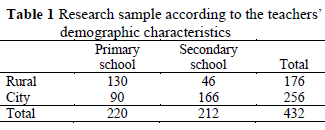
The research sample was randomly chosen. The questionnaire was distributed via email to schools of which the email addresses were available on the internet. There was a similar number of respondents from primary and secondary schools of which the demographic data are available in Table 1. To calculate the sample size, the application http://www.raosoft.com/samplesize.html was used. According to the Statistical Office of the Republic of Serbia, the maximum sample of the teachers in primary and secondary schools was 83,597. Our sample of 432 teachers represented a convenient sample which ranged from 383 to 659. The threshold values were defined with a confidence level of 95%, i.e., 99%.
The research included 95 males and 337 females. Because of non-uniformity of the sample by gender, we did not examine the difference in male and female teachers' opinion about elitism. An explanation for the sample distribution by gender could be contributed to the teaching profession being regarded as a female profession. A considerable higher number of female than male teachers has also been confirmed in research (Organisation for Economic Co-operation and Development Statistics [OECD], 2019). Table 1 shows the distribution according to the teachers' demographic characteristics.
most negatively rated items were "Children with disabilities have the greatest need for special education programmes", and "Gifted students might become vain or egotistic if they are given special attention."
The respondents believed that children with disabilities should be given special support through specialised educational programmes because most of them were not trained to work with this group of students during their initial education at colleges. Due to insufficient training, they broadly support specialised schools that can fully respond to these students' needs in cognitive, psychological, and environmental terms. As an explanation for this negativety, teachers stated that special education programmes should not be created only for children with disabilities, but for all children who need additional support, especially the gifted ones. They particularly emphasised this opinion through the item that the gifted are valuable resources of society and deserved more attention than they currently receive. Therefore, in our research teachers did not regard gifted students as a threat in the cognitive sense or as vain, selfish, and egotistic individuals, but rather perceived them as potentially eager for more opportunities and possibilities. Accordingly, they wanted to support them in their schooling by recommending to enrol in specialised classes and expressing more extensive teachers' commitment to work with these children.
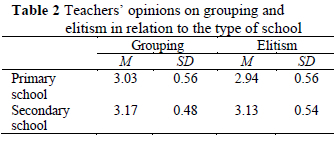
Impact of School Type on Teachers' Opinion ANOVA showed the existence of differences between the respondents for both groupings, F (df= 1) = 9.877, p = 0.016, eta-square = 0.02, and elitism, F (df = 1) = 5.906, p = 0.002, eta-square = 0.03. According to the results, teachers in secondary schools evaluated both components more positively in relation to their peers in primary schools (cf. Table 2).
The uniformity of the number of respondents by school type (primary-secondary) could be reached in sample creation, and accordingly, comparable numbers were obtained.
Data Analysis
For calculating the difference in teachers' opinions on gifted education, ANOVA, and descriptive statistics in SPSS 20.0 were applied, while an eta-square indicator was used to determine the impact size.
Results
The overall results show the existence of teachers' neutral opinion towards the grouping of the gifted (M = 3.10; SD = 0.52) and towards elitism (M = 3.04; SD = 0.56). Teachers expressed the greatest agreement for the item, "Gifted students are a valuable resource for our society", while the Table 3 shows the differences in the opinions using previously defined categories.
The results in Tables 2 and 3 show that primary school teachers expressed more negative opinions about grouping and elitism (around 20% of them), while secondary school teachers showed more ambivalent (around 60%) and positive opinions (around 30%) about the same issues. A possible reason for this can be found in the social component of education and the number of specialised (homogeneous) classes. Primary school teachers believes that it was more important for students on this educational level to stay in direct contact with their peers than to be separated from the group and be moved to a new environment. By separating primary school students in specialised classes, their social and emotional development might be stifled to the extent that they might later not be able to respond to social demands. A potential failure may have a negative effect on students' self-confidence and their further social and emotional development. The respondents' negative opinions may also be linked to the fact that there was a relatively low number of specialised classes, in particular for primary school students as opposed to courses for secondary school students.
In addition to a greater availability of secondary school specialised classes, teachers in secondary education can also send their students to specialised programmes or courses organised in summer, winter, or spring schools at the Petnica Science Centre, or some other camps or colleges with whom they cooperate and are located in their cities. Short specialised courses may provide good insight into cognitive requirements and pace at which activities in specialised classes are completed. They prepare students more for a new environment (a specialised class) and teachers can be more certain that the new environment fits the students' cognitive demands and their social and emotional development needs.
Impact of School Location on Teachers' Opinion
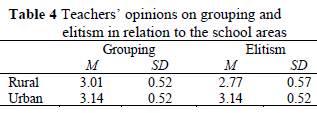
Considering the impact of the environment (rural-urban) in which the school is located, ANOVA showed a statistically significant difference between participants for grouping, F (df = 1) = 4.398, p = 0.037, eta-square = 0.013, and for elitism, F (df = 1) = 30.561, p = 0.000, etasquare = 0.084. The results show that teachers who teach in rural schools expressed a somewhat less positive opinion about grouping and elitism than teachers in urban schools (cf. Table 4).
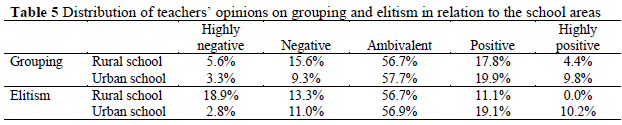
The result in Table 4 point to a more negative opinion of teachers in rural areas. Reasons for that can be found in potential social isolation of gifted students or in limited opportunities for teachers in these areas. Usually, there is more deficient school equipment and a lack of teachers who can present specific private lessons to gifted students. Even if there are qualified teachers, a potential problem is the parents' economic situation, i.e. whether they can afford private lessons for their children. In urban areas, however, there are more offers of private lessons in various subjects, namely ballet, sports, or music, and it is easier for parents to "fight" for the cognitive "prestige" of their children. Table 5 shows the distribution of responses according to the observed categories.
Table 5 shows that about 30% of teachers from rural areas held a negative opinion on grouping and elitism, while a similar percentage of teachers from urban areas held a positive opinion. Based on the overall results obtained in the study, a certain percentage of teachers expressed fear about elitism and grouping of the gifted due to their potential social isolation. Although the situation with gifted education is improving, it is essential to point out that grouping of the gifted should be done in order to respond to their needs in the best possible way while taking care of their cognitive, social and emotional development.
Discussion
Although researchers' and authorities' interest in the needs and support of the gifted has increased in recent decades (Bergold, Wirthwein & Steinmayr, 2020; Matthews, Ritchotte & McBee, 2013), their needs have often been marginalised. According to Dorling (2010), priorities in education have become increasingly determined by a practical concern for the economy's needs, rather than developing each child's thinking. Therefore, many questions remain open regarding gifted education, and one of them is the connection with elitism. Elitism can be understood as a belief that certain persons or members of certain groups deserve favoured treatment under their perceived superiority, as in intellect, academic skills, social status, or financial resources (Valencia, 2010, as cited in Ford, 2014). However, elites are not selected, they emerge from the process of social transformation, and new values are considered the foundations of social power (Dordevic & Dordevic, 2016). Therefore, gifted ones do not need to be considered as elite. On the other hand, if giftedness is understood as a prestige, and this attribute is permeated through every type of elite, then it can be said that some elements connect them. Also, Ozcan (2017) notes that gifted and talented students choose their career with opportunity to have prestige. They choose to be doctors, pilots or engineers. Factors related to financial and social responsibility, safety concerns, as well as social status were articulated as part of the rationale for their choices (Ozcan, 2017 as cited in Maree, 2017). With this in mind, we examined teachers' opinions about the relation between gifted education and elitism and grouping.
Teachers' attitudes and beliefs about students influence how they relate to students and what they expect regarding students' intellectual growth (Goodman, 1985, as cited in Miller, 2009; Rosenthal, 2002, as cited in Miller, 2009). Cross and associates indicate that teachers who serve gifted students in heterogeneous classes were less supportive of gifted education than teachers in a specialised school for gifted high school students (Cross, Cross & Frazier, 2013, as cited in Cross, TL, Cross & O'Reilly, 2018). Therefore, it is crucial to examine teachers' opinions on the connection between gifted education and elitism. In some studies teachers were recognised as barriers to students' achievement (Cross, JR et al., 2018), while according to Maksic (2007, 1998, as cited in Altaras Dimitrijevic & Tatic Janevski, 2016), Serbian teachers are positive towards gifted education. Although some researchers argue that gifted and high-achieving students do not need additional resources to pursue their educational goals as they will do just fine on their own (Rinn & Cobane, 2009), or that gifted programmes are elitist rather than egalitarian (Bain, Bliss, Choate & Sager-Brown, 2007, as cited in Chamberlin & Chamberlin, 2010), the result in our research point to a neutral opinion of teachers towards its connection with elitism and grouping of the gifted. The item "Gifted students are a valuable resource for our society" was singled out, which indicates a positive starting point of future policies for gifted education. The importance of grouping gifted students is explained in a study by Preckel and associates (Preckel, Schmidt, Stumpf, Motschenbacher, Vogl & Schneider, 2017). According to them, there is a class-type (heterogeneous or homogeneous) influence on academic self-concept and students' achievement. This means that raising teachers' awareness of the needs of gifted students and encouraging them to work with these students may create a stimulating environment for the development of the gifted. This view is supported by our findings that secondary and urban school teachers expressed more positive opinions than their counterparts in primary and rural schools. The reason for this can be found in the number of specialised classes for gifted students and the availability of more activities and resources for students on secondary educational level. For example, the Petnica Centre offers gifted and interested students, who are mostly of secondary school age, to expand their knowledge in astrophysics, biology, chemistry, archeology, biomedicine, et cetera. Participants have the opportunity to spend a few weeks at Petnica with the obligation to perform an experiment and present it to other participants. These schools or programmes enable interaction with peers of similar abilities in a supportive environment. Students learn to present, confront, and explain their attitudes and discuss these with their peers. In some heterogeneous schools, however, they may not have similar opportunities. All this means that the availability of resources and a stimulating environment represent crucial factors.
The negative opinion expressed by primary school teachers is in agreement with egalitarians who believe that other students would suffer (academically) if deprived of associating with high-ability classmates (Oakes, 1985, as cited in O'Reilly, 2013; Slavin, 1987, as cited in O'Reilly, 2013). Johann-Friedrich Herbart claims that didactic approaches must consider school class heterogeneity as an image of society's heterogeneity (Weyringer, 2013). Therefore, through a heterogeneous classroom, students will be better prepared for life.
A limited opportunity for teachers in these areas and transport of gifted students to specialised classes or programmes is one of the potential problems in rural areas. In that respect, our study provides empirical support for the need of creating such educational policies in the future that would focus on encouraging the development of competencies of teachers working in rural areas. Also, special emphasis should be placed on improving resources (teaching aids, library resources, information communication technology tools, et cetera) of schools in these areas. According to the recommendation of the South African Department of Science and Technology, best students are more concentrated in the elite schools although the rural areas can be a huge reservoir of untapped talent, so special research in this area is required (Milne & Mhlolo, 2021). This recommendation seems to hold true for Serbia and, therefore, it is necessary to work more intensively with teachers in rural areas. Creating a stimulating environment will enable the development of the gifted regardless of their social and demographic origin. This research topic deserves closer consideration as Serbia introduces a state matura in 2023 of which the results will allow students to apply to certain faculties. Grammar school students will take the general matura and thus gain the opportunity to apply to all faculties. In contrast, vocational school students should first pass the vocational matura and then the general matura if required by their chosen faculty. For the time being, there is no such stratification of students. Still, the topic will require a more detailed examination of students' attitudes about their position when choosing a faculty. It will also be interesting to examine students' and teachers' attitudes towards this question from other countries that already imply matura exams, such as Croatia, Slovenia, and North Macedonia, as these countries have a similar educational system to Serbia. Therefore, the results from our study could be used for possible modifications in the implementation of the matura exam.
Conclusion
According to Maksic (2005:483), the democratisation of education that encourages and engages the "best sides" of each individual has not been fully expressed in practice. In many cases, equality in education has not been observed in terms of opportunities but in terms of student results. However, technical and technological innovations and society' s rapid development require that gifted education is different from other students' education. The question that arises is the connection between the education of the gifted and elitism.
In this research, teachers' neutral opinions on the grouping of the gifted and the connection of their education with elitism have been observed. Secondary and urban school teachers expressed more positive opinions because they have access to more resources and are more familiar with the curriculum of specialised classes that respond to the gifted ones' needs. It is necessary to continue monitoring teachers' opinions in the future in order to detect new problems and find ways to overcome them.
Although substantial changes have been made in gifted education, it is still necessary that future reforms are directed towards achieving the maximum of each individual and that the development of talent is not a problem of the individual but of society (Dordevic & Dordevic, 2016). Therefore, additional strengthening is needed with legislation that would regulate in more detail the issues of gifted education and oblige schools and universities to work continually with the gifted, according to their needs and interests. Education needs to include the paradigm of discriminative and not discriminatory nature that would extend through the entire system and would not connect giftedness with social, but only with intellectual elitism.
Notesi. Published under a Creative Commons Attribution Licence.
Acknowledgement
The author acknowledges the financial support of the Ministry of Education, Science, and Technological Development of the Republic of Serbia (Grant No. 451-03-68/2020-14/200125).
References
- Altaras Dimitrijevic A & Tatic Janevski S 2016. Obrazovanje ucenika izuzetnih sposobnosti: Naucne osnove i smernice za skolsku praksu [Education of students with exceptional abilities: Scientific bases and guidelines for school practice]. Beograd, Serbia: Zavod za unapredivanje obrazovanja i vaspitanja.
-
Bergold S, Wirthwein L & Steinmayr R 2020. Similarities and differences between intellectually gifted and average-ability students in school performance, motivation, and subjective well-being. Gifted Child Quarterly, 64(4):285-303. https://doi.org/10.1177/0016986220932533
» https://doi.org/10.1177/0016986220932533 - Bushkovskaya EF 2015. Phenomenon of academic giftedness in psychological and educational research. Education and Self Development, 46(4):32-35.
-
Chamberlin MT & Chamberlin SA 2010. Enhancing preservice teacher development: Field experiences with gifted students. Journal for the Education of the Gifted, 33(3):381-416. https://doi.org/10.1177/016235321003300305
» https://doi.org/10.1177/016235321003300305 -
Cross JR, Frazier AD, Kim M & Cross TL 2018. A comparison of perceptions of barriers to academic success among high-ability students from high-and low-income groups: Exposing poverty of a different kind. Gifted Child Quarterly, 62(1):111 -129. https://doi.org/10.1177/0016986217738050
» https://doi.org/10.1177/0016986217738050 -
Cross TL, Cross JR & O'Reilly C 2018. Attitudes about gifted education among Irish educators. High Ability Studies, 29(2): 169-189. https://doi.org/10.1080/13598139.2018.1518775
» https://doi.org/10.1080/13598139.2018.1518775 -
Dordevic J & Dordevic B 2016. Priroda darovitosti i podsticanje razvoja [The nature of giftedness and fostering development]. Beograd, Serbia: Srpska akademija obrazovanja. Available at http://www.sao.org .rs/documents/2016/Priroda%20darovitosti%20Djordjevic%20-%20Djordjevic.PDF. Accessed 31 December 2022.
» http://www.sao.org .rs/documents/2016/Priroda%20darovitosti%20Djordjevic%20-%20Djordjevic.PDF -
Dorling D 2010. The return to elitism in education. Soundings, 44:35-46. https://doi.org/10.3898/136266210791036773
» https://doi.org/10.3898/136266210791036773 -
Ford DY 2014. Underrepresentation of African American and Hispanic students in gifted education: Impact of social inequality, elitism, and colorblindness. In JP Bakken, FE Obiakor & AF Rotatori (eds). Gifted education: Current perspectives and issues (Vol. 26). Bingley, England: Emerald Group Publishing Limited. https://doi.org/10.1108/S0270-4013(2014)0000026005
» https://doi.org/10.1108/S0270-4013(2014)0000026005 - Gajic O, Andevski M & Lungulov B 2009. Podrska darovitim studentima - stvaranje drustvene elite i razvojnog resursa [Support to gifted students -creation of a social elite and developmental resource]. In G Gojkov (ed). Daroviti i drustvena elita [Proceedings of the gifted and the social elite] (Vol. 15). Vrsac, Serbia: Visoka skola strukovnih studija za obrazovanje vaspitaca "Mihailo Palov".
-
Gyarmathy E 2013. The gifted and gifted education in Hungary. Journal for the Education of the Gifted, 36(1):19-43. https://doi.org/10.1177/0162353212471587
» https://doi.org/10.1177/0162353212471587 -
Holman PS 2020. Influence of project-based learning and homogeneous grouping on gifted students' cognitive abilities. PhD dissertation. Minneapolis, MN: Walden University. Available at https://www.proquest.com/docview/24415969967pq-origsite=gscholar&fromopenview=true. Accessed 31 December 2022.
» https://www.proquest.com/docview/24415969967pq-origsite=gscholar&fromopenview=true -
Lassig CJ 2003. Gifted and talented education reforms: Effects on teachers' attitudes. In B Bartlett, F Bryer & D Roebuck (eds). Proceedings 1st annual international conference on cognition, language, and special education research: Reimagining practice: Researching change 2. Surfers Paradise, Australia. Available at https://eprints.qut.edu.au/14299/1/14299.pdf. Accessed 31 December 2022.
» https://eprints.qut.edu.au/14299/1/14299.pdf -
Lawrence BK 2009. Rural gifted education: A comprehensive literature review. Journal for the Education of the Gifted, 32(4):461-494. https://doi.org/10.1177/016235320903200402
» https://doi.org/10.1177/016235320903200402 - Maksic S 2005. Medunarodna regulativa o podrsci darovitoj deci kroz obrazovanje [International regulations on support for gifted children through education]. Pedagogija, 60(4):472-484.
-
Maree JG 2017. Opinion piece: Using career counselling to address work-related challenges by promoting career resilience, career adaptability, and employability. South African Journal of Education, 37(4):Opinion Piece, 5 pages. https://doi.org/10.15700/saje.v37n4opinionpiece
» https://doi.org/10.15700/saje.v37n4opinionpiece -
Matthews MS, Ritchotte JA & McBee MT 2013. Effects of schoolwide cluster grouping and within-class ability grouping on elementary school students' academic achievement growth. High Ability Studies, 24(2):81-97. https://doi.org/10.1080/13598139.2013.846251
» https://doi.org/10.1080/13598139.2013.846251 -
McCoach DB & Siegle D 2007. What predicts teachers' attitudes toward the gifted7 Gifted Child Quarterly, 51(3):246-254. https://doi.org/10.1177/0016986207302719
» https://doi.org/10.1177/0016986207302719 -
Miller EM 2009. The effect of training in gifted education on elementary classroom teachers' theory-based reasoning about the concept of giftedness. Journal for the Education of the Gifted, 33(1):65-105. https://doi.org/10.1177/016235320903300104
» https://doi.org/10.1177/016235320903300104 -
Milne A & Mhlolo M 2021. Lessons for South Africa from Singapore's gifted education - A comparative study. South African Journal of Education, 41(1):Art. #1839, 8 pages. https://doi.org/10.15700/saje.v41n1a1839
» https://doi.org/10.15700/saje.v41n1a1839 -
Milojevic MM 2018. Ekonomija Srbije 2014-2018. Kroz kljucne pokazatelje [Economy of Serbia 20142018. Through key indicators]. Revizor, 22(85):7-29. https://doi.org/10.5937/Rev1885007M
» https://doi.org/10.5937/Rev1885007M -
O'Reilly C 2013. Gifted education in Ireland. Journal for the Education of the Gifted, 36(1):97-118. https://doi.org/10.1177/0162353212470039
» https://doi.org/10.1177/0162353212470039 -
Organisation for Economic Co-operation and Development Statistics 2019. Distribution of teachers by age and gender. Available at https://stats.oecd.org/Index.aspx7DataSetCode=EAG_PERS_SHARE_AGE. Accessed 23 November 2020.
» https://stats.oecd.org/Index.aspx7DataSetCode=EAG_PERS_SHARE_AGE -
Oswald M & De Villiers JM 2013. Including the gifted learner: Perceptions of South African teachers and principals. South African Journal of Education, 33(1):Art. #603, 21 pages. https://doi.org/10.15700/saje.v33n1a603
» https://doi.org/10.15700/saje.v33n1a603 -
Ozcan D 2017. Career decision-making of the gifted and talented [Special issue]. South African Journal of Education, 37(4):Art. # 1521, 8 pages. https://doi.org/10.15700/saje.v37n4a1521
» https://doi.org/10.15700/saje.v37n4a1521 -
Ozcan D & Uzunboylu H 2020. School counsellors' perceptions of working with gifted students [Special issue]. South African Journal of Education, 40(Suppl. 1):Art. #1899, 9 pages. https://doi.org/10.15700/saje.v40ns1a1899
» https://doi.org/10.15700/saje.v40ns1a1899 -
Perkovic Krijan I & Boric E 2015. Teachers' attitudes towards gifted students and differences in attitudes regarding the years of teaching [Special edition]. Croatian Journal of Education, 17(1):165-178. https://doi.org/10.15516/cje.v17i0.1490
» https://doi.org/10.15516/cje.v17i0.1490 -
Preckel F, Schmidt I, Stumpf E, Motschenbacher M, Vogl K & Schneider W 2017. A test of the reciprocal-effects model of academic achievement and academic self-concept in regular classes and special classes for the gifted. Gifted Child Quarterly, 61(2):103-116. https://doi.org/10.1177/0016986216687824
» https://doi.org/10.1177/0016986216687824 - Protic J, Tatic Janevski S & Duric Z 2009. Obrazovanje darovitih u zemljama Evropske Unije i Srbiji [Education of the gifted in the countries of the European Union and Serbia]. Beograd, Serbia: Zavod za unapredivanje obrazovanja i vaspitanja i Centar za strateski razvoj.
-
Radulovic B, Gajic O, Spanovic S & Lungulov B 2019. Проблемы педагогического образования в контексте реформ высшего образования Сербии [Challenges of initial teacher education in context of higher education reform in Serbia]. Education and Self Development, 14(3):34-39. https://doi.org/10.26907/esd14.3O4
» https://doi.org/10.26907/esd14.3O4 - Radulovic B & Grozdanic N 2020. Examples of project teaching in work with gifted students in the framework of physics teaching. Exceptional Children: Education and Treatment, 2(4):386-391.
- Rinn AN & Cobane CT 2009. Elitism misunderstood: In defense of equal opportunity. Journal of the National Collegiate Honors Council, 10(1):53-56.
-
Solobutina MM 2020. Исследование личностной идентичности в юношеском возрасте при интеллектуальной и спортивной одаренности [Ego identity of intellectually gifted and sport talented individuals in puberty and adolescence]. Education and Self Development, 15(1):12-20. https://doi.org/10.26907/esd15.L02
» https://doi.org/10.26907/esd15.L02 -
Tzivelopoulou E 2019. A study of teacher beliefs and pedagogical practices relating to gifted and talented education in selected primary schools in England and Scotland. PhD thesis. Edinburgh, Scotland: The University of Edinburgh. https://doi.org/10.7488/era/34
» https://doi.org/10.7488/era/34 -
United Nations Children's Fund 2015. Analiza kvaliteta obrazovanja u skolama i odeljenjima za obrazovanje dece sa smetnjama u razvoju [Analysis of the quality of education in schools and departments for the education of children with disabilities]. Beograd, Republika Srbija: Ministarstvo prosvete, nauke i tehnoloskog razvoja Republike Srbije. Available at http://defektolozisrbije.org/wp-content/uploads/2016/05/UNICEF.pdf. Accessed 19 December 2019.
» http://defektolozisrbije.org/wp-content/uploads/2016/05/UNICEF.pdf -
Weyringer S 2013. Gifted education in Austria. Journal for the Education of the Gifted, 36(3):365-383. https://doi.org/10.1177/0162353213494502
» https://doi.org/10.1177/0162353213494502 - Yunus O 2015. Centers of science and arts (BÍLSEM) as agents of gifted students' education in Turkey. Education and Self Development, 46(4):180-183.
Revised: 25 November 2022
Accepted: 31 December 2022
Published: 31 December 2022