Cultivating self-directed learners through research-based learning in the undergraduate curriculum
Abstract
Research skills are crucial in preparing students to become producers of knowledge, especially in the era of artificial intelligence and the increasing reliance on Google and artificial intelligence applications. Responding to the broader call for more diverse case studies of research in the undergraduate curriculum, we present a multi-year case study of introducing research-based learning through facilitating a self-directed learning approach in a research course in information systems in the Faculty of Commerce at a historically disadvantaged university in South Africa. In our teaching intervention we emphasised a research-based learning approach, enabling students to learn how to conduct research, rather than merely being tasked with it. The findings highlight the importance of developing a self-directed learning environment through the scaffolding of research activities, research assignments combined with written reflections, a minimally guided approach, the use of appropriate research tools, and allowing students to voice their opinions.
curriculum design; group assignments; reflection; research-based learning; research tools; rubric; self-directed learning; student voice; teaching; undergraduate research
Introduction
It is self-evident that research skills are foundational in most disciplines (Benbasat & Zmud, 2003; Chan, HC, Guness & Kim, 2015; Hassan, 2010; Huang & Hsu, 2005; Kirkwood & Christie, 2006; Tams, 2014), lest these disciplines stagnate; yet these core competencies are mainly taught at postgraduate (PG) level. At a PG level, students learn to do research through supervision and methodology courses (Mouton, 2007). They may also conduct independent research led by an experienced researcher or supervisor.
Studies on research in the undergraduate curriculum (RUGC) (Brew & Boud, 1995; O'Mahony, O'Sullivan, Sugrue, McNulty, Foyhy & O'Halloran, 2017; Uys & Chigona, 2018) emphasise the need to incorporate research earlier in the curriculum, together with the teaching and mentoring of students on how and why research is important. This is particularly important for students at non-research-led institutions (Anthony & DesJardins, 2013; Brew, 2010) where the teaching of disciplinary knowledge and skills takes precedence over research and where students might exit their studies at an undergraduate (UG) level, thus not having the opportunity to learn how independent research is conducted. At a UG level, students are expected to acquire several core research skills such as the selection of topics and scope, finding, differentiating and evaluating resources and sources, summarising and synthesising a body of literature, and appropriately understanding and citing those sources (Huddleston, Bond, Chenoweth & Hull, 2019). Additional (soft) skills, such as critical thinking, verifying the accuracy of information, interpreting biases, assessing originality, research ethics, surfacing confirmation bias, reading, writing, time management and work ethics are also mentioned as important skills that student researchers need to develop (Huddleston et al., 2019; Ngwenyama & Rowe, 2024).
Internationally, academics are struggling to distinguish between students' own (original) work as opposed to the use of generative artificial intelligence (AI) (Chan, CKY & Lee, 2023; Molenaar, 2022; Ngwenyama & Rowe, 2024). Even though some of the critical research skills and responsible use of AI can be taught by an academic, librarian or information literacy expert, it appears as if many of these skills are left to chance. This is especially true where students are becoming more dependent on large-language models such as ChatGPT, Anthropic, Bard, Bing Chat and Claude AI (Smolansky, Cram, Raduescu, Zeivots, Huber & Kizilcec, 2023) to assist them in research areas such as idea generation, summarising articles, and analysing large datasets (Chan, CKY & Hu, 2023). If students are not exposed to the ethical use of AI in research, they may abdicate the cognitive load to these AI tools, thus hampering their learning competencies (Chan, CKY & Lee, 2023; Chan, CKY & Tsi, 2023; Molenaar, 2022; Smolansky et al., 2023). Developing original thinking and creative writing capabilities, such as those used in research, is thus more important now than ever before.
Research in the UG curriculum is gaining traction internationally, especially in the science, technology, engineering and mathematics (STEM) disciplines, with health sciences following closely behind (Mieg, Ambos, Brew, Galli & Lehmann, 2022). This is also evident in the establishment of governing bodies such as the Council on Undergraduate Research (CURE) with a footprint in North America and the United Kingdom (UK) (CURE, 2025).
In a recent extensive book, Mieg et al. (2022) examine UG research in 29 disciplines such as physics, chemistry, biology, mathematics, engineering, data science, medicine, health sciences, nursing, sociology, psychology, economics, and political science in 25 countries such as the United States of America (USA), Canada, Argentina, Brazil, Columbia, Mexico, South Africa, Nigeria and the United Arab Emirates (UAE). Some of these studies report that UG research is effective, requires scaffolding, supports inclusion and diversity, and delivers clear benefits for further research, either at a PG level or professional practice (Mieg et al., 2022). Yet, despite this growing international interest, UG research is still in its infancy, especially in countries such as South Africa (SA). This can be attributed mainly to an already full curriculum, heavy workloads, lack of supervisory staff and mentors, large classes at UG level (Brew & Mantai, 2017; Buffalari, Fernandes, Chase, Lom, McMurray, Morrison & Stavnezer, 2020; Huddleston et al., 2019; Levy & Petrulis, 2012; Sharma & Sharma, 2024; Wood, 2009), a lack of interest by students due to research not being core to the discipline, and an increased workload for students (Deicke, Gess & Rueβ, 2014).
There also appears to be a paucity of publications on the teaching of RUGC (Schlicht & Klauser, 2014; Sharma & Sharma, 2024), with most interventions emphasising research methodologies, supervision, and research as a process. The need for more examples and case studies on how to incorporate research into the UG curriculum is also being emphasised (Selin, 1988; Sharma & Sharma, 2024), especially in developing contexts (Uys & Chigona, 2018).
Teaching UG research can be approached in various ways, such as uncoordinated or coordinated research skills development, research-tutored learning (RTL), research-oriented learning (ROL), research-led learning (RLL), or research-based learning (RBL) (Brew, 2010; Brew & Mantai, 2017). RBL is closely aligned with PG research, where students conduct authentic research in real-life situations and produce a research report (Elsen, Visser-Wijnveen, Van der Rijst & Van Driel, 2009).
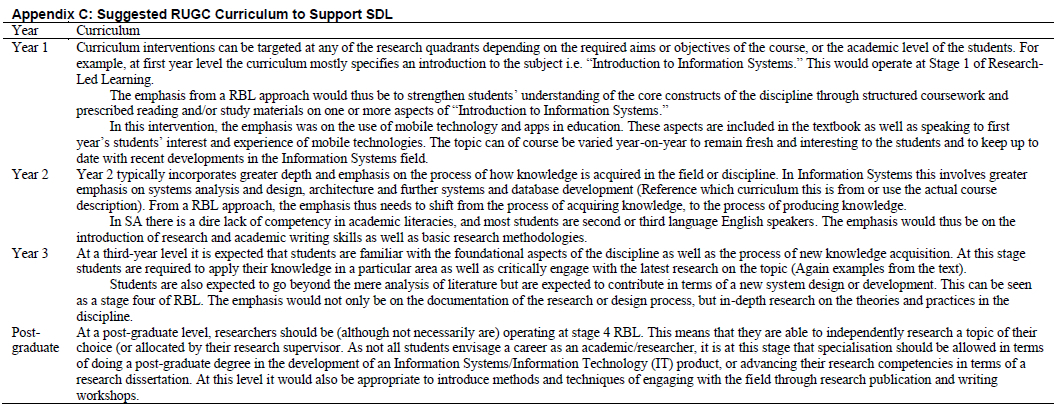
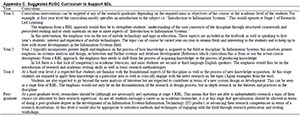
Part of the problem in this context is that research is considered a theoretical competency, with students learning the concepts of research without actually doing research. With this article we present a practical case of changing the curriculum in a research course by introducing a practical research project at a third-year course in a Faculty of Commerce at a South African University. The main question explored in the study reported on here was: How can a research-based learning course support students to become self-directed learners? The particular aim was to identify suitable tasks and activities to cultivate self-directed learning (SDL) in research. With this intervention, we propose SDL and reflection as a process for UG students to develop research skills. We present a case study of RBL drawn from three cohorts of final-year commerce students who were registered in information systems at a historically disadvantaged university in South Africa. Although the research-based curriculum was conceptualised over 3 years, the course was only offered at third-year level. Recommendations are made in the appendix for extending such a course to the first-and second-year levels. Lastly, we provide guidelines for integrating research into the UG curriculum.
Literature Review
In this section we present related literature on the scholarship and practice of UG research, together with some insight into cultivating SDL and RBL in the UG curriculum. We conclude with a section on how we adapted some of these principles for our revised curriculum of RBL to cultivate SdL.
Scholarship and practice of undergraduate research
The scholarship and practice of undergraduate research (SPUR) in higher education is gaining ground internationally (Mieg et al., 2022). One of the earliest studies to report on SPUR is Selin (1988:56), who emphasises that, "research skills need to be seen as integral to the acquisition of knowledge and the habits of mind central to the academic purposes of undergraduate education." Many aspects play an important role in cultivating research at an UG level, such as the role of the lecturer (Badke, 2012), mentoring as opposed to supervising (Childress, Cox, Eve, Dean, Orr & Rivera, 2009; Malachowski, 1996), the central role of libraries and academic literacy (Hensley & Davis-Kahl, 2017; Van Scoyoc & Cason, 2006), and emphasising the process of research with less emphasis on the outcomes (Tams, 2014).
Research in the UG curriculum
The introduction of research in the UG curriculum presents significant opportunities for transitioning from a transmission-mode pedagogy to preparing UG students for independent learning and PG academic studies. Part of the challenge in achieving the benefits of research at UG level is an already full curriculum, and the overt emphasis on teaching disciplinary knowledge acquisition and application (Brew, 2010). The emphasis appears to be on what is learned (the content) and what to do as opposed to the foundational inquiry skills of problem-solving, critical thinking or reflection, and communication skills (Matthee & Turpin, 2019) that are essential for knowledge production, i.e. how it is learned.
Concerns are also raised about UG students' readiness to do research in the field as well as concerns of academics to plan and manage such activities (Wenderholm, 2004). As a way to remedy the gap in the scholarly knowledge, Davidson (2011) suggests that academics adopt research practices in their classroom and publish their findings in scholarly forums and through professional associations.
Due to heavy workloads and large classes, it becomes time consuming to direct and teach every activity and skill that students would require to conduct independent research (Jenkins & Healey, 2005). It is also important to equip students for successful careers and to continue to PG studies and research (Candy, 2004; Haviz, 2018; Salsman, Dulaney, Chinta, Zascavage & Joshi, 2013). It thus becomes essential to develop students' abilities to become self-directed researchers (Candy, 2004; Sharma & Sharma, 2024). It also becomes important to include students from all academic levels in the research endeavours, both as participants and mentors who can maintain continuity of these research projects and where more senior researchers can guide and mentor junior researchers.
Cultivating seif-directed learning
The highest level of independence in learning is SDL, which is also sometimes incorrectly equated to "autonomous learning", "self-regulated learning" or "independent learning"; and is a subset of adult education (Knowles, 1980:18). The development of self-directed learners is central to students' ability to navigate their way in complex processes such as research (Mok, 2013:9). For the purposes of this article the SDL definition by Knowles (1975:18) as "[a] process in which individuals take the initiative, with or without the help of others, in diagnosing their learning needs, formulating learning goals, identifying human and material resources for learning, choosing and implementing appropriate learning strategies, and evaluating learning outcomes" provided the conceptual foundation for this study. Knowles (1975:40-41) highlights a five-step process for developing SDL in the classroom namely: a) climate setting, b) diagnosis of learning needs, c) designing a learning plan, d) conducting learning activities, and e) evaluating learning outcomes.
Millar and Saddington (1993:29) propose the following components as invaluable in a curriculum that aims to cultivate SDL:
• Required reading: "Key texts" need to provide a basis for students to explore their own conceptions of learning as well as frameworks for constructing such learning.
• Required tasks: Tasks need to have a clear purpose and goal and be (un-)structured in a way that requires students to "grasp in the dark" for solutions.
• Group work: Group work is central to the success of SDL, and regular changes in groups give students the chance to experience different "frames of reference."
• Reflection: Reflection is essential in instilling an intrinsic learning approach rather than being given material to memorise or learn.
• Role alternation: Although the roles of teaching staff are clear (such as selecting texts or devising tasks), one of the imperatives is that teaching staff are primarily co-learners in the process, i.e. learning from and with their students.
With this study we aimed to develop a course that integrates the tenets of both RBL and SDL, and to evaluate the outcomes of such a course.
Cultivating research-based learning
We believe that research is something that is mastered by doing and through reflection (Argyris & Schön, 1996; Brew, 2003). RBL provides such a practical approach to conducting research and reporting on these research activities. RBL is an active learning approach where students conduct research in authentic environments (Elsen et al., 2009). According to RBL, students develop their research, critical thinking, writing and presentation skills, and gain confidence in their abilities to learn independently (Elsen et al., 2009:71; Shaban, Abdulwahed & Younes, 2015).
Considering the importance of RUGC, one would expect to see many examples in the literature of implementing RBL in the curriculum, which is not the case. One example of teaching RUGC is presented by Dekker and Wolff (2016:5), based on Elsen et al. (2009), and consists of seven steps, namely:
1) gain an overview of the discipline;
2) review the literature in the (sub)field;
3) discuss and critique research findings in the (sub)field;
4) learn about research methodologies in the field;
5) learn to apply research methodologies;
6) engage in research activities (replicate prior studies); and
7) conduct original (student-led) research as a thesis or capstone project.
Although the implementation of RUGC may differ between disciplines and institutions, our article outlines a particular example of RUGC in a research course in a Faculty of Commerce at a South African University.
Teaching Approach
Prior to our intervention, the research course was mainly philosophical and/or theoretical with minimal intervention in teaching research skills. It followed the typical philosophical discussions, as well as a more focussed approach on research methods based on a research methodology textbook. As summative assessment, each student was required to develop an individual research proposal to be used as the basis for the student's PG research project.
Motivation for the revised course
We were of the opinion that the theories and methods of research were over-emphasised at the expense of letting students conduct research. This was evident in the significant teaching load, where the lecturer needed to prepare PowerPoint presentations on various aspects of research and present these to the class. Based on the review of the literature on SDL and RBL, we surmised that this could be offered in a better way to cultivate students' innate interest in research.
Our aim with the revised design was based on the cultivation of self-directed researchers through emphasis of the course on active experiential learning by doing research-based assignments. After determining the SDL skills that the students required in order to learn during the course (Knowles, 1975), our strategy pivoted to the research activities that would support students to master the relevant research knowledge and skills through SDL, i.e. the task or assignment (Shavelson & Stern, 1981). A third emphasis of our approach was group work (Miller, Trimbur & Wilkes, 1994; Morrow, Rothwell & Wright, 2012), although students had the option to work independently if they were not comfortable in working in a group. A fourth aspect was the introduction of formal reflections (King, C 2011; Rich, 2015), both to cultivate students' abilities for SDL, and to provide students with a record of their research experiences on which to reflect. The teaching approach and evaluation methods of the course were changed as outlined later in this article.
Course structure to scaffold SDL
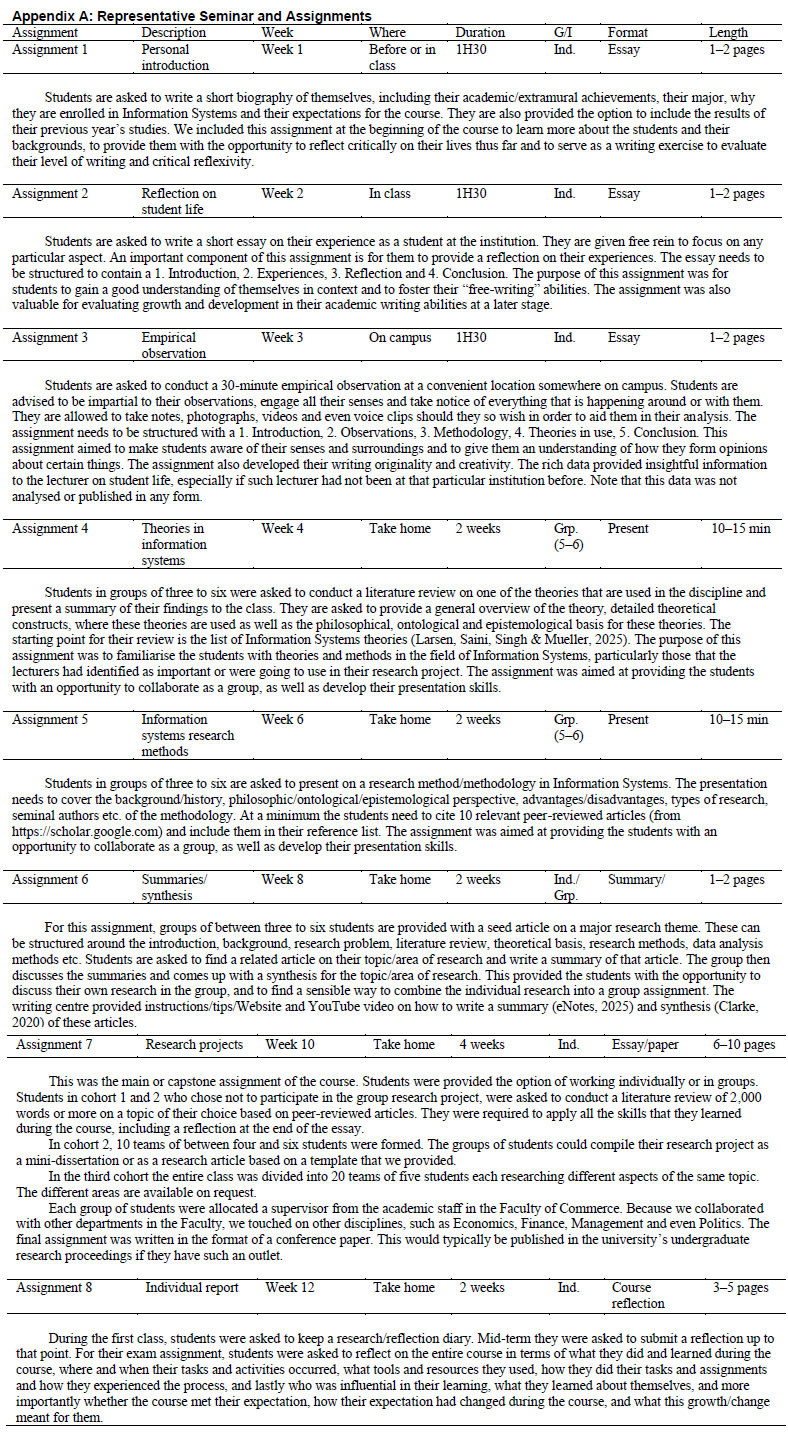
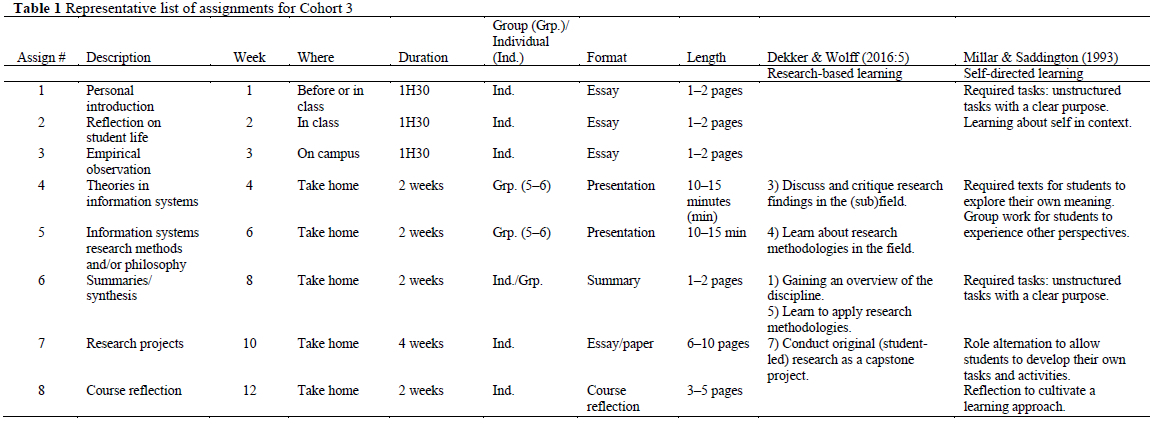
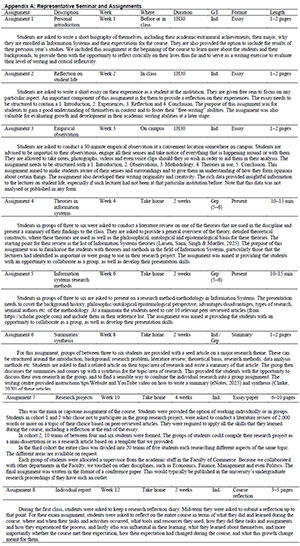
We developed a comprehensive set of seminars and associated assignments (see Table 1) to facilitate the acquisition of research skills among the students.
For each assignment, we facilitated a complementing classroom discussion, both when the assignment was given as well as afterwards to respectively debrief and reflect on the activity. We loosely structured these assignments according to Millar and Saddington's (1993) proposed components of a curriculum to cultivate student learning. In this way, we scaffolded the students' learning and reflection from their personal perspective, the context, the discipline, theories and methods, the research topic, and, ultimately, the research project itself. As the course was improved over the 3 years, the final list of assignments for Cohort 3 are listed in Appendix A: "Representative Seminars and Assignments" and in Table 1 below.
Assessment guidelines
The individual assignments comprised a personal introduction (Assignment 1), the reflection assignment (Assignment 2), as well as individual literature reviews (Assignments 4, 5 & 6), which contributed 30% of the course mark.
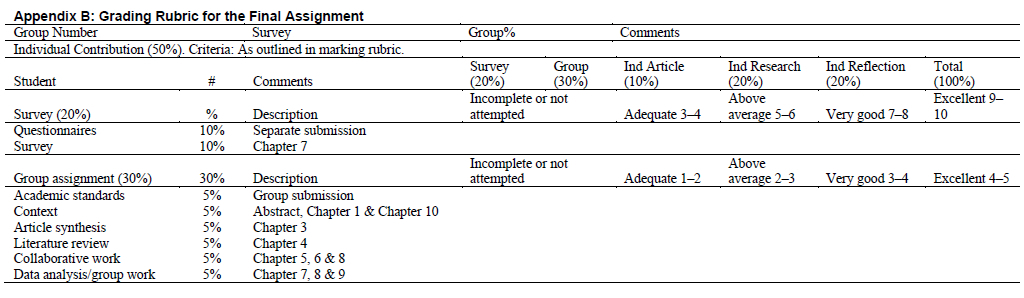
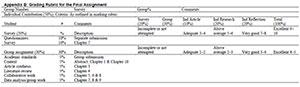
The research project (Assignment 7) was the main or capstone assignment of the course and accounted for 50% of the overall assignment grade. In the research project students had to explain the background or problem statement, the literature review, the research methodology, data analysis and their findings. For Cohort 1, the majority of the class (49/59) did an individual essay according to the course outline, however 10 students were invited to do a group assignment. For Cohort 2, students were provided the option of working individually or in groups. Twenty-four students chose to do research on their own while the remainder of the class self-selected groups of between four and six students. Individual students were provided the option to write up their research report as a mini-dissertation or as a conference paper using a prescribed format. For Cohort 3, 20 teams of four students were randomly allocated specific tasks/topics such as management, events, marketing, secretariat, reference management and topics such as mobile devices, online survey, statistical analysis. Students in Cohort 3 were required to write up their research as a group research report. We scored the research reports and allocated a mark either to the group or individually depending on the type of submission (see Appendix B). The essay was graded based on the overall quality of the research or the assignment and the students' reporting on each of the sections.
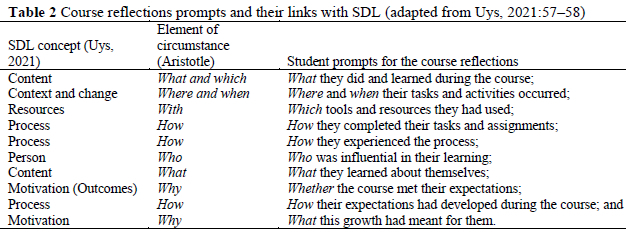
The final 20% of the mark comprised the individual course reflection report (Assignment 8) at the end of the term. These were between five and 10 pages long and comprised the students' reflections based on the concepts as outlined in Table 2. Kember, McKay, Sinclair and Wong (2008) present a rubric that was used to grade the reflections. We used Kember et al.'s (2008) suggestion that the highest level of reflection in a student's paper is graded with pluses and minuses indicating intermediate cases, e.g. A = Critical reflection, B = Reflection, C = Understanding, D = Non-reflective, 0 = No reflection.
Groups and group leaders
An important design aspect of the course was the establishment of student groups and selecting group leaders to attend weekly meetings in order to remain abreast of developments in the course. In Cohort 1 only one group conducted research on the same topic. The group comprised 10 principal researchers that were given additional responsibilities such as project management, catering, referencing, secretariate. In Cohort 2, there were 10 groups of between four and six students. Their groups were structured similarly to those in Cohort 1 and each group did research on a separate research topic or problem. These topics varied throughout the Faculty and were supervised by lecturers from departments such as finance, industrial psychology, management and information systems. Cohort 3 was divided into 20 groups of four students, all researching the same topic, namely, smartphone usage by students. Each group had a project manager and a secretary. The group leaders and secretaries had weekly meetings in order to manage the overall research project.
Methodology
In this section we outline the research method, our sampling strategy, the ethical considerations, data collection, and analysis methods that we followed in the study.
Philosophical Perspective
The philosophical perspective that we followed was primarily humanistic (David, 2020), with the emphasis on the needs, interests and motivations of both students and academics. We believe that academic staff should teach both the product and the process of research, i.e., transitioning students from knowledge consumers to knowledge producers. This belief reflects the growing discontent with content-based or "the banking concept of education" (Freire, 2005:256) and the shift towards more active teaching and learning strategies as advocated by Marquardson and Schuetzler (2019). We believe that researchers need to be self-directed, lifelong learners, and that SDL provides a rich theoretical base for our intervention.
Conceptual Framework
The conceptual framework for this research was based on a review of 14 SDL models (Uys, 2021) that were classified according to Aristotle's elements of circumstance (Sloan, 2010). The 14 SDL models that were synthesised for this conceptual framework are the models from Brockett and Hiemstra (1991), Candy (1991, 2004), Garrison (1997), Grow (1991), Hiemstra and Brockett (2012), Knowles, Holton and Swanson (2005), Long (1988), Oswald (2003), Pratt (1988), Sawatsky, Ratelle, Bonnes, Egginton and Beckman (2017), Song and Hill (2007), Stauble (2005), and Wang and Cranton (2012). The fundamental concepts that were synthesised by Uys (2021) are based on Aristotle's (in Sloan, 2010:240) elements of circumstance which describe any particular circumstance and are conceptualised as "Who, How, Where, Why, Which, What, With, and When." These equate respectively to the SDL concepts of "Person (Learner or Educator) [who], Process [how], Context [where], Motivation [why], Strategies [which], Content [what], Resources [with] and Change over time [when]" as outlined in Uys (2021:57-58). This is also the framework that was provided to the students for completing their final reflective assignment as outlined in Table 2 in the methodology section.
Research Method
Quantitative assessment tools, such as the self-directed learning readiness scale ([SDLRS] Guglielmino, 1978), can be used to evaluate students' readiness for SDL. However, we chose the qualitative method, as it could provide a rich narrative on human experiences and thought (Myers, 1997) and is best suited for an emerging research project. We chose pragmatism as research paradigm (Goldkuhl, 2012). Pragmatism involves both an in-depth understanding of the situation as well as change (Goldkuhl, 2012); it is not merely based on the understanding of a situation such as interpretivism. Pragmatism is a paradigm that was strongly advocated by Dewey in his conceptualisation of educational inquiry (Goldkuhl, 2012) and was thus well suited for this study. This paradigm also links with the incremental changes that were made to the curriculum over the three cohorts. A single case study approach was used to understand the intervention in a single setting (Barrett & Walsham, 2004; Ruddin, 2006). A single source of data, namely course reflections, provided the data for analysis (Scholz & Tietje, 2002). The data were analysed interpretively using two rounds of coding.
Sampling Strategy
The University where this study was conducted is classified as a historically disadvantaged institution ([HDI] Omar, 2000), with the majority of the students from disadvantaged areas around the university. This is also one of the few universities in South Africa that has a dedicated UG research methods course in information systems; as based on a survey of curriculum guidelines for computer science and information systems of the top 10 higher education institutions in South Africa (Uys & Chigona, 2018).
The students primarily specialised in information systems. However, they may have had second major subjects such as finance, economics, management, accounting, computer science, or law. The course is offered in the first semester at third-year level and requires 300 hours of learning time with a total contact time of 48 hours and a suggested 212 hours for assignments, tasks and self-study. The course carries a credit value of 30 within a 180-credit third-year programme comprising six modules offered in English.
The research population was stratified into three cohorts (C1, C2 & C3) and participant reflections selected as follows. The sample was obtained from sixty-four (n = 64) third-year UG student course reflections over 3 years' cohorts.
From Cohort 1 we selected the reflections of the 10 students (17%) who participated in the group research project. From Cohort 2 we selected eight students from 80 (10%) who participated in the group research project on smartphone usage as well as a random selection of 21 (26%) course reflections from students who chose to conduct individual research. From Cohort 3 we randomly selected 25 (25%) reflections from 10 groups which included the course reflections of the group leaders as well as one or two reflections from their group members.
All the student submissions were made electronically on the university' s learning management system (LMS). The final reflection submission also included a copy of the students' consent forms. All the students were invited to participate in the study, however only the reflections in which the students provided consent were included in the sample. The cohort comprised a diverse group of South African students that lived mostly in the area surrounding the University. The students' ages ranged between 19 and 23 years with the median at 21 years and one student being 26 years old. The student grouping remained relatively homogenous across the 3 years. At the time, there were 59 enrolments in Cohort 1, 80 in Cohort 2, and 100 in Cohort 3.
Ethical Considerations
We conducted the research while the first author was a part-time academic at the University under study and a student at a different university. The second author was their supervisor. An ethical waiver to conduct this study was obtained from the primary University. Permission was obtained from the head of the department (HoD) of Information Systems in the Faculty of Commerce at the respective university. As part of the research, informed consent was obtained from the students, and their names were replaced with pseudonyms to maintain their anonymity. All students who were involved in the study were over the age of 18, which and did not compel parental consent. The student reflections were anonymised and stored in private Dropbox and NVivo accounts, accessible only to the researchers concerned. The students were responsible for obtaining the ethical clearance for their respective research projects. Cohort 1 jointly published a conference paper with the first author; the 10 students were listed as co-authors. Ethical clearance was obtained from the respective University for the larger survey conducted by the students in Cohort 3. No paper was published by students from Cohorts 2 and 3.
Data Collection
The importance of reflective diaries for personal growth and development was established by year 3 and at the start of the semester, students were asked to keep a reflective diary of their experiences and thoughts over the semester of the course. Students were informed that these diaries were personal and would not be submitted for grades; however, they were informed that they may need to refer to them to complete their compulsory course reflections. Reflective diaries are a valuable source of information on someone's subjective experiences -both for educators and for the students (Glaze, 2002; Rich, 2015). Reflective diaries are also a valid way of linking inquiry to research, grounded in the reflective practitioner, and form the basis of later reflective practices, serving as a synergistic practice to support student research skills (Rich, 2015). Reflective diaries also add rigour to the process of reflection, as one tends to forget distant events. These diaries also provide a rich source of data for analysis (Glaze, 2002) and were used as the primary data source for this study.
The students were asked to submit a brief extract from their diaries during the mid-semester break, allowing them to review their experiences of the course to that point and encouraging those who had not been keeping their diaries to start or resume writing them. This also allowed for assessing the progress and insight of the students in the course up to that point. For their final course reflection assignment, the students were asked to document the aspects of their experience tabulated in Table 2.
students with a "stimulating experience", allow them to "pose their own questions" and to "explore new knowledge for themselves" (Wallace, 2015:64). Student 1 in Cohort 3 (C3) reflected as follows: "I have learnt very early in this course that we would not be spoon fed and told every single detail or guideline" (emphasis added). Student 2 (S2, C3) reflected:
Although most of the actual learning was from doing the work, we learnt as we went along. We were given tasks and some form of guidance, yet we were encouraged to learn for ourselves. Another way of saying it is, 'we had to research on how to do research' (emphasis added).
Rather than being the "sage on the stage", the lecturer was in the background providing students with strategic advice, articles to read, pointers to resources and serving as a general source of support when they needed some direction.i This was clear from the following: "He encouraged us to take initiative, be self-directed, think freely and be innovative and creative. He strategically planned our assignments as well as classes'" (emphasis added) (S2, C3).
The students were also not provided with a course outline (guideline), as the sequence of activities at the start of the semester were not pre-determined. "The lecturer does not follow any form of planner or commonly known as outline. He teaches as he goes, emphasises that there is no wrong or right and promotes class discussions or debates" (emphasis added) (S3, C3).
In essence, the student reflections indicate that the course guided them through a sequence of assignments, from understanding themselves in context, the discipline, the theories and methods, and how to conduct research, thus enabling them to construct their own content.
Theme 2: Guiding Students to Find Their Own Direction
Another theme identified from the student reflections which was instrumental in developing self-directed learners, was guiding the students to find their own direction. Not providing them with prescribed instructions on how to approach the tasks seemed to stimulate the students' natural curiosity or interest in finding their own way. Support for the students was provided through a process of guidance, by "narrowing down" possible options for them, or "pointing them in a direction." This allowed students to develop their own "sense of direction." From the sample of student reflections, it was found that the term "direction" was used 68 times. By assigning students' activities on what they had to do and not necessarily instructing them on how to do it, they developed their own internal guidance capabilities.
Everything that I have learnt about research I had to teach myself. I often enjoyed not being told what to do; it gave me a sense of ^finding my own way, although when things remained without direction it became extremely frustrating (emphasis added) (S4, C3).
This sense of direction was also highlighted by another student: "[The lecturer] showed us all a lot this semester and taught us how not to always depend on people to give you direction because you may not always have it in the working world" (emphasis added) (S5, C3).
A lack of direction seemed to have prompted the students to find their own way. Student 16 (C2) reflected as follows: "As time passed we started to get our footing and structure in the group as to who must do what, basically we found direction as to where we should be and what must be done to complete the [_] research design.'" With our teaching approach, students developed the ability to form their own "line of reasoning", "direction" and "structure" as indicated by the coding of the data. This was regarding their assignments, the course, or even in terms the direction they were heading with their own lives or studies. "Narrowing down my research helped a lot because now I gained sense of direction on how to approach my topic" (S21, C1). Ultimately, we did not prescribe any specific direction in the course. The students needed to master the requisite knowledge and skills on their own. It seemed that when we provided direction to the students, it removed their responsibility to find their own direction. Hence, they lost their independence in the process.
I no longer need to depend on the instruction and guidance of a lecturer to be able to formulate my own conclusions in terms of my work method and philosophy. Being independent also allows one to be able to exercise their process and methods, as in how they understand, interpret and analyse things. I can choose for myself what will affect me and how I can overcome it - based on my independence and experiences (emphasis added) (S6, C3).
At the end of the course, the students demonstrated a propensity for SDL in research and were confident in their abilities to satisfy their own information needs in the future.
Theme 3: Assignment Design in Developing SDL
The course was not entirely laissez-faire, as the assignments and their sequencing were developed over 3 years of teaching the course. The students reflected that they had to teach themselves how to complete the tasks in the assignments, and that the assignments taught them several valuable lessons as indicated in their reflections. The terms "assignment" and "teaching" below are emboldened to indicate the relevance of that particular code for the analysis.
The assignments required us to practice research techniques like literature reviews, summaries and synthesis. No lecture has been dedicated to teaching us how to do this, but we had to figure out for ourselves how to do it and managed to do it so well that I have learnt that I can do work on myself [sic] and educate myself without an instructor. That is the basis of philosophy. There are some things which one cannot be taught by a lecturer, but one has to be given an opportunity to do the things (for oneself) (emphasis added) (S7, C3).
The student reflections indicate that the assignments prompted them to learn independently through a process of learning by doing.
This module trains you and assesses how much of that work can we do for ourselves without being pushed or directed by a lecturer. To realise how and what exactly you learn about yourself through doing the assignments. The coursework is only included so as to find us work to do on which lecturers can assess our ability to work on our own and educate ourselves effectively. If the project is a success, we are going to be marked on our ability to do things on our own, educating ourselves because there are some things which cannot be taught to a human being through the traditional education system, but rather those skills one develops by actually doing or practicing the work (emphasis added) (S7, C3).
Most of the assignments were communicated via the LMS system, electronic mails (emails), WhatsApp and the group team leaders or during class times. The lecturer did not prepare any lecture slides, and the class sessions were used to discuss the assignments and get feedback from the students. In some ways, this approach also compelled students to attend the class (the attendance of Cohort 3 was 84%): "We had no choice but to attend every lecture in order to know the structure of his assignments; there were no lecture slides" (emphasis added) (S8, C3).
In most cases, further clarity on the tasks and assignments was obtained either in class or through the group leaders. The group leaders' meetings were central to the SDL approach, and these meetings were arranged by the students outside of class times. One student reflected:
One of the things I liked about the assignment was the group leaders' meeting. This is where as [sic] group leaders could get clarity about what we are supposed to do exactly and take the feedback back to the group. Not only do we get clarity, but this is where we would share a pool of ideas about what is supposed to be done next (emphasis added) (S9, C3).
In essence, the students indicated in their reflections that the assignments prompted active learning and participation, and with limited direction from the educator, they were compelled to find out for themselves how to do these assignments. In reality, however, the class seminars were used to discuss these assignments, and the group meetings were used to respond to particular questions that were raised by the group leaders.
Theme 4: Supporting Reflective Learning
The process of reflection allowed students to make sense of the new experiences they were experiencing and also assisted them to develop an independent reflective approach to learning when confronted with new knowledge. The word "reflection" was used 583 times in the sampled reflections. The statement by Student 10 (C2) demonstrates the value of reflective tasks in support of critical reflection on own learning to support transformative learning.
I'm really glad the lecturer asked for a reflection to accompany the final paper/assignment. It allowed me to think beyond the final product/ assignment, so that I can identify the positives, negatives, and draw out what I learnt from the whole experience. In addition, the reflection helped me identify which aspects I can improve on, and what I can or should have done better (emphasis added) (S10, C2).
The process of reflection was not only central to the students' ability to learn for themselves, but it also gave them greater insight into their own lives, thus, setting them up for a process of lifelong learning.
I never reflected in a critical manner in my life before. This helped, as I now had an exact account of my progress and where I was headed. Reflecting is not merely just writing in a diary, there were methods I learnt as to how to do it. I feel it is necessary to carry on reflecting throughout my life, as it has helped me express my emotions and thoughts (emphasis added) (S11, C3).
These reflections not only helped students to crystallise what they had learned (content), but also how they had learned (process) and why it was important (motivation).
Theme 5: Giving Students a Voice
Key to attaining students' engagement in the course was to provide them with the opportunity to voice their opinions, either in class or through their reflections and with the possibility of producing a research publication. This was also reflected in the joint decision-making process for the research projects and/or assignments, as well as curricular decisions, such as deadlines. "This past 6 months has taught me to stand up and voice my opinion, in an appropriate manner, especially when it came to decision-making" (emphasis added) (S12, C3).
Providing students with two personal reflection assignments in the semester enabled them to find and develop their own creative voice in their writing. Furthermore, by giving them assignments in groups they were able to learn from each other and ask their peers when they were uncertain about what to do. "Despite being an unconventional teaching method, I really enjoyed it as I felt that my opinion was being considered and it gave me the opportunity to think on my own and this allowed room for initiative" (emphasis added) (S13, C3).
Students gained their own voices in the process by doing research, finding facts for themselves, and obtaining a basis from which to argue about the validity of their opinions. We created this platform by encouraging students to be themselves and to not stop questioning, especially when they thought that it was not their idea in the first place. We achieved this by discussing the diverse opinions and beliefs of the students, and by providing them with opportunities to participate, both in the project and in class. This is a central aspect of Freirean education, as emphasised by Mayo, that "instead of being passive recipients of knowledge, they are allowed to reclaim a voice which an entire prescriptive social system appears to have denied them" (Mayo, 1999:90).
Unfortunately, in university your own opinion is not much welcome, because we are taught how to memorise the textbook and display our intelligence by getting 80s and 90s, not once was I requested to write what I think in another course (emphasis added) (S14, C3).
Ultimately, one of the main motivating factors for the students was the opportunity to participate in a research project where they had the chance to present their findings to the broader academic sphere through publishing the results.
[W]anting my name on the research paper but being part of the research team would require extra hours and a sacrifice of my holidays. This was exciting to me, because I knew I was part of something bigger than just an exam assignment. (S15, C3)
By the end of the third year, the students had completed several research projects. The research from Cohort 1, "Smartphone usage amongst students at a South African University", was published in a peer-reviewed national conference proceedings with all the students who participated listed as co-authors. For Cohort 2, the students had completed seven different research projects on, among others, use of mobile phones, electronic tolling (E-tolling), eye tracking while driving, gaming addiction, living labs in Cape Town, the eKhanya schools project, and the adoption of a new LMS at the University. For Cohort 3, students designed the research and surveyed more than 2,000 students on students' habits on smartphone use. All these research projects could potentially have been published, but due to the heavy workload for the lecturer concerned, this was not realised for all cohorts. Ultimately, only one publication emanated from Cohort 1, namely Uys, Mia, Jansen, Van der Schyff, Josias, Khusu, Gierdien, Leukes, Faltein, Gihwala, Theunissen and Samsodien (2012).
Theme 6: Supporting Students in Using Research Tools
The course required of students to use a variety of research tools to support their collaborative research efforts. Student 17 (C3) reflected as follows: "The module provides us (students) with the tools and tasks that we need to develop our own abilities to think about and understand things.'" This addresses the 21st-century curriculum needs of developing self-directed lifelong-learning students by using technology (Bok & McKeithan, 2005; Lombardi, 2007). The institutional LMS and WhatsApp were key in facilitating the students' activities and assignments (Ngaleka & Uys, 2013). Student 18 (C3) reflected as follows: "I also used WhatsApp as a platform to engage with the group leaders of other teams throughout the second term.'" With Cohort 3, WhatsApp groups were limited to 20 participants per group, so we replicated the hierarchical structure of the course; that is, we had a management team comprising all the group leaders, as well as a separate group leader for each team. The lecturer was only a member of the management group.
The institutional LMS was used to post notices and assignments and to share a limited number of documents. A Google group folder was created for sharing research articles and related documents.
The library databases and Google Scholar were the students' first option for journal articles. Following the librarian's workshop, the students became increasingly familiar with the databases in our discipline, such as Science Direct and EBSCOhost: "This was found by reliable search engines, mainly EBSCOhost provided on the South African University's Online Library site. We were taught to use this search platform (to utilise for further academe) by the [University's] very own librarian" (S19, C3).
The free version of Mendeley was used as the reference management tool for the course, and each group kept their own database. Articles that were shared with the entire class were managed by one of the students in a Mendeley group. The group features were limited in the free version of Mendeley, and the lecturer enrolled as a Mendeley advisor in order to gain access to larger group options (The Mendeley Support Team, 2024). "I realised that I had to be more organised. I then learnt how to use Dropbox and Mendeley which made my life much easier when it came to downloading and saving all the group articles" (S20, C3).
The students conducted qualitative data analysis manually due to the limited amount of qualitative data that the students had collected, by using printouts of the qualitative questions and highlighting key terms. To support their learning, we had some discussions in class on thematic analysis. The students captured the survey data in Microsoft Excel and used Statistica for the quantitative data analysis. The first author used one of the seminars for some basic training on the use of Statistica in class. The students had to learn the remainder of the research aspects on their own. Although each group captured their survey data on a single spreadsheet, one group was responsible to collate all the data from the separate spreadsheets.
Discussion
From the start of this course on conducting research, we steered away from the traditional talk-and-chalk, textbook-driven didactic approach, to a more active approach to learning. In preparation for RBL, students were guided in the principles of information literacy (Noll & Brown, 2019) to access and critically evaluate online resources, and to formulate their own views, rather than being taught content. This approach encouraged creativity and critical thinking in becoming self-directed researchers. It promoted "active learning", where students engaged critically with the learning material, analysing, synthesising, and evaluating it, instead of merely memorising or recalling it. The educator transitioned from being the "sage on the stage" to "the guide on the side" (King, A 1993:30). In this way, the learning context was not limited to the learning environment, but extended beyond the classroom to the internet, WhatsApp, and institutional (library) databases.
Our approach differed from contemporary active learning approaches such as recommended by A King (1993:31), where "for each major concept or principle that we present[ed] we structure[d] some activity that require[d] students to generate meaning about that concept or principle." In contrast, our approach was inductive, i.e., we started with the activity and ended by reflecting on the primary concept or principle at play. Another approach that is similar to this is problem-posing education (Freire, 1973) or problem-based education (Ryberg & Norgaard, 2013), as well as question-based learning (Rothstein & Santana, 2017). Fundamentally, the approach contributes to a research-based curriculum rather than a research methods course, such as outlined by Ryan and Milevsky (2016).
Part of the success that we achieved in this course was due to our high expectations of the students. From the outset, we believed that the students were capable of obtaining the necessary knowledge through SDL to complete the required research, thereby achieving the course outcomes. The teaching approach required of us to convince the students gradually that this was possible. What we did not know beforehand, was to what degree or standard the students would be able to perform the research and how long this would take. For Cohorts 1 and 2, the assignment extended into the second semester. For Cohort 3 we managed to complete the entire research project in the allocated semester. Overall, it took 3 years to gain the necessary experience to pace the course and to build credibility. This was achieved through the conference publication resulting from the research project of Cohort 1 (Uys et al., 2012) - this convinced the students and lecturers of the efficacy of this approach. All the students in Cohort 1 who participated in the research were credited as authors in the conference proceedings.
We found that reflection and the associated process of critical reflection were central to the SDL process (Brookfield, 1984; Mezirow, 1981). Reflection is an essential aspect of adult cognitive development (Allman, 1981:8). It allows individuals to "explore their experiences in order to lead to new understandings and appreciations" (Boud & Walker, 1991:11), and is central to experiential learning (Saddington, 2000), and transformation of practice (Mezirow, 1981) where students are able to explore and question their own limiting beliefs.
Following a minimally directed approach (Kirschner et al., 2006), students had to find their own way. The minimally guided approach can also be referred to as "inquiry-based learning" (Aditomo, Goodyear, Bliuc & Ellis, 2013:1239) or experiential learning (Saddington, 2000). Some concerns have been raised about the efficacy of the minimally guided approach (Kirschner et al., 2006), such as covering of the required course content. These concerns do not, however, consider students' ability to organise and represent such information themselves. Several aspects, including intrinsic motivation and prior skills and knowledge all had an impact on the students' ability to direct their own learning.
Students in higher education institutions (HEIs) can be guided to become self-directed learners (Grapragasem, Krishnan, Joshi, Krishnan & Azlin, 2015:139). Yet they may not necessarily share the responsibility in classroom practices such as selecting, organising, presenting, and scheduling of curricular content, activities and outcomes. The knowledge for assembling the course still remains with the educator. This is akin to the lecturer preparing a meal, laying the table and having the students sit down to eat, yet, expecting them to subsequently, in their careers or later studies, also be able to prepare a meal for themselves. The "banking" concept of education (see Freire, 2005:256) results in only the lecturer sharing his or her knowledge in class or, at most, asking the students questions on the subject material that the student either does not know or cannot remember, thereby reinforcing a culture of silence. This practice of "silencing" students' innate quest for knowledge, is much in keeping with a pedagogy of the oppressed.
Rather than being encouraged and equipped to know and respond to the concrete realities of their world, they were kept 'submerged' in a situation in which such critical awareness and response were practically impossible. And it became clear to him that the whole educational system was one of the major instruments for the maintenance of this culture of silence. (Shaull in Freire, 1970:30)
Through this RBL curriculum, students were transitioned from being passive recipients of knowledge to active participants in constructing knowledge through their own experiences (Al-Zahrani, 2015). This approach also allowed the students to develop their own voices (Mayo, 1999; Oruç, 2024). In order to achieve this, we needed to shift from an active teaching approach to a passive approach of guiding and allowing students to be more active in their own learning, i.e., finding their own way. This letting-go may be difficult for some educators, especially if they rely on the power-dynamic of knowing more than their students. By embarking on a shared approach to teaching and learning, the students were encouraged to share their own "opinions", i.e., "each individual wins back the right to say his or her own word, to name the world" (Shull in Freire, 1970:33).
In addition, it was essential to acknowledge and encourage the students to share their opinions and ideas regardless of how radical or contentious they may have appeared, particularly in a historically disadvantaged setting. In our study, some of the most engaging situations occurred when students questioned the lecturer's opinions on matters. In such a situation, the only opinion that was unwelcome was the one that was not shared.
Finally, the research has provided a sample curriculum for an RBL course (see Appendix C) that differs from traditional research methodology courses, and which has the potential to cultivate self-directed learners. The numerous reflections by the students on how the course encouraged them to become more self-directed are proof of their personal growth, and how they, with minimal guidance or direction, became free to voice their opinions, and "to take initiative, be self-directed, think freely and be innovative and creative" (S2, C3).
Conclusion
This article advances the argument that the teaching of research should not be exclusive to PG studies but is essential both to students learning a new subject and to those able to apply these skills either for PG research or their careers. Furthermore, as students are struggling to contribute to the knowledge economy in a meaningful way and to develop originality and creativity in the era of AI, it becomes even more critical to introduce these fundamental research skills at an early stage.
For this transformation to occur, students should be guided from a state of dependency and knowledge consumption to one of independence and knowledge production. This means developing self-directed, lifelong learners rather than merely imparting disciplinary knowledge or skills. In this way, we advocate the teaching of research as a process of developing students' SDL abilities. In this article, we report on such a process of developing learners to become more self-directed learners through a series of seminars and assignments that were performed either individually or in a group. The idea was that these assignments guide students through the principles and practices of conducting research, enabling them to learn more about their own capacities and abilities, as opposed to merely learning about the outputs of research.
In this article, we provide a case of developing self-directed learners as researchers. However, the study was limited to the scope and nature of teaching students in a particular discipline at a particular University to conduct a research project. Further research is required in adapting this curriculum to other disciplines such as social science, engineering, science or medicine. This adaptation may require a different set of assignments and collaborative activities from those presented in this article. Our example does, however, hold the promise of contributing a case study on developing self-directed learners to conduct research in a discipline that is traditionally acknowledged to be poorly supported by empirical examples.
Authors' Contributions
The contributions of the authors can be summarised as follows. WFU was primarily responsible for the design and implementation of the research and the writing of the article. WC was the supervisor and reviewed the PhD thesis and this subsequent publication.
Notesi. In their personal diary, the first author reflected on how they were able to influence the group assignments, e.g., the video clip on synthesis, and the belief that the lecturer did not plan the lectures, without students realising it (WU).
ii. Published under a Creative Commons Attribution Licence.
Acknowledgements
This article is based on the insight and material derived from the first author's Doctor of Philosophy (PhD) dissertation. Aspects of this article were presented at the 2018 South African Computer Lecturers' Association and in the AOSIS publication as cited. The authors acknowledge the valuable feedback from the anonymous reviewers. The authors wish to acknowledge the project coordinators for each year; the team leaders and secretaries; the tutors; the post-graduate students that assisted; the faculty librarian; the writing centre director; the academic literacy lecturer; the lecturer of the class; the lecturers from the other departments that each supervised a group of students; the HoD of the Information Systems department; the project sponsor; and the Deputy Dean of research for their input and contributions towards the success of this project.
References
-
Aditomo A, Goodyear P, Bliuc AM & Ellis RA 2013. Inquiry-based learning in higher education: Principal forms, educational objectives, and disciplinary variations. Studies in Higher Education, 38(9):1239-1258. https://doi.org/10.1080/03075079.2011.616584
» https://doi.org/10.1080/03075079.2011.616584 - Allman P 1981. Adult development. In P Allman & KJ Mackie (eds). Towards a developmental theory of andragogy. Nottingham, England: The Nottingham Andragogy Group.
-
Al-Zahrani AM 2015. From passive to active: The impact of the flipped classroom through social learning platforms on higher education students' creative thinking. British Journal of Educational Technology, 46(6): 1133-1148. https://doi.org/10.1111/bjet.12353
» https://doi.org/10.1111/bjet.12353 -
Anthony A & DesJardins M 2013. Starting and sustaining an undergraduate research program in computer science. In R McCauley, T Camp, P Tymann, JD Dougherty & K Nagel (eds). SIGCSE '13: Proceeding of the 44th ACM technical symposium on Computer science education. New York, NY: Association for Computing Machinery. https://doi.org/10.1145/2445196.2445473
» https://doi.org/10.1145/2445196.2445473 - Argyris C & Schön DA 1996. Organizational learning II: Theory, method and practice. Reading, MA: Addison-Wesley.
- Badke WB 2012. Teaching research processes: The faculty role in the development of skilled student researchers. Cambridge, England: Chandos.
-
Barrett M & Walsham G 2004. Making contributions from interpretive case studies: Examining processes of construction and use. In B Kaplan, DP Truex III, D Wastell, AT Wood-Harper & JI DeGross (eds). Information systems research: Relevant theory and informed practice. Boston, MA: Kluwer Academic. https://doi.org/10.1007/1-4020-8095-6_17
» https://doi.org/10.1007/1-4020-8095-6_17 -
Benbasat I & Zmud RW 2003. The identity crisis within the IS discipline: Defining and communicating the discipline's core properties. MIS Quarterly, 27(2):183-194. https://doi.org/10.2307/30036527
» https://doi.org/10.2307/30036527 -
Bok D & McKeithan EB (eds.) 2005. Critical thinking: Lighting the path to lifelong learning. Wilmington, NC: Cape Fear Community College. Available at https://web.archive.org/web/20120503052704. Accessed 25 October 2025.
» https://web.archive.org/web/20120503052704 -
Boud D & Walker D 1991. Experience and learning: Reflection at work. In D Boud & D Walker (eds). EAE600 Adults learning in the workplace: Part A. Geelong, Australia: Deakin University. Available at https://files.eric.ed.gov/fulltext/ED384696.pdf. Accessed 31 October 2025.
» https://files.eric.ed.gov/fulltext/ED384696.pdf -
Brew A 2003. Teaching and research: New relationships and their implications for inquiry-based teaching and learning in higher education. Higher Education Research & Development, 22(1):3-18. https://doi.org/10.1080/0729436032000056571
» https://doi.org/10.1080/0729436032000056571 -
Brew A 2010. Imperatives and challenges in integrating teaching and research. Higher Education Research & Development, 29(2):139-150. https://doi.org/10.1080/07294360903552451
» https://doi.org/10.1080/07294360903552451 -
Brew A & Boud D 1995. Teaching and research: Establishing the vital link with learning. Higher Education, 29:261-273. https://doi.org/10.1007/BF01384493
» https://doi.org/10.1007/BF01384493 -
Brew A & Mantai L 2017. Academics' perceptions of the challenges and barriers to implementing research-based experiences for undergraduates. Teaching in Higher Education, 22(5):551-568. https://doi.org/10.1080/13562517.2016.1273216
» https://doi.org/10.1080/13562517.2016.1273216 - Brockett RG & Hiemstra R 1991. Self-direction in adult learning: Perspectives on theory, research and practice (Vol. 2). London, England: Routledge.
-
Brookfield S 1984. Self-directed adult learning: A critical paradigm. Adult Education Quarterly, 35(2):59-71. https://doi.org/10.1177/0001848184035002001
» https://doi.org/10.1177/0001848184035002001 -
Buffalari D, Fernandes JJ, Chase L, Lom B, McMurray MS, Morrison ME & Stavnezer AJ 2020. Integrating research into the undergraduate curriculum: 1. Early research experiences and training. Journal of Undergraduate Neuroscience Education, 19(1):A52-A63. Available at http://www.ncbi.nlm.nih.gov/pubmed/33880092. Accessed 31 October 2025.
» http://www.ncbi.nlm.nih.gov/pubmed/33880092 - Candy PC 1991. Self-direction for lifelong learning: A comprehensive guide to theory and practice. San Francisco, CA: Jossey-Bass.
-
Candy PC 2004. Linking thinking: Self-directed learning in the digital age. Canberra, Australia: Commonwealth of Australia. Available at https://www.voced.edu.au/content/ngv%3A31516. Accessed 31 October 2025.
» https://www.voced.edu.au/content/ngv%3A31516 -
Chan CKY & Hu W 2023. Students' voices on generative AI: Perceptions, benefits, and challenges in higher education. International Journal of Educational Technology in Higher Education, 20:43. https://doi.org/10.1186/s41239-023-00411-8
» https://doi.org/10.1186/s41239-023-00411-8 -
Chan CKY & Lee KKW 2023. The AI generation gap: Are Gen Z students more interested in adopting generative AI such as ChatGPT in teaching and learning than their Gen X and millennial generation teachers? Smart Learning Environments, 10:60. https://doi.org/10.1186/s40561-023-00269-3
» https://doi.org/10.1186/s40561-023-00269-3 -
Chan CKY & Tsi LHY 2023. The AI revolution in education: Will AI replace or assist teachers in higher education? [Preprint]. https://doi.org/10.48550/arXiv.2305.01185
» https://doi.org/10.48550/arXiv.2305.01185 -
Chan HC, Guness V & Kim HW 2015. A method for identifying journals in a discipline: An application to information systems. Information & Management, 52(2):239-246. https://doi.org/10.1016/j.im.2014.11.003
» https://doi.org/10.1016/j.im.2014.11.003 -
Childress H, Cox GC, Eve SB, Dean A, Orr AJ & Rivera J 2009. Mentoring as a socializing activity -Supporting undergraduate research in the social sciences. Available at https://urca.msu.edu/files/resources/159/document/Mentoring%20as%20Socializing%20Activity.pdf. Accessed 14 February 2025.
» https://urca.msu.edu/files/resources/159/document/Mentoring%20as%20Socializing%20Activity.pdf -
Clarke EJ 2020. How to write the synthesis essay for the AP language and composition test. Video. 6 August. Available at https://www.youtube.com/watch?v=0ccmD6iGwrk. Viewed 20 January 2025.
» https://www.youtube.com/watch?v=0ccmD6iGwrk -
Council on Undergraduate Research 2025. Available at https://www.cur.org/. Accessed 31 October 2025.
» https://www.cur.org/ -
David L 2020. Humanism. Available at https://www.leaming-theories.com/humanism.html. Accessed 12 February 2025.
» https://www.leaming-theories.com/humanism.html -
Davidson EJ 2011. 'Hey professor, why are you teaching this class?' Reflections on the relevance of IS research for undergraduate students. European Journal of Information Systems, 20(2):133-138. https://doi.org/10.1057/ejis.2011.1
» https://doi.org/10.1057/ejis.2011.1 - Deicke W, Gess C & Rueβ J 2014. Increasing students' research interests through research-based learning at Humboldt University. Council on Undergraduate Research Quarterly, 35(1):27-33.
-
Dekker H & Wolff SW 2016. Re-inventing research-based teaching and learning. Paper prepared for presentation at the meeting of the European Forum for Enhanced Collaboration in Teaching of the European University Association, Brussels, Belgium, 5 December. Available at https://www.educationandleaming.nl/uploads/cfeal/attachments/Dekker,%20H.,%20Walsarie-Wolff,%20S.%20(2016)%20Re-inventing%20Research-Based%20Teaching%20and%20Learning.pdf. Accessed 13 February 2025.
» https://www.educationandleaming.nl/uploads/cfeal/attachments/Dekker,%20H.,%20Walsarie-Wolff,%20S.%20(2016)%20Re-inventing%20Research-Based%20Teaching%20and%20Learning.pdf -
Elsen MGMF, Visser-Wijnveen GJ, Van der Rijst RM & Van Driel JH 2009. How to strengthen the connection between research and teaching in undergraduate university education. Higher Education Quarterly, 63(1):64-85. https://doi.org/10.1111/j.1468-2273.2008.00411.x
» https://doi.org/10.1111/j.1468-2273.2008.00411.x -
eNotes 2025. How to write a summary. Available at http://www.enotes.com/topics/how-write-summary. Accessed 1 August 2025.
» http://www.enotes.com/topics/how-write-summary - Freire P 1970. Pedagogy of the oppressed. New York, NY: Continuum.
- Freire P 1973. Education for critical consciousness. London, England: Continuum.
- Freire P 2005. The banking concept of education. In D Bartholomae & A Petrosky (eds). Ways of reading: An anthology for writers (8th ed). Boston, MA: St. Martin's Press.
-
Garrison DR 1997. Self-directed learning: Toward a comprehensive model. Adult Education Quarterly, 48(1):18-33. https://doi.org/10.1177/074171369704800103
» https://doi.org/10.1177/074171369704800103 -
Glaze J 2002. Ph.D. study and the use of a reflective diary: A dialogue with self. Reflective Practice, 3(2):153-166. https://doi.org/10.1080/14623940220142307
» https://doi.org/10.1080/14623940220142307 -
Goldkuhl G 2012. Pragmatism vs interpretivism in qualitative information systems research [Special issue]. European Journal of Information Systems, 21(2):135-146. https://doi.org/10.1057/ejis.2011.54
» https://doi.org/10.1057/ejis.2011.54 -
Grapragasem S, Krishnan A, Joshi PL, Krishnan S & Azlin 2015. Lecturers' perception of classroom management: An empirical study of higher learning institutions in Malaysia. International Journal of Higher Education, 4(4):137-146. https://doi.org/10.5430/ijhe.v4n4p137
» https://doi.org/10.5430/ijhe.v4n4p137 -
Grow GO 1991. Teaching learners to be self-directed. Adult Education Quarterly, 41(3):125-149. https://doi.org/10.1177/0001848191041003001
» https://doi.org/10.1177/0001848191041003001 - Guglielmino LM 1978. Development of the self-directed learning readiness scale. PhD dissertation. Athens, Georgia: University of Georgia.
-
Hassan NR 2010. A re-examination of Banville and Landry's "Can the field of MIS be disciplined?" In R Sabherwal & M Sumner (eds). Thirty First International Conference on Information Systems. Atlanta, GA: Association for Information Systems. Available at https://aisel.aisnet.org/cgi/viewcontent.cgi?article=1190&context=icis2010_submissions. Accessed 31 October 2025.
» https://aisel.aisnet.org/cgi/viewcontent.cgi?article=1190&context=icis2010_submissions -
Haviz M 2018. Development of research-based learning model in Biology education: What is relevance, concystency and practicality? Journal of Education and Learning (EduLearn), 12(1):143-149. https://doi.org/10.11591/eduleam.v12i1.6555
» https://doi.org/10.11591/eduleam.v12i1.6555 - Hensley MK & Davis-Kahl S (eds.) 2017. Undergraduate research and the academic librarian: Case studies and best practices. Chicago, IL: Association of College and Research Libraries.
-
Hiemstra R & Brockett RG 2012. Reframing the meaning of self-directed learning: An updated model. In Adult Education Research Conference. Manhattan, KS: New Prairie Press. Available at http://newprairiepress.org/aerc/2012/papers/22. Accessed 31 October 2025.
» http://newprairiepress.org/aerc/2012/papers/22 -
Huang HH & Hsu JSC 2005. An evaluation of publication productivity in information systems: 1999 to 2003. Communications of the Association for Information Systems, 15:555-564. https://doi.org/10.17705/1CAIS.01531
» https://doi.org/10.17705/1CAIS.01531 - Huddleston BS, Bond JD, Chenoweth LL & Hull TL 2019. Faculty perspectives on undergraduate research skills: Nine core skills for research success. Reference & User Services Quarterly, 59(2):118-130.
- Jenkins A & Healey M 2005. Institutional strategies to link teaching and research. York, England: The Higher Education Academy.
-
Johnson GM 2009. Instructionism and constructivism: Reconciling two very good ideas. International Journal of Special Education, 24(3):90-98. Available at http://www.internationaljournalofspecialeducation.com/articles3c43.html?y=2009&v=24&n=3. Accessed 31 October 2025.
» http://www.internationaljournalofspecialeducation.com/articles3c43.html?y=2009&v=24&n=3 -
Kember D, McKay J, Sinclair K & Wong FKY 2008. A four-category scheme for coding and assessing the level of reflection in written work. Assessment & Evaluation in Higher Education, 33(4):369-379. https://doi.org/10.1080/02602930701293355
» https://doi.org/10.1080/02602930701293355 -
King A 1993. From sage on the stage to guide on the side. College Teaching, 41(1):30-35. https://doi.org/10.1080/87567555.1993.9926781
» https://doi.org/10.1080/87567555.1993.9926781 -
King C 2011. Fostering self-directed learning through guided tasks and learner reflection. Studies in Self-Access Learning Journal, 2(4):257-267. https://doi.org/10.37237/020403
» https://doi.org/10.37237/020403 -
Kirkwood M & Christie D 2006. The role of teacher research in continuing professional development. British Journal of Educational Studies, 54(4):429-448. https://doi.org/10.1111/j.1467-8527.2006.00355.x
» https://doi.org/10.1111/j.1467-8527.2006.00355.x -
Kirschner PA, Sweller J & Clark RE 2006. Why minimal guidance during instruction does not work: An analysis of the failure of constructivist, discovery, problem-based, experiential, and inquiry-based teaching. Educational Psychologist, 41(2):75-86. https://doi.org/10.1207/s15326985ep4102_1
» https://doi.org/10.1207/s15326985ep4102_1 - Knowles MS 1975. Self-directed learning: A guide for learners and teachers. Chicago, IL: Follett Publishing Company.
- Knowles MS 1980. The modern practice of adult education: From pedagogy to andragogy. New York, NY: Cambridge.
- Knowles MS, Holton EF, III & Swanson RA 2005. The adult learner: The definitive classic in adult education and human resource development (6th ed). New York, NY: Routledge.
-
Larsen KR, Saini V, Singh NB & Mueller RM (eds.) 2025. Theories used in IS research wiki. Available at https://IS.TheorizeIt.org. Accessed 1 August 2025.
» https://IS.TheorizeIt.org -
Levy P & Petrulis R 2012. How do first-year university students experience inquiry and research, and what are the implications for the practice of inquiry-based learning? Studies in Higher Education, 37(1):85-101. https://doi.org/10.1080/03075079.2010.499166
» https://doi.org/10.1080/03075079.2010.499166 -
Lombardi MM 2007. Authentic learning for the 21st century: An overview (ELIPaper 1). Boulder, CO: Educause. Available at https://alicechristie.org/classes/530/EduCause.pdf. Accessed 11 November 2025.
» https://alicechristie.org/classes/530/EduCause.pdf - Long HB 1988. Self-directed learning: Consensus and conflict. In HB Long & Associates (eds). Self-directed learning: Emerging theory and practice. Norman, OK: Oklahoma Research Center for Continuing Professional and Higher Education.
- Malachowski M 1996. The mentoring role in undergraduate research projects. Council on Undergraduate Research Quarterly, 12:91 -94.
-
Marquardson J & Schuetzler RM 2019. Learning by teaching through collaborative tutorial creation: Experience using GitHub and AsciiDoc. Journal of Information Systems Education, 30(1):10-18. Available at https://aisel.aisnet.org/cgi/viewcontent.cgi?article=1030&context=jise. Accessed 31 October 2025.
» https://aisel.aisnet.org/cgi/viewcontent.cgi?article=1030&context=jise -
Matthee M & Turpin M 2019. Teaching critical thinking, problem solving, and design thinking: Preparing IS students for the future. Journal of Information Systems Education, 30(4):242-252. Available at https://aisel.aisnet.org/cgi/viewcontent.cgi?article=1352&context=jise. Accessed 31 October 2025.
» https://aisel.aisnet.org/cgi/viewcontent.cgi?article=1352&context=jise - Mayo P 1999. Gramsci, Freire and adult education: Possibilities for transformative action. London, England: Zed Books.
-
Mezirow J 1981. A critical theory of adult learning and education. Adult Education, 32(1):3-24. https://doi.org/10.1177/074171368103200101
» https://doi.org/10.1177/074171368103200101 -
Mieg HA, Ambos E, Brew A, Galli DM & Lehmann J (eds.) 2022. The Cambridge handbook of undergraduate research. Cambridge, England: Cambridge University Press. https://doi.org/10.1017/9781108869508
» https://doi.org/10.1017/9781108869508 -
Millar C & Saddington T 1993. How do you teach learning? Studies in Continuing Education, 15(1):26-38. https://doi.org/10.1080/0158037930150103
» https://doi.org/10.1080/0158037930150103 - Miller JE, Trimbur J & Wilkes JM 1994. Group dynamics: Understanding group success and failure in collaborative learning. In K Bosworth & SJ Hamilton (eds). Collaborative learning: Underlying processes and effective techniques. San Francisco, CA: Jossey-Bass.
-
Mok MMC 2013. Assessment reform in the Asia-Pacific region: The theory and practice of self-directed learning oriented assessment. In MMC Mok (ed). Self-directed learning oriented assessments in the Asia-Pacific. Dordrecht, The Netherlands: Springer. https://doi.org/10.1007/978-94-007-4507-0
» https://doi.org/10.1007/978-94-007-4507-0 -
Molenaar I 2022. The concept of hybrid human-AI regulation: Exemplifying how to support young learners' self-regulated learning, Computers and Education: Artificial Intelligence, 3:100070. https://doi.org/10.1016/j.caeai.2022.100070
» https://doi.org/10.1016/j.caeai.2022.100070 -
Morrow G, Rothwell C & Wright P 2012. Self-directed learning groups: A vital model for education, support and appraisal amongst sessional GPs. Education for Primary Care, 23(4):270-276. https://doi.org/10.1080/14739879.2012.11494120
» https://doi.org/10.1080/14739879.2012.11494120 -
Mouton J 2007. Post-graduate studies in South Africa: Myths, misconceptions and challenges. South African Journal of Higher Education, 21(8):1078-1090. Available at https://joumals.co.za/doi/epdf/10.10520/ejc-high-v21-n8-a6. Accessed 30 October 2025.
» https://joumals.co.za/doi/epdf/10.10520/ejc-high-v21-n8-a6 -
Myers MD 1997. Qualitative research in information systems. Association of Information Systems (AIS). Available at https://www.qual.auckland.ac.nz/. Accessed 11 November 2025.
» https://www.qual.auckland.ac.nz/ - Ngaleka A & Uys W 2013. M-learning with WhatsApp: A conversation analysis. In E Ivala (ed). Proceedings of the 8th International Conference on e-Learning). Reading, MA: Academic Conferences and Publishing International.
-
Ngwenyama O & Rowe F 2024. Editorial: Should we collaborate with AI to conduct literature reviews? Changing epistemic values in a flattening world [Special issue]. Journal of the Association for Information Systems, 25(1):122-136. https://doi.org/10.17705/1jais.00869
» https://doi.org/10.17705/1jais.00869 -
Noll SD & Brown C 2019. Re-thinking information literacy in a postgraduate class at a South African higher education institution. Mousaion: South African Journal of Information Studies, 36(2): 126. https://doi.org/10.25159/2663-659X/4769
» https://doi.org/10.25159/2663-659X/4769 -
O'Mahony C, O'Sullivan A, Sugrue A, McNulty J, Foyhy E & O'Halloran J 2017. Mapping research across the undergraduate curriculum in UCC. Cork, Ireland: University College Cork. Available at https://cora.ucc.ie/items/088f7fd8-d6a1-4a4b-b085-2f8cfab40183. Accessed 14 February 2025.
» https://cora.ucc.ie/items/088f7fd8-d6a1-4a4b-b085-2f8cfab40183 - Omar D 2000. Historically black universities: Challenges and strategies for the next millennium. In PF Iya, NS Rembe & J Balaro (eds). Transforming South African universities: Capacity building for historically black universities. Pretoria, South Africa: Africa Institute of South Africa.
-
Oruç E 2024. Student voice in higher education: A negotiated curriculum in the foreign language classroom. European Journal of Education, 59(2):e12627. https://doi.org/10.1111/ejed.12627
» https://doi.org/10.1111/ejed.12627 -
Oswald DF 2003. Instructional-design theory for fostering self-directed learning. PhD dissertation. Bloomington, IN: Indiana University. Available at https://www.leamtechlib.org/p/126750/. Accessed 7 September 2025.
» https://www.leamtechlib.org/p/126750/ -
Pratt DD 1988. Andragogy as a relational construct. Adult Education Quarterly, 38(3):160-172. https://doi.org/10.1177/0001848188038003004
» https://doi.org/10.1177/0001848188038003004 - Rich M 2015. Reflection-in-addition: Using reflective logs to build research into undergraduate projects. The Electronic Journal of Business Research Methods, 13(2):85-93.
- Rothstein D & Santana L 2017. Make just one change: Teach students to ask their own questions. Cambridge, MA: Harvard Education Press.
-
Ruddin LP 2006. You can generalize stupid! Social scientists, Bent Flyvbjerg, and case study methodology. Qualitative Inquiry, 12(4):797-812. https://doi.org/10.1177/1077800406288622
» https://doi.org/10.1177/1077800406288622 - Ryan RS & Milevsky A 2016. Launching a successful research program at a teaching university. Abingdon, England: Routledge.
- Ryberg T & Norgaard B 2013. Introducing problem based learning in higher education. Journal of Problem Based Learning in Higher Education, 1(1):I-VI.
-
Saddington T 2000. The roots & branches of experiential development. In M White (ed). Experiencing the difference: The role of experiential learning in youth development (Conference Report: The Brathay Youth Conference). Available at https://files.eric.ed.gov/fulltext/ED444798.pdf. Accessed 3 March 2025.
» https://files.eric.ed.gov/fulltext/ED444798.pdf - Saldaña J 2010. Coding manual for qualitative researchers. London, England: Sage.
- Salsman N, Dulaney CL, Chinta R, Zascavage V & Joshi H 2013. Student effort in and perceived benefits from undergraduate research. College Student Journal, 47(1):202-211.
-
Sawatsky AP, Ratelle JT, Bonnes SL, Egginton JS & Beckman TJ 2017. A model of self-directed learning in internal medicine residency: A qualitative study using grounded theory. BMC Medical Education, 17:31. https://doi.org/10.1186/s12909-017-0869-4
» https://doi.org/10.1186/s12909-017-0869-4 -
Schlicht J & Klauser F 2014. Improving higher education by linking research with teaching and learning processes. South African Journal of Higher Education, 28(3):1017-1032. Available at https://joumals.co.za/doi/pdf/10.10520/EJC159137. Accessed 28 October 2025.
» https://joumals.co.za/doi/pdf/10.10520/EJC159137 -
Scholz RW & Tietje O 2002. Embedded case study methods: Integrating quantitative and qualitative knowledge. Thousand Oaks, CA: Sage. https://doi.org/10.4135/9781412984027.n2
» https://doi.org/10.4135/9781412984027.n2 -
Selin H 1988. Teaching research methods to undergraduates. College Teaching, 36(2):54-56. https://doi.org/10.1080/87567555.1988.10532401
» https://doi.org/10.1080/87567555.1988.10532401 -
Shaban KB, Abdulwahed M & Younes A 2015. Problem-centric process for research-based learning. International Journal of Engineering Pedagogy, 5(2):24-31. https://doi.org/10.3991/ijep.v5i2.4506
» https://doi.org/10.3991/ijep.v5i2.4506 -
Sharma R & Sharma U 2024. A comprehensive framework for research-based learning to elevate undergraduate research. Indian Journal of Science and Technology, 17(40):4225-4242. https://doi.org/10.17485/IJST/v17i40.1618
» https://doi.org/10.17485/IJST/v17i40.1618 -
Shavelson RJ & Stern P 1981. Research on teachers' pedagogical thoughts, judgments, decisions, and behavior. Review of Educational Research, 51(4):455-498. https://doi.org/10.3102/00346543051004455
» https://doi.org/10.3102/00346543051004455 -
Sloan MC 2010. Aristotle's Nicomachean Ethics as the original locus for the Septem Circumstantiae. Classical Philology, 105(3):236-251. https://doi.org/10.1086/656196
» https://doi.org/10.1086/656196 -
Smolansky A, Cram A, Raduescu C, Zeivots S, Huber E & Kizilcec RF 2023. Educator and student perspectives on the impact of generative AI on assessments in higher education. In Proceedings of the 10th ACM Conference on Learning @ Scale. New York, NY: Association for Computing Machinery. https://doi.org/10.1145/3573051.3596191
» https://doi.org/10.1145/3573051.3596191 -
Song L & Hill JR 2007. A conceptual model for understanding self-directed learning in online environments, Journal of Interactive Online Learning, 6(1):27-42. Available at https://www.ncolr.org/jiol/issues/pdf/6.1.3.pdf. Accessed 27 October 2025.
» https://www.ncolr.org/jiol/issues/pdf/6.1.3.pdf - Stäuble B 2005. Using concept maps to develop lifelong learning skills: A case study. In R Atkinson & J Hobson (eds). Proceedings of the 14th Annual Teaching Learning Forum. Perth, Australia: Murdoch University.
-
Tams S 2014. Teaching tip: Cultivating and nurturing undergraduate IS research. Journal of Information Systems Education, 25(3):173-180. Available at https://jise.org/volume25/n3/JISEv25n3p173.pdf. Accessed 27 October 2025.
» https://jise.org/volume25/n3/JISEv25n3p173.pdf -
The Mendeley Support Team 2024. Getting started with Mendeley Reference Manager. Available at https://www.mendeley.com/guides/mendeley-reference-manager/. Accessed 18 November 2024.
» https://www.mendeley.com/guides/mendeley-reference-manager/ -
Uys WF 2021. An integrative review of fourteen self-directed learning models. Journal for New Generation Sciences, 19(2):48-66. Available at https://joumals.co.za/doi/10.10520/ejc-newgen-v19-n2-a4. Accessed 27 October 2025.
» https://joumals.co.za/doi/10.10520/ejc-newgen-v19-n2-a4 - Uys WF & Chigona W 2018. Introducing research in the undergraduate Information Systems curriculum. Paper presented at the 47th Annual Conference of the Southern African Computer Lecturers' Association (SACLA 2018), Gordon's Bay, South Africa, 18-20 June.
-
Uys WF, Mia A, Jansen GJ, Van der Schyff H, Josias MA, Khusu M, Gierdien M, Leukes NA, Faltein S, Gihwala T, Theunissen TL & Samsodien Y 2012. Smartphone application usage amongst students at a South African university. In P Cunningham & M Cunningham (eds). IST-Africa 2012 Conference Proceedings. Dublin, Ireland: International Information Management Corporation (IIMC). Available at http://ist-africa.org/home/outbox/ISTAfrica_Paper_ref_60_doc_4812.pdf. Accessed 31 October 2025.
» http://ist-africa.org/home/outbox/ISTAfrica_Paper_ref_60_doc_4812.pdf -
Van Scoyoc AM & Cason C 2006. The electronic academic library: Undergraduate research behavior in a library without books. portal: Libraries and the Academy, 6(1):47-58. https://doi.org/10.1353/pla.2006.0012
» https://doi.org/10.1353/pla.2006.0012 -
Wallace S (ed.) 2015. A dictionary of education (2nd ed). Oxford, England: Oxford University Press. https://doi.org/10.1093/acref/9780199679393.001.0001
» https://doi.org/10.1093/acref/9780199679393.001.0001 -
Wang VCX & Cranton P 2012. Promoting and implementing self-directed learning (SDL): An effective adult education model. International Journal of Adult Vocational Education and Technology, 3(3):16-25. https://doi.org/10.4018/javet.2012070102
» https://doi.org/10.4018/javet.2012070102 -
Wenderholm E 2004. Challenges and the elements of success in undergraduate research. The SIGCSE Bulletin, 36(4):73-75. https://doi.org/10.1145/1041624.1041661
» https://doi.org/10.1145/1041624.1041661 -
Wood D 2009. Challenges to strengthening the teaching and research nexus in the first-year undergraduate curriculum. International Journal of Learning, 15(12):111-120. https://doi.org/10.18848/1447-9494/CGP/v15i12/46051
» https://doi.org/10.18848/1447-9494/CGP/v15i12/46051
Revised: 13 October 2025
Accepted: 10 November 2025
Published: 24 November 2025