The philosophy of Ubuntu and academic achievement among secondary school learners: A case study in the Gweru district of Zimbabwe
Abstract
In the study reported on here we investigated the impact of Ubuntu on learner behaviour and academic achievement in secondary schools in the Gweru district of Zimbabwe. The study participants comprised 38 learners and 7 teachers from 4 secondary schools in the Gweru district. Data were collected through focus-group discussions, semi-structured interviews, participant observations and document analysis. We established that teachers and learners had a satisfactory understanding of how upholding values of Ubuntu contributed to academic achievement among learners. The findings reveal that in addition to other factors affecting academic achievement, like the school and home environment, learners who upheld the values of Ubuntu were disciplined, focused on their studies, and thus attained higher levels of academic achievement compared to learners who lacked Ubuntu and engaged in substance abuse, pre-marital sex, and lacked focus on their schoolwork. Based on the study we recommend that a course on Ubuntu be introduced in teacher training complemented by professional development workshops for teachers in the field to equip them with skills of integrating values of Ubuntu into the curriculum and thus foster the same among learners.
academic performance; learner behaviour; Nziramasanga Commission; school curriculum; Ubuntu; Zimbabwean secondary schools
Introduction
With this study we investigated the impact of Ubuntu on learner behaviour and academic achievement in secondary schools in the Gweru district of Zimbabwe. The study was motivated by the findings by the Nziramasanga Commission where the general public stated that "the country needs a philosophy of education which is Zimbabwean, rooted in Unhu/Ubuntu (humanness) to speak to the hearts, minds and emotions of Zimbabweans" (Nziramasanga, 1999:23). Furthermore, according to Nziramasanga (1999:24), the public stated that "education should be based on the people's beliefs in Unhu/Ubuntu, starting at pre-school level and incorporating diverse cultures for national identity." The Nziramasanga Commission noted that the public was concerned about the general deterioration in moral standards among the youth and even teachers, hence the need for the philosophy of Ubuntu as the base of the Zimbabwean education system. In that regard, Mutekwe (2015:1294) states that "schools, colleges and universities for many African nations should develop a whole and well-rounded person with Unhu or Ubuntu; youths and adults who are loyal, responsible, productive and respectful of the laws, rules, customs and traditions of their societies." The Curriculum Framework for Primary and Secondary Education 2015-2022 adopted and implemented this recommendation from 2017 and Ubuntu/unhu/vumunhu was adopted as the philosophy underpinning the new curriculum. This was an indication that the Ministry of Primary and Secondary Education had taken concrete steps to ensure that all learners who pass through school would be taught to uphold and cherish the values expected from Zimbabwean citizens.
Schools in Zimbabwe are faced with many challenges that indicate a lack of Ubuntu and discipline among learners, which in the long run, affects their academic performance. Maphosa and Mammen (2011) identify bullying, drug abuse, pornography, disrespect of authority, truancy, and the use of foul language as some of the problems experienced in schools. In addition, Gutuza and Mapholisa (2015) note that immoral acts, fighting, improper dress, and hooliganism are common problems of indiscipline in secondary schools. Horsthemke (2009) observes that South African schools are characterised by violence with cases of assault and use of firearms being common. In his study of a primary school in the Eastern Cape, Msila (2009) highlights cases of bullying, violence and low scale drug abuse as some of the discipline problems that this school was experiencing. According to Booysen (2009), socio-economic problems in Zimbabwe have resulted in increased cases of prostitution among girls in secondary school. However, Horsthemke (2009:202) opines that "the steady increase in school violence in South Africa, as elsewhere, might be seen as the manifestation of a steady decline in moral values." In some secondary schools in Gweru, Mutemeri and Gudyanga (2008) observed that learners had negative and uncaring attitudes towards education which led to their poor performance in examinations. In view of such challenges of learner behaviour in schools, Mugabe and Maposa (2013) suggest that learners should be trained to cultivate habits of self-discipline as opposed to the use of authoritarian methods of controlling behaviour. Muzvidziwa and Muzvidziwa (2012) state that the presence or absence of Ubuntu among learners has an impact on the level of learner discipline and academic performance. With that realisation, Dube (2021) observes that schools in Zimbabwe have an obligation to teach moral values to learners since they spend a great part of their lives at these institutions. Nziramasanga (1999:62) further notes that parents expect "the school, which is an extension of the home, to be devoted to the formation of pupils and students in what it means to have Unhu/Ubuntu." This will ultimately help to improve learner discipline and will lead to a more conducive learning environment.
Literature Review
The concept of Ubuntu has its origins in the Bantu people of Southern Africa where the communitarian worldview governs the social life of people (Bolden, 2013; Ntamushobora, 2012). According to Kamwangamalu (1999:25), "Ubuntu is a multidimensional concept which represents the core values of African ontologies: respect for any human being, for human dignity and human life, collective sharedness, obedience, humility, solidarity, caring, hospitality, interdependence, communalism, etc." In addition, Bolden (2013:1) defines Ubuntu as "a social philosophy based on principles of care and community, harmony, hospitality, respect and responsiveness that express the fundamental interconnectedness of human existence." Therefore, Ubuntu is entrenched in African culture where among others, values like caring, respect and compassion are central in maintaining a community that upholds the spirit of familyhood (Broodryk, 2006; Nussbaum, 2003).
In that regard, African philosophy places much emphasis on community hence the aphorism "umuntu ngumuntu ngabantu" meaning that individuals derive their personhood from other people (Gade, 2012:492; Nussbaum, 2003:2). The social life of Africans is, therefore, characterised by accentuating intra-community relations. Saule (2000:4) states that "Ubuntu is a sum total of human behaviours as well as a system of values inculcated in the individual by society through established traditional institutions over a period of time."
Given the above discussion, Ubuntu must be incorporated into the curriculum in secondary schools as a way of character training. Chitumba (2013) opines that as a moral theory, Ubuntu can help cultivate among learners correct norms and values. Furthermore, if Ubuntu is included in the curriculum, it will help learners avoid adopting foreign cultural practices and help them identify with their own culture (Chitumba, 2013). Charamba (2015) suggests that if Ubuntu is important to Africans, it should not just be taught at home but also in schools. In that regard, the objectives of this study were as follows:
• To evaluate the teachers' and learners' perceptions of Ubuntu
• To assess the impact of Ubuntu on the academic achievement of learners
• To explore how values of Ubuntu can be integrated into the secondary school curriculum.
Theoretical Framework
Social bond theory
This study is undergirded by Hirschi's (1969) Social Bond Theory (SBT) and Walberg's (1981) Theory of Educational Productivity. According to Hirschi's (1969) SBT, conformity occurs if individuals are connected to their community while deviance occurs when the social bond is weak or lacking (Cho, 2014; Durkin, Wolfe & Clark, 1999; Petrocelli & Petrocelli, 2005). Hirschi (1969) identifies four elements of the social bond: attachment, commitment, involvement and belief. According to Hirschi's (1969) SBT, individuals who have strong attachments to family and who are committed and involved in conventional activities will conform to societal values, while those lacking these traits end up engaging in delinquent acts. Therefore, if an individual or learner upholds the beliefs and values of Ubuntu that tie them to their society, they are unlikely to engage in deviant behaviour. According to Higgs (2012) this attachment is important in that community and belonging to a community of people constitutes the very fabric of African traditional life thus guiding the way they behave.
Theory of educational productivity
Rugutt and Chemosit (2005:67) assert that Walberg's Theory of Educational Productivity (TEP) "was empirically tested as one of the very few theories of academic achievement." Walberg's (1981) TEP categorises three broad groups of factors that affect educational outcomes. The first is the ability of the learner, the second is quantity and quality of instruction and finally the environment (Farooq, Chaudhry, Shafiq & Berhanu, 2011). It should be noted that these three factors are generalisations drawn from nine factors that Walberg (1981) posits. The home environment, peer pressure and exposure to mass media outside school are among the nine factors identified by Walberg (1981) as influencing educational outcomes.
Methodology
We followed a qualitative research design in this study. Data were collected by using focus-group discussions, semi-structured interviews, document analysis, and participant observation. Purposive sampling was used to identify participants for the study. According to Gall, Borg and Gall (1996:18), the goal of purposive sampling is to select cases that are most likely to be "information rich" to answer the research questions. As a result, a deeper understanding of the phenomena under investigation will be realised (Patton, 2002). According to Fossey, Harvey, McDermott and Davidson (2002), the focus of purposive sampling is not the number of participants but their ability to provide data needed to answer the research questions. The sample for this study comprised four Ndebele teachers, three Shona teachers, and 38 learners from four secondary schools in the Gweru district. The IsiNdebele and ChiShona subjects were selected because their syllabi contain topics which focus on teaching and promoting traditional cultural values of Ubuntu. The sample of four schools enabled us to visit each school to conduct in-depth interviews with teachers and run focus-group discussions within the given timeframe.
Learners in focus-group discussions were selected from classes ranging from Form 4 to Form 6 and the number in each group ranged from six to 11 as suggested by Onwuegbuzie, Dickinson, Leech and Zoran (2009) and Wong (2008). In order to conduct in-depth interviews, one teacher of IsiNdebele and one teacher of ChiShona were selected as participants from each of the four schools. These teachers were selected because of their years of experience in teaching IsiNdebele or ChiShona since it involved teaching cultural values. Seidman (2005) advises that the primary way a researcher can investigate an educational organisation, institution or process is through the experience of the individual people who make up the organisation or carry out the process. In addition, Denscombe (2010) opines that individuals and study sites must be purposively selected if a qualitative researcher is to gain a deeper understanding of a phenomenon. With that realisation, study sites were purposefully selected to represent the different types of schools in the Gweru district as follows: rural day secondary schools, rural government day secondary schools, private boarding/day secondary schools, and urban government day/boarding schools. This was done to get a better understanding of how Ubuntu impacts learner behaviour and academic performance in different school environments. The schools were allocated codes A, B, C, D as a way of maintaining anonymity. School A was a rural day secondary school located in an area where there are artisan mining activities (amakorokoza). School B was a government day school located at a small growth point while School D was a government urban school located near the Gweru city centre with both boarding and day scholars. School C was a private church-run rural school with both boarding and day scholars. All schools are located in the Gweru district.
Data Analysis
Data were analysed by first transcribing responses obtained from focus-group discussions and semi-structured interviews. A compilation of field notes made during participant observation sessions was also transcribed. The raw data collected from semi-structured interview transcripts and focus-group discussion transcripts were coded to develop with major themes that were used to answer the research questions. Having coded and categorised the data, an interpretation of the coded data was made by exploring the themes from these codes and categories. For the academic results for the 5 years under review, notes were made for each document to identify the trends in the learners' academic performance. The themes that emerged from these sources of data were identified and discussed with the view of answering the research questions.
Findings
Perceptions of Teachers and Learners of Ubuntu Findings from participants reveal that Ubuntu is seen in the manner in which one dresses. The teacher of IsiNdebele in School A said during an interview: "Ubuntu refers to the way one conducts himself/herself and the way that person dresses."
During another interview with a teacher of IsiNdebele in School C, she emphasised the importance of dressing in reflecting whether or not one has Ubuntu, by saying: "The youth are now getting lost when it comes to dressing to the extent that one is laughed at when they dress decently."
In addition, the teacher of ChiShona at School C said: "A person with Ubuntu is seen by their dressing and cleanliness."
Participant 3 in Focus group 2 from School B was of the same view: "Ubuntu refers to the way you dress."
If an individual dresses in a manner that conforms to the expectations of society, they are regarded as possessing the values of Ubuntu. One should, therefore, dress in a manner that is comfortable for them and those around them (Sunday News, 2017). In a school setting, participants stated that learners with Ubuntu wore the school uniform as prescribed by their institutions' dress code. Muropa, Kasure, Makwerere, Kasowe and Muropa (2013) opine that the values of Ubuntu include, among others, acceptable dress code and decency. Muropa et al. (2013) further state that one cannot separate Ubuntu and decency. An individual with Ubuntu and is regarded as decent will avoid using bad language and will know what to say and what not to say in public. Furthermore, such an individual will exhibit moral standards that conform to the society and community where they live.
Nussbaum (2003:1) asserts that Ubuntu "is a way of being, a code of ethics and behaviour deeply embedded in African culture." Findings from participants reveal that Ubuntu refers to the upholding of cultural values. Participants gave examples of cultural values, for instance, a girl is expected to kneel when serving food to adults and in the Shona culture one has to clap (kuwuchira) hands as appreciation before receiving something. Participant 3 in Focus group 3 from School C described an example of what is culturally expected of a girl's behaviour in the presence of adults: "A girl is expected to show humility and must not run around - especially in front of the elderly. Parents also expect a girl to kneel when serving adults food"
However, Msuya (2019:1153) cautions that while such traditional or cultural practices are viewed as a way of upholding the values of Ubuntu, they render the status of women as inferior and reflect gender inequality practised within the home.
Participant 5 in Focus group 3 from School C also added: "In the Shona culture one must clap their hands (kuwuchira) before receiving anything from someone."
Findings from the semi-structured interviews revealed that Ubuntu is seen in individuals who uphold values that keep them connected to their society. The teachers stated in the semi-structured interviews that Ubuntu is seen when one upholds a wide range of cultural expectations that ties one to their community. A teacher of IsiNdebele from School D said: "Ubuntu kutsho ukulondoloza amasiko" (Ubuntu means upholding traditions).
A teacher of ChiShona from School B, described Ubuntu as follows: "Hunhu/Ubuntu zvinoreva kuva netsika dzechikare zvinowonekwa nevanhu" (Hunhu/Ubuntu refers to upholding old time traditions which can be seen by people).
Muropa et al. (2013) observe that Unhu/Ubuntu goes beyond the philosophical notion of right and wrong but goes further to refer to behaviour that is approved by Zimbabwean society. Views from participants concur with Hirschi's (1969) SBT in that Ubuntu values are seen in individuals who have a strong connection with their society while those who lack Ubuntu and are deviant tend to have weak social bonds. In focus-group discussions learners emphasised that Ubuntu has to do with conforming to cultural values as dictated by the community. Muropa et al. (2013) note that Ubuntu stipulates the values acceptable and expected of human beings.
Participants also explained that individuals with Ubuntu are those who are respectful to both the young and old. Participant 1 from Focus group 1 in School A explained that: "[a] person with Ubuntu is respectful. When an individual is respectful, we can say that he or she has Ubuntu."
Participant 1 from Focus group 3 in School C and Participant 4 from Focus group 4 in School D said: "Ubuntu refers to the respect of the elderly."
At school, such learners are respectful to their teachers and peers and are ready to take instructions given by those in authority. Broodryk (2002) concurs by noting that individuals who uphold the values of Ubuntu are respectful. Sindane (1994) asserts that an individual with Ubuntu respects everyone they encounter. In addition, Muzvidziwa and Muzvidziwa (2012) opine that respect and dignity are at the core of the values of Ubuntu.
Findings from participants reveal that Ubuntu has to do with the way in which individuals talk to peers and the elderly. Participant 5 in Focus group 1 from School A said: "Ubuntu pertains to how one talks with adults and peers."
A teacher of IsiNdebele from School D gave an example of youthful teachers who used slang when talking to learners in their school as a sign of a lack of Ubuntu.
The way one talks reflects whether or not one has Ubuntu. Some youthful teachers talk in a manner that lacks Ubuntu as they use slang in the same manner as teenagers. To make matters worse, these teachers use slang language in public, which I feel is a disgrace and is a lack of Ubuntu.
Furthermore, participants in both focus-group discussions and semi-structured interviews condemned the use of vulgar language by some learners in secondary schools which indicate a lack of Ubuntu. The use of vulgar language was common in School A, located in a rural community that has a high number of small-scale miners (amakorokoza), who generally lack Ubuntu. During an interview a teacher of IsiNdebele in School A said the following: "Learners in this school have the habit of using vulgar language which is not in conformity with values of Ubuntu."
Participant 9 in Focus-group discussion 1 in School A also said: "One of the problems in this school is that our peers use vulgar language."
The use of slang by some teachers and learners was common in School D located in an urban area. Muropa et al. (2013) are of the view that Ubuntu can be seen in individuals who use language in a manner that is acceptable to society.
Participants stated in semi-structured interviews and focus-group discussions that the values of Ubuntu are reflected in individuals who value other people, are caring and compassionate.
A teacher from School A made the following observation: "Ubuntu kutsho ukwazi abanye abantu lokunakekela" (Ubuntu refers to one who values other people and is caring).
One participant from School D said that her learners have shown compassion to her as she is sickly. Her learners were always ready to assist her and always checked on her welfare. The participant felt that this was an indication that these learners possessed Ubuntu. Learners in the focus-group discussions from School C gave an example of learners with Ubuntu as those who readily assist teachers by carrying books and offering to clean the board before the lesson begins. A teacher of ChiShona from school C confirmed this when she said: "Learners with Ubuntu are helpful; they are the ones who assist me by carrying books and cleaning the board."
Broodryk (2002) and Tutu (1999) concur by noting that individuals with Ubuntu are caring, respectful and compassionate.
The Impact of Ubuntu on the Learners' Behaviour and Academic Performance
Findings from participants revealed that learners with Ubuntu were disciplined, respectful, upheld cultural values, and possessed sound moral values. Participant 4 in Focus group 3 from School C noted that: "Learners with Ubuntu are disciplined and do the right thing at the right time."
In Focus group 2 from School B Participant 8 stated: "We see learners with Ubuntu as those who are obedient to their teachers."
Fafunwa (1974) concurs by noting that individuals with Ubuntu are cooperative and uphold societal values. Letseka (2000) asserts that such acceptable values of Botho/Ubuntu are acquired throughout a person's life. Muzvidziwa and Muzvidziwa (2012:28) state that at school level "the level of school discipline reflects the presence or absence of Ubuntu in the learners, and consequently, a school that embraces Ubuntu will witness a disciplined student body." One participant from the semi-structured interviews in School D emphasised that Ubuntu and discipline cannot be separated; learners with Ubuntu in her school were recognised by their good discipline.
Responses from participants in the focus-group discussions and semi-structured interviews show that learners who lack Ubuntu use drugs, engage in pre-marital sex, watch pornography, are violent, disrespectful, truant, and use vulgar language. In all four schools, participants stated that drug and alcohol abuse were the most common indicators of a lack of Ubuntu among learners. A teacher of IsiNdebele from School A said: "Since this is a day school, we have no control over learners during the week-end; so, some take alcohol and drugs during the week-end with their relatives or school leavers."
A teacher of ChiShona from School B said: "Our school is located near a business centre, so some learners spend time roaming around shops and hence end up buying alcohol and tobacco."
Participant 3 in Focus group 2 from School B said the following: "Some of our friends often team up with school leavers then take alcohol -especially after classes in the evening."
In Focus-group discussion 4 from School D, Participant 4 said: "some of our peers use drugs and alcohol, especially on sports days. However, as learners we actually protect them so that they do not get caught and end up being expelled from school"
Ncube (2013) also observes that drug abuse is common in most secondary schools in Zimbabwe. Maphosa and Mammen (2011) identify problems like truancy, absenteeism, and gang violence among learners in South African schools as indicators of a lack of Ubuntu. Sexual harassment and fighting were cited by Gudyanga, Matamba and Gudyanga (2014) as some of the behaviour that shows a lack of Ubuntu in secondary schools in Gweru in Zimbabwe. Other types of violence in schools were bullying, fighting, and assault (Poipoi, Agak & Kabuka, 2010). Learners in focus-group discussions from Schools A and B stated that some of their peers did not care about their studies and school in general and were seen as learners who lacked Ubuntu (Chirume & Chikasha, 2014). Such behaviour could also be attributed to a family background that is unsupportive and peer pressure resulting in learners' failure to uphold the values of Ubuntu.
Participant observations made at the four schools revealed that Schools A, B, and D faced the challenge of learners coming late to school. This shows a lack of commitment to studies which indicates a lack of Ubuntu as is affirmed by Maphosa and Mammen (2011). At School A, a large number of broken windowpanes indicated a problem with vandalism and a lack of Ubuntu among the learners (De Wet, 2004). It was observed that learners in rural Schools A, B, and C were more welcoming to visitors when compared to School D, an urban school. This shows that the learners in rural schools respect and affirm visitors which are values of Ubuntu.
Academic performance
When asked about how Ubuntu impacted the academic performance of learners in their respective schools, participants said that such learners were committed to their studies, were self-motivated, and focused on achieving their academic goals, thus tending to perform better. Participant 5 from School A in Focus-group discussion 1 said: "If you don't respect a teacher, you can't pass the subject they are teaching."
Furthermore, Participant 10 from School B in Focus group 2 said: "If you lack Ubuntu teachers do not assist you. Obedient learners can easily be assisted by teachers they will perform better in school."
A teacher from School A observed: "Learning is taking instructions; hence those learners with Ubuntu and who take instructions tend to perform better in school. You see, taking instructions is the key to academic performance."
Participants' responses revealed that learners who lacked Ubuntu were disrespectful, involved with drugs, missed classes, and were not motivated to study, hence did not perform well in examinations. A teacher from School D noted the following:
Substance abuse is one of the factors that lead to some students not performing well in this school. Learners with Ubuntu follow rules and do better in school than those who do not read and take drugs; these perform poorly in school.
Walberg's (1981) TEP affirms these findings by noting that educational outcomes are influenced by the characteristics of individual learners. Kapur (2018:para. 5) observes that "goal-oriented students usually possess traits of discipline, diligence, resourcefulness, and are avid readers. As a result, they perform better in school." Contrary to such learners, Waseka and Sinatwa (2016:84) observe that "drug and alcohol abuse and general indiscipline have a negative impact on the performance of learners." Muzvidziwa and Muzvidziwa (2012:28) conclude by stating that a "highly performing school is likely to be characterised by the presence of Ubuntu among learners."
Document Analysis
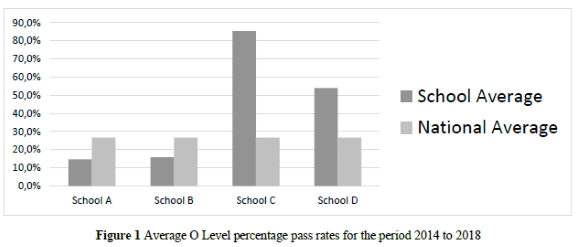
In order to assess the impact of the presence or absence of Ubuntu on the learners' academic performance, document analysis was done of the performance of each school for 5 consecutive years (2014-2018). Figure 1 shows the average percentage pass rate for each school in the O Level for this period.
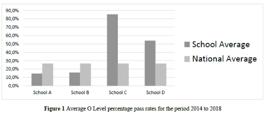
The pass rates were as follows: School A -14.6%, School B - 15.8%, School C - 85.4%, and School D - 54% compared to a 26.6% national pass rate.
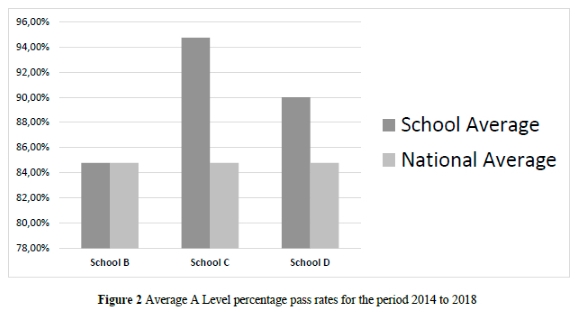
Figure 2 shows the pass rates at the A Level.
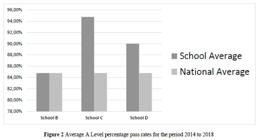
The pass rates at A Level were as follows: School B - 84.76%, School C - 94.74% and School D - 90%, against a national average pass rate of 84.76% (cf. Figure 2). School A does not offer A Level as it only teaches up to Form 4.
The findings reveal that, among other factors, the degree to which each school upheld the values of Ubuntu and discipline had an impact on its academic performance. Findings from document analysis indicate that School C was the best performing school at O Level among the four with an average pass rate of 85.49% over the 5 years from 2014 to 2018 (cf. Figure 1). Schools A and B had a very low pass rate of 14.6% and 15.78 at O Level respectively, which was well below the national average pass rate of 26.6% over the same period (cf. Figure 1). School D performed fairly well with an average of 54% during the same period, which is above the national average (cf. Figure 1). At A Level, School C was the best performing with an average of 94.74% followed by School D with an average of 90%, all above the average of 84.76% over the same period (cf. Figure 2).
Findings from the semi-structured interviews at School C reveal that learners were generally disciplined and upheld the values of Ubuntu. Participants said that cases of drug abuse and immorality were minimal. The participants stated that since this was a church school, there was emphasis on character training which resulted in learners upholding the values of Ubuntu, which resulted in good discipline. School C has a well-articulated vision and mission statement of which Ubuntu is one of the core values. Muzvidziwa and Muzvidziwa (2012) concur by asserting that a school that performs well is likely to be characterised by the presence of Ubuntu among its learners. Participants said that, while they had some day scholars, the majority of the learners resided at the school and benefited from an environment that was conducive to learning They also had more time to do supervised private studies during evenings.
School D had a pass rate that was above the national average in A Level but lower than School C, although some of the learners were in boarding (cf. Figure 2). Findings from the semi-structured interviews and focus-group discussion in School D reveal that the levels of indiscipline were high with cases of drug abuse and violence being very common. One participant said that the day scholars were involved in gang fighting and drugs which were indicators of a lack of Ubuntu, and resulted in a lower pass rate at their school. Participants also sited that the urban setting of the school close to the city centre was not an ideal environment for learners. They said that some learners who lacked Ubuntu were easily attracted to entertainment sports in the city which distracted them from their academic work resulting in lower academic performance.
The pass rates for Schools A and B were low at the O Level, far below the national average (cf. Figure 1). Findings from participants at these schools revealed that learners lacked Ubuntu and were undisciplined. Cases of drug and alcohol abuse and sexual immorality were common. One participant at School A said that they had no control over learners during the weekends and after school since all learners were day scholars. The participant blamed the community youths who were small-scale miners (amakorokoza) for teaming up with learners from their school to engage in abusing drugs. Learners in a focus-group discussion at School B said that, in addition to drug abuse by learners, girls engaged in pre-marital sex with school leavers and taxi drivers to get money. Furthermore, participants said that some learners did not attend classes after lunch as they left to have fun with school leavers, while some left home pretending to be going to school but going elsewhere to take drugs or drink alcohol. According to Hirschi's (1969) SBT, individuals who are committed and involved in school activities and who uphold social values are less likely to misbehave. However, learners in School B showed their disinterest in school through truancy and missing classes, thus, not performing well. Participants said that this showed a lack of Ubuntu resulting in poor academic results. Another participant said that some learners came from homes where parents were unsupportive of academic achievement. According to Walberg (1981) TEP, the home environment and peer pressure are some of the factors that affect the performance of learners. This was the case with learners in schools A and B who were from such unsupportive environments where there was a lack of character training. Findings indicate that the challenges faced by learners in Schools A, B, and D showed that a lack of Ubuntu was the major cause of their low academic performance. However, findings show that other factors like the boarding school environment, walking long distances to school and home environments also impacted on learner achievement.
How can Schools Integrate the Principles of Ubuntu into the Curriculum?
In the semi-structured interviews teachers suggested that if the values of Ubuntu were taught across the curriculum, they would be more effective. Lephalala (2010:8) concurs by proposing that "schools could adopt Ubuntu as a way of life; a community where everyone is affirmed and supported the best way possible." Teachers suggested that Ubuntu should be considered as a cross-cutting issue to equip learners with loyalty and respect for others and property (Zulu, Urbani, Van der Merwe & Van der Walt, 2004). According to Muzvidziwa and Muzvidziwa (2012:30), "it is important for all teachers to realise that it is part of the role of being an educator to instil values of Ubuntu in learners if education is to be worthwhile." Bondai and Kaputa (2016:40) advise that "teachers should use Ubuntu oriented classroom management strategies so that values can be instilled and incorporated in lessons." In the semi-structured interviews, some teachers opined that teaching values of Ubuntu should be an on-going exercise where all acts of indiscipline are corrected the moment they occurred. A teacher from School A said the following:
As I was coming to the office for this interview, I had to correct a learner who was using vulgar language. So, teaching of the values of Ubuntu should be an on-going exercise to guide the learners to do that which is right.
Participants also suggested that teachers be role models so that learners could emulate them. Zenda (2016) is of the opinion that if learners are to adopt the values of Ubuntu, teachers should be the role models. Participant 1 from School D in Focus group 4: "In our dormitory the matron often takes time like a mother to speak to us and we see a good example of Ubuntu from how she talks to us."
In the new curriculum, aspects of Ubuntu are included in the Ndebele and Shona syllabi at O and A Levels. A teacher from School D gave the following explanation: "In the new Shona syllabus, we teach registers and emphasise the values of Ubuntu since the learners will even be examined in this area."
This is expected to go a long way in imparting the values of Ubuntu among learners. One participant explained how she incorporated the values of Ubuntu when teaching comprehension passages by challenging her learners to think critically on how they would respond to particular situations as presented in the passages. A teacher from School C gave the following explanation:
When teaching registers for example, you could read a passage where someone was wronged, then learners are asked how they would respond if they were in that situation. So, we teach such values as politeness and how to talk to the elderly. When teaching a comprehension as a teacher you go beyond the answer to draw lessons that display Ubuntu.
Role-play was another method suggested as an effective way of teaching the values of Ubuntu. A teacher from School C said: "I find the use of role play effective in teaching the values of Ubuntu since most learners enjoy such lessons"
Maphalala and Mpofu (2018:8) state that "role play is a teaching method that promotes enquiry-based learning, in which learners are presented with a situation or a problem to which they have to respond by assuming a particular role." Drama, songs, and public speaking were suggested as other methods that could be used to teach the values of Ubuntu. A teacher from School B noted: "[D]rama and songs can be a useful tool for teaching values of Ubuntu."
Ferreira and Schulze (2014) indicate that methodologies like storytelling, poetry, song, dance, and debates could be used to teach the values of Ubuntu. Participants emphasised the use of extra-curricular activities as a valuable tool for teaching the values of Ubuntu through public speaking programmes. Maphalala and Mpofu (2018:7) suggest that guest speakers from the community could be invited to schools to talk to learners about the values of Ubuntu. Learners in focus-group discussions proposed that if the values of Ubuntu were to be taught effectively, there was a need to allocate time on the timetable and assign a full-time teacher to manage those lessons. Learners said that, in the past, guidance and counselling lessons were helpful but these were scrapped from the curriculum; hence the need to re-introduce a similar subject and allocate time on the timetable.
Discussion
Findings of this study reveal that teachers and learners had a sound understanding of the meaning of Ubuntu. They explained that the concept of Ubuntu meant upholding cultural values and traditions as expected by the society in which the individual lived. Participants described an individual with Ubuntu as one who is respectful, empathetic, caring, compassionate, and uses language that is appropriate to different situations and audiences (Dube, 2021). On the contrary, the absence of Ubuntu was seen in individuals and learners who engaged in alcohol and drug abuse, pornography, pre-marital sex, and violence, among other anti-social behaviour. Schools can, therefore, build on this knowledge and understanding which learners have about Ubuntu to help them identify with their own culture and teach them correct norms and values (Chitumba, 2013). In doing so, Msuya (2019:1150) advises that "traditions and culture should not be obstacles to the realisation of women's rights, but they should rather be a means of paving the way for the right of women to take part in cultural and traditional life."
Participants stated that learners who upheld the values of Ubuntu tended to perform better in their academic work. Such learners were said to succeed because they were disciplined, focussed on their studies, and had a good rapport with teachers. However, it was concluded that learners who lacked Ubuntu and participated in alcohol and drug abuse, missed class, and were generally disrespectful to teachers, ending up performing poorly. This observation is affirmed by Walberg's (1981) TEP which states that educational outcomes are influenced by the characteristics of individual learners. We concluded that Ubuntu and discipline among learners have an impact on academic performance in addition to other school or home-based factors that affect academic achievement. Some of the factors included the community where the school was located as the case of School A which was located in an unsupportive community with learners having to walk long distances to schools. School D's urban setting near the central business district (CBD) exposed learners to distractions which negatively impacted the learners' academic performance. As shown in Figure 1 and Figure 2, schools with challenges of indiscipline and a general lack of Ubuntu among learners tended to have a lower level of academic achievement among learners.
The findings reveal that integrating the values of Ubuntu in the secondary school curriculum needs the involvement of all staff members so that it can become an integral part of school life. Some of the teaching methods suggested for teaching Ubuntu include role play, debates, and drama. In his study, Msila (2009:57) "used drama, stories and legends, and simulation games to teach values of Ubuntu." The results from his study indicate that those methods were effective since learners in that school began to value other human beings (Msila, 2009). Learners in focus-group discussions strongly recommended that lessons that specifically teach Ubuntu should be added to the timetable and a teacher assigned to teach that subject. Msila (2009:63) proposes that "Ubuntu can be one of the philosophies used to instil discipline and responsibility in school." In that regard, a course on Ubuntu should be introduced in teacher education to equip trainee teachers with the skills of incorporating the values of Ubuntu in the classroom. Furthermore, school-based professional development workshops may be conducted to assist practising teachers in teaching Ubuntu. It is also important that material for teaching the values of Ubuntu in secondary schools be developed by the Ministry of Primary and Secondary Education in collaboration with teachers of IsiNdebele and ChiShona so that this programme can be successfully implemented.
Conclusion
The aim of this study was to evaluate the teachers' and learners' perceptions of Ubuntu, assess the impact of the presence or absence of Ubuntu on the behaviour and academic performance of learners and establish how values of Ubuntu can be integrated into the secondary school curriculum. The findings indicate that values of Ubuntu are seen in, among others, the manner of dress, upholding of cultural values, proper use of language, respect and being compassionate. Participants emphasised that upholding the values of Ubuntu led to learners attaining higher levels of academic achievement as opposed to lower levels of academic achievement witnessed among learners who lacked Ubuntu and were indisciplined. Secondary schools should, therefore, integrate Ubuntu in their core values so that education can be effective in developing an Ubuntu social disposition (Nkondo, 2007).
Authors' Contributions
Both authors, Professor P. Higgs, and Doctor N. Dube were involved in the writing of the article. Prof. P. Higgs reviewed the article. Dr Dube wrote the final draft for publication.
Notesi. This article emanated from a Doctor of Education (D.Ed.) thesis by N. Dube, "The Philosophy of Ubuntu in secondary schools in the Gweru district of Zimbabwe: A critical reflection".
ii. Published under a Creative Commons Attribution Licence.
References
- Bolden R 2013. Ubuntu. In D Coglan & M Brydon-Miller (eds). The Sage encyclopedia of action research. London, England: Sage.
-
Bondai B & Kaputa TM 2016. Reaffirming Ubuntu/Unhu mainstreaming in the education curricula: Panacea for sustainable educational change in Southern Africa. International Journal of Academic Research and Reflection, 4(6):37-44. Available at https://www.idpublications.org/wp-content/uploads/2016/08/Full-Paper-REAFFIRMING-UBUNTU-UNHU-MAINSTREAMING-IN-THE-EDUCATION-CURRICULA-PANACEA-FOR-SUSTAINABLE.pdf. Accessed 2 May 2024.
» https://www.idpublications.org/wp-content/uploads/2016/08/Full-Paper-REAFFIRMING-UBUNTU-UNHU-MAINSTREAMING-IN-THE-EDUCATION-CURRICULA-PANACEA-FOR-SUSTAINABLE.pdf -
Booysen S 2009. The presidential and parliamentary elections in Zimbabwe, March and June 2008. Electoral Studies, 28(1):150-154. https://doi.org/10.1016/j.electstud.2008.09.004
» https://doi.org/10.1016/j.electstud.2008.09.004 - Broodryk J 2002. Ubuntu: Life lessons from Africa. Pretoria, South Africa: Ubuntu School of Philosophy.
- Broodryk J 2006. Ubuntu African life coping skills: Theory and practice. Paper presented at the CCEAM Conference, Lefkosia, Cyprus, 12-17 October.
-
Charamba C 2015. Education, pan-Africanism, ubuntu. Herald, 27 May. Available at https://www.herald.co.zw/education-pan-africanism-ubuntu/. Accessed 2 May 2024.
» https://www.herald.co.zw/education-pan-africanism-ubuntu/ - Chirume S & Chikasha AS 2014. A critical analysis of the factors affecting achievement in secondary school mathematics in Zimbabwe: A case study of Gweru District. Merit Research Journal of Education Review, 2(9): 194-202.
- Chitumba W 2013. University education for personhood through Ubuntu philosophy. International Journal of Asia Social Science, 3(5):1268-1276.
-
Cho BJ 2014. Social bonds, self-control and deviance of Korean adolescents. International Journal of Humanities and Social Science, 4(9):1 -8. Available at https://www.ijhssnet.com/journals/Vol_4_No_9_1_July_2014/1.pdf. Accessed 30 April 2024.
» https://www.ijhssnet.com/journals/Vol_4_No_9_1_July_2014/1.pdf - Denscombe M 2010. The good research guide for small-scale social research projects (4th ed). New York, NY: McGraw-Hill/Open University Press.
-
De Wet C 2004. The extent and causes of learner vandalism at schools. South African Journal of Education, 24(3):206-211. Available at https://www.ajol.info/index.php/saje/article/view/24990. Accessed 29 April 2024.
» https://www.ajol.info/index.php/saje/article/view/24990 - Dube N 2021. The philosophy of Ubuntu in secondary schools in the Gweru district of Zimbabwe: A critical reflection. DEd thesis. Pretoria, South Africa: University of South Africa.
- Durkin KF, Wolfe TW & Clark G 1999. Social bond theory and binge drinking among college students: A multivariate analysis. College Student Journal, 33:450-462.
- Fafunwa AB 1974. History of education in Nigeria. London, England: Allen & Unwin.
- Farooq MS, Chaudhry AH, Shafiq M & Berhanu G 2011. Factors affecting students' quality of academic performance: A case of secondary school level. Journal of Quality and Technology Management, 7(2):01-14.
-
Ferreira C & Schulze S 2014. Teachers' experience of the implementation of values in education in schools: "Mind the gap". South African Journal of Education, 34(1):Art. # 727, 13 pages. https://doi.org/10.15700/201412120939
» https://doi.org/10.15700/201412120939 -
Fossey E, Harvey C, McDermott F & Davidson L 2002. Understanding and evaluating qualitative research. Australian & New Zealand Journal of Psychiatry, 36(6):717-732. https://doi.org/10.1046/j.1440-1614.2002.01100.x
» https://doi.org/10.1046/j.1440-1614.2002.01100.x -
Gade CBN 2012. What is Ubuntu? Different interpretations among South Africans of African descent. South African Journal of Philosophy, 31(3):484-503. Available at https://pure.au.dk/ws/portalfiles/portal/48387009/What_is_Ubuntu._Different_Interpretations_among _South_Africans_of_African_Descent.pdf. Accessed 29 April 2024.
» https://pure.au.dk/ws/portalfiles/portal/48387009/What_is_Ubuntu._Different_Interpretations_among _South_Africans_of_African_Descent.pdf - Gall MD, Borg WR & Gall JP 1996. Educational research: An introduction (6th ed). London, England: Longman Publishing.
-
Gudyanga E, Matamba N & Gudyanga A 2014. Visual participatory approach to violent behaviour amongst Zimbabwean schools: Forms and prevalence. Asian Social Science, 10(10):30-40. Available at https://www.researchgate.net/profile/Anna-Gudyanga/publication/267925158_Visual_Participatory_Approach_to_Violent_Behaviour_amongst_ Zimbabwean_Students_Forms_and_Prevalence/links/545ce9890cf27487b44d4440/Visual-Participatory-Approach-to-Violent-Behaviour-amongst-Zimbabwean-Students-Forms-and-Prevalence.pdf. Accessed 28 April 2024.
» https://www.researchgate.net/profile/Anna-Gudyanga/publication/267925158_Visual_Participatory_Approach_to_Violent_Behaviour_amongst_ Zimbabwean_Students_Forms_and_Prevalence/links/545ce9890cf27487b44d4440/Visual-Participatory-Approach-to-Violent-Behaviour-amongst-Zimbabwean-Students-Forms-and-Prevalence.pdf -
Gutuza RF & Mapolisa T 2015. An analysis of the causes of indiscipline amongst secondary school pupils in Nyanga District. Global Journal of Advanced Research, 2(7):1164-1171. Available at http://gjar.org/publishpaper/vol2issue7/d236r33.pdf. Accessed 27 April 2024.
» http://gjar.org/publishpaper/vol2issue7/d236r33.pdf -
Higgs P 2012. African philosophy and the decolonisation of education in Africa: Some critical reflections [Special issue]. Educational Philosophy and Theory, 44(s2):37-55. https://doi.org/10.1111/j.1469-5812.2011.00794.x
» https://doi.org/10.1111/j.1469-5812.2011.00794.x - Hirschi T 1969. Causes of delinquency. Berkeley, CA: University of California Press.
-
Horsthemke K 2009. Rethinking humane education. Ethics and Education, 4(2):201-214. https://doi.org/10.1080/17449640903326813
» https://doi.org/10.1080/17449640903326813 -
Kamwangamalu NM 1999. Ubuntu in South Africa: A sociolinguistic perspective to a pan-African concept. Critical Arts, 13(2):24-41. https://doi.org/10.1080/02560049985310111
» https://doi.org/10.1080/02560049985310111 -
Kapur R 2018. Factors influencing the students 'academic performance in secondary schools in India. Available at https://www.researchgate.net//publication/234819919. Accessed 23 February 2020.
» https://www.researchgate.net//publication/234819919 - Lephalala MMK 2010. Between past and present: Conflict in schools, an ubuntu/RA perspective. Pretoria, South Africa: University of South Africa Press.
- Letseka M 2000. African philosophy and educational discourse. In P Higgs, NCG Vakalisa, TV Mda & NT Assie-Lumumba (eds). African voices in education. Lansdowne, South Africa: Juta.
-
Maphalala MC & Mpofu N 2018. Embedding values in the South African curriculum: By design or default? South African Journal of Education, 38(3):Art. #1437, 11 pages. https://doi.org/10.15700/saje.v38n3a1437
» https://doi.org/10.15700/saje.v38n3a1437 -
Maphosa C & Mammen KJ 2011. How chaotic and unmanageable classrooms have become: Insights into prevalent forms of learner indiscipline in South African schools. The Anthropologist, 13(3):185-193. https://doi.org/10.1080/09720073.2011.11891196
» https://doi.org/10.1080/09720073.2011.11891196 -
Msila V 2009. Ubuntu and peacemaking in schools. International Journal of Educational Policies, 3(1):51–66. Available at https://citeseerx.ist.psu.edu/document?repid=rep1&type=pdf&doi=0c2b4e9dcf57ea2ee63654a4616085c1232553a9. Accessed 26 April 2024.
» https://citeseerx.ist.psu.edu/document?repid=rep1&type=pdf&doi=0c2b4e9dcf57ea2ee63654a4616085c1232553a9 -
Msuya NH 2019. Concept of culture relativism and women's rights in sub-Saharan Africa. Journal of Asian and African Studies, 54(8): 1145-1158. https://doi.org/10.1177/0021909619863085
» https://doi.org/10.1177/0021909619863085 -
Mugabe MJ & Maposa AD 2013. Methods of curbing learner misconduct in Zimbabwean secondary schools. International Journal on New Trends in Education and Their Implications, 4(4):111 -122. Available at http://www.ijonte.org/FileUpload/ks63207/File/2013ijonte.4.pdf#page=118. Accessed 25 April 2024.
» http://www.ijonte.org/FileUpload/ks63207/File/2013ijonte.4.pdf#page=118 - Muropa BC, Kasure LP, Makwerere D, Kasowe R & Muropa Z 2013. Unhu/Ubuntu and its relationship with Civics and Citizenship education. Journal of Emerging Trends in Educational Research and Policy Studies, 4(4):658-661.
-
Mutekwe E 2015. Towards an African philosophy of education for indigenous knowledge systems in Africa. Creative Education, 6(12):1294-1305. https://doi.org/10.4236/ce.2015.612129
» https://doi.org/10.4236/ce.2015.612129 -
Mutemeri J & Gudyanga A 2008. Battling with the unwilling learner: A case for Gweru urban schools in Zimbabwe. SA-eDUC Journal, 5(1):1 -8. Available at https://www.researchgate.net/profile/Anna-Gudyanga/publication/228863936_Battling_with_the_unwilling_learner_a_case_for_Gweru_urban _schools_in_Zimbabwe/links/00b4952601545119750 00000/Battling-with-the-unwilling-learner-a-case-for-Gweru-urban-schools-in-Zimbabwe.pdf. Accessed 25 April 2024.
» https://www.researchgate.net/profile/Anna-Gudyanga/publication/228863936_Battling_with_the_unwilling_learner_a_case_for_Gweru_urban _schools_in_Zimbabwe/links/00b4952601545119750 00000/Battling-with-the-unwilling-learner-a-case-for-Gweru-urban-schools-in-Zimbabwe.pdf -
Muzvidziwa I & Muzvidziwa VN 2012. Hunhu (Ubuntu) and school discipline in Africa. Journal of Dharma, 37(1):27-42. Available at https://dvkjournals.in/index.php/jd/article/view/138/100. Accessed 25 April 2024.
» https://dvkjournals.in/index.php/jd/article/view/138/100 - Ncube A 2013. Students' failure, a shared blame in Zimbabwean secondary schools-the way forward. International Journal of Science and Research, 2(10):228-236.
-
Nkondo GM 2007. Ubuntu as public policy in South Africa. A conceptual framework. International Journal of African Renaissance Studies - Multi-,Inter- and Transdisciplinarity, 2(1):88-100. https://doi.org/10.1080/18186870701384202
» https://doi.org/10.1080/18186870701384202 - Ntamushobora F 2012. The philosophical presuppositions of Ubuntu and its theological implication for reconciliation (Working paper number DU/2012/007). Athi River, Kenya: Daystar University.
-
Nussbaum B 2003. African culture and Ubuntu: Reflections of a South African in America. World Business Academy, 17(1):1 -12. Available at https://www.researchgate.net/publication/281594403_African_culture_and_ubuntu_Reflections_of_a_South_African _in_America. Accessed 24 April 2024.
» https://www.researchgate.net/publication/281594403_African_culture_and_ubuntu_Reflections_of_a_South_African _in_America - Nziramasanga CK 1999. Zimbabwe: Report of the Presidential Commission of Inquiry into Education and Training. Harare, Zimbabwe: Commission of Inquiry into Education and Training.
-
Onwuegbuzie AJ, Dickinson WB, Leech NL & Zoran AG 2009. A qualitative framework for collecting and analyzing data in focus group research. International Journal of Qualitative Method, 8(3):1-21. https://doi.org/10.1177/160940690900800301
» https://doi.org/10.1177/160940690900800301 - Patton MQ 2002. Qualitative research and evaluation methods (3rd ed). London, England: Sage.
- Petrocelli M & Petrocelli J 2005. School performance and crime: Theoretical and empirical links. Southwest Journal of Criminal Justice, 2(2):119- 131.
-
Poipoi MW, Agak JO & Kabuka EK 2010. Teachers' and students' perceptions of psychological factors contributing to violent behaviour among public secondary school students in western province, Kenya. African Journal of History and Culture, 2(6):83-101. Available at https://www.researchgate.net/publication/228337103_Teachers'_and_students'_perceptions_of_psychological _factors_contributing_to_violent_behaviour_among_public_secondary_school_students_in_western_province. Accessed 24 April 2024.
» https://www.researchgate.net/publication/228337103_Teachers'_and_students'_perceptions_of_psychological _factors_contributing_to_violent_behaviour_among_public_secondary_school_students_in_western_province -
Rugutt JK & Chemosit CC 2005. A study of factors that influence college academic achievement: A structural equation modeling approach. Journal of Educational Research & Policy Studies, 5(1):66-90. Available at https://files.eric.ed.gov/fulltext/EJ846830.pdf. Accessed 24 April 2024.
» https://files.eric.ed.gov/fulltext/EJ846830.pdf - Saule N 2000. Ubuntu was? In Proceedings of Seminar of Africa Studies Forum. Pretoria, South Africa: University of South Africa.
- Seidman A 2005. The learning killer: Disruptive student behavior in the classroom. Reading Improvement, 42(1):40-46.
- Sindane J 1994. Ubuntu and nation building. Pretoria, South Africa: Ubuntu School of Philosophy.
-
Sunday News 2017. Ubuntu. With you, 14 May. Available at https://www.pressreader.com/zimbabwe/sunday-news-zimbabwe/20170514/282162176139055. Accessed 22 July 2019.
» https://www.pressreader.com/zimbabwe/sunday-news-zimbabwe/20170514/282162176139055 - Tutu D 1999. No future without forgiveness. New York, NY: Random House.
- Walberg HJ 1981. A psychological theory of educational productivity. In FH Farley & NJ Gordon (eds). Psychology and education: The state of the union. Berkeley, CA: McCutchan.
-
Waseka EL & Simatwa EMW 2016. Student factors influencing academic performance of students in secondary education in Kenya: A case study of Kakamega County. Educational Research, 7(3):72-87. https://doi.org/10.14303/er.2016.138
» https://doi.org/10.14303/er.2016.138 -
Wong LP 2008. Focus group discussion: A tool for health and medical research. Singapore Medical Journal, 49(3):256-261. Available at http://www.smj.org.sg/sites/default/files/4903/4903me1.pdf. Accessed 24 April 2024.
» http://www.smj.org.sg/sites/default/files/4903/4903me1.pdf -
Zenda R 2016. Factors affecting the academic achievement of learners in Physical Sciences in selected Limpopo rural secondary schools. PhD thesis. Pretoria, South Africa: University of South Africa. Available at https://uir.unisa.ac.za/bitstream/handle/10500/20319/thesis_zenda_r.pdf?sequence=1&isAllowed=y. Accessed 24 April 2024.
» https://uir.unisa.ac.za/bitstream/handle/10500/20319/thesis_zenda_r.pdf?sequence=1&isAllowed=y -
Zulu BM, Urbani G, Van der Merwe A & Van der Walt JL 2004. Violence as an impediment to a culture of teaching and learning in some South African schools. South African Journal of Education, 24(2):170-175. Available at https://www.ajol.info/index.php/saje/article/view/24984. Accessed 24 April 2024.
» https://www.ajol.info/index.php/saje/article/view/24984
Revised: 23 January 2024
Accepted: 22 March 2024
Published: 31 May 2024