An empirical review of a hybrid teacher education programme: Lessons from South Africa
Abstract
Scholars have recommended hybrid learning to combat education problems in emerging economies due to their challenging contexts. It potentially offers a means to address growing demand without sacrificing quality or increasing costs. In this article we report on a new "hybrid" distance teacher education programme in which we sought to address the requirements of new policies (both institutional and national) by combining the blended and distance education approach. We adopted a pragmatic qualitative approach, rooted in a communitarian perspective and distance education theory. Although progressing slower than expected, the programme's implementation to date has provided lessons that bolster the value of blended learning theory and practice in a hybrid model. The study also highlighted the critical role that the mode adopted for teacher training can play in shaping teachers' practice. However, to work more effectively in an emerging economy, a more substantial teaching presence is suggested, coupled with modularised and ongoing information and communication technology (ICT) training and support for staff and students as areas for further research.
blended learning transactional distance; community of inquiry (CoI) framework; distance education
Introduction and Background
In October 2016, the University of Pretoria introduced a new programme, the Bachelor of Education (BEd) Honours (Hons) in Teacher Education and Professional Development (TEPD), which sought to address new policy requirements (Department of Higher Education and Training [DHET], 2015) that all teacher education graduates demonstrate basic ICT skills. Teachers must be accustomed to the use of ICTs to align teaching and learning with the 21st-century skills required of students. The university's move helped it achieve its strategic drive to adopt a "hybrid" model for all its programmes, irrespective of the original mode. As noted more recently by Norgârd (2021), there is a need for clarity on what we understand by the term "hybrid" and how it differs from, for example, online learning. Although the term could be understood differently in different contexts (see Li, Li & Han, 2021; Raes, Detienne, Windey & Depaepe, 2020, for example), for the unit in question, hybrid learning refers to a teaching model that combines blended and distance provision. All assessment is, however, completed online. Therefore, success in learning depends on access to the online learning management system (LMS), known as ClickUP - University of Pretoria.
Before introducing the new hybrid learning model, the technology profile of distance students showed that only 30% of students had regular access to ICTs and connectivity, another 30% had irregular access and about 40% had little or no access (Aluko, 2015). This profile informed the design of the new programme during 2016. The integration of online learning into distance learning programmes poses particular challenges for institutions and students in a context characterised by variable access and relatively high data costs in relation to salaries (Hülsmann & Shabalala, 2016). The challenge was, therefore, to design an implementation model for the new programme in a way that would address both internal and external policy directives, take cognisance of what had been learned from past practice (Aluko & Hendrikz, 2012), and be feasible in terms of financial and other resources available to both the students and the institution.
Rationale and Research Questions
Some of the first cohorts of students were due to complete the programme between April and October 2018. This seemed an opportune time to undertake a formative evaluation of the programme. Therefore, the main research question that informed this project was: To what extent does the newly introduced "hybrid" programme address students' learning needs from the point of view of key stakeholders - students, tutors and module coordinators?
Two sub-questions further guided the project:
1) To what extent do key stakeholders agree we are teaching the right things?
2) To what extent do key stakeholders think we are teaching things in a right way?
Literature Review
It is widely argued that the use of ICTs in teaching and learning helps to enrich teachers' productivity and students' performance (Ojo & Adu, 2018). However, generally, the provision of education in emerging economies faces various problems (Lalima & Dangwal, 2017). Scholars have recommended hybrid learning as a possible solution, partly because of its ability to meet the 21st-century expectations of students and address the challenges of limited resources (Dlamini & Coleman, 2017), although there is no clear agreement on how face-to-face and online learning should be blended optimally (Rajkoomar, 2015).
More broadly, hybrid or mixed-mode learning has been used to refer to programmes in which various instructional design systems are employed to enrich teaching and learning experiences (Lalima & Dangwal, 2017).
Generally, achieving active learning in an online environment is more challenging than in traditional face-to-face environments (Khan, Egbue, Palkie & Madden 2017), as is achieving high student retention and attainment (Sahawneh & Benuto, 2018). Among the reasons that students drop out of online courses is the absence of social presence due to a lack of physical interaction with the lecturer or other students (Zilka, Cohen & Rahimi, 2018). Furthermore, lecturers need support in designing and delivering online modules, and they need continuous professional development to update their technological and pedagogical skills (Tshabalala, Ndeya-Ndereya & Van der Merwe, 2014). However, despite the challenges, developing countries have forged ahead to adopt blended and hybrid learning (Cleveland-Innes & Wilton, 2018).
Staff and student satisfaction are essential to assessing a program's quality. The teaching design of the lecturer, organisation of the online environment, and the instructor' s presence are also determining factors that influence quality (Costley & Lange, 2016). On the other hand, students need to embrace the opportunities and skills associated with online learning to reach their learning goals (Yilmaz, 2017). Concerning this study, research shows that some teachers are still slow in accepting the value that ICTs can bring to teaching and learning, which is in opposition to their traditional role of transmitter of education that they have been used to (Ojo & Adu, 2018).
Subsequently, institutions need to evaluate how a programme could prepare students to attain knowledge and competence to work in a specific field of study (Masoumi & Lindström, 2012). Effective hybrid learning is associated with practical online activities that could facilitate and direct cognitive and social processes (Moradi, Liu, Luchies, Patterson & Darban, 2018). Online interaction is essential for learning effectiveness (Sun, Abdourazakou & Norman, 2017). Learning effectiveness could be enhanced when students and lecturers are engaged in hybrid activities (Ogange, Agak, Okelo & Kiprotich, 2018; Sun et al., 2017). The students' and lecturers' online presence should create a meaningful learning environment where effective learning could take place (Sun et al., 2017).
Lecturers' effective instructional design could positively affect students' perceived learning and satisfaction (Costley & Lange, 2016). Yilmaz (2017) argues that e-learning readiness is a determining factor ensuring student satisfaction. Additionally, factors such as students' experiences in hybrid learning, access to off-campus support, access to learning resources and students' motivation to use the internet could influence hybrid learning effectiveness and satisfaction (Hao, 2016). Student feedback also plays an integral part in student satisfaction (Costley & Lange, 2016). Students expect timely feedback from lecturers and administrative personnel (Costley & Lange, 2016). Unfortunately, students without technological skills will struggle to participate in hybrid learning activities (Borup & Stevens, 2016). Therefore, institutions should investigate how they could support students in acquiring these skills.
With this study we sought to investigate whether the promise held out in the literature on hybrid learning would prove an effective hybrid learning solution when combined with our previous distance learning experience.
Conceptual Framework
The conceptual framework adopted for this study emanated from the communitarian perspective neatly summarised in Ubuntu philosophy - we are made human through our relationships with other humans (Letseka, 2016). The interaction between students and content, students and peers, and students and tutors, in both online and face-to-face tutorials, was therefore considered a vital dynamic to explore. Within this Ubuntu framework of the self, concerning others, we adopted a transactional approach - working with teams of people in multiple locations and contexts to develop and/or review the learning programme and supporting systems arrived at through iterative processes of discussion and compromise (Dewey, 1929).
Previously, distance learning provision at the institution had been informed by Moore's (2007) concept of transactional distance and the interplay between structure (provided in approved curricula and learning resources), dialogue (initially via telephone, face-to-face contact sessions and feedback on assessments and later by electronic mail (email) and Short Message Service [SMS] technology) and autonomy (for instance, students were able to choose when to register). But, when it came to the review of the hybrid model, because of the increased online component, it was felt that the CoI framework might be appropriate, even though it had not informed the original design of the hybrid programme.
Generally, an inquiry is a process that leads to deep and meaningful understanding because it involves critical thinking, problem-solving and the growth of personal and collective knowledge (Garrison, 2014:148). However, we assert that inquiry does not take place in isolation. It involves three presences: the cognitive presence, the social presence and the teaching presence (Garrison, 2014).
Social presence is the ability to project one's identity in the online community to be perceived as a "real" person (Garrison, Anderson & Archer, 1999:94). Cognitive presence is the extent to which learners can construct and confirm meaning through sustained reflection and discourse (Garrison et al., 1999). Teaching presence is the "design, facilitation and direction of cognitive and social processes for the purpose of realising personally meaningful and educationally worthwhile learning outcomes" (Anderson, Rourke, Garrison & Archer, 2001:8).
Despite some unresolved issues (such as the possibility of the framework to lead to significant learning and affirmative learning goals) surrounding the framework (Kreijns, Van Acker, Vermeulen & Van Buuren, 2014), scholars have found it beneficial for blended courses because the mode can provide the benefits of face-to-face and online learning. The model remains widely used and researched in other settings such as course development and new technologies (Anderson, 2017; Guo, Saab, Wu & Admiraal, 2021).
As a consequence of choosing this conceptual framework, we revised the research sub-questions as follows:
1) To what extent do key stakeholders agree that we are teaching the right things (that is, is the content fit for purpose)?
2) To what extent do key stakeholders think that we are teaching things in a right way (in terms of cognitive, social and teaching presence)?
Research Design and Methodology
Design
The main aim of pragmatist ontology is action and change (Goldkuhl, 2012). This highlights what we wanted to achieve with this study: to determine where the institution needed to improve the programme from the perspective of key stakeholders. Pragmatic ontology analyses current events and interprets them from a realistic point of view (Maarouf, 2019). We adopted the single case study design using a qualitative approach to review the relationship between the programme, lecturers and students with the aim of evaluating the programme through stakeholders' perceptions. This strategy provided opportunities to do an in-depth analysis of the programme using various data collection instruments (Creswell & Creswell, 2018) through which detailed information was acquired (Yin, 2014).
Data Collection Instruments
The data collection instruments included a literature review, documents, an open-ended survey and interview schedules (for both individual and focus-group interviews), and review criteria for learning materials.
The development of the instruments was informed by quality criteria developed by the distance education community in South Africa (National Association of Distance Education Organisations of South Africa [NADEOSA]. n.d.). The fact that the criteria were developed by distance education experts and used by other distance education experts for similar purposes over several years (Martin, Polly, Jokiaho & Birgit, 2017; Mostert, 2007) suggested that the criteria were both valid and reliable for use in the context of distance education provision in South Africa. One of the authors of this paper has been directly involved in several programme and courseware reviews and has used variations of these instruments in multiple contexts. The survey and interview instruments are available on request.
Question items for the student survey were closed-ended to stimulate set responses from as many of the respondents on the content, programme delivery, feedback and support. It would not have been possible to conduct interviews with all the students because of the number involved. In addition, not all students attended contact sessions; many did not have the necessary technology tools for online interviews; furthermore, they were widely dispersed geographically.
The review instruments on learning resources given to the learning experts, the online LMS expert and the interview schedules (for students, tutors and module coordinators) contained question items guided by the main research questions.
Population and Sampling
The target group for the student survey was the first cohort of the new programme (300 students). Due to the low enrolment, we adopted the total population sampling technique for the survey, which allows respondents to have equal chances of participation in the research (Haque, 2010).
The population for the participants of the focus-group discussions included 300 students, eight module coordinators and eight module experts (representing the eight modules presented in the programme), and one learning management expert.
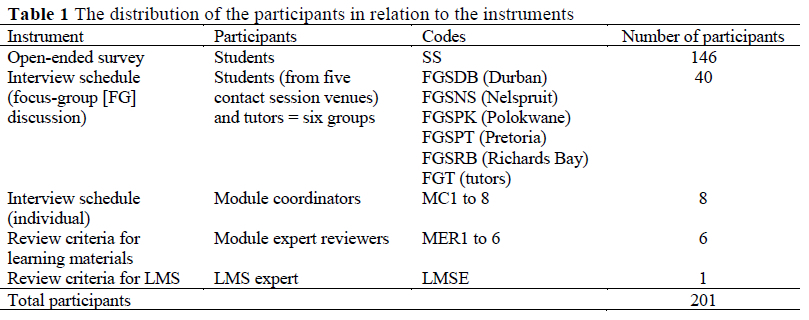
Students in this programme were widely dispersed and did not all attend the voluntary contact sessions. Based on past history of attendance, we felt confident that we would be able to interview 40 students. With this sample size, there was a 70% chance that the real value was within ±2.89% of the measured value (checked on Calculator.net, 2023). Taken together with the 100% sample of teaching staff, we felt that we would get a reasonably accurate picture. Stakeholders were conveniently sampled, resulting in 40 students from the five contact session venues, eight module coordinators, six module experts who participated in the review of the content of the learning material, and one LMS expert who reviewed the online aspects of the programme on the university' s LMS. The total number of participants was 201. The information on the distribution of the participants in relation to the instruments is displayed in Table 1.
We manually distributed and collected the survey during a face-to-face contact session with the students. This was with the aim of generating a better response rate.
The review criteria were sent to eight MERs, while the LMSE was given temporary access to the university's LMS to review its design and use.
We interviewed eight MCs individually and held five FG discussions comprising 40 students from the five contact session venues. The discussions took place during the sessions.
Data Analysis
Data analysis took the form of thematic analysis (Caulfield, 2023) and involved the identification of codes, themes and sub-themes from the qualitative data.
The University of Pretoria has ethical clearance to collect and use anonymised student and teacher information for quality assurance and research purposes related to distance education provision.
Findings
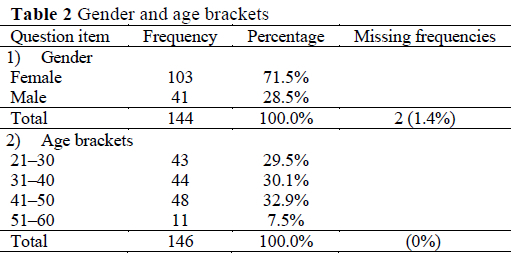
Table 2 shows the biographical information reflecting the gender and age brackets of the student respondents. Of the 146 participants who participated in the survey, 103 (70.547%) were female, while 41 (28.08%) were male. This tallies with the demographics of teachers in the country (Skosana, 2018) and enrolled students in distance education programmes at the institution.
Findings from the Thematic Analysis
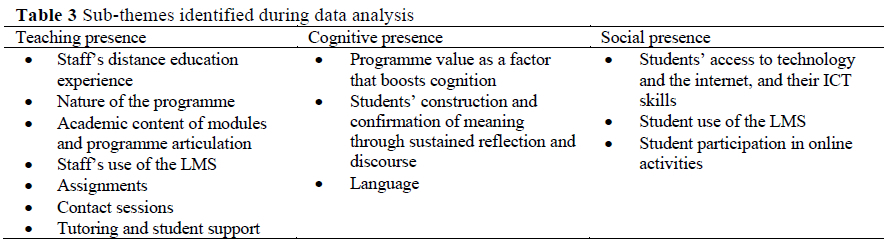
The thematic analysis results were grouped into the three main categories of the CoI framework, which served as the main themes. Thirteen sub-themes were developed during the data collection process, as summarised in Table 3. Most of the sub-themes are discussed in the teaching presence category.
Teaching Presence
Regarding teaching presence, which denotes the role of the instructor, participants had the following to say under each sub-theme.
The findings reveal that most staff participants involved in distance education did not have any background in this teaching mode. Many felt that the institution had not equipped and prepared them to teach effectively, while some felt that their dedication was to the contact mode. The verbatim quotations below confirm this:
It was quite a challenge because I did not have any distance experience previously ... (MC2).
This is the department where ... my first line of work is. Distance has been the tag-on late within the year ... (MC1).
The BEd Hons programme is a postgraduate qualification that aims to develop the students' research skills with a focus on areas of specialisation. While some staff participants felt comfortable with this focus, some expressed concern. A participant commented: "We force students to write a proposal ... it is extremely academic, and they struggle a lot" (MC7).
Most students indicated that the content presented in the modules was relevant and of a good standard. This extract from the student qualitative survey buttressed this: "Yes, we have gained more skills on how to conduct research . it also develops us professionally" (SS3).
This was confirmed during the FG discussions as highlighted by a student: "According to me, the alignment of the programme is of a good standard because it unpacks the aims and it improves our understanding of the programme" (FGSRB1).
In addition, students felt that it prepared them thoroughly for a master's degree. Buttressing this, a learning expert said: "I think that the overall programme is valuable. An Honours degree through distance education where many students are already in practice is beneficial" (MER2).
Most tutors and academic supporters are familiar with the use of the institution's LMS. A tool such as a discussion board is considered helpful since it provides a space where students and tutors can interact with each other asynchronously. The LMS expert emphasised that
[o]nline discussions are very helpful for students studying independently and/or remotely ... Many students study in a language other than their mother tongue - an asynchronous discussion forum provides the opportunity to construct a contribution thoughtfully and to review and edit the language before submitting it. (LMSE)
Nonetheless, it is quite worrisome that the LMS expert indicated: "While there were a few indications of facilitator/lecturer presence, the majority of modules did not display any such presence at all" (LMSE).
All the learning experts credited the quality of the assignments provided to students. One of them said: "Yes, the activities (e.g., assignments) are clearly in line with the purpose and outcomes" (MER1).
Furthermore, students and staff participants agreed that feedback on assignments was essential but insufficient. A student said: "There are some assignments where there is no feedback. When we get feedback, sometimes you find that you fail the assignment and you are supposed to use that assignment to do Assignment 3" (FGSRB6).
Although statistics from the unit showed that less than 30% of the students attended contact sessions, those that did felt that the sessions added value to their learning experience. A participant said: "If you do not attend the contact session, you'll be lost forever" (FGNS3).
The student participants' viewpoint about the support they had received from tutors was mixed. The following response from a student participant provides an example: "... there is one of my modules that I experienced a challenge. Then I forwarded an email, it took long time for the tutor to respond" (FGSRB7).
The mixed reaction was also confirmed through the survey report.
However, the participating MCs were particularly concerned about the payment of tutors. They felt that tutors were underpaid, a point also stressed by tutors. An MC lamented: "I feel humiliated when those people sitting there have doctorates and you know, and then I tell them but this is the kind of payment you are going to get ..." (MC5).
Cognitive Presence
The cognitive presence shows to what extent students can construct and confirm meaning through sustained reflection and discourse.
Most students agreed that the programme was academic to equip them for a master' s degree and broaden their horizons by showing them what they could achieve in the future. A student said: "Now I know that it was not only for the classroom teacher, but for the fact that I can broaden my horizons. I can choose whether I want to stay in the classroom or ... do something else" (FGSNS6).
Unfortunately, some students struggled to find the correlation between their work and their studies. Such students indicated that they found modules on policy and management more relevant than those focused on developing research skills. This ties in with the earlier concerns of some MCs.
The LMSE asserted that online discussions support reflection. She had the following to say: "Forums enable students to express their own thoughts and opinions in a safe learning space, and to respond to and support other students. Encouraging this academic discourse is valuable ..." (LMSE).
However, staff participants felt that students were not extrinsically motivated to participate in online discussions and activities. The following comment emphasises this: "We do not have self-directed learners or students and (they do not bother) if they miss something on clickUP, even if there are marks involved" (MC8).
Another comment highlighted the challenge of students only being in "survival mode." This made them focus on completing their research proposals and passing a module, overlooking the online communities of practice where they could learn a lot from one another.
All the external experts attested to the relative accessibility of the learning material language that enabled student-centred learning outcomes, which most students affirmed.
However, all the MCs agreed that students' academic writing skills were limited - a problem not confined only to distance students, and has to do with students' backgrounds. The following comment illustrates this: "... they do not know how to express themselves in writing, and especially... with academic writing. It is often SMS language . we need some kind of language intervention" (MC1).
Social Presence
For social presence to be effective, students are expected to participate online. However, this expectation is not without its challenges.
Although students received ICT training as a prerequisite for the programme, most indicated the need for a follow-up training session because they still struggled to navigate the LMS. However, some acknowledged that they disregarded the additional requirements of the programme, as a student attested: "I think some of us ... we are not (truthful) when we were asked questions. I remember (a marketer) asked this question: Are you computer literate?" (FGSNS2).
Many students lamented that older students, who were often not computer literate, struggled with technology. A participant said: "If you look ... into the age of the people doing the Honours, it may be older teachers than the younger generation. That will tell you about their computer literacy level ..." (SS50), This can be bolstered from Table 2 that shows that 59 (40.4%) of the student-participants were over 40 years old.
Apart from this, students lamented the cost of data.
Regarding students' use of the LMS, a tutor said: "They are definitely not engaging at all" (FGT2).
In addition, many of the students were under the impression that they needed a computer to access the LMS. They were not aware that they could participate in discussion forums on their mobile devices. Students who are not comfortable using the LMS will attempt to find alternative ways to get support, as suggested by a staff member: ".students will be more comfortable when they can e-mail or send a WhatsApp" (MC5).
A significant reason suggested for this trend was that some students were not comfortable asking questions on an online platform, whereas with email, "...it is between you and them" (FGT3).
A tutor suggested that tutors' email information be removed from the LMS to attract students to the LMS. The tutor also felt that students did not see the value of learning from one another, while "most of the time, they leave things to the last moment" (FGT5).
Most students emphasised no incentive to participate in online activities that did not add to their marks. They would rather spend time on their assignments, citing their busy schedules as the major reason.
Some also preferred the face-to-face discussions, as indicated by a participant: "It is difficult to do most of the activities online. They are not as informative as face-to-face discussions..." (SS60).
The participants' possible reasons were a "lack of access to the internet" and "relevant technical skills."
These issues have led to many students withdrawing from the programme. A participant said: "We do not understand how to use computers. That is why many people did not finish with us . many do not know how to even upload the assignment" (SS4).
Nonetheless, another participant praised the online component:
For me, the purpose of this online is very good as it was designed . when I began this programme, there was little that I knew about online activities ... I can now go to email and access information very easily. (FGSRB7)
Discussion of the Findings
The Ubuntu framework supports different nuances of relationships and gives room for constant inquiry, leading to change. The Ubuntu and CoI frameworks guided the discussion of the findings. The findings elaborate the extent to which the institution is teaching the right things and whether it is teaching things in the right way to determine the extent to which the newly introduced hybrid programme performs in terms of both student success and student satisfaction.
Is the Institution Teaching the Right Things (that is, is the Content Fit for Purpose)? The question, Is the institution teaching the right things?, relates to the content and purpose of the programme that can be linked to its outcomes. According to the Centre for Teaching Support and Innovation, University of Toronto (2020:para. 1), "learning outcomes are statements that describe the knowledge or skills students should acquire by the end of a particular ... programme, and help students understand why that knowledge and those skills will be useful to them. Overall, students' learning outcomes are a key factor of institutional performance..." (Tremblay, Lalancette & Roseveare, 2012:41).
The broad aim of the minimum requirements for all teacher education qualifications in the country is to ensure that the higher education system produces teachers of high quality, in line with the needs of the country (DHET, 2015). Thus, literature (Institute of Museum and Library Services, 2015:para.1) asserts that the purpose of a programme is to achieve outcomes that should strive to answer the question: We do what, for whom, (and) for what outcome or benefit? In the case of this study, the national and institutional outcomes, and the aspirations of graduates, were all catered for. According to the participants, the content of the programme aligned with its purpose.
In addition, the data show that the programme gave students the opportunity to pursue a higher degree. This tallies with the intention of the DHET (2015:s. 13.16) that the BEd Hons, as the first postgraduate degree in education, should "prepare students for research-based postgraduate studies" and should serve to "consolidate and deepen a student' s knowledge of the field and develop research capacity in the methodology and techniques of that field." Based on the CoI framework, the findings in this section indicate that cognitive presence permeates the programme. Although there are diverse views on the extent to which cognitive presence can be demonstrated in education settings, Akyol and Garrison (2011) have linked the presence to perceived and actual learning.
Some of the MCs expressed concern regarding the academic nature of the programme. The group believed that a distinction should be made between teacher training for classroom purposes and teacher training for research.
Some learning expert participants identified some areas of improvement (for example, the need for more in-depth content in some areas), indicating the need for education providers to continuously improve their programmes.
Is the Institution Teaching Things in a Right Way (in terms of Cognitive, Social and Teaching Presence)? In this section, we attempted to answer the question, Is the institution teaching things the right way? We did this by focusing on the intersection that existed in the three presences identified by the CoI Framework: the cognitive, social and teaching presences. Garrison et al. (1999:88) refer to these as the elements of an educational experience.
According to Anderson et al. (2001), teaching presence is the design, facilitation and direction of the social and cognitive processes for the purpose of realising relevant learning outcomes. As is the case in this study, the responsibility for creating the right teaching presence lies with the MCs (Van Niekerk, 2015). The data show evidence of the "careful selection and coherence of content" as identified by the learning experts. The MCs also made use of "student experience."
In addition, they commended the "student introduction and orientation to the modules", which made it possible for them to link "theory to practice." Other aspects of teaching presence in the programme were the contact sessions during which service providers presented the modules, and the feedback on student assignments. However, some of the students complained about the lack of comments on some of their marked assignments and the lack of rubrics in a module. Kreijns et al. (2014) advocate for a more substantial teaching presence in such instances. In addition, Swan (2016:16) asserts that "some ways to enhance teaching presence include designing courses for clarity and consistency, and learner choice, flexibility and control, with diverse activities to be completed every week, and providing frequent opportunities for public and private interactions with students." Other ways, according to the authors, are "providing students with timely and supportive feedback, and applying collaborative learning principles to support small group discussion and collaborative projects."
Unfortunately, the data show that, apart from the contact sessions (teaching presence), during which presenters facilitate sessions and where students can meet other students in attendance, many of the student participants did not participate in online activities (social presence). This was even though modules were designed to enhance social presence on the LMS and that all students were expected to attend a training session on the use of the university's LMS before they began their modules. Reasons given by student participants for their inactivity online included problems with internet connectivity, the cost of bandwidth, their lack of technical skills (which they linked to their age profile) and the lack of responses to students' academic queries by some e-tutors.
Although evidence from the data shows that most student participants struggled with access and ICT skills, there is evidence that technology adoption gives students better exposure, meeting the national objectives. Such acquired skills will assist participants in improving their teaching tasks at school.
Some students advocated for the use of WhatsApp for support purposes because they had formed private WhatsApp groups with other students that they had met during the contact sessions. The application is available to everyone and is inexpensive to use. Literature (Kustijono & Zuhri, 2018) shows that, despite its challenges, some scholars are advocating for the use of the application partly for the reasons that the students gave.
Social presence is the ability of participants to project their individual personalities to identify and communicate with the community and develop interpersonal relationships (Garrison, 2009), although Swan (2016:13) argues that the presences in the CoI Framework "are not attached to actors, but can be assumed by any of the participants or even the materials in an online or blended course." Nonetheless, scholars (Gaur, 2015; Mtshali, Maistry & Govender, 2020) aver that more research is needed on the implementation of social presence, especially in the developing context.
Conclusion: Implications of Findings for Theory, Policy and Practice
Institutions that adopt the hybrid mode need to provide all participants with the necessary support and training to maximise the affordances of these frameworks. Both MCs and students must be willing to take responsibility for their roles. Regarding the CoI Framework, the findings reinforce the importance of cognitive presence (both within modules and across the programme) and teaching presence (structure, timely guidelines, constructive feedback and suggested readings). Unfortunately, both teaching and social presences work in tandem. The former' s absence or partial presence negatively impacts social presence by increasing transactional distance (Zilka et al., 2018). The Ubuntu framework also emphasises the value of collaboration among all stakeholders in the field.
We noted that social presence does not come through strongly concerning student-student interaction. Although, as the data show, this could be attributed partly to technology challenges, a lack of ICT skills, a lack of adequate tutoring support and a lack of faith or interest in peer engagement. However, in a hybrid programme with an online component, research shows a strong link between social presence and distance education students' motivation (Aliabadi & Zare, 2017).
The study brings to the fore the importance of involving key stakeholders in the research on assessing the quality of programmes because they are the end-users. The iterative stance of the university on the quality of its programmes has enabled it to monitor and improve on quality through operational research. To ensure the quality of distance education programmes, scholars have suggested total quality management approaches, including student experience, which will enhance student success (Tait, 2015).
Based on the continual monitoring of the quality of the programme at the time of writing, there have been improvements in the introduction of more focused specialisations, increased tutor structure and support, and the development of an ICT module that gives newly enrolled students earlier and better exposure to ICT skills. For students to familiarise themselves with the institution's LMS, a new module tagged "Module O" was developed; there is ongoing research on the impact of this on student learning.
In addition, the unit is also championing the current review of the national quality criteria to contextualise the 21st-century learning environment to align theory with practice in the mode while being mindful of the potential barriers (Mphahlele, Seeletso, Muleya & Simui, 2021). The study highlights the critical role of teacher training in shaping teachers' practice. If we wish teachers to be more inclusive, socially constructivist and technology-confident in the classroom, which should be reflected in the nature of the training they receive. The Unit for Distance Education, University of Pretoria (UP UDE) has made some progress in this direction, but the review indicated that more work needs to be done. Therefore, suggested directions for future research include further research to accentuate the importance of student-student interaction and how this can be enhanced in a hybrid distance education (DE) programme; the need to contextualise quality criteria in order to provide adequate support to both staff and students; and the monitoring of the areas of need in ICT due to the disruptive changes that take place in the field.
Limitations of this mixed-methods study include the low number of participants in the survey, which has made it impossible to generalise the findings. In addition, findings of the study could have been different if the design of the new hybrid programme had been guided by the CoI framework.
Authors' Contributions
Conceptualisation of article: Mays and Aluko. Development of instruments: Mays and Aluko. Data collection and analysis: Aluko, Mays and Kruger. Write-up of sections: All authors. Review of final manuscript: All authors.
Notesi. Published under a Creative Commons Attribution Licence.
Acknowledgement
The work reported on here was made possible by a Study of Teaching and Learning Grant of the DHET, mediated through the University of Pretoria, South Africa.
References
-
Akyol Z & Garrison DR 2011. Understanding cognitive presence in an online and blended community of inquiry: Assessing outcomes and processes for deep approaches to learning. British Journal of Educational Technology, 42(2):233-250. https://doi.org/10.1111/j.1467-8535.2009.01029.x
» https://doi.org/10.1111/j.1467-8535.2009.01029.x -
Aliabadi K & Zare M 2017. The social presence theory in distance education: The role of social presence in web-based educational environment. Future of Medical Education Journal, 7(4):53-54. https://doi.org/10.22038/fmej.2018.21189.1126
» https://doi.org/10.22038/fmej.2018.21189.1126 - Aluko FR 2015. Initial report on technology profile survey: Unit for Distance Education. Pretoria, South Africa: University of Pretoria.
- Aluko R & Hendrikz J 2012. Supporting distance education students: The pilot study of a tutorial model and its impact on students' performance. Progressio, 34(2):68-83.
-
Anderson T 2017. How communities of inquiry drive teaching and learning in the digital age. Ontario, Canada: Contact North. Available at https://teachonline.ca/sites/default/files/tools-trends/insights/pdf/how_communities_of_inquiry_drive_teaching_and_learning_in_the_digital.pdf. Accessed 13 February 2023.
» https://teachonline.ca/sites/default/files/tools-trends/insights/pdf/how_communities_of_inquiry_drive_teaching_and_learning_in_the_digital.pdf -
Anderson T, Rourke L, Garrison DR & Archer W 2001. Assessing teaching presence in a computer conferencing context. Journal of Asynchronous Learning Networks, 5(2): 1-17. Available at https://auspace.athabascau.ca/bitstream/handle/2149/725/assessing_teaching_presence.pdf?sequence=1&isAllowed=y. Accessed 25 March 2021.
» https://auspace.athabascau.ca/bitstream/handle/2149/725/assessing_teaching_presence.pdf?sequence=1&isAllowed=y -
Borup J & Stevens MA 2016. Factors influencing teacher satisfaction at an online charter school. Journal of Online Learning Research, 2(1):3-22. Available at https://files.eric.ed.gov/fulltext/EJ1148380.pdf. Accessed 31 August 2023.
» https://files.eric.ed.gov/fulltext/EJ1148380.pdf -
Calculator.net 2023. Sample size calculator. Available at https://www.calculator.net/sample-size-calculator.html?type=2&cl2=70&ss2=100&pc2=13.3&ps2=300&x=87&y=11#findci. Accessed 26 July 2023.
» https://www.calculator.net/sample-size-calculator.html?type=2&cl2=70&ss2=100&pc2=13.3&ps2=300&x=87&y=11#findci -
Caulfield J 2023. How to do thematic analysis | Step-by-step guide and examples. Available at https://www.scribbr.com/methodology/thematic-analysis/#:~:text=Thematic%20analysis%20is%20a%20method%20of%20analyzing%20qualitative,and %20patterns%20of%20meaning%20that%20come%20up%20repeatedly. Accessed 26 July 2023.
» https://www.scribbr.com/methodology/thematic-analysis/#:~:text=Thematic%20analysis%20is%20a%20method%20of%20analyzing%20qualitative,and %20patterns%20of%20meaning%20that%20come%20up%20repeatedly -
Centre for Teaching Support and Innovation, University of Toronto 2020. Developing learning outcomes? Available at https://teaching.utoronto.ca/teaching-support/course-design/developing-learning-outcomes/what-are-learning-outcomes/. Accessed 25 March 2021.
» https://teaching.utoronto.ca/teaching-support/course-design/developing-learning-outcomes/what-are-learning-outcomes/ -
Cleveland-Innes M & Wilton D 2018. Guide to blended learning. Burnaby, Canada: Commonwealth of Learning. Available at http://oasis.col.org/handle/11599/3095. Accessed 25 March 2021.
» http://oasis.col.org/handle/11599/3095 -
Costley J & Lange C 2016. The effects of instructor control of online learning environments on satisfaction and perceived learning. The Electronic Journal of e-Learning, 14(3):169-180. Available at https://academic-publishing.org/index.php/ejel/article/view/1753/1716. Accessed 25 March 2021.
» https://academic-publishing.org/index.php/ejel/article/view/1753/1716 - Creswell JW & Creswell JD 2018. Research design: Qualitative, quantitative, and mixed methods approaches (5th ed). Thousand Oaks, CA: Sage.
-
Department of Higher Education and Training 2015. National Qualifications Framework Act (67/2008): Revised policy on the minimum requirements for Teacher Education Qualifications. Government Gazette, 596(38487):1-72, February 19. Available at http://www.dhet.gov.za/Teacher%20Education/National%20Qualifications%20Framework%20Act%2 067_2008%20Revised%20Policy%20for%20Teacher%20Education%20Quilifications.pdf. Accessed 27 March 2021.
» http://www.dhet.gov.za/Teacher%20Education/National%20Qualifications%20Framework%20Act%2 067_2008%20Revised%20Policy%20for%20Teacher%20Education%20Quilifications.pdf - Dewey J 1929. My pedagogic creed. In DJ Flinders & SJ Thornton (eds). The curriculum studies reader (2nd ed). New York, NY: Routledge.
-
Dlamini R & Coleman E 2017. Guest editorial: ICT in education. South African Computer Journal, 29(2):vii-x. https://doi.org/10.18489/sacj.v29i2.547
» https://doi.org/10.18489/sacj.v29i2.547 - Garrison DR 2009. Communities of inquiry in online learning. In PL Rogers (ed). Encyclopedia of distance learning (2nd ed., Vol. 1). Hershey, PA: IGI Global.
-
Garrison DR 2014. Community of inquiry. In D Coghlan & M Brydon-Miller (eds). The Sage encyclopedia of action research (Vol. 1). London, England: Sage. https://doi.org/10.4135/9781446294406
» https://doi.org/10.4135/9781446294406 -
Garrison DR, Anderson T & Archer W 1999. Critical inquiry in a text-based environment: Computer conferencing in higher education. The Internet and Higher Education, 2(2-3 ):87-105. https://doi.org/10.1016/S1096-7516(00)00016-6
» https://doi.org/10.1016/S1096-7516(00)00016-6 -
Gaur P 2015. Research trends in e-learning. Media Communique, 1(1):29-11. Available at https://www.researchgate.net/publication/306092115_Research_Trends_in_E-Learning. Accessed 25 March 2021.
» https://www.researchgate.net/publication/306092115_Research_Trends_in_E-Learning -
Goldkuhl G 2012. Pragmatism vs interpretivism in qualitative information systems research. European Journal of Information Systems, 21(2): 135-146. https://doi.org/10.1057/ejis.2011.54
» https://doi.org/10.1057/ejis.2011.54 -
Guo P, Saab N, Wu L & Admiraal W 2021. The Community of Inquiry perspective on students' social presence, cognitive presences, and academic performance in online project-based learning. Journal of Computer Assisted Learning, 37(5):1479-1493. https://doi.org/10.1111/jcal.12586
» https://doi.org/10.1111/jcal.12586 -
Hao Y 2016. Exploring undergraduates' perspectives and flipped learning readiness in their flipped classrooms. Computers in Human Behavior, 59:82-92. https://doi.org/10.1016/jxhb.2016.01.032
» https://doi.org/10.1016/jxhb.2016.01.032 -
Haque M 2010. Sampling methods in social research. Global Research Methodology, 8(5): 1-6. Available at https://docplayer.net/21144296-Sampling-methods-in-social-research.html. Accessed 22 February 2022.
» https://docplayer.net/21144296-Sampling-methods-in-social-research.html -
Hülsmann T & Shabalala L 2016. Workload and interaction: Unisa's signature courses - a design template for transitioning to online DE? Distance Education, 37(2):224-236. https://doi.org/10.1080/01587919.2016.1191408
» https://doi.org/10.1080/01587919.2016.1191408 -
Institute of Museum and Library Services 2015. Programme purpose. Available at https://www.imls.gov/. Accessed 10 June 2019.
» https://www.imls.gov/ -
Khan A, Egbue O, Palkie B & Madden J 2017. Active learning: Engaging students to maximize learning in an online course. Electronic Journal of e-Learning, 15(2): 107-115. Available at https://academic-publishing.org/index.php/ejel/article/view/1824/1787. Accessed 25 March 2021.
» https://academic-publishing.org/index.php/ejel/article/view/1824/1787 -
Kreijns K, Van Acker F, Vermeulen M & Van Buuren H 2014. Community of inquiry: Social presence revisited. E-Learning and Digital Media, 11(1):5-18. https://doi.org/10.2304/elea.2014.11.1.5
» https://doi.org/10.2304/elea.2014.11.1.5 -
Kustijono R & Zuhri F 2018. The use of Facebook and WhatsApp application in learning process of physics to train students' critical thinking skills. IOP Conference Series: Materials Science and Engineering, 296:012025. https://doi.org/10.1088/1757-899X/296/1/012025
» https://doi.org/10.1088/1757-899X/296/1/012025 -
Lalima & Dangwal KL 2017. Blended learning: An innovative approach. Universal Journal of Educational Research, 5(1): 129-136. https://doi.org/10.13189/ujer.2017.050116
» https://doi.org/10.13189/ujer.2017.050116 -
Letseka M (ed.) 2016. Open distance learning (ODL) through the philosophy of Ubuntu. New York, NY: Nova Science. Available at https://www.researchgate.net/profile/Sindile-Ngubane-Mokiwa/publication/311589269_Delivering_Open_Distance_E-Learning_through_Ubuntu_values/links/6048ecb045851543166b6171/Delivering-Open-Distance-E-Learning-through-Ubuntu-values.pdf. Accessed 31 August 2023.
» https://www.researchgate.net/profile/Sindile-Ngubane-Mokiwa/publication/311589269_Delivering_Open_Distance_E-Learning_through_Ubuntu_values/links/6048ecb045851543166b6171/Delivering-Open-Distance-E-Learning-through-Ubuntu-values.pdf -
Li Q, Li Z & Han J 2021. A hybrid learning pedagogy for surmounting the challenges of the COVID-19 pandemic in the performing arts education. Education and Information Technologies, 26:7635-7655. https://doi.org/10.1007/s10639-021-10612-1
» https://doi.org/10.1007/s10639-021-10612-1 - Maarouf H 2019. Pragmatism as a supportive paradigm for the mixed research approach: Conceptualizing the ontological, epistemological, and axiological stances of pragmatism. International Business Research, 12(9):1-12. https://doi.org/10.5539/ibr.v12n9p1
-
Martin F, Polly D, Jokiaho A & Birgit M 2017. Global standards for enhancing quality in online learning. The Quarterly Review of Distance Education, 18(2):1-10, 101-102. Available at https://www.researchgate.net/profile/Florence-Martin-7/publication/320839797_GLOBAL_STANDARD S_FOR_ENHANCING_QUALITY_IN_ONLINE_LEARNING/links/5d3322be4585153e59110158/GLOBAL-STANDARDS-FOR-ENHANCING-QUALITY-IN-ONLINE-LEARNING.pdf. Accessed 31 August 2023.
» https://www.researchgate.net/profile/Florence-Martin-7/publication/320839797_GLOBAL_STANDARD S_FOR_ENHANCING_QUALITY_IN_ONLINE_LEARNING/links/5d3322be4585153e59110158/GLOBAL-STANDARDS-FOR-ENHANCING-QUALITY-IN-ONLINE-LEARNING.pdf -
Masoumi D & Lindström B 2012. Quality in e-learning: A framework for promoting and assuring quality in virtual institutions. Journal of Computer Assisted Learning, 28(1):27-41. https://doi.org/10.1111/j.1365-2729.2011.00440.x
» https://doi.org/10.1111/j.1365-2729.2011.00440.x - Moore MG 2007. The theory of transactional distance. In MG Moore (ed). Handbook of distance education (2nd ed). Mahwah, NJ: Lawrence Erlbaum Associates.
-
Moradi M, Liu L, Luchies C, Patterson MM & Darban B 2018. Enhancing teaching-learning effectiveness by creating online interactive instructional modules for fundamental concepts of physics and mathematics. Education Sciences, 8(3):109. https://doi.org/10.3390/educsci8030109
» https://doi.org/10.3390/educsci8030109 -
Mostert JW 2007. The challenges for an African DE learner - a distance educator' s perspective. South African Journal of Higher Education, 20(3):501- 513. https://doi.org/10.4314/sajhe.v20i3.25591
» https://doi.org/10.4314/sajhe.v20i3.25591 -
Mphahlele R, Seeletso M, Muleya G & Simui F 2021. The influence of Covid-19 on students' learning: Access and participation in higher education in Southern Africa. Journal of Learning for Development, 8(3):501-515. https://doi.org/10.56059/jl4d.v8i3.515
» https://doi.org/10.56059/jl4d.v8i3.515 -
Mtshali MA, Maistry SM & Govender DW 2020. Online discussion forum: A tool to support learning in business management education. South African Journal of Education, 40(2):Art. #1803, 9 pages. https://doi.org/10.15700/saje.v40n2a1803
» https://doi.org/10.15700/saje.v40n2a1803 -
National Association of Distance Education Organisations of South Africa n.d. Designing and delivering distance education: Revised Nadeosa quality criteria. Braamfontein, South Africa: Author. Available at https://www.nadeosa.org.za/documents/60dc67f2bbbb4.pdf. Accessed 9 February 2022.
» https://www.nadeosa.org.za/documents/60dc67f2bbbb4.pdf -
Nørgård RT 2021. Theorising hybrid lifelong learning. British Journal of Educational Technology, 52(4):1709-1723. https://doi.org/10.1111/bjet.13121
» https://doi.org/10.1111/bjet.13121 -
Ogange BO, Agak JO, Okelo KO & Kiprotich P 2018. Student perceptions of the effectiveness of formative assessment in an online learning environment. Open Praxis, 10(1):29-39. https://doi.org/10.5944/openpraxis.10.L705
» https://doi.org/10.5944/openpraxis.10.L705 -
Ojo OA & Adu EO 2018. The effectiveness of Information and Communication Technologies (ICTs) in teaching and learning in high schools in Eastern Cape Province. South African Journal of Education, 38(Suppl. 2):Art. #1483, 11 pages. https://doi.org/10.15700/saje.v38ns2a1483
» https://doi.org/10.15700/saje.v38ns2a1483 -
Raes A, Detienne L, Windey I & Depaepe F 2020. A systematic literature review on synchronous hybrid learning: Gaps identified. Learning Environments Research, 23:269-290 https://doi.org/10.1007/s10984-019-09303-z
» https://doi.org/10.1007/s10984-019-09303-z -
Rajkoomar M 2015. The development of a framework for blended learning in the delivery of Library and Information Science curricula at South African universities. PhD thesis. Durban, South Africa: Durban University of Technology. Available at https://openscholar.dut.ac.za/bitstream/10321/1397/1/RAJKOOMAR_2015.pdf. Accessed 25 March 2021.
» https://openscholar.dut.ac.za/bitstream/10321/1397/1/RAJKOOMAR_2015.pdf -
Sahawneh FG & Benuto LT 2018. The relationship between instructor servant leadership behaviors and satisfaction with instructors in an online setting. Online Learning, 22(1):107-129. https://doi.org/10.24059/olj.v22i1.1066
» https://doi.org/10.24059/olj.v22i1.1066 -
Skosana I 2018. Women teach and men lead? Gender inequality in South African schools examined. Available at https://africacheck.org/reports/women-teach-and-men-lead-gender-inequality-in-south-african-schools-examined/. Accessed 25 March 2021.
» https://africacheck.org/reports/women-teach-and-men-lead-gender-inequality-in-south-african-schools-examined/ -
Sun Q, Abdourazakou Y & Norman TJ 2017. LearnSmart, adaptive teaching, and student learning effectiveness: An empirical investigation. Journal of Education for Business, 92(1):36-43. https://doi.org/10.1080/08832323.2016.1274711
» https://doi.org/10.1080/08832323.2016.1274711 -
Swan K 2016. The Community of Inquiry Framework, blended learning, and the i2Flex classroom model. In MD Avgerinou & SP Gialamas (eds). Revolutionising K-12 blended learning through the i2Flex classroom model. Hershey, PA: IGI Global. https://doi.org/10.4018/978-1-5225-0267-8.ch002
» https://doi.org/10.4018/978-1-5225-0267-8.ch002 -
Tait A 2015. Student success in open, distance and e-learning. Oslo, Norway: International Council for Open and Distance Education (ICDE). Available at https://static1.squarespace.com/static/5b99664675f9eea7a3ecee82/t/5bb8ec2aa422 2f8e88078db2/1538845743577/studentsuccessreport.pdf. Accessed 27 March 2021.
» https://static1.squarespace.com/static/5b99664675f9eea7a3ecee82/t/5bb8ec2aa422 2f8e88078db2/1538845743577/studentsuccessreport.pdf -
Tremblay K, Lalancette D & Roseveare D 2012. Assessment of higher education learning outcomes: Feasibility study report (Vol. 1). Paris, France: Organisation for Economic Co-operation and Development. Available at http://www.oecd.org/education/skills-beyond-school/AHELOFSReportVolume1.pdf. Accessed 24 March 2021.
» http://www.oecd.org/education/skills-beyond-school/AHELOFSReportVolume1.pdf. -
Tshabalala M, Ndeya-Ndereya C & Van der Merwe T 2014. Implementing blended learning at a developing university: Obstacles in the way. The Electronic Journal of e-Learning, 12(1):101 -110. Available at https://www.learntechlib.org/p/153387/. Accessed 24 March 2021.
» https://www.learntechlib.org/p/153387/ -
Van Niekerk MP 2015. Students' perceptions on IWB through the lens of the community of inquiry framework [Special issue]. South African Journal of Education, 35(4):Art. # 1212, 10 pages. https://doi.org/10.15700/saje.v35n4a1212
» https://doi.org/10.15700/saje.v35n4a1212 -
Yilmaz R 2017. Exploring the role of e-learning readiness on student satisfaction and motivation in flipped classroom. Computers in Human Behavior, 70:251-260. https://doi.org/10.1016/j.chb.2016.12.085
» https://doi.org/10.1016/j.chb.2016.12.085 - Yin RK 2014. Case study research: Design and methods (5th ed). Thousand Oaks, CA: Sage.
-
Zilka GC, Cohen R & Rahimi ID 2018. Teacher presence and social presence in virtual and blended courses. Journal of Information Technology Education: Research, 17:103-126. https://doi.org/10.28945/4061
» https://doi.org/10.28945/4061
Revised: 6 February 2023
Accepted: 1 June 2023
Published: 31 August 2023