Comparative analysis between a STEM-based learning process and traditional teaching
Abstract
The use of technology in education has modified teaching and learning processes. New concepts such as science, technology, engineering and mathematics (STEM) are changing traditional learning. The purpose of STEM education is to prepare students for university engineering courses and higher technical education. The main aim of the study reported on here was to understand the influence of a STEM-based teaching process in different socio-educational dimensions. This was done by comparing the results achieved with a traditional expository teaching process with different groups of students. A quasi-experimental design was applied. A sample of 231 Spanish students from the first year of secondary education (ESO) was chosen. The results show that the STEM approach was significant in all the dimensions of study and, according to teachers, was more influential for student motivation and grades. The results also show that the STEM teaching approach was significant in all the dimensions of study. These dimensions are motivation; teacher-student, student-content and student-student interactions; autonomy; collaboration; depth of content; resolution of problems; class time, student ratings; and teacher ratings. According to teachers, the strongest influence was on the students' motivation and qualifications.
education; expository method; learning; STEM; teaching; technology
Introduction
Society is constantly evolving; technology has gone from being an instrument that complements our daily lives to being a part of our daily lives (Hernandez, 2017). The inclusion of technology in our lives is so important that it has changed our way of relating to one another - a transformation process from which education has not been exempt (Fernández Batanero, Reyes Rebollo & Montenegro Rueda, 2019).
The inclusion of technology in the educational field has transformed teaching and learning processes from many perspectives. One of the most studied phenomena is the effects of technology on student motivation (Senkbeil & Ihme, 2017; Zhou & Teo, 2017). In recent years, it has been proven that its advantages go much further, having a positive impact on both students and teachers (Baran, Canbazoglu Bilici, Albayrak Sari & Tondeur, 2019; Baran, Canbazoglu Bilici, Mesutoglu & Ocak, 2019). Technologies have gone from being an educational support to being an indispensable part of the current pedagogical curriculum (Enakrire, 2019).
Conceptual Framework
One new pedagogical perspective is the concept of STEM, an acronym for science, technology, engineering and mathematics. The term and its associated methods are used in connection with educational policies and curriculum choices to promote and support scientific and technological development (Sousa & Pilecki, 2018). It applies the disciplines of science, engineering, technology and mathematics in the field of teaching, integrating certain curricular elements and content in a practical way (Felder & Brent, 2016; Peters, Jandric & Hayes, 2019). The term "STEM" was not originally related to teaching or education, however, with changing economic and social scenarios, it has been applied and introduced in the educational field (Siverling, Suazo-Flores, Mathis & Moore, 2019). One of the many advantages of STEM education is to prepare students for university engineering courses and higher technical education (Kennedy & Odell, 2014).
The use of STEM in education is aimed towards the development of skills such as problem-solving, teamwork, independent thinking in students and to improve critical thinking and decision-making (Barak & Assal, 2018). It also aims to provide a significant amount of knowledge to students to improve their reasoning skills and develop a positive attitude towards mathematics and science (Toma & Greca, 2018). Teaching and learning through STEM teaching methods require the development of experienced and skilled teachers (Scaradozzi, Screpanti, Cesaretti, Storti & Mazzieri, 2019). Teachers teaching in STEM courses and subjects must have a significant amount of expertise and knowledge in order to impart the required skill development and knowledge in STEM disciplines (Chan, Yeh & Hsu, 2019). This also helps in the process of building a positive outlook toward STEM education. Liu, Lou and Shih (2014) conclude in their study that learning self-efficacy and professional commitment can be fostered through project-based STEM.
The essence of STEM education is the use of advanced technological media for teaching (Aladé, Lauricella, Beaudoin-Ryan & Wartella, 2016). New teaching tools, such as gamification, blended learning, problem-based learning, game-based learning, science education and augmented reality, are examples of the use of advanced technological media for teaching.
Despite the advantages of this type of pedagogical perspective, many teachers only focus on a classic expository methodology. Logically structured, oral presentation of a specific topic is the main characteristic of the expositive method (Gotian, Kang & Safdieh, 2020). The main resource for the exhibition is oral language, which must be the object of the exhibitor's maximum attention. The expository method is one of the oldest in the field of teaching, along with copying, dictation, and reading (Leal Filho, Azul, Brandli, Gökcin Özuyar & Wall, 2020). This methodology, which we can consider classical, has already been compared with other pedagogical strategies, such as project-based learning (Lee, Capraro & Bicer, 2019).
There are three instructional approaches in STEM education - the silo approach, the embedded approach and the integrated approach (Roberts & Cantu, 2012). The first approach refers to the acquisition of knowledge. In the second, the emphasis is on real situations and solving problems in a given context. The third approach refers to the ideal situation in which the student obtains all the competences needed (Roberts & Cantu, 2012).
Several things set the STEM approach apart from traditional teaching methods. The traditional methods of teaching focus on providing increasing amounts of knowledge to the students (Flick & Lederman, 2006), and theories and books are given more importance than practical ways of learning. The traditional methods give more importance to teaching laws and facts, rather than questioning those predefined concepts (Furió, Juan, Seguí & Vivó, 2015).
Modern STEM methods focus more on teaching students how to think out of the box while solving problems (Sarican & Akgunduz, 2018). Moreover, lectures and examinations, which are important components of the traditional education system, are rather inefficient, and the students find them boring as well (Zhuang & Xiao, 2018). STEM education tends to push the limits and expand the learning process beyond classrooms and lectures.
The different dimensions to be analysed in this study were established according to Santiago and Bergmann (2018):
• Motivation: Levels of motivation during the formative action.
• Interactions: Students' interactions, which may occur in different ways (interactions with the teacher, content, and other students).
• Autonomy: The level of autonomy developed during the instructional process.
• Collaboration: The teamwork carried out by the students during the teaching and learning phase.
• Depth of content: Related to the treatment and the projection of the content.
• Resolution of issues: Students' reactions to different problems in the training practice.
• Class time: The time spent during the development of different classes.
• Ratings: The ratings reached by the students regarding the different tasks and assessment tests.
• Teacher ratings: The teacher' s ratings to be compared with the ratings reported by students.
Study Objectives and Research Questions
As mentioned, the scientific literature reveals that STEM practices pursue the development of skills that promote reasoning, team problem-solving, consensual decision-making among the different components of the group, and critical thinking in the face of any contingency (Barak & Assal, 2018). Studies on STEM have focused on the early educational stages, that is, on pre-university stages (Sarican & Akgunduz, 2018; Toma & Greca, 2018; Zhuang & Xiao, 2018). Therefore, the question addressed in this study is whether the aims pursued by the STEM approach are really acquired by students after its implementation and development.
In this study we aimed to understand and compare the scope of two training methodologies, one based on STEM and the other, using a traditional and expository approach. All of this was verified in various dimensions - student motivation, interactions with their environment, autonomy, collaboration, depth of content, use of class time, problem-solving, and ratings obtained.
The novelty of this study was to compare the application of two training methodologies - one traditional (expository) and the other innovative (STEM) - in content related to the environment in the secondary education stage of the Spanish educational system. Likewise, various dimensions of a social and educational nature were analysed to bring new findings to the scientific community and to establish new knowledge bases.
Based on the general objective of the research, the following hypotheses were formulated:
H1: The STEM methodology in content related to the environment produces greater academic improvements in secondary education students than a traditional methodology.
H2: The STEM methodology in content related to the environment does not produce major academic improvements in secondary school students, compared to a traditional methodology.
Methodology
Research Design and Data Analysis
The study was developed with a quasi-experimental research design through a quantitative methodology. For its adequate execution, the methodological considerations of the experts were followed (Hernandez Sampieri, Fernández Collado & Baptista Lucio, 2014; Rodriguez Bravo & Mas Manchón, 2011). Several impact studies that have used this research design in other educational experiences of methodological contrast were also followed on a procedural basis (Fuentes Cabrera, Parra-González, López Belmonte & Segura-Robles, 2020; Hinojo Lucena, López Belmonte, Fuentes Cabrera, Trujillo Torres & Pozo Sánchez, 2020; Moreno-Guerrero, Romero-Rodríguez, López-Belmonte & Alonso-García, 2020).
The choice of this design led to the configuration of two types of study groups (control and experimental). The control group (CG) carried out an instructive action in a traditional way. The explanations of the teacher were carried out in an expository way without the use of techno-pedagogical resources. On the other hand, the experimental group (EG) developed a training process based on the pillars of the STEM educational model, focused on teaching through science, technology, engineering and mathematics.
Two research variables were defined. In this case, the independent variable was the teaching and learning methodology used. The different socio-educational factors analysed in this paper are presented as dependent variables.
Participants
The study involved 231 Spanish students at the first level of secondary education in an educational centre in southern Spain. This sample was composed of 63.2% boys and the remaining students were girls, with an average age of 13 years (SD = 0.91). An intentional sampling technique was used to select participants. This sampling was justified based on the ease with which we could access the educational centre where the students were enrolled. Experts in this type of study argue that the sample size in this type of research design does not condition its execution (Chou & Feng, 2019; Yilmaz & Soyer, 2018). The configuration of the student groups is shown in Table 1.
Instrument
A questionnaire designed for the occasion was used for data collection. The preparation of this tool was based on other instruments reported in the literature that have been used to analyse educational experiences with methodological contrasts (Moreno-Guerrero, Rondón García, Martínez Heredia & Rodríguez-García, 2020; Parra-González, López Belmonte, Segura-Robles & Fuentes Cabrera, 2020). The dimensions analysed in the above-mentioned studies were taken as reference: 1) motivation; 2) teacher and student interaction; 3) student and content interaction; 4) student interaction; 5) autonomy; 6) collaboration; 7) depth of content; 8) problem resolution; 9) class time; 10) ratings; 11) teacher ratings. Furthermore, the questionnaire collected sociodemographic information about the study population. The questionnaire had a total of 40 items in which a 4-value Likert scale response format was used (from 1 - value plus negative to 4 - value plus positive).
The validation of the instrument used is presented qualitatively and quantitatively. The questionnaire was subjected to the Delphi method to comply with the qualitative validity procedure. A total of six experts in active methodologies analysed the questionnaire. These judges revealed a favourable, adequate and concordant opinion (Kappa by Fleiss = 0.84; W by Kendall = 0.86). In addition, these specialists offered observations to improve the design, presentation and wording of certain items.
As for the quantitative validation, it was produced by means of an exploratory factorial analysis using the principal component method. Dependence between variables was obtained with Bartlett's test of sphericity (2153.71; p < .001) and the Kaiser-Meyer-Olkin test (KMO = 0.83) for sample adequacy. Indications of the reliability of the questionnaire were achieved by means of Cronbach's alpha (α) (0.83), compound reliability (0.81) and average variance extracted (0.79).
Procedure
Eight groups were selected from the first level of secondary education. The selection of the CG and the EG was carried out randomly. By means of a lottery of the eight groups from the first level of secondary education, four were selected as a CG and the other four as an EG. This was accomplished through a raffle carried out by the researchers. Both group typologies developed the same didactic unit composed of 10 working sessions. Each of the sessions lasted 1 hour. The didactic unit developed a project with content related to the environment.
Specifically, the content consisted of the following: awareness and respect for the environment; harmful actions of human beings; climate change; pollution; waste recycling; and the responsible use of natural resources. All these content categories were developed in the different work sessions mentioned above. The difference between the groups was produced at the methodological level. The CG carried out the training action by means of the expository method and in a traditional way. The teacher assumed the leading role and taught the content in an unidirectional way without using digital resources. The EG developed a teaching and learning process by means of the STEM method. This method involved a great amount of active participation by the students and the use of different techno-pedagogical resources of learning to approach the process in terms of the potentialities of science, technology, engineering and mathematics.
In short, a methodological contrast was made so that students experienced the different roles that educational agents can assume today - from a more passive perspective to a more active one, according to new methods and educational paradigms. This is influenced by the advancement of society, both in technological and methodological matters, in the teaching and learning processes. In the CG, the students carried out individual activities after the presentation of the content by the teacher. In the EG, the students worked in a multidisciplinary way and in groups, respecting security measures. In the CG, the students simply carried out theoretical tasks with little practical foundation. In the EG, inquiry and problem-solving activities were carried out from a more practical perspective.
The participants' consent was obtained, and all were informed of the research objectives. Once the didactic unit was concluded, the questionnaire was applied. The data were collected and analysed in depth at the statistical level in order to answer the research questions formulated and to achieve the objectives presented in the study.
Data Analysis
Statistical Package for the Social Sciences (SPSS) v25 program was used to perform required data analysis. For the validation of the instrument, statistics such as Fleiss's Kappa and Kendall's W were used, as well as specific statistics for exploratory factor analysis such as the Bartlett sphericity test and the Kaiser-Meyer-Olkin test. To verify the reliability of the instrument, statistics such as Cronbach' s alpha, compound reliability and average variance extracted were used.
For the analysis of the collected data, the mean (M and the standard deviation (SD) were used. Distribution trends were calculated using skewness (Skw) and kurtosis (Kme) tests. The means of both groups were compared by means of student's t-test (tn1+n2-2). The size of the effect caused was obtained through Cohen's d and the biserial correlation (rxy). All data analysis was performed with p-values < 0.05 considered to be statistically significant differences.
Results
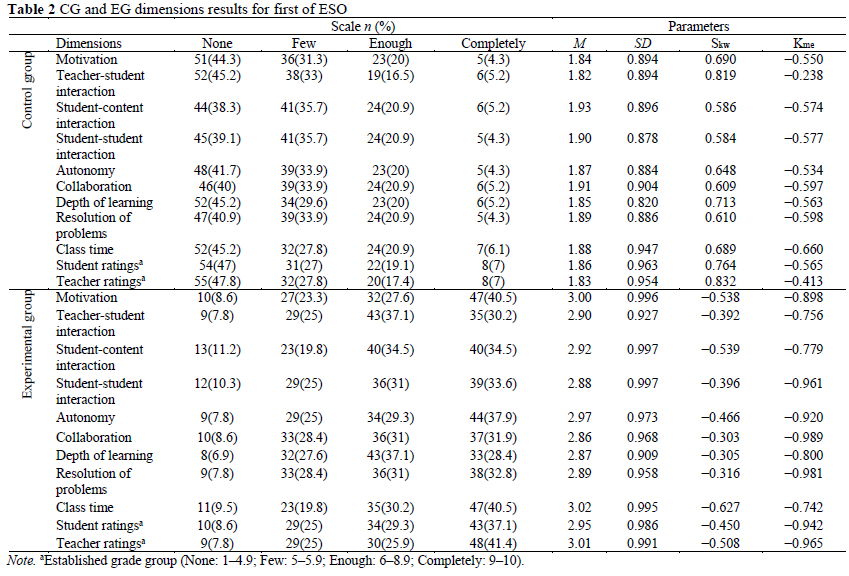
The presentation of the results begins with a descriptive analysis. This descriptive analysis presents the data concerning the first-year secondary school students. In this descriptive analysis, the results achieved by the two groups are presented. One group was taught according to the traditional method (CG) the other group was taught according to the STEM-based method (EG). In the CG, the measures of all dimensions were below 2 points. In EG in which the STEM-based approach was used, the means of the dimensions were around 3. Taking into account the standard deviation, the responses offered by the students were grouped, with no dimension presenting scattered responses. In terms of kurtosis, the distribution of results for all the dimensions was platykurtic. In all cases, the distribution of the sample was normal (Jöreskog & Moustaki, 200i). This is because both kurtosis and skewness were in the intermediate values between ±1.96 (cf. Table 2).
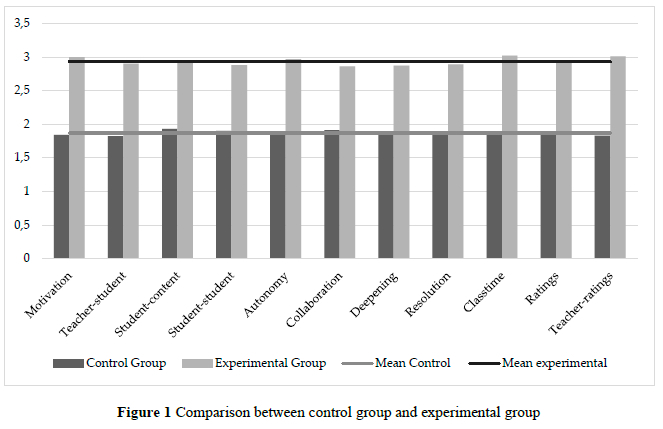
When comparing the averages of the students from the CG with the averages of the students who were taught through the STEM-based method, even trends can be observed. In other words, the ratings of the students in the CG show similar ratings in all dimensions. The same is true for the students in the EG. The difference is reflected when the dimensions of one group are compared with those of the other research group. There is a difference of almost one point, both in the overall mean and in the individual measures of each of the dimensions. This difference is in favour of the group taught through the STEM pedagogical method (cf. Figure 1).
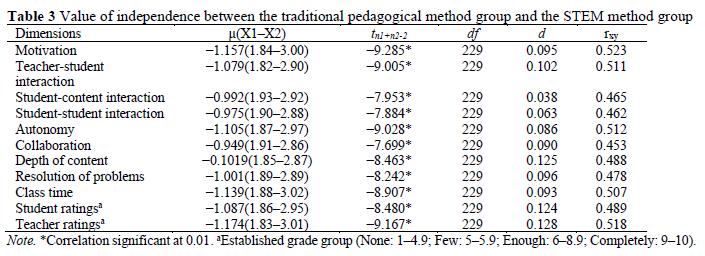
In order to identify whether there were significant differences between the study groups, student's t-statistic for independent samples was applied. In this case, the results obtained show the degree of independence between the students in the CG and the students in the EG. The results shown in Table 3 indicate that there is significance in each of the dimensions of the study. This significance is mainly oriented towards the group of students taught through the STEM pedagogical method. In other words, the STEM method led to better averages in each of the study dimensions. Moreover, this mean is higher than the means obtained by the group in the CG (expository method). The teacher ratings dimension is the one that showed the greatest difference between the EG and the CG. On the other hand, the dimension with the smallest mean difference between the EG and the CG was studentstudent interactions. If the strength of association of all dimensions is taken into account, a medium strength of association is observed. This was obtained by performing the statistical test of biserial correlation. Finally, it is shown that the effect size is low in the dimensions of depth of learning, teacher-student interaction, teacher ratings and student ratings. In all other dimensions, the effect size is very low.
Discussion
According to the results obtained, there are clear differences between students who experienced traditional teaching and those who followed a STEM methodology. The advantages of STEM teaching over traditional learning demonstrates its advantages, as discussed in the scientific literature (Meyrick, 20ii; Xie, Fang & Shauman, 2015).
Student-student interaction was the dimension with the highest mean in the CG. However, the one with the lowest mean was teacher-student interaction, although the detected differences were low. On the other hand, the dimension with the highest average was found in the EG - teacher ratings - whereas the one with the lowest mean was the student-student dimension, although the differences were also small.
There were differences of almost one point in all study dimensions in favour of the EG. The means found in each of the dimensions in the CG were similar to each other. The analysed means of each of the dimensions of the EG were similar to each other; therefore, no great differences were found.
There was a relationship of significance in all the dimensions of the study. This means that when compared to the expository method, the STEM method led to improvements in motivation, as other studies have also highlighted (Senkbeil & Ihme, 2017; Zhou & Teo, 2017). In addition, in line with other contributions, there was an improvement in the dimension of teacher-student interaction (Baran, Canbazoglu Bilici, Albayrak Sari, et al., 2019; Baran, Canbazoglu Bilici, Mesutoglu, et al., 2019).
Regarding autonomy, the results show an improvement when the STEM methodology was used. Although this methodology has shown its effectiveness in improving autonomy, there may be secondary factors such as gender that influence the results (Sobieraj & Krämer, 2019).
The development of collaborative aspects was also shown to be a significant factor, including student-content and student-student interactions. The STEM methodology has already shown positive effects on collaborative work among equals and others (Bartels, Rupe & Lederman, 2019).
The ratings obtained by the students and those awarded by the teacher also improved significantly. Different studies have shown the positive effects of the STEM teaching methodology on academic self-regulation (Abun & Magallanes, 2018) and academic performance (Solanki & Xu, 2018). Problem-solving skills were also developed more in the STEM group than in the CG group. It should be noted that STEM methodology intrinsically involves the use of problem-solving strategies and skills (Becker & Park, 2011).
In terms of the level of significance reached, the greatest incidence was in the dimension of teacher ratings, whereas the one with the least incidence was student-student interaction.
The comparison between methodologies is usually done in pairs. Studies are needed to compare a group of methodologies in a specific natural context.
The use of a STEM methodology has many advantages in real practice (interaction, autonomy, collaboration ...), most of which are known from current scientific literature. Although these advantages are known, as some of them have been highlighted in this work, there are still studies that compare this methodology with other types such as gamification or flipped classroom.
Conclusion
It can be concluded that the STEM teaching method applied to students in the first year of compulsory secondary education in the scientific/technological field is effective in all the study dimensions, which is crucial for the current pedagogical curriculum (Enakrire, 2019). This outcome was observed in comparison with the expository method, with a great impact on the dimension of teacher ratings. It has been confirmed that using methodologies other than the traditional one shows a positive effect on student learning (Ogbonna, Ibezim & Obi, 2019; Penn & Ramnarain, 2019).
In this study we tried to offer a specific teaching method using STEM as a pedagogical resource. This allows those teachers who have such resources to make use of them. Furthermore, it demonstrates the benefits that this method of teaching and learning can provide to students. In particular, in the African context, this teaching and learning process can offer new perspectives to African teachers. It also allows the promotion of careers in engineering, which are emerging in the South African context (Cloete, Maasen & Bailey, 2015) and the promotion of new pedagogical models in addition to the traditional teaching that predominates in that continent (Marfo & Biersteker, 2010).
As a limitation of this study, it should be borne in mind that research of this type in a natural environment allows for the intervention of many variables over which it is probably not possible to exercise control. This fact is to be expected in quasi-experimental designs (Fernández-García, Vallejo-Seco, Livacic-Rojas & Tuero-Herrero, 2014), so we must try to control all possible variables.
As a future line of research and due to the advantages that STEM has demonstrated in education, comparative studies with other active methodologies, such as gamification and flipped learning could be considered in order to measure the influence that each of them has on education.
Authors' Contributions
All the authors participated equally in the elaboration of the different sections of the manuscript.
Notesi. Published under a Creative Commons Attribution Licence.
References
-
Abun D & Magallanes T 2018. Academic self-regulation of STEM of Senior High School students of Divine Word Colleges in Region I, Philippines and their academic performance. Texila International Journal of Academic Research, 5(1):14-30. https://doi.org/10.21522/tijar.2014.05.01.art003
» https://doi.org/10.21522/tijar.2014.05.01.art003 -
Aladé F, Lauricella AR, Beaudoin-Ryan L & Wartella E 2016. Measuring with Murray: Touchscreen technology and preschoolers' STEM learning. Computers in Human Behavior, 62:433-441. https://doi.org/10.1016/j.chb.2016.03.080
» https://doi.org/10.1016/j.chb.2016.03.080 -
Barak M & Assal M 2018. Robotics and STEM learning: Students' achievements in assignments according to the P3 Task Taxonomy-practice, problem solving, and projects. International Journal of Technology and Design Education, 28(1):121-144. https://doi.org/10.1007/s10798-016-9385-9
» https://doi.org/10.1007/s10798-016-9385-9 -
Baran E, Canbazoglu Bilici S, Albayrak Sari A & Tondeur J 2019. Investigating the impact of teacher education strategies on preservice teachers' TPACK. British Journal of Educational Technology, 50(1):357-370. https://doi.org/10.1111/bjet.12565
» https://doi.org/10.1111/bjet.12565 -
Baran E, Canbazoglu Bilici S, Mesutoglu C & Ocak C 2019. The impact of an out-of-school STEM education program on students' attitudes toward STEM and STEM careers. School Science and Mathematics, 119(4):223-235. https://doi.org/10.1111/ssm.12330
» https://doi.org/10.1111/ssm.12330 -
Bartels SL, Rupe, KM & Lederman JS 2019. Shaping preservice teachers' understandings of STEM: A collaborative math and science methods approach. Journal of Science Teacher Education, 30(6):666-680. https://doi.org/10.1080/1046560x.2019.1602803
» https://doi.org/10.1080/1046560x.2019.1602803 -
Becker K & Park K 2011. Effects of integrative approaches among science, technology, engineering, and mathematics (STEM) subjects on students' learning: A preliminary meta-analysis. Journal of STEM Education: Innovations and Research, 12(5&6):23-37. Available at https://www.jstem.org/jstem/index.php/JSTEM/article/view/1509/1394. Accessed 31 December 2022.
» https://www.jstem.org/jstem/index.php/JSTEM/article/view/1509/1394 -
Chan KKH, Yeh YF & Hsu YS 2019. A framework for examining teachers' practical knowledge for STEM teaching. In YS Hsu & YF Yeh (eds). Asia-Pacific STEM teaching practices: From theoretical frameworks to practices. Gateway East, Singapore: Springer. https://doi.org/10.1007/978-981-15-0768-7
» https://doi.org/10.1007/978-981-15-0768-7 -
Chou PN & Feng ST 2019. Using a tablet computer application to advance high school students' laboratory learning experiences: A focus on electrical engineering education. Sustainability, 11(2):381. https://doi.org/10.3390/su11020381
» https://doi.org/10.3390/su11020381 - Cloete N, Maasen P & Bailey T (eds.) 2015. Knowledge production and contradictory functions in African higher education. Cape Town, South Africa: African Minds.
-
Enakrire RT 2019. ICT-related training and support Programmes for information professionals. Education and Information Technologies, 24(6):3269-3287. https://doi.org/10.1007/s10639-019-09931-1
» https://doi.org/10.1007/s10639-019-09931-1 - Felder RM & Brent R 2016. Teaching and learning STEM: A practical guide. San Francisco, CA: Jossey-Bass.
-
Fernández Batanero JM, Reyes Rebollo MM & Montenegro Rueda M 2019. Impact of ICT on students with high abilities. Bibliographic review (2008-2018). Computers & Education, 137:48-58. https://doi.org/10.1016/jxompedu.2019.04.007
» https://doi.org/10.1016/jxompedu.2019.04.007 -
Fernández-García P, Vallejo-Seco G, Livacic-Rojas PE & Tuero-Herrero E 2014. Validez Estructurada para una investigación cuasi-experimental de calidad. Se cumplen 50 aflos de la presentation en sociedad de los diseflos cuasi-experimentales [Structured Validity for a quasi-experimental research of quality. They are fulfilled 50 years of the presentation in company of the quasi-experimental designs]. Anales de Psicología, 30(2):756-771. https://doi.org/10.6018/analesps.30.2.166911
» https://doi.org/10.6018/analesps.30.2.166911 - Flick LB & Lederman NG 2006. Scientific inquiry and nature of science: Implications for teaching, learning, and teacher education. Dodrecht, The Netherlands: Springer.
-
Fuentes Cabrera A, Parra-González ME, López Belmonte J & Segura-Robles A 2020. Educational potentials of flipped learning in intercultural education as a transversal resource in adolescents. Religions, 11:53. https://doi.org/10.3390/rel11010053
» https://doi.org/10.3390/rel11010053 -
Furió D, Juan MC, Seguí I & Vivó R 2015. Mobile learning vs. traditional classroom lessons: A comparative study: Mobile vs. traditional learning. Journal of Computer Assisted Learning, 31(3):189-201. https://doi.org/10.1111/jcal.12071
» https://doi.org/10.1111/jcal.12071 -
Gotian R, Kang Y & Safdieh J 2020. Handbook of research on the efficacy of training programs and systems in medical education: Advances in medical education, research, and ethics. Hershey, PA: IGI Global. https://doi.org/10.4018/978-1-7998-1468-9
» https://doi.org/10.4018/978-1-7998-1468-9 -
Hernandez RM 2017. Impacto de las TIC en la educación: Retos y perspectivas [Impact of ICT on education: Challenges and perspectives]. Propósitos y Representaciones, 5(1):325-347. https://doi.org/10.20511/pyr2017.v5n1.149
» https://doi.org/10.20511/pyr2017.v5n1.149 -
Hernández Sampieri R, Fernández Collado C & Baptista Lucio P 2014. Metodología de la investigación [Investigation methodology] (6th ed). México: McGraw Hill. Available at https://periodicooficial.jalisco.gob.mx/sites/periodicooficial.jalisco.gob.mx/files/metodologia_de_la_investigacion_-_roberto_hernandez_sampieri.pdf. Accessed 31 December 2022.
» https://periodicooficial.jalisco.gob.mx/sites/periodicooficial.jalisco.gob.mx/files/metodologia_de_la_investigacion_-_roberto_hernandez_sampieri.pdf -
Hinojo Lucena FJ, López Belmonte J, Fuentes Cabrera A, Trujillo Torres JM & Pozo Sánchez S 2020. Academic effects of the use of flipped learning in physical education. International Journal of Environmental Research and Public Health, 17(1):276. https://doi.org/10.3390/ijerph17010276
» https://doi.org/10.3390/ijerph17010276 -
Jöreskog KG & Moustaki I 2001. Factor analysis of ordinal variables: A comparison of three approaches. Multivariate Behavioral Research, 36(3):347-387. https://doi.org/10.1207/S15327906347-387
» https://doi.org/10.1207/S15327906347-387 -
Kennedy TJ & Odell MRL 2014. Engaging students in STEM education. Science Education International, 25(3):246-258. Available at https://files.eric.ed.gov/fulltext/EJ1044508.pdf. Accessed 31 December 2022.
» https://files.eric.ed.gov/fulltext/EJ1044508.pdf -
Leal Filho W, Azul AM, Brandli L, Gökcin Özuyar P & Wall T (eds.) 2020. Quality education. Cham, Switzerland: Springer. https://doi.org/10.1007/978-3-319-95870-5
» https://doi.org/10.1007/978-3-319-95870-5 -
Lee Y, Capraro RM & Bicer A 2019. Affective mathematics engagement: A comparison of STEM PBL versus non-STEM PBL instruction. Canadian Journal of Science, Mathematics and Technology Education, 19(3):270-289. https://doi.org/10.1007/s42330-019-00050-0
» https://doi.org/10.1007/s42330-019-00050-0 -
Liu YH, Lou SJ & Shih RC 2014. The investigation of STEM self-efficacy and professional commitment to engineering among female high school students. South African Journal of Education, 34(2):Art. # 749, 15 pages. https://doi.org/10.15700/201412071216
» https://doi.org/10.15700/201412071216 - Marfo K & Biersteker L 2010. Exploring culture, play, and early childhood education practice in African contexts. In S Rogers (ed). Rethinking play and pedagogy in early childhood education: Concepts, contexts and cultures. London, England: Routledge.
- Meyrick KM 2011. How STEM education improves student learning. Meridian K-12 School Computer Technologies Journal, 14(1):1 -6.
-
Moreno-Guerrero AJ, Romero-Rodríguez JM, López-Belmonte J & Alonso-García S 2020. Flipped learning approach as educational innovation in water literacy. Water, 12(2):574. https://doi.org/10.3390/w12020574
» https://doi.org/10.3390/w12020574 -
Moreno-Guerrero AJ, Rondón García M, Martínez Heredia N & Rodríguez-García AM 2020. Collaborative learning based on Harry Potter for learning geometric figures in the subject of mathematics. Mathematics, 8(3):369. https://doi.org/10.3390/math8030369
» https://doi.org/10.3390/math8030369 -
Ogbonna CG, Ibezim NE & Obi CA 2019. Synchronous versus asynchronous e-learning in teaching word processing: An experimental approach. South African Journal of Education, 39(2):Art. #1383, 15 pages. https://doi.org/10.15700/saje.v39n2a1383
» https://doi.org/10.15700/saje.v39n2a1383 -
Parra-González ME, López Belmonte J, Segura-Robles A & Fuentes Cabrera A 2020. Active and emerging methodologies for ubiquitous education: Potentials of flipped learning and gamification. Sustainability, 12(2):602. https://doi.org/10.3390/su12020602
» https://doi.org/10.3390/su12020602 -
Penn M & Ramnarain U 2019. A comparative analysis of virtual and traditional laboratory chemistry learning. Perspectives in Education, 37(2):80-97. https://doi.org/10.18820/2519593X/pie.v37i2.6
» https://doi.org/10.18820/2519593X/pie.v37i2.6 -
Peters MA, Jandric P & Hayes S 2019. The curious promise of educationalising technological unemployment: What can places of learning really do about the future of work? Educational Philosophy and Theory, 51(3):242-254. https://doi.org/10.1080/00131857.2018.1439376
» https://doi.org/10.1080/00131857.2018.1439376 -
Roberts A & Cantu D 2012. Applying STEM instructional strategies to design and technology curriculum. In T Ginner, J Hallström & M Hultén (eds). PATT 26 Conference: Technology education in the 21st century. Linköping, Sweden: Linköping University Electronic Press. Available at https://www.diva-portal.org/smash/get/diva2:533285/fulltext01.pdf%2523page=81#page=111. Accessed 31 December 2022.
» https://www.diva-portal.org/smash/get/diva2:533285/fulltext01.pdf%2523page=81#page=111 -
Rodriguez Bravo Á & Mas Manchón L 2011. Inventario de palabras clave temáticas para la clasificación automática de noticias de televisión [Lexicon of thematic keywords for the automatic classification of TV news]. Anales de Documentación, 14(2):1-24. Available at https://revistas.um.es/analesdoc/article/view/123271/125011. Accessed 31 December 2022.
» https://revistas.um.es/analesdoc/article/view/123271/125011 - Santiago R & Bergmann J 2018. Aprender al revés: Flipped learning 3.0 y metodologías activas en el aula [Learning backwards: Flipped learning 3.0 and active methodologies in the classroom]. Barcelona, Spain: Paidós.
-
Sarican G & Akgunduz D 2018. The impact of integrated STEM education on academic achievement, reflective thinking skills towards problem solving and permanence in learning in science education. Cypriot Journal of Educational Sciences, 13(1): 94113. Available at https://files.eric.ed.gov/fulltext/EJ1196043.pdf. Accessed 31 December 2022.
» https://files.eric.ed.gov/fulltext/EJ1196043.pdf -
Scaradozzi D, Screpanti L, Cesaretti L, Storti M & Mazzieri E 2019. Correction to: Implementation and assessment methodologies of teachers' training courses for STEM activities. Technology, Knowledge and Learning, 24(Pt. 1):269. https://doi.org/10.1007/s10758-019-09406-9
» https://doi.org/10.1007/s10758-019-09406-9 -
Senkbeil M & Ihme JM 2017. Motivational factors predicting ICT literacy: First evidence on the structure of an ICT motivation inventory. Computers & Education, 108:145-158. https://doi.org/10.1016/j.compedu.2017.02.003
» https://doi.org/10.1016/j.compedu.2017.02.003 -
Siverling EA, Suazo-Flores E, Mathis CA & Moore TJ 2019. Students' use of STEM content in design justifications during engineering design-based STEM integration. School Science and Mathematics, 119(8):457-474. https://doi.org/10.1111/ssm.12373
» https://doi.org/10.1111/ssm.12373 -
Sobieraj S & Krämer NC 2019. The impacts of gender and subject on experience of competence and autonomy in STEM. Frontiers in Psychology, 10:1432. https://doi.org/10.3389/fpsyg.2019.01432
» https://doi.org/10.3389/fpsyg.2019.01432 -
Solanki SM & Xu D 2018. Looking beyond academic performance: The influence of instructor gender on student motivation in STEM fields. American Educational Research Journal, 55(4):801-835. https://doi.org/10.3102/0002831218759034
» https://doi.org/10.3102/0002831218759034 - Sousa DA & Pilecki T 2018. From STEM to STEAM: Brain-compatible strategies and lessons that integrate the arts (2nd ed). Thousand Oaks, CA: Corwin.
-
Toma RB & Greca IM 2018. The effect of integrative STEM instruction on Elementary students' attitudes toward science. EURASIA Journal of Mathematics, Science and Technology Education, 14(4):1383-1395. https://doi.org/10.29333/ejmste/83676
» https://doi.org/10.29333/ejmste/83676 -
Xie Y, Fang M & Shauman K 2015. STEM education. Annual Review of Sociology, 41:331 -357. https://doi.org/10.1146/annurev-soc-071312-145659
» https://doi.org/10.1146/annurev-soc-071312-145659 -
Yilmaz A & Soyer F 2018. Effect of physical education and play applications on school social behaviors of mild-level intellectually disabled children. Education Sciences, 8(2):89. https://doi.org/10.3390/educsci8020089
» https://doi.org/10.3390/educsci8020089 -
Zhou M & Teo T 2017. Exploring student voice in teachers' motivation to use ICT in higher education: Qualitative evidence from a developing country. International Journal of Educational Technology, 4(1):26-33. Available at https://files.eric.ed.gov/fulltext/EJ1167304.pdf. Accessed 31 December 2022.
» https://files.eric.ed.gov/fulltext/EJ1167304.pdf -
Zhuang W & Xiao Q 2018. Facilitate active learning: The role of perceived benefits of using technology. Journal of Education for Business, 93(3):88-96. https://doi.org/10.1080/08832323.2018.1425281
» https://doi.org/10.1080/08832323.2018.1425281
Revised: 4 October 2021
Accepted: 17 February 2022
Published: 31 December 2022