Mentoring of pre-service teachers as a method of enhancing effective inclusive teaching: A collaborative action study
Abstract
Mentoring is globally recognised as critical for the preparation of pre-service teachers. In this study we examined the role of mentoring pre-service teachers during their practicum as a tool for professional development in teacher education, focusing on how it enhances inclusive teaching and learning skills for diverse learners. In this article we report on a qualitative critical collaborative action research (CAR) study, whereby an inclusive education research expert from the university worked on a mentoring plan with 5 purposefully selected teachers. Within CAR, data were collected in 4 stages, i.e., planning, observation, action, and reflection using group interpretative meetings, reflective diaries, discussions, observations, document analysis, and focus group interviews with 20 learners randomly selected from the classes taught by 5 pre-service teachers. Thematic content analysis was used to analyse these data. We make a case for mentoring as an evidence-based alternative to developing inclusive teaching practices among teachers.
collaborative action research; mentor; mentoring; pre-service teacher; professional development
Introduction
Despite global progress in developing inclusive education environments, weak preparation of pre-service teachers for inclusive teaching has been attributed to factors such as less emphasis on inclusive pedagogies, insufficient support for pre-service teachers and a lack of professional development for the mentors of pre-service teachers (Abreh, 2025; Ajani & Ntombela, 2025).
In South Africa, the preparation of teachers for inclusive teaching has become a bone of contention since the adoption of White Paper 6, Special Needs Education: Building an Inclusive Education and Training System (Department of Education [DoE], 2001). Inclusive education, a system of education where learners are taught in the same educational environment without segregation or discrimination according to race, gender, disability, ethnicity or any other factor, was adopted in South Africa in 2001 (Makoelle, 2016). White Paper 6 was aimed at establishing inclusive schools and providing a framework for inclusive teaching and learning. Section 2.2.2.3 (p. 29) of White Paper 6 refers to the preparation of pre-service teachers at higher education institutions as follows:
At the institutional level, in general, further and higher education, we will require institutions to establish institutional-level support teams. The primary function of these teams will be to put in place properly coordinated learner and educator support services. These services will support the learning and teaching process by identifying and addressing learner, educator and institutional needs.
Teacher preparation for inclusive teaching for both pre-service and in-service teachers has been integrated into the teacher education curriculum (Moosa & Bekker, 2021), assuming that pedagogical content knowledge, coupled with practicum, would prepare teachers adequately for inclusive pedagogy. However, there are doubts about the knowledge and preparedness of teacher educators to guide and mentor trainee teachers for inclusive teaching (Majoko, Phasha, Brown, Soni, Duku, Febana, Maharajh, Mkra, Mngomezulu, Moodley, Mosito & Ndlovu, 2018). Inclusive teaching is assumed to be based on principles of equity and tolerance of diversity, seeks to respond to the needs of all learners in the classroom, and remove all teaching and learning barriers (Hogan & Sathy, 2022; Makoelle, 2016).
As former teacher, school principal, and teacher educator (first author), my observation was that often mentors of pre-service teachers focus rather on the general aspects of teaching and learning for their mentees, and slight attention is given to the preparation of teachers for inclusive teaching. Often, pre-service teachers are frustrated when the class is composed of diverse learners, particularly, learners with special educational needs and disabilities (SEND).
Therefore, in this collaborative action research (CAR) study we report on a mentoring plan between university experts and a group of five mentor teachers in preparing five pre-service teacher mentees for inclusive teaching and learning. The study was aimed at answering the following research questions:
• How can (if applicable) mentoring be used as a strategy to prepare pre-service teachers for the facilitation of inclusive teaching and learning in an inclusive class?
• Which mentoring practices contribute to inclusive teaching?
• Which challenges (if any) do mentors and mentees experience during practicum?
This study was aimed at exploring mentoring as an alternative mechanism to prepare pre-service teachers for the facilitation of inclusive teaching and learning. The study contributes significantly to international and national literature on the role of mentoring as a strategy for the preparation of pre-service teachers for inclusive teaching, identifies mentoring practices promoting inclusive teaching and proposes solutions to said challenges
Problem Statement
The transition from a teacher-centred curriculum to a learner-centred curriculum in South Africa meant that the implementation of curriculum reforms, which embody the philosophy of constructivism, indicates that teachers would be facilitators of teaching and learning through the accompaniment of learners on their journey of knowledge discovery, rather than acting traditionally as transmitters of knowledge (Dada, Laseinde & Tartibu, 2023; Du Plessis, 2020; Ogunnyi & Mushayikwa, 2015; Van Harmelen, 1999). This came amid the implementation of inclusive education, with a move away from a medical model of learner support, which advocates segregation, to a social model of learner support which promotes the notions of inclusion, equity, and culturally relevant pedagogy. The implementation of a constructivist curriculum became a challenge as teachers were not prepared to change their instructional strategies, embedded in their training and past experiences. Teacher training used to be teacher-centred and based on the segregation of learners according to ability and disability. Diversity, therefore, was viewed as a challenge rather than an opportunity (Makoelle, 2013; Makoelle & Mosito, 2023). The changes towards inclusive education implied a change of teacher roles. For instance, according to the Norms and Standards for Educators (DoE, Republic of South Africa [RSA], 2000), the roles of teachers include that they act as curriculum developers. This means that teachers also play a role in the development of an inclusive curriculum and develop inclusive teaching practices.
As a result of the changing roles of teachers and in aiming to empower them as curriculum deliverers, compulsory inclusive education courses were introduced in almost all initial teacher education courses (Rusznyak & Walton, 2019). This is according to the Minimum Requirements for Teacher Education Qualifications (MRTEQ) (Department of Higher Education and Training, RSA, 2015), which requires that inclusive education is presented to all students. Rusznyak and Walton (2019) caution that while courses are taught, the placement of pre-service teachers in inclusive schools has been a challenge, as most schools do not provide the inclusive environment needed to inculcate inclusive teaching in practice.
While there have been efforts to develop standards for inclusive education, not all teacher training institutions have made similar efforts, making the implementation of standards a complex issue (Rusznyak & Walton, 2019). Although teacher training institutions have adopted the standards, there is a gap in terms of how pre-service teachers are prepared for inclusive teaching in practical terms in the classrooms. Therefore, the problem is that pre-service teachers are not adequately prepared for inclusive teaching and that alternative mechanisms such as mentoring are needed to develop their inclusive teaching skills.
Literature Review
The notion of inclusive teaching
The notion of inclusive teaching is understood to be a teaching and learning approach that does not segregate learners based on diversity aspects such as disability, ability, gender, socio-economic status, language, race, and ethnicity. Makoelle (2016) avers that inclusive teaching and learning occurs within the framework of inclusive pedagogy. Makoelle (2014, 2025) postulates that inclusive pedagogy is the totality of teacher beliefs, attitudes, practices, and strategies that are geared towards enabling the participation of all learners to acquire knowledge regardless of their background. In their work, Florian and Black-Hawkins (2011) emphasise the concept of inclusive practice (which is the enactment of inclusive teaching) as central to the notion of inclusive pedagogy. They postulate that the application of inclusive practice by teachers is a focus on inclusion rather than exclusion, in other words, inclusive pedagogy must seek to widen the participation of all learners in the teaching and learning process.
Conceptualising mentoring and mentoring in teacher education
AT Wong and Premkumar (2007:para. 2) define mentoring as a learning process characterised by a helpful, personal, and a reciprocal relationship between the mentor and mentee, which focuses on emotional support and achievement (Kiadarbandsari, 2025). They postulate that during mentoring, learning takes place through a dialogical conversation in which an experienced mentor guides the novice towards much-needed skills and knowledge. AT Wong and Premkumar (2007) and KK Wong (2025) further postulate that mentoring can be formal or informal. Formal mentoring is organised at the workplace with mentor and mentee plans designed as part of the mentee's professional growth and development, while informal mentoring may occur spontaneously and relates mostly to the mentee's psychological, self-esteem, confidence, and motivational support (Joo & Cruz, 2024).
Petrovska, Sivevska, Popeska and Runcheva (2018) conceptualise mentoring in teacher education to mean a process through which an experienced teacher develops the professional capabilities of a novice teacher. It is regarded as a tool for initial teacher education for pre-service teachers, and it can also be regarded as a tool for the professional development of in-service teachers (Koroleva, 2017).
Nature of mentoring in teacher education
Practicum is a school-based experience programme that pre-service teachers undergo to bridge the gap between theoretical and practical knowledge about teaching and learning (Pratiwi, 2020; Tuli & File, 2009). It is assumed that practicum programme of good quality would ensure that pre-service teachers are prepared adequately for the world of work. For instance, Tuli and File (2009) regard a practicum process of high quality as one that balances theory and practice, fosters partnerships between teacher education institutions and placement schools (Nguyen, 2020), articulates clear stages of development for pre-service teachers, provides diverse experiences for pre-service teachers, includes assessment of resources and needs, is purpose driven, has clear roles and expectations, encourages innovation, is ongoing and involves evaluation and response.
Several suggestions have been made on how pre-service teacher mentoring could be organised, and what effective pre-service teacher mentoring constituted. Nesje and Lejonberg (2022) believe that mentoring through reflection can improve pre-service teachers' understanding of their teaching and learning. They stress that mentoring should be structured and holistic if it is to work. It seems important also that mentoring between teacher mentors and pre-service teachers bears a characterisation of collaborative learning, based on values of trust, confidentiality, protection, and mutual respect. While mentoring can be based on mutual influence, i.e., mentee learning from the mentor and vice versa, Graves (2010) postulates that mentoring should be governed by clear expectations, continuous communication, and positive relationships as cornerstone of an effective mentoring process. Similarly, Ambrosetti (2014) suggests that mentoring is hierarchical but mutual and reciprocal, as both the mentor and mentee negotiate their journey together. Ambrosetti (2014) highlights some of the benefits of mentoring as reflexivity, renewed job motivation, and professional learning. However, some challenges may include increased workload, added responsibilities, and stress for the mentors. It is also believed that the quality of mentoring placements for pre-service teachers could be problematic.
Cross, Hubbard, Beverly, Gravatt and Aul (2020) highlight the complexity of the transition from being a pre-service teacher to that of a novice teacher. They indicate that during this transition, mentoring may take a formal or informal approach, but according to them, formal mentoring appears to be more beneficial. Quoting Strong (2006), Cross et al. (2020) indicate that mentoring may influence beginner teachers' satisfaction, commitment, and retention. Therefore, as Lisenbee and Tan (2019) state, mentoring must go beyond the pre-service stage into the novice teacher stage to manage the transition and improve their pedagogical prowess.
Models or approaches in pre-service teacher mentoring
Several mentoring approaches and models exist. AT Wong and Premkumar (2007) classify the different mentoring approaches as different models. In the apprentice model, the mentee learns from the mentor through role modelling and observation. Through the competency model the mentee's performances and progress are systematically assessed against a set of competencies judged by the mentor. In the reflective model the mentor guides the mentee to reflect, critique, and research practices to build new knowledge and local theories about their work. The most helpful classification of mentoring models for pre-service teacher education have been discussed by Orland-Barak and Wang (2021), namely, the personal growth mentoring approach; the situated learning mentoring approach; the core practice mentoring approach; and a critical transformative mentoring approach.
The personal growth mentoring approach focuses on the mentee's psychological and emotional support. It is about the mentor providing counselling and motivation. It allows mentees to test their ideas in the process of teaching and learning while building rapport with the mentor. The challenge is that it focuses heavily on the affective aspects of the mentee, and may neglect practical skills.
The situated learning mentoring approach prioritises learning as influenced by social situatedness. The socialisation of pre-service teachers through experiential integration and observation is critical for their professional development. Thus, the context and culture of teaching lead to meaningful enculturation through mentor teachers' experience, and role modelling. It is practical and assists pre-service teachers in developing teaching practices. The challenge is that situated learning mentoring is context-dependent and may not prepare pre-service teachers for other contexts. It does not prioritise theoretical knowledge, as such could be problematic.
The core practice mentoring approach assumes that pre-service teachers need to learn core teaching practices that are applicable in diverse contexts. It emphasises the rehearsal of core teaching practices and applies them in different teaching scenarios. Co-teaching with mentors is critical in providing pre-service teachers with the opportunity to develop their teaching skills. It is lauded for reflexivity and preparation of pre-service teachers' instructional strategies, content presentation, and assessment activities. However, the use of core teaching practices could present a challenge as the composition of the class may include learners from diverse backgrounds which requires the use of diverse teaching practices beyond the core.
The critical transformative mentoring approach assumes that teaching and learning knowledge should be critiqued and reflected upon to deal with the underlying colonising mechanisms. Pre-service teachers need to pursue freedom and social justice and be vigilant in the reproduction of constraining and disempowering practices which seek to subjugate both the teacher and the learners. It is politically emancipatory as it endeavours to question power relations in the educational process. When combined with other approaches such as action research, it encourages transformative learning and change. The challenge is that there seems to be an assumption that teaching practices are inherently problematic and need to be changed. The overly critical nature of this approach may create distrust between mentors and mentees (Makoelle, 2014; Stoller, 2021).
The analysis of these approaches seems to show that collaboration, and pre-services teachers' well-being and social and historical contexts play a pivotal role in their mentoring. As such, a more collaborative, approach may go a long way in their preparation for inclusive teaching. In this study, CAR was identified as meeting this criterion.
Action research and pre-service teacher education
Action research is a systematic enquiry used in education as a vehicle to improve teaching practices. It is used as a tool for pre-service and in-service professional development (Osmanović Zajić, Mamutović & Maksimović, 2021). The use of action research as part of pre-service teacher mentoring is not entirely a new phenomenon. According to Clayton and Meadows (2013), the benefits of action research for pre-service teachers have always been bringing aspirant teachers into the process of teaching and learning (Mohamed, 2024) and promoting reflective practice.
Several action research approaches have been instrumental in teacher education, but participatory action research (PAR) and CAR have often been used. They offer direct and valued participation in the enquiry and learning process by pre-service and in-service teachers. In their work, Levin and Rock (2003) sought to advocate for CAR, which presupposes a partnership in learning between the pre-service teacher mentee and the mentor teacher (Yosief, Sulieman & Biede, 2024). According to Levin and Rock (2003), this partnership emanates from collaboration in planning, implementation, and evaluation, in the quest to improve pre-service teachers' teaching skills and capabilities. CAR was, therefore, adopted in this study as it provided the platform for mutual cooperation between pre-service teachers and the school teacher mentors.
Research Methodology
Research Approach and Design
In this study we adopted a qualitative, critical CAR design. Aspland, Macpherson, Proudford and Whitmore (1996) state that critical CAR is an enquiry that brings meaning to the lived experiences and encourages the formation of partnerships between researchers and school-based practitioners. Its significance lies in the critique and improvement of current practices. The adoption of CAR provided a platform for critical reflection for both pre-service teachers and their mentors, to explore how (if applicable) mentoring could be used as a strategy to prepare pre-service teachers for the facilitation of inclusive teaching in an inclusive class.
Choosing a Research Site
According to Deghave and Hanass-Hancock (2023), there were about 848 full-service schools in South Africa in 2020. Although not perfectly resourced, full-service schools are comparatively well-placed for inclusion, and their teachers are trained for it. Based on this criterion and the teachers' willingness to participate, one of these schools was purposefully selected for this study.
Recruiting Participants for CAR
The participants were selected purposefully according to set criteria. The five selected mentor teachers should previously have been involved in the mentoring of novice teachers and should have been trained on inclusive education. The convenience selection of five pre-service teachers required that they were registered for a teacher training course and placed at a selected school/site for practicum. The participants were spread across different subjects, namely, English, history, geography, agricultural science, and biology. A focus group of learners from the classes in which mentees were placed were randomly selected, namely, a group of four learners (male, female, special educational needs [SEN], and non-SEN) per class - a total of 20 learners.
The CAR and Mentoring Processes
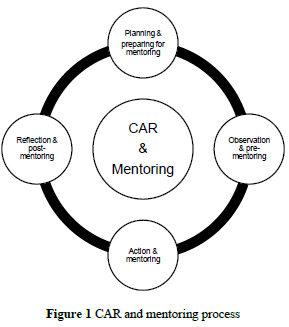
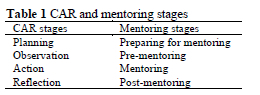
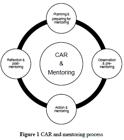
In this study CAR was carried out in parallel with the mentoring stages. Four stages of CAR were conducted alongside four stages of mentoring borrowed from Ambrosetti, Knight and Dekkers (2014). So, for each stage of CAR, parallel activities of mentoring were carried-out (see Table 1).
The CAR and mentoring processes were conducted in a cycle as depicted in Figure 1.
Data Collection Process
Preparing for mentoring (Planning)
During this stage, mentors, mentees and the university collaborators set goals. Firstly, there was a discussion about what inclusive teaching and the notion of mentoring meant in order to have a common understanding of the concepts. Secondly, upon the request of the CAR team, the university collaborator ran a workshop on inclusive teaching, highlighting how a classroom situation analysis is done, how barriers are identified, how an inclusive teaching strategy is developed, how the curriculum is adapted, and how inclusive assessment is developed. The mentors were then allowed to implement principles of inclusive teaching in their classes while recording the lesson on video.
Pre-mentoring (Observation)
To develop a criterion for inclusive teaching, the mentoring team and mentees decided to do observations in classes. Secondly, they decided to record the mentors' lessons. Upon a reflective meeting after the observation of lessons, the mentor and mentee teams came up with the following criteria for inclusive teaching:
• Situation analysis;
• Making pedagogical choices;
• Developing an inclusive assessment strategy.
It was then decided to implement the criteria of inclusive teaching. The mentees were to integrate the set criteria into their lesson while being observed by mentors over 9 weeks. The criteria of inclusive teaching included the following pedagogical activities.
The situation analysis implied that the mentees were expected to firstly analyse the educational needs of the learners in the class. The learners' records were to be perused, and based on those, the teacher and the mentee were expected to reflect on their own abilities, needs and teaching approach to address the learners' needs. It also implied arranging the classroom to create a conducive atmosphere for inclusive teaching and learning, but also arranging the content material in an accessible format for the different learners in the class.
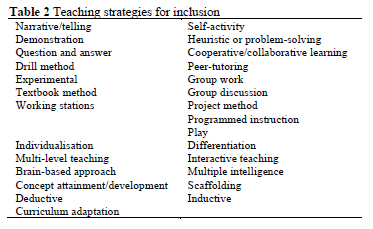
Pedagogical choices implied choosing the most appropriate teaching and learning strategies to address the learning needs of all learners. The choice was whether this could be part of the strategy for the whole class or an individualised education plan (IEP). Table 2 shows the suggested teaching strategies.
Assessment implies choosing between different forms of assessment strategies to address the learners' needs, namely, portfolios, continuous, peer, group, oral, observational, summative, and criterion assessment.
Mentoring (Action)
During this stage, the mentees presented their lessons. The mentors did lesson observations using the criteria agreed upon. After every lesson, the mentors provided feedback to mentees on what and how to improve in the next lesson. The mentees kept a diary of their reflections.
Post-mentoring (Reflection)
Every Friday, mentors and mentees came together to reflect on the actions. During these reflective meetings, mentors and mentees reflected upon what worked or did not. Conclusions were reached about how mentoring could be used to prepare pre-service teacher mentees for inclusive teaching. The agreements were reached through general consensus or a simple majority, while disagreements were also noted.
Data Analysis
Data analysis took place at two levels, namely, group interpretative analysis at CAR level with participants, i.e., mentors and mentees, and at a meta-research level by the researchers (university collaborators) after the CAR process. The data analysis was carried out using a thematic content analysis which included coding and identification of patterns and meaning from the data.
Trustworthiness
To maintain trustworthiness, credibility was addressed through the triangulation of data. Transferability was achieved through the prolonged and systematisation of the research process. In order to attain dependability, the process of data collection was aligned with the CAR process. Confirmability was achieved through constant interaction with the participants of the study.
Ethical Considerations
All ethical requirements for this study were adhered to and ethics clearance was obtained from the University's Institutional Research Ethics Committee (IREC). Thereafter, access was negotiated with gatekeepers. Participants were briefed about the purpose of the study and they chose to participate voluntarily. Their consent was documented in writing. They were also informed about their right to terminate participation at any moment should they so wish. Reasonable steps were taken to conceal the identities of participants and secure data on a password-protected computer.
Findings
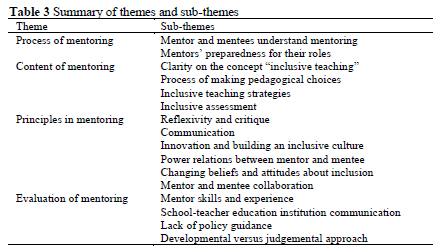
The findings are discussed according to the themes that emerged from the analysis, namely, process, content and principles (see Table 3).
Process of Mentoring
With this study we have confirmed that developing inclusive teaching skills among pre-service teachers through mentoring requires careful planning. Selecting placement schools seemed a critical aspect because the experiences of pre-service teachers within an inclusive class could enhance their inclusive teaching skills. For instance, before mentoring, it should be confirmed that the placement classes are diverse, and are sufficiently resourced to support inclusive learning. In this study, the mentors and mentees thought that placement was crucial in the process of developing inclusive practices. One mentor commented as follows: "I think placing the mentees in classrooms with learners from diverse backgrounds would go a long way in preparing them for inclusive teaching and learning?"
Although the understanding of inclusion was known to participants, the meeting between the mentors and mentees before the mentoring process was critical for developing consensus about what the concept meant, both in theory and practice. Reflecting on the criteria developed between the mentees and mentors, one of the mentors emphasised that "the criteria indicate the things that we as mentors have to look at when observing the pre-service educators in practiced This sentiment was echoed by one of the mentees: "Yes, by agreeing on the criteria for inclusive teaching, one goes into the class with the assurance that one knows what is expected when teaching an inclusive class."
The preparation of mentees for an inclusive practicum also required the preparation of mentors. The fact that mentors had to practice inclusive teaching, critique and reflect on their practice before mentoring pre-service teachers was important for the assessment, the sharpening of their own skills and practice, and encouraging co-learning. One of the mentors remarked as follows: "The fact that I implemented the principles of inclusive teaching in my teaching and got feedback from colleagues gave me confidence. Reflecting and critiquing my teaching only allowed me to see it from a different but improved perspective."
Content of Mentoring
It became evident that the criteria for inclusive teaching adopted before the mentoring held major significance. Conducting the situation analysis seems to have allowed mentees an opportunity to reflect on their strategies before embarking on a teaching exercise. One of the mentees reflected:
The situation analysis provided me with the opportunity to know who is in the class (I mean the kind of learners I have), what their educational needs are, and how I may approach teaching based on my personal skills, learners' learning styles, and their pedagogical preferences. It allows you to think about how the inclusive environment could unfold.
The study has shown that observation of mentors in practice and the discussion between mentors and mentees assisted mentees in making appropriate pedagogical choices, for example, identifying the right teaching strategy for a specific class. Asked about how their ability to make pedagogical decisions and judgements has changed as a result, one of the mentees said: "The fact that we brainstormed the possibilities of how I can approach the teaching of a particular content gave me options to choose from, thus making pedagogical decisions far easier." The mentors also thought that the criteria were important to enable mentors to assess mentees.
It also became evident that a choice of teaching strategy was about striking a balance between whole class involvement and applying individualisation and differentiation with the development of the IEP. Asked about making pedagogical decisions, one of the mentees said the following:
Once you have done the situation analysis of your class, you are then in a better position to decide if individualisation is required, I mean the learner or group of learners who would require a special or added kind of intervention. My take is that if the level of support required by the learner to make progress in learning cannot be achieved with standard practice, I will intervene.
It is evident that exposing mentees to multiple teaching strategies was important to enhance their inclusive teaching and learning skills. For instance, asked about how they made choices about strategies, and how they experienced applying them in the classroom, one of the mentees postulated as follows:
Drawing from multiple teaching strategies provides you as a teacher with the flexibility required to address the needs of diverse learners. It also provided me with an opportunity to assess which of those strategies could work effectively, with which kind of learners and in what kind of classroom context.
On the same note, another mentee had this to say:
I have realised that some strategies could work well with groups while others with individuals, so is with learners experiencing different kinds of educational barriers, as a result, I see that there cannot be a one size fit for all learners, therefore, teaching and learning ought to be varied to address the needs of learners.
With this study we have demonstrated that the use of diverse assessment methods was important for the mentees to improve the learners' learning outcomes. Asked about their experiences of applying various assessment approaches, one of the mentees said:
"Using different assessment strategies for learners not only helped them to learn, but I also found out how different assessments would be effective for assessing specific content, but also assessing learners with a specific kind of educational barrier."
Principles in Mentoring
This study has shown that CAR and mentoring ensured the promotion of inclusive teaching through the application of the following principles.
• Reflexivity and critique: while mentoring can take place at any placement school, the significance of CAR is that mentors and mentees are offered the opportunity not only to reflect on their practice, but to research it. In reflecting about the CAR process, one of the mentors stated that "forming an enquiry group allows us to step out of our practice and see it from an outsider's perspective, which is helpful for improvement."
• Communication: the study shows that communication between mentors and mentees about inclusive teaching was important to debunk myths and ensure consensus. For instance, when asked about the process, one of the mentors praised the fact that communication was open from the beginning to the end of both CAR and the mentoring process.
• Innovation and building an inclusive culture: it is evident that CAR facilitates teachers' change. Prior workshop and brainstorming discussions were helpful in shifting the practitioners' beliefs and attitudes towards inclusive teaching, and this encouraged some innovation. For instance, asked about how they experienced the CAR process, one of the mentees said:
I am glad we were allowed to be part of the research and evaluation of practice; this has allowed us to make suggestions based on our firsthand classroom practice and our interaction with the learners. I believe I have contributed to the innovative ways of teaching inclusively and want to share this with my fellow aspirant teachers.
• Power relations between mentor and mentee: the establishment of a collaborative enquiry group ensured that the voices of mentees were heard and that their contribution to the process of developing their professional teaching identities regarding inclusion was without copying their mentors. Asked about how the process has shaped their beliefs about teaching, one of the mentees cited:
I am glad, albeit for guidance from the mentors, we were allowed to be ourselves in developing our own understanding and innovating our evolving teaching philosophies as far as inclusion was concerned. The process allowed me to evolve into an inclusive teacher in my own way, rather than try to master what our mentors are doing.
• Changing beliefs and attitudes about inclusion: it became evident that the CAR process allowed dialogical interaction between mentors and mentees, and therefore, this contributed to shifting beliefs and attitudes as both participated in the development of practices rather than adopting them from outside. For instance, asked about the role of CAR, one of the mentors indicated:
The fact that we have this open dialogue and conversations about what constitutes an inclusive teaching has helped to shift some beliefs and soften some attitudes, e.g., I always thought inclusion was harder for learners with certain kinds of disability, now I realise this can be done, thanks to my colleagues and our mentees.
• Mentor and mentee collaboration: the study has demonstrated that the formation of the enquiry group led to mentors and mentees forming learning groups, and not working in silos. For instance, one of the mentors said: "The CAR process has created a platform where we can talk about our mentoring and how we can approach it - not as individuals but as a mentoring collective. We have clear consensus about what we need to do during mentoring and how." The same sentiments were echoed by one of the mentees, who suggested that CAR allowed them to work as a collective, and this empowered them as a group.
Evaluation of Mentoring
Evidence from the study shows that although mentoring had benefits, it also had certain drawbacks. For instance, reflecting on the role of mentors, one of the pre-service teachers lamented that "mentoring is good, but sometimes the mentors do not have the requisite skills and competencies regarding inclusive teaching in general?" When asked about what could improve pre-service teacher preparation for inclusive teaching, one of the mentors said the following: "the communication between our school and the university is not always straightforward; more direct communication about mentoring and inclusion in general could be helpful. " On the other hand, both pre-service teachers and mentors agreed that the practicum policies of the education department and universities needed to be synchronised with regard to the expectations of mentoring. One of the pre-service teachers indicated that although mentoring was beneficial to them, it required positivity, implying that it must be developmental rather than judgemental.
Discussion of Findings
This study has shown the significant intersection between CAR and various aspects of the mentoring of pre-service teachers. As Anagnou and Fragoulis (2014) postulate, mentoring and action research contribute to the professional development of in-service teachers (mentors) while preparing pre-service teachers for the world of work. The findings show that while mentoring is important, when done together with CAR, several positive contributions became evident. In support, Tupas (2019) avers that the combination is a critical teacher development tool. Therefore, the findings are discussed according to the stages of mentoring and CAR.
Stage Prior to Mentoring
The study confirmed that careful planning of mentoring was needed before it could be carried out. Graves (2010) posits that for mentoring to succeed, open communication and clear expectations are needed. A comprehensive and detailed action plan should include the following:
• Discussions about what inclusive teaching is are necessary so that mentees and mentors have a similar understanding of what inclusive teaching is.
• Agreeing on the characteristics of placement schools/classrooms is important, as not all schools/classrooms may provide the necessary conditions for inclusive teaching. Lisenbee and Tan (2019) believe that the school has to provide a mentoring culture and have readily available and trained mentors. The aim is to expose mentees to the most diverse classroom that can significantly prepare them to deal with the challenges of an inclusive class, and, therefore, grapple with the notion of inclusive teaching. As Tuli and File (2009) indicate, practicum exposes the mentees to the right conditions of teaching which are as close as possible to those in real-life situations.
• When mentors and mentees are ready and prepared, consensus about the principles of mentoring is needed, as it impacts the aims and the mentoring process. Ambrosetti (2014) postulates that consensus among mentors and mentees should be about the meaning of mentoring and understanding how to do it. These comprehensive mentoring guidelines ensure sustainable and consistent mentoring practices by mentors. Hence, Marcheva-Yoshuvska (2018) regards mentorship as collaborative within conducive and supportive institutional conditions.
During Mentoring
According to AT Wong and Premkumar (2007), different mentoring approaches have different advantages and disadvantages, and each may be applicable depending on the context and situational factors. According to this study, no single method/approach of mentoring should be applied. A mix of mentoring approaches is necessary, hence, Orland-Barak and Wang (2021) propose an integrated mentoring framework for pre-service teacher preparation programmes.
It was revealed that the use of criteria made the inclusive teaching process effective. It assisted both mentors and mentees to clarify expectations, determine actions needed and providing guided feedback. It makes the mentoring process purposeful rather than haphazard.
For instance, the process of situation analysis, making pedagogical choices, and designing assessment strategies impact the mentor and mentee process equally. It allows mentees to reflect on the strategy, the composition of the class and their needs, their abilities as teachers, and their teaching approach. As Nesje and Lejonberg (2022) suggest, mentoring has an enormous potential to boost pre-service teachers' reflections about their teaching and learning practices.
On the other hand, Cross et al. (2020) contends that the choice of pedagogical methods during the practicum should be evidence-based, as it empowers mentees to know which strategies work, and their context. This implies the multiple ways in which inclusive teaching can be approached.
In this study, the application of a variety of assessment strategies assisted mentees in supporting and responding to the needs of most, if not all learners in their classes. According to Makoelle (2014), using a variety of assessment strategies responds to the needs of learners of varied talents and learning styles.
After Mentoring
In this study, the combination of mentoring and CAR presented various opportunities for growth and development for both mentors and mentees, particularly the preparation of pre-service teachers for teaching. However, for successful mentoring, the process should always be anchored in planning, brainstorming, a plan of action, observation, implementation, and evaluation.
Conversely, Binti Kamarudin, Binti Kamarudin, Binti Darmi and Binti Mat Saad (2020) posit that building rapport, within the zone of proximal development between the mentor and mentee, is vital for the professional learning of both. Furthermore, certain values are important for the mentoring process, namely, collaboration between mentors and mentees, reflecting (Andrea, 2010) and critiquing, in a developmental rather than a judgmental way to build rapport between mentors and mentees, and providing feedback that promotes mutual learning. As Pande (2018) explains, mutual trust between mentor and mentee encourages openness and confidence, which may enhance initiative and innovation. It became clear that pre-service teachers valued working together. Levin and Rock (2003) contend that dialogue with fellow aspirants and mentors is an essential aspect of collaboration and mutual learning.
Conclusion
With this study we confirmed that mentoring is important for the preparation of pre-service teachers for inclusive teaching regarding the process, approach, practices and principles of teacher practicum within the South African context.
Contribution to Knowledge about the Mentoring of Pre-service Teachers
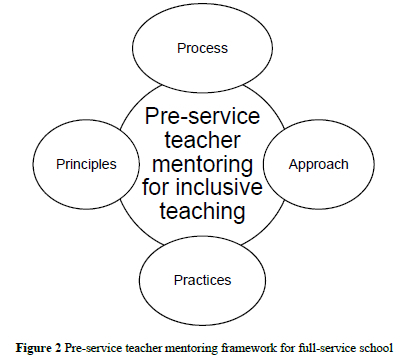
Figure 2 below shows the four concepts that should form the framework for the mentoring of pre-service teacher in a South African full-service school context.
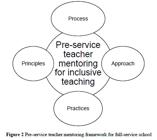
Process
The study indicates that, in a South African full-service school situation, joint planning by pre-service training institutions and mentor schools is crucial for the success of the mentoring process, which would enable readiness and common understanding of concept-inclusive teaching and how it could be operationalised in the classroom.
Approach
It is evident from the study that no single approach to mentoring can provide all that is needed for the preparation of pre-service teachers for inclusive teaching in the South African full-service school and higher education contexts. The study has shown elements of critical transformative mentoring (as pre-service teachers have to critique their own teaching), core practice (had to learn a set of inclusive teaching practices), situated learning (being socialised into inclusive teaching by mentors) and personal growth (building rapport between mentors and mentees).
Practices
The study has confirmed a number of pre-requisites for effective pre-service teacher mentoring practice: reflexivity (which allows both mentors and mentees to learn more about inclusive teaching), criticality (the ability for them to critique their inclusive teaching to improve it), communication (dialogue about inclusive teaching to develop a common understanding), innovation (apply trial and error to develop local theory about inclusive teaching), beliefs and attitudes (reflection on beliefs and attitudes that may create a barrier to learning and practicing inclusive teaching) and collaboration and power relations (working together resulting in mutual learning about inclusive teaching).
Principles
The study has demonstrated that a participatory approach to mentoring was crucial (both mentors and mentees contributing ideas and reflection). Contextualisation of mentoring is crucial as diversity is dynamic and ever-changing. The modelling of roles and the skills of mentors are crucial as pre-service teachers rely on their guidance.
Contribution to Practice
The study has shown that although higher education institutions now have courses on inclusive teaching, a strategic plan for the preparation of pre-service teachers must include school mentors, resulting in an integrated approach.
Contribution to Policy
The study has shown that the mentoring of pre-service teachers happened spontaneously, and a policy framework integrated into mentor schools and pre-service teacher institutions was critical.
Contribution to Methodology
The study highlighted the significance of the intersection between mentoring and action research. Although the study was conducted at one school, it lay the basis for the discussion of the significance of mentoring and action research as a framework for the preparation of pre-service teachers for inclusive teaching.
Challenges of Mentoring
According to this study, more training is required for pre-service teacher mentors about inclusive teaching, and more open communication between schools and pre-service teacher training institutions can ensure that both parties are on board. A policy is needed to guide the application of practicum on inclusion.
While the generalisability of the findings was a limitation of this study, a rigorous process was followed that may lead to replicability and transferability of findings to similar pre-service institution-school relationships in similar contexts.
Authors' Contributions
VB conducted the data analysis and produced the findings. TMM compiled the discussion of the findings and produced the first draft of the article. Both authors reviewed the final manuscript.
Notesi. Published under a Creative Commons Attribution Licence.
References
-
Abreh MK 2025. Inclusive education in Ghana: Enablers, barriers, and challenges of inclusion. In E Charamba & SN Ndhlovana (eds). Enablers, barriers, and challenges for inclusive curriculum. Hershey, PA: IGI Global Scientific Publishing. https://doi.org/10.4018/979-8-3373-1000-8.ch015
» https://doi.org/10.4018/979-8-3373-1000-8.ch015 - Ajani OA & Ntombela S 2025. Advancing inclusive education in higher education: Challenges and opportunities in preparing pre-service teachers to support students with disabilities. International Journal of Management, Knowledge and Learning, 14(1):25-41.
-
Ambrosetti A 2014. Are you ready to be a mentor? Preparing teachers for mentoring pre-service teachers. Australian Journal of Teacher Education, 39(6):30-42. https://doi.org/10.14221/ajte.2014v39n6.2
» https://doi.org/10.14221/ajte.2014v39n6.2 -
Ambrosetti A, Knight BA & Dekkers J 2014. Maximizing the potential of mentoring: A framework for pre-service teacher education. Mentoring & Tutoring: Partnership in Learning, 22(3):224-239. https://doi.org/10.1080/13611267.2014.926662
» https://doi.org/10.1080/13611267.2014.926662 -
Anagnou E & Fragoulis I 2014. The contribution of mentoring and action research to teachers' professional development in the context of informal learning. Review of European Studies, 6(1):133-142. https://doi.org/10.5539/res.v6n1p133
» https://doi.org/10.5539/res.v6n1p133 -
Andrea P 2010. The impact of mentoring pre-service teachers on the mentor teacher. PhD dissertation. Kalamazoo, MI: Western Michigan University. Available at https://www.proquest.com/docview/848626133?pqorigsite=gscholar&fromopenview=true&sourcetype=Dissertations%20 & %20Theses. Accessed 31 December 2025.
» https://www.proquest.com/docview/848626133?pqorigsite=gscholar&fromopenview=true&sourcetype=Dissertations%20 & %20Theses -
Aspland T, Macpherson I, Proudford C & Whitmore L 1996. Critical collaborative action research as a means of curriculum inquiry and empowerment. Educational Action Research, 4(1):93-104. https://doi.org/10.1080/0965079960040108
» https://doi.org/10.1080/0965079960040108 -
Binti Kamarudin M, Binti Kamarudin AY, Binti Darmi R & Binti Mat Saad NS 2020. A review of coaching and mentoring theories and models. International Journal of Academic Research in Progressive Education & Development, 9(2):289-298. https://doi.org/10.6007/IJARPED/v9-i2/7302
» https://doi.org/10.6007/IJARPED/v9-i2/7302 -
Clayton C & Meadows G 2013. Action Research Projects in pre-service teacher education. Teacher Educators' Journal, 20:5-18. Available at https://files.eric.ed.gov/fulltext/EJ1085619.pdf. Accessed 31 December 2025.
» https://files.eric.ed.gov/fulltext/EJ1085619.pdf -
Cross C, Hubbard K, Beverly L, Gravatt D & Aul A 2020. The continuation of a mentoring network for pre-service teachers into early in-service years. Issues in Educational Research, 30(4):1286-1309. https://search.informit.org/doi/10.3316/informit.606149206626956
» https://search.informit.org/doi/10.3316/informit.606149206626956 -
Dada D, Laseinde OT & Tartibu L 2023. Student-centered learning tool for cognitive enhancement in the learning environment. Procedia Computer Science, 217:507-512. https://doi.org/10.1016/j.procs.2022.12.246
» https://doi.org/10.1016/j.procs.2022.12.246 -
Deghave N & Hanass-Hancock J 2023. How well have full-service schools been prepared for disability-inclusion? Stellenbosch: Research on Socio-Economic Policy (RESEP), Stellenbosch University. Available at https://resep.sun.ac.za/wp-content/uploads/2023/09/Signed-off-ReSEP-Policy-Brief-FSS.pdf. Accessed 31 December 2025.
» https://resep.sun.ac.za/wp-content/uploads/2023/09/Signed-off-ReSEP-Policy-Brief-FSS.pdf -
Department of Education, Republic of South Africa 2000. National Education Policy Act (27:1996): Norms and Standards for Educators. Government Gazette, 415(20844):1-34, February 4. Available at https://www.gov.za/sites/default/files/gcis_document/201409/20844.pdf. Accessed 31 December 2025.
» https://www.gov.za/sites/default/files/gcis_document/201409/20844.pdf -
Department of Education 2001. Education White Paper 6: Special needs education. Building an inclusive education and training system. Pretoria, South Africa: Author. Available at https://www.education.gov.za/Portals/0/Documents/Legislation/White%20paper/Education%20%20White%20Paper%206.pdf?ver=2008-03-05-104651-000. Accessed 18 August 2025.
» https://www.education.gov.za/Portals/0/Documents/Legislation/White%20paper/Education%20%20White%20Paper%206.pdf?ver=2008-03-05-104651-000 -
Department of Higher Education and Training, Republic of South Africa 2015. National Qualifications Framework Act (67/2008): Revised policy on the minimum requirements for Teacher Education Qualifications. Government Gazette, 596(38487):1-72, February 19. Available at https://www.dhet.gov.za/Teacher%20Education/National%20Qualifications%20Framework%20Act%2067_2008%20Revised%20Policy%20for%20Teacher%20Education%20Quilifications.pdf. Accessed 31 December 2025.
» https://www.dhet.gov.za/Teacher%20Education/National%20Qualifications%20Framework%20Act%2067_2008%20Revised%20Policy%20for%20Teacher%20Education%20Quilifications.pdf -
Du Plessis E 2020. Student teachers' perceptions, experiences, and challenges regarding learner-centred teaching. South African Journal of Education, 40(1):Art. #1631, 10 pages. https://doi.org/10.15700/saje.v40n1a1631
» https://doi.org/10.15700/saje.v40n1a1631 -
Florian L & Black-Hawkins K 2011. Exploring inclusive pedagogy. British Educational Research Journal, 37(5):813-828. https://doi.org/10.1080/01411926.2010.501096
» https://doi.org/10.1080/01411926.2010.501096 -
Graves S 2010. Mentoring pre-service teachers: A case study. Australian Journal of Early Childhood, 35(4):14-20. https://doi.org/10.1177/183693911003500403
» https://doi.org/10.1177/183693911003500403 - Hogan KA & Sathy V 2022. Inclusive teaching: Strategies for promoting equity in the college classroom. Morgantown, WV: West Virginia University Press.
-
Joo MK & Cruz KS 2024. Formal mentoring and protégés' leadership development: The roles of protégés' informal mentoring networks, political skill, and gender. Group & Organization Management, 49(5):1199-1243. https://doi.org/10.1177/10596011221150869
» https://doi.org/10.1177/10596011221150869 -
Kiadarbandsari A 2025. Mentors' supporting approaches of mentees' cognitive emotion regulation strategies. Journal of Adolescent Research, 40(3):738-773. https://doi.org/10.1177/07435584231163568
» https://doi.org/10.1177/07435584231163568 - Koroleva Y 2017. The role of mentoring in teacher professional development. MEd thesis. Astana, Kazakhstan: Nazarbayev University.
-
Levin BB & Rock TC 2003. The effects of collaborative action research on preservice and experienced teacher partners in professional development schools. Journal of Teacher Education, 54(2):135-149. https://doi.org/10.1177/0022487102250287
» https://doi.org/10.1177/0022487102250287 -
Lisenbee PS & Tan P 2019. Mentoring novice teachers to advance inclusive mathematics education. International Journal of Whole Schooling, 15(1):1-27. Available at https://files.eric.ed.gov/fulltext/EJ1202633.pdf. Accessed 31 December 2025.
» https://files.eric.ed.gov/fulltext/EJ1202633.pdf -
Majoko T, Phasha N, Brown A, Soni TD, Duku N, Febana Z, Maharajh LR, Mkra P, Mngomezulu S, Moodley S, Mosito CP & Ndlovu S 2018. The state of inclusive education in South Africa and the implications for teacher training programmes (Research Report). Johannesburg, South Africa: British Council South Africa. Available at https://www.britishcouncil.org.za/sites/default/files/teaching_for_all_research_report_-the_state_of_inclusive_education_in_south_africa_and_the_implications_for_teacher_training_programmes.pdf. Accessed 31 December 2025.
» https://www.britishcouncil.org.za/sites/default/files/teaching_for_all_research_report_-the_state_of_inclusive_education_in_south_africa_and_the_implications_for_teacher_training_programmes.pdf -
Makoelle TM 2013. Exploring teaching practices that are effective in promoting inclusion in South African secondary schools. PhD thesis. Manchester, England: University of Manchester. Available at https://www.proquest.com/docview/17742465527pq-origsite=gscholar & fromopenview=true&sourcetype=Dissertations%20 & %20Theses. Accessed 31 December 2025.
» https://www.proquest.com/docview/17742465527pq-origsite=gscholar & fromopenview=true&sourcetype=Dissertations%20 & %20Theses -
Makoelle TM 2014. Changing teacher beliefs and attitudes towards inclusion in South Africa: Lessons from collaborative action research. Journal of Social Sciences, 38(2):125-134. Available at https://www.researchgate.net/profile/Tsediso-Makoelle/publication/260366714_Changing_Teacher_Beliefs_and_Attitudes_towards_Inclusion_in_South_Africa_Lessons_from_Collaborative_Action_Research/links/0deec530f97f4ea10e000000/Changing-Teacher-Beliefs-and-Attitudes-towards-Inclusion-in-South-Africa-Lessons-from-Collaborative-Action-Research.pdf. Accessed 31 December 2025.
» https://www.researchgate.net/profile/Tsediso-Makoelle/publication/260366714_Changing_Teacher_Beliefs_and_Attitudes_towards_Inclusion_in_South_Africa_Lessons_from_Collaborative_Action_Research/links/0deec530f97f4ea10e000000/Changing-Teacher-Beliefs-and-Attitudes-towards-Inclusion-in-South-Africa-Lessons-from-Collaborative-Action-Research.pdf -
Makoelle TM 2016. Inclusive teaching in South Africa. Cape Town, South Africa: Sun Press. https://doi.org/10.18820/9781928355038
» https://doi.org/10.18820/9781928355038 -
Makoelle TM 2025. Mentoring pre-service teachers for inclusive pedagogies. In TM Makoelle & CP Mosito (eds). Inclusive education in South African further and higher education: Reflections on equity, access, and inclusion. Bingley, England: Emerald Publishing. https://doi.org/10.1108/978-1-83608-944-520251023
» https://doi.org/10.1108/978-1-83608-944-520251023 -
Makoelle TM & Mosito CP 2023. Pre-service teacher preparation for inclusive teaching in South Africa. In G Boadu, G Odhiambo & P Marandi (eds). Practices and perspectives of teaching and teacher education in Africa. Hershey, PA: IGI Global. https://doi.org/10.4018/978-1-6684-7722-9.ch001
» https://doi.org/10.4018/978-1-6684-7722-9.ch001 -
Marcheva-Yoshuvska P 2018. Mentorship in the context of the inclusive education in Bulgaria. KNOWLEDGE - International Journal, 28(3): 809-814. Available at https://www.uni-vt.bg/userinfo/1475/pub/25125/document.pdf. Accessed 31 December 2025.
» https://www.uni-vt.bg/userinfo/1475/pub/25125/document.pdf -
Mohamed RAA 2024. Enhancing pre-service EFL teachers' teaching performance through action research. Journal of Language Teaching and Research, 15(1):178-189. https://doi.org/10.17507/jltr.1501.20
» https://doi.org/10.17507/jltr.1501.20 -
Moosa M & Bekker T 2021. Initial teacher education students' conceptualisation of inclusive education. Journal of Education, 85:55-74. https://doi.org/10.17159/2520-9868/i85a03
» https://doi.org/10.17159/2520-9868/i85a03 -
Nesje K & Lejonberg E 2022. Tools for the school-based mentoring of pre-service teachers: A scoping review. Teaching and Teacher Education, 111:103609. https://doi.org/10.1016/j.tate.2021.103609
» https://doi.org/10.1016/j.tate.2021.103609 -
Nguyen T 2020. The factors influence the pre-service teachers' learning in the practicum. Journal of Comparative & International Higher Education, 12(6S1):31-36. https://doi.org/10.32674/jcihe.v12i6S1.3089
» https://doi.org/10.32674/jcihe.v12i6S1.3089 - Ogunnyi MB & Mushayikwa E 2015. Teacher education in South Africa: Issues and challenges. In B Adegoke & A Oni (eds). Teacher education systems in Africa in the digital era. Dakar, Senegal: Council for the Development of Social Science Research in Africa (CODESRIA).
-
Orland-Barak L & Wang J 2021. Teacher mentoring in service of preservice teachers' learning to teach: Conceptual bases, characteristics, and challenges for teacher education reform. Journal of Teacher Education, 72(1):86-99. https://doi.org/10.1177/0022487119894230
» https://doi.org/10.1177/0022487119894230 -
Osmanović Zajić J, Mamutović A & Maksimović J 2021. The role of action research in teachers' professional development. International Journal of Cognitive Research in Science, Engineering and Education (IJCRSEE), 9(3):301-317. https://doi.org/10.23947/2334-8496-2021-9-3-301-317
» https://doi.org/10.23947/2334-8496-2021-9-3-301-317 - Pande MH 2018. An action research project to explore peer mentoring to enable CPD. FORTELL, 37:87-97.
-
Petrovska S, Sivevska D, Popeska B & Runcheva J 2018. Mentoring in teaching profession. International Journal of Cognitive Research in Science, Engineering and Education, 6(2):47-56. https://doi.org/10.5937/ijcrsee1802047P
» https://doi.org/10.5937/ijcrsee1802047P -
Pratiwi D 2020. Teaching practicum in pre-service teacher education. Yavana Bhāshā: Journal of English Language Education, 3(1):31-12. https://doi.org/10.25078/yb.v1i1.1375
» https://doi.org/10.25078/yb.v1i1.1375 -
Rusznyak L & Walton E 2019. Inclusive education in South African initial teacher education programmes. Pretoria: Department of Higher Education & Training, Republic of South Africa. Available at https://www.researchgate.net/profile/Lee-Rusznyak/publication/355493072_Inclusive_Education_in_South_African_Initial_Teacher_Education_Programmes/links/6175b4aba767a03c14a9a9d2/Inclusive-Education-in-South-African-Initial-Teacher-Education-Programmes.pdf. Accessed 31 December 2025.
» https://www.researchgate.net/profile/Lee-Rusznyak/publication/355493072_Inclusive_Education_in_South_African_Initial_Teacher_Education_Programmes/links/6175b4aba767a03c14a9a9d2/Inclusive-Education-in-South-African-Initial-Teacher-Education-Programmes.pdf -
Stoller A 2021. Traditional and critical mentoring. The Radical Teacher, 119:52-62. https://doi.org/10.5195/rt.2021.765
» https://doi.org/10.5195/rt.2021.765 -
Tuli F & File G 2009. Practicum experience in teacher education. Ethiopian Journal of Education & Sciences, 5(1):107-116. Available at https://repository.ju.edu.et/bitstream/handle/123456789/4863/Fekede%20Tuli%202009%20Practicum%20Experience%20in%20Teacher%20Education.pdf?sequence=1 & isAllowed=y. Accessed 31 December 2025.
» https://repository.ju.edu.et/bitstream/handle/123456789/4863/Fekede%20Tuli%202009%20Practicum%20Experience%20in%20Teacher%20Education.pdf?sequence=1 & isAllowed=y - Tupas FP 2019. Close mentoring approach: Enhancing action research skills and knowledge of Science and Mathematics teachers. Journal of Educational and Social Research, 9(3):107-116.
-
Van Harmelen U 1999. Where has all the geography gone? A social constructivist perspective of Curriculum 2005. South African Geographical Journal, 81(2):80-85. https://doi.org/10.1080/03736245.1999.9713666
» https://doi.org/10.1080/03736245.1999.9713666 -
Wong AT & Premkumar K 2007. An introduction to mentoring principles, processes, and strategies for facilitating mentoring relationships at a distance. Available at https://pdfs.semanticscholar.org/539f/a34a5c6e88904ef511953e85b7a077193e46.pdf. Accessed 31 December 2025.
» https://pdfs.semanticscholar.org/539f/a34a5c6e88904ef511953e85b7a077193e46.pdf -
Wong KK 2025. Mentoring in higher education in China: A critical survey. Mentoring & Tutoring: Partnership in Learning, 33(4):456-184. https://doi.org/10.1080/13611267.2025.2518386
» https://doi.org/10.1080/13611267.2025.2518386 -
Yosief A, Sulieman MS & Biede T 2024. Improving the practices of teacher educators through collaborative action research: Challenges and hopes. Educational Action Research, 32(2):204-221. https://doi.org/10.1080/09650792.2022.2066147
» https://doi.org/10.1080/09650792.2022.2066147
Revised: 31 December 2025
Accepted: 31 December 2025
Published: 31 December 2025