Targeting interventions on English writing proficiency skills of low-achieving learners in rural areas
Abstract
In the study reported on here we employed a qualitative approach to examine the English writing proficiency skills of academically low-achieving Grade 12 learners in rural areas. The focus was specifically on identifying targeted interventions to address their specific needs of limited vocabulary, underdeveloped metacognitive skills, digital gaps and scaffolding. Vygotsky's socio-cultural theory underpinned the study. The research was conducted at 2 rural schools in the Vhembe district where 8 English First Additional Language (FAL) teachers and 20 high-performing learners participated in the study. A multi-method approach was employed, combining research instruments such as interviews, document analysis, and observations to gather rich and nuanced data. The findings of the study highlight the strengths and weaknesses of the learners' English writing proficiency skills, as well as the teachers' perceptions of the challenges and opportunities in teaching English writing in rural areas. The results inform the development of targeted interventions that can be implemented to support low-achieving learners in rural areas, thereby enhancing their overall academic performance and potentially improving their chances in life. The findings have implications for teacher professional development, curriculum design, and educational policy in South Africa, particularly in rural contexts of the Limpopo province.
critical pedagogical theory; English First Additional Language; Grade 12; rural context; socio-cultural theory; writing skills
Introduction
The acquisition of proficient English writing skills is a crucial aspect of academic success, particularly in the modern era where English has become the lingua franca of global communication. However, for many learners in rural areas, mastering English writing skills remains a significant challenge (McKeown, Beck & Blake, 2009). In South Africa, where English is widely used as a second language, rural learners often struggle to achieve proficient levels of English writing, thereby placing them at a disadvantage in terms of academic performance and future career opportunities (Meskill, 2005).
In this context, identifying targeted interventions to support low-achieving learners in rural areas is essential. With this study we aimed to explore the English writing proficiency skills of low-achieving Grade 12 learners in rural areas, with a specific focus on identifying the strengths and weaknesses in their writing skills and the challenges that their teachers faced in teaching English writing. By adopting Vygotsky's socio-cultural theory, which emphasises the role of social interaction and culture in shaping learning and development, we sought to gain a deeper understanding of the complexities involved in the teaching and learning of English writing in rural areas.
The significance of this study lies in its potential to inform the development of targeted interventions that may be implemented to support low-achieving learners in rural areas. Understanding the specific needs and challenges faced by these learners, policymakers, educators, and other stakeholders may work towards creating a more inclusive and supportive learning environment to meet their needs. The findings should have implications for teacher professional development, curriculum design, and educational policy in South Africa, particularly in rural contexts of the Limpopo province.
Literature Review
In a study, Manyike (2014) focused on Grade 7 Sepedi learners' writing and elaborated on learners' excellent English writing proficiency skills in deep rural schools in the Limpopo province of South Africa. Such skills were attributed to the particular schools' bilingual language policy. These schools applied the additive bilingual policy which is promoted in the South African Language Education Policy, while most schools follow an English-only policy from Grade 4. The results of Manyike's (2014) study emphasise the value of learners' home language in enabling the acquisition of FAL skills.
Fitrawati and Safitri (2021) reveal that English Second Language learners often struggle with grammar and limited vocabulary in writing. Other areas of difficulty for English (FAL) learners include verb forms, subject and verb agreement, the use of appropriate articles and verbs, tenses, spelling and punctuation. Mabasa and Lumadi (2016) established that FAL learners often use the wrong prepositions when writing and fail to write coherent sentences.
Rural contexts in South Africa are characterised by unique challenges that exacerbate the difficulties that learners face in acquiring proficient English writing skills. Limited access to quality educational resources, a shortage of skilled teachers, and socio-economic constraints all contribute to a learning environment that is often understaffed, under-resourced, and under-equipped. As a result, rural learners often lag behind their urban counterparts in terms of academic performance, with English writing skills being a significant area of concern (Ferris, 2018).
Writing proficiency in English (FAL) is viewed as one of the key language skills that learners are expected to possess and apply in their own learning, and to understand the external world. It sheds light on the implications of the learners' experiences of creative writing for pedagogical strategies in the language classroom (Ngubane, Ntombela & Govender, 2020).
It is argued that a relationship exists between learners' complexities with English language competency and how they approach creative writing. The language in which learners write is important. Creative writing is a multifaceted process that requires critical thinking and imagination since it determines the quality and level of creativity that learners portray in their writing (Ahmad Ghulamuddin, Mohd Mohari & Ariffin, 2021).
Research has shown that the quality of teaching is a critical factor in learner achievement, particularly in rural areas where teachers may lack the necessary skills and resources to support learner learning (Fesi, 2018). Furthermore, the cultural and linguistic diversity of rural learners can create challenges for teachers in terms of understanding and addressing their unique needs (Vygotsky, 1978).
In this context, identifying targeted interventions to support low-achieving learners in rural areas is essential. Several studies have highlighted the importance of socio-cultural theory in understanding the complexities involved in teaching and learning English writing in rural areas (Vygotsky, 1978). This theory emphasises the role of social interaction and culture in shaping learning and development and has implications for the design of instructional strategies and interventions that are culturally sensitive and responsive to the needs of rural learners (Jafari & Kafipour, 2013).
In terms of instructional strategies, research has shown that scaffolding, peer-supported writing, and process-oriented instruction can be effective in supporting the development of English writing skills of rural learners (Ghaith, 2019). Additionally, the use of technology, such as online writing platforms and multimedia resources, can provide rural learners with access to quality educational resources and opportunities for practice and feedback (Ýnci & Yýldýz, 2019).
However, despite the promising nature of these instructional strategies, there is a need for further research on the specific needs and challenges faced by rural learners in South Africa. Theoretical Framework
This study is grounded in Vygotsky's socio-cultural theory, which posits that learning and development are shaped by social interaction and cultural contexts (Vygotsky, 1978).
According to Vygotsky, learning is a socially mediated process that occurs through the interactions between learners and their social environment (Vygotsky, 1978). In the context of English writing proficiency skills, this means that the acquisition of writing skills is not solely the result of individual effort or innate ability, but is rather shaped by the social and cultural contexts in which learning takes place.
In rural areas, the social and cultural contexts of learning are often characterised by poverty, lack of access to quality education, and limited opportunities for social mobility (Noh, Wong, Wong & Mahizer, 2017). These contexts may have a profound impact on the development of English writing proficiency skills, as learners may lack the necessary resources, support, and opportunities to develop their writing skills.
Vygotsky's socio-cultural theory also emphasises the importance of scaffolding and guided instruction in supporting learners' learning (Vygotsky, 1978). Regarding English writing proficiency skills, this means that teachers play a critical role in providing support, guidance, and feedback to learners as they develop writing skills. However, in rural areas, teachers may lack the necessary skills, resources, and support to provide effective scaffolding and guided instruction, which may exacerbate the challenges faced by learners in developing their writing skills.
The concept of the zone of proximal development (ZPD) is central to Vygotsky's socio-cultural theory (Vygotsky, 1978). The ZPD refers to the range of knowledge and skills that learners may acquire with the guidance of a more knowledgeable other, such as a teacher or a peer. In the context of English writing proficiency skills, the ZPD is critical in understanding how learners may be supported to develop their writing skills, particularly in rural areas where learners may lack the necessary resources and support to develop writing skills independently.
Overall, Vygotsky's socio-cultural theory provides a nuanced understanding of the complexities involved in teaching and learning English writing proficiency skills. By recognising the crucial role of social interaction and cultural contexts in shaping learning and development, this theory highlights the importance of identifying targeted interventions to support low-achieving learners in rural areas.
Freire's critical pedagogic theory
Freire's theory is a transformative approach to education that challenges the conventional "banking model" of teaching, where learners are treated as passive recipients of knowledge. Instead, it promotes dialogue, reflection, and action as central to learning, aiming to empower learners to understand and transform their social realities. Developed in response to oppressive educational systems, Freire's critical pedagogy is rooted in social justice, humanisation, and liberation. It views education not just as a means of acquiring knowledge, but as a political act that may either reinforce or dismantle inequality (Freire, 2005).
This transformative educational theory emphasises the importance of teaching and learning in ways that empower learners to critically engage with the world. It was developed as a response to traditional, top-down educational models. Critical pedagogy seeks to question the role of education in perpetuating social inequalities and strives to create more justified learning environments.
Several core principles that differentiate critical pedagogy from traditional educational approaches are presented below.
• Teacher as facilitator, not authority Teachers guide and support rather than dictate.
• Conscientisation
Learners develop awareness of social, political, and economic injustices.
• Problem-posing education
Instead of memorising facts, learners explore real-world problems that affect their lives.
• Dialogic learning
Education is a two-way process where teachers and learners engage in meaningful dialogue.
• Praxis: Reflection and action
Learning involves a cycle of reflection and action.
• Humanisation
Education should affirm the dignity and humanity of all learners.
• Culturally curriculum relevance
Promotes inclusion and relevance, especially for marginalised groups.
Research Methodology
We adopted a qualitative research design for this study, which was deemed appropriate for exploring the nuanced and context-specific challenges faced by low-achieving learners in English writing in rural educational settings. The qualitative approach allowed for an in-depth understanding of learners' writing proficiency and the contextual factors influencing their academic performance.
Anchored in Vygotsky's socio-cultural theory, we examined how learners' writing skills are socially constructed and influenced by interaction with peers, teachers, and the environment. The design facilitated the exploration of scaffolding strategies that may be effectively used to support learners, especially in under-resourced contexts.
Sampling and Participants
We employed purposive sampling to select participants who could provide rich, relevant, and diverse perspectives on the topic. Two rural schools located in the Vhembe district of the Limpopo province, South Africa, were selected due to their consistent academic underperformance and rural socio-economic contexts.
A total of eight English First Additional Language (FAL) teachers and 20 high-performing Grade 12 learners were selected to participate in the study. Although the focus was on low-achieving learners, high-performing peers were included to offer comparative insight into effective strategies and classroom experiences that could inform targeted interventions. The teachers were chosen based on their experience in teaching English writing at Further Education and Training (FET) level and their familiarity with the challenges faced by low-achieving learners.
Data Collection Instruments
A multi-method data collection strategy was used to ensure triangulation and to enhance the credibility and depth of the findings. The primary instruments included semi-structured interviews, document analysis, and non-participant classroom observations. Interviews with English FAL teachers focused on their perceptions of learners' writing challenges, existing interventions, and support mechanisms.
Observations were conducted during writing lessons to document teacher-learner interaction, scaffolding practices, and learner engagement. Document analysis involved reviewing learners' written compositions and teacher feedback to identify recurring errors, vocabulary limitations, and signs of underdeveloped metacognitive skills. This combination of methods enabled us to construct a holistic understanding of the learners' writing proficiency and contextual teaching practices.
Data Analysis and Trustworthiness
Data were analysed using thematic content analysis, guided by Creswell and Creswell's (2022) six-phase model. Interview transcripts, observation notes, and document data were coded and categorised into themes that reflected learners' writing strengths and challenges, as well as effective pedagogical interventions.
Themes were cross validated through triangulation to ensure consistency and accuracy across data sources. To enhance trustworthiness, we employed strategies such as member checking, peer debriefing, and thick descriptions of the research context. Ethical considerations, including informed consent, confidentiality, and voluntary participation, were strictly observed to uphold the integrity of the research process.
The qualitative research design allowed for an in-depth exploration of the research questions, and provided rich and nuanced data that may inform the development of targeted interventions to support low-achieving learners in rural areas.
Research Questions
Main question
• What are the strengths and weaknesses of low-achieving learners' English writing proficiency skills in rural areas?
Sub-questions
• What are the challenges and opportunities faced by teachers in teaching English writing in rural areas?
Aim
The aim with this study was to explore the English writing proficiency skills of low-achieving learners in rural areas, and to identify targeted interventions that may be implemented to support the learners in improving their English writing proficiency skills.
Objectives
• To investigate the strengths and weaknesses of low-achieving learners' English writing proficiency skills in rural areas.
Ethical Considerations
The study was approved by the relevant ethics committee, and we ensured that all ethical guidelines were followed in the data collection process. The participants were informed about the purpose of the study, and they were assured of confidentiality and anonymity. We also ensured that the data were stored securely and safely.
Limitations
The study has several limitations. Firstly, the sample size was small, and it may not be representative of all rural schools in South Africa. Secondly, the study was conducted in only two rural schools, which may not be representative of all rural schools in the Limpopo province. Finally, the study was qualitative in nature, which means that the findings may not be generalisable to all rural schools in South Africa.
Findings
Learners' English Writing Proficiency Skills The study on targeting interventions for English writing proficiency skills of low-achieving learners in rural areas has revealed several key findings. A significant finding is the prevalence of foundational writing skill deficits among these learners, including issues with grammar, syntax, vocabulary, and sentence construction. These deficits often stem from limited exposure to English language resources, a lack of qualified English teachers, and insufficient access to technology in rural educational settings. Furthermore, the research indicates that traditional, one-size-fits-all teaching methods are largely ineffective for this demographic, highlighting the need for differentiated instruction and personalised learning approaches. The results also point to a strong correlation between low writing proficiency and reduced academic performance across other subjects, underscoring the critical role of effective writing interventions.
Writing proficiency in English is a critical skill for learners, particularly in academic settings where clear and effective communication is essential. This proficiency encompasses several components that contribute to a learner's ability to express ideas coherently and persuasively through written text.
The study findings on learners' English writing proficiency skills provide a nuanced understanding of their strengths and weaknesses. The data collected through interviews, document analysis, and observations revealed that the learners demonstrated a poor understanding of basic sentence structure and grammar rules. They were unable to write coherent texts without grammatical errors, indicating limited English language skills.
However, the learners' writing skills were characterised by several weaknesses. They struggled to express themselves clearly and concisely, often relying on simple sentence structures and limited vocabulary. This lack of linguistic complexity and depth resulted in shallow and superficial writing. Furthermore, the learners' writing lacked cohesion, coherence, and organisation, making it difficult for readers to follow their ideas.
The data also reveal that the learners' writing skills were influenced by their socio-cultural background and context. For example, the rural setting and lack of access to resources limited their exposure to diverse texts and writing styles. This lack of exposure impacted their ability to develop more sophisticated writing skills and critically engage with texts.
Grammar and syntax
The terms "grammar" and "syntax" are often used interchangeably, but they refer to distinct yet interconnected aspects of language structure (Koll & Gray, 2019).
Grammar provides the overarching framework for how a language operates. It dictates how words are formed (e.g., adding "-ed" for past tense verbs), how sounds are organised to create meaningful units, and how meaning is conveyed. Syntax is a crucial subset of this framework, dealing with the permissible sequences of words and phrases. For instance, in English, the typical word order for a simple declarative sentence is subject-verb-object (SVO), as in "The cat chased the mouse." A sentence like "Chased the mouse the cat" would be syntactically incorrect, even though all the individual words are grammatically sound.
Mastery of grammar rules and sentence
structure is fundamental. Learners were unable to construct sentences that were not only correct but also varied in structure to maintain reader interest.
Vocabulary
This study has yielded significant findings regarding grammar and syntax. A primary finding is that low-achieving learners in rural areas consistently exhibit substantial deficits in both grammar and syntax, which are fundamental to effective English writing. These deficits manifest as frequent errors in sentence structure, subject-verb agreement, verb tense consistency, pronoun use, and the correct application of punctuation. The research indicates that these grammatical and syntactical weaknesses often stem from limited exposure to standard English outside the classroom, insufficient explicit instruction in grammatical rules, and a lack of opportunities for guided practice and corrective feedback (Jacobs, Zinkgraf, Wormuth, Hearfiel & Hughey, 1981).
A poor vocabulary does not permit learners to articulate their thoughts more precisely. The inability to choose appropriate words do not enhance clarity and expression, making writing less engaging.
Coherence and cohesion
Cohesion and coherence are two fundamental principles in linguistics and writing that ensure that a text is understandable and well-structured. While often discussed together, they refer to distinct aspects of text organisation (McCarthy, 1991).
Coherence ensures that the overall argument makes sense, while cohesion involves the use of transitional phrases and connectors that link sentences and paragraphs together seamlessly. It became evident from the study that learners' writing did not flow logically from one idea to the next.
Organisation
Learners' writing was ineffective and ambiguous. Effective writing requires a clear structure, including an introduction, body paragraphs, and a conclusion. The different sections in learners' writing did not serve the purpose of supporting the main argument or narrative.
Style and tone
Style and tone are critical elements in writing that significantly influence how a message is received and interpreted by an audience. While often used interchangeably, they refer to distinct aspects of a text (Koll & Gray, 2019).
Adjusting language according to the audience and context is crucial. Academic writing often demands a formal tone, while creative writing may allow for more personal expression. Learners always struggled with this aspect.
Techniques for improving writing proficiency skills involve consistent practice and engagement following various exercises.
• Free writing: This technique encourages learners to write continuously for a set time.
• Adjusting language according to the audience and context is crucial. Academic writing often demands a formal tone, while creative writing may allow for more personal writing without worrying about grammar or punctuation, fostering creativity and fluency.
• Peer review: Sharing work with classmates provides valuable feedback. Constructive criticism helps learners identify strengths and weaknesses in their writing from different perspectives.
• Paragraph construction: Practicing how to build well-structured paragraphs with clear topic sentences enhances overall coherence in writing.
• Story completion exercises: These prompt stimulated imagination while encouraging organisational skills as learners learn to develop narratives logically.
• Sentence combining exercises: This technique helps learners learn how to create complex sentences from simpler ones, improving sentence variety within their writing.
Additionally, technology plays an increasingly important role in developing writing proficiency. Various software programs offer real-time feedback on grammar, style, and organisation, allowing learners to refine their skills dynamically.
Teachers' Perceptions of Challenges and Opportunities
The study findings on the teachers' perceptions of challenges and opportunities in teaching English writing in rural areas provide valuable insight into the complexities of teaching in these contexts. The teachers identified several challenges that hindered their ability to effectively teach English writing. These challenges included the following:
• Limited resources and infrastructure, such as textbooks, computers, and internet connectivity
• Inadequate teacher training and support, particularly in teaching English as a second language
• Large class sizes and limited teaching time, making it difficult to provide individualised attention and feedback
• Limited parental involvement and support, which impacted the learners' motivation and engagement
• Poor learner attendance and distracted behaviour, making it challenging to maintain a conducive learning environment
Despite these challenges, the teachers reported several opportunities for improving English writing instruction in rural areas. They highlighted the importance of the following:
• Scaffolding and feedback to support learners' writing development
• Peer review and collaboration to foster critical thinking and writing skills
• Contextualised teaching and learning activities that cater for learners' socio-cultural backgrounds
• Teacher collaboration and sharing of best practices to improve teaching and learning outcomes
It is worth noting that learners studying English Home Language (HL) as a subject are expected to have higher English proficiency skills than those studying English First Additional Language (EFAL). Additionally, the declining level of writing skills among EFAL learners was viewed as a concern by other researchers.
Overall, we suggest that there is a need for effective teaching strategies and approaches to improve the writing proficiency skills of Grade 12 EFAL learners in South African secondary schools. English FAL remains a barrier in learners' writing as they internalise information in their mother tongue and then translate it into English when they write (Mathura & Zulu, 2021). Furthermore, several stumbling blocks experienced by learners in writing comprise cognition, language proficiency and writing proficiency related to limited communicative and grammatical competence in English (Fitrawati & Safitri, 2021). This is true for many South African schools where writing is still a daunting task for most learners (Akinyeye & Plüddemann, 2016).
One may argue that most learners are second or third language speakers of English, irrespective of the progressive Language-in-Education Policy which promotes the use of all 11 official South African languages and additive bilingualism which promotes the maintenance of the learners' HLs while learning an additional language such as English (Diko, 2022).
The use of English in the post-colonial era should be viewed as a step towards constructing "a new agenda" for language development. This new agenda is to harness English FAL for the empowerment of the disadvantaged (Bustamante & Eom, 2017). Education is the guardian genius of democracy. It is the only dictator that free people recognise, and the only ruler that free people require.
Implications
The study findings have significant implications for teacher professional development, curriculum design, and educational policy in South Africa, particularly in rural contexts in the Limpopo province.
Teachers' professional development
This study highlights the need for targeted teacher professional development programmes that address the specific challenges and needs of teaching English writing in rural areas. These programmes should focus on:
• Developing teachers' content knowledge and pedagogical skills in teaching English writing
• Enhancing teachers' understanding of the socio-cultural context and its impact on teaching and learning
• Providing teachers with strategies and resources to support learners' writing development, including scaffolding, feedback, and peer review (Sovakandan, Jaganathan & Husain, 2017).
Curriculum design strategies
The study findings suggest that the current curriculum should be reviewed and revised to include more contextualised and meaningful teaching and learning activities that prioritise English writing as a core skill (Mohammad Kamal Tan, Mee & Pek, 2019). The design of a curriculum aimed at improving English writing proficiency among low-achieving learners in rural areas necessitates a multifaceted approach that addresses the unique challenges faced by these learners. This process can be broken down into several key components:
Model academic writing
Providing examples of academic writing of high quality may serve as a valuable resource for learners. These models can illustrate effective structure, style, and tone while also demonstrating how to incorporate evidence and citations properly.
Implement scaffolded learning
Implementing scaffolded learning techniques may help break down complex writing tasks into manageable steps. For instance, teachers can guide learners using brainstorming ideas, drafting outlines, and revising drafts systematically.
Relevant content
The curriculum should include content that is relevant and engaging for rural learners. This could involve integrating local themes or issues into writing assignments to make the tasks more relatable.
Needs assessment
Before designing an effective curriculum, it is crucial to conduct a thorough needs assessment to understand the specific challenges faced by low-achieving learners in rural areas. This includes evaluating their current writing skills, identifying gaps in knowledge, and understanding socio-economic factors that may affect their learning. Research indicates that learners in rural settings often lack access to resources such as qualified teachers, educational materials, and technology.
Conducting a thorough needs assessment is crucial to identify the specific writing deficiencies among low-achieving learners. This may involve surveys, interviews with educators, and analysis of learner writing samples. Once the needs are identified, clear and measurable objectives should be established. These objectives should focus on essential writing skills such as grammar, vocabulary development, coherence and cohesion in writing, and the ability to structure essays effectively. The goals should be realistic and tailored to the learners' current proficiency levels.
Peer review processes
Encouraging peer review among learners fosters collaboration and allows them to learn from one another's strengths and weaknesses in writing. Structured peer feedback sessions can help build critical thinking skills while enhancing learners' ability to critique written work constructively. The following serve as targeted interventions.
i. Writing retreats, conferences, and workshops: Organising focused retreats and workshops that address specific aspects of academic writing such as thesis development, argumentation strategies, or citation practices can provide targeted support for struggling writers. Writing conferences are an interactive method where teachers meet individually or in small groups with learners to discuss their writing. This approach allows for personalised feedback and encourages learners to reflect on their work. During these conferences, teachers can help learners set specific goals related to their writing, such as improving thesis statements or enhancing argumentation skills. Research indicates that immediate feedback during these sessions can significantly improve learner engagement and writing quality (Ien, Yunus & Embi, 2017).
ii. Mentorship programmes: Establishing mentorship programmes that pair low-achieving learners with more proficient peers or teachers can offer personalised guidance and encouragement throughout the writing process.
iii. Using technology: Using technology tools such as online writing labs (OWLs), grammar checkers, and collaborative platforms can provide additional resources for practice outside the classroom setting.
iv. Regular feedback mechanisms: Implementing regular feedback mechanisms allows teachers to monitor learner progress closely and adjust instruction according to individual needs.
v. Community engagement: Engaging with local communities through service-learning projects or partnerships with local organisations can provide real-world contexts for academic writing while fostering a sense of purpose among learners.
vi. Mnemonic devices for grammar rules: Mnemonic devices can be particularly useful for helping high school learners remember complex grammar rules or structures while writing. For example, acronyms like FANBOYS (for, and, nor, but, or, yet, so) help remind learners of coordinating conjunctions essential for sentence construction.
The learners' writing samples show that learners experience insurmountable challenges in organisation, capitalisation, vocabulary and grammar, insufficient use of punctuation marks and inexplicitness or fuzziness. The effect is more serious than the other problem because the anticipated meaning is often misunderstood (Banda, 2009). These serious challenges often result from poor pedagogy. With regard to writing skills, we realised that some learners in both schools could not write even short sentences, let alone short paragraphs (Abongdia, 2014). This could be attributed to the teaching method and style used by the teachers.
• Incorporate more authentic and culturally relevant texts that reflect the learners' socio-cultural backgrounds
• Provide opportunities for learners to develop their writing skills through a range of activities, including writing workshops, peer review, and feedback
• Emphasise critical thinking, creativity, and problem-solving skills to prepare learners for the 21st-century workforce.
Educational policy
The study findings underscore the need for educational policymakers to prioritise rural education and address the systemic inequalities that disadvantage rural learners. Policymakers should
• provide adequate resources, infrastructure, and teacher support to rural schools to ensure that learners have access to quality education
• implement policies and programmes that address the unique challenges and needs of teaching and learning in rural areas
• foster partnerships between schools, communities, and stakeholders to support rural education and development (Hung, 2017).
By addressing these implications, we can improve the English writing proficiency skills of low-achieving learners in rural areas, enhance their overall academic performance, and potentially improve their life chances.
Recommendations
Based on the study findings we put forward the following recommendations.
Teacher professional development
• Develop targeted teacher professional development programmes that address the specific challenges and needs of teaching English writing in rural areas.
• Focus on developing teachers' content knowledge and pedagogical skills in teaching English writing.
• Enhance teachers' understanding of the socio-cultural context and its impact on teaching and learning.
• Provide teachers with strategies and resources to support learners' writing development, including scaffolding, feedback, and peer review.
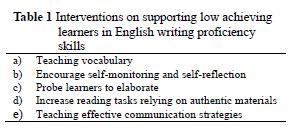
Learners' English writing proficiency may be augmented by using the strategies presented in Table 1.
Building a robust vocabulary is crucial for effective writing, therefore, targeted vocabulary development should be integrated into the curriculum. Activities such as exercises in which word maps or context clues are used enable learners to explore new words deeply and understand how to use them appropriately in their writings (Jacobs et al., 1981).
Furthermore, the following practices may have an impact on English writing proficiency:
• The teacher's direct talk to the learner.
• Emphasising important nouns and verbs.
• Using as few extra words as possible.
• Repetition and speaking louder does not help; rephrasing, accompanied by body language, does.
• Avoiding slang and idiomatic expressions.
Curriculum design
• Review and revise the current curriculum to include more contextualised and meaningful teaching and learning activities that prioritise English writing as a core skill.
• Incorporate more authentic and culturally relevant texts that reflect the learners' socio-cultural backgrounds.
• Provide opportunities for learners to develop their writing skills through a range of activities, including writing workshops, peer review, and feedback.
• Emphasise critical thinking, creativity, and problem-solving skills to prepare learners for the 21st-century workforce.
Educational policy and English writing proficiency
The relationship between educational policy and English writing proficiency is multifaceted, involving various strategies, assessment methods, and instructional practices that aim to enhance learners' writing skills in an academic context. The effectiveness of these policies can significantly influence the development of writing competence among learners, particularly in EFAL.
The implications of the findings are significant for educational policy regarding EFAL instruction. Policies should encourage a balanced approach that integrates both teacher-led assessment and opportunities for self-assessment by learners. This dual approach not only fosters greater engagement among learners but also helps develop critical reflective skills necessary for lifelong learning. In summary, effective educational policies should recognise the importance of writing proficiency in education while embracing diverse assessment methods that promote active learning and self-reflection among learners.
• Prioritise rural education and address the systemic inequalities that disadvantage rural learners.
• Provide adequate resources, infrastructure, and teacher support to rural schools to ensure that learners have access to quality education.
• Implement policies and programmes that address the unique challenges and needs of teaching and learning in rural areas.
• Foster partnerships between schools, communities, and stakeholders to support rural education and development.
Targeted interventions
• Develop peer-supported writing programmes that provide learners with opportunities to collaborate and receive feedback on their writing.
• Implement scaffolding techniques that provide learners with the necessary support and guidance to develop their writing skills.
• Use technology, such as online writing platforms and multimedia resources, to provide learners with access to quality educational resources and opportunities for practice and feedback.
• Develop culturally relevant and contextualised teaching and learning activities that cater for learners' socio-cultural backgrounds.
By implementing these recommendations, the English proficiency skills of low-achieving learners in rural areas may be improved, which may enhance their overall academic performance, and potentially improve their life chances.
Finally, it is essential to establish evaluation mechanisms to assess the effectiveness of the curriculum and interventions implemented. This could involve regular assessment of samples of learners' writing against established rubrics to measure progress over time. In summary, enhancing English writing proficiency among low-achieving learners in rural areas requires a comprehensive curriculum design that incorporates contextual understanding, clear objectives, engaging content, effective instructional strategies, targeted interventions, and continuous evaluation.
Concluding Remarks
With the study reported on here we aimed to explore the English writing proficiency skills of low-achieving Grade 12 learners in rural areas. The strengths and weaknesses of learners' writing skills, as well as the challenges besetting their teachers in teaching English writing proficiency skills were identified. We employed a qualitative research design, using interviews, document analysis, and observations to gather data.
The findings highlight that the learners demonstrated a poor understanding of basic sentence structures and grammar rules and struggled with expressing themselves clearly and concisely, and lacked linguistic complexity and depth in the writing. The teachers identified several challenges, including limited resources, inadequate training, and poor learner attendance, which hindered their ability to effectively teach English writing.
We suggest that teacher professional development programmes should focus on developing teachers' content knowledge and pedagogical skills in teaching English writing, enhancing their understanding of the socio-cultural context, and providing them with strategies and resources to support learners' writing development. The curriculum should be reviewed and revised to include more contextualised and meaningful teaching and learning activities that prioritise English writing as a core skill.
Additionally, educational policymakers should prioritise rural education, addressing systemic inequalities that disadvantage rural learners, and implementing policies and programmes that address the unique challenges and needs of teaching and learning in rural areas.
In conclusion, the study findings and recommendations provide valuable insight into the complexities of teaching and learning English writing in rural areas. By addressing these challenges and implementing targeted interventions, we may improve the English writing proficiency skills of low-achieving learners in rural areas, enhance their overall academic performance, and potentially improve their life chances.
Authors' Contributions
TVM analysed the data while NIL conducted the interviews, did observations and analysed the documents.
Notesi. This article is based on the doctoral thesis of Nnditsheni Irene Lumadi.
ii. Published under a Creative Commons Attribution Licence.
References
-
Abongdia JFA 2014. The impact of a monolingual medium of instruction in a multilingual university in South Africa. Mediterranean Journal of Social Sciences, 5(13):62-71. https://doi.org/10.5901/mjss.2014.v5n13p62
» https://doi.org/10.5901/mjss.2014.v5n13p62 -
Ahmad Ghulamuddin NJ, Mohd Mohari SK & Ariffin K 2021. Discovering writing difficulties of Malay ESL primary school level students. International Journal of Linguistics and Translation Studies, 2(1):27-39. https://doi.org/10.36892/ijlts.v2i1.105
» https://doi.org/10.36892/ijlts.v2i1.105 -
Akinyeye C & Plüddemann P 2016. The story of a narrative: Teaching and assessing English writing in a township school. Reading & Writing, 7(1):a88. https://doi.org/10.4102/rw.v7i1.88
» https://doi.org/10.4102/rw.v7i1.88 -
Banda F 2009. Critical perspectives on language planning and policy in Africa: Accounting for the notion of multilingualism. Stellenbosch Papers in Linguistics PLUS, 38:1-11. https://doi.org/10.5842/38-0-50
» https://doi.org/10.5842/38-0-50 -
Bustamante A & Eom M 2017. Linguistically diverse students' attitudes towards writing in English. Texas Journal of Literacy Education, 5(1):44-56. Available at https://files.eric.ed.gov/fulltext/EJ1147642.pdf. Accessed 30 November 2025.
» https://files.eric.ed.gov/fulltext/EJ1147642.pdf - Creswell JW & Creswell JD 2022. Educational research: Planning, conducting and evaluating quantitative and qualitative research (6th ed). Upper Saddle River, NJ: Pearson.
-
Diko M 2022. IsiXhosa osikhathalele ngantoni na esi ude usindwe ziincwadi ezingaka? Why do you care about isiXhosa so much that you are overwhelmed by so many books? Southern African Linguistics and Applied Language Studies, 40(2):123-134. https://doi.org/10.2989/16073614.2021.1999831
» https://doi.org/10.2989/16073614.2021.1999831 - Ferris DR 2018. Teaching language skills in EAP contexts: Teaching English to second language learners. In CC Goh, L Vandergrift, W Grabe, FL Stoller & JM Newton (eds). Academic contexts. London, England: Routledge.
- Fesi L 2018. Strategies used by teachers to promote reading in Grade 4: A case of English First Additional language learners. PhD thesis. Alice, South Africa: University of Fort Hare.
-
Fitrawati & Safitri D 2021. Students' grammatical errors in essay writing: A pedagogical grammar reflection. International Journal of Language Education, 5(2):74-88. https://doi.org/10.26858/ijole.v5i2.15241
» https://doi.org/10.26858/ijole.v5i2.15241 -
Freire P 2005. Pedagogy of the oppressed (30th anniversary ed). London, England: Continuum. Available at https://files.libcom.org/files/Paulo%20Freire,%20Myra%20Bergman%20Ramos,%20Donaldo%20Macedo%20-%20Pedagogy%20of%20the%20Oppressed,%2030th%20Anniversary%20Edition%20(2000,%20Bloomsbury%20Academic).pdf. Accessed 30 November 2025.
» https://files.libcom.org/files/Paulo%20Freire,%20Myra%20Bergman%20Ramos,%20Donaldo%20Macedo%20-%20Pedagogy%20of%20the%20Oppressed,%2030th%20Anniversary%20Edition%20(2000,%20Bloomsbury%20Academic).pdf -
Ghaith G 2019. The interplay of selected demotivation determinants and achievement in EFL critical reading and writing. TESL-EJ, 22(4):1-16. Available at https://files.eric.ed.gov/fulltext/EJ1204580.pdf. Accessed 30 November 2025.
» https://files.eric.ed.gov/fulltext/EJ1204580.pdf -
Hung HT 2017. Design-based research: Redesign of an English language course using a flipped classroom approach. TESOL Quarterly, 51(1):180-192. https://doi.org/10.1002/tesq.328
» https://doi.org/10.1002/tesq.328 - Ien LK, Yunus MM & Embi MA 2017. Build Me Up: Overcoming writing problems among pupils in a rural primary school in Belaga, Sarawak, Malaysia. Journal Pendidikan Humaniora, 5(1): 1-7.
-
Ýnci S & Yýldýz S 2019. Perceptions of English teachers in Turkey and Germany. Universal Journal of Educational Research, 7(2):436-449. https://doi.org/10.13189/ujer.2019.070216
» https://doi.org/10.13189/ujer.2019.070216 - Jacobs LH, Zinkgraf SA, Wormuth DR, Hearfiel VF & Hughey JB 1981. Testing ESL composition: A practical approach. English composition program. Rowley, MA: Newbury House.
-
Jafari S & Kafipour R 2013. An investigation of vocabulary learning strategies by Iranian EFL learners in different proficiency levels. International Journal of Applied Linguistics & English Literature, 2(6):23-27. https://doi.org/10.7575/aiac.ijalel.v.2n.6p.23
» https://doi.org/10.7575/aiac.ijalel.v.2n.6p.23 - Koll T & Gray F 2019. Grammar and vocabulary tools in schools. United States of America: New Jersey Press.
- Mabasa LT & Lumadi TZ 2016. Teaching strategies for improving reading and writing in English First Additional Language for men and women. Gender and Behaviour, 14(2):7489-7494.
-
Manyike TV 2014. The writing skills in second language of learners from a rural primary school in South Africa. Studies of Tribes and Tribals, 12(1):61 -69. Available at http://krepublishers.com/02-Journals/T%20 & %20T/T%20 & %20T-12-0-000-14-Web/T%20 & %20T-12-1-000-14-ABST-PDF/S-T & T-12-1-061-14-326-Manyike-T-V/S-T & T-12-1-061-14-326-Manyike-T-V-Tx%5b7%5d.pdf. Accessed 30 November 2025.
» http://krepublishers.com/02-Journals/T%20 & %20T/T%20 & %20T-12-0-000-14-Web/T%20 & %20T-12-1-000-14-ABST-PDF/S-T & T-12-1-061-14-326-Manyike-T-V/S-T & T-12-1-061-14-326-Manyike-T-V-Tx%5b7%5d.pdf -
Mathura S & Zulu FQB 2021. Using flashcards for English second language creative writing in Grade 1. Reading & Writing, 12(1):a298. https://doi.org/10.4102/rw.v12i1.298
» https://doi.org/10.4102/rw.v12i1.298 - McCarthy M 1991. Discourse analysis for language teachers. Cambridge: Cambridge University Press.
-
McKeown MG, Beck IL & Blake RGK 2009. Rethinking reading comprehension instruction: A comparison of instruction for strategies and content approaches. Reading Research Quarterly, 44(3):218-253. https://doi.org/10.1598/RRQ.44.3.1
» https://doi.org/10.1598/RRQ.44.3.1 -
Meskill C 2005. Infusing English language learner issues throughout professional curricula: The Training All Teachers project. Teachers College Record, 107(4):739-756. https://doi.org/10.1177/016146810510700407
» https://doi.org/10.1177/016146810510700407 -
Mohammad Kamal Tan NH, Mee RWM & Pek LS 2019. The effectiveness of using prose-model approach in improving ESL learners' writing skill in development and arrangement their ideas. Selangor Humanoria Review, 3(2):1-9. Available at http://share.journals.unisel.edu.my/index.php/share/article/view/162/55. Accessed 30 November 2025.
» http://share.journals.unisel.edu.my/index.php/share/article/view/162/55 -
Ngubane NI, Ntombela B & Govender S 2020. Writing approaches and strategies used by teachers in selected South African English First Additional Language classrooms. Reading & Writing, 11(1):a261. https://doi.org/10.4102/rw.v11i1.261
» https://doi.org/10.4102/rw.v11i1.261 - Noh MH, Wong NA, Wong KT & Mahizer H 2017. Keberkesanan pendekatan [Effectiveness of the approach]. In Pembelajaran sains di sekolah rendah.
-
Sovakandan H, Jaganathan P & Husain FM 2017. Investigating low proficiency ESL students' perception of the use of i-Think Maps in writing practices. Malaysian Journal of ELT Research, 14(1):1-13. Available at https://meltajournals.com/index.php/majer/article/view/572/555. Accessed 30 November 2025.
» https://meltajournals.com/index.php/majer/article/view/572/555 - Vygotsky LS 1978. Mind in society: The development of higher psychological processes. Cambridge, MA: Harvard University Press.
Revised: 25 November 2025
Accepted: 26 November 2025
Published: 30 November 2025