"I think I know it, but I'm not sure": How pre-service teachers blend conceptual physics problems into solution frameworks
Abstract
The purpose with this study was to investigate the challenges faced by second-year pre-service teachers when integrating conceptual physics problems into solution frameworks. The main goal was to understand the complexities involved in this integration process, specifically exploring how pre-service teachers drew upon different levels of knowledge taxonomy (factual, conceptual, procedural, and metacognitive) and the difficulties they encountered at each level when blending conceptual problems into solution frameworks. By categorising the difficulties encountered into minor (D1), major (D2), and atypical (D3) challenges, I aimed to shed light on the effectiveness of different teaching approaches in addressing these challenges. To evaluate pre-service teacher performance, I employed a pre- and post-test control-group design to compare 2 learning conditions: traditional lecture-based instruction and the SPSE (situation, problem, solution, evaluation) blended model in a 6-week advanced physics course for pre-service teachers. Pre-test and post-test data were collected using the conceptual physics problems test (CPPT), and written responses to blended conceptual problems were graded using a moderated memorandum and analysed quantitatively. The results provide evidence of the effectiveness of the SPSE blended model. In particular, performance on tasks categorised as D2 and D3 improved significantly among pre-service teachers who followed the SPSE blended model compared to those who followed the lecture-based approach. However, I found no significant differences in performance on tasks designated as D1 between the two groups. This suggests that while the blended model enhances learning for solving certain types of conceptual problems, it may not universally apply to all types of tasks. Further investigation may be necessary to understand the nuances of how different learning models impact the blending of conceptual physics problems into solution frameworks among pre-service teachers.
blending conceptual physics problems; knowledge taxonomy; pre-service teacher learning; problem-solving difficulties; situation-problem-solution-evaluation
Introduction
Studies show that pre-service teachers frequently exhibit limited quantitative problem-solving abilities before and after completing pedagogical physics courses (Gürel & Süzük, 2017; Iwuanyanwu, 2023; King & Kitchener, 2004). Studies show that successful completion of a physics curriculum at undergraduate level depends on students' problem-solving abilities, which are built on integrated components (Byun & Lee, 2014; Etkina, Brookes & Planinsic, 2019). These key components include content knowledge, a solution framework, and the capacity to solve problems in specific contexts (Kuo, Hull, Gupta & Elby, 2013). The solution framework is a hierarchical structure for understanding and describing processes of how concepts are blended within the knowledge taxonomies (Iwuanyanwu, 2014). However, research at various education levels shows that pre-service teachers, in-service teachers, and students struggle to effectively blend conceptual physics problems into solution frameworks (Govender & Dega, 2016; Kuo et al., 2013; Selvaratnam, 2011). Researchers also express concern when students fail to solve conceptual physics problems, even after completing over 2,000 problems (Byun & Lee, 2014). This concern arises when students cannot identify an appropriate framework or use it to derive the correct solution. In physics, this involves systematically incorporating different taxonomy knowledge levels - factual, conceptual, procedural, and metacognitive - to blend conceptual problems with quantitatively equivalent solutions (Iwuanyanwu, 2014).
To successfully blend conceptual problems into solution frameworks, the problem solver needs to focus on generating mental representations of the problem context and ideas, and then develop a justifiable solution approach (Iwuanyanwu, 2023). This depends on how the new information interacts with the problem solver's prior knowledge and experiences, including pre-existing structures acquired inside and outside the classroom (Jonassen, 2011). The pre-existing structure shapes the way in which the problem solver perceives, contextualises, selects relevant strategies to solve the problem, and evaluates the reasonableness of the solution (Iwuanyanwu, 2020). Therefore, blending conceptual physics problems into solution frameworks necessitates the application of a wide range of concepts and skills, along with the inclusion of mathematical information. This is crucial as mathematics serves as the language of physics (Redish & Kuo, 2015), and mastering physics problems involves merging conceptual knowledge with fundamental principles. Ultimately, the benefits of conceptual blending in physics problem-solving include improved understanding of physics concepts, and insights into students' problem-solving skills, thinking processes, and comprehension (Adams & Wieman, 2015; Etkina et al., 2019).
However, research has shown that pre-service teachers often face challenges in blending conceptual physics problems into appropriate solution frameworks (Gürel & Süzük, 2017; Kuo et al., 2013). This reveals a gap in their knowledge taxonomy (factual, conceptual, procedural, and metacognitive) when dealing with problems of varying difficulty levels (Iwuanyanwu, 2014). This suggests that a robust grasp of the underlying physics concepts is essential, yet many pre-service teachers do not consistently demonstrate this understanding in practice (Govender & Dega, 2016; Iwuanyanwu & Ogunniyi, 2020), highlighting the need for further exploration into how they can better navigate the intricacies of problem-solution frameworks. To address these issues, further investigation is required to uncover how pre-service teachers use different levels of knowledge taxonomy and the specific challenges they encounter, ranging from minor to major and atypical difficulties, when blending conceptual problems into solution frameworks. Understanding these nuances under various instructional conditions are crucial in developing effective strategies to enhance problem-solving skills in physics education. In the study I addressed the following questions:
1) What level of difficulty in mobilising different levels of knowledge taxonomy do pre-service teachers encounter when they blend conceptual physics problems into solution frameworks?
2) Is there a significant difference in the impact of the SPSE blended model versus traditional lecture-based instruction on how pre-service teachers blend conceptual physics problems into solution frameworks?
Review of Literature
Cognitive activities such as identifying and defining the variables that constitute a problem, formulating and representing these variables, exploring possible strategies, implementing those strategies, and evaluating the solutions obtained are widely regarded as the most important skills that students should acquire (Iwuanyanwu, 2020; Jonassen, 2007; Redish & Kuo, 2015). Significant research evidence exists on formalising the cognitive process underlying problem-solving in science education (Belland, Glazewski & Richardson, 2011; Kapon & DiSessa, 2012; Schoenfeld, 2013). Winter's (1968, as cited in Hoey, 2001) work, which he documented while teaching engineering students about information structures, is a valuable example to enhance learning and problem-solving. Winter examined a number of samples of technical texts and discovered that the texts can be best represented in terms of a four-part pattern consisting of situation, problem, solution, and evaluation (the SPSE blended model). The model can enhance problem-solving skills for students, including pre- service teachers in this study, by enabling them to draw upon different levels of knowledge - factual, conceptual, procedural, and metacognitive - to solve problems more effectively. Research in which a comparable approach was used indicates that pre-service teachers believe that their "problem-solving process consisting of a four-step pattern" helped them navigate the complexities of solving intricate physics problems (Baawuo, Azuuga, Adakudugu & Abdulai, 2022:319).
Contextualising knowledge taxonomy
According to current research, the pre-service teachers in this study should be able to effectively use various types of physics knowledge taxonomies to seamlessly blend conceptual physics problems into appropriate solution frameworks. These physics knowledge taxonomies encompass factual, conceptual, procedural, and metacognitive knowledge. Leveraging factual physics knowledge entails understanding the specific details, terminology, and fundamental components within the physics field. Through instructional models like SPSE, pre-service teachers can learn to apply facts about the problem situation/context, solution, and evaluation. Conceptual knowledge requires understanding the interrelationships and functions of the key components - content knowledge, solution frameworks, and problem-solving skills. Pre-service teachers can learn to classify and organise information in meaningful ways, and apply principles and theories to provide declarative knowledge about solutions. Procedural knowledge is the ability to put declarative knowledge into practice. Pre-service teachers need opportunities to demonstrate subject-specific skills, algorithms, and techniques, and need to know when to apply the right procedures to blend conceptual problems into reasonable solutions. Finally, metacognitive knowledge is crucial. Given the complexity of blending concepts into solutions (Kuo et al., 2013), pre-service teachers must also have strategic knowledge, an understanding of the problem context, and self-awareness to effectively resolve physics problems related to everyday life.
Differentiating difficulty levels of conceptual physics problems
A pre-service teacher who can address D1 problems has factual knowledge - the basic elements they need to know to be familiar with the problem and develop the necessary strategies. When pre-service teachers can solve D2 problems, they demonstrate both conceptual and procedural mathematical applications required for problem-solving. This indicates the ability to identify key concepts, categorise and connect principles or theories, model the mathematical structure in physics, be familiar with subject-specific algorithms and skills, and solve problems using learning experiences gained from traditional lectures or SPSE blended learning conditions. The pre-service teacher who can solve D3 problems is considered to have metacognitive knowledge - in addition to factual, conceptual, and procedural knowledge, they can blend conceptual physics problems into justifiable solution frameworks.
Difficulties in blending conceptual problems into solution frameworks
The blending of conceptual problems into solution frameworks presents significant challenges for physics problem solvers (Byun & Lee, 2014; Redish & Kuo, 2015). One primary difficulty lies in the abstract nature of conceptual understanding, which often requires deep comprehension of underlying principles (Adams & Wieman, 2015). This may result in confusion when attempting to apply these concepts to specific problems, as solvers may struggle to translate theoretical knowledge into practical application. Moreover, the cognitive load associated with simultaneously managing both conceptual and procedural elements can further hinder problem-solving efficiency (Cutnell & Johnson, 2019). This is exacerbated by the necessity to maintain a coherent thought process while navigating various mathematical and physical representations (Bing & Redish, 2009). Iwuanyanwu (2014) suggests that these learning difficulties might be contingent on subtle issues related to the use of low-inferential blending of conceptual problems into solution frameworks -issues that are often overlooked. This finding raises important questions about the cognitive processes involved in this blending task. Specifically, why do some physics student problem solvers struggle to seamlessly blend conceptual problems into a reasonable solution framework?
For instance, in a study by Kuo et al. (2013), participants experienced regression-related learning challenges due to their reliance on low-inferential concept-solution blending. Frameworks like those proposed by Govender and Dega (2016), Heller and Heller (2010), and Kuo et al. (2013) shed some light on this situation. In a subsequent study, Iwuanyanwu and Ogunniyi (2020) attempted to unravel the issue by exploring the question: Why do pre-service teachers resort to using low-inferential problem-solving strategies that lack reasoning support? Previous attempts to address this question were inconclusive, but they did provide backing for a more nuanced understanding of a contextualised decoding process that uncovers the relationship between physics concepts and their associated problem solutions, which is crucial for item saliency. The significance of mastering this decoding process to facilitate the proper blending of physics concepts and their related problem solutions informed the adoption of a model known as the SPSE.
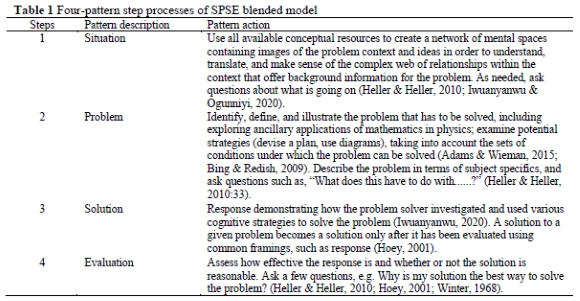
In light of the foregoing, this study builds upon the social constructivism that serves as the philosophical basis for SPSE blended interactions (Hoey, 2001). In this sense, the socio-constructivist component of the SPSE blended model provided the pre-service teachers in this study with a valuable learning experience by enabling them to engage in social negotiation and participate in the social construction of scientific knowledge. In light of the work of Bing and Redish (2009), as well as Heller and Heller (2010), the SPSE blended model is more closely suited to what is required to enhance students' ability to mobilise different levels of knowledge taxonomy, as it is one of the characteristics of expertise in problem-solving to dynamically blend the four concepts of the pattern. Table 1 provides a detailed description of the SPSE blended model. The model is grounded in common epistemological frameworks found in relevant literature, which may help students navigate the complexities of problem-solving and arrive at reasonable solutions (e.g., Adams & Wieman, 2015; Bing & Redish, 2009; Heller & Heller, 2010; Iwuanyanwu & Ogunniyi, 2020; Winter, 1968).
The SPSE model may equip problem solvers with a structured approach to real-world challenges. It can help them to apply their knowledge, pinpoint problems, devise solutions, and critically assess their effectiveness (Heller & Heller, 2010; Hoey, 2001). Beyond enhancing problem-solving skills, the model cultivates a deeper understanding of how problem solvers can mobilise diverse knowledge domains (Cutnell & Johnson, 2019). For the pre-service teachers in this study, the SPSE model may guide them through the key steps of understanding the context of a physics problem, identifying the core issue, developing a solution, and evaluating its effectiveness. Despite extensive research into conceptual problem-solving in science education, which has identified various challenges that students face in and out of the classroom and proposed solutions, many students still struggle to learn physics concepts and solve related problems. This has raised more questions than answers in the science education literature. For example, Jonassen (2007) asked what it was that made science problems so difficult for students. Govender and Dega (2016) investigated undergraduate pre-service teachers' conceptions of mechanics concepts in physics education. They found that the pre-service teachers lacked an overarching conceptual understanding of these concepts. Similarly, Nguyen and Meltzer (2003) tested students' vector kinematic knowledge in introductory mechanics courses before and after an intervention programme. They found that over half of students in an algebra-based course and over a quarter in a calculus-based course were unable to resolve vectors in two dimensions. This highlights the widespread relevance of the problem explored in this study. I sought to, drawing on different knowledge taxonomy levels, investigate the level of difficulty that pre-service teachers encountered when blending conceptual physics problems into solution frameworks.
Methods
Setting and Samples
In this study I compared two undergraduate university physics classes which comprised of 86 pre-service teachers enrolled in a 4-year Bachelor of Education (B.Ed.) programme using a pre- and post-test control-group design (Creswell & Plano Clark, 2011). The two classes were randomly assigned to one of two pedagogical conditions, lectures (control group - Ctr-G, N = 41) or the SPSE blended model (experimental group - Exp-G, N = 45), and spent 6 weeks learning advanced mechanics concepts such as uniform circular motion, rotational kinematics, and dynamics. More than half of the participants were female (64.9%). The pre-service teachers' average age was 23.5 years (SD = 0.56). The majority of the pre-service teachers were from working-class and middle-class families who lived in urban and township areas. The inclusion of pre-test scores allows for generalisable causal effects. Thus, differences in treatment and control group scores are engendered by the intervention. Participation in the study was voluntary.
Instrument
For this study I modified questionnaire items adapted from previous studies on students' ability to demonstrate conceptual and procedural understanding while solving physics mechanics problems (e.g., Adams & Wieman, 2015; Bing & Redish, 2009; Iwuanyanwu & Ogunniyi, 2020). A number of constructs that are consistent with the four-step process (situation, problem, solution, and evaluation) were included, allowing pre-service teachers to mobilise different levels of knowledge taxonomy to demonstrate their understanding of the tasks as well as their ability to blend conceptual problems into reasonable solution frameworks. The first draft of the instrument (conceptual physics problems test [CPPT]) included eight items of non-computational problems - testing for conception (Adams & Wieman, 2015), and six items that provided pre-service teachers with opportunities to identify and define problems to solve, explore possible strategies, implement the strategies, solve the problem, and evaluate the solutions they had suggested to determine whether the solutions were reasonable (Byun & Lee, 2014; Iwuanyanwu, 2020). Five additional items were included to test pre-service teachers' conceptual and procedural ancillary application of mathematics in physics problem-solving, taking into account the sets of conditions under which a given problem is being solved (Bing & Redish, 2009). Nineteen items were developed.
The CPPT tasks were labelled D1, D2, and D3 based on their level of difficulty. This level of difficulty was determined by two key factors: (1) the level of conceptual and procedural mathematical knowledge required to solve the problems, and (2) the application of different knowledge levels - factual, conceptual, procedural, and metacognitive - and the associated difficulty of each level. D1 represented minor difficulty, D2 represented major difficulty, and D3 represented atypical difficulty. These difficulty levels (D1, D2, D3) align with the knowledge domains and cognitive processes of Bloom's revised taxonomy (Iwuanyanwu, 2014). Two science educators assisted in validating the items to ensure content validity in terms of the study goal and suitability for meeting the learning outcomes. Cohen's kappa value k = .68 was obtained as the interrater measure of agreement. The instrument's reliability was 0.73, with subscale reliabilities composed as follows: (non-computational problems = 0.7; computational problems = 0.72; and conceptual and procedural ancillary application of mathematics-in-physics problem-solving = 0.71). Following these rigorous processes for instrument development and validation, the instrument (CPPT) was implemented for data collection.
Intervention and Data Collection
A 6-week short-term intervention was designed in accordance with the physics education work schedule and assessment plan, and it consisted of three advanced mechanics study units (uniform circular motion, rotational kinematics, and rotational dynamics). During the first week of the study, pre-service teachers received instructions from the two lecturers responsible for teaching the physics course in the study project and were provided with instruction on how to approach their learning activities for the duration of the study. Subsequently, the pre-test data collection session, lasting 2 hours, was conducted on a Tuesday. Following the pre-test data collection in week 1, the instruction of advanced physics topics took place in weeks 2 through 6, using two different pedagogical approaches: traditional lecture-based learning and SPSE blended scaffolding. Throughout this period, pre-service teachers received guidance tailored to each instructional condition. The goal was to enhance the participants' learning experience. Teaching time for both groups was the same - two lectures per week (2 hours on Tuesdays and 1 hour on Thursdays). The two classes were taught by two science education lecturers with over 12 years of teaching experience in physics education. Both classes were taught in English. The following constructs were address in three study units: (a) non-computational problems, (b) computational problems, and (c) conceptual and procedural ancillary application of mathematics-in-physics problem-solving, all with the goal of examining how pre-service teachers cultivated deeper understanding of physics concepts as well as blending conceptual problems into justifiable solution frameworks as needed. Table 1 illustrates the SPSE blended model used by the pre-service teachers.
Following the SPSE blended model, pre-service teachers had the opportunity to engage in open discussion of specific problems, to argue, debate, resolve their doubts, and improve their conceptual understanding of the scientific phenomena in question (Belland et al., 2011; Iwuanyanwu, 2023). Pre-service teachers in the control group followed instructions to learn the three constructs by taking notes from the whiteboard, asking questions as needed, and participating in assigned activities individually or in small groups. As is customary in traditional lectures, the lecturer sets up instructions and then gradually introduced pre-service teachers to the same items completed by their counterparts. After 6 weeks of instruction, the 19-item assessment was administered within 2 hours as a post-test to the experimental and control groups near the end of the first semester.
Data Analysis
The pre- and post-test data, collected in the form of pre-service teachers' written responses to blending conceptual physics problems into solution frameworks, were graded using a moderated scoring rubric and then analysed quantitatively. I compiled the pre-service teachers' written responses, removed any identifying information like names and numbers, and then assigned a category code to each response based on the two research questions.
Research question (RQ)1: What level of difficulty in mobilising different levels of knowledge taxonomy do pre-service teachers encounter when they blend conceptual physics problems into solution frameworks?
To answer the first research question, the revised taxonomy table for the dimensions of knowledge and cognitive process was used to categorise and analyse pre-service teachers' contextualisation of problem-solving based on their understanding of each item tested (e.g. D1 for minor difficulty, D2 for major difficulty, and D3 for atypical difficulty). Following categorisation and comparisons, the data were re-examined to determine whether new categories were required. The re-examination process also included a review of in-class problem-solving discussions and other related classwork that provided information about their strategies, SPSE inquiry discussions, group-work interactions, and process reflections. After finalising the categories, I examined the analysed data for trends describing pre-service teachers' successes and challenges as they blended conceptual physics problems into solution frameworks in the two pedagogical conditions.
RQ2: Is there a significant difference in the impact of the SPSE blended model versus traditional lecture-based instruction on how pre-service teachers blend conceptual physics problems into solution frameworks?
To answer the second research question, the collected data were coded into a spreadsheet on the Statistical Package for the Social Sciences (SPSS) (version 24) and analysed in accordance with the research question. The means and standard deviations for each group were computed. To determine whether or not the differences between groups in the two pedagogical conditions were significant, additional tests such as the /-test and analysis of variance (ANOVA), as well as effect size data (Cohen's d), were used.
Results and Discussion
The aim with the results obtained on the first research question was to determine the level of difficulty experienced by pre-service teachers in two different pedagogical settings before and after engaging in learning activities related to blending conceptual physics problems into solution frameworks. The results indicate that pre-service teachers in both groups used a diverse set of skills to navigate problem-solving strategies. Despite demonstrating a variety of skills when dealing with CPPT items labelled as D2 and D3, individuals in the control group exhibited a consistent challenge in effectively linking problem representations to real-world situations. The analysis of their written responses revealed that the pre-service teachers' approach to solving problems was primarily driven by the desire to find quick solutions rather than a genuine effort to understand the underlying phenomena. While some solution frameworks were grounded in scientific principles and occasionally involved mathematical concepts, the pre-service teachers noticeably struggled to apply the correct procedural and metacognitive knowledge when addressing items categorised as D2 and D3. Although some students in the control group managed to successfully blend conceptual physics problems into coherent solution frameworks, there was a notable absence of consideration regarding the implications of using different levels of knowledge taxonomy on the solutions generated. This lack of concern was particularly evident when discrepancies in mathematical representations were perceived as distinct from varying physical representations of the same reality, highlighting a need for a more comprehensive approach to problem-solving strategies among pre-service teachers.
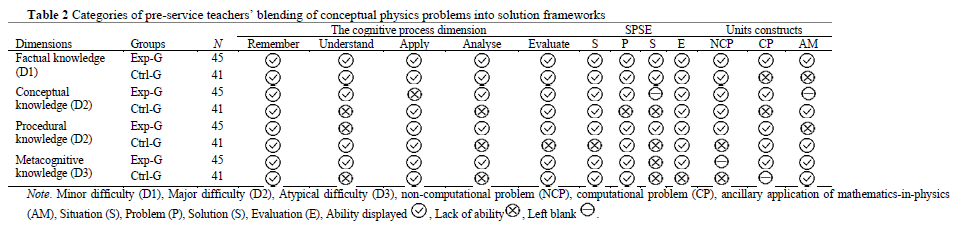
To gain a deeper understanding of how the learning experiences in each pedagogical setting impacted the pre-service teachers, a further analysis of the data was conducted to identify the various categories of knowledge dimensions exhibited by the participants. This analysis shed light on the nuanced ways in which the individuals engaged with the material and how their learning was influenced by the instructional approach employed in the classroom, ultimately providing valuable insights into the effectiveness of different teaching methodologies on student learning outcomes. Table 2 aided in the identification of categories of pre-service teachers' knowledge dimensions, dispositions, and how they cultivated their understanding while contextualising physics problem solving, as well as the areas of difficulty they encountered while responding to CPPT items. Xs were used to indicate knowledge dimensions versus five of the six cognitive process dimensions, revealing the pre-service teachers' inability to blend conceptual physics problems into justifiable solution frameworks, whereas ticks  indicated ability category.
The results show that pre-service teachers had no significant difficulty blending conceptual physics problems labelled D1 (minor difficulty) into solution frameworks. They were able to apply factual knowledge by recalling pertinent concepts, were able to understand and apply their prior knowledge to the new concepts required to demonstrate the four-pattern step process (situation, problem, solution, and evaluation). This indicates that pre-service teachers successfully applied ancillary mathematics knowledge to computational and non-computational physics problems. These findings support previous research (Belland et al., 2011; Byun & Lee, 2014; Etkina et al., 2019), indicating that pre-service teachers' attempts to solve items labelled D1 and the solutions/responses they provided were based on their understanding of physics, logic, and ancillary mathematics applications in physics problems (Heller & Heller, 2010; Redish & Kuo, 2015). Compared to their peers in the class where the SPSE blended model was applied, most pre-service teachers in the control group did not demonstrate robust and logical strategies to solve items marked D2 (major difficulty), which required conceptual and procedural knowledge and the application of mathematics.
As indicated in Table 2, some pre-service teachers in the control group failed to analyse and evaluate items labelled D2. A re-examination of their written work revealed that the majority of pre-service teachers lacked a logical and organised framework to guide their conceptual blending of physics problems into reasonable solutions. Without a reasonable framework directing their efforts to make connections between physics and mathematics concepts, they will have little choice but to continue using the ineffective novice strategies with which they began the course (Adams & Wieman, 2015; Heller & Heller, 2010; Slough & Chamblee, 2017). Nonetheless, one out of every 10 pre-service teachers in the experimental group and four out of 10 pre-service teachers in the control group chose to leave the items marked D3 blank and continue with the items marked D1 and D2. Even so, the solutions that the pre-service teachers provided indicated that they were unable to connect mathematical concepts, such as basic trigonometry ratios, in conceptualising physics problem-solving to reasonable solutions. These findings are consistent with research by Govender and Dega (2016) on the framework categorisation of pre-service physics teachers' vector-kinematics conceptions. They found that third-year pre-service teachers in their study lacked a higher conceptual understanding of basic mechanics. Similarly, Nguyen and Meltzer (2003) found that pre-service teachers who participated in their study were unable to resolve vectors in two dimensions. In other science educational studies (Gupta & Elby, 2011) it was found that pre-service teachers had conceptual difficulties in solving basic mechanics problems.
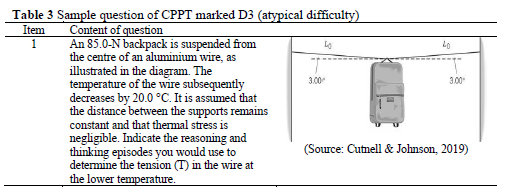
A plausible explanation for why pre-service teachers avoided or struggled with physics problems that required metacognitive knowledge, such as the problems labelled D3 in this study, could be that they had difficulty locating the relevant information in their existing knowledge to solve the problems because other information they may or may not have had tended to mask what they knew about the problems (Table 3). This argument is consistent with findings of research on micro genetic learning analysis of students' understanding of problem-solving (Parnafes & DiSessa, 2013), reflective judgment (King & Kitchener, 2004), conceptual metaphors and epistemological deficits (Bing & Redish, 2009; Gupta & Elby, 2011), and situational interest as factors influencing their learning of science (Etkina et al., 2019). In this study, through categorising and characterising pre-service teachers' written work, I found that more than half of the pre-service teachers displayed various concepts without understanding their application to items marked D3. They were unable to identify the unknown variables or interpret the information for what it represented. As a result, they found it difficult to analyse the tasks and use appropriate algebraic expressions and related physics concepts to make good subject and/or content connections as a solving strategy. Due to space limitations, only one example of CPPT D3 item is provided in Table 3 to show how pre-service teachers in both groups demonstrated contextualisation of problem-solving relating to their understanding of the constructs covered.
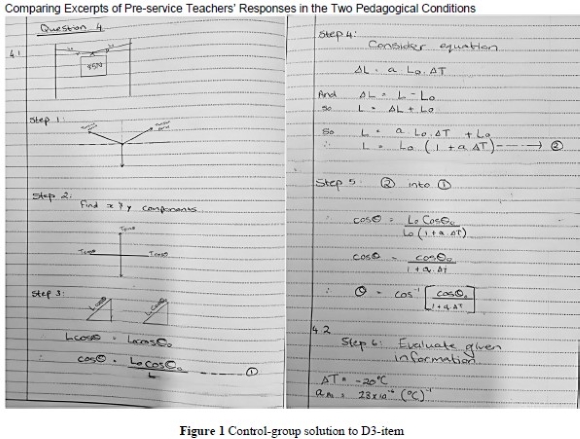
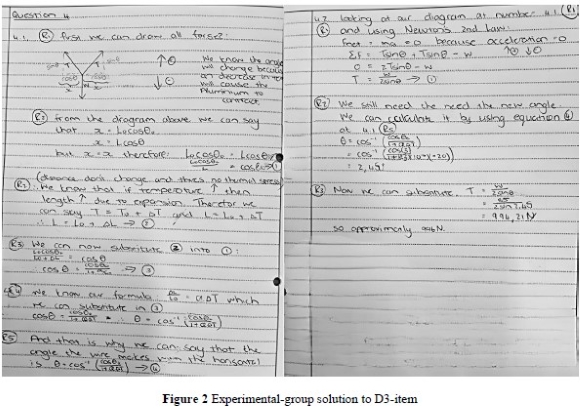
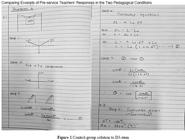
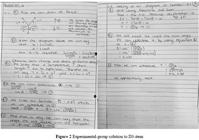
The pre-service teachers instructed through the SPSE blended model demonstrated commendable proficiency in navigating the complexities of blending conceptual problems - especially those marked as major and atypical difficulties - into reasonable solution frameworks. This showcases their ability to understand various terminologies influenced by their knowledge taxonomy. Out of this group, only two thirds were able to demonstrate a solid grasp of principles and effectively use theories to articulate declarative knowledge regarding solutions. The solution frameworks that they presented evolved as they engaged with a variety of problem scenarios, allowing them to cultivate a diverse set of skills to tackle complex real-world applications, transitioning from novice characteristics to expertise in CPPT items labelled D2 (major difficulty) and D3 (atypical difficulty). A comparison of the solution frameworks presented in the written responses of the control and experimental groups revealed significant disparities in classroom discussions, ideas, problems, and patterns of connections within the mobilisation of different knowledge taxonomies. The distinct processes of drawing upon various levels of knowledge taxonomy - factual, conceptual, procedural, and metacognitive - and the challenges encountered at each level when blending conceptual problems into solution frameworks highlighted the differences in performance between individual pre-service teachers in the traditional lecture-based class and the class based on the SPSE blended model. The evidence derived from their written responses, as depicted in Figures 1 and 2, illustrate a context rich in phenomena that shaped their learning experience and influenced their approach to blending conceptual physics problems into solution frameworks.
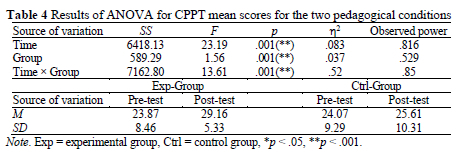
In terms of identifying, defining, and contextualising D3 items, including exploring pertinent ancillary mathematics applications and taking into account the sets of conditions that could pertain to the solution, pre-service teachers in the experimental group performed better than pre-service teachers in control group. This inference is consistent with the findings shown in Table 4. Furthermore, in their written explanations testing for conception, some pre-service teachers, mostly from the experimental group, indicated that the process based on SPSE blended model was stressful and frequently required a lot of explanation, reasoning, and thinking episodes relating to the ancillary application of mathematics-in-physics problem-solving. However, as Parnafes and DiSessa (2013) argue, constructing the appropriate mental structures for a given concept, including reasoning and thinking episodes, leads to easy learning of the concept.
The problem solver's ability to create the necessary conceptual resources using the SPSE blended model is one strategic approach to solving the CPPT items marked D2 and D3 with less mental effort. The problem solver can begin by contextualising the problem situation, as shown in Steps 1 and 2 in Table 1. To do so, the problem solver must first rule out some sets of conditions and leave those variables with negligible effects in the solution pathway, which can be corrected later, undetermined (Iwuanyanwu, 2020). In addition, Figure 2 shows that through the SPSE blended model, the pre-service teachers in the experimental group conceptualised and blended the items marked D3 into a justifiable solution framework. According to Heller and Heller (2010), a correct solution incorporates both correct physics concepts and their proper interconnection with other ideas relevant to the physical situation on which the problem is based. As shown in Figure 1, the pre-service teachers in the control group made a reasonable effort at contextualising items (D3) but stopped halfway through. The fact that they were unable to proceed after stating the required variable may be as a result of conceptual or procedural difficulty or an anomaly. According to Lee and Byun (2012), an anomaly exists when one is unable to comprehend or understand something that is presumed to be straightforward.
To address the second research question, additional data analysis was performed to determine the effectiveness of the two pedagogical conditions in improving pre-service teachers' ability to blend conceptual physics problems into justifiable solution frameworks. The descriptive statistics of the variables for the experimental and control groups were (M = 23.87; SD = 8.46) and (M = 24.07; SD = 9.29), with no significant difference in mean scores, indicating that both groups had comparable initial conceptions of the phenomenon under investigation. Additional results of repeated measures of ANOVA analysis presented in Table 4 show that the interaction effect between group and time (F = 13.61, p < 0.001, η2= .52) and the main effect of time on CPPT scores were significant (F = 23.19, p < 0.001, η2 = .083). There was, however, no significant main effect of group on SPSQ scores (F = 1.56, p < 0.001, η2 = .037).
Furthermore, after controlling for the impact of the pre-test, the variance of post-test results between the control and the experimental groups was found to be significant (p < .001). Pre-service teachers who failed to blend conceptual items marked D2 (major difficulty) into justifiable solution frameworks also did not correctly solve items marked D3 (atypical difficulty). There was a lack of understanding of the phenomenon in question, even among pre-service teachers who correctly answered the D1 and D2 items. This means that pre-service teachers who performed poorly on our physics examination problems did not understand the fundamental concepts of physics (Heller & Heller, 2010; Meli, Zacharos & Koliopoulos, 2016). It should also be noted that a significant percentage of pre-service teachers who responded to D2 and D3 items constructed personal interpretations about the problem situations, which supported their abilities to check, reason, and reflect on their solutions. However, because of a minor change in the way that they conceptualised the problem situations, they were unable to generalise a justifiable solution framework similar to other problems with different objects, events, or constraints. This finding reinforces previous concerns about pre-service teachers' lack of understanding of fundamental physics concepts (Byun & Lee, 2014; Etkina et al., 2019), including their application in specific situations (Iwuanyanwu, 2023). It is clear from the findings that a significant portion of pre-service teachers in the control group may benefit from further support in developing a more comprehensive understanding of how to effectively connect problem representations to relevant contexts. By addressing the underlying issues related to procedural and metacognitive knowledge, these individuals may enhance their problem-solving skills and deepen their comprehension of the scientific principles at play. Additionally, fostering a greater awareness of the implications of using different levels of knowledge taxonomy can lead to more robust and holistic problem-solving approaches among pre-service teachers in both pedagogical conditions.
Conclusion
In this study I examined two pedagogical conditions: traditional lecture learning and an SPSE blended model. The goal was to understand how pre-service teachers integrated conceptual physics problems into solution frameworks, drawing on different knowledge taxonomies. This could benefit them in advanced physics courses. The findings of the study add to the limited empirical evidence on how undergraduate pre-service teachers blended conceptual physics problems into solution frameworks, including their understanding of fundamental physics and mathematics concepts, as well as their application in specific situations. The findings provide evidence demonstrating how some of the pre-service teachers in the two pedagogical conditions demonstrated their ability and/or inability to produce plausible reasoning and thinking episodes required to make sense of complex sets of relationships as applied to the context of physics problems. Nonetheless, a small number of pre-service teachers in both groups who demonstrated an inability to coordinate a variety of concepts and skills, including blending ancillary mathematics information in contextualising problem-solving, retained their conceptual and procedural difficulties. This also indicates the pre-service teachers' inability to produce the types of reasoning and thinking episodes that stimulate metacognitive support for error recovery.
Finally, some of the findings of this study and other findings in the science education literature indicated that if pre-service teachers are not skilled in mathematics, understanding of some science concepts may be impossible. This is especially true for pre-service teachers, as teachers must be competent problem solvers in order to effectively teach physics. Learning physics and solving its complex problems requires the integration of knowledge about concepts with the fundamental principles that form the solution frameworks. Therefore, by blending conceptual physics problems into solution frameworks, pre-service teachers can enhance their problem-solving abilities and deepen their understanding of the subject matter.
In future research one could explore other difficulties that pre-service teachers face when applying knowledge taxonomies to blend conceptual physics problems at varying difficulty levels (major, D2, and atypical, D3). A comparative study on how pre-service teachers contextualise problem-solving in undergraduate physics classes could also be useful. Additionally, in this study I only investigated the effects of the SPSE blended model with a medium-sized sample. A larger study could investigate why pre-service teachers in this pedagogical condition improved their reasoning and thinking episodes required to blend conceptual physics problems into reasonable solution frameworks.
Conflict of Interest
The author declares no conflict of interest in this study.
Notesi. Published under a Creative Commons Attribution Licence.
References
-
Adams WK & Wieman CE 2015. Analyzing the many skills involved in solving complex physics problems. American Journal of Physics, 83(5):459-467. https://doi.org/10.1119/1.4913923
» https://doi.org/10.1119/1.4913923 -
Baawuo A, Azuuga EI, Adakudugu EA & Abdulai I 2022. Developing preservice teachers' scientific problem-solving skills using a pragmatic approach to physics: The case of Gbewaa College of Education. Open Journal of Social Sciences, 10:315-320. https://doi.org/10.4236/jss.2022.109020
» https://doi.org/10.4236/jss.2022.109020 -
Belland BR, Glazewski KD & Richardson JC 2011. Problem-based learning and argumentation: Testing a scaffolding framework to support middle school students' creation of evidence-based arguments. Instructional Science, 39(5):667-694. https://doi.org/10.1007/s11251-010-9148-z
» https://doi.org/10.1007/s11251-010-9148-z -
Bing TJ & Redish EF 2009. Analyzing problem solving using math in physics: Epistemological framing via warrants. Physical Review Special Topics-Physics Education Research, 5:020108-1-020108-15. https://doi.org/10.1103/Physrevstper.5.020108
» https://doi.org/10.1103/Physrevstper.5.020108 -
Byun T & Lee G 2014. Why students still can't solve physics problems after solving over 2000 problems? American Journal of Physics, 82(9):906-913. https://doi.org/10.1119/1.4881606
» https://doi.org/10.1119/1.4881606 - Creswell JW & Plano Clark VL 2011. Designing and conducting mixed methods research (2nd ed). Los Angeles, CA: Sage.
- Cutnell JD & Johnson KW 2019. Introduction to physics (11th ed). Hoboken, NJ: John Wiley & Sons.
-
Etkina E, Brookes DT & Planinsic G 2019. Investigative science learning environment: When learning physics mirrors doing physics. San Rafeal, CA: Morgan & Claypool. https://doi.org/10.1088/2053-2571/ab3ebd
» https://doi.org/10.1088/2053-2571/ab3ebd - Govender N & Dega BG 2016. Framework categorization of pre-service physics teachers' conceptions of vector-kinematics. Journal of Baltic Science Education, 15(3):325-339.
-
Gupta A & Elby A 2011. Beyond epistemological deficits: Dynamic explanations of engineering students' difficulties with mathematical sense-making. International Journal of Science Education, 33(18):2463-2488. https://doi.org/10.1080/09500693.2010.551551
» https://doi.org/10.1080/09500693.2010.551551 -
Gürel C & Süzük E 2017. Pre-service physics teachers' argumentation in a model rocketry physics experience. Educational Sciences: Theory & Practice, 17(1):83-104. https://doi.org/10.12738/estp.2017.L0042
» https://doi.org/10.12738/estp.2017.L0042 -
Heller K & Heller P 2010. Cooperative problem solving in physics: A user's manual. Minneapolis, MN: University of Minnesota. Available at https://www.aapt.org/Conferences/newfaculty/upload/Coop-Problem-Solving-Guide.pdf. Accessed 5 May 2025.
» https://www.aapt.org/Conferences/newfaculty/upload/Coop-Problem-Solving-Guide.pdf - Hoey M 2001. Textual interaction: An introduction to written discourse analysis. London, England: Routledge.
-
Iwuanyanwu PN 2014. Pre-service science teachers' conceptual and procedural difficulties in solving mathematical problems in physical science. MEd thesis. Cape Town, South Africa: University of the Western Cape. Available at https://uwcscholar.uwc.ac.za:8443/server/api/core/bitstreams/4677bc7d-fb52-4dd1-a6c0-13ac887140dc/content. Accessed 2 May 2025.
» https://uwcscholar.uwc.ac.za:8443/server/api/core/bitstreams/4677bc7d-fb52-4dd1-a6c0-13ac887140dc/content -
Iwuanyanwu PN 2020. Nature of problem-solving skills for 21st century STEM learners: What teachers need to know. Journal of STEM Teacher Education, 55(1):27-40. https://doi.org/10.30707/JSTE55.1MMDZ8325
» https://doi.org/10.30707/JSTE55.1MMDZ8325 -
Iwuanyanwu PN 2023. When science is taught this way, students become critical friends: Setting the stage for student teachers. Research in Science Education, 53(6):1063-1079. https://doi.org/10.1007/s11165-023-10122-9
» https://doi.org/10.1007/s11165-023-10122-9 -
Iwuanyanwu PN & Ogunniyi MB 2020. Effects of dialogical argumentation instructional model on pre-service teachers' ability to solve conceptual mathematical problems in physics. African Journal of Research in Mathematics, Science and Technology Education, 24(1):129-141. https://doi.org/10.1080/18117295.2020.1748325
» https://doi.org/10.1080/18117295.2020.1748325 -
Jonassen D 2011. Supporting problem solving in PBL. The Interdisciplinary Journal of Problem-Based Learning, 5(2):95-112. https://doi.org/10.7771/1541-5015.1256
» https://doi.org/10.7771/1541-5015.1256 - Jonassen DH 2007. What makes scientific problems difficult? In DH Jonassen (ed). Learning to solve complex, scientific problems. Mahwah, NJ: Lawrence Erlbaum Associates.
-
Kapon S & DiSessa AA 2012. Reasoning through instructional analogies. Cognition and Instruction, 30(3):261-310. https://doi.org/10.1080/07370008.2012.689385
» https://doi.org/10.1080/07370008.2012.689385 -
King PM & Kitchener KS 2004. Reflective judgment: Theory and research on the development of epistemic assumptions through adulthood. Educational Psychologist, 39(1):5-18. https://doi.org/10.1207/s15326985ep3901_2
» https://doi.org/10.1207/s15326985ep3901_2 -
Kuo E, Hull MM, Gupta A & Elby A 2013. How students blend conceptual and formal mathematical reasoning in solving physics problems. Science Education, 97(1):32-57. https://doi.org/10.1002/sce.21043
» https://doi.org/10.1002/sce.21043 -
Lee G & Byun T 2012. An explanation for the difficulty of leading conceptual change using a counterintuitive demonstration: The relationship between cognitive conflict and responses. Research in Science Education, 42:943-965. https://doi.org/10.1007/s11165-011-9234-5
» https://doi.org/10.1007/s11165-011-9234-5 -
Meli K, Zacharos K & Koliopoulos D 2016. The integration of mathematics in physics problem solving: A case study of Greek upper secondary school students. Canadian Journal of Science, Mathematics and Technology Education, 16(1):48-63. https://doi.org/10.1080/14926156.2015.1119335
» https://doi.org/10.1080/14926156.2015.1119335 -
Nguyen NL & Meltzer DE 2003. Initial understanding of vector concepts among students in introductory physics courses. American Journal of Physics, 71(6):630-638. https://doi.org/10.1119/1.1571831
» https://doi.org/10.1119/1.1571831 -
Parnafes O & DiSessa AA 2013. Microgenetic learning analysis: A methodology for studying knowledge in transition. Human Development, 56(1):5-37. https://doi.org/10.1159/000342945
» https://doi.org/10.1159/000342945 -
Redish EF & Kuo E 2015. Language of physics, language of math: Disciplinary culture and dynamic epistemology. Science & Education, 24(5-6):561-590. https://doi.org/10.1007/s11191015-9749-7
» https://doi.org/10.1007/s11191015-9749-7 -
Schoenfeld AH 2013. Reflections on problem solving theory and practice. The Mathematics Enthusiast, 10(1):9-34. https://doi.org/10.54870/1551-3440.1258
» https://doi.org/10.54870/1551-3440.1258 -
Selvaratnam M 2011. Competence of matric physical science teachers in some basic problem-solving strategies. South African Journal of Science, 107(1/2):Art. #262, 7 pages. https://doi.org/10.4102/sajs.v107i1/2.262
» https://doi.org/10.4102/sajs.v107i1/2.262 - Slough S & Chamblee G 2017. 21st century Pedagogical Content Knowledge and science teaching and learning. Journal of Computers in Mathematics and Science Teaching, 36(2):173-187.
- Winter EO 1968. "Some aspects of cohesion." In RD Huddleston, RA Hudson, EO Winter & H Henrici. Sentence and clause in scientific English. London, England: University College London.
Revised: 21 October 2024
Accepted: 4 March 2025
Published: 31 May 2025