Current practices influencing school-to-work transition for learners with mild intellectual disability: A scoping review
Abstract
Transitions are significant turning points in young people's lives as they enter adulthood. However, for learners with an intellectual disability (ID), this transition comes with effort. To identify and clarify current practices that influence school-to-work transition for learners with mild ID, the Joanna Briggs Institute (JBI), the preferred reporting items for systematic reviews and meta-analyses extension for scoping reviews (PRISMA-ScR) were followed in conducting this scoping review. A 5-step process was followed: the research question was identified; related studies were identified through an electronic grey literature search and databases; studies were selected; the data were charted; and lastly the findings were organised, summarised and reported on. Thirty-one (n = 31) articles published between 2009 and 2021 were included in this review. The current practices associated with school-to-work transition were learnerships or internships, vocational training, transition planning, collaboration effort, independent living skills training, family involvement, self-determination, social skills training, career counselling, and employers' involvement. School-to-work transition for learners with mild ID is a complex, multifaceted process. These practices are necessary to support effective transition across life stages.
intellectual disability; school-to-work transition; scoping review; youth
Introduction
Transitioning across life stages is the norm (Stewart, 2013). Unfortunately, learners with mild intellectual disability (ID) cannot transition seamlessly across life stages as they experience significant challenges (Carter, Austin & Trainor, 2012; Ellman, Sonday & Buchanan, 2020). Learners with mild ID struggle to develop many of the soft skills needed in the workplace. This can be ascribed to their limited participation in the community, being dependent on their family, and being unemployed, which limits their opportunities to gain experience (Davies & Beamish, 2009). ID is characterised by substantially limited intellectual function and adaptive behaviour that emerges before a person turns 18 years old (Sadock, Sadock & Ruiz, 2015). According to the Diagnostic and statistical manual of mental disorders, 5th edition (DSM-5), there are four different levels of ID, namely, mild, moderate, severe, and profound ID (American Psychiatric Association [APA], 2013, 2022). In this scoping review we focused on learners with mild ID, with intelligence quotients (IQs) ranging from 50 to 70, which negatively affected their ability to perform different occupations such as activities of daily living (ADL) including leisure, social, and work (APA, 2013).
Background Literature
In South Africa, most learners with mild ID are enrolled in schools for learners with special educational needs (LSEN) (Capri, Abrahams, Mckenzie, Coetzee, Mkabile, Saptouw, Hooper, Smith, Adnams & Swartz, 2018). Schools for LSEN accommodate learners with learning barriers who cannot be accommodated in mainstream schools. In most settings, schools for LSEN are responsible for transition planning for learners with mild ID (Vlachos, 2008). Some countries, such as Australia, have established transition programmes from school to the world of work (Quintini & Martin, 2014), while many countries, such as South Africa, still need to establish such programmes. To create effective policies through research (Sefotho, 2017), policymakers need to understand the concepts and practices associated with school-to-work transition. Transition practices in schools include: integrated educational institutions and employment; practical life-skills curriculum and community-based education, interpersonal skills development and training, career and occupational assessment, and business and industry links with schools (Landmark, Ju & Zhang, 2010). In general, the transition may include graduating from high school, going to college, finding a paid job, and living independently (Newman, Wagner, Knokey, Marder, Nagle, Shaver, Wei, Cameto, Contreras, Ferguson, Greene & Schwarting, 2011).
The literature emphasises the reality that most people with mild ID do not have access to integrated employment services in the open labour market (Parmenter, 2011). There is also little evidence in the literature regarding the school-to-work transition for learners with mild ID in South Africa. This is supported by Rosner, Grasso, Scott-Cole, Villalobos and Mulcahey (2020) who state that there has not been much research specifically on transition in the ID population. As a result, it is challenging to find and apply best practices for helping learners with ID move from school to the workforce. Hence, there is a need for developing countries such as South Africa, to conceptualise a school-to-work transition framework for learners with mild ID that could lead to effective employment in the open labour market (Davies & Beamish, 2009). They further recommended that future studies need to pay attention to the school-to-work transition of learners from LSEN (Davies & Beamish, 2009). In South Africa, learners with mild ID have possibilities to work in supported employment or competitive employment and attain employment through an employment agency, depending on their abilities (Steyn & Vlachos, 2011; Vlachos, 2008).
In the United States of America (USA), transition services in schools for learners aged 18 to 21 years with ID allow learners to expand their independence, self-advocacy, work, and social skills during their final years of schooling (Hart, Grigal & Weir, 2010). To facilitate the learner's transition from school to the world of work, individualised education transition plans that measure outcomes related to education, training, employment, and independent living skills are needed in a school-to-work transition programme (Landmark et al., 2010). It is important for schools to provide these high quality services for learners with intellectual disabilities to encourage positive post-school outcomes (Chiang, Cheung, Hickson, Xiang & Tsai, 2012; Landmark et al., 2010).
Learners with mild ID have fewer career development opportunities than their counterparts (Engelbrecht, Shaw & Van Niekerk, 2017). Their entering into the open labour market is limited because of the high unemployment rate, a lack of skills, workplace discrimination, and a lack of preparation for work by the education system (Engelbrecht et al., 2017; Hall & Wilton, 2011; Lindsay, McDougall, Menna-Dack, Sanford & Adams, 2015). School-to-work transition strategies available in South Africa are learnership programmes for those in mainstream schools with/without Grade 12 and internships for the graduates from further education and training colleges and universities (Media, Information and Communication Technologies Sector Education and Training Authority [MICT SETA], 2019). However, these programmes do not cater for learners from LSEN schools, because they follow a "district curriculum accommodation plan" which is different from the academic curriculum in mainstream schools. Currently, skills acquired at LSEN schools are not recognised by MICT SETA (2019). Although it was stated that students attending LSEN schools would receive certificates National Qualifications Framework (NQF) Level 4 qualifications starting 2020 (Department of Basic Education, Republic of South Africa, 2018), this has not yet happened. Given the difficulties that come with ID, it is still unclear how learners with mild ID can effectively make the transition from school to the labour market. Despite having the supported employment enterprises in South Africa for youth with disabilities, the entity still depends on partnerships and higher sales to increase the number of employment of people with disabilities. The South African education system has been criticised for being ineffective in supporting employment opportunities for learners with disabilities (Vlachos, 2008). In the absence of clear post-school outcomes for learners with mild ID in South Africa, learners, their families, and service providers are challenged and frustrated as limited post-school opportunities are available (Ellman, 2015).
Aim
With this scoping review we aimed to identify and clarify the current practices influencing school-to-work transition for learners with mild ID.
Methods
We conducted a scoping review of publications that discuss and inform school-to-work practices for youth with mild ID. Scoping reviews are an effective strategy for clarifying key concepts on an emerging topic and finding knowledge gaps (Tricco, Lillie, Zarin, O'Brien, Colquhoun, Kastner, Levac, Ng, Sharpe, Wilson, Kenny, Warren, Wilson, Stelfox & Straus, 2016). The framework and preferred reporting items for systematic reviews and meta-analyses extension for scoping reviews (PRlSMA-ScR) were followed in conducting this review (Arksey & O' Malley, 2005; Peters, Marnie, Tricco, Pollock, Munn, Alexander, Mclnerney, Godfrey & Khalil, 2020; Tricco, Lillie, Zarin, O' Brien, Colquhoun, Levac, Moher, Peters, Horsley, Weeks, Hempel, Akl, Chang, McGowan, Stewart, Hartling, Aldcroft, Wilson, Garritty, Lewin, Godfrey, Macdonald, Langlois, Soares-Weiser, Moriarty, Clifford, Tunçalp & Straus, 2018). We followed the following steps:
Step 1: Identify the Research Question
We developed the research question and subsequent search strategy using the participants, concepts, and context (PCC) framework. The participants included learners with mild lD, the concepts included identifying and describing current practices influencing school-to-work transition for learners with mild lD, and the context included all existing school-to-work transition practices from all countries. Our research question was: What are concepts related to the current practices influencing the transition from school-to-work for learners with mild lD?
Step 2: Identify the Related Studies
We searched electronic databases, reference lists, and websites. We excluded conference proceedings that are known to provide limited information. A librarian assisted with searching databases and relevant journals. We electronically searched the cumulative index to nursing and allied health literature (CINAHL), PsycINFO, nursing academy, MEDLINE, and Education resources information center (ERIC) databases. We manually screened the reference lists of relevant articles and searched websites of organisations and relevant peer-reviewed journals. The database search was conducted in June 2021 after which all captured article titles and abstracts were extracted and uploaded onto the Rayyan platform. The grey literature searches took place on 20 July 2021 and only included published manuscripts and theses. We included relevant studies published between 2009 and 2021 to only capture the most recent literature, considering that policies and legislation are continuously changing. We searched databases using the following search terms/phrases:
• "Intellectual disability" OR "intellectual disability"
• "School-to-work transition" OR "school to work"
• "Intellectual disability" OR "intellectual disability" AND "school-to-work transition" OR "school to work"
Step 3: Selection of Studies
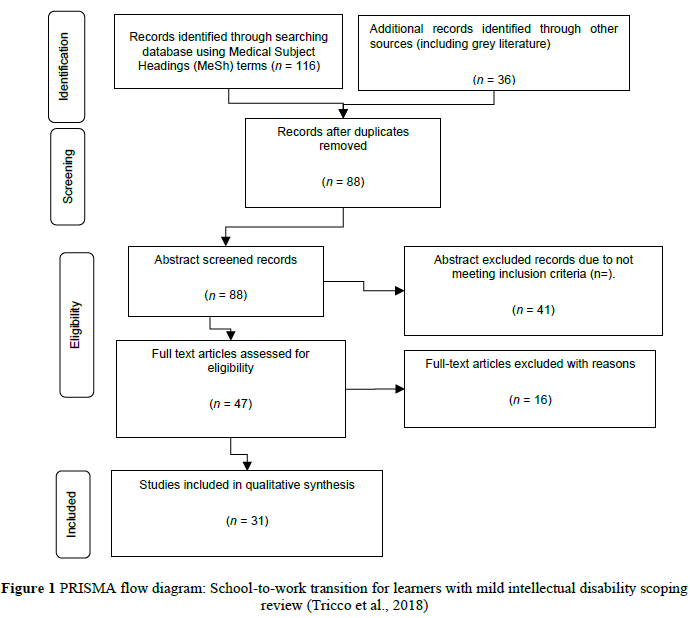
Relevant studies were selected using purposive sampling. We included all articles that met the following inclusion criteria: youth or young people, or learners with ID transitioning from school to work, or school-to-work transition for youth with disabilities. We included qualitative and quantitative studies. All identified articles were uploaded to Rayyan - "a web and mobile app for systematic reviews" (Ouzzani, Hammady, Fedorowicz & Elmagarmid, 2016:1). A dual-member verification method was used, where the researcher and two research supervisors examined the titles and abstracts to see whether the papers fulfilled the inclusion and exclusion criteria (Tricco et al., 2018). The research team also discussed the applicability and relevance of each article based on the inclusion criteria. Full texts that were not available were requested via inter-library loans. We used the PRISMA-ScR extension flow diagram to visually display the process used to identify and select studies (Tricco et al., 2018) (Figure 1). The database search yielded 116 potential studies, and we identified 36 potential studies by searching the reference lists of relevant studies and other grey literature online platforms. Eighty-eight articles were eligible after removing 64 duplicates. We excluded a further 41 articles that did not meet the inclusion criteria. We reviewed the remaining 47 full-text articles, excluding a further 16 articles for various reasons, such as, not about school-to-work related transitions, not about ID, or not about school-to-work transition of youth with ID. The remaining 31 articles were included in the review and qualitatively analysed.
Step 4: Charting the Data
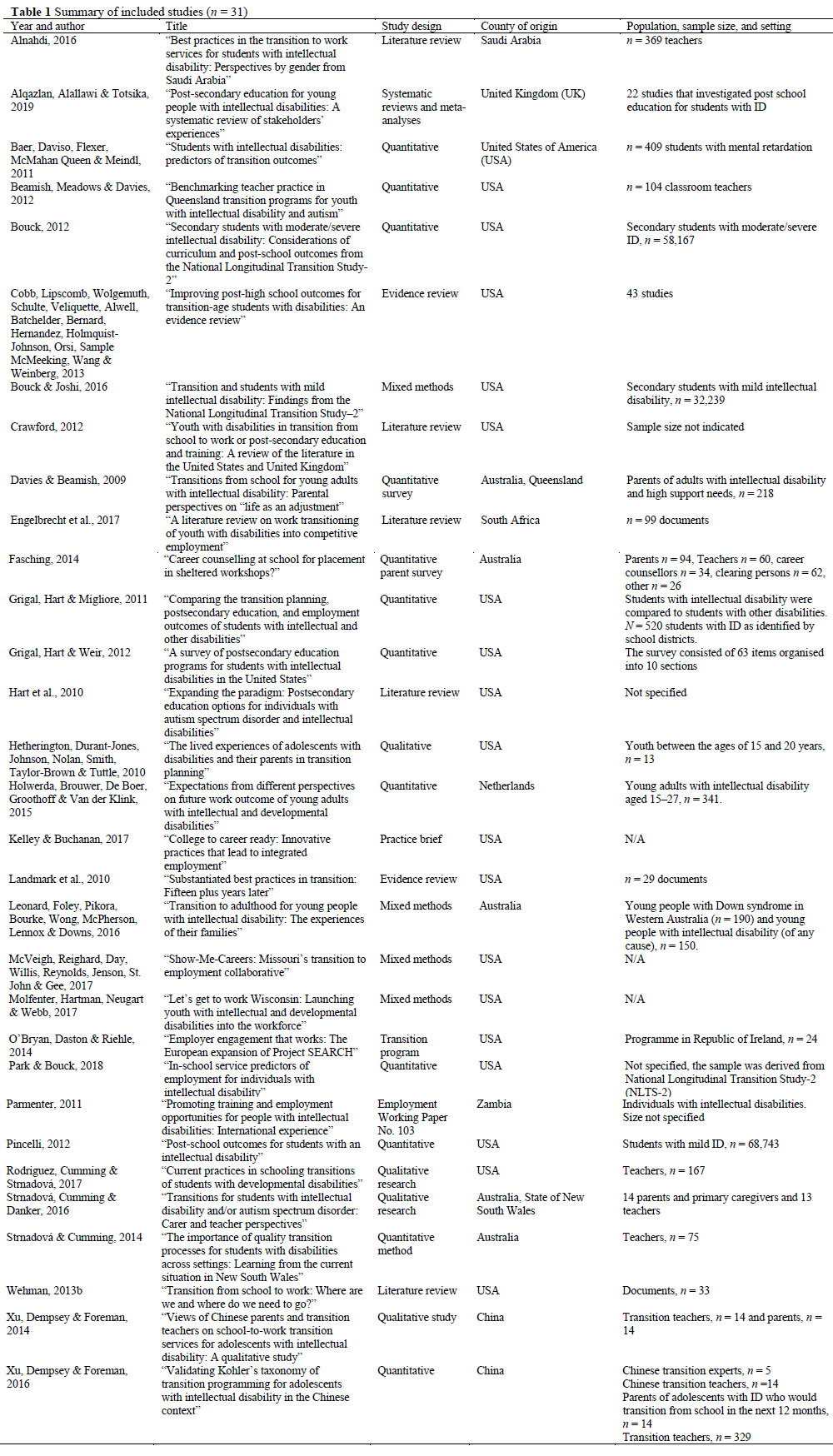
Data charting aims to identify, describe, code, and summarise the data extracted from the included articles (Peters et al., 2020). We captured the following data into a Microsoft Excel spreadsheet: author name(s), year of publication, aim/objectives, country of origin, study design, and population (Table 1). Data were coded using findings relevant to this scoping review in all included articles.
Step 5: Organise, Summarise, and Report Findings
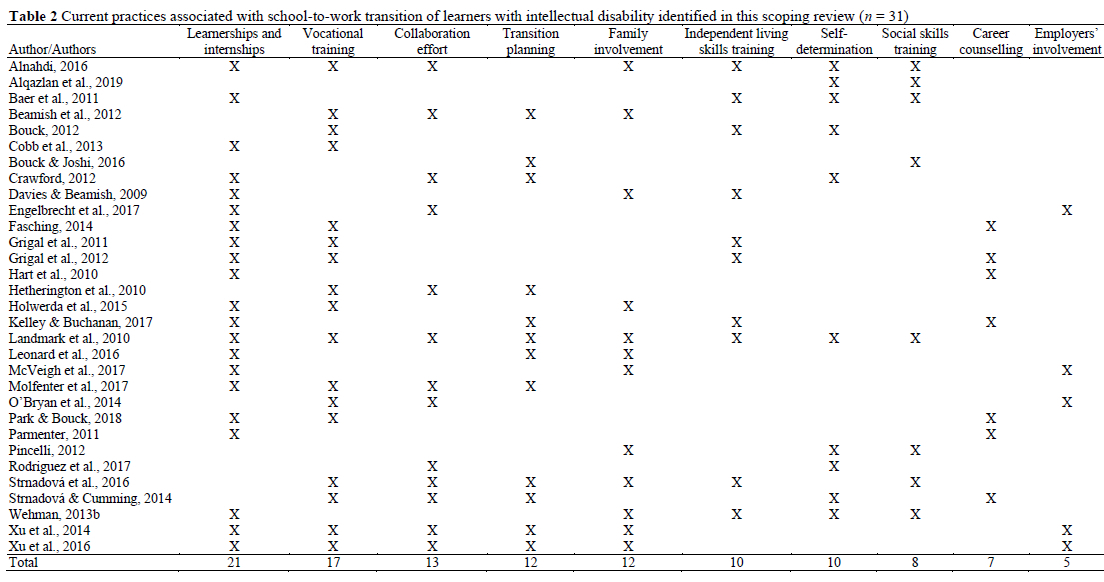
The current practices influencing school-to-work transition for learners with ID were charted in a Microsoft Excel spreadsheet. The data were thematically analysed through manual sifting, charting, and sorting material according to related practices (Table 2). Although referred to as concepts in this study, themes emerged from the codes derived directly from the findings relevant to the school-to-work transition for learners with intellectual disabilities. This methodical procedure enhances dependability and makes it possible to provide the facts in an organised manner. We used an inductive descriptive-analytical method to describe each concept related to current practices influencing school-to-work transition for learners with mild ID.
Ethical Consideration
This scoping review considered the ethical principles that maintained authorship and correctly referenced sources. The ethics reference number is 319/2020.
Results
Study Characteristics
We included 31 articles in the review, which were published between 2009 and 2021. The studies emanated from the USA (n = 19), Australia (n = 5), the UK (n = 1), China (n = 2), the Netherlands (n = 1), Saudi Arabia (n = 1), Zambia (n = 1), and South Africa (n = 1). The articles comprised various study designs including literature reviews (n = 5), systematic review (n = 1), evidence reviews (n = 2), qualitative (n = 4), quantitative (n = 12), mixed method studies (n = 4), transition programme (n = 1), practice brief (n = 1), and a working paper (n = 1) (Table 1).
Practices Included in School-to-work Transition Studies
Clear practices related to school-to-work transition emerged from the selected studies. Conceptually, the articles dealt with school-to-work transition in terms of learnerships or internships (n = 21), vocational training (n = 17), collaboration effort (n = 13), transition planning (n = 12), family involvement (n = 12), independent living skills training (n = 10), self-determination (n = 10), social skills training (n = 8), career counselling (n = 7), and employer involvement (n = 5) (Table 2).
Learnerships or Internships
Learnerships are government-financed training initiatives that mix classroom instruction with real-world experience, while internships are unpaid or low-paid employment opportunities that provide students with experience in the field of their choice. Work experience programmes may include help in finding job interests, finding a job, providing training in specific job skills, offering job shadowing opportunities, and apprenticeships or internships (Grigal et al., 2011, 2012). Twenty-one studies highlighted the importance of learnerships or internships for school-to-work transition. According to a literature review, the most important school-to-work transition practice is to expose learners to work experience and vocational training during high school (Alnahdi, 2016). Numerous studies suggest that career and technical education programmes should include work experience activities to achieve the desired benefits after high school (Baer et al., 2011; Crawford, 2012; Davies & Beamish, 2009). Innovative post-school education programmes include setting up internships and paid work experiences (Holwerda et al., 2015; Kelley & Buchanan, 2017). Learners with disabilities may have better employment outcomes if they participate in career and technical education programmes or are able to get a job while in high school (Crawford, 2012). Job placement was done by job placement agencies and formal employment programmes (Grigal et al., 2011).
Vocational Training
Vocational training refers to skills-based training programmes that train learners for manual, non-academic jobs and provides students with direct experience in the open labour market (Fasching, 2014). Seventeen studies suggest that vocational training was important for school-to-work transition. According to the parents of learners with ID, vocational training was the most noticeable indicator of successful school-to-work transition (Hetherington et al., 2010). Vocational training is one of the best practices transitions planning presently used in government schools in New South Wales, Australia (Strnadová & Cumming, 2014). Most learners participated in integrated classes that emphasised the inclusion of vocational training services (Molfenter et al., 2017).
Collaboration Effort
Successful school-to-work projects depend on true collaboration among partner organisations (O 'Bryan et al., 2014). Thirteen studies specify the positive influence of collaboration efforts for successful school-to-work transition. To successfully transition from school to work, learners with ID require the support and collaboration of learners, families, and schools (Beamish et al., 2012). In the UK, key stakeholders include the host business, young people and their families, a school or college, a supported employment service, and the local government social service (O'Bryan et al., 2014). These key public- and private-sector stakeholders need to coordinate and partner to successfully find employment for learners with disabilities (Crawford, 2012). At the provincial level, schools and government agencies need to formally collaborate (Beamish et al., 2012), and professionals working with learners have to integrate parents' and teachers' knowledge regarding young learners' abilities to enter competitive employment (Holwerda et al., 2015).
Transition Planning
Transition planning is a set of coordinated activities based on individual interests, strengths, and needs to promote a learner's movement from high school to post-secondary education or employment and independent living (Shogren & Plotner, 2012). Personalised transition planning is a holistic approach to promote the successful school-to-work transition of learners with ID (Elson, 2011; Kelley & Buchanan, 2017; Xu et al., 2014, 2016). Twelve studies describe transition planning as good practice for successful school-to-work transition. Learners with ID should have some form of transition planning, whether formal or informal, that outlines practical strategies to meet learners' needs (Crawford, 2012). Practically, family members should contribute to transition planning (Xu et al., 2014). Numerous studies mention that progress is needed to develop and increase school-based transition planning programmes (Crawford, 2012; Roller & Severino, 2016; Strnadová & Cumming, 2014; Xu et al., 2016).
Family Involvement
Family involvement is critical for school-to-work transition, as indicated in 12 studies. Numerous studies show the importance of involving parents in the transition-planning process for successful outcomes (Davies & Beamish, 2009; Wehman, 2013b). Schools recognise that involving families in planning processes and meetings is important for developing transition aims and options (Leonard et al., 2016; Xu et al., 2014, 2016). Furthermore, parents reported that they had meetings at school and assisted with their children' s employment (Leonard et al., 2016). Involving parents creates opportunities to promote and connect learners with services that enhance their future and their quality of life (Wehman, 2013b).
Independent Living Skills Training
Independent living skills training assists individuals with disabilities in acquiring the knowledge and abilities necessary to live independently in the community. Ten studies suggest independent living skills training for learners with ID. Independent living skills are necessary for successful post-school outcomes for learners with ID, who learn to function as independent adults (Baer et al., 2011; Cobb et al., 2013; Landmark et al., 2010; Strnadová & Cumming, 2014). Parents believed that the emphasis placed on independence and life skills training was essential for their children' s seamless transition between contexts, especially when it came to adjusting from high school to life after graduation (Strnadová et al., 2016). Learners should be prepared for their future by learning independent living skills, community access, daily living skills, financial skills, relationship skills, parenting, self-advocacy, and transportation (Bouck & Joshi, 2016; Rodriguez et al., 2017).
Self-determination
Self-determination refers to the combination of belief, knowledge, and skills that enable a person to participate in goal-directed, structured, and autonomous behaviour (Wehman, 2013b). This review included 10 studies that mentioned self-determination training as good practice for successful school-to-work transition as it encompasses an understanding of a person's strengths, limitations, and belief in their capabilities.
When self-determination is present, people can take control of their lives and assume the role of successful adults in society (Wehman, 2013a). During the time of transition, it is essential to promote self-determination and emphasise the importance of everyone feeling in charge of their lives (Pincelli, 2012). Further progress is needed to develop mechanisms to encourage self-determination in schools for LSEN (Crawford, 2012).
Social Skills Training
Social skills training allows learners with ID to develop a range of social and communication skills that promote a sense of belonging in the workplace and the community (Bouck & Joshi, 2012; Wehman, 2013a, 2013b). Eight studies included social skills training as good practice for successful school-to-work transition. It was crucial to cover non-academic abilities such as social skills or establishing new friends in addition to academic support (Alqazlan et al., 2019). Learners without well-developed social skills may struggle to access the workplace and have limited community engagement (Davies & Beamish, 2009).
Career Counselling
Career counselling is a process that helps individuals to find their interests, values, and abilities to assist them in making informed choices about their professions. Seven studies suggested career counselling as a school-to-work transition concept. Career counselling is important in the school-to-work transition process (Fasching, 2014; Hart et al., 2010). Successful vocational services should include career counselling and instruction in looking for a job (Park & Bouck, 2018). The "place, train and support" model for supported employment usually involves job coaches and working with potential employees to identify interests, which all forms part of career counselling services (Parmenter, 2011:49).
Employer Involvement
Employer involvement is strongly recommended in developing learners' skills (Xu et al., 2016). Five studies indicate that employers should be involved in the school-to-work transition process. Employers can facilitate the employment of people with disabilities by providing disability awareness training for staff, using specialised recruitment agencies, having a targeted recruitment plan, and establishing special internships (Engelbrecht et al., 2017). School-to-work transition planning should involve employers as active partners and prioritise the needs of both businesses and learners (McVeigh et al., 2017). Employers should be encouraged to reasonably accommodate employees with ID in specific jobs that match their abilities and skills (Parmenter, 2011).
Discussion
In this scoping review, we retrieved articles describing current school-to-work transition practices for learners with mild ID from across the globe. From these articles, we identified current practices influencing school-to-work transition for learners with mild ID. There is a dearth of literature on school-to-work transition for learners with mild ID, especially in developing countries.
Of the 31 reviewed articles, most studies originated in the USA, and the fewest studies were conducted in sub-Saharan Africa. From these articles, we identified 10 school-to-work transition practices. Most of the articles were based on the practice of leaderships and internships, followed by articles on vocational training, transition planning, collaboration effort, independent living skills training, family involvement, self-determination, social skills training, employers' involvement, and career counselling. Similarly, in their review of 29 articles, Landmark et al. (2010) identified employment preparation, work experience, family involvement, academic inclusion, social skills training, daily living skills training, self-determination skills training, and community or agency collaboration to be the eight most important practices for school-to-work transition. Although there are similarities, we identified other concepts not identified by Landmark et al. (2010).
Our findings also corroborate the 2016 literature review of important facets of school-to-work transition conducted in Saudi Arabia (Alnahdi, 2016). The survey suggests that stakeholders value exposing learners to work experiences during high school as the most important school-to-work transition practice (Alnahdi, 2016). Secondly, stakeholders believed that learners with mild disabilities ought to have opportunities to take part in activities alongside their typically developing peers (Alnahdi, 2016). In the Saudi Arabia survey, stakeholders also felt that family participation was important, as was enhancing decision-making skills in learners with mild disabilities and setting life skills goals for high school learners (Alnahdi, 2016). Students also need opportunities to be independent in school and develop social skills (Alnahdi, 2016).
Successful employment of individuals with ID depends on their ability to interact socially in the workplace (Phillips, Kaseroff, Fleming & Huck, 2014). Although we found few studies covering the concepts of social skills training, community or agency collaboration, and career counselling, these concepts are intertwined and successful school-to-work transition cannot happen without these three facets (Park & Bouck, 2018). In their review, Landmark et al. (2010 also found few studies that addressed community or agency collaboration, while we found only a few studies dealing with career counselling. Learners with ID need to learn, use, and generalise critical social and communication skills which may influence their ability to engage at school, work, and in the community (Wehman, 2013b). Social skills training thus needs to be included in the school-to-work transition practices. Successful school-to-work transition also requires coordination and partnership and effective collaboration between essential public and private-sector stakeholders (Crawford, 2012). Stakeholders include learners, families, special educators, job placement agencies, employers and local government.
Families are an important support structure in the lives of learners with ID. In the articles that we reviewed, family involvement is crucial for school-to-work transition. Families should be encouraged to expect the best for their child's future and contribute actively in all parts of transition planning (McVeigh et al., 2017). Although employers are also stakeholders in school-to-work transition, we found few studies that focused on employers' involvement. Employers should be actively engaged in planning school-to-work transition, which should focus on the needs of both the employer and the learners (McVeigh et al., 2017). When employers are involved, they will be motivated to accommodate learners with ID.
Employers can accommodate learners with ID by creating learnerships or internships. Our review revealed that learnerships or internships were strongly supported as indicated by the number of articles. Landmark et al. (2010) also found strong support for participating in paid or unpaid work experience training programmes. School-to-work transition programmes should focus on exposing learners to different work experiences, since learners with more work experience will have better chances of finding jobs than learners with less work experience (Alnahdi, 2016). In developed countries, school-to-work transition programmes for learners with disabilities have succeeded through integrated school-to-work strategies (Engelbrecht et al., 2017).
The Show-Me-Careers programme was one of many initiatives in the USA contributing to finding employment for individuals with disabilities in Missouri, where the employment of such individuals had gradually increased (McVeigh et al., 2017). The Show-Me-Careers programme included paid work experiences as one of the six guiding principles developed by the Leadership Association (McVeigh et al., 2017).
The studies included in this review strongly support vocational training as important for school-to-work transition. All LSEN schools should include vocational training to prepare learners for school-to-work transition (Steyn & Vlachos, 2011). Vocational training should be fully integrated into national educational systems. School-based and post-school programmes should coordinate efforts to ensure flawless school-to-work transition, receive the necessary support, and have an opportunity to build self-determination skills and community connections (Williams-Diehm, Palmer & Seo, 2019). Vocational training will also promote self-determination and independent living for learners with ID (Rodriguez et al., 2017; Wehman, 2013a).
Although we ranked these concepts according to the number of articles that supported the practice, our ranking does not represent the effectiveness of interventions. Our review did not focus on the best practice of school-to-work transition, instead we identified concepts of current practices included in school-to-work transition for learners with ID.
Despite the existence of inclusion criteria, the scope of this review was limited by certain factors that introduced subjectivity into the selection of papers, as well as the processes of data extraction, coding, and categorisation. It is important to acknowledge that scoping reviews are inherently subjective. To mitigate this subjectivity, a dual-member checking process was employed, as outlined in the methods section. It is possible that some relevant papers on school-to-work transition may have been missed in the search process. However, the decision to limit the search to the past decade is common practice when gathering current insights.
Conclusion
In this scoping review we identified various concepts regarding school-to-work transition for learners with mild ID. Most articles are based on the concept of learnerships or internships, followed by articles dealing with vocational training, collaboration effort, transition planning, family involvement, independent living skills training, self-determination, social skills training, career counselling, and employers' involvement. All these concepts are important and should be included in school-to-work transition practices for learners with mild ID. The findings of this scoping review assisted us to create an online survey and focus-group discussion to assess current practices in South Africa in preparation for developing a contextually applicable conceptual framework for school-to-work transition for learners with mild ID. This helped to identify appropriate concepts and customise them to suit the specific needs of South African learners. A well-rounded, evidence-based framework was developed to help learners with mild intellectual disabilities to transition from school to the world of work.
Authors' Contributions
NTD was responsible for conceptualising this study, data collection, analysis and writing of this article.
KU was the supervisor for this study, and she reviewed and edited this article, while ER was the co-supervisor who reviewed and contributed to the editing of this article.
Conflict of Interest
The authors declare no conflicts of interest relating to this manuscript.
Notesi. Published under a Creative Commons Attribution Licence.
Acknowledgements
Doctor (Dr) Cheryl Tosh for editing.
References
- Alnahdi G 2016. Best practices in the transition to work services for students with intellectual disability: Perspectives by gender from Saudi Arabia. International Journal of Special Education, 31(3).
-
Alqazlan S, Alallawi B & Totsika V 2019. Post-secondary education for young people with intellectual disabilities: A systematic review of stakeholders' experiences. Educational Research Review, 28:100295. https://doi.org/10.1016/j.edurev.2019.100295
» https://doi.org/10.1016/j.edurev.2019.100295 -
American Psychiatric Association 2013. Diagnostic and statistical manual of mental disorders: DSM-5™ (5th ed). Arlington, VA: American Psychiatric Publishing. https://doi.org/10.1176/appi.books.9780890425596
» https://doi.org/10.1176/appi.books.9780890425596 - American Psychiatric Association 2022. Diagnostic and statistical manual of mental disorders: DSM-5-TR (5th ed). Washington, DC: American Psychiatric Association Publishing.
-
Arksey H & O'Malley L 2005. Scoping studies: Towards a methodological framework. International Journal of Social Research Methodology, 8(1):19-32. https://doi.org/10.1080/1364557032000119616
» https://doi.org/10.1080/1364557032000119616 -
Baer RM, Daviso AW, III, Flexer RW, McMahan Queen R & Meindl RS 2011. Students with intellectual disabilities: Predictors of transition outcomes. Career Development and Transition for Exceptional Individuals, 34(3):132-141. https://doi.org/10.1177/0885728811399090
» https://doi.org/10.1177/0885728811399090 -
Beamish W, Meadows D & Davies M 2012. Benchmarking teacher practice in Queensland transition programs for youth with intellectual disability and autism. The Journal of Special Education, 45(4):227-241. https://doi.org/10.1177/0022466910366602
» https://doi.org/10.1177/0022466910366602 -
Bouck EC 2012. Secondary students with moderate/severe intellectual disability: Considerations of curriculum and post-school outcomes from the National Longitudinal Transition Study-2. Journal of Intellectual Disability Research, 56(12): 1175-1186. https://doi.org/10.1111/j.1365-2788.2011.01517.x
» https://doi.org/10.1111/j.1365-2788.2011.01517.x - Bouck EC & Joshi G 2012. Functional curriculum and students with mild intellectual disability: Exploring postschool outcomes through the NLTS2. Education and Training in Autism and Developmental Disabilities, 47(2):139-153.
-
Bouck EC & Joshi GS 2016. Transition and students with mild intellectual disability: Findings from the national longitudinal transition study-2. Career Development and Transition for Exceptional Individuals, 39(3):154-163. https://doi.org/10.1177/2165143414551408
» https://doi.org/10.1177/2165143414551408 -
Capri C, Abrahams L, McKenzie J, Coetzee O, Mkabile S, Saptouw M, Hooper A, Smith P, Adnams C & Swartz L 2018. Intellectual disability rights and inclusive citizenship in South Africa: What can a scoping review tell us? African Journal of Disability, 7(0):a396. https://doi.org/10.4102/ajod.v7i0.396
» https://doi.org/10.4102/ajod.v7i0.396 -
Carter EW, Austin D & Trainor AA 2012. Predictors of postschool employment outcomes for young adults with severe disabilities. Journal of Disability Policy Studies, 23(1):50-63. https://doi.org/10.1177/1044207311414680
» https://doi.org/10.1177/1044207311414680 -
Chiang HM, Cheung YK, Hickson L, Xiang R & Tsai LY 2012. Predictive factors of participation in postsecondary education for high school leavers with autism. Journal of Autism and Developmental Disorders, 42(5):685-696. https://doi.org/10.1007/s10803-011-1297-7
» https://doi.org/10.1007/s10803-011-1297-7 -
Cobb RB, Lipscomb S, Wolgemuth J, Schulte T, Veliquette A, Alwell M, Batchelder K, Bernard R, Hernandez P, Holmquist-Johnson H, Orsi R, Sample McMeeking L, Wang J & Weinberg A 2013. Improving post-high school outcomes for transition-age students with disabilities: An evidence review (NCEE 2013-4011). Washington, DC: National Center for Education Evaluation and Regional Assistance, Institute of Education Sciences, U.S. Available at https://files.eric.ed.gov/fuUtext/ED544172.pdf. Accessed 31 May 2025.
» https://files.eric.ed.gov/fuUtext/ED544172.pdf -
Crawford C 2012. Youth with disabilities in transition from school to work or post-secondary education and training: A review of the literature in the United States and United Kingdom. Toronto, Canada: Institute for Research on Inclusion and Society. Available at https://irisinstitute.ca/wp-content/uploads/sites/2/2016/07/Youth_in_transition_iris_cr.pdf. Accessed 15 February 2021.
» https://irisinstitute.ca/wp-content/uploads/sites/2/2016/07/Youth_in_transition_iris_cr.pdf -
Davies MD & Beamish W 2009. Transitions from school for young adults with intellectual disability: Parental perspectives on "life as an adjustment". Journal of Intellectual & Developmental Disability, 34(3):248-257. https://doi.org/10.1080/13668250903103676
» https://doi.org/10.1080/13668250903103676 -
Department of Basic Education, Republic of South Africa 2018. Annual report 2017/18. Pretoria: Author. Available at https://www.gov.za/sites/default/files/gcis_document/201810/dbe-201718-annual-report.pdf. Accessed 31 May 2025.
» https://www.gov.za/sites/default/files/gcis_document/201810/dbe-201718-annual-report.pdf -
Ellman E 2015. Transition from special school to post school in youth with intellectual disability: Parents' experiences. MSOT dissertation. Cape Town, South Africa: University of Cape Town. Available at https://open.uct.ac.za/server/api/core/bitstreams/724bb823-3469-46ae-836a-fb8aa812939d/content. Accessed 31 May 2025.
» https://open.uct.ac.za/server/api/core/bitstreams/724bb823-3469-46ae-836a-fb8aa812939d/content -
Ellman E, Sonday A & Buchanan H 2020. Transition from special school to post-school life in youths with severe intellectual disability: Parents' experiences. South African Journal of Education, 40(Suppl. 2):Art. #1444, 9 pages. https://doi.org/10.15700/saje.v40ns2a1444
» https://doi.org/10.15700/saje.v40ns2a1444 -
Elson N 2011. Which way next? What is the real choice for students leaving a special school? Support for Learning, 26(4):152-159. https://doi.org/10.1111/j.1467-9604.2011.01498.x
» https://doi.org/10.1111/j.1467-9604.2011.01498.x -
Engelbrecht M, Shaw L & Van Niekerk L 2017. A literature review on work transitioning of youth with disabilities into competitive employment. African Journal of Disability, 6(0):a298. https://doi.org/10.4102/ajod.v6i0.298
» https://doi.org/10.4102/ajod.v6i0.298 -
Fasching H 2014. Career counselling at school for placement in sheltered workshops? British Journal of Learning Disabilities, 42(1 ):50-57. https://doi.org/10.1111/bld.12009
» https://doi.org/10.1111/bld.12009 -
Grigal M, Hart D & Migliore A 2011. Comparing the transition planning, postsecondary education, and employment outcomes of students with intellectual and other disabilities. Career Development and Transition for Exceptional Individuals, 34(1):4-17. https://doi.org/10.1177/0885728811399091
» https://doi.org/10.1177/0885728811399091 -
Grigal M, Hart D & Weir C 2012. A survey of postsecondary education programs for students with intellectual disabilities in the United States [Special issue]. Journal of Policy and Practice in Intellectual Disabilities, 9(4):223-233. https://doi.org/10.1111/jppi.12012
» https://doi.org/10.1111/jppi.12012 -
Hall E & Wilton R 2011. Alternative spaces of 'work' and inclusion for disabled people. Disability & Society, 26(7):867-880. https://doi.org/10.1080/09687599.2011.618742
» https://doi.org/10.1080/09687599.2011.618742 -
Hart D, Grigal M & Weir C 2010. Expanding the paradigm: Postsecondary education options for individuals with autism spectrum disorder and intellectual disabilities. Focus on Autism and Other Developmental Disabilities, 25(3):134-150. https://doi.org/10.1177/1088357610373759
» https://doi.org/10.1177/1088357610373759 -
Hetherington SA, Durant-Jones L, Johnson K, Nolan K, Smith E, Taylor-Brown S & Tuttle J 2010. The lived experiences of adolescents with disabilities and their parents in transition planning. Focus on Autism and Other Developmental Disabilities, 25(3):163-172. https://doi.org/10.1177/1088357610373760
» https://doi.org/10.1177/1088357610373760 -
Holwerda A, Brouwer S, De Boer MR, Groothoff JW & Van der Klink JJL 2015. Expectations from different perspectives on future work outcome of young adults with intellectual and developmental disabilities. Journal of Occupational Rehabilitation, 25(1):96-104. https://doi.org/10.1007/s10926-014-9528-3
» https://doi.org/10.1007/s10926-014-9528-3 -
Kelley KR & Buchanan SK 2017. College to career ready: Innovative practices that lead to integrated employment. Journal of Vocational Rehabilitation, 46(3):327-332. https://doi.org/10.3233/JVR-170869
» https://doi.org/10.3233/JVR-170869 -
Landmark LJ, Ju S & Zhang D 2010. Substantiated best practices in transition: Fifteen plus years later. Career Development and Transition for Exceptional Individuals, 33(3):165-176. https://doi.org/10.1177/0885728810376410
» https://doi.org/10.1177/0885728810376410 -
Leonard H, Foley KR, Pikora T, Bourke J, Wong K, McPherson L, Lennox N & Downs J 2016. Transition to adulthood for young people with intellectual disability: The experiences of their families. European Child & Adolescent Psychiatry, 25(12):1369-1381. https://doi.org/10.1007/s00787-016-0853-2
» https://doi.org/10.1007/s00787-016-0853-2 -
Lindsay S, McDougall C, Menna-Dack D, Sanford R & Adams T 2015. An ecological approach to understanding barriers to employment for youth with disabilities compared to their typically developing peers: Views of youth, employers, and job counselors. Disability and Rehabilitation, 37(8):701-711. https://doi.org/10.3109/09638288.2014.939775
» https://doi.org/10.3109/09638288.2014.939775 -
McVeigh T, Reighard A, Day A, Willis D, Reynolds M, Jenson R, St. John J & Gee R 2017. Show-Me-Careers: Missouri's transition to employment collaborative. Journal of Vocational Rehabilitation, 47(3):337-350. https://doi.org/10.3233/JVR-170907
» https://doi.org/10.3233/JVR-170907 -
Media, Information and Communication Technologies Sector Education and Training Authority 2019. Learnerships. Available at https://www.mict.org.za/leamerships/#:~:text=A%20Learnership%20is%20a%20work,African%20Qualifications%20Authority%20(SAQA). Accessed 15 April 2022.
» https://www.mict.org.za/leamerships/#:~:text=A%20Learnership%20is%20a%20work,African%20Qualifications%20Authority%20(SAQA) -
Molfenter NF, Hartman E, Neugart J & Webb S 2017. Let' s get to work Wisconsin: Launching youth with intellectual and developmental disabilities into the workforce. Journal of Vocational Rehabilitation, 47(3):379-390. https://doi.org/10.3233/JVR-170910
» https://doi.org/10.3233/JVR-170910 -
Newman L, Wagner M, Knokey AM, Marder C, Nagle K, Shaver D, Wei X, Cameto R, Contreras E, Ferguson K, Greene S & Schwarting M 2011. The post-high school outcomes of young adults with disabilities up to 8 years after high school. (A report from the National Longitudinal Transition Study-2 (NLTS2) (NCSER 2011-3005)). Menlo Park, CA: SRI International. Available at https://files.eric.ed.gov/fulltext/ED524044.pdf. Accessed 31 May 2025.
» https://files.eric.ed.gov/fulltext/ED524044.pdf -
O'Bryan A, Daston MM & Riehle E 2014. Employer engagement that works: The European expansion of Project SEARCH. Journal of Vocational Rehabilitation, 41(1):45-51. https://doi.org/10.3233/JVR-140697
» https://doi.org/10.3233/JVR-140697 -
Ouzzani M, Hammady H, Fedorowicz Z & Elmagarmid A 2016. Rayyan-a web and mobile app for systematic reviews. Systematic Reviews, 5:210. https://doi.org/10.1186/s13643-016-0384-4
» https://doi.org/10.1186/s13643-016-0384-4 -
Park J & Bouck E 2018. In-school service predictors of employment for individuals with intellectual disability. Research in Developmental Disabilities, 77:68-75. https://doi.org/10.1016/j.ridd.2018.03.014
» https://doi.org/10.1016/j.ridd.2018.03.014 -
Parmenter TR 2011. Promoting training and employment opportunities for people with intellectual disabilities: International experience (Employment Working Paper No. 103). Geneva, Switzerland: International Labour Office; Skills and Employability Department. Available at http://www.ilo.org/wcmsp5/groups/public/---ed_emp/---ifp_skills/documents/publication/wcms_167316.pdf. Accessed 8 February 2021.
» http://www.ilo.org/wcmsp5/groups/public/---ed_emp/---ifp_skills/documents/publication/wcms_167316.pdf -
Peters MDJ, Marnie C, Tricco AC, Pollock D, Munn Z, Alexander L, McInerney P, Godfrey CM & Khalil H 2020. Updated methodological guidance for the conduct of scoping reviews. JBI Evidence Synthesis, 18(10):2119-2126. https://doi.org/10.11124/IBIES-20-00167
» https://doi.org/10.11124/IBIES-20-00167 - Phillips BN, Kaseroff AA, Fleming AR & Huck GE 2014. Work-related social skills: Definitions and interventions in public vocational rehabilitation. Rehabilitation Psychology, 59(4):386-398.
-
Pincelli M 2012. Post-school outcomes for students with an intellectual disability. MS in Special Education dissertation. Rochester, NY: St. John Fisher College. Available at https://fisherpub.sjf.edu/cgi/viewcontent.cgi?article=1278&context=education_ETD_masters. Accessed 31 May 2025.
» https://fisherpub.sjf.edu/cgi/viewcontent.cgi?article=1278&context=education_ETD_masters -
Quintini G & Martin S 2014. Same same but different: School-to-work transitions in emerging and advanced economies (ECD Social, Employment and Migration Working Papers, No. 154). Paris, France: OECD Publishing. https://doi.org/10.1787/5jzbb2t1rcwc-en
» https://doi.org/10.1787/5jzbb2t1rcwc-en -
Rodriguez CD, Cumming TM & Strnadová I 2017. Current practices in schooling transitions of students with developmental disabilities. International Journal of Educational Research, 83:1-19. https://doi.org/10.1016/j.ijer.2017.02.006
» https://doi.org/10.1016/j.ijer.2017.02.006 - Roller SE & Severino L 2016. Transition planning and continuing education for students with intellectual disabilities.
-
Rosner T, Grasso A, Scott-Cole L, Villalobos A & Mulcahey MJ 2020. Scoping review of school-to-work transition for youth with intellectual disabilities: A practice gap. The American Journal of Occupational Therapy, 74(2):7402205020p1 -7402205020p23. https://doi.org/10.5014/ajot.2019.035220
» https://doi.org/10.5014/ajot.2019.035220 - Sadock BJ, Sadock VA & Ruiz P 2015. Kaplan & Sadock's synopsis of psychiatry: Behavioral sciences/clinical psychiatry (11th ed). Philadelphia, PA: Wolters Kluwer.
-
Sefotho MM 2017. Transición educativa de estudiantes con discapacidad: Más allá de la escuela. "¿Qué pasará con él cuando yo ya no esté viva?" [Educational transition of students with disabilities: Beyond school. "What will happen to him when I am no longer alive?"] Revista Colombiana de Educación, 73:59-76. https://doi.org/10.17227/01203916.73rce57.74
» https://doi.org/10.17227/01203916.73rce57.74 -
Shogren KA & Plotner AJ 2012. Transition planning for students with intellectual disability, autism, or other disabilities: Data from the national longitudinal transition study-2. Intellectual and Developmental Disabilities, 50(1):16-30. https://doi.org/10.1352/1934-9556-50.1.16
» https://doi.org/10.1352/1934-9556-50.1.16 - Stewart D (ed.) 2013. Transitions to adulthood for youth with disabilities through an occupational therapy lens. Thorofare, NJ: SLACK.
-
Steyn GM & Vlachos CJ 2011. Developing a vocational training and transition planning programme for intellectually disabled students in South Africa: A case study. Journal of Social Sciences, 27(1):25-37. Available at https://citeseerx.ist.psu.edu/document7repid=rep1&type=pdf&doi=92a71843b9ba4745977135c191e8a16a6d0215a1. Accessed 30 May 2025.
» https://citeseerx.ist.psu.edu/document7repid=rep1&type=pdf&doi=92a71843b9ba4745977135c191e8a16a6d0215a1 -
Strnadová I & Cumming TM 2014. The importance of quality transition processes for students with disabilities across settings: Learning from the current situation in New South Wales. Australian Journal of Education, 58(3):318-336. https://doi.org/10.1177/0004944114543603
» https://doi.org/10.1177/0004944114543603 -
Strnadová I, Cumming TM & Danker J 2016. Transitions for students with intellectual disability and/or autism spectrum disorder: Carer and teacher perspectives. Australasian Journal of Special Education, 40(2):141-156. https://doi.org/10.1017/jse.2016.2
» https://doi.org/10.1017/jse.2016.2 -
Tricco AC, Lillie E, Zarin W, O'Brien K, Colquhoun H, Kastner M, Levac D, Ng C, Sharpe JP, Wilson K, Kenny M, Warren R, Wilson C, Stelfox HT & Straus SE 2016. A scoping review on the conduct and reporting of scoping reviews. BMC Medical Research Methodology, 16:15. https://doi.org/10.1186/s12874-016-0116-4
» https://doi.org/10.1186/s12874-016-0116-4 -
Tricco AC, Lillie E, Zarin W, O'Brien KK, Colquhoun H, Levac D, Moher D, Peters MDJ, Horsley T, Weeks L, Hempel S, Akl EA, Chang C, McGowan J, Stewart L, Hartling L, Aldcroft A, Wilson MG, Garritty C, Lewin S, Godfrey CM, Macdonald MT, Langlois EV, Soares-Weiser K, Moriarty J, Clifford T, Tunçalp Ö & Straus SE 2018. PRISMA extension for scoping reviews (PRISMA-ScR): Checklist and explanation. Annals of Internal Medicine, 169(7):467-473. https://doi.org/10.7326/M18-0850
» https://doi.org/10.7326/M18-0850 -
Vlachos CJ 2008. Developing and managing a vocational training and transition planning programme for intellectually disabled learners. PhD thesis. Pretoria, South Africa: University of South Africa. Available at https://uir.unisa.ac.za/server/api/core/bitstreams/aaa05b55-6a75-465a-8221-128488472ef9/content. Accessed 26 April 2021.
» https://uir.unisa.ac.za/server/api/core/bitstreams/aaa05b55-6a75-465a-8221-128488472ef9/content - Wehman P 2013a. Life beyond the classroom: Transition strategies for young people with disabilities (5th ed). Baltimore, MD: Paul H. Brookes Pub.
-
Wehman P 2013b. Transition from school to work: Where are we and where do we need to go? Career Development and Transition for Exceptional Individuals, 36(1):58-66. https://doi.org/10.1177/2165143413482137
» https://doi.org/10.1177/2165143413482137 -
Williams-Diehm K, Palmer S & Seo H 2019. A 2-year comparison of goal type and orientation for students with intellectual disabilities and classroom teachers. Advances in Neurodevelopmental Disorders, 3(2):99-110. https://doi.org/10.1007/s41252-018-0083-3
» https://doi.org/10.1007/s41252-018-0083-3 -
Xu T, Dempsey I & Foreman P 2014. Views of Chinese parents and transition teachers on school-to-work transition services for adolescents with intellectual disability: A qualitative study. Journal of Intellectual & Developmental Disability, 39(4):342-352. https://doi.org/10.3109/13668250.2014.947920
» https://doi.org/10.3109/13668250.2014.947920 -
Xu T, Dempsey I & Foreman P 2016. Validating Kohler's Taxonomy of Transition Programming for adolescents with intellectual disability in the Chinese context. Research in Developmental Disabilities, 48:242-252. https://doi.org/10.1016/j.ridd.2015.11.013
» https://doi.org/10.1016/j.ridd.2015.11.013
Revised: 11 November 2024
Accepted: 28 February 2025
Published: 31 May 2025