Social media sites to the rescue of an equilibrated digitalised curriculum in Lesotho: Learners' perceptions
Abstract
The adoption of learning management systems (LMSs) has become a norm in the education landscape owing to the growing popularity of online teaching and learning, and the introduction of the digitalised curriculum in different educational institutions. LMSs, seen as formal platforms that promote professional knowledge-building, have helped institutions embrace a swift paradigm shift that became glaringly evident during/after the COVID-19 pandemic. However, institutions are ostensibly shunning the use of social media sites (SMSs) as they are considered to be informal learning platforms. With this article I explore learners' perceptions on the use of SMSs for an equilibrated digitalised curriculum. In this qualitative case study, framed by the natural identity framework (NIF), I used purposive sampling to select 20 participants who were using SMSs in their learning. Focus group interviews and reflective journals were used, with guided analysis used to decipher the generated data. The findings reveal that SMSs are essential in promoting socialisation and collaborative learning communities, which enhance learners' critical thinking skills, meaningful social knowledge-building and personal learning experiences. It is recommended that SMSs are formally adopted as learning tools, and that online learning policies endorse their full adoption as they are proving to be indispensable in online teaching.
digitalised curriculum; knowledge-building; learning management systems; natural identity framework; social media sites
Introduction
Online education has increasingly been adopted by different institutions in view of embracing the paradigm shift from traditional face-to-face teaching and learning (Cenita & De Guzman, 2023). In other words, online teaching and learning has apparently allowed for transformation in educational paradigms, which ostensibly supports online interaction with educational content (Culduz, 2024). According to Adedoyin and Soykan (2023), online learning alludes to educational use of technological devices, tools and the internet. Thus, the introduction of online learning brings to the fore different digital resources, namely hardware (HW), software (SW) and ideological ware (IW), which are instrumental in ensuring effective use of digital tools. HW resources are resources that can be seen and touched, including computers, tablets and cellular phones that allow access to the internet; SW resources are tools that are produced for the hardware in order to display information during the teaching and learning process; IW resources are theories and ideologies that help learners manage their actions in order to effectively use technology for learning and research (Makumane, 2023b). The three categories of resources promote the use of both formal and informal learning platforms in educational institutions, both in higher education institutions and secondary schools.
The adoption of learning management systems (LMSs) has become a norm in the education landscape (Mpungose, 2020a). This has been perpetuated largely by the growing popularity of online teaching and learning and by the introduction of the digitalised curriculum in different educational institutions (Makumane, 2023a). LMSs, regarded as formal platforms that promote professional knowledge-building (Khoza, 2020b), have helped institutions embrace a swift paradigm shift that became glaringly evident during/after the Coronavirus disease 2019 (COVID-19) pandemic. It is noteworthy that LMSs had been used prior to the unprecedented COVID-19 pandemic in some institutions (Makumane, 2023a; Mpungose, 2020a, 2020b; Sokhulu, 2021). However, the use of LMSs proved especially instrumental during the COVID-19 pandemic as they were seen as a convenient commodity for continuance of the teaching and learning process during the imposed lockdowns (Adedoyin & Soykan, 2023; Henaku, 2020). Adedoyin and Soykan (2023:865) further posit that online learning, sometimes through the use of LMSs, had been persistently viewed as a "good-to-have alternative but not a serious-mission model to guarantee steadiness in instructional activities." This implies that online learning was regarded as a necessary additional instructional tool to somewhat support the face-to-face instructional programmes.
Nevertheless, the "good-to-have" narrative was revised due to the advent of COVID-19 as there was a forceful imposition of the full-fledged use of online learning, even in institutions that had not introduced it prior to the pandemic (Adedoyin & Soykan, 2023; Makumane, 2023a). This mode implied the digitalisation of the traditional curriculum, wherein the use of technological tools was deemed necessary as an alternative form of instructional delivery (Adnan & Adnwar, 2020; Tamrat & Teferra, 2020). Thus, the gunpoint use of online learning, especially LMSs, was imposed to salvage the teaching and learning process, as they were viewed as alternative formal learning platforms (Mpungose, 2020b). Notably, some institutions opted for the use of social media sites (SMSs) as they did not have existing LMSs in place to ensure continuance of the educational process during the pandemic (Khoza, 2020b), and continued with their use after the pandemic (Makumane, 2023a). Colreavy-Donelly, Ryan, O'Connor, Caraffini, Kuhn and Hasshu (2022) assert that some schools opted to retain the use of these sites after the pandemic as an attempt to promote blended learning and to accommodate learners' different learning styles. These SMSs included WhatsApp, Facebook and YouTube. Khoza (2020b) posits that these SMSs are the most used in online social spaces, with Facebook leading the pack, followed by YouTube and WhatsApp. Other learning platforms are used in other countries (such as Tik Tok and Instagram in the United Kingdom) (Catalano, 2022). These SMSs may potentially promote educational reforms and augment academic performance, which may accentuate their relevance not only in the sub-Saharan region, where the use of technology is regarded as a luxury (Tamrat & Teferra, 2020), but also in countries that have embraced the use of technology in view of addressing the paradigm shift in the educational sphere to curb economic challenges.
In this research article we discuss the five main categories of social media's effect on education:
• Social media as digital teaching and learning
• Social media as a tool for building virtual environments and educational communities
• Social media as an instructional resource at various stages of education
• Social media's addiction effect on education
• Society's expectations of education through social media
However, the adoption of SMSs in education is regarded as an informal alternative by some institutions as these tools are part of learners' everyday social life and leisure and are believed not to effectively promote authentic learning (Mpungose, 2020a). However, Mpungose (2020a) advises that educational institutions should embrace the official adoption of SMSs as they promote learner interaction and engagement. Khoza (2020a) postulates that SMSs are informal learning platforms that promote social knowledge-building. Put differently, SMSs ostensibly promote socialisation with knowledge as learners use social platforms that they are familiar with in the teaching and learning process (Makumane, 2023b). "SMSs are referred to as Web 2.0 online applications that allow users to produce and consume (pronsumers) information through sharing, communicating, collaborating, interacting and publishing" (Mpungose, 2020a:300). In other words, SMSs are technological tools that promote social information sharing and interaction through the use of different platforms. Clement (2020) attests that SMSs may influence learners and teachers to effectively collaborate in the process of knowledge-building. This view is substantiated by Khoza (2020a), who indicates that SMSs help achieve heightened engagement with class activities as they encompass and encapsulate learners' technological needs since most learners are habitual users of SMSs, albeit in social, informal spaces. Thus, the adoption of technological tools that learners are comfortable with (SMSs), may result in enhancement in learner interaction, community building and personal growth as learners are at ease with these tools (Anderson, 2019; Delello, Mcwhorther & Camp, 2015; Meena, 2013; Yeo, 2014). SMSs are adopted by some educational institutions in view of supporting the teaching and learning process. However, the use of SMSs is regarded as informal as most institutions subscribe to the performance-based curriculum (formal), which is hinged on educational objectives, content, technological resources, instructional procedures and summative evaluation, as opposed to outcomes, activities, facilitation by teachers, generated content and peer assessment, which highlight principles of the competence-based curriculum (informal) (Makumane, 2023b).
Mpungose (2020a) argues that schools usually opt for formal learning platforms as they are seemingly capable of addressing learners' cognitive domain through equipping them with factual knowledge. Nevertheless, Khoza (2020a, 2020b) and Makumane (2023b) put forth that formal platforms tend to unequivocally disregard learners' social and personal experiences, which are undoubtedly pertinent in ensuring effective attainment of learning outcomes. Khoza (2023) further advances that most schools seem to subscribe to a particular identified user interface as it is believed to represent a certain objective reality. For instance, schools that subscribe to the performance-based curriculum principles (which favour teacher-centred methods) may be of the view that this type of curriculum is effective. However, this user interface does not represent the absolute truth as schools that use this type of curriculum have not received a 100% pass rate, for instance. That indicates that the objective reality followed by these particular schools does not represent the absolute truth in terms of providing desired and ideal results, wherein all learners with different learning styles and needs obtain perfect results. Hence, some schools opt for the use of the competence-based curriculum (which favours learner-centred methods), which also does not present the absolute truth. Thus, the ideological disputation between the two "objective realities" brought about by beliefs in the performance-based curriculum and/or the competence-based curriculum, warrants an exploration into the principles that may contribute to an effective user interface.
Makumane (2023a) posits that a balanced digitalised curriculum should promote the use of both performance and competence-based curriculum principles at more or less equal intensities in view of ensuring good education.
Good education, according to Biesta (2015), consists of qualification, which is reasoning that is informed by factual sources and is based on schooled knowledge, promoted by performance curriculum principle(s), and socialisation, which is informed by everyday knowledge in a society and is supported through the use of SMSs. These two (qualification and socialisation) are said to breed subjectification, which denotes unique individual experiences shaped by facts (qualification -performance-based curriculum) and society (socialisation - competence-based curriculum) that help learners with self-actualisation (Biesta, 2015; Sokhulu 2021). The notion put forth by Biesta (2015) is that good education is a concept of global concern as there seems to be an imbalance in the use of educational technologies (Ed-Techs), especially in addressing the principles of both the performance and the competence-based curricula. Given the significance of an equilibrated use of the digitalised curriculum in different contextual settings, I believe that the findings in this article are pertinent in different contexts as they may sensitise policymakers to ideally provide guidelines for effective adoption of different principles of both the performance and the competence-based curriculum in view of deliberately honing a self-actualised pronsumer of the digitalised curriculum who would reflect on and critique their own actions during the learning process to engage with their future actions to help them acquire set outcomes.
This article is thus premised on the assumption that the official adoption of the competence-based curriculum (SMSs), while maintaining the use of the performance-based curriculum (LMSs) and/or its principles, may contribute to the equilibrated use of the digitalised curriculum that may result in effective attainment of prescribed objectives. It is against this backdrop that I sought to explore learners' perceptions on the use of SMSs for an equilibrated digitalised curriculum. The questions that I aim to address in this article are: What are the learners' perceptions on the use of SMSs for an equilibrated digitalised curriculum? and What informs these learners' perceptions on the use of SMSs for an equilibrated digitalised curriculum? In the next section I delve into the conceptualisation of perceptions and how they may inform the use of SMSs and an equilibrated digital curriculum.
Literature Review: Perceptions and The Digitalisée! Curriculum
Perceptions as a phenomenon have been a subject of scrutiny, especially in qualitative research, as the latter is subjective and influenced largely by an individual's past experiences (Qiong, 2017). Thus, according to Efron (1969:137), "perception is a man's [sic] primary form of cognitive contact with the world around him." This citation seemingly implicitly implies that perceptions are influenced by three categories: one's social environment ("the world around him") ostensibly sends a decoded message on a particular issue, to being cognitively deciphered by an individual. This suggests that, as individuals are unique and different, one person's perception may be distinctively different from the next person's in the same environment due to how a stimulus is decoded consciously, unconsciously and subconsciously (Burn, 2010). Notably, Amodu (2006) highlights that perception is a process and not an action, as it is constantly and continuously being shaped and altered by people's interaction with their environment.
Qiong (2017) adds that environmental stimuli are converted into meaningful experiences in order for the individual to make sense of the world through their unique lens. Makumane (2023a) supports these affirmations and categorises perceptions as factual, social and habitual perceptions. According to Makumane (2023a, 2023b), factual perceptions are informed by a cognitive reasoning as supported by facts through an individual's conscious and planned efforts that ideally contribute to the learner's attainment of a formal qualification. Social perceptions are deemed to be influenced by societal opinions and views as informed by interpretations that are common in a given society through their subconscious trigger that are not necessarily factual (Bernstein, 1999). Habitual perceptions are informed by an individual's unique interaction with the stimulus based on their unconscious interpretation and understanding (Adnan & Anwar 2020). In other words, individuals unconsciously engage the personal significance that they have attributed to a stimulus presented to them (Khoza, 2023; Sokhulu, 2021).
In the teaching and learning environment, perceptions are influenced largely by the type of curriculum being used by an institution. Factual perceptions are shaped by the performance curriculum. Bernstein (1999), supported by Hoadley and Jansen (2013), asserts that this type of curriculum is dependent on facts and professional opinions that help teachers effectively attain set objectives. Thus, through the use of performance curriculum, knowledge is built hierarchically from the lowest to the highest levels through introduction of progressively complex information (Makumane & Fru, 2024). Khoza (2020b) adds that performance curriculum promotes a content-centred approach in teaching and addresses discipline needs. Mpungose (2020a) supports this latter assertion, and adds that this type of curriculum is implemented by following identified systematic steps. This suggests that this curriculum promotes professional knowledge-building, which includes prescribed objectives, content technologies/resources and summative assessment strategies embedded within the curriculum to help attain professionalisation.
Mpungose (2020a) and Sokhulu (2021) posit that professionalisation is bred by the use of formal learning platforms such as LMSs to advance schooled knowledge. Through their use, a learner's cognitive domain is engaged in view of retaining concepts, theories, ideologies and factual knowledge (Hoadley & Jansen, 2013). This, according to Van Deursen and Van Dyk (2023), facilitates learners' ability to plan, reason, solve problems and decipher complex data. However, the performance curriculum is seen to be left wanting in terms of allowing learners to socialise with knowledge (Biesta, 2015; Khoza, 2020a; Makumane, 2023a). In other words, LMSs are used in drilling learners in terms of promoting prescribed content and objectives through the use of HW resources while somewhat neglecting the use of technology that addresses learners' social needs to effectively attain learning outcomes. Thus, SMSs ostensibly come in handy to address this shortcoming and to allow learners to socialise with knowledge, thus promoting socialisation (Biesta, 2015; Sokhulu, 2021). Socialisation, according to Khoza (2020a), facilitates societal knowledge-building through the use of the competence-based curriculum. This type of curriculum is hinged on the principles of effective outcomes, activities, facilitation by teachers, generated content and peer assessment through the use of SW resources (Nkohla, 2025). Therefore, in ensuring effective attainment of the principles, the use of SMSs is required in view of addressing learner's social needs. Thus, this promotes learners' social perceptions through the use of informal learning platforms (Mpungose, 2020a).
Several studies (Culduz, 2024, Khoza, 2020b, 2025; Makumane, 2023a, 2023b; Mpungose, 2020a, 2020b) attest to the essentiality of establishing a balance between professional knowledge-building and societal knowledge-building. In other words, a curriculum is seen to be equilibrated when it addresses a learner's professional and social needs to produce a wholesome and self-actualised individual (Biesta, 2015). Biesta (2015) asserts that a self-actualised individual satisfies the principles of subjectification: unique individual experiences that are bred by a combination of facts through the use of the performance curriculum (HW resources and LMSs) and society (through the use of the competence-based curriculum, SW resources and SMSs).
Subjectification promotes the use of a pragmatic curriculum, which is said to be a convergence of the performance and the competence-based curriculum (Kaushik & Walsh, 2019). Ideally, these three types of curricula are espoused in the equilibrated digitalised curriculum, which is a plan for and/or of teaching, learning and research, driven by specific formal (HW), informal (SW) and non-formal platforms (Khoza & Mpungose, 2022). However, teaching and learning institutions have prioritised the use of formal platforms (LMSs), while shunning informal platforms (SMSs) as they are not regarded as promoting authentic learning (Delello et al., 2015).
Mpungose (2020a) conducted a study in South Africa and the United States of America (USA) in which 47 students' (from both countries) experiences were explored. The findings reveal that the learning of science was done predominantly through the use of LMSs while abandoning SMSs like Facebook, WhatsApp, Pinterest and Snapchat, which are students' preferred platforms. These findings seem to imply that students may prefer platforms that they are most acquainted with to optimise the chances of attaining set outcomes. In a different study, Delello et al. (2015)
sought to explore social media as a tool for learning. In this study, which was conducted in the USA, the findings reveal that the students perceived the use of SMSs in learning as essential as they highlighted that they promoted a collaborative learning environment for information sharing and that they added meaning and were valuable to them personally in their learning. Notably, the findings also demonstrate that a small number of participants registered their challenges in using SMSs as they tended to be distractive due to their socialised nature. These SMSs included Facebook, Twitter and Pinterest. The findings suggest that SMSs are a two-edged sword in that they are beneficial as they promote socialisation, but may be detrimental if not appropriately managed to support authentic learning.
The above empirically studies and others (Khoza, 2020b; Makumane, 2023a, 2023b; Meena, 2013; Shalini & Priyadarsini, 2024) advocate for the use of SMSs to promote effective education. It is important to mention that these studies were conducted in higher education institution (HEI) contexts. With this article I explore learners' perceptions on the use of SMSs for an equilibrated digitalised curriculum and contribute to existing literature in that I delve into learners' perceptions of using SMSs at secondary school level in the Lesotho education context. In the next section I provide a theoretical framework underpinning this article.
Theorising learners' perceptions
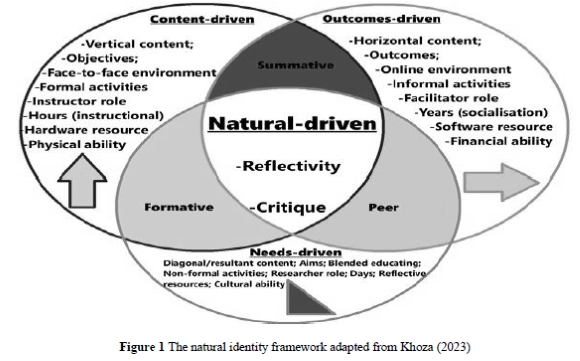
This article is framed by the natural identity framework (NIF), developed by Khoza (2023) in response to the COVID-19 pandemic in view of theorising the digitalised curriculum. According to Khoza (2023), the NIF addresses key questions in education: what (factual), how (social) and who (habitual), and goes beyond to answer the why question. Put differently, this framework underscores the pertinence of merging the ideologies that drive performance (what), competence-based (how) and pragmatic curriculum (who) in order to promote the process of knowledge-building. This denotes that NIF recognises the essentiality of professional, societal and personal contributions in education through the use of HW (content-driven), SW (outcomes-driven) and IW (needs-driven) resources (Khoza, 2025). This combination categorically helps learners to reflect on and critique their actions during the learning process in order to engage their future actions to help them acquire set outcomes (Makumane, Nkohla & Khoza, 2024). Khoza (2023:858) posits that "natural identity is the unconscious, subconscious and conscious cognitive process of believing that all actions and their outcomes are guided by natural laws, actions or forces." This implies that using the factual, social and habitual perceptions, learners should continuously re-reflect and re-critique in order to become aware of their own natural identity. In that way they would be in a position to answer the philosophical "why" question that helps them rationalise their choices. Figure 1 below shows a representation of the NIF.
Figure 1 demonstrates the principles of NIF, with the professional identity supporting factual perceptions as it is content-driven and subscribes to the use of LMS, while societal identity is bred by outcomes and SMSs. Personal identity ascribes to the notion of merging LMSs and SMSs while permitting learners to reflect and critique to appease their individual needs. This framework was deemed pertinent to underpin this study as it promotes the use of an equilibrated digitalised curriculum to promote self-sufficient individuals that acquire three categories: factual, social and habitual perceptions, that ostensibly contribute to the effective attainment of set outcomes through balanced knowledge building (Makumane, 2024).
Research Purpose and Research Questions
The purpose with this article was to explore learners' perceptions on the use of SMSs for an equilibrated digitalised curriculum. Thus, I aimed at addressing the following research questions:
1) What are the learners' perceptions on the use of SMSs for an equilibrated digitalised curriculum?
2) What informs these learners' perceptions on the use of SMSs for an equilibrated digitalised curriculum?
By addressing these questions, I aimed at highlighting the vitality of learners' perceptions in advancing or hindering successful attainment of prescribed objectives and anticipated outcomes. I intended to underscore the pertinence and essentiality of an equilibrated digitalised curriculum in honing a self-actualised and well-rounded individual for sustainable and lifelong learning.
Research Context
The study reported on here was conducted at one international school in Maseru, Lesotho, with a population of approximately 291 learners and 16 teachers at secondary school level. The said school adopted the use of LMS and SMS (WhatsApp) during the COVID-19 pandemic in view of continuing the teaching and learning process. However, the use of the LMS was abandoned when face-to-face classes resumed after hard lockdown. The use of some SMS platforms was maintained, albeit not officially as the school currently does not have a policy guiding effective use of technological tools and platforms. The use of technological tools without a clear exposition of a framework for the teaching and learning process might create uncertainty, anxiety and frustration (Mpungose, 2020a). This points to the need to conduct training workshops for teachers and learners, since the latter are deemed to be digital natives who use SMSs mostly for unstructured and socially influenced purposes with their peers (Makumane, 2023b). Khoza and Biyela (2020) explicate that digital natives are individuals born during the digital era and who are deemed to be conversant with Fourth Industrial Revolution (4IR) technology.
Research Methodology
The article is hinged on the interpretivist qualitative case study approach, which allows for deep understanding of the phenomenon being studied (Creswell & Creswell, 2018). Thus, in order to explore learners' perceptions on the use of SMSs for an equilibrated digitalised curriculum, a qualitative study was deemed suitable as it allows for multiple truths and participants' unique experiences (Merriam, 2014). Two sources of data, reflective journals and focus group interviews were used to generate data for the purpose of triangulation and authentication (Creswell & Creswell, 2018).
Four principles of trustworthiness were adopted to ensure credibility (truth value), dependability (consistency if replicated), transferability (applicability to other contexts), and confirmability (neutrality of the findings) (Guba & Lincoln, 1994). In terms of ethical considerations, participants were required to complete consent and/or assent forms for their participation in the study. Participants were also informed of their right to withdraw from the study any time should they decide to do so (Merriam, 2014). For purposes of protecting participants' identities, I asked learners to use their preferred pseudonyms.
Population and Sampling
Purposive and convenience sampling were used in the study. Creswell and Creswell (2018) define purposive sampling as a non-probability, intentional selection of participants who possess relevant and specific characteristics to help address the research objective(s) of a study. In this article, learners were purposively selected based on their use of SMSs for learning. Thus, 65 Grade 10 learners were selected as participants. Of the 65 learners, 30 were conveniently sampled as they showed interest in participating in the study by accepting consent and assent forms. Etikan, Musa and Alkassim (2016) aver that convenience sampling is non-random sampling in which targeted participants are selected based on ease of accessibility, availability and/or willingness to participate in a study. Nevertheless, 16 participants returned the signed consent and assent forms and formed the sample in this study.
Data Generation and Analysis
Focus group discussions and open-ended questionnaires were used to generate data in this study. As Shabina, Amit, Eram, Pranav and Deeksha (2024) state, focus group discussion is a process of gathering and interviewing participants together with the aim of generating credible data on a specified phenomenon. This method was used to triangulate data from participants whose perceptions either converged or diverged about a phenomenon. Seven of the 16 participants formed part of the focus group discussions as they indicated that they were willing to be interviewed. The remaining nine participants opted for completing the open-ended questionnaires, which were used to authenticate data generated in focus group discussions.
Data were analysed using thematical analysis. Dawadi (2020) posits that thematic analysis is used to systematically organise and analyse data sets into themes that produce insightful and trustworthy findings. Braun and Clarke (2012) assert that thematic analysis promotes inductive and deductive reasoning to make sense of collective meaning, perspectives and experiences through interactions with data. Deductively, themes were guided by the NIF, while unanticipated themes emerged inductively through active interaction with the data (Braun & Clarke, 2012). In the next section I present the data and the analysis thereof guided by themes.
Research Findings and Discussions
As highlighted earlier, the findings of this study are presented in themes that were derived both deductively (prior) and inductively from my interaction with data. The three themes are content-driven perceptions, outcomes-driven perceptions and needs-driven perceptions. The themes are presented in a narrative form and direct quotations are used to highlight the truth value (credibility) of the findings. According to Butina (2015), a narrative approach helps to relate participants' presences and exposes the researcher to the unique identities of different individuals.
Theme 1: Content-driven Perceptions
All participants who participated in the focus group discussions asserted that they used their phones for school work. For instance, Royal said: "I rely on my phone to do my school work. I use my phone to conduct research on anything that I would like to know or that I am curious about, that the teacher touched on in class" This was confirmed by Liz Wisley, who posited that "I use my phone to help me do my homework'" Interestingly, all participants echoed the same sentiments, highlighting their reliance on the phones in constructing "schooled knowledge."
Bernstein (1999) is of the opinion that schooled knowledge is systematically and hierarchically organised in a way that influences new ways of thinking through the use of cognitive facilities. In addition, schooled knowledge is discipline-based and deals with specific content of the subject-matter (Hoadley & Jansen, 2013). This assertion seems to situate the participants' affirmations in the content-driven perceptions as the learners seemed to regard their use of SMSs as promoting cognitive knowledge. In other words, learners' perceptions were factually inspired in that they seemingly depended on their phones to fortify and validate what was prescribed in the syllabus and/or curriculum of a specific subject or theme (Makumane & Ngcobo, 2025). This refers to the issue of following the performance curriculum, which is concerned with "high academic achievements that result in issuing qualifications or licences" through professional knowledge-building (Khoza, 2020a:248).
These findings resonate what was depicted in the open-ended questionnaires. For instance, Stacy William wrote: "I use my phone for study purposes like research, PDFs [Portable Document Format] and updates about the world." Ananas reiterated as follows: "I use my phone for communicating, learning, studying and exploring new things. " The other participants who responded in the reflective journals (Abagail; Winnie the Pooh; Joana P. Hinge; Auron Macwell; Pample Mouse; Mickoslow; and Alan the Alien) all mentioned using their phones for learning purposes through SMS platforms such as Pinterest, YouTube, Duolingo, XtremePapers, and WhatsApp.
Joana P Hinge said: "I use Duolingo for learning languages, YouTube for research purposes and tutorials'" In addition, Auron Macwell highlighted the following: "I use WhatsApp because we have groups for different classes where we get notes and homework. " These statements ostensibly highlight two sides of the coin: on the one hand, learners apparently appreciated the utility of SMSs for professionalisation purposes. In other words, participants seemed to take on and embrace the use of SMSs in addressing their subject needs and addressing the "what" question in education (Mpungose, 2020a). On the other hand, teachers embraced the use of SMSs by using platforms such as WhatsApp to distribute notes and homework. This is noteworthy as the school where the study was conducted had no underpinning theories and policy to guide the use of SMSs to support formal learning. This infers that teachers acknowledge the utility and practicality of SMSs in professional knowledge-building (Khoza, 2020b; Mpungose, 2020a).
These findings seem to imply that through the use of SMS, participants relied on face-to-face environments, where teachers acted as depositors of schooled-knowledge, while also incorporating the use of SMSs through the help of their respective disciplined knowledge, to reinforce learners' cognitive knowledge of the subject-matter.
Theme 2: Outcomes-based Perceptions
In this theme, participants demonstrated their reliance on SMSs to attain competences that helped them address their social needs through socialisation of knowledge. In the open-ended questionnaires, participants highlighted that they preferred a variety of SMSs to expand their horizons beyond the classroom, to decipher schooled knowledge and to break it down to everyday knowledge. In other words, participants mentioned that they had informal discussions with their peers about the content taught in order for it to make sense to them in a more comprehensible and relatable way. For instance, Winnie the Pooh wrote: "I prefer to use WhatsApp with my classmates and friends to make sense of the notes that we are sent in our class WhatsApp group. This helps me understand what I might not have understood in class. "
This assertion suggests that WhatsApp, which individuals use for communication purposes with their friends and family, may also be used to promote societal knowledge-building. Khoza (2020b) attests that learners may be good at socialisation, which may be heightened by their engagement with class activities and addressing societal needs. Yeo (2014) asserts that SMSs may be incorporated into a constructivist classroom as learning tools in order for learners to actively create their own meaningful learning experiences. In this way, SMSs help learners negotiate a social identity as knowledge is constructed within a given social context (Yeo, 2014).
During the focus group discussions, Lyla stated as follows: "I sometimes use TikTok to view certain channels which help me with maths and other subjects'" Jaquetta Blake added: "I use Quizlet to help me understand concepts that were difficult to understand in class." Interestingly, Lyla added that "some of our teachers recommend that we watch YouTube videos for better understanding." It is evident from this and other participants' comments (Master, Miss Thang and Liz Wisley) that learners may prefer to use SMSs to address their unique and preferred learning styles and to enhance their learning experiences. Anderson (2019) avers that social media tools enhance the chances of meeting learners' needs and expectations in the learning process, thus substantiating the above.
Sokhulu (2021) also highlights that SMSs support societal knowledge-building in that they promote connection, socialisation and sharing of content. However, it is necessary to mention that for SMSs to be used effectively, and notwithstanding the fact that most learners use them for their personal lives, learners needed to be formally trained on how to effectively use them in an educational setting (Mpungose, 2020a). This was particularly clear from a statement made by Alan the Alien who suggested that SMSs should be used less "because most of the time we get distracted while learning." "If I were to watch a video on YouTube, the homepage will show a video that will catch my attention and before I know it, I have spent 3 hours scrolling or watching videos", continued Alan the Alien. This statement points to the need of training learners to use SMSs for formal learning purposes, but also for learners to engage with their needs-driven perceptions.
Theme 3: Needs-driven Perceptions The participants' assertions in both the focus group discussions and in the open-ended questionnaires seemed to imply that they needed to rely on their unique experiences with technology to navigate both the HW and the SW. In other words, participants seemingly needed to rely on personal theories and ideologies. Makumane (2023a) underscores a crucial need for learners to engage their IW resources (pragmatic curriculum) "to control learning actions in order to achieve attained goals" (p. 94). This denotes that needs-driven perceptions are drawn from either content-driven and/or outcomes-driven perceptions. In this way, learners need to balance their factual perceptions (schooled knowledge) and social perceptions (everyday knowledge) for an equilibrated digitalised curriculum (Khoza, 2025; Makumane & Ngcobo, 2025; Nkohla, 2025). This intimates that learners may be in a position to decide on a user interface that addresses their unique and specific learning styles and needs while also ideally finagling professional and societal knowledge-building to move towards effective attainment of prescribed learning outcomes. It is noteworthy that attainment of the said outcomes could be maximised by exposure of the ideologies that inspired the development of each SMS being used for their efficient and optimised use (Makumane, 2023b).
Conclusion
The purpose with this article was to explore learners' perceptions on the use of SMSs for an equilibrated digitalised curriculum. Perceptions were categorised as factual perceptions, driven by performance curriculum and the use of HW resources; social perceptions, driven by the competence-based curriculum and the use of SW resources; and habitual perceptions, supported by the pragmatic curriculum through IW resources. The findings demonstrate that participants preferred to use SMS for both professional knowledge-building (schooled knowledge) and societal knowledge-building (everyday knowledge) (Bernstein, 1999). However, it surfaced that learners needed to engage their IW resources in order to navigate the nuances presented by the tenets of the content-driven and outcomes-driven perceptions in order to address their needs-driven perceptions. Notably, participants highlighted that they sometimes struggled to stay focused on their school work while using SMSs, especially in cases where they used platforms such as YouTube and Instagram, as they were presented with informal content that usually appeared while watching educational videos, thus causing unwarranted disruption of the learning process. This points to the need to have learners formally trained on how to effectively use SMSs in an educational setting in order to optimise attainment of set outcomes. I thus recommend that schools intentionally include SMSs in the digitalised curriculum, and to have policies that guide effective implementation thereof. Furthermore, there is need to train both teachers and learners on the optimised use of SMSs in order to inspire creative ways of using the newest technology in the classroom.
Notesi. Published under a Creative Commons Attribution Licence.
Acknowledgements
I would like to thank Ms L. G. Matee who critically read and edited this article.
References
-
Adedoyin OB & Soykan E 2023. COVID-19 pandemic and online learning: The challenges and opportunities. Interactive Learning Environments, 31(2):863-875. https://doi.org/10.1080/10494820.2020.1813180
» https://doi.org/10.1080/10494820.2020.1813180 -
Adnan M & Anwar K 2020. Online learning amid the COVID-19 pandemic: Students' perspectives. Journal of Pedagogical Sociology and Psychology, 2(1):45-52. https://doi.org/10.33902/JPSP.2020261309
» https://doi.org/10.33902/JPSP.2020261309 -
Amodu LO 2006. Perceptions: A determinant for effective communication. Sophia: An African Journal of Philosophy, 9(1):148-153. https://doi.org/10.4314/sophia.v9i1.38774
» https://doi.org/10.4314/sophia.v9i1.38774 -
Anderson T 2019. Challenges and opportunities for use of social media in higher education. Journal of Learning for Development - JL4D, 6(1):6-19. Available at https://files.eric.ed.gov/fulltext/EJ1212505.pdf. Accessed 7 April 2025.
» https://files.eric.ed.gov/fulltext/EJ1212505.pdf -
Bernstein B 1999. Vertical and horizontal discourse: An essay. British Journal of Sociology of Education, 20(2):157-173. Available at https://lchc.ucsd.edu/mca/Paper/JuneJuly05/BernsteinVerHor.pdf. Accessed 30 November 2025.
» https://lchc.ucsd.edu/mca/Paper/JuneJuly05/BernsteinVerHor.pdf -
Biesta G 2015. What is education for? On good education, teacher judgement and educational professionalism [Special issue]. European Journal of Education, 50(1):75-87. https://doi.org/10.1111/ejed.12109
» https://doi.org/10.1111/ejed.12109 -
Braun V & Clarke V 2012. Thematic analysis. In H Cooper, PM Camic, DL Long, AT Panter, D Rindskopf & KJ Sher (eds). APA handbook of research methods in psychology (Vol. 2). Washington, DC: American Psychological Association. https://doi.org/10.1037/13620-004
» https://doi.org/10.1037/13620-004 - Burn CC 2010. Perception. In D Mills, JN Marchant-Forde, PD McGreevy, DB Morton, CJ Nicol, CJC Philips, P Sande & RR Swaisgood (eds). The Encyclopedia of applied animal behaviour and welfare. Wallingford, England: CABI Publishing.
-
Butina M 2015. A narrative approach to quantitative inquiry. American Society for Clinical Laboratory Science, 28(3):190-196. https://doi.org/10.29074/ascls.28.3.190
» https://doi.org/10.29074/ascls.28.3.190 -
Catalano C 2022. The use of social media in online learning and teaching. In I Albulescu & C Stan (eds). Education, reflection, development - ERD 2021 (Vol. 2). European Publisher Limited. https://doi.org/10.15405/epes.22032.21
» https://doi.org/10.15405/epes.22032.21 -
Cenita JAS & De Guzman ZR 2023. Education in the digital world: From the lens of millennial learners. International Journal of Computing Sciences Research, 7:1816-1829. https://doi.org/10.25147/ijcsr.2017.001.1.132
» https://doi.org/10.25147/ijcsr.2017.001.1.132 -
Clement J 2020. Number of global social network users 2017-2025. Available at https://www.statista.com/statistics/278414/number-of-worldwide-social-network-users/. Accessed 24 November 2020.
» https://www.statista.com/statistics/278414/number-of-worldwide-social-network-users/ -
Colreavy-Donelly S, Ryan A, O'Connor S, Caraffini F, Kuhn S & Hasshu S 2022. A proposed VR platform for supporting blended learning post COVID-19 [Special issue]. Education Sciences, 12(7):435. https://doi.org/10.3390/educsci12070435
» https://doi.org/10.3390/educsci12070435 -
Culduz M 2024. Benefits and challenges of e-learning, online education, and distance learning. In L Gray & S Dunn (eds). Incorporating the human element in online teaching and learning. Hershey, PA: IGI Global Scientific Publishing. https://doi.org/10.4018/979-8-3693-4131-5.ch001
» https://doi.org/10.4018/979-8-3693-4131-5.ch001 - Creswell JW & Creswell JD 2018. Research design: Qualitative, quantitative, and mixed methods approaches (5th ed). London, England: Sage.
-
Dawadi S 2020. Thematic analysis approach: A step by step guide for ELT research practitioners. Journal of NELTA, 25(1-2):62-71. https://doi.org/10.3126/nelta.v25i1-2.49731
» https://doi.org/10.3126/nelta.v25i1-2.49731 -
Delello JA, McWhorther RR & Camp KM 2015. Using social media as a tool for learning: A multi-disciplinary study. International Journal on E-Learning, 14(2):163-180. Available at https://www.learntechlib.org/primary/p/41291/. Accessed 7 April 2025.
» https://www.learntechlib.org/primary/p/41291/ -
Efron R 1969. What is perception? In RS Cohen & MW Wartofsky (eds). Proceedings of the Boston Colloquium for the Philosophy of Science 1966/1968 (Vol. 4). Dordrecht, The Netherlands: Springer. https://doi.org/10.1007/978-94-010-3378-7_4
» https://doi.org/10.1007/978-94-010-3378-7_4 -
Etikan I, Musa SA & Alkassim RS 2016. Comparison of convenience sampling and purposive sampling. American Journal of Theoretical and Applied Statistics, 5(1):1-4. https://doi.org/10.11648/j.ajtas.20160501.11
» https://doi.org/10.11648/j.ajtas.20160501.11 - Guba EG & Lincoln YS 1994. Competing paradigms in qualitative research. In NK Denzin & YS Lincoln (eds). Handbook of qualitative research. Thousand Oaks, CA: Sage.
-
Henaku EA 2020. COVID-19: Online learning experience of college students: The case of Ghana [Special issue]. International Journal of Multidisciplinary Sciences and Advanced Technology, 1(2):54-62. Available at https://www.researchgate.net/publication/342586709_COVID19_Online_Learning_Experience_of_College_Students_The_Case_of_Ghana. Accessed 30 November 2025.
» https://www.researchgate.net/publication/342586709_COVID19_Online_Learning_Experience_of_College_Students_The_Case_of_Ghana - Hoadley V & Jansen J 2013. Curriculum: Organising knowledge for the classroom (3rd ed). Cape Town: Oxford University Press Southern African.
-
Kaushik V & Walsh CA 2019. Pragmatism as a research paradigm and its implications for social work research. Social Sciences, 8(9):255. https://doi.org/10.3390/socsci8090255
» https://doi.org/10.3390/socsci8090255 -
Khoza SB 2020a. Academics' "why" of knowledge-building for the Fourth Industrial Revolution and COVID-19 era. International Journal of Higher Education, 9(6):247-257. https://doi.org/10.5430/ijhe.v9n6p247
» https://doi.org/10.5430/ijhe.v9n6p247 -
Khoza SB 2020b. Students' habits appear captured by WhatsApp. International Journal of Higher Education, 9(6):307-317. https://doi.org/10.5430/ijhe.v9n6p307
» https://doi.org/10.5430/ijhe.v9n6p307 -
Khoza SB 2023. Can teachers' identities come to the rescue in the Fourth Industrial Revolution? Technology, Knowledge and Learning, 28:843-864. https://doi.org/10.1007/s10758-021-09560-2
» https://doi.org/10.1007/s10758-021-09560-2 - Khoza SB 2025. Curriculum rationale as witnessed by scholarly publications to the rescue of educating. In SB Khoza, MA Makumane & CB Mpungose (eds). Curriculum development and evaluation: Curriculum components in action. Boston, MA: Brill.
-
Khoza SB & Biyela AT 2020. Decolonising technological pedagogical content knowledge of first year mathematics students. Education and Information Technologies, 25:2665-2679. https://doi.org/10.1007/s10639-019-10084-4
» https://doi.org/10.1007/s10639-019-10084-4 -
Khoza SB & Mpungose CB 2022. Digitalised curriculum to the rescue of a higher education institution. African Identities, 20(4):310-330. https://doi.org/10.1080/14725843.2020.1815517
» https://doi.org/10.1080/14725843.2020.1815517 -
Makumane MA 2023a. Students' perceptions on the use of LMS at a Lesotho university amidst the COVID-19 pandemic. African Identities, 21(2):209-226. https://doi.org/10.1080/14725843.2021.1898930
» https://doi.org/10.1080/14725843.2021.1898930 -
Makumane M 2023b. What is the digitalised curriculum for: Qualification, socialisation and/or subjectification? International Journal of African Higher Education, 10(1):78-103. Available at https://www.ajol.info/index.php/ijahe/article/view/270668. Accessed 30 November 2025.
» https://www.ajol.info/index.php/ijahe/article/view/270668 -
Makumane MA 2024. Implementation or enactment principles underpinning the digitalised curriculum during the COVID-19 era in one Lesotho higher education institution. In KG Fomunyam (ed). Theorising curriculum in unsettling times in African higher education. Auckland Park, South Africa: UJ Press. https://doi.org/10.36615/9781776460618.05
» https://doi.org/10.36615/9781776460618.05 -
Makumane MA & Fru RN 2024. Learners' attitudes towards multilingualism: The case of French in Lesotho. African Identities, 22(2):258-276. https://doi.org/10.1080/14725843.2021.2008305
» https://doi.org/10.1080/14725843.2021.2008305 - Makumane MA & Ngcobo S 2025. An equilibrated use of factual, social, and pragmatic content to the rescue of French foreign language teachers in Lesotho. In SB Khoza, MA Makumane & CB Mpungose (eds). Curriculum development and evaluation: Curriculum components in action. Boston, MA: Brill.
-
Makumane MA, Nkohla, MB & Khoza SB 2024. Decolonising educational technology in a pragmatic curriculum: A systematic review. South African Journal of Higher Education, 38(3): 131-149. https://doi.org/10.20853/38-3-6357
» https://doi.org/10.20853/38-3-6357 -
Meena VK 2013. Role of social media in education. International Journal of Creative Research Thoughts (IJCRT), 1(3):857-860. Available at https://ijcrt.org/papers/IJCRT1133576.pdf. Accessed 7 April 2025.
» https://ijcrt.org/papers/IJCRT1133576.pdf - Merriam SB 2014. Qualitative research: A guide to design and implementation (3rd ed). Hoboken, NJ: Wiley.
-
Mpungose CB 2020a. Are social media sites a platform for formal or informal learning? Students' experiences in institutions of higher education. International Journal of Higher Education, 9(5):300-311. https://doi.org/10.5430/ijhe.v9n5p300
» https://doi.org/10.5430/ijhe.v9n5p300 -
Mpungose CB 2020b. Emergent transition from face-to-face to online learning in a South African University in the context of the Coronavirus pandemic. Humanities and Social Sciences Communications, 7:113. https://doi.org/10.1057/s41599-020-00603-x
» https://doi.org/10.1057/s41599-020-00603-x -
Nkohla MB 2025. Chronicling digital teaching at a South African historically disadvantaged comprehensive university: Navigating institutional culture for agricultural sciences academics. African Identities:1-19. https://doi.org/10.1080/14725843.2024.2439412
» https://doi.org/10.1080/14725843.2024.2439412 -
Qiong OU 2017. A brief introduction to perception. Studies in Literature and Language, 15(4):18-28. https://doi.org/10.3968/10055
» https://doi.org/10.3968/10055 -
Shabina S, Amit TK, Eram P, Pranav K & Deeksha G 2024. Focus Group Discussion: An emerging qualitative tool for educational research. International Journal of Research and Review, 11(9):302-308. https://doi.org/10.52403/ijrr.20240932
» https://doi.org/10.52403/ijrr.20240932 -
Shalini T & Priyadarsini P 2024. Effective use of social media platforms in the age of digital competition. Juni Khyat Journal, 14(5):174-182. Available at https://www.researchgate.net/profile/T-Shalini-2/publication/381614079_EFFECTIVE_USE_OF_SOCIAL_MEDIA_PLATFORMS_IN_THE_AGE_OF_DIGITAL_COMPETITION/links/667690ead21e220d89c87abc/EFFECTIVE-USE-OF-SOCIAL-MEDIA-PLATFORMS-IN-THE-AGE-OF-DIGITAL-COMPETITION.pdf. Accessed 30 November 2025.
» https://www.researchgate.net/profile/T-Shalini-2/publication/381614079_EFFECTIVE_USE_OF_SOCIAL_MEDIA_PLATFORMS_IN_THE_AGE_OF_DIGITAL_COMPETITION/links/667690ead21e220d89c87abc/EFFECTIVE-USE-OF-SOCIAL-MEDIA-PLATFORMS-IN-THE-AGE-OF-DIGITAL-COMPETITION.pdf -
Sokhulu LH 2021. Students' experiences of using digital technologies to address their personal research needs during the COVID-19 lockdown. African Identities, 19(4):436-452. https://doi.org/10.1080/14725843.2020.1801384
» https://doi.org/10.1080/14725843.2020.1801384 -
Tamrat W & Teferra D 2020. COVID-19 poses a serious threat to higher education. University World News, 9 April. Available at https://www.universityworldnews.com/post.php?story=20200409103755715. Accessed 7 April 2025.
» https://www.universityworldnews.com/post.php?story=20200409103755715 -
Van Deursen AJAM & Van Dijk JAGM 2023. IQ and digital inequality: An empirical investigation. New Media & Society, 25(6): 1248-1270. https://doi.org/10.1177/14614448211024012
» https://doi.org/10.1177/14614448211024012 -
Yeo MML 2014. Social media and social networking applications for teaching and learning. European Journal of Science and Mathematics Education, 2(1):53-62. Available at https://files.eric.ed.gov/fulltext/EJ1107719.pdf. Accessed 7 April 2025.
» https://files.eric.ed.gov/fulltext/EJ1107719.pdf
Revised: 16 October 2025
Accepted: 29 November 2025
Published: 30 November 2025