The effects of peer-based influence on career preferences of South African adolescent learners in a private school setting
Abstract
Upon successful completion of Grade 9, South African Senior Phase learners are expected to choose a total of 7 subjects for the Further Education and Training (FET) Phase of their schooling life, namely 3 years (Grades 10-12). These subject choices are most likely to influence the learners' future. With this study we investigated the nature of peer-group influence on FET-learners' subject choices in shaping the groundwork for their lifelong career development. Four FET participants aged between 15 and 16 years who had selected subjects in Grade 9 participated in the research. The data collected included 3 data sets: individual semi-structured interviews, individually crafted collages in a group setting and a focus-group interview at the school. The data gathered were analysed using qualitative content data analysis to identify themes and recurring patterns from the data. The findings show that 2 of the 4 participants had experienced positive peer influence during the process of selecting subjects for the FET Phase. One participant reported strong influence by parents and teachers in the selection of his subjects; another reported independently undertaking the process of selecting subjects. We advocate for contextually appropriate career guidance for learners in the Senior Phase for making informed career choices before entering the FET Phase of schooling.
career choice; career development; further education and training; higher education and training; peer influence; subject choice
Introduction and Background
In the South African education system, learners are expected to decide about their choice of school subjects for the final phase of their formal schooling and further study or work after completing Grade 12 (Naidoo, Visser, De Wet, Rabie, Van Schalkwyk, Boonzaaier, De Bruin, Shirley & Venter, 2019). Despite South African education undergoing significant education reforms to ensure that learners can realise their full potential, some learners are yet to receive equal access to education (Amery, Blignaut & Winchester, 2022). According to Schmidt (2017), South Africa's transformative curriculum policies are often overshadowed by poor implementation thereof, which is impacted by various school constraints. One can assume that such constraints are rooted in a long-standing, inequitable and racially grounded education system with limited equal education opportunities. During the apartheid regime (1948-1994), Black South African youths were confronted with limited career choices due to a poor secondary school curriculum and a lack of career guidance needed to support educational and professional avenues (Makola, Saliwe, Dube, Tabane & Mudau, 2021). As a result, many Black South Africans were deprived of independent decision-making, forcing them into unskilled or semi-skilled employment (Sefotho, 2017). It was, therefore, important that after 1994, adults encouraged the next generation to pursue available career opportunities that they and their families had once been refused.
Another stumbling block to career education was the scarce career guidance and counselling services available to almost all learners, particularly the disadvantaged majority. In this regard, Amery et al. (2022) maintain that South African educators must be equipped to work with learners of diverse backgrounds to eradicate the past injustices of the South African education system by adequately preparing learners with the knowledge and aptitudes for future career endeavours according to their individual interests, skills, and values.
The South African National Department of Basic Education ([DBE], Republic of South Africa [RSA], 2021) regards Grade 9 as a fundamental year of study in the life of South African learners in which they are expected to consider possible career options. The DBE, RSA (2021) advises that making subject choices at the end of Grade 9 assists learners in mapping out the field of study they can follow during the last phase of secondary schooling and beyond. With an inappropriate combination of school subjects that does not meet the entry requirements for tertiary education programmes set by the Department of Higher Education and Training (DHET), learners will likely face challenges accessing education programmes appropriate for their prospective careers. Incorrect subject choices for the last 3 years of secondary schooling leave learners with little room for review, flexibility and career alternatives.
It is crucial for educators, policymakers, and parents to guide learners in making informed subject choices which will empower them to make decisions based on their career-related preferences. The DBE appears to pay no heed to peer influence on subject choices by focusing on school and parent engagement in learners' subject choices for Further Education and Training (FET) and career-related decisions.
Apart from peer-based subject choices at the end of Grade 9, choices for the appropriate school subjects may be influenced by other social factors within learners' environment (Ajayi, Moosa & Aloka, 2022). In the absence of career guidance services available in public schools, coupled with challenges faced in local home and community contexts, learners make uninformed, trial-and-error decisions concerning their subject choices, jeopardising future career options (Naidoo et al., 2019). In contrast to Ajayi et al. (2022), Albien and Naidoo (2018) consider the lack of self-awareness of skills and abilities most detrimental to early career development. Therefore, due to ongoing social and cultural shifts in the South African world of work, we recommend that individual and social attributes influencing the process are taken in account (Patton & McMahon, 2014).
Limited South African research on decision-making regarding subject choices is available, especially concerning the current trends in the world of work. In searching for relevant and recent articles on the topic of secondary school learners' career choices based on Grade 9 subject choices, it appears that findings are available in dissertations and theses rather than peer-reviewed journal articles. Journal articles on the topic largely focus on the situation in other countries. Given the paucity of South African research focusing specifically on peer influence in Grade 9 subject and career decision-making, this study offers new, context-specific insight into how peer dynamics shape early career trajectories within a private school setting.
In this study, the term "career development" is regarded as the evolution of a long journey of career exploration, awareness, ambition, and individual interest impacted by exposure to societal, socioeconomic, and educational influences on career development.
Literature Review
Relevance of systems theory on peer-influenced subject choices
Developed by Ludwig Von Bertanlanffy in the 1920s, systems theory is a holistic approach to understanding complex systems across various fields. It emphasises the interconnectedness and interdependence of components within a system. Systems theory views a school as a unified, purposeful organisation comprising interrelated parts. It helps us understand the relationship among the parts, for example, the role of peers in FET learners' Grade 9 subject choices (Elujekwute, Umar, Danburam & Uwalaka, 2022).
The system is a set of interrelated networks subject to ongoing changes (Puteh, Kaliannan & Alam, 2015). When exploring the effects of peer-group influence on learners' Grade 9 subject choices, it is essential to recognise the internal or external dynamics in the system that influence their career choices. Hence, a minor contribution from a peer is likely to affect a learner's Grade 9 subject choices and, subsequently, their career trajectory (Puteh et al., 2015).
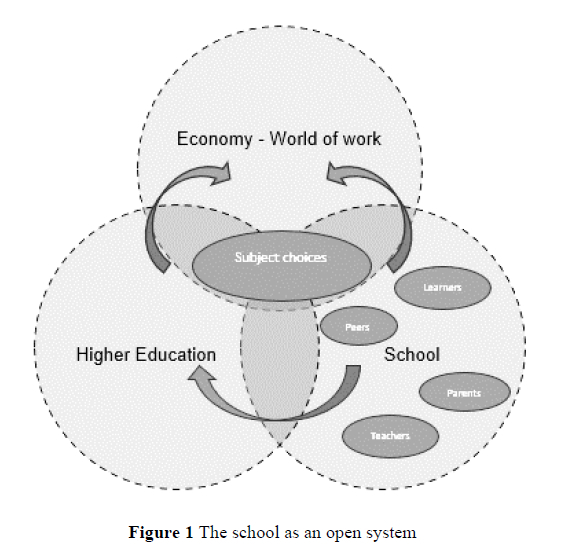
Thus, the participants' school can be regarded as an organisation because of its parts, the relationship between these parts, and the interwoven nature of its function (Elujekwute et al., 2022). The school system is not a closed system as it is impacted by the higher education system and the economic system (namely, the world of work) in the country (see Figure 1).
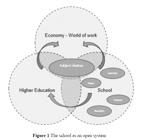
Successful completion of Grade 9 dictates that learners choose seven subjects to obtain the National Senior Certificate (NSC) in Grade 12 before entering higher education and training (HET). This means that the participants' Grade 9 subject choices will ultimately affect their entry into the world of work.
An emerging trend or concern, such as peer influence in the school's Grade 9 subject choice selection process, may be approached by first examining its relevant sub-systems, namely, peer networks within the secondary school system of the country's education system. Systems theory, therefore, assists our understanding of the presence of participants' peer networks as a sub-system within the school system. These networks influence the mandatory Grade 9 subject choice process, which feeds into the HET and economic systems (Elujekwute et al., 2022). Systems theory is applied in analysing peers' influence in Grade 9 learners' subject choices, which are integral to their career development. In essence, the focus is on the interaction between the parts in understanding how the school system functions and the outcomes of its operations (Puteh et al., 2015).
A key aspect of systems theory is that it leads to an understanding of a learner's personal, family, academic, and socio-economic circumstances as influencing factors in choices (Khuzwayo, 2020). Khuzwayo (2020) encourages school management teams to begin with inward analyses of their schools' subsystems to better understand the function of fellow peers' and significant others' roles in learners' Grade 9 subject choices.
However, critics of systems theory, such as Elujekwute et al. (2022), raise several vital concerns. They argue that it can oversimplify complex phenomena, emphasising interaction over the unique characteristics of components. Applying systems theory may, therefore, be challenging and may not provide transparent methodologies for real-world implementation.
Systems theory should be considered since it opens channels for feedback and adaptation (Khuzwayo, 2020). The South African career education system remains deficient regarding the practicalities of learners' subject choices and teachers' educational obligations (Khuzwayo, 2020). Systems theory is, therefore, helpful in providing desired feedback of this study's findings to schools as sub-systems to contribute towards developing career guidance in the FET Phase.
Despite the great potential of shared subject choice information among peers, knowledge transfer among peers is also challenging (Puteh et al., 2015). Learning from peers is often associated with frustration, helplessness, and directionlessness should reliable support on subject choices be unavailable - a "swim-or-sink" approach to coping with the demands of subject choices (Puteh et al., 2015:91).
Peer relationships in adolescence have been shown to shape emotional well-being, with positive peer support linked to better mental health and negative peer dynamics associated with increased stress, anxiety and depression (Allen, Greenwood, Berger, Patlamazoglou, Reupert, Wurf, May, O'Connor, Sanson, Olsson & Letcher, 2024; Li, Huang & Sun, 2025). Peer pressure also predicts aspects of career decision-making, as adolescents weigh their own interests against those of their friendship groups and may be steered towards specific subjects or careers by peers (Mtemeri, 2020).
While much global research examines peer influence, a dearth of South African research exists on how peers influence the mandatory Grade 9 subject choices stipulated by the DBE, and on the influence of these proximal networks. Bridging this gap between international literature and the South African context is challenging. With this study we aimed to uncover the potential impact of peer-group influence on Grade 9 subject choices, which serves as the foundation for lifelong career development.
In the following section we outline the methodological decisions congruent with the required ethical considerations.
Research Methodology
Research Design
We employed a generic qualitative research design to understand the research phenomenon of this study, namely, subject choices, the process involved in choosing subjects at the end of Grade 9, and the personal worldviews of the participants involved. According to Kennedy (2016), generic qualitative inquiry enables the exploration of participants' subjective viewpoints. In this study, a qualitative enquiry allowed for the reflection on Grade 9 participants' experiences on peer-group influences on their career development journeys in a private school setting.
In this study we adhered to the ethical guidelines established by the Faculty of Education Research Ethics Committee at the affiliated university, which granted approval for the research (Ethical Clearance Number: 2018-024). We also declare no conflicts of interest.
Method of Sampling
Purposive sampling was used to identify and select participants who were well-informed on the phenomenon of interest. The selected participants were FET phase learners between the ages of 15 and 16 who had undergone the process of selecting compulsory and elective school subjects at the end of their Grade 9 year as prescribed by the DBE. The participants were based in the Gauteng province in an English-medium, independent school with a Catholic educational tradition. In this article, a "private school setting" refers to such independent, fee-paying schools that operate outside the public DBE system while still following the national curriculum and serving learners from diverse backgrounds.
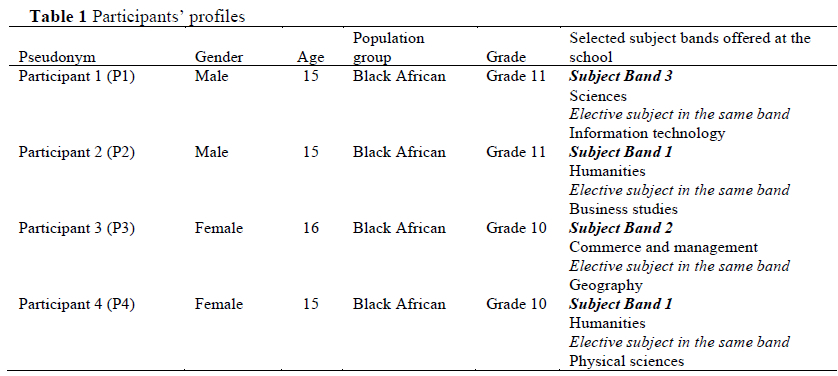
Table 1 presents participants' profiles indicating their selected subject bands. The combinations of subjects (bands) chosen by the participants were assumed to indicate the learners' interests in specific career fields, which significantly impacted the course options available to them in pursuing their tertiary education goals. Consent forms were sent to each participant and their parents to confirm their participation. Pseudonyms were used during the reporting phase of the study. Table 1 illustrates the codes used by each participant to ensure anonymity and confidentiality.
Given the exploratory nature of this generic qualitative study and the feasibility parameters of a postgraduate study, a small, information-rich sample was deemed appropriate. Rather than aiming for generalisation, working in depth with four FET learners who had recently completed their Grade 9 subject choices enabled a nuanced understanding of how peer influence, significant others and school structures shaped their decision-making.
Table 1 shows the participants' selected subject bands, which comprised a combination of two core subjects and an additional subject (elective). The school where the participants were enrolled prescribed the selection of a combination of subjects (bands) indicative of learners' career field interests based on their choice of subjects. In turn, this had an impact on the course options available to them in pursuit of tertiary education programmes.
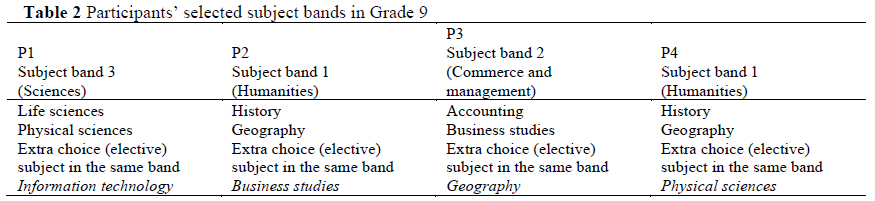
Subject Band 3, selected by Participant 1, included life sciences and physical sciences subjects, with information technology (IT) as an elective in the same band. The DBE, RSA (2021) advises learners to determine the appropriate combinations of school subjects to avoid potential risks of being unable to enter higher or further education programmes. Subject Band 3 represents the sciences career cluster. Medical and health sciences, engineering, biological sciences, environmental sciences and natural sciences are career field possibilities represented by this subject band.
Subject Band 1, selected by Participant 2 and Participant 4, included history and geography with business studies and physical sciences as electives in the same band. Subject Band 1 falls under the humanities career cluster. Communication, journalism, community development, information sciences, linguistics, philosophy, political science, psychology, social sciences, social work and visual arts are appropriate career options for both participants.
Subject Band 2, selected by Participant 3, encompasses accounting and business studies subjects with geography as an elective in the same band. Subject Band 2 reflects the commerce and management career cluster. Mechanical, electrical, civil engineering, architecture, and business management are potentially appropriate career fields for this participant.
Data Collection Methods
The methods for data collection on FET learners' subject choices are described below.
All participants were interviewed individually. The same set of questions was asked separately, with some flexibility in the sequence of the questions.
A focus-group interview was conducted to focus on the inquiry of this study by exposing learners to their peers' views and perspectives. Ideas conveyed by the participants in the group interview allowed for identifying questions and other relevant aspects of the phenomenon under study. Interviews and the focus-group discussion were audio-recorded and lasted between 45 and 60 minutes.
Participants were allowed to create personalised collages to represent their Grade 9 career choices on plain canvases using crafts and materials.
We made field notes to supplement information from the participants' collages, interviews, and research data to organise and manage the data collection and analysis process. Field notes were also used for personal impressions about the events, comments on the research method, records of potential and existing ethical issues and hypotheses about the data analysis.
Before giving informed consent for participation, all participants were informed of potential risks and consequences of the study. Participants were also informed about the datagathering techniques. Informed consent was documented using written consent forms approved by the institution, and confidentiality was maintained by non-disclosure of personal information, unless permitted by the participants involved. Qualitative criteria relating to trustworthiness, including credibility, transferability, dependability and confirmability, were ensured using a second coder's verification of the interpretation of the data.
Data Analysis
In this study, qualitative data analysis established how participants made meaning of the phenomenon by analysing their perceptions, understanding, attitudes, values, feelings and experiences to approximate their construction of the phenomenon (Nieuwenhuis, 2010). Qualitative content analysis was applied to study the data from different angles by identifying notable areas in the text, coding these meaning units, and grouping them into categories and themes that provided rich descriptions of participants' Grade 9 subject choice experiences and their impact on lifelong career development (Zhang & Wildemuth, 2017).
We followed the eight methodical steps proposed by Zhang and Wildemuth (2017) for data analysis. Interview transcripts, collage discussions and field notes were read several times for sound understanding before coding was conducted manually, line by line, to capture significant statements, phrases or sentences relevant to the research question. Initial codes were then compared, refined and clustered into broader categories through constant comparison across the three data sets (individual interviews, focus-group interview and collages). Meanings of significant statements were developed and organised into a collection of themes in response to the overarching research question. Subsequently, similarities and/or differences among the themes were identified and grouped into broader themes. No qualitative data analysis software was used; coding and theme development were completed manually, and a second coder, the study supervisor, reviewed the coding framework and thematic structure to enhance credibility. Data saturation was reached once data no longer contributed to the generation of new themes for further insight into the research question.
Findings
The four main themes identified somewhat reflect the significance of peer influence on the participants' chosen school subjects at the end of the senior phase of schooling for determining their individually preferred career choices.
Theme 1: Influence of Peers The theme indicates the role of peers in participants' Grade 9 mandatory subject choices as an important aspect. Data analysis of the semi-structured and focus group interviews indicates that two participants experienced a positive impact from their peers during the Grade 9 subject choice process. Meanwhile, one participant was influenced by a combination of input from a parent, uncle and teacher, while another indicated that she made her subject choices independently.
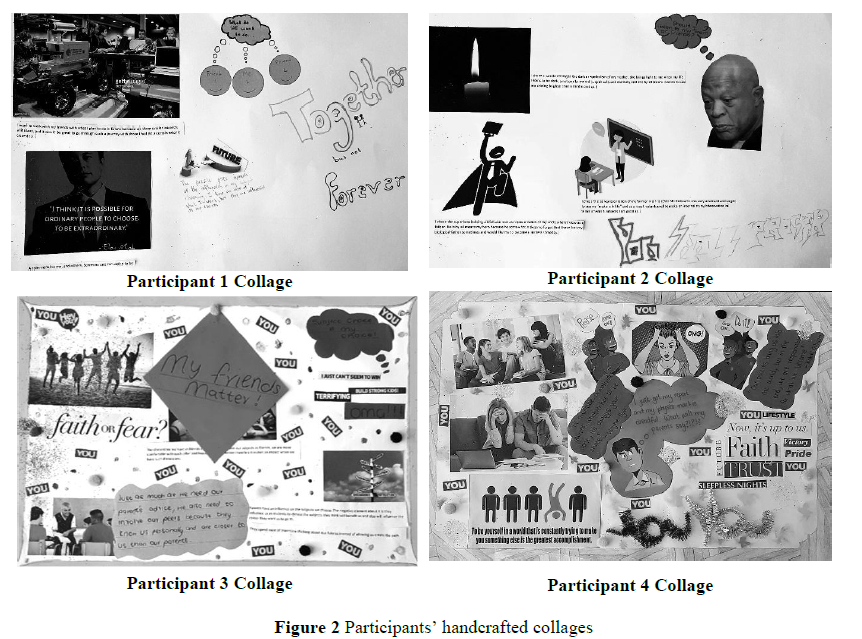
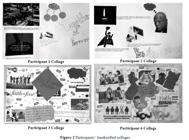
During the collage-making session, participants had the opportunity to craft their career collages individually in the others' presence. This led to "natural" conversations between the participants, which aided them in engaging in discussions on various topics throughout the session.
According to P1 and P3, the role peers in their Grade 9 subject choices contributed to determining their career choices. For example, in his collage, P1 included a diagram, 'What do WE want to do...', which indicated peer collaboration during his Grade 9 subject selection: "It-it shows that, you know, it was more, it was a group thingy, ... like we-we-we, we all had influences on each other and yeah, in our choices of subjects'" P3, in agreement, emphasised that peer familiarity played a more crucial role in shaping learner subject choices:
Ifeel like they played sort of like a big role because then they knew me and we, we all had the same denominator which is, do not involve parents, because they don't write your exams, so we would influence {laughs} each other and we would tell each other uhm ... what we think ... suitable for you and is comfortable, or we would just advise you to do better if you are interested in a certain subject.
In contrast, P2 and P4 indicated less peer influence in their decision-making. Their choices were primarily shaped by parental guidance, family input, teachers, and personal preferences. In his response, P2 noted that "peers were not necessarily involved because I had like ... a very strong support structure coming from my teacher and my, my family, so ... peers didn't necessarily have much of an influence of what subjects I chose." Interestingly, P4 highlighted the importance of independent decision-making over the influence of peers, parents, family and teachers. She believed that friends had little impact on her choices, as she prioritised making decisions independently. In her view, friends were not influential in her choices: "So if I'm with my friends, it wouldn't matter because if they 're good at it and I'm not, then they gonna pass and I'm gonna fail. So, I don't see the point in my friends' opinions."
Among some pictures depicting strong parental, familial and teacher influence on his selection of subjects, P2 associated an image of a burning candle with his mother as a source of guidance in his selection of subjects. In contrast to P2, who experienced a strong influence from parents and family in the subject selection process, P3 highlighted the greater importance of peer familiarity over parent influence on the choice of subjects. "They matter because parents feel like your friends will not influence you in the right path, so what I'm trying to emphasise is your friends know you better than your parents at most times and it is uhm . sometimes important for us to actually put into consideration that our friends do matter and they could have some sort of influence on what we do." In P4's collage, reference is made to the negative consequences of peer influence in the subject selection process. P4 further attempted to illustrate the overwhelming pressure placed on learners by their peers in the selection process. Phrases such as "please", "come on", "go on", and "do it" describe how peers aim to persuade learners to make peer-dominated subject choices.
Three of the four participants in the focus-group interview reported that they were satisfied with their collages and did not express the need to add additional pictures, words and phrases about their peers' role in their Grade 9 subject choices. P2 expressed that he would have liked to include an image of friends engaged in an open discussion, envisioning their futures together by adding: "I think, that picture with the friends, I should have added that like in terms of... coz then, even in my journey of choosing my subjects, I was very narrow-minded. "
Theme 2: Influence of Significant Others
Theme 2 highlights the role of parents, family and teachers as key influences in the participants' subject choices. Apart from P2, who identified parents and teachers as significant influences on his subject choices, the remaining participants viewed parent and teacher involvement as obstacles to effectively planning their future careers. During the individual semi-structured interview, P2 said: "It was my mother, my previous maths teacher and my uncle'" Although P3 was predominantly influenced by her peers, she alluded to some influence by her parents and teachers.
I had to involve my parents in this because they had to have a say. And I asked them, and I also looked at my results at the end of the year and that's how I chose my subjects. My teachers. I had to ask them if my results were good enough for me to actually do that subject.
Despite alluding to being influenced by peers, Pi's individually crafted collage conveys the role of parents in the subject selection process as financial investors in their children's education. P3 agreed with Pi's idea of the demanding parental role in the selection process and further added that parents should avoid taking part in the selection process. "Parents must first keep quiet when it comes to choosing subjects'' P4 agreed with Pi's idea of parents as highly influential financial figures in their children's subject choices. Pi said: "Exactly, it is like, why should they not choose? They are paying for everything. 'Hey, I am investing in you.'" P3 felt that it was important to share her perspective on parental influences in the subject selection process: "... you know, our parents have an influence on the subjects we choose, but the negative element about it is that they influence us as students to choose subjects that they think will benefit us and also will influence the career they want us to go into, and they spend most of their time thinking about our futures instead of allowing us to create our own paths'' P4 portrayed the teachers' demanding role in learners' selections:
I feel like, a teacher when you do a subject, and if they like you, then they say you must do it next year. Do it next year, do it next year! You are going to pass! You are going to pass. They give you so much hope that you are going to pass. The work is going to be different, so you do not know how you are going to do.
During the focus group interview, only P1 had expressed that he would have liked to have added a picture about his teachers' role in his subject choices:
... maybe I did forget about the influence from the teachers, coz yeah ... they, they are a lot. And they're also information how well you do in that subject as yeah, as, as they 're the ones that'll be teaching it, I guess.
Theme 3: Choice of School Subjects This theme shows the subject that the participants chose at the end of Grade 9. Table 2 shows the subject bands selected by the participants. They chose a combination of subjects (bands) that were more likely to indicate their career field interests, bearing an impact on the course options available to them in pursuit of obtaining their Higher Education and Training Certificates (HETCs).
While crafting their individual collages, P1 expressed his preference for accounting and said that he would have preferred to pick this subject if learners like himself were not required to adhere to the limited subject band options offered by his school. "Actually I would do accounting if there wasn't you know this bands thingy." P4 expressed her preference for the visual and dramatic arts, which fall under the art career cluster comprising learning fields such as visual arts, dramatic arts, dance, music and design. P4 would have preferred to have picked this band of subjects rather than the humanities band if learners like herself were not required to adhere to the subject band options offered by her school.
I was going to do visual arts and dramatic arts instead of geo and history, but I really like arts. I don't know what happened. I chose geo and history. If I could I would do visual arts, geography and physical science. It is because of the bands.
We must note that, apart from the parental influence involved in Pi's subject choice, subject bands offered at the school emerged as an additional influence on his Grade 9 subject choices. From P4's response about her preferred subject choices, it was evident that the school's subject band requirements had a significant influence on her subject choices.
P4 pointed to one significant picture in her collage with which she attempted to depict her view of one of her chosen subjects. P4 connected parental influence to her elective subject in one of the school's subject bands. "And then, here, this boy says, 'I just got my report and my physics mark is dreadful. What will my parents say?"' P4 appeared to connect this image with her performance in physical sciences, indicating her dislike for the elective subject and the potential repercussions of her parents' feedback.
This theme is relevant because it shows just how prominent subject bands were in the course options available to participants in pursuit of their HET accreditation. It also shows the restrictions of the requirements for compulsory subject choices and their influence on the participants' envisioned career paths.
Theme 4: Career Aspirations
The fourth and final theme encompasses findings on the participants' aspirations for future employment. By examining their ambitions more closely, the participants' career aspirations were essential to their subject choices.
Detailed analysis and data triangulation from the participants' semi-structured interviews suggest that each of the four participants had specific careers in mind. When answering the question about their future career aspirations, the participants reported as follows.
P1: I want to be a roboticist.
P2: I'd say teaching is one of them ... becoming a geologist or a psychologist.
P3: At this moment, I am in the process of creating my brand, a beauty brand. So, I'm in the process of that, and then in the next 5 years, I would want for it to be an actual company and for me to have my ... my factory that distributes everything that I need and then for university, I was thinking of business management, because I'm gonna be a business owner. So, I would want business management in order for my business to carry on and how to manage my business and to make it grow, because my dream is to make it international. P4: I see myself travelling the world. Yeah, I really want to travel. Well, I had last year then it changed, like, every year it changes. Ya. Well now, since I do geography, I wanted to do something that has to do with the environment . So, I wanna help people . learn more about farming and how they can improve like the amount of crops that they grow and stuff, yeah I wanna do that! I like helping people.
The analysis and triangulation of the participants' collages indicate that three participants pointed to their career choices using visual images associated with their future aspirations. In Pi's collage, a picture of Elon Reeve Musk as a well-known technology entrepreneur, investor and engineer, signified Pi's career interest in engineering and computer science, namely robotics. P1 associates this picture with the possibility of someone ordinary like himself becoming a well-known roboticist in the near future. P3 associated a picture of a street sign as a means of directionality towards the available career options or pathways available to her and her peers regarding their career aspirations. In P4's collage, continued reference was made to her preference for independent career choices. "Our parents bring us into the world, but in the end, we are responsible for what we become" P4 highlighted her preference for independent decisionmaking on her future career. "7ou", "Now it's up to you", "Faith", "Trust", "Future", "Sleepless nights", "Victory" and "Pride."
This theme reveals the participants' intentions and attitudes towards pursuing their desired careers. Their shared career aspirations were regarded as those that played an essential role in their mandatory Grade 9 subject choices, which were particularly aimed at the careers that they wanted to pursue in the future.
Discussion
The findings were organised into four main themes and evidence from all data sources was combined to create a detailed discussion. In the first theme, "Influence of peers", we indicate how peer influence affected FET learners' career choices. It highlights the essential role that peers play in shaping learners' subject choices at the end of the Senior Phase of schooling, impacting future career preferences. Some participants found that their peers significantly influenced their subject choices after Grade 9, which they regarded as beneficial. Ajayi et al. (2022) agree that peer-shared knowledge, advice and reassurance are significant contributors to career decision-making. In addition, Slaten and Baskin (2014) suggest that peer relationships contribute to understanding learners' career uncertainty during their high school journeys.
This study underscores the need to integrate peer influence into decisions on subject choices alongside the roles of parents and teachers. Addressing peer pressure is vital for understanding its impact on career choices. Educators and caregivers should consider learners' peer groups and career interests during crucial decision-making. Ajayi et al. (2022) suggest that teachers should adopt a diverse approach when developing vocational decision-making programmes for secondary school learners. Incorporating peer influence into the life orientation curriculum - covering school subjects, career fields and job market trends is believed to better support learner's career decisions.
According to the DBE, RSA (2021), subject choice implies the subject selection process in which Grade 9 learners are required to select a limited number of school subjects at the end of their Senior Phase of schooling. This Phase provides a firm grounding upon which learners can make informed decisions about the subjects they will take in Grade 10 to 12, namely the FET Phase of schooling (DBE, RSA, 2012). Our research reveals that while parents' and teachers' influences were notable, participants perceived their involvement as a hindrance to their future career planning. Participants generally viewed parents' and teachers' roles as stumbling blocks. However, despite these constraints, the positive impact of peer influence on their subject choices and future career preferences was significant and satisfying for most.
Contrary to these findings, Datar and Ahmad (2019) advocate for diverse career guidance programmes for teachers to strengthen teacher-learner interaction in selecting careers aligned with career interests and talents. This gap underscores the need for teacher-based referrals to school-based career counselling services, focusing on the realities of career fields and the educational requirements for FET learners' desired career endeavours.
Theme 3, "Choice of school subjects", confirms that the subject bands selected by the study participants significantly impacted their higher education options. As a result, few participants expressed that they would have chosen different subjects or subject bands if their school's subject band options hadn't restricted them. Supporting learners during this decision-making phase requires urgent attention through school planning and policy. This need is highlighted by participants' reported challenges, such as limited subject options and constrained decision-making timeframes, although it seems as though these constraints diminished over time.
The fourth and final theme, "Career aspirations", reveals participants' desires for future employment by examining their intentions and attitudes towards pursuing their preferred occupations. This theme confirms that the FET participants had clear career goals and intentions for their considered career trajectories. Following the participants' career aspirations, Du Plessis and Ahmed (2020) found that FET learners demonstrated significant career ambitions and high future expectations. They identified hope, a considered form of learner capital, as a key factor in supporting learners' pursuit of their goals (Du Plessis & Ahmed, 2020). We contend that individual semi-structured interviews, focus-group discussions and personalised collages enabled participants to articulate their career intentions. This method effectively highlights that these learners have well-defined career goals.
It would be helpful to track the study participants in their lives after secondary school to determine whether their subject choices had any bearing on what they had aspired to become and whether these choices were predictors of long-term career success. In a study like this, it would be interesting to note what enabled the participants to achieve or what hindered their career goals and pathways.
Given the lack of context-specific research on how adolescents make career choices in the presence of their high school peers, this study is both timely and relevant. It offers valuable insight into how secondary school learners' relational networks impacted career decisions, moving beyond abstract individual models. Anchored in Indigenous theoretical practices within South African career psychology, the research enhances its applicability and relevance.
The various data collection methods (data sets) allowed for an in-depth exploration of the data and its triangulation. The triangulation of the data collection and analysis is known to establish credibility and determine potential discrepancies in a study's findings (Nieuwenhuis, 2010). In this study, data analysis demonstrated similarities between the data sets.
One significant limitation of this study is the small sample size (n = 4) of Grade 10 and Grade 11 learners from a single private school, which constrains the transferability of the findings to the broader population of FET phase learners who had made subject choices at the end of Grade 9. Consistent with the aims and scope of a study at master's level, generic qualitative inquiry, the intention was depth of understanding rather than generalisability, and we, therefore, do not claim that the results can be generalised to other contexts.
This study establishes the groundwork for future research examining how peer influence impacts the subject choices of Senior Phase learners, shaping their preferred post-secondary educational pathways as they transition into the FET Phase of South African schooling. Research using a larger sample size could be conducted and could include learners from different types of schools, including schools in urban areas, townships and informal settlements. This suggests the need for a comparative study on the impact of peer influence on subject choices among Senior Phase learners. Both female and male FET learners should be included to determine the role of gender on learners' subject choices.
Future research should examine the role of parents, caregivers, and teachers in providing advice on compulsory subject choices within the learning context. Considering such diversity would provide a holistic picture of what influences South African learners' subject choices.
These findings offer practical insight for strengthening life orientation pedagogy and school-based career guidance by encouraging peer-informed, collaborative approaches to Grade 9 subject choices, including a more transparent, structured subject selection processes that explicitly show the implications of subject bands. The findings also highlight the need for DBE policy refinements that acknowledge learners' peer networks and school structures as influential components in subject choices and early career decision-making, and for life orientation curricula to integrate more explicit, contextually grounded career and subject-choice education.
Viewed through a systems theory lens, this implies that life orientation and subject teachers should be supported through school-based professional development to map and respond to the interacting influences of peers, families, subject-banding and institutional policies when facilitating subject choices in Grade 9 (Khuzwayo, 2020; Patton & McMahon, 2014). In practical terms, such professional development could include collaborative system-mapping workshops where teachers trace how peer networks, family expectations and subject-banding rules intersect in real Grade 9 cases and plan coordinated guidance responses. Pre-service and in-service programmes could also use simulations and case-based discussions to build teachers' confidence in working with peer groups and caregivers when supporting subject-choice decisions from a systems perspective.
Conclusion
In this research we explored the effects of peer influence on learners' Grade 9 subject choices, which are essential for future career trajectories. The participants in this study reported that the role of peers in their mandatory Grade 9 subject choice selection was somewhat noteworthy.
Parents, family, teachers and prescribed combinations of subjects (bands) on the participants' subject choices were rather perceived as interferences to successfully executing their future career expectations. Thus, it is important to note the contrast of peer influence on participants' mandatory Grade 9 subject choices for their intended post-secondary school career trajectories. In acknowledging the limitations of this research, the findings emphasise the need for contextually appropriate career guidance practices in secondary schools.
The findings offer noteworthy points for stakeholders to consider in the career development of learners who need to make subject choices at the end of the Senior Phase, despite uncertainty about their future careers. Systems theory allows for collaborative interaction by stakeholders because of the open communication channels in a functioning system (Mhlongo & Zondo, 2022).
Notesi. This article is based on the Master of Education dissertation of Aygul Salieva Mehmedova.
ii. Published under a Creative Commons Attribution Licence.
Authors' Contributions
ASM conducted the study, analysed the data and prepared the manuscript. BMD supervised the research and contributed to the intellectual development and refinement of the manuscript. Both authors reviewed and approved the final version.
Acknowledgements
We acknowledge the learners whose participation, perspectives and creative contributions informed this study.
References
-
Ajayi OB, Moosa M & Aloka PJO 2022. Influence of selected social factors on career decision-making of grade 12 learners in township secondary schools in South Africa. Journal of Education, 89:105-121. https://doi.org/10.17159/2520-9868/i89a06
» https://doi.org/10.17159/2520-9868/i89a06 -
Albien AJ & Naidoo AV 2018. Barriers and enablers for career development among marginalized South African youth. In V Cohen-Scali, J Rossier & L Nota (eds). New perspectives on career counseling and guidance in Europe. Cham, Switzerland: Springer. https://doi.org/10.1007/978-3-319-61476-2_10
» https://doi.org/10.1007/978-3-319-61476-2_10 -
Allen KA, Greenwood CJ, Berger E, Patlamazoglou L, Reupert A, Wurf G, May F, O'Connor M, Sanson A, Olsson CA & Letcher P 2024. Adolescent school belonging and mental health outcomes in young adulthood: Findings from a multi-wave prospective cohort study. School Mental Health, 16:149-160. https://doi.org/10.1007/s12310-023-09626-6
» https://doi.org/10.1007/s12310-023-09626-6 -
Amery E, Blignaut S & Winchester I 2022. The role of intercultural education in a Bachelor of Education program at Nelson Mandela University in South Africa. Interchange, 53:261-281. https://doi.org/10.1007/s10780-022-09456-6
» https://doi.org/10.1007/s10780-022-09456-6 -
Datar T & Ahmad 2019. The effect of career information service on improving students' career understanding. Jurnal Psikologi Pendidikan & Konseling, 5(2):97-103. https://doi.org/10.26858/jppk.v5i2.7107
» https://doi.org/10.26858/jppk.v5i2.7107 - Department of Basic Education, Republic of South Africa 2012. National policy pertaining to the programme and promotion requirements of the National Curriculum Statement Grades R - 12. Government Gazette, 570(36042):1-8, December 28.
-
Department of Basic Education, Republic of South Africa 2021. Subject choice and career pathing. Available at https://www.education.gov.za/Informationfor/Learners/SubjectChoiceandCareerPathing/tabid/980/Default.aspx. Accessed 14 October 2023.
» https://www.education.gov.za/Informationfor/Learners/SubjectChoiceandCareerPathing/tabid/980/Default.aspx -
Du Plessis A & Ahmed L 2020. Exploring the anticipated career aspirations of youth in a rural secondary school: A visual participatory approach. Educational Research for Social Change, 9(2):47-64. https://doi.org/10.17159/2221-4070/2020/v9i2a4
» https://doi.org/10.17159/2221-4070/2020/v9i2a4 -
Elujekwute EC, Umar I, Danburam IU & Uwalaka MC 2022. Relevance of the system theory to the effective and effeicient management of education in Nigeria. Sapientia Foundation Journal ofEducation, Sciences & Gender Studies, 4(3):277-284. Available at https://www.sfjesgs.com/index.php/SFJESGS/article/view/334. Accessed 25 October 2024.
» https://www.sfjesgs.com/index.php/SFJESGS/article/view/334 -
Kennedy DM 2016. Is it any clearer? Generic qualitative inquiry and the VSAIEEDC model of data analysis. The Qualitative Report, 21(8):1369-1379.https://doi.org/10.46743/2160-3715/2016.2444
» https://doi.org/10.46743/2160-3715/2016.2444 -
Khuzwayo QO 2020. The systems theory conceptualised and pasted to teaching and learning. International Journal for Innovation Education and Research,8(10):1-16. https://doi.org/10.31686/ijier.vol8.iss10.2593
» https://doi.org/10.31686/ijier.vol8.iss10.2593 -
Li M, Huang Y & Sun M 2025. Exploring the structural links between peer support, psychological resilience, and exercise adherence in adolescents: A multigroup model across gender and educational stages. BMC Public Health, 25:2300. https://doi.org/10.1186/s12889-025-23308-9
» https://doi.org/10.1186/s12889-025-23308-9 -
Makola ZS, Saliwe P, Dube I, Tabane R & Mudau AV 2021. High school learners views on benefits derived from attending career talks: Need for sound career guidance. The Journal for Transdisciplinary Research in Southern Africa, 17(1):a1082. https://doi.org/10.4102/td.v17i1.1082
» https://doi.org/10.4102/td.v17i1.1082 -
Mhlongo PM & Zondo RWD 2022. Exploration of systems thinking in the universities of technology in KwaZulu-Natal. International Journal of Special Education, 37(3):8281-8288. Available at https://hdl.handle.net/10321/4094. Accessed 25 October 2024.
» https://hdl.handle.net/10321/4094 -
Mtemeri J 2020. Peer pressure as a predictor of career decision-making among high school students in Midlands Province, Zimbabwe. Global Journal of Guidance and Counseling in Schools: Current Perspectives, 10(3):120-131. https://doi.org/10.18844/gjgc.v10i3.4898
» https://doi.org/10.18844/gjgc.v10i3.4898 -
Naidoo AV, Visser M, De Wet M, Rabie S, Van Schalkwyk I, Boonzaaier M, De Bruin G, Shirley L & Venter C 2019. A group-based career guidance intervention for South African high school learners from low-income communities. In J Maree (ed). Handbook of innovative career counselling. Cham, Switzerland: Springer. https://doi.org/10.1007/978-3-030-22799-9_37
» https://doi.org/10.1007/978-3-030-22799-9_37 - Nieuwenhuis J 2010. Analysing qualitative data. In K Maree (ed). First steps in research. Pretoria, South Africa: Van Schaik.
- Patton W & McMahon M 2014. Career development and systems theory: Connecting theory and practice (3rd ed). Rotterdam, The Netherlands: Sense.
-
Puteh F, Kaliannan M & Alam N 2015. Learning for professional development via peers: A system theory approach. Procedia - Social and Behavioral Sciences, 172:88-95. https://doi.org/10.1016/j.sbspro.2015.01.340
» https://doi.org/10.1016/j.sbspro.2015.01.340 -
Schmidt MJ 2017. The perils of outcomes-based education in fostering South African educational transformation. Open Journal of Political Science, 7(3):368-379. https://doi.org/10.4236/ojps.2017.73030
» https://doi.org/10.4236/ojps.2017.73030 -
Sefotho MM 2017. Career guidance in South Africa as a social justice travesty. Orientación y Sociedad, 17:153-163. Available at https://www.scielo.org.ar/scielo.php?script=sci_arttext&pid=S1851-88932017000100012&lng=es&nrm=iso. Accessed 25 October 2024.
» https://www.scielo.org.ar/scielo.php?script=sci_arttext& pid=S1851-88932017000100012& lng=es& nrm=iso -
Slaten CD & Baskin TW 2014. Examining the impact of peer and family belongingness on the career decision-making difficulties of young adults: A path analytic approach. Journal of Career Assessment, 22(1):59-74. https://doi.org/10.1177/1069072713487857
» https://doi.org/10.1177/1069072713487857 - Zhang Y & Wildenrath BM 2017. Qualitative analysis of content. In BM Wildemuth (ed). Applications of social research methods to questions in information and library science (2nd ed). Belmont, CA: Brooks/Cole.
Revised: 29 October 2025
Accepted: 25 March 2026
Published: 31 August 2026