Fostering a culture of mentoring to enhance self-directed learning in a professional learning community: An action research
Abstract
The absence of a structured culture of mentoring in a school can harm teaching and learning. In the study reported on here we explored how a professional learning community (PLC) can be used through action research to foster a sustainable mentoring culture in a primary school, while promoting self-directed learning (SDL) among teachers. The first author, a deputy principal, conducted action research to improve his leadership and management practices while encouraging teachers to take responsibility for their professional learning. We adopted Hudson's (2005) 5-factor model of mentoring as a theoretical lens. Six teachers at various stages of their careers were selected using purposive sampling to form a PLC called Generating Change (GC). Data were generated through observations and semi-structured interviews. The findings reveal that PLC members engaged in collaborative inquiry and reflection, identifying their professional learning needs and developing self-directed mentoring practices that empowered them to take initiative in their growth. Teachers reported growth in their pedagogical knowledge, classroom management skills, and discipline techniques, improving their classroom practices. Consequently, mentoring activities and resources were co-constructed within the PLC to support continuous SDL. The action research enabled us to identify and respond to the mentoring needs of teachers and foster a culture of continuous learning and agency. The study demonstrates that the first author and PLC members had taken ownership of their learning and development trajectories through self-directed engagement.
collaboration; fostering; mentoring; professional advancement; professional learning communities; self-directed learning
Introduction and Background
There has been an influx of novice teachers into the education system. Although these teachers have the necessary qualifications, many struggle to cope with what is required of them. Pedagogical knowledge, classroom and time management, and administrative tasks have been highlighted in different studies as "challenges confronting beginner teachers" (Ndebele & Legg-Jack, 2022:89). In their research study conducted in South Africa, Ndebele and Legg-Jack (2022) found a gap between theory and practice among newly graduated teachers, stressing the need for effective mentorship to ensure that pre-service teachers are prepared well for the classroom. Darling-Hammond (2006) suggests that for new teachers to succeed in the classroom, they must possess sufficient knowledge in several areas, including subject matter, teaching methods, and an understanding of learners and their development within social contexts.
The South African Council for Educators (SACE) Act No. 3 of 2000 regulates educators' professional development activities; however, the council places no formal obligation on teachers to undergo any form of mentoring programmes (Republic of South Africa, 2000). Hudson (2005:6) states that mentoring education appears largely inadequate for developing specialist skills required for mentoring in specific subject areas. In another study conducted in South Africa, Dos Reis and Braund (2019:32) found that although there was some evidence that mentors sometimes met key expectations, the support that they had received and their depth of reflection were far too short-lived and sporadic, or in the worst cases, non-existent.
A gap between policy and practice is evident, and this needs to be bridged - possibly through fostering a culture of mentoring through professional learning communities (PLCs). Ndebele and Legg-Jack (2022) assert that mentoring pre-service teachers aids in the development of a diverse array of pedagogical and teaching skills for effective teaching and learning. However, South African learning environments are characterised by a transmission mode that does not enhance self-directed learning (Mentz & De Beer, 2019; Mentz & Oosthuizen, 2016). In this article we argue that fostering a culture of mentoring through PLCs may provide a platform for collaboration and innovation for mentors to enhance their subject skills set and actual skills, which will allow them to positively influence teachers at a school. The afore-mentioned sentiment is supported by a study conducted in London and Hong Kong in which it was found that in PLCs, a group of teachers engaged in self-directed and continuous learning enhances each other's, and their learners' learning (Hargreaves, Berry, Lai, Leung, Scott & Stobar, 2013).
In this study, using action research, we investigated the role of PLC in fostering a culture of mentoring in a primary school. We integrated models of professional development, namely PLC, mentoring and action research, while also contributing methodologically. The study resulted in an advanced understanding of self-directed learning within these professional development frameworks.
Problem Statement
The South African educational policy recognises the positive impact of mentoring. National education policies and frameworks specify that one of the responsibilities of a competent teacher is to mentor student teachers, novice teachers, and colleagues through a mentoring system (Department of Education, 2000). The Education Labour Relations Council (ELRC) also acknowledges that collegial support and mentoring in schools are essential. The revision of the Integrated Quality Management System (IQMS) to the Quality Management System (QMS) (ELRC, Collective Agreement 2 of 2020) by the Department of Basic Education (DBE) underscores the focus on teachers' professional development and mentoring. Performance Standard 4 of the QMS on "Developing and empowering self and others" (ELRC, 2020:25) emphasises mentoring teachers to improve their productivity. Within Category C activities of the Integrated Strategic Planning Framework for Teacher Education and Development (ISPFTED) (2011-2025), the roles of mentor teachers and lead professional teachers are stressed. These roles, including teaching and learning specialists, senior teaching and learning specialists, and subject advisors, are intended to be developed through training to mentor novice teachers and support professional learning communities (DBE & Department of Higher Education and Training [DHET], 2011:9).
Although policies promote professional learning communities (PLCs) and mentoring as key strategies to enhance teacher growth in schools, a significant gap exists between these policies and their actual implementation (Brodie, 2021; Hargreaves et al., 2013; Vescio, Ross & Adams, 2008). Many schools face difficulties in establishing effective mentoring cultures and collaborative PLCs that genuinely support ongoing professional development (DuFour, 2004). This disconnect often leads to missed opportunities for meaningful professional learning, limited teacher autonomy, and insufficient support for novice educators (Brodie, 2021). Therefore, there is a need for more structured mentoring in South African schools. With this research we aimed to examine how a PLC mentoring programme can foster a culture of mentoring that bridges policy and practice, ultimately encouraging self-directed learning and sustained professional growth among teachers in a primary school setting.
Research Objectives
The main objectives with this study were:
1) To explore how professional learning communities (PLCs) can be used through action research to foster a culture of mentoring in a primary school.
2) To examine how fostering a mentoring culture through PLCs enhances self-directed learning among teachers in a primary school.
We sought to address two research questions:
1) How can PLCs be used through action research to foster a culture of mentoring in a primary school?
2) How does fostering a mentoring culture through PLCs enhance self-directed learning among teachers in a primary school?
Literature Review
Culture of mentoring
Mentoring can be used as a mechanism for the advancement of the professional development of teachers. Therefore, establishing a culture of mentoring in a school can foster the growth of teachers to enhance their teaching and learning. Hozien (2023) attests that a mentoring culture is intended to strengthen the internal capacity of people in an organisation. Furthermore, Hozien (2023) states that some of the benefits of a mentoring culture may include high levels of staff retention, elevated commitment, and higher performance among individuals in the organisation. This is corroborated by Giancola, Whitman and Wilmott (2020) who articulate that a culture of mentoring is a long-term commitment with multiple benefits to mentors and mentees. Additionally, Sezgin, Sönmez and Naillioglu Kaymak (2020) suggest that the professional learning activities of a school may create a culture in which teachers may renew themselves professionally. The literature suggests many advantages of establishing a mentoring culture in schools. The challenge may be maintaining this culture. The formation and implementation of a PLC in a school can ensure continuity in preserving and fostering a mentoring culture.
Professional learning communities (PLCs)
Implementing a mentoring approach through professional learning communities (PLCs) may be a dynamic part of teachers' professional development, as it fashions a supportive environment for self-directed learning. Professional learning communities have been defined as a group of committed educators working collaboratively in an ongoing process, resulting in better student achievement (as cited in Brown, Horn & King, 2018). Brown et al. (2018) assert that PLCs encourage teachers' professional development alongside collaboration and innovation. Hairon, Goh, Chua and Wang (2017) found that Singapore and Shanghai were among the top-performing societies in the Programme for International Student Assessment. This was largely due to PLCs featuring prominently in their schools. Wangmo and Tshering (2021) conducted a study on the effect of PLCs on student performance in Bhutan. Their findings show a drastic increase in student performance in terms of test scores, and that student achievement was influenced by "teachers' professional networks and collaboration among teachers" within a PLC (Wangmo & Tshering, 2021:15).
The ISPFTED in South Africa (DBE & DHET, 2011) accentuates the need for PLCs in schools. The framework aims at establishing PLCs to strengthen teacher professionalism and use expertise within the communities to mentor teachers to address any weaknesses or difficulties (DBE & DHET, 2011:14).
Stoll (2011:104) describes a PLC as "an inclusive and mutually supportive group of people with a collaborative, reflective and growth-orientated approach." This is supported by the findings of a study by Nguyen, Boeren, Maitra and Cabus (2024:91) on PLCs for teachers in the Global South. They found that "PLCs are a crucial model of teacher professional development that aims for enhanced learning and teaching in schools."
Feldman (2020) describes the role of PLCs as learning that draws from a knowledge base specific to a profession, and which supports an individual in becoming more assured and knowledgeable in their professional activities. This description by Feldman (2020) emphasises a strong interconnection between PLCs and mentoring. PLCs also create a collaborative environment that allows for a multi-directional discourse. Hudson, Hudson, Gray and Bloxham (2013), in a study of PLCs and mentoring in the Australian education system, found that PLCs may encourage the creation of professional networks and collaboration, where people share a vision and purpose, and develop leadership abilities. Feldman (2020:2) rearticulated these sentiments, as her findings show that "creating networked communities" such as PLCs "transforms the quality of teachers' pedagogy through systematic inquiry into their current practices." Therefore, PLCs may have a positive impact on teaching and learning by modifying a teacher's pedagogical skills through collaboration therein.
The benefits of PLCs in fostering a culture of mentoring
Research (Botha, 2012; Brown et al., 2018; Lutfia, Sa'ud, Nurdin & Meirawan, 2022) has shown that mentoring through professional learning communities (PLCs) provides numerous advantages. Wells and Feun (2013) highlight that successful PLCs benefit all key stakeholders, such as promoting a culture of mentoring through collaboration, observation, and reflective forums. Hudson et al. (2013) found that teachers gained increased professional knowledge and networking, higher productivity and job satisfaction, stronger commitment to organisational culture, and greater capacity to make lasting changes in the classroom. Stakeholders also benefited through a shared sense of purpose, higher morale, improved job satisfaction, and reduced absenteeism. Wangmo and Tshering (2021) showed that students in Bhutan performed better after their teachers participated in PLCs.
Self-directed learning
Self-directed learning (SDL) offers an understanding of how professional learning communities (PLCs) in schools can foster continuous teacher professional development. Knowles (1975) defines SDL as initiative-centred, goal-setting, and evaluation. It aligns closely with PLCs' collaborative, yet self-motivated aspect, where teachers identify collective and individual learning needs to enhance their teaching practices. Furthermore, PLCs also align with self-directed professional development (SDPD) in that teachers are centrally placed in the process of professional development in a way in which their needs can be incorporated and addressed (Verster, Mentz & Du Toit-Brits, 2024:3). Garrison's (1997) model emphasises self-management, self-monitoring, and motivation, which are all present in effective PLCs as members share responsibility for planning, executing, and assessing professional growth activities. Brookfield' s (2017) focus on critical reflection aligns with PLC practices that encourage teachers to examine their instructional methods from numerous angles, including peer feedback, theory, and classroom experiences. Similarly, Levine's (2010) research on intentional learning projects reflects the structured, goal-oriented cycles within PLCs where educators collaboratively develop and carry out targeted professional learning initiatives. Thus, SDL explains individual agency within PLCs and emphasises the importance of reflective, goal-oriented, and collaborative efforts for sustainable school improvement.
Theoretical Framework
In this study we adopted the five-factor model for mentoring developed by Hudson (2005). This theory posits that for effective mentoring to take place, certain factors need to be fulfilled. These factors, which are discussed in the subsequent paragraphs, include personal attributes, system requirements, pedagogical knowledge, modelling, and feedback (Hudson, 2005).
Personal attributes
Personal attributes include "being supportive of the mentee, comfortable in talking about teaching practices, and attentive listening to the mentee" (Hudson, 2010:32). Being supportive of novice teachers has a tremendous impact on their professional needs. Ndebele and Legg-Jack' s (2022) research shows that a mentor's personal attributes may enhance the mentee's professional growth and make them feel successful in their careers. Hudson (2010:32) also states that a "mentor's attributes are used to encourage the mentee's reflection on practices, and instil confidence and positive attitudes in the mentee."
System requirements
Hudson (2010) defines system requirements as the need for a mentor to articulate the aims, policies, and curricula required by an education system. Hudson (2010) further ascribes that "mentors can provide valuable assistance with mentees' understanding of key practices associated with the system requirements factor." Mentees may acquire this valuable curricula, policy, and operational knowledge of a school environment from a PLC. Hudson et al. (2013:1292) articulate that "PLCs have the potential to facilitate learning for practitioners that align with departmental and school visions."
Pedagogical knowledge
Hudson (2010) regards pedagogical knowledge as being about assessment as well as viewpoints on effective teaching practices that link curriculum, pedagogy, and assessment. Feldman (2020) regards pedagogical knowledge as a teacher's accumulated history of experience, which is produced and reproduced by teachers and shared with other participants in similar contexts. Pedagogical knowledge is key to productive teaching and learning in an educational institution.
Modelling
According to Hudson (2010:32), "mentors also need to model appropriate classroom language suitable for student learning, teaching (if not what to do, what not to do), effective teaching, classroom management, hands-on lessons, and well-designed lessons." Ndebele and Legg-Jack (2022) support these views as they suggest that mentors themselves are considered models of best instructional practices.
Feedback
Effective feedback allows teachers to reflect and improve teaching practices. This is done by mentors 1) articulating expectations, 2) reviewing lesson plans, 3) observing the mentee teach, 4) providing oral feedback, 5) providing written feedback, and 6) giving feedback on the mentee's teaching practices (Hudson, 2010). Hudson et al. (2013) posit that establishing forums for feedback circles can be fortified and guided by the philosophy of PLCs.
Methodology
Action Research
We employed an action research design, recognised as an effective method for addressing real-world problems and facilitating professional learning among educators (Bertram & Christiansen, 2014; Peters, Taylor & Doi, 2009), in this qualitative study. We framed action research as a form of transformative professional development that aligns closely with principles of SDL, where participants take initiative for their growth (Kennedy, 2014). We followed Gravett, De Beer and Du Plessis' s (2015) five-stage model of action research: (1) identifying a problem, (2) planning an intervention, (3) acting and collecting data, (4) analysing data, and (5) evaluating the intervention. The research was conducted within a bounded system. This system was defined by the specific context of one primary school and a purposively selected group of six teachers who formed the Generating Change PLC. The boundaries of the action research cycles limited the scope of the inquiry, enabling a focused and in-depth exploration of the mentoring culture and SDL practices within this setting. Such delimitation aligns with confirmed criteria for bounded systems in qualitative research, emphasising clear contextual and participant boundaries to generate rich insights (Creswell & Creswell, 2018). By focusing on this defined group, we suggest valuable contributions to theoretical understanding and practical applications in teacher development.
Stage 1: Identify a problem
At the school where he was a deputy principal, the first author observed that many experienced teachers lacked professional development for the implementation of technology in the classroom. Although his school was equipped with the necessary resources to integrate technology into their teaching, some experienced teachers did not use technology in their classrooms. Similar results were found in a South African study conducted by Makgato (2014) on the challenges contributing to the poor integration of technology in some schools. The study established that one of the challenges that limited teachers from using technology in their teaching was a lack of confidence as well as a lack of knowledge and skills (Makgato, 2014:1286). Therefore, "teachers who have a lack of knowledge or confidence in using technology need to receive more support and training in using technology in constructing their lesson" (Hameed & Hashim, 2022:1798). Verster et al. (2024) emphasise that teachers' professionalism, teaching skills, subject knowledge, and computer literacy should improve throughout their careers. In line with QMS, Hudson et al. (2013) assert that teachers must be empowered by school leaders to enact their educational vision, hence we conducted this action research on the mentoring of novice and experienced teachers.
Stage 2: Plan the intervention
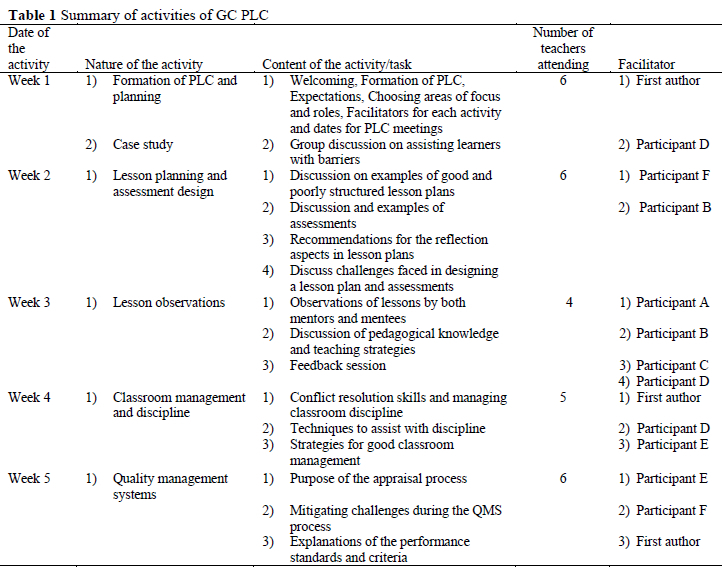
Gravett et al. (2015) explain that in the planning of an intervention in action research, a learning strategy is developed to solve the problems that have been identified. Planning refers to the activities from the beginning to the end of the teaching-learning process. We coordinated the planning phase of the PLC meetings where all the members were tasked with contributing to the topics and activities based on their professional needs. The preferred activities were intended to address the challenges and mentoring needs experienced by the members of the GC PLC. After collaborative discussion and mutual understanding, the topics and facilitators shown in Table 1 were agreed upon.
The activities selected by the PLC members aligned with the first author's observations as member of the school's management team (SMT).
Stage 3: Act and collect data
According to Gravett et al. (2015), the third stage of action research suggests that teachers must act and collect data. During the implementation stage of this action research, all the activities designed in the planning stage were executed within 5 weeks (weeks 2-6). Mistar (2010:31) states that "implementing the action refers to the application of a learning strategy that has been planned before." The PLC activities depicted in Table 1 were implemented over 6 weeks. The activities were facilitated by different members of the PLC based on their specific knowledge and expertise. The novice and in-service teachers also facilitated aspects of the PLC meetings. Furthermore, members of the PLC received handouts about each focus area, which were accessed via different links.
The PLC members reflected during the implementation of the activities and these reflections were documented by the first author.
The data were generated from unstructured observations and semi-structured interviews. Kumar (2022) articulates that observation is a method of observing and describing the behaviour of a subject, and it involves the basic technique of simply watching the phenomenon until insight is gained. Although observations as data collection method holds certain limitations such as unreliability and the Hawthorne effect, Kumar (2022) contends that by conducting observations more scientifically, limitations may be overcome. Unstructured observation allowed us to write a free description of what was observed rather than following a checklist (Bertram & Christiansen, 2014), and the first author recorded the observations in a reflective journal (field notes). Semi-structured interviews were used. Jamshed (2014:87) affirms that interviewing is "the most common format of data collection in qualitative research." This method involves open-ended questions in which the participants respond in more detail. The disadvantage of interviews is that they generate an overwhelming amount of data. However, we had a clear idea of how the data would be coded and categorised.
Stage 4: Analyse the data
The inductive approach was used to analyse data from the unstructured observations and the semi-structured interviews. Bingham (2023) describes this process as an inductive approach, as she mentions that inductive analysis involves identifying themes as they appear from the data. These emerging themes are discussed in the literature review. The first stage of data analysis involved transcribing the interviews and compiling the field notes. Next, all the data were read and re-read thoroughly to ensure an accurate understanding and interpretation. In-vivo coding was employed to capture and incorporate direct quotes from the PLC members' comments. Data reduction was then performed to condense and focus the information, which was followed by the systematic coding of the data to identify key themes and patterns. Berthet, Gaweda, Kantola Mille, Ahrens and Elomaki (2023:80) define coding as an "important element because it helps to make sense of the data in relation to one's research questions and objectives." This process assisted in finding trends and patterns related to the theoretical framework used, as well as the themes from the activities conducted. This process allowed insight into the research objectives. The data collected were then coded and categorised against the activities conducted to determine the effectiveness of the PLC model in fostering a culture of mentoring.
Stage 5: Evaluate the intervention
Reflection is crucial in action research to decide whether the next cycle is necessary (Morrison & Lee, 2019). Mistar (2010:31) states that reflection is an effort to assess whether the teaching-learning process succeeds or fails based on the criteria of success. After analysing the results of the data regarding the success of implementing the PLC model in fostering a culture of mentoring, we found that due to the nature of fostering, it was impossible to foster a culture of mentoring within 5 weeks, hence a second cycle was necessary.
Sampling: Formation of the PLC
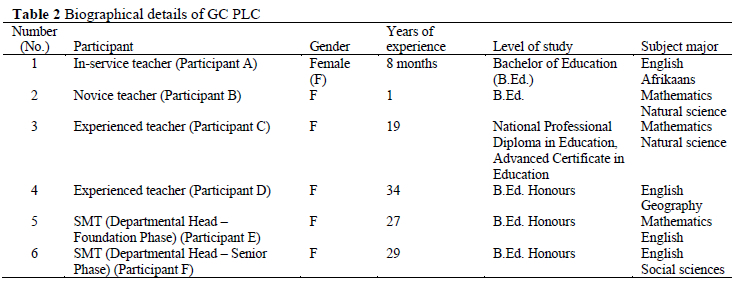
The overall population for this study consisted of 29 teachers who taught in various grade levels and subject areas. A purposive sampling strategy was employed to select a sample of six teachers to participate in the PLC. Purposive sampling was chosen because the aim was not to generate statistically generalisable findings, but to gain an in-depth understanding of the experiences of primary school teachers implementing digital technology in the classroom. This approach enabled the selection of participants with specific knowledge, skills, and lived experiences relevant to the focus of the study (Etikan & Bala, 2017). The selection criteria included representation across different career stages and a demonstrated interest in engaging in collaborative professional development focused on mentoring and SDL. The first author extended invitations to participate in the study personally and provided detailed information regarding the study objectives, the nature of a PLC, and the expected commitment involved. This approach ensured a manageable sample size to facilitate meaningful collaborative inquiry and reflection within the action research framework. The GC PLC consisted of two members of the SMT, one master teacher, a newly transferred senior teacher, a novice teacher, and an in-service teacher. The participants' biographical information and pseudonyms used for the participants are presented in Table 2.
Trustworthiness
Trustworthiness is defined as the degree of confidence in the data, interpretation, and methods used to ensure the quality of a study (as cited by Connelly, 2016). Comprehensive field notes of the observations were kept and all records of the raw data collected from the observations and the interviews created an audit trail (Carcarry, 2020). The semi-structured interviews were audio recorded and transcribed verbatim. The transcript was then returned to the participants for them to authenticate. The first author's dual role as researcher and deputy principal provided beneficial insight into the study. However, it posed possible power dynamics issues due to the hierarchical association with participating teachers. To alleviate these challenges, participation in the study was voluntary, confidentiality was guaranteed, and a safe, open environment was nurtured within the PLC. The first author practised reflexivity throughout the study to minimise bias and support authentic engagement, enhancing ethical rigour and trustworthiness of the study. Bertram and Christiansen (2014) state that analysis done together with other participants ensures the appropriateness and correct interpretation of the analysis of the data. The PLC had full access to the first author's field notes and the transcripts of the interview process. This eliminated researcher bias during data collection.
Data Presentation and Analysis
The following themes emerged from the analysis of the data.
Theme 1: The PLC helps teachers to develop skills to better support learners with special educational needs
The activities set for Week 1 were aimed at addressing how to identify and manage learners with barriers to learning. Participant D facilitated the case study as she had extensive experience dealing with cases related to learning barriers. Participant D also chaired the school-based support team (SBST). The DBE (2014) describes an SBST as the team at a school tasked with coordinating learner and teacher support services. Participant D facilitated the discussion by introducing the case study to the GC PLC. The PLC members were given time to read the case study, "Thabo's Classroom Struggles." Participant D explained how teachers may assist learners with special educational needs (LSEN) by referring them to the SBST. The participants shared the following suggestions on how to support learners with special education needs:
Ma 'am, before we refer the learner to the SBST, how do we even identify these learners? Are there signs that we look for? Because sometimes we do not know if a learner has a learning problem or is just being lazy. (Participant B)
It' s important for early identification of these learners, and normally, during group work, during class activities and even written work, you will find that there are certain strategies that you use to try to identify these learners. You'll also find that they have a low level of confidence. They don' t participate much as well. (Participant E) And how do we give these learners individual attention when there are 35 to 40 learners in a classroom? They do need assistance but it becomes very difficult in the classroom (Participant A).
It' s important that [sic] to spend a little time with them in the class on a one-to-one basis, discuss certain aspects pertaining to the topics. Also a remedial programme will help these learners. It is also important not to lower the confidence of learners by shouting repeatedly at them as there is a stigma attached to these learners. (Participant D)
The afore-mentioned extracts from the observations suggest that a PLC may provide a platform for shared discussion, where expertise on the early identification of learners with barriers, strategies for recognition, and structuring remedial programmes are shared with mentees. Mundschenk and Fuchs (2016) suggest that teachers in a PLC enjoy a measure of success in responding to intervention models to improve teaching and remove barriers to learning. The feedback given by the PLC may help mentees to identify LSEN early and develop support programmes to enhance their learning. However, although mentees were able to acquire some information in identifying and managing LSEN in this activity, we suggest that PLCs discuss and share specific strategies and tools to identify the type of barrier experienced by a specific group of learners.
Theme 2: Using the PLC to enhance differentiated instruction and curriculum completion for diverse learners
The GC PLC set lesson planning and assessment design as activities for Week 2 of the mentoring programme. Participants F and B facilitated the meeting. Participant F, a member of the school's SMT, possessed vast experience in curriculum management, assessment design, and lesson planning. Participant B co-facilitated the meeting to bring a fresh perspective on tertiary-level lesson planning and the design of assessment. The following discussions between the participants were recorded.
My suggestion is to formulate lesson plans according your classroom needs. It is difficult to have just one lesson plan for the entire grade. It also depends on the learners in the classroom (Participant F).
It is also important to consider the activities for the different levels of learners in the classroom. Sometimes learners can get frustrated with too difficult activities which leads to disruption (Participant D).
Remember, in a classroom you have what, 35 to 40 learners? You cannot paint all of them with the same brush, [and] it is important as a subject educator to take that into consideration when planning activities (First author).
My biggest challenge in the class is time management for concepts, [as] I am struggling with learners not finishing tasks, and also completing the concepts with learners (Participant B).
Maybe completing intervention[s] for weaker learners and doing extra remedial work with them as well. Also, completing certain concepts using worksheets and other resources like booklets: it helps a lot with time. Worksheets cut down time from writing the activity on the chalkboard. (Participant C)
The dialogue in the PLC suggests that mentor participants shared strategies to help teachers complete curriculum activities on time, while addressing the diverse needs of learners. PLC members recommended adapting lesson plans and remedial worksheets to better suit these needs. Clark, Zhan, Dellinger and Semingson (2023) articulate that a PLC model can be an effective way to develop innovative teaching practices and to build capacity for innovative teaching by sharing what they have learned with others.
Theme 3: Improving teacher knowledge using a PLC model
Activities for Week 3 were based on lesson observations for enhancing pedagogical knowledge, content knowledge, and general pedagogical knowledge (classroom management). In this dyadic exercise, mentors and mentees both observed each other's lessons. Participant A was observed by Participant D and Participant B was observed by Participant C. The following extracts show the observations and suggestions given by the mentors during their feedback session after the lesson observation activity.
I suggest you write the topic on the board, you know, so learners will be aware of it. Also, it is important to walk around the classroom when learners are completing their work, you will be able to check which learners are having trouble with concepts. Learners also find maths a bit difficult so maybe use more resources like visual aids to help them understand better, and the buddy system works well too to reinforce concepts. (Participant C)
My mentor teacher [Participant C] did discuss with me, [in] group discussions. She suggested pairing the weaker learners with the stronger learners so that they could mentor each other or provide a simpler way of explaining it. I learned how to structure my work on the chalkboard as well. She also gave me new classroom management strategies that she did in her classes, which I have now implemented in my class and that works in the field. (Participant B)
It was a nice lesson, but I noticed that all learners were not participating. Maybe use a different approach to get them involved like the 'chain' method. Using different chalk to highlight the subject or verb or object will help learners to understand more to emphasize the concept. Also get them to read the statement from the board, it is a good way to test their reading together. (Participant D)
She [Participant D] actually gave me other methods of ways in which I could teach or encourage participation in my classroom. She gave me a lot of pointers. She gave me the example of a chain. So that was very interesting for me because I did English and we were doing conjunctions. So using that method was, I would say, very intelligent, where you as a teacher can actually pinpoint the quieter ones and get them involved, rather than the usual learners that always put their hands up. (Participant A)
The extracts show that PLC members reflected on and adopted new teaching methods through lesson observations. Meanwhile, mentees reported gaining different teaching strategies and classroom management practices to enhance their teaching. The above extracts highlight that mentors and mentees can acquire new pedagogical approaches to improve their teaching. PLCs may, therefore, be spaces where teachers collaborate, reflect on practices, and share knowledge to develop more effective teaching strategies (as cited in Feldman, 2017).
Theme 4: Using a PLC to introduce new classroom management strategies to assist teachers with implementing effective discipline
The activities set for Week 4 were intended to address different strategies for good classroom management practices and effective learner discipline. This meeting was facilitated by Participants D and E. Participant D initiated the discussion by querying the discipline used by members in their classrooms. The extract below highlights the interaction and discussions that followed.
I was having multiple distractions in my classroom, and it caused a chain reaction amongst the learners when they start[ed] to talk. Shouting at them did not help and they did not take my threats seriously, so I implemented the game called 'Simon Says' to maintain discipline. (Participant B) I learned a strategy called 'Robot Strategy' at tertiary level, where we had to make a robot, and each colour of the robot, the green, amber and red, they represented different stages, where the red was a punishment, the amber was also [a] warning, and the green was good behaviour. But the learners got too used to the system and it slowly stopped working. (Participant A)
Well done, guys, for trying new strategies, but I feel this may only be a short-term fix, and it may be seen as a game, rather than to something [sic] to instil discipline in learners. Have you guys tried having a reward system in the classroom in terms of giving learners incentives for good behaviour? (Participant D)
I also used the reward system in my classrooms, it did work well. But it is also important to set the tone for discipline at the beginning of the lesson. I also found out the difficult way that idle learners tend to misbehave, so make sure learners are fully occupied in the classroom. (First author)
Effective classroom discipline is a key component of successfully implementing the curriculum. Rossouw (2003) argues that a lack of learner discipline may severely disrupt the teaching and learning process, ultimately hindering educational success if the disruptive behaviour persists. PLCs may improve learner discipline by fostering a collaborative environment, where educators share effective strategies and work together to address challenges, leading to a more supportive and disciplined classroom. The interactions within the GC PLC suggest that PLC members may benefit from adopting new discipline and classroom management strategies. Implementing these strategies may equip mentees with the knowledge and skills necessary to effectively manage learner and classroom discipline. The data also suggest that mentors' experiences in learner discipline can challenge mentees' new methods and introduce them to a more comprehensive approach to sustaining classroom discipline.
Theme 5: Using the PLC forum to address the lack of familiarity and challenges faced in implementing the Quality Management System (QMS) appraisal system
The PLC members decided on discussing the QMS appraisal system during Week 5. The ELRC (2020) states that QMS is a performance management system designed to evaluate teachers holistically in order to achieve high levels of performance in all sectors of the teaching profession. The focus of the activities in Week 5 was primarily on information regarding the QMS and its benefits. Due to her extensive knowledge of the QMS Participant E chaired the meeting. The extracts below show the discourse between the GC PLC members.
How does everyone feel about QMS, is it a good or bad practice? (Participant E). Ma 'am, I do not know much about QMS at all. At university, we were told about it. But what it is about, I do not know ma'am, sorry. I do not even know what the QMS documents look like (Participant A).
I had my QMS done in term two, but I was a bit lost regarding all the forms to fill in and also how to plan a QMS lesson because we do not learn about filling these forms or documents at university. It was a bit of a challenge for me. (Participant B) Remember QMS is focused on improving your teaching practices. It has performance standards and criteria that address all aspects of teaching, from teaching methods to the use of resources and even extra-curricular activities (First author). QMS is for development and mentorship in the areas where you feel you are struggling as a teacher or in areas where you want to improve (Participant D).
Yes, I agree, QMS is a good tool where self-evaluation will show you the areas [in which] you need to be mentored. And by working with your appraiser, a proper support programme can be developed for you (Participant F).
The above extracts suggest that mentee teachers lack understanding of the purpose and implementation of the QMS process. Shongwe and Mutambara (2023) argue that some teachers' lack of content knowledge about QMS has hindered their ability to effectively promote its objectives, leading to poor implementation. Mentees in the PLC noted challenges in navigating QMS, particularly in completing documentation and planning QMS lessons. The mentors' responses indicate that a PLC could offer clearer guidance and training in these areas. Additionally, mentees acknowledged that their lack of experience with QMS limited their ability to view it as a tool for identifying areas of improvement for personal growth and professional development. A PLC could serve as a platform to develop a mentorship and support programme, helping mentees take charge of their learning within the QMS appraisal process.
Discussion of Findings
How can PLCs be Used through Action Research to Foster a Culture of Mentoring in a Primary School? The findings of this study suggest that PLCs can effectively support the professional development of teachers at various career stages. Through activities such as lesson observations and reflective discussions between mentors and mentees about effective classroom management strategies, participants engaged in SDL processes that enabled them to acquire new pedagogical methods benefiting their learners. The lesson observation activity within the PLC demonstrated that mentors and mentees enhanced their pedagogical knowledge and curriculum delivery techniques, consistent with Mu, Liang, Lu and Huang's (2018) findings that teacher participation in collaborative teaching activities within PLCs promotes growth in pedagogical expertise. Furthermore, SDL theory underscores the importance of learners taking initiative and responsibility for their learning (Knowles, 1975), which aligns with Opara, Eke and Iheanacho's (2023) assertion that PLCs serve as avenues for teacher improvement and active learning. Additionally, Wells and Feun (2013) emphasise that PLCs provide collaborative forums where teachers critically engage with best educational practices, fostering ongoing reflective and self-directed professional growth that ultimately enhances learner achievement.
Teachers are required to know their schools' curriculum, policies, culture, and ethos. The findings of this study indicate that activities conducted within the PLC can bridge the gap between university and the practical school environment. Through QMS activities, mentees gain new knowledge about the systemic requirements of the teaching profession - areas often insufficiently addressed during tertiary training. This aligns with Hudson' s (2005) assertion that pre-service teachers must understand the practical aspects of education systems, including aims, curriculum, and policies. Moreover, the PLC' s discussions on lesson plans and assessment facilitated the development of innovative instructional strategies tailored to learners' needs, supported by experienced colleagues. Such processes align with the principles of SDL (Knowles, 1975), where teachers take initiative and responsibility for attaining and applying new knowledge in response to contextual demands. Clark et al. (2023) suggest that PLCs assist teachers in developing innovative practices and share effective strategies. Song (2012) argues that PLCs empower teachers to embrace curriculum changes, enhancing their capacity to adapt and meet changing curriculum demands. Curriculum changes often pose noteworthy educational challenges, with unsupported teachers feeling "lost and uncertain about what is expected of them" (Verster et al., 2024:2). The self-directed, collaborative nature of a PLC provides critical scaffolding to navigate such challenges effectively.
Through lesson observations, mentor teachers in the PLC demonstrated practical teaching qualities to mentees, enabling them to enhance their instructional skills. This modelling process aligns with Hudson's (2005) assertion that mentors play a crucial role by demonstrating effective teaching, classroom management, and lesson design. Such observations also foster SDL, as mentees actively reflect on and integrate observed strategies into their practice, taking initiative to develop their pedagogical knowledge (Knowles, 1975). Supporting this, Bell and Mladenovic (2008) found that teacher observation promotes improvement in teaching practices and shifts educational perspectives. In this study, mentees reported increased pedagogical content knowledge, learning classroom strategies such as board layout for clearer learner understanding, and improved disciplinary techniques observed from mentors. Additionally, mentees recognised the value of being confident and outspoken in the classroom through modelling by mentors. These findings highlight how PLC lesson observations provided practical skills and encouraged SDL, empowering teachers to take responsibility for their ongoing professional growth.
How does Fostering a Mentoring Culture through PLCs Enhance Self-directed Learning among Teachers in a Primary School?
The novice and in-service participants reported that the PLC mentoring programme created a sharing platform to engage equally with the SMT and experienced members, fostering autonomy and agency in their professional development. While Brodie (2021) notes that social structures and power relations can limit agency in PLCs, the first author and other SMT members intentionally enabled PLC members to take on leadership roles during activities. This reflects productive collaboration, which requires participants to exercise autonomy and responsibility through SDL practices such as reflection and inquiry for individual and collective growth (Hargreaves et al., 2013). Therefore, SDL may empower teachers to actively shape their professional learning within PLCs.
The findings indicate that mentors learned new pedagogical strategies, subject content, and discipline measures from mentees who brought fresh ideas from tertiary institutions, demonstrating the reciprocal nature of learning within the PLC. Such exchanges reflect Knowles's (1975) conceptions of SDL, where individuals actively diagnose their learning needs, pursue relevant knowledge, and apply it within authentic, collaborative contexts. Experienced teachers also reported acquiring new methods for integrating technology from mentees, reinforcing the bidirectional learning dynamic. This aligns with Hudson et al.'s (2013:1296) assertion that mentoring "was not a one-way street but a reciprocated arrangement where both parties learn from each other", and with Hill, Ward, Seay and Buzenski's (2022:559) view that mentors may gain new perspectives, technologies, and methodologies from mentees. These findings highlight the SDL opportunities embedded in mentoring relationships in a PLC.
All the PLC members reported that participating in PLC activities added value to their teaching practice, empowering them to take ownership of their learning. The experiences of mentors and mentees suggest that PLCs may serve as vehicles for the transformation of ongoing professional learning and development, supporting SDL through collaborative inquiry. Hudson et al. 's (2013) study shows that linking mentees and mentors who are passionate and open to sharing their skills, knowledge, and expertise provides a network of support within a PLC. One mentee also reported learning new classroom management techniques that enhanced discipline, contributing to a more effective teaching and learning environment. These findings indicate that participants consistently engaged in reflective practices, actively sought new knowledge, and implemented innovative strategies, thus reflecting Garrison's (1997) SDL model as a process involving motivation, self-management, and self-monitoring. The findings are also in line with those of Merriam and Bierema (2013) emphasising SDL as a social, interactive, and contextually situated process. This aligns with Feldman's (2020) conclusion that PLCs provide teachers with sustained opportunities to develop and refine teaching strategies.
In relation to personal attributes, the findings from the observations and the semi-structured interviews indicate that mentors exhibited positive character traits and qualities during PLC meetings, which fostered a supportive environment for mentees and encouraged SDL. Admiraal, Schenke, De Jong, Emmelot and Sligte (2021) suggest that nurturing learning environments promote individual learning essential for professional development. Although some PLC members initially reported feelings of intimidation and anxiety due to the mentors' extensive experience, the programme's collaborative nature appeared to alleviate these concerns over time, fostering confidence and independence as mentees assumed greater responsibility for their learning journeys. Mentees described mentors' empathetic approach during lesson observations and feedback sessions encouraging reflection rather than fault-finding. These findings align with Hudson's (2005) assertion that mentors' supportive attributes promote reflective practice and build mentees' confidence. Such supportive mentoring reflects Merriam and Bierema's (2013) emphasis on SDL as a social and contextually entrenched process, where learners take initiative in collaboration with others. Throughout the PLC meetings, mentors consistently demonstrated strong interpersonal skills by guiding mentees towards independent inquiry and problem-solving knowledge.
Conducting action research has significantly enhanced the first author's mentoring practices within PLCs. The collaborative activities in the GC PLC meetings provided valuable insight into the existing mentoring practices in the school context. Hagevik, Aydeniz and Rowell (2012) state that action research aims to improve both practice and the context in which it occurs. Through this process, we recognise the value of establishing a PLC that brings together experienced and novice teachers as an effective mentoring forum. The participatory nature of action research within the PLC has deepened our understanding of the diverse mentoring needs of teachers at various stages of their careers, fostering a more responsive and adaptive approach to professional development. These mentoring needs became more evident during the structured, reflective discussions within the PLC mentoring programme. Creswell (2007) asserts that action research is practical and collaborative, as it involves inquiry conducted with others rather than on them. The study has cultivated a more critical and reflective stance towards mentoring, encouraging SDL among teachers at different stages of their careers. This reflective practice has enabled the first author to develop and co-create resources that promote a sustainable mentoring culture at his school. The activities implemented in this study will be refined collaboratively with staff and integrated into the school plan. Admiraal et al. (2021) highlight that a successful PLC requires a shared vision of teaching, learning, and development, along with clearly defined goals that guide professional growth.
Conclusion
The aim with the study was to implement a PLC model to foster a culture of mentoring in a primary school. Overall, its findings demonstrate that the first author together with PLC members actively took ownership of their learning and development trajectory. While the study highlights how fostering a mentoring culture through PLCs enhances SDL among teachers, its scope was limited to a single PLC and a 6-week cycle, which may not have been sufficient for long-term impact. Future research could extend the mentoring programme across the entire school and examine its sustained influence on mentoring practices.
Author's Contributions
MM prepared the manuscript and collected data through action research and participant interviews. FQBZ, acting as supervisor, guided and conducted the methodological framework. Both authors reviewed and approved the final version of the manuscript.
Notesi. Published under a Creative Commons Attribution Licence.
Acknowledgements
We wish to express our sincere appreciation to the members of the professional learning community (PLC) at the participating primary school for their invaluable participation, collaboration, and professional insight throughout this study.
References
-
Admiraal W, Schenke W, De Jong L, Emmelot Y & Sligte H 2021. Schools as professional learning communities: What can schools do to support professional development of their teachers? Professional Development in Education, 47(4):684-698. https://doi.org/10.1080/19415257.2019.1665573
» https://doi.org/10.1080/19415257.2019.1665573 -
Bell A & Mladenovic R 2008. The benefits of peer observation of teaching for tutor development. Higher Education, 55(6):735-752. https://doi.org/10.1007/s10734-007-9093-1
» https://doi.org/10.1007/s10734-007-9093-1 -
Berthet V, Gaweda B, Kantola J, Miller C, Ahrens P & Elomâki A 2023. Guide to qualitative research in parliaments: Experiences and practices. Cham, Switzerland: Palgrave Macmillan. https://doi.org/10.1007/978-3-031-39808-7
» https://doi.org/10.1007/978-3-031-39808-7 - Bertram C & Christiansen I 2014. Understanding research: An introduction to reading research. Pretoria, South Africa: Van Schaik.
-
Bingham AJ 2023. From data management to actionable findings: A five-phase process of qualitative data analysis. International Journal of Qualitative Methods, 22:1-11. https://doi.org/10.1177/16094069231183620
» https://doi.org/10.1177/16094069231183620 -
Botha EM 2012. Turning the tide: Creating Professional Learning Communities (PLC) to improve teaching practice and learning in South African public schools. Africa Education Review, 9(2):395-411. https://doi.org/10.1080/18146627.2012.722405
» https://doi.org/10.1080/18146627.2012.722405 -
Brodie K 2021. Teacher agency in professional learning communities. Professional Development in Education, 47(4):560-573. https://doi.org/10.1080/19415257.2019.1689523
» https://doi.org/10.1080/19415257.2019.1689523 - Brookfield SD 2017. Becoming a critically reflective teacher (2nd ed). Somerset, NJ: John Wiley & Sons.
-
Brown BD, Horn RS & King G 2018. The effective implementation of professional learning communities. Alabama Journal of Educational Leadership, 5:53-59. Available at https://files.eric.ed.gov/fulltext/EJ1194725.pdf. Accessed 28 October 2025.
» https://files.eric.ed.gov/fulltext/EJ1194725.pdf -
Clark AM, Zhan M, Dellinger JT & Semingson PL 2023. Innovating teaching practice through professional learning communities: Determining knowledge sharing and program value. Sage Open, 13(4):1-11. https://doi.org/10.1177/21582440231200983
» https://doi.org/10.1177/21582440231200983 - Connelly LM 2016. Trustworthiness in qualitative research. Medsurg Nursing, 25(6):435-436.
- Creswell JW 2007. Qualitative inquiry & research design: Choosing among five approaches (2nd ed). Thousand Oaks, CA: Sage.
- Creswell JW & Creswell JD 2018. Research design: Qualitative, quantitative, and mixed methods approaches (5th ed). Thousand Oaks, CA: Sage.
-
Darling-Hammond L 2006. Constructing 21st-century teacher education. Journal of Teacher Education, 57(3):300-314. https://doi.org/10.1177/0022487105285962
» https://doi.org/10.1177/0022487105285962 -
Department of Basic Education 2014. Employment of Educators Act, 1998: Amendment of the Personnel Administrative Measures and Regulations regarding the terms and conditions of employment of educators to include certain improvements in conditions of service for educators employed in terms of the Act as determined by PSCBC Resolution 1 of 2012. Government Gazette, 593(38249):1-8, November 27. Available at https://www.saflii.org/za/gaz/ZAGovGaz/2014/1098.pdf. Accessed 29 October 2025.
» https://www.saflii.org/za/gaz/ZAGovGaz/2014/1098.pdf -
Department of Basic Education and Department of Higher Education and Training 2011. Integrated strategic planning framework for teacher education and development in South Africa 20112025. Pretoria, South Africa: Authors. Available at https://www.sace.org.za/assets/documents/uploads/sace_58701-2016-08-31-Integrated%20Strategic%20Plan.pdf. Accessed 28 October 2025.
» https://www.sace.org.za/assets/documents/uploads/sace_58701-2016-08-31-Integrated%20Strategic%20Plan.pdf -
Department of Education 2000. National Education Policy Act (27/1996): Norms and Standards for Educators. Government Gazette, 415(20844):1-34, February 4. Available at https://www.gov.za/sites/default/files/gcis_document/201409/20844.pdf. Accessed 28 October 2025.
» https://www.gov.za/sites/default/files/gcis_document/201409/20844.pdf -
Dos Reis K & Braund M 2019. Are school-based mentors adequately equipped to fulfil their roles? A case study in learning to teach accounting. Africa Education Review, 16(4):17-36. https://doi.org/10.1080/18146627.2018.1460210
» https://doi.org/10.1080/18146627.2018.1460210 -
DuFour R 2004. What is a "professional learning community"? Educational Leadership, 61(8):6-11. Available at http://dulaneypd.pbworks.com/w/file/fetch/83199283/what_is_a_professional_learning_community%20article.pdf. Accessed 27 October 2025.
» http://dulaneypd.pbworks.com/w/file/fetch/83199283/what_is_a_professional_learning_community%20article.pdf -
Education Labour Relations Council 2020. Collective agreement number 2 of 2020. Quality Management System (QMS) for school-based educators. Centurion, South Africa: Author. Available at https://elrc.org.za/docs/no-2-of-2020-quality-management-system-qms-for-school-based-educators/. Accessed 29 October 2025.
» https://elrc.org.za/docs/no-2-of-2020-quality-management-system-qms-for-school-based-educators/ - Etikan I & Bala K 2017. Sampling and sampling methods. Biometrics & Biostatistics International Journal, 5(6):215-217.
-
Feldman J 2017. The role of professional learning communities in facilitating teachers' pedagogical adaptation and change. Journal of Education, 67:65-81. https://doi.org/10.17159/2520-9868/i67a03
» https://doi.org/10.17159/2520-9868/i67a03 -
Feldman J 2020. The role of professional learning communities to support teacher development: A social practice theory perspective. South African Journal of Education, 40(1):Art. #1668, 8 pages. https://doi.org/10.15700/saje.v40n1a1668
» https://doi.org/10.15700/saje.v40n1a1668 -
Garrison DR 1997. Self-directed learning: Toward a comprehensive model. Adult Education Quarterly, 48(1):18-33. https://doi.org/10.1177/074171369704800103
» https://doi.org/10.1177/074171369704800103 -
Giancola JK, Whitman B & Wilmott RW 2020. Establishing a mentoring culture within the department: The role of the chair. The Journal of Pediatrics, 225:4-7. Available at https://www.jpeds.com/action/showPdf?pii=S0022-3476%2820%2930170-0. Accessed 24 October 2025.
» https://www.jpeds.com/action/showPdf?pii=S0022-3476%2820%2930170-0 - Gravett S, De Beer J & Du Plessis E (eds.) 2015. Becoming a teacher (2nd ed). Cape Town, South Africa: Pearson.
-
Hagevik R, Aydeniz M & Rowell CG 2012. Using action research in middle level teacher education to evaluate and deepen reflective practice. Teaching and Teacher Education, 28(5):675-684. https://doi.org/10.1016/j.tate.2012.02.006
» https://doi.org/10.1016/j.tate.2012.02.006 -
Hairon S, Goh JWP, Chua CSK & Wang LY 2017. A research agenda for professional learning communities: Moving forward. Professional Development in Education, 43(1):72-86. https://doi.org/10.1080/19415257.2015.1055861
» https://doi.org/10.1080/19415257.2015.1055861 -
Hameed BS & Hashim H 2022. Challenges faced by teachers in integrating 4th Industrial Revolution (4IR) technology in teaching English as a second language (ESL). Creative Education, 13(5):1792-1809. https://doi.org/10.4236/ce.2022.135113
» https://doi.org/10.4236/ce.2022.135113 -
Hargreaves E, Berry R, Lai YC, Leung P, Scott D & Stobart G 2013. Teachers' experiences of autonomy in Continuing Professional Development: Teacher Learning Communities in London and Hong Kong. Teacher Development, 17(1):19-34. https://doi.org/10.1080/13664530.2012.748686
» https://doi.org/10.1080/13664530.2012.748686 -
Hill SEM, Ward WL, Seay A & Buzenski J 2022. The nature and evolution of the mentoring relationship in academic health centers. Journal of Clinical Psychology in Medical Settings, 29:557-569. https://doi.org/10.1007/s10880-022-09893-6
» https://doi.org/10.1007/s10880-022-09893-6 -
Hozien W 2023. Creating a mentoring culture: cultivating leadership potential in faculty and staff [Preprint]. https://doi.org/10.20944/preprints202308.2173.v1
» https://doi.org/10.20944/preprints202308.2173.v1 -
Hudson P 2005. From generic to specific mentoring: A five-factor model for developing primary teaching practices. In W Shilton & R Jeffery (eds). International Education Research Conference: Doing the public good: Positioning education research. Melbourne, Australia: Australian Association for Research in Education. Available at https://eprints.qut.edu.au/971/1/hud04076.pdf. Accessed 24 October 2025.
» https://eprints.qut.edu.au/971/1/hud04076.pdf -
Hudson P 2010. Mentors report on their own mentoring practices. Australian Journal of Teacher Education, 35(7):30-42. https://doi.org/10.14221/ajte.2010v35n7.3
» https://doi.org/10.14221/ajte.2010v35n7.3 -
Hudson P, Hudson S, Gray B & Bloxham R 2013. Learning about being effective mentors: Professional learning communities and mentoring. Procedia - Social and Behavioral Sciences, 93:1291-1300. https://doi.org/10.1016/j.sbspro.2013.10.031
» https://doi.org/10.1016/j.sbspro.2013.10.031 -
Jamshed S 2014. Qualitative research method-interviewing and observation. Journal of Basic and Clinical Pharmacy, 5(4):87-88. https://doi.org/10.4103/0976-0105.141942
» https://doi.org/10.4103/0976-0105.141942 -
Kennedy A 2014. Models of Continuing Professional Development: A framework for analysis. Professional Development in Education, 40(3):336-351. https://doi.org/10.1080/19415257.2014.929293
» https://doi.org/10.1080/19415257.2014.929293 - Knowles MS 1975. Self-directed learning: A guide for learners and teachers. New York, NY: Association Press.
- Kumar A 2022. Observation methods. International Journal of Scientific Research, 1: 1-14.
- Levine TH 2010. Tools for the study and design of collaborative teacher learning: The affordances of different conceptions of teacher community and activity theory. Teacher Education Quarterly, 37(1):109-130.
-
Lutfia A, Sa'ud US, Nurdin D & Meirawan D 2022. Effectiveness of professional learning community programmes to improve school quality. Cypriot Journal of Educational Sciences, 17(12):4570-4582. https://doi.org/10.18844/cjes.v17i12.8073
» https://doi.org/10.18844/cjes.v17i12.8073 -
Makgato M 2014. Challenges contributing to poor integration of educational technology at some schools in South Africa. Mediterranean Journal of Social Sciences, 5(2):1285-1292. https://doi.org/10.5901/mjss.2014.v5n20p1285
» https://doi.org/10.5901/mjss.2014.v5n20p1285 -
Mentz E & De Beer J 2019. The affordances of change laboratories for improved sustainability and impact of in-service teacher professional development programmes. In K Cermakova & J Holmanova (eds). Proceedings of the 8th Teaching & Education Conference, Vienna. Prague, Czech Republic: International Institute of Social and Economic Sciences. https://doi.org/10.20472/TEC.2019.008.018
» https://doi.org/10.20472/TEC.2019.008.018 -
Mentz E & Oosthuizen I (eds.) 2016. Self-directed learning: An imperative for transforming the research educational landscape. Cape Town, South Africa: AOSIS. http://www.dx.doi.org/10.4102/aosis.sdlr.2016.03
» http://www.dx.doi.org/10.4102/aosis.sdlr.2016.03 - Merriam SB & Bierema LL 2013. Adult learning: Linking theory and practice. Hoboken, NJ: John Wiley & Sons.
- Mistar J 2010. Pedoman penulisan tesis [Thesis writing guidelines]. Malang, Indonesia: Universitas Islam Malang.
-
Morrison S & Lee C 2019. Action research - systematic reflective action to improve practice. In C Lee & R Ward-Penny (eds). A practical guide to teaching mathematics in the secondary school (2nd ed). Abingdon, England: Routledge. Available at https://www.researchgate.net/publication/332730437_Action_research_-_systematic_reflective_action_to_improve_practice . Accessed 29 October 2025.
» https://www.researchgate.net/publication/332730437_Action_research_-_systematic_reflective_action_to_improve_practice -
Mu GM, Liang W, Lu L & Huang D 2018. Building pedagogical content knowledge within professional learning communities: An approach to counteracting regional education inequality. Teaching and Teacher Education, 73:24-34. https://doi.org/10.1016/j.tate.2018.03.006
» https://doi.org/10.1016/j.tate.2018.03.006 -
Mundschenk NA & Fuchs WW 2016. Professional learning communities: An effective mechanism for the successful implementation and sustainability of response to intervention. SRATE Journal, 25(2):55-64. Available at https://files.eric.ed.gov/fulltext/EJ1113856.pdf. Accessed 23 October 2025.
» https://files.eric.ed.gov/fulltext/EJ1113856.pdf -
Ndebele C & Legg-Jack DW 2022. The impact of mentoring in the development of pre-service teachers from a university in South Africa. International Journal of Learning, Teaching and Educational Research, 21(3):88-105. https://doi.org/10.26803/ijlter.21.3.6
» https://doi.org/10.26803/ijlter.21.3.6 -
Nguyen D, Boeren E, Maitra S & Cabus S 2024. A review of the empirical research literature on PLCs for teachers in the Global South: Evidence, implications, and directions. Professional Development in Education, 50(1):91-107. https://doi.org/10.1080/19415257.2023.2238728
» https://doi.org/10.1080/19415257.2023.2238728 -
Opara IJ, Eke MO & Iheanacho CU 2023. Professional Learning Community (PLC) as an effective strategy for improving teachers' professional practice: Implications to educational planning. Socialscientia: Journal of Social Sciences and Humanities, 8(4):39-45. Available at https://journals.aphriapub.com/index.php/S S/article/view/2517/2323. Accessed 23 October 2025.
» https://journals.aphriapub.com/index.php/S S/article/view/2517/2323 - Peters JM, Taylor JE & Doi MM 2009. Self-directed learning and action research. International Journal of Self-Directed Learning, 6(2):23-39.
- Republic of South Africa 2000. Act No. 3 of 2000: South African Council for Educators Act. Government Gazette, 422(21431), August 2.
-
Rossouw JP 2003. Learner discipline in South African public schools - a qualitative study. Koers- Bulletin for Christian Scholarship, 68(4):413-435. https://doi.org/10.4102/koers.v68i4.350
» https://doi.org/10.4102/koers.v68i4.350 -
Sezgin F, Sönmez E & Naillioglu Kaymak M 2020. Mentoring-based learning culture at schools: Learning from school administrator mentoring. Research in Educational Administration & Leadership, 5(3):786-838. https://doi.Org/10.30828/real/2020.3.6
» https://doi.Org/10.30828/real/2020.3.6 -
Shongwe EM & Mutambara E 2023. The challenges experienced by school principals in the implementation of QMS Performance Appraisal System in schools within Mpumalanga Province, South Africa. Journal of Service Science and Management, 16(3):266-279. https://doi.org/10.4236/jssm.2023.163015
» https://doi.org/10.4236/jssm.2023.163015 -
Song H 2012. The role of teachers' professional learning communities in the context of curriculum reform in high schools. Chinese Education & Society, 45(4):81-95. https://doi.org/10.2753/CED1061-1932450406
» https://doi.org/10.2753/CED1061-1932450406 -
Stoll L 2011. Leading professional learning communities. In J Robertson & H Timperley (eds). Leadership and learning. Thousand Oaks, CA: Sage. https://doi.org/10.4135/9781446288931.n8
» https://doi.org/10.4135/9781446288931.n8 -
Verster M, Mentz E & Du Toit-Brits C 2024. Self-directed professional development used as intervention to enhance teachers' curriculum as praxis. South African Journal of Education, 44(1):Art. #2346, 17 pages. https://doi.org/10.15700/saje.v44n1a2346
» https://doi.org/10.15700/saje.v44n1a2346 -
Vescio V, Ross D & Adams A 2008. A review of research on the impact of professional learning communities on teaching practice and student learning. Teaching and Teacher Education, 24(1):80-91. https://doi.org/10.1016/j.tate.2007.01.004
» https://doi.org/10.1016/j.tate.2007.01.004 -
Wangmo U & Tshering N 2021. Impact of Professional Learning Community (PLC): Approach to improving teachers' effectiveness in raising students' learning achievement. Journal of Educational Research, 1(5):1-17. https://doi.org/10.17102/jear.22.1.5.09
» https://doi.org/10.17102/jear.22.1.5.09 -
Wells CM & Feun L 2013. Educational change and professional learning communities: A study of two districts. Journal of Educational Change, 14(2):233-257. https://doi.org/10.1007/s10833-012-9202-5
» https://doi.org/10.1007/s10833-012-9202-5
Revised: 4 August 2025
Accepted: 16 October 2025
Published: 24 November 2025