Effectiveness of a nurse-led early stimulation and parenting programme for neurodevelopment among toddlers at risk of stunting: A quasi-experimental study
BACKGROUND. Stunting remains a major public health challenge in low- and middle-income countries (LMICs), including Indonesia, with consequences extending beyond linear growth deficits to impaired neurodevelopment. Although early stimulation and parenting interventions have been shown to improve neurodevelopmental outcomes and mitigate these effects, few studies have evaluated structured, nurse-led programmes targeting toddlers at risk of stunting. OBJECTIVE. To assess the effectiveness of a nurse-led early stimulation and structured parenting education intervention on neurodevelopment among toddlers at risk of stunting. METHODS. This quasi-experimental pretest-post-test control group study involved 200 toddlers aged 36 months in Tangerang Regency, Indonesia. There were 100 participants in the intervention group and 100 in the control group. The intervention group received six weekly nurse-led sessions incorporating play-based stimulation and parenting education, while the control group received routine care. The Bayley-III Scales of Infant and Toddler Development were used to measure neurodevelopmental outcomes, which were analysed using ANCOVA and multiple linear regression. RESULTS. Postintervention, the intervention group showed significantly higher adjusted scores across all Bayley-III domains, namely cognitive (F=20.21; p<0.001; η2=0.093), receptive language (F=18.64; p<0.001; η2=0.087), expressive language (F=17.82; p<0.001; η2=0.083), fine motor (F=21.47; p<0.001; η2=0.098) and gross motor (F=24.10; p<0.001; η2=0.109). Regression analysis revealed that pretest scores (p<0.001) and session attendance (p<0.05) were significant predictors of post-test outcomes, while maternal education and child's age were not. CONCLUSION. Nurse-led early stimulation and parenting interventions were associated with significant improvements in neurodevelopmental outcomes among toddlers at risk of stunting. This model could be integrated into primary healthcare services and may provide a scalable approach to addressing developmental delays in LMICs.
stunting; neurodevelopment; early stimulation; parenting education; nurse-led intervention; toddlers; early childhood development
Effectiveness of a nurse-led early stimulation and parenting programme for neurodevelopment among toddlers at risk of stunting: A quasi-experimental study
R Setia SariI; S Kusnul KhotimahII
INs, M Kep ; Department of Nursing, Faculty of Health Sciences, Universitas Yatsi Madani, Tangerang, Indonesia
IIM Kep, Sp Kep An ; Primaya Hospital Tangerang, Tangerang, Indonesia
BACKGROUND. Stunting remains a major public health challenge in low- and middle-income countries (LMICs), including Indonesia, with consequences extending beyond linear growth deficits to impaired neurodevelopment. Although early stimulation and parenting interventions have been shown to improve neurodevelopmental outcomes and mitigate these effects, few studies have evaluated structured, nurse-led programmes targeting toddlers at risk of stunting.
OBJECTIVE. To assess the effectiveness of a nurse-led early stimulation and structured parenting education intervention on neurodevelopment among toddlers at risk of stunting.
METHODS. This quasi-experimental pretest-post-test control group study involved 200 toddlers aged 36 months in Tangerang Regency, Indonesia. There were 100 participants in the intervention group and 100 in the control group. The intervention group received six weekly nurse-led sessions incorporating play-based stimulation and parenting education, while the control group received routine care. The Bayley-III Scales of Infant and Toddler Development were used to measure neurodevelopmental outcomes, which were analysed using ANCOVA and multiple linear regression.
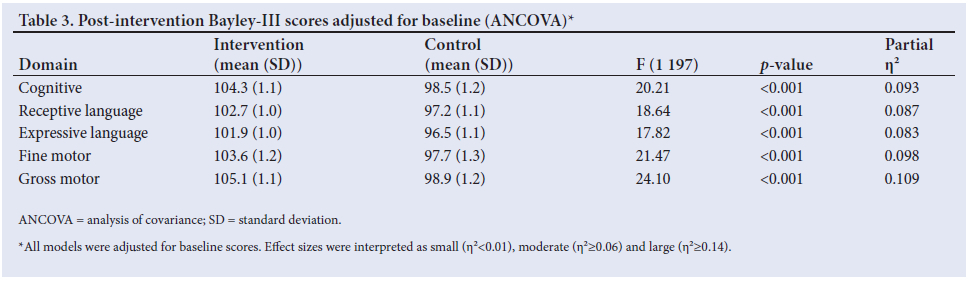
RESULTS. Postintervention, the intervention group showed significantly higher adjusted scores across all Bayley-III domains, namely cognitive (F=20.21; p<0.001; η2=0.093), receptive language (F=18.64; p<0.001; η2=0.087), expressive language (F=17.82; p<0.001; η2=0.083), fine motor (F=21.47; p<0.001; η2=0.098) and gross motor (F=24.10; p<0.001; η2=0.109). Regression analysis revealed that pretest scores (p<0.001) and session attendance (p<0.05) were significant predictors of post-test outcomes, while maternal education and child's age were not.
CONCLUSION. Nurse-led early stimulation and parenting interventions were associated with significant improvements in neurodevelopmental outcomes among toddlers at risk of stunting. This model could be integrated into primary healthcare services and may provide a scalable approach to addressing developmental delays in LMICs.
Keywords:stunting, neurodevelopment, early stimulation, parenting education, nurse-led intervention, toddlers, early childhood development
The Indonesian government has prioritised stunting reduction as a national development agenda, with recent reports indicating a gradual decline in prevalence. However, rates remain above the World Health Organization (WHO) threshold of <20%, underscoring the continued need for effective and scalable interventions.[1,2] Stunting exerts profound effects beyond linear growth failure, severely impairing neurodevelopmental outcomes, including cognition, motor skills and language development, which in turn affect educational achievement and lifetime productivity.[3,4] Economically, stunting in Indonesia translates into substantial national losses, with estimated economic losses ranging from IDR15 062 to 67 780 billion, representing up to 4% of gross domestic product (GDP), and adult worker income losses of up to 20%.[5]
Globally and regionally, children with stunting are at significantly higher risk of cognitive delays, particularly in attention, working memory and processing speed, which are critical for early learning and school readiness.[3,6,7] These neurodevelopmental impairments often persist into adolescence and adulthood, leading to reduced educational attainment and earning potential. A recent
neuroimaging study demonstrated that children with stunting show altered activation in key areas of the brain associated with executive functioning and memory, providing biological evidence for these cognitive disparities.[3]
Indonesia's National Strategy to Accelerate Stunting Prevention (Stranas Stunting) adopts a multisectoral approach through nutrition-specific and nutrition-sensitive interventions, including nutrition counselling, supplementary feeding, exclusive breastfeeding promotion and community cadre training.[8,9] A recent systematic review noted that although strategies such as counselling by community healthcare workers, interprofessional collaboration and supplementary feeding have shown effectiveness, structured neurodevelopmental stimulation integrated into routine nursing practice remains notably absent.[8,9] This gap is critical, given that observational and interventional studies consistently demonstrate that psychosocial stimulation through responsive caregiving and early learning opportunities can substantially mitigate the neurodevelopmental effects of linear growth faltering, especially among children with stunting.[4,6]
Digital innovations have begun to play a role in stunting prevention. For instance, the SEHATi digital health platform has improved maternal knowledge regarding child development and caregiving, although its influence on measurable child neurodevelopmental outcomes has yet to be rigorously evaluated.[10] More broadly, structured early stimulation programmes remain limited in Indonesia's primary healthcare services. Most developmental support is still delivered informally by community cadres, whose training and capacity vary widely. Although both digital and face-to-face maternal education interventions have demonstrated improvements in caregiver knowledge and attitudes, their effects on objective developmental outcomes, such as cognition, motor skills and language, remain inconsistent.[10] This disconnect underscores the need for interventions that are not only evidence-based but also led by qualified professionals capable of delivering targeted, structured support for early childhood development.
In this context, nurse-led early stimulation combined with structured parenting education emerges as a promising and novel intervention model. In this approach, trained paediatric or community health nurses provide developmentally appropriate stimulation activities alongside formal parenting education to caregivers oftoddlers at risk of stunting.[11] Unlike cadre- or volunteer-led initiatives, this model capitalises on the clinical expertise of nurses to monitor child development, promote responsive caregiving and integrate health education into early childhood care. While community-delivered programmes such as Reach Up and Learn have shown developmental benefits,[12] there is limited evidence on nurse-led implementations, particularly in low- and middle-income countries (LMICs) with a high burden of stunting. In Indonesia specifically, although maternal digital education has improved caregiver awareness, there remains a lack of rigorously evaluated, professionally delivered interventions targeting neurodevelopment in children with stunting.[10] This study aimed to evaluate the effectiveness of a nurse-led, structured stimulation and parenting programme designed to improve cognitive, motor and language development among toddlers at risk of stunting. By embedding the intervention within nursing practice, the study offers a professionally anchored, development-focused strategy that addresses both the physical and neurodevelopmental consequences of stunting.
Methods
Study design
This study employed a quasi-experimental pretest-post-test control group design to evaluate the effectiveness of a nurse-led early stimulation and structured parenting education programme on neurodevelopmental outcomes among toddlers at risk of stunting. The intervention group received a structured module delivered by trained paediatric nurses, while the control group received standard community-based care and nutritional counselling.
Sample and setting
The study was conducted in community health centres, locally known as Pusat Kesehatan Masyarakat (Puskesmas), located in two comparable subdistricts in Tangerang Regency, Banten Province, Indonesia. A total of 200 toddlers aged 36 months who were identified as being at risk of stunting based on anthropometric criteria (height-for-age Z-score (HAZ)<-1 standard deviation (SD)) were recruited. The minimal sample size was determined using G*Power statistical analysis software (Heinrich Heine University, Dusseldorf, Germany) with the following parameters: effect size=0.35, α=0.05 and power=0.80. The minimum required sample size was 178. To account for potential attrition, the sample size was increased to 200 participants, with 100 assigned to the intervention group and 100 to the control group using consecutive sampling based on village clusters.
Inclusion and exclusion criteria
Participants were eligible if they met the following inclusion criteria: (i) aged 36 months; (ii) classified as being at risk of stunting (HAZ between -1 and -2 SD); (iii) living with at least one primary caregiver capable of participating in the intervention sessions; and (iv) caregivers provided written informed consent. Exclusion criteria included children with known congenital anomalies, developmental disorders or chronic illnesses that could affect growth or development.
Instruments
Neurodevelopmental outcomes were assessed using the Bayley-III, which evaluates the development of children aged 1 - 42 months across the domains of cognition, language and motor skills. Developed by Nancy Bayley, the instrument comprises 91 items in the cognitive domain, 49 in the receptive language domain, 48 in the expressive language domain, 66 in the fine motor domain and 72 in the gross motor domain. Composite scores were calculated from raw scores, with a mean (SD) of 100 (15). The Bahasa Indonesia version of the Bayley-III has been validated and adapted for use in Indonesia, with high reliability across all domains (Cronbach's α: cognitive=0.88, language=0.91, motor=0.87).[13]
Study procedure
Eligible caregivers were approached during routine Puskesmas visits. Allocation to the intervention or control group was based on Puskesmas location (non-randomised). Two Puskesmas were designated as intervention sites and two as control sites to minimise contamination. Baseline data were collected before the intervention (pretest) using a structured demographic questionnaire and the Bayley Scales of Infant and Toddler Development, Third Edition (Bayley-III).
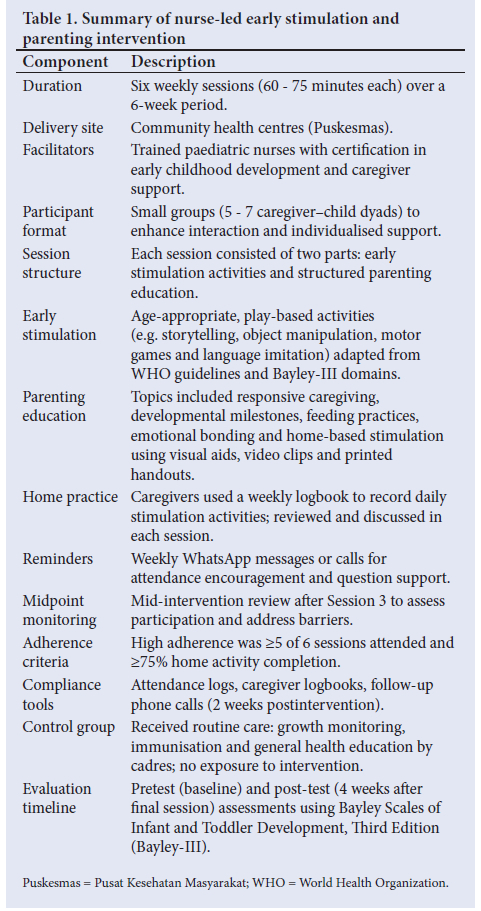
Participants in the intervention group received a structured, nurse-led programme consisting of six weekly 60 - 75-minute sessions delivered over 6 weeks at selected Puskesmas by trained paediatric nurses (Table 1). Each small-group session (5 - 7 caregiver-child dyads) included two components: early stimulation activities based on WHO and Bayley-III guidelines (e.g. storytelling, gross motor play and language games) and structured parenting education (e.g. responsive caregiving, feeding and emotional bonding). Materials included flipcharts, video clips and printed handouts. Caregivers practised activities at home using a logbook, received weekly WhatsApp reminders and were given individualised feedback. Mid-programme reviews were conducted to address barriers. Completion certificates were awarded at the end of the programme, and adherence was monitored using attendance records, logbooks and follow-up phone calls, with high adherence defined as participation in >5 sessions and completion of >75% of home activities.
The control group received standard Puskesmas services without the intervention, including nutritional monitoring and health education. Both groups underwent pre- and post-intervention neurodevelopmental assessments using Bayley-III, with follow-up testing conducted 4 weeks after programme completion.
Data analysis
Descriptive statistics were used to summarise the demographic characteristics. Baseline equivalence between the groups was assessed using independent Student's t-tests. After controlling for baseline scores, post-intervention neurodevelopmental scores were compared between the groups using analysis of covariance (ANCOVA). Partial eta squared (η2
Before conducting ANCOVA, its underlying statistical assumptions were examined. Normality of residuals was assessed using the Shapiro-Wilk test and visual inspection of Q-Q plots. Homogeneity of variances was evaluated using Levene's test, and linearity between the covariates and dependent variables was confirmed. All assumptions were met, supporting the appropriateness of ANCOVA for group comparisons.
Ethical considerations
Prior to data collection, ethical approval was obtained from the Institutional Review Board (IRB) of STIKep PPNI Jawa Barat (ref. no. 015/KEPK/STIKepPPNI-JB/II/2024). Community sensitisation meetings were held with local health officials and caregivers to explain the purpose and procedures of the study. Written informed consent was obtained from the primary caregivers of all eligible toddlers.
Results
Participant characteristics
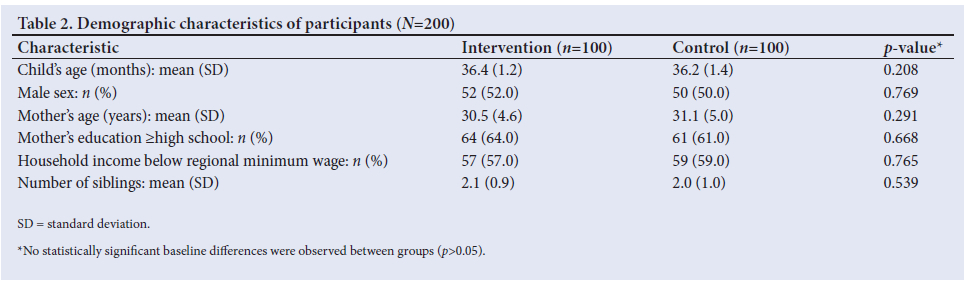
A total of 200 toddlers at risk of stunting were enrolled in the study, with 100 participants allocated to the intervention group and 100 to the control group. Baseline demographic characteristics are presented in Table 2. Independent Student's i-tests for continuous variables and χ2
Baseline and post-intervention neurodevelopmental scores
Descriptive statistics for Bayley-III composite scores at baseline and postintervention for both groups are available (Supplementary Table 1). Independent Student's i-tests showed no statistically significant differences between the intervention and control groups at baseline across all neurodevelopmental domains (p>0.05).
Within-group analyses demonstrated significant improvements in the intervention group across the cognitive, receptive language, expressive language, fine motor and gross motor domains (paired i-tests, all p<0.05). By contrast, changes observed in the control group were small and not statistically significant.
Post-intervention neurodevelopmental outcomes (ANCOVA)
ANCOVA was conducted to compare post-intervention Bayley-III scores between the groups while controlling for baseline scores. The assumptions of normality, homogeneity of variances and linearity of covariates were tested and met prior to analysis.
As shown in Table 3, toddlers in the intervention group demonstrated significantly higher adjusted post-test scores across all assessed domains than those in the control group. Effect sizes were moderate (partial η2
Regression analysis for predictors of post-intervention developmental scores
Multiple linear regression analysis was performed to identify predictors of post-intervention cognitive composite scores. The overall model was statistically significant (F=6.42; p<0.001), explaining approximately 18.7% of the variance in post-test scores (adjusted R2
Baseline cognitive composite score and the number of intervention sessions attended were significant predictors of post-intervention outcomes. By contrast, child's age and maternal education level were not significantly associated with post-test scores.
Therefore, the primary inference of intervention effectiveness was based on between-group ANCOVA comparisons rather than within-group changes.
Discussion
This study found that a structured, nurse-led early stimulation and parenting intervention resulted in significantly higher postintervention neurodevelopmental scores than those in the control group after adjustment for baseline performance. ANCOVA showed that the intervention group outperformed the control group in post-tests of cognitive, receptive and expressive language, fine motor and gross motor development, with modest effect sizes (η2[14] and Viegas da Silva et al.,[15] who reported that parenting interventions, whether delivered through group-based sessions or home visits, significantly improved expressive language and enriched the home environment of toddlers. The results are also comparable with those of integrated early stimulation programmes implemented in South Asia, although these were primarily cadre- or volunteer-led. For instance, Husain et al.[16] showed that combining stimulation with nutrition services in low-resource settings improved cognitive and motor scores, although the intervention lacked professional clinical supervision. This distinction reinforces the potential added value of nurse-led models that incorporate developmental monitoring and evidence-based guidance.
Regression analysis indicated that pretest scores and the number of sessions attended were significant predictors of post-test cognitive outcomes, whereas maternal education and child's age were not. This finding supports previous literature emphasising the critical role of intervention dosage and early engagement in optimising developmental gains.[17] Accurate monitoring of such changes requires instruments with high validity and reliability. The Early Learning Tool, validated for children aged 0 - 3 years in rural Pakistan, demonstrates how culturally adapted assessment tools can facilitate accurate tracking of developmental progress and enable interventions to be tailored to individual needs.[18] Furthermore, our results are consistent with those of randomised controlled trials of structured parenting programmes, such as those based on the 'Care for Child Development Guideline', which have demonstrated measurable improvements in child development outcomes when delivered by trained facilitators.[19]
Large-scale programmes integrating early stimulation with enhanced preschool curricula have demonstrated that combined approaches not only improve cognitive scores but also strengthen school readiness and social-emotional competencies.[20] In addition, a comprehensive review of malnutrition and neurodevelopment indicates that integrating stimulation with nutrition interventions during early life can mitigate the long-term cognitive and behavioural consequences of undernutrition, particularly in resource-constrained settings.[21] These findings reinforce the potential of structured, nurse-led early stimulation and parenting education to address multiple dimensions of child development while remaining feasible for integration into existing primary healthcare services.
Clinically, the use of nurses as intervention facilitators offers several advantages. Nurses are equipped to deliver standardised content, monitor developmental trajectories and provide timely referrals when needed. This approach aligns with evidence showing that trained healthcare professionals can ensure high intervention fidelity and provide individualised guidance, leading to more consistent developmental gains in children.[1,3] Integrating such interventions within existing community health structures, such as Puskesmas in Indonesia, could facilitate scalability and sustainability, particularly when accompanied by ongoing monitoring and supportive supervision.[19] Embedding structured, nurse-led programmes into primary healthcare systems may also enhance caregiver engagement by fostering trust and ensuring continuity of care, which is often lacking in volunteer-led models.[17] Furthermore, combining early stimulation with other essential health services, such as growth monitoring, nutrition counselling and immunisation, may optimise contact opportunities and improve overall child health outcomes.[20,21] In low-resource settings, where specialised early childhood services are scarce, enabling nurses to lead these interventions may represent a cost-effective and context-appropriate strategy for promoting child development on a broader scale.
Although nurse-led interventions offer clinical advantages, their feasibility must be considered in the context of existing workload constraints in primary healthcare settings. In Indonesia, nurses often manage multiple programmes simultaneously, which may limit scalability without appropriate task sharing, scheduling adjustments or policy support.
In addition, repeated administration of the Bayley-III within a relatively short interval may introduce practice effects, potentially inflating post-test scores in both groups. Some stimulation activities also included elements similar to those assessed by the Bayley-III, which may have contributed to domain-specific improvements in scores. These potential sources of bias should be considered when interpreting the findings.
Study limitations
Several limitations must be acknowledged. First, the quasi-experimental design limits causal inference despite statistical adjustment, as unmeasured confounders and selection bias cannot be fully ruled out. Randomised controlled trials would provide stronger evidence of effectiveness and help isolate the true effect of the intervention. Second, outcomes were measured only 4 weeks after completion of the programme; therefore, the sustainability of developmental gains over the medium and long term remains unknown. Longitudinal follow-up is needed to determine whether improvements in cognitive, language and motor domains are sustained and whether they translate into later school readiness and academic performance. Third, although the Bayley-III is a widely used and well-validated instrument for assessing early child development, its predictive validity beyond early childhood has been questioned in LMIC contexts. Factors such as cultural differences in child-rearing practices, variations in exposure to stimulation and language-specific developmental trajectories may limit the applicability of standard norms. Future research should consider adapting or complementing the Bayley-III with culturally relevant developmental assessment tools that capture locally meaningful milestones and caregiver-child interaction patterns. Finally, the intervention was implemented in a limited number of community health centres within one district, which may limit generalisability. Variations in health system infrastructure, human resources and caregiver engagement across regions could influence feasibility and outcomes. Multisite studies, together with cost-effectiveness analyses, are warranted to inform broader policy adoption and nationwide scaling.
Conclusion
This study contributes evidence supporting the effectiveness of nurse-led early stimulation and parenting interventions in improving neurodevelopment outcomes among toddlers at risk of stunting. The model may be suitable for integration into primary healthcare systems and could provide a scalable approach to addressing developmental delays in LMICs. Based on these findings, early childhood development policies in LMICs, including Indonesia, should prioritise the incorporation of structured, nurse-led stimulation and parenting modules into existing maternal and child health services. Capacity-building programmes should be developed to train community and paediatric nurses to deliver developmentally appropriate stimulation and caregiver education. In addition, policymakers should support routine neurodevelopmental monitoring at community level to enable the early identification of and intervention for at-risk children. Future research should focus on the long-term follow-up of neurodevelopmental outcomes, assessment of cost-effectiveness and adaptation of this model to diverse cultural and geographical contexts.
Data availability statement. All relevant data in the article are available from the corresponding author on request.
Declaration. All data generated or analysed during this study are included in this article. Further enquiries can be directed to the corresponding author.
Acknowledgements. None.
Author contributions. RSS: conceptualisation, methodology, data curation, formal analysis, investigation and writing of the original draft. SKK: methodology, supervision, validation and writing, including review and editing. Both authors approved the final version of the manuscript.
Funding. This research was funded through Universitas Yatsi Madani.
Conflicts of interest. None.
References
-
1. Ministry of Health of Indonesia. Hasil Survei Status Gizi Indonesia (SSGI)2022. Badan Kebijakan Pembangunan Kesehatan, 3 February 2023. https://www.kemkes.go.id/resources/download/info-terkini/SSGI-2022.pdf (accessed 8 August 2026).
» https://www.kemkes.go.id/resources/download/info-terkini/SSGI-2022.pdf -
2. World Bank Group. World Bank approves support to expand Indonesia's efforts to reduce childhood stunting. World Bank Press Release, 27 June 2023. https://www.worldbank.org/en/news/press-release/2023/06/27/world-bank-approves-support-to-expand-indonesia-s-efforts-to-reduce-childhood-stunting (accessed 8 August 2026).
» https://www.worldbank.org/en/news/press-release/2023/06/27/world-bank-approves-support-to-expand-indonesia-s-efforts-to-reduce-childhood-stunting -
3. Wijeakumar S, Forbes SH, Magnotta VA, et al. Stunting in infancy is associated with atypical activation of working memory and attention networks. Nat Hum Behav 2023;7(12):2199-2211. https://doi.org/10.1038/s41562-023-01725-3
» https://doi.org/10.1038/s41562-023-01725-3 -
4. Suryawan A, Jalaludin MY, Poh BK, et al. Malnutrition in early life and its neurodevelopmental and cognitive consequences: A scoping review. Nutr Res Rev 2022;35(1):136-149. https://doi.org/10.1017/S0954422421000159
» https://doi.org/10.1017/S0954422421000159 - 5. Suryana EA, Azis M. The potential of economic loss due to stunting in Indonesia. J Ekon Kesehat Ind 2023;8(1):52-65.
-
6. Upadhyay RP, Taneja S, Strand TA, et al. Early child stimulation, linear growth and neurodevelopment in low-birth-weight infants. BMC Pediatr 2022;22(1):586. https://doi.org/10.1186/s12887-022-03579-6
» https://doi.org/10.1186/s12887-022-03579-6 -
7. Mustakim MRD, Irwanto, Irawan R, Irmawati M, Setyoboedi B. Impact of stunting on development of children between 1 - 3 years of age. Ethiop J Health Sci 2022;32(3):569-578. https://doi.org/10.4314/ejhs.v32i3.13
» https://doi.org/10.4314/ejhs.v32i3.13 -
8. Al Mamun A, Mahmudiono T, Yudhastuti R, Triatmaja NT, Chen HL. Effectiveness of food-based intervention to improve the linear growth of children under five: A systematic review and meta-analysis. Nutrients 2023;15(11):2430. https://doi.org/10.3390/nu15112430
» https://doi.org/10.3390/nu15112430 -
9. Sentika R, Setiawan T, Kusnadi, et al. The importance of interprofessional collaboration (IPC) guidelines in stunting management in Indonesia: A systematic review. Healthcare 2024;12(22):2226. https://doi.org/10.3390/healthcare12222226
» https://doi.org/10.3390/healthcare12222226 -
10. Faridah F, Anies A, Kartasurya MI, Widjanarko B. Online educational intervention: Improving maternal knowledge and attitudes in providing developmental stimulation for stunting toddlers. Narra J 2024;4(1):e591. https://doi.org/10.52225/narra.v4i1.591
» https://doi.org/10.52225/narra.v4i1.591 -
11. Jensen SK, Placencio-Castro M, Murray SM, et al. Effect of a home-visiting parenting program to promote early childhood development and prevent violence: A cluster-randomized trial in Rwanda. BMJ Glob Health 2021;6(1):e003508. https://doi.org/10.1136/bmjgh-2020-003508
» https://doi.org/10.1136/bmjgh-2020-003508 -
12. Abdul Latif Jameel Poverty Action Lab. Early stimulation intervention to nurture parents and children: Adapting Reach Up and Learn to Indonesian context. J-PAL Southeast Asia, 2024. https://www.povertyactionlab.org/initiative-project/early-stimulation-intervention-nurture-parents-and-children-adapting-reach-and (accessed 8 August 2026).
» https://www.povertyactionlab.org/initiative-project/early-stimulation-intervention-nurture-parents-and-children-adapting-reach-and -
13. Yunilda E, Gunardi H, Medise BE, Oswari H. The Indonesian version of ages and stages questionnaire III accuracy compared to Bayley scales of infant development III. Infant Child Dev 2023;32(1):e2387. https://doi.org/10.1002/icd.2387
» https://doi.org/10.1002/icd.2387 -
14. Luoto JE, Lopez Garcia I, Aboud FE, et al. Group-based parenting interventions to promote child development in rural Kenya: A multi-arm, cluster-randomised community effectiveness trial. Lancet Glob Health 2021;9(3):E309-E319. https://doi.org/10.1016/S2214-109X(20)30469-1
» https://doi.org/10.1016/S2214-109X(20)30469-1 -
15. Viegas da Silva E, Hartwig FP, Yousafzai A, Bertoldi AD, Murray J. The effects of a large-scale home visiting programme for child development on use of health services in Brazil. Health Policy Plan 2024;39(4):344-354. https://doi.org/10.1093/heapol/czae015
» https://doi.org/10.1093/heapol/czae015 -
16. Husain N, Kiran T, Fatima B, et al. An integrated parenting intervention for maternal depression and child development in a low-resource setting: Cluster randomized controlled trial. Depress Anxiety 2021;38(9):925-939. https://doi.org/10.1002/da.23169
» https://doi.org/10.1002/da.23169 -
17. Jeong J, Franchett EE, Ramos de Oliveira CV, Rehmani K, Yousafzai AK. Parenting interventions to promote early child development in the first three years of life: A global systematic review and meta-analysis. PLoS Med 2021;18(5):e1003602. https://doi.org/10.1371/journal.pmed.1003602
» https://doi.org/10.1371/journal.pmed.1003602 -
18. Hentschel E, Siyal S, Al Sager A, McCoy DC, Yousafzai AK. The development and validity of the Early Learning Tool for children 0-3-year-old in rural Pakistan. J Glob Health 2024;14:04241. https://doi.org/10.7189/jogh.14.04241
» https://doi.org/10.7189/jogh.14.04241 -
19. Bemanalizadeh M, Badihian N, Khoshhali M, et al. Effect of parenting intervention through 'Care for Child Development Guideline' on early child development and behaviors: A randomized controlled trial. BMC Pediatr 2022;22(1):690. https://doi.org/10.1186/s12887-022-03752-x
» https://doi.org/10.1186/s12887-022-03752-x -
20. Meghir C, Attanasio O, Jervis P, et al. Early stimulation and enhanced preschool: A randomized trial. Pediatrics 2023;151(Suppl 2):e2023060221H. https://doi.org/10.1542/peds.2023-060221H
» https://doi.org/10.1542/peds.2023-060221H -
21. Suryawan A, Jalaludin MY, Sanusi R, et al. Malnutrition in early life and its neurodevelopmental and cognitive consequences: A scoping review. Nutr Res Rev 2022;35(1):136-149. https://doi.org/10.1017/S0954422421000159
» https://doi.org/10.1017/S0954422421000159

Accepted 5 May 2026