Hydrocortisone use and outcomes in inotrope-resistant hypotensive preterm neonates in a tertiary care unit in Johannesburg, South Africa
BACKGROUND. Hypotension in preterm infants remains a major cause of morbidity and mortality. Hydrocortisone has been documented to improve blood pressure in inotrope-resistant preterm infants though there is limited information about its efficacy and outcomes. OBJECTIVE. To describe the characteristics and outcomes of preterm neonates who were admitted to the neonatal intensive care unit (NICU) with hypotension and received hydrocortisone. METHOD. We conducted a retrospective descriptive study of hypotensive preterm neonates admitted at the NICU in Chris Hani Baragwanath Academic Hospital (CHBAH) between January and December 2020. RESULTS. Of 191 hypotensive preterm neonates, 176 (92.1%) received inotropes, with 122 (69.3%) of these being administered hydrocortisone. The mean (standard deviation) gestational age was 32 (2.5) weeks and the median (interquartile range (IQR)) birthweight in hydrocortisone recipients was 1.350 kg (1.120 - 1.801). Dobutamine was the most commonly used inotrope (52%) in the cohort. The mean (SD) hydrocortisone dose was 3.2 (1.0) mg/kg/day and administered 8 hourly in 107 (87.7%) of neonates with the median (IQR) time of 4 (2 - 12) hours from the first inotrope. Hydrocortisone administration improved both systolic and diastolic blood pressures (p=0.001). The predictors of neonatal mortality were sepsis (p=0.003) (OR 3.66; 95% CI 1.21 - 11.09) and neonatal Sequential Organ Failure Assessment (nSOFA) score >10 (p=0.001) (OR 1.37, 95% CI 1.01 - 1.84). CONCLUSION. Hydrocortisone significantly improved blood pressure in hypotensive preterm neonates. More studies should be undertaken to strengthen current protocols and improve outcomes.
neonate; hypotension; hydrocortisone; preterm; survival
Hydrocortisone use and outcomes in inotrope-resistant hypotensive preterm neonates in a tertiary care unit in Johannesburg, South Africa
R TsakilaI; K ThandrayenII; F L NakwaIII
IFCPaed (SA), MMed; Department of Paediatrics and Child Health, Chris Hani Baragwanath Academic Hospital, School of Clinical Medicine, Faculty of Health Sciences, University of the Witwatersrand
IIFCPaed (SA), MMed, PhD, Cert Endocrinol Metabol (Paeds); Department of Paediatrics and Child Health, Chris Hani Baragwanath Academic Hospital, School of Clinical Medicine, Faculty of Health Sciences, University of the Witwatersrand
IIIFCPaed (SA), MMed, Cert Neonatol; Department of Paediatrics and Child Health, Chris Hani Baragwanath Academic Hospital, School of Clinical Medicine, Faculty of Health Sciences, University of the Witwatersrand
BACKGROUND. Hypotension in preterm infants remains a major cause of morbidity and mortality. Hydrocortisone has been documented to improve blood pressure in inotrope-resistant preterm infants though there is limited information about its efficacy and outcomes.
OBJECTIVE. To describe the characteristics and outcomes of preterm neonates who were admitted to the neonatal intensive care unit (NICU) with hypotension and received hydrocortisone.
METHOD. We conducted a retrospective descriptive study of hypotensive preterm neonates admitted at the NICU in Chris Hani Baragwanath Academic Hospital (CHBAH) between January and December 2020.
RESULTS. Of 191 hypotensive preterm neonates, 176 (92.1%) received inotropes, with 122 (69.3%) of these being administered hydrocortisone. The mean (standard deviation) gestational age was 32 (2.5) weeks and the median (interquartile range (IQR)) birthweight in hydrocortisone recipients was 1.350 kg (1.120 - 1.801). Dobutamine was the most commonly used inotrope (52%) in the cohort. The mean (SD) hydrocortisone dose was 3.2 (1.0) mg/kg/day and administered 8 hourly in 107 (87.7%) of neonates with the median (IQR) time of 4 (2 - 12) hours from the first inotrope. Hydrocortisone administration improved both systolic and diastolic blood pressures (p=0.001). The predictors of neonatal mortality were sepsis (p=0.003) (OR 3.66; 95% CI 1.21 - 11.09) and neonatal Sequential Organ Failure Assessment (nSOFA) score >10 (p=0.001) (OR 1.37, 95% CI 1.01 - 1.84).
CONCLUSION. Hydrocortisone significantly improved blood pressure in hypotensive preterm neonates. More studies should be undertaken to strengthen current protocols and improve outcomes.
Keywords: neonate; hypotension; hydrocortisone; preterm; survival.
Neonatal hypotension remains a major complication globally, prompting many intensive care units to devise protocols aimed at reducing morbidity and mortality. Prevalence rates from various studies range from 5% to 50% in extremely preterm infants.[1] This has intensified attempts to improve neonatal blood pressure assessments, identifying critically ill infants and, more importantly, expediting management to improve outcomes.[2] Relative adrenal insufficiency prevalent in neonatal sepsis and septic shock demands addressing steroid depletion in this vulnerable population.[3] Huysman et al.[4] reported ventilated sick neonates respond poorly to stress and are steroid-depleted.
Demographic factors such as the gestational age and weight of the patient are important in identifying neonates with immature autoregulation of the cardiovascular system. These neonates have more immature heart muscles that are less responsive to cardiovascular pre- and afterload. In addition, premature neonates have a poorly developed nervous system including baroreceptors, inadequate parasympathetic and sympathetic responses to the cardiovascular load and immature endocrine responses resulting in a higher risk of hypotension. These neonates struggle to adapt from a low flow placental circulation to a high postnatal systemic circulation, increasing their vulnerability to hypotension.[5] Tools like the neonatal Sequential Organ Failure Assessment (nSOFA) score are pertinent in resource-limited settings where justification for NICU admission is important in the face of rationalising medical care.[6] In centres where sepsis rates are high, the nSOFA score assists with risk stratification for NICU admission.[7] Management of hypotension includes volume expansion, the use of vasoactive agents and lastly, the administration of steroids, which is based on a stepwise approach to the physiological cause and tailored according to the responses of these management strategies.[8] There has been limited research into the efficacy and outcomes of steroid therapy. Hydrocortisone is the steroid of choice given its low perceived neurodevelopmental risks[9] and is thus targeted at improving blood pressures in preterm neonates with adrenal insufficiency.[10]
The aim of the present study was to investigate the characteristics and outcomes of inotrope-resistant hypotension requiring hydrocortisone in preterm neonates in a NICU setting.
Methods
Study site
This was a single-centre retrospective observational study of preterm neonates with inotropic resistant hypotension who required hydrocortisone, at the Chris Hani Baragwanath Academic Hospital (CHBAH) NICU in Johannesburg, South Africa. The study period was 1 January 2020 to 31 December 2020.
Study population
CHBAH is a tertiary hospital in Johannesburg, South Africa, with an extensive catchment area which includes primary and secondary level institutions and maternity obstetric units (MOU) in the surrounding districts. The NICU also accepts neonates from neighbouring provincial hospitals. On average CHBAH and the cluster facilities have 30 000 deliveries per annum, with a population of less than 1.3 million.[n
Study recruitment
The unit uses oscillometric mean arterial pressure (MAP) measurements to diagnose hypotension. Hypotension was defined as a mean arterial pressure (MAP) less than the gestational age (in weeks) of the neonate during the first 72 hours of life. For beyond 72 hours, MAPs less than the reference range for the day of postnatal age were used. A neonate with clinical signs of hypotension such as a delayed capillary refill time and a low MAP was given a 10 mL/kg normal saline bolus over 15 - 20 minutes up to a maximum of 20 mL/kg. Neonates who were unresponsive to fluid therapy were given inotropes, and hydrocortisone was subsequently administered if there was no improvement in blood pressure on 2 inotropes. This would have been any of the 2 inotropes according to the unit protocol. The prescribed starting dose of hydrocortisone was 1 mg/kg intravenously. If a rise in blood pressure (BP) and clinical improvement was noted within 6 - 8 hours, hydrocortisone was continued at a dose of 0.5 - 1 mg/kg every 8 hours. If BP was controlled at levels above the 10th centile for age and an improvement of perfusion noted, weaning of hydrocortisone was considered. If hydrocortisone had been used for 3 - 5 days or less, it could be stopped immediately. If used for longer than 5 days, it was weaned over 48 - 72 hours by first reducing the dose by half. Thereafter, half the dose was continued every 12 - 24 hours according to the unit protocol. No patient in the study cohort received hydrocortisone as a solitary treatment for hypotension.
Inclusion criteria
Preterm neonates were defined as neonates who were born before 37 completed weeks of gestation. The study looked at neonates with documented hypotension, defined as mean arterial pressure (MAP) <10th centile for postnatal age, who received normal saline boluses, inotropes and hydrocortisone. After observing refractory hypotension on two vasopressors, neonates were rendered inotrope resistant and received hydrocortisone.
Exclusion criteria
Neonates with chromosomal or congenital anomalies. The study also excluded neonates with endocrine conditions that required treatment with hydrocortisone, such as congenital adrenal hyperplasia (CAH). Neonates who had hydrocortisone prescribed for reasons other than hypotension were also excluded.
Outcome measures
The primary outcome of the present study was to investigate the characteristics and outcomes, such as discharge or death within the neonatal unit during hospital admission of neonates who had hydrocortisone administered. Secondary outcomes included determination of the following: the incidence of hypotension in preterm infants; the time lag from onset of administration of the first inotrope to the first dose of hydrocortisone; the cumulative dose, duration and hyperglycaemia as a side-effect of hydrocortisone defined as a high haemoglucotest (HGT >11 mmol/L); and the response in blood pressure to hydrocortisone administration in terms of time and absolute values of systolic blood pressure (SBP) and diastolic blood pressure (DBP) and MAP, within 30 minutes after hydrocortisone administration.
Sample size
There were 598 admissions in NICU between 1 January 2020 and 31 December 2020, with 37 excluded for missing data and congenital anomalies. A total of 330 preterm infants were admitted during the study period. Using the Yamane formula with a 5% margin of error, the minimum sample size for a 50% prevalence of hypotension, calculated at a 95% confidence interval, 234 preterm neonates were required for inclusion in the present study.
Data analysis
Data were extracted from the neonatal unit REDCap database neonatal files and NICU charts. The data variables extracted included neonatal demographics, SBP, DBP and MAP readings, volume expansion, inotrope and hydrocortisone prescribing practices, i.e doses, cumulative dose, weaning strategy and the response pertaining to hydrocortisone and inotropes. nSOFA score was calculated based on the patient's cardiovascular, haematological and respiratory status. Statistica (version 14.01) (StatSoft., USA) was used to analyse data. Descriptive statistics were used. Skewed data were described using medians and interquartile ranges (IQRs) while normally distributed data were described using means and standard deviations (SDs). Chi-square or Fischer exact analyses were done to compare categorical variables. Paired student's i-tests or Mann Whitney- U tests were used to compare continuous variables. Logistic regression analysis was used to calculate odds ratios (ORs) for risk factors associated with mortality. Variables on univariate OR analyses with a p<0.1 were included in the multivariate model.
Results
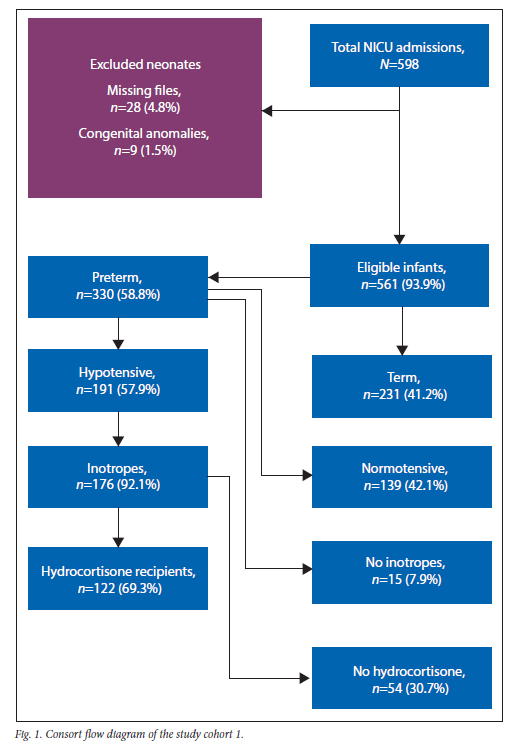
A total of 598 neonates were admitted to the NICU during the study period. Thirty-seven neonates (6.2%) were excluded as 28 (4.8% preterm neonates) had missing data and 9 (1.5%) had congenital anomalies. Of the 561 included neonates, 330 (58.8%) were preterm. One hundred and ninety-one (57.1%) preterm neonates admitted to the NICU were diagnosed with hypotension, with 176 (92.1%) of those requiring inotropic support. Hydrocortisone was prescribed in 122 (69.8%) preterm neonates diagnosed with hypotension (Fig. 1).
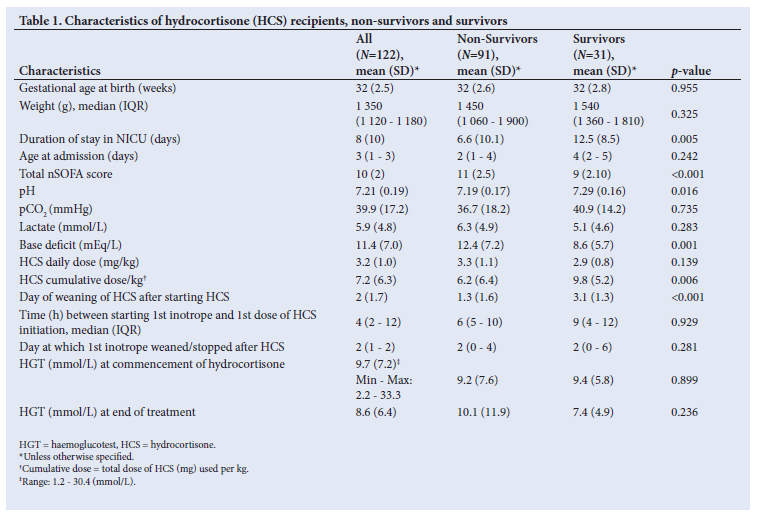
The baseline demographics and clinical characteristics of the neonates that received hydrocortisone v. those that did not showed no significant differences between the two groups, except that the hydrocortisone recipients had higher frequency of blood-culture positivity (p=0.009) and a higher mortality prevalence (p=0.001).
The mean (SD) gestational age was 32 (2) weeks, with the peak frequency between 33 and 34 weeks (29.6%). The median (IQR) birthweight in those that received hydrocortisone was 1 350 g (1 120 - 1 801 g), with 56 (46%) neonates weighing more than 1 500 g, 49 (40%) neonates weighed between 1 000 and 1 499 g, while 17 (14%) weighed less than 1 000 g.
The haemodynamic differences and management of these neonates comparing the hydrocortisone recipients v. non-recipients highlighted that a larger proportion of hydrocortisone recipients received normal saline boluses (80% v. 55%; p=0.002, and all their blood pressure parameters were significantly lower than those f non-recipients at initiation of inotropes and 3 hrs later (p<0.05; data not shown).
The median (IQR) age at admission to NICU was 3 days (1 - 4). The most common (83%) first-line prescribed inotrope was dobutamine followed by dopamine (14%). The commonly Fig. 1. Consort flow diagram of the study cohort 1.
(71%) prescribed third-line inotrope in those receiving hydrocortisone was adrenaline. The median (IQR) time between starting inotropes to giving the first dose of hydrocortisone was 4 (2 - 12) hours (Table 1). Among the hydrocortisone recipients, 68 (53%) neonates received their first hydrocortisone dose within 6 hours of commencing the first inotrope while 25 (20.5%) received it within the first hour. There were no differences in the time frame of commencing hydrocortisone between survivors and non-survivors (p=0.929). The mean daily dose of hydrocortisone was 3.2 (1.0) mg/kg/day. A total of 109 (89.3%) neonates were prescribed hydrocortisone 8 hourly. The cumulative hydrocortisone dose was higher in survivors 9.8 (5.2) mg/kg compared with 6.2 (6.4) mg/kg in the non-survivors (p=0.006). Hydrocortisone was weaned in 33 (27%) neonates at a mean (SD) of 3.1 (1.3) days (p<0.001) in survivors. One-fifth (n=25; 20.5%) had hydrocortisone stopped at 72 hours and 8 (6.6%) at 96 hours. When comparing the survivors and non-survivors in neonates who received hydrocortisone, there were no differences in the HGT measurements (p=0.236).
The mean (SD) systolic blood pressure (SBP) before hydrocortisone administration was 46 (9) mmHg compared with 53 (11) mmHg post treatment, while the diastolic component had an increase in mean (SD) from 24 (9) mmHg to 28 (11) mmHg. Hydrocortisone increased both the mean (SD) SBP (mean (SD) difference 7mmHg; p=0.001) and DBP (mean (SD) difference 4 mmHg; p=0.001). The mean (SD) duration of stay in NICU was 8 (10) days; non-survivors had a significantly shorter NICU stay (6.6 (10.1) v. 12.5 (8.5); p=0.05) (Table 1).
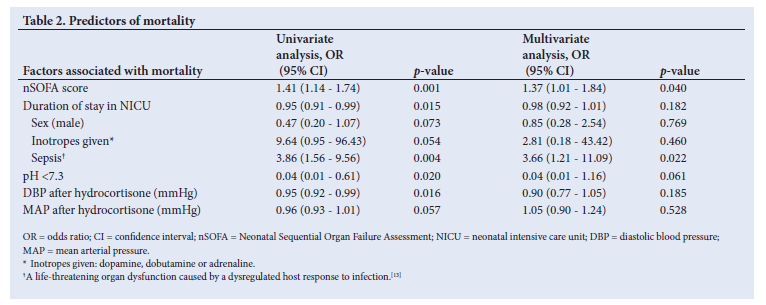
The commonest diagnosis in the hydrocortisone group was respiratory distress syndrome (RDS) (41.8%), nosocomial sepsis (31.3%) and necrotising enterocolitis (NEC) (10.7%). Sepsis was defined as a life-threatening organ dysfunction caused by a dysregulated host response to infection.[12] Neonates that received hydrocortisone for hypotension had a higher blood culture positivity rate (46.8% v. 20.4%; p=0.009) when compared with the non-recipients. Sixty-nine percent of neonates with confirmed positive blood cultures in the hydrocortisone recipients had a Gram-negative infection (XDR Acinetobacter baumannii and Klebsiella pneumoniae CRE). Neonates who received hydrocortisone had a higher mortality rate (74.6% v. 22.2%; p=0.001) when compared with those that did not receive the steroid for their hypotension. The non-survivors that received hydrocortisone were significantly acidotic on admission, with a lower pH (7.195 v. 7.294; p=0.016) and base deficit (12.4 (7.2) v. 8.6 (5.7); p=0.001) compared with the survivors. On adjusted logistic regression analysis (adjusted for the following confounding factors: nSOFA, duration of stay in NICU, male sex, inotropes given, sepsis, pH, DBP and MAP), the non-survivors had sepsis (OR 3.66; 95% CI 1.21 -11.09; p=0.022) and a higher nSOFA score (OR 1.37; 95% CI 1.01-1.84; p=0.040) (Table 2).
Discussion
This study describes the characteristics and outcomes of mainly VLBW and preterm neonates who were administered hydrocortisone for inotrope refractory hypotension in a low- to middle-income country's (LMIC) tertiary neonatal unit. There are limited local data on prevalence rates of hypotension in preterm infants, and this is possibly due to the complexity in accurate assessment and diagnosis. There are no randomised controlled trials looking at hydrocortisone administration in inotropic refractory neonatal hypotension.
Our study reported a hypotension prevalence of about 58% in preterm infants, which was higher than an Indian perspective by Das et al.,[13] who reported a prevalence of 24 - 50% in a physician-based cross-sectional survey conducted using an online tool. Al-Aweel et al.,[14] in a prospective multi-centre cohort study in Massachusetts and Rhode Island, USA reported a prevalence of hypotension in preterm neonates weighing <1 500 g of 24 - 45% in 6 NICUs with a sample size of 1 288 infants. There was a large variation in prevalences of hypotension and the use of vasopressors, which varied 43-fold among the six study centres.
There are contrasting opinions on the dosing of hydrocortisone in neonates. Hydrocortisone administration for inotrope refractory hypotension in our study was started at a low dose of 1 mg/kg and then continued 8-hourly. Other studies had variable hydrocortisone dosing. Noori et al.,[15] in a prospective observational study of 15 preterm neonates who were administered hydrocortisone over 48 hours, proposed higher starting doses of 2 mg/kg followed by maintenance doses 12 hourly and Watterberg et al.[16] who advocates for smaller stress doses of 1 mg/kg, which is supported by the evidence of slow hydrocortisone metabolism in smaller neonates. However, the study sample sizes were small in these studies with Noori et al.,[15] observing 15 preterm infants. These studies differ from our study by dosing of 0.5 mg/kg every 6 - 8 hours in late preterm and 0.5 mg/kg every 12 hours in those born at less than 34 weeks gestational age. Our study weaned hydrocortisone over 48 - 72 hours by first reducing the dose to half and continuous dose reduction every 12 - 24 hours thereafter.
The timing of the initiation of hydrocortisone with respect to the first dose of inotrope given depended on when the second inotrope was commenced. About 25 neonates (20.5% of participants) received the first hydrocortisone dose within the first hour of being administered a vasoactive agent (median starting time 4 hours). The study showed that the cumulative dose was significantly higher in the survivors (9.8 mg/kg) compared with non-survivors (6.2 mg/kg) (p=0.006). The difference in cumulative doses could also be explained by the shorter duration of stay and severity of illness in the non-survivors compared with the discharged patients. Ibrahim et al.[17] in a meta-analysis review of randomised and quasi-randomised trials comparing oral or intravenous steroid administration to placebo in preterm neonates, achieved a cumulative dose of 7 mg/kg and noted no significant side-effects nor complications, thus concluding that steroid therapy is effective and safe in short-term administration for neonatal hypotension.
Our study also assessed the glucose levels before commencing hydrocortisone and at the last documented glucose reading using HGT. There was no significant elevation in median values at the two timepoints. This is similar to Bourchier et al.,[18] who in a prospective study randomly allocated 40 infants to receive either hydrocortisone or dopamine and did not demonstrate hyperglycaemia as a short-term complication of hydrocortisone use in hypotension. Peeples et al.,[19] in a retrospective analysis of 106 infants of a gestational age <28 weeks, observed hyperglycaemia in hypotensive patients receiving hydrocortisone, which required insulin infusions to control the glucose instability. However, the steroid dosing was high, with some participants getting as much as 4 mg/kg per dose. With these conflicting findings, more research should be conducted with a larger sample size to assess the side-effect profile of hydrocortisone administration in neonates.
The systemic blood pressure (BP) improvements were observed in both the systolic and diastolic components. Seri et al.,[20] in a retrospective review of 21 preterm neonates following administration of hydrocortisone, found blood pressure elevations within 2 hours of the first steroid dose, which led to successful weaning of inotropes with an 86% survival proportion. Our unit measured blood pressure continuously in neonates but only documented measurements every 30 minutes post initiation of hydrocortisone. This could have been too early to conclude hydrocortisone impact on blood pressure increments.
Mortality in the present study was high (75%) in neonates who received hydrocortisone. Mortality associated with hydrocortisone use in vasoactive-resistant hypotension is not well documented. Peeples et al.[19] found an increased incidence in death in the hydrocortisone-treated group, associated with higher pretreatment cortisol levels. The elevated cortisol levels were indicative of a more severe disease process that would independently increase mortality. In a recently published meta-analysis on the timing ofhydrocortisone therapy in neonates with shock, Ramaswamy et al.[21] noted that no clinical benefit nor harm could be proven regarding mortality. Three studies in this meta-analysis reported that late hydrocortisone, defined as initiation of hydrocortisone when high dosages of inotropes were required, was associated with mortality. Furthermore, the authors recommended that hydrocortisone administration, both early and late, was beneficial as an adjunct to inotropes in vasoactive-resistant hypotension. Contributory factors to mortality included the timing of hydrocortisone in the pooled studies. The late hydrocortisone group had a higher mortality attributed to an increased risk of sepsis in this group, prolonged exposure to inotropes and the use of dopamine in the smaller neonates. In our setting, we did not analyse the timing of the hydrocortisone in relation to mortality, nor did we collect cortisol levels before administering hydrocortisone, and neonates were admitted to the NICU with sepsis. The majority of these neonates had Gram-negative sepsis (69%). In a retrospective review of 154 neonates over a 5-year period, Iqbal et al.[22]] found a 39.6% mortality in participants with sepsis, of which the majority (52%) were secondary to Gram-negative sepsis. Adrenal insufficiency is more pronounced in critically ill neonates, amplifying the cardiovascular decompensation and subsequent shock.[23] Thus, the disease processes and diagnoses that preceded the hypotension may be independently associated with mortality. The contributions of other clinical complications on mortality which are independent from hypotension should be factored in.[24] That being said, sepsis and a high nSOFA score as significant predictors of mortality may point to the severity of illness that may have led to the NICU admission.
Study limitations and strengths
The study was a single-centre retrospective observational study. HGT monitoring was not continuous, hence elevations could have been missed between readings. Recording (and assessing) peak HGT levels was not included in this study. Cortisol levels were not measured in neonates commenced on hydrocortisone, hence we could not conclude on the effects of hydrocortisone in patients with clinical features of adrenal insufficiency. This is the first study in a LMIC to report on hydrocortisone use in a NICU for septic shock with a large cohort of infants from a single centre.
Conclusion
Low-dose hydrocortisone at 1 mg/kg/dose improved blood pressure in hypotensive preterm neonates. There are no current agreements on timing, dosing, duration and weaning methods of hydrocortisone in the neonatal population. Although mortality was a significant finding in this cohort, the only differences between survivors and non-survivors were lower nSOFA scores and delayed hydrocortisone administration in non-survivors. There is a need for randomised control trials and long-term neuro developmental outcome evaluation in hypotensive hydrocortisone-recipient survivors.
Declaration. A research report submitted to the Faculty of Health Sciences, University of the Witwatersrand, Johannesburg, in partial fulfilment of the requirements for the degree of Master of Medicine in Paediatrics in Johannesburg, South Africa, 2025.
Acknowledgements. My supervisor, Prof. Firdose L Nakwa, Head of Neonatology at Chris Hani Baragwanath Academic Hospital. Prof. Kebashni Thandrayen, Chris Hani Baragwanath Academic Hospital for her statistical support and revising my final drafts. Professor Sithembiso Velaphi, Head of Paediatrics Department at Chris Hani Baragwanath Academic Hospital. Professor Ashraf Coovadia, Head of Paediatrics Department at Rahima Moosa Mother and Child Hospital. All staff and patients at Chris Hani Baragwanath Academic Hospital Neonatal Intensive Care Unit.
Author contributions. RT: principal author of the manuscript, editing statistical analysis and write-up of manuscript. FLN: senior author, conceptualisation, methodology, statistical analysis, reviewing, validation, editing and final approval of manuscript. KT: formal analysis, statistical analysis, reviewing, editing and validation of results, reviewing write-up and final approval of manuscript.
Funding. None.
Conflict of interest. None.
References
-
1. Dempsey EM, Barrington KJ, Marlow N, et al. Hypotension in Preterm Infants (HIP) randomised trial. Arch Dis Child - Fetal Neonatal Ed 2021;106(4):398-403. https://doi.org/10.1136/archdischild-2020-320241
» https://doi.org/10.1136/archdischild-2020-320241 -
2. Davis AL, Carcillo JA, Aneja RK, et al. American College of Critical Care Medicine clinical practice parameters for hemodynamic support of pediatric and neonatal septic shock. Crit Care Med 2017;45(6):1061-1093. https://doi.org/10.1097/CCM.0000000000002425
» https://doi.org/10.1097/CCM.0000000000002425 -
3. Elsheikh RM, Elmashad AM, Aboelenin AM, Elrifaey SM. Relative adrenal insufficiency in full-term and preterm neonates with neonatal sepsis. Asian J Pediatr Res 2024;14(1):1-13. https://doi.org/10.9734/ajpr/2024/v14i1314
» https://doi.org/10.9734/ajpr/2024/v14i1314 -
4. Huysman MWA, Hokken-Koelega ACS, De Ridder MAJ, Sauer PJJ. Adrenal function in sick very preterm infants. Pediatr Res 2000;48(5):629-633. https://doi.org/10.1203/00006450-200011000-00013
» https://doi.org/10.1203/00006450-200011000-00013 -
5. Ping P, Yu B, Xu R, Zhao P, He S. Monitoring and evaluation of hypotension in the extremely preterm. Front Cardiovasc Med 2024;11:1477337. https://doi.org/10.3389/fcvm.2024.1477337
» https://doi.org/10.3389/fcvm.2024.1477337 -
6. Lambden S, Laterre PF, Levy MM, Francois B. The SOFA score: Development, utility and challenges of accurate assessment in clinical trials. Crit Care 2019;23(1):374. https://doi.org/10.1186/s13054-019-2663-7
» https://doi.org/10.1186/s13054-019-2663-7 -
7. Wynn JL, Polin RA. A neonatal sequential organ failure assessment score predicts mortality to late-onset sepsis in preterm very low birth weight infants. Pediatr Res 2020;88(1):85-90. https://doi.org/10.1038/s41390-019-0517-2
» https://doi.org/10.1038/s41390-019-0517-2 -
8. Dempsey E, EL-Khuffash A. Clinical Trials in hemodynamic support. Clin Perinatol 2020;47(3):641-652. https://doi.org/10.1016/j.clp.2020.05.013
» https://doi.org/10.1016/j.clp.2020.05.013 -
9. Kharrat A, Diambomba Y, Jain A. Corticosteroid use in neonatal hypotension: A survey of Canadian neonatologists. Pediatr Neonatol 2024;65(5):451-456. https://doi.org/10.1016/j.pedneo.2023.09.013
» https://doi.org/10.1016/j.pedneo.2023.09.013 -
10. Watterberg KL. Adrenal insufficiency and cardiac dysfunction in the preterm infant. Pediatr Res 2002;51(4):422-424. https://doi.org/10.1203/00006450-200204000-00004
» https://doi.org/10.1203/00006450-200204000-00004 -
11. The Chris Hani Baragwanath Hospital. https://www.chrishanibaragwanathhospital.co.za/ (accessed 29 April 2026).
» https://www.chrishanibaragwanathhospital.co.za/ -
12. Evans L, Rhodes A, Alhazzani W, et al. Surviving sepsis campaign: international guidelines for management of sepsis and septic shock 2021. Intensive Care Med 2021;47(11):1181-1247. https://doi.org/10.1007/s00134-021-06506-y
» https://doi.org/10.1007/s00134-021-06506-y -
13. Das R, Nagpal R, Deshpande S, et al. A survey on management practices of hypotension in preterm neonates: an Indian perspective. Front Pediatr 2024;12:1411719. https://doi.org/10.3389/fped.2024.1411719
» https://doi.org/10.3389/fped.2024.1411719 -
14. Al-Aweel I, Pursley DM, Rubin LP, Shah B, Weisberger S, Richardson DK. Variations in prevalence of hypotension, hypertension, and vasopressor use in NICUs. J Perinatol 2001;21(5):272-278. https://doi.org/10.1038/sj.jp.7210563
» https://doi.org/10.1038/sj.jp.7210563 -
15. Noori S, Friedlich P, Wong P, Ebrahimi M, Siassi B, Seri I. Hemodynamic changes after low-dosage hydrocortisone administration in vasopressor-treated preterm and term neonates. Pediatrics 2006;118(4):1456-1466. https://doi.org/10.1542/peds.2006-0661
» https://doi.org/10.1542/peds.2006-0661 -
16. Watterberg KL. Hydrocortisone dosing for hypotension in newborn infants: Less is more. J Pediatr 2016;174:23-26.e1. https://doi.org/10.1016/j.jpeds.2016.04.005
» https://doi.org/10.1016/j.jpeds.2016.04.005 -
17. Ibrahim H, Sinha IP, Subhedar NV. Corticosteroids for treating hypotension in preterm infants. Cochrane Database Syst Rev 2011(12):CD003662. https://doi.org/10.1002/14651858.CD003662.pub4
» https://doi.org/10.1002/14651858.CD003662.pub4 -
18. Bourchier D, Weston PJ. Randomised trial of dopamine compared with hydrocortisone for the treatment of hypotensive very low birthweight infants. Arch Dis Child - Fetal Neonatal Ed 1997;76(3):F174-F178. https://doi.org/10.1136/fn.76.3.F174
» https://doi.org/10.1136/fn.76.3.F174 -
19. Peeples ES. An evaluation of hydrocortisone dosing for neonatal refractory hypotension. J Perinatol 2017;37(8):943-946. https://doi.org/10.1038/jp.2017.68
» https://doi.org/10.1038/jp.2017.68 -
20. Seri I, Tan R, Evans J. Cardiovascular effects of hydrocortisone in preterm infants with pressor-resistant hypotension. Pediatrics 2001;107(5):1070-1074. https://doi.org/10.1542/peds.107.5.1070
» https://doi.org/10.1542/peds.107.5.1070 -
21. Ramaswamy VV, Kumar G, Pullattayil S AK, et al. Timing of hydrocortisone therapy in neonates with shock: A systematic review, meta-analysis, and clinical practice guideline. Front Pediatr 2025;13:1491976. https://doi.org/10.3389/fped.2025.1491976
» https://doi.org/10.3389/fped.2025.1491976 -
22. Iqbal F, Chandra P, Khan AA, et al. Prediction of mortality among neonates with sepsis in the neonatal intensive care unit: A machine learning approach. Clin Epidemiol Glob Health 2023;24:101414. https://doi.org/10.1016/j.cegh.2023.101414
» https://doi.org/10.1016/j.cegh.2023.101414 -
23. Gutierrez CE, De Beritto T. Relative adrenal insufficiency in the preterm infant. NeoReviews 2022;23(5):e328-e334. https://doi.org/10.1542/neo.23-5-e328
» https://doi.org/10.1542/neo.23-5-e328 -
24. Baker CFW, Barks JDE, Engmann C, et al. Hydrocortisone administration for the treatment of refractory hypotension in critically ill newborns. J Perinatol 2008;28(6):412-419. https://doi.org/10.1038/jp.2008.16
» https://doi.org/10.1038/jp.2008.16

Accepted 19 February 2026