Outcome of therapies for children with persistent/ chronic primary immune thrombocytopenia at a specialised haematology clinic in Durban, South Africa: The role of splenectomy
BACKGROUND. Variance in treatment options and outcomes for patients with persistent/chronic immune thrombocytopenia (ITP) makes the selection of therapies challenging. OBJECTIVE. To describe the response rates and adverse effects of secondary therapies utilised in the management of children with persistent/ chronic ITP. METHODS. This retrospective, single-centre study reviewed clinical records of children with persistent or chronic ITP managed at Inkosi Albert Luthuli Central Hospital from 2010 to 2020. Data were extracted from the electronic-based registry using the Meditech filing system. We captured patients' demographics, clinical features, laboratory data and therapeutic interventions. Outcomes assessed included remission and relapse rates and adverse effects post therapy. RESULTS. Of the 30 patients enrolled, 14 (46.7%) received immunosuppressive agents alone (azathioprine, rituximab, ciclosporin and/or prednisone) and 16 (53.3%) had splenectomy in addition to treatment with immunosuppressive agents. Of the 16 splenectomy patients, 11 (68.8%) had a complete response by 12 months of diagnosis and only 7 (43.8%) had remission at 2- to 10-year follow-up. Remission was noted in 9 of the 14 children (64.4%) treated with immunosuppressive therapy alone, at study end. The rates of side-effects in both groups were statistically non-significant (p>0.05). CONCLUSION. Selection of secondary therapies including splenectomy for patients with non-acute primary ITP remains difficult and should be applied on the basis of availability, costs, social circumstances and safety of the intervention.
chronic immune thrombocytopenia; splenectomy; azathioprine; rituximab; prednisone; platelet response
Outcome of therapies for children with persistent/ chronic primary immune thrombocytopenia at a specialised haematology clinic in Durban, South Africa: The role of splenectomy
C ZwaneI; Y GogaII; P JeenaIII
IMB ChB, FCPaed, MMED; Department of Paediatrics and Child Health, School of Clinical Medicine, Nelson R Mandela School of Medicine, University of KwaZulu-Natal, Durban, South Africa
IIMB ChB, DCH FCPaed, Cert Clinical Haem Paeds, MSc, PG Dip Pall Paeds, PG Dip Public Health; Department of Paediatric Haematology, Grey's Hospital, Pietermaritzburg, South Africa
IIIMB ChB, FCPaed, Cert Pulmonary Paeds, PhD; Department of Paediatrics, Inkosi Albert Luthuli Central Hospital, Durban, South Africa
BACKGROUND. Variance in treatment options and outcomes for patients with persistent/chronic immune thrombocytopenia (ITP) makes the selection of therapies challenging.
OBJECTIVE. To describe the response rates and adverse effects of secondary therapies utilised in the management of children with persistent/ chronic ITP.
METHODS. This retrospective, single-centre study reviewed clinical records of children with persistent or chronic ITP managed at Inkosi Albert Luthuli Central Hospital from 2010 to 2020. Data were extracted from the electronic-based registry using the Meditech filing system. We captured patients' demographics, clinical features, laboratory data and therapeutic interventions. Outcomes assessed included remission and relapse rates and adverse effects post therapy.
RESULTS. Of the 30 patients enrolled, 14 (46.7%) received immunosuppressive agents alone (azathioprine, rituximab, ciclosporin and/or prednisone) and 16 (53.3%) had splenectomy in addition to treatment with immunosuppressive agents. Of the 16 splenectomy patients, 11 (68.8%) had a complete response by 12 months of diagnosis and only 7 (43.8%) had remission at 2- to 10-year follow-up. Remission was noted in 9 of the 14 children (64.4%) treated with immunosuppressive therapy alone, at study end. The rates of side-effects in both groups were statistically non-significant (p>0.05).
CONCLUSION. Selection of secondary therapies including splenectomy for patients with non-acute primary ITP remains difficult and should be applied on the basis of availability, costs, social circumstances and safety of the intervention.
Keywords: chronic immune thrombocytopenia, splenectomy, azathioprine, rituximab, prednisone, platelet response
Primary immune thrombocytopenia (ITP), defined as an isolated immune-mediated peripheral blood platelet count of <100 × 109[1,2] The degree of thrombocytopenia determines the risk of bleeding.[3] The majority of children with primary newly diagnosed ITP recover spontaneously or with corticosteroid treatment within 3 months of onset of disease.[4,5] Approximately 25% of affected children, however, develop persistent (3 - 12 months) or chronic (beyond 12 months of presentation) disease.[4] Children with persistent/chronic ITP require secondary therapies, including immunosuppressants (such as corticosteroids, azathioprine, cyclophosphamide, mycophenolate mofetil, ciclosporin A and rituximab), thrombopoietin-receptor agonists (TPO-RAs) and splenectomy.[1,6-8] Despite the establishment of standard guidelines for both diagnosis and response to therapy, recommendations vary.[6,7,9]
The prolonged use of corticosteroids for persistent/chronic primary ITP is associated with the serious adverse effects of Cushing syndrome, hypertension, abnormal glycaemic control and infections.[7,9-11] The use of azathioprine in children is associated with bone marrow toxicity.[12] The remission rate with the use of rituximab for ITP is approximately 60%,[13] with half of these cases relapsing and the adverse effects of persistent hypogammaglobulinaemia seen.[14-17] TPO-RA treatment has shown a 70% remission rate (a sustained platelet response and the elimination of significant bleeding events that require red cell transfusions or additional ITP treatments) in children,[6,18-20] However, it is expensive. In low-middle-income countries (LMICs), children with persistent/chronic ITP are subjected to splenectomy, although the postoperative risk of infection is a concern. In a retrospective review of 73 patients who underwent splenectomy for ITP in Cape Town, Antel et al.[21] concluded that splenectomy remains the second-line treatment of choice, with newer treatments reserved for patients who are not surgical candidates. At Chris Hani Baragwanath and Charlotte Maxeke hospitals in Johannesburg, the majority (39%) of splenectomies were performed for ITP.[22]
The American Society of Hematology (ASH), the ITP International Working Group (ITP-IWG) and the British Society of Haematology (BSH) have differing recommendations on splenectomy and TPO-RAs[7,9]:
• The ASH[7] prefers TPO-RAs and rituximab over splenectomy, supporting TPO-RAs as second-line treatment.
• The ITP-IWG[9] supports rituximab for refractory cases and TPO-RAs as second-line treatment.
• The BSH[1] advises caution with rituximab and splenectomy, recommending TPO-RAs as second-line treatment.
The ITP-IWG recommends splenectomy only in children who have failed medical therapies, 12 - 24 months from diagnosis,[9] and avoidance before 5 years of age. TPO-RAs are supported as first-line therapy by the ASH and BSH owing to reduced bleeding frequency without adverse effects.[9] However, efficacy and safety comparisons are unclear owing to lack of uniform treatment endpoints.[6] The ITP-IWG recommends 'safe' platelet counts and absence of bleeding as primary outcomes.[8,9]
The applicability of these guidelines in sub-Saharan Africa is uncertain, highlighting a knowledge gap in managing chronic ITP in children in LMICs. Limited access to treatments like rituximab and TPO-RAs underscores the need for context-specific data and guidelines tailored to local healthcare resources. The aim of this study was to describe the response rates and adverse effects of secondary therapies utilised in the management of paediatric patients with persistent/chronic ITP.
Methods
This was a retrospective, descriptive study of children with persistent/ chronic primary ITP, defined as an isolated thrombocytopenia (platelet count <100 × 109
An Excel spreadsheet was used to capture patients' demographic data and vaccination history, clinical features, full blood counts with differentials, viral and autoimmune screen results, HIV status, bone marrow aspirate and trephine biopsy (BMAT) findings, presurgical ultrasound findings and therapeutic interventions implemented over the study period. Outcome variables included platelet response and the number of bleeding episodes recorded at 6 months, 12 months and last recorded visit; clinical status at the last recorded institution visit until 2020; and adverse effects for the duration of the study.
Ethics
Ethical approval was obtained from the University of KwaZulu-Natal Biomedical Research Ethics Committee, approval number: BREC/0003807/22. This study was retrospective in nature; thus informed consent/assent was not required.
-
Definitions
Platelet response and treatment response were defined according standard definitions established by the ITP-IWG as follows: a complete platelet response was defined as an improvement of the platelet count to >100 × 10999
Full remission required a complete platelet response with no bleeding; partial remission required a partial platelet response with no bleeding. Relapse was defined as a decline in platelet count to <100 × 10999
Statistical evaluation
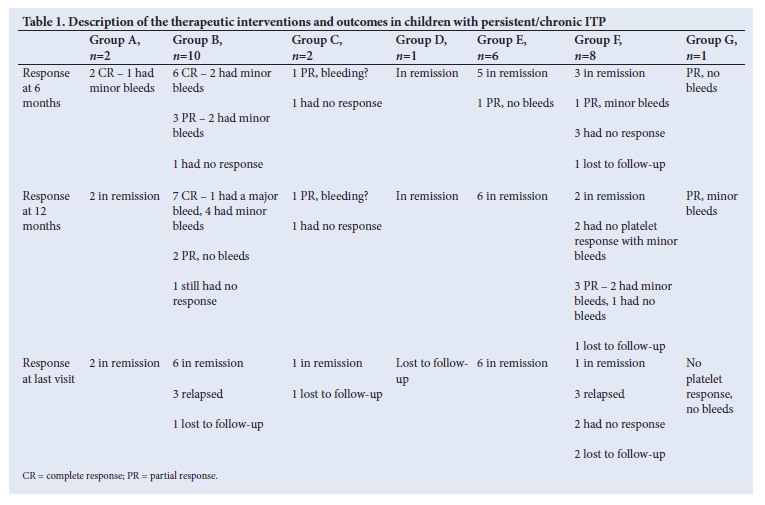
Descriptive statistics were used to summarise the data. Patients who received secondary therapies were classified into six groups according to the type of therapies received (Table 1). These groups were further classified into those who received combination immunosuppressive therapies with splenectomy and those who received a combination of immunosuppressive therapies alone. Fisher's exact test was then used to compare categorical variables between the two groups. Numeric variables were normally distributed, and two-sample t-tests were used for numeric variables. Stata v17 was used for statistical analysis. A p-value of <0.05 was the threshold for statistical significance.
Results
Demographics and baseline characteristics
Thirty-six patients were identified with ITP at screening of electronic files; six patients had secondary ITP and were excluded from the analysis. Of the 30 patients included, 15 were male, with a median age of 4.5 years (interquartile range (IQR) 2 - 8) at presentation. Twenty-three patients (76.7%) were of African descent while the remainder were of Indian descent. All patients were HIV negative.
At diagnosis, 24 patients (80%) presented with minor bleeds; 3 patients each (10%) presented with major bleeds (2 with intracranial haemorrhage and 1 with blindness secondary to bilateral vitreous haemorrhage) or an incidental finding of thrombocytopenia. The median platelet count at presentation was 7 × 1099
Institutional algorithm for management of persistent/ chronic ITP in children
The algorithm below is used for the management of persistent/ chronic ITP in children at our institution. For platelet count <30 × 109
• Asymptomatic: observe
• Symptomatic:
• First-line: pulse prednisone
• Second-line: azathioprine (wait 3-6 months for response); consider ciclosporin or rituximab if intolerant/poor response
• Azathioprine may be combined with low-dose prednisone
• Splenectomy criteria:
• Failure of medical therapy by 1 year
• Significant bleeding with limited hospital access
• Frequent/high-dose steroid dependence
• Postsplenectomy management:
• Stop prednisone and azathioprine/other immunosuppression
• For relapse: recommence prednisone (shorter courses), azathioprine, ciclosporin or rituximab (if previously responsive).
Description of the therapeutic interventions and outcomes in children with persistent/chronic ITP (N=30)
Patients received varying treatments and were characterised into groups A to G according to treatment combination: group A received azathioprine alone; group B received azathioprine and prednisone; group C received azathioprine, prednisone and rituximab or ciclosporin; group D had splenectomy and presurgery azathioprine; group E underwent splenectomy with presurgery azathioprine and prednisone; group F underwent splenectomy with pre- and postsurgery immunotherapies (azathioprine, prednisone, rituximab and ciclosporin); and group G had splenectomy with presurgery azathioprine, prednisone and ciclosporin (Table 1).
All patients who underwent splenectomy received immunisations against Streptococcus pneumoniae, Meningococcus and Haemophilus influenzae prior to surgery. They also received postoperative lifelong penicillin V potassium (Pen VK), per departmental protocol, owing to the susceptibility of patients to overwhelming infection following splenectomy, a practice that is now phased out because of concerns about antibiotic resistance. Two of16 patients who underwent splenectomy had ultrasound examinations with no splenic abnormalities detected. There was no use of TPO-RAs.
Overall outcome measures (N=30)
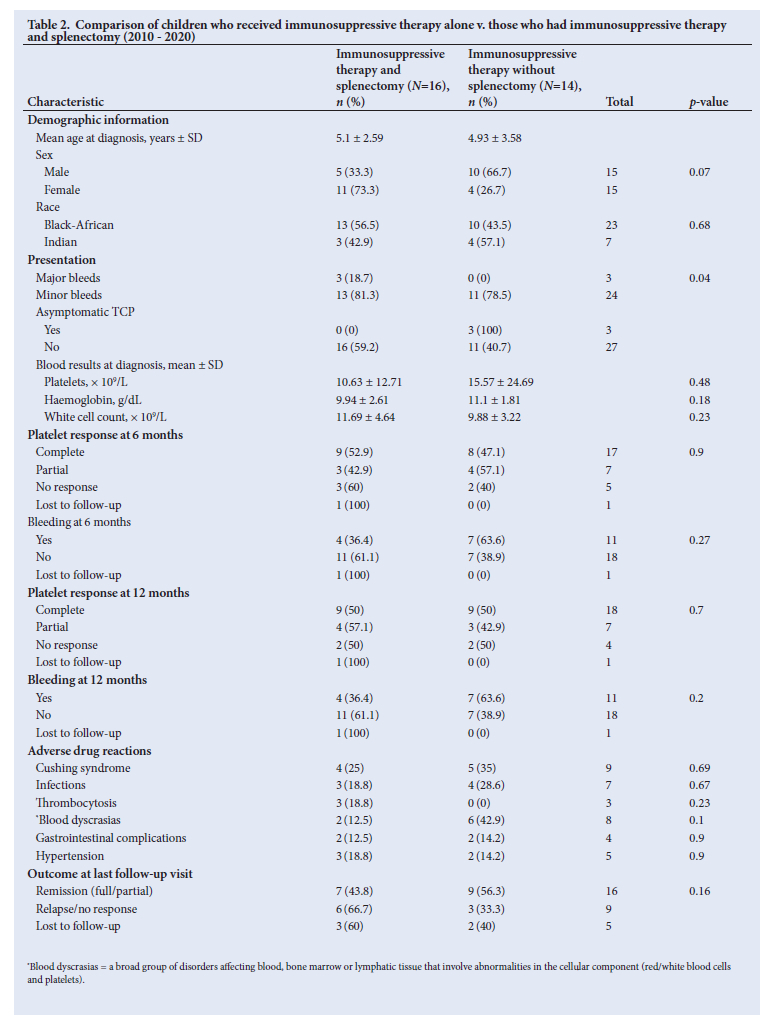
At 6-month review, 17 patients (56.7%) had a complete platelet response, 7 (23.3%) had a partial platelet response, 5 (16.7%) had no platelet response and 1 was lost to follow-up. Eighteen (60%) had no bleeding episodes, 11 (36.7%) still had minor bleeds, while 1 (3.3%) was lost to follow-up. At the 12-month review, 18 patients (60.0%) had a complete platelet response, 7 (23.3%) had a partial platelet response, 4 (13.3%) had no platelet response and 1 (3.3%) was lost to follow-up. Eighteen (60.0%) had no bleeding episodes, 11 (36.7%) still had minor bleeds and 1 (3.3%) was lost to follow-up.
At the last recorded visit (range: 2 - 10 years), 16 patients (56.3%) were in complete remission, 7 (23.3%) relapsed, 2 (6.7%) did not respond to therapy and 5 (16.7%) were lost to follow-up.
Outcome of children on combined immunotherapy with and without splenectomy
Fourteen patients (46.7%) received a combination of medical immunosuppressive therapies alone (Table 2), with four (28.6%) of these patients having persistent ITP. Among the patients treated, 8 out of 12 (66.7%) who received azathioprine alone or azathioprine with prednisone were in remission at their last recorded visit, while three (21.4%) relapsed and one (7.1%) was lost to follow-up. One of the remaining two patients, who was on rituximab with other medical immunosuppressants, showed a partial platelet response at 6 and 12 months and was in remission at the last recorded visit. The other patient, who received ciclosporin and other immunosuppressants, showed no response to treatment at 6 and 12 months and was subsequently lost to follow-up. Of the four patients with persistent ITP, two went into remission with azathioprine alone, while the other two achieved remissions with a combination of azathioprine and prednisone. Five patients (26.3%) with chronic ITP responded to immunosuppressive therapies alone, three relapsed or had no response to immunotherapies and two patients of the immunosuppressive therapy group were lost to follow-up.
Sixteen patients (53.3%) received combined immunosuppressive therapies (azathioprine, rituximab, ciclosporin, prednisone) and splenectomy. At the last recorded visit, seven (43.8%) were in remission. Additionally, 9 (56.3%) patients had a complete platelet response and 11 (68.8%) were free of bleeding at 12 months. Seven patients with persistent ITP underwent splenectomy, resulting in full remission for all. Six patients received presurgical treatment with azathioprine and prednisone, while the seventh patient received immunotherapy both before and after the splenectomy. Six patients with chronic ITP relapsed/had no response to a combination of splenectomy and immunosuppressants. Three other patients with chronic ITP were lost to follow-up. Some patients underwent splenectomy within 12 months of diagnosis. Notably, the complete response rate for persistent ITP was similar for those who had splenectomy (36.4%) and those who did not (36.8%).
Adverse effects
Children on immunotherapies with or without splenectomy had rates and types of serious adverse effects that were statistically non-significant (p>0.05). In the splenectomy group, three patients (18.8%) developed thrombocytosis shortly after surgery, but this resolved by 2 years post splenectomy in all patients. Despite presurgical vaccinations and lifelong Pen VK, two patients (12.5%) were diagnosed with severe infections - one with complicated pyelonephritis and the other with neutropenic sepsis - while one patient suffered from recurrent tonsillitis. Rituximab use was associated with abdominal pain that required hospitalisation.
Discussion
Half of subjects with persistent/chronic primary ITP had a complete response, while a further 25% had an initial response and then relapsed during a follow-up period of 2 - 10 years. The majority of responders (n=11, 68.8%) achieved this outcome by 12 months from diagnosis. This was similar to data from the Pediatric and Adult Registry on Chronic ITP and a 10-year audit from Tygerberg Hospital, where 28% of paediatric patients with chronic ITP achieved remission within 24 - 26 months of diagnosis.[23,24] This was unlike a single-centre study by Jung et al.[25] that demonstrated a benign course, with 86% of children recovering fully within 1 year of diagnosis.
The bleeding outcomes observed in this study underscore the complexity of managing persistent and chronic ITP. Notably, 46.6% of treated patients continued to experience bleeding episodes in the first 12 months, although only one patient required a red cell transfusion following an upper gastrointestinal bleed, highlighting the low incidence of severe bleeding complications. These findings provide valuable insights into bleeding risks associated with persistent and chronic ITP, but do not offer guidance on whether patients should be treated aggressively or observed for spontaneous remission.
We separated the cohort according to immunotherapy with or without splenectomy to represent the current status of therapy in LMICs. Although, owing to the descriptive nature of the study, these groups cannot strictly be compared, 64.4% of children receiving a combination of immunosuppressive therapy alone went into remission, with 50% having a complete platelet response at 12 months. In contrast, children who received both splenectomy and immunosuppressive therapies achieved a remission rate of 43.8%, with 56.3% having a complete platelet response in 12 months.
While splenectomy is considered the most predictable method for achieving a durable remission among patients with chronic ITP,[6] our study shows that the disease may persist beyond splenectomy. This finding is consistent with the remission rate of 66.7% post splenectomy reported previously at Tygerberg Hospital,[24] highlighting the importance of considering local healthcare context and patient characteristics when interpreting treatment outcomes. Several factors that may have contributed to lower remission rate in our cohort include a heterogenous patient population, a limited sample size and differences in treatment regimens. Splenectomy was performed early in the treatment course of selected patients with no predictive factors for better outcomes. The role of splenectomy in primary ITP cannot be drawn from the current literature as studies do not separate results by age, disease duration or bleeding responses.[9] Individual choices of immunosuppressive therapies for ITP could also not be determined, with moderate efficacy rates, relatively high relapse rates and safety concerns.
No statistical difference in adverse effects was observed in children with primary persistent/chronic ITP on immunotherapies with or without splenectomy. Splenectomy is associated with a lifelong risk for life-threatening bacterial sepsis at a rate of 0.73 per 1 000 patient-years and for overwhelming sepsis of up to 3% in children.[6,9] However, in a retrospective study of paediatric patients who underwent splenectomy at two Gauteng hospitals, no cases of overwhelming postsplenectomy infection, thrombosis, cardiovascular disease or pulmonary hypertension were noted.[22] In our study, infection risk associated with splenectomy could not be assessed owing to a small sample size, variable follow-up period and relatively high loss to follow-up. Rituximab is less well tolerated than other therapies, with infusion reactions occurring in up to 18% of patients and severe or life-threatening intracranial haemorrhage or neurological leukoencephalopathy in up to 4% of patients.[7,17] In our study, serious adverse effects were seen in children with and without splenectomy, as both groups were also on corticosteroids and other immunosuppressive therapies.
The major limitations of the study were its retrospective and descriptive nature. The small sample size makes comparisons between the immunotherapy only and immunotherapy with splenectomy groups challenging. Additionally, different therapeutic modalities were implemented at varying times and for distinct indications, further complicating the analysis. With this heterogeneity in treatment regimens, collapsing these into immunotherapy v. immunotherapy with splenectomy may have oversimplified the data. Furthermore, the time to response to a combination of immunotherapies could not be measured as there was overlap with the different options. The strength of this small data set was the minimal loss of data due to electronic data-keeping.
The management of persistent/chronic ITP remains challenging, with patients responding to a variety of combination medical and surgical therapies. Remission occurs in half the cases and often by 12 months from diagnosis. Sequential choices of secondary therapies should be based on availability of treatment options, costs, social circumstances and medicine safety. Splenectomy remains a therapeutic option in LMICs and should be considered based on availability of other treatment options, socioeconomic circumstances and safety.
Future research recommendations
Recommendations for further research include:
• Comparison of the effectiveness of second-line therapeutic options in low-resource settings, including evaluation of time to response and health-related quality of life.
• Investigation of predictive factors to identify patients who require or would benefit from splenectomy early in the treatment process.
Declaration. None
Acknowledgements. None
Author contributions. CZ designed the research, collected data, analysed and interpreted data, and wrote the manuscript; YG designed the research; and PJ designed the research, interpreted data and edited the manuscript.
Funding. None
Conflicts of interest. None.
References
-
1. Cooper N. A review of the management of childhood immune thrombocytopaenia: How can we provide an evidence-based approach? Br J Haematol 2014;165(6):756-767. https://doi.org/10.1111/bjh.12889
» https://doi.org/10.1111/bjh.12889 -
2. Matzdorff A, Alesci SR, Gebhart J, et al. Expert report on immune thrombocytopaenia: Current diagnostics and treatment - Recommendations from an expert group from Austria, Germany, and Switzerland. Oncol Res Treat 2023;46(Suppl 2):5-44. https://doi.org/10.1159/000529662
» https://doi.org/10.1159/000529662 -
3. Nguyen SN, Thao NTP, Van PTQ, Tran VD. First report on health-related quality of life among children with chronic immune thrombocytopaenia in Vietnam. Clin Epidemiol Glob Health 2021; 12:100914. https://doi.org/10.1016/j.cegh.2021.10091
» https://doi.org/10.1016/j.cegh.2021.10091 -
4. Labrosse R, Vincent M, Nguyen UP, Chatrand C, Di Liddo L, Pastore, Y. Using a standardised protocol was effective in reducing hospitalisation and treatment use in children with newly diagnosed immune thrombocytopaenia. Acta Paediatr 2017;106(10):1617-1623. https://doi.org/10.1111/apa.13859
» https://doi.org/10.1111/apa.13859 -
5. Kim TO, Despotovic JM. Pediatric immune thrombocytopaenia (ITP) treatment. Ann Blood 2021:6(4). https://doi.org/10.21037/aob-20-96
» https://doi.org/10.21037/aob-20-96 -
6. Grace RF, Neunert C. Second-line therapies in immune thrombocytopaenia. Hematology Am Soc Hematol Educ Program 2016;2016(1):698-706. https://doi.org/10.1182/asheducation-2016.1.698
» https://doi.org/10.1182/asheducation-2016.1.698 -
7. Neunert C, Terrell DR, Arnold DM, et al. American Society of Hematology 2019 guidelines for immune thrombocytopaenia. Blood Adv 2019; 3(23):3829-3866. https://doi.org/10.1182/bloodadvances.2019000966
» https://doi.org/10.1182/bloodadvances.2019000966 -
8. Provan D, Arnold DM, Bussel JB, et al. International consensus report on the investigation and management of primary immune thrombocytopaenia. Blood 2010;115(2):168-186. https://doi.org/10.1182/blood-2009-06-225565
» https://doi.org/10.1182/blood-2009-06-225565 -
9. Provan D, Arnold DM, Bussel JB, et al. Updated international consensus report on the investigation and management of primary immune thrombocytopaenia. Blood Adv 2019;3(22): 3780-3817. https://doi.org/10.1182/bloodadvances.2019000812
» https://doi.org/10.1182/bloodadvances.2019000812 -
10. Cuker A, Tkacz J, Manjelievskaia J, Haenig J, Maier J, Bussel JB. Overuse of corticosteroids in patients with immune thrombocytopenia (ITP) between 2011 and 2017 in the United States. eJHaem 2023;4(2):350-357. https://doi.org/10.1002/jha2.684
» https://doi.org/10.1002/jha2.684 -
11. Palau J, Sancho E, Herrera M, et al. Characteristics and management of primary and other immune thrombocytopenias: Spanish registry study. Hematology 2017;22(8):484-492. https://doi.org/10.1080/10245332.2017.1311442
» https://doi.org/10.1080/10245332.2017.1311442 -
12. Soman S, Ashok D, Connolly SA, Cordell SJ, Taylor CJ, Campbell DI. Change in haematologic indices over time in paediatric inflammatory bowel disease treated with azathioprine. Drugs R D. 2010;10(4):213-217. https://doi.org/10.2165/11539930-000000000-00000
» https://doi.org/10.2165/11539930-000000000-00000 -
13. Lucchini E, Zaja F, Bussel J. Rituximab in the treatment of immune thrombocytopenia: What is the role of this agent in 2019? Haematologica 2019;104(6):1124-1135. https://doi.org/10.3324/haematol.2019.218883
» https://doi.org/10.3324/haematol.2019.218883 -
14. Kuter DJ. The treatment of immune thrombocytopenia (ITP): Focus on thrombopoietin receptor agonists. Ann Blood 2021;6:7. https://doi.org/10.21037/aob-21-23
» https://doi.org/10.21037/aob-21-23 -
15. Arnold DM, Heddle NM, Carruthers J, et al. A pilot randomised trial of adjuvant rituximab or placebo for nonsplenectomised patients with immune thrombocytopenia. Blood 2012;119(6):1356-1362. https://doi.org/10.1182/blood-2011-08-374777
» https://doi.org/10.1182/blood-2011-08-374777 -
16. Patel VL, Mahévas M, Lee SY, et al. Outcomes 5 years after response to rituximab therapy in children and adults with immune thrombocytopenia. Blood 2012;119(25):5989-5995. https://doi.org/10.1182/blood-2011-11-393975
» https://doi.org/10.1182/blood-2011-11-393975 -
17. McAtee CL, Lubega J, Underbrink K, et al. Association of rituximab use with adverse events in children, adolescents, and young adults. JAMA Netw Open 2021;4(2):e2036321. https://doi.org/10.1001/jamanetworkopen.2020.36321
» https://doi.org/10.1001/jamanetworkopen.2020.36321 -
18. Neunert C, Despotovic J, Haley K, et al. Thrombopoietin receptor agonist use in children: Data from the Pediatric ITP Consortium of North America ICON2 Study. Pediatr Blood Cancer 2016; 63(8):1407-1413. https://doi.org/10.1002/pbc.26003
» https://doi.org/10.1002/pbc.26003 -
19. Grainger JD, Locatelli F, Chotsampancharoen T, et al. Eltrombopag for children with chronic immune thrombocytopenia (PETIT2): a randomised, multicentre, placebo-controlled trial. Lancet 2015;386(10004):1649-1658. https://doi.org/10.1016/s0140-6736(15)61107-2
» https://doi.org/10.1016/s0140-6736(15)61107-2 -
20. Bussel JB, Provan D, Shamsi T, et al. Effect of eltrombopag on platelet counts and bleeding during treatment of chronic idiopathic thrombocytopenic purpura: A randomised, double-blind, placebo-controlled trial. Lancet 2009; 373(9664):641-648. https://doi.org/10.1016/s0140-6736(09)60402-5
» https://doi.org/10.1016/s0140-6736(09)60402-5 -
21. Antel KR, Panieri E, Novitzky N. Role of splenectomy for immune thrombocytopenic purpura (ITP) in the era of new second-line therapies and in the setting of a high prevalence of HIV-associated ITP. S Afr Med J 2015;105(5):408-412. https://doi.org/10.7196/samj.8987
» https://doi.org/10.7196/samj.8987 -
22. Patel N, Nicola A, Bennet P, Loveland J, Mapunda E, Grieve A. Paediatric splenectomy: The Johannesburg experience. S Afr J Child Health 2018;12(1):21-23. https://doi.org/10.7196/sajch.2018.v12i1.1431
» https://doi.org/10.7196/sajch.2018.v12i1.1431 -
23. Lee JM. Advances in management of pediatric chronic immune thrombocytopenia: a narrative review. J Yeungnam Med Sci 2023;40(3):241-246. https://doi.org/10.12701/jyms.2022.00745
» https://doi.org/10.12701/jyms.2022.00745 -
24. Paling A, Stefan DC. Idiopathic thrombocytopenic purpura in childhood: A 10-year audit. Hematology 2008;13(3):175-180. https://doi.org/10.1179/102453308x316167
» https://doi.org/10.1179/102453308x316167 -
25. Jung JY, Rum O A, Kim JK, Park M. Clinical course and prognostic factors of childhood immune thrombocytopenia: Single center experience of 10 years. Korean J Pediatr 2016;59(8):335-340. https://doi.org/10.3345/kjp.2016.59.8.335
» https://doi.org/10.3345/kjp.2016.59.8.335

Accepted 25 March 2026