Tertiary paediatric hospital admissions for children with cerebral palsy in South Africa
BACKGROUND. There are limited data on hospital admissions for children with cerebral palsy (CP) in Africa. OBJECTIVES. To examine the lifetime post-neonatal hospitalisation of children with CP who attended the CP clinic in 2021 at Red Cross War Memorial Children's Hospital, Western Cape Province, South Africa. METHODS. This retrospective study examined lifetime post-neonatal hospitalisation among all children with CP who attended the dedicated CP clinic at a tertiary paediatric hospital at least once during 2021. Descriptive and inferential statistics were used to analyse data. Logistic regression was conducted to test the association between CP comorbidities and hospitalisation. RESULTS. The present study included 877 children and young adults with CP, aged 1 to 23 years. Among them, 800 participants had their CP classified according to the Surveillance of Cerebral Palsy in Europe (SCPE) Classification, with the majority being non-ambulatory (61.5%; n=492) (Gross Motor Function Classification System (GMFCS) IV to V). More than two-thirds (66.5%; n/N=585/877) of the entire cohort were admitted to hospital at least once per year, primarily the non-ambulatory children (63.6%; n/N=372/585). Seizures (22.8%; 293/1 283), respiratory-related illness (14.7%; n/N=188/1 283) and gastrointestinal disorders (7.6%; 98/1 283) co-occurred with frequent emergency admissions. Orthopaedic procedures, however, co-occurred with frequent elective admissions (17.1%; n/N=219/1 283). In our cohort of children with CP, orthopaedic complications were more commonly associated with the first elective hospital admission for ambulatory children (odds ratio (OR) 3.78; 95% confidence interval (CI) 1.82 - 7.86). CONCLUSION. The present study highlights the significant burden of hospital admissions, particularly in non-ambulatory children with CP. It also underscores the importance of preventing and effectively managing complications to reduce emergency hospitalisation for children with CP.
non-ambulatory cerebral palsy; elective hospital admissions; emergency hospital admissions; orthopaedic interventions; LMICs
Tertiary paediatric hospital admissions for children with cerebral palsy in South Africa
T J KatangweI; M KrugerI, II; R van ToornI; R SolomonsI; K A DonaldIII, IV
IPhD; Department of Paediatrics and Child Health, Faculty of Medicine and Health Sciences, Stellenbosch University, Cape Town, South Africa
IIPhD; School of Applied Human Sciences (Psychology), University of KwaZulu-Natal, Durban, South Africa
IIIPhD; Division of Paediatric Neurodevelopment, Department of Paediatrics and Child Health, Faculty of Health Sciences, University of Cape Town and Red Cross War Memorial Children's Hospital, Cape Town, South Africa
IVPhD; The Neuroscience Institute, Faculty of Health Sciences, University of Cape Town, South Africa
BACKGROUND. There are limited data on hospital admissions for children with cerebral palsy (CP) in Africa.
OBJECTIVES. To examine the lifetime post-neonatal hospitalisation of children with CP who attended the CP clinic in 2021 at Red Cross War Memorial Children's Hospital, Western Cape Province, South Africa.
METHODS. This retrospective study examined lifetime post-neonatal hospitalisation among all children with CP who attended the dedicated CP clinic at a tertiary paediatric hospital at least once during 2021. Descriptive and inferential statistics were used to analyse data. Logistic regression was conducted to test the association between CP comorbidities and hospitalisation.
RESULTS. The present study included 877 children and young adults with CP, aged 1 to 23 years. Among them, 800 participants had their CP classified according to the Surveillance of Cerebral Palsy in Europe (SCPE) Classification, with the majority being non-ambulatory (61.5%; n=492) (Gross Motor Function Classification System (GMFCS) IV to V). More than two-thirds (66.5%; n/N=585/877) of the entire cohort were admitted to hospital at least once per year, primarily the non-ambulatory children (63.6%; n/N=372/585). Seizures (22.8%; 293/1 283), respiratory-related illness (14.7%; n/N=188/1 283) and gastrointestinal disorders (7.6%; 98/1 283) co-occurred with frequent emergency admissions. Orthopaedic procedures, however, co-occurred with frequent elective admissions (17.1%; n/N=219/1 283). In our cohort of children with CP, orthopaedic complications were more commonly associated with the first elective hospital admission for ambulatory children (odds ratio (OR) 3.78; 95% confidence interval (CI) 1.82 - 7.86).
CONCLUSION. The present study highlights the significant burden of hospital admissions, particularly in non-ambulatory children with CP. It also underscores the importance of preventing and effectively managing complications to reduce emergency hospitalisation for children with CP.
Keywords: non-ambulatory cerebral palsy; elective hospital admissions; emergency hospital admissions; orthopaedic interventions; LMICs.
Cerebral palsy (CP) remains the most common cause of childhood disability globally, with a prevalence of >4 per 1 000 live births in low- and middle-income countries (LMICs).[1] Children living with CP may be affected by comorbidities,[2] such as epilepsy (more than 40%)[3,4] and feeding problems, e.g dysphagia and gastro-oesophageal reflux disease.[5] If under-investigated and untreated, feeding problems predispose children with CP to undernutrition.[6] This remains a considerable challenge in LMICs, where most children with severe CP are at high risk for malnutrition, with limited investigation and treatment strategies.[7] Progressive musculoskeletal complications, such as spasticity, contractures, scoliosis, hip dislocation or subluxation, are also common in children with CP and a cause of frequent hospitalisation in high-income countries (HICs).[8] These hospital admissions are also more frequent and of longer duration, often requiring multiple investigations and complex interventions, contributing significantly to healthcare expenditure.[9]
Emerging data from LMICs suggest a higher CP prevalence compared with HICs,[1] with perinatal and postnatal causes being more prevalent.[10] However, studies investigating the factors associated with hospitalisation of children with CP in LMICs are lacking.
Limited access to adequate healthcare services may further delay and limit care for these children, putting them at higher risk of poor health outcomes.[11] In South Africa (SA), paediatric CP mortality rates for severe disease are 20% higher than in HICs.[12] Orthopaedic surgery is an integral part of long-term care for children with CP. These are typical emergency and elective procedures globally.[13] However, it is essential to highlight that in most LMICs, orthopaedic interventions remain scarce and expensive, with access limited to carefully selected children. Percutaneous endoscopic gastrostomy (PEG) surgeries are available in SA and are typically offered to children with severe motor disabilities.[14] Elective admissions for PEG insertion are reported to contribute significantly to elective admission rates for children with CP attending tertiary healthcare facilities in SA.[14]
Significant knowledge gaps persist regarding the patterns and causes of hospital admissions for children with CP in LMICs. Bridging this gap is crucial for understanding the health burden on the children, their families, and the healthcare system. Enhanced insight into this area can inform the development of targeted healthcare strategies focused on early CP identification and patient-centred interventions, ultimately improving health outcomes and the quality of lives of children with CP in LMICs. The present descriptive study aimed to examine the lifetime post-neonatal hospitalisation of children with CP, who had attended follow-up at a dedicated CP clinic at Red Cross War Memorial Children's Hospital (RCWMCH) at least once in 2021. The objectives of the study were to: (i) describe the common causes of emergency hospital admissions for children with CP at RCWMCH in the Western Cape Province of SA; (ii) identify the common causes of elective admissions for children with CP at RCWMCH in SA; and (iii) identify the high-risk group for hospital admissions. These objectives would provide a clear understanding of the healthcare needs and utilisation patterns of children with CP, which would ultimately guide strategies to improve their care and outcomes.
Methods
Study design, setting and study population
This study retrospectively analysed routinely collected admission records for 880 children and young adults with CP aged between 1 and 23 years, who attended a dedicated CP clinic at RCWMCH in SA at least once in 2021 to describe their lifetime post-neonatal admissions. The hospital is a state-funded tertiary children's hospital with a 272-bed capacity, serving around 250 000 children annually. RCWMCH provides secondary, tertiary and quaternary healthcare services, including specialised neurology and neurodevelopmental paediatric services. For consistency we refer to this group of children and young adults as children throughout the manuscript, acknowledging that this term encompasses both children and young adults.
Inclusion criteria
The following children were eligible for inclusion in the present study:
• those with a diagnosis of CP as per the SCPE classification
• aged 1 - 23 years
• attended the CP clinic appointment at least once in 2021 (for whom records were available)
• had available hospitalisation records from 2001 - 2024.
The SCPE criteria were used to ensure a standardised and widely accepted definition of CP, enabling comparison with other studies.
Sample size
Lifetime hospitalisation data were collected for 877 children and young adults with CP aged 1 to 23 years who attended at least one CP clinic appointment in 2021 (for whom records were available).
Study procedures
Records of lifetime hospitalisation for all children who attended the CP clinic at RCWMCH in 2021 were accessed. Data on demographics, CP types, Gross Motor Function Classification System (GMFCS)[15] classifications, as well as lifetime hospital admissions (including dates, admission type (emergency or elective), diagnosis at hospitalisation and stay details) were collected and entered in the University of Cape Town's Neurodevelopmental Paediatric Department's Research Electronic Data Capture (REDCap) database.
Only children with CP who fulfilled the Surveillance of Cerebral Palsy in Europe diagnostic criteria[16] and attended RCWMCH's dedicated CP clinic in 2021 were included.
Demographic information, including age, sex and residential location, was extracted. CP types were classified according to the SCPE Classification,[15] and CP motor function was classified using the Gross Motor Function Classification System (GMFCS).[16] Hospital admission diagnoses were coded using the International Statistical Classification of Diseases and Related Health Problems 11th Revision Codes (ICD-11).[17] Children with CP were categorised as ambulatory or non-ambulatory. Ambulatory children were those who were able to walk and were classified as GMFCS I - III, while children with CP who were non-ambulatory were unable to walk and were classified as GMFCS IV - V.
Lifetime hospital admissions data were collected, including dates of admission and discharge, admission type (emergency or elective), primary diagnosis at hospitalisation, and details of hospital stay, such as length of stay and procedures performed. Elective admissions were defined as those admitted directly to the ward without passing through the emergency room (ER), and the emergency unit made no review notes before admission. Emergency admissions were defined as those made from the ER or reviewed by the emergency unit team before referral to the inpatient ward. Hospital admissions were confirmed by a recording of healthcare provision continually for at least 12 hours. Hospital re-admissions were considered as separate admission episodes.
The numerical data extracted from records included the number of hospital admissions, length of stay (in days), and the number of emergencies v. elective admissions.
Weight-for-age (WFA) charts and weight provide an indication of a child's growth status when they initially accessed hospital services at RCWMCH.
Data analysis
Descriptive statistics were used to describe the demographic profile of the study cohort, admission diagnoses and interventions offered during elective and emergency admissions, stratified by ambulatory status (GMFCS I to III v. GMFCS IV and V). The logistic regression model was used to examine the association between ambulatory status (GMFCS I to III v. IV to V) and admission diagnoses, adjusting for potential confounding variables, such as age and sex. Odds ratios (ORs) and 95% confidence intervals (CIs) were calculated to quantify the strength of associations. The level of significance was set at <0.05. Data analysis was done using Stata 13.1 (Stata Corp., USA).
Results
Lifetime hospitalisation data were collected for 877 children and young adults with CP aged 1 to 23 years. Out of these, 800 had their CP classified according to the SCPE classification, with most of the children being non-ambulatory (61.5%; n=492).
Hospital admission patterns
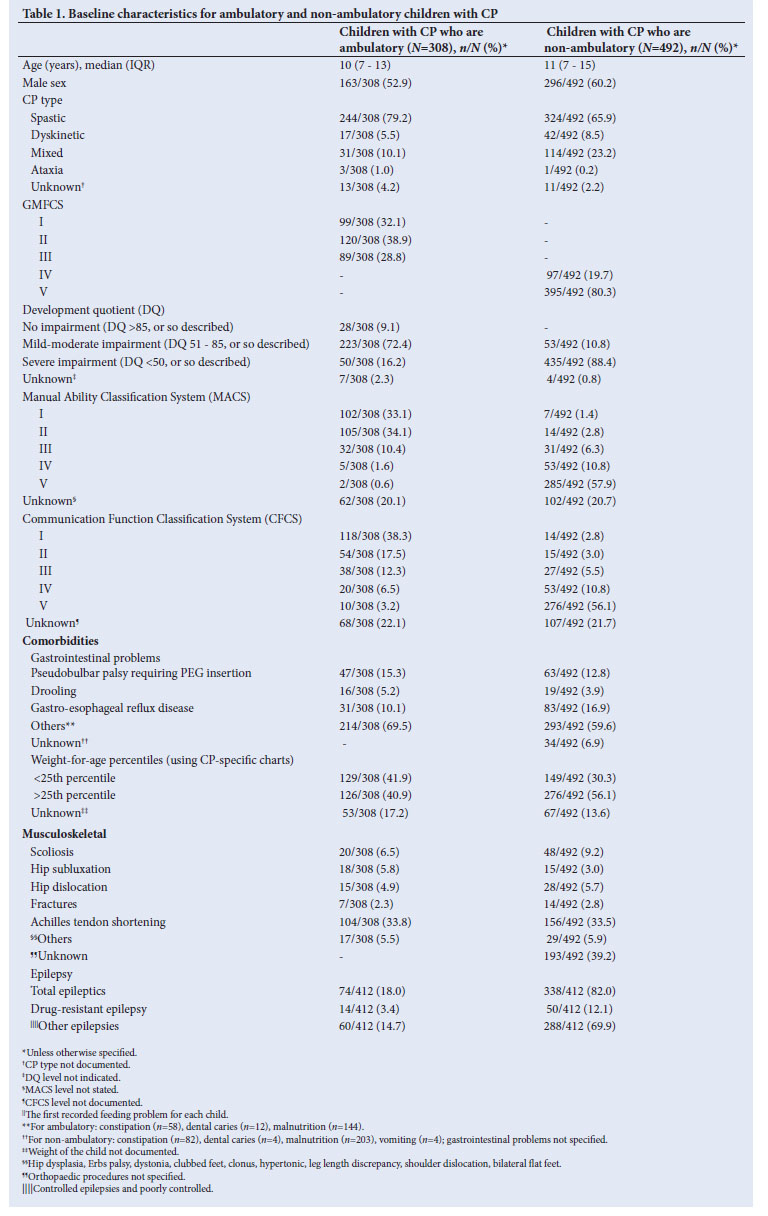
Amongst those who attended the CP clinic in 2021, 585 of the 880 (66.5%) had at least one hospitalisation episode between 2001 and 2024. Most of the admitted children were non-ambulatory (63.6%; n/N=372/585). These children also had a higher emergency admission rate (81.7%; n/N=643/787) compared with the ambulatory group (60.3%; n/N=248/411) (Table 1).
Up to two hospital admissions were recorded in 401 children (68.5%), with a more extended mean (standard deviation (SD)) hospital stay (8.55 (9.40) days) compared with the 184 children (31.5%) who had at least three hospital admissions (6.38 (9.00) days). Low weight-for-age was identified in 41.9% (n/N=129/308) of the ambulatory children, compared with 56.1% (n/N=276/492) of the non-ambulatory children.
Types of hospital admissions
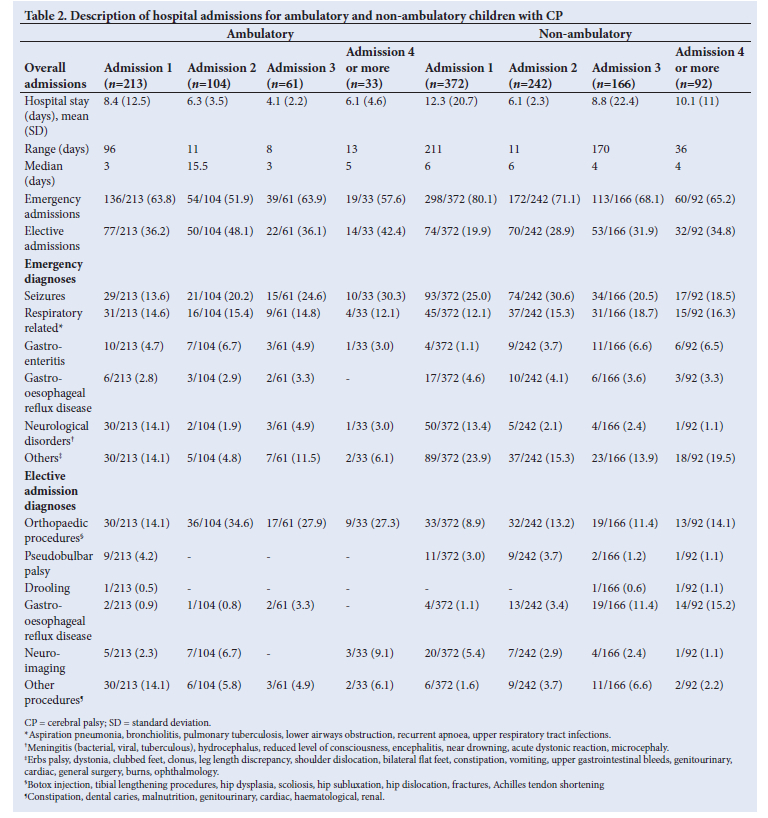
Epileptic seizures (22.8%; n/N=293/1 283), respiratory-related illness (14.7%; 188/1 283) and gastrointestinal disorders (7.6%; n/N=98/1 283) co-occurred with frequent emergency admissions. Orthopaedic investigations and procedures, on the other hand, co-occurred with frequent elective admissions, with children with CP who were ambulatory (22.4%; n/N=92/411) having more admissions than non-ambulatory children with CP (11.1%; 97 /872) (Table 2)
Respiratory illnesses commonly co-occurred with first-time emergency admissions for ambulatory children (14.6%; n/N=31/213), while seizures co-occurred with repeated hospital admissions across all ages in the ambulatory children (15.5% for 2nd admission, 16.4% for 3rd admission) and non-ambulatory children (26.4% for 2nd admission, 18.1% for 3rd admission). Orthopaedic procedures co-occurred with elective admissions across all age groups and admission points in both groups. (Table 2 and Supplementary Table 1).
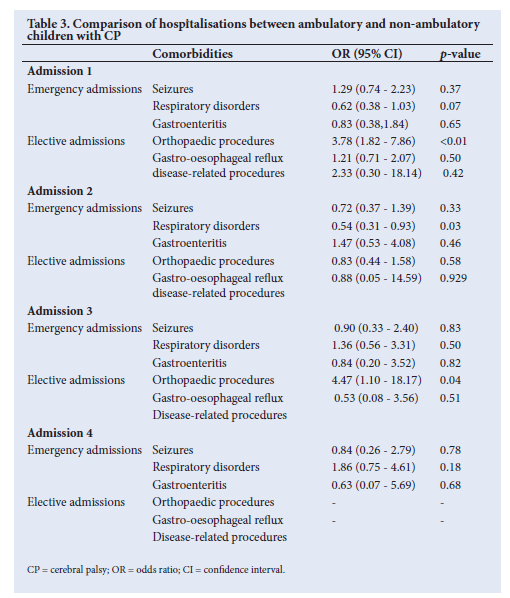
There were no significant differences in emergency admissions after adjusting for age and sex, except for a strong trend towards significance for respiratory infection. For first emergency hospital admissions, seizure recurrence was more common among children with non-ambulatory CP (OR 1.29; 95% confidence interval (CI) 0.74 - 2.23; p=0.37), whilst respiratory disorders were more common among ambulatory children with CP (OR 0.62; 95% CI 0.38 - 1.03; p=0.07), but none of these findings were statistically significant. However, for the first elective admission, orthopaedic complications were more likely in ambulatory children with CP (OR 3.78; 95% confidence interval (CI)1.82 - 7.86; p<0.01). For the second emergency admission, respiratory disorders were more likely in the non-ambulatory children (OR 0.54; 95% CI 0.31 - 0.93; p=0.03). In the third admission, orthopaedic procedures were again more likely in ambulatory children compared with non-ambulatory children (OR 4.47; 95% CI 1.10 - 18.17; p=0.04). (Table 2 and Supplementary Table 2)
Interventions during hospital admissions
Elongation of Achilles tendons was the most prescribed orthopaedic intervention, with 3.7% (n/N=34/931) ofchildren with up to two admissions and 4.5% (n/N=16/352) of those with at least three admissions undergoing the procedure. The most common feeding intervention was percutaneous endoscopic gastrostomy (PEG), performed in 3.5% (n/N=33/931) of children with up to two admissions and 9.9% (n/N=35/352) of those with at least three admissions.
Discussion
The present study is one of a limited number of studies to investigate hospitalisation patterns among children with CP in the SA context. A key finding was that non-ambulatory children had the highest rate of lifetime emergency hospitalisation, whereas elective orthopaedic procedures were the most frequent surgical procedure among ambulatory children. Additionally, almost two-thirds of the children in this cohort had at least one in-hospital admission at this facility, compared with HICs, where lower admission rates were reported.
Our findings highlight the significant burden of hospitalisation among children with CP, particularly those with severe disease (GMFCS IV to V) and multiple comorbidities. This pattern is consistent with published studies from both HICs and LMICs.[18,19] These findings therefore emphasise the need for targeted healthcare strategies to adequately address these needs in any setting. The high lifetime hospitalisation rate in our cohort (67%) compared with other settings (e.g. 53% in an Australian study over 5 years)[20] may indicate inadequate healthcare access and resource constraints in our setting. This may be driven by the differences in healthcare access for these children as well as resource constraints in our setting.[10,11] Therefore, understanding contextual factors, such as healthcare policies, service availability and population demographics is central in planning effective services to reduce hospitalisation rates and improve outcomes for children with CP.
HIC studies have found that non-ambulatory children with CP often undergo more orthopaedic surgeries than ambulatory children to improve their quality of life.[21,22] In contrast, our study found that ambulatory children were more likely to undergo elective orthopaedic procedures. This can be explained by the explicit selection criteria of children, driven by resource constraints to ensure the best-defined functional outcome post intervention. The anaesthetic risk is higher in non-ambulant children, who often tend to have poorer nutritional status, as well as other risks, e.g. scoliosis. Unfortunately, these factors make them less ideal candidates for elective surgery. Additionally, ambulatory children are more likely to access rehabilitation therapies, often through the schooling system, making them better candidates for surgery. The large proportion of children with hip subluxation and dislocation in our cohort highlights the need for hip surveillance, especially in non-ambulatory children with CP. However, limited access to specialist care and imaging services in LMICs often hinders timely diagnosis and treatment.
Furthermore, addressing the age-related differences in the utilisation of rehabilitation therapies and specialist care is crucial to improving outcomes for children with CP in LMICs.11
Study limitations
This study has limitations, including the lack of a control group and its retrospective design. The observational nature without a control group makes it challenging to establish causality between comorbidities and interventions (e.g. orthopaedic surgeries). Without a comparison group, it is difficult to determine whether comorbidities are directly driving the interventions. As a result, the study only reports co-occurrence between comorbidities and admissions. The retrospective study design limited our ability to establish a clear temporal relationship between comorbidities and the interventions.
Additionally, the study findings may not be generalisable owing to the single-centre design. The centre was a tertiary hospital where there was a high potential for referral bias and over-representation of severe CP cases, as referral criteria to any tertiary facility are set and only children meeting specified criteria are referred. As such, access to healthcare is limited by disease severity, leading to a biased sample. Future studies would therefore benefit from prospective, multi-site designs that included secondary-level hospitals to better understand hospitalisations for children with CP in the region.
Conclusion
The present study highlights hospitalisation patterns among children with CP in SA. Notably, non-ambulatory children were more likely to require emergency hospitalisations, while ambulatory children underwent more elective orthopaedic procedures. The high admission rate among this cohort, compared with HICs, underscores the need for targeted interventions to address the complex healthcare needs of children with CP in this context. Therefore, further research should focus on healthcare systems, costs and stratified care models to enhance the quality of life.
Declaration. This manuscript was submitted in partial fulfilment of TJK's PhD in Paediatrics and Child Health at Stellenbosch University.
Acknowledgments. We acknowledge all the children with CP and their caregivers who receive care at this tertiary hospital, whose data were used anonymously in this publication.
Author contributions. TJK: study design and ethics approval, data collection, analysis, and manuscript writing for publication. MK designed the study and critically reviewed the manuscript. RvT critically reviewed the manuscript. RS critically reviewed the manuscript. KAD designed the study and critically reviewed the manuscript.
Funding. TJK received funding from the Department of Paediatrics and Child Health, University of Cape Town, to conduct this study.
Conflicts of interest. None.
References
-
1. McIntyre S, Goldsmith S, Webb A, et al. Global prevalence of cerebral palsy: A systematic analysis. Dev Med Child Neurol 2022;64(12):1494-1506. doi:10.1111/dmcn.15346.
» doi:10.1111/dmcn.15346 -
2. Viswanath M, Jha R, Gambhirao AD, et al. Comorbidities in children with cerebral palsy: A single-centre cross-sectional hospital-based study from India. BMJ Open 2023;13:e072365. https://doi.orgg/10.1136/bmjopen-2023-072365.
» https://doi.orgg/10.1136/bmjopen-2023-072365 -
3. Szpindel A, Myers KA, Ng P, et al. Epilepsy in children with cerebral palsy: A data linkage study. Dev Med Child Neurol 2022;64:259-265. https://doi.org/10.1111/dmcn.15028
» https://doi.org/10.1111/dmcn.15028 -
4. Dos Santos Rufino A, Páhlman M, Olsson I, Himmelmann K. Characteristics and challenges of epilepsy in children with cerebral palsy - a population-based study. J Clin Med 2023;12(1):346. https://doi.org/10.3390/jcm12010346
» https://doi.org/10.3390/jcm12010346 -
5. Speyer R, Cordier R, Kim JH, Cocks N, Michou E, Wilkes-Gillan S. Prevalence of drooling, swallowing and feeding problems in cerebral palsy across the lifespan: A systematic review and meta-analysis. Dev Med Child Neurol 2019;61:1249-1258. https://doi.org/10.1111/dmcn.14316
» https://doi.org/10.1111/dmcn.14316 -
6. Dahlseng MO, Finbráten AK, Júlíusson PB, Skranes J, Andersen G, Vik T. Feeding problems, growth and nutritional status in children with cerebral palsy. Acta Paediatr 2012;101:92-98. https://doi.org/10.1111/j.1651-2227.2011.02412.x
» https://doi.org/10.1111/j.1651-2227.2011.02412.x -
7. Jahan I, Muhit M, Hardianto D, et al. Epidemiology of malnutrition among children with cerebral palsy in low- and middle-income countries: Findings from the global LMIC CP register. Nutrients 2021;13(11):3676. https://doi.org/10.3390/nu13113676
» https://doi.org/10.3390/nu13113676 -
8. Carter B, Bennett CV, Jones H, Bethel J, Perra O, Wang T, et al. Healthcare use by children and young adults with cerebral palsy. Dev Med Child Neurol 2021;63:75-80. https://doi.org/10.1111/dmcn.14536
» https://doi.org/10.1111/dmcn.14536 -
9. Murphy NA, Hoff C, Jorgensen T, Norlin C, Young PC. Costs and complications of hospitalisations for children with cerebral palsy. Pediatr Rehabil 2006;9 (1):47-52. https://doi.org/10.1080/136384905000794
» https://doi.org/10.1080/136384905000794 -
10. Katangwe-Chirwa TJ, Jahan I, Chitedze A, Mankhokwe T, Mughogho A, Chimalizeni Y, et al. Epidemiology of cerebral palsy in Malawi. Dev Med Child Neurol 2025:1-10. https://doi.org/10.1111/dmcn.16453
» https://doi.org/10.1111/dmcn.16453 - 11. Katangwe T, Kruger M, van Toorn R, et al. Utilisation of rehabilitation services amongst children within urban South Africa. S Afr Med J Accepted for publication.
-
12. Brooks JC, Campbell RDD, Whittaker GA. Survival of South African children with cerebral palsy. S Afr Med J 2021;111(6):591-594. https://doi.org/10.7196/SAMJ.2021.v111i6.15272
» https://doi.org/10.7196/SAMJ.2021.v111i6.15272 -
13. Du Toit J. Ageing with cerebral palsy after being treated with orthopaedic interval surgery approach during childhood. Stellenbosch: Stellenbosch University, 2020. Doctoral dissertation. https://scholar.sun.ac.za/items/bfc54a16-a486-4f78-be9e-67f6b9a5437a
» https://scholar.sun.ac.za/items/bfc54a16-a486-4f78-be9e-67f6b9a5437a -
14. Naidoo L, Pillay M, Naidoo U. Who really decides? Feeding decisions 'made' by caregivers of children with cerebral palsy. S Afr J Commun Disord 2024;71 (1):1001. https://doi.org/10.4102/sajcd.v71i1.1001
» https://doi.org/10.4102/sajcd.v71i1.1001 -
15. Cans C. Surveillance of cerebral palsy in Europe: A collaboration of cerebral palsy surveys and registers. Dev Med Child Neurol 2000;42:816-824. https://doi.org/10.1111/j.1469-8749.2000.tb00695.x
» https://doi.org/10.1111/j.1469-8749.2000.tb00695.x -
16. Rosenbaum PL, Palisano RJ, Bartlett DJ, Galuppi BE, Russell DJ. Development of the gross motor function classification system for cerebral palsy. Dev Med Child Neurol 2008;50:249-253. https://doi.org/10.1111/j.1469-8749.2008.02045.x
» https://doi.org/10.1111/j.1469-8749.2008.02045.x -
17. World Health Organization. International classification of diseases (ICD). Geneva: WHO, 2022. https://www.who.int/standards/classifications/classification-of-diseases (accessed 11 October 2024).
» https://www.who.int/standards/classifications/classification-of-diseases -
18. Paget S, Ostojic K, Goldsmith S, Nassar N, McIntyre S. Determinants of hospital-based health service utilisation in cerebral palsy: A systematic review. Arch Phys Med Rehabil 2022;103(8):1628-1637. https://doi.org/10.1016/j.apmr.2021.12.003
» https://doi.org/10.1016/j.apmr.2021.12.003 -
19. Meehan E, Reid SM, Williams K, Freed GL, Sewell JR, Vidmar S, et al. Hospital admissions in children with cerebral palsy: A data linkage study. Dev Med Child Neurol 2017;59:512-519. https://doi.org/10.1111/dmcn.13350
» https://doi.org/10.1111/dmcn.13350 -
20. Meehan E, Freed GL, Reid SM, et al. Tertiary paediatric hospital admissions in children and young people with cerebral palsy. Child Care Health Dev 2015;41:928-937. https://doi.org/10.1111/cch.12263
» https://doi.org/10.1111/cch.12263 -
21. Bakhtiyar M, Iljazi A, Petersen MM, Odgaard A, Wong C. Prevalence and regional differences in migrated hips in Danish children with cerebral palsy from 2008 to 2021: A comparison of ambulant vs non-ambulant children. Children 2024;11(8):964. https://doi.org/10.3390/children11080964
» https://doi.org/10.3390/children11080964 -
22. Difazio RL, Vessey JA, Zurakowski D, Snyder BD. Differences in health-related quality of life and caregiver burden after hip and spine surgery in non-ambulatory children with severe cerebral palsy. Dev Med Child Neurol 2016;58:298-305. https://doi.org/10.1111/dmcn.12872
» https://doi.org/10.1111/dmcn.12872

Accepted 25 February 2026