Exploring workplace breastfeeding support from the perspective of the employees and employers in the Breede Valley subdistrict, Worcester, South Africa
BACKGROUND. Globally, mothers have identified employment as one of the leading barriers to exclusive and continued breastfeeding. OBJECTIVE. To explore the experiences and perceptions of employees and employers regarding breastfeeding support in designated workplaces with more than 50 employees in Worcester, South Africa. METHODS. Data were collected as part of a qualitative study conducted at nine purposively selected designated workplaces, with three each from the retail, public and manufacturing sectors. Eight in-depth interviews with human resource managers and/or company managers, seven focus group discussions with employees (n=51) and three focus group discussions with managers (n=12) were conducted. RESULTS. Employees viewed their workplaces as unsupportive of breastfeeding, particularly in providing time and space, and experienced negative attitudes from coworkers and supervisors. Provision of the recommended breastfeeding break time was largely absent. Challenges raised by managers included a lack of space and infrastructure, as well as insufficient finances to create the necessary space and resources. Although managers reported valuing a supportive workplace environment and a culture of caring that focuses on staff wellness, this contrasted with employees' reports that employers were uncaring and unsympathetic. Employees claimed that employers focused on time, work, targets and performance and that breastfeeding was not a priority. Employees and managers reflected on several ways to best support breastfeeding mothers in the workplace. CONCLUSION. Organisational change within workplaces is needed, starting with advocacy to create an enabling workplace environment and increase the knowledge and awareness of the benefits of workplace breastfeeding support and women's breastfeeding rights.
breastfeeding; experiences; focus group; employees; employers; workplace
Exploring workplace breastfeeding support from the perspective of the employees and employers in the Breede Valley subdistrict, Worcester, South Africa
L C DanielsI; L M du PlessisI; X G MbhenyaneII
IPhD (Nutr Sc) ; Division of Human Nutrition, Department of Global Health, Faculty of Medicine and Health Sciences, Stellenbosch University, Cape Town, South Africa
IIPhD (Nutr) Division of Human Nutrition, Department of Global Health, Faculty of Medicine and Health Sciences, Stellenbosch University, Cape Town, South Africa
BACKGROUND. Globally, mothers have identified employment as one of the leading barriers to exclusive and continued breastfeeding.
OBJECTIVE. To explore the experiences and perceptions of employees and employers regarding breastfeeding support in designated workplaces with more than 50 employees in Worcester, South Africa.
METHODS. Data were collected as part of a qualitative study conducted at nine purposively selected designated workplaces, with three each from the retail, public and manufacturing sectors. Eight in-depth interviews with human resource managers and/or company managers, seven focus group discussions with employees (n=51) and three focus group discussions with managers (n=12) were conducted.
RESULTS. Employees viewed their workplaces as unsupportive of breastfeeding, particularly in providing time and space, and experienced negative attitudes from coworkers and supervisors. Provision of the recommended breastfeeding break time was largely absent. Challenges raised by managers included a lack of space and infrastructure, as well as insufficient finances to create the necessary space and resources. Although managers reported valuing a supportive workplace environment and a culture of caring that focuses on staff wellness, this contrasted with employees' reports that employers were uncaring and unsympathetic. Employees claimed that employers focused on time, work, targets and performance and that breastfeeding was not a priority. Employees and managers reflected on several ways to best support breastfeeding mothers in the workplace.
CONCLUSION. Organisational change within workplaces is needed, starting with advocacy to create an enabling workplace environment and increase the knowledge and awareness of the benefits of workplace breastfeeding support and women's breastfeeding rights.
Keywords: breastfeeding, experiences, focus group, employees, employers, workplace
Breastfeeding is important for maternal and child health. It contributes to achieving Sustainable Development Goal 3 of attaining good health and wellbeing.[1] The Lancet's three-paper series on breastfeeding concluded that breastmilk makes the world healthier, smarter and more equal. The deaths of 823 000 children and 20 000 mothers each year may be averted through universal breastfeeding.[2] However, the United Nations Children's Fund (UNICEF) emphasises that breastfeeding is not a one-woman job; it requires government leadership and support from families, communities, health systems and workplaces to make it work.[3] Support from these stakeholders is essential if women are to achieve the World Health Organization (WHO) recommendation of six months of exclusive breastfeeding (EBF).
Globally, mothers have identified work as one of the main obstacles to exclusive and continued breastfeeding. It is a major reason for not breastfeeding or for ceasing breastfeeding early.[2] The support a woman receives in her workplace, in terms of workplace arrangements, can be critical in enabling her to continue breastfeeding upon returning to work.[4] If women perceive a lack of support for breastfeeding in their workplace, they often turn to formula feeding.
In South Africa (SA), the EBF rate for infants under the age of six months has increased over the past decade but remains low at 32%,[5] which is well below the World Health Assembly 2025 targets of 50% and the extended 2030 target of 60%.[6] There is a need for greater support for mothers in the workplace to enable
them to sustain breastfeeding. There is limited research available in SA on workplace support for breastfeeding. This study explored employees' and employers' experiences and perceptions regarding breastfeeding support in designated workplaces with more than 50 employees[7] in the Breede Valley subdistrict, Western Cape Province, SA. Understanding these experiences and perceptions may aid the development of focused strategies to improve workplace breastfeeding support in the SA context.
Methods
This study formed part of a three-phase explanatory sequential mixed-methods study. Phases one and three have been reported previously.[8,9] The present study represents phase two, which employed a qualitative multiple case study design to capture the perspectives of employees and employers. It was conducted in the Breede Valley subdistrict of Worcester, Western Cape Province, SA. Nine designated workplaces in the Breede Valley subdistrict, with three each from the retail, public and manufacturing/distribution sectors, were purposively selected from a compiled list of designated workplaces. At each selected workplace, in-depth interviews with employers (human resource managers and/or company managers) and focus group discussions (FGDs) with employees and managers were conducted.
Ethics approval was obtained from the Health Research Ethics Committee of Stellenbosch University (ref. no. S17/04/089), and site approvals were obtained from the directors of the three public-sector workplaces. Approval for the remaining six workplaces was obtained from the respective company chief executive officers or workplace directors. Once approval had been granted, the researcher identified a contact person at each workplace who assisted with the placement of advertisements for the FGDs. The researcher contacted the managers to arrange the in-depth interviews, as well as suitable venues, times and dates for the FGDs. If any of the selected workplaces declined participation, another workplace from the compiled list was selected. Since the strategy to support, protect and promote breastfeeding is a Department of Health initiative, one health sector workplace and two other public-sector workplaces were selected. A pilot study comprising one FGD and one in-depth interview was conducted prior to data collection. Changes included rephrasing some questions and adding general questions on paternity leave benefits.
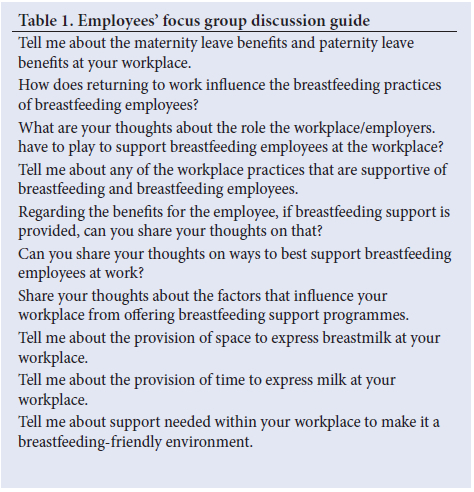
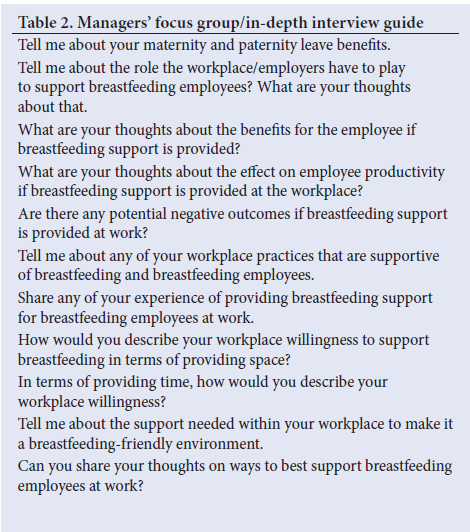
A discussion guide was developed to guide the employees' FGDs (Table 1) and the managers' in-depth interviews and FGDs (Table 2). All in-depth interviews and FGDs were conducted by the researcher in either English or Afrikaans (common official languages in SA), depending on the participant's preferred language. A trained research assistant assisted with the logistical arrangements for the FGDs and noted participants' non-verbal cues. Written informed consent was obtained from all participants, including consent to record the interviews. Participants were assured of the anonymous nature of the interviews and discussions and were informed of their right to withdraw from the study without penalty at any stage. Confidentiality was ensured by password-protecting the transcripts, removing all personal identifiers from the records and keeping the list of interviewees separate from the interview data. Anonymity was ensured by referring only to participant codes and themes in the reporting of the results. The FGDs and in-depth interviews were conducted between September and October 2017 and between February and March 2018, and each lasted approximately 45 to 60 minutes. FGD participants each received an incentive as a token of appreciation for their participation in the study.
A qualified transcriber prepared the transcripts from the in-depth interviews and FGDs. Data were analysed using ATLAS.ti version 8.2.31 (ATLAS.ti Scientific Software Development GmbH,
Berlin).[10] After transcription, the researcher performed quality control checks to ensure that the data had been captured accurately. The first author systematically reviewed all transcripts using open coding. Codes were grouped into categories and then condensed into overarching themes. For the first transcript, the researcher searched for meaning in context and, through repeated reading, identified and documented emerging themes. The identified themes were then reviewed for connections, patterns, tensions and possible subthemes. Thematic content analysis was undertaken using an inductive approach, whereby themes were developed from codes that emerged from the data. The co-authors reviewed and discussed the emerging themes following the initial thematic analysis.
Results
Seven employee FGDs, each comprising six to eight participants (n=51), three middle-manager FGDs, each comprising four to six participants (n=12), and eight in-depth interviews with human resource/company senior managers were conducted.
Employees' perceptions and experiences of breastfeeding support in the workplace
The majority of employees were female (78%; n=40) and employed as general workers (45.1%; n=23). Of the 51 employees, 47.1% (n=24) were employed in the manufacturing sector, 29.4% (n=15) in the retail sector and 23.5% (n=12) in the public sector.
Two main themes emerged: (i) breastfeeding and returning to work experience and (ii) a non-supportive work environment.
Breastfeeding and returning to work experience Emotional stress and guilt
When asked about the effect of returning to work on breastfeeding practices, many female employees shared their own experiences. Many indicated that the transition back to work was emotionally difficult and challenging because it disrupted the breastfeeding routine they had established during maternity leave.
'When I needed to return to work, I felt that I had an understanding with the child. We know how it works now [referring to breastfeeding]. I have it under control and then I needed to go to work.' (Public FGD)
A few female employees also described the maternal guilt they experienced, feeling that they were failing their child, as well as the emotional stress when the baby would not drink anything other than breastmilk or when they did not produce enough breastmilk and their child became distressed.
'She don't want to take the bottle, uhm, yes, so I brought other milk, and other milk. So you start crying with your child, because she will not drink it. So you think she is hungry and then it is a whole emotional thing.' [Public FGD]
A non-supportive work environment
Lack of resources and support
Many employees mentioned a lack of resources at their workplace, including a designated space for expressing breastmilk and refrigeration facilities for storing expressed breastmilk. In addition, a lack of support in providing time and space for expressing breastmilk at work was raised consistently across all the FGDs. Most employees reported using a toilet for expressing breastmilk, indicating that this was inappropriate for hygiene reasons. Employees also reported having to use their lunch and tea breaks and that they were generally not accommodated in terms of time for expressing breastmilk or breastfeeding. Reasons mentioned for the lack of support included employers lacking the resources to provide a breastfeeding space and the fact that employees did not voice their breastfeeding needs to their employers.
Breastfeeding at work not a priority
When asked why employers failed to provide breastfeeding mothers with suitable time and space, many employees stated that workplace breastfeeding support was not a priority for employers. They asserted that work, production, time and targets were their employers' priorities. Employers were perceived to separate employees' work from their personal needs because they believed that employees were paid to work and should therefore focus solely on their work.
'I think the workplace feels that for eight hours of the day you belong to them. Although you [are] a person with feelings and a life outside, they feel you do not have to bring that into the building. When you walk in here the morning then you need to earn your salary ... the personal part, they cut themselves off from that.' [Public FGD]
Negative attitudes
Many employees experienced negative attitudes from staff and supervisors, whom they perceived as being unaccommodating when mothers returned to work. Employees felt that this was because they had already been away from work for an extended period and were therefore expected to devote their time at work solely to performing their occupational duties.
'Sorry nè, you were already not here for four months, now you still wanna go and breastfeed? You must be back now. It's time to work.' [Public FGD]
The non-supportive workplace environment may explain why some employees stated that many employed mothers begin planning to introduce infant formula or mixed feeding before returning to work, as they are aware that breastfeeding is not a common practice in workplaces.
'That is a worry, uhm, already since the second month has passed ... of your maternity leave. Because now you need to get, take the child into a routine of how he's gonna get his feeding. And then you already need to think about mix feeding.' [Public FGD]
Communication challenges
Many employees experienced communication challenges with their employer. A few employees mentioned limited communication with employers after maternity leave, difficulty discussing their needs with managers, and a lack of feedback or action after raising these needs. 'I don't think they have though so far as to ask a mother that came from maternity, to sit and talk to them regarding this [breastfeeding support]. How is it? How's your experience? How are you experiencing this inside?' [Manufacturer FGD]
Lack of trust and compassion
Additional challenges mentioned by employees included a lack of trust and employers who were perceived as unsympathetic, unwilling to listen, unconcerned or uninterested.
'They just want production, they don't worry about their people.' [Manufacturer FGD]
Furthermore, many employees mentioned the challenges posed by a male-dominant work environment, including male managers, supervisors and colleagues who they felt lacked an understanding of women's needs.
'Operators don't understand. The foremen [male supervisors] don't understand. They are not women, they never had/conceived children. Understand?' [Manufacturer FGD]
Managers' perceptions and experiences of breastfeeding support in the workplace
The results from the FGDs and in-depth interviews with managers are reported together, as similar themes and conclusions emerged. The three main themes identified were: (i) the role of the workplace in breastfeeding support, (ii) support for breastfeeding at work and (iii) challenges to providing breastfeeding support at work.
The ratio of male to female managers and company managers was approximately equal. Five (41.7%) of the managers were employed in the public sector, four (33.3%) in the retail sector and three (25.0%) in the manufacturing sector. Among the senior company managers, three (37.5%) were employed in each of the retail and manufacturing sectors and two (25.0%) in the public sector.
The role of the workplace in breastfeeding support
In general, managers had positive perceptions of the role of the workplace in supporting breastfeeding women. They acknowledged that they could do more, that they would make a plan to accommodate women if they received a request for support and that there would be no resistance to such accommodation. However, among the retail and manufacturing managers, some comments revealed negative perceptions:
'If she has four months' notice, then she can get her child on the bottle, then it will not be a problem later on, understand?' [FGD, retail middel manager, male]
Regarding general perceptions of breastfeeding at work, a few retail middle managers indicated that they did not see the need for workplace breastfeeding support and that it was not a major issue, as there was a natural tendency among their staff to place their babies on bottle-feeding before returning to work. Some managers considered breastfeeding to be a personal matter.
From the discussions with human resource and company senior managers, it emerged that most managers valued a supportive workplace environment:
'And I think if a person can run with this and I almost want to say if the employer becomes involved, I think it supports our thing of caring, because breastfeeding is the right thing. So, if we can encourage staff to breastfeed, it confirms that we show interest in them and their children's health. And that speaks to the culture that we are trying to create.' [In-depth interview, manufacturing manager]
Provision of breastfeeding space and time
The lack of a designated space for breastfeeding was consistently cited by the majority of middle and senior managers. Although most claimed to be lenient with regard to providing time for expressing breastmilk, a few stated that time would not be an issue provided expressing took place during employees' lunch and tea breaks. The general view was that time would not be an issue if the activity was planned and managed.
Existing support services for breastfeeding employees
Most managers acknowledged the absence of established supportive practices for breastfeeding in the workplace. Some mentioned a departmental breastfeeding policy, while managers from the manufacturing sector referred to the promotion of breastfeeding at workplace clinics by the occupational health nurse and accommodating women returning from maternity leave by assigning them only day shifts during the first three months. It therefore appears that the supportive workplace culture described by managers is not always realised in practice.
Challenges to providing breastfeeding support at work
Lack of resources
The challenges raised by most senior managers concerned a lack of space and infrastructure in the workplace, as well as insufficient finances to create dedicated spaces, acquire the necessary resources and support the uptake or utilisation of such facilities.
Infrequent request for breastfeeding support
The lack of understanding of the needs of breastfeeding women and a failure to voice their needs to their employers were emphasised by employees; however, employers indicated that they rarely, if ever, received requests for breastfeeding support from employees. One possible reason may be that employees are reluctant to talk to their managers, particularly if they are male. Furthermore, employees tended to introduce formula feeding before returning to work.
Focus on production, targets and service delivery
The demands of the retail environment and busy trading periods were identified by retail managers as challenges. They indicated that client demands and the need for staff to remain 'on the floor' to provide customer service made it difficult to accommodate additional personal time for breastfeeding employees. The potential for dissatisfied customers was also mentioned. Some managers also felt that their workplaces had to focus on productivity and targets, stating that 'time is money.'
'Yes time is money and it is competitive and you need to get out the maximum, like productivity and that.' [FGD, manufacturer middle manager]
Ways to support breastfeeding mothers
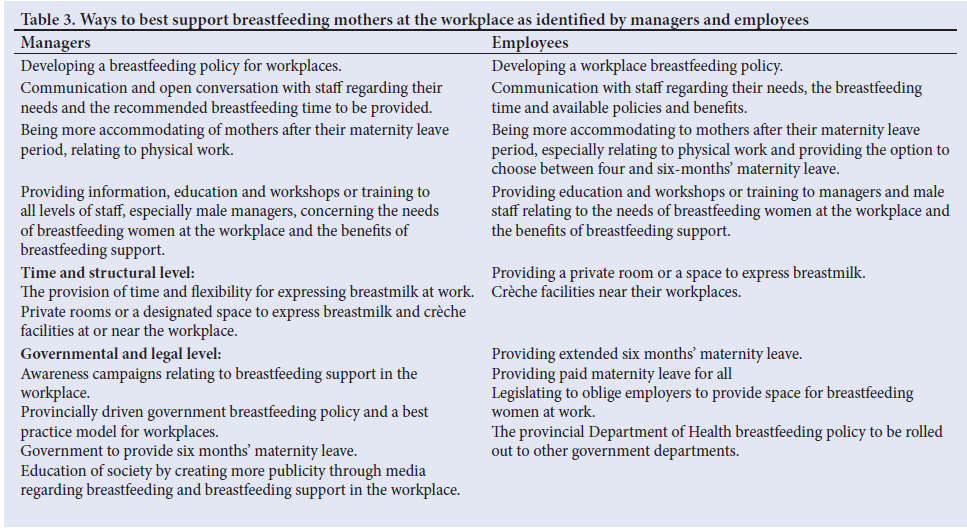
Employees and managers reflected on several ways to best support breastfeeding mothers in the workplace (Table 3).
Discussion
This study provides insights into workplace breastfeeding support from the perspectives of both employees and employers in the SA context. The results revealed that employees perceived the workplace as unsupportive of breastfeeding. The majority reported a lack of designated space for breastfeeding and being obliged to use toilet facilities for expressing breastmilk. Although this is an unsanitary practice, many women have no alternative. The findings also revealed that employers were generally unaccommodating in providing time for expressing breastmilk and that employees had to use their tea and lunch breaks for this purpose. These findings are supported by another SA study, in which mothers similarly reported not being granted breaks to express breastmilk, using their lunch breaks to express and being forced to express in toilets and lunchrooms.[11] Kebede et al.[12] reported that mothers who did not have reasonable lactation break time were 6.7 times more likely to discontinue EBF. Interestingly, managers reported being lenient in providing time for expressing breastmilk, although some stated that they would prefer breastfeeding or expressing to occur during employees' lunch and tea breaks rather than during working hours. This suggests that negative perceptions of breastfeeding support persist in the workplace.
The lack of designated space for breastfeeding in these workplaces was noted by both employees and managers. Studies from New Jersey, Michigan, Indonesia and SA similarly reported a lack of dedicated breastfeeding spaces in workplaces.[13,15-17] Weber et al.[18] reported findings from Australian health service workplaces indicating that flexible work options, lactation breaks and access to a private room were the main factors facilitating breastfeeding at work. Mao et al.[19] found that women who were provided with a dedicated breastfeeding room in the workplace were less likely to discontinue breastfeeding.
The provision of breastfeeding time in SA is recommended in the Code of Good Practice issued under the Basic Conditions of Employment Act, which states that women with an infant younger than six months should be provided two 30-minute breaks during the working day to breastfeed or express milk.[20] The lack of awareness of this provision among employers and employees was evident in this study. Similar findings have been reported in other SA studies.[11,17] There is a need for engagement with and advocacy among both employees and employers. Raising awareness in communities and workplaces could involve various stakeholders, including social media platforms, community health workers, dietitians, nutritionists, lactation consultants, occupational health nurses and human resource managers. If women are empowered with knowledge of the recommended breastfeeding breaks, they may feel more confident in requesting them when returning to work.
The lack of support and a non-supportive workplace culture for breastfeeding are attributable, at least in part, to workplaces focusing on work, time, targets and production, with breastfeeding not being regarded as a priority. This view was expressed by both employees and managers. Similarly, Chow et al.[16] identified time and productivity as barriers to providing breastfeeding support. Participants in a study from Ghana felt that organisations were not doing enough to support EBF, with a lack of breastfeeding spaces and breaks cited as constraining factors.[21] A lack of resources (e.g. lactation space), together with breastfeeding not being a workplace priority, may explain why some of the employees reported that many employed mothers planned to introduce infant formula or mixed feeding before returning to work. The pressure to introduce bottle feeding before returning to work, and the resulting emotional stress and anxiety, have been well described in the literature.[11,17,22,23]
Managers in this study reported that requests for breastfeeding support were rarely, if ever, received from employees, suggesting that employees may be reluctant to communicate, perhaps because they find it difficult to speak to male managers. This situation may lead to the avoidance of necessary communication, with employees' needs not being conveyed to employers. Other studies have also reported infrequent requests and a lack of confidence in requesting breastfeeding support in the workplace.[16,17]
In this study, challenges experienced by employees included communicating their needs to employers, a lack of communication after maternity leave and working in a male-dominated environment. Many factors complicate interpersonal communication, particularly age, sex and hierarchy.[24] Workplaces should consider implementing a return-to-work consultation after maternity leave, facilitated by the employee's supervisor, occupational health nurse and/or the human resources manager. This may facilitate open communication and dialogue on breastfeeding support.
Both managers and employees suggested that employed mothers often planned to introduce mixed or formula feeding before returning to work. This resulted in little demand for breastfeeding support in the workplace. These practices may be linked to employees anticipating a lack of breastfeeding support at work. Similar findings have been reported in the literature.[11, 16,17,22]
The adoption of workplace breastfeeding policies by employers, together with recognition of workplaces that take these positive steps, is needed. The National Department of Health should consider establishing workplace recognition programmes or incentives (e.g. tax relief) to recognise employers who support breastfeeding employees.
Employees in this study expressed maternal guilt, often feeling as though they were failing their child. Two other SA studies have reported feelings of guilt related to not meeting the perceived expectations of motherhood or work (i.e. taking time away from work to express breastmilk) among employed breastfeeding mothers.[17,25] Managers were generally positive about providing breastfeeding support, indicating that they could do more and would make a plan if a request was received. This commitment aligned with the value that senior managers attached to a supportive workplace culture. However, discrepancies existed between managers' expressions of support and the real-life supportive practices implemented in their workplaces. Interestingly, most managers indicated that there were no existing supportive practices in their workplaces. This absence of supportive practices was also reported by employees. Smith et al.[26] found that a supportive workplace culture is associated with a higher proportion of employees exclusively breastfeeding for six months.
Employees and managers identified information and education regarding breastfeeding as urgent priorities. Extending paid maternity leave to six months, in line with SA EBF recommendations, was also suggested as a means of supporting breastfeeding mothers (Table 3). This is an important policy consideration that warrants further advocacy. Comprehensive strategies are needed to address the challenges experienced by both employees and employers. A workplace breastfeeding support practice model developed in SA provides a roadmap that workplaces can use to initiate and/or strengthen breastfeeding support.[9]
Limitations
The use of qualitative methods may introduce subjectivity, as the findings are based on what participants are willing to communicate to the researcher. Participants in the FGDs may have felt the need to conform to the majority view within the group or to make only positive comments. Participants who perceived that their views were in the minority may have been reluctant to speak during the discussion.
Conclusion
Sustaining breastfeeding requires a supportive workplace environment. This study has shown that employees generally experienced workplaces as unsupportive, owing to a lack of breastfeeding time and space, negative attitudes and communication challenges. The recommended breastfeeding breaks were absent or, at best, poorly implemented. This appeared to be mainly due to limited awareness of the breastfeeding recommendations among both employers and employees. Organisational change within these workplaces is needed, starting with advocacy to create an enabling workplace environment for breastfeeding and increase knowledge and awareness of the benefits of breastfeeding and the recommended breastfeeding breaks. Further research should explore other workplace sectors and settings.
Data availability statement. All relevant data in the article are available from the corresponding author on request.
Declaration. None.
Acknowledgements. The authors wish to acknowledge all the participants that took part in the research study.
Author contributions. LD developed the idea and the protocol for the research study, planned the research, undertook data collection with the assistance of a research assistant and a fieldworker, captured the data, analysed the data with the assistance of a statistician, interpreted the data and drafted the article. Co-authors XM and LdP provided input at all stages of the research and revised the protocol, provided input on analysis and interpretation and reviewed the article. All authors contributed to critically revising the article and gave final approval of the manuscript.
Funding. The study was supported by National Research Foundation Thuthuka (ref. no. TTK170419227683), the Stellenbosch University HOPE project and Stellenbosch University Early Research Career. The stated funders had no role in the design, analysis or writing of this article.
Conflicts of interest. None.
References
-
1. United Nations, Department of Economic and Social Affairs. Sustainable Development Goals: The 17 Goals. https://sdgs.un.org/goals (accessed 4 September 2025).
» https://sdgs.un.org/goals -
2. Rollins NC, Bhandari N, Hajeebhoy N, et al. Why invest, and what it will take to improve breastfeeding practices? Lancet 2016;387(10017):491-504. https://doi.org/10.1016/S0140-6736(15)01044-2
» https://doi.org/10.1016/S0140-6736(15)01044-2 -
3. United Nations Children's Fund. Let's make it work ! Breastfeeding in the workplace - Using communication for development to make breastfeeding possible among working mothers. New York: UNICEF, 2018. https://www.healthynewbornnetwork.org/hnn-content/uploads/Mother_BabyFriendlyWorkplaceInitiativeC4D_web1_002_.pdf (accessed 7 September 2025).
» https://www.healthynewbornnetwork.org/hnn-content/uploads/Mother_BabyFriendlyWorkplaceInitiativeC4D_web1_002_.pdf -
4. International Labour Organization. Maternity and paternity leave. Law and practice across the world. Geneva: ILO, 2014. https://www.ilo.org/sites/default/files/wcmsp5/groups/public/@dgreports/ @dcomm/@publ/documents/publication/wcms_242615.pdf (accessed 13 July 2026).
» https://www.ilo.org/sites/default/files/wcmsp5/groups/public/@dgreports/ @dcomm/@publ/documents/publication/wcms_242615.pdf -
5. Statistics South Africa. South Africa: Demographic and Health Survey 2016. Key Indicators Report. Report No 03-00-09. Pretoria: Stats SA, 2017. https://www.statssa.gov.za/publications/Report%2003-00-09/Report%2003-00-092016.pdf. (accessed 10 September 2025).
» https://www.statssa.gov.za/publications/Report%2003-00-09/Report%2003-00-092016.pdf -
6. World Health Organization, United Nations Children's Fund. Global nutrition targets 2030: Topical briefs on maternal, infant and young child nutrition. Geneva: UNICEF, 2025. https://doi.org/10.2471/B09485 (accessed 13 July 2026).
» https://doi.org/10.2471/B09485 -
7. National Department of Labour, South Africa. Employment Equity Act, 1998 (Act No. 55 of 1998). Employment Equity Act. Government Gazette No. 19370:1323. 19 October 1998. https://www.labour.gov.za/DocumentCenter/Acts/Employment%20Equity/Act%20-%20Employment%20Equity%201998.pdf (accessed 11 September 2025).
» https://www.labour.gov.za/DocumentCenter/Acts/Employment%20Equity/Act%20-%20Employment%20Equity%201998.pdf -
8. Daniels LC, du Plessis LM, Mbhenyane XG. Breastfeeding support practices in designated workplaces in the Breede Valley sub-district, Western Cape, South Africa. S Afr J Child Health 2020;14(2):94-98. https://doi.org/10.7196/SAJCH.2020.v14i2.01679
» https://doi.org/10.7196/SAJCH.2020.v14i2.01679 -
9. Daniels LC, Mbhenyane XG, du Plessis LM. Development of a breastfeeding support model in South Africa. Int Breastfeed J 2024;19:32. https://doi.org/10.1186/s13006-024-00638-9
» https://doi.org/10.1186/s13006-024-00638-9 -
10. ATLAS.ti Scientific Software Development. https://atlasti.com
» https://atlasti.com -
11. Maponya N, Janse van Rensburg Z, Du Plessis-Faurie A. Understanding South African mothers' challenges to adhere to exclusive breastfeeding at the workplace: A qualitative study. Int J Nurs Sci 2021;8(3):339-346. https://doi.org/10.1016/j.ijnss.2021.05.010
» https://doi.org/10.1016/j.ijnss.2021.05.010 -
12. Kebede T, Woldemichael K, Jarso H, Bekele BB. Exclusive breastfeeding cessation and associated factors among employed mothers in Dukem town, Central Ethiopia. Int Breastfeed J 2020;15:6. https://doi.org/10.1186/s13006-019-0250-9
» https://doi.org/10.1186/s13006-019-0250-9 -
13. Bai YK, Gaits SI, Wunderlich SM. Workplace lactation support by New Jersey employers following US reasonable break time for nursing mothers law. J Hum Lact 2015;31(1):76-80. https://doi.org/10.1177/0890334414554620
» https://doi.org/10.1177/0890334414554620 -
14. Hojnacki SE, Bolton T, Fulmer IS, Olson BH. Development and piloting of an instrument that measures company support for breastfeeding. J Hum Lact 2012;28(1):20-27. https://doi.org/10.1177/0890334411430666
» https://doi.org/10.1177/0890334411430666 - 15. Spagnoletti BR, Bennett LR, Kermode M, Wilopo SA. Multitasking breastfeeding mamas: Middle class women balancing their reproductive and productive lives in Yogyakarta, Indonesia. Breastfeed Rev 2017;25(3):13-25.
-
16. Chow T, Smithey Fulmer I, Olson BH. Perspectives of managers toward workplace breastfeeding support in the state of Michigan. J Hum Lact 2011;27(2):138-146. https://doi.org/10.1177/0890334410391908
» https://doi.org/10.1177/0890334410391908 -
17. Mabaso BP, Jaga A, Doherty T. Experiences of workplace breastfeeding in a provincial government setting: A qualitative exploratory study among managers and mothers in South Africa. Int Breastfeed J 2020;15:100. https://doi.org/10.1186/s13006-020-00342-4
» https://doi.org/10.1186/s13006-020-00342-4 -
18. Weber D, Janson A, Nolan M, Wen LM, Rissel C. Female employees' perceptions of organisational support for breastfeeding at work : Findings from an Australian health service workplace. Int Breastfeed J 2011;6:19. https://doi.org/10.1186/1746-4358-6-19
» https://doi.org/10.1186/1746-4358-6-19 -
19. Mao Z, Lin X, Tai X, Wang J. Breastfeeding supports for two-child professional women: A case study of Beijing, China. Asian Women 2018;34(2):111-134. https://doi.org/10.14431/aw.2018.06.34.2.111
» https://doi.org/10.14431/aw.2018.06.34.2.111 -
20. National Department of Labour, South Africa. Basic Conditions of Employment Act, 1997 (Act No. 75 of 1997). Code of good practice on the protection of employees during pregnancy and after the birth of a child. Government Gazette No. 19453:1441. 13 November 1998. https://www.labour.gov.za/DocumentCenter/Code%20of%20Good%20Practice/Basic%20Condition/Code%20o f%20Good%20Practice%20Basic%20Conditions%20of%20Employment%20and%20Pregnancy.pdf (accessed 5 September 2025).
» https://www.labour.gov.za/DocumentCenter/Code%20of%20Good%20Practice/Basic%20Condition/Code%20o f%20Good%20Practice%20Basic%20Conditions%20of%20Employment%20and%20Pregnancy.pdf -
21. Desmond D, Meaney S. A qualitative study investigating the barriers to returning to work for breastfeeding mothers in Ireland. Int Breastfeed J 2016;11:16. https://doi.org/10.1186/s13006-016-0075-8
» https://doi.org/10.1186/s13006-016-0075-8 -
22. Abekah-Nkrumah G, Antwi MY, Nkrumah J, Gbagbo FY. Examining working mothers' experience of exclusive breastfeeding in Ghana. Int Breastfeed J 2020;15:56. https://doi.org/10.1186/s13006-020-00300-0
» https://doi.org/10.1186/s13006-020-00300-0 -
23. Wolde FB, Ali JH, Mengistu YG. Employed mothers' breastfeeding: Exploring breastfeeding experience of employed mothers in different work environments in Ethiopia. PLoS ONE 2021;16(11):e0259831. https://doi.org/10.1371/journal.pone.0259831
» https://doi.org/10.1371/journal.pone.0259831 -
24. Anderson J, Kuehl RA, Drury SAM, et al. Policies aren't enough: The importance of interpersonal communication about workplace breastfeeding support. J Hum Lact 2015;31(2):260-266. https://doi.org/10.1177/0890334415570059
» https://doi.org/10.1177/0890334415570059 -
25. van der Bijl C, Steinberg WJ, Kellerman TE, Botes J, van Rooyen C. Breastfeeding intentions and behaviours of doctor mothers in Bloemfontein, South Africa. S Afr J Child Health 2023;17(1):19-25. https://doi.org/10.7196/SAJCH.2023.v17i1.1929
» https://doi.org/10.7196/SAJCH.2023.v17i1.1929 - 26. Smith JP, McIntyre E, Craig L, Javanparast S, Strazdins L, Mortensen K. Workplace support, breastfeeding and health. Fam Matters 2013;93:58-73.

Accepted 12 December 2025